


This evening I've been trying to run through as many of my accumulated Bloglines posts as possible -- since I had no Internet access at Readercon, I had three days piled up, and that gets pretty big.
I just cleared out one folder, and was thinking about diving into another -- but it's late, and I'm tired. And then I noticed that I have exactly 1337 unread posts. How could I not leave it at that level for the night?
Sunday, July 20, 2008


Itzkoff and the Albino
I'm indebted to John Joseph Adams for first pointing out to me that Our Man Itzkoff was back in The New York Times Book Review -- I was at Readercon over the weekend, while both my Times and my Internet access were back here in New Jersey. So I spent a day and a half in anticipation of the pearls of wisdom and jewels of prose that Itzkoff would bestow on us this time.
As has become his routine, this time Itzkoff takes about twelve hundred words -- one whole page in the NYTBR -- to review a single book. As is also usual, he reviews a reprint of old material that he's already hugely fond of. One might begin to wonder if he's the world's first major book reviewer to hit on a way to practice his craft without actually having to read any books...but that would be unkind, wouldn't it?
The book he's reviewing is The Stealer of Souls , the first of Del Rey's new four-volume reprinting of Michael Moorcock's Elric stories. It's a nice-looking book -- illustrated by John Picacio -- and places the stories in the order Moorcock originally wrote them, which makes as much sense as any other order at this point. (Moorcock went to the ending almost immediately, and then spent nearly forty years interpolating material into different parts of the middle, and his style and concerns changed several times over that period.)
The Stealer of Souls was published in February, which makes this review quite late, but I imagine Itzkoff has been busy dealing with Axl Rose's memoir -- and, besides, the NYTBR has been notably late at covering many, many books this year, so it's probably not even Itzy's fault. (Not noting that the second volume in the series, To Rescue Tanelorn , will be published in nine days is, though, a sloppiness that can only be attributed to Itzkoff.)
By the way, am I the only one to note that "Across the Universe" is now appearing only bi-yearly? The last installment -- which I discussed in this space at the time -- was published in February of this year, covering three YA novels, and the one before that, on Philip K. Dick, was more than a year ago. I will also note without comment that two out of his last three columns are on books he read and loved as a child; Itzkoff appears to be doing very little original reading for this gig.
And so on to the actual review: there's a hideous illustration that manages to give Elric a normal Caucasian skin tone, though I can't fault Itzkoff for that. Itzkoff does realize, about halfway through the review -- but before actually mentioning anything that specifically appears in this volume, in the best Itzkoff fashion -- that he's taking up a whole page to badly review a fantasy book for what is ostensibly a science fiction column, and so he contorts himself to describe one of Moorcock's polemical essays, this one against just about every other SF and fantasy writer at the time. (I suspect this essay, "Starship Stormtroopers," is caught up somehow with the New Wave, but Itzkoff is innocent of all movements and so can't tell us.)
Other things Itzkoff doesn't do:
So this is another typical Itzkoff performance of a SF review: well-meaning and enthusiastic, but galumphing off in three wrong directions at once. Itzkoff is the book-review equivalent of Beethoven the dog -- though, sadly, he doesn't have a Hollywood plot to redeem him in the third act.
New York Times Book Review, it's time to stop pretending he can review SF. Either give the job to someone else -- anyone else -- or just go back to ignoring us like you ignore romances.
As has become his routine, this time Itzkoff takes about twelve hundred words -- one whole page in the NYTBR -- to review a single book. As is also usual, he reviews a reprint of old material that he's already hugely fond of. One might begin to wonder if he's the world's first major book reviewer to hit on a way to practice his craft without actually having to read any books...but that would be unkind, wouldn't it?
The book he's reviewing is The Stealer of Souls
, the first of Del Rey's new four-volume reprinting of Michael Moorcock's Elric stories. It's a nice-looking book -- illustrated by John Picacio -- and places the stories in the order Moorcock originally wrote them, which makes as much sense as any other order at this point. (Moorcock went to the ending almost immediately, and then spent nearly forty years interpolating material into different parts of the middle, and his style and concerns changed several times over that period.)The Stealer of Souls was published in February, which makes this review quite late, but I imagine Itzkoff has been busy dealing with Axl Rose's memoir -- and, besides, the NYTBR has been notably late at covering many, many books this year, so it's probably not even Itzy's fault. (Not noting that the second volume in the series, To Rescue Tanelorn
, will be published in nine days is, though, a sloppiness that can only be attributed to Itzkoff.)By the way, am I the only one to note that "Across the Universe" is now appearing only bi-yearly? The last installment -- which I discussed in this space at the time -- was published in February of this year, covering three YA novels, and the one before that, on Philip K. Dick, was more than a year ago. I will also note without comment that two out of his last three columns are on books he read and loved as a child; Itzkoff appears to be doing very little original reading for this gig.
And so on to the actual review: there's a hideous illustration that manages to give Elric a normal Caucasian skin tone, though I can't fault Itzkoff for that. Itzkoff does realize, about halfway through the review -- but before actually mentioning anything that specifically appears in this volume, in the best Itzkoff fashion -- that he's taking up a whole page to badly review a fantasy book for what is ostensibly a science fiction column, and so he contorts himself to describe one of Moorcock's polemical essays, this one against just about every other SF and fantasy writer at the time. (I suspect this essay, "Starship Stormtroopers," is caught up somehow with the New Wave, but Itzkoff is innocent of all movements and so can't tell us.)
Other things Itzkoff doesn't do:
- mention the illustrations
- point out that this Stealer of Souls is a very different book from the old, slimmer Elric collection of the same name
- talk about any of the new material or the edits to old stories
- list the titles of any of the stories included here
So this is another typical Itzkoff performance of a SF review: well-meaning and enthusiastic, but galumphing off in three wrong directions at once. Itzkoff is the book-review equivalent of Beethoven the dog -- though, sadly, he doesn't have a Hollywood plot to redeem him in the third act.
New York Times Book Review, it's time to stop pretending he can review SF. Either give the job to someone else -- anyone else -- or just go back to ignoring us like you ignore romances.
Friday, July 18, 2008
SFWA's New Grand Master
SFWA has announced that the "Damon Knight Memorial Grand Master" for next year will be Harry Harrison, getting a jump on the April event and continuing the new regime's apparent policy of clearing their desks of all work as quickly as humanly possible.
This is a really, really early announcement, isn't it? I thought typically this news came out early in the year, two or three months before the Nebula Awards Weekend. I hope that doesn't mean that Harrison is very ill, but that's what came to mind first.
SFWA is digging deep into the apple barrel for Grand Masters at this point, choosing prolific and long-lived writers who each wrote a few seminal works but aren't the overarching giants of the field. (On the other hand, that description also fits just as well some of the very earliest Grand Masters, like Simak and Williamson. Grand Masters have only rarely been as "Grand" as they might possibly be.)
Personally, I read a lot of Harrison in my formative years, and enjoyed his books, particularly the "Stainless Steel Rat" novels. Most of those books, though, don't really hold up now. I suspect he's really getting the Grand Master-ship because he survived so long and because of Make Room! Make Room! (I also read a lot of Ron Goulart in those days, and I don't seriously expect to see him made a Grand Master any time soon; I'm not claiming I had wonderful taste at the age of twelve.)
I'm not complaining, exactly -- this is SFWA's award, for people who SFWA really likes, and it has never been explicitly for "great writers" -- just noting that I would put Harrison on a lower level than such recent winners as Le Guin, Silverberg, and Ellison.
And SFWA has now given a Grand Mastership every year since 2003 -- seven in a row. They also gave out GMs for seven years straight from 1994 to 2000, after a much more leisurely pattern in the award's first twenty years. It's hard to avoid thinking that SFWA is trying to hand these out to as many of their older friends and colleagues as they can, as quickly as they can, before those older writers die. Again, it's their award, so they can do what they want with it. But if they want to use the Nebulas to increase their prominence and influence -- as has been repeatedly suggested -- then loading up with a bunch of GMs might not be the optimum strategy.
This is a really, really early announcement, isn't it? I thought typically this news came out early in the year, two or three months before the Nebula Awards Weekend. I hope that doesn't mean that Harrison is very ill, but that's what came to mind first.
SFWA is digging deep into the apple barrel for Grand Masters at this point, choosing prolific and long-lived writers who each wrote a few seminal works but aren't the overarching giants of the field. (On the other hand, that description also fits just as well some of the very earliest Grand Masters, like Simak and Williamson. Grand Masters have only rarely been as "Grand" as they might possibly be.)
Personally, I read a lot of Harrison in my formative years, and enjoyed his books, particularly the "Stainless Steel Rat" novels. Most of those books, though, don't really hold up now. I suspect he's really getting the Grand Master-ship because he survived so long and because of Make Room! Make Room! (I also read a lot of Ron Goulart in those days, and I don't seriously expect to see him made a Grand Master any time soon; I'm not claiming I had wonderful taste at the age of twelve.)
I'm not complaining, exactly -- this is SFWA's award, for people who SFWA really likes, and it has never been explicitly for "great writers" -- just noting that I would put Harrison on a lower level than such recent winners as Le Guin, Silverberg, and Ellison.
And SFWA has now given a Grand Mastership every year since 2003 -- seven in a row. They also gave out GMs for seven years straight from 1994 to 2000, after a much more leisurely pattern in the award's first twenty years. It's hard to avoid thinking that SFWA is trying to hand these out to as many of their older friends and colleagues as they can, as quickly as they can, before those older writers die. Again, it's their award, so they can do what they want with it. But if they want to use the Nebulas to increase their prominence and influence -- as has been repeatedly suggested -- then loading up with a bunch of GMs might not be the optimum strategy.
Thursday, July 17, 2008
A Biased Quiz
It was about time for another quiz designed by and for needy twenty-something single girls, so I picked this one, since Diana Pharaoh Francis was doing it.
I don't agree at all with its characterization of me, since I believe its premises are skewed; what it sees as distance and detachment, I would call "being married for fifteen years." Really, kids, the drama level goes way down later in your lives. At least, it's supposed to.
I don't agree at all with its characterization of me, since I believe its premises are skewed; what it sees as distance and detachment, I would call "being married for fifteen years." Really, kids, the drama level goes way down later in your lives. At least, it's supposed to.
Your result for The Attachment Style Test...
The Player

You are most comfortable without close emotional relationships. It is very important to you to feel independent and self-sufficient, and you hate the idea of having to depend on others or having others depend on you. The very few times you have fallen in love, it was probably with someone unattainable and disinterested. You know how to have a good time with your friends, but when it comes time to bare your deeper feelings, you tend to laugh nervously and change the subject.
Fictional character with whom you might identify: Captain Jack Harkness (Doctor Who/Torchwood), Holly Golightly (Breakfast at Tiffany's)


| Other Attachment Types: | |||||
| Secure: | The Unicorn | | | The Cuddleslut | | | The Free Agent |
| Preoccupied: | The Cling Wrap | | | The Squid | | | The Insect |
| Fearful: | The Doormat | | | The Leper | | | The Exile |
| Dismissing: | The Hermit | | | The Stone | | | The Player |
| Confused: | The Waffler |
Marvel Comics Circulation Figures
I love seeing actual numbers, so this Publishers Weekly article by Todd Allen, which examines Marvel Comics's recently released audited circulation figures, is like catnip to me.
The big take-away for me is something every publishing person should have tattooed on the inside of his eyelids: different markets want different things. Some big direct-market books sell decently as subscriptions and on the newsstand, but some direct-market dogs (notably books for kids) seem to sell much better through other channels.
And so some projects that look like money-losing dogs through the blinkers of the direct market are actually at least modestly successful. Because one market isn't everything, and any industry that tries to rely entirely on one market will find itself in big trouble.
The big take-away for me is something every publishing person should have tattooed on the inside of his eyelids: different markets want different things. Some big direct-market books sell decently as subscriptions and on the newsstand, but some direct-market dogs (notably books for kids) seem to sell much better through other channels.
And so some projects that look like money-losing dogs through the blinkers of the direct market are actually at least modestly successful. Because one market isn't everything, and any industry that tries to rely entirely on one market will find itself in big trouble.
Wednesday, July 16, 2008
Movie Log: Seducing Dr. Lewis
 Every so often, there's a small movie about quirky people in some small village, somewhere picturesque but downtrodden, and their relationship with an outsider -- think Local Hero. Seducing Dr. Lewis is the Quebecois version of that story.
In the small fictional town of St.-Marie-la-Mauderne, the men used to be stalwart fishermen, and vigorously pleased their wives when they came back from the sea. (This is explained, only very slightly euphemistically, in the first five minutes of the movie.) But something unexplained happened to stop the fishing, and now nearly the entire population of St. Marie is on the dole, and unhappy about it.
(It's a good enough dole for them to continue to live in their houses and raise their families as they always have, so some right-wing ideologues might think the problem here is that these people don't have enough incentive to get off their duffs and find work. But the movie is solidly Canadian; it prefers work to handouts, but doesn't see anything morally wrong with handouts. Come to think of it, it doesn't see anything morally wrong with bribes, either.)
Anyway, St. Marie has the chance to get a "factory," but they need to have a resident doctor for the company in question to plant their factory there. (They also need to raise the money for that bribe, and to lie about how many people live there, but those are comparatively minor points.)
Through the machinations of an only mildly corrupt policeman, a coke-snorting plastic surgeon named Dr. Lewis (David Boutin) from "the city" (clearly Quebec) is sent up to St. Marie for a month, and the entire village, goaded by new mayor Germain Lesage (Raymond Bouchard), sets out to charm him off his feet by pretending to like cricket, among other things. There is, inevitably, a pretty girl in the town whom Dr. Lewis takes a shine to, but that's a very minor part of the movie -- it's mostly about Germain seducing Dr. Lewis.
Seducing Dr. Lewis is a film that sets its sights on being charming, and lives and dies by how well it lives up to that aim. The Wife and I enjoyed it, and were charmed, so we considered it a success. But if you've watched Waking Ned Devine, Local Hero, etc. recently, you may find this film to be second-hand and derivative.
Movie Log: Wall*E
 Our whole family went to see Wall*E the weekend it opened, since we're all immense Pixar fans in the Hornswoggler house. (As all upstanding, right-thinking people are, of course.)
I didn't write about it immediately because things got busy, and because I didn't have any specific things to say about it. If I'd gotten out there quickly enough, I could have made fun of all the people whining about it -- leftists because it's mean to fatties, rightists because it's mean to rapacious corporations -- but I didn't and that's so two weeks ago.
So what can I say? Wall*E is the story of a robot that falls in love; it's one of the best movies for physical comedy in many years; and, in the end, it's somewhat more moralistic than smart. It means well, and it generally does well, even if the humans' ultimate fate doesn't really make sense (except in terms of the moral). I'm not going to bother to tell the story here; at this point, you either know it well enough or you're not interested.
Ranking it in the pantheon of Pixar movies, I'd have to put it in the second tier, like The Incredibles, another marvelous movie that lets its message pop out in unnecessarily embarrassing ways. If it's not as good as Ratatouille or Finding Nemo, it's clearly better than A Bug's Life or Cars. And middle-rank Pixar is better than 75% of the movies out there, so I expect to watch this several more times -- maybe even without the kids.
Bertelsmann Fire-Sale Update
Bertelsmann CEO Hartmut Ostrowski wrote a letter to employees that leaked to the Associated Press recently, in which he said Bertelsmann is looking to sell off just about every book club that isn't in a German- or French-speaking nation.
This somewhat contradicts the recent word that Bertelsmann's French bookclub operation was up for sale. But it is clear that they're trying to divest themselves of as many bookclubs as quickly as they can.
This somewhat contradicts the recent word that Bertelsmann's French bookclub operation was up for sale. But it is clear that they're trying to divest themselves of as many bookclubs as quickly as they can.
Shoot Me Now
This marketing business is seeping into my brain; I just used the word "impactful" non-ironically...
Why You Little #$&*!
 I came across the Bart Simpson Chalkboard Generator while searching for something for work -- no, really -- and figured I might as well share it, since blogging has been light this week.
Try it yourself -- you can have the little scamp apologize for any kind of horrible activities you might think of. Get him to apologize for William Sanders! (Or the political figure of your choice.)
Tuesday, July 15, 2008
Readercon Schedule
I haven't received my schedule for Readercon yet, which either means they're still working their way towards my end of the alphabet, or I got squeezed out by actual working writers and editors and such. I can't honestly complain, either way. But if I do end up on programming, don't expect me to have done much preparation...
There is one other Readercon point of potential interest: I'll be driving up from North Jersey on Friday morning, and there is spare room in my car if anyone needs a lift up. (I'm also coming back sometime on Sunday, if anyone needs a ride back.) E-mail me if this appeals -- if not, I'll see whoever once I get there.
There is one other Readercon point of potential interest: I'll be driving up from North Jersey on Friday morning, and there is spare room in my car if anyone needs a lift up. (I'm also coming back sometime on Sunday, if anyone needs a ride back.) E-mail me if this appeals -- if not, I'll see whoever once I get there.
Monday, July 14, 2008
Reviewing the Mail: Week of 7/12
 I have nothing in particular to say this morning;, so I'll dive right into what came in for review this last week:
Jeff VanderMeer's new book from Prime is Secret Lives
 , which collects very short pieces he wrote for people who bought his more conventional collection Secret Life
 . Each story is the secret life, as imagined by VanderMeer, of the original recipient -- and, now, the rest of us can learn what kinds of secrets our friends and neighbors keep. It's available now, in a signed and numbered limited edition.
 Me and the Devil Blues: The Unreal Life of Robert Johnson
 is a manga version of the life of the famous and mysterious bluesman. It's by Akira Hiramoto, and coming from Del Rey at the end of July. Given what twisted uses Frank Miller alone has made of Japanese culture, I have absolutely no objection to Japanese creators doing similar things with American or Western ideas. In fact, I'm looking forward to this one, and I'll probably be disappointed if it turns out to be based on scholarship or particularly reverent.
 Also from Del Rey is the first in a more conventional manga series, Kasumi
 by Surt Lim and Hirofumi Sugimoto. As the back cover says, "Kaumi is a special girl -- and not just because she's a super-cute high schooler with a heart of gold. She has a major secret: she can turn invisible when she holds her breath." Since it goes on to talk about her crush on the student council president of her new private school, and her run-ins with a "mean girl extraordinaire," I suspect that the invisibility is used mostly for hiding, not for super-heroics. Kasumi will be in stores July 22nd.
 Kujibiki Unbalance
 is also from Del Rey; it's written by Kio Shimoku and drawn by Koume Keito. It's also set in a high school, one where luck and chance rule everything. The hero, Chihiro, has had bad luck his entire life, but suddenly has been (randomly) chosen to be on the student council of this new, prestigious school -- and thus forced to regularly battle evil. Even more confusing that that, this series is supposedly the favorite manga of the characters of the manga series Genshiken -- and I saw references to the whole thing being based on an anime series, too. You'll have your chance to be as confused as I am on July 22nd, when Kujibiki Unbalance will be published.
 And also also from Del Rey is the novel Zaregoto
 , book 1 of "The Kubikiri Cycle" by Nisioisin, who previously wrote tie-in novels for Death Note
 and xxxHOLiC
 . (It's over three hundred pages long, so I think this is too long to be a "light novel.") Zaregoto takes place on a tiny island in the Sea of Japan, where the exiled daughter of a powerful family has gathered "the best minds Japan has to offer." One of those minds is a young college student, Ii-chan, who has to solve a murder on the island. This one is also coming on July 22nd.
 CMX is the publisher of the manga series Two Flowers for the Dragon
 , and they just sent me the second volume, which will be published August 6th. It's by Nari Kusakawa, and seems to be about a young woman who is also a dragon princess -- she's been kidnapped and is going to be married off to the highest bidder. But her two fiances are after her -- wait, two fiances? Oh, these manga will keep confusing me...
 Also from CMX and also coming August 6th is the fifth volume of King of Cards
 by Makoto Tateno. If I had to guess, I'd say this is a shojo version of Yu-Gi-Oh -- it seems to be based on the Chaos trading card game and features a female lead character.
 Interestingly, Patricia Briggs is setting aside her popular Mercy Thompson contemporary fantasy novels to start a new series set in the same world. Cry Wolf
 is the first of what the cover calls "An Alpha and Omega Novel" (claiming a bit much, I'd say, but no one asked me), and it's about a different werewolf in the modern world. Cry Wolf is from Ace, releasing July 29th.
 Jeff Carlson's new novel is Plague War
 , the post-apocalyptic sequel to last year's apocalyptic Plague Year
 , in which a nanotech plague killed all warm-blooded life on Earth below 10,000 feet of altitude. (Have I mentioned recently that I greatly resent books that murder me and my family to make room for their "exciting" action scenes? It's not a good strategy to get me interested in reading your stuff, though perhaps it works better for the other five billion people Carlson killed off in the first book.) For those readers who like to pretend that they'd survive a holocaust, Plague War will be available July 29th.
 Joe Haldeman's new novel is Marsbound
 , coming in hardcover from Ace on August 5th. It's by Joe, it's about Mars -- what more do you need to know? I'm hoping I can find time to read it, though I've got at least two others books just from Ace that I should read first.
And last this week is David Louis Edelman's second novel MultiReal
 , which reminds me that I still haven't read Infoquake
 . (There are too many books being published, honestly -- could the SFF field just take a break, for about six months, so we can all catch up? Thanks!) MultiReal is the middle book of the Jump 225 trilogy, and Edelman is an interesting guy who wears snazzy hats. If you're not reading piles of comics like I am these days, you'll probably get to this before I will -- and I'll resent you for that.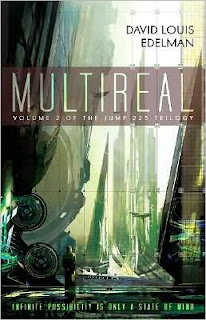
Sunday, July 13, 2008
361 by Donald E. Westlake
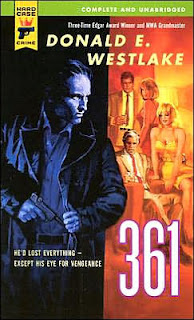 361 is from early in Westlake's career, before he discovered his great talent for humorous crime novels and he moved the hardboiled stuff over to appear under other names. (Most notably Richard Stark, of course.) It was originally published in 1962 -- the same year as the first Stark book, so it was a good year for hardboiled Westlake -- as the third novel under Westlake's name.
(By the way, yesterday was Westlake's 75th birthday -- so happy birthday to him, and a wish for many more.)
361 is a revenge novel, but not a straightforward one -- even that early in Westlake's writing life, he was interested in complications and things that aren't quite what they seem. Our first-persona narrator is Ray Kelly, who has just been mustered out of the Air Force. His lawyer father meets him in Manhattan, to drive him back to their home in Binghamton. But someone was looking for Kelly senior, and they're shot at from a car on the highway. Ray wakes up in a hospital bed with one eye and one father missing.
His brother Bill comes to see him there, but has to leave suddenly -- his wife was just killed in a hit-and-run back in Binghamton. Suddenly, it looks like someone is trying to wipe out the Kelly family. Bill and Ray go to ground in Manhattan, and start investigating their father's past.
It turns out the elder Kelly was a mob lawyer back in the mid-30s -- before he went off to Binghamton -- and that one of the bosses he knew best is getting out of prison in a few week. The Kelly boys put two and two together and decide to nab that boss, Eddie Kapp, when he gets out of Dannemorra. But then someone else shoots at Kapp...
361 twists on from there, following themes of family and blood in unexpected ways and always tightly focused on Ray Kelly, a man not in the habit of thinking or talking about his emotions. (And who has trouble when he's not able to be active immediately -- which happens quite a lot in 361.)
361 is more of a novel than the Stark books are, since the Stark books have a protagonist, Parker, who is eternally unchanged and unchangeable. Ray Kelly does change as 361 goes along, as he learns more about himself and his family. Like all of the other Hard Case books I've read this week, 361 is a lean, tight novel with a lot of action and suspense -- the way they used to make 'em. And it's still well worth reading for those of us who like 'em that way.
And that'll be the end of this streak of Hard Case Crime books; I'll be reading other things for the next week. But this was fun; I should do it again some time.
Saturday, July 12, 2008
Songs of Innocence by Richard Aleas
 "Aleas," as many of you might know, is a not-entirely-secret pseudonym for Hard Case Crime's owner/editor/publisher Charles Ardai. (Aleas is not only a homophone for "alias," the full name is also an anagram for "Charles Ardai.") This is his second novel for Hard Case, after Little Girl Lost (which I will now have to track down and read).
Songs is a direct sequel to Little Girl Lost, another mystery centered on John Blake, who was a private detective in Girl but now, three years later, works as an administrative assistant at Columbia. He's an unhappy man, thinking about suicide regularly, and convinced that he's responsible for the deaths of a number of people. (Which, during the events of Girl, he quite likely was.)
In Songs, Blake is investigating the death of his friend Dorothy "Dorrie" Burke, which looks like suicide -- but he's sure that it wasn't. Dorrie was in the writing program at Columbia, the same program Burke works for, and the two of them were close in the way only two damaged people could be.
Dorrie was working as a masseuse -- yes, the kind you're thinking of, the ones that make more money and aren't as respectable -- and Burke believes someone connected to that life killed her and made it look like suicide. So he investigates, in best fictional PI fashion, and pokes his way around the fringes of the sex business and of a Hungarian gang.
It's all fine so far -- Aleas/Ardai is a skillful writer, and updates the hardboiled idiom well to modern Manhattan -- but it's fairly generic and predictable in its broad outlines. But as Songs of Innocence heads towards its ending, it substantially increases the stakes.
There's one twist in the ending which most experienced mystery aficionados will see coming -- maybe Aleas threw that in as a "gimmie." But the final pages are stark and gripping; one of the best and most unexpected endings I've ever read in any novel. Hardboiled novels are supposed to be about the people who really do commit violent crimes and what it does to them; Songs of Innocence delivers and in spades. It ends breathtakingly and perfectly, lifting itt into the pantheon of great crime novels.
Subscribe to:
Posts (Atom)
