Monday, May 24, 2010

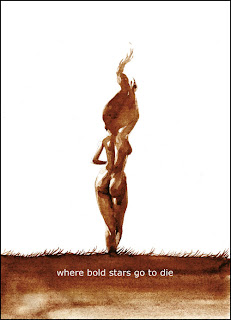
Book-A-Day 2010 # 110 (5/24) -- Where Bold Stars Go to Die by Esmena and Alanguilan

The time is long past when even the most dilligent reader could keep up to date on any even moderately broad field. There's no one fully informed on "the modern novel," or even a commercial genre such as mystery or science fiction -- sure, there are people who read a lot of it, and read carefully in it, but even they find that there's much more that they don't manage to read than they do. The situation gets even worse when we take off our local blinders -- I used to have a decent sense of everything that was being published in the speculative fiction field in the US, but a slightly fuzzier sense of Canada and the UK, some guesses and suppositions about Australia and New Zealand, but only scattered random facts about the entire rest of the world. But that doesn't mean we should abandon everything outside of the narrow area of specialization that we can cover completely -- though there are a lot of blogs and websites (and magazines and readers and conventions) that have given up and settled for doing exactly that. Even if we can't know the whole world of things that might be interesting, it's so much more fun to dive in and see what we can find.

In that spirit, this week is Philippine Week here in the land of Book-A-day. Due to the incredible good graces of Charles Tan -- the Philippine SFF/comics community's secret weapon and ambassador to the rest of the world -- I've seen a stack of Philippine comics and SFF novels/anthologies over the past few years. Last year, I reviewed a number of those comics in one post at ComicMix. This year, I wanted to do something different, so, for the next few days (I'm hoping for a whole week, but it should be at least the five days of this working week) I'll have a new review of a Philippine comics or SFF project here.

I'm starting with Where Bold Stars Go To Die, a short graphic novel published last year in the Philippines by Komikero Publishing, written by Gerry Alanguilan and illustrated by Arlanzandro C. Esmena. Bold Stars has 32 pages of story in a 56-page package; the rest includes script pages, an afterword, pin-ups from a variety of other Philippine artists (Arnold Arre, Carlo Pagylayan, Philip Tan, Lenil Francis Yu, etc.) and the usual other pages required to turn a story into a book. There's no price on the copy I have, but I imagine this is difficult to find unless you're in the Philippines to begin with anyway.

Daniel is a young man -- still in some kind of school, maybe college, who has become obsessed with the forgotten "bold star" Anna. (A "bold star" is a Philippine term that doesn't translate precisely into North American. As far as I can tell, a bold star is not quite a porn star -- they're women who posed nude or semi-nude for magazines and appeared in what seem to be soft-core movies. So they're somewhere in the pin-up/scream queen/nudie cuties zone -- their physical beauty is the point, but their job wasn't to actually have sex.) Daniel spends far too much of his time rhythmically admiring the movies and magazines of Anna that he's managed to find an accumulate, to the detriment of everything else in his life.

And then, one day, he closes his eyes afterward, and opens them somewhere else. He's in a pastoral landscape, populated only by bold stars, or their spirits -- the eternally-young, beautiful, undressed manifestations of lust and desire that remain as long as there are still people (oh, all right: men) in the real world still thinking about and lusting after them. And of course Anna is there. But of course he can't stay there long.

Where Bold Stars Go to Die is a bold story itself, diving headlong into the thorny questions of representation and the male gaze and taking what would be a very politically incorrect stance on them on this side of the Pacific. But, on the other hand, it could be argued that this story takes place entirely in Danny's head -- the other characters are thus not actually people, but just the images he uses for his own pleasure. Still, I don't think many self-identified feminists will be comfortable with Bold Stars -- but, then, they wouldn't be all that fond of actual bold stars, either.

Bold Stars is a thoughtful character piece, a closely viewed portrait of sexual obsession viewed from an original angle -- Danny's obsessed with a woman who doesn't now exist, and possibly never really existed. He's only interested in the image, not the reality, but he's desperate for the image. Esmena's images are equally lush and detailed to match the writing, in a style reminiscent of other Philippine masters like Alfredo Alcala and featuring a lot of appropriately gorgeous women. It may be only a short book, but Bold Stars is a fully-formed story, and a surprising one.
Book-A-Day 2010: The Epic Index
----------------
Listening to: Jesus Makes The Shotgun Sound - Do Not The Clothes Make The Man!?!?!
via FoxyTunes

Reviewing the Mail: Week of 5/22

As I say every week, these are the books that arrived in my mail over the past seven days; I haven't read any of them yet, but I have looked intently at their spines as they piled up next to my computer. And here's what I can tell you about them for a quick glance and my own possibly unjustified prejudices:

Larry Doyle's second novel Go, Mutants! heads into the SFnal realms of '50s movies, after his first (I Love You, Beth Cooper) mined either his own life or the plots of '80s teen movies. It's set in one of those default satirical Earths, where all of the monsters and aliens and other weirdnesses of drive-in movies actually happened, and the kids of those creatures are attending high school. One of them, J!m, is the Deanoid rebel on the cover; son of a would-be world-conqueror and with the macrocephalic profile to show for it. J!m is, of course, brooding and outcast, but somehow he gets caught up the the promised whirl of "beach parties, dances, fistfights, and hotrod races." Ecco Press will publish Go, Mutants! as a hardcover in July.

Graphic Classics is reissuing its first book -- a collection of comics adaptations of the world of Edgar Allan Poe -- in a new fourth edition, with forty new story pages. As always, the series is edited by Tom Pomplun, and this volume includes "The Tell-Tale Heart" by Rick Geary, "The Fall of the House of Usher" by Matt Howarth, and much more, with eleven Poe adaptations in nearly a hundred and fifty pages.

I am really not the reader or reviewer for zombie stories, so I'll just note quickly that David Moody's first novel Hater (which got generally admiring reviews as well as an option for a movie from Guillermo Del Toro) has spawned a sequel, Dog Blood. Thomas Dunne Books will publish the new book in hardcover on June 8th, which I'm sure will delight those of you who enjoy reading about zombies.

I've already reviewed Zeus: King of the Gods -- first in a planned twelve-book series of graphic novels for younger readers by George O'Connor -- but I just got a copy of my own this week, which will make my Greek-gods-obsessed older son very happy. (He grabbed the second book, Athena: Grey-Eyed Goddess, as soon as I finished reviewing that, and I think he likes Zeus even better.) It's available in paperback for only $9.99, so if you -- or a young person close to you -- has the slightest interest in mythology, you should take a look at O'Connor's books.

Cory Doctorow's new novel For the Win is his second for teens -- after 2008's Little Brother, which I reviewed at the time -- and looks to be as politically engaged and button-pushing as Little Brother was. This time, Doctorow is telling the story of online gamers around the world, and how the weakest of them -- the impoverished gold-farmers from countries like China and India start to organize and fight against the people that exploit and profit from them. (I don't expect right-wingers will be any happier with this book than they were with Little Brother, in other words.) Tor Teen published For the Win in hardcover on May 11th, so it should be everywhere already.

I think I saw J.A. Pitts's first novel, Black Blade Blues, back in advance-copy form, but it's now turned into a real book, so let me mention it now (again). It's an urban fantasy with a heroine who works as a blacksmith -- yet another case of a fantasy main character having unlikely skills that will turn out to be amazingly handy when things go all weird, in a tradition stretching back to Martin Padway, if not farther -- and finds herself dealing with real dragons, dwarves, and even worse -- like...investment bankers! Tor published Black Blade Blues this month, simultaneously in hardcover and trade paperback.

I hope you all haven't had your fill of literary/historical horror mash-ups, because they're going to keep coming fast and furious (Queen Victoria: Demon Hunter, anyone? Mansfield Park and Mummies?) until they completely kill the market dead. The one I have in my hands right now is Shakespeare Undead by Lori Handeland , which posits that William Shakespeare was a powerful necromancer, that the "Dark Lady" of the sonnets was his secret True Love, and that they fought an army of zombies together to save England. If that sounds like fun to you, Shakespeare Undead will be published in trade paperback by St. Martin's Press on June 8th.

Turning from the ridiculous to the sublime, Drawn & Quarterly has put out a new volume of their collection of the early years of Frank King's Gasoline Alley newspaper strip, after a three-year hiatus. Walt and Skeezix: 1927-1928 collects two years of the classic strip, and is available now in hardcover.

Also from D&Q is a second collection of John Stanley's Melvin Monster comic book from the mid-'60s, with a handsome design from Seth (which doesn't match at all in style with the Stanley strips, but I suppose that's a minor point). And that brings me to the bottom of the pile, and then end of the week.
----------------
Listening to: The Orion Experience - The Cult of Dionysus
via FoxyTunes

Sunday, May 23, 2010

Book-A-Day 2010 # 109 (5/23) -- B.P.R.D.: War on Frogs by Mignola, Arcudi & various artists

Getting into a groove can be a good or bad thing -- it all depends on the groove. When creative work is going well, and staying focused on the core concerns of a work, a groove can be a great thing. When it's just lame rehashing of the same thing that's been done a thousand times before, though, it's pure lousiness. And, for the same reasons, getting out of a groove can be the best or worst things a creative work can do.

B.P.R.D. -- mostly but not always written by Mike Mignola and John Arcudi with art by Guy Davis -- has been in a very good groove for several years now, telling interlocking stories that combine to move forward the larger story of the Bureau of Paranormal Research and Defense's battle against various supernatural forces that threaten the entire world. This book is a jump out of that groove -- both obvious, in the art styles, and more subtly, in the storytelling. And I'm afraid this was one of the good grooves that jumping out of doesn't really help: War on Frogs wobbles and wanders, and not all of the pieces here work all that well.

War on Frogs is a flashback miniseries, and something of a jam as well -- each of its four issues (plus a fifth story, included here, from the anthology series Dark Horse Presents) was a separate story set early in the B.P.R.D.'s battle against the hideous inhuman frog-creatures, with mostly separate casts and separate art teams. So the book War on Frogs feels like a collection of one-shots, and it's old news -- the reader knows that none of the series characters will be seriously hurt.

The first story, illustrated by Herb Trimpe with Guy Davis inking, is unfortunately the weakest of the lot: Trimpe/Davis turns into bland '70s superhero art, and the story -- the homunculus Roger looks for two frog brothers, and then gets into a fight -- is not particularly special and told flatly. The best piece of the book is next, illustrated by Davis solo, with Captain Daimio tracking down frogs traveling as tent revivalists in the American South. (Though I'd have liked to see that concept expanded; it has the potential to push a lot of creepy/nasty buttons if done right.) Still, this is an episode rather than a story -- it doesn't lead from anything or to anything.

After that comes a grisly John Severin tale, of a regular B.P.R.D. squad on a boat that supposedly has already been cleared of frogs. I find Severin's style too clean and crisp for the kind of horror that this story is aiming for, but I realize that a lot of readers love to see horror like this from Severin, so I'll just shrug and pass on. Peter Snejbjerg then illustrates the story of medium Johann Kraus exorcising a bunch of frog ghosts -- that otherwise show an unpleasant tendency to follow him around -- again, it's a decent story well told, but stays at that level. (Unlike the similar discrete short Hellboy stories, which always had an undercurrent of mythic danger to them.) And last is a story illustrated by Karl Moline -- again, I find his work too clean and mainstream for a book like B.P.R.D., but it's otherwise an effective discrete story.

There's nothing at all wrong with War on Frogs, and it could serve as an introduction to the B.P.R.D. to new readers if they happened to wander into it. (Not the best introduction -- that would be the first volume, Hollow Earth -- or, better yet, the first Hellboy book, Seed of Destruction -- but a decent one.) But it's very much a sidebar to the current storyline, and it doesn't showcase what Mignola, Arcudi, and Davis have been doing so well in the main sequence of the series.
Book-A-Day 2010: The Epic Index

Saturday, May 22, 2010

Book-A-Day 2010 # 108 (5/22) -- The Amazing Cynicalman by Matt Feazell

To start off with, you should know that the best way to buy The Amazing Cynicalman is directly from the author, Matt Feazell, and his Not Available Books -- that's how I bought it, and my order came with a signature (and sketch, and a "Cynicalman Seal of Grudging Approval" stamp inked inside) in the book, a minicomic, and a single-page strip on something like a cover letter. Sure, I'll throw in my usual Amazon link at the bottom, but we're in the era where we're supposed to be buying cool things directly from small, quirky creators, so you might as well get used to it.

And Cynicalman is well worth getting. Feazell has been drawing his stick-figure comics for almost thirty years now, and that's not because he can only draw stick figures (as anyone who ever read Ant Boy! can attest) -- his drawing is deceptively simple but very expressive, and wonderful for short gag comics.

In an odd twist of fate, this book primarily consists of short gag comics -- the full run of the "Cynicalman" strip (1997-2002), which appeared in various newspapers (mostly in Michigan). But Cynicalman has been around for much longer than that -- Feazell has been doing minicomics about him (and various other amusing characters, like Cute Girl, the evil Dr. Pweent. the Board of Superheroes, Stupid Boy, Spud and Ernie -- Cynicalman's fan club -- and Bother) for about as long as he's been doing comics.

As you can guess from the names, Feazell tends to the stripped-down in his writing as well as his art -- this is cartooning, full of gags (cheap and otherwise), with lots of clever situations and amusing dialogue. And, as I've said before, Cynicalman is a product of the midwest and the early '80s -- he's cynical, but not corrosively so; his attitude is that things will probably go wrong, and that the world is filled with unpleasantness.

There are some good examples of Feazell's work at his site (link above); go check it out if this sounds at all interesting. He's one of the great, and longest-running minicomickers, and an inspiration to anyone in comics who wants to try something new and different -- he certainly hasn't gotten rich from this, but he's had a long career doing what he wants to do, and created some very entertaining stories and strips along the way.
Book-A-Day 2010: The Epic Index
----------------
Listening to: Hexes & Ohs - Wildfire!
via FoxyTunes

Friday, May 21, 2010

Book-A-Day 2010 # 107 (5/21) -- Leviathan by Scott Westerfeld

I was one of the many editors who thought Scott Westerfeld told great stories, and then couldn't manage to figure out how to make people buy his books. In my case, it was a 2-in-1 of his Succession series -- which another editor, at Tor Books, had already bought, and gave vastly more time and effort than I did. (Not that it helped either of us -- the "Succession" books were a nifty space opera with great characters and some exciting space battles, but it never quite clicked with those fickle readers.) Luckily, some smarter editor did manage to make Westerfeld's books take off the way they always should have -- not too long after my failed attempt, actually -- and he's been one of the stars of YA fiction since then.

I haven't read as much of Westerfeld's work since then as I should have -- in part because his most famous and popular sequence, starting with Uglies, was both dystopian and about physical beauty; two things I'm not terribly excited by -- but the great thing about a working writer is that he keeps putting out more books. (And no one has time to read everything, anyway.) I was particularly happy to see Leviathan because it was a steampunk WWI novel, and I like the unlikely current flourishing of steampunk (even if I still don't understand it).

It's the summer of 1914, with the Allied and Central Powers -- or at least their militaries and governments -- itching for a new war that all sides are sure they can win quickly and easily. Westerfeld's world parallels our own, with the same nations, the same borders, even what seem to be all the same politicians and rulers, but there are two very important differences. First, Charles Darwin not only discovered evolution, but jump-started a revolution in bioengineering that has given the Darwinist nations (primarily Great Britain, France, and Russia) elephantine beasts of burden, living zeppelin-like airbeasts, and other useful biological creations. And on the other side of Europe are the Clankers, led by Germany and Austria-Hungary, who have developed purely mechanical marvels and clockwork contraptions, including a fleet of walking battle engines of all sizes from fleet scouts to heavily armed and armored dreadnoughts.

But Westerfeld's story isn't about machines and biological marvels, except in passing -- he's gotten this popular by writing about people, and he's got two great young characters at the heart of this story. And both of them have a huge secret.

Aleksandar Ferdinand is the grand-nephew of the Emperor of Austria-Hungary, but isn't in line for the throne himself due to his mother's relatively common blood. In the opening pages of Leviathan, the assassination of his parents in Sarajevo sends Alek and a few trusted retainers on a wild flight to the neutral safety of Switzerland, in a small Cyklop Stormwalker. He's the target of German assassination attempts, due to his father's role as a voice of peace and general bloody clearing-the-table sentiment, but -- by traveling quietly, and at night -- there's a good chance he can survive the war in an obscure bit of Europe and try to return when peace does.

On the same day, young Dylan Sharp is trying out to become a Midshipman in the British Air Service. But Dylan is actually Deryn, a young woman, and she'll be summarily drummed out of the service if her commanding officers find out. She quickly finds herself in the Service and on the gigantic Leviathan airship, ferrying a valuable and highly secret cargo -- and its minder, the much too intelligent and perspicacious "boffin" Dr. Nora Barlow -- to the Ottoman Empire.

So Leviathan sets those two viewpoint characters into alternate chapters, and sets them across Europe towards each other, one in a giant living airship and the other in a clanking, nightstalking walking tank, as their respective nations declare war on each other and start massing armies in the background. Of course they do meet, and of course their separate secrets complicate the issue -- not that that a Europe swiftly sliding into a vast new war isn't already complicated.

Leviathan is only the first in a trilogy, and the story isn't complete here -- Alek and Deryn's secrets aren't even revealed, let alone the cargo of the Leviathan and its purpose in Constantinople -- but there's enough of a stop at the end to make this satisfying as a book. (Though it does read much more like Book One of a multi-book series than like the first novel in a sequence of independent novels.) Along the way, Westerfeld has more of the splendid action scenes I remember fondly from "Succession," and his characterization is just as good.

(Leviathan is also heavily illustrated, with full-page illos by Keith Thompson roughly every chapter and some smaller pieces as well -- plus a great grotesque map of Europe on the endpapers.)
Book-A-Day 2010: The Epic Index
----------------
Listening to: A Faulty Chromosome - This Is Far From A Belle Epoque
via FoxyTunes

Quote of the Week: On Floating Islands

"Floating islands are invariably Krakens."
- Bishop Erik Pontoppidan, A Natural History of Norway, 1752-54, amazingly prescient about RPGs and webcomics

Thursday, May 20, 2010

Book-A-Day 2010 # 106 (5/20) -- Your Hate Mail Will Be Graded by John Scalzi

New things are rarely as new as we pretend they are -- we delight in their newness because that shows that we are exciting, au courant, and forward-thinking, and so we do our best to ignore that Grandpa did something very similar. Blogs, for example, often have a lot in common with small-town or 19th century newspapers -- right down to the lack of return to the proprietor.

And the book of collected blog essays? Well, except for the specifics of those essays' original publication -- which will be of vastly less interest to our own grandkids, as they try desperately to differentiate themselves from us -- they're very much like a long string of similar books, from Art Buchwald and Mike Royko, Herb Caen and Jimmy Breslin, Russell Baker and Maureen Dowd.

For some, this may be disconcerting -- No! they shriek, the Internet is completely unlike anything else ever ever ever! -- but, as a reader who cut his teeth on Royko and Baker (and Dave Barry, and so on), it makes a book like Your Hate Mail Will Be Graded to be surprisingly familiar and homey. It is, as probably anyone reading this blog already knows, a collection of blog posts on various and sundry topics by John Scalzi, published to mark the tenth anniversary of his blog Whatever. Whatever is vastly popular, and a lot of fun to read, even if Scalzi chooses not to engage in the core blog-fun activity of tagging those posts.

And so, like a collection of newspaper columns, Your Hate Mail is full of things that fans of the writer have read already -- in this case, "Being Poor" and the visit to the Creation Museum and a dozen more. (None of the more picture-oriented posts, though, since this is a pure-text book -- so there's no bacon on cats here.) That never bothered me with Dave Barry, and it didn't bother hundreds of thousands of people for four decades with Art Buchwald, so I don't see why it should suddenly be a huge problem now. The essays in Your Hate Mail are just as readable and entertaining now as when they were first posted.

This book, though, is not quite as carefully constructed as those old newspaper collections -- it has no table of contents or index, so it's difficult to find any specific essay. (One might think a publisher wouldn't go out of its way to make a book notably less useful than the already existing free Internet version, but one might think a lot of things that aren't true, as well.) There's no obvious scheme of organization, either, and Your Hate Mail could have strongly benefited from one. It didn't need to be slotted into several thematic categories -- though that's certainly one plausible option -- but it should have had some kind of continuity, and remembered the cardinal rule of collections: always begin with a bang and end with a bigger bang. Your Hate Mail starts off with the usual introductory bumf (from Scalzi and his forewordist, Wil Wheaton) and a snarky "Disclaimer," which is just fine, but it peters out at the end with a series of minor posts culminating in "The Best End of the World," in which Scalzi exercises his non-fiction-explainer muscles to run through some historical nutjobs who thought the world was about to end.

So everything in Your Hate Mail is fine -- it could have just been better organized and presented. Oh, and the cover, being mostly white, picks up ink and fingerprints like nobody's business. Try to read it with disposable gloves if you care desperately about condition. But, otherwise, it's a fine selection from an entertaining blog, suitable for reading away from electricity and connectivity (or even close to them, if you prefer).
Book-A-Day 2010: The Epic Index
----------------
Listening to: Those Darlins - Who's That Knocking At My Window?
via FoxyTunes

Wednesday, May 19, 2010

Book-A-Day 2010 # 105 (5/19) -- Britten and Brulightly by Hannah Berry

Britten and Brulightly is an impressive debut graphic novel with some odd choices in tone and a slightly confused manner about itself. In a perfect world, I'd try to mimic those aspects in my review -- but, sadly, ours is not a perfect world, and I'm writing this late on a Sunday night, so I'm afraid I may be notably less successful at my task than Berry was at hers.

Fernandez Britten is a private detective -- a researcher, he calls himself --in a time and place that never quite comes clear. It probably takes place somewhere in the UK -- where Berry herself lives -- but the specifics are obscure, and the trappings of modern society are missing here, so this story may be set twenty or forty or sixty years ago. Britten used to do a lot of work on divorce cases -- or his cases caused divorces; so much that he became known as "the Heartbreaker." And his partner is Stewart Brulightly.

Stewart Brulightly is a talking teabag that sits in Britten's pocket.

That's the first jarring element, and it never becomes clear if Berry intends the reader to take Brulightly as a bit of magic realism or a sign that Britten is deeply mentally unwell. (Probably not the latter, in the end, since Britten does end up solving this case in his usual way.)

This particular case follow Britten's new plan -- he only deals with murders. (Other private detectives, fictional and real, have generally found trouble with that limitation -- the police rarely like intrusion in their own work -- but it's pretty common in fiction.) He's hired by Charlotte Maughton to investigate the death of her fiance Berni Kudos. Kudos was found hanged in his own home, with a note -- but Charlotte is sure that he was murdered.

Britten also has something he's sure of -- that this case intersects another one, from twenty or so years before (Berry never makes the precise timing clear, which is unfortunate and detracts from the mystery story), involving Kudos's older brother. And so he begins to investigate, following Kudos's life from one end and tracking down the principals of that earlier case from the other end.

The case is frankly bewildering, with a large cast who have complicated relationships to each other, and Berry doesn't handle identifications as well as she could have. (Her dialogue, including Britten's internal monologues, are all very believable, but she needed to sacrifice a bit of naturalism in the service of untangling her complicated plot.) Britten has several theories along the way, each of which is more convoluted (and slightly harder to comprehend) than the one before it, until, finally, the truth comes out.

Berry doesn't quite make Britten's essential sadness at his role in the world as stark as it should be -- he feels at times like simply an unlucky, or insufficiently discrete, investigator. The complication of the plot makes Britten's existential dread -- his sense of the inevitability of what he always discovers -- less reasonable, since he had to be smart and lucky to get to the end. But, with all that, Britten and Brulightly is an assured and atmospheric graphic detective story, with art that completely supports and enhances the story. It's a real treat to find a first book-length fiction from anyone that succeeds as well as this book does.
Book-A-Day 2010: The Epic Index
----------------
Listening to: The Builders And The Butchers - Vampire Lake
via FoxyTunes

Tuesday, May 18, 2010

Book Habits: A Meme

Got this from my doppelganger (another blogger/reviewer/toiler in obscure corners of publishing/resident of New Jersey) Rob B:

What is your favorite drink while reading?

I mostly read while commuting these days, so I'm not drinking at the same time. I most usually have water otherwise.

Do you tend to mark your books as you read, or does the idea of writing in books horrify you?

It doesn't horrify me the way it did when I was young and innocent: several years of marking up books for production purposes (and knowing that two old books must die for a new edition to be born) cured me of that. But I tend just to put little pencil marks in for passages I want to quote; I'm not a margin-scribbler.

How do you keep your place while reading a book? Bookmark? Dog-ears? Laying the book flat open?

Bookmarks. Sometimes I'll dog-ear pages to mark a quote, but that's about it.

Fiction, nonfiction, or both?

Both, more or less alternating, these days. (Though with a lot of comics/graphic novels/manga as well, and those are nearly all fiction.)

Are you a person who tends to read to the end of a chapter, or can you stop anywhere?

I read while commuting, so I often have to stop reading because I'm where I need to be. I do try to stop at a natural break, but it doesn't always happen.

Are you the type of person to throw a book across the room or on the floor if the author irritates you?

Authors irritate me all day long; I work in publishing. I try not to hold that against their books. When books annoy me, they may be cast aside lightly, but I generally don't hurl any with great force.

If you come across an unfamiliar word, do you stop and look it up right away?

No. I usually can't, for one thing.

What are you currently reading?

I need to do a bookmark inventory -- since I've got them in at least two dozen books scattered across the house -- but the main thing I'm reading now is Michael Lewis's The Big Short.

What is the last book you bought?

I believe the last thing I picked up to add to my pile on my last trip to a store selling book-shaped objects was Grendel: God and the Devil by Matt Wagner, John K. Snyder III, Jay Geldhoff, and Bernie Mireault. The last just-words book that I picked up similarly was The Sad Tale of the Brothers Grossbart by Jesse Bullington.

Are you the type of person that reads one book at a time, or can you read more than one?

I usually only have one main (narrative) book going at once these days, but I've often read several books in tandem, particularly back in my book-club days. And, of course, there's the bathroom book, the a-few-pages-before-bed book, and so on....

Do you have a favorite time/place to read?

I do most of my reading on the train to and from work. My favorite time and place to read was late at night, in the 24-hour room of Vassar's library, in the late '80s, while getting paid as a Campus Patroller. Sadly, that's no longer possible now.

Do you prefer series books or stand alones?

I don't prefer genre fiction that much to make this a reasonable question to begin with. I prefer books with something to say and the style to say it well. I find that later books in series often have neither of those, and we keep reading them out of inertia, which is no good for anyone.

Is there a specific book or author you find yourself recommending over and over?

It depends on the context -- and I don't give out a lot of recommendations to begin with -- but I've often mentioned Lawrence Block, Gene Wolfe, P.G. Wodehouse, Donald E. Westlake, and Roger Zelazny, in various contexts.

How do you organize your books? (by genre, title, author’s last name, etc.)

Oh, it's much more complicated than that. First, there's the great read-unread divide. Then there are the stacks of unread review books, versus the shelves of unread books I bought. The read shelves are divided into several categories: comics, oversized, classics, hardcovers, trade paperbacks, and mass markets (hiding behind the classics). And there are probably other quirks (like the from-the-library pile) that I'm ignoring or skimming over.

Smart Enough to be Dumb

There are times when I wish I was either noticeably smarter or dumber -- sometimes I feel like I'm right in the middle of a hole in the middle. People smarter than me clearly understand what's going on, and can speak about it with that knowledge. And people dumber than me don't expect to understand things, so they can rattle on as well, secure in their unshakable convictions.

But I find that I can only really talk about things that I understand, and only discuss them to the limits of that understanding. A lot of people I deal with regularly have clearly mastered the art of using jargon in place of deep knowledge, which I've never been good at -- I can't grapple with the signs unless I actually understand the signifiers.

People tell me I come across as very knowledgeable at my day job, and I've always had the sense that I'm very plausible in conversation -- even when I'm not sure of something, people think I know what I'm talking about, as long as I can keep talking -- but it doesn't feel that way from here. I'm reading yet another book that's explaining CDSes and CDOs, and, once again, I have to sit and think about them for a while until I sort-of understand what they actually are -- and whatever understanding I do manage to achieve will disappear soon enough when I close the book. (The same thing happens with the laws of thermodynamics and other similar technical details -- I recognize them when I come across them again, but have to recreate my limited understanding each time.)

The Wife mentions that she thinks I'm smart, every so often -- not too often, of course, since I'm plenty self-absorbed enough, thank you -- but I've always hoped that wasn't the case. There's so much that takes so much hard thinking to get the vague gist of, that I sincerely hope that the real movers and shakers of this world -- from Ben Bernanke to Stephen Hawking to Angela Merkel -- really do understand all of this stuff much more clearly, and are all much, much smarter than I am. It would be really depressing otherwise, in so many ways.
----------------
Listening to: Ida Maria - Everybody's Always Alone
via FoxyTunes

Buy Your Father Power Tools! Avoid Unseemly Displays of Emotion!

Father's Day is coming up -- as I was just reminded by a certain Internet retailing emporium -- and they would greatly appreciate it if you (and, actually, every single person in the whole world) were to buy expensive powered machinery for the fathers and father figures in your life.

To encourage you, they have various discounts and special offers, as well as dedicated pages to such man-centric brands as Gladiator GarageWorks.

They also have instructed me to place the following banner in front of your eyeballs, which they have assured me will inerrantly drive you to buy many expensive items redolent of stereotypical concepts of manhood from their overflowing distribution center:

You know what to do now.
----------------
Listening to: Josh Ritter - Folk Bloodbath
via FoxyTunes

Book-A-Day 2010 # 104 (5/18) -- The Checklist Manifesto by Atul Gawande

Everyone wants easy answers. For every problem, we secretly think, there must be a simple, easily-applied solution that everyone can understand. Look at whatever politicians you like least -- don't they preach easy solutions to problems? Look at The Secret -- or any self-help book, for that matter. (Or most personal-finance books.) Look at the thousand talk shows and their devil spawn, the "fix your life" shows -- that will correct a chosen person's house or life or job or wardrobe or what-have-you in half an hour, with time out for mop advertisements. Look at all of modern culture.

The Checklist Manifesto looks very much like yet another work in that very same vein -- Gawande, a noted surgeon and writer (a regular in the New Yorker, two previous bestsellers on doctor-y topics), has a thesis that many complicated tasks and processes can be improved by following checklists. But it's not quite as simple and easy as the marketing copy for Checklist Manifesto would have you think it is -- Gawande is clear that a good checklist, one that actually does capture the most important steps and will improve processes, requires a lot of thought and work and trial-and-error before it actually will improve processes.

Gawande discovered checklists through commercial aviation, the field that has used them the most extensively and for the longest time (since test pilots created the first one while flying the B-17 bomber in the 1930s), and has refined the use of checklists the most. And he came to see the need for checklist through his surgical practice, where a thousand tiny details have to be tracked carefully -- and usually during times of high stress -- to ensure a successful outcome for the patient.

Gawande is a strong reporter of the New Yorker school; he examines various kinds of checklists in different areas (most notably the construction of skyscrapers, along with medicine and aviation) and explains his own successes and setbacks in implementing surgical checklists, both in his own practice and as part of a World Health Organization imitative. (Gawande is low-key about all of his work, but one begins to wonder when this star writer, star surgeon, star professor, and globe-trotting UN functionary finds time to sleep, let alone to nod at his wife and three children once every so often.)

A checklist is not a panacea, of course, though Gawande does insist that it is an immensely useful tool for a wide swath of complicated human activities. And he makes a good case that, in so many of these areas, the work that needs to be done quickly is now too complex to be easily remembered and followed. He probably overstates his case slightly -- a popular book on a subject like this could hardly not -- but the model of aviation is very compelling, and it's clear that many other fields, not least medicine, could stand to improve their procedures through some carefully designed and implemented checklists.
Book-A-Day 2010: The Epic Index
----------------
Listening to: Mieka Pauley - Marked Man
via FoxyTunes

Monday, May 17, 2010

Book-A-Day 2010 # 103 (5/17) -- Solomon's Thieves by Mechner, Pham & Puvilland

The Knights Templar have been the launching point of a thousand conspiracy theories -- luckily, Jordan Mechner knows that (and writes about it in his afterword). Even better, he hasn't set this graphic novel in 1207 -- the year the French King Phillip IV (aka "the Fair") arrested the entire local branch of the order and had them condemned for heresy, homosexuality, and anything else he could think of -- to launch a conspiracy theory, but to tell an adventure story about a knight on the run.

(Mechner does play somewhat fast and loose with the facts -- he has the dissolution of the order, which even in France wasn't complete for several years, happening with blinding speed and everywhere in Europe. From his listing of sources at the end, I'm reasonably confident that he knows this is a fictionalization, and did it on purpose for dramatic license.)

Our hero here is Martin, a brawling, headstrong Templar with a knack for fighting and a head for drunkenness, who has returned to Paris with his fellow knights after the fall of Acre. He sees the girl he was in love with all those years before, and attempts to confront her. It's not entirely clear, in Solomon's Thieves, whether she's married or not: she's supposed to be, but we never see her with her husband, nor does the book mention him. But before Martin's mulishness can cause him too much trouble, Philip the Fair's machinations do far worse, and he's arrested with the rest of the order.

From there, it's a short step to a prison break, brigandage, and the inevitable quest for the lost fortune of the Templars. (Perhaps I was too hasty in dismissing this as a conspiracy theory book?) Solomon's Thieves will be a series -- at least three books, I expect -- and this one primarily exists to set up the premise, introduce Martin to some roguish compatriots, and set them on the trail of the hidden fortune. The feel is very much Dumas hommage, but authentic swashbuckling is so hard to come by in comics these days, so the swordplay is welcome -- though I do hope Mechner allows space for some wenching and carousing in the next volume.

The art is by LeUyen Phan and Alex Puvilland, the team that worked with Mechner (or, more likely, the writer A.B. Sina) on the graphic novel version of Prince of Persia two years ago. (I reviewed Prince of Persia then for ComicMix.) They give Solomon's Thieves a Euro-album feel that works well with the story, including a wide variety of faces that are more grotesque and deformed than they appear to be at first.
Book-A-Day 2010: The Epic Index
----------------
Listening to: Titus Andronicus - "Fear & Loathing in Mahwah, NJ"
via FoxyTunes

Reviewing the Mail: Week of 5/15

Every week I get mail, and every Monday I write about it here. This time around, I only got two packages all week, for whatever reason. (The mail is always unpredictable, and I don't really mind, because I have too many books to read no matter how I get them.)

Darren Shan is a familiar name to teenage readers (not to mention their librarians, teachers, and parents) from his "Cirque du Freak" series (about a half-vampire boy also named Darren Shan) and its successors, but his books haven't been aimed at adults previously. But his new novel Procession of the Dead -- coming as a YA-priced $19.99 hardcover from Grand Central on June 4th -- will be in the adult section of bookstores, either chasing a new audience or following the readers who read his first novel, Cirque du Freak, nine years ago. Procession is the first book in a new trilogy, "The City," in which an amnesiac young man, Capac Raimi, arrives in a darkly magical city that is ruled -- and even more closely connected to -- The Cardinal, who may hold the secrets of Capac's past.

Shan is busy this year -- he also has a novel for teens, The Thin Executioner, coming out in August. It's a standalone novel somehow inspired by Huckleberry Finn -- though it seems to be about a boy "on an eight-month journey to petition the fire god for invincibility...to return and claim the post of executioner from his father." (Which doesn't sound much like the Huck Finn I know.) Thin Executioner is also hardcover, but will be even cheaper, at $17.99. Novels for teenagers are a great bargain, aren't they? I should read more of them to stretch my book budget....

The other package this week came from the good folks at Tokyopop, containing a variety of manga projects publishing in June:

Tachibana Higuchi's Portrait of M & N Volume 2 continues the story of teenage masochist Mitsuru and narcissist Natsuhiko, as they continue to try to hide their proclivities (which, I assume, are nearly uncontrollable, in best manga fashion) from the rest of the world. This series still sounds very weird, and I hope to read some of it before long.

Isle of Forbidden Love is a yaoi story from Duo Brand (and that doesn't sound like a pseudonym, oh no!), with an Edo-era murder mystery and the world of the theater as the background to this stylized gay love story.

Also on the yaoi side is Madness, Vol. 2 by Kairi Shimotsuki, finishing up this story about assassins, mind-controlling microchips, gunplay, and lots of man-on-man love. (With the latter man drawn as hugely effeminate for genre-convention reasons.)

There's also a second volume of Jinsei Kataoka and Kazuma Kondou's Deadman Wonderland -- I reviewed the first one a few months back.

And there's a third volume of Alice in the Country of Hearts by Soumei Hoshino and Quinrose, which is -- as you might guess from the title -- a manga-tized reimagining of Alice in Wonderland.

Last from Tokyopop is the least manga-ish book, World of Warcraft: Mage, written by Richard A. Knaak and illustrated by Ryo Kawakami. According to the back cover, it's part on an "ongoing class series," which may be of interest to hardcore WoWheads.
----------------
Listening to: Kate Miller-Heidke - God's Gift To Women
via FoxyTunes

Sunday, May 16, 2010

2009 Nebula Winners!

Last night, the Nebula Winners for last year were announced during the usual gala banquet – this year held in Cocoa Beach, Florida. And those winners are:
Novel: The Windup Girl, Paolo Bacigalupi (Night Shade)

Novella: The Women of Nell Gwynne’s, Kage Baker (Subterranean)

Novelette: “Sinner, Baker, Fabulist, Priest; Red Mask, Black Mask, Gentleman, Beast”, Eugie Foster (Interzone 2/09)

Short Story: “Spar”, Kij Johnson (Clarkesworld 10/09)

Ray Bradbury Award: District 9, Neill Blomkamp and Terri Tatchell (Tri-Star)

Andre Norton Award: The Girl Who Circumnavigated Fairyland in a Ship of Her Own Making, Catherynne M. Valente (www.catherynnemvalente.com)
This year’s Grand Master was Joe Haldeman, and the “Author Emeritus” (a title I will always loathe) was Neal Barrett. Also honored, with SFWA’s new Solstice award (the title of which also has an undertone of “you’re old and eclipsed,” but at least it is an undertone), were Tom Doherty, Terri Windling, and the late Donald Wollheim.

It's an interesting list, with some bittersweet outcomes (Kage Baker getting it so soon after her death) and some oddities (the Bacigalupi novel has gotten very mixed reviews -- I guess I'll have to read it myself now, though I've been avoiding it since he's depressing and axe-grinding enough in short form that I didn't want to inflict several hundred pages of the same on myself). I'm also not certain what to make of Valente's win in the Norton -- is it another sign that Nebula voters are utterly detached from the actual YA field, or is it a show of support for a fine writer from their community trying something interesting? (Valente published that novel online herself for "tips" -- a strategy that SFWA was debating very loudly just a few years back.) Either way, it's another book I need to find time to read, along with so many more.

I also note, as a publishing person, that smaller presses took the entire field this year -- even District 9 was arguably the movie from the smallest production house. (Though Moon is the other side of that argument.)

Congratulations to all of the winners and nominees!