There's a decent-sized pile to get through, and I've already lost one hour today (to Daylight Savings Time), so there's no time for exposition!
These are all books, either just published or just about to be. I got them in the mail last week, from publicists at their respective companies. I may review them, some or all, at some time in the future. But this is not a review, despite the title. This is just what looks amusing and/or enticing about these books, decided as I look at them right this second.
I've got both genre fiction and manga this time, but more of the latter than the former -- so, this time out, we'll have a skiffy sandwich, with manga for the bread. And I'll start out with two titles from Vertical, the classy boutique manga publisher:
Limit, Vol. 3
continues Keiko Suenobu's story of a group of schoolgirls thrown on their own devices -- and at each other's throats -- in the aftermath of a horrific bus crash that killed most of their classmates. This volume promises the return of another survivor -- and I've heard that this one is a boy, to shake up the creepy power dynamics of the survivor group.
And then there's Toru Fujisawa's
GTO: 14 Days in Shonan, Vol. 8
, continuing the side-story to his main
Great Teacher Onizuka series -- though I'm beginning to wonder if each volume covers only one day of that short trip, since the pages keep piling up. (I have to admit I haven't read this or the main
GTO series.)
(I was going to continue the sandwich metaphor, comparing each of the next few books to a kind of cold cut -- ham, cheese, pepperoni,who-the-hell-knows -- but it was silly and tortured to begin with, so I'm just dropping it here.)
Mark Chadbourn's Elizabethan Faerie-Cold-War secret-agent saga "Swords of Albion" returns with a third book,
The Devil's Looking Glass
, which was published by Pyr in mid-February. This time out, Elizabeth's master magician Dr. John Dee has gone missing, with an obsidian mirror of great power. And so Will Swyfte must go after him -- and, if the cover is anything to go by, he ends up far from England, somewhere tropical, steamy, and dangerous.

It must be the month for third-in-a-series, because Lee Carroll's contemporary fantasy series about jewelry designer (and world-protecting magic-worker, of course) Garet James is also back with a third book,
The Shape Stealer
. This one comes from Tor, and was published last week -- and, I see, that this book
also features John Dee, who is rather more villainous in Carroll's world, having connected with the just-unleashed spawn of an evil Babylonian god in Paris. (Paris is
the place for hook-ups, particularly if you're trolling for evil gods.) Garet and her ancient vampire boyfriend (and their buddies, a secret society of knights who protect the timeline -- guess there's some time-travel in this one as well) must stop the menace before the whole earth is engulfed.
Elizabeth Bear's pseudo-Mongol epic fantasy series (which began with
Range of Ghosts) returns with a second book,
Shattered Pillars
, a Tor hardcover hitting stores next week. There's a lot going on here -- a scheming sorcerer hidden away and manipulating his enemies to fight each other, two mismatched heroes preparing for a great heroic deed, a plague-ridden empire, and more vaguely Arabic and central Asian names than you can shake a stick at.

If you like your genre elements in a more mainstream form, stuck into a thriller plot and without those skiffy cooties on it, you may want to check out Warren Fahy's
Pandemonium
, now in hardcover from Tor. It seems to be a sequel to Fahy's
Fragment, with the series heroes (who seem to be married biologists) being invited by the obligatory ruthless Russian tycoon to visit a secret underground city which, inevitably, is connected to the tunnels where some kind of hideous evil subterranean monsters are waiting to rise up and wreak havoc.
And then, to finish up, I have a pile of books from Yen Press, all publishing right around now:
Durarara!! -- I reviewed
the first volume about a year ago -- is back with a new, slightly-confusing
Saika Arc
, which begins in the volume I have in front of me. (Confusing mostly because the first few volumes I've seen weren't arcs at all, so it's not clear if this is a side-story or the continuation of the main story in a slightly different package.) The art is by Akiyo Satorigi, and the book also credits character designs to Suzuhito Yasuda and "creator" Ryohgo Narita, but doesn't actually say who
wrote this particular combination of words and pictures. I expect Satorigi adapted it from the original light novel series, either with or without Narita's input. And the story still seems to be the same kind of thing: a whole bunch of characters, with semi-intersecting stories, in Tokyo's Ikebukuro district.
Atsushi Ohkubo's
Soul Eater
series hits a thirteenth volume, which I know my sons will be thrilled to see -- they're eating up this very energetic
shonen tale of demon-fighters and their sapient shapeshifting weapons, which is something like the the early days of
Naruto if the sharingan was a
person.

And JinHo Ko's
Jack Frost
-- another series that I reviewed
earlier volumes -- is back for a seventh installment, in which the mousy female protagonist has apparently become much less mousy and is engaging in some ultraviolence of her own as she learns her true role as "the mirror image."
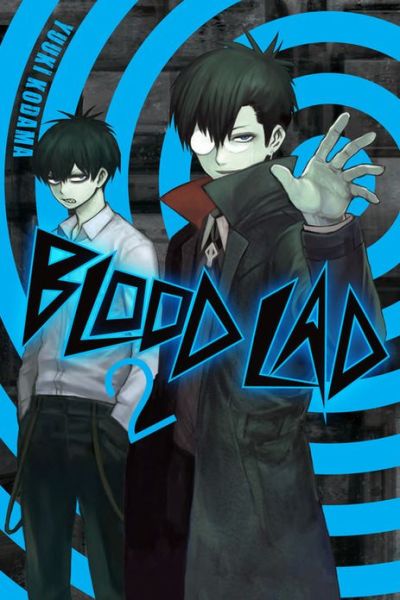
 Blood Lad, Vol. 2
is by Yuuki Kodama, continuing the story of Staz, the
otaku slacker vampire head of a sector of Hell, and of the human girl who wandered into his territory (for no clear reason). I read the first volume, though I haven't written it up yet, and this volume looks to keep increasing the throw-everything-at-the-wall atmosphere of the first one.

I also have (deep breath)
Higurashi When They Cry: Massacre Arc, Vol. 3
, by Ryukishi07 and Hinase Momoyama, which tells more of the middle of the story of the eighth and penultimate videogame in the long-running series about a murder in small-town 1983 Japan. This has nearly 500 pages of comics, and its the twentieth book in a mega-series I haven't read, so I hope you'll excuse me if I can't explain the plot.

Last for this week is
The Dark-Hunters: Infinity, Vol. 1, adapted from the novel
Infinity (itself the beginning of a prequel series to the main Dark-Hunters series) by Sherrilyn Kenyon, with art by Jiyoung Ahn. The book credits Kenyon in the largest type -- as of course it should; it's her series, and she's the draw -- but it looks like Ahn did all of the work to turn the novel
Infinity into comics page, from scripting to actually sitting down and drawing the whole damn thing. Kenyon's world is a big, complicated supernatural milieu, and this is one of the better entry points into it, following an important character early in his life as he learns it all for the first time.


 is the latest anthology edited by the powerhouse team of Ellen Datlow and Terri Windling (sixteen annual volumes of Year's Best Fantasy & Horror; the influential series of fairy tale retellings that began with Snow White, Rose Red; a series of anthologies for the Young Adult market in recent years; not even to mention their individual achievements), which would be enough for most circumstances. But it's also an uber-steampunk anthology -- not pure steampunk, but encompassing all kinds of fantastic visions of the Victorian era, including but not limited to goggles, dirigibles, and combat parasols -- which are rather popular these days. And the nitpickers prone to criticize the gender balance of anthologies will have to find a new angle of attack, since a full fourteen of the eighteen writers or writing teams here are female. (Those eighteen include Elizabeth Bear, Tanith Lee, Delia Sherman, Jane Yolen, Catherynne M. Valente, and a few non-distaff types like Gregory Magurie, Jeffrey Ford, and James P. Blaylock.) Book of Spells is a Tor trade paperback, officially on sale this Tuesday.
 . I didn't read the first one, but I can tell you that there's an exiled rebel general named Adolphus, a ruler called Diadem Michelle Duchenet, a Deep Zone, something called a shadow-Xayan settlement, and, of course, the planet named Hellhole, which will never not make me think of this:
 , the sequel to The Lost Gate. It looks like Card's take on contemporary fantasy, with a teenaged hero who is the scion of a long line of gatemages, with special secret powers that allow them to control access to magical otherworlds (or something vaguely similar to that). Presumably, our hero will be staunchly heterosexual, for those to whom such things are deeply important. This is also from Tor, and will be officially available tomorrow.


 by Walt Kelly -- I came late to the Pogo bandwagon; I've heard about it my entire comic-reading life (which only slightly trailed my breathing-and-pooping life), and seen snippets of Kelly's great comic strip a number of times, but I never pulled the trigger and actually read the thing. Until, that is, last year, when the first volume of this new series collecting the entire newspaper strip -- Through the Wild Blue Yonder -- showed up in my library, so I had to

 , the second collection of the not-really-a-webcomic The Oatmeal, by Matthew Inman, who makes his name difficult to find on his work (though for apparently different reasons than Cris Ware does the same) -- I got the first Oatmeal collection during the death throes of Borders, and
 by Mark Siegel -- This graphic novel got a lot of attention when it was published a few month back, but that was at a time when I was being flakier than usual with my reviews here and my relationships with publishers (I'm unabashedly amateur at Antick Musings; I'm serious about what I do but can be lackadaisical due to the general lack of remuneration), so I didn't get a copy of it, even though it probably wouldn't have been difficult at the time. But it was in the library, as I figured it would be eventually, and so now I can read it.
 , which you may have heard of -- it's been kind of a big deal. I've reviewed Forney's work here -- her cute, memorable, smart what-it-was-like-to-be-me-as-a-kid strip


 by Caitlín R. Kiernan, and
  by Kiini Ibura Salaam.


 )
)