Monday, January 31, 2022

Reading Into the Past: Week of 1/29/05

Every Monday, I talk about a list of books here. If I've gotten anything new, that's the list. If I haven't...that's when "Reading into the Past" comes into play.

This series of posts looks at what I was reading "this week" in a randomly-chosen past year, from the period when I did keep a reading notebook (so I know what I read) but didn't have this blog yet (so there isn't already a post about that book). It is a weird and quixotic thing, but it is mine own.

This time out: the end of January of 2005.

Andre Norton, The Beast Master (photocopies, in Beast Master's Planet omnibus, 1/23)

This I read for work, obviously - I was Senior Editor of the SFBC at the time, and this omnibus was being published by Tor later that year. Beast Master was the first novel about Hosteen Storm, some guy in the future who could talk to animals (I think he had a Native American background to explain that - well, in those days it was probably an "Indian background," but you know what I mean). The other novel in this omnibus is Lord of Thunder; I don't seem to have read that, but the SFBC did offer the omnibus. And Lynn McConchie then wrote a series of sequels, supposedly "in collaboration" with Norton, but I always doubted how much the senior author did in the junior-senior pairings like that.

I never imprinted on Norton as strongly as some people of my generation did. I read some of her books when I was younger and enjoyed them, but never really went out of my way to read more - and Norton always had lots more; she was prolific and generally dependable. My memory is that this series is on her sillier side: psionics stories have not aged terribly well to begin with, and psionics stories about a noble savage and his animal friends have it even worse.

Robert E. Howard, Bran Mak Morn: The Last King ("read parts and skimmed parts," bound galleys, 1/23)

Here we see the era when I was "handling" a lot of books for work, and being clear about how much of them I actually read. (Elsewhere in this notebook I see "got through most of it" and "poked through parts," but the most common thing is "read beginning & end." You can get most of the point of genre fiction, especially a series novel, by reading the first 50 and last 50 pages, if you have to.)

This one was part of a somewhat scholarly project reprinting a lot of Howard work by Del Rey in the early years of the century - I think there were four Conan books first, with all of the stuff by other people stripped out of the mid-70s twelve-volume series and a serious attempt made to get back to preferred texts and proper chronological order. Bran was part of the second wave, along with Solomon Kane and Kull; I don't think we did all of them in the club, but I'm pretty sure we did this one.

I'm not a huge Howard fan; I've mostly stuck with Conan, which is his best stuff, as far as I could tell. My memory is that most of this collection - the cover calls it a novel, but it's not, at all - is OK pulp adventure, with a couple of stories substantially better than that.

Steve Almond, Candyfreak (1/24)

Popular nonfiction is always the same kind of thing: shortish books, in a breezy style, about something interesting to at least a big swath of people. It helps, the past three decades or so, if the writer can pretend that thing changed the entire world - that's not required, but it's been a major strand in the nonfiction world. This one was a bestseller, so you may have heard about it - I bet it's still selling decently even now, since the world Almond depicts is basically the same: there are a few big food/candy conglomerates, though they do tend to trade divisions to each other, like baseball cards, every so often, and they have kept buying up or forcing out the smaller players.

I remember liking this, and I think I went on to read at least one more Almond book, which is a good sign. But I'm also a guy whose family took an annual trip to the Hersheypark amusement conglomerate (mostly for the roller coasters & similar stuff, but always with a stop to the gigantic visitor's center and gift shop) for a couple of decades, so you may have to recalibrate your expectations.

John Kovalic, The Dork Side of the Goon (1/25)

I know this was a collection of Kovalic's popular webcomic Dork Tower, but I'll have to look it up to tell which one. According to that big internet bookstore, it's #7, and seems to be from the era where it looked like the series might actually move forward with some of its plotlines. (It's been irregularly-published for what feels like the last decade - never quite going away, but reduced to monthly random gags at times and often dropping what seemed to be central plots.) I like Kovalic's humor, even though the only tabletop gaming I did was back in highschool, and - though I think he's made a good living doing card art and creating games - I do wish he had time and financial incentive to tell more stories in comics form, since I like stories better than random art.

J.G. Ballard, Millennium People (1/26)

Before I look it up: I think this was Ballard's new novel at the time, and almost the last one he published. (My memory is that we got one more, and that he's been dead not quite a decade at this point.) Ballard's novels always came in clusters: the last group was about shiny new buildings and developments and other built environments in Europe, the not-quite-as-shiny people who moved into them and caused trouble with their neuroses and messy lives, but not nearly as much apocalypse as the similar urban novels of the '70s or the phantasmagorical books of the '80s. This one was right in the middle of that cluster: was it the one about the holiday camp in Spain? Now let me check my facts.

Actually, Cocaine Nights is the one set in Spain; Super-Cannes is the one set in a planned community near Cannes; and Kingdom Come the one about the mall outside London, his last novel. Millennium was second-to-last, with the original UK hardcover in '03 and the US edition (I think) somewhat delayed, and was the most general, about terrorists in the London suburbs - Ballard was always writing about suburbs, even when he didn't seem to be - and the man with the name starting with M who investigated and inevitably joined them. And he died in 2009; more than a dozen years ago now. Tempus fugit.

Thinking about Ballard always makes me want to read more Ballard, but which Ballard? The chilly  core stories? The '70s urban novels? The '60s cozy apocalypses? The experimental stories? The pseudo-autobiographies? Or the late flourish this one was part of? So many choices....

Simon Furman, et. al., Wallace & Gromit: The Whippet Vanishes (1/27)

I'm pretty sure this was a collection of the comic strips - originally from newspapers or comics? - from the UK starring Nick Park's claymated duo. But let me check.

No, this seems to be an original GN about W&G - I think the ongoing comics came slightly later, or maybe didn't make it to this side of the Atlantic until substantially later. As far as I can tell, this is indeed a story about W&G investigating a whippet (the dog breed, not the teenage drug of my youth) disappearing.

Nick Hornby, How to Be Good (1/28)

Hornby is a writer who makes deeply readable books that are thoughtful in a mass-market way, if that makes sense. (In some ways, he's very parallel to Tom Perrotta, his US equivalent.) I like his books a lot while reading them, but, even though he doesn't have a whole lot of books, I still struggle to remember which one was which. And that's my backhanded way of saying I don't remember anything about this one unaided. So time for some aid:

OK, so this is the one about a woman who - to be hugely reductive - was "the good one" in her marriage, until suddenly her husband changes and becomes massively more charitable, kind, giving, open - all of those things. And she...doesn't hate it, because that would be petty and wrong. But she's suddenly at sea in a lot of things in her life.

I think Hornby is a really incisive writer about the kind of lives lots of people actually live - a lot like Perrotta. He'll be read, at least by scholars, in a hundred years as they construct theories about "the mind of early 21st century humanity," if that's a positive for anyone.

Daniel Pinkwater, Atilla the Pun (1/29)

I've read a lot of Pinkwater; many of his middle-grade (and the rarer YA and one adult) novels are among my favorites in the world. This I think is a more minor work, but I don't remember it well, so let me research:

This is the sequel to Magic Moscow, which I'm not sure if I read as an adult. This time, a punmaster from the historical depths of the Eastern steppes is transported, magically, to the modern day, and causes upheavals and consternation among the people of what I think was the early '80s originally. Generally not considered to be one of Pinkwater's best, but just fine if you want more - which is pretty much exactly how I came to it.

Sunday, January 30, 2022

Another Song from the Movie I Will Never Make

Someone, somewhere, absolutely needs to use this song in a movie - in my mind, it's a scene with first one person moving forward, marching or walking but definitely out in public as an example, maybe doing something quixotic or unlikely, not demanding but hoping they're not alone in what they want, and is joined by more and more until the good guys win.

It's "Rome" by Ratatat, and however many people have heard it, that's not enough:

(It's also one of those songs where I can't help but keep the beat as it plays: it's that compelling.)

Friday, January 28, 2022

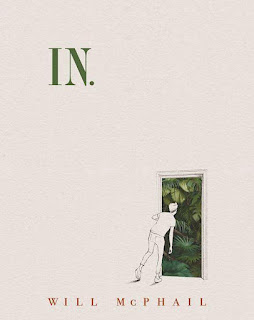
In. by Will McPhail

This graphic novel is just too damn good to be Will McPhail's first book-length project. He has to have a drawer-full of stuff, or maybe he's published short work somewhere. The drawing I completely believe; I've seen his cartoons and they're assured enough that I believe he could easily make the jump from single panels to juxtaposed images. But the story here? How does someone go from a one-line joke to a full-realized story of almost three hundred pages?

So, um, yeah, this is pretty good. In. is apparently the first long narrative Will McPhail has created, and it works from beginning to end.

It's about this guy, Nick, who lives in a big city (not unlike McPhail, who lives in Edinburgh, though this city is more vaguely New York) and works as an artist (also not unlike McPhail). He's got a sister, Anne, and a mother, Hannah, and early on he meets a woman, Wren, who could turn into a girlfriend if everything goes right.

But he feels like he doesn't connect with people, like he just skates across the top of conversations, saying generic things back and forth with people, and never gets to know anyone. He's not sure if he wants to get deeper into other peoples lives, but he feels like he's missing something, as if he's just play-acting at life. In fact, he's actually play-acting in the first contemporary scene of the book, as if this is how he thinks adults, or normal people, act with each other.

But then he connects, unexpectedly - he says something really honest and really listens to the answer. McPhail illustrates this conversation, and similar ones later in the book, as a surreal scene that Nick falls into - it's related to the topic, loosely and visually, but McPhail is not illustrating what Nick learns. Instead, he's showing what it feels like: a visual, comics metaphor for a deep human connection.

The rest of the book looks like McPhail's cartoons: line art with light washes of gray for emphasis and texture. But the surreal sections are fully painted, and striking every time they appear. (McPhail also signposts that a color scene is about to begin by zooming into the speaker's face and showing their eyes in color: another nice visual metaphor about seeing that only works in comics.)

I don't want to detail what the story is about from there: every story is in the telling of it. Nick does start out a bit immature, a bit unconnected - that's the point - and learns how to be different. Along the way, McPhail does things right both big (those surreal scenes, the overall flow of the book, all of the characterization) and small (a dozen throwaway joke names for coffee bars and alcohol bars, an amusingly arch depiction of Nick and Wren's first sexual encounter).

One of the most impressive things, particularly for a first book, is that I can point to something like a dozen things that McPhail does really well, and nothing at all that I'd seriously criticize. No book is perfect, but I'd be hard-pressed, even as a former editor, to point to anything in In. that I'd have red-penciled or asked for revisions on.

So: yeah. Really impressive. Thoughtful, deep, meaningful, lovely. Takes advantage of the comics form brilliantly, though I can still see someone wanting to turn this into a movie. (They'd probably screw it up, since it's already as good as it can be, but it would have four great parts to entice various actorly types.) If you haven't read it, you probably will want to.

Thursday, January 27, 2022

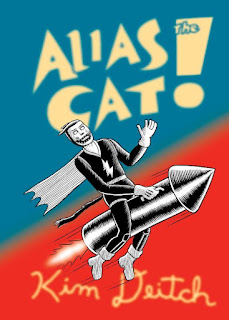
Alias the Cat! by Kim Deitch

I don't know if all of the Waldo stories are consistent. I don't know if they can be consistent, or if Deitch would want them to be.

I kind of hope they aren't, actually. Memory is flawed, history is misunderstood, the past is a mystery. And demon-creatures shouldn't be completely knowable, able to be nailed down to a specific timeline.

Alias the Cat! is a Waldo story: it's almost twenty years old now, but close to the last major Waldo story to date. It followed A Shroud for Waldo and The Boulevard of Broken Dreams (probably the centerpiece of the Waldo universe) and was in turn added onto by The Search for Smilin' Ed. Deitch's most recent book, Reincarnation Stories, is a similar style but doesn't include Waldo as far as I remember.

What does any of that mean?

Well, Deitch presents himself as an autobiographical cartoonist, one fascinated by popular entertainments of the early 20th century: cartoons, circuses, movie serials, comic strips, carnivals, and so on. Ephemeral stuff, things that are largely forgotten or lost. His big stories, for the last thirty years or so, tend to combine his discovery of some old piece of entertainment with a retelling of that old story - or the circumstances surrounding those people, or a complicated combination of the two. We get comics pages of Deitch talking to the reader directly, about the things he's discovered, and pages of him doing things in his life, and we also get stretches retelling the history he's discovered, or - as in this book - supposedly reprinting old comics by someone else from a hundred years before. It all combines together into fictions that mimic non-fiction, as surreal and supernatural elements are first hinted at and then leap into the center of the story.

They're impossible, and Deitch presents them all as if they're true. I'd say he presents them "straightforwardly," but he doesn't - Deitch portrays himself as excitable, eager to chase down these crazy ideas, as maybe more than a little bit naïve or gullible, someone always ready to believe in a great story.

Alias the Cat! is a three-part story: it appeared originally as three separate comics, in 2002, 2004, and 2005, and each volume has that Deitch energy and enthusiasm - each one has that air of "hey, look at what I just discovered!" They each end inconclusively, with mysteries left unsolved: even the third, even the end of this book and story.

Again, that's the nature of history, of the kind of stories Deitch tells. There's only so much Deitch-in-the-story can find out, only so much that has survived a hundred years. Only so much Waldo will tell, or allow to be told.

Waldo is a anthropomorphic character, like a black cat - call him Felix's evil twin, or dark doppelganger. He was a character in forgotten '20s cartoons, or a real creature impossibly in the real world, or a supernatural entity centuries old, or a hallucination only seen by the insane: he's all of those things in turn, or at the same time. He's a trickster at heart, a hedonist who has been everywhere and done everything and is ready to tell entertaining and possibly even true stories about those places and things.

As Alias the Cat! opens, Deitch-the-character insists he's never met Waldo, and that he's not saying that Waldo is a real person in the actual world. He likes Waldo stuff, and likes digging into these old stories, but he's not some kind of nut, he's not crazy - he can't see Waldo. All that will change by the end: meeting Waldo, being crazy, all of it.

Each of the three issues has its own arc and obsessions, from "furries" to Waldo's time as the charismatic leader of a tropical island, to a forgotten movie serial from the 1910s that strangely paralleled the actual events surrounding its release, to a forgotten New Jersey town populated entirely by midgets. Deitch-the-character keeps getting in deeper and deeper, more excitable and surprised by each new revelation.

This is all fiction, as far as I know. Waldo is not real, Deitch did not meet him, and meeting Waldo didn't send Deitch into a sanitarium for observation. As far as I know. But how far do any of us know?

Alias the Cat! doesn't end as well, as definitively as Boulevard or Smilin' Ed - it's an uneasy, uncertain ending, an ending about things that didn't happen rather than about the things that did. Maybe a disappointing ending rather than a triumphant one, but a true ending, an ending based on those bits of history and forgotten popular entertainments, and what's left of any of them in the modern day.

I don't know if I'd recommend starting reading Deitch here: I'd recommend running more or less in publication order, or starting with Boulevard if you want to jump forward to the big book. But this is a big middle piece of the Waldo saga; you'll get here eventually.

Wednesday, January 26, 2022

A Treasury of Victorian Murder, Vol. 1 by Rick Geary

I wrote about this book extensively just three years ago, during my last Book-A-Day run. And that post is a nice, straightforward explanation of what the book is, how it fits into Geary's larger career, and what a reader might get out of it.

I don't know if I can do better than that this time: you might want to just hit that link.

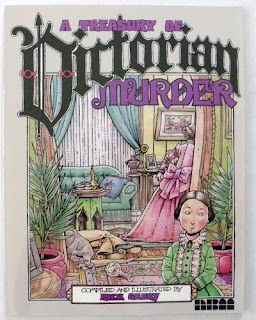
This time, writing about Rick Geary's A Treasury of Victorian Murder, Vol. 1, I want to look at the cover.

There it is: right in front of you. A cluttered High Victorian room, stuffed with things. So stuffed it takes a moment to notice the body sprawled on the floor; the woman stalking away to the right is more prominent. That's Geary for you: he'll promise murder, and deliver murder, but not be blatant about it. The murder is one thread of the story he wants to tell - the central thread, yes, the lurid thread, but all of the other objects in that room are just as carefully delineated, in his art and in his story.

And who is that in the foreground? I go back and forth: is that a child or a young woman? She could be sitting down, or she could be that short. She could be the murderess, or an innocent bystander, or a  neighbor whose unexpected visit caused the discovery of the heinous deed. Her face will not give away any of that: she's composed, but not calm. Is that a worried crease to her lips? What is she looking sideways at?

She's the one element of the cover that points outward to us the readers. She's our path into this image, our guide into the story we build in our own heads about the cover image. Perhaps I need to say here that it comes nowhere near the facts of any of the three stories in the book: it's clearly not illustrating anything within. This is a pure picture, a cover to be "A Treasury of Victorian Murder." The book will not tell us how to read this image. This cover stands alone: it implies a story Geary has not explicitly told.

It's also a moment: it's a comics cover, not an illustration. The figure at the front is glancing to her left; the woman in pink is stalking out of the room. There is motion throughout - this is not a static picture, but a moment in time, a moment that will be gone instantly. Something happened a second ago, something else will happen next. But what we have is this moment, as a window into this scene and this Victorian murder.

That's what Geary gives us. The cover is larger and more detailed than most of the panels in the stories inside - though not all of them; there are a couple of fold-out double-page spreads - but it's in their style and manner. This is what we find within: questions and moments, figures and mysteries, bodies and shocks, clutter and detail.

If the cover intrigues you, the book will do more than that.

Tuesday, January 25, 2022

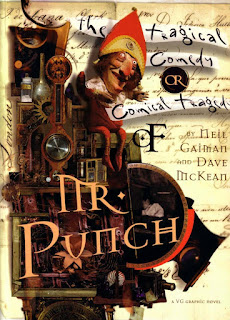
Mr. Punch by Neil Gaiman and Dave McKean

To me, the core Neil Gaiman stories are about young people, encountering things they don't understand. The Ocean at the End of the Lane. "How to Talk to Girls at Parties." Violent Cases. Coraline, something of an edge case - since the core set of stories are all about a young person like Gaiman.

And, of course, Mr. Punch.

I don't want to speculate how much of this story is "true." That's the wrong question anyway: the truth of a story is the story-ness of it, and this is a great story, told beautifully by Gaiman's words and Dave McKean's art. (I wish they had worked together more: they are each other's best collaborators.)

It's a graphic novel about a young British boy, about fifty years ago, remembered by that boy as a man, about twenty-five years later. So it's now as far back in time itself as the events it depicted were when it was published: this is a 1995 book about things that happened in the late '60s. The boy is Gaiman. Or he is not. Or, more accurately, that again is not the right question.

It's the story of how the boy learned about Punch and Judy shows, about his grandfather's failing seaside business, about family stories. Like all stories about childhood, it's about memory most of all: what is remembered, how it's remembered, what looms larger looking back than it did at the time. It is an intensely told story, constructed carefully by Gaiman even as it seems to be narrated off-the-cuff by the man in the story who is and is not Gaiman.

And, most of all, it's about the questions of childhood: the things you asked at the time, the things you wish you'd asked at the time, the things you know you never would have gotten a straight answer about, and the things you didn't even think could be questions until much much later.

Punch and Judy shows are alien to Americans: they don't exist here. I don't know if they exist in Britain, these days: I get the sense the boy in this book was from the last generation to see that kind of puppet theatre all over the place. So this might be entirely a dispatch from a foreign country: for all of us, everywhere.

That's entirely right, though: that was the point and purpose of Mr. Punch. It was always a dispatch from the foreign land of childhood, the land we all were born in and can never return to. And it's just as strong and thoughtful and moving now as it was then. Mr. Punch does not change with time, as Gaiman points out. He is always the same, always there, holding strong his side of the stage, eternally on the puppeteer's right hand.

Monday, January 24, 2022

Reviewing the Mail: Week of 1/22/22

One book this week: a publicity title that the publisher actually asked me if I wanted to see. (So I am feeling a certain internal pressure to actually read and post about it quickly, which is running up against my current six-week buffer on posts. Oh, modern problems!)

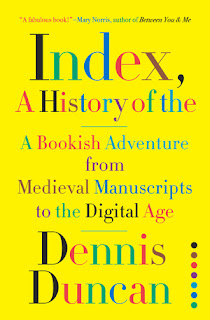
Index, A History of the is a new non-fiction book which does exactly what it says. Subtitle is "A Bookish Adventure from Medieval Manuscripts to the Digital Age," publisher is Norton, and it will be released into the wild on February 15 in hardcover. Author is Dennis Duncan, who teaches at University College London and writes for the usual classy outlets of that location (Times Literary Supplement, London Review of Books, Guardian).

It has a very impressive index of its own, as of course it must. The critical apparatus in general looks strong for a three-hundred-page book aimed at consumers: Norton knows how to make and publish books like this to an audience that wants borderline-frivolous topics treated seriously. (And I say that as a member of that audience.)

I expect this will be the next book I read, barring unforeseen circumstances: it looks like the kind of thing I'd enjoy.

Friday, January 21, 2022

Quote of the Week: Teas, High and Otherwise

Has there ever been a more English word than chutney? It's almost disappointing to discover that it's a name for a vinegary mush of spiced, preserved vegetables, and not, for example, an affectionate nickname given to the now-disgraced Earl of Lichmond-on-the-Blather by a beloved nanny. Part of the appeal is that it's an Indian word, coming to Britain in the days of English colonial rule and sticking delightfully to the tongue like itself on an en-Stiltoned cracker.
 - Fraser McAlpine, Stuff Brits Like, p. 86

Thursday, January 20, 2022

Dead Lies Dreaming by Charles Stross

I'm a year late and not as enthusiastic as I thought I would be: this will likely be short.

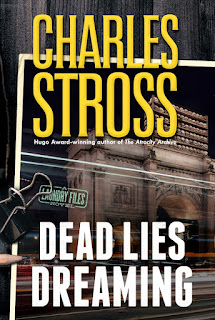
I've loved all of the previous books set in this world, but I had a hard time getting into Dead Lies Dreaming. This is not a "Laundry Files" book, partly because that government organization has been disbanded and partly because it's about other people doing other things. But I didn't think I was particularly invested in Bob Howard as a protagonist, or that particular government agency, so I was happy to dive into the story of some other people, relatively normal civilians, in a world sliding into a pick-and-mix of Lovecraftian apocalypses in the middle of the past decade.

(See my post on The Labyrinth Index for the most recent of the original series, and links backward to previous books.)

So: Nyarlathotep, more-or-less (an avatar of him, at least) is Prime Minister of the UK, which makes this world not quite as dystopian as you might think (human beings can still go about their lives mostly untroubled!) but still noticeably dystopian (pyramids of skulls in public parks! several other Lovecraftian death cults are jockeying for power, some apparently through mass sacrifices of their own!). Also, every bad thing about our real world is also happening in fantasy form, since Charles Stross is a mostly realistic writer who has never seen a horrible thing he didn't immediately incorporate into a novel.

(I've long wondered how he manages to get out of bed in the morning: his creative muse, at least as seen from the outside, tends to the bleakest of the bleak and the darkest of the dark.)

Living in this shitshow are our cast: four young people squatting in the ruins of a palace that used to belong to the family of one of them (Imp, Game Boy, Doc, and the Deliverator); an ex-cop now working in private security (Wendy); and Imp's older sister Eve, the personal assistant to a evil billionaire. (But I repeat myself.)

All of them are also sorcerers of some power, or possessors of mid-level superpowers, depending on how you want to look at it. This probably means all of them have extradimensional beings already snacking on their brains, because that's how power works in Stross's world, but they're young enough not to show any effects yet, and the real apocalypse could easily come along before the many-angled ones manage to eat too many brain cells.

Or they could die from other things: it's a dark, dangerous world. Living long enough for magical Alzheimer's to kill you can be seen as the good outcome. (Have I mentioned Stross's worlds are really really dark? I may be understating the case.)

I think their powers are all clear in Stross's head, but I kept mixing up the four squatters, and never quite got straight what each of them can do. It felt like several of them were mostly "really good at persuading people," though that's mostly their leader Imp's thing.

In fact, it took a long time to get the four squatters' names and personalities clear in my head: Stross jumps from real names to goofy code names to physical descriptors to emotional descriptors as he writes about them, and it took me a while to get that The Deliverator is Del is Rebecca is the Black woman. (Also, Imp is an asshole - charismatic visionary subcategory, so with an explanation, but still an asshole - and all of the four are damaged needy whiny bastards a lot of the time.) They also all get introduced in a high emotional register, so they emote madly at each other for the first two or three chapters in which they appear.

Anyway, these four people that I'm supposed to relate to but initially found deeply annoying and confusing are running a series of big robberies, despite a magic-powered surveillance state that uses summary execution as the answer to any crime more serious than failing to pay a TV license. They are doing this to fund a movie that Imp plans to direct, because of course he does. Their powers are sufficiently good that they have gotten away with it up to now, and have nearly what they need for the movie, so it's maybe One Last Job And Then They Can Retire.

Wendy runs into them during one of those robberies, causing a rapid transition from "cop attempting to catch them" to "co-conspirator and Del's new girlfriend," and their skills and some huge coincidences get all of them pulled into Eve's schemes on behalf of her horribly, horribly evil boss. There are also a few large men toting powerful firearms, who are mostly in the narrative to provide danger for a while until they get killed by each other or more horrible things. All of those characters travel through a house larger on the inside to get to a Dreamlands version of past London, where the big ending happens.

I liked all of the sentences, found the paragraphs pleasant, and read all the way to the end. But this one wasn't as compelling a read as some of Stross's earlier books have been for me: the characters weren't appealing enough to offset how dark and miserable his worlds always are. Frankly, I didn't like any of them all that much - Wendy was fine; I kept hoping she would bug out and find a more interesting plot among people less aggressively boho and whiny - and so wasn't as invested as I wanted to be in seeing them not get killed by the over-the-top combo of Peter Thiel, Harvey Weinstein, and Aleister Crowley that is the villain of the piece.

That all sounds like the definition of "a me problem." If you think you would be any more amenable to a boho retelling of Peter and Wendy in a crapsack mostly-contemporary Lovecraftian London, Dead Lies Dreaming is one of the best books to read as an introduction to Stross's no-longer-Laundry-centric world.

Wednesday, January 19, 2022

The Quantum Age by Jeff Lemire and Wilfredo Torres

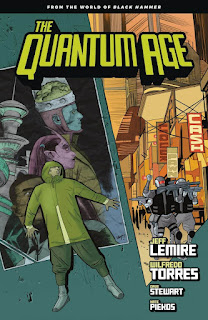
So it's Black Hammer time again! This one doesn't have "Black Hammer" in the title, but it's the next story in the series, following somewhat directly from Age of Doom, Part II, which presented itself as the big, final, absolutely definitive ending.

But we all know about endings in superhero comics, right?

Thus we come to The Quantum Age, written by Jeff Lemire (like all of the Black Hammer books) and drawn by Wilfredo Torres. This one features Lemire's take on the Legion of Super-Heroes, though, in this timeline, they're only one hundred years in the future instead of five.

(There is also what seems to be an unfortunately ham-handed, and awfully late, metaphor for Muslims post-9/11 dumped in the middle, which drives a lot of the larger plot but is badly explained and defined - the George W. Bush figure clearly has some kind of motivation, but it seems to be all in Lemire's head and not on the page.)

Anyway, we start with the bright, shiny happy future one hundred years on, with an interstellar polity of some kind defended by a big team of super-powered young people, including a really obvious Brainiac 5 type. (There's also clear versions of the original three Legionnaires, and more-or-less clear versions of a lot of others; as usual, Black Hammer is largely about reworking someone else's IP.) A new Black Hammer - Hammer Lass, who I mistakenly thought was the same Black woman legacy Black Hammer as the one before, but is actually a different Black woman legacy Black Hammer, which I should have known because her costume is somewhat different - appears near the end of the first issue to tease the same goddamn "what happened to the heroes who died in the not-Crisis?" story as every other book in the series.

But then issue two drops us into a crapsack future twenty-five years later, which we gradually learn was caused by a humanity-first genocidal totalitarian state led by a ex-not-Legionnaire, who took over, in some way the book never event hints at, after a massive Martian invasion. Apparently, when Earth was invaded by one alien race, that made all humans everywhere, or at least enough of them to utterly change society and government, immediately hostile to all other races everywhere in the galaxy, and most of them are being exterminated. Well, this is superhero comics: so it looks like that, but it may just be overstated for dramatic impact in the moment.

And we follow yet another new character, who gets the uniquely stupid name of Barbaliteen later on. Again, Lemire has an infinite universe, where he can create anything he wants, and he just keeps ringing obvious changes on other people's fifty-year-old stories for children.

Now, I have to spoil the earlier Black Hammer stories to complain adequately about this one, so stop reading now if that bothers you. You see, the end of Age of Doom II absolutely required the lost heroes to go back to their pocket universe, and stay there forever. It was the usual "needs of the many outweigh the needs of the few" stuff - very serious, very superheroic. There was no other option, Lemire told us there, very seriously: none of them could ever go back to the real universe in any way, for any reason, or the Anti-God would saunter back in and do whatever vague horrible thing Lemire never quite described.

But then the two of those heroes who stuck the rest of them in the pocket universe are back in the normal universe in this story, with no explanation. So the "you absolutely need to stay there or else Anti-God will eat the universe" is more of a possibility than a real thing, and the ones who did it all just quietly left the others behind to rot on a lousy farm with each other.

(Oh, one other character got out, somehow, but that's a separate spoiler, so I'll avoid complaining directly about that.)

So the story I thought was bullshit for one reason is now retroactively bullshit for an entirely separate reason. Does that make me happy? Well, happy is a sliding scale. I'd prefer that the whole Black Hammer saga make somewhat more sense and not be so obviously Lemire playing with other people's toys - there's glimpses of his serious style throughout Black Hammer, and if the whole thing wasn't so deeply self-indulgent, it could have been a lot better. This is one of those comics in which a lot of strong, true moments add up to nothing at all because the overall plot is a weird combination of second-hand, half-assed, and just plain silly.

Every time I read one of these books, it manages to annoy me in new and different ways. That's impressive, so I think I'll keep going to see just how many ways there are. I have faith in Lemire and the boundless childishness of the default superhero universe.

Tuesday, January 18, 2022

Go Figure by Tom Standage

I tend to be a stickler for credits, and am not always complimentary when a book plays fast and loose with them. On the other hand, sometimes I complain about things that are super-minor, which is silly.

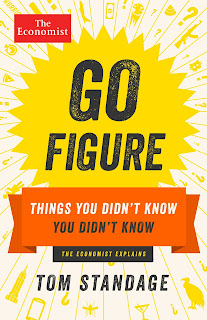
So, let me try to be measured here. Tom Standage is credited as the author of Go Figure, a collection of explainer articles that originally appeared separately in The Economist in the handful of years leading up to 2016. Standage was Deputy Editor of The Economist for that period; he was responsible for this department. However, it says in this book that he did not write all of these articles - there was a team who did this regularly, possibly including researchers on top of actual writers - and it's not entirely clear if he wrote any of the pieces from a blank page, or if he was primarily the editor.

If the book said "edited" or "compiled" by Standage, or by Standage "with" or "and" some way of defining that team, that would be fine; it would be clear and descriptive. What annoys me is one person standing up and taking credit for something I'm pretty sure was a group effort.

Of course I could be wrong: maybe I misunderstood. Maybe Standage did write all of these articles from scratch, however often they appeared, for several years, and then compiled them into the book in 2016. If so, it's entirely reasonable to only list him on the cover.

But I'm pretty sure that's not how it happened.

The book itself is slightly out of date at this point: journalism dates quicker than most non-fiction, though explainers are more shelf-stable than breaking news. But it's all, as far as I can tell, still accurate - there may be more details about many of these areas, but I didn't see anything that was superseded.

It's organized into a number of rough categories, which are fairly vague: the first two sections are "things you didn't know you didn't know" and "things you've quietly always wondered." It gets a little better-defined from there, which sections on differences between countries, economics and numbers, leisure and sport, newish tech (mostly Internet-related), and science. Each section has around fifteen articles; each article is about two book pages - Standage says in his afterword that the format is to write in four paragraphs, and I bet there was a target word-count, too. (Which he does not mention.)

It is from The Economist, so it has their biases deeply embedded in it: capitalism is the greatest good of all time, everywhere in the world, and economic analysis will always provide the correct answer, no matter what that means for actual human beings or what insight other kinds of expertise might bring to a situation. A reader can get a lot of interesting data and ideas from the book, as long as that very clear bias is kept in mind.

Monday, January 17, 2022

Reading Into the Past: Week of 1/17/02

As usual: on Monday, if I have new books, I write about them here. If I don't, I pick a random year in my reading notebook and try to remember the books I read this time that year. (How much do any of us remember about things we did ten or twenty years ago? It is an odd exercise, I admit.)

This time, our number is 2002:

Julianne Balmain, Office Kama Sutra (1/10)

Before I look it up, I'm going to assume that I read it because of that title, and also that I found out about it through work. I have a sneaky suspicion that QPB offered it: it's got their kind of title.

And...it is exactly what you'd expect from the title: a tongue-in-cheek guide, written in faux-Orientalia, about pursuing nooky in the office. I suspect 2002 is awfully late for a book like that; it would not fly now, even written by a woman (and illustrated by another: Thorina Rose). It looks amusing, but, these days, it would be a race between being condemned for cultural appropriation and being condemned for making light of workplace sexual harassment.

Michael I. Meyerson, Political Numeracy (bound galleys, 1/11)

I was still a Good Republican in 2002, though I was wavering. So this may well be a "why lefty economics never adds up" book, though I hope not. Let me check.

Nope: looks like this was more of a follower in the school of Freakonomics: applying scientific rigor, at least in theory, to some thorny policy questions to find Provable Right Answers. A lot of people thought that was possible, in that technocratic time, but that thread in American discourse seems to have mostly disappeared: right-wingers aren't interested in objective facts or science to begin with, and left-wingers are coming from a different direction.

It looks like Meyerson was either using political issues to explain mathematical concepts, or using mathematical concepts to show how political issues could be solved in a roughly utilitarian way, and I don't think anyone took the hint.

Kazuo Koike and Goseki Kojima, Lone Wolf & Cub, Vol. 16: Gateway Into Winter (1/13)

This was just past the half-way point of the samurai epic, which was collected in twenty-eight volumes. Even if I read dug out the descriptive copy for this book, I don't think I could say anything coherent about this specific piece of the larger story. I did think the whole series was excellent, and I'd read it again if I hadn't lost all of those books in my 2011 flood. (Buying twenty-eight books for a re-read is more than I feel up to at the moment. Maybe someday.)

Doron Swade, The Difference Engine (1/15)

I had to look it up, because my mind kept going to the Gibson/Sterling book of ten years earlier. This is a non-fiction work about Charles Babbage and his machines, and, knowing that, I can vaguely remember reading a book about that at some point. (This one, presumably: unless I've read multiple books on Babbage without keeping track, which is unlikely but not impossible.)

Swade was assistant director of the Science Museum in London, and led the team that built the first working Difference Engine in 1991. (So I'm pretty sure this is the book I'm remembering.) As I vaguely remember now, it's Babbage's story, not Swade's -- there might be an intro or something about his team's work, but the book itself is a conventional this-one-interesting-thing-in-history kind of book.

Calvin Trillin, Tepper Isn't Going Out (1/16)

This book I actually do remember! Trillin has only written a few novels - Barnett Fummer Is an Unbloomed Flower, a very hippie-inspired book from the late '60s, Floater, a very newspaper-inspired novel from 1980, and this one, a very New York-inspired book that was new at the time.

Trillin is a great writer, funny in a wry way no matter what he's writing, and I remember this as one of his best books. It is deeply frivolous - as I recall, he referred to it as a the only novel ever written about parking. Tepper is a guy who likes to read the newspaper in his car, and inevitably, people ask him if he's leaving that spot. He isn't. I believe he becomes local-famous for this, and the plot escalates from there: silly, parochial, and specific, all things Trillin is good at.

Richard Stark, The Score (1/17)

This is the fifth of the Parker novels; I may have been trying to read through them at the time. A decade later, in 2013, I read and reviewed the entire series in the puckishly titled blog series "Starktober." (No points for guessing what month it took place in.) So let me just link to my more detailed post on The Score.


Immediately before that, I finished Jorge Luis Borges's Selected Poems (no memory at all). And right afterward I had some reading for work: a two-book Star Trek: Stargazer series by Michael Jan Friedman (I don't remember what Stargazer was; my guess is a book-only series with some new characters) and then R.A. Salvatore's novel Transcendence (I'm sure it was part of some series; but I'd have to look it up.).

Friday, January 14, 2022

Quote of the Week: Always Someone Else's Shout

I've had to explain some of the peculiarities of British English swearing to my North American colleagues on several occasions. Those most often eliciting a degree of bafflement are tosser, wanker, and twat, so for the sake of North Americans reading this, here's my handy guide.

[description of buying rounds in a pub excised: the important bit is that you're supposed to buy at least one round for the whole group, on pain of social opprobrium]

So, with this in mind, let's meet Adam, Barry, and Chris.

  • Adam has forgotten his wallet tonight. He has to borrow some money so he can get a round in. Adam is a tosser.
  • Barry has forgotten his wallet but makes no attempt to borrow money. He drinks but doesn't buy a round. Barry is a wanker.
  • Chris always "forgets" his wallet, accepts a drink at every round and then tries to cadge some money for a kebab on the way home. Chris is a twat.

 - Emma Bryne, Swearing Is Good for You, pp.19-20

Thursday, January 13, 2022

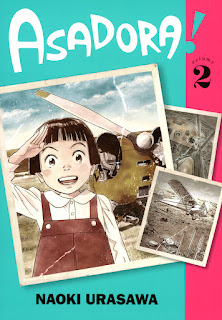
Asadora!, Vol. 2 by Naoki Urasawa

Middle volumes are tough to write about, particularly for a series that the reader expects will run for a while. For the fairly early books: how do you tell what will be really important in the end, and what's just scene-setting? For the books deep into the series: how do you even describe what's happening among characters with hundreds of pages of backstory?

Asadora!, Vol. 2 is a middle volume - the first middle volume of this series, he said puckishly. Like the first book, it's by Naoki Urasawa, a highly respected manga-ka whose work I'm only vaguely familiar with. My post on the first book is scheduled to go live in three days as I write this, so I am hoping I remember to turn some of the words in this sentence into a link. (If I didn't, I apologize. Use the search function.)

The series centers on Asa: she was about nine in the first book, set in 1959 during a massive typhoon. From some narration in that book, I believe the series will follow her up to something like the present day, likely hitting just a few major events years apart. And I think "events" will mostly be disasters. There's a Godzilla-sized monster that has not yet been clearly seen, lurking around the fringes of the story - it's a good bet to assume that will cause some more disasters.

In the aftermath of that typhoon, Asa teamed up with her kidnapper - it was a pretty weird mentor/mentee meet-cute, I guess, but Urasawa made it plausible - to semi-commandeer a small airplane to airdrop food parcels to people stuck in floodwaters. Urasawa depicted the authorities, at least the local cops, as either completely incompetent or just entirely overwhelmed, completely unable to cope with the size of the disaster. But one girl and one critically-injured thief, supported by a street of rice-ball-making shopkeepers, could feed a huge swath of Nagoya.

This second volume picks up in the middle of that rescue effort: it's a few moments later, on the same day, as the end of the first book. Asa and Kasuga (the kidnapper) are still air-dropping rice-balls to survivors, but other dramatic events interfere with that as the book goes on.

Well, actually, there's a chapter before we pick back up - a team of scientists are in a jungle somewhere, looking for something, and arguing fiercely about whether they should keep going or turn back. (It is a bit cliched, I have to admit.) And then they see a tree with a gigantic claw-mark - dun dun DUNNNNNN!

This book ends the 1959 episode, with Asa finding some survivors important to her and getting something that will be major in her life. That takes about three-quarters of the book; the rest begins a new episode, set in 1964. (The year of the Tokyo Olympics, in case we have forgotten.) Asa is now a teenager, and has somewhat different problems. Kaguya is still around, and his past is causing complications.

Oh, and the Godzilla-sized-thing is still out there: a few more scraps of evidence pop up just before the end of this volume, and there's a connection back to that squabbling-scientists first chapter.

At some point, Asa will be flying a plane around or above that monster, probably dropping something on it. But that has not happened yet. Maybe next volume it will attack the Tokyo Olympics!

This is zippy and fun, but it's not clear where it's going or how long getting there will take. Are we going to get ~350 pages for each episode, and will those episodes be set about five years apart up to the present day? If so, that would imply Asadora! could be as much as 7000 pages and thirty-five volumes. But those are massive assumptions; it could be a lot shorter. (It could, I suppose, actually be longer, too - manga is a format that is not afraid of multi-thousand-page stories.)

So far, there's a whole lot of mystery, a whole lot of spunky-girl stuff, and very few answers. That's fine for a beginning, but the balance will need to tip at some point: I hope sooner than seven thousand pages from now.

Wednesday, January 12, 2022

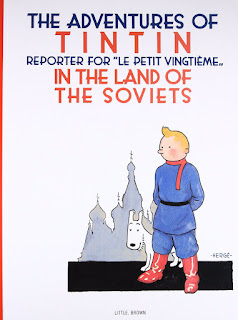
The Adventures of Tintin, Reporter for "Le Petit Vingtieme, in the Land of the Soviets by Herge

OK. Going from the mature peak of any art form back to the earliest examples is going to be a big surprise. And if it's all by the same creator, it's not fair to compare the early stuff to the really good stuff.

But, boy howdy did Herge get better over his career.

I finally dropped all the way back to the beginning of the Tintin series, the inimitably titled The Adventures of Tintin, Reporter for "Le Petit Vingtieme," in the Land of the Soviets, originally serialized in the newspaper advertising itself in the title during 1929 and 1930. And it is....not nearly as well-done, in every possible way, than even Tintin in America, which came just a few years later.

On the positive side, Tintin does actually seem to be a a reporter in this book, though that's mostly an excuse for his travels: he does spend one night frantically writing something that he never manages to file. (And never does anything else reporter-ish, like talking to people and taking notes, or even having a dispassionate view of anything he encounters.)

Soviets is a really weird model for the rest of the series: it's nearly three times as long as the others (138 story pages) and reads like a run-on sequence of very slapstick newspaper adventure comics from ten or twenty years earlier. There's no depth of characterization, none of the verbal wit Herge developed later, and the art is quicker and sketchier, possibly because of the newspaper publication.

Instead, we get agitprop. Did you know the Soviet Union was bad? It's bad. Really bad. Tintin is sent on an assignment to Soviet Russia to report on something, or maybe everything - this isn't particularly clear, maybe since it was just a thin excuse to send him in that direction. Immediately (on page 2) a scruffy commie tries to murder Tintin, since - we will hear this over and over - the USSR is one big Potemkin village, where everything is horrible in every way, and if right-thinking Belgians (well, maybe other people elsewhere too, but who cares about them?) knew the truth they would be shocked and appalled, which would lead to something unclear.

The plot follows that initial impetus: Tintin is traveling, first to get into Russia and then to get out of it, while various dirty commies try, sometimes with massive military force and sometimes with sneaky sabotage, to murder him. Several times, for variety, they capture him, tie him up, and threaten to murder him slightly later.

None of this is successful, obviously, since he went on to star in twenty-three more books over the next fifty years or so. This is partially because the narrative is so clearly on Tintin's side that nothing can harm him, and partially because this (twelve-year-old? I guess?) little blonde kid can beat up absolutely anyone and everyone he comes across, probably because his heart is true and they're all dirty commies.

This is not good. It is amusing for anyone who can avoid taking it seriously. It moves very quickly, with that Perils of Pauline-style one-damn-thing-after-another plotting, and a reader will not be bored. (Annoyed, maybe. Baffled, possibly. Bemused, if they're lucky.) It is primarily of interest for people who know the mature Herge and want to do a compare-and-contrast, and possibly for fans of social history who want to see a master-class in fear-mongering.