Wednesday, July 05, 2017

Pulse by Julian Barnes

I discovered Barnes, and burned through all of his books to that point, before I started this blog, so I don't have links for the novels of his that I love best -- A History of the World in 9 1/2 Chapters or Flaubert's Parrot or Talking It Over or England, England. He's a literary writer, in the sense of being both deeply concerned with real people living real lives and having a strong ear for language and clean writing. His books occasionally have semi-flashy organizing principles -- and he's written novels about love triangles at least three times I can think of -- but his work isn't flashy or shocking in itself, unlike his contemporaries Ian McEwan and Martin Amis. I guess he's an old-fashioned post-modernist, if that makes any sense. But I've been reading his novels and story collections, mostly as soon as I know they exist, for nearly three decades now.

And, as I get older, I gravitate to nonfiction by novelists, and maybe novelists do that, too -- so Barnes had a collection of essays for Americans about the UK a decade ago, Letters from London, and has followed that up more recently with a pair of spare books about death and aging and facing the inevitable (and ballooning, because that's the way Barnes works), in Nothing to be Frightened Of and Levels of Life. I could also mention the essay collection Through the Window, mostly about writer.

Anyway, that partially explains why his story collection Pulse has sat neglected on my shelves since 2011. (Two successive copies of his 2005 novel Arthur & George have done so for even longer.) Short stories, at least for me, seem to take more mental energy to read than a novel of the same length -- so much stopping and starting, so many endings to process. But I did grab this book, eventually, probably because it was short and I appreciate short books a lot these days.

Pulse contains fourteen stories -- nine in one section, five in another. I'm not really sure what the difference is, or why Barnes didn't just arrange them all in one list, but I'm sure he had his reasons. All of the stories are short -- the title story, at the end, tops out at nearly thirty pages -- all of them are about regular people in the real world (the UK portion of the real world), entirely mimetic and entirely low-key. Barnes shows rather than tells: he's in some of the character's heads, some of the time, but he's mostly showing us what they do and how they interact with each other.

This is exactly the kind of literary fiction, to be precise, that genre readers complain about. No detectives, no time-travel devices, no sexy redheads, no intrigue, no unicorns, nothing numinous or flashy or pulse-pounding. The pulse of Pulse is a measured one, a seasoned runner going at pace and knowing well the distance he's going to cover.

So most anyone who could conceivably be reading this blog is not going to be interested in this book. That's fine: thousands of books are published each year, and each of us would enjoy far more of those than we'll ever have the chance to read anyway. It's good to know our limits. If this is outside yours, good for you.

My limits follow a more complicated set of markers, which can be frustrating: the things I look for in books don't track cleanly to genres or styles, and sometimes I think there's nothing coherent in those limits at all. (And that might be true: what any of us wants to read today will be a bit different from what we wanted to read yesterday, and could be vastly different from what we'll want to read in ten years.) But, when I do want to read fiction, I want to care about the people -- I want to believe in them.

And I have always believed in Barnes's people. Even when he's avoiding writing about his own grief by telling stories of 18th century ballooning, or when he's sketching a whimsical history of the entire earth in short vignettes that barely have characters in them, each individual is real and round. So I keep coming back. And I was happy to meet the people in these fourteen stories, and to live alongside their lives for a while. What more can you ask from fiction?

Tuesday, July 04, 2017

Great Plains by Ian Frazier

Ian Frazier is a long-time New Yorker writer, and one of the few who straddles the line between the two kinds of writing they're known best for: serious, boots-on-the-ground reportage full of checked facts and quotes, on the one hand, and whimsical, throw-these-two-odd-facts-together-at-high-speed humor pieces. So he's both John McPhee and S.J. Perelman, alternately. (Calvin Trillin is somewhat similar, but he's spent the vast majority of his career on the silly side, and is not as strongly identified with the New Yorker to begin with.)

Luckily for me, I like the work of both Fraziers. I think I discovered him on the silly side, with his classic collections Dating Your Mom and Coyote V. Acme (I think I found both of them remaindered at a mall B. Dalton after Christmas some time in the mid '90s), and followed him through the newer books Lamentations of the Father, The Cursing Mommy's Book of Days and Gone to New York (which isn't exactly a humor book, but is closer in tone to those than to his serious reportage).

But at some point I discovered there was a serious Frazier as well, and figured I should give that one a try, with Travels in Siberia and Family and now this book. In fact, I've been mostly working backwards through Frazier, since Family was a mid-90s book and this one came along in 1989, his first big reported book.

I should probably officially say here that "this book" is Great Plains, in case this post ever gets separated from its title. It's a look at the region of the title, the vast grassy plains in the middle of our continent (well, it's mine and Frazier's; I don't know where you live), from a personal and historical and random-facts point of view. Frazier lived in Montana for three years -- researching this book, more or less, or at least that looks like the reason three decades later.

It's not a long book -- the text ends on page 214 in my edition, though the notes and index run until page 292 -- and is only loosely organized. Frazier was interested in the history of this vast region, and in particular about the Native American groups that lived there. Well, interested, from the evidence of this book, about the end of their time there, since history is all about times when things change and people die.

So Frazier drove around the Plains states, in extended journeys over several years, talking to historians and old folks and random locals, to learn as many things as he could and piece them together his own way. He tells that story afterward, with no obvious organizing principle -- he could have gone by state, or traced each of his journeys, and worked historically, but didn't, in any case. Instead, he tells stories about the Plains in what feels like a natural way, as if each one was coming to him in turn. Great Plains was certainly more carefully constructed than it appears, but it appears simple and direct, like a two-lane road across a great plain.

The main criticism I could see of Great Plains is that it's like Gertrude Stein's Oakland: there's no there there; it's a book that wanders aimlessly down back roads, real ones and historical metaphors, for a while until it ends. But I think that was the point, and it's not useful to criticize a book for doing exactly what it sets out to do. (Noting that aim, and the success at achieving it, is entirely reasonable.)

This isn't my favorite Frazier book, even on the serious side. Family is more unified and Tales from Siberia has more outrageous stories from an even larger, even more harsh plain on the other side of the world. But as a first serious book from a then-young author, it's an impressive achievement. And it might well be better to people who know those plains themselves.

Monday, July 03, 2017

Reviewing the Mail: Week of July 1

Here I am again, with a list of books that came in to my mailbox over the past week, hoping that some of you will find something new and fun to read. I haven't read these books myself -- I may, someday, but I don't read as fast as I did when I did it for a living.

This time out I have two books: one paperback and one hardcover. I'll take them in that order, purely because that's how they're currently stacked.

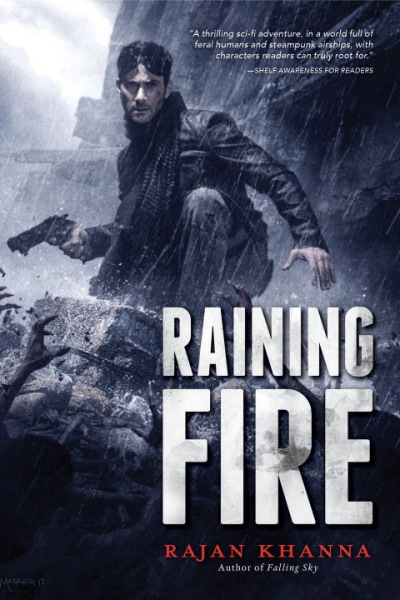
The paperback is Rajan Khanna's Raining Fire, coming from Pyr on July 18th. It's the finale of his post-apocalyptic trilogy about Ben Golds, one-time airship pilot. The first two books are Falling Sky and Rising Tide. If you like steampunk but aren't crazy about the Victorian era, this series might be exactly right for you -- why not give it a try?

The hardcover is the start of a new trilogy from Nancy Kress: Tomorrow's Kin. It's from Tor, coming July 11th, and expands on her Nebula-winning story "Yesterday's Kin." Kress expanded another award-winning story into a trilogy some time ago with Beggars in Spain, which turned out pretty well: I wouldn't be surprised if she does it again. This one is a first contact novel: an alien ship has touched down in New York harbor, speaking English in a mechanical voice, willing to speak only to the United Nations, and demurring to leave their ship at all. As usual, one obscure scientist, called to meet with the aliens, is our viewpoint character.

Saturday, July 01, 2017

Read in June

We're now halfway through 2017, which is a hopeful sign -- if we can make it through these six months, we can make it through anything. I avoided thinking about the outside world, somewhat successfully, by reading these books:

Hope Larson and Rebecca Mock, Compass South (6/1)

Ian Frazier, Great Plains (6/2)

Julian Barnes, Pulse (6/5)

Daniel Clowes, Patience (6/8)

Sylvie Rancourt, Melody: Story of a Nude Dancer (6/12)

Isabel Greenberg, One Hundred Nights of Hero (6/13)

Zander Cannon, Kaijumax, Season One: Terror and Respect (6/14)

Frederik Peeters, Aama, Vol. 2: The Invisible Throng (6/15)

Matt Fraction, David Aja, and others, Hawkeye, Vol. 1 (6/16)

Charles M. Schulz, The Complete Peanuts, 1999 to 2000 (6/20)

Mike Dawson, Troop 142 (6/21)

Sara Varon, Sweaterweather (6/22)

John Darnielle, Universal Harvester (6/27)

Andi Watson, Princess Decomposia and Count Spatula (6/28)


That was the month of June, as I type this, it's just before noon on the first day of July, and I'm going to set this to post at the usual time (twelve hours ago). I expect to keep reading books and writing about them; I hope you, too, will keep doing the things you enjoy and make you happy.

Friday, June 30, 2017

Quote of the Week

In most lives, in most places, people go missing. This isn't as true as it was in a less connected age; people see more of their high school classmates on Facebook every day than they previously would have in their entire lives after graduation. Lonely husbands or wives form secondary accounts to keep track of lost loves and secret prospects; short of catastrophe, these points of contact never wholly erode. They may go ignored for months or years, but they crackle away in the cables, never wholly out of reach.
  - John Darnielle, Universal Harvester, p.205

Wednesday, June 28, 2017

Aama, Vo. 2: The Invisible Throng by Frederik Peeters

We're continuing a space-opera series in comics form here: my understanding is that there are four books in this series, and that it has all been published, originally in French and also in English translation. (I could be wrong.) So, if true, this book sees us halfway through, and the ending would tend to reinforce that: things have gotten really serious by the last page, and so I'd expect them to get more serious (and worse) in the third book before somehow concluding in the end.

Maybe I should mention what this thing is, though? That could be useful.

The series is Aama, this second book is The Invisible Throng, and the author is French cartoonist Frederik Peeters. The first book was The Smell of Warm Dust, which I reviewed, quickly, in a monthly round-up last year.

There's still some flashing back this time out -- to flesh out our main character's past, and his retrograde relationship with technology -- but, for the bulk of the story we're solidly on the desert planet Ona(ji) with amnesiac Verloc Nim, his possibly mad-scientist brother Conrad, Conrad's servitor robot (in ape form), and the local group of scientists who came here to do their researches far away from anyone who might interfere. Yes, very Forbidden Planet, or like a thousand other similar stories -- there are clearly people here who have been meddling in realms where God told them not to, and it will not turn out well in the end for everyone.

For now, though, we're still not entirely sure what the Aama project was doing -- something about AI, something about organic growth -- and what exactly it did, though signs are what it did is "a lot" and "entirely out of anyone's control."

That project will be more and more important as the series heads towards a conclusion, I'm sure. But it's also about Verloc, who I hope will get more of his memory back, and about his brother, who has a connection to Aama that I'm still not sure about.

So far, Aama is a smart, adult SF story in comics form -- it does have some pulpy tropes, admittedly, but the characters are good and their relationships are realistically complex and true. I'm hoping to find the rest of it, and find out just what this Aama thing is, and if any of these characters will make it out the other side of their encounters with it.

Tuesday, June 27, 2017

Kaijumax, Season One: Terror and Respect by Zander Cannon

I tend not to give up on things, so in my head Zander Cannon is still in the middle of a really long hiatus from his early and excellent fantasy series The Replacement God. (Yes, that hiatus is now twenty years long. But Mage: The Hero Denied was finally announced recently, so decades-old thought-dead things I really like do come back.)

For everyone else, he's more likely best known as the artist of Top 10 and Smax in Alan Moore's most recent stab at a superhero universe, back in the early Aughts. And his most recent solo book was the dark adventure Heck, which I liked a lot: Cannon is a real talent, both as a writer and a draftsman, so I wanted to see more from him.

So why did it take this long for me to get to his not-all-that-new-anymore ongoing series? This collection -- Kaijumax, Season One: Terror and Respect -- is nearly a year and a half old at this point, and a second series has had time to come out and get collected since then.

Well, I was looking for it. I wanted to poke through it in person before buying it, and I'd never seen a copy in front of me. Finally, I just broke down and ordered it through the library -- have I mentioned that I have a NYC library card these days, and that system has a ridiculously large number of books that they're happy to deliver to a location less than a block from my office? And so, now, I've finally read it, and am almost caught up with Cannon.

The title explains the premise: this is a world full of giant monsters (kaiju, in Japanese), of many different types, and they seem as hard to kill as in most monster movies. So there needs to be a place to put them after the army, or Ultraman, or whoever, has stopped them from destroying the other half of Tokyo and more-or-less captured them. That place is an unnamed Pacific island, now just called "Kaijumax" -- a maximum-security prisoner for monsters, guarded by guys and gals in Ultraman-style super-suits that let them instantly grow to monster size for smackdowns when needed.

So, yes: it's a prison story about giant monsters. In comic-book form. Cannon's afterword notes that many people would find all three of those things silly, but he loves all of them, so sucks to their assmar. (He's somewhat more polite and felicitous in his phrasing.) But a reader does need to be ready for that -- Cannon isn't joking or goofing around; there are silly things here but they're taken basically seriously, in a world where they're not as silly as they would be in ours.

As usual in a prison story, our focus is on the new guy -- the innocent guy. This time, it's Electrogor, a sea-dwelling giant monster who was trying to find food for his two kids when he ran into a human ship and things went bad. He never attacked a city, he never tried to destroy much of anything. But he was found, and caught, and now he's in monster prison. And those two kids are outside, and the best case is that they're still at home and getting really hungry. Electrogor wants to be helpful and nice and get out quickly...which never works in a prison story.

He learns better, more or less, and plenty of other things go on around him in the six issues it takes him to learn what he does. Terror and Respect has an ending that fits that "Season One" note -- not a real end, but a good place to break for the summer, to come back for more stories with a somewhat different emphasis.

Kaijumax is another fine comic from Zander Cannon, and I hope it's a huge success: the season structure means it can't run forever, right? And that means, once it's a massive crossover bestseller and millions are lining up for the next Zander Cannon joint, the time will be right for that Replacement God revival!

Well, a man can dream, can't he?

This is a fun series: serious but not self-serious, with vivid characters, interesting dilemmas, and a quirky and unique world. I'm going to enjoy it for as many seasons as I can get.

Monday, June 26, 2017

Reviewing the Mail: Week of 6/24

Back again!

As usual, this is the place where I list books that have arrived in my mail the past week, sent by the hard-working publicists of the book industry. I haven't read them, and I can't promise I will read them -- there are a lot of books in the world, and too many of them are on my shelves -- but here's what I can tell you about them.

Twelve Days is the new novel by Steve Barnes, who's had a long and varied career, mostly in speculative fiction of one kind of another. He's written bestsellers with Larry Niven and a mystery series with his wife, Tananarive Due, plus screenplays and other stuff. This time out, he's got a book that sounds like it starts as a thriller, with an ex-Special Forces soldier coming home to commit a big crime with his former squaddies -- at the same time a local martial-arts teacher might have uncanny abilities and a global terrorist organization is claiming responsibility for a sudden series of unexplained deaths of well-known leaders and criminals. I don't know what the Maguffin is here, but it's clearly not mundane -- something big and weird is happening, and, I expect, the thriller plot means our ex-soldiers-turned-crooks are going to have to be the ones to save the world. This is a Tor hardcover, available June 27.

Also from Tor in hardcover on the same day is R.S. Belcher's The Queen of Swords, latest in the steampunk/Wild West series that includes The Six-Gun Tarot and The Shotgun Arcana. This time, the focus is on Maude Stapleton, a woman with a hidden past -- membership in a secret global society of assassins, to start out -- who has to get back into her old world when her daughter is kidnapped.

Thursday, June 22, 2017

Hawkeye, Vol. 1 by Matt Fraction, David Aja, and others

I don't keep up with superhero comics anymore -- I have to admit that. Astro City was probably the last thing in that vein I read regularly, and even that was only as "regularly" as Astro City itself was...and that's not very. Eventually, I even soured on that comic.

At some point in your life, you either realize that punching people is not the solution to problems, or you become a full-blown psychopath. For all my flaws, I'm on the first path.

All that is to explain why I never bothered to read the Hawkeye run written by Matt Fraction and mostly drawn by David Aja, despite it being pretty much assumed to be the best superhero comic while it was coming out (2012-15). Even if something is the obvious best sushi in the world, it doesn't matter if your taste for seafood has gone.

But time marches on, and curiosity keeps building. And there's always time for one more book, especially one that's a few years old and no longer the hot new thing. So I finally did get to the hardcover collecting the first half of that Fraction-Aja Hawkeye run -- eleven issues of that series, plus a loosely related issue of Young Avengers Presents as a kind of flashback.

(That Young Avengers Presents issue comes off very badly by comparison, even with strong art from long-time expert ink-slinger Alan Davis. It's very much Yet Another Superhero Story, in the middle of a big stupid story that people didn't even care that much about at the time, with the bog-standard angst and drama and Whining About the Relationship. It's everything "good superhero comics" usually are, and a major exemplar of why I stopped reading that crap. In a nutshell, it's a story about costumes being moved around a chessboard, not about people or real relationships.)

The main Hawkeye story, though, is about people. Mostly Clint Barton, the least of the Avengers, whose origin is a bizarre amalgam of Robin I and Green Arrow and whose "power" is just being good at shooting arrows. And who isn't actually all that good at the living-normal-life thing, for reasons Fraction wisely doesn't explore -- he just takes Barton as the overgrown boy he is, stumbling through his own life like a bull in a china shop, getting into trouble just because that's what he does when left to his own devices. The trouble here is mostly about a Brooklyn tenement that he semi-accidentally bought (with stolen money from the Marvel Universe's biggest gangsters), to drive away a low-rent Russian gang he calls the Tracksuit Draculas. Again, his plans mostly don't work, or don't work right, and he needs to be saved repeatedly by the women in his life. Which brings us to....

There's also a newer, younger, female Hawkeye -- always have to have a non-cishet-SWM person in the costume these days, and pretend that person will "always" be the "real" holder of the shiny superhero title, as if we haven't seen a million "always" melt away in a million comics. (I think that's mostly cynical audience-pandering, but it's hard to tell in individual cases -- and every superhero-universe character gets handled by so many people that they turn into river-stones, rubbed down to an essence that no one person intended.) She's Kate Bishop, and I have no idea why she's so good at shooting arrows, or why she went into the superhero game -- she seems to have as few powers as Barton, and many more options. (She's some variety of rich girl, as far as I can tell.)

But this is a superhero universe, so dressing up in tight spandex to jump around rooftops and beat up thugs is just what you do. Apparently no other entertainment media exist in this world, so this is the only thing to do to keep oneself occupied.

These are, as I said, mostly low-level superheroics. Neither Hawkeye saves the world, and the globe-trotting is more spycraft than Galactus-defeating. Aja's art is perfectly suited for that level, and tells the story brilliantly, well aided by Matt Hollingsworth's colors. (There's also a two-issue story by Javier Pulido and a single issue by Francesco Francavilla here -- both are good, but flashier than Aja and so they stand out too much for my taste.) Aja reminds me of nothing so much as David Mazzucchelli's classic superhero period, particularly Daredevil and Batman: Year One. There's a similar grounded-ness, with thin lines that frame often violent action without rationalizing it -- keeping it shocking and unexpected even in the middle of a story designed to showcase violent action. It's strongly compliments Fraction's similarly grounded writing: both of them are committed to telling a story about people in a real world, moving through real space, whose actions have consequences and who bleed and feel and curse and laugh and wryly shake their heads.

Aja also delights in complex page layouts -- or his ability energizes Fraction to create them, either way it's a strong collaboration -- which make the world part of the story, and not just flat backdrops for more punching. An issue told from the POV of a dog is particularly impressive, and probably hugely well-known by this point.

You don't need to read Hawkeye. You never need to read any superhero comic, no matter what they tell you. But, if you do want to read about superheroes., this is miles closer to the real world than most.

Wednesday, June 21, 2017

One Hundred Nights of Hero by Isabel Greenberg

I really do not want to be that guy. One Hundred Nights of Hero is a lovely book, with gorgeous art and compelling words, and it's another great success from the author of The Encyclopedia of Early Earth. It retells the story of Scheherazade in Isabel Greenberg's invented cosmology, putting a feminist spin on the frame story and the tales Hero tells to make it something new and unique.

It's a good book and a strong book and a smart book and a powerful book. And it's not a book about me, which I fully realize.

But nearly every man in it is absolutely horrible and evil. Greenberg doesn't quite say it's because they're men -- and there is one male-female love story in the middle, where the woman is vastly more powerful than the man and (therefore?) their relationship is lovely while it lasts (but still essentially doomed?). There's one other decent man, who we know to be decent because he doesn't rape a princess he could have taken for his own, and instead goes off to never have a wife or true love of any kind for the rest of his life.

So that's two men, neither of whom can find any happiness or lasting love, who are basically good. All other men in One Hundred Nights are horribly, nastily evil: vile scheming husbands, assholish bird-headed gods, controlling fathers, two-faced seducers, autocratic religious slimeballs, and a retinue of toadies with swords who support the status quo with violence.

Again, this is the story Greenberg is telling, and that's entirely her choice. This is a book about women finding love with each other, finding momentary safe places with each other, and telling each other stories -- those stories being primarily about how horrible men are. It's about the power of story -- not to change the world, because Greenberg doesn't seem to believe this world can be changed, but to witness the horrible things in the world and make them clear and apparent to all.

So it's a sad and depressing book. I don't know if it's particularly sad and depressing to read it as a man, and be left out of the only hope and love Greenberg has on offer here, or if would be worse for women, since this is such a horrible world for them top to bottom. It does have gods and supernatural beings, which provide both the original source of the horribleness and the slender possibility of happiness and escape from it.

I should emphasize that there is hope and love on offer. Hero, our storyteller, and the woman she loves, Cherry, have a pure and perfect love that sees them through all obstacles, up to and including their impending doom. Doomed love is traditional, right?

Maybe One Hundred Nights was the necessary corrective to Early Earth, which was very male-dominated -- it had a boy hero who did great deeds and won the girl, but she didn't get her own great deeds or even much of a story. One Hundred Nights is the story of women in that same world, and has as much of a love of storytelling and the power of story to move people as Early Earth did, adding in a stronger central plot that incorporates the thousand-stories structure Greenberg clearly loves while keeping a central unity. As a story, One Hundred Nights is stronger and more mature than Early Earth, but it's less pleasant to read, less fun to explore.

It feels a bit like Tehanu: a female creator looking back at work she did before and finding things she doesn't like lurking in the cracks, so she drags those horrible things out into the light to expose them and condemn them. That may be necessary, and may be what that creator absolutely wanted to do at that time, but it doesn't make for a pleasant time reading.

Greenberg's woodcut-looking art is just as good as in Early Earth -- it looks rough-hewn, as if these stories had to fight their way into existence, and her faces have remarkable mobility and power given their simple design. Her pages are artfully constructed, drawing the eye through bold drawings and extensive text without flagging, and making this long, complex story always clear and compelling.

Early Earth is a horrible place for women. But I wouldn't want to be a man there, either. Maybe a god. It seems to only be tolerable if you get to be a god.

Tuesday, June 20, 2017

Melody: Story of a Nude Dancer by Sylvie Rancourt

If Stephen Hero were female, Francophone, and made a living by dancing naked, he'd be Melody. She is her creator, transformed onto the printed page but otherwise true to life...as far as we know.

And how far do we ever know what's true about anyone else's life?

Sylvie Rancourt came to Montreal in about 1980, barely out of her teens, with her mildly dirtbag boyfriend Nick. Since Nick couldn't get a job -- or wasn't willing to actually work, which seems more likely -- he encouraged her to try out at a strip club. Sylvie did, and found she was good at dancing naked and enjoyed the life. A few years later, she started to draw comics about her early days, which she printed herself and sold to patrons at the clubs where she still danced.

Melody collects those initial seven comics, each about fifty pages long, which Rancourt wrote, drew, and published entirely on her own. She did get some newsstand distribution as she went on, and then quit when the weight of the accumulated paper caused her floors to make unpleasant groaning noises. The versions here have been translated by Helge Dascher, and this, I think, is the first time the majority of them have been available at all in English.

Slightly later, in the early '90s, Rancourt worked with fellow cartoonist Jacques Boivin on another version of Melody, in the English language, for publication by Kitchen Sink Press. She wrote those comics and Boivin drew them, and I understand the second series of Melody is a prequel to the first one -- if I read them, it was long ago, so I don't know exactly.

Why did it take so long for Melody to be collected? Why are these stories from 1985 through 1989 only now coming to an English-speaking audience? Well, the collapse of Kitchen Sink -- and the accompanying near-collapse of the entire pamphlet-comics industry -- probably put a damper on the project for a while, particularly since the second series of Melody looked to be on a pace to eventually cover the same events as the original comics and maybe even move forward in Rancourt's life from there. So these stories were the "early version," maybe. Or maybe Rancourt's style, which is clear but untutored and naive, was too far out of fashion -- too much "folk art" and not enough High Art, or standard comics art -- was a stumbling block.

Or maybe there are just lots of good comics out there, and so a lot of them get forgotten -- particularly if they broke off in the middle and didn't do all they wanted to do. (Cf. Billy Nguyen or The Eye of Mongombo or Hepcats or Stig's Inferno or Redfox, from roughly the same era.) Melody got rediscovered, and brought back, which is what counts.

Rancourt's style is naive and simple -- some might call it childish, but Chris Ware notes in his introduction that she does some sophisticated visual things, so I think that's incorrect. And that style takes some getting used to, all open faces with simple expressions on top of naked bodies gyrating (and occasionally screwing). But she's telling a true story honestly here, looking at her younger self basically from the outside -- telling it as "Melody" rather than herself for some distance.

We're still on her side: Melody is friendly and positive and open and giving -- maybe too much so, at least for some people. Certainly, she indulges Nick far longer than most readers will have sympathy for, since Rancourt shows him as a leech and an low-level opportunistic criminal.

The important thing to know about Melody is that it's not what it seems. It looks childlike, but the art is deceptively supple -- and about sex and crime and nudity much of the time. It looks like someone else's story -- but it's really Rancourt's. It looks like a light-hearted view of the exploits of a sexy young stripper -- but it's more nuanced and thoughtful than that. Any work of art that sneaky and seductive deserves a closer look.

Monday, June 19, 2017

Reviewing the Mail: Week of 6/17

This week, I'm going to be telling you about three books that I first saw inside mailing envelopes. But not all of them were surprises, and not all of them were sent by publishers in hopes of publicity. They all came in the mail, though, so that's good enough for me.

First up is a book that did come from its publisher, that was sent by the usual publicity apparatus, and which will be published by Tor in trade paperback on June 20: Perilous Prophecy by Leanna Renee Hieber. It's set in 1860s Cairo -- possibly an alternate world, since there's a "Goddess' who seems to be the dominant religious figure there, and that does not jibe with my knowledge of the Islamic world in the 19th century -- and is something of a prequel to Heiber's first novel Strangely Beautiful. The blurbs talk about romance and "a love story," so this may come out of a mix of genres rather than purely historical fantasy. (Also, I note that the group of main characters appears to have precisely three men and three women, which may indicate serious pairing-up.) If you're not as into romance, there are also marauding ghosts, crippling self-doubt, an ancient prophecy, a terrible darkness, and, inevitably, a "final, deadly conclusion."

Next is a book that came in the mail because I paid for it: The Story of the Lincoln County War, the latest self-published effort by Rick Geary, one of my favorite cartoonists. The Lincoln County in question is in New Mexico -- where Geary has been living for a couple of decades -- and the War took place in the 1870s. (So we've got a sort-of theme going on today -- mayhem in the late 19th century.)

And last is a book that was on my plate yesterday (Saturday) at dinner at my mother's house: it was originally planned as a birthday present (I've been told) but was re-purposed for Father's Day when shipping delays intervened. Hey, I'll take books as gifts any day -- you don't need an occasion. This one is The Complete Discworld Atlas, ostensibly by Terry Pratchett but mostly by his factotums and cartomancers. "Additional illustrations" are credited to Peter Dennis, but any primary illustrations are not -- so my guess is that Dennis did the bulk of the imagistic work here. This one was published in the UK by Transworld in 2015, an updated and upgraded version of the old Discworld Mappe.

Thursday, June 15, 2017

Patience by Dan Clowes

Dan Clowes has made occasional forays into SFnal territory over his career -- The Death-Ray being the most obvious example, but there have also been a lot of shorter works with SF elements. But Patience is a full-bore SF work, entirely structured by its fantastic conceit, which is something new for Clowes.

It's not a pulpy SF story, of course -- Clowes has always been more interested in losers and outcasts and grumpy outsiders, never the winners and mightily-thewed he-men of old-fashioned SF. His world is more Phildickian, if you want to reach for a prose SF equivalent: full of people just scraping by, slaves to their obsessions and circumstances, capable of love but often hobbled by it, human in the most basic and humbling ways. Clowes loves people like that, the way Phil Dick did. They're the kind who make the world.

Patience is the title character, and the central character, but not the protagonist -- that falls to her boyfriend Jack, initially in a slightly alternate 2012. They're scraping by on menial jobs, but happy, more or less -- and get much happier when they learn Patience is pregnant. Jack obsesses about the small lies he's told her -- he pretends his job is more serious, and more like a career, than it is -- and vows to do better for the new family. But then Patience is killed, senselessly, during a break-in of their apartment. We know it's not Jack, but the cops focus on him immediately and totally. By the time evidence finally springs him from jail, it's nearly a year later and he's the only one who wants to find out who killed her.

He's obsessed by it, frankly. And that's entirely normal: Clowes characters tend to be obsessive anyway, and this is a huge shock. But the next section of the book jumps to a semi-utopian 2029, where an aging Jack is just as obsessed, just as angry. And then there's a chance to change the past -- a working form of time travel. Jack jumps at it, and finds himself in 2006, trying to untangle the sordid past Patience wouldn't tell him about, to figure out who killed her and stop it from happening.

Time-travel stories never flow smoothly -- if they did, they wouldn't be very good as stories, would they? So 2006 doesn't work out as well for Jack as he hoped, and he's forced to blindly jump out of that time and end up somewhere much worse for his project. But time-travel stories also tend to be circular, so I'm probably not giving much away to say that Jack does get back to 2012, before the murder, eventually.

Clowes ends it all phatasmagorically -- perhaps to simplify his narrative loose ends, perhaps as a nod towards a time-travel theory in which everything has to get cleaned up neatly in the end, perhaps just because it's the way he wanted to end this story. It's a hopeful, positive ending, in a very Clowesian way -- more positive than we usually get from Clowes, certainly.

Along the way, though, it's a very talky Clowes story -- his people, here as in his other stories, have a mania for explaining themselves, for talking through their place in the world, for using dialogue to control and box in others, to force the world to respond or react through sheer force of will and word. Patience also has intermittent narration from Jack, in a laconic semi-private eye style (like Lloyd Llewellyn, perhaps, or as a distant descendant of him). So this is a wordy graphic novel, full of as many words as pictures, a book to be read as much as to be looked at.

I think SF readers will generally enjoy the time-travel plot, if they have the tolerance for Clowesian characters and situations. I think they'll find a lot to enjoy and think about here...if they have the patience for it.

Wednesday, June 14, 2017

Compass South by Hope Larson and Rebecca Mock

Everybody's got to eat. And if you want to make a career out of creative work, you're probably going to find yourself, more and more, telling stories that people want to hear. That's not a bad thing -- people are your customers and audience, and most creative folks want both of them -- but it does mean that early idiosyncratic work tends to smooth into more genre-identified work as a creator matures and lives and wants to stop eating ramen noodles every single day.

Maybe that's why Hope Larson moved from the near-allegory Salamander Dream and dreamlike Gray Horses to the more conventionally genre Mercury and Chiggers, and followed those up with writing a script for the adventure-story Compass South, first of a series. (In comics in particular, there's a tendency for cartoonists to turn into writers over time, since a person can generally get done more units of writing-work (than art-work) in the same amount of time.)

Compass South is an adventure story for younger readers, in which red-headed twins (and orphans, more or less) Alexander and Cleopatra start off as petty criminals in 1860 New York and go on to get involved with pirates, secret treasure, and another set of red-headed twins of a similar age on their way to San Francisco, where they hope to pose as the long-lost redheaded twin sons of a rich man.

It's a genre exercise, but a good one -- Cleo dresses as a boy, of course, and there are swordfights and chases through jungles, long-lost mysteries and potential new love. Alex and Cleo get separated, as they must, and mix with the other team of would-be fake San Francisco heirs, each becoming friendly with the ones they're thrown in with, and somewhat making common cause as young poor redheads all alone in the world.

And I expect those young readers will like this better -- most of them, anyway, that vast conventional audience -- than Salamander Dream or Gray Horses. It's a fine book, exciting and fast-moving and colorful and gung-ho. If I didn't like it quite as much, well, you have to remember that I'm not a redheaded young person.

Tuesday, June 13, 2017

Ghosts by Raina Telgemeier

I had something like five hundred words typed about this book -- pretty much the whole post -- but I deleted it instead of cut-and-pasting, and then saved over the place I was typing it.

So I'm not going to try to recreate that thought process: it's too frustrating to contemplate. Instead, I'll run through the high points of Raina Telgemeier's 2016 graphic novel Ghosts in a more telegraphic way: it won't be as pretty, and probably not as coherent, but maybe I can hit the same points, more or less.

First: Telgemeier is huge. Probably the best-selling creator of comics stories in the US right now, the center of gravity for a whole area of the industry. I think most people know that by now, but the insularity of the Wednesday Crowd is legendary.

Second: whether on purpose or not, Telgemeier has been on a memoir-fiction alternation for her recent career. This is the second work of fiction, after memoirs Smile and Sisters and previous fiction Drama.

Third: it's the story of Catrina, a tween who moves with her family up the California coast, to the cold and windy town of Bahia de la Luna from somewhere near LA. Yes, that means leaving all her friends and surroundings; that happens just before page one.

Fourth: the family did this for the health of Cat's kid sister Maya, who has cystic fibrosis. Maya's condition is progressive, degenerative, and incurable: she will get worse and worse over time. Running, exerting herself -- normal kid stuff -- will progress it more quickly. Bahia's cold chilly climate is better for her than the southern heat, but that's at best a delaying tactic.

Fifth: Bahia is a town full of ghosts, says local boy Carlos. The girls meet him on their first day in town. These are the nice, friendly, dead-relatives kind of ghosts, happy to share time with you, not the haunting or angry kind.

Sixth: Cat is a rationalist, like me. She insists that ghosts aren't real. This is true in the real world, but, unfortunately for her, is not true in this story. I'm personally not entirely happy with stories -- especially those for young people -- that show smart rationalists being proven wrong by inexplicable supernatural stuff, but I guess this is OK, because....

Seventh: Ghosts is, in a quiet, unobtrusive way, about the inevitability of death and the need to make one's peace with that. Maya understands this better than Cat, and so embraces the ghosts more willingly than Cat -- even though doing so runs her a huge risk of advancing her condition seriously.

Eighth: the ghosts in Ghosts are intrinsic to that theme, obviously. How better to accept death than to make friends with people who have already experienced it? I still wish Cat wasn't so obviously proved wrong, but this story had to go this direction.

Ninth and final: Telgemeier is a thoughtful and interesting comics-maker who shouldn't be left  entirely to be enjoyed by pre-adults. I do think her memoirs are her strongest books, still, but Ghosts has its own energy, point of view, and story to tell -- it's well worth reading.