Monday, September 05, 2022

Why You Should Not Send Me Review Copies

Monday mornings, around here, is where I list new books (and, when I don't have any, old ones instead). Once upon a time, I got a lot of review copies, even though I never made much of an effort to get them. I was a former editor with contacts, I ran a bookish blog when blogs were still somewhat new and shiny, and my traffic, like everyone else's, was much better before the social networks hoovered up all of the eyeballs for themselves.

Those days are long gone. It's even been several years since I would say, only half-joking, that I wouldn't send me review copies. I was working in book publishing as a Marketing Manager at the time, so I still had some skin in that game - oh, sure, Publicity actually handles that side of things, and my day-job was a million miles from the kinds of books I cover here, but I was still in the same world.

I'm not, now. I still do marketing, but not for books. I like what I do now, most of the time, but book publishing is just a neighborhood I used to live in. I got driven out by market forces fifteen years ago, and I don't know if I'd recognize the place if I drove down those streets again.

I still do get some review copies, even these days. Some of it is inertia, I think, and some driven by the fact that free books are cheap, book publicists have a huge world to cover, and I'm not much worse than a lot of what's out there.

And so, today, I was remembering how I used to say in passing why I wouldn't send me review copies. And I decided it should be a post of its own, this week when I don't have any new books.

I'm not 100% serious: I like free stuff, and if you are in a position to send me free stuff, I'd probably be happy to see it. But these are the reasons why it's probably not a great idea for you to waste stuff on me:

Reason the First

I don't review most of what I'm sent for review.

Pretty straightforward: even now, when I only get a trickle, I cover maybe a quarter of that trickle in a good month.

Reason the Second

I don't respond to queries.

This isn't a "I refuse to respond" reason. I just don't respond, for laziness or ambivalence reasons. If I eventually post a review, I might remember to notify you, but probably only about half the time. I'm sorry, but, after all these years, I think that's just the way I am. I do apologize, if that helps: I always feel bad about this, but don't actually change.

Reason the Third

My traffic is lousy.

I don't check it at all regularly these days, but the numbers are hugely down from a decade ago, for all the obvious reasons. My posts are seen by a few dozen people on a good day. By hundreds if something unexpected happens. I'm sure you can do better than me.

Reason the Fourth

I'm unfocused.

This is not a reviewing-comics blog, or a reviewing-SFF blog. I hit some YA, but not consistently. It's a stuff-I-felt-like-reading blog, which leads to a smaller audience (see #3) as well as directly to this reason. Heck, I don't even cover new books consistently.


So, in conclusion: I would really like if you sent me free stuff, because I am human. But I'm honest enough to say that it's probably not a great deal for you.

On the other hand: if you don't mind wasting your time...

If you work for one of the big companies, my address is probably already in your publicity system. You can also email me at gbhhornswoggler@gmail.com, but see note #2 above, and know that I'm apologizing again, as I stare at your email, thinking "that sounds like fun...would I really read it? can I get to it quickly? Oh, I have to think about this." And then look at it again, several times, until I decide it's too late to reply.

Saturday, September 03, 2022

Books Read: August 2022

This is an index to the blog, since it's basically a book-review venue these days. I don't really expect anyone else to care about this post; I do it for my own convenience.

But here's what I read this past month:

Molly Knox Ostertag, The Girl From the Sea (8/6)

Pornsak Pichetshote, Alexandre Tefenkgi, Lee Loughridge, and Jeff Powell, The Good Asian, Vol. 1 (8/7)

Joan Didion, Miami (in We Tell Ourselves Stories in Order to Live, 8/7)

Bobby Carnow and Simon Gane, Ghost Tree (digital, 8/13)

Manu Larcenet and Jean-Yves Ferri, Back to Basics, Vol. 2: Making Plans (digital, 8/14)

P.G. Wodehouse, Right Ho, Jeeves (8/14)

Budjette Tan and KaJo Baldisimo, Trese, Vol. 4: Last Seen After Midnight (8/20)

Ana Galvan, Press Enter to Continue (digital, 8/21)

Brenna Thummler, Delicates (digital, 8/27)

Joseph Heller, Now and Then (8/27)

Diana Schutz, editor, Autobiographix (digital, 8/28)

Anonymous, editor, World's Funnest (digital, 8/29)

Gwen de Bonneval and Matthieu Bonhomme, William and the Lost Spirit (digital, 8/30)

Frances Larson, Severed (8/30)

Lewis Trondheim and Matthieu Bonhomme, Omni-Visibilis (digital, 8/31)

Tim O'Brien, If I Die In a Combat Zone (8/31)


In September, I will meet with ministerial colleagues and others continue to read more books.

Friday, September 02, 2022

Quote of the Week: Truth in Advertising

Maurice did his kibbling at Katz's Kosher Kibble Kompany, which is owned by our family and is the maker of Katz's Kosher Kitty Kibble, and Katz's Kosher Kute Puppy Kibble. Some explanation is in order here, so I will say that if you look up "kibble," the best definition you will find is, "something that has been kibbled." It is chunks or bits, usually of grain, for use as animal feed, and it comes in bags. "Kosher" refers to food that has been prepared in a manner according to Jewish law. There is no evidence that any cats or dogs belong to a specific religion, including Judaism, so it is highly unlikely that whether or not kibble is kosher would mean anything to them. Also, it is unclear whether kibble can even be kosher. To be precisely correct, the wording on the label should be in quotes, Kosher, or better, Kosher Style. Nobody seems to care.

 - Daniel Pinkwater, Crazy in Poughkeepsie, pp.4-5

Thursday, September 01, 2022

Black Hammer/Justice League: Hammer of Justice! by Jeff Lemire, Michael Walsh & Nate Piekos

In the life of every licensed superhero comic, there will come an especially blessed day: Baby's First Crossover.

This, my dear hearts and gentle people, is that blessed event for the unnamed super-team of Jeff Lemire's Black Hammer comics. [1] (See here for the previous volume and here for the first volume, if you're unfamiliar.) Oh, you may quibble that they have already met quite a lot of other superheroes and villains, fighting and teaming up and generating a lot of Licensable Content. But all of those previous encounters were from Lemire's universe as well; those calls were all coming from inside the house.

For the first time here, someone else deigned to have a play-date with Black Hammer, to let their toys play with the Black Hammer toys, to touch the dolls' faces together to make them kiss. Those heroes are the current Justice League, the someone is DC Comics, and it is a bit like Barbie and GI Joe in the hands of an hyperactive eight-year-old.

The story is Black Hammer/Justice League: Hammer of Justice!, possibly the laziest possible title for this story. (The exclamation point might have taken a moment of thought; thus the "possibly.") It's written by Lemire with art by Michael Walsh and colors by Nate Piekos; I imagine someone on the DC side kibitzed editorially to keep the JL on-brand as well.

Amusingly to me, the Black Hammer gang are still their core '80s incarnations while the JL is the current (I think) modern incarnations. Sure, separate universes don't need to line up their timelines exactly, but wouldn't it be more fun if Lemire had used the contemporaneous bwa-ha-ha era League? Or, possibly even better, the Detroit League? Ah, well.

In any case, the plot is the usual: a Mysterious Someone appears to both teams in their normal milieu (the BH gang grumping on the farm; the JL punching Starro) and swaps their places for making-mischief reasons. In a twist that is never explained, the JL immediately believe they've been on the farm for ten years, and mope about that, but the BH gang are aware of actual reality and spend most of their time squabbling with other Justice Leaguers.

The plot from there is...well, there's that squabbling and moping, which takes up a lot of pages, then the inevitable Reveal of the Mysterious Someone, which is played up big but is one of the few obvious candidates and doesn't really lead to anything, then, finally, as the play-date is ending, all of the dolls need to go back into their respective boxes separately, so they can stay in mint condition for the collector's market. Lemire does throw out what may be a hook for another story, but it would need to be another DC Crossover, so let's hope he gets good grades in school and does all his chores, so maybe there will be another play-date.

At the end of the book, we get what seems to be thirty pages of variant covers for the five issues of this miniseries, and I have nothing coherent to say about that.

I cannot take a single thing about Black Hammer seriously for a second, even while reading it. It is so deeply pastiche that there's nothing substantial about it. If you are less cynical about superhero comics than I am, you may enjoy this on a more normal level. But it's well-done - the characters talk like human beings and are drawn in a solid modern style - so it amusing on whatever level you can connect to it on. Black Hammer is not bad; it's never been bad. It's just deeply pointless and creepily incestuous.


[1] Black Hammer was a guy; he's dead now. His daughter later becomes the new Black Hammer, and another woman who looks very much like her becomes another version a hundred years later. And I think there was one before the main guy, but Lemire hasn't told any stories with the old dead one yet. This is superhero comics; names are just trademarks, and trademarks have to be used or they will be lost.

The team, on the other hand, has no trademark, no identity, since they're drafting on the Black Hammer name and it's far too late to create something new now, ten books in.

Wednesday, August 31, 2022

Gender Queer by Maia Kobabe

When I was a teenager, I came across a list of the most commonly banned books in the USA - and, of course, I posted it on my bulletin board and ran down the list, checking them off one by one as I read them all. (I do have one asterisk: I only skimmed Our Bodies, Ourselves in the library, for fairly obvious not-my-body reasons.) I like to think I wasn't alone in that. Bans can work to suppress things, but they also call attention to the things they ban, in a Streisand Effect, and if those things are good and supported by enough people, the bans only make them more visible.

In those days, the reasons for banning were more varied, and the would-be banners more diverse: there were still a lot of lefty groups complaining about racist language in Huck Finn and similar books, for example. But the bulk of the complaints, even then, were clearly from the conservative side, about lives that didn't fit into their neat little boxes or revealed uncomfortable things to little Timmy and Stacy that they might then repeat to parents who would prefer not to hear any of that. Books about sex education, of course, like Our Bodies. The Diary of Anne Frank - always, ostensibly, for her few glancing mentions of sexuality, but we all knew the real reasons. Lots of books by Black writers - that may have been the peak of Toni Morrison's place on those lists - which were usually couched as complaints about "vulgar language."

There was a lot of that. Books that were obviously objected to for an unstated reason - the author was Black or gay or Jewish or Native or wrote about those lives in a compelling way - but the stated reason was something nitpicky about language, because the ever-more-right-wing book-banners weren't yet comfortable bluntly expressing white supremacy in public.

Times have changed.

Maia Kobabe's comics memoir Gender Queer leaped to the top of those lists almost as soon as it was published in 2019. As before, the stated reasons are usually "explicit sex." Now, I've read a bunch of comics with explicit sex in them - I was around for the '90s smut boom, and more recently read things like Sex Criminals and Gilbert Hernandez's Blubber - so perhaps my smut detector has been burnt out from overuse. There is some nudity in Gender Queen, though not much: Kobabe is unhappy with eir body most of the time; that's the point of the book. There are two unpleasant gynecological exams, which is where some of the nudity comes in. But the only panels depicting "sex" I can remember or find now are two in which Kobabe and eir female partner engage in oral sex on a strap-on dildo, which, as you know Bob, does not actually involve the genitals of either person.

And, frankly, I have to expect that "explicit sex" focus is deeply frustrating for Kobabe, eir editors and publishers, and all the librarians and teachers who have championed this book, since it's primarily about a lack of sexual desire, about how Kobabe doesn't fit into standard expectations of pairing and dating and lust and life. To be blunt, a major thread in the book is Kobabe's growing realization that e cares about sex and intimate relationships vastly less than most people: this is a book largely about finding out that you don't really care that much about sex, and can do without it, thank you.

It's almost as if the banners are grabbing something easy to understand, though completely incorrect, because it's a convenient stick to hit something they don't like for other reasons.

No, not "almost." Actually.

Gender Queer is a loose collection of vignettes and pseudo-chapters of comics pages that tell Kobabe's life - or the parts of it that intersect with eir understanding and investigations of eir gender - but it's not tightly structured. Kobabe starts off in childhood, but bounces around a lot, as e tells various pieces of eir life. I'm probably not a good person to boil down eir complex understanding of gender and eir place in that, but, if I had to put it into a few words, I'd say Kobabe feels most comfortable as a person who sits between the two major genders, and who particularly avoids "feminine" things, possibly because e was AFAB and brought up as "a girl."

By the way, you've probably noticed that Kobabe uses "Spivak pronouns" - e, em, eir. I still think the less-used pronouns can set their users up for a lot of additional microaggression and worse in their lives, especially as them/they is actually getting traction as a singular pronoun in wide culture, but I don't get to decide those things for other people. I will say that having more pronouns, and more specific, particular ones, can make it easier for writers to make it clear which person is doing what in a narrative, so I'm in favor of them for that one selfish reason. I would like to puckishly insist that all groups should have one him, one her, one em, one ze, one they, and one xie.

Kobabe has a clean, cartoony line, well enhanced with mostly-bright colors by eir sibling Phoebe Kobabe, and an equally rounded, very legible lettering font, too. The latter is good, since Gender Queer is a book with a lot of words: Kobabe had to process a lot of stuff, and this book is the record of that.

And this book will be an eye-opener to a lot of people, particularly young people. Particularly young people who could be figuring out their own places on their own gender spectra, how they want to interact with other people, what the options are.

That, again, is why some people want to ban books like this. Can't let Ethan and Emma get ideas!

I could wish that Gender Queer had more to it, but it's clear Kobabe is a very private person by nature, and what e put on the page already may feel like way too much to eir. In particular, I wonder about eir parents: e presents them as loving, granola-esque Northern California types, but I suspect they were oblivious or distracted in some important ways. Kobabe describes serious learning issues in eir childhood that two parents who are both labeled as teachers should presumably have done something about. I get a vague impression that Kobabe was basically left to do whatever e wanted to do as a child, maybe some kind of pseudo-radical "free range parenting" thing. But, as all parents discover (or should), every kid needs a different style of parenting, and you don't get to do things your way consistently if you want to do it right.

I hope Gender Queer stays in libraries and schools: it belongs there, and has important work to do there. The people trying to ban it are a mixture of the misled and the actively hostile; it may be possible to engage with the former but the latter deserve only scorn and derision.

Tuesday, August 30, 2022

Bionic by Koren Shadmi

Victor is a geeky teenager, mildly bullied by the jockish types at his high school - but also smart and skilled enough to be rebuilding old game consoles to make a serious side income. He's obsessed with Patricia (Patty), who is gorgeous and rich and blonde, in the way of a million boys before him, and has about as much chance as they do.

Maybe less of a chance, since I'd estimate nearly 5% of the panels of Koren Shadmi's graphic novel Bionic are of Victor looking at something, usually Patty, and if he's not gaping open-mouthed and frozen every time, well, he's close to it. This is very much a book from the point of view of a tentative young man who doesn't know what to do, what to say, or even what he actually wants. It's full of moments of Victor's confusion and indecision and longing and desire: those moments are the core of the book.

There's more to Bionic than that, of course, as the title and cover imply. Victor and Patty have an almost-relationship: they sit together for at least one class (this isn't clear) and he adopts a pet from the shop where she works. That's probably where it would have stayed, with Victor whining to his friend Gus about his crush and Patty getting deeper into her relationship with probably-not-as-much-of-an-asshole-as-he-seems Brian.

But then something happens.

Patty's father is CEO of a tech company, and...you see that cover? That's Patty, after the something that happens. Hence the title. She's suddenly not as popular as she was: Brian isn't interested in a half-robot girl, and her former BFF is now a queen bee angling for him and being casually cruel to Patty. But, then: these are all teenagers. They are casually cruel in any case, all of them, almost all of the time. Maybe they will outgrow it eventually, some of them.

There are other layers, but that's the core: cruel teenagers, body transformation, sexual desire, with a bit of technological and capitalist paranoia lurking around the edges. Victor and Patty are both difficult people to like: Victor is horribly passive and whiny; Patty is oblivious before her change and horribly moody afterward. This could have been the story of how two imperfect people helped each other, but that's not the story Shadmi wants to tell here: it's much more conventional than that, with Patty as the figure of lust (in spite of her bionics? or, for Victor, even more so because of her bionics?) and Victor as the perpetually yearning horny teen boy.

There are a lot of conventional elements here, I have to admit. I haven't even mentioned Patty's relationship with her father, which checks off a couple of clichés by itself. The SF elements are equally as shopworn as the teen-crush plot, though both are handled subtly and well. But if you think you've seen this story before, you probably have - it's that kind of story.

Shadmi has a soft art style, mostly mid-range colors (maybe with colored pencils?) over mostly thin, not overly dark lines. His people are a bit cartoony: the boys, especially the geeky boys, more so than the girls. Or maybe I mean the attractive people are less cartoony.

I don't think Bionic is as new or different or interesting as perhaps it wanted to be, or thought it is. But it's a solid story, set in the intersection of teen-drama and SF, that uses its familiar elements solidly and has a lot to admire.

Monday, August 29, 2022

Reading Into the Past: Week of August 29, 2002

So this blog series is silly; I know it. When I don't have new books to write about for a Monday, I instead use a random-number generator to pick a week from the span 1991-2007 (when I was at least nominally adult, kept a reading notebook, and hadn't yet started putting up blog posts about everything I read) and write up quick memories of whatever I was reading "this" week that year.

It's puckish, and usually an exercise in demonstrating just how fallible memory is. But here we go again...and I first got 2006 (middle of a Book-A-Day run! posts already existing for all books!) and then 2007 (almost as bad, a week I was reading two books a day and writing about all of them!) until finally getting 2002:

Tamora Pierce, The Woman Who Rides Like a Man (8/24)

At the SFBC, we liked to think we were ahead of the hoi polloi, but we couldn't keep track of everything and probably had as many blind spots as any other group of readers. In particular, I think we were only intermittently plugged in to YA/middle-grade publishing - we always saw the gigantic things (usually because they came into the larger, more prestigious clubs), but didn't always realize someone was doing awesome work until they started being GoHs at major cons and similar giant flashing lights alerted us to their presence.

Which brings me to Tamora Pierce, who was on a roll at this point - she'd been writing books about Tortall (mostly in four-book series) for nearly twenty years, and had recently expanded into a second fictional universe. I don't know remember exactly what triggered us to check out her books - could have been colleagues in the kids' clubs, could have been a conversation with her publisher, could have been any of a dozen things - but I read her first Tortall series that August, and we turned them into a SFBC omnibus later that year. (Only about a dozen years after the fourth book came out, but better late than never.) I went on to do two more 4-in-1s of the next couple of Tortall series, but the books after that (Beka Cooper) were in progress when I was canned, and I think the club never did them.

So this is a good series, aimed at younger readers and particularly good for girls, especially those who are maybe not as "girly" as some people in their lives want them to be. And it's, I think, still the best place to start with Pierce.

Los Bros. Hernandez, Music for Mechanics (8/24)

I don't think this was the first time I was reading Love and Rockets, but maybe I was doing a re-read from the beginning. My sense is that I discovered it in my Iron Vic years (Iron Vic's was my local comic shop while at college in Poughkeepsie, where I discovered and was reading mostly indy stuff, on the grounds that I was a college student and that was expected) and read new L&R stuff as it came out more or less from that point on, filling in the gaps before randomly.

Anyway, this is where it all began, with stories originally published started in in 1980. This edition is out of print, I think - the current set of reprints puts each brother's work separately (which makes more sense; they never told stories together, just side by side). If you wanted to start reading L&R these days, you'd pick up either Maggie the Mechanic (for the Jaime side) or Heartbreak Soup (for the Gilbert side).

Tamora Pierce, Lioness Rampant (8/25)

See above; this was the fourth book of the same series.

Joseph Heller, Catch-22 (8/27)

This is a classic of world literature; I hope you've heard of it. I re-read it just a couple of years ago (for the second time? or was the 2002 reading the second?) and so let me just send you to that link for more coherent, better informed natterings.

Robert A. Heinlein, The Door Into Summer (8/28)

A lot of people in SF have a love-hate relationship with Heinlein these days. (Well, that leaves out the ones who only hate him and the ones who don't care - probably much larger groups these days, thirty years after his death.) He was always a smooth, facile writer - the cleanest, clearest, most pleasant and readable major SF writer for decades, and massively popular because of that - but he was also the King of Hobbyhorses, and the epitome of the writer whose characters are Right Because They Agree With Him.

But, generally, his earlier and shorter books are better - the ones where editors could still keep him focused, before he became Robert! A! Heinlein! This is one of those, an early-'50s time-travel story with problematic elements you can ignore if you squint and a relative lack of infuriating old windbags. Like so much Heinlein, it's hugely readable, and, as I recall, the world-building still holds up pretty well.

You don't have to read Heinlein. (You kinda did in the '70s and '80s, if you cared about SF, but no more, unless you're studying the history of the genre.) If you want to, this is a decent choice. The mid-period juveniles are the other good place to start.

Poul Anderson, Three Hearts and Three Lions (8/29)

I find Anderson books drop out of my head with blinding speed. They're pleasant to read, and he's good at plotting and his characters have more blood and less cardboard in their DNA than most of his contemporaries, but I tend to retain only the most obvious thing. This is the one about a Danish Resistance fighter in WWII who gets whopped on the head and ends up in a fantasy world: that's pretty much all I ever retained of it.

Anderson told good stories, and did a whole bunch of major plots and ideas first in SFF, so he's worth reading for those reasons. (Also: he wrote in the era when books were short, so you can speed through a half-dozen Anderson classics in a week without a problem, if you want to.) 

In case you're wondering why I hit those last two books in a row; I was clearly reading for the first series (collecting eight 1950s novels) of the SFBC 50th Anniversary Collection, which I was editing over the next five years. Following these two books, I continued with The Space Merchants, The City and the Stars, City, More Than Human, Under Pressure, and The Stars My Destination within the next eight days. And those eight books did become the first series of that project, meaning I actually got all of my first choices - go, 2002 Andy!

Friday, August 26, 2022

Quote of the Week: The Family Business

I didn't want to climb in bed with Karina for fear that she might wake up and ask me to explain why I was putting our son's life on the line with my own. There was really no way for me to explain how keeping Twill close to me, even in dangerous situations, was better than leaving the young man to shift for himself. The spirit of the law was Twill's heart, but he had no truck with lawmakers or their enforcers. He knew that a poor woman wasn't going to get a fair trial; that the laws were made for the rich to pick the pockets of everyone else; and that, at the crux of it, the only real law was the one that nature provides.

My job was to steer him along until his survival instincts matched his natural intelligence.

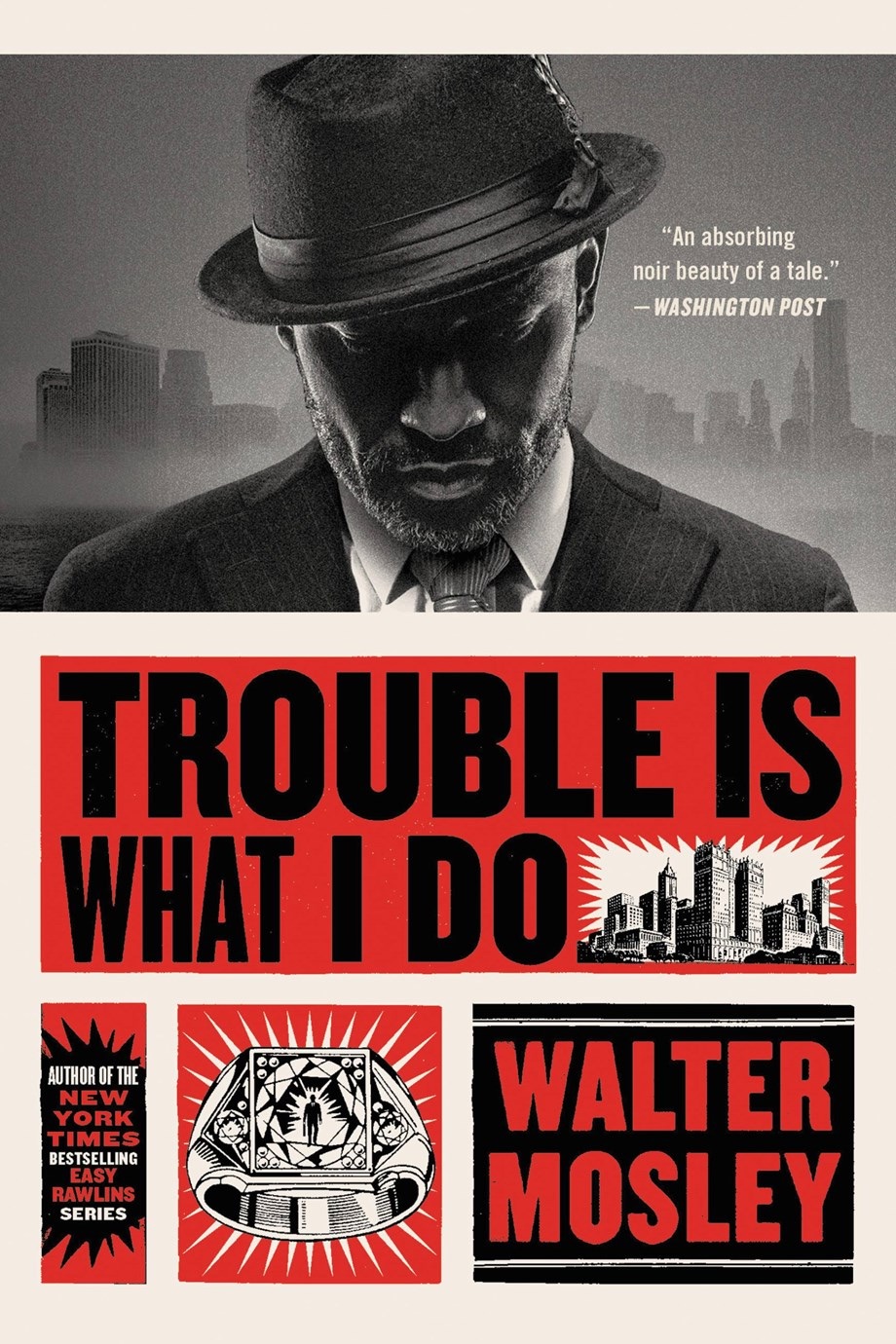
 - Walter Mosley, Trouble Is What I Do, p.123

Thursday, August 25, 2022

Little Nothings, Vol. 3: Uneasy Happiness by Lewis Trondheim

If I wanted to be dismissive, I'd describe this book as collecting daily watercolor comics pages about French cartoonist Lewis Trondheim's vacations in 2007.

And that's not untrue, but it misses the point. The whole Little Nothings series, as far as I can tell, is about quotidian life: small moments in a day that are interesting or evocative or representative. Trondheim didn't seem to do this diary comic every day, and I haven't seen any explanation of when he did do it. My guess is that he did it when he wasn't working on something else: in between other projects, on vacations or trips to comics festivals or just random days at home. Maybe because he did these in small notebooks, so they traveled more easily than his usual art setup; maybe for entirely different reasons.

In any case, he stopped doing these a good decade ago - again, for a reason I don't know. There were seven books of the series in French, as Les petits riens, and four of them were translated into English. This here is the third one, Uneasy Happiness. I read all four back around the time they were published, lost them all in my 2011 flood, and recently went back to get new copies of The Curse of the Umbrella and The Prisoner Syndrome.

There's not a lot to say about the substance of diary comics: each page is a moment in a particular day. Trondheim does regularly construct sequences, especially when he's somewhere warm on a holiday, but those are 2-5 pages at most, loosely linked with the same concerns, each one again a specific moment or interaction on a different day. It's like anyone's life: some things recur, or make us remember what happened yesterday, or we see the same things and have the same thoughts again and again.

Trondheim's art is quick but assured: I get the sense he did these without fussing about them, and he mostly doesn't go in for serious page layouts - just individual vignette panels, unbordered, almost scattered across the page, with lines that are never quite straight (I don't think Trondheim has ever used straightedges or cared about being precise and level) and colors built on top of them.

In this book, Trondheim travels to Italy, Portugal, Reunion Island, and Fiji (including what seems to be some other islands in the same region of the Pacific), as well as Paris and some other destinations within France. He rarely explains why he's going anywhere - the Angouleme festival each year is obvious, but mostly he's just off somewhere with someone, and sometimes he shows himself at a signing (so it must be a comics festival) and sometimes he doesn't (so it might or might not be) and sometimes he shows himself with his family (so it's clearly a vacation).

The Fiji trip in particular is in company with another cartoonist, who I think is named Emile from some postcards on the last page of the book. Trondheim draws him as a panda, and never explains who he is or why the two are traveling together: was this another festival? did they just both want to go to Fiji and their families didn't? were they working on a project together and could call this "research" for tax purposes? We don't know, as we rarely know the details of other people's lives. We just see some moments, react to it however we do, and then move on.

I found Trondheim a great diary cartoonist, and I wish both that he did more of it and the rest of his diary comics that do exist were published in English. But the things I wish for only very rarely come true. At least we have four books of Little Nothings: they may be little, but that's not nothing.

Wednesday, August 24, 2022

Blackwood by Evan Dorkin, Veronica Fish, and Andy Fish

All the most interesting people have the least-likely careers. (Says the man who started out as a SF editor and somehow ended up doing content marketing for corporate lawyers.) Evan Dorkin was a fiery young cartoonist in the '80s and 90s when I discovered his work, writing and drawing id-fueled scrawls like Milk & Cheese and The Eltingville Club. But somehow, along the way, his modern comics career is mostly about writing vaguely Lovecraftian-flavored fantasy/horror adventure stories for other artists to draw.

Like Beasts of Burden or Calla Cthulhu - or like this book: Blackwood, written by Dorkin with art by wife-and-husband team Veronica and Andy Fish.

Blackwood College seems to be just another mid-rank private learning institution, though it seems like all of their fields of study are specialized cases of anthropology with various cultural, occult, or religious bends. It's not that simple, of course: Blackwood has Deep Secrets.

And four brand-new first year students, who have all been recruited to the secret college-within-a-college at Blackwood, are going to find out about those secrets the hard way.

Blackwood collects a four-issue series, so it gets going quickly - with some old guy who just did something magically dangerous and is now dictating his last words while Something happens to him - and keeps at a blistering pace throughout. There's not a lot of room for the lore of this place to be explained, so the reader (and those four main characters) pick it up in bits and pieces as Dorkin tosses it out.

The last issue hits all of those Deep Secrets, some of which the reader will have guessed and some of which seem to come out of left field. (I wonder if this was originally planned to be longer - maybe six issues? and it got shortened somewhere in the process.) It all runs just a hair too fast and is a hair too generically Creeping Horrors for me, but it is fun and zippy throughout, and the Fishes make good artistic choices: they do grotesquerie well and Veronica's chapter-break art is particularly atmospheric and spooky.

All in all, I wanted a little more How This World Works and a little less "ahh! the bugs are going to kill us!" but this is largely a Teenagers in Danger movie done as a comic, so what I wanted is somewhat outside the bounds of the genre. This is just fine for what it is, and sets up a world where there could be plenty of other stories - I know there's at least one more already.

Tuesday, August 23, 2022

Trouble Is What I Do by Walter Mosley

Every genre has a continuum: some works are off at one end, some way out the other way, and most of them in clusters scattered around in the middle. There may be more than one continuum, especially in a big, complex, older genre that's had time to diversify and grow, but there's always at least one.

Think of magic vs. technology in fantasika, professional vs. amateur detectives in mystery, sweet vs. hot in romance.

There's also a continuum of...well, call it power or ability or connections or scope or resources. A hero can be no one, with nothing to call upon, or can be massively well-connected, with top experts on speed-dial, a crew of valuable assistants, and more esoteric knowledge than Wikipedia.

Leonid McGill, the private detective that narrates a series of books by Walter Mosley, is way the hell out on the latter side of the continuum - at least by the point of Trouble Is What I Do, Mosley's short 2020 novel. Here, he takes a job for no pay and racks up costs that must be at least six figures to do it, bringing in world-class assassins, the head of a swanky private hospital, and several other deeply-knowledgeable and well-connected experts to achieve his ends.

The only thing I can compare it to, possibly because my reading in mystery is less broad than it used to be and also a couple of decades out of date, is Robert Parker's Spenser novels, which equally feature a detective who is functionally bulletproof and possessed of a Rolodex that presidents would be in awe of. McGill is just as overpowered and immediately able to handle any situation as Spenser; their main difference (other than skin color) is that McGill has a massively self-doubting internal narration, and Spenser never had time for anything that slows down the action like that.

Anyway, in the manner of the overpowered mystery, McGill is hired by someone world-famous - nonagenarian bluesman Philip "Catfish" Worry - to do something dangerous and elegant involving someone else world-famous, a racist right-wing billionaire and his about-to-be-married debutante daughter.

The secret, of course, is that the billionaire is the secret son of the bluesman, and McGill is entrusted with a decades-old letter from the billionaire's mother to give to the debutante explaining her Black heritage. Handing a letter to someone is usually pretty simple, but Trouble is kept from being a drabble by the fact that Catfish tried to talk to the billionaire, not long ago, and got the bum's rush for his troubles - which had put the entire circle of the billionaire and his family on lockdown until at least the wedding.

Have I mentioned the billionaire is in close with a crime boss? Because of course he is. But McGill's best buddies include not one but two world-class assassins - possibly so he can beat Spencer's compadre Hawk by volume - so he's got that covered.

This is a short book. It's largely taken up with McGill's thoughts - both on race and history and secrets, obviously, and on his own flaws and foibles that never actually slow down any of the action or activity - and with his connecting to that wide panoply of rich and/or powerful and/or accomplished and/or skilled close friends, all in the aim of getting that one letter to that one young woman. Actually, I take it back: there's also a fair bit of digression and flashback, especially in the first half, where Mosley either replays some greatest hits from earlier novels in the series or newly explains a whole lot of McGill's connections.

This is also a book, like a lot of Mosley's work, that aims to speak about the experience of race in America - in this case, I guess "passing," and what it means to pass without knowing that you're doing it. I'll gesture at that rather then engaging deeply; I'm in no position to critique Mosley on anything in that area, though I will say it comes across a bit glib and cartoonish in the context of this short, quick book with so much else that is flashy and larger than life.

All that is, frankly, way too much to balance on the slender reed of a plot here. I like Mosley's work, but he's never been a subtle writer, and he's possibly even less subtle here than usual. I do have a sneaking suspicion that Mosley's audience doesn't want subtle, so I guess that's just fine. I think the earlier, longer books in this series have some more nuance to them - I hope they do, at least; this kind of thing could be exhausting extended over 300+ pages - so maybe I need to check those out. 

Monday, August 22, 2022

Reviewing the Mail: Week of August 20, 2022

One book this time out; it came in the mail, as is traditional. It's a new book in a SFF vein, from a writer I've read before, just published and sent to me for publicity purposes - a sign that, despite everything, maybe this world is worth saving after all.

Neom is the new novel from Lavie Tidhar, who has written a lot of excellent and diverse things - the ones among them that I've actually read are Central Station and The Violent Century and The Escapement. Neom is being published by Tachyon, and will be available on November 8th.

It's set in the same world as Central Station, but I don't think it's otherwise linked: it centers on the desert city of the title, which is not too far from Central Station - the back cover says it's on the Red Sea, and a map in the front matter puts it in Arabia. (This is at least several hundred years in the future; I'm pretty sure the House of Saud is barely a memory and every other human border has been moved multiple times in between.)

And what happens there, in Neom and the deserts outside it? Well, the back cover implies that two characters are falling in love - "loyal shurta-officer Nasir and hardworking flower-seller Mariam" - and then hints about a more destructive character, called "the robot" and "a deadly terrorartist." I imagine those three are central, but, from my experience of Tidhar, there will be a number of other important characters as well.

Friday, August 19, 2022

Quote of the Week: Why, Hello!

This isn't the first time I've been completely naked before I got around to introducing myself, But it's the first time I've only shaken hands.

 - James Alan Gardner, They Promised Me the Gun Wasn't Loaded, p.189

Thursday, August 18, 2022

Kaijumax: Season Four: Scaly Is the New Black by Zander Cannon

When I find myself reading a book in a series, and not remembering all of the details of previous entries, I wonder if it's a failure in my memory or just the passage of time. (OK: it could also be something the creator did wrong, but let's be positive here!)

Luckily, I keep track of what I read and when, so I can see that I scribbled about the previous Kaijumax volumes in June 2017, March 2018, and December 2018. So almost four years: that's a substantial amount of time. It's probably the passage of time.

But this fourth volume of Kaijumax, subtitled Scaly Is the New Black, also features an almost entirely new cast, since it's set in the related prison for female monsters - one major human character from the earlier books is central here, for reasons that even I remembered, and there's I think one other that we've seen before.

So: if you're new to this series, this might look like a good place to start, since the cast and story is mostly new. I'd generally advise against it, since a lot of the plot here depends on the reader knowing some Big Things that happened in previous books. (And I say that with full knowledge that, as I said above, I might be forgetting other Big Things that also should be important.)

Cannon still has that walking-the-tightrope tone: this is not essentially jokey, but it's dancing on the edge of camp. Since it's about giant monsters in a women's prison, it would be difficult to do otherwise. There's also something of a racial allegory going on with the monsters, intersecting with the usual "prisoners join up into gangs based on their origins" prison-story stuff.

We start with some new prisoners arriving. As usual, they're familiar, with Cannon only altering serial numbers slightly to fit his world or to avoid infringing someone else's IP. So there's a monster Lady of the Lake who gave a sword to the wrong person, a Lovecraftian creature that had a good thing going in a Dunwich-esque seaside town, and Dr. Zhang, former prison doctor at the men's location and now a murderer stuck at giant-size due to a malfunction in her suit. The first two slot fairly easily into the factions in the prison; Dr. Zhang does not. She's in much the same position as Electrogor in the first book: essentially innocent, stuck in the middle, wanting just to get out of things they can't possibly get out of. All three will be important to the plot here, all three have powers and abilities and aims and desires that will make things happen, for good and bad (for themselves and others).

This is a prison story, so things escalate. There's some satire along the way, and probably more references to other prison/monster stories than I caught. And this is not the end: there are at least two more seasons already. I don't think I got as much out of Scaly Is the New Black than I could - I don't know Cannon's cultural touchstones, and I think Kaijumax is more and more becoming a thing of touchstones - but I did enjoy it, and I always find Cannon's plotting and character work excellent. So I'll be back for the next one...I hope in less than another four years.

Wednesday, August 17, 2022

Sheets by Brenna Thummler

Some books you read because you get a specific recommendation - an award win, a glowing review somewhere, it's made into a movie. Some you decide to read because it just feels like you've seen it too many times not to.

I think Sheets was Brenna Thummler's first book; it came out in 2018. I think I've been seeing it since then - maybe a list of recent YA graphic novels here, maybe personal recommendations there, maybe a display at the library...things like that. No one big burst, but it's been around; I keep getting the sense that a lot of YA readers have been finding and loving this book.

So I picked it up, even though I haven't been a Young Adult for a long time. And it is a little first-book-y, and has a few elements that seem particularly YA, but it's got a great soft color palette supporting clean confident art and a strong story told quietly and honestly.

Marjorie Glatt is holding her family together in the wake of a tragedy, as so many other girls have before her. I've seen some descriptive copy saying that she's thirteen, but I didn't see that in the book: she's clearly in middle school, and taking on more responsibility than she probably should, but the book itself is a bit vague on her age. Her family has a laundromat, by the lake in some small American city - my guess is somewhere on the Great Lakes, Michigan or Pennsylvania or thereabouts.

Marjorie is running the laundromat single-handedly, rushing after school to open it and take in laundry from customers and working into the night to get it all clean. It was her mother's shop, but her mother died quite recently. The details don't come out until nearly the end of the book, but her father is devastated: he seems to be capable of getting her younger brother to kindergarten and feeding the family, but that's about it. It's not clear what he did when his wife was alive, but he's doing vastly less now.

An obnoxious local, Mr. Saubertuck, has grandiose visions of building a spa on the waterfront in this town, and he seems to have seized on the idea of forcing out Glatt's Laundry, taking over their building, and getting the family to work for him for free in the new spa that he will have built... somehow. All of this, apparently, without spending a penny. That's the most YAish element here: the unpleasant adult whose badly-planned ideas might happen just because he is an adult. In a book for adults, Saubertuck's crude sabotage and transparent flattery of the locals would have no chance of success, without some financial chicanery underlying it - but, in a book for tweens, that adults will stick together and screw over kids is always plausible.

Meanwhile, in the land of ghosts, there's a relatively new arrival, a boy named Wendell. He tells a lot of transparently untrue stories about his past, and he's not really fitting in. I don't think I've seen ghosts handled this way before in graphic fiction, but it's brilliantly obvious: they are sheets, like in Charlie Brown cartoons and a million quick Halloween costumes, that define and enclose the energy of a dead person. They all look mostly the same, with accessories and flair to make them distinctive. Wendell has not been cleaning his sheet, so he's getting dingier and dirtier. He's not happy, and we're not sure why: every conversation he has is filled with his extravagant lies.

He takes a train back to the world of the living. He finds his way to Glatt's Laundry. And the combination of his goofy playing around and Saubertuck's sabotage nearly puts them out of business - but Marjorie does meet Wendell, eventually, and that's the beginning of some hope for her and for the business. That's where the main plot comes in, and I don't want to talk about the plot.

Sheets is a book about grief, at its core. About the kind of grief that's so large that you can't even say the word, so huge that it knocks almost everything else out of the world. Marjorie is grieving less than her father, maybe even grieving her mother less than Wendell is grieving himself, but she's still grieving all the time. But it's not an "issue book," not something just for librarians to give to kids that are grieving. It's a story about these people, and that's where they are: that's what's most important in their lives right now. Thummler threads that needle deftly to tell the story of a girl with a lot more on her shoulders that she should have, and who is almost able to handle all of it.