Friday, July 31, 2009

Movie Log: Lost in Austen

A week or so ago, The Wife and I were watching previews before some movie or another, and one came up for Lost in Austen. When the preview ended, my wife whipped her head right around to look at me and said forcefully, "We have to get that one." And so we did.

Amanda Price is a modern young woman; she lives in a Hammersmith flat with her obligatory black (and slightly predatory) roommate Pirhana, has an only moderately loutish boyfriend, and does something for a bank that requires dealing with the public. But what she really cares about, this movie tells us, is re-re-re-reading Pride and Prejudice all of the time.

And that comes in handy -- though not as much as it could have; she apparently has never looked at the scholarly apparatus in her Penguin Classics edition or had a moment's thought about the social setup of Regency England -- when Elizabeth Bennett slips through a hidden door in her bathroom. Soon Amanda finds herself in Pride and Prejudice, and unable to go back home.

She then bumbles around for a while, gawking at all of the characters that she recognizes, and making comments about how she expects the story to go, until, by her presence (essentially in place of Elizabeth, who has stayed on the 21st century side of the door, doing what we do not know) she changes everything.

Amanda has definite elements of the Mary Sue; nearly all of the men want to marry her at one point or another, and all of them admire her much more than they should. (She's rough, uncouth, almost completely unmannered by their standards, criminally ignorant of everything, and her conversation is elliptical when it's not full of non sequiturs.)

But eventually -- and it's a long eventually, since this was originally a BBC ITV miniseries; eventually takes almost three hours to come -- all is put right, if not precisely the way Austen put it to begin with. (One can guess what happens to Amanda, particularly if I re-emphasize that she's there in place of Elizabeth.)

The writing is quite good, particular for the P&P characters; their dialogue sounded to me like Austenite speech even when it was original. And the acting is quite good, too. But the character of Amanda is so much of a bull in a china shop that I found it hard to believe in her -- surely a woman who has devoted so much of her life to reading this one novel would have some clue about the society it depicts? Surely she can't be that thoughtless and dull?

There are a number of places the plot seems about to jump into a more interesting track -- one character felt like another potential person from the 21st century, but nothing came of that; Elizabeth's adventures in our world are left to the imagination; and the possibility of the P&P characters discovering the copy of the book that Amanda brought in and altering their behavior because of that comes to one tear-jerkingly "dramatic" confrontation scene -- but it never quite does. Lost in Austen stays always in the safe BBC costume drama mode, enlivened only by casting a slightly more intelligent and less clumsy Bridget Jones at its center.

It will be enjoyed most by groups of women, particularly those who have not yet gotten over the sight of Colin Firth in a pond. (Mr. Firth makes no appearance in this production, but his spirit pervades it.)

----------------
Listening to: Dish - Chase My Ghost
via FoxyTunes

Quote of the Week

"Remember, if you smoke after sex you're doing it too fast."
- Woody Allen

Thursday, July 30, 2009

James Bond Daily: Moonraker

The third James Bond novel, Moonraker, was the Fleming novel that took the longest to be turned into a movie, and so the movie of the same title (from 1979) bears only the very slightest resemblance to the novel (from 1955).

The main points of congruence are in the villain, Hugo Drax, who is a British aerospace magnate planning a mass murder unbeknownst to the world. In the novel, he's testing the Moonraker rocket, which will be Britain's homegrown nuclear deterrent. (And this places Moonraker firmly in period; it's set before ICBMs and a whole lot of the NATO nuclear-weaponry infrastructure.)

Bond meets Drax because Drax belongs to the same club as M, Blades, and the head of that club has confided in M that he believes Drax cheats at cards. (Some things about England -- particularly male, moneyed England -- never change.) So Bond goes along with M to Blades on a Monday evening, detects Drax's cheating, and cheats back at him to teach him a lesson.

On the Friday of that same week, the Moonraker is to be tested -- supposedly to be shot into the North Sea from the coast near Dover. Of course, Drax has a more nefarious plan than that, and Bond eventually discovers and foils it, with the aid of Miss Gala Brand, an agent of Scotland Yard's Special Branch inserted as Drax's secretary a year before to keep an eye on him.

As usual, the Bond novels are strongest in their focus on real spycraft: how agents operate, who they talk to, how different government agencies dance around each other, each protecting their own turf and trying not to impinge on others. Moonraker has no exotic locations, no unlikely gadgets -- just the detective work of two well-trained professionals who will never get full public recognition for what they've done.

And Miss Brand -- who doesn't even come close to sleeping with Bond, and only kisses him once -- goes off at the end to marry her fiance. Fleming's Bond is much less happy with himself than any of the movie Bonds (even Daniel Craig at his scowlingest only comes close), and inhabits a much more dangerous world. But we knew that already, didn't we?

Hey! Did'ja Notice the Eisner Awards Were Given Out a Few Days Ago?

I've been on vacation, so I sort-of missed it. But here's the complete list. I was one of the judges this year, which means -- in the case of the Eisners -- that the other judges and I decided on the shortlist, but the eligible voters (comics professionals of nearly all kinds) did the actual voting.

Since, in many cases, they picked the creators and projects I would have, I hereby declare that the Eisner voting public, this year, is pretty darn cool. And congratulations to all of the winners and nominees; 2008 was a great year with a lot of wonderful work.

----------------
Listening to: Richard Thompson - Ça Plane pour Moi [Live 2003]
via FoxyTunes

Movie Log: Watchmen

It would be very instructional for some film-school class -- or just a group of interested fannish types -- to carefully compare and contrast the directorial choices made by Peter Jackson with the three Lord of the Rings movies and by Zack Snyder with Watchmen. Both are quite faithful translations of a difficult work from another medium to film, both had fanatical fans who had to be wooed (and, as with everything, some of both were utterly convinced and some were utterly horrified), and both were at least moderately successful (artistically and commercially).

The difference is that when Jackson made some clunky moves -- which is inevitable; much like the old definition of a novel, a film is a long series of flickering images with at least one major thing wrong with it -- he made them by departing from the source material, but Snyder's mistakes are entirely those of being too faithful to the source material. Actually, I should qualify that: Snyder was intensely faithful to one strand of the Moore-Gibbons graphic novel Watchmen, the most obvious and noisy part of that book, and his slavishness in replicating moments, and particularly images, from that plot, turn his movie into something like a "greatest-hits" version of the comic, sparking lots of recognition but not nearly enough engagement.

His one major change to that strand -- the precise nature of the "villain's" plan at the end -- actually makes the plot work slightly better; it ties up something that was a loose end in the Moore-Gibbons graphic novel. But the reason that change was necessary is that the graphic novel's giant maguffin was tied into the other subplots -- to the pirates and the secondary characters, the missing scientists and artists and everything else that Alan Moore used to define his fictional world. Without all of that, Snyder's Watchmen is basically just our world with underwear perverts in it. (And the whole stop-motion credits montage just underlines that -- yes, it's visually exciting, but it doesn't add up to a world that's all that different from how Moore saw the real 1985.)

I can't say how Watchmen looks to someone who doesn't know the source material; it must be an utterly different movie depending on whether one knows the story already or not. But it is amazingly -- ridiculously, even -- faithful to Moore's words and Gibbon's images, with dozens of shots that look like comics panels even to a reader who hasn't looked at Watchmen in years. (Perhaps Snyder really did use the Gibbons art, or large portions of it, as his storyboards.)

There's no dramatic tension for a reader of the original graphic novel; this Watchmen hits its marks and punches its lines, but it's like watching yet another production of Hamlet, without the benefit of actually having the catharsis of a real tragedy or the power of Shakespeare's words. (Moore is good, but he's no Shakespeare.)

And the movie of Watchmen forces the viewer to remember that the plot of the graphic novel didn't entirely make sense, that the ending was stronger in theme than in story, and that even the ultimate superhero story, on screen, turns into unpleasant scenes of grown men in skin-tight leather hitting each other with overly-choreographed moves that never quite convince.

This is quite possibly as good as any single-movie version of Watchmen ever could have been, but that's still just mediocre.
----------------
Listening to: The Arrogants - Future Classic
via FoxyTunes

Incoming Books: 30 July

In my house, vacation time means many things. But one of the most important is that I get some serious book-shopping time in. And so today, while The Wife was at work -- since retail never ends -- I took my two sons to the Montclair Book Center, the best new/used bookstore I know in New Jersey, for an extended stroll through their wares. The boys came out with one Gundam manga volume (Thing 1), two Junie B. Jones novels (Thing 2), and four assorted Garfield books (both).

And I got:

Lawrence Block's recent memoir/meditation on running, Step by Step, which I've already read, since it was available at the library one day I happened to be there. And now, since it happened to be in the book store the day I was there, I own my own copy.

I haven't yet read Christopher Buckley's memoir Losing Mum and Pup, though not through lack of trying -- I've been searching for it at the library for the last several months, without luck. So I bought it.

Has Roddy Doyle had a novel since Paula Spencer? It took me three years to get a copy of this one -- and I hope it doesn't take me that much longer to finally read it -- but I have the sense that I'm only this one book behind on him. (Literary writers can be nice that way; one book every three or four years is easy to keep up with.) This one is the sequel to his decade-old novel The Woman Who Walked into Doors.

I have a weakness -- shared, one way or another, with a lot of the book-buying population -- for books of funny snippets, easy to read and easy to put down. One of those is Leland Gregory's Idiots at Work: Chronicles of Workplace Stupidity. I'd never heard of it before I saw it at the store, but I bought it.

I've had Lisa Lutz's The Spellman Files -- first in what I think will be a series of humorous family/mystery novels; there's already a sequel -- on my list of books to read for a while, but I've never quite gotten to it in the library. Maybe having a copy in my own house will mean I'll actually pick it up and read it; it looks good.

Another book I've actually picked up and looked at in the library -- but ended up buying in a store -- is Alberto Manguel's A Reading Diary. Manguel is the co-author of The Dictionary of Imaginary Places, and a couple of other things that I think I've read, and this is a book about the books he was reading one year. I suspect his reading was aggressively highbrow, and that his musings on those books will be the same, but I love books about books, so I want to encourage them.

Merrill Markoe wrote some very funny TV for David Letterman's first late-night incarnation, and several equally funny books of essays. She also wrote at least one novel, It's My F---ing Birthday, which I hadn't known existed until approximately 11:15 this morning. It's a novel in seven monologues, or letters to herself, from a woman on seven birthdays in her life. I like funny novels, I like the way Markoe writes, and I'm a sucker for books with interesting structures, so I grabbed it.

The Book of Vice is subtitled "Very Naughty Things (and How to Do Them)," which all by itself is a good enough reason to buy it. (The way that it vaguely mocks the mid-90s Bill Bennett The Book of Virtues is pretty good, too.) It's by Peter Sagal, who seems to be another one of those people with much, much more interesting and fulfilling careers than I do (broadcaster, playwright, screenwriter, writer for New York Times Magazine).

The American Future
goes on my Simon Schama pile -- with the three volumes of A History of Britain and with Rembrandt's Eyes, as well as three or four other books in various other places around here. There was a point at which I was reading Schama's books more quickly than he was writing them, but that time ended about a decade ago. Perhaps my mental image of myself as a man who reads Simon Schama books is in error?

I grabbed Mark Stein's How the States Got Their Shapes because I liked the title, and because I'm enjoying working my way (slowly) through State by State. As far as I can see, this book is exactly what it says it is.

I read Thy Neighbor's Wife -- the classic Gay Talese examination of the landscape of the sexual revolution of the '70s -- furtively as a young teenager, twenty-five or so years ago. I'd thought about it occasionally since then, but never expected to re-read it. But I saw this new HarperPerennial edition -- with updates from Talese and a foreword by Katie Roiphe -- and decided it was time to look at it again, and see what (if anything) of it I remembered.

And last for me was Donald E. Westlake's last Dortmunder novel, Get Real. It's a damn shame he's gone, but at least there's this one last book (and the upcoming, long-lost Memory) to remember him with.
----------------
Listening to: Cracker - Hand Me My Inhaler
via FoxyTunes

The Hornswoggler Family Hershey Park Leader Board

The family spent the front half of the week at Hershey Park, which I suppose is our favorite theme park (since we go there more than anywhere else). We had a lot of fun, got very tired, and only suffered slightly from the sun and crowds.

Most importantly, Hershey has eleven roller coasters, and my two sons -- Thing 1, eleven years old and about 5'4", and Thing 2, eight years old and a little shy of five feet -- were all tall enough to go on all of the thrill rides there.

And so the final tally was:
  • Thing 2, with a perfect 11 rollercoasters
  • (tie) Thing 1, with 10 (missing the newest, most "extreme" coaster, Fahrenheit, since he did it last year)
  • (tie) G.B.H. himself, with 10 (missing the Roller Soaker, a lousy "water roller coaster" with huge lines and minimal thrills)
  • The Wife, who was enticed to go on one coaster, and regretted it the rest of the day
By next year, the boys may not need me at all. And I'm not sure if I'll be looking forward to that, or regretting it.

Wednesday, July 29, 2009

James Bond Daily: 007 Dislikes Facial Hair

From pp.113-114 of Moonraker, originally published in 1955:
With the exception of Drax they all wore the same tight nylon overalls fastened with plastic zips. There was nowhere a hint of metal and none wore spectacles. As in the case of Walter and Krebs their heads were close-shaved, presumably, Bond would have thought, to prevent a loose hair falling into the mechanism. And yet, and this struck Bond as a most bizarre characteristic of the team, each man sported a luxuriant moustache to whose culture it was clear that a great deal of attention had been devoted. They were in all shapes and tints: fair or mousy or dark; handlebar, walrus, Kaiser, Hitler -- each face bore its own hairy badge amongst which the rank, reddish growth of Drax's facial hair blazed like the official stamp of their paramount chief.

Why, wondered Bond, should every man on the site wear a moustache? He had never liked the things, but combined with these shaven heads, there was something positively obscene about this crop of hairy tufts. It would have been just bearable if they had all been cut to the same patter, but this range of individual fashions, this riot of personalized growth, had something particularly horrible about it against the background of naked round heads.
----------------
Listening to: The Mummers - Wonderland (Edit)
via FoxyTunes

Movie Log: Ice Age: Dawn of the Dinosaurs

The family hadn't been to see a movie in the theater together in a while, so we wandered off to the local four-plex on Friday evening to eat overpriced popcorn from a gigantic vat and watch the three-quel Ice Age: Dawn of the Dinosaurs.

The short version: it's no better, and no worse, than the first two movies; it's amusing and doesn't actively stumble, but it's dumb, derivative, and incredibly obvious.

As is required with American mass-marketed sequels, the major theme is "how can friends stay together when things change in their lives" and at least one new, "zany" character must be added -- in this case, Simon Pegg as a crazy subterranean weasel. Also, since one of the subplots is about pregnancy, the male parent-to-be must be a frantic ninny whenever required for humor.

Given all of the constraints on it, Ice Age 3 isn't bad -- like the first two movies, it's a solid piece of all-American cheese, aimed right down the middle of American culture. These movies neither aim for the aggressively "hip" cultural references of DreamWork's animated movies, nor do they have any deep understanding of story and character like the folks at Pixar. Blue Sky is the Baby Bear of American animation -- neither Too Smart nor Too Dumb for Joe Sixpack, which makes them Just Right. There's no reason to see this movie unless you have children of a certain age, but -- if you do -- it will not be painful. (As long as you don't get any of that popcorn stuck in a difficult-to-reach place.)

Tuesday, July 28, 2009

A Message from the Management

We're sorry, but Antick Musings is temporarily unavailable due to an oversupply of frivolity and merrymaking. Please try again tomorrow.

Monday, July 27, 2009

James Bond Daily: A Day in the Life

From pp. 008-009 of 1955's Moonraker, in which Bond goes to the office:
Bond sighed and sat down at his desk, pulling towards him the tray of brown folders bearing the top-secret red star, And what about 0011? It was two months since he had vanished into the 'Dirty Half-mile' in Singapore. Not a word since. While he, Bond, the senior of the three men in the Service who had earned the double 0 number, sat at his comfortable desk doing paper-work and flirting with their secretary.

He shrugged his shoulders and resolutely opened the top folder. Inside there was a detailed map of south Poland and north-eastern German. Its feature was a straggling red line connecting Warsaw and Berlin., There was also a long typewritten memorandum headed Mainline: a well-established Escape Route from East to West.

Bond took out his black gunmetal cigarette-box and his black-oxidized Ronson lighter and pout them on the desk beside him. He lit a cigarette, one of the Macedonian blend with the three gold rings round the butt that Morlands of Grosvenor Street made for him, then he settled himself forward in the padded swivel chair and began to read.

It was the beginning of a typical routine day for Bond. It was only two or three times a year that an assignment came along requiring his particular abilities. For the rest of the year he had the duties of an easy-going senior civil servant -- elastic office hours from about ten to six; lunch, generally in the canteen; evenings spent playing cards in the company of a few close friends, or at Crockford's; or making love, with rather cold passion, to one of three similarly disposed married women; weekends playing golf for high stakes at one of the clubs near London.

He took no holidays, but was generally given a fortnight's leave at the end of each assignment -- in addition to any sick-leave that might be necessary. He earned £1500 a year, the salary of a Principal Officer in the Civil Service, and he had a thousand a year free of tax of his own. When he was on a job he could spend as much as he liked, so for the other months of the year he could live very well on his £2000 a year net.

He had a small but comfortable flat off the King's Road, an elderly Scottish housekeeper -- a treasure called May -- and a 1930 4½-liter Bentley coupé, supercharged, which he kept expertly tuned so that he could do a hundred when he wanted to.

On these things he spent all his money and it was his ambition to have as little as possible in his banking account when he was killed, as when he was depressed, he knew he would be, before the statutory age of forty-five.

Eight years to go before he was automatically taken off the 00 list and given a staff job at Headquarters. At least eight tough assignments. Probably sixteen. Perhaps twenty-four. Too many.

Reviewing the Mail: Week of 7/25

Here's another week's worth of the mail -- all of these are books that I received for review, and I do hope to review many of them. But, just to cover them all, here's what I know or can tell about them without reading them.

First is Why Does E=mc2?: (and why should we care?) by Brian Cox and Jeff Forshaw, a popular science book by two noted particle physicists and professors about exactly what Einstein's famous equation means -- each element of it and in whole. It was published this month by Da Capo Press in hardcover.

And then, from a completely different kind of publishing plan, there's Metal Gear Solid 2: Sons of Liberty by Raymond Benson. It's the sequel to Benson's first novel based on the video game -- that one was just called Metal Gear Solid -- and it has more adventures of Solid Snake and similar deeply characterized individuals. And it will be published by Del Rey in trade paperback in November.

W.W. Norton's program of reprinting Will Eisner's graphic novels continues this month with three books Eisner created in the '90s:
  • Life on Another Planet (originally published as Signal from Space), about the discovery of a mysterious radio signal of alien origin, was originally published in 1995.
  • 1998's A Family Matter is one of Eisner's family melodramas, with a family gathering to celebrate their patriarch's 90th birthday -- and that, of course, is not nearly as happy and conflict-free as it might be.
  • And Minor Miracles, published for the first time in 2000, sees Eisner look back to his childhood for inspiration one more time, as he "explores the everyday miracles of our lives."
And last for this week is a new collection of the first two years of the classic humor strip Bringing Up Father, by George McManus. When I say "classic," I mean it -- this is the real deal, from 1913-1914. NBM published this collection in July, and -- from those of us who have been hearing about Maggie & Jiggs for years, without having more than scattered strips to read -- I hope this is as good as I've been hearing it is, and that they are successful enough to continue reprinting it.

And, with that, I have to give the last word to Josh Ritter...

----------------
Listening to: Josh Ritter - Me & Jiggs
via FoxyTunes

Sunday, July 26, 2009

Vacation Notes

Right at this very moment, I am on vacation. And I had been hoping that said vacation would mean that I'd have time to catch up on the posts I wanted to make here (reviewing 8 books and covering 2 movies) and for ComicMix (7 books that should turn into 4-6 reviews). Sadly, it looks like that won't be the case; I'm busy.

Yesterday was the big Cub Scout camp-out and picnic, so I had to drag my two sons (the elder of whom has graduated from Cub Scouts and has no intention of becoming a Boy Scout, but he's stuck) out into the woods for an afternoon of barbecue, hearty outdoor games, and repeated questions of when it would be over. Eventually, The Wife arrived for the sleepover portion of the event -- I'll be damned if I'm sleeping in the woods on purpose as long as I have a perfectly good roof and bed -- and stayed there with the still dewey-eyed and camp-happy younger son, Thing 2.

Thing 1 and I decamped to my mother's house for a dinner with my brother -- visiting from Oregon for the weekend -- and then finally got home about nine. I then watched about two-thirds of Watchmen (how am I liking it so far? Well, the fact that I could stop in the middle should be a clue) and then went to bed.

Today Thing 1 and I ran back up to the campsite, fresh bagels in hand, to help with pack-out. We brought everything home, spread it all out to dry in the yard, and had a short pause before I took the two boys back to my mother's for another meal with my brother (so Thing 2 could get some uncle time in). And then, around 3:30, I drove said brother to JFK for his flight back to Portland. Coming back, I got caught in a nasty, hail-filled downpour -- and also ended up going twenty or thirty miles out of my way, trying a different way back from the airport -- and finally got back here around 7:30.

So I've already lost two days that I could have been blogging, or lazing on a couch, or something.

Tomorrow we head off to Hershey Park, land of rollercoasters and chocolate-coded rides, which will eat up another two and a half days. More activities are planned for the back half of the week...and then next Monday will see me, bright and early, on a hotel function room floor in a Wiley booth at the awe-inspiring American Accounting Association show. Luckily, it's in New York this year, so I can do it from home, but it's still going to be a tough week to come back.

And then I'm off to Worldcon that weekend. (And the week after Worldcon is the company's thrice-yearly Sales Meeting -- luckily, this is one of the ones in New Jersey.)

It's beginning to look like I have the vacation at the wrong end of the month.

Anyway, I still do hope to catch up on all that typing stuff this week, but I'm less clear on when I'll have time to do it. Content may be light here for a week or three, and my reviews at ComicMix may become less dependable again. But, as always, We'll See what really happens.

----------------
Listening to: Talking Heads - Life During Wartime
via FoxyTunes

Dateline: Afghanistan, 1986

On Friday and over at the ComicMix, I reviewed a book by Emmanuel Guibert, Didier Lefevre, and Frederic Lemercier called The Photographer, which mixed photojournalist Lefevre's real photos and art by Lemercier and Guibert to tell the story of Lefevre's first trip to Afghanistan -- then under Russian occupation -- with the humanitarian group Doctors Without Borders.

----------------
Listening to: Randy Newman - Short People
via FoxyTunes

James Bond Daily: Sexual Ennui

From p.149 of Casino Royale:
With most women his manner was a mixture of taciturnity and passion. The lengthy approaches to a seduction bored him almost as much as the subsequent mess of disentanglement. He found something grisly in the inevitability of the pattern of each affair, The conventional parabola -- sentiment, the touch of the hand, the kiss, the passionate kiss, the feel of the body, the climax in the bed, then more bed, then less bed, then the boredom, the tears and the final bitterness was to him shameful and hypocritical. Even more he shunned the mise en scene for each of those acts in the play -- the meeting at a party, the restaurant, the taxi, his flat, her flat, then the week-end by the sea, then the flats again, then the furtive alibis and the final angry farewell on some doorstep in the rain.

Movie Log: The Great Buck Howard

The Great Buck Howard is a movie that feels like it's missing a reel -- well, not one whole reel, but it does feel like it should have a few more scenes to pull everything together and make it all cohere.

It's a pleasant movie that can't decide who its main character is. It starts with a young man, Troy (Colin Hanks), who isn't quite sure what he wants to do with life but has just become sure that law school isn't what he wants. Troy wanders to LA in a vague attempt to "write," then -- when he realizes that he actually needs a job to keep him going -- answers an ad to become the road manager and general factotum for "The Great Buck Howard" (John Malkovich). And then Howard mostly takes over the movie -- though it's not his story at all, since he doesn't change, and his arc is pretty flat. But he dominates the scenes between the two of them -- as would be expected -- and also the scenes he isn't in. And Troy's voice and presence isn't strong enough to overcome the Buck-ization of the movie.

Howard is a moderately veiled version of the The Amazing Kreskin, a mentalist who used to be reasonably big -- lots of appearances on The Tonight Show in the Johnny Carson days; long stints in Vegas; the usual -- but has settled into a routine of half-empty halls in third-rate cities, doing the same corny act night after night across the country. He's demanding and finicky, but Troy learns how to handle him. There are the usual small triumphs and set-backs leading up to the huge triumph and set-back (or vice versa); the structure of The Great Buck Howard could have come right out of a screenwriting seminar.

So The Great Buck Howard is nearly a road-show My Favorite Year, down to the new love the young man finds along the way. But both the movie and Troy are less focused; Troy's ambitions aren't clearly defined -- does he want to become a screenwriter? is this the movie that he wrote about his life? -- and Buck Howard has a mostly episodic structure, with episodes of unfortunately very different lengths. It should be a movie about how Troy turned into whoever it is that he's going to turn into, but it's more about how he hung out with this weird old guy for a while and came to like him.

There are lots and lots of solid actors in secondary roles -- you can see a line of them on the box cover, though none of those guys share a scene with each other, or with much of anyone but Hanks Jr. and Malkovich -- and the whole movie is pleasant and professional. But, like Oakland, when you reach the end, there really wasn't a there there.


----------------
Listening to: Midwest Dilemma - Damage Is Done
via FoxyTunes

Saturday, July 25, 2009

James Bond Daily: Bond & M Are Not Quite As Racist As You'd Expect

From pp.016-017 of Live and Let Die, originally published in 1954:
'I don't think I've ever heard of a great Negro criminal before,' said Bond. Chinamen, of course, the men behind the opium trade. There've been some big-time Japs, mostly in pearls and drugs. Plenty of negroes mixed up in diamonds and gold in Africa, but always in a small way. They don't seem to take to big business. Pretty law-abiding chaps I should have thought, except when they've drunk too much.'

'Our man's a bit of an exception,' said M. He's not pure negro. Born in Haiti. Good dose of French blood. Trained in Moscow, too, as you'll see from the file. And the negro races are just beginning to throw up geniuses in all the professions -- scientists, doctors, writers. It's about time they turned out a great criminal. After all, there are 250,000,000 of them in the world. Nearly a third of the white population. They've got plenty of brains and ability and guts. And now Moscow's taught one of them the technique.'

Friday, July 24, 2009

James Bond Daily: Live and Let Die

This second James Bond novel was published in 1954, barely a year after the first -- and the Bond books would continue to appear every year until Fleming's death in 1964, and even thereafter, with the last (possibly unpolished) novel The Man With the Golden Gun in '65 and the last few stories scraped up into Octopussy and The Living Daylights in '66.

From the movies, we have an image of Bond in one world -- the '60s, if we're a fan of Connery's straightforward toughness, or the '70s, if we prefer the baroque complexities of Moore. But Fleming's Bond is a creature of the post-war era, of the '50s. He lived and worked when the Cold War was quite warm indeed, when detente wasn't even a joking possibility. His backstory reaches solidly into World War II, and in particular the quiet, darker corners of that war. Fleming's Bond is a man of sniper rifles and knives in the back, of dark alleys and darker actions. The Double-O number doesn't signify elitism or status, as it does in the movies, but is instead a label for a man who has gone too far to get back, an explanation for why he is what he is.

All of the Bond novels take place in a dead era -- one that some of us remember, but none of us have lived in for a generation -- and Live and Let Die is particularly dated, with its voodoo plot and black "Mr. Big" villain. (Though Mr. Big is genuinely nasty and as terrifying as any other villain in the Bond novels; Fleming makes it quite clear that he, and his characters, don't consider blacks essentially inferior, which is an unexpected touch. He also explicitly out-thinks Bond several times; Fleming portrays him as startlingly smart and foresighted.) The dangerous, deadly black men Bond faces here are nearly a decade prior to the Black Panthers and mid-'60s riots; Fleming might turn their dialect into something very ugly on the page -- and he does; rendering much of the dialogue in Harlem nearly incomprehensible -- but he does certainly allow them agency and strength.

This novel has somewhat more plot than Casino Royale did; M sets Bond on the trail of Mr. Big, who has somehow found and is smuggling a four hundred-year-old treasure of gold coins, hidden by Henry Morgan somewhere on Jamaica, to finance his own criminal empire and his Russian backers. "The Big Man" is also, explicitly, a trained agent of SMERSH, that Soviet agency of terror and the policing of spies that Bond has made it his mission to wipe out as thoroughly as he can. And so Bond meets up with his CIA counterpart Felix Leiter -- whom he'd met in Casino -- to start with Big's Harlem base and work their way back, through Fort Lauderdale, to Jamaica.

But Big is more dangerous and smart than they'd expected, and he stays ahead of them for most of the book. Leiter is nearly killed, and Bond survives several times due mostly to luck and his own hypertrophied survival instincts. In the end, Bond gets the girl -- Big's captive (white) fortune-teller Solitaire -- and Big gets killed, but it's in large part due to luck (and another large part due to Bond's planning).

Bond's world is nihilistic; he does believe that he's better than the monsters he fights, but he's not all that much better -- and he knows that. And each monster takes something out of him -- even though he doesn't have all that much to begin with. I'm not claiming these books are great literature -- clearly they're not -- but they are very good, tough-minded novels of violence and conflict, exemplary thrillers of the Cold War.

Quote of the Week

"In our age if a boy or girl is untalented, the odds are in favor of their thinking they want to write."
- W.H. Auden

Thursday, July 23, 2009

James Bond Daily: Not a Good Flight

From pp.159-160 of Live and Let Die, describing an airplane in a storm in 1954:
He looked at the racks of magazine and thought: they won't help much when the steel tires at fifteen thousand feet, nor will the eau-de-cologne in the washroom, nor the personalized meals, the free razor, the 'orchid for your lady' now trembling in the ice-box. Least of all the safety-belts and the life-jackets with the whistle that the steward demonstrates will really blow, nor the cute little rescue-lamp that glows red.

No, when the stresses are too great for the tired metal, when the ground mechanic who checks the de-icing equipment is crossed in love and skimps his job, way back in London, Idlewild, Gander, Montreal; when those or many things happen, then the little warm room with propellers in front falls straight down out of the sky into the sea or on to the land, heavier than air, fallible, vain. And the forty little heavier-than-air people, fallible within the plane's fallibility, vain within its larger vanity, fall down with it and make little holes in the land or little splashes in the sea. Which is anyway their destiny, so why worry? You are linked to the ground mechanic's careless fingers in Nassau just as you are linked to the weak head of the little man in the family saloon who mistakes the red light for the green and meets you head-on, for the first and last time, while you are motoring quietly home from some private sin. There's nothing to do about it. You start to die the moment you are born. The whole of life is cutting through the pack with death. So take it easy. Light a cigarette and be grateful you are still alive as you suck the smoke deep into your lungs. Your stars have already let you come quite a long way since you left your mother's womb and whimpered at the cold air of the world. Perhaps they'll even let you get to Jamaica tonight. Can't you hear those cheerful voices in the control tower that have said quietly all day long, 'Come in BOAC. Come in Panam. Come in KLM?' Can't you hear them calling you down too: 'Come in Transcarib. Come in Transcarib'? Don't lose faith in your stars. Remember that hot stitch of time when you faced death from The Robber's gun last night. You're still alive, aren't you? There, we're out of it already. It was just to remind you that being quick with a gun doesn't mean you're really tough. Just don't forget it. This happy landing at Paliadoes Airport comes to your courtesy of your stars. Better thank them.

Bond unfastened his seat-belt and wiped the sweat off his face.

To hell with it, he thought, as he stepped down out of the huge strong plane.

A Rising Tide Lifts More Than One Boat

Recently, Eric of Pimp My Novel (who works in sales at a major house) wrote a post that argued that the new Dan Brown book, The Lost Symbol, will take sales from other books rather than increase the total number of books sold when it's published. He had several reasons, which he enumerated.

I believe Eric is wrong. I could list a similar set of reasons, but I decided to use numbers instead. So I looked up sales for the last major blockbuster release, Stephenie Meyer's Breaking Dawn. (I'm using the usual sales-tracking system for the book industry, and giving round figures and percentages to avoid revealing proprietary information. Those of you who also have access to that system can check my work, if you wish.)

Breaking Dawn was published August 2, 2008 (a Friday), and sold more than three-quarters of a million copies for the week ending August 3rd. (But not vastly more; it was less than a full million.) Total universe of book sales that week was between fifteen and sixteen million, closer to sixteen.

The previous week -- a week without Breaking Dawn -- total sales were a bit under fourteen million. Those sales were 13% below those of Breaking Dawn's debut week, and sales of frontlist books (new ones) jumped up 22% to the week with Breaking Dawn.

Breaking Dawn was responsible, all by itself, for only 44% of the sales increase. Therefore, 56% of that increase -- slightly less than a million units total -- was in sales of other books.

But sometimes a particular week is strong, no matter what the year, so I also looked back at that same week (31, for those following at home) in 2007 -- those sales were actually a bit lower than week 30 in 2008, and 14% below week 31 in 2008.

So: this is only one example, but I believe it's the usual pattern. Breaking Dawn's release caused an increase of 13% in all book sales from the previous week -- or a 14% increase from the same week a year before -- and it only accounted for 44% of the increase itself.

This is the common wisdom in publishing; that big books sell more books. Event books bring customers in to the store and predispose them to buy, and those customers do not, on average and contrary to Eric's assumptions, just walk out with that single book.

Therefore, big books are good for the business; they increase sales of books in general. If the Breaking Dawn pattern holds true for The Last Symbol, the week it's published should see an increase of nearly a million copies sold of entirely different books.

----------------
Listening to: Richard Thompson - Nobody's Wedding [Live]
via FoxyTunes

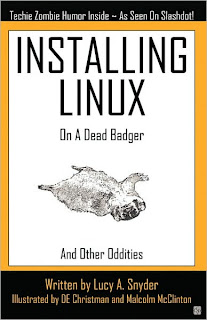
Installing Linux on a Dead Badger and Other Oddities by Lucy A. Snyder

If you've ever read Charles Stross's "Laundry" novels, or his magnificently chilly story "A Colder War," and thought to yourself, "this is really great, but I wish it was shorter and done for laughs," then Lucy Snyder is the writer you have been looking for.

Installing Linux on a Dead Badger (And Other Oddities) collects twelve stories, all of them humorous, and most of them in a post-Onion neo-non-fiction style. Touchstones include zombie movies, H.P. Lovecraft, and geeky culture in general.

This is a short book, and it's mostly made up of complicated jokes for geeks, so I'm not going to get into detailed story notes. Snyder does create something like a world in these short pieces, though -- she rings changes on the same concepts through several stories (or barefacedly repeats her own best ideas over and over again, if you prefer) that collectively add up to a slacker's-eye view of a somewhat more interesting (in the "ancient Chinese proverb" sense) world than our own.

This is a short book (barely a hundred pages), and difficult to find; it was published by a micro press and probably isn't available many places. (On the other hand, I just looked it up on BookScan, and discovered that there's plenty of stock in one of Ingram's warehouses, so anybody's local store could easily order it.) But, if the idea of creating a zombie badger through Linux is already making you giggle, you know that you already want this book.


----------------
Listening to: Bess Rogers - Bulldozer
via FoxyTunes

Wednesday, July 22, 2009

The Mike and Lamar Show!

For no good reason, I reviewed two comics-as-books today, both published by AdHouse, for ComicMix, under the rubric "post-genre superheroes." I have no explanations for my actions.

Those two books were Mike Dawson's Ace-Face: The Mod with the Metal Arms and Lamar Abrams's Remake.

The culprit is still at large.

----------------
Listening to: The Monolators - I Must Be Dreaming
via FoxyTunes

Blogging and Publishing Cynicism

I was just writing a comment on this post at OF Blog of the Fallen, and it got away from me. I'm not sure it entirely makes sense without Larry's original post -- so go read that -- but I'll stick it here as well, just because.

First, the fact that not all copies of a manufactured commodity are eventually sold is not at all unusual. What's different about the book/magazine industry is the ability of retailers to return unsold product; most retailers just have to eat unsalable goods. There's no such thing as "returns" in consumer electronics or evening wear, but there definitely is a percentage of unsold and unsalable goods on every single consumer product. Many are marked down in place, but many more are destroyed.

(And, yes, a book is a consumer product. It may be other things, but a consumer good it always is.)

Second, this is not cynicism; it's realism. Newspapers and magazines are vastly reducing their coverage of books; they were even before the economic crisis, and it's gotten much worse. Publicists and marketers are trying to get their books into the hands of people who will talk about them to a reasonable audience, and bloggers are such people. This might not be business to you, but it's business to them -- you're getting that book because The Ann Arbor News went under, and those marketers and publicists would really like someone to see and appreciate their books.

Also, unless your numbers are much higher than I suspect, or your response rates are vastly through the roof, any one (non-superstar) blog will probably move a dozen or so copies of a novel, at best. But, then again, The Ann Arbor News probably didn't move more books than that, either.

And those now out-of-work newspaper people were just as passionate about books as any of us. Sure, they were usually paid (badly), and we aren't, but otherwise it's mostly a different of format and preferred genres.

(Also, what Charles said -- I won't repeat it, but it's all true.)

James Bond Daily: The Very First Talking Killer

From page 114 of Casino Royale:
'Perhaps I should explain,' said Le Chiffre. 'I intend to continue attacking the sensitive parts of your body until you answer my question. I am without mercy and there will be no relenting. There is no one to stage a last-minute rescue and there is no possibility of escape for you. This is not a romantic adventure story in which the villain is finally routed and the hero is given a medal and marries the girl. Unfortunately these things don't happen in real life. If you continue to be obstinate, you will be tortured to the edge of madness and then the girl will be brought in and we will set about her in front of you. If that is still not enough, you will both be painfully killed and I shall reluctantly leave your bodies and make my way abroad to a comfortable house which is waiting for me. There I shall take up a useful and profitable career and live to a ripe and peaceful old age in the bosom of the family I shall doubtless create. So you see, my dear boy, that I stand to lose nothing. If you hand the money over, so much the better. If not, I shall shrug my shoulders and be on my way.'

Adam Roberts Hates Your Hugo Vote

In case you didn't know, Adam Roberts has better taste than you do.

So stop fooling your silly little head with the idea that you know what you like to read, and what's of interest to you. Just do what he says in future, and he won't have to whine at you a second time. Read the books he tells you to, and then vote for them when award time comes. You clearly aren't competent to judge what you enjoy and want to honor.

After all, Roberts teaches at a university, and that makes him unimpeachable. Remember: the thing to do is to listen to experts on literary matters, and avoid things that they consider mediocre or sub-literary. That's how SF got to where it is today, isn't it?

Tuesday, July 21, 2009

James Bond Daily: Casino Royale

The first James Bond novel was published in 1953; it was Ian Fleming's first book. (And I looked at it just a few years ago.)

I don't know if I have much more to say about it than I did in 2006; the book's Bond is very different from the movie Bond -- even the supposedly "tough" ones, like early Connery and parkour-happy Craig -- but I want to think about those differences more, as I read more of the books.

Another thing I'll want to think about is the shape of the series -- Bond is seriously injured in the middle of Casino Royale, at the hands of an enemy, escapes through no action of his own, seriously considers resigning from the service, and is nursed back to health by Vesper Lynd, who turns out -- as so many Bond girls do -- to not be quite as true and trustworthy as she appears. And, as I recall, something quite similar happens in You Only Live Twice, the last novel to be published when Fleming was alive.

Casino Royale is a tough novel of applied spycraft; it's definitely sensationalized -- I doubt any real-world spy ever set out to ruin his opposite number at the baccarat table -- but it's solidly set in the real Cold War '50s, with many references to the events and names of the day that would affect a spy like Bond. Fleming was surpassed in psychological realism by many later writers of spy novels, but Bond is still a fascinatingly spiky character, deeply damaged and re-healed broken like a badly set leg. And we do have to remember that his world is not ours -- doubly so, since his world is nearly sixty years in the past now, and the feral world of the Cold War practitioners (or of any similar agents, now or ever) is very different from the world of law most of us live in.

Movie Log: He's Just Not That Into You

I told The Wife that I'd be perfectly happy to watch He's Just Not That Into You with her on Saturday night -- as long as the sometimes-buggy wireless Internet was working, so I could do it with my laptop at hand and the movie with only about half of my attention. It was, so I did.

I've seen this movie described as a somewhat dumbed-down American version of Love, Actually (one of our favorite movies), and that's vaguely true -- it's a collection of loosely-linked plotlines, all basically in the romantic-comedy genre.

As with Love, Actually, having a whole bunch -- four or five, depending on how you count -- of romantic plots means that He's Just Not That Into You doesn't need to spin out stupid complications and silliness from any one of them; it can jump back and forth, and just give us good scenes from each plot. (Of course, any movie can just give us the good, important scenes, but it's never actually that easy.)

There's also a Greek-chorus effect several times, particularly early on in the movie, as unnamed other women -- this is a movie aimed squarely at women, in case you didn't notice that -- comment on men, their own love lives, and similar topics. It's a nice effect, and makes He's Just Not That Into You somewhat more interesting and sprightly than it would otherwise be.

This is not a great movie, but it's a decent one; it has a solid cast of nice-looking people who can act and mostly do. I won't run through all of the separate plots, since they're all fairly standard, even if they don't all end happily, which is rare for Hollywood. This is an excellent movie for a bunch of women to see together -- one might even say it was designed for that, which it probably was -- but men of even average tolerance for chick flicks will make it to the end without cringing much and probably even with some enjoyment. (And not just of Scarlett Johansson's naked swimming scene.)


----------------
Listening to: State Shirt - Hospital Hill
via FoxyTunes

The Search for the Worst Cover Ever Continues!

Orbit is in the middle of a promotion to create the worst SFF cover ever, which I think is a wonderful -- and totally achievable -- goal that reflects very well on them as an organization. I'd mentioned their plan once before, when they were looking for title suggestions for that book.

Their plans have now hit the next level; they have five potential titles -- some of the worst possible titles for SFF books ever -- and are asking readers to vote on which one should be immortalized.

And one of those titles -- Rise of the Fallen, Book Seven, The Pre-Antepenultimate Battle -- was suggested by Your Humble Hornswoggler.

Now, I don't think it would be entirely right if I were to urge you to go to the voting site -- which I've conveniently linked RIGHT HERE -- and vote en masse for that title...so I'm not going to do that.

But I do urge you to vote for whichever title you think would make the best bad cover.

----------------
Listening to: Dish - Zombie Love Song
via FoxyTunes

As My Fiendish Plan Hurtles Towards Completion...

I decided to take an Internet quiz to see what kind of a supervillain I am would be, and learned:

Your result for The Supervillain Archetype Test...

The Megalomaniac

Ambitious, Intelligent, Calculating


The Megalomaniac is the most prestigious of super-villain classes. If anyone is ever going to rule the world, it will probably be you.

Your main goal in life is power and domination, you have the tools to do it, and you know it. Megalomaniacs are intelligent and forceful, and they tend not to let their emotions cloud their judgment. Most of the time. They are usually found, or not found, working at the top of a huge structured organization, though many prefer to work by themselves.

The Megalomaniac has but one flaw, but its an invariably fatal one; arrogance. He knows that he can take over the world, and he isn't afraid to let you know, often elaborately and in great detail. They often do not foresee the fly in their ointment, because they do not want to admit that such a fly could exist.

Sample Megalomaniacs: Dr. Doom, Lex Luthor, Ras al'Ghul, Kang the Conqueror, Emperor Palpatine, Brain

Take The Supervillain Archetype Test
at HelloQuizzy

The Other Glass Teat by Harlan Ellison

There's no one else in the world who loves anything as much as Harlan Ellison loves the sound of his own voice. And there's no one as sure of anything as Harlan is of his every last opinion. There's a point, late in this book, where Ellison excoriates a television writing team -- declares that nothing they do can ever be good, and that they are necessarily evil, twisted human beings -- purely on the basis of watching a failed pilot based on their script.

Mind you, this is mere pages after Ellison also ranted at great length about what a different set of pigheaded morons did to one of his scripts, turning it into something lumpen and disgusting. (One never goes to Ellison for consistency; Ellison is for raw energy and pure emotional force, aimed in whatever direction he feels like aiming it at the time. He is hugely Whitmanian in his contradictions.)

The Other Glass Teat is one of the few Ellison books I haven't read before; I made my way through most of his work when it's supposed to be read -- when the reader is young and passionate, and, perhaps, easily led by a strong-voiced writer who knows precisely what is right and wrong, and will expound on it at great length. But this book was out of print, and hard to find; I only just read it through the generosity of a friend.

Ellison wrote about television for about three years at the turn of the '70s for the Los Angeles Free Press; this book reprints the back half of that run, plus two columns from a year later in Rolling Stone (with very little explanation as to the hole in between, and less as to why Ellison had been counting down in his last Free Press columns, but didn't quite reach his intended ending). According to Ellison's introduction, The Other Glass Teat was published much later than its predecessor volume, The Glass Teat, because the then-Vice President of the US, Spiro Agnew, personally asked magazine distributors to scuttle the first book.

Oddly, this scuttling does not seem to have affected any of Ellison's other books from that era, nor did the supposedly evil and Machiavellian Agnew take any other actions to rid himself of Ellison. Curious.

The matter of The Other Glass Teat is the very ephemeral TV scene of the time; there's very little that would be of interest to anyone nearly forty years later. Or rather, there wouldn't be anything of interest, if it hadn't been written by Ellison. The shows may be long-dead and best forgotten, but Ellison's impassioned, hectoring, hair-trigger voice is always a pleasure. (And never more so than when the reader can forget his own prejudices and preferences -- because very few of us will even remember that there was such a show as Nanny and the Professor -- and let the waves of Ellisonian bombast and invective wash over him.)

I was going to complain about how massively over-the-top that Ellisonian voice is -- it really is too much, too much of the time -- but then I looked back at my own recent review of Goats: Infinite Typewriters. And I realized how much of my own writing style has been influenced by Ellison. It's not just me -- the default tone of the entire Internet is High Outraged Dudgeon, and no one has ever done that better than Harlan Ellison, circa 1970. So I could no more complain about Ellison's writing style in a review on the Internet than I could swallow my own head.

This is a mostly forgotten book, and one that will be little read in future years -- it's little read now, and has been so its entire existence. But Ellison's voice will be read, I hope, and -- though his fiction will always be the core of his appeal and reputation -- even his vituperative, ridiculously angry, bizarrely demanding and inhumanly opinionated columns and reviews will be dug up, now and then, to the surprise and dismay of generations to come.


----------------
Listening to: Jacob Golden - Love You
via FoxyTunes

Is Jack Vance "A Great American Writer"?

The New York Times Magazine was at least willing to consider the question this past Sunday, which is rather nice of them.

Speaking of Sundays and The New York Times, this week marked the 39th week of No Itzkoff. I hope you all celebrated sensibly.

Fear and Loathing in Las Vegas by Hunter S. Thompson

A week ago, I'd never been to Las Vegas, and I'd never read this book. Since I was going to do the one, I knew I needed to do the other as well.

Fear and Loathing in Las Vegas is an artifact from the grand age of magazine journalism -- though I'm sure at the time that the more serious proponents of that art detested Thompson and his demented scribblings -- a reprint of a two-part report for Rolling Stone from the fall of 1971 about nothing so much as what it's like to be inside Hunter S. Thompson's brain, under the influence of an immense laundry list of controlled substances and in the fakest city on Earth.

It's a book that defies synopsis, and is nearly indescribable -- Thompson, and his lawyer, go to Vegas first to cover a motorcycle race in the nearby desert (but wander off before seeing who won), take a lot of drugs, meet several people, and then infiltrate a convention of policemen meeting to discuss the drug threat, but don't spend much time there, either. Throughout, Fear and Loathing is really just a series of Thompson's verbal pyrotechnics, which are themselves just a stand-in for his massively altered states of consciousness.

There's not a whole lot about Las Vegas in Fear and Loathing; it's the frame rather than the picture. And the fakery of Vegas circa 1971 is quite different from the current style. But Thompson's attitude towards Vegas still resonates; it's still the place in America where people go to be that crazy. If you want to take "A Savage Journey to the Heart of the American Dream" -- Fear and Loathing's subtitle -- it'll be Vegas you head for, even today.

So, even though Fear and Loathing tells you almost nothing about Vegas, and barely anything about the two events Thompson was ostensibly covering, it's still a vital, pulsing, raw nerve of the American psyche. Most of us will never be this crazy, but we don't have to be -- Thompson was that crazy for all of us.


----------------
Listening to: Gladshot - He Was Gone
via FoxyTunes

Monday, July 20, 2009

Amazon Shrewdly Realizes You Have a Computer

Amazon has sent me one of their periodic e-mails, asking me to help them sell some stuff. (Perhaps money is tight this month, and it's either hit me up, or scrounge under the couch cushions in the break room -- and you don't want to go in there after the third-shift telemarketing guys get done with it.)

This time, they've hit on the brilliant scheme of selling computer peripherals. Makes sense, right? If you're reading this, you're almost certainly on some sort of computing device. Sure, your smartphone might not need any of these things yet, but just you wait...

So, here are some of the things that might interest you:
  • the Computer Accessories & Supplies homepage, where you can get mice and printer paper and just about anything else for what Golden Age SF writers assumed we would be calling a 'puter by now.
  • If you're easily led, you may prefer to just look at the Bestsellers in Electronics page.
  • There's also something Amazon calls an "Outlet", which implies but doesn't directly say that the products therein will be at low or discounted prices.
  • But if you have a short attention span and demand special pricing, then the Today's Deals page is just what you need.
Finally, I'll just throw in a banner, for the three of you who haven't installed an ad-blocking add-on. It's pretty snoozy, though:


----------------
Listening to: Dirty Projectors - Stillness Is The Move
via FoxyTunes

Mythopoeic Awards

I've gotten out of the habit of posting all of the minor SFF awards, since I haven't been seriously trying to be a portal/links site for close to two years now. But I like the word "Mythopoeic" -- even if I always want to shove a "t" in the middle and make it more "poetic" -- so I'll toss these winners out at you. They were announced this last weekend at Mythcon XL (not sure if that's "40" or "extra-large") in the city of Lost Angels:
  • Adult Literature: Flesh and Spirit and Breath and Bone, Carol Berg (Roc)
  • Children's Literature: Graceling, Kristin Cashore (Harcourt Children's)
  • Inklings Studies: The History of the Hobbit, Part One: Mr. Baggins; Part Two: Return to Bag-end, John Rateliff (Houghton Mifflin, 2007)
  • Myth and Fantasy Studies: Four British Fantasists: Place and Culture in the Children’s Fantasies of Penelope Lively, Alan Garner, Diana Wynne Jones, and Susan Cooper, Charles Butler (Children's Literature Association & Scarecrow Press, 2006).
[via Locus Online]

One Last Novel From Donald Westlake

Thanks to Westlake's friend Lawrence Block and Hard Case Crime publisher Charles Ardai, the novel Memory -- which Westlake wrote in the early '60s but which his then-agent said couldn't be sold -- will be coming early next year. It's not as good as Westlake still being alive and writing new books, but it's better than a poke in the eye with a blunt stick.

[via Galley Cat and Sarah Weinman]

How Did That Book Get Published?

Editorial Anonymous, who by day is secretly a high-powered editor of books for younger readers, has blasted away the walls of secrecy surrounding publishing with an incendiary blog post entitled...

The Publishometer: How to tell whether a manuscript will be acquired

Well, I may be exaggerating slightly. But it's a very good look at the factors editors have to weigh in their acquisition decisions, if (inevitably) most closely describing the children's publishing world. But if you've ever wondered how that horrible book by {insert famous person here} ever got published, it will Explain All.

Some Days You're the Hero, and Some Days...

I've been absent from ComicMix for more days than I want to tally up, due to various busyness and laziness reasons, but today I roared back with an exceptionally long and meandering review of the new webcomic collection Goats: Infinite Typewriters by Jonathan Rosenberg.

I'm not making any promises, but there may be more later in the week.

Another Place You'll Soon Be Seeing My Ugly Mug

Since it was announced by Nonfiction Editor Douglas Cohen earlier today, I can pass on the news that I'll be the new Graphic Novels columnist for Realms of Fantasy magazine, following the estimable (but somewhat overworked) Jeff VanderMeer.

Given the nature of print-publication deadlines, you won't be reading my words in Realms for several months. But be warned: I'm coming, and now not even magazines are safe from my rantings.

James Bond Daily: Bond on Women

As I've threatened for some time, I'm now reading straight through all of Ian Fleming's James Bond books, and hope to comment on them quickly. The original plan was to read a book every day and write about it that night, but I doubt that will actually happen -- it looks more like each book will take two days.

But perhaps I can find other things to throw in on the off-days to keep up the Bondian theme, such as this quote, from p.27 of Casino Royale, the first novel:
Women were for recreation. On a job, they got in the way and fogged things up with sex and hurt feelings and all the emotional baggage they carried around. One had to look out for them and take care of them.
And I'll also note that I read Casino Royale only a few years ago, in the middle of Book-A-Day, and before seeing the recent movie.

Reviewing the Mail: Week of 7/18

Well, here it is Monday again, so it's time for a list of what came in the mail last week. I'll end up reviewing some of these books, but -- if the past is any guide -- certainly not all of them. But I do want to give at least a little spotlight to each of them -- every book has a reader, and that may be you -- so here's a quick look at the eight books that hit my mailbox in the last seven days.

First up is a new edition of Ian McDonald's 1998 debut novel, Desolation Road, which I'm pretty sure is the best novel ever written about trains on Mars. This attractive new edition is a trade paperback from Pyr, and it should be in bookstores everywhere next week.

DAW has turned two linked novels by S. Andrew Swann -- Dragons of the Cuyahoga and The Dwarves of Whiskey Island -- into a new omnibus under the fairly obvious title Dragons & Dwarves. (In fact, I'm pretty sure I played Dragons & Dwarves at some point in the '80s.) It's an urban fantasy, deviating from the norm in having the main character be male (reporter Kline Maxwell), and looking back to the first wave of urban fantasy with its Bordertown-ish setup: Cleveland now has a magical Portal, through which all sorts of creatures and people have migrated. Dragons & Dwarves is an August mass-market paperback.

The Grave Thief is the third book in Tom Lloyd's "Twilight Reign" epic fantasy series, though not the end. (Do any of us expect big fantasy series to end at three books these days? I'd think that the publishers have thoroughly trained us out of that assumption over the past decade.) It follows The Stormcaller and The Twilight Herald, neither of which I've read, so, for this book, I can say little more than that it's more adventures of those same people, but that the world has not yet been saved. Grave Thief is coming from Pyr in September.

Also from Pyr is the new fantasy novel by James Barclay, Nightchild, the third book in the "Chronicles of the Raven." As I recall, The Raven is "four men and an elf," which always strikes me as the beginning of a joke told in a bar. This was originally published in the UK in 2001, which may make it faintly familiar to some of you. But this American edition of Nightchild is coming in November.

In the tradition of such my-college-admissions-essay novels as Daniel Pinkwater's The Education of Robert Nifkin (and probably a dozen more famous books that I'm forgetting for the moment) comes a first novel by E. Van Lowe called Never Never Slow Dance with a Zombie. It's a first-person novel for teens in which our heroine/essayist Margot must deal with her junior year at a school where most of the the other students have suddenly been transformed into flesh-eating zombies. (And, if that doesn't turn into a mild allegory, I'll eat my hat.) Never Slow Dance With a Zombie is a Tor Teen trade paperback, coming in September.

I mentioned The Sheriff of Yrnameer once before, when I saw the bound galleys, but I'll mention it again, since I now have the very green (and oddly textured) final hardcover in my hands. It's a humorous SF novel -- heavily in the Hitchhikers school, from what I can see -- by the television writer Michael Rubens, whom I'm sure is a fine writer and human being despite his TV background. Pantheon is publishing Sheriff in August.

The Birthing House is a horror novel in a ghost-story style, about a couple who buy an old house -- once a haven for unwed mothers -- and come to be haunted by it. (In horror novels, nothing old is ever any good for you -- the only solution is to buy brand-new things, with no history or connections to anyone who might ever have died. If you suspect you are living in a horror novel, take that advice to heart.) Birthing House is written by Christopher Ransom, who is credited as "International Bestseller" on the cover, though he's American and Birthing House is billed as his first novel. So it's not entirely clear what he's sold best, internationally. But Birthing House has a panoply of laudatory quotes, from Publishers Weekly and Library Journal through Michael Marshall Smith and Jacquelyn Mitchard to my old colleague Jane Dentinger of the Mystery Guild, which strongly implies that it's a very good novel of its kind. If you like modern horror -- Joe Hill, say -- then you might want to find you way to a bookstore in August, when St. Martin's Press will publish Birthing House.

And last for this week is Stephen Hunt's new novel, the steampunk fantasy The Kingdom Beyond the Waves. It's set in the same world as The Court of the Air -- which might make excessively tidy minds wonder if Earth or Fire will be next. Tor is publishing Kingdom in hardcover this very week -- it should be in stores everywhere as of tomorrow.

Sunday, July 19, 2009

This Is Where I Leave You by Jonathan Tropper

It's very difficult to read contemporary novels without bringing along masses of personal baggage and history; I know I tend to enjoy and seek out books about people much like myself...even while I make snarky comments when other people do the same thing. So the fact that I greatly enjoyed reading Jonathan Tropper's new novel This Is Where I Leave You may be very much because it's about a man near my age, in my part of the world, who is even more confused and troubled than I am.

Judd Foxman is a Westchester radio producer in his early thirties, and had thought that he was successful, with a good life. But then, a few weeks before the novel opened, he walked in on his gorgeous wife, Jen, having sex with his boss, a roadshow Limbaugh named Wade Boulanger. Somehow -- Tropper never narrates the specifics -- this led to Judd moving out of his house and into a crummy basement apartment, and Jen (whose job, if any, Tropper never mentions) keeping the house. Judd also found himself out of a job, though he wasn't exactly fired and didn't precisely quit. (Though he does get a sitcom-worthy storming-out-of-the-office scene.)

That's backstory; on the first page of This Is Where I Leave You, Judd learns that his father has died. And the old man's last wish was that his widow Hillary and four children -- Judd, married-to-a-self-absorbed-venture-capitalist Wendy, damaged ex-jock Paul, and ne'er-do-well baby brother Philip -- would sit shiva for him, though none of them have been more than nominally Jewish for decades, if ever. But it's hard to deny a dying wish, so the whole family descends on the typically spacious ancestral home, which is even, far too symbolically, at the end of a cul-de-sac.

And then there are the second rank of supporting characters, who deserve to be bullet-pointed:
  • Penny, an old girlfriend of Judd's who is, amazingly, completely unattached
  • their rabbi, and Judd's old school friend, Charles "Boner" Grodner
  • mother Hillary's bestselling parenting book Cradle and All, which comes up several times but remains a free-floating metaphor or explanation
  • next-door neighbor Linda Callen, who has a very special connection to mother Hillary
  • Linda's seizure-damaged son Horry, whose injury neither quite resonates with Paul's similar story nor comes into its own; it's just another damned thing
  • Wendy's one-dimensional husband Barry, and their three kids, who are underfoot but uncharacterized
  • Paul's wife Alice, who desperately wants children and hasn't gotten any after years of trying -- and she was also Judd's first girlfriend
  • and Tracy, Philip's fifteen-years-older therapist and girlfriend
All this, and the subsequent events involving all of those characters, read very smoothly -- Judd's voice is crisp and clear, with a justified undertone of self-loathing and despair but an essential openness and honesty -- but it's a novel that starts to seem more contrived the more time and energy one puts into thinking about it. A more cynical reader might even consider it written primarily as Hollywood bait; it has a slew of quirky parts, and could easily be pitched as a Djareeling Express-meets-Rachel Getting Married-style indy comedy-drama.

All of those many parts are juicy enough to attract the usual actorly types, and all of the women are gorgeous to an unlikely degree. (The men are not described in terms of their physical beauty quite as much, but the reader gets the impression that they are all rugged, sturdy types and each has an emotional arc that, if played right, would bring the Academy to tears.)

The problem with This Is Where I Leave You is that it's too full of characters, and that they all are too much "characters" for a relatively serious novel and not funny enough for a farce. Judd's story is compelling -- at least to men in their middle years, who suddenly poke their heads up, look around, and wonder how the hell they ever got here and if it really was anything they wanted -- but it becomes only one story in a broth of them, and, in the end, the novel is happy to revel in the trivial and the standard rather than blazing its own trail.

This Is Where I Leave You is quite entertaining, in a sub-Tom Perotta way, but it doesn't earn any of the deep emotions it wants to evoke. Judd goes through his week of shiva, and the readers meet all of the members of his crazy family -- but he doesn't really learn anything important, about them or himself, and that family is not nearly as crazy as Judd seems to think. Every family is crazy. It's what you do with the craziness that matters, and, at the end of This Is Where I Leave You, Judd still doesn't know what he can, or should, or will do with that craziness. But that's where Tropper leaves us: happy, entertained, but essentially unsatisfied.

Saturday, July 18, 2009

A Pretty Face by Rafael Reig

On the evening of the Fourth of July, I was lying on a blanket behind a local highschool -- neither mine nor the one my sons will go to -- waiting for the sun to go down and reading a novel translated from the Spanish and narrated by a dead woman. Not as patriotic as I could be, I guess.

That novel is Rafael Reig's A Pretty Face, which was published as if it were a noir, or a mystery novel, by the British press Serpent's Tail. It does feature a murder -- of Maria Dolores Eguibar, our narrator and main character, on page two -- but it's not about low-lifes or detection. A Pretty Face is short but diffuse, so it's difficult to give a phrase to sum exactly what it is about, but it's a novel more concerned with the messy lives of the living -- and with the messes that the dead leave behind -- than it is with justice and righteousness for the dead.

Maria, after her unexpected death, finds herself invisible and intangible, able to witness and comment on the living world, but completely unable to affect it. Her only companion is Benito Viruta, the Eyeball Kid, preteen hero of a series of novels for young readers that Maria wrote under the name Lola Lios. Maria tells us that Benito is crass and crude, but Reig doesn't really show that -- the novel is driven entirely by Maria's contradictory, changing voice and memories, and all of the other characters are seen only darkly through the eyes of the dead woman.

Benito is also just the first of a long series of elements that Reig throws into A Pretty Face without adequately explaining them; he shows up long before Reig mentions the novels. Her husband's career, and that of her father also figure in the novel, as does a half-explained alternate history in which the USA conquered Spain and outlawed the Spanish language after a coup in the wake of Franco's death. So the reader gets a confused, jumbled view of Maria's life, driven by flashbacks and her memories, as she follows her body to the morgue and then pieces of the investigation of her death. We learn that she's estranged from her brilliant scientist husband, Fernando -- famous head of the psychiatric clinic previously run by Maria's equally famous father, working on a neuroprotein that can "cheat death" -- and that she spent the night before her death with a lumpish English ex-patient of that clinic. And one or both of those men -- and that neuroprotein -- were responsible for Maria's death.

But Maria isn't really interested in finding out who killed her and why -- in fact, it's hard to say what she is interested in. She floats along on the stream of her own consciousness, and either the translation or the original cultural referents leave the result murky and opaque to North American readers. There are events -- a few within the timeline of the novel, after Maria's death, and more that are shown in flashback -- but their greater significance never quite comes clear.

A Pretty Face is short, and it contains many interesting scenes and lines. But it doesn't entirely make sense, or cohere as a novel. And the significance of the title -- Maria was fat in life, though slim as a spirit, and so the standard complement for her was that title -- also escaped me. I read this book entirely because of a good review I read -- I believe in Publishers Weekly -- but I can't really pass on that favor. It is an afterlife fantasy, so readers who particularly love those may want to seek it out.

Friday, July 17, 2009

An Unexpected Quote

Some of you might doubt that I'm quite like I portray myself, but here's The Wife -- in an e-mail to my mother that she didn't have any reason to expect that I'd see -- talking about me:
Andy called from Las Vegas. Only 107 degrees today. He isn't planning on going out at all. I can't imagine not going out at night and seeing the lights and fountains, but then we are talking about Andy. It's funny he'll go out of his way to see something old, historic or museum quality, but isn't interested in FAKE things, like the strip.
If that's what I'm like, I guess I can live with that.

Quote of the Week

"[Chris] Anderson's reference to people who 'prefer to buy their music online' carries the faint suggestion that refraining from theft should be considered a mere preference. And then there is his insistence that the relentless downward pressure on prices represents an iron law of the digital economy. Why is it a law? Free is just another price, and prices are set by individual actors, in accordance with the aggregated particulars of marketplace power. 'Information wants to be free,' Anderson tells us, 'in the same way that life wants to spread and water wants to run downhill.' But information can't actually want anything, can it? Amazon wants the information in the Dallas paper to be free, because that way Amazon makes more money. Why are the self-interested motives of powerful companies being elevated to a philosophical principle?"
- Malcolm Gladwell, "Priced to Sell," on p.80 of the July 6 & 13, 2009 New Yorker, being a thorough takedown of Anderson's nobody-but-me-gets-paid manifesto Free: The Future of a Radical Price

----------------
Listening to: State Shirt - Conway Station Road
via FoxyTunes

Thursday, July 16, 2009

Amazon Sayeth: Go to School, Buy a Kindle

I'm clearing out my inbox, and I have two separate messages from Amazon asking me to send them business, so I might as well shove them together here.

First, they note that school will be starting up again soon (in a week or so for younger folks in more-benighted regions of the country; after Labor Day, as God and George Washington intended, where it counts), and that those students might need stuff.

Amazon is ready and willing to help out those students, whether they be clean-cut college-bound sorts or tow-headed school-aged tykes. So, if you need stuff for the student close to you, you can follow those links to buy some of it.

Second, Amazon recently cut the price on what it's now calling the "Six-inch Kindle" (all jokes left to the dirty minds of listeners), and would like everyone to know about it. I've recently discovered that I don't get a penny when people buy Kindle books, so it's not actually in my interest for you folks to buy a Kindle. But it's a measure of my utter devotion to you, the home viewer, that I'll give you a Kindle link anyway.

Because I care, goddammit.

McGraw-Hill's Third Reorg in Two Years Claims 550 Jobs

The full story-cum-press release is at Yahoo Finance; it leads with the gosh-wow details of their snazzy new structure, and buries the lede (550 total jobs lost, including 340 in their educational arm alone).

And there's another dash of cold water in the face for those of us who thought book publishing had settled down from the turmoil late last year.

[via Publishers Lunch]

Handicapping the Hugos, 2009 Edition

Updated 8/11/09 with new "checking my work" sections to see how (in)accurate my predictions were, partially based on the actual votes.

I seem to have neglected entirely to post the 2009 Hugo nominees, showing just how far I have drifted from the SFF world since I wandered over into the Land of Accountancy. (If anyone at a reputable publisher has an interest in retrieving me, I may be able to retrace the bread crumbs.)

As I've done in past years, I'll attempt to predict the winners, using my usual mix of intense cynicism and sarcasm. It's flavored with more ignorance than usual this time out, since I basically haven't been reading short fiction the last couple of years. As always, I am not predicting what works I want to win, but the ones I think those benighted souls who call themselves Hugo voters will vote for. And, again, I'm usually wrong. I also should mention at this point that I was eligible to vote for the Hugos this year, but forgot -- meaning that I really will have no excuse for complaining if one of my favorites loses.

(Oops. I did post the nominees, and said then that I'd do something like this around now. It's nice to know I can predict myself so accurately. Speaking of inaccurate predictions, let me link to my frivolous and ill-conceived 2008 and 2007 posts on this subject.)

Best Novel

  • Anathem by Neal Stephenson (Morrow; Atlantic UK)
  • The Graveyard Book by Neil Gaiman (HarperCollins; Bloomsbury UK)
  • Little Brother by Cory Doctorow (Tor Teen; HarperVoyager UK)
  • Saturn’s Children by Charles Stross (Ace; Orbit UK)
  • Zoe’s Tale by John Scalzi (Tor)

This is a tough category, full of well-loved writers, all represented by books that seemed to be quite popular. I suspect this one will be a tight race through all of the drops, but that those drops will be (in this order) Doctorow, Stross, and then Scalzi. I think Stephenson will squeak ahead of Gaiman in the end, aided by the Hugo voters' instinctive tropism towards SF when they have the choice, but Anathem is the one book I haven't read, so I could be wrong about its essential appeal. Still: a very strong year, even if I did have qualms about the Stross and Scalzi books.

Checking my work, 8/11: Graveyard Book did beat Anathem, but it led the whole way. But Anathem's support was weak enough that Little Brother snuck past it for second place. Wrong!

Best Novella

  • “The Erdmann Nexus” by Nancy Kress (Asimov’s Oct/Nov 2008)
  • “The Political Prisoner” by Charles Coleman Finlay (F&SF Aug 2008)
  • “The Tear” by Ian McDonald (Galactic Empires)
  • “True Names” by Benjamin Rosenbaum & Cory Doctorow (Fast Forward 2)
  • “Truth” by Robert Reed (Asimov’s Oct/Nov 2008)

I haven't read any of these, so I'll have to guess. I still think magazine stories, particularly those in Asimov's, have the edge among Hugo voters, so I suspect it will be a race between Kress and Reed. I predict Reed will win.

Checking my work, 8/11: "Erdmann Nexus" was ahead the whole time, and won. I expect I predicted it for the utterly wrong reasons, but I'll take it. Right!

Best Novelette

  • “Alastair Baffle’s Emporium of Wonders” by Mike Resnick (Asimov’s Jan 2008)
  • “The Gambler” by Paolo Bacigalupi (Fast Forward 2)
  • “Pride and Prometheus” by John Kessel (F&SF Jan 2008)
  • “The Ray-Gun: A Love Story” by James Alan Gardner (Asimov’s Feb 2008)
  • “Shoggoths in Bloom” by Elizabeth Bear (Asimov’s Mar 2008)

Resnick has a story with an odd title, so I'm going to predict that he will win. It's as good a reason for a prediction as any.

Checking my work, 8/11: "Alastair Baffle" was dropped first; I was completely wrong. Wrong!

Best Short Story

  • “26 Monkeys, Also the Abyss” by Kij Johnson (Asimov’s Jul 2008)
  • “Article of Faith” by Mike Resnick (Baen’s Universe Oct 2008)
  • “Evil Robot Monkey” by Mary Robinette Kowal (The Solaris Book of New Science Fiction, Volume Two)
  • “Exhalation” by Ted Chiang (Eclipse Two)
  • “From Babel’s Fall’n Glory We Fled” by Michael Swanwick (Asimov’s Feb 2008)

I have the sense that Chiang always wins, but that's the Nebula -- he's won the last couple of times he was Hugo-nominated, but not before that. But I still think he's on a streak, and so will win this time. If he doesn't, it'll be Swanwick.

Checking my work, 8/11: I was right about Chiang, but not about Swanwick being his strongest competition; "Babel's Fall'n Glory" was the first drop. Right!

Best Related Book

  • Rhetorics of Fantasy by Farah Mendlesohn (Wesleyan University Press)
  • Spectrum 15: The Best in Contemporary Fantastic Art by Cathy & Arnie Fenner, eds. (Underwood Books)
  • The Vorkosigan Companion: The Universe of Lois McMaster Bujold by Lillian Stewart Carl & John Helfers, eds. (Baen)
  • What It Is We Do When We Read Science Fiction by Paul Kincaid (Beccon Publications)
  • Your Hate Mail Will be Graded: A Decade of Whatever, 1998-2008 by John Scalzi (Subterranean Press)

This category, in my mind, always goes to the book by or about the oldest writer on the most fannish topic. But there's nothing obvious along those lines this time -- there are two books of serious criticism, one of semi-serious hardly-any-criticism-at-all, a collection of art, and a collection of writings on writing by Scalzi. In that company, I think Scalzi will romp away with it -- the Mendelsohn and Kincaid books, being the most serious and least-read, will be dropped first. (If I'm wrong, it will be if the book about Bujold pulls ahead.)

Checking my work, 8/11: Scalzi did win, as I predicted, but Mendelsohn was a close second, so I was wrong about that. Right!

Best Graphic Story

  • The Dresden Files: Welcome to the Jungle Written by Jim Butcher, art by Ardian Syaf (Del Rey/Dabel Brothers Publishing)
  • Girl Genius, Volume 8: Agatha Heterodyne and the Chapel of Bones Written by Kaja & Phil Foglio, art by Phil Foglio, colors by Cheyenne Wright (Airship Entertainment)
  • Fables: War and Pieces Written by Bill Willingham, pencilled by Mark Buckingham, art by Steve Leialoha and Andrew Pepoy, color by Lee Loughridge, letters by Todd Klein (DC/Vertigo Comics)
  • Schlock Mercenary: The Body Politic Story and art by Howard Tayler (The Tayler Corporation)
  • Serenity: Better Days Written by Joss Whedon & Brett Matthews, art by Will Conrad, color by Michelle Madsen, cover by Jo Chen (Dark Horse Comics)
  • Y: The Last Man, Volume 10: Whys and Wherefores Written/created by Brian K. Vaughan, penciled/created by Pia Guerra, inked by Jose Marzan, Jr. (DC/Vertigo Comics)

That is a very weird, unfocused agglomeration of stuff, and there's no track record for this category. So I'll go for maximum cynicism and predict the Serenity product will win, partly because I found it hermetic and unreadable.

Checking my work, 8/11: I'd forgotten one of the cardinal rules of Hugos: those who already have Hugos tend to get more of them. (Phil Foglio won back-to-back Best Fan Artist awards at the beginning of his career.) And Serenity was a solid, if distant, second. Wrong!

Best Dramatic Presentation, Long Form

  • The Dark Knight Christopher Nolan & David S. Goyer, story; Jonathan Nolan and Christopher Nolan, screenplay; based on characters created by Bob Kane; Christopher Nolan, director (Warner Brothers)
  • Hellboy II: The Golden Army Guillermo del Toro & Mike Mignola, story; Guillermo del Toro, screenplay; based on the comic by Mike Mignola; Guillermo del Toro, director (Dark Horse, Universal)
  • Iron Man Mark Fergus & Hawk Ostby and Art Marcum & Matt Holloway, screenplay; based on characters created by Stan Lee & Don Heck & Larry Lieber & Jack Kirby; Jon Favreau, director (Paramount, Marvel Studios)
  • METAtropolis by John Scalzi, ed. Written by: Elizabeth Bear, Jay Lake, Tobias Buckell and Karl Schroeder (Audible Inc)
  • WALL-E Andrew Stanton & Pete Docter, story; Andrew Stanton & Jim Reardon, screenplay; Andrew Stanton, director (Pixar/Walt Disney)

I've actually seen all of the movies in this category, though I haven't seen/read/heard METAtropolis...and I think I'm very like the average Hugo voter in that. The real-writer starpower behind METAtropolis will help it, but I think, in the end, Hugo voters want movies to win in this category, and they'll like WALL-E this year.

Checking my work, 8/11: The two biggest, most popular movies (Dark Knight and WALL-E) fought it out, and the more skiffy and positive one won, as I said. (Actually, Iron Man was closer to Dark Knight than DK was to WALL-E, so that's a vast oversimplification.) Right!

Best Dramatic Presentation, Short Form

  • “The Constant” (Lost) Carlton Cuse & Damon Lindelof, writers; Jack Bender, director (Bad Robot, ABC studios)
  • Doctor Horrible’s Sing-Along Blog Joss Whedon, & Zack Whedon, & Jed Whedon & Maurissa Tancharoen , writers; Joss Whedon, director (Mutant Enemy)
  • “Revelations” (Battlestar Galactica) Bradley Thompson & David Weddle, writers; Michael Rymer, director (NBC Universal)
  • “Silence in the Library/Forest of the Dead” (Doctor Who) Steven Moffat, writer; Euros Lyn, director (BBC Wales)
  • “Turn Left” (Doctor Who) Russell T. Davies, writer; Graeme Harper, director (BBC Wales)

Doctor Horrible, all the way. But I have a horrible track record in this category, since I have never seen any of the nominees.

Checking my work, 8/11: Doctor Horrible ran away with it, as I expected. Right!

Best Editor, Short Form

  • Ellen Datlow
  • Stanley Schmidt
  • Jonathan Strahan
  • Gordon Van Gelder
  • Sheila Williams

Van Gelder has won this category twice before, and Datlow has won the predecessor category. I always assume Hugo voters are completely hidebound and conservative, only very rarely doing anything new. So I suspect it will be between the two of them. And I think Ellen will win this year, partly because of The Del Rey Book last year and partly because the publication hiccup of The Year's Best Fantasy and Horror reminded the voters of what Datlow has been doing and for how long.

Checking my work, 8/11: I was right about Ellen, but her strongest competition was from Stan Schmidt, which either proves the Analog voting block is still strong, or there is an undercurrent of wanting to give the editor Hugos to the longest-standing deserving editors, in some vague order. Right!

Best Editor, Long Form

  • Lou Anders
  • Ginjer Buchanan
  • David G. Hartwell
  • Beth Meacham
  • Patrick Nielsen Hayden

Since this category has existed, it's gone to Hartwell once and Nielsen Hayden once -- again, since I assume Hugo voters shun and fear the previously un-awarded, I think it will be between the two of them. Patrick is Scalzi's editor, which I think will bring him ahead on points.

Checking my work, 8/11: It went to Hartwell rather than Nielsen Hayden -- I'd neglected to factor in that Hartwell was Editor GoH at Anticipation, and that Hugo voters will usually pick the older of two otherwise similar candidates. Wrong!

Best Professional Artist

  • Daniel Dos Santos
  • Bob Eggleton
  • Donato Giancola
  • John Picacio
  • Shaun Tan

This is one of the most conservative Hugo categories; it tends to go to the same artist for five- or ten-year stretches, broken only when the Worldcon is overseas and a favored son breaks through. This year the Worldcon is in Montreal, but none of these folks are really "favored sons" there, so I suspect it will go to the current Standard Hugo-Winning Artist, Donato Giancola.

Checking my work, 8/11: I was right, though John Picacio was a strong second; there's hope that more than one person will be able to win this award per decade. Right!

Best Semiprozine

  • Clarkesworld Magazine edited by Neil Clarke, Nick Mamatas & Sean Wallace
  • Interzone edited by Andy Cox
  • Locus edited by Charles N. Brown, Kirsten Gong-Wong, & Liza Groen Trombi
  • The New York Review of Science Fiction edited by Kathryn Cramer, Kris Dikeman, David G. Hartwell, & Kevin J. Maroney
  • Weird Tales edited by Ann VanderMeer & Stephen H. Segal

The (possibly-last?) award for Best Locus will go to Locus. And it won't be close, either.

Checking my work, 8/11: This was the big upset of the night, and it seems to be a triumph of the "anybody but Locus" sentiment, since Locus was ahead until the last drop. I think the not-Locus winner was Weird Tales because of the relaunch and the 85th anniversary, but I suspect someone else would have won it this year regardless. Wrong!

Best Fanzine

  • Argentus edited by Steven H Silver
  • Banana Wings edited by Claire Brialey and Mark Plummer
  • Challenger edited by Guy H. Lillian III
  • The Drink Tank edited by Chris Garcia
  • Electric Velocipede edited by John Klima
  • File 770 edited by Mike Glyer

I'm at my most ignorant when it comes to the fan categories, so I'm often reduced to reading tea leaves. The leaves this time say that File 770 will win again.

Checking my work, 8/11: I'm vastly happy for John, but this might re-ignite the "what is a fanzine" wars; Electric Velocipede is a different kind of publication than its competitors, and it ran away handily with this category -- possibly because it attracted Hugo voters who usually didn't vote in this category. It was ahead the whole time, but I'll claim half-credit, since File 770 came in second. Wrong!

Best Fan Writer

  • Chris Garcia
  • John Hertz
  • Dave Langford
  • Cheryl Morgan
  • Steven H Silver

Scalzi is out of contention, so Langford is once again the fanwriter to beat. Being cynical and prone to assuming the most conservative/lazy tendencies of the Hugo voters as I am, that means I'm predicting no one will beat him.

Checking my work, 8/11: I was wrong, and good for Cheryl. She was ahead the whole time (it was one of those years, I guess), and beat the mighty Langford without much trouble. Wrong!

Best Fan Artist

  • Alan F. Beck
  • Brad W. Foster
  • Sue Mason
  • Taral Wayne
  • Frank Wu

In recent years, Frank Wu pretty much wins this category when he's in it; so I'm going to say that he'll do so again this year.

Checking my work, 8/11: I had a brief scare when I realized that I predicted against a Worldcon GoH winning his category -- I'd forgotten about Taral Wayne -- but I was right in the end. Right!

The John W. Campbell Award for Best New Writer

  • Aliette de Bodard*
  • David Anthony Durham*
  • Felix Gilman
  • Tony Pi*
  • Gord Sellar*

*(Second year of eligibility)

I'm embarassed to admit that I don't know three of those names. (Probably the same three that you don't recognize, either.) Pi is Canadian, which may help him, and Sellar is also Canadian, though of the living-somewhere-else-right-now variety, which may not help as much. But I suspect that this will be a battle between the two names most of us have heard of -- Gilman and Durham. (Though I'm amused that Durham, who has been published since 1998 and whose first novel came out from a big publisher in 2001, is eligible for a "new writer" award.) Durham's book is bigger and more crowd-pleasing, so I'm going to predict that he will win.

Checking my work, 8/11: It was Durham in the end, though he didn't run away with it as I expected, and it was de Bodard that was his strongest competition. Right!

And those are my predictions -- come back here in about a month, when I'll post again to explain exactly how I got all of them wrong.

Checking my work, 8/11: Final score: 9-7, which I believe is better than previous years, though still probably wasn't worth wagering any decent sum of money on.

----------------
Listening to: Midwest Dilemma - Francoise
via FoxyTunes

Wednesday, July 15, 2009

Just in Case You Ever Wanted To

Google will be quite happy to give you walking directions from Anchorage, Alaska to Key West, Florida. But be sure you have at least 70 days free.

Book Marketing 101: A Hiatus

I didn't have a particular topic in mind for this week, and I've been off at a conference in Las Vegas this week, so this week is going to be a bye.

But I did have two things I wanted to mention:

First, that one major inspiration for this series of posts has been The Book Publicity Blog, which I've been reading with great interest for many months now. I'm constitutionally incapable of doing a single-topic blog, but I do greatly admire those with more focus than I. It's written by a real book publicist, and is full of great thoughts on how it works and what authors can do. It made me want to cover some of the same territory from the slightly different perspective of marketing, which led to this series.

Second, I want to know what topics you readers most want to know about. What parts of marketing make the least sense to you? What questions do you have?

Movie Log: Phoebe in Wonderland

I have two children, both of the same sex, and the older one is not entirely neurotypical, so I was very interested to see Phoebe in Wonderland. The specifics in the movie aren't the same -- here it's two girls rather than my two boys, and her condition is different from my son's -- but there were enough parallels to make it very interesting for The Wife and I.

Phoebe is smart and about ten but starting to have more and more trouble at school; she's spitting at other kids and just generally having problems with impulse control. She's also creating very elaborate coping mechanisms -- of the I-have-to-wash-my-hands-a-specific-number-of-times type -- which are not really helping her fit in. And, related to both of those -- or creating both of them -- she's also having hallucinations. (She's played by the excellent Elle Fanning, who I note is twenty-three days younger than my own Thing 1.) In the movie, this starts subtly, keeping the audience's sympathies with Phoebe -- we see her interact with a series of rule-bound, dull teachers and with a ratty (he's too mean to be mousy), passive-aggressive principal.

At the same time, Phoebe's mother, Hillary (Felicity Huffman), is greatly conflicted about her decision to semi-abandon her own career (which appears to have been in the English PhD-industrial complex) to raise her daughters, and somewhat annoyed by her husband Peter's (Bill Pullman) success in that same area and/or his lack of support of her needs. She wants to believe that Phoebe will be better, or that there's nothing "wrong" with her daughter -- she also thinks that Phoebe's problems, essentially, have to do with Hillary. (Phoebe's younger sister, Olivia (Bailee Madison) doesn't get much screen time, but she has one great scene where she declares that she doesn't want to have to manage her older sister all the time.)

So, Phoebe is getting worse at coping with her everyday life, as her own brain is making that life harder and harder to live. But, one day, she decides to sign up for an audition for her school play -- an adaptation of Alice in Wonderland -- and quickly comes to believe in and trust the odd drama teacher, Miss Dodger (Patricia Clarkson). She gets the lead, and the play becomes a place where her new behaviors don't overwhelm her -- but, of course, the outside world threatens the world of the play, as it always does in stories like this.

Phoebe in Wonderland has a lot of cliches in it -- the One Special Teacher, the Wonderfulness of Theater, the Perfidiousness of Authority Figures, and so on -- and the script doesn't always live up to its potential, or to the performances it loosely contains. But the acting is uniformly strong, and Elle Fanning is particularly good. And if it has any connection to your own life -- if you, or someone close to you, is young and not neurotypical -- it's riveting.

Tuesday, July 14, 2009

Vegas Update

I'm still here, though I'll be gone early in the morning. (Not quite as early as my flight out on Sunday, but plenty early enough.)

And it looks like I will have managed the difficult trick of spending three days in Vegas without 1) gambling, 2) drinking, 3) seeing a show, or 4) doing any of the less-savory activities this city is known for. Harrumph. I didn't think I was actually that boring, but this isn't a great city to be visiting alone for a person who doesn't like to gamble. I also note that the heat makes one disinclined to go anywhere or do anything.

(Having four early mornings in a row -- one on the way here, and three here -- has also cast a pall on the idea of going out to do something "fun.")

But next time I really must drive in from LA with a Samoan lawyer and a car-load of assorted pharmaceutical mood enhancers.

Skin City by Jack Sheehan

So I'm in Las Vegas right at this very moment. Since I'm normally in New Jersey, to get here I had to fly. And, before I could do that, I had to pick some books to take to read on the trip.

That might seem simple, but when you have as many unread books as I do -- or, perhaps, if you merely are me -- picking what to read next becomes a process that can take several hours over several days, with lots of pulling things out, frowning, and then putting them back again. Eventually -- after seriously considering Replay, a book of Evelyn Waugh short stories, several Anthony Trollope novels, and the most recent novel in the "Malazan Book of the Fallen" series -- I finally decided to read books about Vegas while I was in Vegas.

I decided that because I came across this book, which I picked up from a "free books" shelf back at the book clubs soon after it was published in paperback by Harper in 2006. It was really now or never -- if I didn't read about about the sleazy side of Vegas before my first trip there, when would I ever? So I read a big chunk of it in Newark Airport, waiting for my flight, and then some more here.

And I have to warn you that this book is one of the largest manifestations of bait & switch that I've ever seen. It's packaged like a frat boy's guide to the seamy side of Las Vegas -- a burst on the cover says "Includes Insider Tips to Vegas's Best Adult Entertainment" and the inside flap has a list of topics covered, all strongly consumer-focused on the horny fella (or possibly gal or couple) coming to Vegas with an eye to something sexy.

The book itself was originally published in 2004 by Stephens Press, and I strongly suspect -- though the book doesn't say -- that the last chapter was added for the Harper edition (it declares that it was written in 2005, which is one clue) and that the other chapters mostly or partly were magazine articles to begin with. Those earlier chapters are nearly all very clearly and closely based on Sheehan's interviews with a very small handful of people each -- three female porn stars get their own chapters, as do a pair of high-priced prostitutes and a madam, as does a couple that run a swingers club, as do three lawmen who mutter darkly about prostitution being completely run by lowlife men and organized crime and full of underage girls (this being utterly opposite to the chapters that have interviews with women in the sex trade), and so forth. Sheehan makes no attempt to bring any of his separate pieces together, each chapter is about sex in one way or another, and they're all about people with some connection to Las Vegas (some more tenuous than others), but they're not about the sex industry here in any systematic way.

What Sheehan aparently did was write a number of magazine pieces that were all vaguely tittilating and had enough local color to be sold to a local outlet. Then, when the stack of those writings was as large as a book, he stuck them into a book without (as far as I can tell) doing much of anything to unify them. Two years later, he re-sold the book to Harper, which got him to add one last chapter on strip clubs (with lots and lots of thin sidebars, suitable for a Playboy article on the city), use that chapter as the hook, and misrepresent the whole book.

If you'd like to read a book of interviews with a few mid-rank porn stars, strippers, and call girls, here's Skin City. If you're looking for a serious (or silly, or wildly incorrect, or whatever) guide to the sex biz in Vegas, you'll be left feeling like the man at the strip club two seconds after the lap dancer realizes he's out of money.

Monday, July 13, 2009

Charles Brown, 1937-2009

Charles N. Brown, founder and long-time editor of Locus (and a fixture of the SFnal fan/pro scene even longer than that) died in his sleep on Sunday night, on the way home from Readercon.

On the one hand, I'm sure Charles would have appreciated dying on the way home from a con. But there are so many cons still to come that will now have to go on without him.

Charles Brown was one of the great Big Name Fans: smart and opinionated, talkative but good at listening, so familiar and dependable that he seemed like part of the furniture. But there's now a big hole in the room of SFF, and it will never quite be filled. Farewell, Charles.

His full obituary appears on Locus Online -- where else?

Reviewing the Mail: Week of 7/11

I'm starting this week's entry very early, since I'm scheduled to fly out to Las Vegas for a conference -- of the hard-living Association of Certified Fraud Examiners -- far too early on Sunday morning. So, if the following is disjointed, it might have gotten that way by being written over several days and several states. And, if it doesn't read as disjointed, that's just proof of my innate genius.

As I say every week: I get books in the mail to review, and I'm thankful for them. But I don't manage to review all of them -- some of them, in fact, I don't terribly want to read and review. (A personal message to any publicist reading this: not your books, sweetie. Yours are always wonderful. The ones from that other publishing house. You know the one.) And that's one reason why I do these posts every Monday morning: to note and say something about all of the books, even the ones that will sit on the to-be-read pile for so long that I forget about them, or forget why I wanted to read them.

Roc will be publishing the latest in Rachel Caine's "Weather Warden" series in August: it's called Cape Storm, it's the eighth in the series, and it will be a mass-market paperback like all of the others. I haven't really read this series -- I did read a chunk of one book as preparation for a meeting at Ace/Roc a few years back, but that doesn't really count -- but they've always looked like the kind of semi-soap opera contemporary fantasy that program does really well.

Also from Roc in August is S.L. Viehl's Crystal Healer, the (I believe) ninth "StarDoc" novel, about a genetically engineered interstellar surgeon. Again, I don't have any personal knowledge of these books, but I've read, off and on, her blog Paperback Writer, and she's got a grumpy but intensely professional tone there that is both smart and appealing.

It's been another two months, which means it's time for another volume of the dementedly wonderful Black Jack series by Osamu Tezuka to be published by Vertical. This time, it's Volume 6, which hits stores at the end of this month. I reviewed #1 and #2 for ComicMix, but not the later volumes -- though, as far as I can tell, they're all the same kind of nitro-fueled wackiness, and there's no real overall plot, so you could start here as well as anywhere.

I really, really need to read The Magicians by Lev Grossman, because the nice publicist at Viking e-mailed to ask me if I would be interested in seeing it, and I said I was. (That's one of my rules: if I ask for something specifically, I really do need to find time to read and write about it.) Grossman wrote one previous novel, Codex, which I did not read. He also writes and reviews books for Time magazine, and I think I complained about something he wrote there at least once. (It wouldn't be difficult; I complain about a lot of things.) The Magicians appears to be a post-Harry Potter literary fantasy novel, about a young man who goes to a secretive school of magic. There's also a map of a fantasy kingdom on the endpapers, so I suspect it becomes a portal fantasy at some point. The Magicians will be published August 11, and I really do intend to read and review it by then.

In the category of licensed novels that I couldn't evaluate at all fairly, there's Gears of War: Jacinto's Remnant by Karen Traviss, a novel based on a game that not only have I never played, but I've never knowingly heard of it before Del Rey started publishing books about it. This one is coming on July 28th, and Traviss is quite good at licensed-novel warfare, so -- if you do like the game -- this is probably at least an entertaining waste of time. I gather from the package that Gears of War is an Xbox game, which explains why I haven't heard of it; I'm of the other persuasion.

Next is a book I know I'll have to try out on my two sons (ages eight and eleven) -- My Rotten Life: Nathan Abercrombie, Accidental Zombie, Book 1, by David Lubar. It's a middle-grade novel from Tor's Starscape imprint, publishing in August. Nathan is a tween boy who, as you might have guessed, finds himself transformed into a zombie one day and wants to get back to being just a regular fifth grader.


I really hope that David Ratte's Toxic Planet isn't as thuddingly obvious as it looks -- it's a graphic novel (translated from the French and coming from Yen Press in August) in an unspecified future world that's so polluted that everyone wears gas masks all the time. It's also apparently funny. I'll save any further comment until I actually read it; it's the kind of thing I could see myself heaping scorn on, but -- if it actually is funny -- I could also forgive it quite a lot.

Enigma is the second novel by C.F. Bentley, and the sequel to her first novel Harmony. According to the letter, it's a "combination of military science, New Age mysticism and magic" -- which reminds me that it's been close to a decade since I saw anyone use the phrase "New Age" un-ironically. DAW published Enigma in hardcover; it was in stores last week.


The fourth and last book of Sherwood Smith's "Inda" saga is Treason's Shore, a big fat fantasy novel from DAW in August. If I remember right, Treason's Shore is just down the coast from the Deception Point, near the mouth of the Seditious River, and on the main trade route to the Confederacy of Apostacy. (I believe you can also see the Moon of Mutiny from there.) So just keep going the way you're going for about twenty miles, then turn left when you see Mount Treachery and follow the Connivance Trail for a fortnight. When you reach Castle Perfidy, you're almost there -- you can get a guide to the shore from there. (This vamping is brought to you by the fact that I've read none of the previous three books in the series, so I have nothing at all of substance to say. But Smith is generally a good writer, so, if you like this sort of thing, here's that thing that you like.)

The fourth novel in Kat Richardson's "Greywalker" series is Vanished, coming in in hardcover from Roc on August 4th. Richardson has always seemed smart and interesting when I've run into her online, so I feel guilty for not reading her books. This series is about a female P.I. (and I bet she's feisty -- contemporary fantasy heroines are nearly always called feisty, which seems to translate to "not a doormat") who got the ability to talk to the dead after being briefly dead herself (and not for tax purposes, either).

And last for the week is Flight, Volume Six, the latest annual anthology of comics storied edited by Kazu Kibuishi. It looks to be the same kind of suitable for nearly all ages material as the previous volumes, with most of the usual cast of creators returning for this one. And it's officially published by Villard as a trade paperback on July 29th, though you can probably find it in some stores right now, if you look hard. (I reviewed volume three here, and volume five for ComicMix; the other three volumes are still on my far-too-tall to-be-read pile.)

Sunday, July 12, 2009

On Witches, and the Blades Thereof

Close to a year ago -- some books take more time to read than others, and some take months just to gather the courage to open -- Cat Eldridge of Green Man Press asked me to read and review a book for him. It had taken down one of his usual reviewers, he said -- she had asked to have it taken off her hands, and so Cat needed someone with a strong stomach, a way with invective, and a willingness to go big-game hunting.

(I mentioned this book when it arrived, so you readers can see for yourself just how long I have been dawdling over it -- and, by extension, how patient Cat must be.)

But everything must, eventually, come to an end. And so, now, it's my pleasure to link you to my review of The Witchblade Compendium, Volume One. I warn you: I'm a bit opinionated there, even for me.

(And, if that review makes you actually want to buy the book -- even though I'm standing there frantically waving my hands and trying to wave you away -- please use this link to do so.)

A Quote I Must Share

Context? We don't need no stinkin' context!

"Not that I particularly mind, you understand, but it’d be nice to know which comics I read involved cross-dressing prostitutes. My filing system is oddly specific."
- Chris Sims, Chris's Invincible Super-Blog

Saturday, July 11, 2009

Brooklyn to Las Vegas

Today's activities:
  • Get up early (for a weekend, at about 7) to make sandwiches and snacks and pack up the usual backpack.
  • Cajole my two sons -- Thing 1 and Thing 2, currently eleven and eight years old -- into getting dressed and having a little breakfast.
  • Bundle said sons into my car.
  • Drive to Coney Island, via the impressive Verazzano-Narrows Bridge, which my boys were awed by.
  • Park at the New York Aquarium, using my family membership to get in free. (Parking, sadly, wasn't free.)
  • See various sea creatures for several hours.
  • Get out onto the Boardwalk -- the first time I've ever been to Coney Island, actually -- and have lunch at a randomly-chosen establishment there.
  • Ride the Cyclone, which we were astonished to see was running. (We knew Astroland closed down last year.) It's rickety and rattlely and very much the old-fashioned wooden coaster, and we loved it, despite the possible brain damage due to all the shaking.
  • Back to the car to drive up to Prospect Park. (Drive all the way around the park, due to missing the entrance the first time. Whee!) Park, for free, at the Wollman rink. (Though we didn't have the cash to ride on the paddle boats, due to the Cyclone and lunch running through my wallet.)
  • Wander through the park up to the Bandstand, for a free They Might Be Giants concert in the late afternoon.
  • Enjoy the concert, particularly since the threatened rain never actually hit.
  • Race back through the park to the car, pretending a circling helicopter is searching for us. (We may, perhaps, have been watching too many Bond movies lately, but it kept us all moving when we were pretty tired.)
  • Drive back home, catching a drive-through dinner along the way.
  • Collapse briefly, and then pack.
Tomorrow I will get up far, far too early and drive to lovely Newark Airport (don't talk to me about Liberty at an American airport) for a 7:35 AM flight to Las Vegas, where the high temperature for the next four days is expected to be 107. Feh. I expect not to leave the Bellagio, where I'm manning a booth at the ACFE annual meeting, unless forced outside by fire alarms or something similar.

And then I'm back here on Wednesday, and I hope things will settle down a bit for a while.

So I don't expect any substantial blogging tomorrow. On the other hand, I may be spending a lot of time in my Bellagio room, which could mean I'll catch up on things. We'll see which it ends up being, won't we?

----------------
Listening to: Josh Ritter - Golden Age Of Radio
via FoxyTunes

Friday, July 10, 2009

Another Quote

You don't look so bad; here's another.
She gets off the bed and onto her knees to kiss the forehead of each sleeping boy. Wendy taught me to curse, matched my clothing, brushed my hair before school, and let me sleep in bed with her when bad dreams woke me up. She fell in love often, and with great fanfare, throwing herself into each romance with the focus of an Olympic athlete. Now she's a mother and a wife, who tries to get her screaming baby to sleep through the night, tries to stop her boys from learning curse words, and calls romantic love useless. Sometimes it's heartbreaking to see your siblings as the people they've become. Maybe that's why we all stay away from each other as a matter of course.
- Jonathan Tropper, This Is Where I Leave You, p.321

----------------
Listening to: Loop 2.4.3 - Zodiac Dust
via FoxyTunes

Sins of Blogging

One of the worst things about blogging is that sometimes you (by which I mean me) find yourself reading through random old posts of your own, chuckling at your own wit and thinking what a jolly fellow that writer was.

And down that road lies nothing good at all. So I need to stop it.

(But one of the Firefox add-ons I recently added is very bad for my self-control; I check to see what posts got hits every day, and look at some of them -- and AutoPager automatically loads up the previous post below that, and the previous post below that, and so on....)

Quote of the Week

"The girls around the bar shake themselves lightly in time to the music, pouting the way girls do when they dance, like they're experts in something we'll never understand. I need to stop looking at these girls. No good will come of it, You keep looking at girls like this and then one day you catch a glimpse of yourself in the mirror behind the bar, and if you're not yet too old, you're on the borderline, and the last thing you ever want to be is the old guy in the bar. There's no dignity in it."
- Jonathan Tropper, This Is Where I Leave You, p.274

----------------
Listening to: John Vanderslice - Fetal Horses
via FoxyTunes

Thursday, July 09, 2009

The City and The City by China Mieville

The cliche goes that books are like a conversation -- they speak to each other and to the reader, some telling jokes, others grabbing the lapels and pleading, a few lying languidly back and rolling out unlikely tales. The City and the City, in that company, is that one guy at the party who seems personable and interesting, but keeps returning to some utterly insane pet theory. You want to like that guy -- his stories start wonderfully, and have great touches -- but then every other sentence is about the Trilateral Commission and you find yourself mentally disengaging from even the seemingly-sane parts of the conversation. But, if you stick with it, you just might find that everything that guy says makes sense in the end -- and then you have to decide if that means that he's just gotten you to drink his Kool-Aid.

The City and the City is a police procedural: gritty, street-wise, particular, grounded. But it's also set in a bifurcated city-state that could have come right out of Borges or, more pointedly, Italo Calvino's Invisible Cities. The setting is fabulist, which keeps dragging the narrative, and the reader's attention, away from the specifics of the police investigation -- the reader's mind keeps trying to reconstruct the entire plot as a metaphor or allegory, and that's just not what The City and the City is trying to do. For most of the length of The City and the City, Mieville whipsaws back and forth -- often within the same sentence -- between the grounded, street-level detective work of Inspector Tyador Borlu, and the existential issues of "unseeing" the other city.

The metaphor of the two cities is so strong, and so foregrounded, that it demands thought on nearly every page, but it also frustrates any thoughts running along the same lines as the mystery plot. The intertwined but utterly separate cities of Beszel and Ul Qoma cannot be investigated and questioned in the ways Borlu is tracing his murder case; they demand to be worked out metaphorically, like a fable. We can read Beszel and Ul Qoma as rich and poor, as black and white, as Christian and Muslim, as capitalist and communist, as any dichotomy we like -- it doesn't fit all of those equally well, and it's a deeper, richer metaphor than any one of those, but it inevitably makes the reader think of other commensal rivals, other thoroughly interwoven yin-and-yang partners.

So The City and the City keeps jarring the reader out of the story to think about the world -- as a Science Fiction or Fantasy book often will do. But The City and the City isn't a SFF book; it's meant to be a mystery, a story about a cop in a very real -- only the slightest bit alternate-historical, to allow this city and city to exist -- world. And that's the problem; it's a novel crosshatched as intensely as the most heavily-trafficked square in its fictional world, bouncing itself between mystery and SFF phrases and ideas in every paragraph, humming with motion as it vibrates between two genres, trying to be in both and neither at the same time.

Somewhere in the Balkans, or at least a vaguely defined "Eastern Europe," exists the conjoined twins of city-states: Beszel and Ul Qoma. They occupy the same space, as anyone else in the world would define it. But somehow -- and, apparently, no one in either city now has any idea how this came to be -- they are entirely, utterly separate. So separate that residents of each city must "unsee" events taking place in the other city, must pretend that half of the cars on the streets, and people on the pavements, and buildings in the sky do not exist at all. There are areas of "totality" of one city or the other, but this novel only rarely takes place in them; the reader begins to assume that they are very few and not well-trafficked. Streets, parks, squares, even buildings are "cross-hatched," with parts being totally Beszel and parts totally Ul Qoman -- and every citizen of either city must have a near-perfect mental map of both cities, and a gazetteer of the acceptable clothing, architecture, body languages, and gestures from each culture. Every Beszel, every Ul Qoman must already know what he is seeing to know what he is seeing -- and to know, most importantly, what he is not seeing.

For seeing the other city is "breach," and this is the very worst crime in both cities. So bad, in fact, that it's turned over to an super-secret agency called Breach, which in some ways is a servant of the two city-states' governments and in some ways is their superior. Breach is known by all in both cities to be everywhere, all the time -- all-knowing, all-seeing, all-powerful, and swift to anger, like the Old Testament God. Some technical matters are handed over to Breach by the governments, but the day-to-day cases -- where a man stares at a building in the wrong city, or talks to a person in the other city, or walks down the wrong street -- is handled swiftly and apparently mercilessly by the agents of Breach, who appear from nowhere and whisk the offenders away, usually never to be seen again. No one in either city knows anyone who ever became a Breach agent; Breach has no connection to their normal world -- except that it permeates that world entirely.

This is a fantastic setting for a fabulist story, and it resonates strongly with many real-world cities and urban issues -- from the obvious ones like the question of Jerusalem to more subtle issues like the "unseeing" of urban homeless and blight to the existential question of whether we can ever see something unless we already know what it is. Mieville has created a wondrous pair of cities, utterly suitable for a great fantasy writer, full of wonder and deep mysteries.

But then he used them to tell the story of Inspector Tyador Borlu, of the Beszel Extreme Crime Squad. And, in a mystery story, what the audience -- and the detective -- have to do is pay attention to everything, to sift out the important from the trivial. But, instead of being able to do that, we get Borlu going on for pages and pages about how this street is full of buildings he doesn't see, and how he's driving even though most of the traffic is cars that he's not officially noticing, and on and on and on. Mieville never lets the mystery plot get any traction; the reader is left thinking not that this is a particularly difficult case, but that policing these cities is utterly impossible, and that they should have collapsed into utter anarchy long before now. (And then the reader smiles at that thought, too, since it mimics what so many have said about so many cities so many times, and wonders if Mieville built that in as well.)

Perhaps everything holds together because of Breach and only because of Breach -- that certainly is Breach's opinion, and seems to be Mieville's. Criminals may be terrified of running away from a crime, for fear of putting one foot wrong and falling into the cold, implacable hands of Breach. It's possible; Mieville spends a lot of time in the first half of the novel building Breach up as an effectively supernatural agency. The characters he has talking about Breach are all cops, and mostly veteran, smart, powerful cops. But they don't complain Breach the way big-city cops complain about the FBI, nor do they have the kind of burning scorn those cops have for Internal Affairs. Borlu and his colleagues find Breach just as ineffable as the regular people of Beszel and Ul Qoma; they talk about Breach in vague platitudes and nonspecific references, showing clearly that even they don't have the slightest clue who Breach really is, how they do what they do, and what the extent of their powers is. They're not cops talking about their rivals or superiors; they're medieval penitents crouching before an angry, unknowable God.

The plot is set in motion by a murder -- a young woman was killed in one city and dumped in the other -- and Borlu investigates, only a bit above the minimum required, since obviously they'll be able to hand it all over to Breach. (And when did a good cop ever think that way? "Oh, just let the FBI/SEC/Internal Affairs/Special Crimes/ATF come in; they'll be sure to find the real culprits.")

That doesn't happen, which shocks and stuns Borlu and his colleagues. So he actually has to investigate this case -- actually has to do his job. (Which is the opposite of the standard police procedural plot, which usually sees obstacles thrown up to the detective at every turn.) But Borlu, partially because of the difficulties of investigating across cities, ends up spending most of his time dealing with more existential matters -- not seeing buildings and people and cars, not talking to suspects, not Getting Off His Ass and Knocking on Doors. It's reminiscent of mysteries set in corrupt and totalitarian societies, where the detective is just going through the motions until his superiors decide who the crime will be pinned on. But that's not going to happen here; if Borlu doesn't clear this murder, no one will.

So the case sees Borlu talking to the same people over and over, mostly about philosophical, existential issues of the two cities -- and, in particular, the semi-crackpot theory, which the dead girl may have believed, that there's a third city named Orciny hidden between Beszel and Ul Qoma. There's very little tracing of physical evidence, and hardly any serious interrogation of potential witnesses -- the murder is less the core of the plot than the Maguffin that Mieville uses to give Borlu an excuse to go first to Ul Quoma and then to more unexpected places.

The City and the City is a deeply frustrating book, one that has the lines of a mystery but continually thwarts all attempts to read it as one. But it's also not much more satisfying as a fantasy -- again, it has elements that read as fantasy, or hint at fantasy, but it collapses those as the book rushes to its conclusion. There are novels that take elements of two genres -- and often those are crime fiction and speculative fiction -- and work within both successfully. The City and the City, though, sets the genre conventions in opposition to each other, and oscillates between them, ending somewhere in the wastelands in between. It does have its strengths, and Mieville's muscular prose and compelling conception of the twinned cities make it a very readable, if ultimately frustrating book.

Wednesday, July 08, 2009

Book Marketing 101: Co-Op at The Chains

This is the third in a series of posts about marketing books; the first two covered the various channels that sell books and Amazon.com.

And I'm very lucky in my timing, since the agent Nathan Bransford posted on Monday a great, long essay by a sales assistant named Eric (from one of the major trade houses), which covers in great depth how the national chains actually buy books, how sales reps prepare for and make sales calls, and how co-op works. So a lot of what I might have typed here is already available there -- I suggest any interested parties go there and read that essay, then come back.

I'm going to try to be short this week, and to go into further depth about the parts of the co-op process I find most interesting, or that I think are least understood by readers and authors. As always, comments and questions are very welcome.

More About Co-Op
I was going to start my Co-Op section this week by writing something like this:
Walk into your favorite bookstore. See all those tables up front? And the face-out bookshelves in the same vicinity? And the smaller tables in the large aisles, and the displays on the ends of rows, and the books by the registers? Those are all co-op placements; those books are all in those places because their publishers paid for them.
The process generally starts with the chain -- they create a calendar of promotions for a coming month or season. They do that pretty far out, too; I imagine the buyers and merchandisers at B&N and Borders HQs are doing their plans for the first quarter of 2010 now, if not further out than that. And that calendar is pretty predictable: every month (or as often as the slots rotate; this can be weekly or bi-monthly) there will be a "New & Notable" table up front, and another one for new paperbacks. A third table will be devoted to some seasonal or thematic category -- maybe Dads & Grads in June or Back to School in August.

It's a big calendar, with lots of entries in it. Besides the FOS (front of store) promos, there will also be in-section co-op opportunities -- maybe a big paranormal romance display with a Halloween theme in October, definitely a New Year promo in January with diet and exercise books. Every section will get some promo activity during the year, though obviously not all of them at the same time.

So the chain sends that calendar, with prices attached -- so much (in co-op dollars and minimum purchase units) for a placement in an in-section promo, and several times that for a FOS placement -- to the publishers. And then the publishers decide what they can afford, and what they want to go for.

Backing up for a moment, depending on the house, the sales force generally will find out about books because the editors or marketers have presented those books to them. (Either at monthly meetings, or in a big burst for an entire season.) For those authors who hate pitching and get annoyed that they have to do it, it might slightly mollify you that your pitch is only the first in a long string: authors pitch to agents, who pitch to editors, who pitch to marketers, who pitch to sales reps, who pitch to buyers. (Of course, it's not at all the same pitch at every step -- buyers care about very different things than editors and agents do.)

So: each publishing company, collectively, puts the list of promotions on one side, and the list of their publications for that period on the other, and starts matching things up. Inevitably, they'll run out of money before they run out of books -- not every book can get co-op (count the number of books in a section some time, and then the number of pockets on the end-of-row display), and so they'll prioritize, focusing on the books with the best chance of reaching the largest number of readers.

Eventually, the sales rep will call on the buyer, and, among other things, map out what co-op nominations that publisher wants to make for the period in question. The buyer will generally have to wait until all of the nominations are in from all appropriate publishers before being sure everything is set -- it's entirely possible to have thirty nominations for a table that will hold twenty books. (And the chain may decide to refuse other nominations for other reasons, as well -- the chain always has the final decision, though the publisher with a sure-to-be-in-heavy-demand title has a lot of leverage.)

In other words, co-op is a business negotiation like many others: two parties are each trying to maximize their benefits from the deal, and their interests are parallel but not necessarily identical. (The publisher would love to get a dedicated display space; the chain wants to have the biggest and best books no matter who publishes them. Both want to sell a lot of books, though the chain is generally agnostic as to which particular books.)

For authors, this process is really just FYI; you don't have any direct involvement in it. Obviously, you'll want your books to have the most prominent placement they can possibly get -- but so will every other author published by your company, and every author published by different companies. And you can't all get what you want; most of you will just get a buy to be placed in the appropriate section.

(And, sometimes, you won't even get that -- your book might get skipped.)

What you can do here is what you need to do in general -- write the best book you can, one with a real and sizable audience, get it into the hands of an editor (and maybe an agent, if you're in an end of publishing where that helps or is necessary) who is really enthusiastic about it, and follow their lead about what you can do to help them promote and publicize it.

You probably won't get front-of-store placement; most writers never do. And that's OK.

For readers: those books at the front of the store are there because a lot of people -- at both their publisher and the chain's headquarters -- thought that a large number of readers would want them, and some of those people were willing to pay handsomely based on that assumption.

Tuesday, July 07, 2009

Another One of Those Reading-Metrics Thingies

This one comes to us from the wilds of LiveJournal, and it only really works in the wilds of LiveJournal, but luckily I have an avatar who is like a native there:

andrewwheelersf's Flesch-Kincaid Grade Level: 12
Average number of words per sentence:33.40
Average number of syllables per word:1.51
Total words in sample:334
Analyze your journal! Username:
Another fun meme brought to you by rfreebern

I have the vague feeling that I've scored higher than that in the past -- don't some of these have college-level ranking? -- but that's complicated enough for most purposes.

Wireless by Charles Stross

Hard Science Fiction used to be all about wonder and amazement, about pushing the limits of knowledge and expectation. But that's been obsolete for some time; the rump Hard SF that we have these days has been formed by two generations of fannish nitpickers, the failure of the US space program, and an abiding sourness about mankind that has no single source I can detect. But that sourness is definitely real -- serious Hard SF is, more often than not these days, about the extinction of the human race, or the triumph of eusociality, or some other dreary outcome next to which "a boot stomping on a human face forever" is a cheery and optimistic ideal. (At least in Orwell, there are human beings, and what they do matters. In modern Hard SF, human beings are utterly pointless and due for extermination as soon as possible.)

Charles Stross didn't originate that mindset -- Greg Bear has been gleefully slaughtering mankind since the '80s, and Stephen Baxter's books are the purest exemplar of all of the myriad ways in which humanity can be snuffed out -- but he's one of the best writers of the New Gloom, and the kind of writer that crystallizes the obsessions of his generation. And so Wireless, his new collection of SF stories, is a catalog of all of the ways the the cold, remorseless universe is working to screw over humanity, as well as a slim pamphlet of the few possibilities available in that endless murky night.

It opens with "Missile Gap," his magnificent novella from the 2005 Gardner Dozois/SFBC anthology One Million A.D., a story that begins with one of the most expansive, possibility-filled premises SF has ever provided -- that the Earth of 1962, or an exact facsimile thereof, was plated onto an immense Alderson disc among hundreds of millions of other similar-sized worlds -- and then inexorably shuts down all of those possibilities, all the while explaining, in remorseless detail, why humanity is utterly, utterly doomed -- on this Earth as well as every other one that can possibly be conceived. It's a powerful, amazing story -- but it's also black as pitch.

The next story, "Rogue Farm," was from a theme anthology -- Lou Anders' Live Without a Net, which postulated contemporary or near-future worlds without an Internet -- and saw Stross postulate another one of SF's periodic conflicts between unmodified humanity and flashier new variants. In this case, a "farm" is a gestalt entity, on its way to Jupiter's orbit (shades of Varley's "Gotta Sing, Gotta Dance," though without the isolation), though not without some serious destruction to the local English countryside along the way. The unmodified humans, including Stross's old-fashioned farmer protagonist, are not fond of these "farms." So "Rogue Farm" is another "transform or stagnate" story -- like Simak's "Desertion" -- that comes down, as this generation seems to do most often, on the side of stagnation as preferable to transformation; it's an awfully conservative message for a writer usually as cutting-edge and forward-looking.

"A Colder War" is next, and it's one of the great stories of modern SF, a reimagining of Reagan-era brinkmanship using the Cthulhu Mythos and a deep appreciation for the deep games that governments play. It's also one of the very chilliest stories in all of SF, as cold and inimical to life as the Plateau of Leng.

For a few years, the prestigious scientific journal Nature ran very short science fiction stories (they had to fit on a single page of the magazine) under the heading "Futures." Stross was one of those asked to contribute, and his Nature story was "MAXOs," an extended joke on SETI and the Fermi Paradox which I won't spoil here. It's a decent joke, for what it's worth.

"Down on the Farm" is a return to the milieu of Stross's excellent novels The Atrocity Archives and The Jennifer Morgue (and a handful of other stories) -- another tale about Bob Howard, who is something in between an IT support geek and a secret agent for the British government, in a world where Lovecraftian horrors lurk just outside the spaces we know, ready to be summoned by the right mathematical conjurations -- and, as we all know, modern computers do math very very quickly. In this story, Bob has to investigate strange doings at the Laundry's captive, super-secret insane asylum. The Laundry stories are cousins to "A Colder War;" they start from many of the same premises but remain within the happy-ending tradition of genre fiction. That's about as hopeful as Stross's stories get -- that the multiverse is full of tentacled horrors that would be very happy to eat mankind's brains as a snack, but that it may be possibly to avoid them, at least for a little while, if we're very smart and lucky.

Stross occasionally collaborates on stories with other writers, and Wireless has one such story: "Unwirer," which he wrote with Cory Doctorow. It feels more like a Doctorow story than a Stross, with a very strong (even didactic) if-this-goes-on setup; it presupposes that the Internet and similar technologies were essentially outlawed in the US in the late '90s, with the usual result of what happens when you outlaw something. For a story only six years old, it struck me as being very much of its time, and already severely dated (besides being both tendentious and obvious to begin with -- it's grand theme is that information wants to be free and that the Internet is nice). Non-Americans regularly write SFnal versions of the US that I can barely recognize as a twisted version of the country I live in; I suspect my countrymen are just as bad writing about other countries. (Stross is British and Doctorow is Canadian.)

"Snowball's Chance" is a short deal-with-the-devil story with an awful lot of Scots dialect in it; it's amusing but very minor, and doesn't wear out its welcome.

For a change of pace, "Trunk and Disorderly" is a comedy, a translation of P.G. Wodehouse's Jeeves and Wooster characters into what turned out to be a dry run for Stross's novel Saturn's Children. Stross makes his Bertie Wooster manque substantially more competent than the original, and he's too much of a hard SF writer to get as funny as these kind of characters can be, but the story is amusing and at least an order of magnitude less bleak than the others in this collection. (Though that bleakness is still off in the distance; Stross just doesn't seem to be the kind of writer who can do frivolity.) I didn't find it all that funny, though; Stross kept the tone only marginally less serious than his other works, and the Wodehouse influence came across mostly in speech tics and a vague aristocratic flavor. I don't think Stross has the essential affection for dumb aristocrats to do a really good Wodehousian story; it's a very rare feeling in the modern world.

And last in Wireless is a major new novella, "Palimpsest," a Time War story in the tradition of Asimov's The End of Eternity and Leiber's The Big Time and even Robert Silverberg's Up the Line (plus a thousand more). And is it as bleak as the rest? Well, the first mission of all agents of Stasis Control in Stross's telling is to murder their own grandfathers, and another major milestone in their training is when they murder their own two-seconds-shifted selves, so I have to say that there's not much sweetness and light here, either. In this long, long timeline, humanity repeatedly goes extinct -- generally after reverting to a hunter-gatherer level -- and is only saved by Stasis Control seeding a small population a few thousand years in the future from that particular cataclysm. There's no space travel, no singularity, no triumph of Man -- the height of civilization is barely a century above what we have now, and that is achieved regularly, only to be torn down over and over again. (As is depressingly frequent in stories like this, a current bugaboo is raised to the level of eternal inevitability -- thus, here, a "ubiquitous surveillance society" is declared to be the minimum requirement of a true civilization.) Our hero, Pierce, is one of the agents of Stasis Control, and settles into a happy life in an enlightened era far in our future -- until, of course, something unexpected happens, sending him away from that happy life. And, as required in stories about the time police, there's a shadowy enemy, which I will neither confirm nor deny has moles who are, or is itself entirely made up of, secretly rogue Stasis Control agents. "Palimpsests" is a dizzying, widescreen vision of all of the future of a mankind doubly doomed -- by its own limitations, to self-destruct repeatedly over and over and over, and by those damned Cold Equations of the physical universe, which will slaughter any survivors. It's a fine story, but I'm glad that no sharp blades were close to hand when I finished reading it.

If Hard SF ever has any trouble being gloomy enough, there's always the death of the universe, deep in the bag of tricks, to pull out whenever gravitas and depression are needed. And a writer with a Lovecraftian streak, like Stross, doesn't even need to go that far -- world-devouring horrors are always conveniently available in whatever unnatural angles are closest. Stross is without a doubt one of the most inventive and thoughtful writers in the modern SF idiom, and that makes it doubly unfortunate that his output so consistently takes the tone of battling to ever-so-slightly slow down the inevitable fall of night. Wireless collects some of the very best stories in modern SF, by one of the most important writers in the field -- but, collectively, they form a singularity of depression and bleakness from which no optimism can escape.

Monday, July 06, 2009

Prometheus Awards for 2009: Now With Added Aragorn

The Prometheus Awards, which are given by the Libertarian Futurist Society and which routinely confuse those of us who think they're supposed to honor books with some connection to modern libertarian thought, have come around again. The 2009 winners -- who will each receive a plaque, to symbolize literary achievement, and a one-ounce gold coin, to symbolize the coming collapse of all governments and the rise of a goldbuggy libertoonian utopia (or something like that) -- are as follows:
That's darn impressive. The LFS has honored a lot of works with different political leanings before, but I don't think they've ever come down in favor of the divine right of kings before.

[via Locus Online]

----------------
Listening to: Sinéad O'Connor - Paddy's Lament (live)
via FoxyTunes

Help Make the Worst SFF Cover in the World

Orbit, the SFF imprint of the Hachette folks, knows that all of us on the Internet like to do nothing more than complain about cover art. But, unlike those other publishers, they're going to do something about it.

They intend to create the worst SFF cover ever.

Sure, the competition is high -- what about this German horror for a Lois Bujold novel? -- but I'm confident that they can do it. They will need your help, though: right now they're still looking for the perfect bad title.

So go to Orbit's blog and enter your suggestions for the worst possible SFF title. You might even find that someone has been there before you, with some titles (he said modestly) that are about as horrible as can be imagined.

----------------
Listening to: Sly and the Family Stone - Everyday People
via FoxyTunes

Penguin UK Sending a Hundred Employees Packing

The Bookseller has the full story, but here's the gist: they're doing a massive reorganization (after a "consultation," which I still think sounds very weaselly, though I'm prepared to change my mind if someone can point me to an instance where a company consulted and then didn't lay off the massive number they expected to), several very senior people are leaving, and there's a lot of talk about The Future!

They claim that this has nothing to do with the worldwide economic slump, and, if you believe that, I have this lovely bridge on the Thames that you might be interested in.

Reviewing the Mail: Week of 7/4

This particularly patriotic installment of "Reviewing the Mail" will be short; I only have a handful of books to write about. Every week, I start this off by writing something like "I list all of these books because I know I won't manage to read them all," but, this week, I probably could read all of these books before next week...if I ignore all of the books that have been piling up from previous weeks.

Anyway, hope your 4th was full of fireworks and hot dogs (if you're American), and here's what I saw in the mail:

Amefurash: The Rain Goddess, Vol. 1 by Atsushi Suzumi is the beginning of another manga series, and was published by Del Rey on June 23rd. Suzumi is the creator of the previous series Venus Versus Virus and Haridama: Magic Cram School; I've never heard of the first one, but I did read and review the latter. This story is set in a s mall town, somewhere out in the desert, where the requisite "ordinary boy", Gimmy, meets the local rain goddess, who is the girl on the cover. Wacky hijinks, of course, ensue. (But what kind of name is "Gimmy," anyway?)

Libyrinth is a young adult SF novel coming from Tor in hardcover tomorrow. It's credited to Pearl North, though the jacket biography tells us that North has written "a number of science fiction novels for adults" under another name, and that she lives in Royal Oak, Michigan. (So anyone who really wants to figure out who "North" is could do so -- and I also suddenly wonder if the name is a reference to "Andrew North"?) Libyrinth is set far in the future, on an alien world, where human long before built a vast, half-uncharted library. The main character is a young clerk to a Libyrarian, who has a secret talent. And the antagonists appear to be the Eradicants, who want to burn all books. I trust Libryinth isn't as obvious as it looks.

And last for this week is something else again, a book called G.I. Joe vs. Cobra: The Essential Guide, by Pablo Hidalgo. Del Rey is publishing it on July 7th, precisely one month ahead of the big movie in August. It's another one of those four-color, large-format guides to a fictional world, with lots of "dossiers" about the various characters and their guns, cars, and other equipment. And when I opened it to a random page, I found the Dreadnoks, which I suppose is a good sign. For those of you who like this sort of thing, you'll like this very much.

Sunday, July 05, 2009

History Laid Bare by Richard Zacks

The subtitle -- Love, Sex, and Perversity from the Ancient Etruscans to Warren G. Harding -- describes this book well; it's a collection of historical writings about sex and sexuality from 1400 B.C. to 1921 A.D, edited and with commentary from Zacks. It was published by Harper in 1995; I found my copy in a used bookstore in Charleston last fall, and I've been reading it before bed for the last month or two. (It seems to be out of print at the moment, but nothing is really difficult to find in this Internet era -- not at all like it used to be, the Hornswoggler harrumphed.)

History Laid Bare can be depressing if read straight through; earlier ages were not as enlightened about sex as we like to believe we are, so the selections come, more often than not, from "thou-shalt-not" laws, unpleasant religious leaders and humorless doctors, and are heavily disapproving. (There's a lot of memoirs and letters, as well, which tend to be happier about sex, but there's a lot of negativity in History Laid Bare.) But it is a fine historical survey of an area often neglected, and it collects dozens and dozens of "good parts" from various documents, many of them concerning famous figures. I don't know of any other book that does what History Laid Bare does -- Jack Murninghan's The Naughty Bits has a similar take, but it covers famous fiction -- and it does it well. It's a particularly good book for bathroom or bedside; it's great to dip into now and then.


----------------
Listening to: Elizabeth Willis - One
via FoxyTunes
Saturday, July 04, 2009

One of Many Half-Assed Stabs at Defining Science Fiction

Today is the 4th of July, the national holiday of the USA, and, as such, I'd be unpatriotic if I did anything productive. So, instead, I'm digging into the archives for new Antick Musings content.

Over on the Straight Dope Message Board, in the year Four, there was a thread about Robert Harris's novel Fatherland, centering on the question of whether it was SF -- since it was, first, alternate his