Showing posts with label Splendors of Publishing. Show all posts

Thursday, April 14, 2022

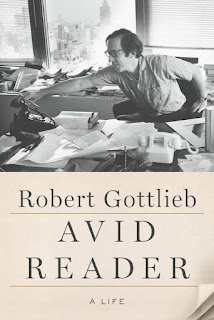
Avid Reader by Robert Gottlieb

I am in no way an unbiased observer here: let me say that up front. I've been to the circus, spent some time in a side ring, and got left behind when it decamped to the next town at a time when I thought I was a valuable part of the troupe. Bob Gottlieb was one of the biggest ringmasters around, and here's he's talking about all of his favorite acrobats and clowns and lion-tamers - OK, so in this metaphor he would be running a different circus, but you get what I'm saying.

Avid Reader covers roughly sixty years in the world of publishing, with some side-trips into other aspects of Gottlieb's life. It was published in 2016, and Gottlieb began, as the assistant to the editor-in-chief of Simon & Schuster, in 1955. (As often happens in publishing - the same thing hit me on a much smaller scale - he was quickly thrown into work on a higher level just because he was there and willing when the work needed to be done.) It's divided into a few big chapters, which each seem to be attempting to run somewhat chronologically but tend to blur that with the usual publishing-lovey stuff about how wonderful X was, leading to talk about how X was like Y who was also a joy to work with, and how can I forget Z, the greatest dosh-distimer of her generation!

Those chapters are, before I forget: Reading (early life), Learning (school, college, his first marriage), Working: Simon & Schuster, Working: Alfred A. Knopf, Working: The New Yorker, Working: Knopf Redux, Dancing, Writing, Living. The last three are more general, summing up other aspects of Gottlieb's life that don't as directly pertain to his central career: he was on the board of both City Ballet (in NYC) and Miami City Ballet, and became a ballet critic late in life. He also started writing non-fiction books, mostly film biographies, late in life. And he managed to do some living outside of working nearly all hours of a seven-day week - he in fact is still active as I write this, nearing his ninety-first birthday, with a biography of Garbo published last year and reportedly still editing some things for Knopf while sitting waiting for Robert Caro to deliver his next volume of the LBJ biography.

The center of the book covers the years he ran things: Editor-in-Chief of S&S, Publisher of Knopf, Editor-in-Chief of The New Yorker in the tumultuous transition years between the guy an entire world seems to call "Mr. Shawn" and Tina Brown. Those years ended twenty years before the book came out: this is mostly a memoir of the late '50s through the very early '90s. (Gottlieb's running-things days overlapped with my own publishing career almost not at all.)

I don't want to say I hate-read this book. Gottlieb has always been a hard worker and a passionate advocate for good writing and stories - and he's very clear in this book that's he's not a snob, as people that hit his level in publishing generally aren't: he likes books, and always wanted to find, edit, publish and push books that are good of their kind, without as much concern about what kinds those were.

But he's also such a lovey. He does have a funny quick introductory Note basically pre-apologizing for that, admitting that he's going to talk about people he knew and what they did together, so there will be a lot of names dropped. But he more than lives up to that in the rest of the book, in a near-Hollywood-style list of wonderful people who did great things that were super-successful.

The bulk of Avid Reader are those long, trackless chapters about S&S and Knopf and The New Yorker - I note, idly, that there never has been any accepted short way to refer to that very snooty magazine - that cram years of long days and lots of activities into name-clotted lists of stuff. Occasionally a section pops out because it's that big, notably in the early days at S&S (Catch-22 and The American Way of Death in particular). But Gottlieb is almost always relentlessly positive, with a very few muted slight criticisms of just a few people who are probably mostly dead by now anyway.

So, for a book about a guy who was at the center of a lot of publishing for more than half a century, Avid Reader is very light and puffy. Everything was a success, everyone was wonderful, the elephants never shit in the middle of the ring. I spent enough time in that world not to believe that view of things - I know how it's manufactured to public consumption - so I am amused but not convinced.

Gottlieb does seem to have had a great time, though, even as his repeated protestations that the giant piles of money were always thrust upon him by his employers ring exceptionally hollow. And I wonder if there were rumors about his personal life that he "addressed" here - there's an awful lot of really close relationships with women, several of whom he talks about traveling with repeatedly over the years. Also, his second wife was ten years younger than him, and they seem to have first met when she was in her early teens: it seems to have all worked out in the end, but I do have to wonder about that - both the living of it, and bringing it back up fifty years later in a memoir.

All in all, this is a book in which Gottlieb seems to be trying to cram everything he did that he wants to remember, or be remembered for. It is primarily a memoir of publishing, with the other material stuffed in at beginning and end, since his life was mostly spent in publishing. Readers will appreciate it depending on how much they first care about the things that Gottlieb did, and, on perhaps a reverse scale, how much they already know about those things.

Wednesday, January 11, 2017

Belated Notes on the Milo Yiannopoulos Boycott

This has probably all already been said elsewhere. But it's been annoying me for several days now, so here goes...

Noted right-wing asshole [1] Milo Yiannopoulos has signed a book deal with the Simon & Schuster imprint Threshold Editions, for a reported $250,000. The book will be called Dangerous, and it will go on sale in March. Yiannopoulos previously was most famous for being banned from Twitter for harassing actress Leslie Jones and for proving that a gay man can indeed be homophobic, but he's still young: he has many years of assholishness ahead of him and will likely top them.

Many people who are not right-wing assholes are deeply unhappy with this, and right-wing assholes are ecstatic. (And, like everything else in this world, the vast majority doesn't really care.) A collection of non-assholes have called for a boycott of Simon & Schuster in retaliation.

First Point: I don't recall any similar boycotts of the publishers of books by Colin Powell, Donald Rumsfeld, and Dick Cheney, who actually lied this country into war and arguably committed war crimes along the way. Perhaps being an asshole on the Internet is just worse behavior than that?

Slightly less snarkily, where have you people been? This is what the right-wing imprints do -- they put out quick fatuous books by currently popular right-wing assholes (Sarah Palin, that fake plumber guy) with deliberately incendiary titles and themes to grab the money of angry old white men (of various ages, races, and genders). I find it hard to believe that Yiannopoulos is clearly worse than the dreck that has been pouring out of that sector of publishing for the last couple of decades.

Second Point: You know that S&S is just a mid-rank link in the corporate chain, right? The actual decision-maker for the Yiannopoulos book was presumably Louise Burke, the publisher of the group of imprints that Threshold is part of. If you want to target the actual people connected to this book, boycott Gallery and Pocket as well as S&S mass-market paperbacks. The rest of S&S is run by other people who weren't part of this decision. (Anyone thinking about joining this boycott isn't going to buy any Threshold books in the first place, of course.)

Alternatively, if you want to punish the actual larger company, that isn't S&S. S&S is just a division of the CBS Corporation. So your boycott should include Showtime, The CW, Stephen Colbert, 60 Minutes, and so on.

But Andy! you say, those things aren't books! I want to boycott books!

Well, then head your time-machine back to 1969, because big publishers these days are firmly ensconced in large global media companies as part of a deliberate multi-media strategy. Books are one revenue stream of many, as part of a synergy strategy for continued incremental growth in major markets, among other bullshit buzz terms. They are not a separate thing from other media.

So: your choices are:

  • boycott books from Threshold, Gallery, Pocket, and S&S mass-market
  • boycott the entirety of CBS
  • whine online but not get around to doing anything
  • be an idiot and boycott some slightly larger piece of a big media company

Seriously, this is like boycotting ESPN but not ESPN 2, because you want to keep watching soccer. Or boycotting PTI but nothing else because you want to watch the playoffs.

And perhaps...just maybe...you might want to find some kind of positive message to rally behind, and not just "fuck everyone associated with this asshole." Because the world is full of assholes, and the next four years are going to bring that home over and over. You're quickly going to run out of ability to boycott if you start out like this.


[1] Not exactly his job description, but pretty much what he does for a living: he's an asshole to various people (mostly minorities of one kind or another) in public for the entertainment of others. He's also an instigating asshole: his thing is inciting virtual hate mobs.

Wednesday, December 30, 2015

Hit Lit by James W. Hall

What makes a bestseller? (No fair saying "a lot of people buying the same book." I mean, that's true, but it's not terribly helpful.) What attracts millions of readers to the same book, and what makes that happen really quickly?

Thriller writer James W. Hall, under his other hat teaching graduate writing students at Florida International University, decided to examine that question some years ago. (He's a little vague about exactly when.) And since he is a professor, the way he examined it was by having a class on the subject, so he could get paid to look into it and his students could pay for the privilege of figuring it out for him. (Professor Hall is no dummy, you can plainly see.)

The class ran for a number of years -- it's not clear, but Hall might still be teaching it today -- even once Hall had codified what he thinks are the aspects all really huge bestsellers have in common. (That's not really a surprise, I guess: professors are supposed to know the thing they're teaching before the classes start at the beginning of the semester.) And, in the grand tradition of "publish or perish," Hall wrote up his findings and set off to have them published. But unlike most similar academics, he already had strong big-publishing contacts from his decade-plus career as a successful writer of thrillers, and he had a topic that was of great inherent interest to Big Publishing. (We all love to hear stories about ourselves, don't we?)

Hit Lit is the book distilled from the years of that course: a class in the American bestseller of the past seventy years or so, organized into a dozen essential traits and embodied in a dozen exemplar books. (Though not all of the books live up to all of the traits, and the books are not quite all of the biggest bestsellers of those seventy years, no matter how you define "bestseller." But a little fuzziness around the edges is expected in an academic theory, right?)

The dozen books are:
  •  Gone With the Wind by Margaret Mitchell
  • Peyton Place by Grace Metalious
  • To Kill a Mockingbird by Harper Lee (which turns out to be an outlier in a number of Hall's areas, making me wonder why he didn't pick something more typical to make his theory work better)
  • Valley of the Dolls by Jacqueline Susann
  • The Godfather by Mario Puzo
  • The Exorcist by William Peter Blatty
  • Jaws by Peter Benchley
  • The Dead Zone by Stephen King (an outlier in a different way: Hall describes it as King's first big bestseller -- though I think he means hardcover, which is a major distinction -- and it doesn't fit his description for a Big Bang-style bestseller)
  • The Hunt for Red October by Tom Clancy
  • The Firm by John Grisham
  • The Bridges of Madison County by Robert James Waller
  • The Da Vinci Code by Dan Brown
If you're not Professor Hall, you might think what those books have in common -- most of them, at least -- is that they hit a Zeitgeist-y topic squarely at the right time, they were published well and were lucky in the marker, they were almost entirely first novels (or first big novels, early in a writer's career), and they all became big successful movies fairly quickly. But Hall has more detailed analyses to dig into, and a dozen Procrustean beds that these books more or less fit (there are some stretchers, and some severed feet, before we're done).

Hall's dozen elements include -- here I'm being very reductive -- secret societies, maverick protagonists, enough sex to be mildly scandalous without getting completely banned, corrupt cities vs. upstanding country, mild questions about conventional Christianity, similarly mild questioning of and unpacking of the American Dream, hot-button topics, a big scope, detailed-sounding information about interesting real-world facts, and family strife. Hall does his best, but the reader might come away with the sneaking suspicion that his "twelve features" are loose enough to be applied to almost any work of fiction, and thus not all that helpful for showing how big bestsellers are different from other similar books.

(Oh, and the subtitle is inaccurate, since Da Vinci Code was published in 2003, and is not part of the Twentieth Century. As long as I'm picking nits.)

I don't think Hall has really identified anything specific here; his book is so full of caveats and qualifications and explanations of the levels of particular elements in particular books that there are no rules here. This was never going to rise to the level of scientific rigor, but his elements are so vague that, as I said above, a reader can pick basically any piece of mainstream American fiction and find all of these elements. It doesn't work for strongly genre books as easily -- though a lot of crime fiction, particularly thrillers, will fits solidly into all of his elements -- but it basically defines mainstream mimetic fiction by Americans. And that is not the most useful thing in the world.

Sunday, May 10, 2015

My New Gig

I've been coy over the past two weeks, because I didn't want to say too much too early, but my long national nightmare is over as of tonight: I begin my new job tomorrow morning.

I'll be joining a great marketing team on the Practical Law product at Thomson Reuters, and I'm thrilled about all of it: joining a big, smart company with great resources and reach; working on a major product that provides real value to a professional audience; and both using the things I've already learned and learning more about methods and audiences and marketing tools.

Even more interesting, I'm diving right in: there's a big marketing summit for the Legal division of TR on Tuesday and Wednesday, so my first business trip will be on Day Two of the job, which may be a record. (I'm going to Minneapolis, which is where most of this division is headquartered.)

The Practical Law offices are in Manhattan -- Third Ave in the forties, which I'm amused to remember was the big publishing neighborhood back when I started in the business, twenty years ago -- so I'll be back in town all the time now, and might even start showing up more regularly to events there.

Anyway: I've got a great new job at a great division of a great company, which I hope will lead to less grumpiness here than there's been for the past three and a half months of unemployment. It may also lead to fewer posts here, since obviously real work is always the first priority. But we'll all have to see how things shake out: getting back into the commuting habit will probably mean I'll be reading more again.

(And, since I like to track everything, I'm also happy to note that my unemployment time is on a downward slope, though there are very few datapoints. I was out for 20 weeks in 1990-91, 17 weeks in 2007, and now 14 weeks this year. From this, I can project with presidential-election-level confidence that I will next be unemployed for 11 weeks in 2019.)

Tuesday, January 20, 2015

Job Hunting Again

Sadly, my seven great years at the house of Wiley are coming to an end this month -- not by my choice.

But it's a turbulent market out there for books and information products, with too many disruptions over the last few years than I could list. (Wiley has three divisions, and there's an existential threat to the business model of each one of them right now -- interesting times.) So I'm not happy, but I'm also not surprised. I have only good feelings for this place: it's still a great place to work, producing a lot of great things that materially make the world better, and I'd stay much longer if I could.

Since I can't, though, I need to find a new place to work. My hope is that this won't be as hard as last time, since the economy is booming (unlike 2007, when I was out of work right before the crash) and I now have seven years of really diverse marketing experience, including time spent on a wide range of categories (accounting, finance, architecture, public health -- to add to SF/Fantasy/comics, hunting & fishing, and general fiction from the earlier days) and pretty much every media or marketing vehicle known to man. But hopes only go so far, so I'm now knee-deep in plans and schemes and opportunities.

All that is to say that content may become scarce here, particularly once February gets under way and I don't have an office to go to everyday. Or, alternatively, I may throw myself into writing things here to keep myself busy while the mills of job-searching grind on the background. We'll have to see which one it is.

And, for you folks out there: if you know of anybody looking for an experienced Marketer --  either in publishing or out of it -- I'd be very grateful if you'd let me know about it.

Monday, August 11, 2014

Amazon and the Glorious Price of $9.99

I can't seem to stop writing about this...

Many, many people have dug into the cherry-picked Amazon statistic of the month, the fact that "For every copy an e-book would sell at $14.99, it would sell 1.74 copies if priced at $9.99."

For the purposes of this discussion, I'm going to assume that:
1) Amazon does have a large enough dataset to make this claim with confidence
2) They really do mean that this is the case for every possible e-book, and not some more narrowly defined sub-set

As John Scalzi and others have said, there's a big excluded middle there: huge numbers of major trade fiction and non-fiction titles [1] are priced between $9.99 and $14.99. Actually, I believe that standard agency-model contracts require ebook price points in the low teens for hardcovers priced in the $25-$30 range.

Also, the self-published end of the business is almost entirely under $9.99, mostly in the $0.99 to $2.99 range and topping out in most cases at $4.99.

So Amazon did not pull $14.99 out of a hat; it deliberately chose a little-used price point higher than most similar books on its site to make the best possible case for its preferred price point of $9.99.

And, again, Amazon can price any ebook at $9.99, or even lower, right now. They're not an agency account; they can set their prices however they like. If a $9.99 ebook price maximizes revenue for that book, they can do that now. But, of course, they want a larger piece of that revenue, which is what they're currently fighting with Hachette about. (And, less disingenuously, they are likely paying more than $9.99 for those ebooks -- but they've been regularly selling below cost since the first Kindle, both hardware and software, to buy market share.)

As I've said before, Amazon's claim is entirely silent about the effects of a blanket $9.99 price on two categories of sales of that same book: sales of the print edition on Amazon, and sales of all editions of that book anywhere else. They clearly can't directly measure the latter, but we can expect that Amazon does not expect this policy to increase sales elsewhere; what they want to do is to maximize their own market share. And their trading partners do all want Amazon's sales to be healthy and preferably to grow every year -- but to grow by increasing the market, not by grabbing market share from other retailers. [2]

But Amazon also wants to shift sales to ebooks from print. Sure, they are wizards at logistics, and have an impressive network of warehouses. But they're even better at moving electrons around, the margins are better there, and that dovetails more closely with where they want to move their global business. If they can shift 10% of their current print book sales to ebooks, that's an immense savings in warehousing costs and labor. So my assumption is that Amazon's model explicitly shows that the .74 extra copies as a $9.99 ebook also means a definite reduction of hardcover sales, which they likely sell for around $16 (35% off a $24.99 list price).

We don't have all of the other numbers behind this, so we can't build a model. But Amazon is only claiming a 15% total increase (in this very best case) of ebook revenue, so it would not take much downward sales pressure on the hardcover to wipe that out entirely.

In sum, in case anyone is wondering why no major-publisher authors have taken Amazon's offer seriously, this is why: they know that any increase in sales as an Amazon ebook will be offset -- and probably much more than offset -- by reductions in sales as a print book everywhere, and likely as an ebook elsewhere as well. The single statistic Amazon has provided has very clear and obvious holes, and we can see through those holes to the likely dataset behind them. As it has done so often before, Amazon has picked one very shiny number and is trying to make it work much harder than it actually can.


[1] I personally work in an end of publishing that rarely dreams of putting out any product as low as $14.99; Amazon isn't even trying to talk to me and my colleagues here. But perhaps it behooves all of us to remember that the universe of publishing books is immensely larger than the tiny ground of low-priced trade fiction, and even more immensely larger than the sub-set of that ground that's made up of e-books.

[2] To put this more bluntly, since a lot of people don't seem to get it: Hachette absolutely wants to see sales of Hachette books increase at Amazon this year and every year -- increase in units and increase in revenue. But they also want to see sales of Hachette books increase at other accounts, and overall. Amazon, like any retailer, wants to crush their competition, see them driven before the heel of Bezos, and hear the lamentations of their women.

The Co-Op Shuffle

I just left the following comment on this post over at John Scalzi's blog, but I'm posting it here as well, mostly so I can keep track of it in the future. (I have no illusions that there's even one single person who would see it here and not at the mighty Whatever.) It's driven by the odd Amazon letter that came over the weekend -- I'm signed up for KDP myself, since I keep thinking I'll turn a Book-A-Day run into an ebook, just because, so I got the letter myself Saturday morning -- which has not had the public reaction that Amazon probably expected.

Just a factual note: several people have said (or assumed) that co-op is free, or perhaps free only for big publishers.

This is very untrue; co-op is incredibly expensive, and one of the pieces of this conflict that has gotten overlooked is that Amazon is trying to turn into paid co-op some aspects of retailing that most people would consider the basic essentials -- such as having a buy button that works, or appearing in searches for the book's title. (Note that this is not unique to Amazon: Barnes & Noble has an extensive co-op program, and the details of what supermarkets do would curl your hair.)

Co-op is governed by the contracts a supplier has with a retailer, and those are inevitably secret, so no one will speak about specific terms in specific cases. But Amazon's co-op is a very large and pricey program, including such things as paying the entire cost for specific Amazon staffers to actually market one's books. Generally, co-op becomes more expensive the larger a publisher is: it increases with sales volume, and more opportunities open up with that volume as well. (So it increases not only overall, but as a percentage of sales.)

So neither Amazon nor Hachette will talk about any of these terms, but I expect the menu of exactly what services Amazon will provide and exactly what each of them will cost Hachette is one of the central details of this negotiation. It's entirely possible that ebooks are something of a sideshow, but it is the piece of the negotiation with the most public interest and media hooks, so it's the piece that drives the media attention.

Wednesday, July 30, 2014

Amazon and the Myth of Perfect Pricing

For the "world's most consumer-centric company," Amazon has real trouble actually talking to people. Their corporate communiques tend to be written in clotted, hermetic language; are few and far between; and appear only when posted on obscure corners of their own site. Amazon's managers and leaders are never quoted in the media, except for an occasional Bezos sighting. And both customers and suppliers struggle to connect with a human being at Amazon at all times.

And yet Amazon has a universal reputation for making customers happy, driven primarily by low prices and lenient return policies -- in this, as in so many other things, they've been using their investors' money to buy customers for almost two decades now. It has definitely been a successful strategy: they outcompeted, outlasted, and outgrew their Web 1.0 rivals to become the dominant online retailer and one of the world's top retailers, period.

Now, though, there's a sense that Amazon has to actually become strongly profitable soon -- like Bullwinkle and the hat, this time for sure! There's finally some mild pressure from the investing community to show profits commensurate with their valuation and sales, and the stock took a minor hit from the lousy recent quarterly results. For most companies, this would be an everyday occurrence, but Amazon has had a charmed life with investors for a long time -- they've gotten more time and benefit of the doubt than any other company in American history.

This is what's behind Amazon's current simmering conflict with Hachette: Amazon wants to be able to continue as it's gone (discounting to equal or better the competition's prices; expensive loyalty programs to lock in customers; aggressive expansion into new devices, new business models, and new territories; benign neglect from The Street and an ever-soaring stock price) and also generate more cash. The easiest way to generate more cash, as Walmart discovered before them, is to squeeze your suppliers: once you're that big, they're more dependent on you than you are on them, so you're likely to win that squeeze.

Amazon, though, wants to be loved. It's not enough that they force their suppliers to pay to have buy buttons that work, or pay to have their products actually show up in searches, or pay for an Amazon employee that the supplier can actually talk to and get results from. (Though Amazon has been forcing their suppliers to do all of these things for a long time. And Barnes & Noble forces their suppliers to do similar things, as do Walmart and your local grocery-store chain.) Amazon is an Internet-era company, so they need the world to admit that they are right and that their way of doing business is better and more special than anything the world ever saw before the Glory of Bezos was unfurled.

And putting their urge to be loved along with their borderline-incompetent public relations causes some interesting results: lots of wonky talk about "demand-weighted units" (what you or I would call books) and naked attempts to subvert the authors of the world away from their current publishers to the Glorious Land of Amazon, where payments are currently 70% (but can be changed, without notice, to any figure, at any time, on Amazon's sole discretion -- including giving it away for free to anyone who might want your book). This has not been notably successful: authors are fractious and squabbling -- and have never been terribly happy with publishers in the best of times -- but can all read, and most of them recognize bad contracts when they see one.

So Amazon's boosters remain who they have always been: the few self-publishers who won that particular lottery and have made a lot of money because of Amazon's terms and market. (Every publishing ecosystem is a lottery, and only a very few writers are ever big winners in any of them -- the trickier question is which ecosystems are better for the vast majority of authors who will never hit big.)

But they keep trying. Even after a couple of failed "offers" to Hachette, for both sides to give away their profits to compensate authors, they keep trying. (Those offers were very carefully chosen -- Amazon is full of smart, sneaky people, and their tactics are routinely brilliant when they don't have to account for the preferences of small groups of individual, grumpy authors -- to do the maximum damage to Hachette, cause the minimum damage to Amazon, and seem the most generous possible offer to authors. Unfortunately for Amazon, the authors realized this.)

Now, they're going back to one of their favorite tactics: the naked unsupported statistic, carefully deployed. Their latest salvo against Hachette -- again, remember that their real audience is Hachette authors; they're trying to demoralize the rank and file of the opposing army and force a capitulation -- relies on declared Amazon experience on the sales of ebooks to "prove" that $9.99 is the best price for an ebook.

(And many Amazon boosters have missed that message, actually -- they're crowing that Amazon has declared that lower prices are always better. Read more closely: Amazon is declaring that $9.99 is better than $14.99 for maximizing revenue. They say nothing about lower prices, which may be because they don't want to spook traditionally-published authors, or may be because prices lower than that decrease revenue. Or there may be some other reason: we don't know. What we do know is what Amazon is implying -- that $9.99 is the price point that maximizes revenue from an ebook.)

But note what Amazon is ignoring: primarily, the existence of other formats of that same content, with varying prices and varying responses to ebook discounting. (And secondly, the existence of a market outside of their own site -- though any damage to sales elsewhere due to their pricing changes would clearly be a feature rather than a bug.) That $14.99 ebook is likely also a $19.95 trade paperback or $24.95 hardcover. Presumably, Amazon can track the effect of sales on Amazon of print editions correlated to changes in ebook pricing, but they say nothing about such sales.

Does dropping the ebook to $9.99 lower hardcover sales by 25%? Or 75% Or none? Could it perhaps slightly increase sales of the hardcover, due to greater buzz and publicity? Amazon doesn't say; it takes no stance on the changing sales of print editions. (And note that, according to the latest BookStats report, ebooks are approximately $3 billion of the total $27 billion book market, having dropped very slightly from 2012 to 2013. There's a massive not-ebook market to be concerned about.)

Given that silence, one could assume that print editions take a hit when ebook prices lower. That fits expectations, and is a reasonable assumption. (Which means that it's certainly wrong, in at least some cases.) And it would only take a slight drop in print sales to wipe out the revenue gains Amazon trumpets as the whole point of moving all ebook prices to $9.99.

Authors: you each need to weigh your own situations, your own contracts, and your own sales, and do what's best for your own careers. That may even mean maximizing units sold rather than revenue -- particularly if you write the kind of nonfiction that leads to more lucrative consulting work, for example -- depending on your particular goals. And you need to be clear what data Amazon is extrapolating from, and what pieces of that dataset they know but aren't talking about.

But please don't forget that Amazon is explicitly trying to drive a wedge between you and your publishers. They would prefer that authors deal with them one-by-one, because in that situation they have all of the power and can use those we-change-them-when-we-feel-like contracts. Always know what your contracts allow -- the worst-case details were written in there for a reason, by someone specific, and they weren't put in frivolously. (This applies to contracts with anyone, mind you.)

There's less to say to consumers: you generally prefer lower prices, obviously. Everyone prefers that prices are low when they buy and high when they sell. And arguments that a certain level of revenue are necessary to keep an industry running at such-and-such a level are not likely to convince anyone: I'm not about to agree with some blogger who says I need to make sure I pay at least $2.50/pound for my apples to maintain that industry, so I won't try to make an argument like that about books. But I do buy apples from my local greengrocer, because they're fresh, because I can inspect and pick them myself, and because that business pays people who live in my community. And a similar argument can be made for books.

(Of course, if you disagree, you can use this link.)

Friday, May 16, 2014

Genres and Audiences, Women and People

I followed a PW link to this screed at the Guardian today, which makes a few good points but is confused about the core issue.

First: "Women's fiction" is a genre. It may be a genre with a problematic name, but it can line up with Sci-Fi, Mystery, and Romance with their similarly problematic names. Genre names are problematic; they often prescribe rather than describe, and seem to overly limit what goes on in their boundaries.

But, more importantly: "Women's fiction" does not mean the same thing as "fiction written by women." Sidney Sheldon wrote women's fiction. Nicholas Sparks does so today. The Bridges of Madison County, one of the biggest bestsellers in women's fiction history, was also by a man, Robert James Waller. A number of men write women's fiction, because they understand the history and boundaries of the genre and tell stories that the audience for that genre really loves.

Yes, there is plenty of sexism in publishing (as in the world at large). The fact that a major and hugely bestselling genre of fiction with several distinct threads -- the big ones: bildungsroman about women whether serious or comedic, "group of women" stories, and family sagas -- has such a reductive title does show that legacy of sexism. And, yes, maybe this is a genre name that you'd like to change. (At which the proponents of Speculative Fiction laugh a bitter chuckle and the Crime Fiction boosters look only slightly smug -- it's difficult to change what people call something.)

But it's not called women's fiction because only women write it. It's called women's fiction because the assumption is that only women read it -- and that's the gendered behavior to attack. The real issue is that publishing, and the world in general, thinks that the story of a young man growing up and finding love is literature, while the same story about a young woman is chick-lit. That is the real problem: the assumption that women's lives are for women, while men's lives are for everyone. (And that sexism seems to be even worse, and more smug, on Harris's side of the Atlantic than it is on mine.)

Also, as to Joanne Harris's assumption that only women get attacked by ignorant readers, just try googling any random male writer you like and the word "plagiarism" to be proven wrong. I tried it with one of her examples, Neil Gaiman, and quickly got to this page, where various message-board idiots accuse him of ripping off Miayzaki and Douglas Adams. Those idiots are no more correct than the idiots complaining about Harris -- though, as we've seen in other areas, there are likely more idiots complaining about women, and those idiots are more likely to use gendered terms and threats of violence when directly communicating with those women.

Tuesday, January 14, 2014

Another Radical New Scheme for Publishing!

There's one every year, and 2014 gets its entry early from self-publishing superstar Hugh Howey.

As usual, he thinks that everything that has actually worked for many multi-million dollar companies, in the US and around the world -- and continues to work, year after year, producing products and paying thousands of salaries -- is completely wrong, but he, one guy in his basement, has The One True Solution which will be vastly better.

This post may expand, if I have time to dig into his list later on. And not all of his suggestions are completely stupid. But they represent the usual profound misunderstanding of what publishing is and does -- and, more importantly, what Amazon is and what kind of market it represents -- that we always see from self-published authors.

Just to whet your whistle, I'll note that his #6 is actually about "most favored nation" clauses, not "escalator clauses." And it would require a publisher to renegotiate all of its existing contracts to change language in a way that would be unfavorable to the authors and agents. Yes, that is likely to happen. Not even Chris Christie can strongarm people that much.

Thursday, April 25, 2013

James Patterson Is Unhappy

So the book business is all aflutter about a recent advertisement by ex-ad man James Patterson, in which he demanded that someone (unspecified) do something (unspecified) about the horrible problems in publishing (unspecified). The ad is histrionic, hectoring, and utterly vague.

(If this is emblematic of the keen sensibility and razor prose that Patterson commands, I feel better for never having read one of his books.)

I don't seem to be the only one confused about his aims; Patterson spoke to Slate yesterday to insist that he has no plans and can't really articulate exactly what the problem with "books, bookstores and libraries" is, but he definitely wants someone to do something to maintain the industry that pays him millions of dollars a year.

On the very unlikely chance Patterson sees this, let me make some suggestions:
  • If the problem is that libraries are underfunded, then the solution is to find stronger and more stable streams of funding. Libraries in the US are traditionally maintained and funded on the local level, but a federal program or private foundation could certainly step in to add broad financial support to the entire sector. Such a foundation could be set up relatively quickly by an individual or group of individuals with high personal wealth, and would enjoy broad support in the publishing industry and among the general public.
  • If the problem is that bookstores are closing, then the solution is to get more people to buy books in bookstores -- this is a capitalist economy, so demand rules. If that doesn't happen, the next most plausible option would be some kind of non-profit status or preferential tax treatment for physical locations for selling printed matter, to help make those businesses more viable. But, as Yogi Berra said, if nobody wants to come, you can't stop them. And Patterson seems to have missed that large swaths of middle-class retail -- from JCPenney to Best Buy to Staples -- are also in trouble; this is likely a big-box retail problem rather than a book problem.
  • If the problem is that big publishers -- primarily among them, the major competitors to Patterson's longtime publishing company -- are merging to better negotiate terms with ever-larger partners and retailers (e.g., Amazon and Apple), then someone first needs to articulate exactly how that is damaging and to whom. There are a lot of medium and small publishing companies; there has not been a notable flood of bankruptcies in that sector recently. If Hachette becomes somewhat less powerful in an industry dominated by Random Penguin on the one hand and Amazon on the other, that may be less than pleasant to Patterson, but it's difficult to see why the rest of us should care.
In short, Patterson needs to first define the problem. There can be no solution if we don't know what we're trying to fix. "Things are changing" is not a problem; it's a description of the world.

Wednesday, April 24, 2013

What Is the Deal With LeaderShift?

It's some kind of business parable that suddenly sold lots of copies last week -- and the Amazon comments on the one low-ranking review imply that there's an astroturf campaign in place to give it lots of good reviews quickly. (Not that that's anything new or notable.)

There's a weird stew of "take our country back" and multi-level marketing here, and the book itself clearly has some political slant, but it's hiding that slant behind code words. (Or perhaps the word I mean is dog-whistles.)

One author, Orrin Woodward, is head of a current major multi-level marketing scheme called LIFE, and seems to have been a bigwig in another one called MonaVie. His co-author, Oliver DeMille, has a long Wikipedia page that doesn't say much, and which claims his politics are "independent" while listing a bunch of Republican codewords.

Best of all, the book is a "parable" -- which is what business books call themselves when they're fictional. (Business readers are serious, serious folks, with no time to waste on stories, so you need to pretend that you're Aesop if you want to sell fiction to them.)

Anyone seen this book in real life yet? It looks like something very, very special.

Wednesday, April 10, 2013

Things I Haven't Commented on Yet

I had a very nice comment yesterday, asking my thoughts about the Night Shade firesale. (The best link round-up to date I've seen is from Publishers Weekly's blog.)

That reminded me that I also haven't said anything about the slate of Hugo Nominees -- I gather there is the usual ranting and rending of garments about them, though I've mostly just marked those posts to read later so far.

There's several other award things that I haven't weighed in on, either.

I may get to all of this stuff soon, but I have to admit, I've been really busy lately -- work and life and everything else, with a long Saturday trip into NYC with my sons last weekend that stole what would have been blogging time. (And, of course, when I have free time right now, what I really want to do is play some more Lego City Undercover.)

But, just in case I don't have time for a longer, more thoughtful post later, some quick takes on La Affaire de Nightshade:
  • I don't know Jeremy Lassen and Jason Williams well, but I do know them, from my SFBC days, and they're deeply passionate and devoted to what they do. What I've seen written about their very generous royalty rates matches what I know of them -- and, I suspect, they also paid advances somewhat higher than warranted even by their royalty rates. Those points have been often forgotten in the kerfuffle, but I'll be blunt: Night Shade probably went under because they were too generous to authors. (Or, to be more nuanced, because they've spent 10+ years trying to punch above their weight, and you get awfully battered doing that.)
  • I also know Tony Lyons from those same days -- my other hat in my last five years of bookclub duty was for Outdoorsman's Edge, which sold books on huntin' and fishin', and Tony ran Lyons Press before he founded Skyhorse. He can be a tough negotiator, but he's a great publisher with a strong sense of markets and an eye for a good business -- he's built that company very strongly through a recession, which is no small feat. (And I'm amazed at the implication that he did it entirely through dead-tree books.)
  • Actual bankruptcies, that go through courts, are horrible for authors. Really. It's been a while since we had one in the field, so you folks might have forgotten, but contract provisions mean nothing in a bankruptcy, and your contracts could be sold for pennies with no money coming to you for years, if ever. Avoiding that is a huge deal.
I do have to dig in more, though -- I've only seen the broad outlines so far. It's possible that authors are being utterly shafted, but that's always the standard narrative of any publishing story, so I tend to doubt it.

Thursday, April 04, 2013

Stuff My Employer Has Sold, And What Happened To It

There are no value judgements stated or implied here; I'm mostly trying to keep track of this myself, so I can refer back to this post in several years when I've forgotten how it all happened. I presume all of these deals made great business sense to all parties at the time, and that everyone is happy with the outcome.

So: just over a year ago, in early March of 2012, Wiley announced that it intended to sell off a number of consumer publishing assets.

Google was the first buyer to surface, buying the travel business from Wiley, including Frommer's and the Unofficial Guides, in August.

The second major divestment was in November, when Wiley sold its culinary program (along with the CliffsNotes reference guides and a reference program centered on the Webster's New World dictionary) to Houghton Mifflin Harcourt.

A couple of weeks ago, news leaked that Google had decided to eliminate all Frommer's books as of mid-February. The Unofficial Guides, though, would continue in both physical and e-books.

Yesterday, Arthur Frommer -- who founded the Frommer's brand back in 1957 -- announced that he's bought back the brand from Google. (Though, presumably, not all of the publishing assets and content, which implies he paid less than the $25 million Google reportedly did.)

Also yesterday, Turner Publishing bought a third chunk of Wiley's consumer publishing, including the Baseball Prospectus as well as pets, crafts, and general consumer books.

And, today, Publishers Weekly reported that HarperCollins Canada had bought a bunch of titles from Wiley Canada, including titles on hockey and cooking.

And who says that publishing is boring?

Update, May 31:

What appears to be the last piece of the stuff that Wiley wanted to sell -- a nautical program headquartered in the UK -- has been sold, as of today, to Fernhurst Books. (That company is apparently headed by the guy who build the program and sold it to Wiley in the first place, which sounds like a good thing for the audience and authors.) Details of this sale were not announced, but really curious folks can probably winkle it out of Wiley's next 10-Q.

And so it looks like Wiley did manage to sell of the things it wanted to sell, to what look like good homes on all sides. (I'm being positive, and assuming HMH is now solid and stable and has successfully gotten through its own recent turmoil.)

Tuesday, February 26, 2013

Carving Out a New Nook in the Market

When Barnes & Noble hints that they're going to slow-track their Nook e-reader business and "focus more on licensing their content to other device makers" -- as reported by The New York Times on Sunday -- what on earth are they talking about?

B&N is a retailer; they don't own the content they sell. They don't even own the relationship with the content providers -- that's all on the publishers. So how can they possibly find a successful business strategy out of trying to shove themselves into the middle of a marketplace that has been aggressively shedding middlemen for several years?

Are they trying to imply that they think Nook technology is so special and unique -- unlike a thousand other e-readers, most of which failed -- that they can live on licensing it to some other company that wants to beat its head against Amazon's predatory discounts for a few years?

Seriously, is there any strategy that could conceivably work behind that quote, or is it just bland waffling to hide the true cluelessness beneath?

Wednesday, February 06, 2013

Najafi Sells Bookspan to Pride Tree

Publishers Weekly reported yesterday that the Najafi Companies, the mysterious holding company that bought the book- and music-club assets known by a bewildering array of names (Yes Solutions, Direct Brands, Doubleday Entertainment, Direct Group North America, Bertelsmann Direct, Bookspan, "the entity") from Bertelsmann back in 2008, has sold those assets to what seems to be an even more mysterious entity called Pride Tree Holdings.

Good luck to my old compatriots still working at the clubs, though this certainly doesn't look like a good sign from the outside. PW notes that the operation has been "steadily downsized in recent years," but all of the major clubs seem to still be running and Direct Brands is claiming 8 million members, which ain't chicken feed. Najafi is privately held, so no revenue or sales figures (or details on the Pride Tree deal) are or will be forthcoming.

From what I've heard, the downsizing has been the usual corporate type: get rid of half of the people and insist on running the same level of business. And we all know how well that usually works.

Friday, January 04, 2013

What BookScan Measures, and What It Doesn't

I found myself typing a long comment on this post over at The Beat blog -- about Colleen Doran's discovery that BookScan has been horrible at measuring the sales of her books -- so I've ported it over here as well. I think it will make sense out of that context.

Sure, it's true that mainstream newspaper reporters and other ill-informed people state that BookScan covers 75% of the book market as if that means all kinds of books everywhere -- but why should we listen to ill-informed people?

BookScan only covers the US, for starters -- many books will have a substantial life outside of that territory. And it always has been very clear about which accounts report to it and which don't -- it covers most of the largest retailers of books (Wal-Mart is joining as of the beginning of 2013), but does not include the mass of small bookstores, nor does it cover all of the other outlets that sell books sometimes, or sell a few specific niche books. And, as others have said, it doesn't do a good job of covering sales to libraries, either.

So there are publishing areas where BookScan is less useful: craft books, some travel categories, anything that gets picked up in large numbers by non-traditional retailers (like those books in Starbucks), and, yes, graphic novels. What it does cover well, not surprisingly, are the core areas of major publishing: fiction and narrative non-fiction, the kind of books that dominate sales and keep most of the big publishing companies afloat. For the vast majority of those titles, the BookScan rule of thumb (add about 25% to account for libraries and indies) works well, and it's thus the only way publishing people can accurately gauge how books from other publishers are doing. (Nobody in publishing uses BookScan to check out their own books' real sales; we all have internal systems for that.)

The smart publishing people who work in the areas that are less well covered by BookScan know that (and complain about it, of course, since it makes their jobs harder), and they make allowances for those other markets. In the case of the DM, relatively accurate numbers are available separately from Diamond, so anyone looking to sign up a comics project with any hope of hitting a comics-shop audience would have to be an idiot not to check the numbers in that channel. I'm not claiming that those idiots don't exist, of course.

I think what Colleen Doran has really unearthed is that there are stupid, badly informed people -- some of them (at least momentarily) in positions of power at publishing houses. (And many of them writing for major newspapers like the Globe & Mail.) Those people don't understand what BookScan really measures, and use it wrongly. That's not the fault of the tool; it's the fault of the idiot using the tool.

Since she came out of the DM world -- and most of her projects are focused at that world -- it's only to be expected that her books would sell primarily in that world. Since BookScan does not, and has never claimed to, include sales figures in the DM, her numbers are vastly more inaccurate than in the genres that BookScan was made for. That doesn't mean that anyone is lying or misrepresenting things; it means that BookScan is a very bad tool for calculating the sales of products that mostly sell within the DM. And we all should have known that already, since that's not what it measures.

This all seems analogous to looking at a thermometer in your living room and complaining that it doesn't tell you how cold it is outside.

Saturday, December 08, 2012

The Imp of the Perverse

Yesterday, along with the other mail, I got a copy of A Memory of Light, which, as you know Bob, is the thrilling conclusion to a very long-running epic fantasy series. It presumably contains many shocking and surprising events that are eagerly awaited by hundreds of thousands of fans.

And so it came with a little notice, asking -- well, perhaps demanding is more correct -- that any coverage or reviews hold off until the official publication date in early January.

So of course I was immediately seized with the desire to thumb through the last chapter or two, type up what seemed to be the juiciest and most amazing bits, and post immediately. That was a silly, weird desire, particularly since I've never read any of the other books, but it was definitely there.

I didn't do it, obviously -- I do have more tact and couth than that. But I'm sure someone, somewhere on the vast Internet, has already done so. And perhaps that's the lesson of the Internet: anything you can think of, someone has already done.

Friday, October 12, 2012

The Great Amazon Squeeze, Once Again

This week, Jeff Bezos admitted what numerous teardown analyses have shown: that Amazon sells its Kindle devices at "cost" to drive content sales. There's no indication of how optimistic Amazon is when it determines its "cost," so the general suspicion in publishing that they actually sell devices at a slight loss is still entirely plausible.

And those with memories that stretch back more than a couple of years remember that the famous $9.99 Kindle price point was also, in the vast majority of cases, selling at a loss. Since the end of the great antitrust suit means that Amazon is free to once again discount major-publisher books below its own cost, is there anyone who doesn't believe that Amazon will do so again?


(The comparison in that Forbes article is with videogames, where Sony, Microsoft, etc, do take a small loss on each $300-$500 console...but then make that up by making hefty profits on each piece of $60 software for that console, plus the gravy of direct-to-consumer DLC. I don't need to point out the differences between that and the book market, do I?)


So, to review: Amazon sells hardware at what is at best a breakeven price to sell more content, and then sells content at a loss to maintain lock-in with their customers. It must be nice to have a pile of money so large that you can burn it off idly like that.

But, if I owned Amazon stock, I know I'd be screaming right now.

Wednesday, September 26, 2012

Trillions! Trillions! Trillions!

Most of the projects I work on for my day job never get mentioned here, because they're deeply technical and only of interest to accountants, CIOs, and similarly specialized business folks. But, once in a while, I do have something that's more exciting that that, and this is one of those times.

Yesterday was the official publication date for Trillions, a great book on what pervasive computing will mean for business and society, from three very smart and very savvy technologists/designers/thinkers, Peter Lucas, Joe Ballay, and Mickey McManus. They're all part of MAYA Design, a Pittsburgh firm that does amazing work on interface design and other things I don't even have the terminology to describe. (When I visited them last year to talk about marketing for Trillions, they showed off an amazing system called Visage that they created for DARPA to manage and control manifold real-time dataflows for a battlefield.)

So Trillions is genuinely visionary, and comes from three guys who really know and live this stuff. It's an exciting book to be (a tiny) part of.

I'd like to get more copies of Trillions out there, particularly in the hands of SF folks and influential Internet people. (And who else would be reading this blog?) In the past, I've sent out queries to people I knew on books of less direct interest to the field, but I think I've already outstayed that welcome. So, this time, I won't spam anyone; I'm just looking for inbound interest. I'll be happy to send a copy of Trillions to you if you'll read it and possibly blog/talk/write about it -- I'm not looking for guarantees, just interest. I might be able to swing e-books in some format as well, though it's still much easier to ship blocks of dead tree.

Check out the website, which has a bunch of fascinating videos about what MAYA has done and the topic of the book, and shoot me an e-mail if you're interested in a copy of Trillions.

C'mon! It's the only book at Wiley I've worked on that has a quote from a SF writer! (And probably the only one that ever will!)

"Trillions is bold, unabashed, ingenious, and absolutely fizzing with insights about the new-modern process of blending design, high-tech, and commerce. Always entertaining and mostly right on topic."
 - David Brin