Showing posts with label Poetry. Show all posts

Tuesday, September 02, 2025

Dante's Inferno by Paul & Gaëtan Brizzi

The last time I read a comics adaptation of Dante, it was by Seymour Chwast. This one, you might say, is from the opposite end of the picture-making spectrum, all soft pencils in a detailed, almost photorealistic style as opposed to Chwast's bold colors and carefully-designed simplicity.

And clear, obvious distinctions like that are good: living in a world with multiple graphic adaptations of Dante, you want to be able to define them against each other as clearly as possible.

Dante's Inferno, unlike the Chwast book from over a decade ago, just adapts the first and most famous of Dante's three sections of the Divine Comedy. Paul and Gaëtan Brizzi - brothers who have mostly worked in animation together for the last few decades - use some of Dante's words, but mostly present this story visually, in cinematic full-bleed pages packed with striking images and magnificent effects. They have animators' eyes for gesture and expression and, in particular, for the large arresting image - the book irises out from the usual four-to-six white-bordered panels per page to full-page or full-spread images at least once per Circle, for maximum effect.

The relative lack of text keeps the focus on the main characters - Dante himself, journeying through Hell to find his dead love Beatrice, and his guide, the classic poet Virgil. Most of the text in the book is their conversation: Dante's wonder and fear, Virgil's explanations and some of his negotiations with all of the strange doomed creatures they meet.

That's the story of Dante's poem, for anyone unfamiliar with the original. The author himself is moping about a forest near his hometown of Florence, since his great love Beatrice has recently died. Virgil appears - long-dead author of The Aeneid and Dante's poetic role model - and says he will lead Dante to her. But Virgil does not reveal that the trip will go through literal hell until they're within the gates. (Seems like a thing one's mentor would want to mention at the outset, so one could be properly prepared with strong footwear, the right mental attitude, and some appropriate traveling snacks.)

Anyway, Inferno is the journey down through the nine circles of Hell, in Dante's poetry filled with lovingly-described scenes of the torture in various inventive ways of all sorts of people, particularly those he knew and loathed. It's followed by Purgatorio and Paradiso, covering Dante's journey through the other two portions of the Christian afterlife. The other two bits are less popular, and I see no indication that the Brizzi brothers intend to continue this work to adapt them - though, of course, they might.

The Brizzis show us a lot of the creatures and people in Hell - at least one group per circle - but they've quietly simplified the presentation and removed the long Dantean descriptions of various groups of sinners, the horrible things they did in life, and how they are being tortured in inventive ways in Hell. Those who have read Inferno know quite a lot of it is made of that catalog - oh, here are the simoniacs, who are in the third of ten ditches in the eighth circle, Malebolge, and they are evil because they sold holy things, and they are punished by being left head-down in holes in the burning landscape with only their feet showing. It's all a bit like Medieval Mad Libs: the SINNER TYPE is in the REGION OF HELL because they committed VERY SPECIFIC SIN and are punished in INVENTIVE WAY.

Dante sees all of this, and is horrified and/or gratified - the latter when he sees people he knew, and is happy to see them being tortured in Hell - at all of it. Eventually, the two of them make it to the bottom of Hell, where a gigantic goat-like Lucifer breaks out of a frozen lake (the thermodynamics of Hell do not bear close scrutiny) and our heroes are able to jump onto his head to get themselves to the exit.

(Rather convenient of the King of Lies, I'd say - provides good service to visitors. Five stars.)

The Brizzis make compelling pages here, and they have a fantastic, world-famous story full of striking images to work from. Their version of Dante loses the tedious catalog of sins and torments for visual grandeur and a near-epic feel. It may disappoint some hard-core Dante fans, who want more details on exactly how the murderers are tortured, and what the virtuous pagans are up to, but, for most readers, this is either a fantastic introduction to Dante or a gorgeous reminder of his work.

Friday, May 31, 2024

Opened Ground: Selected Poems 1966-1996 by Seamus Heaney

If anyone actually hits this post for advice or guidance on Seamus Heaney, I have one big thing to say: read the afterword first. Opened Ground includes Heaney's 1995 speech on winning the Nobel, "Crediting Poetry," which does a good job of explaining why he wrote poetry and the kind of poetry he tried to write.

Reading that before the poems themselves would go a long way to put a reader in the right frame of mind. Reading it last instead made this reader think he'd missed the whole point, and made him faintly annoyed by Heaney's editor.

Heaney is one of the declared great poets of the twentieth century - he won the Nobel, got extravagant praise his entire career, and was a noted Harvard professor for a couple of decades. He also grew up in Northern Ireland and lived through the worst of the "Troubles" - though, reading between the lines, it seems that he moved to Dublin pretty young and America in his early thirties, so his view of NI, for most of his life, was that of an expatriate.

That feels appropriate to me. I may be cynical, but Heaney's matter feels very "auld sod" to me: mythologizing, backwards-looking, celebrating things he has personally left behind and wants to engage with only on the level of his tightly-controlled writing.

I have to admit I struggled through a lot of Opened Ground. I found it full of far-too-precious, far-too-specific Irish farming terms, words with immediate meanings only to people of Heaney's generation and heritage or older. Specificity in poetry is a good thing: I'll never deny that. But it has to be specific in ways a reader can get into, and I found Heaney's word were barriers to meaning: for me, maybe for Americans or people of my generation in general.

Halfway through, I formed a cynical schema. Heaney's poems, I postulated, were all metaphors. About half were metaphors of a rural scene of his youth: a village blacksmith, a horse pulling a plow, the color of sunlight on a Tuesday morning in June through one particular tree. The other half were metaphors for Catholicism. Eventually, I decided that was too limiting. Instead, every single Heaney poem was both: it used Irish rural dialect words about random farming details as a metaphor for Catholicism. And sometimes for the Catholic-Protestant sectarian battles, in which Heaney would not officially pick a side (even though the Irish Catholics, the greatest people on earth, are clearly correct and clearly horribly downtrodden).

Heaney wrote about people as types, not persons. He almost never uses names, instead starting with pronouns - almost exclusively "him;" women are mostly absent in Heaney's poetry other than glancing references to the fecundity of his mother and wife - and commonly writing from the viewpoint of himself as a very young child, bedazzled by the worlds of manly work and honest toil.

The Nobel lecture talks about his reasons for this - why his work is so intensely about his viewpoint, about being Seamus Heaney at its core, this person born into a troubled land at a troubled time, and  trying to write about it in ways that won't get him stood up by the side of the road and shot the next time he comes back to visit family. I appreciate all of that. I appreciated it once I read the lecture, and would have greatly appreciated having that perspective before reading the poems.

There were lines I enjoyed greatly, probably even a few entire poems. I found a lot of it too precious, in that so-common poet's way of being besotted with glittering, quirky words. I expect readers who did grow up in a rural district, or in Ireland (or possibly the British Isles in general) will find many more of those words more homey and immediate than I did. My favorite bits of Heaney were his translations: he worked quite a lot from the ancient Greek, perhaps seeing an echo of the conflicts of his own life in the Trojan War. (I did also read his translation of Beowulf a long long time ago - that may have been the reason I got this book in the first place, way back when.)

I usually end my post about books of poetry by exhorting whoever is reading to read more poetry. I'll do that again here, though it probably sounds like faint praise, since I didn't click with Heaney the way I'd hoped. Still, poetry is clarified, intense, distilled language. If you read, you need to tackle the hard stuff now and then. Maybe not Heaney, unless you're either quite different from me or ready to read the afterword first, or both.

Thursday, June 15, 2023

Selected Poetry by Emily Dickinson

I don't know if this is a plus or a minus, but one feature of writing about every book I read is that I fairly regularly need to throw my hands up, admit that there are some pretty fundamental things I just did not get, and try to assemble something coherent out of my confusion and misreadings.

Not actually changing the subject: I'm getting to a book of poetry about once a year, these days: not a lot, but more than a lot of people, so I guess it balances.

This year, it was Selected Poems by Emily Dickinson, an attractive little edition published as part of the "New York Public Library Collector's Editor" series in the late '90s. [1] I thought I would be simpatico with Dickinson's work; she seemed like a fun, quirky writer and that I would enjoy her allusive poems.

This mostly was not the case.

Now, Emily Dickinson is a world-famous poet, whom many great writers and readers have found inspiration and delight in for more than a century. But not every reader is for every writer. 

I did find a few things that spoke to me, but most of this book was deeply opaque, on multiple levels. I never quite figured out how to read Dickinson's famous dashes: close to a majority of them seemed to not even break the meter, so they weren't breaks or pauses or anything I could figure out. [2] Oh, sometimes they could be used as pauses, but not consistently - they felt more like greengrocer's apostrophes to me, thrown in whenever the writer felt like fancying things up. (Which I'm sure was not the case, but it's as close to a theory as I had.)

And the topics of the poems were often vague at best, with Dickinson's churchy and high-falutin' 19th century language mostly serving to obscure whatever it was she was talking about. About half way through, I formed a theory: Dickinson's poems were either about some random natural thing (a beetle, for example) that was common outside her house in 1860 but went extinct twenty years later, or about Death in a vaguely Protestant way, or occasionally about some other human being whom she would never name or explain.

So I'd read a poem, think, "this is an allegory for a birch tree, maybe" and move on. And then the next one would be "OK, so somebody is dead, I think." And then would be one that was probably about a cloud, and then another about what her life would be like after she was dead. (That last category seemed very common.)

I did find Dickinson's late poems were clearer, that they made sense to me more consistently. I'm not sure if that was a shift in her work, or just that I'd read enough Dickinson that I'd clicked - I think the former, since she used far fewer dashes towards the end.

But my main takeaway was: just because something is declared to be Great doesn't mean it will work for you, today or ever. There's no shame in that. It doesn't mean it's not Great for someone if it's not Great for you. And the goal of writing about art is to try to see what is or can be Great in there - where's the spark that inspires or thrills or excites.

Dickinson was a fizzle for me, mostly. But I'm not sorry I read her poetry, and I hope having read them will set me up to read other things in the future, and, I hope, to find them Great in unexpected ways.


[1] If I remember correctly, my then-colleague Barbara Greenman at what was then the Doubleday Book Clubs was involved with the series, though I don't know on what level. But they're lovely books, and the clubs sold all of them, and I grabbed copies of every one I could and still have a few two-plus decades later.

[2] I tried reading some poems out loud, pausing or not at dashes, which didn't help. I'm sure there is some method to it, but I didn't manage to stumble into that method.

Wednesday, May 11, 2022

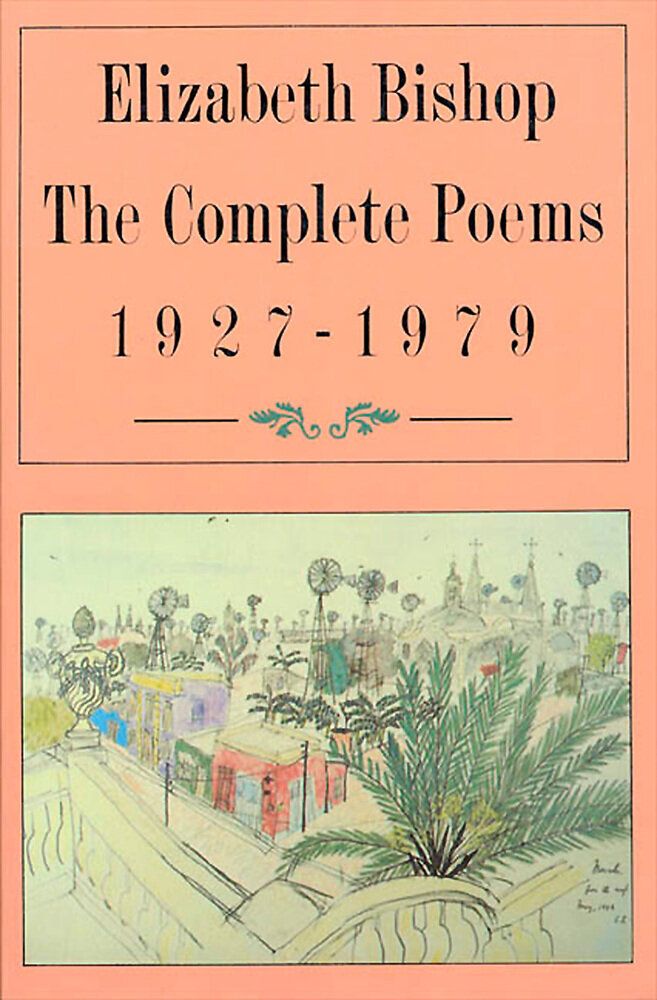
The Complete Poems: 1927-1979 by Elizabeth Bishop

Do you know how long it takes me to get a to a book on my to-read shelves? I can give you one hint: this book was superseded a decade ago, a newer, possibly larger Poems having hit in 2011. I just discovered that when searching for a link and finding the book I own is deeply out of print. (I was hoping there was something newer, and I was happy to find that true.)

My copy of Elizabeth Bishop's The Complete Poems: 1927-1979 is from the fifteenth printing in 1995, with a 10% off penciled price on the first page, so I might have gotten it it new. I'm pretty sure it was the late '90s, but can't tell any more specifically than that. It's been on my shelves for a couple of decades, moving bookcases and somehow surviving my 2011 basement flood.

And I finally read it this year: I'm trying to read the work of at least one poet a year, someone I know a little about but haven't read in depth before. For Bishop, what I knew was that she went to Vassar, decades before me, so there's an old home connection. And of course "Visits to St. Elizabeth." I'd probably also read "The Moose" at some point.

But that was it: I knew she wrote poetry, went to the same college as me, lived and died before I even knew her name. Had a vague sense of her life, and did a little Wiki-reading when starting this book, but that's not particularly relevant. Bishop was a very private woman, and wanted her poetry to stand on its own. I can understand that, and do my little bit to reinforce it.

Complete Poems is short: less than three hundred pages, even collecting what I think were four separate books (North & South, A Cold Spring, Questions of Travel, and Geography III) and several previous "collected" editions. The last fifty pages are translations, mostly from the Portuguese - she lived in Brazil for a long time - with a few from French and Spanish.

It's organized in what I think is the usual standard: chronological for the major work, then the "Poems Written in Youth" (youth being up to a year before the first "mature" poem, in her mid-20s), and finally those translations. That means the reader begins with the most tightly constructed, hermetic Bishop poems: she loosened up, I think, as her life and career went on.

I am no good critic of poetry. So I try to point at what I see, what seems interesting. In Bishop I see a lot of work about places, either where she was living or traveling at the time or places from her youth - lots of Brazil, lots of Nova Scotia and Massachusetts. The poet is usually absent, or, rather, the poet is the viewpoint rather than a speaker or the line of argument. Bishop's poems, to me, seem to be mostly about seeing, or maybe inhabiting, about the world around in all its complexity, and how things and people fit into that world.

There's a lot of good poetry here. I'll have an excerpt I particularly like for the weekly quote this Friday. And I end posts about poetry the same way every time: read poetry. It's condensed language, deeper and richer and more concentrated than prose. We all need to take time to read the hard stuff. Maybe for you it could be Bishop, or Shelley, or Spenser, or someone brand new. But poetry, I think, is even more important than prose, more central. So we all should take the time for it, when we can.

Tuesday, November 09, 2021

The Collected Poems of William Carlos Williams, Volume II: 1939-1962

I am no expert on poetry. Let's start there. I do read some of it, now and then, and think any serious reader should want to hit poetry now and then. The specifics will differ - maybe Dickinson, maybe Herrick, maybe Best American Poetry - but I have to believe that if you like stories and words and learning things about the world, poetry is part of that mix somewhere.

I've been reading William Carlos Williams since college, where a 20th Century American Lit class introduced me to his book-length poem Paterson. That's since become one of the very few things I re-read: I've hit it roughly once a decade since, and have a copy waiting for me on the to-be-read shelf for this decade.

I read the first volume of his Collected Poems some time ago. I'm sure it's in my reading notebooks, but I'm not sure which year, so finding it would be a pain. It was definitely before this blog, before 2007. And I've had this second volume on the shelf since there; it somehow (along with the rest of one shelf of unread poetry) survived my 2011 flood.

That's more-or-less how The Collected Poems of William Carlos Williams, Vol. II: 1939-1962 came to be the book I read in the smallest room of the house over most of the past year. (It's a big, dense book. And poetry is good for reading one or two poems at a time: it keeps them separate and distinct.) It was edited by Christopher MacGowan; it's the definitive text, issued as part of a project in the '80s to eliminate errors in the Collected Early Poems and Collected Late Poems, the previous definitive editions. It collects the separate books The Wedge, The Clouds, The Pink Church, The Desert Music, Journey to Love, and Williams' nearly-posthumous final collection, Pictures from Brueghel, which won the Pulitzer.

So this is over four hundred pages of modernist poetry, mostly post-war. Lots of sentence fragments, no organized rhyme scheme anywhere. Williams, as a poet, was all about the line, and even more the foot - his poems work really well read out loud. (I used to have a quirky dream to stage a big reading of Paterson, with multiple voices for different sections, though I had no clue who would want to attend such a thing. Maybe I just wanted to be able to yell "no ideas but in things" in public.)

There is nothing famous here. The two short poems by Williams that people know - the plums, the wheelbarrow - were much earlier in his career. It's just a lot of good, thoughtful poetry by one of the greats, a man who was also a working doctor in a busy city, living in a time of change and upheaval, watching the change of the seasons and his family grow up and older, traveling and thinking and writing.

I liked it. I liked reading a bunch of Williams poetry over the course of a year. I expect to get to Paterson in another year or so, and try some other poetry, bit-by-bit, in the near future as well. I recommend that to any reader. Maybe Williams, because he is good and surprising and little-known, so every poem will be new. But just as easily someone else: someone that speaks to you, a poet from your part of the world or background or similar to other things you love.

I guess I'm just encouraging you to read good poetry. Yes, that'll do.

Tuesday, August 20, 2019

No Fair! No Fair! and Other Jolly Poems of Childhood by Calvin Trillin and Roz Chast

I should be honest, up front: this is a book for kids. In fact, it combines some of the worst genres of the kids-book world: the first book for children by someone famous for something else, a collection of humorous verse, a book for kids by someone whose grandchildren seem to have grown up quite a bit.

(There can be good things in the worst genres, of course. And I mean "worst" partly aesthetically and partly commercially: these are genres that exist to move product and usually have all of the flaws that aim delivers.)

I read it because I'm a long-time Calvin Trillin fan, even as I think his verse is doggy at best and occasionally cringe-inducing. Sometimes you just have to look because you think the car has crashed.

So, then: No Fair! No Fair! and Other Jolly Poems of Childhood. Written by Trillin with pictures by the great cartoonist Roz Chast. There are about fifteen selections of verse here -- I'm not going to call them "poetry" in anything but the tags -- though three of those are themselves collections of four shorter related pieces.

It's all intended to be funny, and it's all mildly amusing. And it's about the things you'd expect: protecting your side of the back seat, not wanting a new sibling, stuffed animals, eating habits, shoe-tying, how the older sibling is in charge [1], the "Grandpa rule," school troubles, bedtime troubles, demands for pets.

There's no reason to read this unless you're reading it out loud to very small persons. And, even there, I have to think making up your own jokes, songs and rituals based on your own family will be better and funnier...and will probably happen anyway, in any family that might be inclined to read a book like this. But if you are a grandparent, particularly one who likes Trillin, you are the core audience for this book, and you may find that you have bought it without thinking deeply on the matter.


[1] Wasn't true in my childhood -- my younger brother was the most stubborn person alive at the age of seven, and would do the opposite of anything I told him to, or alternatively would do whatever would most annoy me in that moment -- or with my own sons.

Sunday, November 11, 2018

Book-A-Day 2018 #315: Collected Poems by Philip Larkin

Oh this is not going to go well. I don't read a whole lot of poetry these days, and I never really had the right critical vocabulary to talk about it at the best of times.

I'd like to say something like: we all read poetry, and go on to say something about why. But I think I lot of you never read poetry, and never would. That's sad, but I never read romances, and maybe you think that's sad. (Am I equating the two? See, here I go, tipping over into banalities and silliness when I haven't even gotten to the title of the book.)

Look: lot of people who know more about poetry than me say that Philip Larkin is one of the greats. That's why I read his Collected Poems, actually: that was the point.

Larkin is a 20th century British poet. That is to say his work is grumbling, gnarly, hermetic and he himself seems to have been deeply repressed and in-drawn in that way that only British men have. His most famous poem is "This Be The Verse" -- that's the one that starts "They fuck you up, your mum and dad."

I read the second edition of his Collected Poems. Somewhat reading between the lines of the introduction by editor Anthony Thwaite, the first edition came out in 1988, only a few years after Larkin's death, and included all of Larkin's poetry (possibly including things otherwise unpublished) in strictly chronological order. And the critical response to that organization was not what Thwaite would have liked, so, in 2003, he retreated with this edition to running the four books of poetry Larkin published in his life (one in the middle of each decade from the '40s through the '70s) and then putting only a few of the other works in Appendices, covering those years first and then the last decade of his life.

So I get the sense there is substantially less Larkin in the book I read than in its predecessor, and that everyone though that was the right thing to do. Since the book is only 218 pages long with indexes and all, that does seem odd to a boy reared on the bug-crushers of fantasy, but poetry is a different world.

I do think reading poetry is vital, important. It doesn't work like prose and requires closer attention. Anyone who is serious about reading does need to dip into poetry every so often, for that depth and that different perspective. (I mean poetry and not verse, and I'll make that distinction even if I can only offer a Whizzer White-level demarcation between the two.)

Larkin was a small-city British man: from his poetry, almost stereotypically so. His poetry was all about his world, and his world is not at all my world. There are a lot of churches in here, a lot of not talking to people, a lot of being quietly angry at aspects of life that he didn't want but couldn't avoid. Poetry throws you even more strongly into a stranger's head than prose; it's that much closer to pure thought. So, if I were being expansive, I would say that reading books like this is the point of poetry: getting that full-blast glimpse into someone else's inner life.

Larkin can be hard to like, hard to understand, hard to sympathize with. But that's what makes his work poetry. If it were easy, it wouldn't count. It is worth it, at least for this span. Maybe the longer book wasn't worth it. But this one is. He's worth reading, and trying to understand.

Tuesday, March 14, 2017

Trigger Warning by Neil Gaiman

My role here is mostly superfluous -- if you happened to miss that Neil Gaiman had a new short-story collection in 2015 (despite all of William Morrow's most strenuous efforts), you've suddenly realized it now. I suppose it's not precisely impossible that someone may be reading this blog on the Internet and not be familiar with Gaiman, but I find that unlikely on the raining-pennies-from-heaven level.

So, at this point, I'm talking to two audiences. First, the people who like Gaiman's work, and either have already read Trigger Warning or have it on that big shelf of things they fully intend to get to "someday." And, secondly, the people who just don't like Gaiman.

I won't try to characterize the second group, since taste is so subjective. There are writers I respect but never will warm to (that old dullard Henry James primary among them), and writers I haven't the least bit of respect for but will never say so in public. I'm sure it's the same way with Gaiman. He often has a tinge of horror to his work, especially in the shorter forms, and, as a reader who generally hates horror, I can see that turning off a number of readers. Maybe some people find him too twee, or two verbose, or too roundabout, or just too British. Or the opposite of all of those things, for all I know: we are all idiosyncratic.

Anyway: I doubt I'll convince you, folks in Group Two. I might suggest that you might not just have clicked, and a look at some of his best short stories ("Snow, Glass, Apples" is still my choice there, or "The Problem With Susan," though this book's "'The Truth Is a Cave In the Black Mountains...'" is very close) or graphic novels (Violent Cases with Dave McKean, or Black Orchid also with McKean) or novels (The Ocean at the End of the Lane or Coraline, both nicely compact) could perhaps show you something you actually do like.

But time is short and books are near-infinite. You have no obligation to give anyone a second chance -- or a first one, for that matter.

I do think you're missing something, though: Gaiman is that unicorn of the literary world, a subtle writer who is a regular bestseller. He's a writer's writer who somehow wrote himself into a reader's reader audience, and has maintained it for close to thirty years now, across two and a half media (comics and prose and somewhat movies). That's rare and worth celebrating; writers like Gaiman are usually the ones who their compatriots love and whose books appear in small editions from presses with strange names.

But Trigger Warning, despite being that very unfashionable thing, a collection of short stories --  containing a fair bit of poetry as well -- was a major bestseller a couple of years back, and is now a very respectable trade paperback with a book-club guide in the back and everything. (And Gaiman has another bestseller at the moment in his retelling of Norse Mythology; I begin to suspect he made a pact with an infernal power many years back for such success at unlikely writing projects.)

I should provide some consumer information here: Trigger Warning contains exactly two dozen works of prose and poetry -- much more of the former than the latter, for those of you allergic to verse -- all but one and a half of which were originally published between 2004 and 2013. (The American Gods-related novella "Black Dog" is completely original, and "The Return of the Thin White Duke" contains a first half published in V Magazine -- no, I've never heard of it, either -- and a second half only written when Gaiman assembled this collection in 2014.) Gaiman completists will likely have read much of this -- "'The Truth Is a Cave In the Black Mountains...'" and "The Sleeper and the Spindle" both appeared as individual, illustrated books in the past several years, for example. But much of it, particularly the poetry, is more obscure, and will be new to all but a few obsessives.

There are a number of quite short, mostly borderline-horror stories, including "A Calendar of Tales," which is twelve of them all together -- all well-done, but of necessity small things -- and a story about Gaiman's particular favorite Dr. Who incarnation, which is quite good for sharecropping work. The long stories -- "Nothing O'Clock," the Dr. Who piece, along with "Black Dog" and the two already published in illustrated form -- are the standouts here, as one would expect.

If you've never read any Gaiman short fiction, go to Smoke and Mirrors first. It's not so much that he was better when he was younger as that his time was spent more on short fiction then, so there's more strongly invested work there. But if you're keeping up with him, more or less, this is an excellent collection of work by a writer who is never satisfied with the almost-right word or a story that blatantly tells you what it's about.

Saturday, July 02, 2016

This Is Just to Say

I have posted the books I read
in April

which you probably
weren't expecting
and don't care that much
about anyway.

Read them
or don't:
remember spring days
and books in your own past

Friday, November 07, 2014

Book-A-Day 2014 #309: Howl by Allen Ginsberg & Eric Drooker

There are very few graphic novels based on poetry. I won't claim any particular number -- since I'm sure there are some odd things lurking about that I haven't seen -- but I'd be surprised if that number were higher than the very low double digits. The two forms come from different cultural places, which explains some of that disconnect, but we can easily imagine how some of the right imagery would work very strongly with the right poem. Poetry is all about making words work really hard, after all, for imagery or story or atmosphere, and the words in comics have to work very hard to justify their space, too.

So there may be more things like this in the fullness of time. But, for now, they're pretty rare. Howl is perhaps even more complicated than that: it's a graphic novel made from (as far as I can tell) a sequence or two from the movie Howl depicting the thrust of the poem of the same name. The movie as a whole is slightly more conventional, with a narrative and characters and dialogue and so forth, but the animated sequences are phantasmagorical, riffing on the imagery and language and concepts of the poem like jazz, becoming the visual equivalent of the poem.

The poem, of course, is by Allen Ginsberg, originally published in 1956 and a modern classic almost immediately. The animated sequences of the Howl movie were designed and storyboarded by cartoonist Eric Drooker, who actually worked on another project with Ginsburg before his death in the late '90s and whose usual agitprop wordless scratchboard look and fervent committed politics are clearly very simpatico with Ginsberg's similar leanings. It was a great and inspired pairing: two intense creators of very different generations and forms with enough common ground to make for sparks.

The book Howl deconstructs the animation from the movie into single images, not always in the same sequence as in the animation, and pairs those images directly with the full text of the poem, presented one line or so to a spread. So each thought in the poem gets an image -- not to say that Drooker illustrates the poem, since he's never working that simply, but the images amplify or riff on or harmonize with the words. (The book's credit is "Animated by Eric Drooker," which is a strange and silly thing to say about static images on flat pages, but you can get what they're trying to say.)

Howl is not an easy poem; it's a cry against the dehumanizing world, the straight world (in at least two senses), the working world, the boring world, the capitalist world, the world that never lives up to expectations. Drooker's images provide one way into that cry, an angle of attack on that free-form flow of words and emotions, but it's not the only way, and certainly not the way. Some readers, particularly those who read Howl long ago and have their own images of it, won't want or need Drooker's version.

But this graphic novel of Howl is an amazing thing, an inspired melange of words and art. I'd love to see more similar works -- who could do Prufrock? Or The Prelude? Or Paterson? The field is still wide open; many wonders could still be ripe for the creation.

Book-A-Day 2014 Introduction and Index

Friday, July 29, 2011

More Awards Than You Can Shake a Stick At

There have been lots of awards and nominations released recently, and I've neglected most of them. So here's a speed round to catch up:

First: the Rhysling Awards for Science Fictional Poetry Winners

Yes, only a few dozen people in the entire world care, but the winners are among them:


Short Poem
  • First Place: “Peach-Creamed Honey”, Amal El-Mohtar
  • Second Place: “Binary Creation Myth”, Karen A. Romanko
  • Third Place: “Dogstar Men”, C.S.E. Cooney
Long Poem
  • First place: “The Sea King’s Second Bride”, C. S. E. Cooney
  • Second place: “Dark Rains Here and There”, Bruce Boston
  • Third place: “Wreck-Diving the Starship”, Robert Frazier

Second: the Cordwainer Smith Rediscovery Award Winner

This award goes to a writer whose work has been unjustly neglected -- all those of you whose work is justly neglected will have to find a different award -- and is given in memory of Cordwainer Smith, a great SF writer who was never massively popular.

(For those of us who like smart, interesting books and stories, the Smith award is bittersweet -- it does bring a tiny bit more attention, but it mostly serves to remind us that these excellent writers are neglected, and will almost certainly continue to be so.)

This year's winner is the first living recipient, Katherine MacLean.


Third: Mythopoeic Award Winners

These are given by the Mythopoeic Society and have complicated rules that I don't entirely understand -- books that lose the first year can go around again for a second try, and all winners must be as similar to Tolkien and C.S. Lewis as possible -- but they exist, and here's the stuff that won this year:

Fourth: Shirley Jackson Award Winners

These are given for "outstanding achievement in horror, psychological suspense, and dark fantasy fiction" -- and, yes, nominees do get a handsomely engraved stone, suitable for flinging at some unfortunate person. This year's winners are:
  • Novel: Mr. Shivers, Robert Jackson Bennett (Orbit)
  • Novella: “Mysterium Tremendum”, Laird Barron (Occultation)
  • Novelette: “The Truth Is a Cave in the Black Mountains”, Neil Gaiman (Stories)
  • Short Story: “The Things”, Peter Watts (Clarkesworld 1/10)
  • Single-Author Collection: Occultation, Laird Barron (Night Shade)
  • Edited Anthology: Stories, Neil Gaiman & Al Sarrantonio, eds. (Morrow)

One does wonder what kind of non-edited anthologies the judges have come across, that they feel compelled to make such a distinction.


Fifth: Prometheus Award Winners

These awards -- which were announced a couple of weeks ago, but will actually be awarded at Renovation, the Reno Worldcon in a couple of weeks -- are given by a libertarian organization but are for "pro-freedom" science fiction, which quite often does not seem to fit anyone's definition of libertarianism.

Sixth: World Fantasy Award Nominees

And, to bring up the rear, the nominees for the most prestigious award in fantasy:

Novel
Novella
Short Fiction
Anthology
Collection
Artist
  • Vincent Chong
  • Kinuko Y. Craft
  • Richard A. Kirk
  • John Picacio
  • Shaun Tan
Special Award Professional
  • John Joseph Adams, for editing and anthologies
  • Lou Anders, for editing at Pyr
  • Marc Gascoigne, for Angry Robot
  • Stéphane Marsan and Alain Névant, for Bragelonne
  • Brett Alexander Savory and Sandra Kasturi, for ChiZine
Special Award Non-Professional
  • Stephen Jones, Michael Marshall Smith and Amanda Foubister, for Brighton Shock!: The Souvenir Book Of The World Horror Convention 2010
  • Alisa Krasnostein, for Twelfth Planet Press
  • Matthew Kressel, for Sibyl's Garage and Senses Five Press
  • Charles Tan, for Bibliophile Stalker
  • Lavie Tidhar, for The World SF blog
If the process is still the same as when I was a judge a few years back, the judges picked three nominees in each category, with the other two being added by a vote from member of this year's convention and the members of the conventions of the past two years. Then the judges either already have or are about to pick the final winners. (If you suspect that makes the votes of the members slightly beside the point, that precisely matches my experience as a judge.) This year's judges are Andrew Hook, Sacha Mamczak, Mark Rich, Sean Wallace, and Kim Wilkins.

There also are two Lifetime Achievement Awards given annually, under slightly different rules that I believe are secret (so I won't talk about them here). This year's winners are:
  • Peter S. Beagle
  • Angélica Gorodischer
Congratulations to all of the winners and nominees, and all patience to the WFA nominees, who know that the winners have probably already been decided.

Thursday, January 22, 2009

Deciding the Next Decider by Calvin Trillin

This is the fourth time Trillin has published a collection of his "deadline poetry" -- I wouldn't go that far; I'd settle for calling it verse -- with Deadline Poet covering the decade of the '90s and Obliviously On He Sails and A Heckuva Job coming closer and closer together to chronicle the Bush years. Deciding the Next Decider takes an even smaller compass: purely the Presidential race of the last two years.

And it's easily the least of a series of decidedly minor books. Deadline Poet had a long span of time to play with and Obliviously got to channel the Left's growing anger with Bush in the second half of his first term. Heckuva was the same as the previous book, only more so. And now Deciding is a verse account of the presidential race, with nuggets of shorter poems interpolated.

In fact, the longer verse leads right up to each of the shorter poems, and -- though the book never actually comes right out and says this -- it's pretty clear that the short poems are the ones Trillin wrote for The Nation during the race and the bulk of the book was composed later, with the benefit of hindsight. So -- if I'm right -- Deciding is much less "deadline poetry" than its predecessors, which makes it just a mediocre, vaguely humorous long poem (with interpolations) on the campaign just passed. If you're any less of a Calvin Trillin fan than I am, there's no reason for you to buy or read this book. (And that's sad, since Trillin is usually one of our most thoughtful and funny writers. It might just be time to re-read Travels with Alice, in fact.)

Monday, October 27, 2008

Wednesday, August 27, 2008

Sharp Teeth by Toby Barlow

Arma vriumque cano, sang the poet,
Though Barlow makes it canine.
Singing of men and arms, tooth and claw,
Of red red blood and the men who spill it
And the werewolves of Pasadena.

(I joke: it's always Los Angeles,
Centerless city of cars and men in cars.
Men turning to wolves, wolves wanting to be men.)

Werewolves are real, biting and scratching

Anthony Silvio's just this guy, see?
Needs a job, gets a job, working at the pound
Caring for the lost dogs, the stray dogs
And, unknowing, for the dogs that aren't dogs

Werewolves are real, changing and fighting

Weredogs is better: big bruisers,
Mutts and bulls and retrievers and hounds
Man-sized, running free from heaped clothes

Werewolves are real, in the unreal land of LA

Dogs have packs. Dogs have territory.
Dogs piss around the edges and snarl for show
A pack has one woman, one bitch
Two bitches fight -- no bitches fight
Every pack needs a girl
Sister/mother/whore to love and fuck

There's more than one pack in LA
Going to be a lot of pissing

Lark's got the smart pack, the plan, the way
Growing steady, keeping quiet
Smells two other packs
Not ready for attack, betrayal, murder

Lark survives pack's slaughter
So does the girl -- call her "the girl"
She runs away, meets Silvio:
Just a cute girl
Just a guy at the pound
Just a coupla kids in love

Lark hides in Silver Lake
He's Bonnie's dog Buddy
Can ya believe it?
Plans are good -- "good dog" is better

Then there's this cop, Peabody
Circling outside the dogfight
Not a dog, barely honest
Cop enough to add two and two
Slick enough to slide into trouble

There's three packs in LA
And Mexican druglords
And a girl who came north,
Surfing doggie style in Baja,
Until her pack got killed
By Mexican druglords

There's a lot of killing
The wild ones don't live to be old

Two of Lark's dogs
Playing tournament bridge in Pasadena
They get good, get in deep
With some ol' Mexicans

Add crystal meth, cooked in stinking houses
(Dogs can smell real good)

Shake down to taste, stir well with
Doublecrosses by threes and fours
Semiauto rounds and teeth at the throat

There'll be flowing blood in LA tonight
Bitten and shot and cut and scratched
Enough red to sink the town

It ends in tears and gunshots
As any good noir must
Does Silvio get the girl?
Does he get his own changing skin?
Does anyone come out alive?

Just read it.
How often do you find
A werewolf novel in verse?
Verses much better than mine.
(But if this is doggerel,
What then is wrong with it?)

Wednesday, April 16, 2008

The Best American Poetry: 2007, edited by Heather McHugh and David Lehman

On my last trip to the library, I came across this and had one of my periodic attacks of high culture. I hadn't read any poetry in quite a while, and I felt like I should. So I grabbed The Best American Poetry: 2007 and prepared to better myself.

(By the way -- before I forget -- McHugh is the guest editor of this year's edition and Lehman the series editor. Don't ask me what that meant for their work-flow or about how all of the poems were chosen; they don't explain it.)

I knew I was in for rough seas when McHugh's introduction began thusly:
Poetry attracted me in the first place, fifty years ago, because (half gasp half gape) it seemed constitutively thunderstruck, wonderstruck. The oddity and opportunity of verbal life seemed not just a poem's object but its fundamental subject: In a poem, theme and instrument could not be told apart. Except insofar as verve or the vernacular refresh it, daily life wants language chiefly for a tool of will, to note the sorely needed or the merely known. But as soon as systems of words are wielded by intentions only, predictable and paraphrasable, they begin to bore me. A logophiliacal hunger craves amazement. And words can blaze! -- most brightly where (like fires) their logs are interlaid with airs. They can flow -- or flock -- or fluster! From their arrangement in measures, uncontainability pours forth.... (And so it is with us: We can't contain ourselves.)
Oh, my. Lookie, ma, I's writin' now! And that sets the tone for the anthology, in which a lot of people on minor-college shelves strive to be too clever by at least half.

Some of the poems are pretty good, but I see that American poets -- at least the ones McHugh and Lehman like -- have nearly abandoned meter and rhyme; there are only a few pieces in here with either. (Not that that matters all that much, or that I really care about a hundred-year-old controversy, but if I'm going to grump properly about a book of poetry, I might as well hit the obvious targets.) There's also quite a number of "prose poems," which I know is a time-honored term, but it makes about as much sense to me as "ocean desert." One or the other, writers -- you need to choose. You don't get to claim that you're doing both at once.

It also struck me as odd that the anthology is organized alphabetically -- poets are listed purely in the order of their last names. To my mind, an anthologist has two jobs: first to select the works (including editing, if appropriate), and then to organize them into an pleasing configuration. So it looks to me like Ms. McHugh (or maybe Mr. Lehman, or even both; again, they don't explain any of this) knocked off work for lunch halfway through the job and just never came back.

All in all, this left me seriously underwhelmed. Some of the individual poets are nearly as full of themselves in their notes as McHugh is in her intro. And, sadly, I've already returned it to the library, so I can't single out any poems, or poets, for particular praise or blame.

I do still have a shelf of unread poetry, so maybe it will soon be time to dig into Larkin or Bishop or even dive back into my giant Penguin three-volume Browning (where my bookmark is still in the middle of Collected Poems, Vol. 1 since an Arisia about ten years ago). But I doubt I'll go back to this series to see what previous years were like.

Monday, April 30, 2007

The End of National Poetry Month

I started National Poetry Month by posting my favorite short poem, A.E. Housman's "Terrence, This Is Stupid Stuff," so it's only fitting that I end the month by posting part of my favorite long poem.

I don't know what the reputation of William Carlos Williams's Paterson is in the wider world, and I don't much care. I discovered it in college, in a 20th Century poetry course, and it hit me like a thunderbolt. It's an epic, but not an epic of a man -- it's the story of a city, of a people, told in the big American voice of the modern age. It's one of the very few works of poetry that I come back to again and again -- and not just because it's about my part of the world.

Here's the "Preface" from Book I of Paterson. If it intrigues you at all, go buy the book -- I may be biased, but I think this is as good as 20th century poetry gets. (And I hope the f-ing hard spaces I've coded in by hand twice to get the lines to start in the right places actually stay this time.)

Paterson: Book I

Preface

"Rigor of beauty is the quest. But how will you find beauty when it is locked in the mind past all remonstrance?"
To make a start,
out of particulars
and make them general, rolling
up the sum, by defective means--
Sniffing the trees,
just another dog
among a lot of dogs. What
else is there? and to do?
The rest have run out--
after the rabbits.
Only the lame stands--on
three legs. Scratch front and back.
Deceive and eat. Dig
a musty bone
For the beginning is assuredly the end--since we know nothing, pure
and simple, beyond
our own complexities.

Yet there is
no return: rolling up out of chaos,
a nine months' wonder, the city
the man, an identity--it can't be
otherwise--an
interpenetration, both ways. Rolling
up! obverse, reverse;
the drunk the sober; the illustrious
the gross; one. In ignorance
a certain knowledge and knowledge,
undispersed, its own undoing.

(The multiple seed,
packed tight with detail, soured,
is lost in the flux and the mind,
distracted, floats off in the same
scum)

Rolling up, rolling up heavy with
numbers.
It is the ignorant sun
rising in the slot of
hollow suns risen, so that never in this
world will a man live well in his body
save dying--and not know himself
dying; yet that is
the design. Renews himself
thereby, in addition and subtraction,
walking up and down.

and the craft,
subverted by thought, rolling up, let
him beware lest he turn to no more than
the writing of stale poems . . .

Minds like beds always made up,
(more stony than a shore)
unwilling or unable.

Rolling in, top up,
under, thrust and recoil, a great clatter:
lifted as air, boated, multicolored, a
wash of seas --
from mathematics to particulars--
divided as the dew,
floating mists, to be rained down and
regathered into a river that flows
and encircles:

shells and animacules
generally and so to man,

to Paterson.


Oh, maybe just a few more snippets:
--Say it, no ideas but in things--
nothing but the black faces of the house
and cylindrical trees
bent, forked by preconception and accident--
split, furrowed, creased, mottled, stained--
secret--into the body of the light!
The preceding quote and the following one are both from the beginning of Book I, "The Delineaments of the Giants."

A man like a city and a woman like a flower
--who are in love. Two women. Three women.
Innumerable women, each like a flower.

But
only one man--like a city.

Thursday, April 12, 2007

Signs of the Apocalypse, # 3792

Someone in a red squirrel costume rapping Wordsworth's "I Wandered Lonely As a Cloud."

No, I am not joking....

Monday, April 02, 2007

National Poetry Month Meme

I see from Keith DeCandido that this is National Poetry Month. To mark the occasion, he posted one of his favorite poems, which I think is a fine idea. (He's planning to keep doing it every Sunday this month, but I'm not committing to any more than one.)

So here's one of my favorites (I had big chunks of it memorized at one point), "Terrence, This Is Stupid Stuff" by A.E. Housman

‘Terence, this is stupid stuff:
You eat your victuals fast enough;
There can’t be much amiss, ’tis clear,
To see the rate you drink your beer.
But oh, good Lord, the verse you make,
It gives a chap the belly-ache.
The cow, the old cow, she is dead;
It sleeps well, the horned head:
We poor lads, ’tis our turn now.
To hear such tunes as killed the cow!
Pretty friendship 'tis to rhyme
Your friends to death before their time
Moping melancholy mad!
Come, pipe a tune to dance to, lad!"

Why, if 'tis dancing you would be,
There's brisker pipes than poetry.
Say, for what were hop-yards meant,
Or why was Burton built on Trent?
Oh many a peer of England brews
Livelier liquor than the Muse,
And malt does more than Milton can
To justify God's ways to man.
Ale, man, ale's the stuff to drink
For fellows whom it hurts to think:
Look into the pewter pot
To see the world as the world's not.
And faith, 'tis pleasant till 'tis past:
The mischief is that 'twill not last.
Oh I have been to Ludlow fair
And left my necktie God knows where,
And carried half way home, or near,
Pints and quarts of Ludlow beer:
Then the world seemed none so bad,
And I myself a sterling lad;
And down in lovely muck I've lain,
Happy till I woke again.
Then I saw the morning sky:
Heigho, the tale was all a lie;
The world, it was the old world yet,
I was I, my things were wet,
And nothing now remained to do
But begin the game anew.

Therefore, since the world has still
Much good, but much less good than ill,
And while the sun and moon endure
Luck's a chance, but trouble's sure,
I'd face it as a wise man would,
And train for ill and not for good.
'Tis true, the stuff I bring for sale
Is not so brisk a brew as ale:
Out of a stem that scored the hand
I wrung it in a weary land.
But take it: if the smack is sour,
The better for the embittered hour;
It should do good to heart and head
When your soul is in my soul's stead;
And I will friend you, if I may,
In the dark and cloudy day.

There was a king reigned in the East:
There, when kings will sit to feast,
They get their fill before they think
With poisoned meat and poisoned drink.
He gathered all that springs to birth
From the many-venomed earth;
First a little, thence to more,
He sampled all her killing store;
And easy, smiling, seasoned sound,
Sate the king when healths went round.
They put arsenic in his meat
And stared aghast to watch him eat;
They poured strychnine in his cup
And shook to see him drink it up:
They shook, they stared as white's their shirt:
Them it was their poison hurt.
--I tell the tale that I heard told.
Mithridates, he died old.