Showing posts with label Horror. Show all posts

Friday, May 29, 2026

Young Shadow & the Watchdogs by Ben Sears

I'm still not sure if Ben Sears intends his comics to be all-ages (or, more specifically, most-ages, for tweens and up), or if it's a by-product of the stories that he tells. Either way, I'd say his books are OK for tweens, mostly, if that's something you care about.

Young Shadow & the Watchdogs is Sears' new book this year; it follows 2021's Young Shadow and can be considered a sequel to that book. I say "can be considered," because it doesn't reference the plot of the first book in any way, and Spiral Scratch isn't in this book - so maybe it's a prequel, instead. Or just another book in the same world, with no clear time sequence.

In the first book, Young Shadow was an urban vigilante, of the kind renowned in comics since the 1930s, though he was somewhat more lefty - mostly beating up polluters and corrupt cops - than the typical Big Two character. And he's still doing some of that here: the story starts with Shadow and a group of kids - a distributed group of sidekicks, I suppose, or something like the Shadow's organization, or a anarcho-syndicalist collective, if we think he's leaning more heavily into the lefty thing - follow a truck with two bearded guys, stop them from dumping large barrels of something toxic in a place they shouldn't, and turn them those bearded guys to the authorities of Soil & Water.

So we think "Young Shadow & the Watchdogs" is this vigilante group, probably. The title at first made me think it was a band, but sadly it's definitely not that. But it's not exactly a superteam, either: The Watchdogs are actually a baseball team, and Shadow is their coach. There's only eight of them other than Shadow, which means, including him, they only just barely have enough players to field a team, and can never change pitchers - but it's comics, and I suppose Sears wants to avoid having a too-large cast.

Anyway, the Shadows have a game coming up, with the requisite snooty rich kids - the term of art used in the book is "prep school jerks" - in two days. So the day after the vigilante action, they're going to have a big practice to make sure they're ready.

Parenthetically, these seem to be school-age kids - maybe middle school, maybe late elementary - but no one even mentions school. They're out late at night stopping polluters who threaten them with guns, and parents don't seem to bat an eye. And they spend the whole next day playing baseball. I assume that Bolt City has public schools and that these kids are enrolled, but the book itself provides no evidence to support that.

The reader thinks that the book will be about that big game with the snooty rich kids, and this old Meatballs fan was up for that. Or, possibly, that the polluters would come back and interfere with the game: some kind of intersection of the vigilante plot and the baseball plot. Neither of those two things are true.

Instead, Watchdogs takes a turn into the supernatural - signposted by a cold-open sequence about a nasty pro baseball player, in some earlier time and place - and the Watchdogs instead play a very different baseball game, against an unexpected opposing team. I don't want to be coy about it; you can see them on the cover: the Watchdogs need to battle a team of skeletons because of the usual haunted-artifact-makes-them reasons. If they lose, they all die.

To immediately defuse all tension, they do not get eaten by the eels at this time. Sears works in a combination of the traditions of the superhero comic and the It-was-Old-Man-Jenkins! kid-friendly mystery, both of which require that the hero win in the end and everything be put right with the world. So they play fair, they play well, and they win in the end. The haunted artifact is returned to its proper custodian, and even the grumpy old  supernatural baseball player has a change of heart, maybe, we think.

Sears tells all of this in a fun cartoony line, softly rounded and full of amusing visual interest in every panel. He tells it all straight, but his art subtly tells the reader not to worry; nothing too scary will happen from these skeletons and other monsters. That's another reason I think his books are OK for younger readers: they fit well in that tradition, and tell stories in ways that audience will both enjoy and be familiar with.

I'd still like to see a proper sequel to Young Shadow, to see what happens next and what's the deal with Bolt City, but this was an amusing diversion from that plot, with an appealing cast and a lot of pages with great bits on them.

Tuesday, May 19, 2026

Uri Tupka and the Gods by Mike Mignola and Dave Stewart

Mike Mignola seems to be settling into his "Lands Unknown" for an extended stay; that's a good thing for those of us who enjoyed the light touch and quirky bits of folklore - not to mention the pure joy of storytelling evident throughout - that he brought to the first "Lands Unknown" book, Bowling for Corpses.

In possibly even-better news for long-term Mignola fans, he's also shifted to a longer narrative, with a main character who he says will return in at least one more book. This isn't like Hellboy; the world is not constructed around a single character that we'll follow for a decade. But we might get more than the quick views of semi-archetypes that we got in Bowling.

Uri Tupka and the Gods is the second "Lands Unknown" book, a standalone graphic novel set in that world. The background is one part Europe in the Dark Ages and several parts vaguely Europeanesque fantasy-novel-land, of the style stretching back to Bob Howard. We get bits of maps in this book, with clusters of small countries with evocative titles and a "Northern Empire" lurking on the edge of that map, plus the usual dangerous wildlife (in one scene a forest giant fights a river dragon) and humans (pirates, caught between those aforementioned monsters). Mignola throws out minor details of the world, which could be hooks for further stories or just local color, as his hero navigates through it.

Uri Tupka is a scholar in late middle age, who has spent his life studying the gods of this world. Along with a few colleagues, he sent a letter condemning the emperor for some kind of statue, for which he was declared a heretic - his colleagues were seized and killed immediately. But Tupka had a prophetic dream, which told him to run - and so he did.

He travels south, as a pilgrim, after a fateful encounter with a local hermit. He is actually on a pilgrimage, honestly - to find out what happened to the gods, who were part of normal life in the deep past but are distant and unseen now. He has various other adventures, including frightening episodes with a devil-figure and various naked flying witch-women. I won't give more detail than that: this is an episodic, picaresque book - and a fairly short one - so the episodes are best read for themselves.

But he does make it to an ancient city, with a famous temple to the gods. (This world has lots and lots of gods, by the way: Mignola names a handful of them but says there are vastly more, seeding the ground for as many more stories as he wants to tell.) And then he goes on from there to an even more remote and strange place, where he does learn where the gods are now and what they are doing.

Again, I don't want to give away the whole thing, but this is a Manichean world, as fantasy worlds usually are. There is an Adversary, opposed to humanity and life and light and happiness, with as much or more power as the forces of light. And Tupka now has a new focus for his studies: that adversary and its minions. That will come in the second book about Tupka, which Mignola promises at the end here.

Mignola's art is strong and inspired in Uri Tupka, with writing quirky and specific - this new world has clearly inspired him, and he's pouring out its details in stories that play well to his strengths. I hope he keeps up this pace - a new "Lands Unknown" book a year for a while would be a nice thing.

Friday, February 06, 2026

Fishflies by Jeff Lemire

It still surprises me when I lose track of a "favorite" creator's work - in my head, I'm still the guy who spent sixteen years diligently tracking every last thing being published in my areas of concern, so that feels impossible to me. But I haven't tracked like that for two decades now, and I don't even see the trade publications I used to use as initial sources. Even if I wanted to, both PREVIEWS and Publishers Weekly are gone or vastly diminished from what they were when I relied on them.

But when I recently read 10,000 Ink Stains, Jeff Lemire's recent memoir of his career in comics, some of those old habits came back - I took notes. (I keep a small google doc with mostly series I want to keep reading in the library app - keeping them more-or-less in the same order, so I rotate through and remember to keep going with the ones I want to continue with. On the other side, I just removed my entry for Asterix as I was updating it based on reading this book.) So I now have a list of things I missed by Jeff Lemire.

Some of them are his Big Two superhero work - those have question marks after them, and I'm not sure if or when I'll get to them. But I also missed some of his more "indy" work, which I've consistently (well, mostly, with a big asterisk for Ascender/Descender, where the worldbuilding triggered a strong reaction) enjoyed - so I have a list of those books, and plan to get to them in '26.

First, though, he had a major series recently that I missed - seven issues of sixty-ish pages each, collected as a single book this past March. Written and drawn by Lemire, with one flashback section drawn by Sean Kuruneru. That was Fishflies, another story of rural Ontario and the hardscrabble lives of the damaged people who live there, like a lot of his solo work going back all the way to Essex County.

Fishflies is the story of two people - that's them on the cover. She's Francis "Franny" Fox, an elementary-schooler in Belle River, a small town in Southern Ontario, near the water. He's Lee Simard, a minor criminal, probably in his late twenties, who held up the Belle River Mini-Mart one night, shot a kid coming there to buy popsicles, and then...something happened to him.

It's the height of summer, the few weeks around a full moon when the local mayflies - called fishflies here, because they come from the water and smell like fish - swarm over everything. Some of you may have similar insect infestations where you live: I've seen cicadas here in New Jersey and "love bugs" down in Florida. This is a big, annoying, unpleasant one - the fishflies gather in huge masses for a few days, and then die. They don't bite or sting; they're purely a nuisance - the worst thing is their vast number and the unpleasant crunch underfoot.

There's a supernatural element to this book, which isn't explained until much later. 

Lee flees the botched robbery and his shooting of the kid, Paul Dupuis. He seems to be shot himself, in exactly the same place as the kid. He's also tormented by the fishflies, which seem to be biting him. He runs through the fields, and ends up on the farm where Franny lives with her sour, abusive father. She takes him in, making him a place to stay in an unused silo. She knows he "did something bad," but insists God can forgive him if he changes.

And he does change - but not the way she means. See that thing on the cover? That's Bug, which Simard transforms into by the next day. He can't talk, but is strong and can jump really far. Franny still wants him to be her friend. She still wants to protect him, and vice versa.

Meanwhile, the local head of police Danny Laraque is looking for Simard. We also follow Dupuis's mother Helen, first watching over her comatose son in the hospital. And there's an old couple, brother and sister, who have seen "bugs" like Simard emerge before - and devoted their lives to killing those bugs.

Franny and Bug flee - and the police realize that she's missing and think Simard has kidnapped her. Things escalate. We learn the secret of the supernatural element: why Simard became a bug, and how it's happened before. All of those characters circle the story, and circles always lead back to where they began.

Fishflies is somewhat horror-tinged and somewhat crime-story-plotted, but it's still very much in the mainstream of Lemire's solo work: damaged people, in poor circumstances, in small Ontario towns, in stories that are, to quote myself, "literary explorations of death and regret and loss." His scratchy art is perfect for those kind of stories, those hardscrabble people, and it works really well for a giant anthropomorphic bug, too. Lemire gives this story the page-space it needs to breathe, including sidebars about fishflies from secondary characters in this town at the end of most of the original issues. It's creepy and sad and dark, but does give a glimmer of hope for some people, especially Franny - who needs it most.

Friday, December 12, 2025

Something More Than Night by Kim Newman

There's more than a little discussion of the differences between mystery and horror in Kim Newman's 2021 novel Something More Than Night. Which is appropriate, because the book itself somewhat tries to split the difference - though, in the end, it falls solidly into horror, with the actions of the protagonists not being dispositive, with big set-piece scenes that run on for shock and effect, with pure monsters and their makers, with mad science and shocking transformations and deep lore and unpleasant truths about the way the world really is.

It also may be part of a longer sequence of Newman's works - there's a secondary antagonist, or maybe I mean a higher-level antagonist, named Ariadne, who appears on stage briefly only once but who is said to be something like the source of all evil in the world and who was part of a (mentioned but not narrated) major transformative event for our two main characters in their youth.

Frankly, for quite a while, Something More Than Night reads like maybe the fourth or fifth book in a series, with references to previous adventures and that origin story involving Ariadne. It's not, as far as I can tell - it seems to stand alone - but if Ariadne turns up in other Newman works, that could explain some of the odd aspects of the book.

This is a high-concept secret-history book, somewhat in the Tim Powers mode: famous people battling supernatural dangers in ways that illuminate their work in the real world. The famous people this time are author Raymond Chandler and actor Boris Karloff, who were English schoolboys at the same time in the same town, though they went to different schools. (Karloff was Billy Pratt in those days - Hollywood changes so many names along the way.) The third main character is their friend and mentor Joh Devlin, a DA investigator-turned-PI.

The three, in Newman's fictional world, spent much of the Thirties investigating creepy cases, in between their better-known work, and stopping at least a few fiends in human form. There's no specifics of supernatural elements mentioned about those previous cases, but there's no reason to believe they weren't supernatural, either. The mysterious, ages-old femme fatale Ariadne - who was invoked at some kind of ritual when Ray and Billy were schoolboys, at which they were among, and possibly the only, survivors - is behind some or most or all of these events, though we don't learn who she is or what she does or even what kind of a creature (vampire? goddess? human with mesmeric powers? something different or older?) she is.

We hope, in the early pages of this novel, that Something will be the story of their final confrontation with Ariadne, and to end with revelations to explain all of that. It is not, and does not. Hence my thinking that Ariadne is something like Brust's Devera: a motif or linking element more than an element of this novel.

Something also has an odd structure: it flashes back and forth multiple times, with a lot of sections of wildly different lengths, and jumps from mostly following Chandler's first-person narration to a couple of long chapters in third-person from Devlin's point of view. It's set in the late Thirties, it says, but the two main time periods seem to both be after The Big Sleep was published, and that was February of 1939.

Anyway, after the novel itself does some obfuscation with the timeline and sets up things that it doesn't entirely plan to explain, we settle into the main plot: Devlin pulls in Chandler and "Karloff" to investigate Ward Home Junior, a movie mogul and scion of a oil family - Newman is loading both barrels to show this guy is stereotypically California rich - who was just in some kind of a bizarre accident at his palatial home in the sprawling Home compound.

It turns out that Home's pet doctor Vaudois and the doctor's oversized, creepy assistant Norman Quin have developed a mad-science device for transferring "special abilities" - in this case, mostly side-show-freak things like quick healing or super flexibility - from one person to another. And the major test of that device left Home on fire, so that he's now recuperating at the Lamia Munro Clinic, also part of the Home compound.

First Devlin investigates the basement laboratory of Home's house - which is as full of horrors as might be expected, and where he learns that only one other subject survived the experiment, a woman now calling herself Laurel Ives, whose "special abilities" aren't exactly detailed but seem to include some manner of extended life or limited vulnerability.

(She also does not seem to have lost this ability from the experiment, though we see later in the book that abilities are taken away during the transference procedure with another character. I'm not sure if that's a plot hole, meant to be a clue as to "Ives's" true nature, or something else.)

Soon afterward, Chandler and Karloff go to the Munro Clinic, where they rapidly get in over their heads: Home is not only not in a coma, he's healthier than ever before, close to a foot taller, and possessed of near-superpowers. It all leads up to a big scene in a courtyard in the rain, where Karloff gets some special abilities himself, but our heroes do, eventually, get away, after yet more horror-movie scenes.

As I said, this is a horror story, so our main characters don't gather their forces and battle the monsters to save the world - that would be fantasy. They also don't find out exactly how it works, figure out how to counter it, and do so - that would be a thriller. And they don't gather evidence and present it to some authority who can shut down Home - that would be a mystery.

What they do is lie low and hope not to get killed, with a few more sections with varying timeframes finally coming back to the cliffhanger established way back at the beginning of the book. There is a more-or-less happy ending, but in the dying-fall mode: the characters don't initiate it, or have much to do with it, but they do realize that things have worked out in their favor, and are able to brush their hands together, say "well, that's that, then" and end the novel cleanly.

It's not the most satisfying ending one could have hoped for. Ariadne is resolutely not explained, let alone defeated. Home won't be a problem going forward, we think, but there's no reason the process his minions developed can't be used again, by just about anyone. Think of it as a sequel hook, if that makes it better, I suppose.

On the positive side, Newman does a good mock-Chandler throughout - it's not the same voice Chandler used to write his novels, but it feels authentic and has quite a bit of fine writing of its own. Newman's characters, though sometimes types - especially his villains - are interesting and well-drawn, and the central relationship between Chandler and Karloff is well-depicted and plausible. Something More Than Night, I found, is over-complicated in the telling and full of things that don't seem to begin or end in this book, but, all in all, it's a pleasant historical horror novel that does what it sets out to do: tell an untold, unexpected story of the friendship of Raymond Chandler and Boris Karloff.

Thursday, September 11, 2025

Night Drive by Richard Sala

This was Richard Sala's first book; this edition is (at least for the moment) Richard Sala's last book.

Sala died in mid-2020, alone at home, of what turned out to be a heart attack. He didn't die of COVID, but I have to believe he's one of the many, many people who would have had a much better chance of surviving that horrible year - getting better health care, being seen by more people who could notice something was wrong, etc. - if it hadn't happened. But that's the deal with the past: it's already happened, its horrors and unfairnesses already baked in. And that's a pretty solidly Richard Sala thought, frankly.

The original Night Drive was self-published by Sala in 1984, a 32-page comic in 500 signed copies. It got appreciative reviews, sold a decent number of those copies, and was useful for Sala to open doors to get illustration work - and then the long last story, "Invisible Hands," was picked up by MTV's Liquid Television, which gave Sala another paying gig to help get his career started.

This expanded edition of Night Drive came out this May, just about doubling the size of the original and turning it into a small hardcover book. It includes a foreword remembering Sala by his friend and fellow comics writer Dana Marie Andra, an interview section with answers from Sala about this book over the span of several decades, and a number of stories and illustrations from the same era - some almost made it into Night Drive, some were for the potential follow-up that was shelved when his work on Liquid Television and illustration jobs got too busy.

The art is both deeply Sala - scratchy, black-and-white, with scrawled lettering and quirky misshapen faces - and deeply 1980s, full of design-y borders and title panels. His work got somewhat easier to visually "read" later, when he moved into working most commonly in watercolors, but this is Sala at his darkest and most cryptic, all of his old horror-movie and noir influences coming out in a flood of tropes and dialogue and ideas. The pieces here are more vignettes than stories, as if Sala was trying to get down all of his inspiration and his ideas his way as fast as he could. He got clearer than this, he told more complete and satisfying stories than this - he definitely got better at his craft and I think moved closer to doing exactly what he wanted to do - but this package is full of pure unfiltered Richard Sala, early in his development and heady with the possibilities of comics.

"Invisible Hands" is still the standout here - long enough to give Sala room to maneuver, full of fiendish plots and mysterious characters, shocking reverses and new complications, quirky and entirely Sala but close enough to a normal narrative for the parallax to be deeply satisfying. But the whole package is fun, a deep dive into the beginnings of a unique artist and the style of a very distinctive, and now long-gone era.

Thursday, August 28, 2025

H.P. Lovecraft's The Call of Cthulhu by Gou Tanabe

Gou Tanabe is a manga-ka whose work has largely been adaptations of literary works - with a particular line in adapting H.P. Lovecraft stories. He's put out a fairly long shelf of work, but I can only speak to his two-volume version of Lovecraft's At the Mountains of Madness, which I read a few years ago.

Tanabe - in this edition, supported by Zack Davisson (translation), Steve Dutro (lettering and touchup) and Carl Gustav Horn (editor) - is, from what I've seen, a very faithful adaptor of the stories he chooses. He picks up large chunks of the original author's prose and runs those as large captions, floating over his pages, occasionally for several pages at a time. He also replicates the structure of those stories, at least in the Lovecraft works I've seen, which is particularly notable since Lovecraft tended to use a multi-section, fake-document style in his major works, and Tanabe closely follows that.

H.P. Lovecraft's The Call of Cthulhu - the Tanabe adaptation, I mean; the original short story is from 1928 - was published in Japan in book form in 2019, and this English translation followed in the fall of 2024. And it does adapt the underlying story very, very closely, turning a thirty-some page story into about two hundred and fifty pages of comics. The only thing I could think to complain about is that the main character, Francis, looks a lot more like Elric - very pale, thin face, stringy collar-length hair - than I think Lovecraft would have been comfortable with.

Tanabe's backgrounds and objects are hyper-detailed, especially the horrific visions - he's an artist who clearly delights in the monstrous and hideous, crafting his images of Cthulhu, cyclopean ruins, and the like with great care and to strong effect. His people are slightly less detailed, though still well into the realistic side of manga art styles - and he gives his people distinct faces here, something American readers don't always find the case with manga.

Do I need to describe the Lovecraft story? It's, like a lot of Lovecraft, one of the world's creepiest document reviews, as Francis gathers and annotates several statements by other people - all of whom, spoiler alert! - are dead because of the horrific things they witnessed, which slowly reveal to the reader the by-now well-known Lovecraft view of the universe: humans are small and unimportant; beings of far greater power and scope used to rule, and will come back "when the stars are right;" understanding humanity's very small and temporary place in the universe almost inevitably leads to a mental breakdown if not immediate death.

This story was one of the earliest crystallizations of that idea, the story where all of Lovecraft's ideas melded into the final form that he would work out in a series of stories over the next nearly twenty years. And Tanabe's adaptation of it does justice to Lovecraft's "unspeakable, unnamable" language - Tanabe is excellent at drawing gigantic, shadowed, horrific, bizarre creatures that both seem real on the page and yet are impossible. This is a fine adaptation of a major horror story; I'd recommend having a familiarity with the original story first, but anyone interested in a Lovecraft adaptation will have that arlready.

Wednesday, April 30, 2025

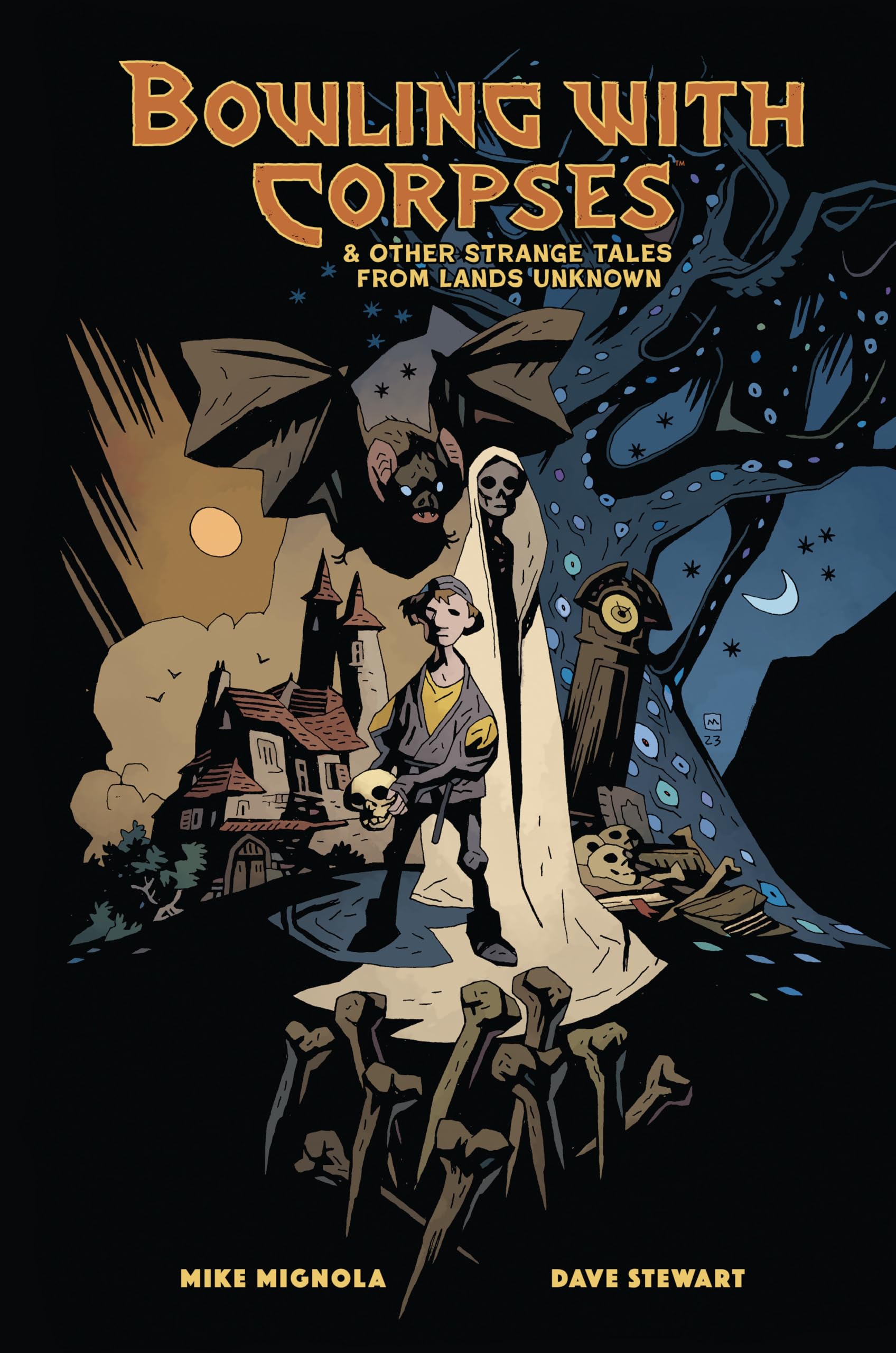
Bowling with Corpses and Other Strange Tales from Lands Unknown by Mike Mignola

It's been a while since Mike Mignola just made comics - especially if by "made comics" you mean writing and drawing them himself. His Hellboy-universe comics have been a parade of collaborators for the last decade and a half, at least, and the movies and potential movies have also taken a lot of his attention.

But he just put out a new book of folklore-inspired stories, Bowling with Corpses and Other Strange Tales from Lands Unknown. And it is as close to pure Mignola as we've seen in a long time: he's joined here just by long-time collaborators Clem Robins (letters) and Dave Stewart (colors), handling aspects of the comics that Mignola never actually did himself. 

The title is a bit long and unwieldy, hinting that Mignola may still be working out what this project is, where it will go, and how much further he'll continue with it. It's not unlike the earliest Hellboy short stories - several loosely-linked supernatural tales, heavily narrated, coming out of odd or quirky bits of legend that Mignola has discovered over the years.

But with Hellboy, Mignola started with a character and built a world around him, bit by bit. Here, with what I guess we'll call "Lands Unknown," Mignola went in the other direction, starting from notebooks and sketches of an alternate medieval world - one similar to Europe in the Dark Ages, but much more stuffed with monsters and creatures and dark shadows - and telling various bits of story that he found or thought up or adapted into that world.

The art is dark and lovely and creepy, in Mignola's mature style. The stories are realistically folklore-esque, which could be a positive or a negative - they tend to be almost fragments, a collection of moments that sketch a series of events and hint at a moral or at a larger mythological framework rather than being robust specific stories - and often end with those minor characters elbowing the reader in the ribs to say the story is not over. Bowling with Corpses is a collection of related material about a new world rather than a book of individual stories; on the positive side, that means these pieces build on each other and refer back to each other. To the other side, it also means the individual pieces tend to stop rather than end definitively, as if Mignola is still building this world and doesn't want to close out any possibilities there. Much of the middle of the book is nicely atmospheric and well-told "tell this old bit of folklore in a Lands Unknown context," but for the "hey, this story isn't over; I'm going to bring back this character" notes that tend to undermine them as stories.

(It's the difference between a folktale that stands on its own and a flashback to tell the origin of a villain the book implies will be important later - made vaguer by the fact that it's pretty clear Mignola is making this up as he goes along, and doesn't yet have any overall story to tell, or that any of these people will actually be "the villain" in anything.)

There's a lot of fun dialogue here - it's very nice to see Mignola getting out of apocalypse mode and letting his characters wisecrack, especially the minor ones. If that doesn't necessarily lead to anything, well, this is a new project, and explicitly a "tales from" book, which we should not expect to be a fully-rounded single story.

Still, I'd like to see this project come into a bit more focus, assuming Mignola keeps telling stories in this world. He doesn't need to pick a single core character, but he really should make some more rounded characters, and have them run through actual stories, with beginnings, middles, and ends, rather than just the mythological moments he's most interested in drawing today. This could have been a more focused book about Yeb the Spoon and Una Krone if he wanted it to be, with multiple stories about both of them, commenting on each other, with the other pieces to give more background and detail to the world.

That could still happen, or something different could happen next. Either way, I hope Mignola does continues to tell "strange tales from lands unknown," and leans into his strengths of distinctive characters, zippy dialogue, and evocative but not necessarily over-explained supernatural backgrounds as he goes on.

Tuesday, January 28, 2025

Everything Is Fine, Vol. 1 by Mike Birchall

This is much more of a Volume One than I expected, so I hope to set your expectations more accurately than mine were.

Everything Is Fine is a psychological horror webcomic by Mike Birchall, appearing weekly (during "seasons," three so far) on Webtoon. There have been ninety episodes since the series began in spring of 2021.

Everything Is Fine, Volume One collects the first sixteen episodes, gathered and possibly somewhat updated or rearranged into nine parts and a very brief comics Prologue. 

It's set in suburbia, somewhere - "neighborhood one-four-seven-D." Sam and Maggie are a married couple, living in a house. He goes off to work, she stays at home. They have gigantic cat heads that may be masks. They have a dog named Winston, or so they say to each other. The men in the neighborhood, we learn a bit later, have jobs with boxes - Sam handles paperwork, single neighbor Charlie moves boxes from point four to point five (of at least ten), and Bob works at the box incinerator.

Everything is totally normal, they say to each other in chipper voices. 

But we see surveillance all over, and the local policeman, Officer Tom, is oddly insistent in his questions. And there are clearly teeth in this world, as we see hints as these chapters go on - everything is only fine for those who can follow the rules, of action and demeanor and correct thinking. If you fall out of that, you might as well not exist at all.

This is clearly a constructed society of some kind, but we don't know how or why. Are they being tested, or pitted against each other to see who comes out on top? Is this meant to be permanent - a "perfect life" constructed according to some plan - or is it something that will end?

Most importantly: what happened in the past that they shouldn't think about? The telling line of dialogue is "We need to forget - you know as well as I do." Birchall doesn't explain all of the things they need to forget in these chapters, but it's clear there's a lot: other people, other ways of living, any other possibilities.

Birchall's art is all thin lines, instantly clear, almost generic-looking, like some Flash game. It looks fine, like a world you've seen a million times before, a world that wants to slide away from your eyeballs and hide in the background. It looks like the suburbs of a million other stories, in comics and animation and film. And his dialogue is subtly creepy, full of those insistences that everything is completely normal, that nothing is at all strange ever.

There's no answers here. There are probably something like answers, or at least next steps, in the seventy-plus episodes Birchall has made since these. But there's no end in sight yet. Every reader will have to decide if they're interested in creepy psychological horror with no end in sight - I have to admit it makes me less interested in continuing. But this is really good at the building-horror phase, and people who like that should check it out.

Wednesday, December 04, 2024

Miss Truesdale and the Fall of Hyperborea by Mike Mignola and Jesse Lonergan

It's always nice when two creators you're vaguely getting back into have a book together - it makes it feel like the universe is telling you you're going in the right direction.

I was a long-time Hellboy fan who lost the thread when the two major stories basically "ended" - Hellboy himself died and went to hell, his former organization the B.P.R.D. failed to stop a couple of major supernatural apocalypses and the fictional world was plunged into megadeath and chaos - and also, maybe about the time we learned various sordid details of the working life of long-time editor and sometime cowriter Scott Allie. But even if the main stories ended, that doesn't mean comics stopped appearing, since companies in the business of publishing comics gotta publish comics, and they tend to want to keep doing the ones that sell well and make money. So there's been a flurry of what seem to me secondary and odder Hellboy-universe books over the past five years or so, including Hellboy in Love.

At the same time, I randomly rediscovered Jesse Lonergan. I'd read a couple of his creator-owned books a decade ago, including All-Star, thinking he told good stories and had an attractive flexible drawing style. And then I came back to his work this year with Hedra and Planet Paradise, two interesting but unrelated SF stories from 2020.

So, when I realized that Hellboy creator Mike Mignola wrote and Lonergan drew a four-issue Hellboy-universe story last year - which was collected as Miss Truesdale and the Fall of Hyperborea in January - I thought that I might as well read that book, too.

It's set in one - well, two; I'll get to that - of the quirkier niches of this particular fantasy universe. You see, ages ago, before the rise of the sons of Aryas, there was an Age undreamed of, when shining kingdoms lay spread across the world like blue mantles beneath the stars...and so on. Yes, Conan's Hyborian age, with only a slight shift in spelling, took place in Hellboy's world as well.

Both Howard and Mignola are very fond of evil snake gods, so it works pretty well. (There's one here, of course.)

Anyway, we don't start there. The titular Miss Truesdale is a London-based follower of a secret society, the Heliotropic Brotherhood of Ra, in the Victorian era, and is in Paris to meet the organization's head, Tefnut Trionus, when the book opens. Teffie - no one calls her Teffie but me - gives a portentous speech to Miss Truesdale (who does not seem to have a first name), all about how they are both reincarnations of women who were around in the last days of the ancient Hyperborean empire. (Teffie is also the reincarnation of Eugene Remy, the founder of the Brotherhood, which is why she's the figurehead leader now. Souls are valuable; you gotta re-use them as much as you can.)

All those thousands of years ago - after the drowning of Atlantis and so forth - Miss Truesdale was the doughty warrior Anum Yassa, a powerful woman with a gigantic hammer-axe thing she used to win glory in the inevitable gladiatorial combats she was thrown into after she was captured as a slave by the obligatory evil and cruel overlords of the empire. And Teffie - again, only I call her that - was the new slave girl who warned Anum Yassa that said evil and cruel overlords were going to have her quietly murdered because, of course, she had gotten Too Popular With the Groundlings, and Threatened The Established Powers by being so good and honest and true while killing other slaves with a big hammer-axe thing.

There is a snake god behind those evil and cruel overlords, and Anum Yassa will eventually get a chance to whack it with her hammer-axe thing. But first! She has to escape, fight various pursuers, muse on the fickleness of fate, and do all of the other standard Conan-style bits of business.

That's about half of the book - the more exciting and fun parts. We also see Miss Truesdale, mostly after having returned to London and falling into a swoon or coma as she relives Anum Yassa's life (or is thrust back in time to live it for the first time? I'm not clear on how time in general, reincarnation, or mental time-travel works in this universe). Anyway, it's the standard "collapse on the bare floor of your tiny cubicle, behind a locked door" thing, with her Brotherhood compatriots first worrying about her and then breaking down the door to offer her succor during the strange episode they do not ken.

(You may notice that, while I enjoyed every bit of Miss Truesdale and the Fall of Hyperborea, I didn't take any of those bits at all seriously. Your mileage may vary.)

Lonergan, here with colors by Clem Robins, is a bit more energetic in his art than I've seen him before, to fit the tone of this story. He does fine Mignola-esque monsters and evil men, and gets the required dynamism into his layouts as well. (Books about whacking people with giant hammer-axe things need to be zippy and full of action.) I find the whole thing just a little bit silly, frankly, but it's the fun kind of silly.

Tuesday, October 22, 2024

White Cat, Black Dog by Kelly Link

Kelly Link is one of the best writers of our time: full stop. I can say more - I will say more - but I'll start with that bedrock. She's already one of the greats, from the work she's already produced. (And I say that knowing her first novel is fairly new in the world, and I haven't read it yet.)

White Cat, Black Dog was her new story collection last year, gathering seven stories from roughly the previous decade (including, as is traditional, one brand-new piece). Her previous collection was Get In Trouble, back in 2015; I know I read her earlier books but they were long enough ago that I might have read them for work, or just before this blog.

I'm tempted to write a bit about each story, but that urge drags me back to 1992, trying to capture every genre book I read on those fussy little pieces of paper for the SFBC (those who know, know) with a single log-line at the top for genre, a long plot description with all of the names clear and spelled correctly, and a short, separate editorial opinion at the end. It took me a long time to break the habit of writing about books like that, but short fiction always wants to drop me back into it:

Fantasy short-story collection, all based loosely on fairy tales, mostly reprint.

The White Cat's Divorce - A rich man's usual three unnamed sons are sent on various errands to win his fortune, over the course of several years. We follow the youngest son, who...

and so on drearily.

These are precise stories, told uncannily well. When I read these days, I keep an eye out for interesting passages to quote here on the blog - with this collection, I stopped and started dozens of times, wondering if I could quote some particularly devastating moment. Mostly, I couldn't - to explain the moment, it would have taken too much detail, too much explanation. The hallmark of a great short story is that it contains just the right words - no extras, no fluff, nothing extraneous. Link does that, over and over, here.

The collection does start with a white cat and ends with a black dog. Like so many other things, Link means that both literally and figuratively. A word or phrase will rarely have only one purpose in a Link story.

Look: just read it. It's a short book. It's been on multiple award shortlists and "best of" lists. Link has the narrative power of genre, the puzzling insight of fable, and the cuttingly pure prose of literature, all in one writer. You'll thank me afterward.

Tuesday, October 01, 2024

Hellboy in Love by Mike Mignola, Christopher Golden, and Matt Smith

I have completely lost track of the Hellboy universe: I have to admit that. Last time I paid attention, Hellboy was dead and had just gone to Hell, his former compatriots in the B.P.R.D. were dealing with their...I want to say third?...supernatural apocalypse, none of which they actually managed to avert, and the energy of the larger universe seemed to have been diverted into almost a dozen oddbar side-stories about characters like Mr. Higgins and Frankenstein.

It looks like Hellboy-verse books have continued to appear - and several audio dramas, just to make things even more confusing - but that they are all flashbacks or sidebars these days, and they all have series creator Mike Mignola involved to some degree but not doing more than co-writing. (Which Your Cynical Host takes to mean "approving the scripts and cashing the checks," possibly because the ongoing movie-reboot drama is taking most of his time.)

However the work gets divvied up, we got this book last year: Hellboy in Love, collecting five issues and three short series, all set in 1979 and featuring Hellboy's previously never-mentioned great love, the archeologist Anastasia Bransfield. (I say "never-mentioned," but the Hellboy universe is so continuity-besotted that she probably did get a footnote or two somewhere that I'm forgetting.) It's written by Mignola with long-time collaborator Christopher Golden, drawn by Matt Smith, and colored, as usual for this universe, by Dave Stewart.

And...they're pretty standard Hellboy stories, with an added flavor of "the girlfriend is along for the ride." Anastasia is smart and knowledgeable, though without any supernatural abilities or monster-fighting prowess of her own, so Hellboy has to keep her safe during the inevitable punch-the-monsters sequences, and I have to guess that her story eventually ends, however many years later, when Hellboy isn't able to punch one particular monster in time. (The monsters in the Hellboy universe are typically pretty nasty things, and the body counts, even in these somewhat more love-oriented stories, are quite high.)

So Helly and Ana meet cute on a British train when a band of goblins steal something valuable she's transporting, and they chase the goblins across hill and dale to the inevitable secret auction of supernatural materials organized by Shadowy Forces, where they retrieve the goods.

They enjoy each other's company, and so stick together in London afterward to do boyfriend/girlfriend stuff for a few pages before jetting off to Turkey to deal with murderous shadow puppets at a dig: that makes up the second story.

Anastasia's particular area of study is a semi-conspiracy theory - which, in this world, is clearly absolutely true - about an early-medieval global network of magicians and their methods of long-range communication. This theory has very little evidence, has been pooh-poohed by the finest minds of her time, and the reader is morally sure that not only is it completely accurate, but the organization still exists, is active, and probably at least mildly malevolent.

In the third, shortest story, there's another potential breakthrough - an ancient gigantic skull inscribed with mysterious messages in multiple wildly distant languages, which would prove that Anastasia's theory is true. And, of course, there's some kind of supernatural entity - Delilah, who was at the auction in the first story, and has some kind of demonic/vampiric thing going on - who wants the skull even more so, and is able to take it away.

My sense is that Anastasia's theorized ancient society of magicians is yet another still-extant, vaguely apocalyptic cult that threatens the whole world, and that we'll get subsequent stories to show how Hellboy thwarted and possibly destroyed them, though Anastasia nobly sacrificed her life in the process. I may be overly cynical here.

These particular stories are just fine, though the relationship stuff feels a bit shoehorned in, as if Mignola decided thirty years in that Hellboy really should have had a personal life at some point, and is now making up for lost time. And we all know the rules of flashbacks, especially long flashbacks about The Love of My Life. So expectations are definitely set, but this is fun and diverting for now, and a pleasant corner of this universe that isn't too burdened by the weight of apocalypse at the moment.

Friday, September 06, 2024

Gahan Wilson's Even Weirder

I'm pretty sure I read this book; I'm pretty sure I owned it. Gahan Wilson's Even Weirder is a 1996 Tor collection of Wilson's single-panel gags, mostly from Playboy (his best-paid and most prestigious venue for most of his career), and I was paying a lot of attention to everything Tor published in those days for the day-job.

(And was then, as now, a big Wilson fan too.)

Since then, I had a major flood at my house in 2011 that destroyed what I said at the time was 10,000 books - I may have overestimated a bit, but it was somewhere in that ballpark - plus all my records of that old day-job. So I have vague memories of this book, and I can't see how I could possibly have missed it, but the only thing I can point to is an entry in my reading notebook to say that I did read it on Halloween of 1996, a few weeks before publication.

That was a long time ago, and a book of single-panel cartoons isn't the kind of thing that sticks in the mind tightly to begin with. So I was able to read Even Weirder as if it were new to me this time.

By my count, there are 232 cartoons here, all presented in black and white, each on their own page. It's full of the usual Wilson material - nervous kids in nice clothes, monsters of all sorts with oversized features and appendages, various aliens and talking animals, more fiendish Santa Clauses than you would expect, sinister cultists and mad scientists, devils and Satan both in Hell and out of it, and two different gags about a wife bricking her husband up, Cast of Amontillado-style. There's also a whole lot of slightly more conventional setups: dinner tables, office desks, diner counters, jury boxes, streetscapes, men and their dogs, analyst couches and doctor's offices.

Wilson was one of the great gag cartoonists of his time - of all time, I'd go further - with a uniquely creepy, horror-infused style and a facility with all of the random wellsprings of humor and a point of view uniquely his own: jauntily, often shockingly and unexpectedly positive in the face of disaster and apocalypse, cynical at its core but not dwelling on that, and full of a whistling-past-the-graveyard jeu d'esprit.

This is a fine collection of his work - but I should also say that he was pretty consistent, and had a long career. The best Wilson collection is the gigantic magisterial Fifty Years of Playboy Cartoons (which I also owned, pre-flood; I had it for about a year), but any of his collections are worth picking up if you see them. If you ever liked Gross or Addams, Wilson is right up your alley. (And vice versa, if you're already a Wilson fan.)

Friday, August 23, 2024

Authority by Jeff Vandermeer

Ten years ago, Jeff Vandermeer published a whole trilogy in a year. That's always a dangerous, gutsy move, but I think it worked for him: both artistically and commercially, popping him up from a well-regarded quirky slipstream writer working mostly in the genre-fiction world into a solid position in the wider literary universe. Better yet: I don't think he changed the way he wrote or his subjects - he just got better publishing support and the kind of appreciative quotes that subtly imply this is not genre fiction, because it's good.

(Those quotes are always half bullshit - they were when Kingsley Amis made fun of them in the 1960s, and still are now - but they do their job, and I guess that makes them useful, even if they rely on a kind of reader who is paradoxically both fond of literary invention and skill and unable to see quality anywhere but a narrow plot of "good" fiction.)

The trilogy was called "The Southern Reach." The first book was Annihilation and this second one is Authority. (I'll get to the third book Acceptance eventually. It took me four years to get to #1 and six more for #2, so don't hold your breath.)

The whole series is about Area X: a coastal region in the Southern US - facing south, probably in the Florida panhandle - that had a transformational paranormal event thirty years ago. (The books take place in an unspecified time, probably slightly in the future from when they were published, but it's deliberately vague. Area X could have formed in the 1980s, or 2020.) A impenetrable - well, utterly destructive, as far as anyone can tell, which is nearly the same thing - border came down, except for one access point. Everything made by humanity inside Area X - except for one lighthouse - disappeared or was destroyed. Strange organic life has been growing there. There are other, weirder, less definable changes as well. Explorers into Area X come back transformed, if at all.

The Southern Reach is the organization - it rolls up to "Central," probably some acronymed agency we have heard of - that monitors and investigates and sends expeditions into Area X. They are themselves secret, as is Area X: the general population thinks there was some kind of ecological disaster, and everyone has been kept away from the region.

Southern Reach is also the name of their headquarters building, not far from the border of Area X.

Vandermeer doesn't write trilogies like most people do. Before this, he - to quote myself - "wrote three books about the city of Ambergris... the collection City of Saints and Madmen, the metafictional novel Shriek: An Afterword, and the detective story Finch." Similarly, Annihilation was a novel built from the journals kept by one woman on an expedition - called just "the biologist" there.

Authority is a third-person novel focused on "Control" - a career intelligence professional (OK, call him a spy if you want) named John Rodriguez, who has been sent to take over as Director of the Southern Reach and to investigate what happened to the Twelfth Expedition - the one chronicled in Annihilation.

Three of the four women of the Twelfth Expedition came back, appearing in random places far from Area X, without clear memories of their time there or their lives before the expedition. The one who didn't return, "the psychologist," was the previous Director of Southern Reach.

This book is partly about the conversations Control has with the biologist - he has not read her journals, the ones that formed Annihilation, and she can't tell him much of anything about what happened to her - partly about his troubles taking control of Southern Reach, where the assistant director, Grace Stevenson, is deeply loyal to the missing previous director and quietly blocks nearly everything he does, and partly about how he sifts through what the previous director left behind and what the rest of the scientific staff of Southern Reach can tell him.

Control learns that the most recent expedition was officially the Twelfth, but each numbered expedition was a series - the Eleventh had multiple iterations, and the total number of forays into Area X is well over thirty. And that Area X is not necessarily stable. And that, even thirty years later, the Southern Reach doesn't really know the first thing about Area X or the phenomenon or entity that created it.

He learns many things, plenty of them horrific, over the course of the novel, and loses control of Southern Reach in more than one way by the end. Like so many Vandermeer stories, it has creepy biological manifestations and a tone at most one or two clicks away from horror. It ends with a leap that I assume leads into the third book: it ends reasonably well for the middle of a trilogy, but it clearly is middle.

This is a creepy, unsettling novel, about something mostly unknown that just might be poised to destroy all of humanity and the entire biosphere of our planet - or maybe to do something even stranger, and potentially worse, than that. And Vandermeer does creepy and unsettling better than nearly anyone else: this is excellent in every way.

Tuesday, March 12, 2024

Falconspeare by Mike Mignola and Warwick Johnson-Cadwell

I know that the books about the Mignola-verse - or maybe we should call it the Hellboy-verse? - have continued to pile up, even after its main character died a decade ago and the second main pillar book, B.P.R.D., ran through a fairly comprehensive and long list of apocalypses. But I am not sure what is going on there, since I seem to have missed a bunch of those books.

Thinking that I might want to get back in, I looked for a place to dip my toe. I found something that looked standalone, that was definitely short, and took a leap.

Falconspeare is a 2022 book credited to Mike Mignola and Warwick Johnson-Cadwell - they previously did Mr. Higgins Comes Home (which I saw, back in 2018) and Our Encounters With Evil (which I have not, but will now look for) together. But when I checked the credits more carefully, Mignola did the cover and the whole thing is "based on characters created by" him and Johnson-Cadwell. Otherwise, Johnson-Cadwell wrote, drew, and colored the whole thing, with letters by Clem Robins.

Also: it's set (as was Higgins, which I had forgotten) in a vaguely Victorian world, a bit quirkier and nonspecific than the core Mignolaverse - oh, definitely full of vampires and other mythological monsters that need to be dealt with, but without, as far as I can see, the whole dude-from-hell and otherdimensional Lovecraftian gods and multiple-apocalypses thing.

So this was not, in the end, a way back into that universe, but is just fine on its own.

A group of intrepid vampire hunters had a heyday fifteen years ago - signposted by captions saying exactly that - but it is now fifteen years later, and one of them, the title dude, has been missing for a while. The others are summoned by a mysterious message to the usual Balkan landscape, meet their long-lost comrade, and hear his strange and compelling story.

There is a twist at the end, of course. And it's all in a quirkier register than the regular Mignola books -not quite as odd as I recall Higgins being, but just a bit pantomime, as if we all know how this story is going to go, so we can just sit back and enjoy it without worrying about anything.

Johnson-Cadwell has a much looser line than usual for Mignola collaborators: again, this is not unserious, but it's not overly serious the way most Mignola books are. I compared Higgins to Eurocomics, in particular the Dungeon books, and I still see that similarity here, that same viewpoint and style.

It's probably not for readers who want hardcore mythology and megadeath from Mignola - it's mostly not Mignola, after all - but for a lighter, more amusing read, it definitely hits the spot.

Wednesday, October 25, 2023

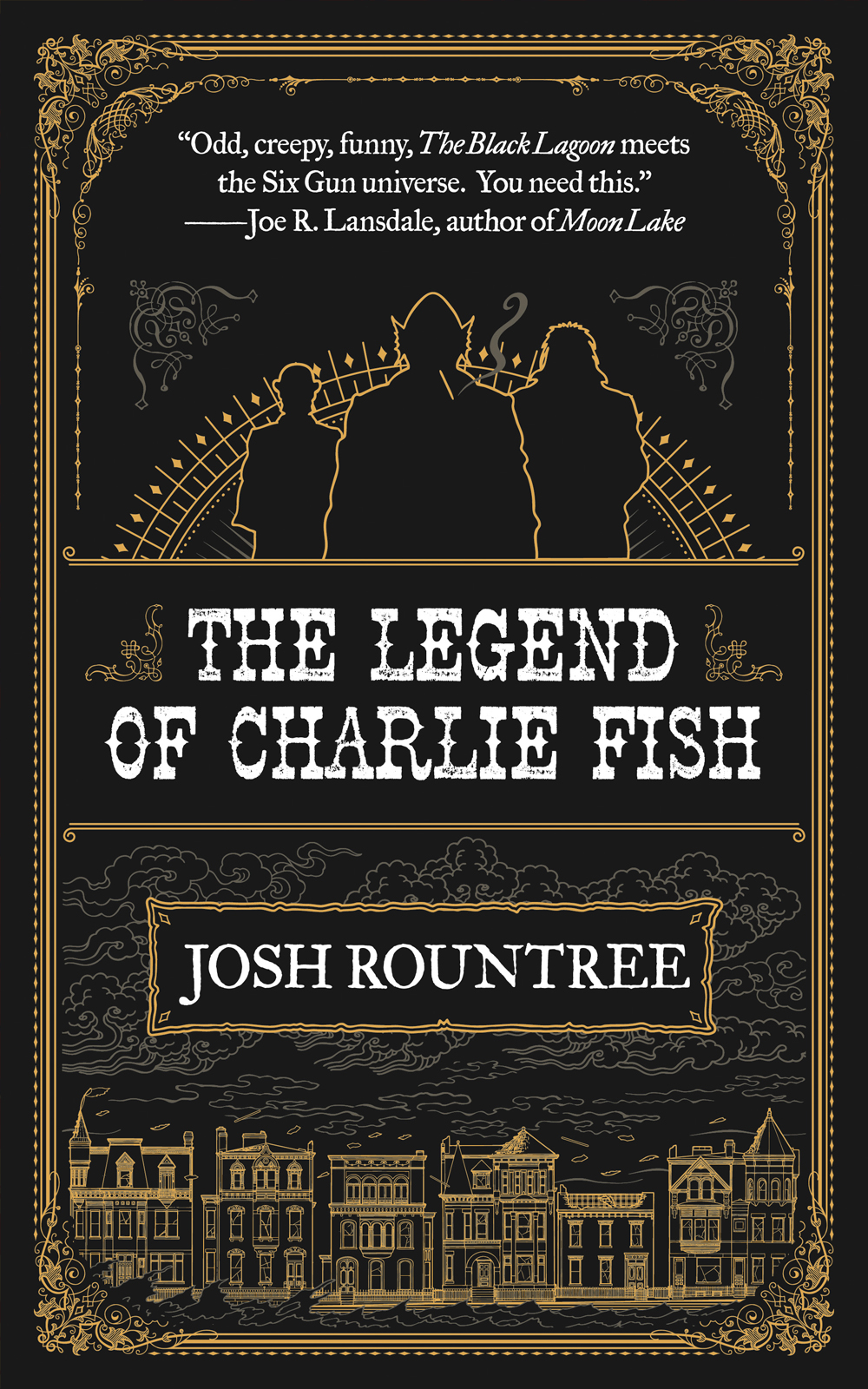
The Legend of Charlie Fish by Josh Rountree

There is a humanoid ichthyic personage in this story - he's in the title, this is not a spoiler - and people who know modern horror may expect him to be some variety of Deep One. But he isn't, really: he's much more of a Gill-Man, though one less inclined to sudden violence than his filmic counterparts, and part of a large diverse society in a way we don't see (as far as I remember) in any of those movies.

So, what I'm saying: this isn't Lovecraftian.

I know! It's rare and unexpected for anything roughly in the horror vein to have a trope that could be Lovecraftian but definitively isn't. Just for that, Josh Rountree deserves kudos.

He deserves them for more than that, though: The Legend of Charlie Fish is a remarkably assured first novel, with two different and believable first-person narrators, atmosphere to burn, a great story to tell, and a flair for telling that story just slightly slant to make it more interesting.

My TL; DR would be: I don't generally like horror, and nobody much reads Westerns these days. This is a great horror Western that's well worth your time, short enough to easily read in a day.

For the more-detail version: Floyd Betts is a carpenter in Galveston, in 1900. He mostly keeps to himself, is good at what he does, lives a quiet life in a boarding house. And he has to go out to Old Cypress to bury his father, a spiteful alcoholic he's been estranged from for decades.

Meanwhile, in Old Cypress, lives a young family: the mother is disliked by the town as a witch, though she's never done anything to hurt anyone. The father grew up there, but has been tainted by association. And the kids are Nellie, twelve, and Hank, nine.

Floyd finds Nellie and Hank in Old Cypress, orphaned, and decides to take them back to Galveston. Along the way they meet and save Charlie Fish: the reader knows all of that very early. I won't spoil who they save Charlie Fish from, or why those people want the fish-man back, but they do, and they follow.

Oh, one other thing. Ever heard of the Great Galveston Hurricane? It's on the way.

Rountree never says that Charlie's people have anything to do with the hurricane. He doesn't even really hint in that direction. But I want to believe it, for whatever apocalyptic reason: you may also want to believe that when you read Charlie Fish.

Oddly, this is a less quirky book than I expected, given the plot and the endorsement from Joe R. Lansdale. Nellie has a version of "the sight," so she can communicate, mostly empathically, with Charlie. But that, and Charlie's mere existence, are the only real fantasy elements. Rountree grounds all of the rest soundly in the mud and wood and heat of the time: these are realistic people in a realistic world, facing mortal danger from both nature and man, and living as best they can, according to their own lights and values. There's a surprising lot of philosophy for life in Charlie Fish, too, the hard-won standards of a life lived cross-grain to the people around you.

It's a short book that feels expansive, a Western that feels modern, a horror novel that feels hopeful. That's one hell of a Legend, and I recommend it.

Tuesday, October 10, 2023

I Am Providence by Nick Mamatas

Nick Mamatas is a genre-fiction writer, but this 2016 novel is not in the genre you might expect. It's a book about Lovecraftians rather than a book that is Lovecraftian. Nothing squamous or rugose shambles through the pages here; no one has a momentary vision of the depths of geological time and his place in the universe that sends him quavering into madness.

On the other hand, I'm not going to say the characters here are entirely sane to begin with.

I Am Providence is a murder mystery set at the Summer Tentacular, an annual horror convention devoted to H.P. Lovecraft and taking place in steamy August in (of course) Providence, Rhode Island. Anyone who knows Mamatas's online presence over the past two decades can guess that he does not have a positive and friendly opinion about those people and that scene and the whole concept of making Lovecraft central to a kind of literature or a fan lifestyle.

I am convinced that all, or maybe just most, of the characters in Providence are versions of real people in the horror/Lovecraftian world, though I was only tangentially connected there (and that fifteen years ago), so I'm not going to try to trace them. (OK, just one: Bhanushali is so obviously a gender-swapped S.T. Joshi that no one will miss that.)

Well, maybe one more, the central one: Panossian, the murder victim. He's dead on page one, and he narrates alternate chapters in first person, posthumously [1] - the even-numbered chapters are from a tight third-person POV on Colleen Danzig, a new writer coming to her first convention, expecting to room with Panossian and instead finding herself amateur-sleuthing her way around the BNFs. [2] Panossian is a gadfly, a deliberately annoying minor writer whose single novel, The Catcher in R'lyeh, is seemingly too clever by half (especially for the very traditionalist Lovecraftian crowd) and sank almost without a trace.

Panossian is Mamatas himself, slightly transmuted (Greek to Armenian, Move Under Ground to Catcher, etc.). That's the metafictional joke here: Mamatas is saying, somewhere between jokingly and honestly, "these people probably want to kill me for making novels like this and admitting Lovecraft was a massive racist, among other things."

Providence is not just a gigantic in-joke, but the in-jokiness is central. It rambles around the convention for three days, alternating between Panossian's newly-dead ruminations and Danzig's investigations, which ape the form of a play-fair mystery but end up more like a shaggy dog story. Frankly, there's no good reason for Danzig to care that much about Panossian's death, and spend all her time playing Nancy Drew - but that's the novel, so it's what she does.

It's OK as a mystery; it's killer as a stab in the back of Lovecraftians. "Is there a reason for a literate person to read century-old pulp fiction? For the most part, no, which is why most of it has been forgotten by all except obsessives and weirdoes." (p.3)

There are a lot of events in Providence; there's a lot of opportunity for Lovecratians to demonstrate the various ways they are obsessives and weirdoes; there's a lot of theorizing about the murder from various people. Mamatas is more or less in control of the plot, but there are several Signals from Fred, as when Danzig realizes, more than half-way through the book, that she's talked to several different uniformed cops but never even seen the detective running the case. That's the shaggy-dogness again; this is a book that rambles and wanders, to hit all of the scenes and ideas Mamatas had and to showcase all of these people in their (un)natural habitat.

I dog-eared a bunch of quotes while reading it: Mamatas is excellent at the cutting takedown, the epigrammatic attack. Here's some good ones:

  • Hiram seemed harmless, but only in the way a heavily medicated inpatient at a lunatic asylum seemed harmless. (p.107) 
  • Ranger was pretty important in Lovecraftian fandom, after all, since he had access to a photocopy machine and made his little 'zine, Dreamlands, with it sometimes. (p.189)
  • Most people who are inexplicably confident despite being talentless and more than a little stupid have warm, affectionate parents. (p.232)

I didn't entirely believe in Colleen, the sleuth. I completely believed Panossian, the self-loathing dead loser. I somewhat recognized all of the other weirdoes and obsessives at the Tentacular. And I read Providence with some joy and multiple laughs and a lot of recognition. I think this book got a bad reception, because it's for that thin segment of fandom that both understands the jokes and can take them; fandom is famously humorless when it comes to itself. If you think you fit in that segment, check it out, but don't be surprised if you feel "attacked."


[1] To put in Panossian's own words, from p.4: "We dwell in darkness, anxious and panicked and alone without the benefit of senses or a future, and for who knows how long after death."

[2] Big Name Fans. Not entirely accurate: Lovecraftiana is a small, incestuous pool, and nearly everyone in it is a filthy pro, at least in their own heads. But Providence is a book all about in-group behavior and markers, so the term is appropriate.

Friday, December 30, 2022

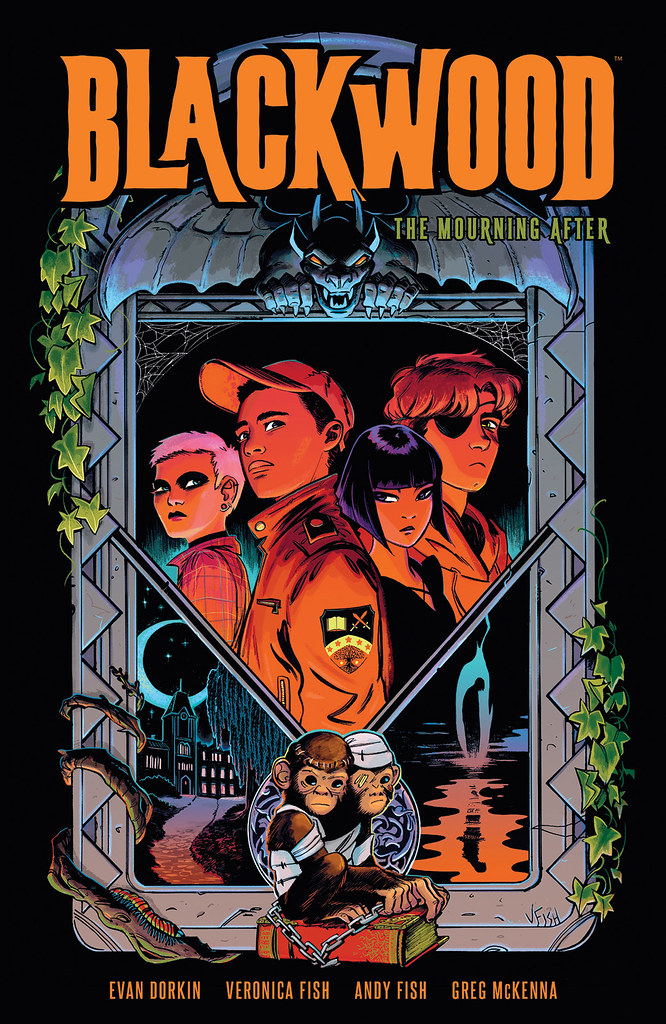
Blackwood: The Mourning After by Evan Dorkin, Veronica Fish, and Andy Fish

In the Before Times, this would have just been the next four issues of an ongoing series called Blackwood - it reads that way, and my guess is that Dorkin and the Fishes would have been happy to just keep telling a bunch of these stories in one series rather than mucking about with re-launching a new mini-series with a new title.

They might not have wanted to do it monthly, on the old chain-gang work-until-you-drop style, but that's an entirely different question.

But, in the Now Times, everything must be new, and everything must have an Issue #1, and the attention span of any comics reader is assumed - probably with good reason - to be lower than the belly of a ground sloth. So Blackwood: The Mourning After was a "brand-new" four-issue mini-series, following up the original Blackwood series and collection a couple of years later.

But it begins immediately after the ending of the previous book, and deals entirely with the fallout of the events in the previous book, and in no way is meant to stand on its own: it's not a new story, not a separate story, just the next story of this place and these people. And that's totally fine for an ongoing, though it feels a little odd in our modern mini-series world.

And it does mean that if I want to talk about any of the plot, I'm going to either utterly spoil the first book or be very, very vague. I'm going to try to err on the side of vague.

So the cover shows four people, which includes three of the four main characters of Blackwood, but not the one who SPOILER in the first book. And there's one more person, who was a secondary but important character the first time out, but has more to do here - maybe he'll turn out to be part of the Scooby Gang in the long term. And, as the title implies, someone important is dead - let me refer here to the first book, which I said started "with some old guy who just did something magically dangerous and is now dictating his last words while Something happens to him" and note that there is an funeral coming up in a couple of days, nudge nudge wink wink.

We learn a little more about the faculty of Blackwood, the college ostensibly some vague liberal-arts thing (though really really focused on anthropology as far as I can see) but secretly a training-bed for new magicians, plus "psychic researchers, alchemical engineers, occult archivists." We also see another secret magic-based organization, I.N.S.P.E.C.T., who seem to be some kind of government agency - big guns, dark suits, humorless affect, the whole works. Blackwood and I.N.S.P.E.C.T. are not on the chummiest of terms, of course, and even less so after the revelations of the new book.

An I.N.S.P.E.C.T. team is coming for that funeral, and various people are planning for the funeral and/or for secret magical rituals designed for fiendish ends, because of course they are. Our four heroes are in the middle of that, partly because of magical shenanigans in the first book, partly because they are nosy, and partly just because their are the heroes of this story, so we follow their viewpoints.

There is another big magical foofaraw at the end of this book, as there must be. A gigantic unpleasant entity is summoned from Somewhere, an evil actor gets hold of a Powerful Artifact and threatens to do Unspeakable Things, and there's a big confrontation in the college library, which is roughly as cool as you are hoping it will be. (Do I mean the confrontation, or the library itself? A bit of both.)

Like the first book, I found this zippy and fun, and this time writer Evan Dorkin has a little more time and space to start fleshing out the world, which I appreciate. Oh, it's still a thriller, so the action-plot takes precedence, and the artists (wife-husband team Veronica and Andy Fish) do good work there, with a lot of room for moody, creepy colors on top of their already pretty-darn-moody line art.

As I said, it would have been nice if this were still a world where Evan Dorkin and the Fishes - and doesn't that sound like a weird ska band? I bet Dorkin is amused by that - could do these more regularly and build their mythology more quickly. But we never get the world we want, and the world we have does have two solid Blackwood stories in it so far, so it's not all bad.

Thursday, July 28, 2022

Escape from Yokai Land by Charles Stross

This one is a "Laundry Files" book. Not all of the books with that logo on the cover are, in the purest case, but Charles Stross's publishers have decided to keep using the logo for anything set in the same world for simplicity's sake. (See my post on the novel Dead Lies Dreaming for more details, and to begin a link-trail back earlier in the series.)

Escape from Yokai Land is a flashback, or a previously-untold story; it covers what happened to "Bob Howard" on his trip to Japan just before the events of The Delirium Brief. It's also a novella, which is not always clear to a purchaser, so understand that: this is a shorter story, only eighty pages long. But, if you want more of Bob, this might be the only dose for a while.

As readers of the series know, this is a Lovecraftian universe: horrible many-angled ones lurk just outside our world and are trying to get in to eat the brains of humans and do even worse things. More seriously, such incursions are easier the more people and computing devices are in the world, as well as the traditional "when the stars are right" - and all three metrics are trending hugely up as this series hurtles towards what will be at least a minor apocalypse.

Bob is the current host of an entity called The Eater of Souls for good and sufficient reasons. Luckily, he's in as full control of that entity as is possible. Slightly less luckily, he's a fairly new host; his predecessor was killed in the line of duty the year before. (The undertone being: even a powerful, skilled, old sorcerer with a scary thing called the Eater of Souls in him can get snuffed out in this world.)

Bob has been requested by the Miyamoto Group, which seems to be the Japanese equivalent of the Laundry - the fully or quasi governmental body that manages supernatural stuff secretly for their country and snuffs out all of those budding apocalypses - to do a every-four decades check on their local warded sites, and eliminate some current yokai (local folkloric creatures) manifestations. The previous host of the Eater did not leave a good impression during his visit in the 1970s, though.

More seriously, a big manifestation is bubbling up, and Bob will need to contain it, with the aid of his local liaison officer.

That manifestation is centered on a theme park in Tama New Town, and will manifest as something that the book almost consistently calls Princess Kitty. (There are a couple of "Hello"s lurking, which I gather the publisher's attorneys missed in what may have been a late and rushed review.) As Stross says in his short afterword, this is the story that asks: "What if The Color Out of Space were...Pink?"

The Laundry books are often amusing, on the borderland of funny, in a buried, whistling-past-the-graveyard way; this one slots into that stream and is full of quirky little touches having to do with "Princess Kitty" and Japan in general. It is short, and entirely focused on this one short trip of Bob's, but it does just fine in its length.

Thursday, January 20, 2022

Dead Lies Dreaming by Charles Stross

I'm a year late and not as enthusiastic as I thought I would be: this will likely be short.

I've loved all of the previous books set in this world, but I had a hard time getting into Dead Lies Dreaming. This is not a "Laundry Files" book, partly because that government organization has been disbanded and partly because it's about other people doing other things. But I didn't think I was particularly invested in Bob Howard as a protagonist, or that particular government agency, so I was happy to dive into the story of some other people, relatively normal civilians, in a world sliding into a pick-and-mix of Lovecraftian apocalypses in the middle of the past decade.

(See my post on The Labyrinth Index for the most recent of the original series, and links backward to previous books.)

So: Nyarlathotep, more-or-less (an avatar of him, at least) is Prime Minister of the UK, which makes this world not quite as dystopian as you might think (human beings can still go about their lives mostly untroubled!) but still noticeably dystopian (pyramids of skulls in public parks! several other Lovecraftian death cults are jockeying for power, some apparently through mass sacrifices of their own!). Also, every bad thing about our real world is also happening in fantasy form, since Charles Stross is a mostly realistic writer who has never seen a horrible thing he didn't immediately incorporate into a novel.

(I've long wondered how he manages to get out of bed in the morning: his creative muse, at least as seen from the outside, tends to the bleakest of the bleak and the darkest of the dark.)

Living in this shitshow are our cast: four young people squatting in the ruins of a palace that used to belong to the family of one of them (Imp, Game Boy, Doc, and the Deliverator); an ex-cop now working in private security (Wendy); and Imp's older sister Eve, the personal assistant to a evil billionaire. (But I repeat myself.)

All of them are also sorcerers of some power, or possessors of mid-level superpowers, depending on how you want to look at it. This probably means all of them have extradimensional beings already snacking on their brains, because that's how power works in Stross's world, but they're young enough not to show any effects yet, and the real apocalypse could easily come along before the many-angled ones manage to eat too many brain cells.

Or they could die from other things: it's a dark, dangerous world. Living long enough for magical Alzheimer's to kill you can be seen as the good outcome. (Have I mentioned Stross's worlds are really really dark? I may be understating the case.)

I think their powers are all clear in Stross's head, but I kept mixing up the four squatters, and never quite got straight what each of them can do. It felt like several of them were mostly "really good at persuading people," though that's mostly their leader Imp's thing.

In fact, it took a long time to get the four squatters' names and personalities clear in my head: Stross jumps from real names to goofy code names to physical descriptors to emotional descriptors as he writes about them, and it took me a while to get that The Deliverator is Del is Rebecca is the Black woman. (Also, Imp is an asshole - charismatic visionary subcategory, so with an explanation, but still an asshole - and all of the four are damaged needy whiny bastards a lot of the time.) They also all get introduced in a high emotional register, so they emote madly at each other for the first two or three chapters in which they appear.

Anyway, these four people that I'm supposed to relate to but initially found deeply annoying and confusing are running a series of big robberies, despite a magic-powered surveillance state that uses summary execution as the answer to any crime more serious than failing to pay a TV license. They are doing this to fund a movie that Imp plans to direct, because of course he does. Their powers are sufficiently good that they have gotten away with it up to now, and have nearly what they need for the movie, so it's maybe One Last Job And Then They Can Retire.

Wendy runs into them during one of those robberies, causing a rapid transition from "cop attempting to catch them" to "co-conspirator and Del's new girlfriend," and their skills and some huge coincidences get all of them pulled into Eve's schemes on behalf of her horribly, horribly evil boss. There are also a few large men toting powerful firearms, who are mostly in the narrative to provide danger for a while until they get killed by each other or more horrible things. All of those characters travel through a house larger on the inside to get to a Dreamlands version of past London, where the big ending happens.

I liked all of the sentences, found the paragraphs pleasant, and read all the way to the end. But this one wasn't as compelling a read as some of Stross's earlier books have been for me: the characters weren't appealing enough to offset how dark and miserable his worlds always are. Frankly, I didn't like any of them all that much - Wendy was fine; I kept hoping she would bug out and find a more interesting plot among people less aggressively boho and whiny - and so wasn't as invested as I wanted to be in seeing them not get killed by the over-the-top combo of Peter Thiel, Harvey Weinstein, and Aleister Crowley that is the villain of the piece.

That all sounds like the definition of "a me problem." If you think you would be any more amenable to a boho retelling of Peter and Wendy in a crapsack mostly-contemporary Lovecraftian London, Dead Lies Dreaming is one of the best books to read as an introduction to Stross's no-longer-Laundry-centric world.