Tuesday, December 15, 2020

Department of Mind-Blowing Theories by Tom Gauld

Some books you don't review so much as point at, to show that they exist. You might talk a bit about why you enjoy them, but that's about all. For me, books of cartoons -- especially themed collections of funny cartoons -- are squarely in that category.

Once you say "he's a fat cat, and he hates Mondays! It's hilarious!" what else is there to say?

So I'm here today to point at Tom Gauld's new book of cartoons, Department of Mind-Blowing Theories. It contains 152 cartoons, each presented in color on a separate page, all originally appearing in New Scientist, all on the subject of science, all funny and inventive.

You might know Gauld from his previous books Baking with Kafka (cartoons from The Guardian's book section) and You're All Just Jealous of My Jetpack (all over the place, with a general tropism towards SF and mad science). Those books are also about the same length, in the same format, and are full of funny and inventive stuff.

At this point it's usually typical for a reviewer to spoil a few of the jokes, in order to make it clear he really has read the book. (Like, duh. It's a short book of funny cartoons; it's harder not to read it once it's in front of you.) So let me say: cut-price science park, out-of-universe messages, #alchemists, classic fiction in binary.

Gauld is fond of doing variations on a theme, often starting with a common phrase like "fount of all knowledge" and extending the metaphor. He also gets a lot of mileage out of mad science, horrors from between the angles of normal space, robots, and of course the usual furniture of scientists' lives: papers, research, theories, experiments.

Again: I think this is very funny, very inventive. I like smart humor, and Gauld is one of the best at smart humor today. If you do as well, this is a book for you. If not...you just might be a redneck.

Monday, December 14, 2020

Reviewing the Mail: Week of 12/12/20

This week's list is a lie. The first three books -- two from the library and one from the mail -- arrived late last Saturday, after I'd written up the previous week's post and set the publish time.

But if we can't manage our obsessions to suit ourselves, what can we do?

So I held those three books for this week, thinking I probably wouldn't have anything else to mention. (Spoiler: as I type this, there are two more books on hold for me at the library. Further Spoiler: two more came in the day after that. See the end of the list for the non-lie titles.)

Publicity Copies in the Mail:

Allergic is a new graphic novel from the powerhouse program at Scholastic, written by Megan Wagner Lloyd and drawn by Michelle Mee Nutter. (As far as I can tell, this is their first work together, and their first major work of comics, though Lloyd has written a number of picture books, which are not a million miles away from comics.)

It is somewhat in the tradition of Raina Telgemeier, though Scholastic is (smartly) not playing that up: the story of a pre-teen girl with an unexpected medical issue, somewhat based on the author's life, and how that plays out for her and her family. This time, as the cover implies, it's about young Maggie, who really wanted a dog but realized as soon as she got one that she's allergic to animal fur.

Allergic publishes on March 2nd in both hardcover and paperback formats.

The Mighty Emmanuel Einstein Free Public Library:

Piranesi is the new novel by Susanna Clarke, author of Jonathan Strange & Mr Norrell.

(I almost want to leave it at that.)

I was one of the many people who read and loved JS&MR back in 2004. My memories are hazy, but I'm pretty sure it came in to the "mainstream" clubs first, rather than the SFBC -- since it was Classy and Serious and from a non-SF publisher (Bloomsbury). I did get to it before publication, as I recall, though I have no memory if I (or the SFBC in general) was any part of the decision to offer it in the clubs. Anyway, it was a great book, and then it was a Big Book: bestseller, Hugo winner, et cetera.

And then Clarke went quiet. There was a small book of stories, The Ladies of Grace Adieu, two years later, collecting mostly work she'd published in magazines and anthologies during the decade-long writing of JS&MN, some of which were loosely related to that book. But that was it.

Then, earlier this year, there was news: Clarke had finished a new novel, which was not the rumored loose sequel to JS&MN, set among much lower-class English folk. Instead, Piranesi was short where the earlier novel was long, with a small cast, set in a Gormenghastly structure that may be the entire world and where only two people live.

And of course I have to read it.

Clyde Fans took even longer than Piranesi to emerge, though we knew it was in progress, and sections have been published separately over the past twenty years. It was supposed to be the "second book" by Canadian cartoonist Seth (just Seth, born Gregory Gallant, and you'd think up a new name too if that was your original name), after the sublime It's a Good Life, If You Don't Weaken, but...well, he's been working on it since 1997, and some other things have leapfrogged over it during that time, most notably the lighter George Sprott.

But it's finally complete: the bug-crushing slipcased edition was published late last year, and (somewhat more recently) I realized a copy was in a library system I had access to, so I didn't have to actually pay the full price for a bug-crushing slipcased edition. (When you lose five thousand books at once, as I did in 2011, you lose something of your enthusiasm to spend lots of money on books forevermore afterward.)

Further Books from Emmanuel Einstein's Hallowed Halls

This is going to be difficult on desktop; I got four more books in series where I already have one at home, so I've just written about all of these, in exactly this context, only a week ago. And, as I have been complaining about recently, on the desktop version of this blog, there's an ugly gap of whitespace if the text about a book doesn't run longer than the image of that book's cover.

On mobile, the image shows up full-width, so the issue doesn't apply. I suspect this is a responsive-design thing -- the old Blogger editor used to wrap text fully around images on desktop, which was a cleaner look there but may not have worked as well on mobile. (I like the idea of responsive design, but in practice it seems to be an exercise in deciding where most of the readers are and making giant sweeping design decisions based on that, so that the minority platform of the time gets the crappy look.)

So, anyway, I don't have a lot to say, and those of you reading on desktop would suffer visually because of that. So, instead, all of you get to suffer from me vamping -- isn't that better?!

H.P. Lovecraft's At the Mountains of Madness, The Second Volume concludes Gou Tanabe's adaptation of the Lovecraft novella of the title. I've already read the first book, and now (I hope) I can read this one and write one post about the thing as a whole.

The Arab of the Future, Vol.4 is the latest in the series by Riad Sattouf about his childhood, which has been mostly in Libya and Syria up to this point, though I gather much of this volume sees him living in France. Sattouf's father was Syrian and his mother French, which created a certain amount of tension in that childhood -- that's underlying all of the books. (See my posts on one and two.) Again, I've already read #3, and I believe this one is the end -- it covers five years and gets Sattouf to about the age of fourteen, so it will stop being a "childhood" somewhere in the middle there. And we know Sattouf ended up in France as an adult, making comics and directing movies.

Giant Days, Vol. 9 is another book collecting the great comics series written by John Allison, about three women at a fictional British university and some of the other people surrounding them. This time out the credits are slightly different -- Liz Fleming is still credited as inker, but there's "with" credits for Jenna Ayoub (issue 35) and penciller Max Sarin (issue 36). I don't know if that means Fleming got behind and needed some support, or if there are specific sequences in those issues that needed a different artistic look. I guess I will find out when I read it -- once more, I read #8 a few days ago and am hoping to hit more than one in one review. (Well, I'd love to get all the way to the end at Vol. 14 in one big post, but I doubt the library will get me all of them in time or let me hold onto them long enough to do that. As usual, we navigate between what we want and what we can get.)

Last up this time out is By Night, Vol. 3, written by the same John Allison I mentioned mere moments ago. This one is drawn by Christine Larsen and colored by Sarah Stern, and it concludes the series. At the danger of being a broken record -- here's my post on book one, and I have already read the middle one.

Friday, December 11, 2020

Quote of the Week: Heraclitean Rivers

Miriam looked at this man, Boris, this stranger who had been someone that the someone that she had been had once loved.

Lavie Tidhar, Central Station, p.18

Thursday, December 10, 2020

the bus 2 by Paul Kirchner

The title is in lowercase on the book, so I did the same on my post. Sure, it's pretentious, but this book was published in France, so it comes by its pretension honestly.

No seriously: the text, where it exists, is in English, but the book was published by Tanabis Editions of "19, rue Francis Chirat 69100 Villeurbanne, France." (My assumption is that Villeurbanne is the name of the town, but it could be a district or arrondissement or something else for all I know.) As proof I also offer that the spine reads up rather than down.

Anyway, it's the bus 2, the sequel to the original the bus, published in 1987 and collecting a bunch of surrealist strips about a guy and a bus by Paul Kirchner. I never read the original, as far as I can remember, but they did run in Heavy Metal in the late '70s and early '80s, so it's likely I saw at least one of them.

This one opens with an arch comics-format preface, talking about how "the studio that produced 'the bus' was forced to shut down" many years ago, but a surge in interest brought it back in 2002 with the son of the original "commuter" stepping into his father's shoes. The truth? I have no idea -- my best guesses are either Kirchner suddenly had new bus ideas, or some paying editor popped up and mentioned loudly loving the old strips and wishing he could publish some new ones. However it happened, either in 2002 or somewhat later (since this 58-page book came out in 2015, collecting nearly fifty single-page strips and a couple of related illustrations), Kirchner did a new batch of the same kind of thing he'd done thirty years before.

Most of the strips are wordless, though a few have captions. All are pantomime -- the commuter, the bus driver, and various other characters never speak on-panel. And they're all surreal: bus seats as ski-lifts, a Busby Berkley commuter extravaganza, plays on size and shape and direction, and so on.

Kirchner draws it all with a clean, precise illustrative line, almost like advertising art: his buses are solid and specific (General Motors "New Look") and his people are a bit more generic, especially the balding commuter.

It's amusing rather than laugh-out-loud funny, but that's what it's supposed to be: various weird things happening, one per page, to a generic commuter on a generic bus. Someday, maybe, there will be a massive (by which I mean: more than a hundred pages) the complete bus with everything, and that will be even better. But this is just fine for what it is right now.

Wednesday, December 09, 2020

Central Station by Lavie Tidhar

Diversity is not one thing. Books can be diverse in authors, in characters, in style, and in ideas. Preferably, the world of books would be diverse in all of those things, plus others I'm not thinking of right now, and individual books slot in interestingly into multiple diverse categories simultaneously.

Sometimes it feels to me like the current diversity drive in SFF is entirely around authors and characters -- so the Chosen One defeating the Big Bad to Save The World can be someone different, and their author can be someone different as well. That's a great step forward, but I don't want to read stories about any Chosen One, no matter what kind of person they are or who's writing about them. I don't become more interested in your book about dragons just because you're Chinese rather than Welsh.

Diversity in ideas was the killer app for SFF from the beginning, so that's just table stakes. If you can't bring that to the party, this isn't the party for you to begin with.

That leaves me with diversity in style, as you might expect from a self-declared literary guy. (Hey, I got an English degree from a fancy liberal-arts school, and I don't get a lot of opportunity to use it in everyday life.) So I tend to gravitate to books that do interesting literary things -- told in quirky ways, incorporating techniques from literary fiction, or just telling different kinds of stories.

I liked Lavie Tidhar's The Violent Century when I read it last year. More importantly, I was deeply impressed by it: it was a taut, smash-cut race through a hundred years of alternate history. From that, and what I've heard about the rest of his books, he sounds like my kind of writer: always doing something different, as influenced by literary traditions as by SFnal ones. And as I get older, I appreciate writers who do interesting books more than the ones who do the same thing over and over, even if I loved that thing. 

So I wanted more Tidhar. I had several of his books on my shelf: this is what happens if you keep acquiring books but aren't reading them as quickly. Central Station looked enticing: a linked collection, or maybe a fix-up, of stories set in an indefinite future, around the beanpole spaceport of the title, right on the border between an Israel and Palestine that are at least somewhat less hostile to each other than the current versions.

The quotes mentioned Naguib Mahfouz rather than A.E. Van Vogt, which was a good sign to me -- not that I've read Mahfouz (to my shame), but I've definitely read too much Van Vogtian stuff already.

And Central Station is quieter and more personal than most SFF. Its cast is large and diverse; several loosely related families of mostly the descendants of people from all over the world who came to help build the beanpole and who then put down roots in the neighborhood. Each story is about one or three or five of those people; they interlock and appear in each other's stories. But there's no overall plot -- Central Station is about these people and this neighborhood and their relationships. There are no Big Bads to be defeated, no Chosen Ones -- just people.

Some of those people are robotniks, transformed into mechanical bodies an unknown time ago to fight in now-forgotten wars. Some are Others, or paired with Others, the purely AI consciousnesses that live in a system-wide shared mental space called the Conversation. Some are physically unable to access the Conversation at all. Some have been off-planet, and come back inherently changed -- some have never been here before, and were also changed, against their will.

All of them are good people, more or less, the way we like to think we and our families are good people, more or less. All have basically good intentions, though some are more destructive than others, and some of them, as Tidhar puts it dryly in his list of characters at the end, "tend to meddle."

All of their stories are personal ones, which is not the same thing as small ones. All the best stories are personal.

This is a wonderful book, full of life and nuance. Each story is a separate gem, but together they combine to show a more complete picture of this world and these people. Tidhar never says how far in the future this is, though some hints imply "centuries" is the low bound. And he's never quite clear on how long these people can or do live -- though, in at least some cases, centuries would also be a low bound. Tidhar's cast is large and interesting, and their world is equally so: this is the kind of book that implies vastly more than it says, and lives in your head for a long time afterward.

Tuesday, December 08, 2020

I Know What I Am by Gina Siciliano

I know I've said this before, but a book can be impressive and magisterial and a wonderful achievement, but still be a chore to read. (Some people might say those things are always correlated; I wouldn't go that far.) Today's book is a case in point.

Scholarly books have extensive footnotes and lists of references; they show clearly the author's reasoning and defend how the author arrived at specific, potentially controversial, points. They are often dense: they have a lot of detail to cover, and only a limited number of pages. Art books show great works of art and architecture with similar apparatus, giving context variously historical, site-specific, personal, and cultural.

I Know What I Am: The Life and Times of Artemisia Gentileschi is something like 75% of the way to being a scholarly monograph on the 17th century painter of the title in comics form, which is hugely impressive but still makes I Know What I Am a bit of a slog to work through.

Gina Siciliano letters most of it in an all-capitals format, which is a bit tiring, particularly since she has massive captions in nearly every panel. It's all entirely reasonable: she has a huge cast with complicated connections to each other and is covering nearly sixty years of one of the most tumultuous times and places in history on one hand, and specifically uses sentence case to show where she's directly quoting from source documents [1], which is a great use of the comics form in service of clear scholarship.

But it does leave her with over two hundred pages of comics -- oversized pages, occasionally falling into something like a 9-panel grid, but often breaking out of that -- filled with long explanatory captions in all capitals, and another fifty-plus pages of two-column text backmatter to accommodate the copious notes and a long list of referenced works. So this is a dense book -- even if the reader just reads through the comics (and I'm enough of a purist that I followed along with the notes as I went), it's a long, slow read.

Siciliano works in what looks almost like pencil, light and expressive with lots of shading and crosshatching. Her faces are excellent, and I never had trouble distinguishing between characters. (Remembering who they all were and why they were important...maybe, but that's on me.) She draws a lot of major architecture in her backgrounds, and talks about getting it just right in her notes -- I didn't find this really obvious in the work, though, since the people and their concerns are always central in her layouts.

I'm not an art history scholar, so I'm not qualified to comment on the liberties Siciliano may or may not have taken here with the life of Artemisia Gentileschi, the most famous and successful female painter before modern times. (Some would argue for Elisabeth Vigee Le Brun, whose work I know a bit more and like a lot.) It was a tumultuous life, even more so than her male contemporaries, which is saying a lot. For example: Caravaggio was a pimp, they all lived through the Black Death, and several served in various wars of the era. Artemisia's just being a woman meant she had Ginger Rogers Syndrome in everything she touched: just having the career and life she had was only just barely this side of impossible to begin with.

 I Know What I Am is an inherently feminist book; I'd like to think any telling of Arteminia's life would have to be. One of the central events of her life was a trial of her rapist Agestino Tassi, and Siciliano does not shirk from describing just how biased and horrible the justice system was in that time and place. (For just one thing, rape was not illegal. Deflowering a virgin could be, if the culprit didn't marry her afterward and/or didn't have other extenuating circumstances.) This is the kind of book that will make any reader with the slightest bit of compassion a bit more feminist than he went into it.

So I was deeply impressed with I Know What I Am, and I'm glad I read it, but it's not a happy book -- biographies often aren't, since their subjects always die at the end anyway -- and it's harder work than most of us expect from comics. It is worth it, though: it shows a world and a life that most of us will know very little about.


[1] Well, translations of source documents -- Siciliano is American and is working in English; Gentileschi and the people around her were mostly Italian and spoke Italian most of the time.

Monday, December 07, 2020

Reviewing the Mail: Week of 12/5/20

This is the week where a nice librarian called the house and The Wife thought she said "none of the books Andy reserved are available." And that confused her momentarily, since why bother to call? [1] But the real number was nine, and here are those nine library books (all of which I hope to read by the end of the year, and maybe even get posts up for many of them by then):

H.P. Lovecraft's At the Mountains of Madness, The First Volume by Gou Tanabe -- As far as I can tell, I've never read any of the manga created by Tanabe. But I do have an interest in Lovecraftian stories, and reviewed one book-length comics adaptation of Mountains of Madness (by I.N.J. Culbard) a few years back. This particular adaptation is longer than one volume -- one more is already published, and I'm not sure if that's the end to begin with.

It also looks like Manga Alan Moore is staring out of the cover at the upper right, daring me to read this, and who am I to gainsay Manga Alan Moore?

Are You Listening? by Tillie Walden -- Walden burst out a couple of years ago with a really strong memoir, Spinning, about her childhood as a competitive skater (among other things; that was the big through-line). She had a couple of shorter books before that which I haven't managed to track down yet, and followed it up with On a Sunbeam, an idiosyncratic and deep SFnal story originally published on the web. This book, if I have the sequence right, was the official follow-up to Spinning: Walden's next big book conceived and produced as a book, set in the modern world.

But that may be me still talking like a publishing person: for actual readers, creators make books and we read them. Some of the books might be exactly what we want, some not quite, and some much too far away -- I imagine Sunbeam's SF might have been too much for some readers who wanted more real queer girls in a real queer world. (Though the world of Sunbeam is very queer, in several overlapping senses of the word.) Listening is clearly that follow-up, about two young women -- I think upper teens, maybe not -- who meet each other on the run in what mostly seems to be our America.

The Adventures of Tintin, Vol. 4 by Herge -- I have to admit, once again, that I never read Tintin as a kid. The books were available in the US, and I'm pretty sure I saw them here and there, but I wasn't really a comics reader as a kid to begin with. I wanted real books, with lots of words, and in particular I wanted the ones on the other side of the library, in the adult section. (Admittedly, mostly the Mystery and SF sections, for those who deduct points for genre, but sucks to those people anyway.)

So comics for kids were not on the radar after the age of, oh I don't know, seven or eight?

I started Herge's famous series a few years back, and plan to read the official omnibus reprints and then hit the two semi-expunged scandalous books (due to racism or tedious didacticism) last. We'll see if that actually happens, but I have already hit omnibuses one, two, and three. And now I'm up to the fourth one, with stories from the end of WWII and soon afterward.

The Arab of the Future, Vol. 3 by Riad Sattouf -- On the one hand, I do think there should be a limit as to how much any one person can string out retelling his own childhood for profit. But on the other, I have to admire someone so devoted to building a career entirely out of telling the story of his own life in smaller and smaller chunks for each book. (See the first volume, covering Sattouf's life to age six, and the second, covering roughly his first year of school.)

I say this in part because I know there already is an Arab of the Future 4 lurking out there, and in part because I know enough about publishing to assume that 5 is either in process or the subject of intense discussions among Sattouf, his agents, and his publishers.

And in part so I can quote myself about the second book:

one can hope that he's not going full A la Recherche du Temps Perdu on us here, with successive books of memoir covering every-shorter periods of time in his ever-more scrutinized childhood.

On the other hand, maybe that would be pretty cool. So we might be in for The Arab of the Future 25, covering the hours from noon to seven PM of May 23, 1991, around 2040 or so.

Giant Days, Vol. 8 by John Allison, Max Sarin, Liz Fleming & Whitney Cogar -- Now here we see my biggest problem with the current Blogger format (and it's not the crazy line-spacing, although that is both horrible and apparently completely uncontrollable within the laughingly named WYSIWYG editor). Realistically, what I have to say here is "coming back to this series, which I love," and probably tossing in links to the earlier books, since I'm compulsive like that.

But that will leave a big chunk of white space, which is even worse than the horribly crazy line-spacing, and I just cannot deal with both of those things going wrong in one post. (And moving to Wordpress at this stage in the life of blogs, particularly this blog, would be utterly stupid. I mean, I haven't even bothered to tweak the template or clean up the ridiculously outdated blogroll for more than a decade, and I'm going to migrate the whole thing? Please. I know me better than that.)

So, anyway, instead I'll just rant about something I'm getting free on the Internet, since that's what we do in the 21st century. Thanks for your time. Here's some stuff I wrote before about Giant Days.

By Night, Vol. 2 by John Allison, Christine Larsen, & Sarah Stern -- And here's the same problem, but even more so. I like Allison's work, and I realized the library has the second and third volumes collecting this series. Since I enjoyed the first book but didn't love it, buying the others was lower on my priority list -- but now I can still read them relatively quickly and maybe change my mind about the series.

And that's all I had to say.

But that will leave that horrible white gap. And I actually can do something about the white gap, as I cannot about the line-spacing. (Which, honestly, bothers me even more, particularly since there's nothing I can do to fix it.)

So I have inserted the image, and I am typing here until I fill up the space with lines of text. It's not the point of blogging, but does blogging even have a point in 2020? (all work and no play makes johnny a dull boy allworkandnoplaymakesjohnnyadullboy) That should just about do it. Maybe one more line just to be sure, as a vamp to fill up space with things that look like meaning. My apologies to those who are actually reading this.

Cave Carson Has a Cybernetic Eye, Vol. 1 by Jon Rivera, Gerard Way, Michael Avon Oeming, & Nick Filardi -- I am a cynical old man, so I didn't really read any of the "Young Animal" books as they were coming out. (Well, also, I stopped reading floppy comics around a decade ago -- had mostly stopped to begin with, and when my 2011 flood destroyed every last comic I'd ever bought, I took that as a clear end.) In fact, I'm pretty sure the imprint petered out, but I'm not totally sure it's not running now, or "not officially dead," even if nothing is currently being published.

But I am also old enough to be vaguely interested in "DC dusts off a stupid old character and lets new creators do crazy stuff with him," since that worked really well for the proto-Vertigo books in the '80s and a lot of Vertigo in the '90s. (And I am, as noted, old enough to remember that.)

So: I have no personal interest in Cave Carson, or Gerard Way, who I keep wanting to define as "in some sort of Pop Band" as if I were several decades older than I actually am. But I'm willing to check out crazy pseudo-Vertigo stuff on occasion, and I guess this counts as an occasion.

Shade the Changing Girl, Vol. 2 by Cecil Castellucci, Marley Zarcone, Ande Parks, Marguerite Sauvage, & Kelly Fitzpatrick -- More Animals Which Are Young! I read the first collection of this series a couple of years ago, since I was doing a Book-A-Day run, and that always gets me diving into odder and less likely things. (Which, you might realize, is one of the reasons I do it.)

The Castellucci Shade is a reboot of the '90s Shade, mostly written by Peter Milligan and drawn by Chris Bachalo (and which I also re-read part of two years ago), which was itself a comprehensive reboot of the original series from the '60s by Steve Ditko (which I have never read, and which I doubt anyone younger than me has read for pleasure any time in the past forty years).

That's a lot of boots up the ass of a comic about a wacky guy in a silly costume fighting crime, but, hey, corporate comics, amirite? If you own an asset, you want to leverage that asset every last chance you can get. And so as long as there's a thing called DC Comics -- and don't think I'm claiming that's necessarily all that much longer; I can read tea-leaves as well as anyone -- they will keep pumping out books like this, in hopes some old crap they own will make them some new money.

And it may be good, who knows! I liked a lot of things about the first volume of the Castellucci Shade.

The Unbeatable Squirrel Girl, Vol. 7 by Ryan North, Erica Henderson, & Rico Renzi -- And last for this week is a series that ran a long time, and has finally ended, and which I enjoyed but read substantially after publication. So I'm still somewhere in the middle -- I think there are fourteen volumes, so maybe exactly in the middle -- but maybe this renewed burst of reading will see me through to the end of the stories about Doreen Green and her furry pals.

If not, not.

Anyway, here's what I wrote about the earlier books: one, two, three, four, five, six, and the obligatory OGN. (And I keep wanting to turn "OGN" into some early-90s rap thing, but I am far too white and suburban to even make a decent joke in that direction.)


[1] It was also the week where The Wife accidentally applied for a job at Chic-Fil-A and then thought the manager was from "Triple A" when he called, so it's more than normally sitcom-wacky in my household the past few days.

No, seriously: both of those are things that happened in the last few days right in front of me. If I start hearing a laugh track, it won't even surprise me.

Friday, December 04, 2020

Quote of the Week: Why They Call It a Break-Up

"Why are you here?"
"Well. I mean, I still live here, don't I?"
"You tell me."
"I don't think you can just tell someone whether you're living with them or not. It's more a consensual thing," said Duncan.
"Do you want to live here?"
"I don't know. I've got myself into a bit of a mess, haven't I?"
"You have, yes. I should warn you, Duncan: I'm not going to fight for you. The whole point of you is that you're not the sort of person anyone fights over. You're my easy life option. The moment you stop being that, you're no option at all."
"Right. Well. That's telling me straight. Thank you."
Annie shrugged, an it-was-nothing gesture that capped what she felt had been a flawless couple of minutes.
"Would you say there's any way back for me? If that's what I wanted?"
"Not when you phrase it like that, no."
 - Nick Hornby, Juliet, Naked, pp.144-145

Thursday, December 03, 2020

Guts by Raina Telgemeier

Several hundred thousand people -- mostly girls, mostly under the age of fifteen -- already have very strong opinions on this book in particular and Raina Telgemeier in general, and it's unlikely that anything this One Old Guy could say will shift any of them in the slightest. (And most of them love it and her -- not everyone, since nothing is universally beloved, but close.)

Raina Telgemeier is the pre-eminent maker of comics in our time: the crest of the YA graphic novel boom, the reigning queen of the Scholastic Book Fair, author of some of the most circulated books in thousands of libraries. A whole lot of comics fans have no idea who she is, though: the dismissive explanation is because they think only superheroes (or maybe the slightly larger pamphlets-on-Wednesday* market) count as comics, the more reasonable explanation is that everyone focuses on the stuff they like and care about, and comics is now big and capacious enough (like books, or movies, or TV) to have entirely separate, disjoint worlds within it.

But, yeah, Raina is huge. When she had a new book out last year, it was a massive publishing event. It was called Guts; I got to it this week.

Telgemeier started her comics-making career by adapting four of Anne M. Martin's perennially-popular "Baby-Sitters Club" books into comics, and then, just about a decade ago, had her first comics memoir, Smile, about dental troubles she had starting in middle school and how that affected her life. It was a massive bestseller, and was followed by the similar memoir Sisters and the fictional GNs Drama and Ghosts (both about tween girls not unlike the way Telgemeier portrayed her younger self).

Guts is in the same vein as Smile and Sisters: starting from a moment in Young Raina's life and moving forward through the months after that to show her dealing with a medical/personal issue. This time, it's a stomach flu or something similar when she was in fourth grade: probably the first time she vomited since she was a toddler. That led to more worry about intestinal issues, which led to anxiety-induced stomach pains, and so on -- the whole spiral, at the age of about ten. (And that's not uncommon, actually -- especially for relatively smart, sensitive kids of that age, even more so for girls.)

Of course, anxiety is never just about one thing, and it doesn't stay compartmentalized: Young Raina's school work suffers, and it causes trouble with her friendships (and one definitely-not-a-friendship, with Michelle, who starts off bullying Young Raina) as well. Young Raina eventually starts talk therapy, because her parents are worried about her. (And Telgemeier has an afterword, frankly about the fact that she's in therapy even now, and that her anxiety is more controlled, but never "went away.") That's the story: how Young Raina started an anxiety/stomach spiral, and how she started to deal with it. Like a lot of things in life, dealing with it is ongoing and continuous.

Guts is personal and true and specific, and I'm sure a lot of librarians and teachers are happy to put in the hands of other kids going through something like Young Raina did. But Telgemeier's work is more than just that: we were all kids once (some of us still are), and we all had and still have things that make us anxious and worried. Guts is about that feeling, that process -- understanding what makes us concerned, what can lead into that spiral. And it's also a good story -- Telgemeier draws open-faced kids whose emotions are all right there (as they are at that age) and shows us what it's like to be those kids, whether they're named "Raina" or not.

Wednesday, December 02, 2020

The Unsinkable Walker Bean and the Knights of the Waxing Moon by Aaron Renier

My first reaction to this book is idiosyncratic and petty; it may also come off as a minor spoiler. So flee now if you need to.

If you call your organization the "Knights" of something, it implies certain things: people chosen for specific qualities, organizational structure, a martial bent. Calling the family that survived a cataclysm "the Knights of the Waxing Moon" does not check any of those boxes, or any of the other boxes that people think of when they think of knightly orders. The family can be the equivalent of a secret society, they can keep ancient mysteries and protect the treasures of the ancients -- but they are in no way knights.

But here we are, in Aaron Renier's graphic novel The Unsinkable Walker Bean and the Knights of the Waxing Moon. It continues the story of the original Unsinkable, picking up almost immediately after the events of that book and continuing to add more complications and dangers for young Walker and his friends.

I didn't enjoy this one as much as I think I liked the first one: maybe I was in the wrong mood, maybe I didn't remember the details well enough ten years later. This time out, I kept thinking too much of Knights was vague and unfocused: the shipwrecked pirates are divided into factions, sort of, but don't have clear leaders and also don't seem to be jockeying to create leaders. Their goals are equally vague or unclear: getting off the island they're shipwrecked on feels like it should be a bigger deal than it is, or there should be a "we want to settle here" faction. The aforementioned Knights are mostly just living where they live and occasionally repelling people who wander in, without any larger plans. There's a creepy family that clearly has some goals -- riches and power, most clearly -- but also already has a lot of unexplained power and abilities, no clear leaders, and underpants-gnomes-levels of fiendish plots. (Send more family members to the place where our family always dies...something something...we get the secret metal that controls the world!)

All in all, Knights felt like a book with a lot of people running around in circles for a couple of hundred pages. Sure, they found some Neat Stuff, and battled over that, but why they were doing any of it was always muddy. It looks great, and the characters are interesting and specific -- but the ways they interacted didn't quite click for me. To be brutally honest, it's probably a combination of me not paying enough attention this time and forgetting what I read in the first book. So this is likely what we call a Me Problem -- check out the first book if you haven't already (and which I loved at the time), and then maybe move on to this one if you like Walker's first adventure.

Tuesday, December 01, 2020

Tales Designed to Thrizzle, Vol. 2 by Michael Kupperman

Michael Kupperman has a deeply weird sense of humor, if his Tales Designed to Thrizzle comics are any indication. (And he'd be even weirder than that if he made funny comics like these that aren't based on his own sense of humor, if this was some odd attempt to deliver what he thought a mass audience wanted.)

One major running theme is the adventures of Twain & Einstein -- they look almost identical, get it? -- who fight crime or have other random adventures, usually in a vague "now" that corresponds to neither of their lives. (Which I don't think actually intersected, though they were both alive from 1879 to 1910.) Another is the duo of Snake & Bacon, an actual hissing snake and a presumably sentient piece of cooked meat that only says "I'm real bacon."

Anyway, Kupperman's comics are filled with surrealist nuttiness, which is why I'm back for Tales Designed to Thrizzle, Vol. 2. (I read Vol. 1 a couple of years ago, only about a dozen years late.)

I probably said most of what I could say about Kupperman's style the first time; writing about surrealism tends to deteriorate into listing the random references ("and there a one-page Odd Couple gag with vampires!", "and Quincy, M.E. plays a major role, as does Saint Peter, to the point that they appear in each other's comics!", "did I mention the pseudo-horror story about men who suddenly have sexy women's legs?") and that's not terribly interesting for the reader.

This is funny in its own way, deeply steeped in pop-culture references: Kupperman is from Gen X like me, so I stewed in much the same media world as him in childhood, and that may be important to fully appreciate what here might Thrizzle you. (If you're too much younger, a lot of this will seem entirely random, rather than references to odd things that were originally meant to be serious.)

I didn't find Vol. 2 quite as funny as the first one: maybe there's a bit too much Twain & Einstein here, and not enough of the really crazy stuff like sex blimps and criminal fingertalk. But it's definitely more of the same kind of thing for people who liked the first one, and is very similar in tone and style and art. (Kupperman draws like a grainy photocopier about half the time and colors with a garish cheap-printing palette almost all the time; his humor comics also look like nothing else.)

If you're looking for a Thrizzle, you will find one nowhere else.

Friday, November 27, 2020

Quote of the Week: Nobody Knows How to Merge, Either

People who are born in Los Angeles are different from those who come to it, because they're the only ones who have not chosen to be there; almost no one just winds up in Los Angeles. They choose to come to Los Angeles because their dreams and appetites are at once so huge and vague that it is the only destination that makes sense, since it is the city that, above all others, promises to provide them with what they want, or in case they don't know what they want, show them. It's only later people realize that, like New York, L.A. is run by people for whom denying other people their dreams is fun.
 - Steve Erickson, American Nomad, p.123

Thursday, November 26, 2020

Reading Into the Past: 1993

I am still planning on doing these "Reading into the Past" posts, digging out pages from my old reading notebooks and seeing what (if anything) I remember about books I read ten to thirty years ago. They may not go up on any clear schedule, since I'd prefer to write about books I just read (when I have just read a book), but there might be one most weeks for a while.

Or I could disappear for weeks at an end again: who knows!

This week, though, I'm burying this on what is traditionally one of the very lowest-traffic Internet days of the American year. And I'm looking pretty far back, to 1993, since that's what the RNG gave me. Here's what I was reading this week twenty-seven years ago:

I seem to be randomly hitting these weeks-of-mystery-book-reading consistently this time around with "Reading Into the Past," for whatever mysterious reason. I think I did read a lot of mysteries during the '90s, probably hitting a cluster like this at least quarterly, but it wasn't as common as it might seem. (Or maybe it was, and I'm forgetting? Maybe I really did read more than a hundred mysteries every year, and that's one reason I was able to read so much?)

Anyway, I read all of the first burst of Easy Rawlins books, and they were all marvelous. Like so many mystery series, remembering the details of which one was which is difficult, so I won't give more details here. But Devil was the very first Easy book, and I see I got to it three years late -- I was generally looking for mystery series with several books at the time, things I could continue with if I liked the first one.

What I remember most about this was that the entire SFBC office -- Ellen Asher, Moshe Feder, and I -- all agreed unanimously that the title of this book should be I, Asimov (with a comma, not a period) and kept bugging Doubleday about that (mostly Ellen, I think) almost up to publication. We did not prevail, obviously, but I still think we were right.

This was the third and last of Asimov's memoirs, published after his death. I still haven't managed to read the first two books, from the '70s -- In Memory Yet Green and In Joy Still Felt -- and probably never will at this point. So this one was mostly "here's what my life was like once I was relatively rich and famous and settled, and spent all of my time in my apartment writing books." It was not particularly exciting, but Asimov had a great writing voice, and that voice was always better-suited to non-fiction than stories anyway.

This is the seventh of the Garrett books, about a hardboiled PI in a fantasy world. I eventually became a fan of Cook's "Black Company" books (very dark fantasy, basically about a mercenary company after their boss Dark Lorded over the world), and clearly I was reading a lot of hardboiled mysteries, so maybe this seemed like it would be right up my street.

Although, looking at the publication timeline, I started working at the SFBC during the Black Company hiatus between Books of the South and Glittering Stone -- I've still never gone back to read the original trilogy and Books of the South -- so I probably didn't read a Black Company book until Bleak Seasons in '96.

Anyway: this looked like my kind of thing, and my memory is that the SFBC had done two 3-in-1s of the prior books (though Wikipedia claims that was later). I didn't like this series as much as I did the Black Company: it's more than a little jokey, and I don't recall Cook taking his setting all that seriously -- it's kind of a generic D&D fantasy world from the '80s. In those days, I was passionate about what PIs and fantasy world-building should be, and Garrett didn't really match. Still good books; still a lot of fun -- but Young Andy could not bring himself to entirely approve.

The ninth of an eventual eleven books -- Valin is not yet dead, but the last one was in 1995 -- about a PI named Harry Stoner in Chicago. I came to it only a couple of years after publication, so this was a series I was catching up with. I remember the "Chicago" thing, and that it was pretty dour -- my sense is that Valin was aiming for Ross MacDonald-style family stories, and at least got the misery and complication and craziness part down. Other than that, the Big River Bookstore tells me it's the one where Stoner drives to Cincinnati one snowy winter to investigate the disappearance of a rich guy's teen daughter. (I suspect there are a lot of mysteries about "the disappearance of a rich guy's teen daughter," and that most of them have not aged well.)

I'd never read Peake before -- and I don't think I've read the Gormenghast books since, either -- but I got through them in the fall of 1993. I finished Titus Groan on October 20, Gormenghast on November 13, and then this third, short one on the 24th. To emphasize just how damn much I was reading then, I got through fourteen other books between Groan and Gormenghast and then sixteen more before Alone -- including novels for SFBC like Diamond Mask (Julian May), Green Mars, Mirror Dance, and Larque on the Wing (Nancy Springer).

This, as we all know, is the third and least of those books, written while Peake was more-or-less dying. It doesn't match the first two, which are already pretty weird -- almost Victorian in their slowness and majesty, chilly and distant on purpose -- but, if you're reading the trilogy, you want to get to the end.

I'd like to think I'll read the Gormenghast books again someday, but I'd probably need to get to a point in my life where I'm reading at that speed again. And I really don't see how that would happen, absent the kind of injury that leaves me stuck in a bed for months on end. (Note: I am not looking for such an injury.)

The second of Brust's Dumas-inspired spin-offs from the Vlad Taltos books, which is one of the most marvelously puckish and ridiculous projects in all of SFF: Brust wrote five novel-length books, roughly following the Three Musketeers trilogy (yes, there are three books, and the third one is absolutely elephantine, basically a trilogy in itself), written in a self-consciously ornate style mimicking a 19th century translation of Dumas he loved as a child.

Yes: exactly. These books are not easy to read, but they are tremendously fun, and Brust has a wonderfully unreliable narrator telling us all manner of swordplay and derring-do, set only a century or so before the main Vlad sequence, and giving us a (albeit deeply unreliable) different view of that world, from the viewpoint of its masters. This is a series of books I do intend to re-read some day; I think I've gotten all of them again, after my flood, and someday it will happen.


Thanksgiving was the 25th that year, and I finished up three books that Sunday as well -- two comics (Mark Martin's oversized 20 Nude Dancers 20 Year One Posterbook and Daredevil: Love and War by Miller and Sienkiewicz) and the fantasy novel Witch and Wombat by Carolyn F. Cushman.

I blame the Internet: before doomscrolling, I just read books instead.

Wednesday, November 25, 2020

I, Rene Tardi, Prisoner of War in Stalag IIB, Vol. 2: My Return Home by "Tardi"

This is, obviously, a sequel. The first volume of Rene Tardi's WWII war memoirs, as interpreted, reimagined, and made into a graphic novel by his son Jacques, was published in French in 2012 and English in 2018. That one covered the bulk of the war: how Rene got into it, his capture and transfer far to the east to Stalag IIB, and the life of the camp through the end of 1944. (See my post on that book for more.)

My Return Home picks up the story from there: the first page has the POWs on the march, having already been herded out of the stalag by their posten (guards). It's late January in Northern Poland -- well, what is now Northern Poland; it was conquered Nazi territory then, part of the crumbling dreams of the greater Reich. Jacques begins deeply in medias res, giving no explanations for potential new readers. We don't even get a date for nearly a dozen pages, and if we've forgotten that Jacques is drawing his younger self (circa 1958 or so; he was born in 1946 and seems to be a tween here) as an interlocutor and interpreter for Rene's sketchy notebook account, there will be no relief to our confusion. (That's the two of them on the cover: Rene from 1945 and Jacques from about 1958. It doesn't make a whole lot of sense, frankly, but it works as a framing device.)

So: this is the story of a long forced march, of hundreds of French POWs (and some others, I think -- Jacques and/or Rene are not particularly clear on the makeup of the POW group), through Poland and northern Germany, for reasons that were not clear to Rene on the ground in 1945 and are no clearer to us now. The posten apparently thought they would be killed by the advancing Russian armies -- which is probably entirely true -- and perhaps were still dutiful or suspicious enough not to leave hundreds of former combatants, even ones broken down by four years of camp life, in their rear as they fled West. (It probably made sense to them at the time. Some of them likely even made it out to safety and survived the end of the war.)

Rene kept a skeletal diary of the march -- names of towns and kilometers on the road for each day, and a few other notes on river crossings and armies seen in the distance and similar events. That diary survived for Jacques to turn it into this book, but the reader has to be amazed at how much work it took for Jacques to go from those quick notes, which we can see on the endpapers, to three wide panels per page, full of landscape and men trudging through that landscape, with events and dialogue and endless marching.

In the end, though, My Return Home is more than a bit of a slog itself. We know Rene made it home, and the march is neither particularly interesting (another night in a random field! backtracking yet again to cross the same river!) nor horrifying (there are some moments, but it looks like nearly all of the POWs survived and only a few of them got up to anything that could be called seriour war crimes [1]). It's another war story, and war is hell: we know that already. My Return Home is about a hundred and fifty pages of men marching through dull terrain under duress: that's it.

Jacques' writing, or perhaps the translation by Jenna Allen, is a bit stilted in spots. Since Jacques's afterword is stilted, and fond of random exclamation points in the middle of the sentence the same ways, I'm inclined to pin it on him. His art is strong as usual, and his slogging POWs remind me of Mauldin's soldiers -- maybe just due to the era and my American biases.

There is a third volume, which was just published in the US, covering (I think) Rene's return to Germany as a civilian, years later. But, frankly, it's looking like there only needed to be one I, Rene Tardi, Prisoner of War in Stalag IIB, and that's the one when he actually was a prisoner of war in Stalag IIB.


[1] Rene did, as part of revenge against the remaining posten near the end of the march. It's mildly shocking in the story, but not surprising.

Tuesday, November 24, 2020

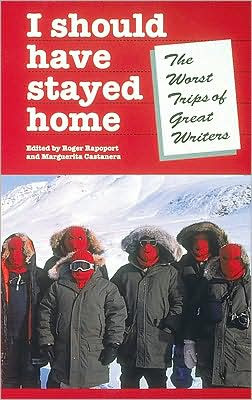
I Should Have Stayed Home edited by Roger Rapoport and Marguerita Castanera

Today I'm here to talk about keeping reading. This year I've had a lot of things that kept me from reading as many books I did in past years -- you may have had some similar distractions in your own life in 2020. But you're probably here reading this blog because you like books, like being the person who reads books for leisure, and want to reinforce that habit. So those distractions are doubly annoying: not just in themselves, as all distractions are, but because they push you away from doing something you really want to do.

This isn't the book I thought I was going to be reading next. I've gotten back into a rhythm, and am avoiding the anxiety of choice by going shelf-by-shelf through the unread books, picking one from this shelf and then one from the next. (Choosing among 35 books or so being much simpler than choosing among several hundred.) So I picked up what I think is still the newest novel by one of my favorite writers -- a bit longer than what I've been reading lately -- from the next shelf along and settled into a big chair, expecting to love it.

But it wasn't the right book, or I wasn't in the right mood. I got one chapter in, but it took most of a distraction-filled weekend day. For years, I didn't give up on books -- when you're reading professionally (and reading at the speed I was), you just power through to the end. Now, I'm quicker to realize time is limited and the world is infinite: so put down that book immediately if it's not what you need or want now. We all have options.

Another book on the same shelf was this one: I Should Have Stayed Home, a collection of short travel writings from 1994. It was shorter, made up of short pieces to begin with, and, most importantly, much closer to what it seemed like I wanted to read at the time.

So, instead of reading a novel by a writer I love, instead I read fifty essays by...well, let me be generous and say that some of them were world-famous travel writers. Others were loosely associated with the small Northern California press that published this book and/or the store Book Passage and its related travel-writing conference (which is still running), and several have the kind of bios in the back that made this former editor cringe.

I doubt any of you have ever heard of this book, will ever see this book, or would ever make any effort to find or read this book. But I bought it randomly at some point, it was sitting on that shelf, and it was a pleasant-enough thing that kept me from sitting with a bookmark in that novel (which I am never going to name) for the next six months.

I'm probably slandering I Should Have Stayed Home here. The pieces included -- they're all vignettes or short narratives rather than essays or fully-formed stories -- are almost all funny, all at least solidly written, and none of them outstay their welcomes. Sure, the subtitle "the worst trips of great writers" is slightly hyperbolic, but it definitely has a lot of bad trips (and bad in amusing ways) of many writers (at least a handful of whom are clearly great). So that's close enough for blurb purposes.

The famous here include Rick Steves, Paul Theroux, Tony Wheeler, and Jan Morris, plus a bunch of novelists (Isabel Allende, Joe Gores, Barbara Kingsolver, several others). There are also a lot of people who were writing travel pieces, particularly for San Francisco-area markets, in the early '90s, most of whom were not then great or famous and did not become so later.

But I'm not great or famous myself, so it's not a big deal. Editors Roger Rapoport (owner of the RDR Books that published this as well as a contributor) and Marguerita Castanera (one of the organizers of the conference and the person I suspect did most or all of the work making this book happen) did a good job of pulling together an entertaining themed collection. Most of the proceeds of this book were also donated to Oxfam America, which is a noble cause -- I don't quite see the connection to travel writing, but that's a quibble.

Again, I could have a lot of quibbles. It's a book made up largely of quibbles, and it was built from those quibbles over twenty-five years ago. The world has changed hugely since the trips chronicled in I Should Have Stayed Home happened -- that's the eternal issue with travel writing, that everything is different almost immediately everywhere.

It's a Heraclitean river, I guess. If you do randomly encounter this book -- maybe if it's the only thing in English to read in some youth hostel in a country foreign to you, as night falls and you're stuck far from home -- it can entertain you for the hours it takes to read. And that's definitely not nothing.