


"It is not possible...to concentrate enough military planes with military loads over a modern city to destroy that city."
- US colonel John W. Thomason, Jr., November 1937
Friday, January 13, 2012


Thursday, January 12, 2012
You Never Get Happy, Uplifting Music From ME!
But, just this once, I'll make an exception.
I talked about Cloud Cult's Light Chasers record briefly in my Hugo Nominees post -- it's a brilliant, happy, thrilling piece of chamber pop that's both a concept album about a starship journey and an examination of the self, in music that sounds a little bit like what early Yes might have done if they'd all been born thirty years later -- and I realized that I could share a bit of it.
The song "You'll Be Bright," from near the beginning of the record, is available free on the website of the Minneapolis Star-Tribune.
And, if you don't want to click a link without knowing what you'll get, here's the official video for that song, too:
(But I have to say that the next time I write about music it will probably be another song about committing suicide on New Year's Eve or something equally cheery.)
I talked about Cloud Cult's Light Chasers record briefly in my Hugo Nominees post -- it's a brilliant, happy, thrilling piece of chamber pop that's both a concept album about a starship journey and an examination of the self, in music that sounds a little bit like what early Yes might have done if they'd all been born thirty years later -- and I realized that I could share a bit of it.
 record briefly in my Hugo Nominees post -- it's a brilliant, happy, thrilling piece of chamber pop that's both a concept album about a starship journey and an examination of the self, in music that sounds a little bit like what early Yes might have done if they'd all been born thirty years later -- and I realized that I could share a bit of it.
The song "You'll Be Bright," from near the beginning of the record, is available free on the website of the Minneapolis Star-Tribune.
And, if you don't want to click a link without knowing what you'll get, here's the official video for that song, too:
(But I have to say that the next time I write about music it will probably be another song about committing suicide on New Year's Eve or something equally cheery.)
Walt Disney's Mickey Mouse: Race to Death Valley by Floyd Gottfredson

For example, the "graphic novel" -- if we quickly define that as a book-length work of comics created for original book publication, and brush aside the million objections -- is going through a strong period right now, but comics -- the art form of pictures and words in sequence, telling long stories or short gags or combinations of those things -- has had multiple, overlapping peaks in various areas for the hundred years that it's been a serious, moderately mature art. In particular, the newspaper strip, which was for six or seven decades the commercial pinnacle of that world, started throwing out masterpieces as early as the 1910s or '20s (depending on who you listen to), and had a great decade through the depths of the Great Depression. (I'm a particular fan of E.C. Segar's Popeye strip, which I've been babbling about here for the last year or so, but there are a dozen other examples of the same era.)
And that's a long way around to Floyd Gottfredson's Mickey Mouse strip -- though I suppose I could have come around the other long way, starting with Carl Barks and damning Gottfredson with the faint praise of "second-best Disney cartoonist" -- but that strip, at least as seen in this book, is an odd artifact of its time, not quite sure of itself and bouncing around among premises, tones, and styles.
That book is called Walt Disney's Mickey Mouse, Vol. 1: "Race to Death Valley", and the cover credits it purely to Gottfredson, though the table of contents has much more intricate credits, detailing the story input of Disney himself, and the art contributions of Win Smith, Jack King, Roy Nelson, Hardie Gramatky, Earl Duvall, Ted Thwaites, Al Taliaferro, and even Ub Iwerks. It reprints the first two years of the strip, from January of 1930 through the first days of 1932, sliced up into continuities (not always in chronological order) and separated by what eventually felt like too many text features.
 , and the cover credits it purely to Gottfredson, though the table of contents has much more intricate credits, detailing the story input of Disney himself, and the art contributions of Win Smith, Jack King, Roy Nelson, Hardie Gramatky, Earl Duvall, Ted Thwaites, Al Taliaferro, and even Ub Iwerks. It reprints the first two years of the strip, from January of 1930 through the first days of 1932, sliced up into continuities (not always in chronological order) and separated by what eventually felt like too many text features.
Once you wade through those bits of text -- some about Gottfredson, some about his collaborators, some about the characters, and all of them just a bit too Disney-chipper in tone for a book from Fantagraphics-- you get to the stories themselves. The first story Gottfredson had a hand in is the title piece, "Mickey Mouse in Death Valley," which zigs and zags the most, veering from farce to melodrama and following the over-cranked pace of a cliffhanger movie serial. Once that finally ends, Gottfredson & Co. are on more solid ground, keeping Mickey (and Minnie) mostly in the context of their community (mostly unnamed here, though a scholarly footnote indicates it became "Silo Center" in '32) and friends, with stories about boxing and fire-fighting, circuses and the new character Pluto, Mickey's taxicab business, a picnic, and others. There are two other long melodrama continuities here -- one about a sneaky suitor for Minnie's heiress hand, and another about a sneaky Gypsy tribe also out to get Minnie's money -- but they maintain their pace and tone much better than "Death Valley" (with its many hands) did.
The art is evocative and detailed, still in a very Ub Iwerks-ian rubber-hose style -- and the first continuity of the strip, reprinted in an appendix, is pencilled by Iwerks himself, with the most energy and verve in the book -- giving it the feel of an early Mickey cartoon extended and expanded. (Though that does highlight the lack of music!) The character of Mickey -- and the simple fact that he has a character, and isn't just the waving silent mascot of the last couple of decades of Disney -- will be surprising to most readers, but this mouse was a tough little guy, ready for both adventures and fun at any minute, and he's deeply enjoyable to read about.
[1] Other ages had the opposite reaction, assuming the past was always better in all things. If you're a Rick Santorum supporter, you may be living in one of those other ages right now.
Tuesday, January 10, 2012
Philip K. Dick Nominees!
The nominees for this year's Philip K. Dick Awards -- presented annually to a distinguished work of science fiction published as a paperback in the US -- have been released; I got this list via the indispensable Locus.
The winner will be announced in a gala ceremony at Norwescon 35 on April 6th.
- The Company Man, Robert Jackson Bennett (Orbit)
- Deadline, Mira Grant (Orbit)
- The Other, Matthew Hughes (Underland)
- A Soldier’s Duty, Jean Johnson (Ace)
- The Postmortal, Drew Magary (Penguin)
- After the Apocalypse, Maureen F. McHugh (Small Beer)
- The Samuel Petrovich Trilogy, Simon Morden (Orbit)
The winner will be announced in a gala ceremony at Norwescon 35 on April 6th.
Blacksad by Juan Diaz Canales and Juanjo Guarnido

 at all.
"Oh, a serious funny animal comic, with a tough cat-man private eye?! Snort!"
But I try to read even things I think will be silly -- sometimes, I go out of my way to read things I think will be silly, since I enjoy making fun of silly things online -- so I found myself a copy of this Blacksad book, which collects three European-style album-length stories (originally published in 2000, 2002, and 2005) written by Juan Diaz Canales and drawn by Juanjo Guarnido. And a funny thing happened when I read it: it wasn't funny. Not at all. The funny-animal faces turned into just another way to tell the story -- and gave some interesting twists on old material, especially in the second story, "Arctic Nation" -- and those stories were tough, smart, compelling noir thrillers.
(It's not as if I haven't learned the "funny animals can be serious" lesson before -- books as varied as Little Nothings, Dungeon, and Maus have done it -- but maybe I was expecting these two Spanish creators' take on "grim & gritty" would be as laughable as most recent American efforts along those lines. Whatever the reason, I was wrong.)
So, yes: Jon Blacksad is a panther-man (I guess), in a world very much derived from US B-movies of the '40s and '50s -- this is clearly the US, and equally clearly that time of history, and both of those things should make telling these stories even more difficult for two modern European men, but there's no sign of strain or axe-grinding here. Blacksad has a complicated relationship with the local police -- neither used as an extension of their power nor reflexively kicked aside, but somewhere in between, depending on the case -- and inhabits a world full of many other complications, from racial politics to nuclear dangers to movie-star intrigue, and, of course, the requisite murder and secrets and lust and greed to fuel the plots he gets caught up in.
And these are three damn good mystery stories, with sharp dialogue and an excellent world-weary narration. Even more, Guarnido is a excellent artist, giving these dog-men and cat-women and owl-men a full life, with realistic body language and great facial expressions. There is a whole world inside Blacksad, and I really hope that these aren't the last stories to come from that world.
Monday, January 09, 2012
Reviewing the Mail: Week of 1/7

Anyway, these four were the books that showed up in my mailbox over the past week, sent by publicists and editors and authors and other folks who really want to see them succeed and find their natural loving audiences -- and what I try to do here, as much as possible, is present those books so that, if you're the person who would love them, you realize that. (On the other hand, sometimes I get into a puckish mood and just make fun of things, but I try to keep that to a minimum.) I haven't read any of these books yet, and it might be that I never read some or all of them -- but this is what I can tell you about them, right now:
Red Dot Irreal is, I think, the first collection of stories from Jason Erik Lundberg (who was one of the forces behind a neat book called A Field Guide to Surreal Botany, which I reviewed a few years back). The ten stories here have mostly appeared before -- but in various literary and other journals, mostly in or near Lundberg's home of Singapore, so it's not terribly likely that many readers will have read many of them. (Isn't it annoying when you get a short-story collection and have already read most of it? That shouldn't happen here.) Lundberg has a page for Red Dot Irreal on his website, with links to a wide array of purchase possibilities, including a very inexpensive, un-DRMed ebook edition, and samples of several stories. It was published by Math Paper Press a couple of months ago, and is available in electrons and dead-tree form pretty much world-wide -- though not, at this precise moment, from the world-spanning seller I usually link to here.
 , which I reviewed a few years back). The ten stories here have mostly appeared before -- but in various literary and other journals, mostly in or near Lundberg's home of Singapore, so it's not terribly likely that many readers will have read many of them. (Isn't it annoying when you get a short-story collection and have already read most of it? That shouldn't happen here.) Lundberg has
 comes out from Tor this month in mass-market; I saw it as a galley a couple of months back and mumbled
  I've heard of the Black Butler manga series (by Yana Toboso) but not, as far as I can remember, read any of the books in it. So Volume VIII, in front of me now, is deeply confusing me -- the inside back cover talks about it as a sports drama about "the wild child, Sebastian," who competes in track-and-field activities against the world's best; the back cover has circus imagery and talks about Sebastian as the butler to a nobleman, and protecting a Manor from attack by a circus; and the first few pages have a bunch of young people fighting and killing each other for no reasons I can figure out. So: this is the middle volume of a manga age-banded for older teens, it comes out from Yen Press this month, and I would not recommend jumping in at this point.
 , in front of me now, is deeply confusing me -- the inside back cover talks about it as a sports drama about "the wild child, Sebastian," who competes in track-and-field activities against the world's best; the back cover has circus imagery and talks about Sebastian as the butler to a nobleman, and protecting a Manor from attack by a circus; and the first few pages have a bunch of young people fighting and killing each other for no reasons I can figure out. So: this is the middle volume of a manga age-banded for older teens, it comes out from Yen Press this month, and I would not recommend jumping in at this point.
 , a hardcover from Viking coming February 6th. It somehow links together European prehistoric skeletons, killed by arrows; horrifying genetic experiments in Russia; "mystical mutations" committed by Cambodia's fanatical Communist Khmer Rouge regime; a strange, demonic woman; and a mysterious fortress in Tibet. Knox previously wrote the novels
  and
and  , which also seem to be semi-SFnal conspiracy thrillers.
Sunday, January 08, 2012
Hugo 2012 Nominations Open
Yes, indeedy, they are.
Last year, I grumped about forgetting to nominate, and grumped nearly as much about forgetting to urge anyone within the sound of my voice to nominate (preferably things I like, but, what the hell, you can use your nomination power for anything you enjoyed, I suppose).
I will nominate, but, even more, I'm going to list things I'm considering nominating here -- and hope you folks will chime in on the comments. This might keep going up until the March 11th deadline; we'll see.
Locus typically has an exhaustive -- really, it contains pretty much everything that anyone might consider eligible and worthy -- list of Recommended Works every year, but that comes out in the February issue, which is still a couple of weeks away as I write this. I'll add a link, assuming I remember, once that list is up.
Categories are, with what I'm thinking about nominating as of the last time I updated this post:
Best Novel (40,000 words or more)
Best Novelette (7,500 to 17,500 words)
Best Short Story (up to 7,500 words)
Best Related Work
Best Graphic Story
Best Dramatic Presentation "Long Form" (more than 90 minutes)
Best Dramatic Presentation "Short Form" (less than 90 minutes)
Best Editor Short Form
Best Editor Long Form
Best Professional Artist
Best Semiprozine
Best Fanzine
Best Fan Writer
Best Fan Artist
Best Fancast
John W. Campbell (Not a Hugo!) Award for Best New Writer
I do expect to update this -- assuming I do manage to see/read/think about other Hugo-eligible stuff in the next two months -- but I also hope whoever is reading this will comment here and/or post on their own blogs/social media accounts to talk about the SF/Fantasy stuff from 2011 that they think is worthy of a Hugo.
The more people nominate, the better the process is -- so get to it!
Last year, I grumped about forgetting to nominate, and grumped nearly as much about forgetting to urge anyone within the sound of my voice to nominate (preferably things I like, but, what the hell, you can use your nomination power for anything you enjoyed, I suppose).
I will nominate, but, even more, I'm going to list things I'm considering nominating here -- and hope you folks will chime in on the comments. This might keep going up until the March 11th deadline; we'll see.
Locus typically has an exhaustive -- really, it contains pretty much everything that anyone might consider eligible and worthy -- list of Recommended Works every year, but that comes out in the February issue, which is still a couple of weeks away as I write this. I'll add a link, assuming I remember, once that list is up.
Categories are, with what I'm thinking about nominating as of the last time I updated this post:
Best Novel (40,000 words or more)
- Among Others by Jo Walton (my review)
Shades of Milk and Honey by Mary Robinette Kowal-- oops, originally published in 2010, so ineligible (my review)- One of Our Thursdays Is Missing by Jasper Fforde (my review)
- A Dance with Dragons by George R.R. Martin
- Circle of Enemies by Harry Connolly (my review)
- The Quantum Thief by Hannu Rajaniemi (my review)
 by Jo Walton (
 by Mary Robinette Kowal
 by Jasper Fforde (
 by George R.R. Martin
  by Harry Connolly (
- haven't read any yet
Best Novelette (7,500 to 17,500 words)
- haven't read any yet
Best Short Story (up to 7,500 words)
- haven't read any yet
Best Related Work
- nothing comes to mind at the moment
Best Graphic Story
- Anya's Ghost by Vera Brosgol
Hereville: How Mirka Got Her Sword by Barry Deutsch-- Oops again! Another 2010 book. (my review)- E.C. Segar's Popeye, Vol. 5: "Wha's a Jeep?" (my review)
- Hera: The Goddess and her Glory by George O'Connor (my review)
- Dear Creature by Jonathan Case (my review)
 by Vera Brosgol
 by Barry Deutsch
 by George O'Connor (
 by Jonathan Case (
Best Dramatic Presentation "Long Form" (more than 90 minutes)
- Geez. Maybe Paul?
 ?
?Best Dramatic Presentation "Short Form" (less than 90 minutes)
- I was going to nominate Cloud Cult's excellent album Light Chasers, which is both SFnal and not a big dumb Hollywood movie (of the kind that usually dominates this category), but I just checked, and it came out in 2010. Wah-wah.
- I would like to nominate things, both here and in the "long form" category, that aren't just big famous movies & TV shows, since the original aim of the DP awards was to honor all kinds of dramatic works -- convention speeches, concept albums, radio plays, and so on. It's become a tedious "what's your favorite Doctor Who episode this year?" category purely because of inertia.
Best Editor Short Form
- Haven't been reading short stuff this year, so I'll pass for now.
Best Editor Long Form
- I hope someone does the "who edited what novels" for 2011, since otherwise this is a tough category for all of us. I'll need to think about it before I nominate.
- But let me mention Jeremy Lassen, Editor-in-Chief of Night Shade Books -- I'm not sure (see above) which Night Shade titles are his hands-on books, and which belong to others, but NS has a great, quirky list and I haven't seen Jer called out in this category so far.
Best Professional Artist
- I don't see as many covers as closely as I did in my SFBC days, but I still want to personally nominate in this category based on actual covers published in the calendar year 2011, and urge everyone else to do the same.
- John Picacio continues to do great work, such as the cover of Ian McDonald's Planesrunner
- Other people who've done some neat stuff this year on the few books I actually have on hand here: Victor Koen, Michael Komarck, Jon Sullivan, Sam Weber, John Harris
Best Semiprozine
- I'm not even sure what's eligible, so I think I'm waiting until the more faanish types -- maybe NESFA -- get their rec lists together.
Best Fanzine
- I really don't read fanzines, so I probably won't nominate in this category. That's an important point: it's perfectly fine to skip entire categories, or only nominate one or two things. But, if you're eligible to nominate, you really should nominate something -- whatever things you thought were really impressive about the SFnal stuff of 2011.
Best Fan Writer
- I'm eligible -- practically anyone who glancingly mentions SF once in a while is eligible, actually -- and I might just be self-centered enough to nominate myself this time around. If I do that, though, I really need to nominate other people as well -- otherwise, that's terribly rude.
Best Fan Artist
- I almost certainly will not nominate in this category, unless I think of someone on the webcomics side who should be here (and most of them aren't "fan artists" in the conventional sense).
Best Fancast
- Putting them all into orbit would be a good start.
- I kid, I kid.
- I hate podcasts, so I'm not going to nominate here, either.
John W. Campbell (Not a Hugo!) Award for Best New Writer
- This is another category where it's vital to know who is eligible. Luckily, there's a standard reference for that at Writertopia. I'm not familiar with any of those names -- I haven't been reading much short fiction lately -- but it's a great place to check before finalizing your nominations.
I do expect to update this -- assuming I do manage to see/read/think about other Hugo-eligible stuff in the next two months -- but I also hope whoever is reading this will comment here and/or post on their own blogs/social media accounts to talk about the SF/Fantasy stuff from 2011 that they think is worthy of a Hugo.
The more people nominate, the better the process is -- so get to it!
Amulet 4: The Last Council by Kazu Kibuishi

 , shows Kibuishi still in adding-complications mode; anyone who had hopes that this series would start moving towards its conclusion will be disappointed by this book, which sets up what just might be the other major villain of the series. After the evil, world-conquering elf king, who is entirely offstage in these pages -- Kibuishi's world, like that of many epic fantasists before him, has expanded to such a degree that he can't manage to shoehorn all of his subplots into a single volume.
(I reviewed the previous volume, The Cloud Searchers, just less than a year ago, but, oddly, I don't seem to have written anything here about the first two books.)
 , just less than a year ago, but, oddly, I don't seem to have written anything here about the first two books.)
This is very much the middle book of an epic fantasy series, which means any serious plot summary would be either a spoiler or superfluous to readers of the series and close to incomprehensible to those who haven't read the previous books. The focus, as usual, is on Emily, a teenage girl from our world who came through a portal to a fantasy world after getting a mysterious and powerful magical talisman, called an amulet, which talks to her telepathically and has its own agenda. Emily came through with her younger brother, Navin, and her mother Karen (who was in a magical coma for the first two books, and acted as the voice of overwhelming caution since then), and has since picked up a group of friends, allies, and companions: the rabbit-shaped robot Miskit, the fox adventurer Leon, grumpy robot Cogsley, airship captain Enzo, and Trellis, the more-or-less good son of the evil elf king.
Those folks are separated for most of this book, getting into their own adventures -- and, in the case of Miskit and Cogsley, discovering Vigo, another stonekeeper -- people who have an amulet, like Emily and Trellis, and, more importantly, anyone with any serious power whatsoever in this world -- who will be a major mentor/helper figure going forward, if I'm any judge.
The major plotline focuses on Emily, of course -- she was led to the flying city of Cielis by the young stonekeeper Max, and they all had thought of Cielis as their one hope of refuge, the strong center of resistance to the forces of the elf king. But, after a disastrous training ritual for young stonekeepers, and certain actions by Max, Emily and her friends find themselves is clearly an even worse position at the end of Last Council, facing ever-longer odds with fewer and fewer potential allies.
The series is still fun and exciting, but it's really settling in to be the graphic-novel equivalent of a middle-rank epic-fantasy series; if does what it needs to do, and is quite thrilling along the way, but it's easy to forget during the time between volumes, and it's not, so far, doing much all that interesting or special with its generic ingredients.
Update: See also my reviews for the first book, The Stonekeeper (in the middle of a longer round-up post), and for the second, The Stonekeeper's Curse.
Friday, January 06, 2012
Popular Music Always Sucked: The Meme
I saw James Nicoll doing it: that's my excuse.
The rules:
The source: http://current.com/15jpm4c (for me, at least)
The result:
(Hm. That wasn't nearly as bad as I was expecting it to be. Chalk it up to dumb luck.)
The rules:
1) Find out the song that was #1 the week you were born.(For values of "Wall" that may vary depending on your social media platform.)
2) Find that song on YouTube.
3) Post that video on your wall without shame.
The source: http://current.com/15jpm4c (for me, at least)
The result:
(Hm. That wasn't nearly as bad as I was expecting it to be. Chalk it up to dumb luck.)
Quote of the Week: Dylan Sends a Message
"Message songs, as everybody knows, are a drag. It's only college newspaper editors and single girls under fourteen that could possibly have time for them."
- Bob Dylan, interviewed in 1970
- Bob Dylan, interviewed in 1970
Thursday, January 05, 2012
The Meaning of Life...And Other Stuff by Jimmy Gownley

 is the seventh Amelia Rules! graphic novel -- not including A Very Ninja Christmas, which I haven't seen but which seems to be shorter and slighter than the other books -- about a preteen girl and her odd friends in Anytown, Pennsylvania. (Not literally Anytown -- I'm sure it has a real name -- but figuratively, since Amelia moved there from the big bad city of New York in the first book.)
I've written a lot about this series before, starting with the fourth volume, then hitting the first three in one post, and then volume five and volume six in quick succession last year -- so I don't have a whole lot to add this time. Gownley is still telling his story in chapters that sometimes feel as if they could have been individual issues, through they're mostly 32-36 pages long this time, and his characters are still growing up at a pace far slower than real kids, though they are growing up, which is good to see. Gownley also still has a deeply buried cynicism, which only burbles to the surface occasionally -- the principal at (nudge, nudge!) Joe McCarthy Elementary School, a grumpy old idiot who hates Amelia for insufficient reasons, is the best example -- and a deeper sweetness that almost masks the fact that he can craft interesting characters and resonant plots. (Amelia Rules! tends to float along on a half-goofball, half-tween-drama level, so when it drops into the story of the father of one of Amelia's friends, lost in action while serving in the army overseas, it's surprising and almost shocking.)
So this volume is about rebuilding the old clubhouse, about the the travails of the cheerleading squad, and about Amelia's rock-star aunt Tanner, who ran off suddenly in the previous book to go on tour and has been entirely absent since. It's soap-operatic in the good sense -- a long story, filled with characters whose lives you get to know and care about -- but that does mean that it's better to drop back and start at the beginning, even if that end of the story was a bit weaker and sillier.
Wednesday, January 04, 2012
The Hidden by Richard Sala
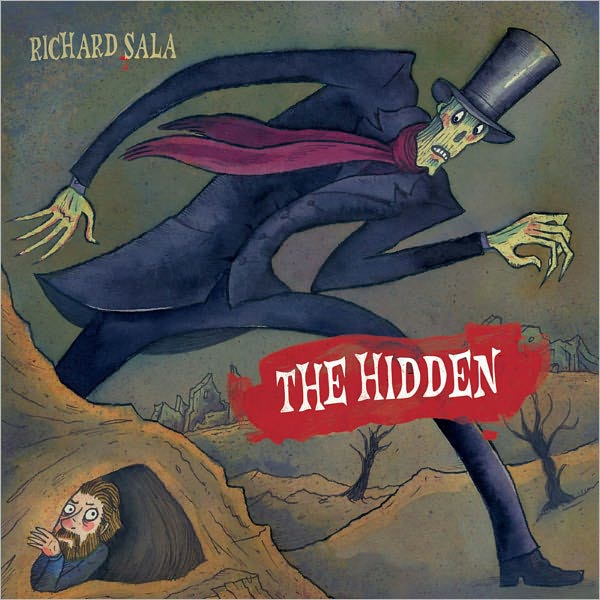
I've been reading Sala for years, though it seems the only time I've written about his stuff before is a ComicMix review for Cat Burglar Black
 , a slightly untypical book for Sala -- it was ostensibly for teenagers, and didn't see a dreadful end come to its entire cast -- that came out two years ago.
The Hidden
 is closer to a standard Sala, an apocalyptic story in which one tough young woman -- this time named Colleen, and darker-skinned and more sensibly-shoed than usual for a Sala heroine -- finds herself in the midst of supernatural horrors, deep secrets, and more than a few up-close-and-nasty deaths. This time, the apocalypse is sudden and all-encompassing: monsters burst forth on the second page, and the explanation (such as it is) doesn't come until nearly the end. But what does it matter why or how the world is ending? The time to worry about that is before it ends, and it's far too late for that in The Hidden.
So Colleen, and her boyfriend Tom -- who wants to be strong, but young men never fare well in Sala's graphic novels -- were lucky enough to be out in the wilderness when the worst happened, and so are still alive and wandering. And they were lucky, or perhaps very unlucky, to run into a wild-looking man who doesn't know his own name. He leads them to a group of other survivors, and Colleen learns the monstrous secrets of their guide -- of the creature he created, long ago, and the race of monsters that creation has patiently made and now released on the world.
The Hidden is even bleaker and more nihilistic than most of Sala's work; his stories usually end with a smaller evil -- a mass-murderer or criminal -- suffering a suitable end as the plucky girl escapes, barefoot. But there's no hope for humanity in The Hidden, and little hope for the few people surviving at the end. That may be a consequence of the fact that The Hidden is quietly a sequel to a famous book by someone else, but I should warn you: this book is dark and bleak even for Sala, and that's dark indeed. There are still hints of his mordant humor, and his precise lines and color washes are as ghoulishly appropriate as always -- but The Hidden out-Salas any of the prior Sala books, which is an unlikely and impressive thing.
Tuesday, January 03, 2012
What I Hate from A to Z by Roz Chast

 , for example, was a big hit last year, and that explains a lot of the problems with the form -- these are almost always books very much like books for kids, but twisted in a specific way to make them unsuitable for those kids and thus adult.
What I Hate: From A to Z
 is an alphabet book -- another very common kid of picture book, as Go the F**k was a sleepy-time book -- with, of course, very adult concerns and fears, written and illustrated by the renowned New Yorker cartoonist Roz Chast. There's a short prose introduction -- set in type, unlike the body of the book, which has Chast's hand-lettering for both the cartoons and the page of short explanation facing each one -- to talk about an exercise she uses to fall asleep by thinking of an example for each letter of the alphabet of something. (Chast suggests rock bands, birds, fruits and vegetables, diseases, movie titles, and similar prosaic categories.) Chast is also -- or at least presents herself as, in best New Yorker-cartoonist fashion -- deeply neurotic, and worried about most of the things in the world.
So this book catalogs one anxiety for each letter of the alphabet, from Alien Abduction to Z (which doesn't really have a specific anxiety -- Chast riffs on endings instead), with crowd-pleasers like Rabies, Heights, Premature Burial, and Kites along the way. It's high on free-floating anxiety, as of course it would be, but doesn't have the punch of a book of individual cartoons, since each page is designed to illustrate a concept rather than to be a funny cartoon on its own. It's not the best example of Chast's work -- if you like New Yorker-style cartoons, she is wonderful, but this sees her specific viewpoint channeled into a particular schema rather than allowed to make jokes wherever it can.
It's amusing, and pretty funny, but it's really more of a gag gift, or possibly for Chast's most devoted fans. And the title is slightly inaccurate -- it's things that make her afraid, or uneasy, or anxious, rather than things she hates. (Hate is such a strong emotion for a New Yorker-style cartoonist; they typically feel things that are more inwardly-directed.)
Monday, January 02, 2012
The Quantum Thief by Hannu Rajaniemi

Serious is not necessary better, or any more worthy, than frivolous; Red Mars is serious, but The Stars My Destination is frivolous. The Foundation Trilogy -- despite being set in a far future -- is deeply serious, while The Martian Chronicles, supposedly a plausible near-future at the time of writing, is entirely frivolous.
And so I'm being entirely descriptive -- though possibly even a little laudatory -- when I describe Hannu Rajaniemi's first SF novel, The Quantum Thief
 as being a magnificently and intricately frivolous SF story. It's set in a baroque medium-future solar system -- from that limitation, and some of the bafflegab, I believe that Rajaniemi is staying within the bounds of cutting-edge physics as he understands them, though it's far beyond how I understand them -- broken into the usual major inner- and outer-system polities, with humans in various formats from meat-bound traditional through various flavors of biologically and technologically modified up to high-speed post-human downloads. But, even with all that, it's still a caper novel, about the greatest thief of his age being busted out of the most escape-proof prison to return to the scene of one of his greatest crimes to rediscover the pieces of himself he closed off and pull the fabled One Last Heist.
(I'm probably the only one in the world who was reminded of possibly Roger Zelazny's most obscure novel, Bridge of Ashes, which also has a man with anti-social skills needing to unearth the parts of his mind that he tidied away some time ago.)
The thief is Jean le Flambeur; the prison is the Dilemma Prison, an infinite virtual space in which the inmates enact the Prisoner's Dilemma, over and over, out in the coldest depths of the outer system; the agent of his escape is Mieli, a woman with a powerful ship (and equally powerful personal modifications) filled with technology from the Sobornost, a collective of uploaded posthumans; the scene of the crime is a moving city on Mars, the Oubliette, where all citizens control their personal privacy through ubiquitous nanocontrols but are otherwise unmodified, and where Time is the only currency; and what Mieli wants him to steal, primarily, is who Jean was, locked away somehow in that Oubliette.
And, since every Raskolnikov must have a Porfiry, every Valjean a Javert, The Quantum Thief is equally the story of Isidore Beautrelet, a young man of the Oubliette with a talent for investigating crimes and close connections to a secret group of vigilantes with deep suspicions about the Oubliette's supposedly directly democratic governance. Isidore begins by investigating the murder of a chocolatier, but, through his own inquiries and the influence of his girlfriend -- Pixil, the first newly created/born member in centuries of a mildly posthuman zoku clan currently living in the Oubliette after losing a war to the Sobornost in the outer system -- he learns of Jean's arrival, and is hired by a rich man who fears Jean will try to steal from him.
Jean and Isidore's stories twine around each other, usually in alternating chapters, as both pursue their own ends and unravel, separately, the secrets of the Oubliette and its privacy-mad inhabitants. And there is a huge confrontation at the end, as there must be, as those secrets are revealed, a society is rocked to its core, and danger looms for everyone. Rajaniemi keeps up a furious pace throughout Quantum Thief -- this is not a novel for the timid, or for readers who want SF concepts to be explained carefully to them, one at a time -- but still manages to find ever higher gears for that climax.
Lurking mostly quietly in the background throughout The Quantum Thief is the larger question of freedom and independence for all -- or any -- of the minds of the solar system. The Sobornost is huge, ever-more-dominant, and growing -- and it is utterly controlled by the copyclans of the few Founders, with all other minds controlled, ruled, and used as slave labor. The Oubliette is the only place left with physically unmodified humans, and it -- like all of the Martian Moving Cities -- is under constant attack by phoboi, self-replicating machines that want to destroy anything human or human-made. There may be other major posthuman powers in this system -- a solar system is a big place, after all -- but we don't see them in this book; it's just the lurking Sobornost and the small minds that have so far avoided being sucked into it.
Now, I fully expect that Rajaniemi has worked out how our world gets to the state of play in The Quantum Thief -- Jean seems to be from our era, as are the Founders of the Sobornost, who he used to know -- but that backstory is covered with a few evocative terms, like Collapse and Spike, and Earth is notable primarily by its absence from the novel. Perhaps the promised latter two-thirds of this trilogy will flesh out that history, and I'll be forced to move Quantum Thief, retroactively, into the realm of serious SF. But I hope not. It's so much fun that it deserves to be frivolous.
Quantum Thief is a fast-moving, flashy, excitement machine, crammed full of shiny SFnal ideas and turbo-charged by prose that pauses only briefly to illuminate but never stops to fully explain. Rajaniemi is a tremendously confident writer, from the evidence here: he has a million ideas, and throws them as quickly as he can, assuming that his reader will be able to catch them equally well. If you're willing to get up to the speed required, and can hang on for the ride, Quantum Thief is well worth the time, and Rajaniemi well launched as a major new SF writer.
[1] Or alternate present, or alternate past, if you, like me, accept stories like that as "science fiction."
Reviewing the Mail: Week of 12/31

One might think the week between Christmas and New Year's would be a very quiet one for the book-mailing business, but the last week of the month tends to be the busiest, so there's a decent stack to talk about. And so I'll get right to it:
Michael Flynn's new SF novel, In the Lion's Mouth
 , continues the space opera series -- written in prose vaguely skaldic, and reminiscent of medieval chronicles -- of Up Jim River
 and The January Dancer
 . It's an odd concept for a SF series, though I wouldn't at all be surprised to know Poul Anderson did something similar at least once (at a longer stretch than "Uncleftish Beholding," I mean). I have to admit that I haven't read any of these books, but Flynn's late '90s near-future series starting with Firestar
 was excellent (though, I'm sure, entirely alternate history at this point) and his standalone The Wreck of the River of Stars
 is a magnificent SFnal tragedy -- so he's definitely got the chops to do this right, if anyone does. Lion's Mouth is a hardcover from Tor, coming January 17th.
First is a book that seems to be called DRRR!!, but, on closer inspection, is actually Durarara!!, Vol. 1
 , and is credited to creator Ryohgo Narita, character design Suzuhito Yasudo, and art Akiyo Satorigi. Some quick googling tells me that this property was originally a series of light novels (nine so far, by Narita) but then expanded, as popular Japanese properties always do, into this manga, an anime series, and even a radio show. What I have in my hands is the first volume of the manga, which presents itself as a "bunch of wacky characters" story, set in Tokyo's Ikebukuro district -- and I think the main character is that staple of manga, the quiet boy from the provinces who came up to Tokyo to go to a well-known school and is thrown entirely out of his depth.
 is a later volume in the series -- for those doing their own googling, let me note that the anime uses the two-word style "High School" and the manga collapses that into the single word "Highschool" -- about, as far as I can tell, mostly nubile and pneumatic young women fleeing from (and/or being eaten by, I suppose) zombies. It's rated M for mature -- and, as I type this, I haven't broken the shrinkwrapping -- and was written by Daisuke Sato with art by Shouji Sato.
 Pandora Hearts
 -- Jun Mochizuki's very loose retelling of Alice in Wonderland -- has reached its eighth volume, which means it's probably pretty different from the first volume, which I reviewed for ComicMix about two years ago. (And which I described then as "messy and loud and disheveled, like a sorority girl at 3 AM on a Friday," a phrase I'm still proud of.)
 Pre-teen boys probably don't need to be introduced to Cirque du Freak -- a series of vampire novels about a boy named Darren Shan, and credited as written by that very same Darren Shan -- but the rest of us aren't as likely to have heard of the series. The novels have also been adapted into a manga series -- by Takahiro Arai -- and that series ends this month with its twelfth volume, Sons of Destiny
 , which is not-so-coincidentally the name of the twelfth and final novel in the series as well. (I reviewed the first volume back in early 2009, and gave some more details about the background then.)
 The Zombie-Loan series, by the manga collective known as Peach-Pit, ends with a lucky thirteenth volume
 this month. (I reviewed books two, three, and four, and described the heroine then as "the mousy girl with glasses – you know her, you find her bland and slightly tedious, and she infests manga like dengue fever: something non-fatal and a bit obscure, but painful, lingering, and annoying." I clearly was in full Chandleresque odd-similes mode when I wrote for ComicMix, wasn't I?)
 Black God, on the other hand -- a series by Dall-Young Lim and Sung-Woo Park, but done Japanese-style for Japanese publishers, despite the creators' Korean names -- is still roaring along with a fifteenth volume
 this month. (I reviewed volumes two, three, and four at exactly the same times as Zombie-Loan -- which makes me vaguely wonder how Black God managed to get two volumes ahead, if they're still publishing at the same time -- but will give you new links here, just because I'm feeling that servicey today.) The series seems to still be about a young jerk of a manga creator and the supernatural hottie he's permanently bonded to -- she saved his life by trading limbs with him -- and the overpowered supernatural battles they get into with other similar (but vastly more evil) folks.
 is the fourth book in a light novel series by Mizuki Nomura about a a book-eating goblin who is also the president of her school's literary club. (Consuming Japanese pop-cultural products goes much more smoothly once you accept that everything takes place in a highschool, and revolves around club activities.)
  I'm slightly confused by the presence of 13th Boy, Vol. 1
 by Sang Eun-Lee in my Yen package this month: it was originally published in 2009, and I reviewed it then. This seems to be exactly the same book I saw then, including -- to quote myself one more time, "[t]he title page of 13th Boy – actually a two-page spread – ... two boys with contrasting hair colors, three-foot necks, pointy little chins, tousled windblown hair, and eyes the size of truck tires staring out at the reader like four Twilight Zones of soulfulness." It's not a new edition, but it might be a reissue or new printing -- though the copyright page doesn't indicate that. Whatever reason, 13th Boy is heading back into stores for a second chance, so, if you like manwha stories about love triangles among teenagers with gigantic eyes, this is precisely the book you need.
 . (The first was Cryptum
 , and the trilogy is known as the "Forerunner Saga" -- with, I deeply hope, a wink in the direction of a certain Miss Alice Mary Norton -- for those of you taking notes for your own shopping expeditions. I haven't played any of the Halo games or read any of the Halo books, so you're on your own with this one. It's officially published tomorrow, on January 3d.
 And last this week is Sisterhood of Dune
 , the eleventh Dune novel by Brian Herbert and Kevin J. Anderson -- which means that Herbert fils and Anderson have now written more than twice as many Dune novels in a dozen years as Dune creator Frank Herbert managed in twenty years. This particular book -- coming from Tor as a hardcover, and officially published tomorrow -- follows up their "Legends of Dune" trilogy, about the Butlerian Jihad, by beginning a new trilogy about the origins of the Bene Gesserit sisterhood and, presumably, many of the other important institutions of the Dune-iverse.
Subscribe to:
Comments (Atom)
