Showing posts sorted by relevance for query e.c. segar. Sort by date Show all posts

Wednesday, June 25, 2008

E.C. Segar's Popeye, Vol. 1

The subtitle of this first collection of Segar's Thimble Theater strips is the very appropriate "I Yam What I Yam!"

I've already taken it back to the library -- I actually read most of it on the afternoon of the day after it was due back. (Mostly because it's outlandishly oversized, and so can only be read really comfortably at a table.) So I can't cite chapter and verse.

But damn if E.C. Segar wasn't a sly, funny, and amazingly entertaining cartoonist. The character of Popeye has been very badly served by other hands for the past fifty or seventy years, so seeing the pure Segar is a revelation.

Popeye doesn't even appear until about page twenty-seven -- and this volume starts ten years into Thimble Theater's twenty-year run. The first part of the story has then-lead Castor Oyl inheriting Bernice the Whiffle Hen from his uncle, and then trying, repeatedly, to kill it for a reward. (Whiffle Hens are rare, valuable, and consummate escape artists.) Then Castor spends a month or so selling Bernice to various shady characters -- she always comes home to him, which causes trouble.

Finally, Castor and his friend Ham Gravy -- who had been Olive's long-time boyfriend before being rudely shouldered aside by a rough seaman -- learn that rubbing a Whiffle Hen's feathers brings great luck, so they set off to break the bank of an island casino. But to get there, they need a boat...and a crew.

For crew, Castor hires Popeye. The sailor is clearly supporting cast for the rest of that story, but it's also clear that Segar was having fun with the new character -- and, outside the world of the strip, Popeye was becoming hugely popular.

Popeye leaves the cast at the end of that story, but he's back pretty quickly -- either Segar or someone at his syndicate must have realized they had a great character on their hands. And what's astonishing -- at least to me, in 2008 -- is that Popeye wasn't the caricature that we think of these days. He was a tough guy and a sailor, and not book-smart, but he was canny and knowledgeable, with a great wealth of experience and an individual view of the world. He didn't eat spinach, he didn't fight with a sailor named Bluto (or Brutus), and he didn't talk in catchphrases.

Anyone who thinks Popeye is a dull, essentially limited character should check out this reprint series -- along with anyone who has an interest in classic comic strips. Segar's Thimble Theater was one of the good ones, with long, intricate stories and detailed art.


Wednesday, February 16, 2011

Popeye, Vol. 3: "Let's You and Him Fight!" by E.C. Segar

Popeye has always been too popular for his own good: almost from the very moment he appeared in E.C. Segar's then-mid-rank comic strip Thimble Theater in 1929, he almost-inexplicably grabbed the imagination of the public and the strip began to reconfigure itself around him. By the time of the stories reprinted in this volume -- originally published in newspapers during 1932 and '33, about half-way through the Segar Popeye years -- Thimble Theater was universally known as Popeye, and the wave of other-media versions had already begun.

(I complained about the animated Popeye, in particular, when I reviewed the first two volumes of this series -- "I Yam What I Yam!" and "Well, Blow Me Down!" -- so I won't repeat myself here.)

So this third volume is titled "Let's You And Him Fight!", which is of course one of the catchphrases of the cover character, Mr. Wellington J. Wimpy (along with "I will gladly pay you Tuesday for a Hamburger today" and "Come up to the house sometime for a duck dinner -- you bring the ducks" and "Have a hamburger with me -- on you"). Wimpy only appears in the Sunday continuity, though -- this is from the era in which dailies and Sundays were almost entirely separate, like Earth-1 and Earth-2 versions of the same characters.

The dailies in this book -- from June of '32 through December of '33 -- have a succession of long stories (each one generally taking several months, even with six large, dialogue- and action-filled panels a day), in which Popeye sails off in search of treasure in "The Eighth Sea," fights Bluto and his piratical mutineers, discovers that treasure and takes it back to King Blozo's kingdom of Nazila, where there's another close to a year of adventures, with Popeye founding his own country and dealing with wild men (and, even better, wild women!).  When Popeye finally gets back home -- which is some nameless port city in the USA -- he immediately dives into an unlikely job as a star investigative reporter, which quickly gets sidetracked when he discovers a lost baby. (Popeye, of course, usually calls him "Swee'pea," but the boy is actually christened with spinach in the name of Scooner Seawell Georgia Washenting Cristiffer Columbia Daniel Boom, just in case you want a really obscure Popeye trivia question.) And then, at the end of the daily section, there's the funniest sequence of this period, in which Popeye was hit on the head -- and developed "Bonkus of the Konkus," a very serious ailment -- which made him think "I yama lonely cowboy" who had lost his "horsh" and all of his cows. Popeye's usually so all-competent -- pretty much unstoppable, unless he's frightened of black magic -- that seeing him confused and aimless is a lot of fun, especially since we're sure that he's too tough to ever really be hurt.

The Sundays cover a similar but distinct period -- October '32 to November '33 -- and have less continuity to them. There are occasional boxing matches, and other stories, that run for a few weeks, but most of these are one-off gags, set either in Rough-house's restaurant or the Oyl's front parlor -- though, again, each of these strips has sixteen big panels, so they're not small gags. (The Sunday pages also include Segar's other strip of the time, Sappo, about -- by this time -- a pair of inventors and the odd things they get up to.)

Segar's Thimble Theater was a nearly perfect blend of humor and adventure, with a cast of interesting oddballs (led by Popeye himself, of course) and a tone that could veer from high drama to low comedy within a couple of panels. And this Fantagraphics series is even closer to perfection, presenting Segar's work gorgeously on great big pages -- it would be a much better world if all our artistic treasures were treated this well.

Sunday, January 01, 2012

Favorite Books of 2011

I've been doing a year-end list for several years -- see 2010, 2009, 2008, 2007, 2006, and 2005 for the prior installments -- and this year will be as idiosyncratic as ever.

First of all, I insist on doing my year-end list at the end of the year, unlike pundits and media outlets that start trotting them out in mid-September, for the simple, obvious reason that the year isn't over yet at that point.

These are my favorites rather than the "best," since the latter is a slippery, difficult term.

I'm surveying what I read in 2011, which isn't necessarily entirely books first published in that year. I do try to keep the slots on the final list for newish books, but I can't promise anything. (I can't promise my tastes will be yours, either, but I'm arrogant enough to believe that the books I choose as favorites are demonstrably good outside of my own taste.)

This list is not of any particular genre or type of book -- it combines fiction (genre and not), comics/graphic novels, and sometimes even non-fiction -- since interesting people, such as me, read more than one kind of thing, and lists of tightly defined stuff are deadly boring.

I pick one best book from each month, partly to allow me to have a Top Twelve for the year, and partly just to be different. And I write a bit about some of the other books I read that month, for comparison.

This year, I've read only 144 books -- by far the least since I've been keeping track as an adult. (The next lowest total was 2000, with 259 -- and the highest was 1993, the peak of my SFBC reading, with 419 books.) So the pickings may be slim this year -- I'm hoping that I concentrated on good books, but clearly the combination of Book-A-Day fatigue, a crushing convention schedule this past summer, and my little flood threw me entirely off my pace this year.

So this was my year in reading:

January
I read 32 books in January, in the last over-the-top of my Book-A-Day campaign, but most of them were pleasant but not terribly ambitious graphic novels. Worth breaking out of that pack were Brian Wood and Ryan Kelly's Local, an indy-style reimagining of superpowers more in line with SFnal wild talent stories; the eighth and last volume of Kazuto Okada's unsettling look at adolescent sexuality, Sundome; Doug TenNapel's afterlife fantasy for young readers, Ghostopolis; the Neil Gaiman-edited Best American Comics 2010; and the second volume of Fantagraphics' wonderful reprinting of the complete E.C. Segar Popeye, "Well, Blow Me Down!". I also read Wanted, by Millar and Jones, which is all the way to the other end of the scale of worth. On the prose side, Side Jobs collected the various stories about Jim Butcher's series hero, Harry Dresden, and those stories were of widely varying quality. And Steve Martin's new novel, An Object of Beauty, was smart about the art world but not as focused as it should have been. So the best book of that flurry was another graphic novel, Jason Little's Motel Art Improvement Service, returning to the story of Bee (from Little's Shutterbug Follies) to tell a smart, funny, and sexy story about art, drugs, travel, and the kind of people you meet when you're caught up in those things.

February
Book-A-Day ended on the second, so I dropped down to eleven books for the shortest month of the year. I got to the third volume of the complete Fantagraphics E.C. Segar Popeye, "Let's You and Him Fight!", which was also wonderful. I read Connie Willis's Blackout, which was not. Daniel Pinkwater's newest novel for young readers, Adventures of a Cat-Whiskered Girl, was pleasant but felt a bit like a Pinkwater greatest-hits collection; it hit all of the notes without having the groove quite right. But the best book of the month was Ian Frazier's Travels in Siberia, a lovely evocation of a distant, strange, cold land.

March
Once I got through Willis's All Clear on the first day of the month -- about which, the less said, the better -- it was all uphill from there. Patrick Rothfuss's second big fat fantasy, The Wise Man's Fear, was just as fun and full of wonders as his first. Joe Daly's stoner dungeon-crawl of a graphic novel, Dungeon Quest: Book Two, was laid-back entertainment at its finest. (I reviewed it for the now-thrice-deceased print magazine Realms of Fantasy, so no linkage.) Barry Deutsch's graphic novel Hereville had some thematic problems (I thought), but was a great story of a girl taking charge and kicking butt. And then I read two great fantasy novels back-to-back: in any other month Mary Robinette Kowal's lovely and precise Shades of Milk and Honey would have been the pacesetter, but it was lapped entirely by Jo Walton's quietly magnificent Among Others, a book I fully expect will be read in a hundred years to explain who were were and what we felt.

April
This is a tough month. Do I go with the fourth volume of the Fantagraphics E.C. Segar Popeye, "Plunder Island," collecting one of that strip's greatest continuities and many of its best moments? Or Vera Brosgol's excellent first graphic novel, Anya's Ghost (also reviewed for Realms of Fantasy)? Any other month, Steven Brust's thorny new "novel," Tiassa, might be in contention, and so might John Scalzi's deeply amiable but not deeply anything else Fuzzy Nation. And so could be John Banville's fantasia of memory and human fallibility, The Infinities. Or Jasper Fforde's rejuvenation of his best-known series with One of Our Thursdays Is Missing. But I read a Pulitzer prize-winner this month as well, and I have to agree with that committee: Jennifer Egan's A Visit from the Goon Squad is brilliant, unforgettable, touching, devastating, and as close to perfect as a work of fiction ever gets.

May
This was a quieter month, with flawed but interesting graphic novels like Matt Fraction and Gabriel Ba's stylish spy thriller Casanova: Luxuria and Kevin Huizenga's utterly unclassifiable The Wild Kingdom. Steve Dublanica's Keep the Change was an entertaining and useful look at what Americans tip to various kinds of service-people, and Diana Wynne Jones's last novel, Enchanted Glass, was a sweet, lovely piece of reassurance for young oddballs. Matthew Hughes, one of my favorite writers, tried something new with the contemporary superhero/deal-with-the-devil novel The Damned Busters. But clearly the best book of the month was Dennis Lehane's return to his Kenzie/Gennaro series with the tough-minded, riveting Moonlight Mile.

June
I spent two weeks on the road this month, which partially explains why I didn't finish any pure-prose books in June. Of the things I did manage to get through, of interest were Nate Powell's powerful but slightly out-of-focus Any Empire and Ray Fawkes's second "Possessions" story, The Ghost Table. But pride of place this month has to go to the fifth Fantagraphics E.C. Segar Popeye collection, "Wha's a Jeep?", which introduced the title character and saw even more great gags and storylines.

July
I spent July diligently reading the Hugo nominees, meaning that I got through the lousy Feed by Mira Grant; The Dervish House by Ian McDonald, which I respected more than I liked; and the very entertaining and moderately thoughtful Hundred Thousand Kingdoms by N.K. Jemisin. None of them, though, nor any of the Graphic Novel nominees, are worth listing in my Top Twelve. For that, I have to stretch to George O'Connor's Hera: The Goddess and Her Glory, the third in his series of graphic novels for young readers about the Greek gods -- it's lovely and carefully researched and subtly revisionist and refuses to talk down to its audience in the slightest.

August
The deluge hit at the end of the month, but, before that, I read some good books, such as Dan Wells's deeply engrossing first novel I Am Not a Serial Killer (which led me, very quickly, to its two sequels in later months); Rick Geary's latest graphic novel of century-old murder and detection, The Lives of Sacco & Vanzetti; and the new novel from the supposedly retired mystery Grand Master Lawrence Block, A Drop of the Hard Stuff. But even better was Catherynne M. Valente's lovely, spunky, prickly, and indomitable Girl Who Circumnavigated Fairyland in a Ship of Her Own Making.

September
I distracted myself from my own travails, early in the month, with Paul Theroux's quintessentially grumpy traveler's voice in the two-decade-old The Pillars of Hercules, and then moved on to a couple of good SF/fantasy novels in Matthew Hughes's The Other and Michael Swanwick's Dancing With Bears (both still waiting for me to write about them as I type this). But the book I needed the most this month, and something of a replacement for the shelf of books by him I lost, was Calvin Trillin's career retrospective Quite Enough of Calvin Trillin, several hundred pages of wry humor and clear-eyed wisdom when I most needed it.

October
This is possibly an even thinner month than May; the runners-up are the third book in Dan Wells's "Mr. Monster" trilogy, I Don't Want to Kill You and a throwback pulpy/sexy novel by Lawrence Block (as "Jill Emerson"), Getting Off. I also found time to get through all thousand pages of George R.R. Martin's A Dance With Dragons, and how can I deny him a place on my list, since this is so clearly his year? (I didn't review Dragons, but I imagine enough other people have done so that no one will notice the lack.)

November
I read a bunch of excellent graphic novels this month: Kate Beaton's collection of short historical/literary cartoons, Hark! A Vagrant, which is paradoxically both frothy and deep; Jonathan Case's Dear Creature, a weirdly Shakespearean romance between a sea monster and an agoraphobic middle-aged woman; Lewis Trondheim's fourth collection of "Little Nothings" diary strips, My Shadow in the Distance; Jason Shiga's quiet and semi-autobiographical Empire State; and the almost-the-best-of-the-month Nuts, collecting the great '70s strip from the National Lampoon by Gahan Wilson. But I have to instead pick the tough, smart, unflinching urban fantasy Circle of Enemies by Harry Connolly...which I still need to review, come to think of it.


December
I haven't read much this last month of the year, but it's been good stuff: Lawrence Block's autobiography-in-afterwords, Afterthoughts; Michael Specter's full-throated defense of rationalism and science, Denialism; and Terry Pratchett's wonderfully familiar new Discworld novel, Snuff. And the best of this month is the vertiginous, endlessly energetic first novel from Hannu Rajaniemi, The Quantum Thief...which is yet another book waiting for me to review it.


And then here's that Top Twelve again, together and arranged alphabetically:

  • Among Others by Jo Walton
  • Circle of Enemies by Harry Connolly
  • A Dance With Dragons by George R.R. Martin
  • E.C. Segar's Popeye, Vol. 5: "Wha's a Jeep?"
  • The Girl Who Circumnavigated Fairyland in a Ship of Her Own Making by Catherynne M. Valente
  • Hera: The Goddess and Her Glory by George O'Connor
  • Moonlight Mile by Dennis Lehane
  • Motel Art Improvement Service by Jason Little
  • The Quantum Thief by Hannu Rajaniemi
  • Quite Enough of Calvin Trillin
  • Travels in Siberia by Ian Frazier
  • A Visit from the Goon Squad by Jennifer Egan

Monday, January 10, 2011

Book-A-Day 2010 # 341 (1/10) -- Popeye, Vol. 2: "Well, Blow Me Down!" by E.C. Segar

This is the golden age for all kinds of comics reprints -- from comic books to single-panels, but especially the great newspaper strips of the 20th century. Fantagraphics and IDW seem to be trying to out-do each other with each new project, and other houses like Drawn & Quarterly and NBM are scarcely a step behind. Nearly every major strip is either in process or has been announced -- from Gasoline Alley to Mickey Mouse, from Mutt and Jeff to Dick Tracy, from Peanuts to Bloom County -- and the only problems for collectors is finding the money and shelf space to accommodate the flood of books. (And maybe the time to read them.)

One of most-forgotten of those great strips is Elzie Crisler Segar's Thimble Theatre: usually called by the name of its most famous character, Popeye, and overshadowed by his later exploits in bigger media (the Fleischer cartoons of the '30s, the many TV cartoons since then, the odd Altman live-action movie from 1980), Segar's original is a full-bodied funny adventure strip, with long, intricate continuities and a large cast of quirky characters. (Though Popeye was clearly the central character from soon after his introduction.) Fantagraphics has been reprinting the Segar Thimble Theater run, from Popeye's introduction in 1929 (ten year's into Thimble Theater's run, actually) through Segar's death in 1938, with four volumes out so far and a fifth due to be published within a couple of months. (I saw the first book back in 2008, and was very impressed -- impressed enough to get volumes 2-4, actually, though it's taken a while to work out a time and place to actually read these impressively large slabs of comics.)

The second book is Popeye: "Well, Blow Me Down!" -- the actual volume number is buried in the copyright information on the title page [1]; each book does stand alone, though, since each reprints whole continuities -- which was published in 2007 and reprints daily strips from December, 1930 through June 1932 and Sunday strips (which had a separate continuity) from '31 through October of '32. It also has a very short foreword by Mort Walker and the first half of a only mildly tedious academic-style article by Donald Phelps. [2]

Those who are used to only the post-Fleischer Popeye plots -- a large beefy type named either Bluto or Brutus kidnaps Olive; Popeye's strength is insufficient until he gags down a can-load of spinach; Popeye clobbers the man named B and embraces Olive -- will be surprised to see how expansive and inventive are the stories here. The dailies, with a broader canvas and longer continuities, first send Popeye and Olive's brother Castor out west to capture the notorious outlaw Glint Gore, then back for Popeye to spend his reward money setting up a "one-way bank," and then off to the South Seas for a long string of stories about the war between the nations of Nazilia and Tonsylvania, before ending up with another western story, with Popeye trying to clean up Skullyville, "the toughest town in the world." And those daily strips are a generous six panels long, giving Segar lots of space for wordplay, fighting, and various shenanigans.

The Sundays are somewhat more domestic, sticking closer to home, mostly with stories about Popeye's boxing career (taking on a series of bruisers set up by Mr. Kilph, who hates Popeye for reasons explained in the first volume), and many, many cartoons about Popeye calling on Olive or hanging out at restaurant run by his friend Rough-House. Along the way, a boxing referee named Wimpy shows up, and begins sticking around, continually bugging Rough-House for a hamburger (to be paid for on Tuesday, naturally) and, at the least sign of impending violence, declaring "Let's you and him fight." (Though that sentence is one a boxing referee could use a lot in his working life, and Wimpy does.)

Also included on the Sunday pages are Segar's contemporaneous Sappo strips, about a Castor Oyl-ish inventor and his harried wife, which are more typical genre entries (Bringing Up Father by way of Rube Goldberg) but have their own energy and verve.

Throughout it all, Segar's art is energetic and expressive, the printed-page equivalent of the black-and-white cartoons of the '20s, and his characters are broad and exciting but always identifiable. Popeye in particular has depths that later stories rarely dealt with: he's a brawling, gambling roughneck of a sailor, but he also has a huge soft spot for children and "brunecks" and a suitably Depression-era easy-come, easy-go attitude towards money. Seger's Thimble Theatre stories are great American originals, and they suffered the fate of every other great American original: to be watered down and redone a thousand times by a thousand hacks in search of a quick buck and a sure thing. But the original endures to be rediscovered, as often as necessary, and that's no small thing.


[1] After I typed this, I happened to look closely at the spine, where "Volume Two" also appears, in teeny-tiny type near the bottom.

[2] Its immortal first sentence:
From its inception in the mid-1910s, Elzie Crisler Segar's Thimble Theatre kept in mind that it was a theater indeed; and the outstanding result, and wondrous paradox, of this belief was that even the original cast -- Olive Oyl; her ferrety brother Castor; her staid, forbearing parents Nana Oyl and Cole Oyl; and her fiercely disconsolate suitor Ham Gravy -- occupied the foreground of the strip in physical presences, and, a fortiori, as it continued, and their proper demons entered them, their personalities.

Book-A-Day 2010: The Epic Index

Thursday, May 04, 2017

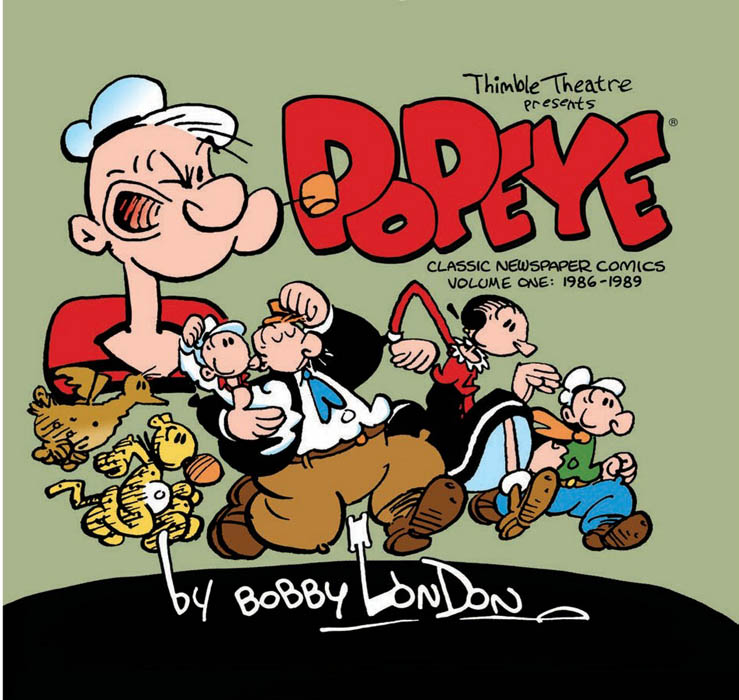
Thimble Theatre Presents Popeye by Bobby London (two volumes)

There are times when you can't merely resign, for whatever reason. No, you have to make the bastards kick you out. And, if you have the right kind of personality, you might take a twisted glee at how hard you can get them to kick when they finally do. Anything else that happens along the way may be regrettable, may be collateral damage, but the important thing is to get that kick.

Bobby London got kicked in 1992, from the daily Popeye newspaper strip, which he'd been writing and drawing since 1986. (London took over from the aging Bud Sagendorf, Segar's former assistant who took over the strip in 1938. Sagendorf held onto the Sundays through his own death in 1994.) London's Popeye was both very much of its time -- yuppies! home shopping! fern bars! gentrification! -- and a return to the long adventure continuities of E.C. Segar after a few decades in which the newspaper Popeye was as dull and inoffensive as the various animated spin-offs that were most people's major impression of the character.

Almost twenty-five years later, the complete London run of Popeye was collected in two volumes by IDW, as part of their Library of American Comics imprint, including several weeks that London's syndicate pulled, in process, from newspapers as part of that big kick. There are also six additional weeks that didn't even make it out to papers -- London did them to finish out his contract, and the syndicate spiked them as soon as they came in.

And now the rest of us -- those who don't have access to the King Features vault -- can read this late flourishing of Popeye, in something like a Segar mode, from the cartoonist of Dirty Duck, and finally see both what got him canned and how he brought down the curtain on his version of the cast for an audience that, at the time, he must have assumed was only himself and his editors.

It opens as the gag-a-day strip that Popeye (everyone had long forgotten that it once was called Thimble Theatre, though London would pull that out for the title panels of his longer continuities a bit later) had degenerated into over the past several decades. London's line give it energy and some current pep, but it wasn't great stuff. London combined '30s sight gags and characterization with trendy topics and King-approved "family" jokes into an amusing mish-mosh that was inoffensive and pleasant enough, but little more than that.

But then, a little more than a year after he took over Popeye, London launched into a long continuity, featuring the Sea Hag as a real estate shark taking over Sweethaven, and the real London Popeye snapped into focus. For the next five years, London spun out long stories -- most of them with title cards to launch them -- over the course of months of two-panels-a-day comics, throwing in a satire of '80s-era go-go capitalism and consumerism that clearly wasn't always appreciated in the King offices.

They're not Segar, but they're Segaresque, the kind of stories a creator like Segar would have made in the '80s, looking at the world around him and asking how the cantankerous, underdog-loving Popeye would react to it. And London's energetic cartoony line -- and his few additions to the cast, like Olive's voluptuous cousin Sutra Oyl -- made it a joyful, smart piece of the comics page.

So of course it couldn't last.

I can't say that London deliberately tweaked the King censors to get himself fired. But the last full continuity before the final strips -- the last one to get a title card -- was "Stupid Little Hat!," five months of strips explicitly about Popeye being forced to act inoffensively and look like he did in '60s cartoons. "Stupid Little Hat!" ended with a showdown with the King of Licensing, the one forcing Popeye to act like that in order to make more money off of him. Again, I can't prove that this was London trying to get himself fired, but he went from attacking his own licensing department to a series of thinly-veiled abortion jokes, so I've got a strong hunch.

However it happened, London was kicked. His Popeye ended in the summer of 1992, after roughly six years of comics. It was just a bit dull in its inoffensiveness in the beginning, and a bit too obviously combative in its end. But in between, for around five years, it was a great adventure strip full of excellent humor, several decades after that form was supposedly dead. And it's available again these days, in a permanent form, for later generations to discover after reading the Segar originals -- I hope many of them do.

Thursday, January 05, 2017

Popeye, Vols. 2 and 3 by Roger Langridge and others

I don't know if Roger Langridge's faithful homage to E.C. Segar absolutely required the great six-volume Fantagraphics reprint of Segar's strips to exist, but it certainly didn't hurt. Langridge pulls back in all of the complications and oddities and quirks of Segar that the Popeye comics and cartoons of the past seventy years had simplified or stripped out -- Sappo and Professor O.A. Wotasnozzle, Ham Gravy, Alice the Goon and the Sea Hag, Geezil and Toar and Rough-House's restaurant -- and tells his own stories in a mode much closer to Segar than most of the Popeye that the last three generations have been used to.

These two books -- Popeye, Vol. 2 and Popeye, Vol. 3 -- each collect four issues of the recent Popeye comic. Each issue has one or two standalone stories, with a rotating crew of artists: Langridge draws one story in each book himself, and is ably joined by Bruce Ozella, Vince Musacchia and Ken Wheaton for the art in the other stories.

These comics aren't exactly for kids, but they're not not for kids, either -- some parents will look askance at the violence inherent in any true Popeye story, but Langridge works as family-friendly as Segar did, telling accessible stories with colorful characters without dumbing anything down. Sure, most kids won't recognize Barney Google (who makes a guest appearance in one story in Vol. 2), but most adults will only have the very vaguest idea of who he is, too.

I don't want to go too far; these are silly comics stories about boxing and horse races and giant ants and ventriloquism and movies and other similar hooks for gags. But they're smart silly comics stories with an understanding of the past of this particular comics universe and the larger field of strip comics, told in snappy dialogue and a selection of zippy energetic art styles.

Monday, November 17, 2008

Reviewing the Mail: Week of 11/15

Those of us who review books are cursed by our mail carriers: we're always getting packages, sometimes a giant pile in one day, and sometimes a constant trickle. I'm no different -- oh, I don't know for sure that my mailman hates me, but I certainly suspect it. And none of us ever get to review everything; there's just not enough hours in the day, or willpower to force us to look at some of the things we see.

But I always want to list and note books as I see them -- both because I'm an inveterate list-maker, and because every book has a reader -- so I post something like this every week. It's Monday morning, so here's what showed up on my doorstep last week:

I finally figured out how to get in touch with Fantagraphics -- I freely admit that webforms have been known to send me into an atavistic "Mongo smash!" mentality -- and they were kind enough to send me several things this week. (I expect some or all of them will be reviewed at ComicMix, as soon as I can get to them.) The one that made me let out a squeal of glee -- no, really; ask my wife, she'll back me up -- was Popeye Vol. 3: "Let's You and Him Fight!" by E.C. Segar, which Fantagraphics published in November as a very nice oversized hardcover. I read the first volume a few months back and thoroughly loved it, so I've been thinking that I should buy the second volume. Well, now I have to, because I have Vol. 3 waiting at the end of it. Don't wait for me to review the later volumes -- go back to see what I said about the first one, and, if that sounds at all interesting to you, go out and get it. Seriously -- E.C. Segar was a great cartoonist, and it's a damn shame how the corporate Popeye is a pale, emaciated shadow of his original creation.

Also from Fantagraphics, and only mildly less awesome (since it's a collection of a story I already have in at least one form) is the special tenth eleventh anniversary edition of Ghost World: the Special Edition. It's by Daniel Clowes, of course, and this new edition includes the original graphic novel, the screenplay for the 2001 movie based on it, a couple of pages of new Clowes comics, a rare strip created for the movie's soundtrack, and whatever other related stuff Clowes and Fantagraphics could find. The whole thing was published in hardcover in October.

The book I actually asked Fantagraphics about was Dash Shaw's Bottomless Belly Button, which seems to be (so far, at least) the big graphic novel of 2008. (And, since I'm judging an award that includes various categories it might be eligible in, I thought I should check it out. Plus, you know, it's supposed to be really good.) It's some kind of huge family story, and it was originally published in trade paperback in June.

And also from Fantagraphics is the all-prose Man of Rock: A Biography of Joe Kubert by Bill Schelly, which they just brought out in trade paperback. I've only just looked at it for a couple of minutes, so I don't have any real opinion on it -- though I did wince a bit at a disclaimer on the copyright page that "Marvel" and "DC" are used throughout the book to describe the predecessor companies and administrations of the entities that currently bear those names. I'll withhold judgment until I read, since that may just be to simplify background details -- but, in general, when a narrative nonfiction book tells you up front "I'm not paying attention to these issues," it's not the best sign.

Moving on into a very different genre -- too-tightly defined fantasy anthologies -- we have Catopolis, edited by Martin H. Greenberg and Janet Deaver-Pack. Catopolis contains "seventeen original tales about the "city of cats" that exists on the same plane with humans, yet is hidden from us." I think you and I both know the kind of people who are going to buy this book, right? So let's just snicker quietly and move on -- Catopolis will be published in the ever-popular mass-market format by DAW in the chilly month of December.

Also in mass market is Laura E. Reeve's Peacekeeper, the first in a new military SF series and -- I think -- the author's first novel. The heroine is an ex-war criminal (according to some people, at least) who gets dragged back into military affairs a decade later when her old compatriots start being assassinated by mysterious forces. Peacekeeper will be published by Roc in December.

I also have before me John Zakour's The Flaxen Femme Fatale, sixth in a series about the last private eye in a post-something world six decades in the future. (They don't seem to be entirely serious books, and I suspect there may be a Ron Goulart influence lurking in them.) The first three books in the series were co-written with Larry Ganem (who, long ago and when we both had other lives, used to sell books to me), but Larry's dropped out by this point. I also note that Zakour writes the daily single panel Working Daze (mostly I note this because I only recently realized it myself). Flaxen Femme Fatale is another mass-market paperback -- so much reading, so cheap! -- coming in December from DAW.

And I'm not done with the mass-markets yet! I also have Moving Targets and Other Tales of Valdemar edited by Mercedes Lackey, which contains...well, tales of Valdemar, and you should have figured that out by yourselves. I won't pick on Valdemar -- though it it easily pickable for a cynical bastard like me -- since I've read nearly all of the books and liked most of them quite a bit. Call 'em guilty pleasures, if you must -- but they were certainly pleasures. This one will have only a tincture of pure Lackey, and so probably won't be as potent, but you take what you can get. It's coming from DAW in December.

The fourth in E.E. Knight's "Age of Fire" series is Dragon Strike, which indeed does have a striking dragon on the cover. But I don't really have anything more than that to say about it. Roc is publishing this one in trade paperback in December.

I've been trying to push the boundaries of the books I cover here at Antick Musings, outward from the realms of SFF (where I've got a thousand contacts from my SFBCdays) and comics (which usually feeds my ComicMix reviews). So I'm always happy when publishers come to me with things outside those areas -- particular with books that look as fascinating as Mac Motandon's Jetpack Dreams. Montandon has traced the history of the jetpack -- mostly in fact, but apparently a bit in fiction as well -- to explain why we all don't have them already, and who does have them. I've been reading a lot of narrative nonfiction lately anyway, so it's great when books I might otherwise miss come aimed right at my head. (Figuratively.) Jetpack Dreams was published in October by Da Capo, and it looks deeply awesome.

Harry Turtledove writes novels nearly as quickly as most men eat hot dinners -- I don't know how he does it, but I've seen his large array of daughters, and I suspect the financial strain of putting them all through college and saving for their presumptive nuptials has something to do with it. And maybe Harry just really does write that fast, and enjoys it -- I haven't been able to read Turtledove as quickly as he can write Turtledove, but the recent books of his I've read (like Beyond the Gap) have been fun and thoroughly entertaining. Anyway, the Great Turtledove Machine has brought forth another novel, The United States of Atlantis. This is an alternate history -- you guess that, didn't you? -- set in a world where the eastern seaboard of North America is a separate mid-Atlantic continent, and the sequel to Opening Atlantis. Roc is publishing it in hardcover in December.

Watermind is the first hardcover by M.M. Buckner, who won the Philip K. Dick award for her previous novel, War Surf. (The PKD is a self-destructive award these days; it tends to bring enough attention to its recipients that they're no longer published in paperback, and so no longer eligible for the PKD. I think Dick would appreciate that touch.) It's a near-future SF novel about a self-organizing intelligence born out of the flushed nanotech, genetically-modified organisms, and what-not that landed in the Mississippi Delta. (No word as to whether everyone that knows fear burns at its touch, or if it's merely a muck-encrusted mockery of a man.) Watermind will be published by Tor in November, and I hope they sell a Heap of them.

I seem to have gotten a high enough profile that people seek my reviews out, at least some of the time. That's gratifying, especially when those projects are as unique and interesting as Jobnik!, Miriam Libicki autobiographical comic about her two-year stint in the Israeli army. (She grew up in the US and currently lives in Canada, so she's even more "one of us" than a born-and-bred Israeli would be.) Libicki's own press, Real Gone Girl, will publish Jobnik! in December as a trade paperback. It'll be available through Amazon and, via Diamond, though more discerning comics shops. (But probably not through other standard book-industry sources.)

And last this week are two books by Scott Morse -- whom I've heard of, and read some work in anthologies, but whose books I'm not familiar with yet -- the creator of Magic Pickle and Southpaw, as well as being an animator and filmmaker. They're Tiger!Tiger!Tiger! and Notes Over Yonder; the first an album-sized collection of semi-autobiographical stories and the latter a wordless story of jazz, cats, ukuleles and beach bums told wordlessly in full-page panels. Both are published by Morse's Red Window imprint and distributed by AdHouse Books. Notes shipped in October; Tiger! will ship in December.

Thursday, November 01, 2012

Read in October

This month I'm trying an experiment, to see if I can trick myself. I'll list all of the books I read here, and start writing about them here. If I'm like I have been recently -- and I hope that phrase makes sense outside of my head -- I'll end up with things of actual real-post length, which I can then harvest, extract, and turn into separate posts.

In any case, this is what I was reading this past month:

Kevin Huizenga, Gloriana (10/1)

Adam Skolnick, Lonely Planet: Pocket Los Angeles (10/1)

Paul Tobin & Colleen Coover, Gingerbread Girl (10/3)

Mary M. Talbot & Bryan Talbot, Dotter of Her Father's Eyes (10/4)

Max Gladstone, Three Parts Dead (10/4)

Ed Piskor, Wizzywig (10/5)

Marc Hartzman, God Made Me Do It (10/8) -- You know how some people keep claiming that the dumb and/or insane things they do are really because of Yahweh? (And that probably bugs you as much as it does me, if you've noticed it.) Well, freelance writer Marc Hartzman is annoyed by those things as well, but he did something about it: he got a contract to write a book collecting all of those idiot's explanations, since they do become funnier the more of them you pile up together. And that book is God Made Me Do It: a compendium of the same bad excuse for an incredibly wide swath of bad behavior, insane ideas, and bone-deep stupidity. It does have a tropism for the modern day, since these idiots are sadly very common nowadays, but Hartzman has not shied away from digging into the archives to find the feebs, poltroons, and liars of the past when they've claimed divine reasons for their own earthly actions. This is not a deep book, or a scholarly one, but it does exactly what it claims to do, and will make any of us who are less than insanely religious feel quietly superior, which is a damn good thing for a book to do.

Neal Stephenson, Some Remarks (10/11)

Eddie Campbell, The Lovely Horrible Stuff (10/11)

Kevin Cannon, Far Arden (10/12)

E.C. Segar, Popeye, Vol. 6: "Me Li'l Swee'Pea" (10/12) -- Thimble Theatre was a great comic strip in its day, and "its day" precisely tracked the working life of its creator, Elzie Crisler Segar. This volume finishes up his run -- he died in early fall of 1938, after fighting leukemia (and taking time off from the strip to do so) over the previous year and a half. This book also reprints a few non-Segar Thimble Theatres to finish up stories and show the later work, but there's no comparison. If you haven't been listening to me -- I've reviewed volumes 1, 2, 3, 4, and 5 here with paeans of praise -- I don't know what else to say here now. Popeye, as Segar made him, is one of the great American characters: cunning but soft-hearted, brawling but a great friend, deeply knowledgeable about his own work but a good-natured naif in the larger world, and always looking out for the little guy, widows, and "orphinks." More than that, he's an icon of America itself in all of those things, a vision of what we want to be and can be, if we only eat our spinach and always do the right thing. Don't start with this book -- it's all middles and endings, though there's some great Wimpy stuff in the Sundays -- but do find that first book, subtitled "I Yam What I Yam!", and see what great American comics looks like.

Janet Groth, The Receptionist (10/16)

Alina Simone, You Must Go and Win (10/18)

Steve Martin, The Ten, Make That Nine, Habits of Very Organized People. Make That Ten. (10/29) -- Steve Martin has a Twitter handle (@SteveMartinToGo), and he's funny there, as he's been funny pretty consistently in most of his efforts for the last thirty-some years. Since he is Steve Martin, he can even get his Tweets collected into a book -- along with some responses and riffs by his followers, which he notes are often funnier than he is. (One of the never-fail signs of a great comedian is a generosity with praise for other funny people: the best comedians want laughs to happen -- they'd prefer to be completely responsible for those laughs, if they can, but, if not, they're happy to get an assist and make the laugh.) So, anyway, this book doesn't have much of a through-line, but it's witty and funny and shows a fine established comedian trying a new medium and doing a pretty good job at it.

Jeff Lemire, The Underwater Welder (10/19)

Jeffrey Brown, Darth Vader and Son (10/20) -- Absolutely any idea can become a book -- and I don't even need to say "these days," since I remember the fake-catalog and silly-lifestyle-guides of the '80s (remember The Preppy Handbook? Real Men Don't Eat Quiche?) -- and this is one of the perfect examples of that process. Cartoonist Jeffrey Brown started work on a "Google Doodle" -- their day-specific logos, which used to be rare but probably now are controlled by a gigantic spreadsheet and an epic series of meetings in Mountain View -- for Father's Day in 2010, involving Darth Vader and his son Luke Skywalker. Brown's own son was four years old at the time, so his ideas stayed in that realm: what if Darth was a "normal" dad, raising an energetic young boy? The Doodle itself never quite happened, but -- with LucasFilm's eventual blessing -- the idea did turn into this book, with about sixty single-panel cartoons (most of them riffing on well-known Star Wars lines, scenes, or characters) featuring those two. It's a cute little book and a great little impulse buy for the Star Wars lover (and/or newish dad) that you know.

Charles M. Schulz, The Complete Peanuts, 1983 to 1984 (10/20) 

James Kochalka, Pinky & Stinky (10/22)

Rick Geary, Lovers' Lane (10/23)

Michel Rabagliati, The Song of Roland (10/24)

Ken Dahl, Monsters (10/25)

Well, I didn't fool myself quite as much as I hoped, but I did manage to break off a few pieces to post separately. The missing links should appear over the next few days, in some cases, or somewhat longer than that, for the things I haven't written yet. I could blame this month's problems on Hurricane Sandy, but I'd be lying: it did get me to waste most of a weekend in preparation, but it also gave me several work-at-home days with no commuting to suck up my time. (And complaining about something that hit several million people much worse than it did me would be epic Bad Form.)

Wednesday, April 20, 2011

Popeye, Vol. 4: "Plunder Island" by E.C. Segar

The fourth big slab of Elzie Crisler Segar's great comic strip Thimble Theatre -- better known, now but even in it's '30s heyday, by the name of its central character, Popeye -- came out from Fantagraphics about a year and a half ago, but it took me a while to work out how to physically read these gigantic, wonderful artifacts in the most satisfying way, so I didn't get to it until recently.

It's called Popeye, Vol. 4: "Plunder Island" -- after the six-months-long Sunday sequence of that name, in which Popeye, Wimpy, Olive, and others go in search of that legendary island, facing the horrible Sea Hag and her weird minion, Alice the Goon, along the way -- and it's just as good and thrilling a mixture of low humor, high adventure, running gags, populist sentiment, brawling action, expressive drawing, and unforgettable characters as ever. (See my reviews of the first three books -- "I Yam What I Yam!", "Well, Blow Me Down!", and "Let's You and Him Fight!" -- for more details.)

Everything I wrote about the earlier books -- well, except for the detail of which stories are in which volumes; this one has "Plunder Island" and some shorter continuities in the Sundays and a host of stories in the dailies, seeing Popeye back out West, back in Nazilia, hobnobbing with high society, in the "laziest town on earth," searching for the pool of youth, and, finally, building and filling an ark to found a men-only utopia that he'll rule -- is still true of Plunder Island, and I don't feel like repeating myself. The newspaper comic strip is one of the great American artforms, the second quarter of the 20th century was probably its greatest flowering, and Segar was one of the brightest lights of that Renaissance. This is great stuff, and it's just as funny and enthralling as it was in the mid-30s when Segar was spinning it out, day by day, in the funny papers. Someone who can read Popeye and doesn't has no advantages to speak of over the mule, who cannot read Popeye.

Saturday, February 19, 2011

Movie Log: Speed Dating Edition

It's been a cold and windy day in my neck of the woods, and it's a bit chilly in this basement right now. I'm also tired after a long and busy week, and not really up to writing anything complicated or overly thoughtful. So, instead, I'm going to catch up on all of the movies I saw over the past eight months or so, while my blogging energies were entirely taken up with Book-A-Day. My intention is to write roughly one sentence for each movie...but I usually write longer than I expect, so let's see how that works out.

Movies I Saw on Video
Lupin 3rd: The Castle of Cagliostro -- Hayao Miyazaki's very first full-length movie has some moments and set-pieces that are clearly Miyazaki-ish in retrospect, and is an exciting and always fun entry in a sturdy, audience-pleasing series. But it's clearly a formula, and not a terribly demanding one.


The Dinner Game -- The French original that became Dinner for Schmucks in English (which I still haven't seen). Dinner is remarkably well-written and well-acted, and is staged almost like a play, with nearly the entire action taking place in one apartment. For anyone who can stand reading a movie -- of who speaks French -- it's well worth seeing; it's a great comedy with some real depth to it.
 
Mr. Blandings Builds His Dream House -- Continuing my intermittent self-study course in the great movies of the past; this one is still very funny and true, though the specifics of place and money add some inadvertent humor now. (That money pit was probably worth over a million by the late '80s, for one thing.)


Adam -- A young man with Asperger's Syndrome falls in love for the first time, in a movie that's thoughtful and moving -- and not nearly as mawkish or afterchool-special-ish as you might fear -- and doesn't go the ways you'd expect. Small, but perfectly formed.


My Wife Is an Actress -- Another French movie -- I find that a good French comedy is superior to all but one or two of the best American funny movies a year -- directed by Charlotte Gainsbough's husband, about a man who is married to the gorgeous actress Charlotte Gainsborough. Slightly less sexy than expected, but a lot of fun.

Popeye -- I hadn't seen Altman's Feiffer-scripted version of the E.C. Segar strip in twenty-five years or more, but my two sons were a great excuse, and Popeye is actually a damn good (if utterly idiosyncratic) movie. Yes, it's a musical. Yes, all of the characters are utterly caricatured. Yes, it does lose track of itself more than once, and starts too slowly. And, yes, the spinach thing is done much less subtly or well than Segar would have. But it's indisputably Popeye -- and miles closer to Segar than any other moving-picture version has ever come -- and a hell of a lot of fun.

The Miracle of Morgan's Creek -- It's a 1944 movie about a girl who finds herself unexpectedly pregnant after blacking out during an "all-night party"; how could I not watch it, once I knew it existed? It's quick and funny, and mostly full of actors we don't think about anymore. 

Foul Play -- Another movie that I hadn't seen in twenty-five years, and which still held up, with great funny stuff from Chevy Chase and Goldie Hawn. 

Impromptu -- I've complained about the very stereotyped plots that costume dramas about creative types always fall into, but this one is about Chopin more than George Sand, and, luckily, doesn't try to pretend that this series of events was "the basis" for some famous Sand work. In the end, it's a middle-rank costume drama, but The Wife eats those up.

Hot Tub Time Machine -- There's no excuse for this one; it's silly and obvious and could have been much smarter and sharper if the writers stopped laughing at their own jokes and worked a bit harder. But it is a decent silly comedy, in a vaguely '80s mode, so it's worth wasting the two hours or so to look at it.

Jet Lag -- Yet another French movie, this time a romantic comedy with Juliette Binoche and Jean Reno stuck at an airport. It hasn't stuck in the memory terribly well, but it was enjoyable at the time.

In a Day -- A small-budget British romantic comedy-drama with some slight pretensions; it doesn't work 100%, but it does work well enough.


Strange Brew -- So, like, take off, eh? I will never apologize for loving Strange Brew, and I've now made my sons watch it as well.


Bringing Up Baby -- More classic comedy, with Katherine Hepburn and Cary Grant. You probably shouldn't wait until you're forty-one to watch this, like I did.

Fletch -- Now, this one, I hadn't seen before. It was fun, but not as good as it's supposed to be, with a generic and forgettable '80s plot.


Alice in Wonderland -- Tim Burton really needs a high-profile failure or two to bring him back ot earth and get him to engage strong again; sadly, this movie didn't do that. It's an interesting-looking mess, but it's completely a mess, even by the standards of an Alice movie.
 
Finding Bliss -- Leelee Sobieski is a would-be filmmaker who can't get funding to make her dream script, but (though the usual contrived situations) gets a job editing porn movies and then...you can pretty much work out every plot beat from there. It follows its formula with energy and really believes in itself, but it will never surprise you.


Out of Sight -- I like George Clooney's work, and I've missed a lot of his movies -- this one is a sturdy, smart thriller that I expect most of you saw ten years ago.


Diary of a Wimpy Kid -- This plays really differently in live-action than it did on the page, which I found very interesting to think about while watching it. The book is so cartoony that none of the over-the-top things that happen to Greg are a problem, but they seem less likely with real twelve-year-olds. It's lovable like an ingratiating dog, but about as deep.


City Island -- The comedy version of a kitchen-sink problem movie, circling around Andy Garcia as a middle-aged NYC cop who really wants to be an actor. It all comes together too patly in the end, but everyone is good in it, and it has a fine sense of place.


Date Night -- It fails the Siskel test, in that the viewer keeps suspecting that the jokes that Steve Carrell and Tina Fey told each other in the makeup chair were funnier and less formulaic than this movie, but it is entertaining, and Carrell and Fey are both completely game and utterly likable. Plus, I am one half a boring, married, middle-aged couple in New Jersey.


The Apartment -- Most of the old movies I see are pretty frothy, but this one is more biting, though a lot of that bite is due to the specific sexual mores of 1960, which are solidly exploded now. It certainly had more impact then, and would have more impact for a younger viewer, but it's still a great movie.


Royal Flash -- The only movie made, to date, from George Macdonald Fraser's excellent series of novels -- directed by Richard Lester right after his "Three Musketeers" movies. Malcolm McDowell is a perfect Flashy, and it made me wish I was in the next universe over, where there were half-a-dozen more of these movies, and McDowell was prepping another one right now.

The Taste of Others -- A complicated French romantic comedy -- of the large cast that interacts with each other like billiard balls style -- that I don't remember in detail. Pleasant but forgettable, I suppose.


Ondine -- Colin Farrell drags out his thickest Irish accent in the story of a fisherman who pulls a woman from the sea and can't quite decide if he (and his crippled daughter) want her to be a mermaid or not. It tries really hard, and succeeds at a level only just a bit below what it's aiming for.


Babies -- An entirely unnarrated documentary of the first year of life of four babies, in vastly different parts of the world. Probably only for parents or wanna-be parents, but cute and deeply lovable.


The Secret of Kells -- The surprise Oscar nominee of last year, once it was finally available on video. Visually inventive and heartfelt, but awfully slow for a movie that's not even ninety minutes long, and not without the sound of axes grinding. See it to look at rather than to think about.


Confetti -- A silly British mockumentary about a reality-TVish competition by a bridal magazine for the Most Inventive Wedding of the Year. It doesn't take advantage of all of its opportunities, but it creates some great characters and is entertaining to the end.

Get Him to the Greek -- About as silly and frivolous a comedy as can be imagined, but Russell Brand always delivers, even if Jonah Hill's blustering-twerp persona is wearing ever thinner.


Toy Story 3 -- No one in the family felt the need to see this in the theater; I don't care about any second sequel all that much. It's not as good as #2, but rings some new and thoughtful changes on the thematic material from the first two movies. And there's now a lot of material for a major dissertation on the (almost unveiled at this point) religious undertones of the series.


The Emperor's New Clothes -- Ian Holm is Napoleon, who switched places with a lookalike to escape from Elba back to Paris and reclaim his power. It doesn't work out that way, though he does find love instead. Holm is always fun to watch, and this deviates enough from the costume-drama template to be worth seeing.


Iron Man 2 -- It is what it is: loud, brash, full of itself, but enthralling and ever-so-occasionally smart.

Robin Hood -- Russell Crowe shows us how Hood was dull and depressing, and his life a rough slog through mud and shit. Has almost none of the things anyone wants to see in a Robin Hood movie.


Artemisia -- Yet more costume drama, with a female Italian Renaissance painter who -- in the movie-ized version -- falls in love with her teacher, which leads to Big Trouble. (In real life, he raped and blackmailed her into sex, but that's not Romantic enough for a movie.) It's better if you don't try to learn anything about Artemisia Gentileschi ahead of time.


Shrek Forever After -- Broad, obvious, and massively renormative in all the worst ways. The incidental jokes are funny, as they should be, given how much money and time went into them.


Maybe Baby -- A mostly-forgotten Hugh Laurie movie from a decade ago, which I missed then like everyone else in the world. He's a screenwriter for not-the-BBC, and secretly turns his own wife's fertility drama into a comedy -- the ending runs off the rails for a while, but otherwise it's so good that you'll wonder why it was so forgotten.

Next Stop Wonderland -- A small Boston romantic comedy, except it's not all that funny and not really a romance. It is a good character piece about the two people that the audience knows will eventually get together -- though the movie itself keeps them apart practically the entire time.


The Kids Are Alright -- A masterclass in great acting; there are scenes that hinge on body language or glancing expressions. The central drama is arguably trite -- that a lesbian couple can be just as mixed-up, but still fixable, as anyone else -- but the dialogue is excellent and delivered perfectly.


Easy A -- Emma Stone is damn good, and this movie is smart and sneaky; this is a movie about teenagers, but it's as much for people who were teenagers two or four decades ago.


Soul Kitchen -- A German movie about a restaurant and its various comic dramas; it's sweet and lovable but mildly predictable.


Going the Distance -- The movie that made everyone wonder how close it was to the real relationship of Drew Barrymore and that Mac guy; it's a good view of a relationship that has real strengths and depths but is being seriously tested. All processed through the usual Hollywood rose-tinted lenses, of course.


Inception -- Anyone who had trouble following this is just dumb; I have to say it. It's not as profound or brilliant as some people seem to think, but it's an exceptionally well-constructed and entertaining astonishment machine. (And The Wife and I cracked each other up every time it cut back to the van falling into the water, calling out "Buffering!" as it happened.)


The Other Guys -- The end credits were almost better than the movie, and the movie could have done with a bit more of the credit's viewpoint and cold anger. But the movie, as it did exist, was a decent odd-couple story, and had a particularly watchable set of characters.


Nanny McPhee Returns -- Not nearly as good, or as subtle, as the first movie, and much more of a film for kids. But The Wife and I enjoyed it anyway.


Stuff I Actually Got Into a Theater to See:The Last Airbender -- Yes, well. It's not as bad as some people said, but I saw it in non-eye-straining 2-D, so I may not have seen it at its worst. Shamalyan does have some good camera work, particularly his swooping shots in the battle scenes, but that wasn't enough.


Despicable Me -- This was as good as everyone said, and almost not at all mawkish. I'm beginning to think Steve Carrell can make anything good.

The Sorcerer's Apprentice -- Big, flashy, silly, full of explosions and often losing track of its own rules -- yes, it's a Jerry Bruckheimer movie. It shouldn't be as entertaining as it is, honestly, and no one can see it and feel proud of themselves.

Scott Pilgrim Vs. the World -- I loved it, and my two sons loved it. Hugely visually exciting, and only very slightly damaged by Michael Cera whinyness. It had better become the hugely popular touchstone cult movie of this generation.  

Red -- An action thriller that does everything right, including pandering to its audience. It's cheese, but some kind of very nice, and slightly classy cheese -- say a nice Stilton.


And why did I think writing all that would be quick or easy? Well, I'm caught up (except for Youth in Revolt, which I saw a few days ago) now.