Showing posts sorted by relevance for query fables willingham. Sort by date Show all posts

Saturday, February 13, 2010

Book-A-Day 2010 # 10 (2/13) -- Fables. Vol. 12 by Willingham, Buckingham, et. al.

Realizing that Fables -- which I still sometimes think of as the book that's keeping Bill Willingham from getting out the fourth issue of Coventry -- is now eight years old and in its twelfth collection does nothing to help my occasional feelings of being old and tedious. ("You whippernappers! I was reading Elementals when it was being published! Before it started sucking golf balls through a garden hose, too!") But time moves on, and we have to move with it.

This book is entitled The Dark Ages, and is anchored by the story of the same name, by the core Fables team of Willingham (writer) and Mark Buckingham (artist). Also included are Willingham-written single-issue stories with art by (for one) Michael Allred and (the other) David Hahn, plus a serialized back-up story with art from Peter Gross. Dark Ages follows the previous book, War and Pieces, which many thought was a natural end for the series and wrapped up the major fighting-the-Adversary plotline from the previous seventy-some issues.

But Dark Ages shows that the previous storyline wasn't the end of the story of Fables, and it's pretty clear that Willingham planned it that way; this isn't an epilogue or an attempt to start a new story, but an examination of what happens afterwards. Besides the obvious questions -- what do you do after you've accomplished the great deed of your times? what are the personal and political ramifications of winning the war that defined your society? -- there are the specific issues of the Fables universe. Sure, the Adversary was a bloody-handed tyrant who slaughtered millions to bring a thousand worlds under his rule...but, along the way, he sealed or neutralized a host of other nasty folkloric entities, and those may now find their way to freedom. And those thousand worlds are full of people who want to live free...and of people who want to get rich the quick and easy way, or conquer and slaughter their neighbors, or a million other things that are detrimental to peace and good order.

If the defining metaphor of the first act of Fables was the myth of modern Israel -- the plucky, embattled small land fighting against overwhelming odds on all sides -- this second act looks to draw much more heavily from the lessons of Afghanistan and Iraq, with unintended consequences blossoming both in Fabletown and across those thousands of now "liberated" worlds. In this book, there's already a major death in the aftermath of the war, a new and dangerous power coming to the mundane world, and a major disaster in Fabletown. It's no comics cliche to say that, by the end of this book, the status quo for Fables has been completely changed -- more so even than by the end of the war.

Willingham has always been a writer willing and able to torment his characters, all the way back to the Elementals days. (Remember: that superhero team was made up of four people who died in horrible ways to get their powers.) Fables has generally had Willingham channeling that in a friendlier, more grand-adventure way -- there have been deaths, but generally heroic ones, and Our Heroes did win their big war -- but I would not be surprised to see the darker side of Willingham coming more and more to the fore. (This may be the time for Fables fans to dig those three Coventry issues out, to remind themselves of what he's willing to do.)

I'm glad to see that; falling in love with his own creations is one of the deadliest sins for any writer, and I'm confident that it hasn't happened to Bill Willingham. So I'll stick with Fables to see where it goes next -- and remember that there are hundreds of folkloric folks that he could write about, so I shouldn't get too attached to any of the ones currently populating this book.

Book-A-Day 2010: The Epic Index
----------------
Listening to: Paper Route - Thank God The Year Is Finally Over
via FoxyTunes

Tuesday, May 04, 2021

Bad Doings & Big Ideas by Bill Willingham and various artists

The odds-and-sods collection has a long and glorious history, which I'm not going to get deeply into here. But I will say that in comics, and especially DC Comics, it's a way to squeeze another piece of product out of a current top performer, since that top performer probably did a bunch of random shorter stuff that can be slapped profitably between two covers.

(Previous examples of the form: The Sequential Art of Amanda Conner, DC Universe by Alan Moore, Neil Gaiman's Midnight Days and The DC Universe by Neil Gaiman. No, I don't know why Gaiman gets the definite article when creating the DC Universe, and Moore does not.)

In 2011, Bill Willingham was the biggest creator DC's Vertigo imprint had, smack in the middle of the hugely popular Fables series and spinning off sidebars mostly co-written with others (Jack of Fables, Fairest, Cinderella). But no corporation is ever happy with what it has: it always wants more.

And so, somewhere, in some office high above Manhattan, the idea of a Willingham odds-and-sods collection was born. It turned out he had a lot of DC odds, mostly related to the Neil Gaiman Sandman-verse, the previous heavyweight Vertigo champion. And it was the era of big bug-crushing omnibi, so DC was presumably happy to see they had enough to slaughter several beetles at once.

Bad Doings & Big Ideas came out at the end of 2011, collecting basically the Venn diagram of "by Bill Willingham," "from Vertigo," and "not Fables." It has over five hundred pages of comics from roughly the decade 1999-2009, including three graphic-novel length stories (of six, four, and four issues each), three more full-issue stories, and eight more shorter pieces. It has both a general (though short) introduction by Willingham and notes on each story, along with detailed who-did-what credits for every story and a detailed table of contents. And it was all wrapped up in a new James Bennett cover, which is good and eye-catching and yet makes me wonder if Willingham offered to make a cover himself and was let down gently. (On the other hand, I don't think Willingham has ever been a painter, and a book like this just looks classier with a fully-painted cover rather than a drawn-and-colored one. So maybe it was even his idea.)

The first big story is Proposition Player, a comics series drawn mostly by Paul Guinan (it started off as an all-Willingham joint, which lasted not quite halfway through the first issue) about a professional poker player who gets mixed up with the supernatural in a very Vertigo way. It was intended to be an ongoing series, but the market did not agree, so it got just the initial six issues to set up the premise and has sat dormant ever since. It's a decent set-up, with that core Willingham cruelty baked in around the edges, but, in retrospect, might not have given as much scope for additional stories that Fables did, just three years later.

The second and third big stories are the two "Thessaly" miniseries, about an ancient witch who showed up in Sandman and walked out of that series still alive and mostly untouched, which was rare. Shawn McManus, who also worked on Sandman, illustrated those two stories, which are a little bit too tight and plotty for their own good: Willingham throws out hooks for things he doesn't have space to reel in, but the stories themselves are solid in that neo-horror Sandman style.

And then the rest is partly comedy (a one-shot about Merv Pumpkinhead as a "spy" in the real world) partly horror (several of the shorter pieces), partly already odds-and-sods (a one-short with multiple artists called Everything You Always Wanted to Know About Dreams But Were Afraid to Ask), and then partly more-or-less just adventure stories ("The Further Adventures of Danny Nod, Heroic Library Assistant," from the miscellaneous book The Dreaming). Some of the short pieces I didn't call out specifically fit into multiple of those categories, or not clearly into any -- there's a short series of backups from House of Mystery that seem to be mostly "Willingham gets to work with artists he loves and has never collaborated with before."

It is miscellaneous; that's the point. And it's very much for the audience of people who found Willingham through the Fables door and want more kinda like that. (People who found Willingham through the Elementals door are older, crabbier, and still waiting for our collection.) Whether that's much of an audience a decade later, I can't say: I was vaguely looking for this for several years, finally found it cheap, and then it sat on the shelf for a while after that. I am happy I finally found and then read it, though: I'd missed Proposition Player at the time (pretty much everyone did) and didn't even know about most of the short stuff.

Saturday, June 12, 2010

Book-A-Day 2010 # 129 (6/12) -- The Great Fables Crossover by Willingham, Sturges and a host of artists

The Great Fables Crossover is the lucky 13th collection of Bill Willingham's Fables comics series, about folktale creatures now living in our "mundane" world. It's also effectively Jack of Fables Vol. 6 1/2, collecting three issues of that spin-off series (about the self-absorbed character who was "Jack" in nearly every story you can think of) that fall between the ones collected in last year's Vol. 6 and the upcoming Vol. 7. And it also collects a three-issue spin-off limited series called The Literals.

Sounds complicated? It really isn't. This story might have originally been published under three labels, but it was all one story to begin with, and the labels primarily served to allow it to have extra shelf space in comics shops and to pop out three issues each month -- so as to avoid being damaged by the Wednesday Crowd's notoriously short attention spans. And the whole story didn't really need to wrap back into the parent book (where it's a sideshow, and a distraction from their own plotline), since it's entirely driven by The Literals Problem that writer Bill Willingham (and co-writer for Jack Matthew Sturges) gradually painted himself into in Jack of Fables.

Jack, in his travels in search of fame, fortune, and willing women across America, discovered that not only are there Mundanes (non-magical people like you and me) and Fables (who have abilities mostly due to being part of stories), but that there are also Literals, who embody or create those stories. This inevitably led to a story about a character we might as well call The Writer (though Willingham called him Kevin Thorn -- the only Literal to have a completely Mundane name), who possibly created the whole ball of wax.

But Willingham clearly didn't want his Fables universe to degenerate into metafiction, and he also realized that Kevin Thorn was too powerful to be a useful villain: a character that can do absolutely anything without any trouble can't actually do anything, because he overbalances the story. So the purpose of "The Great Fables Crossover" is to walk the Fables universe back to a pre-Literals status quo, and it takes two hundred pages (amusing pages, but pages that also often feel like added complication for the purpose of complication) to do so.

In the end, Jack is basically where he was at the beginning of his own series, and the cast of the main Fables series gets to go back to their own pressing plotline. The whole thing isn't necessary, I suppose -- even less so than most stories, I mean -- and it's much more of a Jack story than a main Fables story, but it'll do.
Book-A-Day 2010: The Epic Index

Tuesday, November 28, 2017

Fairest, Vol. 1: Wide Awake by Bill Willingham, Phil Jimenez, and others

So, when you're a big corporation devoted to exploiting intellectual property that you've accumulated over the past seven or eight decades, and you have a new piece of IP that's doing decently, what are you going to do?

Exploit it, obviously.

DC Comics [1] didn't own Fables, as far as I know -- I haven't seen the contracts personally, but Vertigo was famously a creator-owned shop -- so that means writer Bill Willingham and artist Mark Buckingham (or maybe just Willingham, because what's comics if not a chance to grab all ownership for yourself?) had to go along with the exploitation as well. But who doesn't like a little tasteful exploitation, especially when it puts money in your pocket?

So Fables begat Jack of Fables, which was never as good as it should have been, but it exploited a fair bit of change back to DC and its creators. And, after that ended, and with Fables still chugging along towards an eventual-but-still-comfortably-in-the-future ending, DC must have been looking for a new way to exploit it.

And what's the most obvious thing to exploit in comics?

Attractive women, obviously. If they're posing wearing not-too-much, all the better.

So, in 2012, DC launched Fairest, featuring sidebar stories about the female fables. And, five years later, I finally read the first collection, Fairest, Vol. 1: Wide Awake. This one collects the initial six-issue story written by Willingham and drawn by Phil Jimenez, plus a single-issue story written by Matthew Sturges and drawn by Shawn McManus. (And, as far as I can tell, Willingham just wrote that first arc -- after that he presumably just OK'd other people's writing and cashed the checks.)

This is basically "what happened to Sleeping Beauty after she was used as a weapon of mass destruction," with Ali Baba and a pre-Frozen Snow Queen as the other components of the main triangle, plus an annoying loquacious Bat-Mite-ish genie and the inevitable Eeeevil Scary Woman Villainess. As is usual with Fables stories, it pretends to be much tougher and nastier than it really is: things work out very well for the good characters and very badly for the bad characters. (Because that is what fiction means, as the man said.)

I understand this series has ended, too, so I don't know if I'll bother to continue. I might just dig up the end of Fables itself -- I missed the last five or six collections. This was entirely pleasant Fables product for the year 2012, but it's pretty disposable now, unless you're someone working through the Fables-verse or deep in a master's thesis on the presentation of fabulistic characters in modern graphic literature.


[1] Every so often, I need to remind people that "DC Comics" stands for "Detective Comics Comics," because that's how I roll. Put it up there with "Amazon AWS."

Saturday, September 20, 2014

Book-A-Day 2014 #263: Fables, Vols. 15 & 16 by Willingham, Buckingham, et. al.

It's not that I avoided writing about the Fables series for the past three years -- since I covered the fourteenth volume, Witches, in early 2011 -- it's that I haven't actually read any of the Fables books since then, as my flood later that year threw a giant hitch in my reading plans and discombobulated everything. (I've still got the last two collections of Jack of Fables on the shelf, plus a Cinderella collection -- and that's not even counting Fairest, which I haven't gotten around to even picking up in a store.)

But I used to really enjoy this series, and I've been following writer Bill Willingham's work since Elementals back in the 1980s -- and that's a property that's been completely forgotten for some unknown reason; I'd have expected a nice fat collection of it any time in the past eight years -- so I decided to jump back in with both feet, and read the next two collections, Rose Red and Super Team, back to back. As usual, the penciller for most of the stories is Mark Buckingham, who has been with the series since the beginning, and he's mostly inked by Steve Leialoha. But, as usual, the maw of monthly comics publication require fill-ins, and big complicated stories that can range across all of imaginative literature call out for varied visual presentations, so there's also artwork here from Eric Shanower, from Inaki Miranda, and from Terry Moore.

Willingham has always written this series in rather vague arcs, more Claremont X-Men than Gaiman Sandman, with a much larger plot going on overall and the smaller stories -- from a single issue to five or six, twenty pages to about a hundred and fifty -- usually illuminating some piece of backstory for that larger story, or moving it forward just a bit, or providing a bit of color. So there have been about twenty collections of Fables so far, but only two stories to this point, really: the battle against the Adversary, and then the battle against Mister Dark.

The latter story comes to a climax in both of these volumes, seeming finished near the end of Rose Red only to flare up again until what I believe is a more lasting ending in Super Team. But most the pages of these books tell other stories -- a long digression to Rose Red's youth in the first volume, along with a single-issue tour of Mister Dark's ever-more-dangerous and depressing New York; and the second one focuses mostly on an eventually useless (and always silly and comics-fan indulgent) plan to defend the Fables' last home against that Mister Dark, while their salvation happens somewhere else, at someone else's hands.

It's all very periodical comics-style: there's twenty-some pages to fill this month and every month, so there's plenty of time to digress over here and there as long as the audience is still interested. Willingham's building blocks here are always issues; he may have arcs that cover several issues, or issues broken into shorter stories, but the issue is always there, always the core metric of a mainstream comics series. Fables isn't exactly tired by this point -- it's a huge, nearly infinite conceit, with more stories than any creative team could exhaust -- but this particular core cast has a lot of miles behind them, and a shrinking story-space for their future adventures. So knowing that the end of the series is looming isn't a bad thing -- and, after all, there are around eight hundred more pages of Fables to go from this point.

Book-A-Day 2014 Introduction and Index

Thursday, December 31, 2009

Closing With Three Jacks


If I'd set this post to appear early tomorrow morning, I could have called it opening with three jacks, which would make slightly more sense...but I've got the usual year-end stuff already queued up, so this post will be the last one for 2009 instead.

I recently caught up with the last three collections of the DC/Vertigo Jack of Fables series -- written by Bill Willingham and Matthew Sturges, with art primarily by Russ Braun and Tony Akins (plus various inkers and others) -- even though I'd had mixed feelings about the first three volumes. The main problem with the series is that the main character -- the guy who was "Jack" in every traditional story you can think of, one of the "fables"from various parallel worlds -- is a grade-A jerk, as self-centered as it is possible for a human being to be, and not half as smart or savvy as he thinks he is. By definition, he doesn't learn from his mistakes, and is entirely a one-note character. One-note characters can work just fine as part of a larger cast, as Jack did in the parent Fables series, but they're more troublesome at the center of their own stories.

What Willingham and Sturges did to get around that problem was to quickly build a new cast around Jack, primarily from the inmates and warders of the Golden Boughs Retirement Village (created by the fiendish Mr. Revise to leech magical powers from fables and thus slowly turn the world utterly mundane). Thus Jack is the title character, and the central character, but he doesn't have to carry the entire story himself.

And let me digress briefly to poke at Willingham and Sturges's mythology here. Besides "mundanes" -- people like you and me, who are real and have normal lives -- and fables, there are also "literals," who are the personifications of literary techniques. Or something like that; it's not quite clear. To make it more confusing, all of the literals we've met so far are part of one family, which implies that literals are all one family. The oldest member of the family we've met so far -- and this doesn't make much sense, either -- is Gary, the Pathetic Fallacy, who has at least one son, Kevin Thorne. Kevin is possibly the author of all of the fables, or at least of lots of them -- and it's not exactly clear if all of the fables needed Kevin, or someone like him, to write them in the first place. Kevin in turn has at least two sons: Mr. Revise and The Bookburner. There's no explanation as to why the Pathetic Fallacy came first, or why a guy named Kevin would name his sons Revise and Bookburner. There may be a literal world, as there are fable worlds and the mundane world, but we haven't seen that -- and it's hard to picture how it would work, either. If you ask me, there's a definite feeling that W&S are throwing things at the wall to see what sticks, and that there's no long-term plan in place.... 

In Vol. 4: Americana, two different groups -- on the one hand, Jack, Gary, Jack's Indian sidekick Raven, and a reconstituted Humpty Dumpty; and on the other, Hillary Page (one of Revise's three beautiful librarian daughters), a shrunken Paul Bunyan and his inevitable blue ox Babe -- hop a train to Americana, the land of American Fables, in search of the lost golden city of Cibola. There they discover the Bookburner, who has a somewhat different approach to librarianship than Hillary does, and find themselves having to team up (and incidentally betraying each other in various permutations, since that's what happens when you team up with your enemies).

Then comes Vol. 5: Turning Pages, which has two three-issue stories -- one a flashback to 1883, with Jack as a pistol-packing outlaw pursued by Bigby Wolf from the main Fables series, and the other split evenly between the history of the three Page sisters (including repeatedly confusing information about who is and is not the father of which of them) and the lead-up to the big confrontation between brothers Revise and Bookburner.


And then, in Vol. 6: The Big Book of War, Bookburner's forces arrive at Golden Boughs and besiege it, with Jack and his companions on the inside. And so there's a big long fight, with escalating nasties on both sides, until Revise is forced to go against his entire purpose (as of course we all expected). In the end, there's not exactly a winner of the battle, but Jack does walk away (with the usual entourage), which counts as a win for him.

I expect the series is heading off in a different direction at this point, since Revise (the original primary villain) and Bookburner (his replacement in these volumes) are both thoroughly neutralized. Presumably Kevin is the new Big Bad, though it may be difficult to show the fiendish trouble caused by a guy named Kevin with a quill pen. And perhaps W&S will explain more about Literals -- or keep throwing more of them in, willy-nilly, and hope that each reader works out a plausible explanation individually.

Friday, October 03, 2014

Book-A-Day 2014 #274: Jack Of Fables, Vols. 8 & 9 by Willingham, Sturges, Akins, & Pepoy

Calling a comic-book series that ran fifty issues and was entirely collected into book form "failed" is stretching the term to its limits. But Jack of Fables did fail in a number of ways: it never quite found enough for its main character to do, it was often wishy-washy on who that main character was, it relied on charm and slickness to glide over rough patches (much like that main character), and it never really added anything interesting or useful to the world of its progenitor Fables. (The whole Literals thing was confusing, never completely clear, and didn't go anywhere interesting.)

But now it is over, and we can look back at the whole thing: it was amusing, in a silly, frivolous way. It was another Fables book to read for four years, while the main series was quite popular. It probably made decent-sized pots of money for DC Comics. It gave employment to a number of good comics creators for several years. And if its main character was casually sexist -- he was casually dismissive toward everyone, but more so to women -- well, at least no one ended up in a fridge, and several of the female characters had a fair bit of agency and control.

I've reviewed all of the volumes of Jack of Fables along the way, so really devoted readers could dig back into volumes one, two, three, four to six, six and a half, and seven. And now I'm back for the ending: the eighth volume is The Fulminate Blade and the final ninth is The End.

But, actually, the real story of Jack of Fables ended in that "six and a half" volume, the one that wrapped up the Literals plotline. If Jack had managed to run another forty issues, writers Bill Willingham and Matthew Sturges would probably have figured out other things to happen, but, as it turned out, volumes seven and eight wander around aimlessly, and the last is an exercise in vamping to gather all of the characters into one place for the big finale. (This is a particularly egregious example of writing for the trade: the entire last plotline really just exists so that it's long enough to be a book called The End; it's all entirely unnecessary and silly.)

Jack of Fables started out about the ne'er-do-well who was "Jack" in all of those fairy stories -- an entitled, slick jerk for whom everything worked out fine in the end and who was the quintessential anti-hero -- but he's sidelined in these last ten issues, as part of something that was probably originally planned as a longer-term plot development. Instead, the title character is his much more boring son, Jack Frost, who is young and naive and optimistic and crusading and dull in Fulminate Blade and old and crafty and optimistic and crusading and dull in The End.

So The Fulminate Blade is a bland epic fantasy adventure of the young Jack Frost, entirely separated from anything that happened earlier in the series. And then The End first bizarrely jumps about two decades into the future -- without visibly aging a single character, changing their relationships, or altering the "real world" in any way -- and then gathers basically every character still left alive. In the end, they all get to the hoard of the original Jack, who was turned into a dragon in volume seven, with various aims in mind. And then -- spoiler alert! -- they all die, in what I suspect Willingham and Sturges meant to be a parody of Walt Simonson's famous all-splash page Ragnarok issue of Thor. To say it doesn't work is to massively understate the case.

(The art -- mostly by the regular series team of penciller Tony Akins and inker Andrew Pepoy -- is sold mainstream-comics storytelling; nothing to get excited about, but always solid and dependable.)

If you never read Jack of Fables, you can safely ignore it. It never lived up to its promise, and almost entirely avoided the picaresque adventures of an amiable rogue that it could have been. If you stopped somewhere in the middle, I don't recommend throwing any more good money after bad. And if you stuck it all the way out to The End, you have my sympathies.

Book-A-Day 2014 Introduction and Index

Saturday, June 23, 2007

Just Read: Jack of Fables Vol. 1: The (Nearly) Great Escape by various

The (Nearly) Great Escape collects the first "arc" of a spin-off of Bill Willingham's Fables series, featuring the adventures of the guy who was "Jack" in every single fairy tale and fable. (Fables being the story of lots of fabular -- fabulous? -- characters in the modern-day world.)

This book is written by Willingham and Matthew Sturges; there's no specific explanation as to how much Willingham contributes (big author/small author spin-offs often imply that the big author has done little more than read the book in question), but the tone, dialogue, and themes are pretty similar to the main book, so Willingham is either strongly involved or Sturges is on the same wavelength enough so that it doesn't matter.

In this story, Jack -- having been kicked out of Hollywood by his former friends of Fabletown and told to make himself incredibly scarce -- runs afoul of a previously unknown player in the supernatural-creature game, who has some unspecified reason for wanting to depower Fables (which he does by incarcerating them until they're forgotten, basically -- this is the old "magical power comes from worshippers" idea, with a slight twist). Jack's just coming off three blockbuster movies about his exploits, so he's about as strong and tough as a Fable can get (and arrogant and self-centered as ditto, but he was that way to begin with), and not an easy man to cage. From the title -- and the fact that a long-running "break out of magical prison" series would probably be redundant and boring -- you can guess, more or less, how it ends.

Jack is more than a bit of a jerk, so I'm not sure how long I'll be able to stand him; if Willingham and Sturges keep his adventures more light-hearted than this one, that will be better. (He's the kind of character who can't support too much drama or seriousness; he needs to glide through life without too much trouble.) I'll be back for the second volume, but I'm not yet convinced that I'll stick around for good. The main series is the serious one, with a large continuing cast, a secret history, and geopolitical parallels. Jack of Fables needs to be something distinctive -- nimble, light, and quick-moving, I'd say -- if it wants to carve its own niche.

Sunday, February 20, 2011

Fables, Vol. 14: Witches by Willingham, Buckingham, and others

Fables has seriously overrun its obvious ending at this point, proving  that Bill Willingham wasn't planning to write the story of a glorious victory, but instead to continue the story of how a bunch of rarely-unified people muddled through all of the troubles that the world could throw at them. (Well, a few of them haven't managed to muddle all the way through -- there has been a mild body count along the way -- but the central characters of Fables have mostly been safe, and look to remain so.) And this volume sees Fables returning to its own story after the forced "Great Fables Crossover," which served primarily to drag in the main-series characters in to clean up the tangled plots of the daughter series Jack of Fables.

So Witches begins with what amounts to a gigantic "anyway..." and dives backward into the history of our new Big Bad, the Dark Man, explaining how he was captured by the empire of the previous Big Bad, in a single-issue story, "Boxing Days," with art by Jim Fern and Craig Hamilton. It's a decent story in its own right, but serves primarily to litter crumbs in the path of the main story, explaining where things will be going for the next ten or twenty or fifty issues.

The title story then follows, which originally filled up five issues and has art by the main Fables artist, Mark Buckingham. It moves the ball down the field a healthy amount, and begins to incorporate those bread crumbs from "Boxing Days" as it sets a number of major Fables characters off on new paths (such as "Frau Totenkinder," current head of the Fabletown witches) and brings others in (such as Ozma, future head of those witches). It's all good stuff, but it's all middle at this point, and it will take a while to decide whether this particular hunk of middle is working as well as it should -- probably until we get within hailing distance of an ending, I expect.

And then this collection ends with what was a two-issue story -- "Out to the Ball Game" -- with art by David Lapham, in which King Flycatcher deals with a threat to the peace of his still-new land, far out in the former worlds of the Empire. This is a complete story, but it's one part two-finger-exercise -- aping "Casey at the Bat" -- and six parts boilerplate "it's tough to be the king," so it's pleasant rather than particularly impressive.

All in all, Fables is still chugging along professionally, telling new stories out of the cloth its been weaving for ninety issues now. It's not as exciting and new as it once was, and there is a certain undertone of and-here's-another-damn-thing to it, but it's solidly entertaining and occasionally inventive.

Thursday, June 24, 2010

Book-A-Day 2010 # 141 (6/24) -- Peter & Max by Bill Willingham

Some skills transfer easily, some can be worked into new forms, and some just don't translate at all. Writing for comics is usually somewhere in that middle range -- it can lead without much trouble into screenwriting (particularly if the writer has worked extensively in corporate comics, and is used to random diktats and bizarre requirements), but has a much bumpier path moving into pure prose, where every word has to count and there are no collaborators to carry their share of the load.

I suspect this is getting worse, as comics have turned against captions and descriptions of all kinds over the past decade. When Neil Gaiman lept from comics to novels with Neverwhere, over a decade ago, he'd been writing a very heavily narrated comic for a number of years (and, of course, had co-written one novel and done a large pile of journalism as well), and so was used to writing descriptions that would be read as part of the final work. But today's writers produce almost entirely dialogue -- their descriptions are purely for the artists, and so can be as long or short, as convoluted or straightforward, as tedious or exciting as they feel like. That part of their work is essentially an internal memorandum, like an IBM white paper, and has only a tenuous relationship to an entertainment product.

Peter & Max is a novel by a modern comics writer, and, inevitably, the dialogue is the best part of it. Bill Willingham is used to putting word into his characters' mouths, and skilled at moving them through a sequence of scenes, but the words he uses to describe them are clunkier, workmanlike rather than inspired. His plot is not terribly exciting, either -- he mostly alternates present-day chapters with those in the past to disguise the fact that he doesn't have a whole lot of story to tell on either side, and the story he is telling runs entirely along predictable lines.

See, on the world-sized Germany Fable world -- the one a majority of the characters in the Fables comics series seem to have come from, unfortunately -- there was a family of itinerant musicians, the Pipers. They had two sons, Peter and Max. And Peter and Max enacted a very familiar story -- Jacob and Esau, Joseph and his brothers, Cain and Abel. Peter, our hero, was younger and nicer and more skilled, but Max was more cunning and devious and nasty. And so, while the forces of The Adversary conquered that world, and everything went to hell anyway, Max attempted to take his revenge on his brother for all the perceived slights only a literarily deranged older brother could conjure up. And then, many hundreds of years later, Max found his way to our world to try for that revenge again -- with vastly greater powers and cruelty.

But the reader knows that Peter -- and his love, Bo Peep -- will survive the historical chapters, and make their way to our world, so there's less tension there than there should be. And the reader also can't seriously believe that Max will succeed in killing Peter in the modern timeline, and then use his massive evil powers to wreak havoc on the world, making the tension not much higher in that half of the book. And so all of Willingham's lovingly described squalor and violence and nastiness become just something to be endured, just more pages to turn before we get to the happy ending.

(Max is also a cartoon of evil, practically wringing his hands in glee as to how nasty he is. Willingham never honestly gets into his head, or sufficiently motivates him -- he's jealous of his brother, but that's a slim thing to hang hundreds of years of capital-e Evil Monomania on.)

Peter & Max is an entirely serviceable fantasy novel, my complaints aside. Peter is a somewhat thin character himself, but he's a solid hero, and well worth reading about. And Willingham's dialogue is very good -- his people come alive not in their own heads, but as they talk to each other. And the Fables concept still has power and wonder. But the Fables world isn't unique and special enough to carry it at this point; Willingham would have been better off telling a story much less tied to the main series -- no Bigby, no Adversary, maybe no Fabletown. He has a gigantic concept to work with, and it's disappointing to see him come back again and again to the same narrow piece of it. In a million worlds of stories, I find it hard to believe Peter & Max was the most vital one to tell!
Book-A-Day 2010: The Epic Index
----------------
Listening to: The Indelicates - Jerusalem
via FoxyTunes

Friday, November 12, 2010

Book-A-Day 2010 # 282 (11/12) -- Jack of Fables, Vol. 7 by Willingham Sturges Roberson Braun Akins Marzan Pepoy

Serial comics do have to go on as long as they have an audience, even if the "real" story is over -- as Jack of Fables seemingly wrapped up its over-arching story of Literals and the Fate of the World in the last volume (the combined collection The Great Fables Crossover, which I reviewed as Book-A-Day # 129) -- and so The New Adventures of Jack and Jack, the seventh collection of the Jack of Fables series, follows two so-far-independent stories.

Jack -- aka Jack Horner, or Jack of the Fables, or just about every other Jack you remember from childhood stories -- is back on the road, with his sidekick Gary, who used to be the Literal Pathetic Fallacy, but now, apparently, isn't. (There's also the usual post-Crisis-style "I'm talking about things that I then claim I don't remember, to nudge the reader in the ribs" to establish the new status quo -- though, as I recall, worlds did not live or die, particularly, in the previous Jack of Fables story.) And Jack's son, the vastly younger, more innocent, and more conventionally heroic Jack Frost, is off on his own path, looking for adventure and to do good deeds. (Having recently rewatched the MST3K episode Jack Frost, I couldn't help but be struck by the "I must do good deed" parallels, though this young hero never gets a bear's head or gets into a stomping contest with Baba Yaga.)

So, after a single-issue story written by Chris Roberson and drawn by Tony Akins involving Jack, Lord of the Apes (which may have been a try-out or fill-in of some description, or possibly just a way to give the usual crew a month to catch up), that usual crew -- writers Bill Willingham and Matthew Sturges, artist Russ Brawn -- bounces between the separate adventures of our pair of Jacks. Jack the elder finds himself changing in unexpected ways, but does not actually develop an actual story in this volume. (In fact, there's a concluding caption that implies -- in the arch, generally misleading style the series has often used -- that he's been written out of the book entirely, but I entirely doubt that. He may disappear for a story arc or two, but he'll be back, like a bad penny.)

Young Jack Frost takes the inevitable pilgrimage to the seat of the former empire of the Adversary (where his nasty mother is entombed alive along with most of the Big Bads of that empire), renounces enough of her powers to keep his story interesting now that he's not battling someone who can rewrite the universe, and meets his own sidekick (Macduff, a wooden owl carved by you-can-guess-who). Frost and Macduff then have a minor adventure off on a random fable-world, which may or may not set the tone for the next stretch of this series.

It all looks very much like a reboot, substituting a very different protagonist and set of stories in the middle of a series -- but, then again, the original Jack was more the irritating grain of sand at the middle of a pearl than an enticing and engaging hero, so it's not as if we'll entirely miss him. We'll have to see where Jack of Fables goes from here -- I do have my suspicions that this "new direction" will not prove to be deeply enduring -- but getting away from Jack, even for a little while, is just fine.


Book-A-Day 2010: The Epic Index

Wednesday, October 01, 2014

Read in September

Here's what I read this past month, linked to the Book-A-Day posts where I wrote about them. If you find this post pointless, be assured you're in good company.

Matt Kindt, Mind MGMT, Vol. 1: The Manager (9/1)

Danica Novgorodoff, The Undertaking of Lily Chen (9/2)

Sacchi, Is This a Zombie?, Vol. 8 (9/3)

Jasper Fforde, The Song of the Quarkbeast (9/3)

Edward Gorey, Amphigorey Too (9/3)

Shouji Saito, Triage X, Vol. 7 (9/4)

Nico Tanigawa, No Matter How I Look at It, It's You Guys' Fault I'm Not Popular!, Vol. 4 (9/5)

Pascal Girard, Bigfoot (9/8)

Farel Dalrymple, The Wrenchies (digital proof, 9/8)

Andrew Helfer & Bill Sienkiewicz, The Shadow Master Series, Vol. 1 (9/9)

Paul Hornschemeier, Let Us Be/Perfectly Clear (9/10)

Dr. Joe Schwarcz, Is That a Fact? (9/10)

Bill Willingham, Mark Buckingham, et. al., Fables, Vol. 15: Rose Red (9/11)

John Stanley with Tony Tallarico, Thirteen "Going On Eighteen" (9/11)

Bill Willingham, Mark Buckingham, et. al., Fables, Vol. 16: Super Team (9/12)

Sam Arthur, Alex Spiro, & Ben Newman, eds., Nobrow 9: It's Oh So Quiet (9/14)

Lucy Knisley, An Age of License (9/15)

Paul Pope, JT Petty, & David Rubin, Battling Boy: The Rise of Aurora West (9/16)

Michael Lewis, Flash Boys (9/16)

John Layman & Rob Guillory, Chew, Vol. 2: International Flavor (9/17)

Brian K. Vaughan & Fiona Staples, Saga, Vol. 2 (9/18)

Jeff Lemire, Trillium (9/19)

Jasper Fforde, The Eye of Zoltar (9/19)

Anonymous, ed., Korea as Viewed by 12 Creators (9/21)

Mike Mignola, John Arcudi, & Guy Davis, B.P.R.D.: Hell on Earth, Vol. 1: New World (9/22)

Mike Mignola, John Arcudi, Guy Davis, & Tyler Crook, B.P.R.D.: Hell on Earth, Vol. 2: Gods and Monsters (9/23)

Jay McInerney, Bright Lights, Big City (9/23)

Mike Mignola, John Arcudi, & Tyler Crook, B.P.R.D.: Hell on Earth, Vol. 3: Russia (9/24)

Ian Frazier, Coyote V. Acme (9/24)

Bill Willingham, Matthew Sturges, Tony Akins, & Andrew Pepoy, Jack of Fables, Vol. 8: The Fulminate Blade (9/25)

Bill Willingham, Matthew Sturges, Tony Akins, & Andrew Pepoy, Jack of Fables, Vol. 9: The End (9/25)

Bruce Felton, What Were They Thinking? (9/26)

Raina Telgemeier, Sisters (digital proofs, 9/28)

Kazu Kibuishi, Amulet, Vol. 6: Escape From Lucien (digital proofs, 9/29)

Fay Fawkes, The People Inside (digital proofs, 9/30)

Coming next month: more books!

Sunday, December 24, 2006

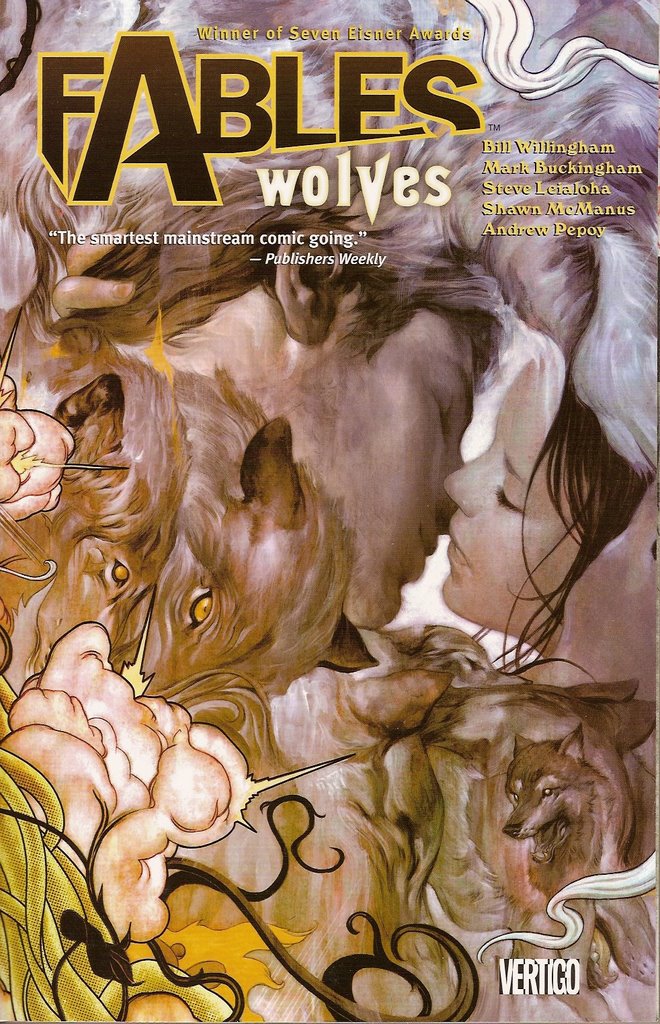
Book-A-Day #161 (12/24): Fables, Vol. 8: Wolves by Bill Willingham and various artists

I read Vol. 7 a few months ago, and didn't have much to say then. I've now read Vol. 8 today, and I still don't have much to say. This collects three shorter stories (one single-issue, a two-issue story, and the 50th issue extravaganza), along with writer Bill Willingham's script for that 50th issue.

It's a great series; Willingham has been an interesting writer for twenty years now, but never found anything as successful as his original series, Elementals. Fables finally moved him beyond that, and had the added bonus of being a good idea done well (sometimes it seems to be rare when the successful series are also the good ones, but it does happen).

If you haven't read Fables yet, don't start here -- either get Vol. 1 or the recent 1001 Nights of Snowfall hardcover. But if you have been reading the series, this is just as good as it's been, and it shows that Willingham is willing to both add things to the ongoing story (the Cloud Kingdoms) and let sub-plots end (Bigby and Snow White).

The Fabulous Book-A-Day Index!

Monday, September 19, 2011

Reviewing the Mail: Week of 9/17

Publishing is starting back up for the fall, after its summer doldrums -- though, from the frenzied activities at my house, you'd never know summer doldrums existed, and others at other companies may feel similarly -- and so a few things made their way to my mailbox this past week. And so, as usual, I'll tell you what I can about them, from prior knowledge and a quick glance and a deep sense of disappointment in all human endeavor.

Down the Mysterly River is a young adult novel from Bill Willingham, most famous these days as the creator of the Fables comics series. (Though some of us old-timers persist in remembering him for his first big success, the early revisionist superhero team Elementals.) It's also, as far as I can see, his first professional foray into mostly unadorned prose [1] -- though the book is illustrated by Willingham's Fables collaborator, Mark Buckingham. Mysterly River is the story of a Boy Scout, Max "the Wolf," who  mysteriously finds himself in a strange landscape populated by talking animals beset by a relentless group of human hunters called the Blue Cutters. Since this is explicitly billed as a middle-grad book, I expect this will be less nasty to its characters than Willingham's work sometimes gets -- particularly since it's also described as a tribute to the Boy Scouts. Tor Starscape published it (in hardcover) on September 13th.

I saw (but did not read) the first book in Clay Griffith & Susan Griffith's alternate-historical "Vampire Empire" series, in which vampires have conquered most of the northern latitudes and driven free, civilized men down to the hot equatorial regions. The stories themselves are steampunky adventures, focused on a mysterious figure called the Greyfriar and the Princess who loves him, and the second book -- called The Rift Walker -- emerged from Pyr as a trade paperback on September 6th.

I may have already mentioned The Monster's Corner before -- it's an anthology of nineteen original stories, edited by Christopher Golden, all fantasies told from the point of view of the monster (which may be, but isn't necessarily, the same as the "villain") -- but, if I have, then I'll just mention it again. Among the contributors are Kevin J. Anderson, Sharyn McCrumb, Kelley Armstrong, Dana Stabenow, Heather Graham (presumably not the one you're thinking of), Tananarive Due, and Michael Marshall Smith. It's a trade paperback, coming September 27th from St. Martin's Press.

And last for this week is MetaMaus, an examination of art spiegelman's classic Maus graphic novel. It's central spine is a series of interviews spiegelman did with academic Hillary Chute, but there's also several sections created by spiegelman in comics form, plus lots of sketches, artwork, comics panels, photographs, interviews with other members of the spiegelman family, and other things. (On top of that, the book includes a DVD that includes the complete Maus, audio archives of spiegelman's interviews with his father, 300 notebook pages, thousands of drawings, and even more archival/historical material.) This isn't the edition of Maus that you'd want if you want to read it in print first, but, if you're interested in Maus on any deeper level, it's clearly a vast trove of data and interpretation. Metamaus is coming from Patheon on October 4th.


[1] See comments; this is Willingham's second novel, and I wouldn't want to bet that he doesn't have a pile of prose short fiction as well. Even worse, I knew that, and forgot it as I was typing.

Monday, March 04, 2013

Graphic Novels I Read Three Months Ago and Want to Put Away Now

As the post title says, I read these three books in December/January and still have them stacked up on top of the printer. Time to make 'em go away!

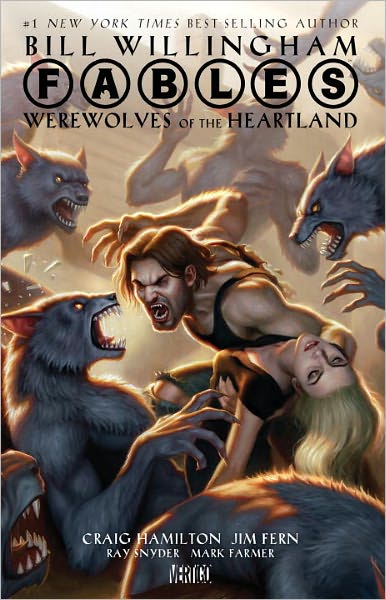
Fables: Werewolves of the Heartland by Bill Willingham, four artists, and at least one full year

I'm not as connected to Corporate Comics as I used to be, but even I noticed that this book was supposed to come out a good year before it actually did. The creative credits hint at possible reasons -- layouts are by Jim Fern, pencils by Craig Hamilton and Fern, and inks by Hamilton, Ray Snyder, Mark Farmer, and Fern -- but I don't know what happened, and frankly I don't care: I paid for a book, and it's that book that matters.

Too many cooks did not add up to a great stew here: much of the book is fussy and over-rendered (particularly the mania -- I couldn't trace it to any of the four inkers, so it may be a collective mania -- for drawing each individual body hair on werewolves and hairy men alike), and even the panel-to-panel storytelling is clunky and obvious. After the usually sinuous, casually beautiful art on the main Fables book (which, of course, took massive work by main series artist Mark Buckingham to accomplish), Werewolves of the Heartland looks a day late and a dollar short.

Willingham's story gives up with the art, as well -- he must have planned this to be something special, but it's just dull. Bigby Wolf -- one of the main characters of Fables, the wolf from fairy tales and also a son of the North Wind -- is wandering across America, and comes across Story City, an isolated town with an usual relationship to him and a uniquely unified population. (I'll avoid spoiling the whole point of the book, in case any of you still want to read it.) Stuff happens, things blow up real good, and Bigby walks out alone again in the end, just like an old episode of The Incredible Hulk -- though Bigby has more control of his alter ego than Bixby did.

If you've read the whole main Fables series and all of the better spin-offs, this will be an only slightly disappointing trip to the same well. If not, go do that other stuff first.

Spleenal by Nigel Auchterlounie

Auchterlounie cartoons for several British outlets (mostly for kids, from what I've seen, in a very boyish, potty-humor style), and also at Where I Vent My Spleen, which I've been recommending ever since I found it.

This is his first book -- I think his only book so far, though I'd be happy to find out I'm wrong -- and it collects a number of longer comics from his blog (plus a few new things created for the book). Much of it is rude -- there's a "18+ only" notice on the cover for a reason, and all of it is funny, and much of it is oddly true in a way you don't expect from quick comics about a thinly-veiled version of the cartoonist retelling versions of stories from his own life and his fantasies (or, again, versions of those fantasies).

Auchterlounie also has a quirky, idiosyncratic cartoony style -- all of the characters look like Weebles more than anything else, no one has feet, some characters don't even have legs, and women have floating hands without arms -- that gives his work energy and visual pizazz; he's otherwise a very conventional cartoonist, with a lot of nine-panel grids and standard transitions.

If any of that sounds at all enticing, check out the blog -- Auchterlounie looks like a laddish British cartoonist, but there's a lot of thought and drawing chops going into his stories, which go interesting places and say unexpected things.

The Infinite Wait and Other Stories by Julia Wertz

Wertz is a young autobiographical cartoonist who used to use "The Fart Party" as an overarching title for her work -- but that clearly palls with time (even though Wertz is still only in her twenties), and so she's been distancing herself from that. (Still, you know that in 2050 or so, she'll be a Guest of Honor at whatever the intergalactic version of Comic-Con is by then, and she'll still get people snickering as they ask her about her favorite farts.) Infinite Wait contains three long stories, breaking with Wertz's prior style: lots of little pieces that add up to a mosaic of her life.

I reviewed the first Fart Party collection for Comic Mix, noted that I read the second one without saying much else, and then reviewed her big major publisher book, Drinking at the Movies, here. (Though Drinking had the same format and style as the first two collections; Infinity Wait is actually a bigger break from Wertz's previous work than Drinking was.) I won't claim any augural powers from my saying that Wertz, at that point, "still wants to tell lots of stories about all of the different aspects of her life, instead of telling one long story about one piece of her life." Wertz is ambitious about her work -- her art may look crude, but that's on purpose, and her storytelling is smooth and assured and much more sophisticated than that art style makes it appear.

Two of the stories in Infinite Wait are long looks at one aspect of Wertz's life -- the title story covers her diagnosis with lupus at the age of twenty, and how she's lived with it since then, while "Industry" runs through all of the jobs she's had since age six, which is an interesting catalog of youthful energy and then a succession of colorful food-service job before she went full-time with her comics a few years ago. Those both clearly derive from her earlier work, though it's more unified, with a clear single voice and through-line in each pushing the narrative forward.

The third and shortest story is the one that most readers will love best, for obvious reasons: "A Strange and Curious Place" is a sweet story of Wertz's love of reading, and specifically of libraries -- and I've yet to find a serious reader that doesn't have a soft spot for large collections of books.

I do wonder if autobiography is a deep enough row for any creative person to stick to for a whole career, but Wertz is still young; she has plenty of time to find other things to cartoon about, or to start doing exciting things just to cartoon about them afterward. And I expect her snotty, post-punk attitude -- even if it, like the focus on farts, is waning -- will keep whatever stories she creates vital and energetic and real for many years to come.

(Infinite Wait is, shockingly, not available from That Voracious Bookstore Named After a River; you might have to get it in a real bookstore, like I did -- at the Strand, signed, plug plug -- or buy it directly from the cartoonist in the new 20st century web stylee. I also see that Drinking is called "a full-length graphic memoir" on the page for the new book, which doesn't match my memory or what I wrote about it. Sadly, my copy perished in my flood in 2011, so I can't check -- so we'll have to agree to disagree.)


Monday, June 30, 2008

Reviewing the Mail, Week of 6/28: Comics

And this is the yin to the previous yang; here I'll list, and try to explicate, all of the things that came into the Hornswoggler home last week that were comics in one way or another.

I'm going to start with things I paid money for, because I wanted to draw particular attention to this first book:

The third collection of Yoshihiro Tatsumi's manga to be translated and published by Drawn & Quarterly is Good-Bye, and it's in stores now. I reviewed it at ComicMix when the galleys circulated, and probably didn't adequately describe how special Tatsumi is. He's one of the greats of world comics, with stories by turns shockingly raw and evocatively quiet. His stories aren't just good for manga, or good for comics -- they're great short stories, period.

Skyscrapers Of The Midwest is a title I don't know much about -- it's by Joshua W. Cotter, published by Adhouse Books, and seems to be a collection of (linked?) anthropomorphic stories. But I've heard good things about it, and my comics shop had it marked down, so I'll give it a whirl.

Lobster Johnson Vol. 1: The Iron Prometheus is another brand extension of the mighty Hellboy empire -- probably the last one to make it into into stores ahead of the new Guillermo de Torro-directed movie -- and it's written by Hellboy and Lobster Johnson creator Mike Mignola, with art by Jason Armstrong. (Actually, the credit reads "story by Mignola," which may mean that Armstrong worked from an outline and acted as his own scripter.) It was published by Dark Horse sometime in the very recent past.

Fables Vol. 10: The Good Prince is the latest in the modern fairy-tale-inspired fantasy series, written as always by Bill Willingham, with art by Mark Buckingham and (mostly) Steve Leialoha. As I remember, the series is still continuing, so this isn't the big finish, but it looks like a major piece of the story of the battle between the Adversary -- who conquered most of the alternate worlds of fairy-tale characters before the series began -- and our main characters in the expatriate community of New York.

In the same world, but with a somewhat different tone, is Jack of Fables, Vol. 3: The Bad Prince. It's about one of the less heroic characters from the main series, off having his own adventures. (I have no idea if the seemingly linked titles mean these two stories have anything to do with each other, though I do expect to find out soon.) The Jack of Fables series is written by Bill Willingham and Matthew Sturges, and the pencil art in this book is mostly by Tony Akins, though there are four others credited with part of the pencils and inks. This is also from DC, as one would expect, and it was published within the last month.

PvP Volume 5: PvP Treks On os the yes, fifth collection of the webcomic PvP, which is by Scott Kurtz. Image publishes the webcomic as a monthly comic book, and bills their collected books (like this one) as collections of the comic books, without even mentioning the Internet once. The direct market really is its own little parallel universe, isn't it?

I've been looking at Erotic Comics: A Graphic History from Tijuana Bibles to Undergound Comix the last two or three times I hit the comics shop, and went so far as to pick it up and look through it last time. And this time I finally admitted to myself that I was interested enough in the subject to buy the thing, and so I did. It's by Tim Pilcher, with Gene Kannenberg, Jr., and has a foreword by Aline Kominsky Crumb. Harry N. Abrams, which is a classy, serious publisher of art books and whom I trust has kept the whole proceedings as tasteful as possible (under the circumstances) published Erotic Comics in February. (What I'm hoping is that its as interesting and fun as Bob Adelman's Tijuana Bibles of a few years back.)

And the last thing I picked up at the comics store -- literally, just before I got on line to pay for my huge stack of good stuff -- was the first two volumes of Chica Umino's Honey and Clover manga series. I've already got a copy of the movie that was adapted from this series, and I hope to review the whole package for next week's Manga Friday column for ComicMix.

Now, on to the things that actually did come in the mail:

Nate Powell's Swallow Me Whole, which Top Shelf will publish in September, is a big original graphic novel -- the pages aren't numbered, but I'd estimate it's over 200 pages long -- with some kind of supernatural element in it. There are a lot of bugs, on the cover and throughout. (And I can't help wondering if this Powell pronounces his name the way it's spelled or like Anthony Powell -- if the latter, it would rhyme with the title. These are the kinds of things I think about when I see new books...)

Jeff Lemire's Essex County Volume 3: The Country Nurse is also from Top Shelf, but it's publishing slightly later, in October. As the title probably clued you in, this is the third of his graphic novels to be set in his ficionalized Essex County (of Ontario, Canada), after Tales from the Farm and Ghost Stories. This book follows one day in the life of a traveling nurse in a farm community -- I think I recognize her from Ghost Stories, so perhaps this book is meant to tie together the first two volumes.

CMX Manga -- now as always an imprint of the mighty DC empire -- sent me two sets of photcopies with their usual secrecy. (They never have a cover letter, or even a tip sheet/fact sheet/sell sheet to say when the book is being published and the pertinent information -- even the most professional comics publishers seem to struggle with the things that seem simple in trade publishing.) First is Kikaider: Code 02, Vol. 7 by Ishimori Shotaro and Meimu, a science-fiction story with robots -- giant ones, I think -- and the usual accouterments. It will be published in on July 9th and is marked for Mature readers.

Also from CMX is Suihelibe!, Vol. 1, a title which I'm having the greatest of difficulty in spelling correctly (and consistently). It's by Naomi Azuma and seems to be a combination of a school club story and a cute girl from space story. (And I'm sure there's an official Japanese manga term for both of those things, but I don't know them.) This one is a bit further in the future, coming in late October. As befits a series with characters who seem to be about nine years old, it's rated E for everyone.

Manu Larcenet's Ordinary Victories: What Is Precious, collects what were the third and fourth graphic novels in the "Ordinary Victories" series in France -- the first two were published in the US as just Ordinary Victories in 2005, and ended up on Time magazine's list of the five best graphic novels of the year. It's a semi-autobiographical story about a photographer dealing with family issues, and NBM is publishing it in August.

Also from NBM is Bluesman by Rob Vollmar and Pablo G. Callejo, which collects a series originally published in three volumes only a few years ago. It's set in the '20s and about a couple of black musicians in the South -- so I don't expect it will be a terribly happy story. This new complete edition of Bluesman will be published in August.

Vittorio Giardino's No Pasaran!, Vol. 3, is the finale of a trilogy, and the latest book about Giardino's series character Max Friedman, a spy in '30s Europe. NBM will publish it in August.

Slow Storm is the first full-length graphic novel by 2007 Eisner nominee Danica Novgorodoff, a story about tornado season in Kentucky and about a woman firefighter and a Mexican immigrant. It will be published by First Second in September.

And last for this week is the Rick Geary adaptation of H.G. Wells's The Invisible Man, second in the new Papercutz Classics Illustrated series, and publishing in August. This adaptation first saw print in the great, but short-lived CI series from First Comics in the late '80s, but somehow I missed it then (even though I was buying Rick Geary stuff on sight, and most of the First CI books as well).