Sunday, July 26, 2009

Dateline: Afghanistan, 1986

On Friday and over at the ComicMix, I reviewed a book by Emmanuel Guibert, Didier Lefevre, and Frederic Lemercier called The Photographer, which mixed photojournalist Lefevre's real photos and art by Lemercier and Guibert to tell the story of Lefevre's first trip to Afghanistan -- then under Russian occupation -- with the humanitarian group Doctors Without Borders.

----------------
Listening to: Randy Newman - Short People
via FoxyTunes

James Bond Daily: Sexual Ennui

From p.149 of Casino Royale:
With most women his manner was a mixture of taciturnity and passion. The lengthy approaches to a seduction bored him almost as much as the subsequent mess of disentanglement. He found something grisly in the inevitability of the pattern of each affair, The conventional parabola -- sentiment, the touch of the hand, the kiss, the passionate kiss, the feel of the body, the climax in the bed, then more bed, then less bed, then the boredom, the tears and the final bitterness was to him shameful and hypocritical. Even more he shunned the mise en scene for each of those acts in the play -- the meeting at a party, the restaurant, the taxi, his flat, her flat, then the week-end by the sea, then the flats again, then the furtive alibis and the final angry farewell on some doorstep in the rain.

Movie Log: The Great Buck Howard

The Great Buck Howard is a movie that feels like it's missing a reel -- well, not one whole reel, but it does feel like it should have a few more scenes to pull everything together and make it all cohere.

It's a pleasant movie that can't decide who its main character is. It starts with a young man, Troy (Colin Hanks), who isn't quite sure what he wants to do with life but has just become sure that law school isn't what he wants. Troy wanders to LA in a vague attempt to "write," then -- when he realizes that he actually needs a job to keep him going -- answers an ad to become the road manager and general factotum for "The Great Buck Howard" (John Malkovich). And then Howard mostly takes over the movie -- though it's not his story at all, since he doesn't change, and his arc is pretty flat. But he dominates the scenes between the two of them -- as would be expected -- and also the scenes he isn't in. And Troy's voice and presence isn't strong enough to overcome the Buck-ization of the movie.

Howard is a moderately veiled version of the The Amazing Kreskin, a mentalist who used to be reasonably big -- lots of appearances on The Tonight Show in the Johnny Carson days; long stints in Vegas; the usual -- but has settled into a routine of half-empty halls in third-rate cities, doing the same corny act night after night across the country. He's demanding and finicky, but Troy learns how to handle him. There are the usual small triumphs and set-backs leading up to the huge triumph and set-back (or vice versa); the structure of The Great Buck Howard could have come right out of a screenwriting seminar.

So The Great Buck Howard is nearly a road-show My Favorite Year, down to the new love the young man finds along the way. But both the movie and Troy are less focused; Troy's ambitions aren't clearly defined -- does he want to become a screenwriter? is this the movie that he wrote about his life? -- and Buck Howard has a mostly episodic structure, with episodes of unfortunately very different lengths. It should be a movie about how Troy turned into whoever it is that he's going to turn into, but it's more about how he hung out with this weird old guy for a while and came to like him.

There are lots and lots of solid actors in secondary roles -- you can see a line of them on the box cover, though none of those guys share a scene with each other, or with much of anyone but Hanks Jr. and Malkovich -- and the whole movie is pleasant and professional. But, like Oakland, when you reach the end, there really wasn't a there there.


----------------
Listening to: Midwest Dilemma - Damage Is Done
via FoxyTunes

Saturday, July 25, 2009

James Bond Daily: Bond & M Are Not Quite As Racist As You'd Expect

From pp.016-017 of Live and Let Die, originally published in 1954:
'I don't think I've ever heard of a great Negro criminal before,' said Bond. Chinamen, of course, the men behind the opium trade. There've been some big-time Japs, mostly in pearls and drugs. Plenty of negroes mixed up in diamonds and gold in Africa, but always in a small way. They don't seem to take to big business. Pretty law-abiding chaps I should have thought, except when they've drunk too much.'

'Our man's a bit of an exception,' said M. He's not pure negro. Born in Haiti. Good dose of French blood. Trained in Moscow, too, as you'll see from the file. And the negro races are just beginning to throw up geniuses in all the professions -- scientists, doctors, writers. It's about time they turned out a great criminal. After all, there are 250,000,000 of them in the world. Nearly a third of the white population. They've got plenty of brains and ability and guts. And now Moscow's taught one of them the technique.'

Friday, July 24, 2009

James Bond Daily: Live and Let Die

This second James Bond novel was published in 1954, barely a year after the first -- and the Bond books would continue to appear every year until Fleming's death in 1964, and even thereafter, with the last (possibly unpolished) novel The Man With the Golden Gun in '65 and the last few stories scraped up into Octopussy and The Living Daylights in '66.

From the movies, we have an image of Bond in one world -- the '60s, if we're a fan of Connery's straightforward toughness, or the '70s, if we prefer the baroque complexities of Moore. But Fleming's Bond is a creature of the post-war era, of the '50s. He lived and worked when the Cold War was quite warm indeed, when detente wasn't even a joking possibility. His backstory reaches solidly into World War II, and in particular the quiet, darker corners of that war. Fleming's Bond is a man of sniper rifles and knives in the back, of dark alleys and darker actions. The Double-O number doesn't signify elitism or status, as it does in the movies, but is instead a label for a man who has gone too far to get back, an explanation for why he is what he is.

All of the Bond novels take place in a dead era -- one that some of us remember, but none of us have lived in for a generation -- and Live and Let Die is particularly dated, with its voodoo plot and black "Mr. Big" villain. (Though Mr. Big is genuinely nasty and as terrifying as any other villain in the Bond novels; Fleming makes it quite clear that he, and his characters, don't consider blacks essentially inferior, which is an unexpected touch. He also explicitly out-thinks Bond several times; Fleming portrays him as startlingly smart and foresighted.) The dangerous, deadly black men Bond faces here are nearly a decade prior to the Black Panthers and mid-'60s riots; Fleming might turn their dialect into something very ugly on the page -- and he does; rendering much of the dialogue in Harlem nearly incomprehensible -- but he does certainly allow them agency and strength.

This novel has somewhat more plot than Casino Royale did; M sets Bond on the trail of Mr. Big, who has somehow found and is smuggling a four hundred-year-old treasure of gold coins, hidden by Henry Morgan somewhere on Jamaica, to finance his own criminal empire and his Russian backers. "The Big Man" is also, explicitly, a trained agent of SMERSH, that Soviet agency of terror and the policing of spies that Bond has made it his mission to wipe out as thoroughly as he can. And so Bond meets up with his CIA counterpart Felix Leiter -- whom he'd met in Casino -- to start with Big's Harlem base and work their way back, through Fort Lauderdale, to Jamaica.

But Big is more dangerous and smart than they'd expected, and he stays ahead of them for most of the book. Leiter is nearly killed, and Bond survives several times due mostly to luck and his own hypertrophied survival instincts. In the end, Bond gets the girl -- Big's captive (white) fortune-teller Solitaire -- and Big gets killed, but it's in large part due to luck (and another large part due to Bond's planning).

Bond's world is nihilistic; he does believe that he's better than the monsters he fights, but he's not all that much better -- and he knows that. And each monster takes something out of him -- even though he doesn't have all that much to begin with. I'm not claiming these books are great literature -- clearly they're not -- but they are very good, tough-minded novels of violence and conflict, exemplary thrillers of the Cold War.

Quote of the Week

"In our age if a boy or girl is untalented, the odds are in favor of their thinking they want to write."
- W.H. Auden

Thursday, July 23, 2009

James Bond Daily: Not a Good Flight

From pp.159-160 of Live and Let Die, describing an airplane in a storm in 1954:
He looked at the racks of magazine and thought: they won't help much when the steel tires at fifteen thousand feet, nor will the eau-de-cologne in the washroom, nor the personalized meals, the free razor, the 'orchid for your lady' now trembling in the ice-box. Least of all the safety-belts and the life-jackets with the whistle that the steward demonstrates will really blow, nor the cute little rescue-lamp that glows red.

No, when the stresses are too great for the tired metal, when the ground mechanic who checks the de-icing equipment is crossed in love and skimps his job, way back in London, Idlewild, Gander, Montreal; when those or many things happen, then the little warm room with propellers in front falls straight down out of the sky into the sea or on to the land, heavier than air, fallible, vain. And the forty little heavier-than-air people, fallible within the plane's fallibility, vain within its larger vanity, fall down with it and make little holes in the land or little splashes in the sea. Which is anyway their destiny, so why worry? You are linked to the ground mechanic's careless fingers in Nassau just as you are linked to the weak head of the little man in the family saloon who mistakes the red light for the green and meets you head-on, for the first and last time, while you are motoring quietly home from some private sin. There's nothing to do about it. You start to die the moment you are born. The whole of life is cutting through the pack with death. So take it easy. Light a cigarette and be grateful you are still alive as you suck the smoke deep into your lungs. Your stars have already let you come quite a long way since you left your mother's womb and whimpered at the cold air of the world. Perhaps they'll even let you get to Jamaica tonight. Can't you hear those cheerful voices in the control tower that have said quietly all day long, 'Come in BOAC. Come in Panam. Come in KLM?' Can't you hear them calling you down too: 'Come in Transcarib. Come in Transcarib'? Don't lose faith in your stars. Remember that hot stitch of time when you faced death from The Robber's gun last night. You're still alive, aren't you? There, we're out of it already. It was just to remind you that being quick with a gun doesn't mean you're really tough. Just don't forget it. This happy landing at Paliadoes Airport comes to your courtesy of your stars. Better thank them.

Bond unfastened his seat-belt and wiped the sweat off his face.

To hell with it, he thought, as he stepped down out of the huge strong plane.

A Rising Tide Lifts More Than One Boat

Recently, Eric of Pimp My Novel (who works in sales at a major house) wrote a post that argued that the new Dan Brown book, The Lost Symbol, will take sales from other books rather than increase the total number of books sold when it's published. He had several reasons, which he enumerated.

I believe Eric is wrong. I could list a similar set of reasons, but I decided to use numbers instead. So I looked up sales for the last major blockbuster release, Stephenie Meyer's Breaking Dawn. (I'm using the usual sales-tracking system for the book industry, and giving round figures and percentages to avoid revealing proprietary information. Those of you who also have access to that system can check my work, if you wish.)

Breaking Dawn was published August 2, 2008 (a Friday), and sold more than three-quarters of a million copies for the week ending August 3rd. (But not vastly more; it was less than a full million.) Total universe of book sales that week was between fifteen and sixteen million, closer to sixteen.

The previous week -- a week without Breaking Dawn -- total sales were a bit under fourteen million. Those sales were 13% below those of Breaking Dawn's debut week, and sales of frontlist books (new ones) jumped up 22% to the week with Breaking Dawn.

Breaking Dawn was responsible, all by itself, for only 44% of the sales increase. Therefore, 56% of that increase -- slightly less than a million units total -- was in sales of other books.

But sometimes a particular week is strong, no matter what the year, so I also looked back at that same week (31, for those following at home) in 2007 -- those sales were actually a bit lower than week 30 in 2008, and 14% below week 31 in 2008.

So: this is only one example, but I believe it's the usual pattern. Breaking Dawn's release caused an increase of 13% in all book sales from the previous week -- or a 14% increase from the same week a year before -- and it only accounted for 44% of the increase itself.

This is the common wisdom in publishing; that big books sell more books. Event books bring customers in to the store and predispose them to buy, and those customers do not, on average and contrary to Eric's assumptions, just walk out with that single book.

Therefore, big books are good for the business; they increase sales of books in general. If the Breaking Dawn pattern holds true for The Last Symbol, the week it's published should see an increase of nearly a million copies sold of entirely different books.

----------------
Listening to: Richard Thompson - Nobody's Wedding [Live]
via FoxyTunes

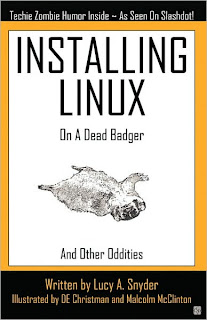
Installing Linux on a Dead Badger and Other Oddities by Lucy A. Snyder

If you've ever read Charles Stross's "Laundry" novels, or his magnificently chilly story "A Colder War," and thought to yourself, "this is really great, but I wish it was shorter and done for laughs," then Lucy Snyder is the writer you have been looking for.

Installing Linux on a Dead Badger (And Other Oddities) collects twelve stories, all of them humorous, and most of them in a post-Onion neo-non-fiction style. Touchstones include zombie movies, H.P. Lovecraft, and geeky culture in general.

This is a short book, and it's mostly made up of complicated jokes for geeks, so I'm not going to get into detailed story notes. Snyder does create something like a world in these short pieces, though -- she rings changes on the same concepts through several stories (or barefacedly repeats her own best ideas over and over again, if you prefer) that collectively add up to a slacker's-eye view of a somewhat more interesting (in the "ancient Chinese proverb" sense) world than our own.

This is a short book (barely a hundred pages), and difficult to find; it was published by a micro press and probably isn't available many places. (On the other hand, I just looked it up on BookScan, and discovered that there's plenty of stock in one of Ingram's warehouses, so anybody's local store could easily order it.) But, if the idea of creating a zombie badger through Linux is already making you giggle, you know that you already want this book.


----------------
Listening to: Bess Rogers - Bulldozer
via FoxyTunes

Wednesday, July 22, 2009

The Mike and Lamar Show!

For no good reason, I reviewed two comics-as-books today, both published by AdHouse, for ComicMix, under the rubric "post-genre superheroes." I have no explanations for my actions.

Those two books were Mike Dawson's Ace-Face: The Mod with the Metal Arms and Lamar Abrams's Remake.

The culprit is still at large.

----------------
Listening to: The Monolators - I Must Be Dreaming
via FoxyTunes

Blogging and Publishing Cynicism

I was just writing a comment on this post at OF Blog of the Fallen, and it got away from me. I'm not sure it entirely makes sense without Larry's original post -- so go read that -- but I'll stick it here as well, just because.

First, the fact that not all copies of a manufactured commodity are eventually sold is not at all unusual. What's different about the book/magazine industry is the ability of retailers to return unsold product; most retailers just have to eat unsalable goods. There's no such thing as "returns" in consumer electronics or evening wear, but there definitely is a percentage of unsold and unsalable goods on every single consumer product. Many are marked down in place, but many more are destroyed.

(And, yes, a book is a consumer product. It may be other things, but a consumer good it always is.)

Second, this is not cynicism; it's realism. Newspapers and magazines are vastly reducing their coverage of books; they were even before the economic crisis, and it's gotten much worse. Publicists and marketers are trying to get their books into the hands of people who will talk about them to a reasonable audience, and bloggers are such people. This might not be business to you, but it's business to them -- you're getting that book because The Ann Arbor News went under, and those marketers and publicists would really like someone to see and appreciate their books.

Also, unless your numbers are much higher than I suspect, or your response rates are vastly through the roof, any one (non-superstar) blog will probably move a dozen or so copies of a novel, at best. But, then again, The Ann Arbor News probably didn't move more books than that, either.

And those now out-of-work newspaper people were just as passionate about books as any of us. Sure, they were usually paid (badly), and we aren't, but otherwise it's mostly a different of format and preferred genres.

(Also, what Charles said -- I won't repeat it, but it's all true.)

James Bond Daily: The Very First Talking Killer

From page 114 of Casino Royale:
'Perhaps I should explain,' said Le Chiffre. 'I intend to continue attacking the sensitive parts of your body until you answer my question. I am without mercy and there will be no relenting. There is no one to stage a last-minute rescue and there is no possibility of escape for you. This is not a romantic adventure story in which the villain is finally routed and the hero is given a medal and marries the girl. Unfortunately these things don't happen in real life. If you continue to be obstinate, you will be tortured to the edge of madness and then the girl will be brought in and we will set about her in front of you. If that is still not enough, you will both be painfully killed and I shall reluctantly leave your bodies and make my way abroad to a comfortable house which is waiting for me. There I shall take up a useful and profitable career and live to a ripe and peaceful old age in the bosom of the family I shall doubtless create. So you see, my dear boy, that I stand to lose nothing. If you hand the money over, so much the better. If not, I shall shrug my shoulders and be on my way.'

Adam Roberts Hates Your Hugo Vote

In case you didn't know, Adam Roberts has better taste than you do.

So stop fooling your silly little head with the idea that you know what you like to read, and what's of interest to you. Just do what he says in future, and he won't have to whine at you a second time. Read the books he tells you to, and then vote for them when award time comes. You clearly aren't competent to judge what you enjoy and want to honor.

After all, Roberts teaches at a university, and that makes him unimpeachable. Remember: the thing to do is to listen to experts on literary matters, and avoid things that they consider mediocre or sub-literary. That's how SF got to where it is today, isn't it?

Tuesday, July 21, 2009

James Bond Daily: Casino Royale

The first James Bond novel was published in 1953; it was Ian Fleming's first book. (And I looked at it just a few years ago.)

I don't know if I have much more to say about it than I did in 2006; the book's Bond is very different from the movie Bond -- even the supposedly "tough" ones, like early Connery and parkour-happy Craig -- but I want to think about those differences more, as I read more of the books.

Another thing I'll want to think about is the shape of the series -- Bond is seriously injured in the middle of Casino Royale, at the hands of an enemy, escapes through no action of his own, seriously considers resigning from the service, and is nursed back to health by Vesper Lynd, who turns out -- as so many Bond girls do -- to not be quite as true and trustworthy as she appears. And, as I recall, something quite similar happens in You Only Live Twice, the last novel to be published when Fleming was alive.

Casino Royale is a tough novel of applied spycraft; it's definitely sensationalized -- I doubt any real-world spy ever set out to ruin his opposite number at the baccarat table -- but it's solidly set in the real Cold War '50s, with many references to the events and names of the day that would affect a spy like Bond. Fleming was surpassed in psychological realism by many later writers of spy novels, but Bond is still a fascinatingly spiky character, deeply damaged and re-healed broken like a badly set leg. And we do have to remember that his world is not ours -- doubly so, since his world is nearly sixty years in the past now, and the feral world of the Cold War practitioners (or of any similar agents, now or ever) is very different from the world of law most of us live in.

Movie Log: He's Just Not That Into You

I told The Wife that I'd be perfectly happy to watch He's Just Not That Into You with her on Saturday night -- as long as the sometimes-buggy wireless Internet was working, so I could do it with my laptop at hand and the movie with only about half of my attention. It was, so I did.

I've seen this movie described as a somewhat dumbed-down American version of Love, Actually (one of our favorite movies), and that's vaguely true -- it's a collection of loosely-linked plotlines, all basically in the romantic-comedy genre.

As with Love, Actually, having a whole bunch -- four or five, depending on how you count -- of romantic plots means that He's Just Not That Into You doesn't need to spin out stupid complications and silliness from any one of them; it can jump back and forth, and just give us good scenes from each plot. (Of course, any movie can just give us the good, important scenes, but it's never actually that easy.)

There's also a Greek-chorus effect several times, particularly early on in the movie, as unnamed other women -- this is a movie aimed squarely at women, in case you didn't notice that -- comment on men, their own love lives, and similar topics. It's a nice effect, and makes He's Just Not That Into You somewhat more interesting and sprightly than it would otherwise be.

This is not a great movie, but it's a decent one; it has a solid cast of nice-looking people who can act and mostly do. I won't run through all of the separate plots, since they're all fairly standard, even if they don't all end happily, which is rare for Hollywood. This is an excellent movie for a bunch of women to see together -- one might even say it was designed for that, which it probably was -- but men of even average tolerance for chick flicks will make it to the end without cringing much and probably even with some enjoyment. (And not just of Scarlett Johansson's naked swimming scene.)


----------------
Listening to: State Shirt - Hospital Hill
via FoxyTunes