Thursday, June 10, 2010

Book-A-Day 2010 # 127 (6/10) -- Calamity Jack by Shannon & Dean Hale and Nathan Hale

This is a sequel to Rapunzel's Revenge, by the same team -- written by novelist Shannon Hale with her husband Dean; illustrated by non-relation Nathan Hale (who isn't the famous dead Nathan Hale either, obviously) -- though it actually begins before the character of Jack appears in Rapunzel, to give him some background. (I reviewed Rapunzel at the beginning of one of my comics round-ups early last year; I read it as part of the massive pile of stuff I plowed through as an Eisner judge -- and it was a wonderful discovery.)

Calamity Jack is another retold fairy tale, like Rapunzel; Jack is the giant-killing beanstalk-climber, though here the story didn't unfold precisely as the legend would have it. Jack is a Native American-looking young man -- though that's never explicitly remarked on, remaining as an odd bit of subtext here -- in a steampunky city somewhere slightly more civilized than the wilderness where Rapunzel grew up (and met Jack, and overthrew the wicked witch posing as her mother). There are a variety of fantasy races here, most notably pixies (like Jack's partner-in-crime Prudence) and the giants (about fifteen feet high or so, led by the malevolent and bone-chewing Blunderboar).

Jack is a mischevious child, and grows into a scheming and law-breaking young man -- generally with the aim to raise enough money to get his widowed mother's bakery out of debt, but also generally without enough planning acumen to bring those schemes to fruition. And so he does, at the end of the first, introductory, section, raise a beanstalk, sneak into Blunderboar's floating mansion, and steal a goose that lays golden eggs, but the beanstalk ruins his mother's bakery (among much else) along the way, and he's forced to light out for the territory.

Between chapters, the events of Rapunzel happen, and then Jack returns to the city, with Rapunzel, to use a supply of golden eggs to help his mother and make everything right. But they find that Blunderboar has found a fiendish new way to tighten his grip on the city, and that Jack is a wanted fugitive. They do find a few allies, though, and, as heroes must, do find a way to confront evil.

The adventure-story aspects of Calamity Jack work perfectly well, though the budding romance with Rapunzel -- which proceeds almost precisely as the same element did in the earlier book, as if that book hadn't happened -- is more cliched and obvious. Jack is also somewhat more generic as a lead character than Rapunzel was, and without the "girl power" aspect of the first book, Calamity Jack is just a good fractured fairy tale. That's nothing to sneeze at, of course, but the first book was more special and interesting than that -- so I hope the Hales light out for an entirely new story the next time out, and find some other fairy-tale heroine who they can make more active and strong in the pursuit of her own destiny.
Book-A-Day 2010: The Epic Index
----------------
Listening to: Titus Andronicus - Upon Viewing Bruegel's Landscape With The Fall of Icarus
via FoxyTunes

Wednesday, June 09, 2010

Book-A-Day 2010 # 126 (6/9) -- Super Spy: The Lost Dossiers by Matt Kindt

Super Spy: The Lost Dossiers is explicitly a companion piece to Kindt's 2007 graphic novel Super Spy (which I reviewed for ComicMix), and really doesn't stand alone -- it's a collection of experimental stories (told in panels meant to be cut out and rearranged, or viewed steroscopically), annotations, associated drawings and art, and other odder bits of string associated with Super Spy and with Kindt's previous, related graphic novel 2 Sisters.

It feels more like DVD bonus material, honestly -- like an appendix to some future, larger edition of Super Spy -- than it does like a book that stands on its own. There are a few pieces in here that have a basically story-like shape, but they're short, vignette-like pieces -- yes, Super Spy was also made up of similar pieces, but they were arranged and grouped in the earlier book to form a larger story; what's here are like some jigsaw puzzles pieces left in the box after the picture has been completely formed.

Kindt's atmospheric, color-washed art still sets the perfect mood for his dark, shadowy tales of spycraft and casual betrayals in WWII Europe, and his writing is still excellent on the level of dialogue and panel and page. But with the stubby, uncompleted feeling of Lost Dossiers, the reader might begin to wonder why Kindt specifically set these stories so long ago, in that particular historical moment, in the middle of "the good war." (It's not as if the long Cold War afterward didn't provide ample possibilities for spy stories,nor does the modern world lack agents quietly carrying out dangerous plans and double-crossing each other whenever necessary.) It's not clear what the Super Spy stories gain from their haze of historicity -- perhaps a sense of inevitability, or the patina of the dead past. The Lost Dossiers is an interesting sidebar to Super Spy, but I can't recommend it even slightly to readers not familiar with the original.
Book-A-Day 2010: The Epic Index

Tuesday, June 08, 2010

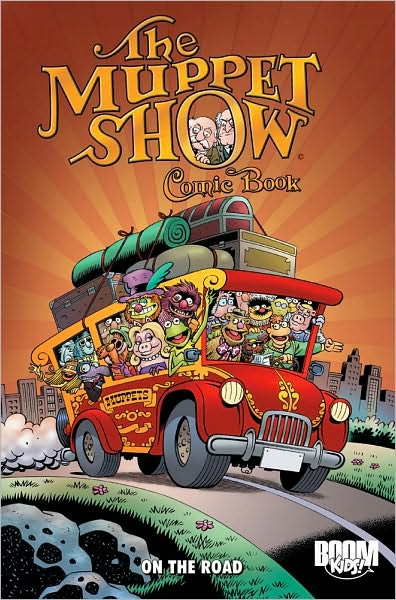
Book-A-Day 2010 # 125 (6/8) -- The Muppet Show Comic Book: On the Road by Langridge with Paroline

This is the third collection of Roger Langridge's excellent ongoing The Muppet Show Comic Book series for Boom! Kids, with a single-issue "Pigs in Space: The Movie" story with art by Shelli Paroline and a three-issue story with Langridge's art.

I wrote about the first book in a monthly round-up, and was very impressed. I got to the second book for Book-A-Day # 80, and was even more thrilled then. My love for this series has perhaps plateaued -- I'm not going to keep claiming that I love each new volume more than the ones before it, since that would be just silly -- but it certainly has not diminished.

Langridge still has an excellent feel for the pace of a muppet routine, and his twenty-two-page comics equate very closely to a TV episode of the same number of minutes. He still captures the essence of the characters in his art and dialogue, while drawing the muppets just a touch manic and off-model, as if they're about to get up to something completely unlikely the minute you take your eyes off them. This time, the one-issue story has Fozzie and Gonzo pitching two movie moguls -- seen mostly in shadows, but with very familiar silhouettes and heckles -- on a "Pigs in Space" movie, interspersed with that actual story. And the rest of the book sees the muppets on a tour of the sticks while their theater is rebuilt after the shenanigans in the last book. (And, quirkily, Fozzie and Gonzo have somewhat limited roles in this story, as if they were "busy" filming the other issue!)

Langridges's comics are great fun for all muppet fans, both the kids that are ostensibly the audience this time around and those of us old enough to remember the '70s show that this comics version follows so closely and so well. And, once again, it remind me that I really should chase down some of Langridge's older comics -- if he's this good doing Henson and Oz and Goelz, how good is he when he's doing pure Langridge?
Book-A-Day 2010: The Epic Index

Monday, June 07, 2010

Book-A-Day 2010 # 124 (6/7) -- Scarlett Takes Manhattan by Molly Crabapple and John Leavitt

It's a truth acknowledged almost as much as it should be that the primary weapons of a young and comely woman are her wits and her body, and even more so her willingness to use them both in concert. Take, for example, Shifra Helfgott, a young spitfire of a redhead born to a single Jewish mother a century or so ago in a city that is never specifically called New York. Left an orphan at eighteen, young Shifra made her way in the world from chambermaid to mistress to streetwalker before finding fame as the fire-swallowing vaudevillian Scarlett O'Hering. (And a place in the bed of her impresario, Daniel D'Lovely, whose story is perhaps even more unlikely than Shifra's -- though Scarlett Takes Manhattan doesn't have space in its few pages to explain Daniel's past or quirks.)

Scarlett's first taste of fame was due to her nudity on the stage, and her second from a combination of her fire-eating and the scarcity of her dress, but her third was less likely (and less well integrated in this story, I must admit.) Scarlett Takes Manhattan has an one-damn-thing-after-another plot, framed as a story told by Scarlett a few years later and featuring events, characters, and backdrops that pop in and out of the story, the reader begins to suspect, just because that's what Molly Crabapple felt like drawing at that moment.

Scarlett, like its main character, is a sexy, never more than half-serious romp through a garish fun-house version of the turn of the last century, with more sex and voluptuous nudity than most sexy stories twice its length and just enough plot to connect the points of its story. I'm sure Crabapple and Leavitt could make a cleaner, more plausible and deeper story if they really wanted to, but they're having so much fun here I almost feel ashamed for raising the point.
Book-A-Day 2010: The Epic Index

Reviewing the Mail: Week of 6/5

This week, I was home for only just about twenty-four hours of the weekend. However, I was doubly lucky -- that time overlapped with the end of mail delivery for the week, so I can be sure that this is all that showed up in my mailbox, and it's a very short list, so I can actually squeeze out time to look at it and ramble a bit here for you.

As always, these are books that I haven't read yet -- they just arrived in the mail. But I do want to mention that they exist, and to let whoever is actually reading these posts know something about these new/upcoming books, based on whatever I already know or can tell from a quick glance.

The second book of Mark Chadbourn's "The Dark Ages" series -- itself a sequel to his "Age of Misrule" trilogy, in which old supernatural creatures returned, slaughtered me and most of mankind, and Changed Everything -- is The Queen of Sinister. In the UK, they saw this book in 2004, but we on this side of the Atlantic are so blighted and behind-the-times that we won't get it until June 8th of this year. (That's tomorrow, for those of you who have trouble with higher maths.) On the other hand, we get this deeply spiffy Pyr trade paperback, with a great creepy-cool cover painting by John Picacio, and I doubt the Brits had anything nearly so awesome back in the year four. So, once again, good things come to those who wait!

From Collins Design, a part of the vast HarperCollins empire that I thought was endangered if not actually dead -- though I'm thrilled, as always in cases like this, to find that I'm wrong -- comes a neat book called We Are Paper Toys! (Yes, the bang is part of the title. Looking at the cover, I think it's actually all supposed to be in lowercase, too: we are paper toys! Speaking of "design"....) It's edited and compiled by Louis Bou, and features exactly what the title implies: designs for paper toys from thirty-two of the finest designers in the world. (Designers of paper toys, of course -- what would a cover/fashion/architectural/whatever designer know about them, anyway?) The book includes pictures of dozens and dozens of paper toys, actual designs for a whole lot of them, and a CD with PDF templates (suitable for printing and then cutting/gluing/folding/constructing) for a bunch of those. If I had more manual dexterity -- ask my family what presents wrapped by me look like some day -- I'd be all over this like white on rice, but, as it is, I will look on in amazement and with a slight euphoria induced not entirely by the aroma of these thick white art-book pages. we are paper toys! hits your favorite bookseller (and possibly craft store) on June 15th, for your print-and-folding pleasure.
----------------
Listening to: The Mountain Goats - The Best Ever Death Metal Band In Denton
via FoxyTunes

Sunday, June 06, 2010

Book-A-Day 2010 # 123 (6/6) -- Festering Romance by Renee Lott

I don't have a lot of time tonight -- I'm writing this the first evening of a long week at a conference for work -- and I don't want to jump on this book with both feet anyway, since it's a sweet little thing that works just fine by itself and doesn't need or require any critical heavy armament aimed in its direction. Festering Romance is the first full-length graphic novel by Renee Lott, a young cartoonist from Savannah (and, I would bet, a graduate of the Savannah College of Arts and Design, a version of which is in the background of this story), and it tells a low-key romance that doesn't punch its ending as it might -- and has some very noticeable manga-isms in the art along the way, not always integrated fully -- but is winning and deeply good-natured.

Janet is a student at an art college in Savannah -- note that up front, since her schoolwork doesn't come into the story at all other than a few brief mentions. She also lives alone in an apartment with the ghost of her childhood friend, Paul, and has an unexplained aversion to men and/or dating and/or any human contact. One day, she's set up on a blind date with Derek, whom she doesn't want to admit that she grudgingly likes, and that sets in motion the plot of Festering Romance -- Derek also lives with a ghost, and the secrets of Janet and Derek (and their ghosts) will bounce off each other and intertwine before Festering Romance comes to a conclusion.

(By the way: I really don't get why this story was named Festering Romance, so there's a definite possibility that I missed something major. Caveat lector.)

Lott's art and story do show a strong manga influence, with her characters' hair-trigger emotionalism (and their very fluid facial expressions to show those emotions) and the shojo-esque plot driven by omitted details and accusations of insufficient openness. (On the other hand, her very expressive figures draw equally from the rubber-hose anatomy of early animation; her people only rarely have definable elbows, and their sharp-featured faces have eyes that fall towards the dot end of the spectrum.) The deep focus on how the main characters feel towards each other -- and what they've told, and not told, each other -- are very reminiscent of shojo as well. But Lott does incorporate those influences into a story clearly her own, set in a millieu she knows. I hope, her next time out, she builds her story out a little further, thinking about the consequences of actions rather than concentrating on those initial moment of high emotion.
Book-A-Day 2010: The Epic Index

Saturday, June 05, 2010

Book-A-Day 2010 # 122 (6/5) -- Charley's War, Vol. 1 by Mills and Colquhoun

It's always tricky to come upon someone else's classics years later -- they so often don't live up to the hype, or just the love from an audience that saw them appear fresh and new. Even if a story is thirty years old, we're reading it now, so everything we've seen over those thirty years -- all of the responses and follow-ups to that classic -- rolls into our reading of the older work. Sure, it's not fair -- but who ever said that art was fair?

Certainly, no one ever said that about war.

Charley's War stands in relationship to the UK war-comics field pretty much as Harvey Kurtzman's EC war comics (Frontline Combat and Two-Fisted Tales) did to their American counterparts -- impeccably researched, clearly anti-war stories illustrated with an equally high level of attention and skill, received with enthusiasm but never as lucrative as more slapdash, jingoistic efforts. Charley comes a generation later -- this volume collects the first 29 weekly installments, published in Battle during 1979, and the strip itself survived through 1985, to see its main character safely through the Great War.

Charley's War is very different from Kurtzman's work in very British ways, though: writer Pat Mills insists in his introduction on the importance of class differences (always a live-wire issue in the UK), and our hero, Charley Bourne, is a stereotypical British "Tommy" -- nearly as dumb as a box of rocks, but ferociously loyal to his mates and stalwart and true more than anything else. (Charley's traits, of course, are clearly supposed to be those of the great British working class -- he's tough rather than effete, dogged rather than smart, loyal rather than self-serving -- all in opposition to the nasty aristocratic Lieutenant Snell.) An American story would have made Charley smarter and more individual, since the great American myth is of one man winning out -- the great British myth is of pulling together.

Charley, in the best tradition of war stories, runs off to join up in the infantry in the early summer of 1916, when he's only sixteen years old himself. He quickly finds himself in the trenches of northern France with a colorful group of characters -- though, remember that this is WW I, so don't get too attached to any of those characters. This book runs through two months -- the subtitle is "2 June 1916 - 1 August 1916" -- as Charley and his fellow soldiers prepare for and then fight the bloody battle of the Somme.

Mills provides muted thrills along the way, as even an anti-war war story must have excitement to it. And artist Joe Colquhoun has a careful, detailed style -- reminiscent, a bit, of Joe Orlando's EC Comics work in a similar vein -- that shows all of the things it needs to show without ever looking over-fussy and comes to life during the battle sequences. Colquhoun also has a real gift for individualizing his characters, which is a much greater trick than it might seem -- all of these men are in identical uniforms and helmets!

Charley's War is a strong work, and a clearly, truthfully anti-war depiction of the nastiness of the one war everyone agrees was a senseless waste. I don't think it entirely lives up to Mills's glowing description of it in his introduction, but a man must be allowed to think highly of his own work, so I don't fault him on that.
Book-A-Day 2010: The Epic Index
----------------
Listening to: The Indelicates - Be Afraid Of Your Parents
via FoxyTunes

Friday, June 04, 2010

These Are The Pros and Cons of Air Travel

...apologies to Roger Waters for mangling the reference.

I'm in the incredibly lovely Fort Lauderdale/Hollywood International Airport -- no, really, how could anything with "Hollywood" in its name not be fabulous? -- and my brain is fried from three straight days of twelve-hour days selling books to accountants. So all I can do now is look at the world in a terribly narrow binary fashion:

Good: this airport has free wi-fi, without even any hoops to jump through. Just connect, and there's the whole internet.

Bad: South Florida heat, humidity, and storms -- I left the hotel this afternoon in the teeth of a gullywasher. One close thunderbolt sounded like an explosion across the street.

Good: the convention is over, and I'm on my way home.

Bad: ...for one day, and then I'm off to another convention for work on Sunday.

Good: um...pass

Bad: If I never see a man wearing flip-flops again, it will be too soon. I'm not entirely resigned to women wearing them away from the beach, and I actually like looking at women.

Good: a TSA agent wished me a happy birthday -- how often does that happen?

Bad: I've still got a three-hour flight and close to an hour's drive before I get home.


Bah, humbug. I want a real weekend, though I know I'm not going to get one. Hope the drive to Baltimore is more fun than the plane flights have been.

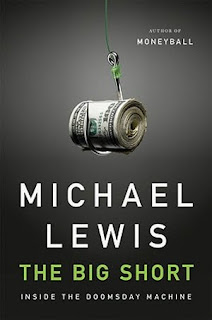
Book-A-Day 2010 # 121 (6/4) -- The Big Short by Michael Lewis

Writers of narrative non-fiction fall into two camps: reporters and historians. Reporters like to get out at ground level, talk to people, fill up notebooks with observations, and then write the specific story that they’ve seen. The big picture may get blurry – or may be distorted by the beliefs of the people they interviewed – but the specifics are as correct as possible.

Historians care more about that big picture, and want it to be as sharp and accurate as possible. So they may skimp on the GOYAKOD part of the job – getting off their asses and knocking on doors – but they read more widely, and are fully aware of all of the competing theories. A historian will be more dependable over all, but a reporter always has better stories to tell -- and so reporters are almost always more popular.

Michael Lewis is a reporter, and has been since Liar’s Poker – a book in which he reported what happened to him in his own days in the financial-services machine. The Big Short is his book about the financial crisis of 2008, but, in the typical fashion of Lewis (and of reporters in general), he doesn’t want to explain what happened in aggregate, but to get out and talk to a few specific people. In the prologue to this book, he describes Big Short as something of a sequel to Liar’s Poker – Poker explained how he got into the financial world himself, as a young and naïve man, and soon got out of it after he realized that the people around him didn’t have much more of a clue about finance than he did, and that, though the money was excellent, it wasn't what he wanted to spend his life doing. Since then -- he explains -- he’s come to believe that most of the financial world really doesn’t know what’s it's doing:
Somehow that message [that the financial world is "phony"] was mainly lost. Six months after Liar's Poker was published, I was knee-deep in letters from students at Ohio State University who wanted to know if I had any other secrets to share about Wall Street. They'd read my book as a how-to manual.

In the two decades after I left, I waited for the end of Wall Street as I had known it. The outrageous bonuses, the endless parade of rogue traders, the scandal that sank Drexel Burnham, the scandal that destroyed John Gutfreund and finished off Salomon Brothers, the crisis following the collapse of my old boss John Meriwether's Long-Term Capital Management. the Internet bubble: Over and over again, the financial system was, in some narrow way, discredited. Yet the big Wall Street banks at the center of it just kept on growing, along with the sums of money that they doled out to twenty-six-year-olds to perform tasks of no obvious social utility. The rebellion by American youth against the money culture never happened. Why bother to overturn your parents' world when you can buy it and sell off the pieces?

At some point, I gave up waiting. There was no scandal or reversal, I assumed, sufficiently great to sink the system. (pp.xv-xvi)
But then, of course, there was a reversal "sufficiently great to sink the system" -- or so it looked for much of 2008. Lewis's timeline in the prologue has him starting to work on this book early in 2008 -- before Bear Sterns's collapse was the first pebble of the avalanche, at least for those of us not paying close attention to the structured-finance world -- and wondering if, finally, the financial world would go back to what it was before the early '80s, before Salomon Brothers (and then the other investment banks) went public and started playing with everyone else's money instead of their own. That was the story he was thinking about: that the last twenty-five years of so of Wall Street hubris was the exception, and that things would crash back to the way they used to be, finally.

So, for Big Short, Lewis wanted to find a few people who he figured did know what was going on – those who saw the crash coming, bet against it, and made lots of money as the markets imploded. Some of those people begin to wonder, towards the end of Big Short, whether their willingness to make those huge bets might have done something to worsen or hasten the crash – but, like financial people everywhere, they quickly brush off those concerns. There’s always a market, and markets are, by definition, right. So making lots of money is the proof that you did the right thing, and the guy losing his shirt has equally proven to have done the wrong thing. In fact, Lewis' conception of Big Short implicitly buys into that central truth of Wall Street -- the guy who makes the biggest pile of money is right. He was just waiting, not all that patiently, for the system he is sure in untenable to finally smash so badly that the people betting against it can make the monster profits (like John Paulson's hedge fund, which made $20 billion as the market shot downward) that prove, once and for all, that he and they were right.

Those people are a small band of short-sellers, some of whom knew each other, and all of whom were loosely linked through a few vectors. (Paulson himself, though, is mostly absent here; presumably, he isn't one of the people Lewis talked to, for whatever reasons.) As Lewis tells it, those short-sellers are at the core of the story -- from Steve Eisman, an ex-Oppenheimer analyst turned New York hedge fund manager, to Michael Burry, an ex-doctor turned California hedge fund manager, to Greg Lippman of Deutsche Bank, who "infected" a dozen others with the same idea.

That idea was, to vastly simplify it, that the US residential mortgage market was becoming vastly over-inflated, as less and less qualified buyers were being placed into houses under shakier and shakier loans (balloon ARMs and even more exotic forms, such as the one that required no payments at all, and just rolled interest into the principal until...well, that was the question), driven primarily by investment bankers that had found a vast new line of business turning those mortgages into investment-grade securities and peddling them to various institutional investors. That may still be too complicated, I suppose. So let's say that there was a huge tower of paper wealth, spread worldwide, built entirely on the ability of American homeowners -- a large percentage of whom had refused to state their income -- to pay the mortgages that pretty much everyone knew they couldn't afford.

After the fact, of course, everyone saw the crash coming. (Those of us who owned houses through the boom often found ourselves wondering how anyone could afford those ever-escalating house prices, without realizing the truth: they couldn't.) But most of Wall Street lost vast amounts of money -- with several firms disappearing entirely, being eaten by the competition, or fleeing the golden fields of investment bank-hood for something a bit safer -- and the institutional investors that they sold to had it even worse. Lewis's bracing account focuses entirely on the people who made money. So this isn't yet another book about the crisis that talks about Jamie Dimon, or Dick Fuld, or Ben Bernanke, or the poor saps at Bear and Lehman. Those people stay offstage; they're busy, doing their own things, busily building the towers that will collapse. Lewis tells the story of the few men (and, aside from the Oppenheimer analyst Meredith Whitney in the prologue, they're all men) who found ways to bet against that teetering tower of mortgage debt and eventually win big.

Reading The Big Short in 2010, we know what will happen. We know that Burry and Eisman and the rest will eventually be vindicated, so the tension that Lewis tries to create by describing their angry investors and unease as the bull market continued powering upward falls somewhat flat. But Lewis is a great reporter, so he can create a compelling story about an inevitability.

Still, Big Short doesn't explain, or try to explain, why and how these complex financial instruments were created -- all of the credit-default swaps and collateralized debt obligations that were sold off to enrich the issuing banks. He does explain what they are, and how they work -- clearly enough that I once again almost understood them entirely, for a few days, while I was reading his book. And maybe it doesn't really matter who, precisely, created some particular tranches, or figured out how to manipulate Moody's into rating nearly everything as AAA. Lewis isn't looking for a culprit -- he assumes nearly all of Wall Street is guilty of extreme greed and aggravated stupidity and third-degree short-sightedness, so it's pointless to find any small group of people and declare that they "did it" -- so those kind of details are irrelevant to his story. As Lewis sees it, Wall Street has been off-kilter and detrimental to the health of the rest of the country for more than a generation, so the particulars of this crash -- no matter that it's the biggest one yet; the latest crash is always the biggest one yet -- are beside the point.

Along the way, Lewis is tremendously entertaining, as usual, here's one great description, near the end, as even the dimmest, most conventional money managers were beginning to suspect that things couldn't go up forever:
In the murky and curious period from early February to June 2007, the subprime mortgage market resembled a giant helium balloon, bound to earth by a dozen or so big Wall Street firms., Each firm held its rope; one by one, they realized that no matter how strongly they pulled, the balloon would eventually lift them off their feet. In June, one by one, they silent released their grip.
The Big Short won't be the definitive book on the 2008 crash, since it avoids writing about the actual crash almost entirely. (I still like John Lanchester's I.O.U. as an overview.) But it's excellent for Lewis's perspective on why this crash was inevitable, and how further crashes -- each one worse than the one before it -- will also inevitably follow as long as Wall Street is allowed to continue on the path its made for itself since the early '80s. It's a frankly chilling book -- not so much for what it says, but for what it implies.
Book-A-Day 2010: The Epic Index
----------------
Listening to: A.A. Bondy - When The Devil's Loose
via FoxyTunes

Quote of the Week: Eat Your Face

"An investor who went from the stock market to the bond market was like a small, furry creature raised on an island without predators removed to a pit full of pythons. It was possible to get ripped off by the big Wall Street firms in the stock market, but you really had to work at it. The entire market traded on screens, so you always had a clear view of the price of the stock of any given company. The stock market was not only transparent, but heavily policed. You couldn't expect a Wall Street trader to share with you his every negative thought about public companies, but you could expect he wouldn't work very hard to sucker you with outright lies, or blatantly use inside information to trade against you, mainly because there was at least a chance he'd be caught if he did. The presence of millions of small investors had politicized the stock market. It had been legislated and regulated to at least seem fair.

The bond market, because it consisted mainly of big institutional investors, experienced no similarly populist political pressure. Even as it came to dwarf the stock market, the bond market eluded serious regulation, Bond salesmen could say and do anything without fear that they'd be reported to some authority. Bond traders could exploit inside information without worrying that they would be caught. Bond technicians could dream up ever more complicated securities without worrying too much about government regulation -- one reason why so many derivatives had been derived, one way or another, from bonds."
- Michael Lewis, The Big Short, pp.61-62

Thursday, June 03, 2010

No Context for You!

"The 5200 had more problems than a fat man wearing a Stormtrooper outfit trying to run for mayor of New York City."

Oh, go here if you want to know what it means. But that's a lovely sentence just all by itself, isn't it?

Book-A-Day 2010 # 120 (6/3) -- How Math Can Save Your Life by James D. Stein

I should have a long and detailed review here, really digging into the strengths and weaknesses of this book -- and it has plenty of both, as most books do -- and explaining what's good and bad about it. But How Math Can Save Your Life was published by a certain operation in lovely Hoboken, NJ -- an operation to which I have a certain professional connection myself -- and so I really don't think it's appropriate to say even mildly negative things about it. (And, knowing the way I blog, even if I started off fully intending to be entirely laudatory, some element of harsh criticism or unexpected bile would creep in before I was done.)

So, just the facts: Stein is a math professor in the Cal State system, and he wrote this book about how to use basic arithmetic -- the kind all of us learned in grammar school -- to make things easier and better in all aspects of our lives. (The full title is How Math Can Save Your Life (and Make You Rich, Help You Find The One, and Avert Catastrophes.) There's some game theory, some calculation of expected values, and probably more math than you're used to in a book for general audiences. (There's not a lot of math, and it's not particularly hard math, but the rule of thumb I always heard in publishing is that each equation reduces the potential audience for a book by half -- that's a very cynical rule of thumb, I must admit.)

And it was acquired by an editor in the same building as me -- I don't know him, but I'm sure he's a fine, upstanding chap, and excellent at his work. And a marketer I might even have talked to is responsible for getting it out into the world and bringing it to the attention of consumers. (I'm not sure who that person is, so I'm being vague. I can't check that stuff from this computer anyway.) So I hope How Math Can Save Your Life gets a huge, adoring worldwide audience, for partially self-serving reasons.

It's somewhat in the vein of John Allen Paulos's classic Innumeracy, though Stein focuses much more on solutions, and assumes that his audience wants to use math to make their lives better. It's not perfect, of course -- what book is? -- but it does have a lot of useful, concrete ways that anyone could use math in their daily lives to help quantify risks, rewards, and possibilities. So I look upon it like a distant but sentimental uncle, and can offer no impartial review of it at all.
Book-A-Day 2010: The Epic Index
----------------
Listening to: The Mountain Goats - Red River Valley
via FoxyTunes

Wednesday, June 02, 2010

Book-A-Day 2010 # 119 (6/2) -- Dear Undercover Economist by Tim Harford

Harford is the author of The Undercover Economist (which I read, and wrote about briefly, back in 2006), one of the flood of Freakonomics wannabe books by various economists and economic writers in the middle of that nameless decade. Undercover was the same sort of thing as the Leavitt-Dubner book: several aspects of modern life were examined, through the lens of moderately right-wing academic economic theory, to prove that Everything We Know Is Wrong. And, like the other books in that genre, it was interesting and useful to the extent that a reader could bring his own common sense -- and ability to realize that the real world is not an academic economic-theory abstraction in several important ways -- to bear on Harford's examples and ideas.

Undercover was successful enough that Harford has been writing for the Financial Times since then: he's on their editorial board, writes "The Undercover Economist" column, and also took over a nascent economics agony aunt column, "Dear Economist." And it's from that last column -- in which Harford answers the usual run of questions on sex, relationships, money, family, work, and everyday life, all according to whatever economic paper he's read most recently or can be most amusingly applied to that situation -- that the contents of this particular book were taken.

It would be slightly exaggerating to say that Dear Undercover Economist is entirely a joke; there are nuggets of useful advice scattered throughout, amid the inappropriate application of theory to reality. (The more of an academic economist one is, the more one can be expected to find Dear Undercover Economist a close guide to everyday behavior.) But the point is to entertainingly apply particular economic theories to the questions, and if we were keeping score, Harford would receive bonus points for dropping major names in economics and for the abstruseness of the theories chosen.

This is a quick and generally entertaining read, and it certainly does look just like a collection of similar questions from Dear Abby or whomever -- there are five chapters on very broad topics, within which are a semi-random sequence of questions and answers from the column. I do tend to think it won't be much use as a guide to anyone's behavior, which might make it seem substantially less useful than it could be -- but, then, the real point here is either "oh, those economists are so out of touch with reality" (for most of us) or "if only people would follow sound economic principles, everything would be much more efficient" (for the FT crowd), and Dear Undercover Economist delivers those feelings reliably.
Book-A-Day 2010: The Epic Index
----------------
Listening to: The Indelicates - Be Afraid Of Your Parents
via FoxyTunes

Tuesday, June 01, 2010

Book-A-Day 2010 # 118 (6/1) -- If Ignorance Is Bliss, Why Aren't There More Happy People? edited by Lloyd and Mitchinson

If Ignorance Is Bliss is an apparently well-researched (there are no actual notes, but many references about certain quotes or names being difficult to run to ground) book of quotes, edited by John Lloyd and John Mitchinson. The subtitle, which explains the point better than the long title, is "Smart Quotes for Dumb Times." The title itself is a slight misquotation of Victor Cousins's "If ignorance is bliss, there should be more happy people," from p.155.

Lloyd and Mitchinson are both producers of the popular British quiz show QI, and they've written two books of random facts together, probably based on work for that show. (Lloyd is somewhat better-known than Mitchinson, with a long list of credits stretching back to Blackadder and Not the Nine O'Clock News; he also co-wrote The Meaning of Liff -- a book of joke "definitions" of geographical place names -- with Douglas Adams.) I wouldn't be at all surprised if this book also grew out of their work on QI, or perhaps as work avoidance in the writing room for QI.

Quote books are remarkably resistant to review, particularly popular ones like this: once you say that it's about four hundred pages long, arranged topically, has rough edges, and was published last August by Harmony Books at $21.99, there's very little else to add, unless you start re-quoting some of your favorites.

So let me re-quote some of my favorites...
"There is no such thing as an ugly woman. However, there is such a thing as not enough vodka."
- Russian proverb

"There are two rules for success: 1) Never tell everything you know."
- Roger H. Lincoln

"Reality is that which, when you stop believing in it, doesn't go away."
- Philip K. Dick

"Sculpture is the stuff you trip over when you are backing up trying to look at a painting."
- Jules Olitski

"It's simple to be wise. Just think of something stupid to say, and then don't say it."
- Sam Levenson

"In theory, there is no difference between theory and practice. But, in practice, there is."
- Jan L.A. Van De Snepscheut

"No travel writer I have ever known has written about the importance of parking."
- J.G. Ballard
If Ignorance Is Bliss is a fun book to poke through at odd moments; like most books of quotes, it's not designed to be read straight through, but to be dipped into now and then. (And so borrowing it from the library, as I did, may lead to overdue fines, as it did with me.) For people who like quote books -- and I'm definitely one of them -- this is a good one; it's got many that I hadn't seen before, and it was clearly put together with care, unlike some competitors I could name.
Book-A-Day 2010: The Epic Index
----------------
Listening to: Jacob Golden - 'Merican
via FoxyTunes

Read in May

Book-A-Day continued chugging along through this whole month, which means I have only links to share below. (Actually, I prefer it that way; it's best when books have a single post, since they're easier to find and more likely to be helpful to someone interested in that particular book.) And here's what passed in front of my eyeballs this month:
As this posts, I'll be (I hope) sleeping in preparation for an early-morning flight down to Miami Beach for the grueling NACVA convention. (See my report from last year for the horrible details -- but they do buy our books, for which I'm deeply grateful, and which makes it all worth it.)

I also note in passing, that Book-A-Day has kept me more honest than usual; I've reviewed everything I've read before May 28th as I write this (with four Book-A-Day posts sitting in the hopper for the next few days), and I hope to get one more done today. On the other hand, it seems to be reducing my other blogging severely, which could be good or bad, depending on what kinds of Hornswogglery nattering you prefer.