Monday, January 17, 2011

Reviewing the Mail: Week of 1/15

This post goes up bright and early on Monday morning, as always, but today is a national holiday in the USA (though not for some school districts in the South, of course), which means many of you may not see it until Tuesday. But, compared with the billions of people who will never read this random blog post, what does that matter?

As usual, listed below are the books that came in my mail last week, all sent by publishers as part of their standard publicity and outreach efforts. I haven't read any of them yet, and -- from the evidence of the past, and the size of the pile of books I want to read -- I'm not likely to ever read all of them. But they're all new now or coming up soon, and I want to give them some attention, since the book I don't manage to read might be the one that's your favorite of the year.

So: what I'm about to type is based on a quick perusal of the marketing materials; from my own knowledge of publishing, bookselling, and stuff in general; and from my ineffable connection to the Mystic All. Take it all with a grain of salt, and I hope something sounds intriguing to you.

One of Our Thursdays Is Missing is the sixth "Thursday Next" novel from Jasper Fforde, whose last novel was the amazing Shades of Grey (which I reviewed last year, and made one of my favorite books of 2010). Fforde is a smart and deeply entertaining writer with the occasional tendency to be glib and superficial, but all of his novels have been, at the very least, zippy romps with a lot of humor and excitement in them, so I'm looking forward to this one, in which the fictional Thursday Next has to investigate the disappearance of the real Thursday. It's coming in hardcover from Viking in March.

Katherine Kerr is best known for her long "Deverry" secondary-world fantasy series, but secondary worlds are passe now -- really, ask any editor of your acquaintance if you don't believe me -- so she's launching a new series set in the modern world, with a tough female lead involved in both mayhem and romance. License to Ensorcell seems to be the first novel about Nola O'Grady, agent of a psychic government operation so secret she can't tell you its name, and it sees her returning to her hometown of San Francisco and teaming up with an infuriating Israeli named Ari to track down a werewolf-targeting serial killer. The back cover also hints at some family drama, so there looks to be plenty going on here -- and Kerr has been telling satisfying stories to fantasy readers for quite some time now, so I think she knows her business. License is a mass-market paperback from DAW in February.

DAW's science-fiction paperback in February, on the other hand, is S. Andrew Swann's novel Messiah, the third book of the "Apotheosis" space opera trilogy. The alien AI Adam is absorbing half of the universe into itself and destroying the other half, with only a few people holding out in a last-ditch resistance effort -- Can. They. Succeed? (What do you think?)

And DAW's horror offering for February is the anthology Zombiesque, edited by Stephen L. Antczak, James C. Bassett, and Martin H. Greenberg. Greenberg's Tekno Books operation is responsible for a collection of brand-new fiction just about every month for DAW -- I think it's actually every single month, but I'll err on the side of caution -- and this one has sixteen new stories about zombies that do more than just shamble and eat brains. Authors include Nancy A. Collins, Richard Lee Byers, Seanan McGuire, Jim C. Hines, Jean Rabe, and Nancy Holder.

Speaking of zombies, they also turn up in Madeleine Roux's debut novel, Allison Hewitt Is Trapped, which is also a novel in blog form (with comments and everything) about a small band of survivors trapped in the break room of a big-city book store when the Zombie Apocalypse hits. Allison Hewitt actually began as a blog, making it doubly ultra-modern, though I hope no one holds that against it. According to the blurbs, it's both funny and thrilling, and, if I can balance my massive ennui about zombies against my ever-high interest in epistolary novels and strongly individual first-person narrators, I might manage to read it myself. Tor is publishing Allison Hewitt on January 18 as a trade paperback -- light enough to throw into your backpack as you flee a zombie, though not hefty enough to batter one with if necessary.

David Moody's Autumn: The City is the second book (after, of course, Autumn itself) in a near-future apocalyptic series that never uses the word zombie (as the back cover helpfully explains), but there is "a disease of unimaginable ferocity" that "has torn across the face of the planet, leaving billions dead." (Once again, readers: that's you. You're not the survivor, statistically. You're one of the unnumbered dead. Please read John Varley's "The Manhattan Telephone Book, Abridged", the best story about apocalypse in our time.) And, of course, in time "the full effects of the horrific infection start to become clear." Get it!? ZOMBIES!!!!!! Lots and lots of really scary, flesh-eating zombies! Killing the minor characters first! Boogaboogaboogabooga!!!!!!!!

(I really should stop writing about zombies; I'm not at all coherent on the subject.)

Autumn: The City is coming in trade paper from Tor in February.

And while I'm writing about appalling futures, I should note that I also have in hand the graphic-novel version of Ayn Rand's Anthem, which was adapted by Charles Santino and Joe Staton. I have nothing at all coherent to say about it -- though I hope I will once I read it, since I can't let something this odd pass me by -- except to say that New American Library is publishing it as a trade paperback in February and that it appears to be shot directly from Staton's pencils.

M.M. Bucker has rewritten the mythical story of Orpheus as a near-future science fantasy novel, The Gravity Pilot, in which Orpheus is Orr, a skydiver who gains world-wide fame from a reckless jump and Eurydice is Dyce, the girlfriend who leaves him for a job in the underground city of Seattle. The background seems to be not entirely meathook-y, though there clearly are lurking lumps of grim nastiness. Tor will publish it in hardcover in March.

Cowboy Angels was Paul McAuley's new novel in the UK back in 2007, but it's taken until now to reach the US, possibly because it's about a particular USA being a particularly self-serving and nasty version of the Paratime Police from 1963 until President Jimmy Carter tries to reform the system in the late '70s. Views of one's own county's politics often look highly distorted through the lens of a writer from elsewhere in the world (McAuley is British), but this looks to be a decent alternate-worlds thriller, no matter what it's politics are.

Sunday, January 16, 2011

Everyone Has Probably Worked This Out Already

The reason we've seen such a surge in zombie stories over the past decade is because they fill the role that major-terrorist-attack stories used to: exciting stories set against the backdrop of a huge, apocalyptic upheaval in normal life, which the audience knows can never, ever actually happen. SFnal apocalypses, like Cloverfield, serve an identical function -- the vector of destruction has to be something the audience knows to be impossible.

After 9/11, Die Hard and its ilk were no longer unthinkable, so the big thriller disappeared, briefly, for retooling. When it came back, zombies were the new terrorists -- suitable for the background of all kinds of thriller stories, and then (for the current, second wave) for stories commenting on thrillers, from comedies to romances to buddy movies. Terrorists won't come back in big dumb stories until we're convinced that they won't strike in real life.

Book-A-Day 2010 # 347 (1/16) -- The King by Rich Koslowski

Other people's tastes in music is inexplicable. How can P be such a huge Abba fan when she has good taste enough to also be a huge Beatles fan? Why does M listen to '70s dance-pop incessantly? And what possibly explanation can there be for Justin Bieber?

Elvis Presley is one of the canonical Great Musicians of the rock era; we've all heard, and recognize, a lot of his work, even if his music isn't something we particularly care about. He also had a massive streak of grandiosity -- not unlike a thousand other musicians, true -- but he was big enough, early enough to make all of the grandiose talk plausible. And, of course, he's dead, which is key to any mythology: it's so much easier to spin stories about someone who isn't around to contradict them anymore. Though any self-respecting mythology has to have at least one resurrection in it. So there have been many stories -- a great number of them putatively non-fictional -- about that mythological Elvis, and what happened to him after he did, or didn't, die on that Graceland toilet in August of 1977.

The King is one of them: a graphic novel about Elvis Presley, faith, and doing the work that you were "meant" to do. It's mostly about one man -- Paul Erfurt, a formerly-successful tabloid journalist who tried to make the leap to legitimate work and failed -- interviewing "The King," a Vegas Elvis impersonator in 2005 who claims to be Elvis himself, back from the grave. The King has become hugely popular and a media icon in the six months since he appeared -- as so often happens in stories about creative people, by storytellers who like to forget or elide the long, hard work that it takes to be successful in any creative field -- and Time magazine, among many others, craves his secret story. The King, though, will only speak to Erfurt, whose specialty, back in the day, were stories about the unlikely and unbelievable post-mortem adventures of Elvis.

So Erfurt interviews The King, who says the usual grandiose and nebulous things that all cult leaders and charlatans do, and who insists that he's both Elvis and a literal God. The King's motley band of hangers-on have their own colorful stories to add, but there's, of course, no evidence for anything. (In fact, the actual evidence, gathered by Erfurt and a private detective he's hired many times in the past, aims right at a far more prosaic explanation.) The King insists, again as all cult leaders do, that faith has nothing to do with evidence, and that the divine is numinous and all-present to those who are willing to believe. He also continually insists that Erfurt has to decide how to tell the story, using a judo-esque exerting-pressure-by-insisting-there's-no-pressure technique, trying to make the fact that he's a fraud and a charlatan Erfurt's fault.

Erfurt seems to be standing up to the attempted brainwashing pretty well, until a shocking act of violence at the climax of The King leads him to reconsider the slant of his article. Koslowski clearly had some sort of "follow your dreams" message in mind for the heart of The King, but it comes out more like "ignore reality and opportunities to keep doing dumb, minor things, if someone else thinks they're good." Erfurt was a failure at the beginning of the story, true, and he's at least published again at the end -- but he's now chasing entirely the wrong god if he wants to continue as a reporter. "Mystery" is fine for lots of people, but it's deadly to a reporter's sensibilities -- the whole point of reporting is never to accept vague answers, but to keep digging. A reporter whose every story ends "and why did it all happen? Damn if I know; it's another mystery" is not one whose career will continue in a happy direction.

So The King is an accomplished, excellently constructed, strongly written graphic novel with a deep message that I believe is the purest bunkum. Those of a more romantic or wistful disposition may get more out of than I did -- as, of course, will Elvis fans.


Book-A-Day 2010: The Epic Index

Saturday, January 15, 2011

Book-A-Day 2010 # 346 (1/15) -- Ex Machina, Vol. 10: Term Limits by Vaughan, Harris & Mettler

There's an old writers' rule -- forgotten, or never known much, in the fields of comics, I imagine -- that your story should be the most important thing that ever happened to your central character. That doesn't necessarily mean it has to be "important" in a world-historical sense: it could be the day he decides to put his aging mother in a nursing home, or the moment she gives up her dream of being a musician. But it does have to be central to that person's life; and the story should encompass the full sequence of events. [1]

Ex Machina started off promisingly on that score: the otherdimensional thing that hit Mitchell Hundred and gave him the ability to command machines was obviously the most important thing that happened to him. But this final volume ends without finishing that story; writer Brian K. Vaughan makes it very clear that Hundred -- who has fended off a few attempts by otherworldly elements to push through to this world, over the course of the series -- will have more trouble from the makers of that thing, and that he may have to face a stark choice, eventually. But that choice doesn't happen here. Hundred's essential story is left in medias res, like a million single-issue comic books from the last three-quarters of a century. Even if Vaughan never writes about Mitchell Hundred again, even if this really is the end of Ex Machina forever, he didn't tell the story of Hundred's most important decision.

Term Limits collects the last six issues of the series, with a five-issue story in which Hundred must battle The Strongest Foe of His Superhero Life to Save His World, and then a single-issue coda to bring his story up to close to the present day, and, incidentally, to fail to end that story well. It's classy and street-smart about politics and tough-minded about people as always; Vaughan's weaknesses in Ex Machina have always been ones of focus, and not of execution: the moments he shows are strong moments, precisely arrayed.

But, as happens all-too-often with Big Comics, it's more about moments -- about this month's issue, and the cool splash pages and shocking revelations in it -- than about the shape of the whole story. Perhaps the problem is that Ex Machina is naturally a tragedy, and either Vaughan or his editors were unwilling to let it really be that tragedy -- to let Hundred either destroy the world or destroy himself to save it. So, instead, it's a tragedy with no fifth act, left at a moment of tension, shrugging its shoulders and shuffling offstage, pretending that the play is over.

In the end, Ex Machina is a curate's egg: parts of it are excellent, but some things got scrambled in the making of this omelet that should have been left alone. (I've covered volumes six, seven, eight, and nine of this series in some depth, and earlier volumes more desultorily, deep in the archives.)


[1] Series novels have trouble with this rule as well; the first book in any series is often Real Big and Real Important, but the drive to keep topping that is a major pitfall itself.


Book-A-Day 2010: The Epic Index

Friday, January 14, 2011

Asking a Rude Question

So do gun sales spike after major public shootings (as most recently documented in this Politico article) because gun owners are frightened that new laws will make it more difficult to buy guns in the future, as the conventional wisdom has it?

Or is it that there's a subset of people that sees a creepy loner kill a whole bunch of people and get himself on the news, and those people think, "Hm, might want to get me some of that action," so they run out to get some appropriate guns for similar (possibly fantasized, potentially real) rampages?

I'd like to see more detailed statistics on these spikes: are the numbers of purely hunting guns (mostly rifles and shotguns) going up strongly, or is it all those sexy high-rate-of-fire handguns?

Book-A-Day 2010 # 345 (1/14) -- Cryoburn by Lois McMaster Bujold

One of the most difficult jobs in fiction is to show a really smart character, and to do so honestly: not to cheat by making everyone else in the story remarkably dumb, and to play as fair with the reader as possible. Miles Vorkosigan isn't inhumanly smart at the same level as an Odd John or a Culture ship, but he is ridiculously quick-thinking and legendarily always on top of any situation, which makes him a Sherlock Holmes-level problem for a writer; he has to be ahead of the action all the time. Add to that the accumulated accolades and powers that he's acquired during a busy career in SF novels, and I can easily understand why Lois McMaster Bujold has rested the "hyperactive little git" for eight years, since Diplomatic Immunity; it's got to be difficult to think up suitably knotty plots for him to bull his way through.

Cryoburn is a late book is a well-established series, and a fairly sedate one at that; there's danger and adventure here, but Miles is mostly not in danger, though just being around him is an adventure, as always. It's officially set seven years after Diplomatic Immunity, and Miles's growing family -- never seen on the page, always back at home on Barrayar -- signposts that. But Miles doesn't seem seven years older, or as if he's had seven years' more experience -- though, come to think of it, Miles hasn't changed much at all since reaching adulthood.

He's still an Imperial Auditor, sent to rummage around and solve problems on behalf of his Emperor Gregor, and this time he's off to the vaguely Japanese-descended planet Kibou-daini to poke around a scheme by one of their core-industry cryogenic-preservation firms [1] to expand onto one of Barrayar's subject worlds. There's a crafty scheme there, of course, but it's not the main scheme in Cryoburn, which begins with Miles, hallucinating wildly from a sedative he's violently allergic to, escaping from an attempted kidnapping by running a vast distance through underground cryogenic storage. Miles is saved by a runaway boy, Jin, shelters at an illegal sqautter's settlement/cryogenic-freezing group, and finds himself on the trail of a different scheme, from another one of Kibou's cryocorps, which of course are all fiendishly evil, bureaucratic, and dismissive of the lives of the "little people."

Cryoburn continues on, with a remarkably large number of scenes of people traveling from one place to another, or dealing with transportation. Miles also struggles with not having enough minions on hand -- there's his ever-present Armsman Roic, and special guest star Dr. Raven Durona (a doctor specializing in cryo-revival and an old contact of Miles's), but the local consulate has but Consul Vorlynkin himself and a Lieutenant Johannes available to take over. (Miles's brother Mark does show up, very late, but that's just part of the flurry of added complications at the climax of the novel.) Cryoburn isn't quite flabby, but it's not heavily muscled, either -- it gets where it needs to go, and is just on this side of gasping when it arrives, and then digs its toe into the sand for a couple dozen pages while Bujold vamps for a bit to present a big not-a-surprise at the end. [2]

It's entertaining and satisfying, but bears no serious comparison with Bujold's best books in this world, such as Memory: it's entirely smaller than her stronger work, and unconnected to the core concerns of her main characters. Miles functions here like a cozy-mystery detective, wandering into the corrupt little village and setting everything right with no consequences to himself. One could wish that Bujold had written the novel implied by Cryoburn's last line -- but, then again, she could still do that next. Perhaps she will; we can hope so, at least.


[1] As Bujold presents it, Kibou's primary industry is freezing its dead citizens and (only very occasionally) reviving and fixing them up. This is plausible as long as one is willing to take "primary industry" as meaning "what it's known for, three planets away." It also comes across as quite unsubtle when combined with Kibou's occasional Japonais bits of culture. (But there's a much less subtle Kibou-as-allegory-for-modern-capitalist-America that goes by quickly in a middle chapter, complete with Tea Party analogs and an implied political slant that is not at all what one would expect from Baen Books.)

[2] It's an event she and others have speculated about for quite some time, and, by being placed at the very end of Cryoburn, turns it into a stunt. (Particularly if, as seems likely, she doesn't write another Vorkosigan book for a while.)


Book-A-Day 2010: The Epic Index

Quote of the Week: Patience

"Never interrupt your enemy while he is making a mistake."
- Napoleon Bonaparte

Thursday, January 13, 2011

Publishing Brands

Pimp My Novel was writing about brands in publishing today, and, well, I disagreed with him. My comment grew long, so I'm repurposing it here, though I suspect you may have to read his post first for mine to make sense:
Penguin isn't really a brand. Penguin Classics is a brand. Ace is a brand. Portfolio is a brand. Firebird is a brand. (There is an imprint called Penguin, but it doesn't have a strong identity -- imprints with the same name as the parent company, like Penguin and "Little Random," tend not to have strong identities, perhaps for the same reason Mickey Mouse has been a bland wimp for most the past century: it's hard to be both distinctive and a corporate symbol.)

This is exactly parallel to the way that SC Johnson isn't a brand, but Glade, Drano, Windex, Ziploc, and Raid are brands. Book publishing is very much like other manufacturing industries in that the consumer band is not the same as the name of the parent company, and it's not particularly surprising or remarkable.

Most publishers tend to promote their author-brands more strongly than their house brands -- though there are exceptions, such as Harlequin and O'Reilly -- because the authors have stronger, more resonant brands with consumers. But there are definitely publishing brands, and consumers who read deeply in particular areas know the brands in that area.

I'd say your advice is exactly backwards: publishers need to understand the power of specific brands and strengthen the ones they have. Their big "mainstream" imprints, though, are clearly the ones with the least effective branding and the least audience recognition -- perhaps they need to focus their efforts better and present a stronger brand proposition for "Bantam" or "Little, Brown" or "Viking."

Book-A-Day 2010 # 344 (1/13) -- Ghostopolis by Doug TenNapel

The difference between a book that's "appropriate" for younger readers and one that's right for them is like that famous difference between a lightning bug and lightning -- they'll both give you some light, but you can't mistake the two. Doug TenNapel knows how to do graphic novels for kids -- not ones that parents think are good for their kids, but stories that almost seem like they were written by a band of inventive, hyperactive, super-enthusiastic kids themselves.

Ghostopolis was TenNapel's new book for 2010, and it's a bouncy, fast-paced romp through the afterlife, with a story that never stops to explain itself and amusingly oddball dialogue spoken by similarly odd characters. It's also a remarkably long book to sustain that kind of energy and style -- over two hundred and fifty story pages -- which makes its focus and shape even more impressive; it's not just a headlong rush through whatever-comes-next, but a true journey.

And the guy taking that journey is Garth Hale, a boy somewhere around ten. He's not without his own problems -- he's got some unspecified slow-acting fatal disease as the book begins -- but they get left behind when he's accidentally transported to the ghost world (inside the ribs of that "nightmare" on the cover) due to the laziness and borderline incompetence of once-great ghost wrangler Frank Gallows. But that nightmare wants to help Garth, and so does a kid he meets soon after arriving in the afterlife: his dead grandfather, Cecil.

Meanwhile, Gallows has been canned due to his screw-up, and his boss, Lieutenant Brock, is planning to lead a team to save Garth. But Gallows's ghost ex-girlfriend, Claire Voyant, also has a vehicle that can get to the ghost world, and Gallows convinces her to go with him, to fix his mistake. And then there's the repressive lord of the afterlife, Vaugner, the usual creepy white-haired Christopher Walken type, who Claire dumped long ago for Gallows. Only another living human in the ghost world can threaten Vaugner's rule, and, of course, Garth is shown to have amazing magical potential by Vaugner's scans -- so he must send his insect minions to capture and kill the boy.

The story careens onward from there, following some pretty familiar genre paths. We all know that Garth has to confront Vaugner in the end, that Vaugner has a mysterious secret origin that ties into other characters, that Claire and Gallows have to spar but be drawn back together, that Garth's still-mentally-adolescent grandfather has to grow up, that the lands of the dead have to be freed of tyrannical rule, and that there must be a sacrifice at the last moment. But we don't know how any of that will happen, and TenNapel does it all with a loose-limbed electricity and an ever-inventive eye for the bizarre and unlikely. His drawing is similarly loose and expressive, and his goofy, non sequitur dialogue is that much more charming in his blocky hand lettering. Ghostopolis has already been optioned for a movie -- and, since TenNapel is the guy who created "Earthworm Jim," that actually means a little more than it might -- but there's no reason to wait for Hollywood to flatten out Ghostopolis and tame its wild corners: it's just right the way it is.


Book-A-Day 2010: The Epic Index

Wednesday, January 12, 2011

Book-A-Day 2010 # 343 (1/12) -- The Good Neighbors, Book 3: Kind by Black & Naifeh

The series title is, of course, deeply ironic: faeries are not good neighbors in any sense. They're horrible neighbors: tearing down necessary walls, blithely taking over whole cities, ignoring everything that humans want and do. The humans might not be great neighbors, either -- this story doesn't focus on that side of the relationship, so we can only guess -- but they could hardly be worse than the faeries are.

Kind is the third book of a graphic novel trilogy from writer Holly Black and artist Ted Naifeh, after Kin (my review) and Kith (my review). In the first book, teen Rue Silver learned that she was half-fae; her faerie mother having agreed to live quietly in the human world for as long as Rue's father stayed faithful to her. And that deal had just run out as the book began, for the usual reason of human fickleness and frailty.

In the second book, Rue was vacillating between her teen friends and the faerie world, ruled by her grandfather Aubrey, who had a secret plan for Rue's hometown. At the end of that book, the plan came to its end: Aubrey died, and Rue's city was thrown into the faerie world with all of its human inhabitants, as Aubrey had planned all along.

Kind begins with chaos; human authority has entirely disappeared from this city and faerie authority is more about punishing afterwards than organizing before. Rue wanders through the places she used to belong, more and more convinced that she's essentially a faerie and that faeries can never live with humans. She may be the slightest bit teenage and overdramatic on this point; she's only known any faeries for a very short time and so identifying herself so totally with them is a reaction rather than a planned action. But if there's one thing Holly Black knows, it's how teenagers think: scarily self-centered, determined to do the right thing though possessed of very idiosyncratic ideas of what that is, and terribly quick with the darkest and strongest of emotions. (Not all that different from folkloric faeries, actually, if you follow.)

So Rue must make a big decision, and set everything right -- that being her decision of what's right, and how to set it. She's spent the series being very dramatic and central and self-confessedly put-upon, and this decision fits entirely with that: she sacrifices herself (or thinks that she does, and does it loudly, so that everyone can see she's sacrificing herself) so that her city can go on, somehow, without her. Again: terribly teenagery, terribly dramatic, entirely believable and real.

The "Good Neighbors" trilogy should be a big hit with teens -- it depicts them as they think they are, or want to be, and makes the usual coming-of-age and finding-yourself story more resonant and mythic along the way. It's slightly less believable for an older audience -- or, at least, for any reader who has grown out of the kind of drama that Rue inevitably makes in her life.


Book-A-Day 2010: The Epic Index

Tuesday, January 11, 2011

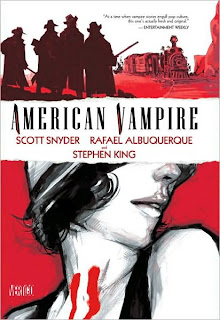
Book-A-Day 2010 # 342 (1/11) -- American Vampire, Vol. 1 by Snyder, Albuquerque, & King

Today's book is a request, I guess, or a recommendation -- a fellow Wileyite e-mailed me to suggest it, and ten minutes later my library was holding it for me. (Well, perhaps it wasn't that quickly, but I had the hold in within half an hour and the book in my hands the next night.) And that small fact saves me from thinking of a three-hundred-and-forty-second clever angle of approach to yet another day's book, which makes me very thankful towards @rutila. (The fact that the book itself was pretty good is nice, too.)

There's an assumption about books that have one big-name writer and one small-name writer -- prevalent among people who work in publishing, and even more so among those of us who are particularly cynical (assuming those two groups are not identical) -- which is utterly untrue in this case. Scott Snyder is the driving force behind American Vampire: it's his concept, his plot, and mostly his script. But he somehow dragged Stephen King into the middle and got The Big Man himself to co-script this first storyline. (I'm not sure if King continued with American Vampire after this point, but it wouldn't be a huge loss if he didn't -- the core of this book is all Snyder, and King came along because he liked that story, and, probably, because he knew his name would attract more eyeballs.)

So one-half of this American Vampire collection is King (from a Snyder plot or concept, apparently), and the other half is pure Snyder. The two stories break down simply: Snyder tells the "now" story (set in 1925 Hollywood), and King fills in the backstory, starting in 1880s out in Colorado. Pearl Jones, a hardworking would-be actress (currently working as an extra, and in a breakfast restaurant, and as a cigarette girl, to make ends meet), is the heroine of the 1925 story -- she's tough and smart, but something very nasty happens to her very early on -- perhaps the title will give you a clue.

The backstory is told by Will Bunting, a reporter-turned-novelist, who was there when the notorious outlaw Skinner Sweet was apprehended by the tough Pinkerton agent James Book -- and when Sweet's gang attacked the train carrying Sweet back to Bakersville to be hung, and when Sweet was killed...and when Sweet came back, later. King, as usual, isn't interested in a good-guys-versus-bad-guys story, so Sweet is as important as Book, and King's sympathy often seems to be with gleefully vicious Sweet -- not to say that Sweet isn't more sympathetic than the cold, old European vampires trying to sew up control of the West through railroads and dams.

As the title suggest, those old European vampires discover that they're not the only kind -- a new breed of vampire springs up in the West, with slightly different powers and weaknesses. (As far as we see here, just as strong, with weaknesses that are harder to exploit.) The series may eventually be about the struggle between the new breed of vampires and their older kin -- but, this time out, it's the story of Pearl and Skinner, one good girl and one very bad man, and how they both came to be what they became.

Vampires are a dime-a-dozen, of course, but this particular vampire story is worth telling: it's got energy, and style, and a point of view. (And, in Rafael Albuquerque's art, all of those things and more.) It's not the second coming of anything, but it does claim its own piece of ground in the crowded vampire field, over in the traditionalist side -- these vampires are brutal, self-centered, and never sparkly, or romantic, or domesticated.


Book-A-Day 2010: The Epic Index

Monday, January 10, 2011

Book-A-Day 2010 # 341 (1/10) -- Popeye, Vol. 2: "Well, Blow Me Down!" by E.C. Segar

This is the golden age for all kinds of comics reprints -- from comic books to single-panels, but especially the great newspaper strips of the 20th century. Fantagraphics and IDW seem to be trying to out-do each other with each new project, and other houses like Drawn & Quarterly and NBM are scarcely a step behind. Nearly every major strip is either in process or has been announced -- from Gasoline Alley to Mickey Mouse, from Mutt and Jeff to Dick Tracy, from Peanuts to Bloom County -- and the only problems for collectors is finding the money and shelf space to accommodate the flood of books. (And maybe the time to read them.)

One of most-forgotten of those great strips is Elzie Crisler Segar's Thimble Theatre: usually called by the name of its most famous character, Popeye, and overshadowed by his later exploits in bigger media (the Fleischer cartoons of the '30s, the many TV cartoons since then, the odd Altman live-action movie from 1980), Segar's original is a full-bodied funny adventure strip, with long, intricate continuities and a large cast of quirky characters. (Though Popeye was clearly the central character from soon after his introduction.) Fantagraphics has been reprinting the Segar Thimble Theater run, from Popeye's introduction in 1929 (ten year's into Thimble Theater's run, actually) through Segar's death in 1938, with four volumes out so far and a fifth due to be published within a couple of months. (I saw the first book back in 2008, and was very impressed -- impressed enough to get volumes 2-4, actually, though it's taken a while to work out a time and place to actually read these impressively large slabs of comics.)

The second book is Popeye: "Well, Blow Me Down!" -- the actual volume number is buried in the copyright information on the title page [1]; each book does stand alone, though, since each reprints whole continuities -- which was published in 2007 and reprints daily strips from December, 1930 through June 1932 and Sunday strips (which had a separate continuity) from '31 through October of '32. It also has a very short foreword by Mort Walker and the first half of a only mildly tedious academic-style article by Donald Phelps. [2]

Those who are used to only the post-Fleischer Popeye plots -- a large beefy type named either Bluto or Brutus kidnaps Olive; Popeye's strength is insufficient until he gags down a can-load of spinach; Popeye clobbers the man named B and embraces Olive -- will be surprised to see how expansive and inventive are the stories here. The dailies, with a broader canvas and longer continuities, first send Popeye and Olive's brother Castor out west to capture the notorious outlaw Glint Gore, then back for Popeye to spend his reward money setting up a "one-way bank," and then off to the South Seas for a long string of stories about the war between the nations of Nazilia and Tonsylvania, before ending up with another western story, with Popeye trying to clean up Skullyville, "the toughest town in the world." And those daily strips are a generous six panels long, giving Segar lots of space for wordplay, fighting, and various shenanigans.

The Sundays are somewhat more domestic, sticking closer to home, mostly with stories about Popeye's boxing career (taking on a series of bruisers set up by Mr. Kilph, who hates Popeye for reasons explained in the first volume), and many, many cartoons about Popeye calling on Olive or hanging out at restaurant run by his friend Rough-House. Along the way, a boxing referee named Wimpy shows up, and begins sticking around, continually bugging Rough-House for a hamburger (to be paid for on Tuesday, naturally) and, at the least sign of impending violence, declaring "Let's you and him fight." (Though that sentence is one a boxing referee could use a lot in his working life, and Wimpy does.)

Also included on the Sunday pages are Segar's contemporaneous Sappo strips, about a Castor Oyl-ish inventor and his harried wife, which are more typical genre entries (Bringing Up Father by way of Rube Goldberg) but have their own energy and verve.

Throughout it all, Segar's art is energetic and expressive, the printed-page equivalent of the black-and-white cartoons of the '20s, and his characters are broad and exciting but always identifiable. Popeye in particular has depths that later stories rarely dealt with: he's a brawling, gambling roughneck of a sailor, but he also has a huge soft spot for children and "brunecks" and a suitably Depression-era easy-come, easy-go attitude towards money. Seger's Thimble Theatre stories are great American originals, and they suffered the fate of every other great American original: to be watered down and redone a thousand times by a thousand hacks in search of a quick buck and a sure thing. But the original endures to be rediscovered, as often as necessary, and that's no small thing.


[1] After I typed this, I happened to look closely at the spine, where "Volume Two" also appears, in teeny-tiny type near the bottom.

[2] Its immortal first sentence:
From its inception in the mid-1910s, Elzie Crisler Segar's Thimble Theatre kept in mind that it was a theater indeed; and the outstanding result, and wondrous paradox, of this belief was that even the original cast -- Olive Oyl; her ferrety brother Castor; her staid, forbearing parents Nana Oyl and Cole Oyl; and her fiercely disconsolate suitor Ham Gravy -- occupied the foreground of the strip in physical presences, and, a fortiori, as it continued, and their proper demons entered them, their personalities.

Book-A-Day 2010: The Epic Index

Reviewing the Mail: Week of 1/8

It's another week, and here are the books I saw. Mail is still slow in these parts, for whatever reasons (snow? the fact that we're barely past the holidays? that publishers have finally realized that minor bloggers don't sell books?), so I'll be typing here for a shorter span that I do some weeks, which is no bad thing. [1]

Anyway, here's what I saw that first full week of 2011 -- two books that I haven't read yet and probably won't get too soon, but which you may love:

Vampire Federation: Uprising is the first book of a new series by Sean McCabe, in which there is a secret government of the vampire world (the federation of the series title), that clashes with "rogue vampires who threaten to destroy the world." Signet is publishing it in mass-market at the beginning of February.

And then there's Shojo Manga: Pop & Romance, a guide to drawing in the style of the Japanese comics genre for young women. It was put together by the leading anime school Kamikaze Factory Studio, and covers both traditional and digital tools. My drawing skills are pathetic at best, so I won't be trying this out, but those of you who do want to draw like Natsuki Takaya, this is the book you want. Collins Design is publishing it as a large trade paperback on January 18th.


[1] One of the tricks to having an interesting life is to set up your happiness bench-marks to be negatively correlated with each other: if you get a lot of mail, it means spending more time writing about it. If you have a lot of free time, that means that you're forgotten or unimportant. Try it for yourself!

Sunday, January 09, 2011

Book-A-Day 2010 # 340 (1/9) -- Sundome, Vol. 8 by Kazuto Okada

Some relationships are good, some are bad. And some, to paraphrase Facebook, are just complicated. It's entirely appropriate that my relationship to the manga series Sundome is complicated, since the relationship central to that series is deeply complicated. (Some might say "perverse," or "appalling," or "bizarre," but I'll stick with complicated.)

(If you want to trace my relationship with Sundome: follow back the train to volumes one, two, three, four, five, six, and seven.)

This eighth volume finishes up the series, and, as usual with complicated, long-running series, it's difficult to say much about this book other than generalities without writing about the events of earlier books. The central conceit is still the same: teenager Hideo Aiba is sexually obsessed with his classmate Kurumi Sahana, and they've fallen into a self-defined dominant-submissive relationship that has pushed both of their boundaries pretty far. Aiba is also the president of their school's "Roman Club," supposedly devoted to romantic pursuits, but actually a hide-out for a small group of geeky misfits.

In this book, the Roman Club, and the comedic plots arising from the fish-faced Katsu Toshitsuku, the gorgeous and pneumatic Kyouko (whom the rest of the members assume is part of some kind of plot to get them to break the club's central virgins-until-graduation rule), and the butt-obsessed "ex-Prez" are minor and backgrounded; this book is about the inevitable end of Hideo and Kurumi's relationship. There have been strong hints all along that Kurumi has a major illness -- of the Ali MacGraw style; so that she stays beautiful and physically unchanged, but is occasionally weak -- and that comes to the fore towards the end of this last volume.

The very end of Sundome is more positive and optimistic, in its own way, than I expected, and it turns out that nearly everything having to do with the Roman Club -- the entire series except for the Hideo-Kurumi relationship -- was subplot. And this book is almost entirely not creepy, though that may be primarily because the earlier volumes broke the creepy detector. I still wouldn't recommend this series to anyone who isn't comfortable with an D/S relationship between two teenagers, but it does cut to the heart of obsessive male teen sexuality like nothing else I've ever seen.


Book-A-Day 2010: The Epic Index

Saturday, January 08, 2011

Book-A-Day 2010 # 339 (1/8) -- Motel Art Improvement Service by Jason Little

Good comics are hell on those of us with poor waiting skills: a decent writer-artist is lucky to have a new book-length story every two or three years, and it often takes much longer than that. Take, for example, Jason Little. His first graphic novel, Shutterbug Follies, came out in 2002, telling a story of mayhem and intrigue swirling around teenaged Bee, a photo-shop clerk in New York. His lines were crisp and rounded; his colors bright and vibrant; his story bouncy and inviting.

And it took eight years for Bee to come back for another story. Motel Art Improvement Service was worth the wait, but it does make me wish that graphic novelists could manage to produce book-sized stories as quickly as their prose counterparts.

Motel doesn't have much direct continuity with Shutterbug; this time out, Bee is setting off on a cross-country bicycle trip at the beginning of the summer, heading from New York to San Francisco. So her roommate, Lyla, is the only real common element, and she's only in Motel briefly. (In other words: Motel stands completely alone; no knowledge of Shutterbug is required.)

Bee's cross-country trip doesn't work out as she expected; very soon, she's staying in a motel outside Bohemia, NJ, and trying to figure out her next move. There she meets Cyrus, who is working as a housekeeper, but who turns out to be as quirky and odd as she is. (He was a budding art-world darling, but dropped out and now wanders around the country, "improving" the art at small motels he works at briefly -- oh, and he also steals 10% of any medication or drug he finds in guests' rooms. [1]) Cyrus and Bee continue on together, and get closer over the next few days, taking new jobs together at a fancier Newark airport hotel.

In that hotel, they get caught in the middle of a drug deal, with a hotheaded soldier on leave on one side and two squirrelly Princeton kids looking to make quick money on the other. There's also an art dealer following Cyrus's trail, with a proposition to make, and the senior staff at the hotel, where they're not supposed to be living for free while they work there. It all turns into a big, mostly-serious chase, which Little handles with a lighter, surer touch than the climax of Shutterbug. (Though the antagonists in Motel don't seem nearly as dangerous as those in Shutterbug.)

Motel is sunny and fun, thrilling and sexy, confidently adult enough to be silly and serious by turns. It's even better than the entirely entertaining Shutterbug, and I fervently hope that Little will be back with another Bee graphic novel before another eight years pass. (Would it be too much to hope for two? Maybe three?)

(If you don't trust my unsupported word, Little has a sample of Motel, and plenty of other work, up on his website.)


[1] As someone who travels quite a bit these days, and who carries carefully doled-out heart medication, this did not endear Cyrus to me; it is, frankly, a serious asshole move.


Book-A-Day 2010: The Epic Index