


(The usual disclaimers, though, still apply to everything that follows.)
Fuzzy Nation
 is the first new novel from SFWA President John Scalzi since 2008's Zoe's Tale
 , and the first standalone (not set in the Old Man's War-iverse) since 2006's The Android's Dream
 . Of course, it's only a standalone within Scalzi's oeuvre, since it's a reworking of H. Beam Piper's 1962 novel Little Fuzzy
 , which had two sequels by Piper and two further sequels by other
 hands
hands . I've grumbled about the increasing tendency of mainline SF to look backwards (alternate history, steampunk, deliberately retro futures) -- and I'm certainly not the only one, or even near the first, to do so -- but I'll save those grumblings for an actual review of Fuzzy Nation. The book is a pleasant old-fashioned skiffy adventure story, lightly updated to modern mores, and is suitable both for current SF readers (as long as they don't demand adventurousness) and those who drifted away from the genre before the New Wave. Fuzzy Nation is a Tor hardcover with an official on-sale date of May 10th -- but I doubt it's a "day-and-date" book, so you could buy it right now, if you want.
 Next is a book that makes me feel old -- no offense to the book, of course, since, as time goes on, more and more books do that. The Golden Key
 was a three way collaboration between three female fantasy writers -- a concept that inexplicably was reasonably common, and popular, for several years -- which I remember well from my time at the bookclubs, but was surprised to re-discover was originally published in 1996. The three authors are Melanie Rawn, Jennifer Roberson, and Kate Elliott, and Golden Key -- a novel about a family of painters with a secret magical power in a Renaissance-esque world -- was very well-received at the time, and was even nominated for the World Fantasy Award. (Which doesn't happen a whole lot with multi-author books.) There's a new mass-market paperback edition of Golden Key coming from DAW in June, though, sadly, they've cropped the great Michael Whelan cover art so that Whelan's cheeky self-portrait can't be seen.
 Also from DAW in June (and also in mass-market) is Thistle Down
 , a contemporary fantasy by Irene Radford set in small-town Oregon. (Though I hasten to note that it doesn't seem to have any sparkly vampires in it. No buff shirtless werewolves, either, as far as I can tell.) This particular town, though -- called Skene Falls -- has a wood outside it filled with pixies, and the pixies are now threatened by the imminent destruction of the woods. Add one normal woman -- who never quite gave up on the pixies she saw as a child -- plus one pixie woman exiled to live as a mortal, and I expect they'll make up a plan to save the woods that's So Crazy It Just Might Work.
 DAW's third mass-market book for June is its usual anthology from Martin H. Greenberg's Tekno Books operation: Hot & Steamy: Tales of Steampunk Romance
 , edited by Jean Rabe and Greenberg. It has sixteen stories by mostly the usual Tekno anthology crowd -- Michael A. Stackpole, Jody Lynn Nye, Elizabeth A. Vaughan, C.J. Henderson -- all about love amid corsets and cogs, goggles and gauges, and all the usual steampunk furniture.
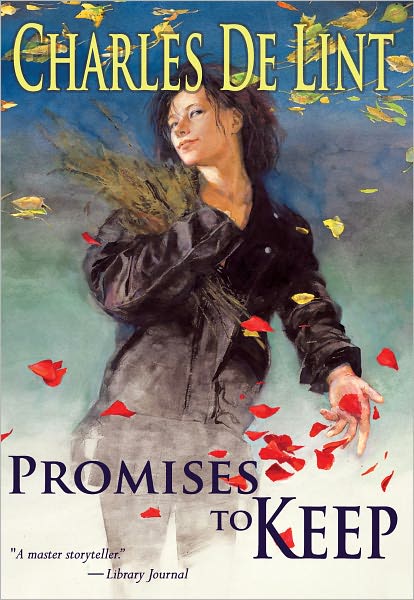 Charles de Lint's short novel Promises to Keep
 -- about the early history of Jilly Coppercorn, one of the central characters of his fictional city of Newford -- was originally published in 2007 as an expensive hardcover from Subterranean. In June, though, it will finally be re-released, as a reasonably priced trade paperback from the fine San Francisco publishers Tachyon.
 Adrian Tchaikovsky's "Shadows of the Apt" epic fantasy series continues to roll on, much faster than most of us would expect. The US publisher Pyr put out the first book, Empire in Black and Gold
 , last March, and already they've got the fifth book, The Scarab Path
 , in a matching trade paperback this month. (Tchaikovsky seems to be a quick writer, but he's not that quick -- Pyr is catching up with Tor UK. Tchaikovsky's home publisher, who started the series in 2008. But the UK is still one book ahead, with The Sea Watch
 hitting stores there in February.)
 Shoko Tendo was born to an uneasy privilege, the daughter of a Japanese yakuza mob boss. But his power waned as she grew up, and her teens and twenties saw her becoming addicted to drugs, caught up in the world of gangs, and trapped in one abusive relationship after another. Eventually, she broke free, got sober, and told her story in a memoir, Yakuza Moon, which was translated into fourteen languages. It also has just been translated into a graphic novel, called Yakuza Moon: The Manga Edition
 (even though it reads left-to-right and was adapted from the English-language version of Tendo's memoir), adapted by Sean Michael Wilson and illustrated by Michiru Morikawa. Kodansha USA is publishing Yakuza Moon: The Manga Edition in July as a trade paperback.
 . As usual, the American editions of Dungeon books each collect two albums of the French Donjon series -- in this case, "Night of the Ladykiller" and "Ruckus at the Brewery" -- and, as always, the series is written by Joann Sfar and Lewis Trondheim. (The continuity of Dungeon is detailed -- though not all that complicated -- so let me just aim any interested parties at the handy Wikipedia page.) These two stories have art by Jean-Emmanuel Vermot-Desroches and Yoann, respectively, and actually were published earlier than the stories collected in the last volume of Dungeon Monstres. (Heartbreaker
 , which I reviewed last fall.) I won't try to convince you that this particular book is utterly awesome -- at least, not until I've read it -- but the Dungeon series as a whole is a deep, thoughtful, complicated, shocking, amazing and utterly vital series of comics, among the very best available in that form. And, if you don't believe me on the subject, how about Jeff VanderMeer? Night of the Ladykiller is coming in June from NBM; if Dungeon sounds like something you'd like to try, I''d recommend dipping into Duck Heart
 , the first book in the central "Zenith" subseries.


 .
. 
 is the new novel by China Mieville, coming as a hardcover from Del Rey on May 17th. And it's a science fiction novel -- his first, unless you have a really good argument about
  . In fact, it looks like another angle on the cluster of concerns that motivated City & City -- it's set in a city uneasily shared shared by two groups, on an alien world far in the future. And the action of this novel seems to begin with the arrival of a new group of humans, which will shift the balance of power. Mieville has always been deeply interested in cities -- their governance, communities, their wonders and terrors -- so it will definitely be interesting to see him translate that into a SFnal milieu.
 is the fourth and last in Jennifer Fallon's "Tide Lords" series, about one of a group of Immortals who has been trying -- for longer than the human race has been around -- to finally die. I've read some of Fallon's earlier novels (though not this series, sadly), and she's got a great grasp of character and a broad scope -- she writes big fantasy books that aren't just about the same people doing many different things in a row, but of many people doing many things, just like a real world. This one will be published by Tor US in hardcover on May 10th; Fallon is Australian, so it's probably already available at her end of the globe, and might just have hit the rest of the Commonwealth as well. (If you haven't read the series at all, I expect the best place to begin would be the first book,
  .)
.)
 -- Hannu Rajaniemi's
  . I've been hearing about Rajaniemi and this novel for a few years now, so I hope it lives up to the advance notice. I'm also amused to see that Rajaniemi's day-job is as "director of a think tank that provides business services based on advanced math and artificial intelligence," which runs around and through several of the things I deal with at my own day-job out at the financial end of business publishing. In any case, Quantum Thief looks like a romp through a colorful and distinctive future, with a larger-than-life figure at its center -- exactly the kind of book that SF always needs more of (especially if it is as good as I expect it to be).


 , which I hope will be somewhat more positive and life-affirming than his usual work.
 , a sort-of new -- it collects work that has been more-or-less collected twice before in smaller, more comic-book-like packages -- collection of his "Glenn Ganges" stories.
 , the first graphic novel I've seen in a while from Matt Howarth -- though, apparently, he's been busy online, with
  by Charles M. Schulz -- the strip is solidly into the "feel-good" years by this point, though Schulz was still inventive, particularly in his longer sequences. And there were flashes of the old bleakness in the previous book, so I'm going to keep going with this as long as it stays entertaining, probably through the shaky years right up to the end.
 , which is the last published collection of Roger Langridge's great work on that series -- though there's reportedly another story arc by Langridge that's in semi-limbo as Disney pulled the license back from Boom!
  , a new original graphic novel by those fabulous Brazilian twins, Fabio Moon and Gabriel Ba. (They are real, though they sound like characters out of a minor Grant Morrison story.)
 , reprinting his strip from The New York Times Sunday Magazine's short-lived "Funny Pages" section. As I recall, it's the depressive side to Wilson's manic; another Clowes middle-aged schlub facing an uncaring world with very little to help or protect him.
 (4/25)
 (4/27)
 on Amazon, since I got the book, oddly enough, through their Vine program.