


As usual, these are the books that arrived in my mail last week, sent by the lovely and personable publicists at the various publishing houses responsible for sharing them with the world. Every single one of them will be someone's favorite book in the whole wide world, and that may just be you. (Even if I seem to hate it.) I have not read any of these, and my glances at them may be even more cursory than usual this week. But, with that being said, let's take a look at:

 , a new novella-as-a-book by Brandon Sanderson (author of the Mistborn series, hand-picked to finish Robert Jordan's "Wheel of Time" series, and general Big Name in the epic fantasy game), in which a thief is captured while replacing a priceless artifact of the obligatory Empire with her own nearly-perfect forgery, and must bargain for her life. To survive, she must create a new soul for the secretly comatose Emperor. Soul is a trade paperback from Tachyon, publishing in December.
 Also from Tachyon is the anthology Steampunk III: Steampunk Revolution
 , from the estimable Ann Vandermeer (lead editor of the first two Steampunk anthologies). It contains twenty-seven reprinted stories -- from such be-goggled luminaries as Garth Nix, N.K. Jemisin, Bruce Sterling, Nick Mamatas, Catherynne M. Valente, Caitlin R. Kiernan, Carrie Vaughn, Cherie Priest, and Lev Grossman -- and several brand-new essays on aspects of steampunkery of interest to aficionados. It will descend from its aether-powered blimp to book dealers near you in December.
 A month earlier, Tachyon has another anthology in a different genre: John Joseph Adams's Epic: Legends of Fantasy
 . As the title implies, it collects seventeen previously-published stories by big names including George R.R. Martin, Robin Hobb, Orson Scott Card, Kate Elliott, Ursula K. Le Guin, Tad Williams, and Melanie Rawn. Most of those stories are pretty recent, but there's a '60s tale from Michael Moorcock, and Le Guin's story is "The Word of Unbinding," of the same vintage. (So potential purchasers would be wise to check the Table of Contents to avoid potential disappointment.)
 From Vertical -- hitting stores tomorrow -- is HeroMan, Volume 1
 , the English-translation of the manga version of an anime created and written by Stan Lee (via the BONES studio), which just shows how gosh-darn global the comics biz is these days. Art is by Tamon Ohta, and the story is about a boy who becomes a hero through his toy-turned-giant-robot, the title character. (If I had a dime for every time one of my old toys turned into a giant robot, I'd have twenty-six dollars and forty cents.)
 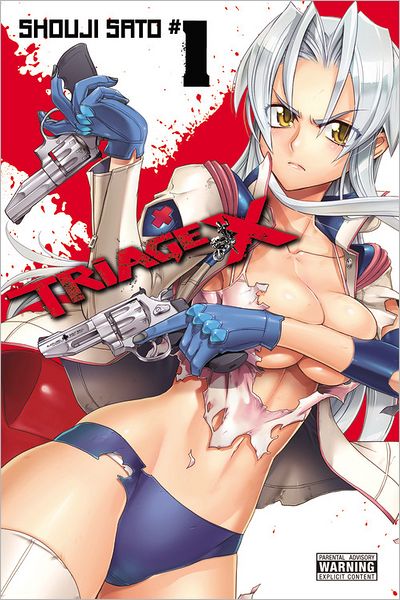 I have the monthly stack of fine manga published by Yen Press in front of me -- the month being, of course, October -- and, as usual, I'll run through it organized by the volume number of the books included. Thus, I will most likely become more and more confused as I go on, since a lot of plot can happen in a dozen two-hundred-page volumes...
- Shouji Sato's Triage X
debuts this month, with the fan-servicey story of buxom nurses who battle crime by night and sickness by day (and the tensile strength of their clothing every single moment).
- The Disappearance of Nagato Yuki-chan
-- which is itself a sidebar story to the popular Haruhi Suzumiya empire -- is written by Nagaru Tanigawa and drawn by Puyo from characters created by Noizi Ito; this month sees the second volume, where Haruhi makes a major appearance.
- The fourth volume of Durarara!!
-- created by Ryohgo Narita, character design by Suzuhito Yasuda, and the actual art on the pages done by Akiyo Satorigi -- hits shelves and virtual spaces in October as well, in which a lot of stuff happens, some of which centers on the fan-favorite headless motorcycle assassin Celty. (See my review of the first volume for more.)
 Yana Toboso's Black Butler
-- which I've generally assumed to be a bizarrely Victorian mystery series -- continues with an eleventh volume (or "XI," as the cover puts it), in which Earl Ciel Phantomhive (no, really!) and his butler set to sea to investigate a sequence of mysterious resurrections.
- Pandora Hearts
, from Jun Mochizuki, hits a twelfth volume -- I reviewed the first, a few years back, for ComicMix -- which seems to mostly be about a tea party and the picture taken there of the attendees. (I don't write 'em, I just do my best to report on 'em.)
- Last from Yen in the popular manga trim size this month is the seventeenth volume of Dall-Young Kin and Sung-Woo Park's energetic and violent Black God
. (I reviewed and liked the early volumes, and then came back last year to check out the fifteenth book.) I have no idea what's going on in this volume; the back cover copy is entirely mythology.


 , a graphic novel adapation (in an exceptionally manga-influenced style) in Cassandra Clare's Young Adult novel of the same name. Clare is credited as the writer on this book (which may be because she adapted it into comics, or may be just because she wrote the original), with art from Hyekyung Baek.
 You may have read Stephenie Meyer's Twilight. You may have read the sequels. You may have seen the movies. (You may have read a certain popular smutty series that started as Twilight fan-fiction too, but that's beside the point.) You may even have read the graphic novel adaptation of Twilight, written by Meyer with art by Young Kim. But, until this month, you haven't had a chance to read the Collector's Edition Graphic Novel
 of Twilight, which I hold in my hands right now. And you haven't gotten sated with Twilight yet, have you?


 , the follow-up to her comics memoir Smile, which was a #1 New York Times bestseller, an Eisner winner, and several other awards (and which both I and Thing 2
 , the third in Darwyn Cooke's pitch-perfect translations of the early novels by Donald E. Westlake alter ego "Stark" into comics that almost could have been produced at the time, if the '60s comics world was more amenable to crime stories utterly tough, true, and unsentimental.
 is a first novel by Teri Terry (and I do not envy the childhood that name probably gave her), and it's one of those dystopian YA novels I was just muttering about. In this one, the Oppressive Evil Government® has wiped clean the memory of a sixteen-year-old girl, for reasons she obviously does not remember. And, of course, she's meant to Straighten Up and Fly Right after her "slating," but living under an Oppressive Evil Government® means nasty things are happening, and what self-respecting YA protagonist can just sit by? There will be sequels, you can bet on that. Slated is coming as a hardcover from Penguin in January; it's already been published in the author's native UK.
 , which continues the story of her debut novel, Legend. In this one, America has balkanized into two countries -- at least one of which has an Oppressive Evil Government®, with added militarism -- and two fifteen-year-olds, the prodigy good girl and the criminal bad boy, fell in love in book one while learning the secrets of their very, very rotten world. The package for Prodigy doesn't give any hints of what happens this time out, but it's the middle book of a dark, dystopian trilogy, so I wouldn't hope for anything happier than Empire Strikes Back. Prodigy is a hardcover coming in January from Putnam. (And also a dead online service which I suspect Lu is too young to remember.)
 has previously been a large-format limited edition and a "live shadow show," but now it's a widely available book, which tells the story of an East Texas seamstress, five orphans, and the creepy tale told to them by a mysterious storyteller in black -- not to mention the ominous box he lays down in front of them as a prop. Fifty Year Sword contains illustrations stitched by three seamstresses, a novella's worth of text, and a very bumpy cover -- and it promises as immersive and complicated a reading experience as Danielewski's other books. Pantheon is publishing it in hardcover on October 16th.


 is not officially a zombie novel. Matthew Costello's second novel -- a sequel to his first,
  -- is set in an apocalyptic near-future where there are flesh-eating formerly-human monsters have overrun society, destroyed the rule of law and order, torn families apart, and made getting a decent tee-time a thing of the past, admittedly. But they're called Can-Heads, so they are most assuredly not zombies. But, if you like to read about a small band of plucky survivors killing lots and lots of people -- and feeling morally superior because they're not really "people," so killing them is just fine -- you'll have another opportunity to indulge your baser instincts when Thomas Dunne Books publishes Home on October 30th.
 is the fourth and concluding book in Tad Williams's big epic-fantasy series "Shadowmarch"
 is the fifth book in Laura Resnick's ongoing urban fantasy series about Esther Diamond, struggling actress and reluctant fighter of supernatural evil
 , from Tanya Huff, is a sequel to The Enchantment Emporium, continuing the story of matriarchially-run magic shops across modern Canada.
 , a slim book that harvests rules for living from J.R.R. Tolkien's tales of Middle-earth. (Presumably "Do not meddle in the affairs of wizards, for they are subtle and quick to anger" is right up top.) There is an introduction by Peter S. Beagle, and an
 , which has now been published in a handsome Penguin Classics edition, with French flaps and a gorgeous illuminated-manuscript-style cover. (Of course, you e-book types lose all of that, but you're probably all reading mommy porn anyway, if the bestseller lists are any indication.) That handsome edition hits stores on October 30th.
 (a novel based on the videogame series, and written by Karen Traviss) and understood perhaps one word in three. So I can tell you that there are people fighting very hard about things that you probably care about vastly more than I do. (And doing so on a Thursday, apparently.) I can tell you that this is in the "Kilo-Five" trilogy -- I suspect the middle book, since it's Traviss's second Halo novel, but don't quote me -- which may affect your buying decision. And, lastly, I can tell you that it's a Tor hardcover that published on October 2nd. If you like reading novels based on videogames -- an idea which, frankly, confuses me, since playing videogames mostly makes me want to play more videogames -- here is one to read.
 (and tells another aspect of the back-story of that popular villain of the series) and leads up to events in the main comics series. It's a zombie story, which means you know what it's about: the living dead will eat your flesh, but the real humans are even worse, those power-grubbing, nasty, scheming bastards. If that's the kind of world you like to immerse yourself in, I won't judge you. (Well, not to your face -- that would be rude.) Road to Woodbury is a hardcover from Thomas Dunne Books, coming on the 16th (which would be tomorrow).
 is a graphic novel in Kim Harrison's "Hollows' contemporary fantasy series, written by Harrison with art by Gemma Magno. As has become usual for such graphic adaptations, Blood Crime is a prequel to the main series (though a sequel to the first graphic novel,
  ), telling the story of an early case of series heroines Ivy Tamwood and Rachel Morgan. Blood Crime is from Del Rey, and hits stores on October 30th.

