I went straight from the structure of October (which became
Starktober around here) to first a family vacation and then a work conference, so reading fell off a lot this past month. Of course, the real lesson is more complicated: like everyone else, I'm busier and have more distractions than I'd like, so I need to prioritize the things I really want to do. When I do prioritize reading and writing about books, that happens regularly -- when I don't, it doesn't.
This was a "don't" month, then. But here's what I did read, and perhaps something will seem interesting to some of you:
Lisa Lutz,
The Last Word
(11/2)
This is the sixth and potentially final -- my suspicion is that Lutz thinks the series is over, but her publisher hopes to persuade her otherwise, so the book itself doesn't
quite promise there will be no more books -- novel in the series of seriocomic private-eye books about Isabel Spellman and her complicated, difficult family. I've written about the series before in round-ups in
November of 2012 (the first book) and then
January (books 2 and 3) and
February (books 4 and 5) of this year. It's a really good mystery series that I haven't wanted to dissect here: they each work well as individual novels and move this family forward along a larger plot, which is a remarkable achievement to be celebrated. If Lutz does manage to quite the series here -- and intended to -- it will be something nearly unique: a series that didn't outstay its welcome, didn't descend into self-indulgence, didn't fall into the twin faults of massive woe or massive joy, and did tell a great story. I recommend these books really highly; start at the beginning with
The Spellman Files.
Gahan Wilson Sunday Comics
(11/14)
For two or three years in the mid-70s -- the back cover says 1972-1974, the afterword by Gary Groth says March 3, 1974 to June 5, 1977 -- Gahan Wilson created a weekly Sunday comic, for his then-hometown paper
The Boston Globe and syndicated at least somewhat by The Register and Tribune Syndicate. And now all of those strips have been collected in one place, surprising a lot of Wilson fans who had no idea he ever did such a thing.
There's no continuing story, and only a handful of "continuing characters" -- really just stock figures for Wilson's gags.
Sunday Comics was a collection of gags, something between a place to use the single panels that magazine editors rejected and a place to work out the ideas that weren't right for those magazine clients in the first place. Some of the weekly "strips" had a vague theme -- there are a number of holiday-themed installments, for example -- and there were recurring "features," such as the space-themed "Future Funnies" and the serial-villain-looking "The Creep," but
Sunday Comics was essentially just a collection of gags. Those gags are all Wilson, though not high-powered Wilson; he clearly had to work more obviously and less cruelly to fit into newspapers -- Wilson's best work is more dark and creepy than he's ever allowed to get here.
So this is a diversion, and interesting sidebar to Wilson's main career. It's mostly for Wilson fans -- but I am one, so I'm thrilled to see it, even if I was surprised to know it ever existed.
Catherynne M. Valente,
The Girl Who Soared Over Fairyland and Cut the Moon in Two
(11/19)
September is no longer the heartless child who first visited fairyland (and saved it from an unpleasant ruler) in
The Girl Who Circumnavigated Fairyland in a Ship of Her Own Making, or even the year-older person who returned in
The Girl Who Fell Beneath Fairyland and Led the Revels There to fix a problem she didn't know she caused. This third time out, she's solidly a teenager, growing up in a Kansas where the distant War is possibly rumbling to an end and learning to drive an old Model A Ford borrowed from a neighbor.
One might assume that this is the third book of a trilogy -- by the end of this book, September has now seen fairyland from all around, beneath, and above, which sounds final, and growing up has generally proved to be a fatal to journeys to fairyland. But Valente took aim at that latter assumption in the last book, and
Soared is definitely
not the last story about September. (I can say that much without without getting into the details of the end of this book.)
Unfortunately, I didn't find
Soared as vital and enthralling as the first two books. I don't know if that's due to my own jadedness, or if Valente is writing a different kind of story this time out, or if there's some other reason. But I enjoyed
Soared without loving it the way I did its predecessors. Whether people more female and substantially younger -- the true audience for this book -- will feel anything like the same way is a question I can't answer.
Alina Simone,
Note to Self
(11/22)
Simone is an excellent musician (now retired, I think) who has previously written the very good collection of memoir essays
You Must Go and Win, which explored a lot of the aspects of her interesting life: the rock 'n' roll dream and the horrible apartments that show up on the way there, her ancestry in Ukraine and Russia, the perils of an examined life.
Note to Self is her first novel, about a woman in her late '30s who's addicted to the Internet -- clicking random links for hours on end, checking news and social media and Craigslist, dreaming ideas of what to do with her life and never following through.
Note to Self is the story of what happens to that woman, Anna, when she loses the dead-end "cubicle serf" job at a law firm that she thought she hated, and tries to move on to something better. Like so many people, she decides she wants to make art, which pushes her to meet a filmmaker, and that reverberates through other parts of her life as well. Simone's voice is smart and quick and witty, and every page of
Note to Self is a joy to read. I thought the ending was a bit rushed and didn't entirely fix the problems that the book had set up, but it's a first novel -- and a very assured and promising one at that.
Lemony Snicket,
"When Did You See Her Last?"
(11/25)
Snicket, in case you don't know, is the YA-writing pseudonym of Daniel Handler (whose first novel
The Basic Eight I will continue praising until every last person in the world has read it) and whose first major work was the excellent, very dark, and surprisingly popular "Series of Unfortunate Events," thirteen books in which things went very wrong for three orphan children. "Snicket" didn't produce any novels for several years, but has returned with a four-book series called "All the Wrong Questions," about Snicket's own youth -- the "author" was the narrator of the first series, and at least a minor character as well.
The first book of All the Wrong Questions was
"Who Could That Be at This Hour?" and this now is the second: young Snicket, just shy of thirteen, is still in the decaying ex-coastal town of Stain'd-by-the-Sea, still working for his incompetent, distracted, self-obsessed "mentor" for their mysterious organization of interlopers and busybodies, and still -- as he tells us in his narrative voice, years later -- following up the wrong leads and missing the point. The matter of this series comes from the last few generations of juvenile horror -- pre-
Goosebumps, I think, with John Bellairs as a major touchstone -- but the tone and style of writing is straight out of the pure adult PI tradition, with requisite Chandlerisms and
femmes fatal not yet old enough to drive.
It's a mystery, so much of the enjoyment is seeing the details first come out and then fall into place, and I won't spoil that. Snicket/Handler is still an incredibly engaging writer, by turns deviously tricky and emotionally direct, and this series is at least as good as "Unfortunate Events" was.
Next month: who knows? I'm sure I'll manage to read
something, though.


 is the most recent major Kim Deitch book, in his ever-proliferating Waldo universe of secret histories of obscure and oddball entertainment media of the early 20th century. I reviewed it with two other (very different) graphic novels two years ago, and I just had to re-buy it, since my first copy was lost in the flood. But I was happy to do so.
 Rick Geary has a new book in his long-running series of graphic novels about historical murders, currently under the umbrella title "A Treasury of XXth Century Murder." This year's entry is Madison Square Tragedy
 , about the 1906 murder of noted new York architect Stanford White. I've reviewed many books in this series over the years, and expect this one will be as carefully-researched and thoughtfully executed as all of the rest.
 I also had to re-buy Thor Visionaries: Walt Simonson, Vol. 3
 , since my first copy was lost in the flood. (I think my sons might like to read this one, one day.) And this is the book with Skurge's last stand at Gjallerbru, one of the finest moments in comics, and in heroic literature.
 The program to reprint the whole run of Charles Schulz's strip Peanuts has continued at Fantagraphics -- two volumes a year, regular as clockwork -- with The Complete Peanuts 1989-1990
 .
. And there was a new graphic novel from the Norwegian cartoonist Jason this year, called Lost Cat
 , which is some kind of Chandleresque hardboiled PI story.
 I will re-collect the entire Love and Rockets saga, so I can do a big re-read -- it's now the major thing on my "future reading projects" shelf, now that Starktober is done -- and I got two books this week to bring me closer to that goal. First was the new book for this year, Love And Rockets: New Stories No. 6
 , by both of the Hernandez Brothers.
 And the other one was Human Diastrophism
 , collecting the second major storyline from the original L&R series by Gilbert Hernandez. I've not got nearly twenty L&R books, and only need about three more -- I should be able to get this reading project in sometime in early 2014, before New Stories No.7 hits.
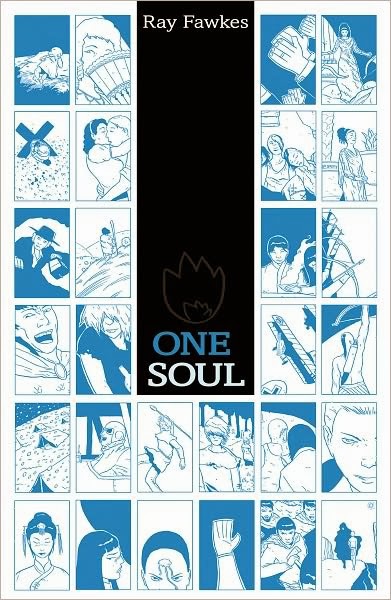 Ray Fawkes's One Soul
 is a book I've already read -- I reviewed it when I got it from the library about eighteen months ago -- but it's so good and so wonderful that I needed to own a copy for myself. I hope you decide to do so, too.
 Drawn & Quarterly's program of Yoshihiro Tatsumi's books continues with his contemporary work, which only very slightly disappoints me -- A Drifting Life is deep and interesting and thoughtful, but Tatsumi's early-'70s stories as collected in The Push Man, Abandon the Old in Tokyo, and Good-Bye are raw-nerve powerful and searingly immediate, so I want to see if he has more work as unrelenting and striking as those from around the same time. So his new book this year was Fallen Words
 , originally published in 2009 in Japan.
 Another book -- like One Soul -- that I bought because it's so major and so full of energy that I know I'll need to read it again is Anders Nilsen's Big Questions
 , a gigantic and major graphic novel that's as good as. I did a quick review of it when I read it two years ago.
 And last was Vanessa Davis's Make Me a Woman
 , which I've been vaguely looking for since late 2010, when it was published. (When you already have a lot of unread books, and are interested in lots of things, most of the books you're looking for aren't all that urgent -- you can find the ones you happen to come across in person, or find cheaply, or whatever, letting chance decide what you read next.) I've liked her short strips in various anthologies and Year's Best books, so it will be fun to see a whole book of her work.


 , because it makes me feel so very old to remember when the first book in the series came out from Harper in the mid-90s and I bought it for the SFBC. The editor is still David G. Hartwell, who is as close to the perfect SF editor (both long and short form) as it's possible to find in this imperfect world. And this latest edition of the annual series collects twenty-eight of the best stories of 2012, from writers including Eleanor Arnason and Andy Duncan, Linda Nagata and Gene Wolfe, Megan Lindholm and Paul Cornell, Pat Cadigan and Tony Ballantyne. All of those are short stories, and all are science fiction -- rather than fantasy or something else -- at least according to Hartwell's compass, since people can and do disagree strongly on the subject. Year's Best SF 18 is available as a trade paperback on December 10th.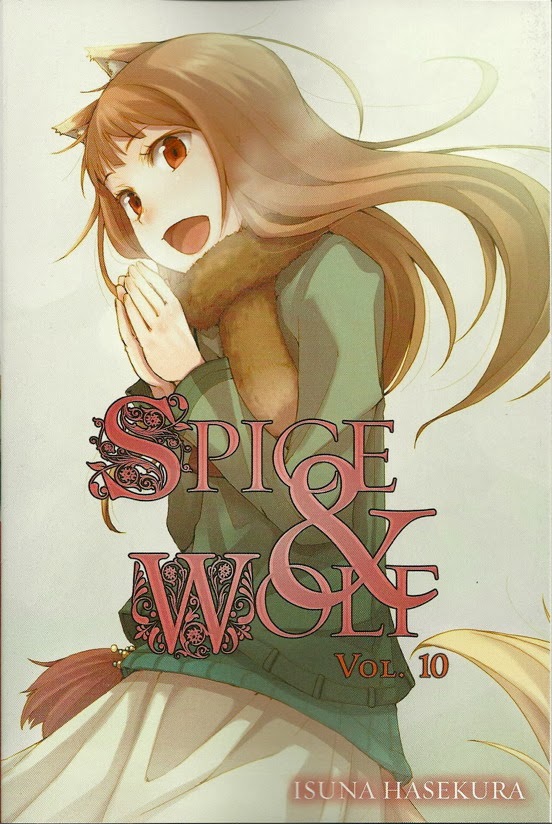
 by Isuna Hasekura, from a series of "light novels" (which, in Japan at least, are shorter and quicker reads than things sold as just plain "novels") about a medieval merchant and the ancient goddess embodied as a wolf-girl who travels with him. There are seventeen novels in the series in all, so we're a little over halfway at this point. If you've ever wished that your secondary-world fantasy had fewer flashing swords and more details of economics and trading, you are in for a huge treat with this series.
 is set in the world of Sherrilyn Kenyon's urban fantasy series "Dark-Hunters," and is credited to Kenyon, with art by JiYoung Ahn. I'm not clear if this adapts part of Kenyon's sprawling series of books, or if it tells a new story set in that world -- I think it's the latter, but the book itself doesn't make the connection clear. In any case, there's a teenage boy who has recently (in the first book) discovered he has supernatural powers and Everything He Knows Is Wrong, along the usual lines of urban fantasy.
 adapts Gail Carriger's steampunk series -- I think each comics volume adapts one book, so this would be 2010's Blameless in comics form -- with art by an entity credited as REM. (Not the one with the twanging guitars, I presume.) I
 . She's a cursed half-angel, half demon! He's a full angel! They're
 , and I have to admit I have no idea what the title means, even after a quick skim. But it's about Roxas, who was born as a Nobody and is now part of Organization XIII -- and if you know what that means, go for it.
 is back for a second volume, in which the bunch of young Japanese people kidnapped and trapped in an abandoned courthouse continue to be forced to decide which of them are the worst sinners and be killed. (So it looks like a slightly more legalistic Saw from my point of view.)
 is by Ikumi Katagiri and Ai Ninomiya (credited as "original story by") and is some kind of Alice in Wonderland-themed story with gangsters in a weird alternate world.
 . Kazumi, the helpful subtitle adds, is "The Innocent Malice," which makes everything all right.
 , continuing Hiroshi Takashige and DOUBLE-S's story of a blind swordsman (those are the most dangerous kind, of course, just like little old men have the deadliest kung fu) and the precognitive girl he's protecting from the obligatory evil rich man (here called Mr. Wiseman, to be that much more on the nose).
 contains more 4-koma gag strips about the six girls living at the Hidemari Apartments and taking art classes at their school, by Ume Aoki.
 is back for an eighth volume -- actually, I should admit that I don't know for sure if it's still ultraviolent, but it certainly was for the first two volumes, which I
 has arrived: they love this series about an amazingly enthusiastic and innocent young girl encountering new things and being amazed by them over and over again. (I have to admit that it's never clicked with me, though I'm not quite as clueless now as when I read
 , the latest in a very energetic and active boys' manga series, with all of the associated demon-fighting and details about everyone's secret moves. (I reviewed the first volume of this one
 will be happy to hear that the seventeenth volume is now out, and anyone else is advised to find the beginning and start there. It's by Gaku Tsugano and Nagaru Tanigawa, as usual, and contains approximately twelve times the recommended daily level of teen-girl energy.
 , another series (this one by Jun Mochizuki) that does weird things to Alice in Wonderland for its own purposes. I reviewed the first volume back


