There's a standard for autobiographical comics: they have to be about
"you," obviously, but that "you" must be larger than life. Whatever
your actual flaws are, make them bigger and funnier -- your cartoon
avatar must be a cartoon, in all of the senses of that word that you can manage.
Gina
Wyndrandt understands this instinctively -- or maybe from her
art-school background in Chicago -- and so her first collection of
comics, Someone Please Have Sex With Me, features a hot mess
central character exaggerated from what the real Wynbrandt must think
are the most interesting (or most easily parodied) aspects of herself. Someone Please
collects five minicomics -- one for each of the last five years --
which are essentially all of her work to date. (I found another
one-pager on her website, but otherwise this is pretty much it; she's right at the beginning of her career.)
So
the Gina of these comics is sex-obsessed and self-deluded, a big ball
of longing and wrecking-ball destructiveness, a more clueless Melissa
McCarthy character. (American culture never knows what to do with
oversized women, like it doesn't know what to do with loud ones, so
there are few role models for a Wynbrandt character. In her lazy
thoughtlessness, she's almost more like a gender-swapped Kevin James
character, if that makes any sense.) Comics Gina starts out obsessed
with Justin Bieber -- inappropriately, as even other characters point
out -- and Wynbrandt's fantasy-tinged stories allow her avatar to meet
and have a relationship with him.
It all turns out
badly, of course -- autobio comics are usually about wacky people
failing, and Wynbrandt is in that tradition. But it turns out badly in
nutty over-the-top ways -- like the title story, which projects a
sex-starved Comics Gina almost a century into the future, still begging
and cajoling and maneuvering to get more nookie. Each story works that way, starting with something like reality and then steadily moving farther and farther afield as Cartoon Gina deforms reality around her with the force of her demands.
The
art improves steadily over the course of the book, getting more assured
and expressive with each story -- and even the first one, "One Less
Lonely Girl," is just fine. The book itself is a cute little thing,
drenched in a very girly pink for maximum impact.
I
hope Wynbrandt finds other things to cartoon about than herself,
eventually, but she's got a fun character in Cartoon Gina, and there's
still plenty of life there. As a first book, this is both a hoot and a stake driven into the sand to show the direction Wynbrandt is going to be headed (away from everyone else, which is the best direction to travel for a new creator).
Wednesday, November 23, 2016
Tuesday, November 22, 2016
Invisible Ink by Bill Griffith
It takes some kind of chutzpah to write a full-length book
about your own mother's infidelity. And a towering sense of equanimity
to do so positively, openly wishing your mother had married the man she
dallied with for sixteen years instead of the presumably lousy second
husband who is barely named. But Bill Griffith has both of those things
-- and, on top of that, a much better ability to control and shape a
complex book-length story than one might expect from the cartoonist
behind Zippy the Pinhead for the last few decades.
Invisible Ink is billed as "a graphic memoir," but it's more about Barbara Jackson Griffith -- Bill's mother -- and Lawrence Lariar, the cartoonist she had an affair with from 1957 to 1973. Bill tells the story, and organizes it -- like so many Zippy sequences, this is the story of the "Griffith character" looking at things and thinking a lot about them, though he lets himself be more grounded and less neurotic than his usual Zippy persona. (It helps that he's not trying to set up a punch line every four panels here, of course.) Bill, or his cartoon avatar, is our guide, and the one who uncovers the story -- but the core story is about Barbara and "Mr. Lariar," as she always called him.
Along the way, we learn that Bill's childhood was not all that happy -- he and his sister Nancy were both regularly beaten by their tightly-wound father (even before their mother's long affair, in case anyone suspects a cause-and-effect relationship), though Bill hit back at age eleven, and that seems to have stopped the abuse for him, at least. That father, Jim Griffith, stays a distant, cold, unpleasant figure throughout the book; he was young and happy once, but that curdled when the two children were young and didn't lift until his unlikely bike-accident death in 1972. Bill wasn't thus super-close to his mother, either -- it looks like one of those chilly WASPy mid-century families, where the kids play outside and far away as much as they can to stay away from the parents that much longer.
Barbara told Bill about her affair right after Jim died -- Bill was in his late twenties then, but, still, it's an unusual thing to tell even an adult son about a long-running affair. The affair was just about to break up then, as Griffith shows here: Lariar was married, and didn't want to break that marriage for the newly-free Barbara. But Barbara wanted a solid relationship, one that encompassed her whole life, and wasn't willing to stay the woman on the side once her own husband was gone. So Lariar broke it off, and Barbara married that barely-mentioned second husband a year later, on the rebound.
Some time after that, Barbara wrote a novel -- never published, and it's not clear if it's even finished -- about her life and centering on that affair. (Amusingly to me, to simply her life into fiction, she shrunk "her" family down to one child, leaving Bill out of the book entirely.) Invisible Ink is, in part, about what Bill learned by reading that novel -- and also, in part, what he learned while obsessively researching Lariar. (He now claims to be the preeminent expert on Lariar in the world, which is entirely plausible.)
Invisible Ink is a deeply humanist book, full of thought and wisdom: it's the book of an older man looking back at several lives (his own among them) and seeing the things that could have gone better. There's a wishful tone in places, but more often an inquisitive spirit: every life has secrets, and Invisible Ink is the story of Bill Griffith delving into the deepest secrets closest to his own life and coming to terms with what he finds out. Actually, "coming to terms" is too strong -- Griffith already accepts all of it; there's no anger or disbelief here. He just wants to understand and to know -- and, along the way, he presents it all for us, written thoughtfully and drawn compellingly.
Monday, November 21, 2016
Reviewing the Mail: Week of 11/19
Here I am once again, to tell you about the book that arrived in my mail last week. Yes, this time out it's "book" -- singular rather than plural. (Saves me some time on a Sunday morning, which is no bad thing.)
And that book is the new SF novel by Hugo-winner Robert Charles Wilson, which is pretty darn great even before we look at the book itself.
That book is Last Year, one of those SF stories in which time travel exists, but each portal connects to a different alternate universe -- and that new universe is, obviously, immediately altered by the connection and starts to move further and further from recorded history as future people change things up.
One such gateway has been opened to 1876 Ohio, but it's been open for about a decade, and the locals have gotten more familiar with future people -- even jaded, you might say -- and its days as a tourist attraction are numbered. Which means that gateway -- the only possible link between those two worlds, unrepeatable and unique -- might just be severed forever sometime soon.
Jesse Cullum is a native of that 1876 Ohio, but he's in love with a woman from the other side of that gate. And so he needs to get through it while it's still there -- no matter what that takes.
Last Year is a Tor hardcover hitting shelves and electron-dispensing apparatuses on December 6th. Check it out.
Recurring Motifs:
Reviewing the Mail
Wednesday, November 16, 2016
Cousin Joseph by Jules Feiffer
Jules Feiffer, I'm beginning to believe, can write anything. He's a cartoonist (Explainers), a screenwriter (Carnal Knowledge), a playwright (Little Murders), a memoirist (Backing Into Forward), and, late in life, a graphic novelist (Kill My Mother).
I won't claim he's always entirely successful at all of those things --
who ever is? -- but he's done good work in all of those areas, over a
fifty-plus year career.
So I find myself wanting to softball his new book Cousin Joseph, another graphic novel that is both a prequel to Kill My Mother and the middle book of a trilogy. It's got that great scratchy Feiffer line, and a lot of great Feiffer dialogue -- so does it matter that it also has a lot of warmed-over '30s movie cliches?
Cousin Joseph is the story of the father of the women in Kill My Mother, and it ends about as well as that book did: this trilogy is deep noir, the movies that Feiffer didn't get to write because the genre ended when he was a young man. It has a twisty plot, a lot of characters, plenty of overheated dialogue, some shocking revelations, deep-seated corruption, and a tough man trying to do right at the center of the story -- again, I said it was noir.
I think it's a bit less coherent than Kill My Mother, which was already pretty far over the top, but still a fun genre exercise for a great creator whose work is always fun and engrossing. And I think I want to leave it at that; I'll be back for the big trilogy-ending finale, and hoping that focused the whole series and makes it all sing.
Tuesday, November 15, 2016
The Private Eye by Brian K. Vaughan and Carlos Martin
Metaphors are wonderful things, in their places. They can brighten
literary works, create unexpected parallels, and add depth to stories
that otherwise would feel thin. What they can't do, though, is
substitute for worldbuilding. (There are a thousand bad examples back on
my homeworld of Skiffy.) A metaphor has to become concretized in
a story, to be something other than the words that make it up -- it has
to mean actual things that happen in the story or underpin it.
I'm saying all this because Brian K. Vaughan doesn't seem to have learned that lesson yet.
The Private Eye is based on a metaphor: blatantly and nakedly. We say that all of our data is "in the cloud" these days, yes? Well, in The Private Eye that cloud burst! And it rained data upon the USA! For a highly biblical forty days and nights! Isn't that exciting and amazing?
But if the reader thinks about that for a nanosecond, the questions instantly pop up. Did some hacking group simultaneously break into AWS and Google and the NSA? Did a million disgruntled tech employees team up with WikiLeaks in the greatest data-dump known to mankind? Did a foreign power get everything at once and release it? Did the Internet itself become sentient, like an early William Gibson story, and throw off all of the merely human shackles on it? (That last one is the least likely, though it's the most plausible mechanism for everything being accessible immediately.)
And did this happen to the whole world, or just the US? If the latter -- which the story hints is the case -- what stopped it from going wider?
Vaughan doesn't care about any of those questions. The cloud burst! Get it! Isn't that awesome?! He waves away any tedious questions about how dozens of different, physically separate servers could "burst" simultaneously, or how the Internet would remain up while everyone did all of this intensive research on their neighbors and co-workers over a month or so, or even how people were able to find anything meaningful in a torrent of unindexed terabytes of random stuff from a million sources.
Even worse, what seems to be the most damaging things were individual search patterns and web history...you know, the stuff that's mostly held locally and already has prompted a lot of unpleasant conversations between family members and co-workers? Of all of the things that could happen in a world with total data transparency -- from baroque forms of identity theft to chaos in the financial markets to weird forms of information arbitrage -- widespread distress about regular people's sex lives is easily the most boring, conventional, and dull.
And all of this could have been avoided: Vaughan didn't need that metaphor in the first place. All he really wanted was to tell a near-future detective story in a world where everyone wears masks. (Like superheroes! Because this is comics!) Now, except for the opening pages, the fact that masks hide identities really isn't important -- it really looks like Vaughan started from "wouldn't it be kewl if everyone dressed up like superheroes" and didn't go much farther than cobbling up a quick explanation for that.
But that's what he did: the "cloud burst," and the USA collectively turned off the Internet, destroyed all serious computing devices, and went back to making shiny physical stuff like we did in '50s SF. A generation or so later, the US is prosperous if insulated from the world (which is also against every economic lesson of the last 200 years, but I'll let that go for now) and everyone wears masks all of the time because Vaughan thinks that would be awesome. Oh, and the media are now the police, for no obvious reason -- though that's also a cool metaphor!
That all is too bad, because the detective story is OK (if very conventional and Chandleresque) once you finally get down to it. Sure, there's a murderous megalomanical billionaire with a stupidly complicated plot to do something both gigantic and silly, but you have to expect a comic-book writer like Vaughan to go too big: that's what comics trains writers to do. (Oh, and the foreign-accented henchmen as well...come to think of it, there are a lot of cliches here, so spotting them could be an amusing pastime while reading.) Our hero is the usual guy who walks down mean streets but is not himself mean -- yadda yadda yadda -- but he also has a fancy apartment that can get trashed and a comic-book hero's requisite quirky and vitally useful sidekicks, so he's less Philip Marlowe and more MacGyver.
The art is from Marcos Martin, in low, wide pages originally designed for screens -- which translates into a short fat book that is substantially more expensive that you might expect -- and there's less to criticize there: he tells the story cleanly, using his unusually-sized pages well. The art is a bit scratchy and dark, to suit the noir atmosphere, which colorist Muntsa Vicente also plays up.
I can't really recommend The Private Eye to anyone familiar with prose science fiction or mysteries; it will come across as cartoonish in a number of ways to readers who've thought about any of these things before. It has been pretty lauded in the comics market, which possibly says more about that market than about the book. It is pretty, and it aims higher than most comics about people who wear masks all of the time, and it has a real structure and ending. That may sound like damning with faint praise, and maybe it is. But it's better than you might expect for a comic about an LA full of costumed wackos that was originally going to be called Masks.
Monday, November 14, 2016
A Song for Millennials
On the way in to work this morning, I realized this song is very appropriate -- both in my country and the UK, sadly -- for the generation seeing their parents turn to xenophobia, racism, and fear-mongering. (Me? I'm the generation in between. Gen X has never been large enough to be more than a media blip; we're the pause between the boom and echo. My parents are late war-babies and my kids are probably whatever we'll call the bunch that comes after millennials.)
The video itself goes in a different direction, but the lyrics are very appropriate as "leaders" in both countries try to figure out how to actually deliver the frightening things they've promised:
Reviewing the Mail: Week of 11/12
Yeah, Monday again. What can you do? On my end, what I do is list some books that came to me by the fine folks in American book publishing, hoping that you the home viewer will find something that you will clasp to your bosom forevermore. (Or, being more realistic, read with moderate appreciation and then argue internally about donating to the library sale.)
This week, I have five manga volumes from my friends at Yen Press, all coming out this month. I have them organized basically in order of size, because why not?
Anne Happy, Vol. 3 comes to us from the mono-named Cotoji, and continues the story of the unluckiest class in Tennomifune Academy. (They seem to be officially unlucky, as if this is set in a world where karma can be quantified, as in a video game, and students can be sorted based on it.) It seems to particularly focus on three very, very unlucky girls, and I understand the aim is light, mostly positive comedy.
A very different school figures in Dragons Rioting, Vol. 5 by Tsuyoshi Watanabe. It's (I think) about a boy at a very competitive and formerly all-girls school -- and that "competitive", in best manga fashion, extends to martial arts, so these kids are beating the crap out of each other as well as taking tests.
Then there's Sword Art Online: Girls' Ops, Vol. 3, another side-story about those poor kids trapped in an MMO (as opposed to all of the other manga stories about other poor kids trapped in their own MMOs). This one has art by Neko Nekobyou and credits original story (the light novel Sword Art Online, I think) to Reki Kawahara and character designs to the enigmatic entity known only as abec. This seems to be just a side-story about a group of female characters, presumably fan-favorites. (And if you wonder why manga keep having "who's your favorite character" polls, this is why: they're trying to figure out whose side-stories you'll buy.)
And we're back to dangerous high schools with Akira Hiramoto's Prison School, Vol. 5, about what seems to be the maximum security prison for Japanese teenage murderers. (Yes, in this world, there are enough of them to fill a school. And yes, they do all look super-attractive, like most young manga characters.) In this volume, the boys battle the power of the girls of the Shadow Student Council, showing some things never change in manga high schools, even if all of the kids there are felons. Also, the back-cover copy un-subtly promises lots of "butts," and the book is shrinkwrapped to help sell that.
Last for this week is the complete-in-one-volume Scumbag Loser by Mikoto Yamaguti (which seems to have been published in three smaller volumes other places). Our main character is the second worst "scumbag loser" in his class...until the absolutely worst one suddenly gets a girlfriend, dropping him into the crapper. He invents a fictional girlfriend to try to save his place, but she then appears, and, sadly, she's creepy and murderous and quite possibly some kind of supernatural being. It's tough out there for a scumbag loser, forced to procure new bodies for his pseudo-girlfriend so she doesn't kill him.
Recurring Motifs:
Reviewing the Mail
Wednesday, November 09, 2016
Chicago by Glenn Head
So Glenn Head was a wild young thing: he was too cool and too
underground-comics to actually go to his classes or study or work at the
Cleveland Institute of Art when he enrolled there in 1977 at the age of
nineteen. He wanted to live life, man! He wanted to be a real cartoonist, like the mighty R. Crumb! He had no time for life drawing or professors or getting a job or any of that bullshit.
(Why, yes! He did grow up quite rich and privileged, in New Jersey to a Wall Street father who paid his full tuition at CIA. He'd never worked a day in his life, and saw no reason why he ever should. How did you guess?)
And so Glenn -- well, in this book he's Glen, with one "N," but it's otherwise autobiographical -- leaves squaresville and heads to the big time! He doesn't even bother to tell the school he's dropping out, just hops a bus to Chicago, to live real life and to, he thinks, immediately get a great job drawing comics for Playboy, because everything always works out for a guy like Glen, right?
Well, of course not. But it does work out better than we might expect: he meets someone the first day who lets him crash for the duration of his stay, and Playboy art director Skip Williamson indulges Glen, including actually inviting him to a dinner party with Crumb. Glen doesn't get a job or any kind of real stability, but he also doesn't become an addict, break any laws, or really hit bottom -- he panhandles for money and doesn't have enough food to eat some of the time, but that's as bad as it gets. (He steals from the refrigerator at the apartment where he's crashing! He's that guy in the office who takes other people's lunches, basically, but he doesn't get caught.)
A much older Glenn Head tells this story in Chicago, and he clearly has affection for the young man he once was, so much that he might not see what an obnoxious asshole young Glen actually was. The only real bright spot is that he's entirely an inward-facing asshole; he's so lazy and unmotivated that he doesn't do anything to anyone else. Sure, his family is worried about him, but that's about it -- young Glen is such a fuck-up that he can only damage things through neglect, not through actual action.
You might guess that I did not have much sympathy for young Glen. Old Glenn does not show him learning anything from his experience; his family saves him and brings him back safe to New Jersey after a short tourist-trip through the scenic gutters of Chicago. The book then jumps ahead in time more than twenty years, to 2010, when a now older and successful (though he says that success is entirely due to inherited family money from that Wall Street father) Glen again meets with Sarah, the coulda-been love of his life from high school because she showed up early in the book and then disappeared.
Reader, he fucks her. Which is nice from a closure point of view, though the book isn't about his relationship with Sarah. (That would have been a different book.) And she leaves immediately afterward, anyway. So what's the point of the coda in 2010? Damned if I know. To me, it looks like Old Glenn couldn't figure out how to end the story of young self-indulgent asshole Glen, who I think still had a few years of young self-indulgent assholery ahead of him. (Head eventually graduated from New York's School of the Visual Arts in 1986, nearly a decade later.)
Old Glenn is energetic in his art and dialogue, and does his damnedest to make young Glen likable and engaging. This is a well-told story of a young asshole, slightly hampered by not being entirely clear about what its actual story is. If it's the story of Glen and Sarah, it needs to start earlier, include more of Sarah, and it could use more of an ending. If it's the story of how young Glen got serious about art and comics, Chicago doesn't show him doing that in Chicago, and definitely not back in NJ. If it's just a nostalgic wallow in his gutter days, it would be better if there were some actual gutters to wallow in.
So, as I see it, Chicago has two big problems. First, young Glen is a jerk who doesn't really do anything, just whines and complains and refuses to work. And second, the book isn't clear on what its central story is: it begins before young Glen's time in Chicago and extends twenty-plus years later, and doesn't make a clear case that the few weeks in Chicago changed young Glen in any way.
It looks great, and readers who mind young-asshole protagonists less than I do will probably enjoy it a lot more -- young Glen is engaging and amusing.
Tuesday, November 08, 2016
Sacred Heart by Liz Suburbia
Somewhere in America, there's a town by a river -- maybe not
even a town, really, but a neighborhood. It's cut off from the outside
world for some reason -- we don't know why, we don't know how. But the
people who live there are going on about their lives as if nothing has
changed -- except that they're all teenagers. (Well, we do see a couple
of tweens. But no one older, and no one younger.) It's been going on for
a while, too -- at least a couple of years.
How did this happen? Liz Suburbia will not tell you. What does it mean? She's not going to be really clear on that, either. There's no why in Sacred Heart. There's just a here.
As in, here are these teens, living the way they would without parents or expectations or requirements. Forming bands, having parties, going to the high school every day but mostly just to hang out, making and breaking relationships, watching movies, drinking, swearing and smoking and carrying on. The stuff teens do.
Oh, and dying. At least once in a while. Suburbia will tell us more about that, as Sacred Heart goes on, but at first it just looks like what you'd expect from rowdy unsupervised teens: some car crashes, some fights that got out of hand, some people who probably just left town.
Sacred Heart is mostly the story of Ben Schiller -- we learn her full name near the end, but she prefers to be just Ben, so that's what I'll call her -- and secondarily the story of her younger sister Empathy and her best friend Otto. Ben is probably a high school junior or senior; or she would be in a normal town. She's a little smarter and a little clearer-headed than most of the kids here; she thinks about the world and makes plans in ways most of these teens don't. In a more normal town, she'd be one of the good kids, diligent at school and near the top of her class, preparing to go to a good college and move on to a successful life.
But that's not possible here -- this is a place entirely about now. No one is making plans, no one is going to be an adult. They're all reveling in teenager-ness, and Ben is, too, mostly, She has a crush on a boy on the football team -- don't ask how there's still a high-school football team, or who they play, because those questions won't help -- and she's worried about her little sister. (Worried about her in the entirely wrong way, as it turns out, like so many parents and older siblings.)
Ben isn't the focus all of the time; Suburbia's camera eye roams around the town -- the opening pages ape a tracking camera or montage, to tell us up front that she's telling the story of this place, and not one person -- and a number of teens, and those two weird tweens, have significant time on the page to have their stories come to life, too. This is a big book -- over 300 pages -- and Suburbia takes her time in telling this story, so she has room for a lot of pieces of stories, a lot of couples and breakups and heartbreak and crazy stories and just hanging out.
Sacred Heart is a remarkably quiet and understated graphic novel, for a story about rowdy teens left to their own devices with a mildly apocalyptic ending. It's a book about people and their relationships in a quirky, not-quite-realist world -- the closest comparison that comes to mind is Jaime Hernandez's early "Mechanics" stories, also about teens living in bigger-than-life ways. Suburbia's art is clean and just a bit cartoony, the kind of black-and-white art that denies that color is even a consideration. I don't know if I completely understood it -- I'm the kind of reader who wants to know how worlds work, and this isn't a world that can be clearly explicated -- but I liked it, and respected it, and cared about the people in it.
Monday, November 07, 2016
Reviewing the Mail: Week of 11/5
Howdy!
Yen Press sent me a gigantic box this week -- they're are too nice to me, I admit it -- so I don't want to waste time and energy up here. So, here's the scoop:
Dan Wells, author of the John Wayne Cleaver books (most recently Over Your Dead Body) is back just a few months after that aforementioned book with a new standalone, Extreme Makeover. (A subtitle, Apocalypse Edition, appears only on the title and copyright pages.) This one is satirical SF, in which the beauty company NewYew is testing an anti-aging hand lotion. Good news: it really does make people younger. Bad news: it also changes their DNA to make them a younger someone else. But is that a good enough reason not to go to market? Extreme Makeover is a Tor trade paperback, available November 15.
Ten years ago, Ellen Datlow had a big anthology called Darkness, collecting her picks for the best horror stories of the previous two decades. (Since, basically, she started working in that field and paying close attention to it.) But there was no reason that she had to wait two decades to do it again, and so Tachyon is bringing out Datlow's Nightmares: A New Decade of Modern Horror as a trade paperback. (It officially published on October 31, as so many horror books of the fall do.) Nightmares collects twenty-four horror stories from the past decade, from writers including Laird Barron, Garth Nix, Caitlin R. Kiernan, Richard Kadrey, Margo Lanagan, M. Rickert, Reggie Oliver, Lisa Tuttle, Gene Wolfe, my ex-co-worker Livia Llewellyn, and more than a dozen others. Datlow is probably the best-known and highest-regarded horror editor out there, so if you have any interest at all in the form, you'll want to take a glance at this.
From here on, everything is from Yen and everything is coming this month. I'm going to start with the stack of larger-format books (light novels and some fat manga volumes), just because it's slightly closer to my hand. Hey, we've all got to make decisions based on something....
A Certain Magical Index, Vol. 6 is a light novel by Kazuma Kamachi with illustrations by Kiyotaka Haimura, continuing the series about a city filled with magical schools and the obligatory "average guy" who is the protagonist. This time out, there's a big athletic tournament, the Daihasei Festival, in which all of the previously established characters are competing.
Turning to manga, we see there's ain't no party like a Corpse Party: Blood Covered, Vol. 3. ('Cause a corpse party...is really disgusting? I don't know where I'm going with this.) This comes from Makoto Kedouin (story) and Toshimi Shinomiya, and is one of those horror stories about seeing a lot of teenagers in peril and/or murdered in inventive ways. In this case, it's a passel of unquiet ghosts from a dead elementary school ("dead" in several senses) and the modern teens have to lay those ghosts before they're all murdered.
The cover of the next book declares itself DRRR!!, Vol. 5, but if you try to search that on popular on-line book-shopping services, you might not find it. The actual title is Durarara!! (still with the two bangs), and it's by Ryohgo Narita and illustrated by Suzuhito Yasuda, who does not get a cover credit. (Call your agent, Yasuda!) This light novel series has a bunch of loosely-connected plot threads in the Ikebukuro district of Tokyo -- or at least it did when it started; it might have turned into something else by now. This book focuses on spring break, which I did not know was a thing for people old enough to be out of school. Maybe it is in Japan?
Continuing the republication of Natsuki Takaya's well-liked series in larger double-size volumes: Fruits Basket Collector's Edition, Vol. 7. It has the currently-popular manga cover style, "Here, have a character or two per cover until we get them all in color. No it doesn't have much of anything to do with the interior. Why?"
A new entry in the long title sweepstakes! A side-story to the light novel series, in what may be a new light novel series, launches with (deep breath) Is It Wrong to Try to Pick Up Girls in a Dungeon? On the Side: Sword Oratoria, Vol. 1. It's written by Fujino Omori with illustrations by Kiyotaka Haimura. I think this is one of those "retell the story from the girl's POV" things, made popular by Sword Art Online. And I'm going to pointedly avoid any of the "Singing Sword" puns that are coming to mind.
OK, I think the title pieces of this next book come together like this: The Isolator: Realization of Absolute Solitude, Vol. 3:The Trancer. It's a light novel by Reki Kawahara (author of Accel World and Sword Art Online), with illustrations by Shimeji. It seems to be one of those teens-with-super-powers books, in which our hero is working for the usual shadowy government agency to defeat slavering evil, along with other teens with strange powers. (The girl on the cover, who seems to be very sorry for whatever she did and hopes you won't ground her, is I would guess one of them.)
The next manga is Karneval, Vol. 6 by Touya Alikanagi, and I don't have a good sense of what this series is about. (And it consistently neglects to have any description on the back cover to help us out.) So my best guess is that it's about interdimensional circus-cops and the normal kids who gets caught up in one of their operations.
Hey! Anybody want a light novel about people being trapped in a MMO? (OK, how about yet another one?) Log Horizon, Vol. 6: Lost Child of the Dawn will scratch that very specific itch, though this one seems to be heavier on the building-society stuff and less about dungeon-crawling. As usualy, the book is written by Mamare Touno, and it has illustrations from Kazuhiro Hara.
One more light novel for you: Re:ZERO: - Starting Life in Another World - , Vol. 2. (And, yes, the dashes are part of the title. That ZERO might actually be ZeRo, from the cover, but life is just too short to figure that out.) It's written by Tappei Nagatsuki with illustrations by Shinichirou Otsuka, and is not about people getting stuck in an online MMO. It's about one person getting stuck in an alternate universe with some game-like aspects. Totally different!
The heroine of Natsuki Takaya's Twinkle Stars, Vol. 1 has absolutely massive eyes, big enough to have their own slight gravitational field. And we all know what that means. This new manga series is about a sweet orphan girl and the boy she met in passing once who she immediately afterward latches onto as her One True Love of All Time, and is only slightly hindered by not really knowing who he is or how to find him. She also apparently heads her school's looking-at-the-stars club, because of course there would be one of those.
Last of the large books from Yen is Until Death Do Us Part, Vol. 13, ending the series by Hiroshi Takashige and DOUBLE-S about an esper girl and her blind swordsman protector. This is the big confrontation, of course, though I haven't read this series, so I can't tell you much more than that.
And now we're into the home stretch, with the regular-manga-sized manga books, if that isn't a complete oxymoron. (Also note that "home stretch" is still a dozen books; Yen publishes a lot of manga on a regular basis!)
Yana Toboso's popular pesudo-Victorian series is back in Black Butler XXIII, the series that sneers at your modern Arabic numerals. This time out, our hero the Earl and his butler are sent by Queen Victoria to investigate a popular but suspicious music hall.
Btooom!, Vol. 15 is from Junya Inoue, and is still about an island where a large number of kidnapped people are forced to murder each other with various explosive devices. And even after fifteen volumes, there are still plenty of people to be blown up.
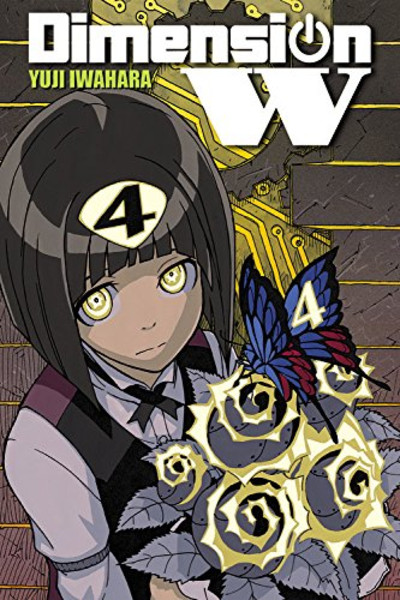
Then there's Dimension W, Vol. 4 from Yuji Iwahara, in which a cop and his robot fight ghosts. (I think; I might have mangled that. This volume definitely has ghosts, but they might other things the rest of the time. And it's possible that I'm misremembering that she's a robot.)
I have no idea why this is called How to Raise a Boring Girlfriend, Vol. 4; it seems to be a series a bout a guy and three girls (harem manga alert!) who are making a dating simulator game, but perhaps he's dating one or more of them. (Or maybe the sim is a fiendish plot to make one or more of them fall in love with him!) I think this is from a light novel; it's credited to Fumiaki Maruto (original story), Takeshi Moriki (art), and Kurehito Misaki (character design).
Hey, remember the side-story about girls in a dungeon way up above? Well, there's a new volume of the manga as well: Is It Wrong to Try to Pick Up Girls in a Dungeon?, Vol 6. It's by Kunieda from Fujino Omori's light novel, and features lots of hot girl-picking action in dungeons, as you demand!
Next up is Konosuba: God's Blessing on This Wonderful World!, Vol. 1 by Masahito Watari (art), Natsume Akatsuki (original story) and Kurone Mishima (character design). A game-loving shut-in boy dies in a stupid way, but comes up before a ditzy cute-girl goddess, who offers him a new life...in a fantasy universe, with the requisite quest to defeat a demon king. But things don't work out as expected, and soon he's got three goofy girls with short skirts around him. (I'm not saying this is a harem manga, but it seems to be tending in that direction.)
Nico Tanigawa's otaku heroine is back for No Matter How I Look at It, It's You Guys' Fault I'm Not Popular!, Vol. 9, featuring hot headband-tying action on the cover. This volume features the end of a class trip and the beginning (and maybe end) of a sports festival, providing lots of opportunities, I'm sure, for Tomoko to be inappropriate.

And if you like your manga to be about making manga, I have for you Izumi Tsubaki with Monthly Girtls' Nozaki-Kun, Vol. 5, which is just that thing. I think most of the characters are in high school, because that seems to be a law in Japan: no manga allowed without at least 75% of the characters still in secondary school.
I have rarely been so confused by a first volume, but here's Puella Magi Oriko Magica: Sadness Prayer, Vol. 1. (There's also a [New Testament] on the cover, but I'm damned if I know where that would go in the title.) This is part of the ever proliferating "Puella Magi" series across media, about a troupe of magical girls and the universe they save from evil (which I think is also mostly in the form of magical girls). The story is by the opaquely named Magica Quartet, and the art is by Mura Kuroe.
Books don't usually have seasons, but this next one does: Rose Guns Days, Season 2, Volume 1. It's related to an animated show somehow (adapted? telling related stories? existed first?) and I think it's semi-Victorian and set in China. But don't take my word for that.
Are you looking for a story about the zombie apocalypse, but also want to read about a bunch of bubbly girls at a high-school club? Well, you don't have to choose: School-Live!, Vol. 5 gives you both of those things in one volume! The art is by Sadoru Chiba and the story is by something called Norimitsu Kaihou [Nitroplus].
And last for this week is Trinity Seven, Vol. 7 by Kenji Saito and Akinari Nao. This is yet another we're-at-wizard-school story, with a side order of saving-the-world, since wizard schools now require world-saving as part of the core curriculum after the He-Who-Must-Not-Be-Named Act of 1998. This one is also sealed in plastic, so I expect there are some cartoon boobies as well, in case any of you are experiencing a dearth of such. (If so, please remember that you are on the Internet, the greatest repository of cartoon boobies ever devised by man.)
Yen Press sent me a gigantic box this week -- they're are too nice to me, I admit it -- so I don't want to waste time and energy up here. So, here's the scoop:
- These books came in the mail
- I haven't read them
- You might love them
- Here's what I can tell you
Dan Wells, author of the John Wayne Cleaver books (most recently Over Your Dead Body) is back just a few months after that aforementioned book with a new standalone, Extreme Makeover. (A subtitle, Apocalypse Edition, appears only on the title and copyright pages.) This one is satirical SF, in which the beauty company NewYew is testing an anti-aging hand lotion. Good news: it really does make people younger. Bad news: it also changes their DNA to make them a younger someone else. But is that a good enough reason not to go to market? Extreme Makeover is a Tor trade paperback, available November 15.
Ten years ago, Ellen Datlow had a big anthology called Darkness, collecting her picks for the best horror stories of the previous two decades. (Since, basically, she started working in that field and paying close attention to it.) But there was no reason that she had to wait two decades to do it again, and so Tachyon is bringing out Datlow's Nightmares: A New Decade of Modern Horror as a trade paperback. (It officially published on October 31, as so many horror books of the fall do.) Nightmares collects twenty-four horror stories from the past decade, from writers including Laird Barron, Garth Nix, Caitlin R. Kiernan, Richard Kadrey, Margo Lanagan, M. Rickert, Reggie Oliver, Lisa Tuttle, Gene Wolfe, my ex-co-worker Livia Llewellyn, and more than a dozen others. Datlow is probably the best-known and highest-regarded horror editor out there, so if you have any interest at all in the form, you'll want to take a glance at this.
From here on, everything is from Yen and everything is coming this month. I'm going to start with the stack of larger-format books (light novels and some fat manga volumes), just because it's slightly closer to my hand. Hey, we've all got to make decisions based on something....
A Certain Magical Index, Vol. 6 is a light novel by Kazuma Kamachi with illustrations by Kiyotaka Haimura, continuing the series about a city filled with magical schools and the obligatory "average guy" who is the protagonist. This time out, there's a big athletic tournament, the Daihasei Festival, in which all of the previously established characters are competing.
Turning to manga, we see there's ain't no party like a Corpse Party: Blood Covered, Vol. 3. ('Cause a corpse party...is really disgusting? I don't know where I'm going with this.) This comes from Makoto Kedouin (story) and Toshimi Shinomiya, and is one of those horror stories about seeing a lot of teenagers in peril and/or murdered in inventive ways. In this case, it's a passel of unquiet ghosts from a dead elementary school ("dead" in several senses) and the modern teens have to lay those ghosts before they're all murdered.
The cover of the next book declares itself DRRR!!, Vol. 5, but if you try to search that on popular on-line book-shopping services, you might not find it. The actual title is Durarara!! (still with the two bangs), and it's by Ryohgo Narita and illustrated by Suzuhito Yasuda, who does not get a cover credit. (Call your agent, Yasuda!) This light novel series has a bunch of loosely-connected plot threads in the Ikebukuro district of Tokyo -- or at least it did when it started; it might have turned into something else by now. This book focuses on spring break, which I did not know was a thing for people old enough to be out of school. Maybe it is in Japan?
Continuing the republication of Natsuki Takaya's well-liked series in larger double-size volumes: Fruits Basket Collector's Edition, Vol. 7. It has the currently-popular manga cover style, "Here, have a character or two per cover until we get them all in color. No it doesn't have much of anything to do with the interior. Why?"
A new entry in the long title sweepstakes! A side-story to the light novel series, in what may be a new light novel series, launches with (deep breath) Is It Wrong to Try to Pick Up Girls in a Dungeon? On the Side: Sword Oratoria, Vol. 1. It's written by Fujino Omori with illustrations by Kiyotaka Haimura. I think this is one of those "retell the story from the girl's POV" things, made popular by Sword Art Online. And I'm going to pointedly avoid any of the "Singing Sword" puns that are coming to mind.
OK, I think the title pieces of this next book come together like this: The Isolator: Realization of Absolute Solitude, Vol. 3:The Trancer. It's a light novel by Reki Kawahara (author of Accel World and Sword Art Online), with illustrations by Shimeji. It seems to be one of those teens-with-super-powers books, in which our hero is working for the usual shadowy government agency to defeat slavering evil, along with other teens with strange powers. (The girl on the cover, who seems to be very sorry for whatever she did and hopes you won't ground her, is I would guess one of them.)
The next manga is Karneval, Vol. 6 by Touya Alikanagi, and I don't have a good sense of what this series is about. (And it consistently neglects to have any description on the back cover to help us out.) So my best guess is that it's about interdimensional circus-cops and the normal kids who gets caught up in one of their operations.
Hey! Anybody want a light novel about people being trapped in a MMO? (OK, how about yet another one?) Log Horizon, Vol. 6: Lost Child of the Dawn will scratch that very specific itch, though this one seems to be heavier on the building-society stuff and less about dungeon-crawling. As usualy, the book is written by Mamare Touno, and it has illustrations from Kazuhiro Hara.
One more light novel for you: Re:ZERO: - Starting Life in Another World - , Vol. 2. (And, yes, the dashes are part of the title. That ZERO might actually be ZeRo, from the cover, but life is just too short to figure that out.) It's written by Tappei Nagatsuki with illustrations by Shinichirou Otsuka, and is not about people getting stuck in an online MMO. It's about one person getting stuck in an alternate universe with some game-like aspects. Totally different!
The heroine of Natsuki Takaya's Twinkle Stars, Vol. 1 has absolutely massive eyes, big enough to have their own slight gravitational field. And we all know what that means. This new manga series is about a sweet orphan girl and the boy she met in passing once who she immediately afterward latches onto as her One True Love of All Time, and is only slightly hindered by not really knowing who he is or how to find him. She also apparently heads her school's looking-at-the-stars club, because of course there would be one of those.
Last of the large books from Yen is Until Death Do Us Part, Vol. 13, ending the series by Hiroshi Takashige and DOUBLE-S about an esper girl and her blind swordsman protector. This is the big confrontation, of course, though I haven't read this series, so I can't tell you much more than that.And now we're into the home stretch, with the regular-manga-sized manga books, if that isn't a complete oxymoron. (Also note that "home stretch" is still a dozen books; Yen publishes a lot of manga on a regular basis!)
Yana Toboso's popular pesudo-Victorian series is back in Black Butler XXIII, the series that sneers at your modern Arabic numerals. This time out, our hero the Earl and his butler are sent by Queen Victoria to investigate a popular but suspicious music hall.
Btooom!, Vol. 15 is from Junya Inoue, and is still about an island where a large number of kidnapped people are forced to murder each other with various explosive devices. And even after fifteen volumes, there are still plenty of people to be blown up.
Then there's Dimension W, Vol. 4 from Yuji Iwahara, in which a cop and his robot fight ghosts. (I think; I might have mangled that. This volume definitely has ghosts, but they might other things the rest of the time. And it's possible that I'm misremembering that she's a robot.)
I have no idea why this is called How to Raise a Boring Girlfriend, Vol. 4; it seems to be a series a bout a guy and three girls (harem manga alert!) who are making a dating simulator game, but perhaps he's dating one or more of them. (Or maybe the sim is a fiendish plot to make one or more of them fall in love with him!) I think this is from a light novel; it's credited to Fumiaki Maruto (original story), Takeshi Moriki (art), and Kurehito Misaki (character design).
Hey, remember the side-story about girls in a dungeon way up above? Well, there's a new volume of the manga as well: Is It Wrong to Try to Pick Up Girls in a Dungeon?, Vol 6. It's by Kunieda from Fujino Omori's light novel, and features lots of hot girl-picking action in dungeons, as you demand!
Next up is Konosuba: God's Blessing on This Wonderful World!, Vol. 1 by Masahito Watari (art), Natsume Akatsuki (original story) and Kurone Mishima (character design). A game-loving shut-in boy dies in a stupid way, but comes up before a ditzy cute-girl goddess, who offers him a new life...in a fantasy universe, with the requisite quest to defeat a demon king. But things don't work out as expected, and soon he's got three goofy girls with short skirts around him. (I'm not saying this is a harem manga, but it seems to be tending in that direction.)
Nico Tanigawa's otaku heroine is back for No Matter How I Look at It, It's You Guys' Fault I'm Not Popular!, Vol. 9, featuring hot headband-tying action on the cover. This volume features the end of a class trip and the beginning (and maybe end) of a sports festival, providing lots of opportunities, I'm sure, for Tomoko to be inappropriate.
And if you like your manga to be about making manga, I have for you Izumi Tsubaki with Monthly Girtls' Nozaki-Kun, Vol. 5, which is just that thing. I think most of the characters are in high school, because that seems to be a law in Japan: no manga allowed without at least 75% of the characters still in secondary school.
I have rarely been so confused by a first volume, but here's Puella Magi Oriko Magica: Sadness Prayer, Vol. 1. (There's also a [New Testament] on the cover, but I'm damned if I know where that would go in the title.) This is part of the ever proliferating "Puella Magi" series across media, about a troupe of magical girls and the universe they save from evil (which I think is also mostly in the form of magical girls). The story is by the opaquely named Magica Quartet, and the art is by Mura Kuroe.
Books don't usually have seasons, but this next one does: Rose Guns Days, Season 2, Volume 1. It's related to an animated show somehow (adapted? telling related stories? existed first?) and I think it's semi-Victorian and set in China. But don't take my word for that.
Are you looking for a story about the zombie apocalypse, but also want to read about a bunch of bubbly girls at a high-school club? Well, you don't have to choose: School-Live!, Vol. 5 gives you both of those things in one volume! The art is by Sadoru Chiba and the story is by something called Norimitsu Kaihou [Nitroplus].
And last for this week is Trinity Seven, Vol. 7 by Kenji Saito and Akinari Nao. This is yet another we're-at-wizard-school story, with a side order of saving-the-world, since wizard schools now require world-saving as part of the core curriculum after the He-Who-Must-Not-Be-Named Act of 1998. This one is also sealed in plastic, so I expect there are some cartoon boobies as well, in case any of you are experiencing a dearth of such. (If so, please remember that you are on the Internet, the greatest repository of cartoon boobies ever devised by man.)
Recurring Motifs:
Reviewing the Mail
Friday, November 04, 2016
Rosalie Lightning by Tom Hart
Rosalie Lightning was a real person: you have to know that first. She
was the daughter of cartoonists Leela Corman and Tom Hart. In November
2011, she was just a few days from her second birthday.
And she died. Suddenly. Unexpectedly. In her sleep, for no apparent reason.
Any death is sad. The death of a child is devastating. But many deaths can be prepared for -- it might not lessen the inevitable shock, but at least you know it will be coming. Rosalie's death was the worst kind of death: mysterious, random, of a child old enough to be a specific person but still so young as to be mostly potential.
I can barely even imagine the vague outlines of what that could be like. I have two children of my own, though they're much older than that now. (I still worry; you always worry. You worry more every year.)
Tom Hart took that intensely personal, searing story and turned it into art: it's what artists do, to make sense of the senselessness of the world. The book is Rosalie Lightning.
It is a masterpiece of comics, of grief, of witnessing -- the most moving comic about family and loss and the unimaginable since Maus. Hart tells the story in fits and starts, through many chapters, looping back and forth in time around that one horrible moment. His family's life was already hard when it happened -- they had just moved out of New York, driven away by rising rents and the relentless go-go-ism of that city's culture, and were trying to sell their co-op. (And that was going as well as selling any piece of rel estate at a distance ever does -- particularly when it needs to be approved by a board that won't accept the price you can actually get for it.)
Rosalie Lightning is the story of Rosalie: a way to keep her memory alive, to put down the cute things she said and did, the person she was and was becoming, so she won't be forgotten. And it's even more the story of Tom and Leela, of a couple battered by the worst thing that can happen and who held on through it all. And then it's the story of their friends and connections and family, the people who circled around them in their pain and did what they could to share that pain and lessen it.
Hart tells all of those stories, braided together -- of Rosalie's energy and enthusiasm, of the dark days after she was gone, of the frustrations of selling that co-op, of what it felt like when the ground opened up and swallowed them whole. He tells them brilliantly, in a way purely comics, with art sometimes realistic and sometime scratchy and words flowing across the page in just the right cadence.
Rosalie Lightning is heartbreaking and uplifting, lovely and horrible, a monument both to the depths of grief and the glimmerings of recovery. It is a powerhouse of a book, and one of the strongest, most powerful things I've read in a long time.
Thursday, November 03, 2016
How to Be Happy by Eleanor Davis
Eleanor Davis has a short foreword to this book of graphic stories,
explaining that it's not a how-to book, despite the title, and pointing
to some books actually on that topic that she's found helpful in her own
life. But How to Be Happy really is about how to have a
happy life, or, rather, about all of the ways that life conspires to
make us unhappy, to make us doubt ourselves, to throw up obstacles and
problems and miseries in our way.
So the characters in these stories are not happy. I think I can say it that broadly. There may be a moment or two of happiness here -- like any life -- but the overall emotion is less bright. But they all want to be happy, and are making heroic efforts in that direction: some directly, and some to live the lives that will make them happy and fulfilled, like the pseudo-Paleo cult leader in the first long story, "In Our Eden."
The centerpiece and longest story is the SFnal "Nita Goes Home," in which a successful woman in a polluted near-crapsack near-future world has to leave her mostly-utopian domed community to go back and see her dying father and engage in the life her less-successful sister is living in that polluted world. Nita can only get back to happiness, pointedly, by getting back to her separate community, getting away from the rest of the world.
Davis's other characters don't have it as easy -- some, like the ferryman of "Seven Sacks" and the musician of "Stick and String," are stuck in a world of wonders and horrors that are not entirely clear, and their main choice is whether to think about what they see and do, or to let it pass by. Others are living in something like our modern world -- going to a class to learn to cry, obsessively body-building to be able to save everyone, teen girls furtively reaching out to each other in suburbia or young boys exploring a derelict house that we readers know if not as wondrous as the boys want to believe. They are all looking for happiness and fulfillment, however the think they might find it -- and some will have better chances that others. But Davis doesn't let any of them fully attain "happiness" -- and what would that mean, anyway?
Interspersed with the longer pieces are short stories -- one page or two -- and some diary comics, including the story of a Greyhound trip cross-country. Davis's art style changes radically throughout, with an animation-looking flat color (reminiscent of some recent Dash Shaw books to me, though I think Shaw may actually be following Davis) in some stories and a detailed pen-and-ink style for others. Still other stories, mostly the single-pagers, are drawn very loosely, with only-barely human forms quickly thrown on the page sketchbook-style to crystallize a thought or emotion. It's a lot of artistic variety for one book that's not all that long, but every style is clear and true to the stories it's used to tell and right. I'm frankly amazed that all of those pieces were drawn/painted/created by the same person over the course of only a few years.
So Davis is monstrously talented: I'd heard that a number of times before, and now I'm impressed by how true that really is. I'd love to see her take on a book-length project: she clearly has the ideas and the ambition and the art chops to do something both big and great. I don't know anything, but I like to think she's hard at work right now on the next book, which will amaze us in another few years.
Wednesday, November 02, 2016
The Arab of the Future 2 by Riad Sattouf
Riad Sattouf grew up in the Middle East -- Lybia and Syria, as far as
we've seen to date, though this book only brings him up to about age 7
in 1985 -- the son of an unrealistic Arab academic father and a
compliant French mother. And he's telling us about it at great depth;
the first volume
of his graphic-novel memoir (you get one guess as to the title) covered
his earliest memories up to about age six, and this one covers
basically his first school year. He's also a filmmaker and writes a
weekly column in his now-native France, so one can hope that he's not
going full A la Recherche du Temps Perdu on us here, with successive books of memoir covering every-shorter periods of time in his ever-more scrutinized childhood.
On the other hand, maybe that would be pretty cool. So we might be in for The Arab of the Future 25, covering the hours from noon to seven PM of May 23, 1991, around 2040 or so.
But what we have here is The Arab of the Future 2, the story of little blonde-haired, semi-Westernized Riad and how he was tossed into a very provincial village school in Ter Maaleh, Syria. Sattouf now is vastly more cosmopolitan than the inhabitants of Ter Malleh, and even six-year-old Riad had a wider experience of the world than they did at the time. Little Riad didn't have the language to confront the problems with that village life, and the older Sattouf mostly tells the story of his younger days without editorial interpolations. (There's one situation, related to an honor killing, that is so egregious that even little Riad knows how horrible it is.)
So Riad ends up in that horrible school -- cruel, almost sociopathic-seeming classmates all about him and a female teacher who unpredictably switches from happy blandness to vicious glee in capital punishment up in the front. He doesn't learn anything academic for quite some time, though Sattouf does show the other things he learns about the people around him. They're not happy lessons, but the human race is full of nasty, evil, cheating, scheming people, so they are important, necessary lessons.
His family -- both the immediate, happy one, and the larger and vastly more dysfunctional and anti-role-model extended family -- takes up somewhat less space in this book, since school takes up so much of Riad's time and mind. But we still see his father's warring sides: he's somewhat Westernized, enough to have a cosmopolitan view of what's acceptable and to fight for justice in the case of that honor killing, but he's also a mama's boy who can't see most of the problematic elements of his home culture and doesn't appreciate at all the sacrifices his wife makes every day for him. And we see some of his horrible cousins, among the other horrible kids that Ter Maaleh and nearby localities can provide. (I'm not sure what Sattouf's point is here: there have certainly been nasty schools, with cruel teachers and vicious pupils, in many countries and many times -- the British public-school model is the best known -- but this one is more particular, stunted by ignorance and religious fanaticism and dull provincialism. I can't quite tell if this is all just a "yeah, school was pretty bad" shrug or a "nationalism, ignorance and knee-jerk vague Islamism ruined most of my generation, as it did the one before us" cry of disgust.)
It all adds up to an episodic book; Sattouf doesn't tell it in chapters, but it does run from moment to moment, each one showing us another side of this mostly unpleasant town of mostly ignorant and often seriously damaged people. Sattouf makes it compelling, but I do hope that if there's an Arab of the Future 3, that it takes little Riad to somewhere less medieval and soul-crushing than Ter Maaleh.
Tuesday, November 01, 2016
The Nightmare Stacks by Charles Stross
We all knew that Charles Stross wouldn't be satisfied writing secret history forever. And so his Laundry Files series definitively shoves itself off onto an alternate timeline with this year's The Nightmare Stacks. Some nitpickers will note that the flood of superpowered people in the previous book, The Annihilation Score, marked the clear defining line for turning this series alternate. I agree with that, in theory, but Nightmare
turns the heat up several notches to make large and permanent changes to
the world -- this is the book that draws a line and says that nothing
will never be the same again.
Every Laundry book sees Stross pick up a shiny fantasy/horror trope, examine it from all sides, and then tell us how it would really be (in his world, at least). The last couple have examined vampires (The Rhesus Chart) and superheroes (Annihilation Score), so perhaps it was inevitable that fairies would be next. Stross tends to agree with Pratchett in his conception of the Fair Folk, and to disagree strenuously with both Doyle and Tolkien. His elves are tall, slim, magically powerful people from an alternate universe, a branch of hominid development that is somewhat more eusocial due to developing language later. And they're also -- a touch like this is not uncommon for Stross -- embedded in a deeply unpleasant and Procrustean web of geases and magical compulsions, making their society the epitome of magic-enforced authoritarianism.
Their world is now uninhabitable, so they're looking for a fixer-upper planet to take over. Some time ago, there was a war that escalated, and kept escalating -- dropping an entire moon on the planet was an early gambit -- until one side called in nightmare creatures from between worlds. Unfortunately, those creatures don't make allies, and they don't leave, so now the surface of the elf-world has possibly a few cowering elves who haven't been killed yet and a whole lot of interdimensional monsters. The entirely of elfin civilization is one small military force in an obscure bunker off in what was the hinterlands of a major empire, mostly dreaming uneasily in suspended animation while their resources slowly run out. Their only hope is to go somewhere else, and their only plan is to conquer that place and rule it, the only way they understand living.
One of the viewpoint characters of Nightmare Stacks is the princess of those elf forces, more or less. Her name, or designation, is First of Spies and Liars: she's head of the feud-decimated tiny remnant of her nation's military intelligence agency. Her father is the commander of this single surviving military force, and so all of the magical obey-charms have devolved to pointing to him -- he's the emperor of the few survivors of his race. Her mother has been recently murdered by her father's second, very ambitious wife. And First is also deeply abnormal for her race: she has something that resembles a conscience and occasionally thinks of the needs and interests of people who aren't herself. Because of that, and because of her training, she's actually capable of lying, which is beyond most of her people -- when your brain is tightly controlled by a web of magical obey-spells, just doing what you're ordered to do is more than enough for most of her race.
The other viewpoint character -- who gets substantially more page-time, actually -- is somewhat familiar: ex-high frequency banker and still-new vampire Alex Schwartz, last seen in Rhesus Chart learning how to cope with his new abilities (and the transdimensional brain parasites that gave him those abilities). Since the magical apocalypse is looming ever closer, and the Laundry is now barely lurching from one near-extinction event to another, he's been thrown in the deep end very quickly and is part of the team evaluating several sites in Leeds for potential Laundry headquarters and/or defensible bolt-holes for when one of the now-inevitable CASE NIGHTMARE scenarios happens.
If all this is confusing, perhaps you'd like to see what I wrote about earlier Laundry books -- see the links for Rhesus and Annihilation above, and the novels before those (in reverse order) were The Apocalypse Codex and The Fuller Memorandum and The Jennifer Morgue and The Atrocity Archives. To be massively brief: this is a fantasy/horror series with SFnal rigor set in a universe where Lovecraft was almost entirely correct but lacked some imagination. Those horrible things between universes are both attracted by thinking minds and can be summoned by mathematical calculations -- so a world with a burgeoning population and geometrically-growing computer power is the equivalent of a huge neon sign saying "Eat Me." The Laundry is the UK government organization tasked with keeping them from noshing down. Like all such organizations, it's underfunded, badly organized, full of people who don't really want to be there, and dependent on tools and facilities that should have been upgraded decades ago.
And, in this book, the Laundry has to deal with a full-fledged magical invasion of Leeds, with flying dragons and battle mages and the lot -- all of them cloaked in seriously powerful charms and essentially lethal to look upon for any unguarded human eyes. Sure, it's a small military force, and the elf Emperor doesn't understand the real capacities of the people he calls uruk and intends to turn into his slaves. He has no chance to conquer the world; his forces will be destroyed eventually...but that eventually could easily be "after all of Western Europe is murdered."
On their side, the Laundry has a priest and a death-ray technician riding around on a Nazi armored half-track, a networked camera-cum-basilisk-gun system throughout the center city which has unfortunately been having target-acquisition problems, several outmatched but tough SAS units, and several overwhelmed mid-level bureaucrats who happened to be in Leeds that weekend. Oh, and Alex, who has been captured by First to be the first uruk-mage slave and the elves' key into what the Emperor thinks is the local mag HQ (that Leeds building that the Laundry is just beginning to set up). Luckily, the two of them have surprisingly convergent interests, and may have come up with a plan cunning enough to save the UK...though they can't actually talk about the plan, due to First's geases.
Stross continues to expand and deepen this world; this is the second book in a row not to focus on his original series character, Bob Howard. And, frankly, Bob isn't missed here: the world of the Laundry has enough interesting spaces and quirky characters at this point not to need any one character to carry a book. Alex is a bit bland -- I would have liked to see more math-geekery, or finance-geekery, out of him -- but First is a great character, and I hope she will return in future books.
So I'll reiterate that this is one of the great SF/Fantasy/Horror series of our time -- I don't want to genre-type it any more specifically that that, though you can if you feel the need -- and that anyone who has ever enjoyed Len Deighton, Lovecraft, or Dilbert (or their cognates) should at least give it a try.
Recurring Motifs:
Fantasy,
Horror,
Reviews,
Science Fiction
Read in October
I am actually typing these words in early October, which is how this monthly post is supposed to work. I'm sure that means that calamity lurks right around the corner, but I'll enjoy it while it lasts.
In any case, these are the books that I read in the dark and brooding month of October, conveniently linked to places where I wrote words I thought might be interesting about those books.
Charles Stross, The Nightmare Stacks (10/3)
Simon Hanselmann, Megg and Mogg in Amsterdam (10/3)
Jennifer Hayden, The Story of My Tits (10/4)
Etienne Davodeau, Lulu Anew (10/5)
Nick Drnaso, Beverly (10/7)
Chris Oliveros, The Envelope Manufacturer (10/10)
Skottie Young, I Hate Fairyland, Vol. 1: Madly Ever After (10/11)
Mike Dawson, Rules for Dating My Daughter (10/12)
China Mieville, This Census-Taker (10/12)
Faith Erin Hicks, The Nameless City (10/14)
Riad Sattouf, The Arab of the Future 2 (10/24)
Eleanor Davis, How to Be Happy (10/25)
Tom Hart, Rosalie Lightning (10/26)
Liz Suburbia, Sacred Heart (10/27)
Glenn Head, Chicago (10/31)
Michael Davis, Street Gang (10/31)
And now I'm writing these words in late November (Thanksgiving Day, actually), which is somewhat later than what I'd prefer. But I got to the end of this list, and words about all of those books are now set to post over the next few days. So I can now call October done and move forward into November. I hope you can, or have, done the same.
Recurring Motifs:
Books Read
Subscribe to:
Posts (Atom)