Tuesday, December 06, 2016

Bucko by Jeff Parker and Erika Moen

I could have sworn that I read this book before. But most of the events in it were completely new. So either there's some other book inexplicably really close to the premise of Bucko (which would be really unlikely), or I read just the first few pages some time long ago, or I'm hallucinating again.

In any case: Bucko. Originally a webcomic, then turned into print. Written by Jeff Parker, drawn by Erika Moen. Longer and denser than it looks, with commentary by the creators on the bottom of most pages and about twenty pages of extra stuff at the end.

It's the story of a threesome.

Well, a failed threesome. It opens with our title character -- his name is Rich, but he gets saddled with "Bucko" here, and it sticks -- waking up on a couch in the apartment of Gyp, the girl he met the night before. Her quickly learns they all got too drunk -- him, Gyp, and Gyp's mostly-lesbian roommate Dell -- for the three-way Gyp had hinted at the night before. But Bucko has no time for romance: he's already late for a job interview, so he rushes out...and walks into a dead body at the office where he interviews.

That's all in the first five pages of a 120-page story; I'm not going to get into that much detail for the rest of it, or we'd be here all day. Suffice it to say that Bucko is a very plotty book, full of colorful characters and weird situations and bizarre moments and quirky dialogue. Did I forget to mention that this is all set in Portland (Oregon), where the hipsters and goofballs roam free? Well, take that as read now.

Bucko is arrested for the murder, but doesn't stay in jail long. But finding the real murderer -- and, much more importantly, getting a job and achieving that three-way -- will take much longer (four long acts worth), and involve:
  • a Pixies cover band that performs on bicycles
  • the Queen of the Suicide Girls
  • a Maker's Fair
  • another dead body in a bathroom, found by you-know-who
  • Gyp's roommate Dell doing strip karaoke
  • a fight with Juggalettes, who in best comic-book fashion then team up with our heroes
  • a sinister bike-theft ring
  • weaponized farts
  • a wiki devoted to the search for the missing Bucko
  • a hobo jungle constructed entirely of books
Bucko is a goofy book -- Parker admits that he wrote it one page at a time, to see how Moen would adapt each idea, and then wrote the next page based on what she did. So this is a loose, shaggy story, that wanders around Portland over the course of a few weeks and brings in every cliche or actual element of Portland that either of them could think of over the course of the year that they made this comic. You do need to have a relatively high tolerance for goofiness and hipsters to enjoy it. But who doesn't like seeing jokes about hipsters?

Bucko provides a rollicking good time, and promises that failed threesome -- expanded into a foursome, since everything in Bucko is bigger and odder than you expect -- will take place just a few minutes after the last page. What more could you want?

Monday, December 05, 2016

Reviewing the Mail: Week of 12/3

This is one of those weeks when the wonderful folks at Yen Press (Hi, Ellen!) have sent me boxes and boxes of manga goodies, and so I have a long list of books to get through. So I'll try to do it quickly, since I need to run off with the family to get a Christmas tree in just over an hour. (It's 8:09 AM on Sunday as I type this.)

As always:
  • these books came in my mail, somewhat unexpectedly
  • I haven't read them
  • I hope you will find something to love
  • And so here's what seems interesting
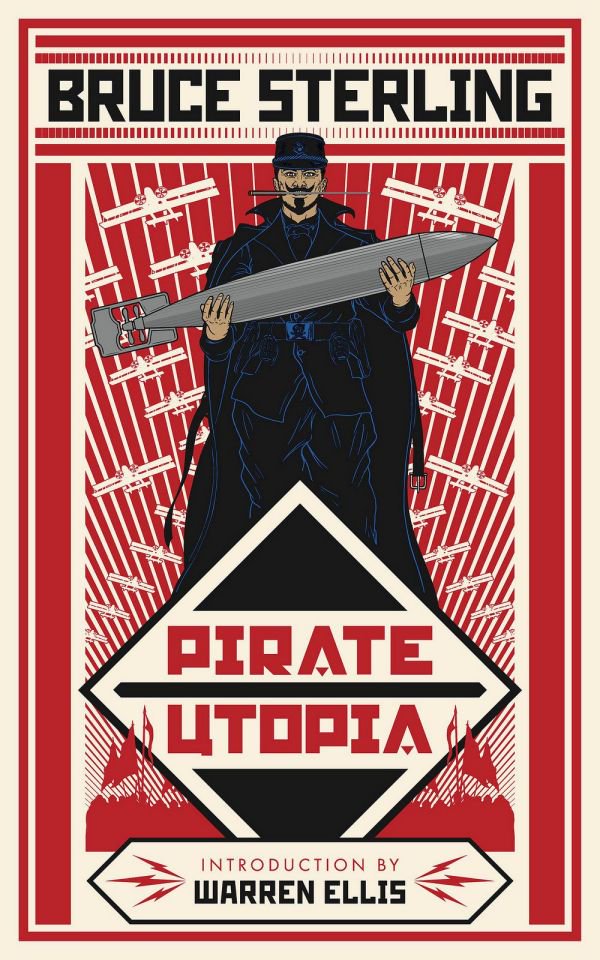
I'll start off, as usual, with the non-Yen books -- first up is a new novella from Bruce Sterling, Pirate Utopia. Chairman Bruce hasn't been as active in fiction this last decade -- with The Caryatids in 2009, something I never heard of before named Love Is Strange in 2012, and now this book -- but I hope this signals that he's back; we could use the old Sterling from the '80s and '90s to make sense of our new world. Pirate Utopia comes to us from Tachyon, and is some kind of oddball historical SF, possibly steampunk -- it's set right after WW I, in the new futurist-dominated nation of Carnaro (which I keep reading as "Camaro"), and seems to be about their power struggles as they try to build a new nation with the aid of American visitors H.P. Lovecraft and Houdini.

And from Pyr in trade paperback: Judgment at Verdant Court, the third in the "World of Prime" epic fantasy series by M.C. Planck. (Insert joke about length of this book being the "Planck distance" here.) This series is about a mechanical engineer turned into priest of a war god -- I think he's a local engineer, rather than the more typical contemporary-guy-who-walked-around-the-horses. And I gather by this point in the series, he has a truly impressive prophet-of-God beard, looking at the cover.

Everything else if from Yen Press, as previously mentioned, and is rolling out to stores and electron-vending establishments this month. I'll present them in basically alphabetical order by format.

I cannot say definitively that Akame ga KILL! Zero, Vol. 4 is full of fan-service, but...it does come sealed in plastic and features a limber young woman doing the standing splits on the cover. So I can take a guess. This come to us from Takahiro and Kei Toru, and continues the prequel series to the main Akame ga KILL! storyline.

Aoharu Machinegun, Vol. 2 is by an entity credited as NAOE [1]. It's about a team in some kind of firearms-based competition -- it seems to be real-world rather than virtual, and regular semi-auto guns rather than the highly-engineered single-shot competition rifles I'd expect, which may mean they're shooting at each other. But the back cover is vague, and there's no list of characters, so all I can say is: competition with guns. And we're still in the training-montage portion of the story.


Starting a new series from Kafka Asagiri and Sango Harukawa: Bungo Stray Dogs, Vol. 1. Our hero is a boy kicked out of an orphanage for no obvious reason -- something about budget cutbacks, or maybe they just don't like him -- and is about to starve to death on the streets when he runs into one of the agents of a fabled "armed detective agency" that takes on supernatural cases that no one else can handle. So of course he's dragged into their next case.

Another new series, from Pandora Hearts creator Jun Mochizuki: The Case Study of Vanitas, Vol. 1. The title character is a semi-crazy vampire doctor in Paris -- both a doctor and a vampire, unlike Doctor Worm -- who is trying to save the peace between humans and vampires from some upheaval or other. There's also a young man caught up in his schemes, since every manga needs the average guy to act as a viewpoint.

Diving into the oddball long titles category, there's a new volume in Wataru Watri (original story), Naomichi Io (art) and Ponkan➇'s (character design) series, My Youth Romantic Comedy Is Wrong, As I Expected, Vol. 3. This is another one of those normal-buy-forced-to-be-in-a-weird-club-at-school stories, which the Japanese have turned into a solid subgenre for their own reasons.

And then there's the manga adaptation Overlord, Vol. 3, which comes from Kugane Maruyama's original light novel and has been turned into comics by Hugin Miyama. This is a I'm-trapped-in-this-videogame story, but our hero is trapped as a super-powerful Dark Lord type for added spice. It looks like this is mostly a story about fighting, in which the characters loudly announce each move as they do it.

From here on it's still Yen, but mostly light novels -- be warned! You may have to read more words!

Accel World, Vol. 8: The Binary Stars of Destiny is by the prolific Reki Kawahara, with illustrations by Hima. This is about people who aren't trapped in a big online game, but spend most of their time there anyway, just like many of us in the real world. Apparently, though, you can be permanently polluted by evil online -- I think Jimmy Swaggart warned us of that -- and our hero is fighting to save his friend from that in this volume.

Yuu Miyazaki brings us The Asterisk War, Vol. 2: Awakening of Silver Beauty, with illustrations by okiura. This one is about a school that trains people to duel, because of all of the jobs in the duel sector available to graduates.

Then there's Ryohgo Narita's Baccano!: 1931 The Grand Punk Railroad: Express, Vol. 3, which has an extra colon in its subtitle for no obvious reason. (Unless there will be a Baccano!: The 1931 Grand Punk Railroad: Local coming along later, to be followed by Baccano!: The 1931 Grand Disco Railroad: Express and Baccano!: The 1932 Grand Punk Railroad: Express for maximum variety.) This is a story of '30s gangsters on a strain in America, with possibly less emphasis on historical realism and plausibility then you would think could be possible.

More secret societies protecting the world from mysterious hidden threats! Shiden Kanzaki (and illustrator Saki Ukai) are back with Black Bullet, Vol. 5: Rentaro Satomi, Fugitive. No points for guessing the main character's name, or the major plot event that happens to him in this book.

And we're back to manga briefly with the 4-koma series from Satoko Kiyuduki, Geijutsuka Art Design Class, Vol. 7, usually just referred to as "GA" unless you're trying to google the darn thing. The group of girls at an art college are coming up to graduation, but there's room for another hundred or so pages of jokes first.

Satoshi Wagahara's light novel series continues with The Devil Is a Part-Timer!, Vol. 6, with illustrations by the creature designated 029 (oniku). The devil is still working in a not-McDonald's in Tokyo, but it has now opened a coffee shop upstairs, which he sees as his stepping-stone to management and then TOTAL POWER!!!!!!! (I may be slightly exaggerating. Or maybe not.)

Natsuki Takaya's popular manga series in being reprinted in handsome double-sized volumes, and the latest is Fruits Basket Collector's Edition, Vol. 8. As I recall, this is one of those series with a family of supernatural folks who transform when various things happen in their vicinity -- the see butter, or trip over a rug, or sneeze, or maybe experience existential ennui.

Another light novel about kids at magic school, because we all know how popular that idea is: Tsutomu Sato's The Irregular at Magic High School. Vol. 3: Nine School Competition Arc 1 (with illustrations by Kama Ishida). I believe there is a competition here among nine schools, and that it's not done in this book. (You're welcome!)

Fatter than most light novels: Is It Wrong to Try to Pick Up Girls in a Dungeon, Vol. 7, by Fujino Omori with illustrations by Suzuhito Yasuda. In this volume, our hero Bell comes out of the Dungeon and to the city of Oratorio's pleasure quarter, presumably to spend some of his hard-earned loot enjoying himself. (Why he has to go there when the entire rest of the cast seems to be attractive women who love him is a question I cannot answer here.) Sadly, it seems the pleasure quarter just gives him intrigue rather than reasonably-priced love.

And here's a new 4-koma manga series, Yui Hara's Kiniro Mosaic, Vol. 1. It seems to be about a girl who loves Japan so much, she moves there from England to go to high school. Which is...a thing that actually happens in the world? Maybe, I guess. Certainly a decent set-up for jokes.

Yet more light novels about gaming! Yuu Kamiya's No Game No Life, Vol. 5 is, I think, not about people trapped in a specific online game, but is about regular Earth-people transported to another world where everyone is obsessed by games. So entirely different. (And, yes, this is what the publisher's website has up right now for a book that I have in my hand. Oopsie.)

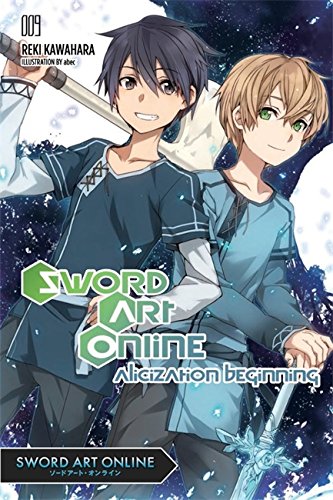
Back to people trapped in games with Reki Kawahara's Sword Art Online, Vol. 9: Alicization Beginning. In this one, the series hero wakes up amnesiac -- presumably in yet another game -- and starts to pursue the just-recovered memory of his childhood friend Alice. (I would not bet against this being yet another Japanese retelling of Alice in Wonderland.)

And last is a big fat manga volume with a particularly unpleasant-looking character on the cover: Wataru Watanake's Yowamuchi Pedal, Vol. 4. Our hero dreams of being a great cycling legend, but can he stand the training montages and backstabbing from supposed allies? (Well, he's the hero, so obviously he can.)


[1] Nanotech Assembly Organized for Extermination, perhaps?

Sunday, December 04, 2016

5,000 km per second by Manuele Fior

I wish I could just hand this book to you so you could go into it as ignorant as I was. I knew I'd read a good review or two of Manuele Fior's 5,000 km per second somewhere, and I knew it was translated. (I thought it was French, but it's actually from the Italian.) But that was about it. I'd picked it up a couple of times and poked through it before eventually buying it: what that mostly meant was I was impressed by the moody, color-coded art and thought it was some kind of domestic story.

If you want, you can stop there. This is one of the best graphic novels I've read this year -- maybe for much longer than that; I have to think about it -- and you don't need to know any more than that. It's a story about people in the real world, and their interactions through time. A love story, maybe. A people story, definitely. And the world needs more emotionally smart people stories like this: there are never enough.

If you want more, here's what I can tell you: we begin in Italy. A teenage girl, Lucia, is moving into an apartment with her mother, after the father went away. Two local boys, maybe a year or two older, are lurking around, and catch sight of her --they're Nicola and Piero. That scene is mostly yellows and greens. A few pages later, there's another scene, in blues, set in Norway, and one of those three is now studying there, a few years later.

5,000 km per second continues on like that, jumping into different scenes in different times, circling around the lives of Piero and Lucia and Nicola, with a palette suitable for each time and place and mood. Each moment is true, every character is real.

This isn't a story about easy answers or romantic gestures or big emotional moments: if your idea of a love story is a Hollywood movie, you will be hugely disappointed by Fior's much truer, much more mixed story. But he tells this story beautifully and lovingly, through body language and dialogue -- even more of the former than the latter; just look at the cover to get a sense of that -- and it's a stunning, deep experience. This is another book to put on the short shelf of comics to hand to people who think comics are junk: it's deep, and meaningful, and lovely, and bittersweet in the best way.

Saturday, December 03, 2016

Garden of the Flesh by Gilbert Hernandez


OK. Even for a creator who does weird comics practically every year, Garden of the Flesh is particularly weird. Here Gilbert Hernandez retells a big chunk of the first book of the Christian Bible as a series of fuck-fest vignettes starting with Adam and Eve naked and humping in that 'ol garden called Eden. And he does it in a relentless two wide panels for each of his small-format pages, with (deliberately?) stiffly posed figures and lots of unrealistically spurting fluids.

Yes, Biblical sex comics in a deliberately crude style. Was Hernandez inspired by Crumb's The Book of Genesis, Illustrated from a few years ago, or did this Adam-and-Eve stroke book come from some other wellspring? Is this some kind of reverse Jack Chick tract? Hernandez has always come across in his interviews as more instinctual than calculating, so there may not be any single reason why, no matter how much we search for one.

More importantly: is the fact the the sex here is all very bland and hetero some kind of clue? Is Hernandez mellowing in his middle age from the pan-sexual Birdland of his youth, or is Garden of the Flesh's relentless focus on sex as one-man, one-woman, two or three acceptable positions and some gratuitous oral a commentary on Biblical literalists? (Or on fundamentalists?)

It has to be said that Garden of the Flesh is a not particularly sexy sex comic, and I have to assume that Hernandez knows this. He's done sex comics before; he can move the bodies around to make them more appealing. So, if he doesn't do so here, it must be on purpose.

I find it hard to recommend Garden of the Flesh. Compared to most of Hernandez's work, it's stiff and mannered and dull and flat, and I can't give you an coherent reason why it is. I think this one is just for completists: either of Hernandez or sex comics.

Friday, December 02, 2016

Hellboy in Hell, Vol. 2: The Death Card by Mike Mignola

Hellboy was dead: to begin with. There was no doubt whatever about that. But in Mike Mignola's fictional universe, being dead just means that you're not here anymore. You can still go somewhere else, if there's somewhere that will take you. Hellboy could always go home. [1] And so he did: Hellboy in Hell, Vol. 2: The Death Card collects the back half of what creator Mike Mignola originally thought was going to be a substantially longer story.

But it turned out that Hellboy's story was already over: his story took place on Earth. Sure, things happen in this book. Hellboy even spends some quality time punching various monstrous entities with that big right hand of his, which is the sine qua non of any Hellboy story. There are murky scenes in creepy landscapes, and hellish creatures and doomed souls talking eruditely or crudely about their fates and threatening violence to each other. There are flashes of brilliance and wonder, as in all Hellboy stories. But none of it means anything. Mignola has an afterword in this book where he writes about how this story moved more quickly, and ended more abruptly than he expected -- if you read closely, you can see how it went from "open-ended" to twice the current length to barely this. He claims killing Satan was the big change-point, but my theory is that he was already done with Hellboy and just didn't know it. Hellboy's story, again, was on Earth.

Many creators write past the ending. Novelists, these days, have the luxury of noticing that before publication and trimming the story down. Comics, though...comics has a long tradition of ignoring or disregarding endings, for that eternal moment of Now and a new issue every Wednesday. And I think that mindset led to Hellboy in Hell. Twenty years from now -- assuming Mignola doesn't find some more things for Hellboy to do, later in fictional time than his sojourn in Hell -- this story will be seen as a vestigial appendage to the main Hellboy story, or at best a coda summing up some themes and presenting them in a different way.

Now, it's still about a hundred and fifty (unnumbered) pages of Mignola Hellboy comics, so it's a very nice thing. But it's a very nice faintly unnecessary thing, for those who are picky about such matters.


[1] I'll also note, in passing, that Our Hero notes during this book that it's kinda silly to be called "Hellboy" when he's actually in Hell, showing that Mignola can lampshade with the best of them.

Thursday, December 01, 2016

Mighty Jack by Ben Hatke

You got a kid named Jack. You got some beans. But it don't go the way you expect, see?

(Will he write the whole review in a bad '30s gangster patois? Let's hope not!)

Ben Hatke's new graphic novel Mighty Jack is indeed a partial retelling of a certain well-known folktale -- though this book ends with Jack and his companions heading off to parts unknown in a bean-related way, so it is not the entire story. And, other than the kid being named Jack and the bean-centricity, so far this is pretty divergent from the folktale.

OK, Jack does trade the family car for a box of magic beans at a flea market -- but that's only because his autistic sister Maddy tells him to...even though she never talks. And he plants the various packets of beans outside their house -- but, again, only because Maddy is awake before him the next morning, turning over the soil and wordlessly insisting on doing so. Jack is the sensible one, trying to be as grown up as a kid (of ten or so, I think) can be. The two of them are mostly on their own this summer; their single mother is working two jobs to barely make ends meet, so it's just Jack and Maddy.

Well...and, before long, Lilly. Lilly, the home-schooled maker-kid who Jack keeps seeing out in her front yard doing sword-practice with a dummy. Lilly, who is strong and tough and brave and has a lot of gear that will be really helpful. (For the younger readers Mighty Jack is aimed at, Lilly will just be cool. For people my age, she will be a reminder of all of those otherwise-bland protagonists with suspiciously-useful skills in classic SF -- the kind of guys who get accidentally thrown into 40 AD but luckily are master fencers and experts on the chemical composition of gunpowder.) Lilly quickly realizes something weird and cool is going on at Jack's house, and latches on to it -- not that Jack can't use her help, since he very much can.

Some of the beans grow mischievous plants, and some grow helpful ones -- but all are weird, grow overnight, and seem to have intelligence. And, before long, the three kids learn that "mischievous" is only the half of it.

Eventually there's a large manifestation, and a rampage of destruction, and the use of the one seed packet that should have stayed unused. A path is opened to somewhere else -- and paths are there to be taken.

There will be at least one more book; Jack and Lilly and Maddy have only just gone down that path as the book ends, and we have no idea what lies ahead for them. (Giants, maybe?) So Mighty Jack does not end so much as pause: this may be a problem for some readers. Perhaps particularly smaller ones, who are often not as good at waiting.

But the reason they won't want to wait is that Mighty Jack is n engrossing, colorful, energetic romp from the creator of the Zita the Spacegirl books. Hatke is good at hooking this audience...and, maybe, good at hooking people substantially older than that audience, too. Mighty Jack is the kind of book you buy if you have a kid aged somewhere from five to thirteen (depending on the kid) and then read it yourself first, because it's that good. And if you don't have a kid in that range -- I know I don't, anymore -- you can always just read it yourself first even if there's no one to read it "next."

Read in November

I'm getting closer to the way this is supposed to work, so I don't need to waste as much space up here with excuses. So, um, these are the books I read in November 2016, and they probably all have links to the posts I wrote about those books.

Brian K. Vaughan and Marcos Martin, The Private Eye (11/1)

Jules Feiffer, Cousin Joseph (11/2)

Bill Griffith, Invisible Ink (11/7)

Ben Hatke, Mighty Jack (11/8)

Mike Mignola and Dave Stewart, Hellboy in Hell, Vol. 2: The Death Card (11/10)

Brian K. Vaughan and Cliff Chiang, Paper Girls, Vol. 1 (11/11)

Gilbert Hernandez, Garden of the Flesh (11/13)

John Baxter, Carnal Knowledge (11/13)

Manuele Fior, 5,000 km per second (11/14)

Jeff Parker and Erika Moen, Bucko (11/15)

Neil Gaiman and Mark Buckingham, Miracleman: The Golden Age (11/16)

Haruki Murakami, Colorless Tsuruku Tazaki and His Years of Pilgrimage (11/17)

Gina Wynbrandt, Someone Please Have Sex With Me (11/17)

Richard Thompson, The Complete Cul de Sac, Vol. 1 (11/18)

At the moment I type these words, I'm still reading Vol. 2 -- there are only two; the world is cruel and capricious and took Thompson's drawing ability away before it even took him, much too early -- in the same room of the house where I read this first volume. And it doesn't really make any sense to me to write about one and then write about the other: the two books come in a slipcase together, and so have to be considered part of one thing.

So this is just to say that this book has not been forgotten. I will write about both books, eventually, once I get to the end of Cul de Sac. And then there will be a little link above for you to follow.

Kyle Baker, Cartoonist (11/21)

Neil Gaiman, Fabio Moon, and Gabriel Ba, How To Talk to Girls at Parties (11/22)

Matt Fraction and Chip Zdarsky, Sex Criminals, Vol. 3: Three the Hard Way (11/28)

Neil Gaiman, The View from the Cheap Seats (11/28)

Brian K. Vaughan and Fiona Staples, Saga, Vol. 6 (11/29)

Mike Mignola et. al., Hellboy in Mexico (11/30)


As of this moment (11:06 AM on Christmas Eve), there are finally posts on all of those books written and scheduled. So I'm going to put this index carefully in its place, and update it with links as those last few posts go live. I still think December will go up on time, since I'm on vacation this week, but I make no promises.


Wednesday, November 30, 2016

The Nameless City by Faith Erin Hicks

In a country that is not China -- but, if it were actually in our world, might be -- there is an important city that has been fought over by three great nations for hundreds of years, with control going back and forth repeatedly. Each of those nations has its own name for the city, but the inhabitants prefer not to give it a name -- since that will only change with the next conquest.

(This is a book aimed for teen readers, or perhaps set in a world slightly more rational than ours, so the inhabitants of that city can have a policy to stand aside and let the three nations fight it out each time. In this world, that means that they survive and continue their lives under different rulers, not that they are sacked and raped and murdered with each change of overlord.)

Faith Erin Hicks tells a story in that city: The Nameless City. That story doesn't end here; there will be at least one more volume. (And what writer can resist a trilogy? Or an expanded trilogy? We'll have to see if Hicks can resist, or wants to.) But the action of this book ends by its last page; this is not a cliff-hanger.

Kaidu is a young man -- say twelve or thirteen, right at the age to begin seriously training for his manhood -- of the Dao nation, the latest conquerors of the city they call DanDao. He grew up with his mother in the homelands, but has been sent to train as a warrior in the city where his never-seen father is an advisor to the Dao general who conquered it thirty years ago and has ruled it since.

Rat is a girl of the streets of the Nameless City, a fearless orphan racing across rooftops, contemptuous of the Dao as her people have been contemptuous of each invader in turn. (So...there's never been any intermarriage among any of these four people, for hundreds of years of turn-and-turn-again conquest? That seems implausible. The people of this city should be utter mutts by this point -- and much stronger for it.)

Kaidu and Rat meet cute, and don't entirely hate each other. They each have no other friends, and so become something like friends when they're not being enemies. Because this is a book for younger people, you may guess that their story is positive and has something like a moral -- don't worry, it's a good moral. If you squint, it might even be a moral about the best government requiring the consent of the governed, rather than that the good overlords will make good decisions because they are good.

This isn't my favorite Hicks book -- there a lot of unexamined neo-feudalism here, and the world is just a hair more cartoonish than I'd prefer -- but it's vibrant and exciting and full of action and has two great characters at its center. Even better, the girl is the more accomplished and level-headed of the two, besides being better at physical derring-do. But, since it's supposed to be for people a third of my age, I can't fault it -- it's very good at doing what it sets out to do, and is a lot of fun as it goes along that path.

Tuesday, November 29, 2016

This Census-Taker by China Mieville

I like to think I'm a thoughtful reader.  Not perfect, of course -- who is? -- but good at working out metaphors and allegories and fictional schemas of all kinds. If I can see that there's a shape moving under the surface of a book, I can usually make a decent guess at what kind of leviathan lurks down there. (This may not need to be said, but authors generally want to be understood: some things may be obscure or subtext, but they do expect that a lot of readers will figure them out nonetheless.)

There is something lurking behind China Mieville's short 2016 novel This Census-Taker. I would swear to that on whatever is worth swearing on. But I can't for the life of me quite figure out what that thing is.

So whatever I say about this book is at least half-wrong -- know that up front. Census-Taker is fabulistic, the story of a deliberately unnamed Boy in a clearly potent landscape. And I'm not going to be able to explain the implications of that landscape, or of the actions of the characters in this story. All I can do is tell you, if you decide to read This Census-Taker, to pay close attention and think about what everything might mean. You could be better at this than I am.

In an unnamed country, a decade or so after an unnamed war, a nine-year-old boy runs down the steep slope from his isolated house to the small town nestled around a bridge over a river between two equally sharp peaks. He says his father has killed his mother -- or perhaps the other way around. He is comforted, taken in, and preparations are quickly made to investigate.

Then the father appears. The mother is not dead, he insists: the boy heard an argument, their final breakup. The mother has left forever, gone away from this town where she grew up (but left once, admittedly), and will never be seen again. But she is definitely not dead, he insists again. Not at all, though he has no proof of this.

The boy is handed over to the father with apologies. The two return to that isolated house, where the father is even more demanding and cold than before, as if the boy has betrayed him. And the father kills animals, now and then -- quickly, and perhaps under a compulsion. The boy thinks the father has killed other people, but never sees it happen. We see this all, interspersed with memories of the time when the mother was still with them, in the way a boy's memories can be mixed and jumbled.

Many years later, the boy is a functionary of a larger political entity. The functionary is telling us this story of the boy's childhood -- well, we think the two are the same person, and they probably are. But This Census-Taker is twisty enough that you'll want to put a pin in that assumption, to mark it. (You may need many such pins before you're done reading.) One of the things our narrator tells us is how another functionary -- now his boss, or the boss of the person telling the story, if that makes a difference -- came to that isolated house, and what happened there.

Does it matter that the father is a foreigner, perhaps a refugee from that war in the past? There's no solid indication that he was a soldier, but it's not impossible. My essential problem in trying to encompass This Census-Taker is trying to figure out what is impossible. And that list is not long.

Mieville's voice is confident and controlling: he tells this story precisely the way he wants to, doling out moments and sentences that glisten like jewels -- but jewels just far enough away that their outlines are less than crystalline. I don't doubt that this is exactly the story he wanted it to be. And perhaps he intended this uneasy confusion, too.

I do recommend reading This Census-Taker: Mieville is one of our best writers, and his prose is a joy to grapple with, even if that grappling feels like a knife-fight in the dark for much of this book. Bring your A-game when you read This Census-Taker; that's my primary advice. You'll need all your wits about you for this one; I was clearly missing a few.

Monday, November 28, 2016

Reviewing the Mail: Week of 11/26

Those of us in the US of A are just coming out of a weekend-long food coma, raising our heavy heads, and looking around bleary-eyed to see if the world is still there. And then a Monday hits us, right when we're not expecting it. (If you think we'd be more prepared after a four day weekend, you don't know Americans.)

But at least I can offer you a few books -- books are quiet and friendly, unlike the outside world or those people you work with. These three came in my mail last week -- I don't know much about them, but let's take a look, shall we?

First up is a story collection by South African novelist Lauren Beukes: Slipping. It collects twenty-one stories -- some of them quite short, as you might guess -- along with five non-fiction pieces and a Glossary for those who are not au courant with SA slang. It's available right now in trade paperback from Tachyon.

From Yen Press -- their Yen On imprint, and that distinction I have to admit I don't entirely understand -- comes Goblin Slayer, Vol. 1, a light novel by Kumo Kagyu with illustrations by Noboru Kannatuki. It seems to be set in a RPG-ish world, focusing on a young Priestess joining a party of dungeon-crawlers for the first time. This particular party contains the title character, the usual enigmatic figure clad in dark armor with a quixotic obsession -- his is slaughtering every last goblin, as you can guess from his name -- and that presumably leads to complications.

And last for this week is a big manga volume: Blame! Master Edition, Vol. 2 by Tsutomu Nihei. I didn't see the first volume, and this one doesn't have any description -- literally the only thing on the cover other than title and author is "Toha Heavy Industries Manga Production Division," which I think is the author's puckish name for his studio -- can I can tell you it's about a robot girl who fights creepier robots in an at least mildly post-apocalyptic future. This one if from Vertical.

Sunday, November 27, 2016

Carnal Knowledge by John Baxter

Would you say the 20th century had more sex than previous centuries, or less?

John Baxter set out to encyclopedize the sex of the 20th century -- he called it "modern sex," which basically means from the tail end of the Victorian era up to 2009, when he published -- in Carnal Knowledge, which could be taken to imply the answer to that question is "more." (Truly, though, it's probably all a wash: we just don't like to think about our grandparents knocking boots, and previous generations were either more discreet, used euphemisms we don't recognize anymore, or were posthumously bowdlerized in the occasional waves of prudery that followed them.)

Carnal Knowledge runs from AC/DC -- not the band, in case you're wondering -- to Zoophilia, covering a few hundred people, places, kinks, ideas, and erotic works along the way. And, if you're looking for a book to while away stray moments, an encyclopedia of sex is hard to beat: it's chock-full of interesting tidbits (most of them prurient, obviously), but easy to pick up and put down repeatedly. Baxter affects a globalist outlook here, though his default cultural milieu seems to be the UK. This may disconcert those who think that the US is the rightful center of the world in all things, but I found it lended a quirky parallax to the various forms of spanking and other activities covered here.

I hope I don't need to say this bluntly, but Carnal Knowledge is not itself particularly arousing, though it does have some soft photographic and cartoon nudity among its many black-and-white illustrations. It's not a book to put one in the mood, but to list and comment briefly on a wide range of moods that a whole lot of people have had for the past century or so. You'll probably find a decent fraction of them perverted or appalling, but that's how sex is: if you're not scaring the horses when you do it in the road, you're not doing it right.

I found some facts here I could quibble with, but I didn't take notes -- really, it's not that kind of book -- so I can't attempt to dazzle you with my inappropriate knowledge. I do think the timing of Carnal Knowledge meant that Baxter's descriptions of the porn-film industry as it is "now" means that it's already a historical document; the Internet has transformed all content businesses a lot this past decade. But its whole point is to talk about sex historically, so that's not a bug so much as a feature: just file the descriptions of mid-aughts porn as "historical" in the same way you do Baxter's descriptions of the mob-dominated big-hair porn scene of the '70s.

This is an essentially frivolous book, but in the best way. It will not make you smarter, and any facts you learn here will be difficult to bring up in conversation in most circles. But it's amusing and interesting in a wholesomely voyeuristic way, and sex should be treated seriously, like any other aspect of human behavior.

Saturday, November 26, 2016

Paper Girls, Vol. 1 by Brian K. Vaughan and Cliff Chiang


I tend to treat Brian K. Vaughan as just another comics writer --  whether that's a positive or a negative thing, I'll leave to each of you to decide -- but he really has the instincts of a TV writer, befitting the other half of his career. Vaughan loves high concepts, even if they seem inherently destined to deflate, as similar concepts have dozens of times before.

And Paper Girls is definitely a high concept: four spunky (and mildly ethnically diverse) 12-year-old paper-delivery girls in 1988 -- perhaps because that's close to the end of the time in which delivering news by hand in pulp-paper format overnight was a bedrock part of the American landscape [1] -- are out on their bikes, hurling big piles of newsprint at front doors late the night after Halloween.

And then...weird shit happens!

Well, it's not so weird that the careful reader can't figure it out pretty quickly: there's a time-war on, and the Snakes and Spiders this time around are different generations of future-dwellers. (Yes, a generation-gap time war! There's probably a Harlan Ellison story on the same general idea from about 1967.) And our girls are stuck right in the middle of it: apparently the only civilians left in their neighborhood after the warring time factions cleaned it up for whatever nefarious purposes they each are contemplating. (We're still really early; we have no idea what the aims of each side is, and they both claim to be on the side of the angels, as of course they would.)


Now, Cliff Chiang has a grounded, realistically-detailed art style that helps to sell all of this very well. And Vaughan is, I should admit, really good at throwing bizarre concepts up into the air and creating a sense of mystery. (Catching all of those concepts and resolving the mystery...well, it's too early for Paper Girls to dwell on that.)

So Paper Girls, Vol. 1 is a hoot: it's all mysterious questions and bizarre ideas and strange moments. It even ends on another great moment, showing Vaughan will keep throwing complications in for as long as he can think of them. Since comics is mostly about beginnings and only rarely about endings, it's been quite popular, and for good reason: this is a great beginning. I just hope there's something left here once it stops being a beginning -- but, then, I'm well-known as a grump and a curmudgeon, so of course I would take the darkest view possible. This book is a lot of fun; my only quibble is that when I look forward, I seem to dimly see another sequence of Vaughan stories, each slightly less fun than the one before, until the whole thing ends in a muffled thump.


[1] Or, more pointedly, because Vaughan himself was 12 years old that year, and solipsism is a terrible thing to waste.

Friday, November 25, 2016

Street Gang by Michael Davis


Don't ask me why I read this book. I was looking for something to read on a recent business trip, and grabbed the now-not-all-that-new translation of Bulgakov's The Master and Margarita, which I really do expect to read one of these days. But I never want to have only one book for a trip -- what if I'm not in the right mood? -- so I also grabbed a battered nonfiction paperback for contrast. And that's the one I picked up on that plane flight, and ended up reading over the next two weeks.

The book was Street Gang, a history of the TV show Sesame Street by longtime writer-about-TV Michael Davis, which I found in a library sale for a quarter sometime last year. It's meat-and-potatoes nonfiction, with a chapter about the life of each of the major people who launched Sesame and potted bios of a number of other people who aren't quite as important. Davis doesn't transcend his material here, but he does give a good account of early TV for kids -- Beany & Cecil, Captain Kangaroo, and so forth -- as he gets to the launch of Sesame in 1969 at about the halfway point of the book.

From there it gets vaguer and looser: Davis mostly follows the major players forward, or at least does so when they (like Northern Calloway) had a tragic ending. He doesn't attempt to chronicle the show season-by-season, or even divide it into eras any more specific than decades. So each decade -- '70s, '80s, and '90s/aughts -- gets a scattershot chapter covering some of the many things that were happening then. (And somewhere along the lines I realized I really wanted to read a book about Jim Henson, who isn't actually in this book all that much -- the prologue is set at his 1990 funeral, though, and I think that's what dragged me in.)

Street Gang came out in 2008, just shy of Sesame's fortieth anniversary. That's a lot of ground to cover, particularly in a book that wants to explain the industry as it existed pre-Sesame and show where the major figures of Children's Television Workshop came from. (The answer, more often than not, was Captain Kangaroo.) It suffers somewhat from wanting to tell and show everything about everything -- everyone's lives before Sesame, all of the conflicts as the show went on, the professional lives of all of the main cast, and how Sesame affected the world as well -- because it really doesn't have enough space, nor any reader enough patience, to do all of that. Readers more attuned to the world of TV than me will probably enjoy this more, but Street Gang is honestly a pretty good book about a great show that really did change the world for the better.

Thursday, November 24, 2016

Rules for Dating My Daughter by Mike Dawson

I'm lucky, personally: I have only sons. So I can sit on the sidelines of the feminist-parenting debate, and pretend that I would have all of the perfect answers if things had gone otherwise. What are the rules for dating my sons? Well, first you have to like one of them, and want to date them -- I'm assuming that will happen at some point, though it hasn't yet. I'll work out any other rules at that point, I guess. (Probably won't need to.)

Mike Dawson, on the other hand, has a young daughter. And the title story of this collection of short comics is about the wonders and terrors of parenting a daughter as a 21st century man. (There are plenty of men out there who are still stuck in prior centuries -- a majority of them just elected a President.) He's seen the usual fake-redneck rules, and reacted strongly against them -- he's modern enough to realize the goal there is the control of women's sexuality, and not want to buy into that. And he's seen a feminist version -- "her body, her rules," that kind of thing -- which is also uneasy-making, because it still implies he gets to make rules, and, also, his particular daughter is young enough that he doesn't want to think about it. So "Rules for Dating My Daughter" ends up not having any; he's not the one who will make those rules, and she's too young to think about it.

But what about the rest of Rules for Dating My Daughter? The book contains more stories than the title track. The remainder, though, aren't there to provide  guidance for young people in 2025 looking to woo Miss Dawson. (Which is definitely a good thing: 2025 will come soon enough, so we don't have to hurry it.) But all of the stories are political in the way the title story is -- maybe more the-personal-is-political, but that certainly counts -- worries about role models and masculinity and which lives matter and climate change and violence and apocalypse.

Many of them are about that daughter, directly or as part of the family, but I think I can say that all of them are about the fears that come with having a child. Suddenly, you're not looking just at your own life, just at the next day or year -- you wonder what the world will be like after you're gone, what kind of a society you're bringing a new life into. Dawson isn't thrilled by the world and society we have, but, like so many of us, doesn't know exactly what to do.

He shows us that uncertainty and thought process, in the short comics collected here. Dawson uses captions a lot more than the mainstream standard now -- maybe because he's an '80s kid like me, maybe because it really does illuminate his stream of consciousness really well, to tease out nuances and doubts and the back-and-forth of internal debate. Rules is not a book to tell us what Mike Dawson thinks the answers are: it's a book of his questions and worries and thoughts as he tries to figure out for himself what an answer might look like. That's vastly more honest and appealing than a I-know-best style, and Dawson is thoughtful and interesting as he works through these concerns and ideas.

Multiple Nights in a Not-All-That-Lonely October

Hey! I've just finally posted the list of books I read in October, since I've just now finished up posts for all of those books. (I have a system going, I guess -- it's a weird system, and one I don't want to talk about, but it still counts as a system.)

If you want to go to that list of links, here is the path. But do remember: it's dangerous to go alone.