Sunday, November 21, 2010

Book-A-Day 2010 # 291 (11/21) -- Stage-Land by Jerome K. Jerome

I took a couple of "real" books on my Florida vacation -- a fantasy novel by James Enge and a Paul Theroux travel book -- but I didn't really touch them, as I was seduced instead by my new techy toy, the iPad. I played some games, read my feeds during the rare times I had the Internet, and poked around in the pile of books I've loaded onto it (in four entirely separate reading programs, no less). The only thing I actually made it to the other end of, though -- the only book I made a serious attempt at, to be honest -- was this short amusement by Jerome K. Jerome, the writer forever known as "that Three Men in a Boat guy."

Stage-Land is a type of writing still very familiar -- it takes the concepts of a popular form of entertainment and tries to explain them as if they described a plausible, self-consistent world, and at the same time makes fun of that form. Call it the single-author version of TV Tropes, circa 1889, and you'll get the picture. Jerome's topic of satire is the popular theater of his day -- very much the TV-equivalent, providing regular disposable entertainment to a wide and generally undiscerning audience -- and it proves equally prone to stock situations and characters, which make very little sense when Jerome gets to poking at them with logic.

Jerome, of course, never actually describes the plot of any play -- either a real one or one he makes up as an example -- but the outline is very clear from his descriptions of the characters and their actions. The heroes he describes are not entirely out of fashion today:
He can make long speeches, he can tell you all his troubles, he can stand in the lime-light and strike attitudes, he can knock the villain down, and he can defy the police, but these requirements are not much in demand in the labor market, and as they are all he can do or cares to do, he finds earning his living a much more difficult affair than he fancied.
I was also disheartened -- though perhaps I shouldn't have been surprised -- to find that the place of law in fiction has always been bad;
The only points of stage "law" on which we are at all clear are as follows:
  • That if a man dies without leaving a will, then all his property goes to the nearest villain
  • But if a man dies and leaves a will, then all his property goes to whoever can get possession of that will
  • That the accidental loss of the three-and-sixpenny copy of a marriage certificate annuls the marriage
  • That the evidence of one prejudiced witness of shady antecedents is quite sufficient to convict the most stainless and irreproachable gentleman of crimes for the committal of which he could have had no possible motive.
  • But that this evidence may be rebutted years afterward, and the conviction quashed without further trial by the unsupported statement of the comic man
  • That if A forges B's name to a check, then the law of the land is that B shall be sentenced to ten year's penal servitude
I'm pretty sure I've seen a couple of those much more recently than 1889....

Jerome is funny and quick, providing a great example of the fake-aggrieved tone that has served humorists so well for so many years, and he's particularly good when talking about the parts that are supposed to be funny (the comic lovers, the peasants, the comic man), but never actually are. I'm sure I've never seen any of the plays that annoyed Jerome -- in the same way that audience in 2130 won't know what most of the sitcoms of today were -- but he's smart and witty in his complaints about them.

Somebody really should compile a great big book of Jerome -- he was very funny at his best (Three Men, of course, and his "Idle Thoughts" essays are mostly excellent, as well), but he also wrote a mass of other things, some of which were not intended to be funny in the first place, and some of which weren't particularly funny even then. Once again, it's a great job for someone who isn't me -- there must be some grad student casting about for a subject, right? I'm sure Jerome Studies is a wide-open field for the right chap.

Book-A-Day 2010: The Epic Index

Saturday, November 20, 2010

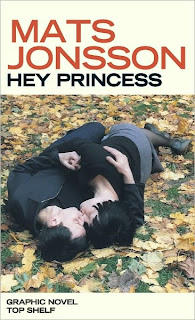
Book-A-Day 2010 # 290 (11/20) -- Hey Princess by Mats Jonsson

We were all young and callow once. So the story of "back when I was young and callow" is a common one -- every new writer has one, and it seems, sometimes, as if they're all going to inflict their versions on us, one after another. Those stories are not all equally worthwhile, though, even if the matter of them is all pretty similar -- I was in love with X, X didn't love me, I was left swinging in the breeze, O my poor tormented heart -- and it all depends on how that individual creator turns a very universal story into a particular work of art.

Hey Princess is one such story -- Mats Jonsson was young and callow in Sweden in the mid-90s, and this is the story of how he got somewhat older and slightly less callow by the time that decade ended. But, when the book opens, it's early in 1993 and Jonsson is twenty and very callow indeed, falling deeply in love with Anna, the first girl he ever made out with. That relationship follows the expected path, and the subsequent sections of Hey Princess see Jonsson just having finished one course of studies, but jumping right into another in Stockholm to get away from home (and obsessing over a girl from school he calls "The Bunker"); and then working for a magazine publisher (and falling for "indy girl" Elsa but trying to hide the relationship from his possessive friend Alva); and, finally, another year or so later, getting to be the stable, normal one is a relationship with bipolar Goth girl Ola.

Along the way, Jonsson spends almost as much time writing about his friends and the music they were all listening to, but his love life -- and particularly his self-deprecating, sad-sack outlook on that love life -- is central to Hey Princess. This is the story of how he spent his early '20s, and that includes a lot of drinking, hanging out, and going to see festival concerts, but what he clearly cared about the most during that time was finding a girl he could love, who could love him, and who wasn't crazy. (And what more have any of us ever wanted -- substituting "boy" for "girl" where appropriate?) But Jonsson buries his story under a huge mass of narration and confusion -- his cast is large and ever-changing, and he never adequately introduces new people (or reminds us of who they are later). That self-deprecating voice, too, gets tiring over nearly five hundred pages -- we get that he was young and callow, and that he was young and callow for a very long time, and it reaches a point where we no longer need more examples.

Jonsson's art doesn't help the situation; it's rough, almost primitivist, with flat faces grinning as if out of a teenager's notebook. His people -- even the girls he lusts after -- are all pretty ugly, and it can be difficult to tell the girls from the boys (or remember who is who) as the pages mount up. Hey Princess is a heartfelt outpouring of one man's back pages, an unflinching look at who Mats Jonsson was and what was wrong with him...but that's not enough to make it a great graphic novel.


Book-A-Day 2010: The Epic Index

Friday, November 19, 2010

Book-A-Day 2010 # 289 (11/19) -- Dungeon: Monstres, Vol. 3: Heartbreaker by Sfar Trondheim Nine Killoffer

The world of Dungeon is a dangerous one -- not in the usual "dangerous" way of adventure fiction, with hair's-breadth escapes and miraculous survivals, but in the way of real danger, with murders, accidental deaths, and assorted mayhem liable to happen at any time, and hit any character. But it's even worse for young, attractive women -- this is one fantasy world that admits that all of those tough, hard-bitten soldier/pirate/adventurer types are as likely to rape an available pretty girl as to look at her, and that she'd be lucky to survive the experience, as well.

Heartbreaker collects two of the French albums from the "Monstres" sub-series, devoted to "great adventures of secondary characters." The two stories here are both about young women thrown into that dangerous world, to survive any way they can -- which means, inevitably, that these stories are about the horrible things that happen to them, and so the originally light-hearted tone of Dungeon continues to get gloomier and more depressive here. Those two young women -- both of whom we first meet as innocents, and then see dragged into circles of death and danger -- are Alexandra, assassin lover of Hyacinthe, the mysterious vigilante of "The Early Years" series, and Drowny, later known as Ballsy, a normal teen girl of an aquatic race who has to pose as a soldier of the Great Khan when her family (and that of her best friend) are slaughtered.

When we've seen Alexandra in "The Early Years," she's been dashing and in control of the situation, but here she's mostly controlled herself: shackled in a prison, tied to a chair, almost poisoned, exhausted and on the run from the authorities, barely surviving at best. The art in her story -- by the Argentinian Carlos Nine -- is smoky and hazy, full of soft penciled lines and sketched backgrounds, very unlike the usually sharp-edged Dungeon world. And given how odd-looking many of these characters are -- the cover is a good example, with Alexandra, something like a busty snake whose body separates into legs, and a one-eyed porcine editor she's talking to -- Nine's fuzziness and figures that fade into the shadows aren't a good artistic match for the story, leading to confusion and annoyance. Alexandra's story is full of events -- she narrates her history over the first third of the story, before she's captured and thrown in prison -- but this telling focuses on the unpleasant things that happen to her, turning it all sad and desperate and tawdry.

The second story, "The Depths," is brighter and crisper in its art, drawn by Patrice Killoffer in a style much closer to the standard for the Dungeon books. But its heroine, Drowny, has an even worse time -- losing her family and making a horrific choice by page seven, and then in danger of her life (or of being revealed, or of being raped) for most of the rest of the book. She's connected with the "Twilight" subseries somehow, though I don't remember her from the main books. Her story is entirely one of frantic fear, hiding in plain sight because she has absolutely no options, and her situation keeps looking worse and worse and worse.

There have been plenty of dark moments in the Dungeon books before this -- even the "Zenith" subseries, the original and sunniest, has danger and nastiness in it, and Twilight and Early Years are both darker -- but there hasn't been a collection so steeped in moroseness and villainy. Alexandra and Drowny never have a chance to even try to take charge of their destinies, like the male heroes of the main books (Herbert, Marvin, Hyacinthe) do -- they run, and hide, and try to escape, and attempt to lead their tormentors to death, but nothing more active than that. I don't think it's sexism, but it is unfortunate -- the world of Dungeon is a dangerous, deadly place, but surely the girls should be allowed to have adventures with as many high points as the boys do?


Book-A-Day 2010: The Epic Index

Quote of the Week: Teaching

"War is God's way of teaching Americans geography."
- Ambrose Bierce

Thursday, November 18, 2010

Book-A-Day 2010 # 288 (11/18) -- Miki Falls, Vol. 4: Winter by Mark Crilley

Eight days beats three years, I can tell you. I read the first half of Mark Crilley's 2007-2008 series "Miki Falls" around the time it was published, and then stopped (because that's where my local library had). I finally found a copy of Autumn earlier this month [1] -- a nearby library had it, and was willing to lend -- and so I got to Winter as well, finishing up the series.

This is the big finish, and to write about that at any length would be to give away all of the secrets of Summer and Autumn, which I don't want to do. So, as I was eight days ago, I expect I'll be vague and roundabout. Miki and Hiro are still trying to avoid their Bad Destiny, which is couched in the very most dramatic and controlling fashion possible, as is most appropriate for a series for teenagers about love. (Teenagers have no distance on anything, least of all themselves, and so what they want most of all in their entertainment are stories that collapse that distance completely as well -- every teenager is both the center of the world and the entire world at the same time.)

If the Secret Society of Antagonists find Miki and Hiro, they will be separated forever, their True Love utterly thwarted for reasons that seem righteous and true to the SS of A. So they're trying to get away, once and for all, so that they can live together forever. (And if the slightly older reader -- yours truly, for example -- begins to suspect that their undying passion for each other would start seriously limping after just a couple of months living in a dumpy apartment somewhere, scraping by at menial jobs to keep food on the table, well, then, it just proves that we're utterly unromantic grumps.) There is a confrontation, as there must be, and all seems lost -- not once, but twice -- before Crilley reaches into his back pocket for the happy ending we were all sure must be there.

Miki Falls can make the reader feel a thousand years old, though I presume that it has the opposite effect on readers closer to Miki's age. I can't entirely recommend it to readers of my age, particularly those anywhere near as cynical as I am, but it's a sweet, energetic love story in a semi-manga style focusing on a smart, self-willed young woman who won't let other people make her decisions for her, and there need to be more True Love stories for teenage girls with heroines like that.


[1] And reviewed it last week as Book-A-Day # 280.

Book-A-Day 2010: The Epic Index

Wednesday, November 17, 2010

Book-A-Day 2010 # 287 (11/17) -- 7 Billion Needles, Vol. 2 by Nobuaki Tadano

Alien monsters always come back; they wouldn't be monsters if they didn't. So we all know that the big fight at the end of the first volume of 7 Billion Needles [1] wasn't as conclusive as it looked, and the alien body-stealing, mass-murdering energy being called Maelstrom wasn't actually dead...although it did look that way.

This second volume opens with a helpful recap of that big climactic battle, and then moves into the following summer vacation, when our heroine, teenager Hikaru, decides to go back to the quiet, bucolic southern island where her father died a few years ago. She's never been back to visit his grave, and a boy from the island named Masaya has been pestering her via postcard for some time. So far, so normal -- as if life is getting back to its normal rhythms, and Hikaru might be able to forget that there's still an alien (Horizon, the cop to Maelstrom's criminal) living inside her body.

But of course Maelstrom isn't gone, and of course he and Horizon must fight again. Creator Nobuaki Tadano does avoid a re-run of the first volume, turning this second confrontation into a psychological battle inside a simulacrum world, rather than the Akira-esque melange of rolling waves of undifferentiated flesh and energy bolts of the first volume. And this volume has an unlikely ending that should lead to more interesting scenes in the back half of the series -- two more volumes will follow this one.

Hal Clement still would have trouble seeing his original novel Needle in this story, but he'd likely find this volume more along his lines than the super-battles of the first book. And 7 Billion Needles is actually pretty good SF as well -- leaving aside the gleeful violations of the rules of mass and volume -- with characters that have at least two dimensions and plotting that finds ways to avoid the obvious.


[1] Which I reviewed as Book-A-Day # 234.

Book-A-Day 2010: The Epic Index

Tuesday, November 16, 2010

Book-A-Day 2010 # 286 (11/16) -- A Cynic Looks At Life by Ambrose Bierce

There was a time when I modeled much of my own attitude toward life on Ambrose Bierce's; he was one of my favorite writers in college (and the linchpin of my senior thesis), I read all of his stories several times plus chunks of his essays -- and, of course, the marvelously cynical The Devil's Dictionary, the book that proved conclusively to me that there was nothing distinctively "modern" about today's world that the previous century (or, indeed, any century) couldn't match. But I haven't read much Bierce for a while; I should, I know, but he hasn't come up in the rotation. [1]

However, one of the good things about modern electronic devices and e-books is that they allow you to carry a shelf-full of old out-of-copyright books along with you wherever you go, and so I've got a whole lot of Bierce (and many other things) with me at all times. And between a conference in Las Vegas and a family vacation in Orlando -- both deeply American places, utterly devoted to enjoyment in their very different ways, which Bierce would have enjoyed in his nasty, disapproving, cruel way -- I found time to read some essays here and there and so work my way through A Cynic Looks at Life. (As far as I can tell, which isn't far, this is probably one of the later works in his twelve-volume Collected Works from 1909-12, since I can't find this title by itself in any standard Bierce bibliographies online, and the scanned copy was published by The Neale Publishing Company in 1912.)

A Cynic Looks at Life might have been collected, or adapted from, his newspaper column "Prattle" -- and, even if it wasn't, it's formed by having been written by a man who had a daily newspaper column for most of the previous four decades. The essays here are a look at what was then the modern scene -- mores and habits of everyday people, as Bierce saw them -- and, as usual, Bierce was not impressed. He opens with a piece entitled "Civilization," which Bierce, at length, is not entirely in favor of. (Not that he admires the natural state of man, either -- but he does admit that a savage is more honest in his rapacity than the civilized man.)

Later essays cover eloquence (which Bierce believes often covers up flaws in reasoning), natural disasters (which never manage to make people stay away from the places they continually happen), the death penalty (he's for it, mostly because he hadn't managed to think up anything nastier to do to criminals), the immortal soul (don't get him started), the modern "emancipated woman" (he's primarily worried that working women would take jobs from men, and has his usual blindness that things might not be that simple), and insanity (he finds it incredibly common). And then Bierce ends with a long section of cynical epigrams -- here, as in the rest of the book, "cynical" means primarily that the then-current ideas of sex roles and righteous behavior were only rarely upheld. Bierce's topical nonfiction is so relentlessly disapproving that reading these pieces straight through would induce either a headache or thoughts of mass murder; I don't recommend that. (His fiction reads much better lumped together, especially his tall tales, which are rollicking, slippery-slope-to-hell fun that gain a lot from the repetition of his favorite themes and ideas.)

This is an angry book, coldly angry at a world that never was what it claimed to be and at the fakes and liars that populate it. Bierce was one of the world's all-time great haters, with an anger so expansive that it could only rarely shrink enough to be aimed at a particular person; his anger needed to blast forth at humanity as a whole, or, when he could throttle it down slightly, to just women, or Americans, or adults. His anger here will seem almost entirely misplaced to anyone not an utter reactionary -- but, still, Bierce is magnificent in his anger, one of the all-time masters of bile and derision. It's lovely to see him at work, even when the target doesn't seem worth the powder to blow it up.

There's no reason for anyone who's read less Bierce than I have to seek out this book; there's at least a million words of his writings (including plenty of "Prattle" about events of more historical interest) that are more interesting to 21st century readers. But Bierce is one of the great American originals, and should never be forgotten -- so I'll once again complain that this quintessential American writer (angry, splenetic, unbending, demanding, militaristic, humanist, Stoic, passionate) has still not been entombed in the standard Library of America series, which has instead spent much of the last decade farting around with miscellaneous reportage and Henry James yardgoods. LoA, get off the stick, and give us the Complete Stories and Tall Tales that we deserve!


[1] If you've never read Bierce, steer either for The Devil's Dictionary (for precision of language and skewering of everyone's idols) or for his short stories, which come in three flavors: Civil War (dark and modernistically gloomy), ghost (equally gloomy, with an excellent supernatural air), and tall tales (horrifically witty and creepily wonderful; usually about murder and mayhem). All of his short stories are available online at The Ambrose Bierce Project.

The quick way of describing Bierce is that he's the nasty, cynical, misanthropic San Francisco writer some people think Mark Twain was.

Book-A-Day 2010: The Epic Index

Monday, November 15, 2010

Book-A-Day 2010 # 285 (11/15) -- The Cartoon History of the Modern World, Part II by Larry Gonick

Larry Gonick has been writing the history of the entire world in comics form -- well, actually, he started off with the universe, only limiting his scope as the earth cooled and more interesting things started happening here -- since 1977, but he's finally done. Of course, he's only "done" in the sense that he got up to the present (2008, when he was done) and stopped -- history, as it does, kept going on, and always will.

That history first appeared in comics form from the old underground publishing house Rip Off Press -- I've got twenty or so issues in one of my long boxes, deep in the basement -- and was reprinted in book form, first with three volumes of The Cartoon History of the Universe from Doubleday (where Gonick was originally acquired by Jacqueline Kennedy Onassis) and then with the follow-up The Cartoon History of the Modern World. This is the second volume of Modern World, published late in 2009, which brought the history of the entire planet from the French Revolution up to "now."

Gonick's history has a clear tone and point of view, embodied by a Gonick-like narrator and characterized by a clear sense that humans are capable of both wonderful and hideous behavior; Gonick neither sugar-coats history nor purely focuses on the gory points. He does try to bring out as much cultural history as he can fit in -- particularly in the earlier volumes -- to keep his book from being the usual history-overview list of kings and wars, massacres and battles. But this volume is more focused on the high points of history than the earlier ones; he has two very busy centuries to fit into less than 250 pages, which doesn't leave much room for discussions of everyday life. (It does then seem to spin along at high speed; one might have wished for this to have been expanded into two volumes -- one for the 19th century, say, and one for the 20th -- but I could also easily see that ever-expanding, as each new volume covered fewer and fewer years, like a high school history class that can never quite make it to WWII.)

Gonick has continued his excellent bibliography -- here a four-page annotated list of works he consulted, with suggestions for further reading -- which is one of the great features of the Cartoon Histories; the earlier volumes, with their wider-than-historical scope, also showcased his thorough grounding in accurate science and scholarship. (Again, that first volume began with the Big Bang and ran through planetary formation and the dinosaurs; a lot of this "history" has been archaeology, physics, and cosmology.)

Gonick's work, as always, is deeply enjoyable just to read; he makes even wars and atrocities into opportunities to learn and do better next time, and has an enthusiasm for learning and knowledge that shines forth from every page. Modern World works equally well as an introduction to the subject and as a reminder for those of us who have studied some of these years (sometime, in some depth, in memories that somewhat survive) -- I can't think of anyone who wouldn't benefit from reading Gonick's histories and thinking about them.


Book-A-Day 2010: The Epic Index

Reviewing the Mail: Week of 11/13

As always, this is the list of books that arrived on my doorstep recently -- in this case, since I was away on vacation for a while and last week's post was bookless, it's since the beginning of this month -- and I have to remind you all that I haven't read any of them, so I could be deeply wrong about anything I say below.

I hope I'm correct, of course, but I'm going from the books' packaging and marketing materials, plus whatever prior knowledge I can dredge out of memory on short notice. So, without further ado, here's what I've got piled up:

I'll start with Stan Lee's How to Draw Comics, a new book in Watson-Guptill's extensive and renowned series of art instruction books, has everything you need to know about the art of comics from a guy who's world famous for...um, writing them. And in writing "Marvel Method," as well, in which the scripter doesn't provide panel breakdowns or otherwise give much art direction. Some may say, "But, Andy, don't you remember Lee's famous How to Draw Comics the Marvel Way?" And I'll reply, "You mean the one co-written by John Buscema, noted Marvel penciller? What of it?" Stan Lee knows many things -- how to make boundless energy and self-promotion into a career, to begin with -- but he would not be among the first five hundred people I'd go to for advice on how to draw comics. How to Draw features contributions from nearly fifty artists -- not including Lee, who contributes not a single pen or pencil line -- and "contributing writer" David Campiti, whom I suspect had a very, very large role in making this book actually happen. And it's being published this month.

Turning to the land of paperback fiction, I also have here Blood Prophecy, a novel by Stefan Petrucha and coming from Grand Central this month in mass-market. It's about a vampire in search of "an ancient artifact as old as creation itself," which he hopes will "restore his lost humanity. It's good to see vampires that aren't making the young girls swoon, once in a while, and I have a vague sense that I slightly knew Petrucha far back in my misspent youth, so I wish him well.

DAW Books is also publishing mass-markets in December: three of them. And, by an amazing twist of fate, I have all three right here --
  • Love and Rockets, an anthology of stories that sadly have nothing to do with the comic or the band (and even less so to the fictional band in the comic) but are instead romantic Space Opera stories. It's edited by Martin H. Greenberg and Kerrie Hughes, and its thirteen stories are by many of the usual suspects: Jody Lynn Nye, Kristine Kathryn Rusch, Nina Kiriki Hoffman, Dean Wesley Smith, and even a few writers (like Jay Lake) who don't have triple-decker names.
  • Alien Tango, by Gini Koch, is the second novel in a series about -- and I have to say up front that this is a direct quote from the back cover -- "Alien Super-Being Exterminator Katherine 'Kitty' Katt," who works for Centaurion Division and could not possibly be mistaken for one of the Men in Black. I haven't read the first book (Touched by an Alien), but it looks like this is light adventure, fun rather than trying to be laugh-a-page funny.
  • And then there's a new anthology of Valdemar stories edited by Mercedes Lackey, Finding the Way, which has fifteen new originals from Judith Tarr, Tanya Huff, Fiona Patton, Brenda Cooper, Sarah A. Hoyt, and others.
Switching to books with words and pictures all mixed together, there's Ema Toyama's I Am Here!, a shojo manga story about a wallflower tween who suddenly blooms when "the most popular boy in the grade suddenly talks to her." It's being published on November 23rd by Del Rey Manga, and it's a big book -- around 400 pages, what seems to have been three separate Japanese volumes.

7 Billion Needles is a very different kind of manga series -- a loose adaptation of Hal Clement's classic SF novel Needle in modern Japan, by Nobuaki Tadano -- and its second volume is also coming out on November 23rd from Vertical. (I reviewed the first volume as Book-A-Day # 234, and liked it a lot.)

In yet a different direction is the new adaptation of Paulo Coelho's massive international bestseller The Alchemist (which I think of as -- without having read either of them -- this generation's The Prophet). The Alchemist is one of those philosophical, designed-to-change-your-life, stories-within-stories kind of books, about an Andalusian shepherd boy who travels to Egypt in search of a treasure and of course finds much more. The graphic novel adaptation was written by Derek Ruiz and illustrated by Daniel Sampere; it will be published by HarperOne in December.

And then there's a new entry in the ever-expanding "Dungeon" saga -- Dungeon: Monstres, Vol. 3: Heartbreaker, written as always by Joann Sfar and Lewis Trondheim, with art for one included story by Carlos Nine and for the other by Patrice Killoffer. Dungeon is one of the most intriguingly gnarly and purely entertaining comics series coming out these days, so I'll recommend this book -- publishing this month from NBM -- even before I read it.

And from NBM's officemates Papercutz -- a graphic novel imprint for young readers with a large line in licensed characters that kids already love -- come the relaunches of two classic and well-loved series in graphic novel form:
As you can see, a relaunch of tween-oriented series in 2010 requires supernatural creatures, but I think we all knew that already. The Hardy Boys was published this month, while Nancy Drew will follow in January.

Speaking of young readers, First Second is another publishing company that usually targets them, and they had a new graphic novel in October that I just saw. It's called Dawn Land, and it was adapted into comics (from Joseph Bruchac's novel of the same name) by Will Davis. Dawn Land (both versions) is the story of a journey by a young Native American man to save his tribe from the Stone Giants, ten thousand years ago.

Also from First Second in October is The Zabime Sisters, a graphic novel from the late French creator Aristophane, translated by Matt Madden. Three teenage sisters on the Caribbean isalnd of Guadeloupe face the first day of summer vacation -- and the thought of growing up -- in their own ways in Aristophane's starkly black-and-white art.

I mentioned Sophie Crumb: Evolution of a Crazy Artist a few months back, when I saw it in bound galley form. But it's now a finished book, so I mention it again: the book was published by
Norton on November 15th, and it has a collection of Sophie Crumb's artwork -- from the age of two up to the present day, in her late twenties (though, from a quick glance, there's more "early" than "recent" here, chosen by herself and her famous cartoonist parents, R. Crumb and Aline Kominsky-Crumb.

Wicked City: The Scarlet Clan is the third of a series of three novels by Hideyuki Kikuchi (creator of Vampire Hunter D), which were turned into the Wicked City animated movie many years ago but had never been translated into English until recently. But that third novel is now available -- just published as a small trade paperback by Tor/Seven Seas -- so people who prefer their sexy supernatural horror in written rather than animated-movie form don't have to settle for second best.

I've seen unhappy online rumblings about the political/racial implications of the "Vampire Empire" series by Clay and Susan Griffith -- possibly prematurely, since the first book, The Greyfriar, is just publishing from Pyr in November. See if you find anything possibly offensive in this: a wave of vampires overran "the northern regions of the world" in 1870, causing that era's Great Powers to race for the tropics, where vampires can't live, to build the inevitable all-white steampunk empire of the equator, which in 2020 has a heir in the snowy white Princess Adele. Adele -- in an unlikely turn for the heir of one of the world's great empires, even less so for a female one in a seemingly Victorian world -- is a master swordswoman and shot, off on adventures before the inevitable arranged marriage, when she falls in love with the inevitable mysterious protector called The Greyfriar.

Update: See comments for a note from the authors about the background, which is not as racially unbalanced as random people on the Internet thought it was. (And what ever is as unbalanced as random people on the Internet, anyway?)

If you're as old as I am -- or even older, if that's possible -- you may remember Dream Park, a 1981 novel by Larry Niven and Steven Barnes about an amusement park that allowed something like live-action D&D, with real-seeming monsters, dangers, scenery, and adventure. They followed up Dream Park with a sequel eight years later, and, after some time out of print, that sequel, The Barsoom Project, is back in print as a trade paperback from Tor.

The Wolf Age is James Enge's third book about the dangerous enchanter Morlock Ambrosius, who this time has come to the far northern werewolf city of Wuruyaaria, where trouble certainly will find him. It will be published tomorrow by Pyr.

Pearl North's The Boy from Ilysies is the sequel to Libyrinth and the middle book in a a science fiction trilogy for young readers. Tor published it in hardcover earlier this month.

The Search for Philip K. Dick is a memoir from Dick's third wife, Anne, originally written soon after Dick's death in the mid-80s, published at least once before (in the mid-90s), but now revised and expanded. It's published by Tachyon in trade paperback.

And last in the long list for this week is another book from Tachyon: SSteampunk II: Steampunk Reloaded, a second canon-establishing anthology of the burgeoning subgenre, edited again by Ann & Jeff VanderMeer.