There's a lot to get through this week, and less time than usual -- it's The Wife's birthday this weekend, so various festivities are ongoing -- so let me dive right into the disclaimers:
- These books were all sent to me by their various publishers
- I haven't read them yet
- But you might want to know about them anyway
- So here's what I can tell you, which is guaranteed to be mostly true
The fifth book in the "Fleet of Worlds" series, set in Larry Niven's Ringworld/Known Space universe, is
Fate of Worlds
, written by Niven and Edward M. Lerner (as were the first four books in the series, beginning with
Fleet of Worlds
itself). It's a hardcover coming August 21st from Tor, and, in it, I presume that worlds will live, worlds will die, and Known Space will never be the same.

Also from Tor as a hardcover on 8/21 is
The Unincorporated Future
by Dani Kollin and Eytan Kollin. It's the third book in the series that began with the Prometheus Award-winning
The Unincorporated Man
, and finishes up the Heinleinian space opera trilogy with what appears to be the traditional war between the freedom-loving Belters and the evil, decadent corporatist/socialist forces of the Inner System.

Coming from Tor slightly later -- as a hardcover in December -- is John C. Wright's new novel
The Hermetic Millennia
, which is a sequel to his previous book
Count to a Trillion
. This is also big-idea, wide-screen SF, spanning (as the title promises) millennia. Our hero is the uniquely named Menelaus Illation Montrose, who "has gone into cryo-suspension following the discovery that, in 8,000 years, a powerful alien intelligence will reach Earth to assess humanity's value as slaves." Personally, my first act on learning that company is coming would probably
not be to go to sleep, but that's why I'm not named Menelaus Illation Montrose and famed as "Texas gunslinger, idealist, and posthuman genius."
Last week I had some titles from Yen Press publishing in August, and foolishly implied that it was their entire output. (Insert hollow laugh.) This week, Yen sent me
many more books, from August and the recent past, in an amazing breadth of manga styles, and so I have again arranged them for you in ascending order of volume number:
The Disappearance of Nagato Yuki-chan, Vol. 1
is the first volume of a spin-off series from
The Melancholy of Haruhi Suzumiya, featuring the characters created by Noizi Ito for the main series but with a different creative team: writer Nagaru Tanigawa and artist Puyo. If you know
Haruhi, you probably recognize Yuki Nagato -- the obligatory quiet, mousy girl in glasses -- but if not, probably not. Either way, this is a series focused on her.
Speaking of spin-offs, I also have here
Soul Eater NOT!, Vol. 1
, which is by Atsushi Ohkubo, the creator of the original
Soul Eater series. As the original focuses on the training of young witch-hunting
shingami and Death Meister Weapons Academy,
Not! showcases the training of their sentient, transforming weapons. Because why not?
 Is This a Zombie?, Vol. 2
asks an uncommon question, and is answered by the creative team of Cascci (comic), Shinichi Kimura (original -- ?!), and Kobuichi * Muririn (character design -- not sure if the bullet between the names is a separator for two people or some fancy pseudonym). Anyway, I'm pretty sure this is about a young man transformed into a "magikewl girl" and forced to live in a dormitory for the same (because
Japan, that's why!), although he also may be a magically reanimated corpse. Oh, and it's shrinkwrapped, so there are at
least a lot of panty shots, and probably more than that.

Ryohgo Narita and Suzuhito Yasuda and Akiyo Satorigi's
Durarara!!
is back for a
Vol. 3 -- and you can see
my review of the first one, if you want. This volume seems to focus on Celty, the Irish dullahan (headless rider spirit), who equally searches for her missing head and carries out assignments for the local criminals.
 Highschool of the Dead
-- the series that boldly mixes titillation and decapitation -- reaches a
Vol. 7, as usual by Daisuke Sato and Shouji Sato. (See my review of Vol. 5 for more details.) In this one, our heroes reach a police station, but it's not as welcoming as they might have hoped.

I know Yana Toboso's
Black Butler
series -- now hitting its ten volume -- is well-known and -loved, but I haven't read it. It's set in Victorian England -- and the very specific kind of Victorian England as imagined by 21st century Japanese -- where a uniquely impressive butler, as he must, takes care of all of the unlikely and violent activities his lord and that lord's imposing pile of a house are caught up in.

Jun Mochizuki brings us
Pandora Hearts, Vol. 10
-- I
reviewed the first volume of this very loose retelling of
Alice in Wonderland, back when the world was young and we were gay -- which has the typically opaque back-cover copy of a story this deep into its convolutions. There's a "forbidden portal," which was opened a century ago -- in Sablier, which we're told as if it would explain things -- by one boy to protect his brother, but which led to nastier things. Now, the series heroes are trying to fix those nastier things, though this volume appears to be mostly wandering around a ruined city, trying to determine the difference between illusions and reality.

SangEun Lee's Korean
manwha series comes to an end with
13th Boy, Vol. 12
-- I guess it
would be too much to ask for a 13th volume of
13th Boy -- and you can see
my review of the first volume for more details on this teen-romance-focused story.

I mentioned the spin-off above, but there's also a new volume of the main series: Gaku Tsugano, Nagaru Tanigawa, and Noizi Ito return with
The Melancholy of Haruhi Suzumiya, Vol. 13
, which tells the pulse-pounding tale of the Literature Club having to actually create a newsletter to keep their clubroom from being given to some other random club. (Manga can sometimes hew
too closely to the real lives of its audience, you know.)

And last from Yen is a light novel -- not a
manga at all, though it does have some illustrations -- from Mizuki Nomura,
Book Girl and the Wayfarer's Lamentation
. It's another series set in a small Literature Club in a highschool -- this one only has two members, the (young, diffident boy) narrator and the book-eating mythological girl who is his president. It looks like our hero is in love this time -- with someone other than the club president -- and has no idea at all how to deal.
And, to finish up, I also have the three mass-market paperbacks coming from our friends at DAW in September:
Seanan McGuire's
Ashes of Honor
, the sixth in the urban fantasy series about October Daye (whose name I've decided to stop making fun of), a changeling PI. The back cover is deep in series-stuff, with names that will be familiar to fans of the series and not to the rest of us, so I wouldn't start here: the first book is
Rosemary and Rue
, so see if that one suits you.
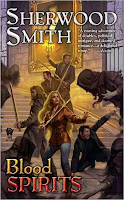 Blood Spirits
is the second book -- possibly the middle book in a trilogy) of Sherwood Smith's Dobrenica series, which is a fantasy Ruritanian (literally: with a magical little European kingdom and everything) romance.

And last from DAW is C.S. Friedman's
Legacy of Kings
, the finale of her Magister trilogy. This looks like big-scale epic fantasy, with Souleaters, the First Age of Kings, a magical barrier called Wrath of the Gods, and a heroine named Siderea Aminestas. The first book is
Feast of Souls
, interested parties should check in there.


 sees Gurgazon shake things up: the demon gets a message out to an old compatriot to lure Thorne away. And then the demon uses the abilities of the other members of the "collection" to plot a very plausible way out of the Llewellyn-Vane mansion's magical defenses. And so we'll see if Gurgazon is really so "adorable" when destroying the world is really a possibility.


 , the 2011 novel by Tom Perrotta, in a fancy bound-galley form. I've read all of Perrotta's previous books -- and
  , in a style that seems overly laudatory to me now -- and enjoyed them, partially because he's a good writer and partially because he's of an age and geographic persuasion to push an awful lot of my buttons.
 , his bestselling and hugely popular memoir of moving to France to write about it for an American audience. I avoid bestselling books somewhat reflexively, from working in the business so long, and I am hugely jealous of people who get to do things like this. Buy, hey, it was a quarter, and it's supposed to be really good.
 is by Michael and Trisa Knight, and there are no points awarded for guessing why I'm reading it. (Though my guys -- who will be 14-and-a-half and just shy of 12 during that trip -- are probably not well described as "kids" these days.)
 by Derf Backderf. Derf has been an alt-weekly cartoonist for some time -- from back when that was a reasonable career for an adult, since there were plenty of alt-weeklies and they all carried a bunch of cartoonists -- and this is an expansion/reworking of autobiographical material that he originally published more than a decade ago. And, yes, Derf did go to high school with, and was in the same circles with, Jeffrey Dahmer. (I
  , in a round-up during my Eisner deathmarch a few years back.)
 is a big fat graphic novel by Mark Kalesniko, whom I don't know. But it's semi-autobiographical, was published by Fantagraphics (who ain't no dummies), and looks interesting.
 is the third collection of his Victorian clip-art webcomic
 , as adapted into comics by Seymour Chwast. I
  , a couple of months ago, and I clearly liked it well enough to go back for another dose.


