Showing posts sorted by relevance for query black hammer. Sort by date Show all posts

Thursday, May 04, 2023

Black Hammer Reborn, Part I by Jeff Lemire, Caitlin Yarsky & Dave Stewart

Black Hammer is dead; long live Black Hammer!

Black Hammer Reborn was the declaredly "ongoing" series about Black Hammer III [1], daughter of the title character for the whole series, who took up her father's mantle after traveling to the pocket dimension way back at the end of the very first storyline, getting his giant hammer [2] and engaging in superheroic exploits of her own.

This first volume - Black Hammer Reborn, Part I  [3] - starts off with that daughter, Lucy, telling us the big story once again, though there's more closure and dates than the actual telling of the story did. The Not-Crisis was in 1986; her trip to the pocket dimension was ten years later in 1996; she "eventually helped liberate the other lost heroes." [4] But it's "now" another twenty years later, and Lucy is retired from the long-johns biz, with a schlubby husband, two recalcitrant kids, and a lousy job editing ad copy. Superheroing is handled in Spiral City by the shiny uniforms of TRIDENT, some kind of paramilitary organization: the type that always turns out to be nefarious in superhero comics.

And, of course, there's a Returned Nemesis, which is, as it must be, The One That Made Her Put Down The Hammer. (Guess who?) And, yes, She Crossed The Line back then, Doing What No Superhero Should Do (wink wink, nudge nudge), but it was Necessary To Save Us All.

I don't need to be that coy about it: it's laid out, in detail, in the very first issue collected here. Black Hammer is a lot of things, but, as I think I've said before, it's not subtle.

As seems to be required in every single Black Hammer story, Colonel Weird shows up to be wild-eyed and say things that don't make sense but will retroactively prove to have been completely true. We also have extensive flashbacks to 90s-era Lucy, featuring Skulldigger, Doctor Andromeda, and more than a few hints about the apocalyptic thing that is coming back in the main timeline. Those also allow the book to show Lucy in costume hitting things with her ginormous hammer, which is kind of the point of a book called Black Hammer Reborn.

I am sorry to say there is also an Incredibles-style "we can't use our powers, because we are Normal People now, and That Is Good" sub-plot, which looks like it will work out exactly the same way that subplot always works out in superhero comics.

Lucy only gets into her costume in the main timeline on the very last pages of this book, during the Tense Confrontation with someone I shouldn't specify. I suspect we'll learn, in the next book, that Things Were Not As They Seemed, maybe with another pocket dimension or some "Man Who Has Everything" kinda deal.

As usual with Black Hammer comics, I admire the skill and energy - writer Jeff Lemire is actually telling a different story this time, allowing it to move forward and everything; new artist Caitlin Yarsky does a lot of great dynamic work, and her covers are particularly strong - while not engaging with it on a visceral level at all. This is all deeply silly, paper-doll theatre, and I can't shake the feeling that only quite dull people could ever take it seriously.

There are two more Reborn collections; the "ongoing" ended last year after twelve issues. I expect I'll be back to see how it turned out, and hope for an ending this time. The side stories mostly had endings; those are pretty good superhero stories. The main 1996-era story, though, seems to be utterly insistent on never moving anything forward at any time. I'll have to see where this piece of the puzzle goes.


[1] I have convinced myself there was a Black Hammer before the main one, and can even call to mind vague panels in which he was discussed. I bet Lucy, our protagonist here, is generally referred to as "Black Hammer II," though.

[2] Remember this is superhero comics: everything is as literal as possible. "Black Hammer" is a Black person who has an absolutely ginormous Hammer, as it must be.

[3] It's the fourteenth collection, officially titled Black Hammer 5: Reborn, Part 1, for maximum confusion.

[4] Is this in some uncollected story, or is it just a gimme? No status quo in comics lasts forever, so of course they got out of the pocket dimension, eventually, somehow.

Thursday, November 16, 2023

The Last Days of Black Hammer by Jeff Lemire and Stefano Simeone

A cynical reader, such as me, could look at that title and think "oh, good, they're finally ending this repetitive superhero waffling that never actually goes anywhere." But that reader would be wrong.

This is not "last" in the sense of anything actually ending. This is a superhero "last," meaning it's about something in the past, and retelling a story already at least half-told multiple times before - but now telling it in greater detail. Even more so, what we have here pretends to be the actual issues of the 1986-era comic in which the original Black Hammer snuffed it, with covers that have fake high numbers and everything.

So The Last Days of Black Hammer is actually a prequel to nearly all of the Black Hammer stories we've already seen. (Black Hammer '45 takes place almost entirely before this, as does Barbalien: Red Planet, but I think those are the only ones - OK, maybe Doctor Andromeda, too.)

The whole premise of the entire vast Black Hammer-i-verse was that there was a big superhero fight (cough Crisis! cough) against the "Anti-God," who looks nothing like Darkseid, in the sky over Spiral City, which apparently also turned the skies of the rest of the world red, because that's the thing comics geeks still latch onto from Crisis even thirty years later, and that the Greatest Hero of All Time, Black Hammer, whacked said Anti-God with his big, um, Black Hammer, and that made the Anti-God go all "ouchie!" and run away forever and forever but also alas! killed Black Hammer in the same way that every superhero dies at least once.

For the dull ones in back: Black Hammer is the Silver Age Flash. He died so worlds can live. Got it? (Character-wise, he's actually more like the Black Racer crossed with Thor, but that's a different kind of derivative-ness.)

This pretends to be the 1986-era issues 234-237 issues of the Black Hammer comic book, including both a "hero no more!" and an "all-new! all-different!" cover, plus the double-sized epic conclusion. There's also a coda or epilogue at the end, outside that "old comics" schema, to show how Sad it all was, how Important was The Sacrifice of Black Hammer To Save Us All, and that His Daughter had to Grow Up Without a Father, Alas! 

Otherwise, though, this is exactly what we already know and what we expect. Black Hammer is conflicted, and wants to give up hitting things with a big hammer to Spend More Time With His Family Before It Is Too Late. But, alas! He Is Needed, because The Bad Guys Will Destroy The World And Only Black Hammer Can Stop Them. The superhero group that still doesn't have a name - the Spiral City Sluggers? the Saviors? the Bad Guy Whompers? the Fabulous Dudes? - more or less breaks up after the events of the first "issue" here, having stopped what was believed to be Their Greatest Threat, and several of them need to be brought back out of retirement - quickly, perfunctorily - for the big ending.

Reader, there is nothing here you will not predict, nothing that gives a true moment of surprise or wonder, nothing that isn't entirely derivative and utterly pre-determined. This is a piece of product, an engineered jigsaw puzzle piece that slots in exactly in the middle of all of the other pieces to make a bland picture of people punching each other.

I usually praise creator Jeff Lemire's writing when I talk about these books, though I know it feels like faint praise. (He can, and does, do a lot better than this. But the Black Hammer books are professional, and the characters are as dimensional as anything in generic superhero-dom can be.) This time, the art is from Stefano Simone, who has a looser, sketchier line that might not quite say "1986 Big Event Comics" to me, but it's energetic and fun and doesn't look like fifty years of superhero comics, so I count that as a plus.

But, as always, I question the whole point of the exercise. We know everything here already. Last Days adds nothing.

Tuesday, March 10, 2026

Black Hammer: The End by Jeff Lemire & Malachi Ward

So a few years ago there was a Black Hammer story-segment [1] called The Last Days of Black Hammer, which sounded like it could have been an ending. But that was a flashback; it told us things we already knew in greater detail, like so many superhero comics. It was not an ending.

Series creator and writer Jeff Lemire might be getting more blunt; the new Black Hammer book for 2024 was explicitly The End.

And, this time, it actually was. (Well, I don't want to oversell it. This is Vol. 8 of the main Black Hammer sequence; there's already a Vol. 9 out, so I mean "end" in a story sense rather than an actually stopping sense.)

I have been reading the Black Hammer stories, with somewhat of a gimlet eye, since mid-'21. I should mention that I haven't been particularly a fan of superhero stories for at least twenty years; they are artificial in silly (and seemingly absolutely required) ways that I find more and more annoying as the years go on. I keep coming back to this one, I think, because it's discrete, because I respect Lemire and enjoy most of his work, and because just whaling on something in writing is one of the little-discussed great pleasures of criticism.

OK, so let me set this up. In 1996, this superhero universe had its required crossover: worlds lived, worlds died, nothing was ever the same again. One superhero team from Spiral City, which apparently didn't have a team name because we've never learned it, was mostly exiled to a pocket universe afterward, while their leader and big gun, the titular Black Hammer [2] died defeating the Big Bad, Anti-God. [3] The main cast moped on a farm in that pocket universe for a while, and then - in a story I only vaguely remember, and am mostly going on faith that it was actually told in the pages of these comics - were freed from the tiny pocket universe to the exact same location, but on our Earth, a world outside of the superhero multiverse, which was Better Somehow. (This is explicitly a no-superpowers world - our world, remember? - but superheroes can pop in and out and their powers work just fine on this planet like anywhere else, so it's somewhat of a distinction without a difference.)

In between stories about the Moping Crew on the Farm, there were a lot of flashback and side stories about other superheroes back in Spiral City, including the Moping Crew themselves, mostly set before the big fight with Anti-God. Finally, in the Reborn series, Black Hammer's daughter Lucy - who had taken up as Black Hammer II for about twenty years after his death, but got older and settled down with a family even later than that - faced Shocking Revelations and The Return of the Villain She Thought Was Gone Forever.

The End is what happens next. My dismissive description is: Jeff Lemire said, "What if Crisis, but me?" It is very, very much in the Crisis mode. Anti-God is working his way down the string of infinite universes - hey, if they're infinite, shouldn't that take infinite time? wait, don't answer that - while he sends the Evil Black Hammer (older, with white in his evil-coded facial hair, like the old-man evil Hulk and a thousand others) ahead of him to whack all of the other Black Hammers in all of those universes first.

Because only a Good Guy with a Really Big Hammer can defeat a stone-faced kaiju-sized villain intent on eating your universe, of course!

So we get panels of worlds like beads on a string, getting crunched or eaten or whatever one after another. We see two versions of Earth with each other upside-down in the sky (like, really close!) and the requisite evil Hellamentals run around killing people and causing destruction, because if you're capable and willing to eat an entire universe, you need minions to smash things on one particular planet first, for Reasons.

And we see, in what is surely the point of the whole thing, alternate versions of all of our heroes, assembled from other universes, including the inevitable Parliament of Weird - every superhero multiverse must have a Parliament of That Guy; it's required - who are gathered by characters we vaguely remember from some of the many, many random Black Hammer spin-offs, who squabble with each other in the best Marvel Manner, and who fight Anti-God in various ways, which are all ineffectual (leading to many of them getting killed on the page - multiverses are great for disposable versions of characters the reader is expected to care about) until the One Last Crazy Idea That Just Might Work.

Anyway, before the Crisis kicked off, Lucy fled with her family to what DC Comics would prefer I don't call Earth-Prime, to live with the Moping Crew on their farm. She is pursued by the Evil Black Hammer, and she and her family eventually fight the guy. They lose and the entire multiverse is destroyed, the end!

Sorry, just a little joke there. Of course they beat the old man who is an alternate-world version of their father and grandfather to death. That's much better.

Then they pop back into the main multiverse to take part in the really, really final fight, because the page count is dwindling. And Anti-God, we think, is defeated for ever and ever.

But, then, we also thought that way back at the beginning of Black Hammer, and we were wrong then.

As always, I do not take this seriously in the slightest. It's Superhero Grand Opera, and the fat lady is screeching for all her might in a really silly costume downstage center, trying to make us all really invested, but I just don't feel it. No shade on Lemire, who keeps everyone talking like human beings and does his best to make it as grounded as possible (spoiler: not very much) along the way. Or on artist Malachi Ward, who draws a bewildering array of versions of characters in a solid adventure-comics style - not as flashy as some of the previous Black Hammer artists, but dependable and clear. (This could easily have been a mess with a flashier artist, frankly.)

I cannot recommend any of the Black Hammer books for anyone with an attitude towards superhero comics anything like mine. Or, well, maybe I can, because I do enjoy making fun of them, and maybe you will, too. But I expect you need to have a very different opinion on the value of yet another Crisis knockoff to enjoy this on a non-camp level.


[1] They're all in Big 2 all-epic mode, so none of the main-sequence miniseries have been actual stories, since there was one beginning (at the beginning) and no end previously - all middle, all the time.

[2] How literal are superhero comics? Black Hammer is a Black guy who hits things with a comically oversized hammer. That literal.

[3] Anti-God has no personality or traits other than wanting to destroy all of the universes (for no stated reason). Visually, he's basically Darkseid in a Spirit Halloween "Galactic Planet Eater Guy" costume.

Tuesday, July 05, 2022

Black Hammer: Streets of Spiral by Jeff Lemire and a cast of thousands

This post may be shorter than my previous diatribes about the wonderful world of Black Hammer, for multiple reasons. One, I've said most of the things I could say. Two, this is an odds and sods collection to begin with, so it's small and random and miscellaneous and will not stand the weight of serious criticism. There may be other reasons as well, but I think those two will do.

In any case, I have written a bunch about the previous Black Hammer books - the most recent was the flashback Black Hammer '45, and that one links further back in turn. And, frankly, how much background do you need? This is a pastiche superhero universe, with mixed DC and Marvel influences (Legion of Super-Heroes here, New Gods there), and anyone who knows superhero comics from the second half of the 20th century will find all of it deeply recognizable.

So this is Black Hammer: Streets of Spiral. It was the ninth collection of the series, and the one that gathered all of the loose bits of string to that point: one "Giant-Sized Annual," in case you thought it wasn't on-the-nose enough about its obsession with '70s comics; a one-shot called Cthu-Louise; The World of Black Hammer Encyclopedia, a very "Who's Who"-style compendium of superhero details; and a short story from the Dark Horse Free Comic Book Day issue for 2019. The Encyclopedia was written by Tate Brombal with series-creator Jeff Lemire; Lemire and Ray Fawkes wrote the short story; Lemire wrote the rest solo. Art is by a large number of people:

  • Nate Powell, Matt Kindt, Dustin Nguyen, Fawkes, Emi Lenox, and Michael Allred for the Annual
  • Lenox with Dave Stewart (who provided colors for nearly all of these pieces) for Cthu-Louise
  • Fourteen different people for the Encyclopedia, including many of the above
  • David Rubin did full-color art for the short story
And what are these individual stories?

The Annual is one of those standard multiple-artists, multiple-heroes "special" stories, which could be assembled piecemeal, showing the whole team dealing with Problem X individually. As was the case with its models, it doesn't add up to a whole lot in the end. There is a sub-Starro the Conqueror eyeball/squid thing, which appears repeatedly out of the Random Mystical Zone and which has to be punched back out of the normal world. It is, repeatedly - this is a superhero story, after all.

What what does it all mean, ask our heroes in the end?

Well, probably nothing. In a regular superhero universe, it's either space-filler or a set-up for a crossover. In Black Hammer, it's just yet another kind of indulgence.

Cthu-Louise is very familiar; the character (and her father, the former supervillain Cthu-Lou) have appeared at least once before, and the plot beats here are very similar. Louise is a teenager with a alien-god squid head, which makes her unpopular, and she wants to fit in. Eventually, she does.

The Encyclopedia is a collection of pages on all of the major characters that have appeared in the various Black Hammer comics to this point, with first appearances and power levels and known family and all that bumf. It is much odder when it's about a world created by one guy, in one series of stories, over only three or four years.

And the short story is the most forgettable, functioning mostly as a teaser - well, it was in a FCBD comic, and that's the whole point of the thing - for both past and (I assume) future Black Hammer stories.

If you like Black Hammer, this is a bunch of minor Black Hammer. If you like vaguely '70s-esque, vaguely Big Two-ish comics, you will like Black Hammer. And god knows there are more of you out there than I want to believe.

Thursday, September 01, 2022

Black Hammer/Justice League: Hammer of Justice! by Jeff Lemire, Michael Walsh & Nate Piekos

In the life of every licensed superhero comic, there will come an especially blessed day: Baby's First Crossover.

This, my dear hearts and gentle people, is that blessed event for the unnamed super-team of Jeff Lemire's Black Hammer comics. [1] (See here for the previous volume and here for the first volume, if you're unfamiliar.) Oh, you may quibble that they have already met quite a lot of other superheroes and villains, fighting and teaming up and generating a lot of Licensable Content. But all of those previous encounters were from Lemire's universe as well; those calls were all coming from inside the house.

For the first time here, someone else deigned to have a play-date with Black Hammer, to let their toys play with the Black Hammer toys, to touch the dolls' faces together to make them kiss. Those heroes are the current Justice League, the someone is DC Comics, and it is a bit like Barbie and GI Joe in the hands of an hyperactive eight-year-old.

The story is Black Hammer/Justice League: Hammer of Justice!, possibly the laziest possible title for this story. (The exclamation point might have taken a moment of thought; thus the "possibly.") It's written by Lemire with art by Michael Walsh and colors by Nate Piekos; I imagine someone on the DC side kibitzed editorially to keep the JL on-brand as well.

Amusingly to me, the Black Hammer gang are still their core '80s incarnations while the JL is the current (I think) modern incarnations. Sure, separate universes don't need to line up their timelines exactly, but wouldn't it be more fun if Lemire had used the contemporaneous bwa-ha-ha era League? Or, possibly even better, the Detroit League? Ah, well.

In any case, the plot is the usual: a Mysterious Someone appears to both teams in their normal milieu (the BH gang grumping on the farm; the JL punching Starro) and swaps their places for making-mischief reasons. In a twist that is never explained, the JL immediately believe they've been on the farm for ten years, and mope about that, but the BH gang are aware of actual reality and spend most of their time squabbling with other Justice Leaguers.

The plot from there is...well, there's that squabbling and moping, which takes up a lot of pages, then the inevitable Reveal of the Mysterious Someone, which is played up big but is one of the few obvious candidates and doesn't really lead to anything, then, finally, as the play-date is ending, all of the dolls need to go back into their respective boxes separately, so they can stay in mint condition for the collector's market. Lemire does throw out what may be a hook for another story, but it would need to be another DC Crossover, so let's hope he gets good grades in school and does all his chores, so maybe there will be another play-date.

At the end of the book, we get what seems to be thirty pages of variant covers for the five issues of this miniseries, and I have nothing coherent to say about that.

I cannot take a single thing about Black Hammer seriously for a second, even while reading it. It is so deeply pastiche that there's nothing substantial about it. If you are less cynical about superhero comics than I am, you may enjoy this on a more normal level. But it's well-done - the characters talk like human beings and are drawn in a solid modern style - so it amusing on whatever level you can connect to it on. Black Hammer is not bad; it's never been bad. It's just deeply pointless and creepily incestuous.


[1] Black Hammer was a guy; he's dead now. His daughter later becomes the new Black Hammer, and another woman who looks very much like her becomes another version a hundred years later. And I think there was one before the main guy, but Lemire hasn't told any stories with the old dead one yet. This is superhero comics; names are just trademarks, and trademarks have to be used or they will be lost.

The team, on the other hand, has no trademark, no identity, since they're drafting on the Black Hammer name and it's far too late to create something new now, ten books in.

Wednesday, September 15, 2021

Sherlock Frankenstein and the Legion of Evil by Jeff Lemire and David Rubin

Names come with expectations. If a biker gang has members named Trash, Jocko, Bonecrusher, and Fluffy, you're going to expect there's a story there. And if the names are references, you'll already have preconceptions based on the originals.

So when a major character is named "Sherlock Frankenstein," you're going to expect a detective who is a monster - or, maybe, if you're more of a purist, a detective who creates monsters. If you're told this Sherlock Frankenstein is a villain, that might be a little confusing at first, particularly the "Sherlock" bit, but you assume the creators know what they're doing.

Until you realize they mean "Sherlock" in the kid-insult sense: this guy is kinda smart, but it implies no more than that. And they mean "Frankenstein" at about the same level: it sounds cool, and he's old, like the Frankenstein story. Both words here signify "vaguely 19th century dude," and the man with those names is a tinkerer-type supervillain with a silly circa-1900 origin (hero! villain! random transatlantic journey!  long years as an always-failing villain! hero once more many decades later!) and no motivation other than "a sad thing happened to me, and so therefore the world is horrible and I will make it worse."

Well, that's disappointing. But superhero comics traffic in disappointment as much as they do in punching: it's in the top five ingredients on the label. So it shouldn't be much of a surprise that "Sherlock Frankenstein" is much duller and more generic than his name implied. That's how superhero comics work.

And then we come to Sherlock's big story: Sherlock Frankenstein and the Legion of Evil! You can't even say it out loud without adding a "bwa-ha-ha!" on the end! Surely this will be an epic story of villainy (presumably thwarted, but maybe not if he's the title character) full of epic battles with do-gooders and prominently featuring the battle aftermath we see on the cover. If we like superhero stories - and why the hell else would we be reading Sherlock Fucking Frankenstein and the Motherfucking Legion of Evil if we don't? - we're keyed up for it.

Reader: that scene appears nowhere in the book. There isn't a plotline that could lead to that scene. It presumably depicts some old battle of Sherlock against whatever the hell the WWII superhero team is called in this universe, in which some other superhero then came in from off the cover to save the day, hurrah! It's purely a bait-and-switch, which sadly is also in the top five label ingredients of superhero comics. [1]

No, Sherlock Frankenstein and the Legion of Evil (bwa-ha-ha!) is actually a story that would more honestly be titled Black Hammer II: Lucy's Quest or something along those lines. It is a sidebar to the main Black Hammer storyline - this phrasing implies there is a main Black Hammer storyline, and I've seen very little evidence of that in the first two volumes, but I'm willing to be generous - in which Sherlock is the McGuffin, not the main character. He's the guy the narrative circles, and eventually shows up onstage at the end for an extended talking-heads sequence, but engages in exactly zero world-conquering plots and at no time uses an insectoid mechanized thing to defeat Golden Gail and whoever the hell the rest of the people on the cover are.

In the main Black Hammer story, a small band of heroes were transported to a farm on the outskirts of a rural town - which itself is in a pocket universe or something, so they can't get out - a decade ago, after defeating not-Darkseid in the not-Crisis. The hero actually named Black Hammer was physically disassembled attempting to cross that pocket-universe border and get back to Spiral City, main venue for all the punching. Everyone in Spiral City believes all of the heroes were killed in "the event," but the rest of the main cast is sure only Black Hammer is dead. (And we the readers realize he's only as dead as any superhero character ever is: until his triumphant return.)

Black Hammer had a young daughter when he "died," Lucy Weber. In the Black Hammer comics, we saw her, now a reporter in her early '20s, do the spunky-reporter thing, find a way into the pocket universe, and take up her father's hammer to become what has not yet been inevitably named Black Hammer II [2]. None of that is surprising or new.

This Sherlock Frankenstein series tells more of Lucy's story: some of the things she did to learn about her father's life before the final success we've already seen. Yes: it's yet another fucking flashback. At this point, the entire Black Hammer saga is a loose tapestry of flashbacks held together by the thinnest possible "present-day" (probably actually mid-90s) story.

I'm half-expecting the gang will never leave the pocket universe, that every Black Hammer story will flash back more and more to tell smaller and smaller stories about things we really don't care about. How Abraham Slam found boots that are comfortable and long-lasting! Barbalien's first epic love story on earth in the 1950s! Talky-Walky's brief spin-off, The League of Super-Robots! Mildly Unsettling Tales, hosted by Madame Dragonfly! All of them with titles that imply much more action and punching than we actually get.

Look: Jeff Lemire is an excellent writer. His people talk like human beings and have understandable motivations, which is rare in comics about punching. But this whole Black Hammer thing is a two-finger exercise that he seems to be doing in his sleep. There is nothing surprising or new or exciting about any of it; it doesn't even have the usual energy and forward momentum that's one of the major draws of the superhero comic.

It all also looks very nice: for this story, David Rubin provides full art and colors, and his dynamic layouts mostly hide the fact that this is a superhero story entirely about people talking to each other.

But I just don't get it. I gather the appeal here is the "superhero universe" thing, to see Lemire spin out more variations on (mostly) DC Comics history, but there's a gigantic actual DC Comics universe out there, with probably thousands of issues of comics (admittedly, written and drawn much more for socially maladjusted pre-teens of the 1970s, but with stories that actually go places and include vastly more of the punching that superhero fans crave) that people could be reading instead.

And naming this Sherlock Frankenstein and the Legion of Evil instead of Black Hammer, Vol. 3 leaves a bad taste in my mouth. This is not a standalone, it's not about Sherlock, and he's nothing like what "Sherlock Frankenstein" would imply to begin with. Frankly, it all feels like Lemire is trying to build an entire superhero universe out of the avoidance of finishing a single story.

But maybe it's just that I don't get how superhero universes work these days. Maybe this is all the point. It's confusing, it doesn't go anywhere, the character names are deliberately misleading, you have to follow the thinnest thread of story through a dozen books with confusing and changing titles, and you never get the big scene on the cover. Maybe Lemire is either just really good at doing what usually takes a whole Big Two bureaucracy or the whole thing is a deeply meta piss-take.

I doubt it. But maybe.


[1] What are the other two ingredients in the top five, you ask? Let's say "silly costumes" and "problematic social attitudes," today. I reserve the right to pick five entirely different ones tomorrow. Well, except for punching. Punching is like sugar in kid's cereal: people who know better will always point out how unhealthy it is, but it's the whole point of the thing.

[2] I think she will actually be the third, but I'm calling her Black Hammer II in all my Black Hammer posts because otherwise it's just too damn silly and confusing. (Although "too damn silly and confusing" is roughly my take on nearly all superhero comics nearly all of the time.)

Wednesday, January 19, 2022

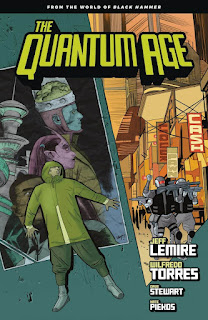
The Quantum Age by Jeff Lemire and Wilfredo Torres

So it's Black Hammer time again! This one doesn't have "Black Hammer" in the title, but it's the next story in the series, following somewhat directly from Age of Doom, Part II, which presented itself as the big, final, absolutely definitive ending.

But we all know about endings in superhero comics, right?

Thus we come to The Quantum Age, written by Jeff Lemire (like all of the Black Hammer books) and drawn by Wilfredo Torres. This one features Lemire's take on the Legion of Super-Heroes, though, in this timeline, they're only one hundred years in the future instead of five.

(There is also what seems to be an unfortunately ham-handed, and awfully late, metaphor for Muslims post-9/11 dumped in the middle, which drives a lot of the larger plot but is badly explained and defined - the George W. Bush figure clearly has some kind of motivation, but it seems to be all in Lemire's head and not on the page.)

Anyway, we start with the bright, shiny happy future one hundred years on, with an interstellar polity of some kind defended by a big team of super-powered young people, including a really obvious Brainiac 5 type. (There's also clear versions of the original three Legionnaires, and more-or-less clear versions of a lot of others; as usual, Black Hammer is largely about reworking someone else's IP.) A new Black Hammer - Hammer Lass, who I mistakenly thought was the same Black woman legacy Black Hammer as the one before, but is actually a different Black woman legacy Black Hammer, which I should have known because her costume is somewhat different - appears near the end of the first issue to tease the same goddamn "what happened to the heroes who died in the not-Crisis?" story as every other book in the series.

But then issue two drops us into a crapsack future twenty-five years later, which we gradually learn was caused by a humanity-first genocidal totalitarian state led by a ex-not-Legionnaire, who took over, in some way the book never event hints at, after a massive Martian invasion. Apparently, when Earth was invaded by one alien race, that made all humans everywhere, or at least enough of them to utterly change society and government, immediately hostile to all other races everywhere in the galaxy, and most of them are being exterminated. Well, this is superhero comics: so it looks like that, but it may just be overstated for dramatic impact in the moment.

And we follow yet another new character, who gets the uniquely stupid name of Barbaliteen later on. Again, Lemire has an infinite universe, where he can create anything he wants, and he just keeps ringing obvious changes on other people's fifty-year-old stories for children.

Now, I have to spoil the earlier Black Hammer stories to complain adequately about this one, so stop reading now if that bothers you. You see, the end of Age of Doom II absolutely required the lost heroes to go back to their pocket universe, and stay there forever. It was the usual "needs of the many outweigh the needs of the few" stuff - very serious, very superheroic. There was no other option, Lemire told us there, very seriously: none of them could ever go back to the real universe in any way, for any reason, or the Anti-God would saunter back in and do whatever vague horrible thing Lemire never quite described.

But then the two of those heroes who stuck the rest of them in the pocket universe are back in the normal universe in this story, with no explanation. So the "you absolutely need to stay there or else Anti-God will eat the universe" is more of a possibility than a real thing, and the ones who did it all just quietly left the others behind to rot on a lousy farm with each other.

(Oh, one other character got out, somehow, but that's a separate spoiler, so I'll avoid complaining directly about that.)

So the story I thought was bullshit for one reason is now retroactively bullshit for an entirely separate reason. Does that make me happy? Well, happy is a sliding scale. I'd prefer that the whole Black Hammer saga make somewhat more sense and not be so obviously Lemire playing with other people's toys - there's glimpses of his serious style throughout Black Hammer, and if the whole thing wasn't so deeply self-indulgent, it could have been a lot better. This is one of those comics in which a lot of strong, true moments add up to nothing at all because the overall plot is a weird combination of second-hand, half-assed, and just plain silly.

Every time I read one of these books, it manages to annoy me in new and different ways. That's impressive, so I think I'll keep going to see just how many ways there are. I have faith in Lemire and the boundless childishness of the default superhero universe.

Wednesday, June 30, 2021

Black Hammer, Vol. 1: Secret Origins by Jeff Lemire, Dean Ormston, and Dave Stewart

So this is much more of a conventional superhero thing than I thought it was. Oh, it's pretty good - Lemire is a strong writer, as always, and Ormston does that pseudo-horror look that is nearly a Dark Horse house style (or maybe just rules the Mignolaverse). But I was expecting something quirkier. (Note that Black Hammer is four years old. I had plenty of time to get more details; I just didn't bother.)

It's not clear if this was really a team. No name for the group is given in this first collection. But a half-dozen of the superheroes who used to defend Spiral City have been stuck on a farm somewhere in the middle of nowhere for ten years, after a battle with Darkseid "the Anti-God". They saved the world, and ended up here. The creators don't tell us how or why in this story - I'm sure it becomes clear later.

None of them are Black Hammer. Black Hammer isn't the name of the group either. Black Hammer was another guy, the one who died as part of the whole saving-the-world thing. (Or maybe afterward, discovering that they really can't get out of this small bit of farm landscape with one small town.) The actual hammer he used - this is a superhero comic, so obviously "Black Hammer" is a large Black man who carries a hammer to hit things with until evil is vanquished, because superhero comics are still written for the particularly stupid children of 1938 - is lying on the ground in a field, as if to shame Chekhov into thinking a gun on a mantlepiece could ever be sufficiently obvious.

Black Hammer, the series, is not exactly a pastiche - it's not "doing the favorite superhero stories of my youth, only as if written by a functional adult" like Astro City has generally aimed for, or "I want to tell stories of these existing characters, but the IP owners haven't hired me to do so, so decipher this really transparent code" like a dozen others. The characters are pastiches, though -- most of them very obviously so:

  • Golden Gail is Mary Marvel, with the serial numbers crudely altered
  • Abraham Slam is the standard WW II strong guy, powered by gumption rather than magic or superscience
  • Barbalien, Warlord from Mars is J'onn J'onz lightly run through a Edgar-Rice-Burroughs-inator
  • Madame Dragonfly is Madame Xanadu with details changed, your standard '70s horror host with weird and mysterious powers (and a tragic backstory involving accidentally creating a muck-monster boyfriend and eventually losing him)
  • Col. Weird is an '80s-style reimagining of Adam Strange, transformed by his journeys through the Anti-Zone into a distracted, ghostly, transitory presence
  • Talky-Walky is Weird's robot sidekick, more or less an equal member of the group on the farm
Black Hammer: Secret Origins collects the first six issues of the main Black Hammer series, beginning when those six have been living on "The Farm" for ten years. Some of them may have been aging, such as Abraham (though this is unclear: we don't know when this story takes place and he's been around since 1939 without any powers to keep him young), while Gail has definitely not been aging, which is a plot point.

Speaking of the unclear timeline: Gail and Abe are clearly WWII heroes, with forty or fiftyish years of history behind them. That puts us in the '80s or '90s. Weird and Barbalien are '50s characters with some history as well, Weird specifically a '50s character with a later ('70s or '80s) spin put on him. Dragonfly was probably the "newest" character if we think of them as being part of an established universe. But all of them probably had at least a decade's worth of adventures behind them, and most of them multiple decades.

This is a combination "introducing the team" arc - they each get an extended flashback to show their origins and life back in Spiral City - and examination of how well they're all getting along here on the farm. Abe is doing best: he's making time with a local age-appropriate waitress (ex-wife of the unpleasant local sheriff) and finally gets into her pants during this story. Gail is doing worst: she's stuck in the superhero body of her nine-year-old self and has been repeating the same grade in a crappy rural school every year. Barbalien might be becoming a churchgoer. Dragonfly is mystical and detached, and clearly has Deep Secrets that readers will need to wait to learn. Weird is barely sane at the best of times, fading in and out of reality. Talky is just keepin' on keepin' on.

Near the end, there is a Shocking Event from Outside, and everyone who has ever read a superhero comic will immediately see the next three or four plotlines coming out of that. (Most obviously: Black Hammer II! The sensational character find of whatever-the-hell-year-this-is!)

I'm being pretty dismissive here, because this is all very deeply derivative stuff. Lemire makes that clear in the sketches and other materials collected after the story: there are even '80s DC Universe-style character sheets for all of the major characters (and several who didn't make it in). The derivative-ness is the point. This is a story for people who want more stories about superheroes like these, written by someone who understands how actual human beings talk and drawn by someone who has experienced actual cast shadows, studied the ways clothing actually drapes, and experienced the touch of actual human women.

That is not my particular jam, but I've started this, so I think I'm going to try to read it far enough at least to see how they get back to Spiral City. (And how long Black Hammer I stays dead: my bet is not all that long.) But know that this is very much a "wouldn't it be cool if Jeff Lemire could write <insert character here> without those suits at DC screwing it all up?" book.

Wednesday, June 21, 2023

Black Hammer Reborn, Part II by Lemire, Ward & Sheean

Looking back over my posts on the vast Black Hammer saga, there's one thing that jumps out: I'm not actually that fond of derivative superhero stories, particularly ones without clear endings. You, Dear Reader, might rightfully ask: why do I keep coming back?

Well, it's fun to complain about things online, obviously. And Black Hammer stories let me sample some superheroic stuff without getting into the insane continuity tangles of the Big Two, or contributing to their bottom lines. And I do actually have a lot of respect for writer Jeff Lemire, even if I think he's massively slumming here. Plus a lot of interesting artists have worked on the series.

All that said, I am probably not going to be particularly complimentary to this fifteenth (!) collection of Black Hammer stories, Black Hammer Reborn, Part II. (Along with everything else, this is pure middle: the central third of a twelve-issue series, with no real beginning or end.) But, before I get into that, let me say that Lemire and his artistic compatriots - this time, Malachi Ward and Matthew Sheean; Ward also did the colors with Bryce Davidson as flatter - do solid work in the superhero mines, creating exciting pages of people punching each other and declaiming dramatic things and contemplating cosmic vistas and all that crap.

(Some potentially useful background links: the first Black Hammer story, the first part of Reborn, and the time a book called Sherlock Frankenstein triggered my loudest rant. A search for Black Hammer will bring up all my related posts, gawd help you.)

So: as we saw in the first part of Reborn, Lucy, the second-generation Black Hammer, is fortyish in the modern day (mid 2010s), having retired from the superhero biz around fifteen years ago for a reason that we see in this series. It's a big dramatic thing, of course: everything is a big dramatic thing in superhero comics. No one ever moves to Schenectady for the spouse's job, or gets really busy with the PTA for a while, or has that annoying lumbar issue and gradually realizes the whole superhero deal just isn't fun any more.

Meanwhile, the Big Bad of the series may be stirring, even though he was supposedly Destroyed Forever. Skulldigger, the Punisher-esque grim n' gritty '90s hero, and Doctor Andromeda, the Starman-esque Golden Age science hero, are both involved somehow, as is, inevitably, Doctor Weird. (Boy howdy is he involved, but I will not spoil the idea that Lemire has here stolen from Alan Moore.)

Oh, and it's Crisis time again! Because modern comics are All-Events, All-The-Time, every "core" Black Hammer story is actually about saving all of the worlds everywhere from final destruction. There is another Spiral City in the sky above "our" Spiral City, which is of course getting closer.

Superhero fans will be happy to see that Lucy is in-costume this entire book, after mostly being in civilian clothes in the first part, and that she hits a bunch of things with that big hammer. It doesn't resolve anything, since this is still all middle, but you do get a lot of pages of punching and clobbering and assembling and emoting, which is what you want, right?

It's not done yet, so it's not as disappointing as it could be. It's still all potential, which is the fun part of a superhero story: the moment before the big fight Changes Everything, never quite in the way that we were hoping. That all will be in Part III, I'm sure.

And, y'know, I'm pretty sure that Worlds Will Live, Worlds Will Die, Nothing Will Ever Be the Same, as usual. Until the next time.

Thursday, August 03, 2023

Black Hammer Reborn, Part III by Jeff Lemire and Caitlin Yarsky

So this is what "ongoing" means in current comics: twelve issues, basically on a regular cadence, ending on a cliffhanger that, if we want to be charitable, was probably planned as a chapter break. Black Hammer Reborn is over, but it did not end.

Then again, what in superhero comics ever does end?

Black Hammer Vol. 7, Reborn Part III is, as I write this, the most recent publication in the endless, ouroborosian saga of a group of derivative superheroes in a derivative world, with the central McGuffin the title character, in two different incarnations.

Reader, rejoice! For both Black Hammers appear in this book. After multiple books with no Black Hammers, and several with only one - and at least one book, the first in this sequence, with the former Black Hammer, Lucy Weber, never appearing in costume - we have two people in skintight spandex flying around with comically oversized but mostly unadorned hammers, ready and able to whack whatever they want to.

I'm vamping here, because there isn't an ending, and, since this is Part III of something, there's not really a beginning either. Some of the plotlines from the previous two books are wrapped up: in particular, we see what happened to Lucy's family, who were "killed" in the first part of Reborn. [1] We see payoffs for a few things from Reborn I and II, and a fairly by-the-numbers heel-turn "because I'll do anything in the world to save my family," which is walked back almost immediately.

It's all standard superhero stuff, Crisis subdivision: the world is faced by the greatest threat it's ever seen, as always, and only Lucy and her fabulous up-do can save it. We have the Evil Universe and the Good Universe - heroes from the Good Universe are all villains in the Evil Universe, and vice versa, in the kind of moral schema that was pleasant undemanding entertainment for five-year-olds in 1954. There are a passel of other, less obviously morally aligned universes - maybe we'll see the Chaotic Neutral Black Hammer next time? - mostly just for flavor, since they don't do anything. We also get an  Earth-Prime equivalent, which is specifically lampshaded as being better and preferable - let me emphasize that: living in a dumpy little town in the middle of nowhere with rural bumpkins and endless dullness as "normal people" is preferable, for all of these super-beings who were mostly functionally immortal in their original worlds, besides, y'know, having superpowers, than their previous lives in the worlds they used to live in with friends and family and co-workers and everyone else.

(And shouldn't Abraham Slam be about a hundred years old now? If he's in a dirt-normal world, he's under the dirt.)

And, again, it doesn't end here. This story stops, basically, with a lot of things up in the air. But, in just a couple of weeks, there will be a new Black Hammer series which promises to really really end the story. Really. They promise. It's called Black Hammer: The End and everything. They all but say that they won't do any Black Hammer comics after that - how much more serious could they be?

As usual, I find Black Hammer books silly, thin, and ridiculous - not without their enjoyment, but I'm not getting at all out of them what the creators (here series writer Jeff Lemire and artist Caitlin Yarsky) intend. I keep reading them out of habit and for the way they always find a new way to tickle my sense of the ridiculous. (I've written a lot about this series; I'm too tired to add lots of links so here's the whole shebang.) If you enjoy this on a straightforward level, well, ghod bless you and I hope you can still eat soup without assistance.


[1] Note: no reader was convinced for even a second that they were killed. 

Friday, October 28, 2022

Skulldigger and Skeleton Boy by Jeff Lemire, Tonci Zonjic and Steve Wands

Nigrum Malleoleum est omnis divisa in partes tres.

Some Black Hammer books have numbers in the title: those are the main series. Before the book I'll be complaining about today, there's been Secret Origins, The Event, Age of Doom 1, and Age of Doom 2.

Some Black Hammer books have the words "Black Hammer" in the title, but no number: Streets of Spiral, the Justice League crossover. These are side stories about the whole team.

(Black Hammer '45 is deeply confusing in this schema, but it actually fits in the next category. The "Black Hammer" referred to in the title is not the same as the other books, for maximum what-the-fuck-age.)

And some Black Hammer books are about other people in the same world, whose stories may intersect the main gang of mopey superheroes or may not obviously do so. (This is superhero comics: all stories intersect in the Grand Summer Crossover eventually.) Before this book, there was Sherlock Frankenstein, Doctor Andromeda, and The Quantum Age.

Skulldigger and Skeleton Boy, as the title implies, is in the third group. For those who weren't counting along on their fingers, it's the eleventh collection. It is written by Jeff Lemire, creator and co-owner of the whole shebang, with stylish gritty art by Tonci Zonjic (often breaking into double-page spreads, which are gorgeous and well-designed but made me wish I wasn't reading the whole thing on a tablet) and lettering by Steve Wands.

Skulldigger asks the superhero question: "what if the Punisher instead used a metal skull on a chain to kill people, instead of guns? Wouldn't that be totally awesome?!" It is perhaps the most '90s idea ever to have been thought up twenty years later, and would have fit comfortably into either DC or Marvel's mid-90s grim and gritty eras - which, of course, is the point of all of the Black Hammer comics: they're meant to seem like that stuff you read long ago while at the same time being new stuff you can buy on Wednesdays.

(The argument about how all superhero comics have been doing this more and more consistently for roughly the past forty years is left as an exercise for the reader.)

Now, in any realistic universe, Skulldigger would be shot dead extremely quickly, but so would Batman, so he gets the same dispensation. At the time of the 1996 of this story, he's been around for maybe a decade, and is seemingly the preeminent crimefighter in Spiral City.

So he's not-Punisher. There's also Detective Reyes, who is not-Rene Montoya (literally: tough female detective, lesbian, always fighting with her captain, olive skinned - I do wonder if Lemire does that on purpose or just can't be bothered to change the details), one of the other viewpoint characters.

The third viewpoint character is Matthew. He's twelve, and we see his parents get murdered in front of him in the first scene, with a particular overhead view that will make you think they just came out of a Zorro movie. (Black Hammer is many things, but it is never, ever subtle.)

Anyway, the story here is: random thug kills Matthew's parents. Skulldigger arrives, kills random thug. Matthew becomes non-verbal at witnessing his parents' murder, doesn't respond to any questioning by cops including Reyes, is institutionalized. Reyes is obsessed with finding and stopping Skulldigger; her boss literally says "he's killing the right kind of people, don't waste time on him."

Look, do I need to give all of the story beats? Skulldigger gets a sidekick. If you've been paying any attention, you know who that is. It's not a good idea, but he at least seems to be devoted to training the kid so he doesn't die immediately.

Oh, and meanwhile, an ex-superhero - formerly the Crimson Fist, now civilian Tex Reed - is running for mayor, on a "let's get back to happy superheroing" platform. (He's an unpowered guy, maybe a bit more Moon Knight than Batman, and now fiftyish and retired for ten years or so.) The Crimson Fist's old nemesis Grimjim - who is not anyone in particular from another superhero universe, but is deeply in the Batman Villain template, something of a mash-up of Joker and Ra's al Ghul conceptually and Killer Croc visually  - has to break out of not-Arkham Asylum to cause trouble.

Tex and Grimjim and Skulldigger have hidden connections, of course. Every superhero story is about the same people tripping over each other over and over again; there's never anyone new.

It is grim and it is gritty and it is violent: this is supposed to be a 90s-style story, from the dark and decadent age of superheroing. We are meant to deplore that at the same time we revel in it.

Frankly, this is one of the most successful Black Hammer stories to date, in my mind: it tells a specific story, beginning to end, without getting caught up in extraneous crap. It isn't burdened with the core series' weird reluctance to move from the initial premise, and has the strengths of the whole series to date: Lemire's naturalistic dialogue and strong plotting, and great storytelling art.

It's still a pastiche grim-n-gritty Punisher/Batman comic that has no good reason to exist, mind you. But it's successful at the things it sets out to do.

One last point: the descriptive copy for this book describes it as a tragedy. It is not. Not in any traditional sense, not in any way. "Tragedy" here seems to mean "a story in which sad things happen," but that's most of them. This is not a tragedy, not for Skulldigger or Skeleton Boy or Det. Reyes, or even for Grimjim. And a tragedy has to be a tragedy for the main character.

Wednesday, April 06, 2022

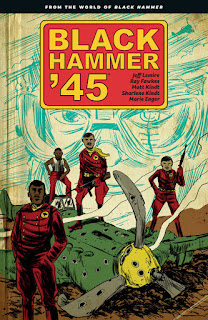
Black Hammer '45 by Jeff Lemire, Ray Fawkes, and Matt Kindt

It's Black Hammer time again, baby!

This book collects a basically standalone story set in the same universe as the cluster of superhero stories mostly set in the present day - I've most recently hit The Quantum Age - four comics issues that were collected into this book in 2019 soon after their original publication.

This time out, series creator Jeff Lemire just co-plotted with Ray Fawkes, who wrote the script. And new-to-the-series creator Matt Kindt is the artist, with some pin-ups (sorry, "chapter breaks") by other hands. Those are three of the very best American comics-makers of their generation, three thoughtful and skillful men whose time is usually spent on weightier matters than "Hey! What is the Blackhawks were actually Black?"

Spoiler alert! That's the whole point here. Like everything else in the Black-Hammer-verse, Black Hammer '45 is made up of scavenged pieces of old superhero comics stories, re-arranged to tell very much the same kind of stories in ways that will not get Jeff Lemire sued by the suits at (most often) Warner. As usual, I am baffled that grown men think this is the best use of their limited time and professional skills, but I've come to realize that a lot of people like stories of punching in spandex vastly more than I ever have.

We do get a very loose frame story, set seventy years later - basically the same "present day" as the other comics, for the continuity nerds who are the assumed audience - but that's mostly there to signpost that not all of the characters survived the main story. That main story is The Last Flight of the Black Hammer Squadron: I may slightly overdramatize it but only by giving it that title.

It is April of 1945. American forces (oh, and maybe other Allies, but who cares about them?) are pushing East towards the borders of Germany. Meanwhile, Soviet (boo! hiss! they may be our allies now but we know they won't be for long!) forces are doing the same from the West. As usual in a four-color universe, it seems that all of the events of the real-world war happened, plus a lot of superhero-fighting as well on top of it, and we get some quick single-panel flashbacks to show what the Black Hammer Squadron, and the more conventionally superheroic Liberty Squadron, have been up to for the past three years.

The BHS - my apologies; I just can't keep typing out the full title - is made up of three pilots and their mechanic, all of whom are what the "Who's Who" of this universe would term "of above-average athletic ability and skill in both hand-to-hand and aerial combat" while sniffing that they possess "no true super-powers." The head is Captain Hawthorne, sole survivor of the three brothers who made up the original BHS. The other two pilots at the end of the war are Jean-Paul, who is both our narrator and very, very obviously French in the manner of Blackhawk comics, and Li, who doesn't get a lot of background but who, from his name, I assume is Chinese. In a stunning break from their Blackhawk models, Li is not presented in any deeply racist way at any time.

The mechanic might have a name. If he does, I missed it. He only gets a couple of lines, and is left back at base for the vast majority of the book.

This Last Mission is to save the Greenbaum family - dad scientist, mom scientist, son probably-not-a-scientist-yet (but I would bet dollars to donuts he's one of the first Science Heroes! of this universe around about 1961) - who are being held in a Nazi compound (commanded by what seems to be a werewolf for no obvious reason I caught) that is So Secret It Doesn't Even Have a Name! [1]

Also making a beeline for The Compound So Secret Everyone Knows About It are the giant robot mechs of the Soviet Red Tide, led by the usual Plucky Young Woman Who Has Seen Great Tragedy, Since Russia Is The Land of Great Tragedy. (Forgive me if I don't dig out her name: she's there to be Russian, to shoot missiles at Nazis, and to fail at her mission since she's in conflict with Americans.)

Also also in the mix is the Ace of All Aces of All Aces, Ghost Hunter, who has racked up more confirmed kills than there have been days of aerial combat so far during the war. He also, inevitably, was the killer of Hawthorne's two brothers, so this is not only the Last Mission, but, even more importantly, This Time It's Personal.

Do the BHS make it to the unnamed compound? Do they battle Ghost Hunter there? Does the Red Tide get destroyed by the Ghost Hunter to show how badass he is? Are there battles in the sky and on the ground? Do characters we know from the other Black Hammer stories make Important Cameo Appearances? Do the clichés fall like rain upon the battlefield?

Dear Reader, you know they do.

Matt Kindt's scratchy, determinedly anti-heroic art style is kind of an odd choice here, but he's done a lot of WWII-adjacent stuff, so maybe that's it. I always like his art, because it's organic and specific - no one else draws like him - but it's not what you'd expect in a story of the Black Blackhawks and their Epic Battles With Nazi Aces and Giant Soviet Robots.

As always, I enjoy Black Hammer stories for close to the complete opposite reasons the creators expect: they are so obvious, so dumb, so silly. Nothing else in the world shows the core decadence and pure Kabuki nature of contemporary superhero comics the way Black Hammer does. It is impressive in its purity, its utter commitment to the bit.


[1] Int. Day. Berlin. Bunker.

HITLER: Achtung! Give me a report on the secret compound!

HIMMLER: Yes, Fuhrer! Early tests on the Odinspear are promising...

HITLER: Nein! Not that secret compound! The one outside Vienna!

HIMMER: West of Vienna or South of Vienna?

HITLER:  West, you schweinhund!

HIMMER: Oh, right, the Greenbaums.

Thursday, November 04, 2021

Black Hammer: Age of Doom, Part I by Jeff Lemire, Dean Ormston, (and in smaller letters) Dave Stewart and Todd Klein

Hey! Shit actually happens in this book! And those things largely validate my "get off the pot and actually say XYZ" grumblings from the previous books, which also makes me happy. [1] Once again, I'm not claiming any great powers of reasoning or insight: this is a pastiche superhero comic, and the plot beats are thuddingly obvious. They were just massively delayed for reasons that I tend to believe owed more to "I want to tell some only vaguely related stories first" than "this Other Stuff is actually important."

This book follows the first two Black Hammer books (one and two) and the very much sidebar (and baroquely-titled) books about Sherlock Frankenstein and Doctor Star Doctor Andromeda (my post will go live in three days as I type this; let's see if I remember to add the link!). And it leads pretty directly, I expect - with the caveat this this series has been all about the fakeouts leading to extensive unrelated flashbacks up to this point - into the next volume, which is titled Age of Doom, Part II.

(There's no third volume of Age of Doom, which could be ominous, but there are seven more volumes after that. They could all be flashbacks - Black Hammer '45 pretty obviously is, for one - but I choose to believe that even this series will move forward in time once it exhausts all other options.)

Anyway, this is called Black Hammer: Age of Doom, Part I but, as I just pointed out in tedious detail, it's not actually "Part 1" of anything. It's either part three (of the linear story) or part five (of all previous volumes). Like the rest of the main series to this point, it's written by Jeff Lemire and drawn by Dean Ormston, assisted by colorist Dave Stewart and letterer Todd Klein.

And it's still stuck on the moment at the end of the first volume, when the new spunky female Black Hammer arrived on "The Farm" from Spiral City, discovering the five or six superheroes living there (do we count Talky Walky? I do) after The Event and we the audience saw one of those supposed heroes, the witchy Madame Dragonfly, immediately steal Hammer's memories for what we have to assume are nefarious purposes.

(Note that we get a different flashback version of that scene in this volume, following the big "everything you know is wrong" moment, and the new version means that the old version could not have possibly happened that way...which is really annoyingly lazy storytelling.)

So we open  this book with another return to the moment where Hammer announcing she's remembered everything and is going to have a reckoning, and she of course immediately disappears. (Gotta keep the tension up somehow!) From there, we get a couple issues of Hammer in various weird worlds (first a transparent ripoff of the bar between worlds from the end of Sandman, then not-DC Hell and a couple of other mystical places, just in case any of the slower readers aren't convinced Dragonfly is behind it), while the main cast decide to figure this out and get sidetracked by their various inamorata deciding that, yeah, OK, we can have sex now.

Again, Lemire is making it clear, even to the slower kids in the back, that the two reality-warping characters are...what's that again? oh, yeah, warping reality.

Eventually, in time for the last of the five issues collected here, we finally get to see Everything We Know Is Wrong. (Well, Everything We Know about the Farm. I bet we know some wrong things about the death of the previous Hammer, and maybe the Anti-God, too.) And we get a big cliffhanger moment on the very last page, as we must when a Part I is going to lead directly to a Part II.

As before, I can appreciate the storytelling and character work - both Lemire and Ormston do good panel-by-panel and page-by-page work here, making engaging people, moving them around convincingly, and making them all interesting - while still finding the overall structure silly and ungainly and massively derivative and entirely airless. I still think Black Hammer is a very well-done version of a thing I would be hard-pressed to say is worth doing.


[1] Trust me, this is me happy. At least as happy as I get about manipulative third-hand superhero tales.

Friday, June 12, 2026

Black Hammer: Spiral City by Jeff Lemire and Teddy Kristiansen

I think this is still the most recent Black Hammer collection; it came out last November. It's set in the modern day, and does not feature the series main characters - the group of five Bronze Age heroes stuck on an extradimensional farm, like that dog you had as a child that had to go away, who I've come to call the Moping Crew because their super-team was never named.

Like most Black Hammer stories, it tells superhero stories that the reader will find at least faintly familiar, using its own invented world and characters that are different enough from Marvel and DC so as not to excite the vicious IP lawyers. I wonder if anyone has traced those familiarities: my sense is that some of them are obvious, but I also think there have been many more iterations of these stories since the '70s-80s versions I only vaguely remember.

Anyway, Black Hammer: Spiral City is potentially a new beginning for the series. It's written by series creator Jeff Lemire, with atmospheric, organic art in a variety of styles by Teddy Kristiansen. I have a hard time taking anything Black Hammer seriously, for the above second-hand story reasons, but maybe you feel differently.

It is soon after the Second Crisis Cataclysm. The techno-powered semi-fascist governmental/military group known as Cadmus AIM TRIDENT maintains the peace in Metropolis New York Spiral City. This city is presumably somewhere in the USA, but Lemire has never said where, or referred to any larger government of any kind. Black Hammer stories tend to use "Spiral City" as shorthand to mean "the real world" or "where we live" - Lemire's city has the usual streets and neighborhoods named after dead superhero artists, but there's never been a sense of larger geography, of suburbs and bridges and commuters and airports and so on.

That lack of specificity is used as if it were a strength in the storytelling here: one strand is in a storybook style, about a "kingdom" in which we follow a few iconic characters: a fool and a princess and a knight and a king. The kingdom, of course, is Spiral City itself, which has a mayor but apparently is not subject to any other level of government.

Malcolm Gold is the villain, the "king." He runs TRIDENT, and we know from the first page he's the Luthor-esque manipulator gathering power for his own nefarious aims. (Primarily outlawing superheroes, since that's the most important issue in a superhero story.) Aside from being evil and personally corrupt, he might be a reasonably effective technocratic manager, but superhero stories are never happy with "reasonably effective." He is running for mayor, and we expect he will win.

The fool is Inspector Insector, a bug-headed private detective who is a bit of metafiction - a "forgotten character" from a land of others like him, who never appeared in a "real story" in the "real world" until he bumbled his way into the Second Cataclysm and became part of a story - the Black Hammer story. He could be a fun character in the right kind of story, but his strengths and style are at odds with most of the core elements of the series: he has no powers, is no good as smashing Anti-Gods, and isn't even much good at moping. He wanders through this story as something like comic relief - though his story is sadder than that.

The princess is Helle's Bell, a superpowered pop star at a cusp in her career. She's trying to expand her work into movies, but she's also a young, hot-headed - literally, as with everything in superhero comics: she has fire-based powers triggered by her anger - prima donna who will sabotage her own best chance and be forced to run back to her Spiral City home from the vague land of Hollywood we first see her in.

And the knight is Concretestador, a former guard at the Akrham Spiral Asylum, which Malcolm just shut down with much grinning and twirling of mustache, because we all know comic-book asylums and prisons are just revolving doors to hold antagonists until they're needed for the next story, at which point they will escape easily. Concretestador needs to get a new job, but his skills are particular and the obvious outlets (TRIDENT and its ilk) are run by Malcolm and so don't want anyone good-coded. So he goes back to fighting other supers at the usual underground high-stakes fighting ring.

Meanwhile, behind all this, the general public - as always in superhero comics, a stupid mass of sheep-like morons who can't understand that superpowered people are better and special and their rightful masters - has responded to the Second Cataclysm by turning against all superheroes, on the grounds that alien gods never seem to try to eat planets that don't have superheroes on them.

(The Spiral City centrality issue also means that people talk as if Anti-God was trying to destroy Spiral City specifically, and not the entire universe it was part of - which is how it appeared in the actual story, too, so I can't fault them for that. Come to think of it, perhaps Spiral City is a small, flat, compact universe - that would explain how the evil forces could appear in the sky above during the various Crises Cataclysms at a 1-to-1 mapping; that would never work on any normal round planet.)

Anyway, everyone hates superheroes now: it's that kind of story. The bad guy is about to win a landslide election, take over everything, and outlaw Our Heroes. The plucky Good Guys are outnumbered, overwhelmed, and seemingly have no options left.

Of course they win in the end. Of course Malcolm wins the election but is forced to leave Spiral City, the only real place in the universe, with his tail between his legs. Along the way, nearly every friend Inspector Insector has is murdered by a serial killer, but I guess you can't make a superhero story without breaking eggs.

This is a second-hand story told well. If you've read superhero comics, of almost any kind, any time in the past fifty years, it will all rhyme with things already in your head. I think that's the point. I personally prefer stories that at least attempt to do something new, but I may be in the minority.

Wednesday, July 21, 2021

Black Hammer, Vol. 2: The Event by Jeff Lemire, Dean Ormston, David Rubin, and Dave Stewart

The thrilling pastiche continues! Everyone who cares read this series four years ago: I think I'm just catching up now because I'm a fan of Lemire's indy work and (possibly incorrectly) classified this as such.

Black Hammer: The Event collects another six issues [1] of the then-ongoing series Black Hammer, written by Lemire with art mostly by Dean Ormston. David Rubin draws one issue for a change of pace, and Dave Stewart colors it all in what I think of as the Dark Horse house palette.

This is all the same thing as the first volume: the story doesn't actually move forward at all. A shocking moment that was completely obvious and that I called out in my post on Vol. 1 actually finally happens on the last page of this book, which presumably will allow the actual story to start moving in the next volume.

What we do get, instead, are flashbacks. Flashbacks to the big fight with Darkseid the Anti-God, flashbacks to random eras in our heroes' lives, flashbacks to Black Hammer's career, flashbacks to things we saw in the first volume. We learn that Black Hammer is basically Thor as a member of the New Gods (Black Racer, more or less, I guess), to continue to show that every single character here is deeply unoriginal. We learn that Gail had a fulfilling sexual relationship with her super-nemesis, which is nice for her, I guess. We get Talky Walky's origin, and get it confirmed that Barbarlien is gay. (Well, that he prefers human men, I suppose - are sexual preferences necessarily consistent across different sapient races?)

It has become clear that "the event" was the Crisis-equivalent for this superhero universe, so that happened in the mid-80s and it's "now" the mid-90s. None of that is actually important to the story; it's all for being-like-the-source-material reasons. I am also amused that its name is the incredibly generic "the event," as if an overworked team of assistant editors couldn't be assed to think of anything better.

Maybe in the next book we will learn why two of the team members are keeping Shocking Secrets! from the rest, and maybe if they are actually keeping the same Shocking Secrets! as each other, too. (It will be funnier if they are keeping totally different Shocking Secrets!, since they seem to not talk clearly to each other, but I don't hold out much hope for that.) I'm sure it will turn out to have been ostensibly for everyone's own good, but that the secret-keepers will have been wrong for some subtle superheroic reason.

This is perfectly cromulent superhero yardgoods. If you're looking for vaguely '80s DC stories, and have already read all of the ones actually from DC in the '80s and/or prefer those vaguely '80s DC stories to be told in moody art and a modern, non-cringey writing style, this is very much up your street.

For anyone else, it looks a hell of a lot like masturbation.


[1] Seven to eleven, and then thirteen. My guess is that twelve is even more of a flashback and/or even more of a fill-in issue than Rubin's contribution here. I think it turns up in a later volume.