Showing posts sorted by relevance for query dorkin. Sort by date Show all posts

Wednesday, December 12, 2018

Book-A-Day 2018 #346: Dork by Evan Dorkin

There are days when I think that Evan Dorkin exists so I can be regularly reminded that I'm not the most cynical, negative person in the world. But most days I manage not to be that solipsistic.

Dorkin is probably the most cynical, negative person in comics -- I could remove the "probably" if I limited that to creators. (Otherwise he'd be fighting with Gary Groth for the throne, and who wants that?)

He's best-known for creating Milk and Cheese, the reductio ad absurdum of '90s hyper-violent comics heroes, but he's done a lot of other work over the years, starting with his early Pirate Corp$! ska-fuled adventure stories in the '80s and running through a lot of projects in comics and animation.

One of the spines of that long career has been his occasional (yearly, optimistically) solo comics series Dork, from the company that was once named Slave Labor. (And which I will keep calling that, since I am old.) Dork is a big new collection of the stories from the comic of the same name, leaving out stories already collected in Milk & Cheese or The Eltingville Club and matching the format of those books. It's large, almost album-sized, and has sturdy paper-over-boards covers and nice glossy paper.

So now Dorkin fans can have a trilogy of bile on their shelves, collecting pretty much all of his central work, which is nice for us. We can wish that he did more work over the years, was less obviously conflicted about working in comics at all, and that he made several more boatloads of money along the way, but those would be as futile as all of our wishes.

Dork starts off with a new two-page introduction (in comics format, of course), and then seems to reprint the eleven issues of comic Dork more-or-less chronologically, starting with the first "Murder Family" story from 1991 and running through about two hundred pages of black and white comics and then twenty-seven pages of color comics before hitting a final supplemental section of covers from the comics and previous collections, plus similar stuff. At some point, material from the 2012 one-shot House of Fun -- which was not Dork #12 for some reason I didn't know, then or now --is included as well, though there's no way to know where unless you have those comics and pull them out to compare. It's a lot of good comics, organized well to read, but there's no explanation of where else any of this stuff originally appeared.

This is probably the complete Miscellaneous Dorkin to date, as far as I can tell. It's definitely almost three hundred pages of comics full of bile and spleen, featuring all of the appearances of the devil puppet and those late '90s stories that made us all worry whether Dorkin was OK or not. (He seems to have been about as OK as he could be, which can be good or bad, and is maybe somewhat more OK these days.)

The work is is very mixed: there's a lot of very short gag strips, mostly organized into pages of "fun" with seven four-panel pseudo-strips, each with one (generally dumb) joke. Longer pieces include several "Murder Family" stories, his early "Fisher-Price Theatre" pieces, his work from the early-'90s book Generation Ecch (the Gen X version of today's self-hating millennial websites), and a bunch of semi- or fully autobiographical stories, culminating in those '90s pieces about what looks really close to a nervous breakdown.

Dorkin's comedy is usually aggressive, about sex and violence and anger and fear and hatred, no matter what the length. Nothing is nice, and if Dorkin has ever been happy in his life, it doesn't come out in this work. It's also deliberately dumb humor a lot of the time: obvious jokes told in boundary-pushing ways. It is really funny a lot of the time, and regularly creepily true -- his more ambitious longer stories are really powerful.

Since this collects work from twenty or more years, the reader can trace the evolution of his art: he started pretty "punky," possibly self-taught, with lots of little lines and and a mania for details. His line has strengthened and simplified over the years -- he got very precise starting in the late '90s, and has kept that look since. I've said in the past that the early look was great for Milk and Cheese, but this book shows the real strength of his mature style: he definitely got better as he got more disciplined and worked on laying down that one right line.

All of the coloring here is provided by Sarah Dyer, who is also married to Dorkin. It is traditional here to use the word "long-suffering," or to make a comment about Dorkin's struggles with depression, but none of us really know anything about other people's relationships, and doubly so when we're experiencing someone else's life through art. So I'll just say she does good work, and it's more obvious with Dorkin's later work, where the cleaner lines give more space for the color to work well.

Dork is primarily for readers who are already fans of Dorkin, since it's so miscellaneous. Most people would be better off starting with The Eltingville Club (if you have a love-hate relationship with comics) or Milk & Cheese (if you have a love-hate relationship with the entire world). But, if you like confessional cartooning and sick humor -- maybe you're a fan of Ivan Brunetti or R. Crumb, and haven't encountered Dorkin yet -- this could be a good place to dive in.

Wednesday, October 19, 2022

World's Funnest edited by some random DC functionary

It was someone's job to put together World's Funnest. Probably a pretty serious job, says the guy who used to assemble reprint books of prose fairly regularly - comics are even more complicated, since it's not just a batch of words that need to be flowed, but pages of art that have different aspect ratios over the years and exist in different file formats and levels of quality. Someone worked pretty hard on this, before it was published in 2016.

Comics used to have a serious credits problem, in that there were hardly any. Stories were about the characters, not the people who made the stories, so credits were left off most of the time for the first few decades. That changed, slowly. By the 1960s, Marvel pretended Stan Lee was in charge of everything, and whoever else he deigned to give a stupid nickname to got mentioned. That probably pushed DC and other competitors to do something similar.

So, these days, comics have lots of credits. Reprint collections even more so - to the point of being deeply silly.

World's Funnest has a page of small type for credits - it lists forty-six people, most of whom were the VP-level and higher corporate officers of DC in 2016.

Wait, I take it back. Comics still has a credits problem. And it's still the same one: credit goes to the company or the character or the "VP - Sales Planning & Trade Development" rather than to the people who actually made the thing.

This book was probably edited by Robin Wildman, listed as "Editor - Collected Edition." Maybe partially by Jeb Woodard, then "Group Editor - Collected Editions." Maybe the reason the cover says "by Evan Dorkin and Friends" is that Dorkin made the initial list of stories to be reprinted? Or kibitzed as Wildman and/or Woodard dug through the archives to find these?

Anyway, what we have here is the 2000 one-shot World's Funnest, written by Dorkin and drawn by Dave Gibbons for the early pages and then a cast of thousands for the rest of its 64-page epic, and then a selection of the first and/or best and/or most memorable stories featuring DC's lovable imps, Bat-Mite and Mr. Mxyztplk. Except for that first story, everything is in strict chronological order, which means related stories are separated several times, and it also means we end with a story from 2008, later than the Dorkin piece.

I said someone assembled this, and that it was hard work. I didn't say I agreed with all of their artistic decisions.

I'll come back to the Dorkin story, since it's the point and capstone of the exercise. But after it we get what amounts to a potted, slapdash history of DC Comics, starting with the first appearances of both Mxyztplk (a 1944 Siegel-Shuster story with a nice lightness and sense of humor to it) and Bat-Mite (a snoozier 1959 piece from Bill Finger, Sheldon Moldoff, and Charles Paris, deep in the giant-props and dull-detective era of Batman).

Then comes the inevitable team-up, "Bat-Mite Meets Mr. Myxzptlk," from 1960, from which Dorkin cribbed a few ideas for his story. It is pleasant, but this is still the Wooden Era of DC.

We then jump two decades for two short Bat-Mite vignettes: the first is a pleasant bit of metafiction mostly memorable for showing how a bunch of DC folks looked in 1979 (big hair, mustaches, etc.) and the second is a single-page gag.

Then we get two Mxy stories from the John Byrne Superman reboot of the late '80s - first Byrne himself and Karl Kessel have Supes tangle with Mxy (for the first time!...once again) and then the Stern Peyer Cullins Janke law-firm brings back Mxy to let Lex Luthor have a crack at him. Both of these are mostly serious, with some humor, though the Luthor one is more dour.

And that drops us into the grim-and-gritty '90s, with two Alan Grant/Kevin O'Neil "Dark Mite" stories, which are mostly parodies of the real Batman comics of the time. Grant and O'Neil are always great, but these are really close to poking yourself in the eye with a sharp stick.

In between those two, out of chronological order I guess entirely to separate them, is "The Imp-Possible Dream," the post-Crisis version of the "the Mite and the Mxy Meet!" story. Dorkin may have re-used some ideas from this story, too.

Last in the book is a two-parter from the New Earnest era, "L'il Leaguers," in which Mite and Myx port over Superman and Batman (and, eventually, a lot more) from a chibi version of Earth-1, and everyone has to learn The Meaning of Heroism. (Which is the point of roughly eight single issues every month, but nevermind.) It has really engaging art from Rafael Albuquerque, but the saccharine level is a bit high for my taste.

Finally, I'll get back to the opening story. Remember the fad for "this guy kills the <superhero company> universe" stories? It's one of those. Gibbons does his best Dick Sprang/Shelly Moldoff impression, to make it all look like a Silver Age comic, as Superman, Batman, and Robin capture the standard batch of '50s gangsters to start us all off, but then Mite & Mxy appear, start squabbling with each other, and things escalate. They kill the World's Finest folks, then the female versions, then the Super-Pets, then the Legion, and go on from there to depopulate and destroy first Earth-1 and then every other Earth Dorkin could remember existed at that point. (They get 2, S, X, the Zoo Crew one, and a few dozen others, including alternate futures and other imaginary stories - as always, Dorkin is thorough when he sets out to blow stuff up.)

Each universe is drawn by someone else, in many cases the creator or most famous artist: Frank Miller does three Dark Knight-y pages; Bruce Timm provides two pages of TV-show storyboards; Alex Ross paints three pages of gods getting slaughtered. Others involved are Mike Allred, Stephen DeStefano, Joe Giella, Jaime Hernandez, Stuart Immonen, Phil Jimenez, Doug Mahnke, David Mazzuccheli, Sheldon Moldoff hisownself, Glen Murakami, Norm Rapmund, Scott Shaw!, Jay Stephens, Ty Templeton, and Jim Woodring.

It's a lot. Frankly, it's a bit too much: by the mid-point, it starts to feel like a box-checking exercise ("Look, Lou, we've still got twenty-seven universes to wreck by quitting time, so let's get going!"). Myx and Mite don't actually have great chemistry, since they're both one-note characters designed to stymie their superhero foes...and Dorkin got rid of those on the sixth story page. But Dorkin is the master of Ids on the rampage, so he gamefully keeps them going until they destroy everything - and then pulls out the requisite superhero-universe ending.

I did not enjoy this book quite as much as I'd hoped. Partially it's that a little of these guys goes a long way - and this book has 300 pages of comics, which is a really, really long way.  I also suspect a more focused collection - maybe just Golden/Silver age stuff, without the meta-commentary - would be more fun. But this book exists, and it's probably got as much or more Mxyzptlk and Bat-Mite as anyone would want.

Thursday, July 03, 2014

Book-A-Day 2014 #183: Milk and Cheese by Evan Dorkin

Another book designed to make me feel old: Evan Dorkin has been making Milk & Cheese comics for twenty-five years now, and put together a big collection of those strips in late 2011. (Though I suspect Dorkin himself feels vastly older, since he's been doing this for more than twenty-five years now.)

Milk & Cheese are a one-joke premise -- violent anthropomorphic foodstuffs, "dairy products gone bad" -- that continues to work because Dorkin always keeps their adventures short and because Dorkin has an admirable surplus of bile available to channel through these little psychopaths. The book Milk and Cheese: Dairy Products Gone Bad! might not be their complete works anymore, since it's now three years later and I bet Dorkin has done a page or three since then. But it's pretty darn complete.

Each M&C strip follows a standard template: they appear, first in little circles flanking the title, and then in regular square panels, generally angry or excited about something. A rampage immediately follows -- perhaps slightly delayed for a bit of plot in the longer stories, with three or five pages to spread out in -- which culminates in a field of circular panels filled with mayhem. Their specific targets can vary -- hippies, blood banks -- but the premise is usually just an excuse for the ultra-violence, a place or a thin idea that sets off the little monsters.

It's repetitive, of course -- it's intentionally repetitive, and that's why Dorkin took almost twenty-five years to put together two hundred and forty pages of them. This is not a book to read straight through: it works much better three or five or ten pages at a time over the course of a few days or weeks. (And it's a lot of Schadenfreude-ly fun read that way; M&C tap into a deep well of antisocial and undirected anger in the human heart -- I may be oversharing here, particularly if you don't agree with me -- which makes their massively destructive antics gleeful and thrilling.)

I hate to be "that guy," but, looking back, I find the first comic's worth of strips -- maybe the second as well -- are the very best. Dorkin developed a vastly stronger and more supple art style later, with a precise line and amazing powers of detail, but the earliest strips have a raw punk energy in their lines that the "better" art can't quite match. He also hadn't settled into that template yet in the early strips; M&C were violent loudmouths who screamed non sequiturs, but they were more free-floating ids, causing destruction wherever they went because of who they were, not because that was the point of this particular strip. You can see that they came out of the same '80s stew as Badger and Flaming Carrot, before they became '90s-ized, all screaming and violence for violence's sake.

So you'll find some sameness as this book goes on, and the early work is the most exciting and fresh. But Dorkin's art becomes amazingly expressive as the book goes on, which will be more interesting to some readers. And Milk & Cheese themselves are wonderful comic creations -- in both senses of the word "comic" -- nihilistic and random and horrible and wonderful all together.

Book-A-Day 2014 Introduction and Index

Wednesday, October 05, 2016

The Eltingville Club by Evan Dorkin

When they said that bile could only take you so far, they didn't count on Evan Dorkin.

Well, maybe they did -- how far is he? Despite the love of (I don't want to guess how many) devoted fans, he works in comics only sporadically these days, and I have no idea if that's because animation pays so much more or because of his issues with pain in his drawing hand or because everyone in Team Comics thinks he's a big meanie and shuns him. Let me assume the former: it's always more pleasant to think that people you like and respect have wonderful, fulfilling lives and are hugely happy and successful.

But it's hard to keep that thought in mind when reading The Eltingville Club, the high-water mark of Dorkin's bile -- and probably close to the high point of bile in the history of the human race.

(By the way, Eltingville is a real neighborhood -- I believe a vaguely suburbanoid area out on Staten Island. Where I work in NYC, I see express buses with "Eltingville" on their signs pretty often, which is always a tiny shock.)

No one else can hate comics -- and the particular horrible kinds of comics people -- as much as Dorkin does, or as specifically. And, more than twenty years ago, Dorkin gathered all of his bile at the comics world into "The Eltingville Comic Book, Science-Fiction, Fantasy, Horror, and Role-Playing Club!," a 1994 short story about the four horrible teen boys in that club and the horrible things they do to each other and the rest of the world in pursuit of the hobbies that Dorkin heavily hints are also horrible. It was a critical success, and widely loved by the kind of comics readers who like to hate themselves or their fellow fans. (And that's most of us -- I'm not proud to say it, but it's true.)

So Dorkin came back to the Eltingville group, every once a year or so when he'd gathered up enough appalling things in the comics world to fuel another eight pages or so, for another near-apocalyptic story in which they lay waste to themselves or a house or a store or the lives of everyone around them or all of that simultaneously. The four Eltingville lads are deeply horrible people, but they're verbally horrible in that pop-culture way, all references and insults and mean-spirited trivia contests and in-group insults. Each story is draining, as it must be -- the expression of another year's worth of anger at the stupid things that comics/SF/gaming people do to each other and the world.

This book collects all of those stories together -- twenty years of the worst of fannish behavior in a fictional form, including the self-parody "The Northwest Comix Collective," plus some production art from the failed animated Eltingville TV pilot -- in a book that is difficult to read straight through. The Eltingville boys are so destructive, of themselves, their supposed friends, and the rest of the world, that they're best taken in small homeopathic doses. Still, having all of their rampages together in one book is a great thing.

Comics fans are not really like this. Eltingville is a parody. But it's not as far off as it may seem. It's as cutting as it is because we've known people who are nearly this bad, and have had some similar thoughts in our own heads. So it's both entertainment and an object lesson, a signpost to show how far we could go if we weren't worried about going too far.

Friday, December 30, 2022

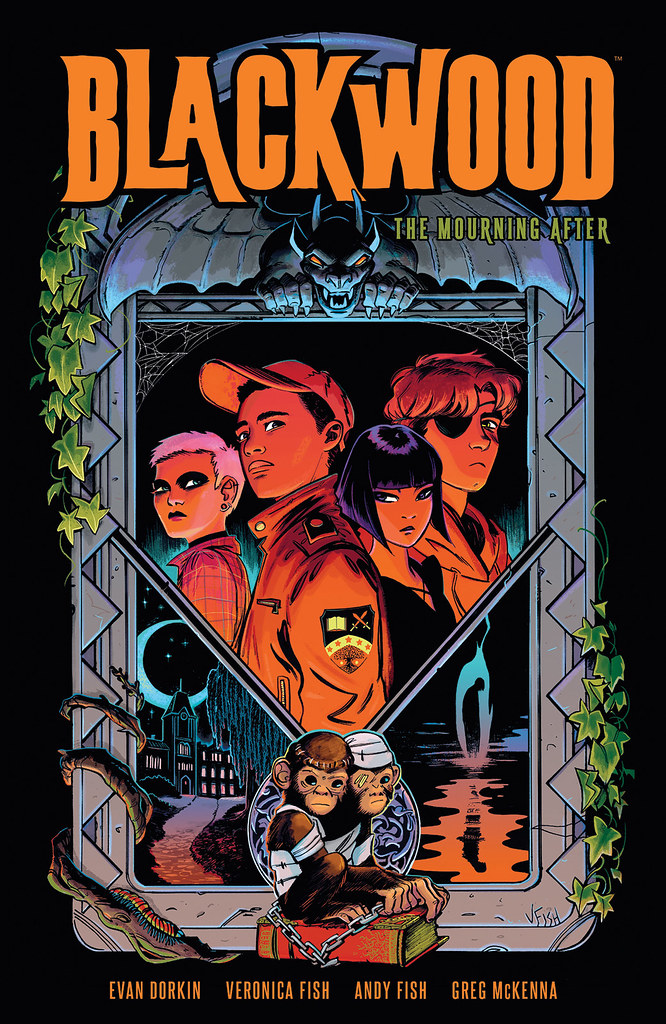
Blackwood: The Mourning After by Evan Dorkin, Veronica Fish, and Andy Fish

In the Before Times, this would have just been the next four issues of an ongoing series called Blackwood - it reads that way, and my guess is that Dorkin and the Fishes would have been happy to just keep telling a bunch of these stories in one series rather than mucking about with re-launching a new mini-series with a new title.

They might not have wanted to do it monthly, on the old chain-gang work-until-you-drop style, but that's an entirely different question.

But, in the Now Times, everything must be new, and everything must have an Issue #1, and the attention span of any comics reader is assumed - probably with good reason - to be lower than the belly of a ground sloth. So Blackwood: The Mourning After was a "brand-new" four-issue mini-series, following up the original Blackwood series and collection a couple of years later.

But it begins immediately after the ending of the previous book, and deals entirely with the fallout of the events in the previous book, and in no way is meant to stand on its own: it's not a new story, not a separate story, just the next story of this place and these people. And that's totally fine for an ongoing, though it feels a little odd in our modern mini-series world.

And it does mean that if I want to talk about any of the plot, I'm going to either utterly spoil the first book or be very, very vague. I'm going to try to err on the side of vague.

So the cover shows four people, which includes three of the four main characters of Blackwood, but not the one who SPOILER in the first book. And there's one more person, who was a secondary but important character the first time out, but has more to do here - maybe he'll turn out to be part of the Scooby Gang in the long term. And, as the title implies, someone important is dead - let me refer here to the first book, which I said started "with some old guy who just did something magically dangerous and is now dictating his last words while Something happens to him" and note that there is an funeral coming up in a couple of days, nudge nudge wink wink.

We learn a little more about the faculty of Blackwood, the college ostensibly some vague liberal-arts thing (though really really focused on anthropology as far as I can see) but secretly a training-bed for new magicians, plus "psychic researchers, alchemical engineers, occult archivists." We also see another secret magic-based organization, I.N.S.P.E.C.T., who seem to be some kind of government agency - big guns, dark suits, humorless affect, the whole works. Blackwood and I.N.S.P.E.C.T. are not on the chummiest of terms, of course, and even less so after the revelations of the new book.

An I.N.S.P.E.C.T. team is coming for that funeral, and various people are planning for the funeral and/or for secret magical rituals designed for fiendish ends, because of course they are. Our four heroes are in the middle of that, partly because of magical shenanigans in the first book, partly because they are nosy, and partly just because their are the heroes of this story, so we follow their viewpoints.

There is another big magical foofaraw at the end of this book, as there must be. A gigantic unpleasant entity is summoned from Somewhere, an evil actor gets hold of a Powerful Artifact and threatens to do Unspeakable Things, and there's a big confrontation in the college library, which is roughly as cool as you are hoping it will be. (Do I mean the confrontation, or the library itself? A bit of both.)

Like the first book, I found this zippy and fun, and this time writer Evan Dorkin has a little more time and space to start fleshing out the world, which I appreciate. Oh, it's still a thriller, so the action-plot takes precedence, and the artists (wife-husband team Veronica and Andy Fish) do good work there, with a lot of room for moody, creepy colors on top of their already pretty-darn-moody line art.

As I said, it would have been nice if this were still a world where Evan Dorkin and the Fishes - and doesn't that sound like a weird ska band? I bet Dorkin is amused by that - could do these more regularly and build their mythology more quickly. But we never get the world we want, and the world we have does have two solid Blackwood stories in it so far, so it's not all bad.

Monday, September 06, 2021

Reading Into the Past: Week of 9/6/01

Nothing new arrived this week, so I'll fire up the RNG and...here's what I was reading this week in 2001:

David Garnett, Bikini Planet (bound galleys, 9/1)

This is a humorous SF novel, published in the UK in 2000; the US edition was more than a year later, at the end of 2001. I was clearly reading it a few months ahead of publication with an eye towards offering it in the SFBC.

We did not, in the end, offer it in the club. That may indicate my opinion of the book at the time, or may be because I made an offer and it fell through. (But I think it was the former.) I didn't remember ever holding or even knowing about a book called Bikini Planet until picking up the reading notebook a few minutes ago. And I don't think I've read anything else by Garnett (though I keep mixing him up with Paul Barnett, who I did know). 

P.N. Elrod, editor, Dracula in London (bound galleys, 9/2)

Elrod had a couple of fun series about vampires herself: Jack Fleming of "The Vampire Files" was a PI, I think in the traditional '30s, who solved crimes and hobnobbed with mobsters. And the Jonathan Barrett books, which I recall being a bit more ambitious, were set during the Revolution. And it looks like the rest of her career was pretty vampire-centric, as well.

So she edited this anthology, which looks to have been entirely original. I don't see a SFBC edition on ISFDB, which makes sense: anthologies were then and are now a tough sell; they never do as well as a single equivalent novel. I don't remember the specific stories, but it is an anthology I read during Worldcon twenty years ago. But Elrod was generally good with the vampire stuff, and Ace put together smoothly professional books, so my bet is this would still be fun and entertaining if you had a copy of it.

Alan Dean Foster, Star Wars: Splinter of the Mind's Eye (9/3)

I had definitely read this before. I know I read it at least once before Empire came out, and possibly other times afterward. My guess is that I was reading it in 2001 with the thought in my head that having a Star Wars book in one of our twice-yearly "Collector's Issues" would be a good seller, and that this book could slot in there and not be embarrassing. That's the guess, since there doesn't seem to have been a new edition around 2001 that could have triggered the re-read.

Or maybe I was reading it for pleasure? It's not impossible, but SFF tended to all be work, in those days.

Anyway, this is the very first sharecropped SW novel (after Foster's adaptation of the movie itself), and I've heard stories that it was a potential plot for Movie 2, if Star Wars did well enough to get a sequel but the budget got cut. It would have definitely been a lower-budget movie, mostly with Luke running around a misty planet and hiding from Vader - I don't remember the details all these years later, but it was OK adventure fiction that only showed slight indications of having been built from much earlier ideas of the Star Wars universe.

Evan Dorkin, Dork, Vol. 1: Who's Laughing Now? (9/4)

This was the first trade paperback collecting Dorkin's solo, and roughly-yearly, comic Dork! As I remember, there were eventually three volumes of Dork!; this one has the first five issues. You can get all of this material in more permanent form these days - most of it is in the big omnibus Dork (note the lack of exclamation point, indicating we are older and wiser now), with some of the strips over in the series-specific books about Milk & Cheese or the Eltingville Club.

Dorkin is, and was even more then, the grumpiest, most cynical cartoonist about the comics field (and a strong contender for "grumpiest and most cynical" in the overall event, too). I always appreciated that: he is funny, biting, and unstoppable at his best. But I always thought being Evan Dorkin seemed to be a really difficult, unpleasant thing - I hope he's mellowed as the years have passed, and that I don't see as much bile from him because he doesn't need to spread as much bile as he used to.

But these are awesome, nasty, funny comics and everyone who reads comics should read them. In this format, if you randomly find this book, in Dork, wherever. Dorkin is one of the greats.

The Humorous World of Jerome K. Jerome (9/6)

This appears to be a 1962 book from Dover Publications - famously a house that focuses on works out of copyright to simplify their accounting - and I have no idea why I was reading it, or what's included in it. I have read other Jerome - obviously I started with Three Men in a Boat, like everyone else, but I've also read Idle Thoughts of an Idle Fellow and (I think) Three Men on the Bummel. And this, whatever this was.

My guess is that it was an anonymously-edited collection of excerpts from a lot of Jerome's work, but it could also have been a small omnibus - maybe of Boat and one other book.

Jerome is still entertaining, at his best: he was frivolous enough, and his time modern enough, that he still reads well today. So if you're looking for funny stuff, he's still a good place to go.

Philip Gourevitch, A Cold Case (9/6)

This was almost brand-new at the time; the hardcover came out in July. So I suspect I got a copy at work, since this was late enough that I think the BOMC-Doubleday merger had gone through and I had access to basically any normally-published book I could possibly want.

Gourevich was famous from We Wish to Inform You That Tomorrow We Will Be Killed with Our Families, which had come out a few years before (and which is still on my shelf, unread - it's hard to get the energy to read several hundred pages about massacres). This book was shorter and about just one murder, which may be why I managed to read it. As I remember, it's a great book of reportage, following one detective as he cracks a personally-important thirty-year-old case. 

The beginning of this week overlapped the Millennium Philcon - the Worldcon was in Philly that year, so it was an easy, convenient trip, and I vaguely remember having a good time there. (As much as I've ever had a good time at any convention: I'm not good at crowds, or small-talk, and I never quite figured out what to do at conventions.) So those first few books were read in chairs in hotel lobbies, or at random moments in the exhibit hall, or (probably) in too much time in my hotel room. I seem to have been trying to "work" during that time, which makes sense: Worldcon was work for me. 

Saturday, September 11, 2010

Book-A-Day 2010 # 220 (9/11) -- Beasts of Burden: Animal Rites by Dorkin and Thompson

Stories about animals are always in grave danger of falling into the bottomless Pit of Twee, or of simply excluding readers who don't love that particular kind of animal quite as much as the creators do. Luckily, Beasts of Burden was written by Evan Dorkin, who has a bone-deep sarcasm and loathing for Twee that sees these stories -- even though they are about talking animals that battle supernatural menaces in a Rockwell-esque suburbia -- stay well on this side of that fatal Pit. Animal Rites collects all of the stories about this group of animals -- in an afterword, Dorkin admits that they didn't have a group name until he had to come with one for the four-issue miniseries that takes up most of the pages here, and they're still not called "Beasts of Burden," or anything like it, in the pages of the stories themselves -- from several Dark Horse anthologies over the past decade, and that aforementioned miniseries. There will almost certainly be more stories coming, of course -- comics is always willing to do more of something that's even moderately popular and successful -- but we're still at the point where these stories are fun, fresh, and exciting, so it's something to look forward to. The premise gives you a sense of the book -- there's a bunch of dogs in this neighborhood (named Burden Hill about half-way through), and one stray cat that hangs out with them, something like an honorary dog. As is the usual case with stories like this, they can talk amongst themselves, since all animals share a language, but humans (of course) can't understand them, except in very rare, special cases. And there are supernatural events and problem -- unquiet spirits, an infestation of witches, an aggregated frog, zombie dogs, a wolf-boy, and several other flavors of undead -- that only a wise dog (or a team of deputy wise dogs, like our heroes) can deal with. The secret weapon here is Jill Thompson's subtle, almost purely naturalistic watercolors -- these aren't cartoony animals in any sense, but real-looking animals, painted as if on a canvas your grandmother would hang on her living-room wall. Except that they're fighting zombies, giant frogs, and so on -- but, all the time, they're only un-doglike in the very humanish facial expressions that they get when faced with yet another supernatural threat. Beasts of Burden is a lovable set of supernatural-detective stories, with a form that will probably sustain it for another five or ten years comfortably. At this point, the mythology and armature of the series doesn't look complex enough for it to grow to Hellboy-esque proportions, but Dorkin and Thompson may yet surprise us. And it will definitely be enjoyable to see what these mutts do next. Book-A-Day 2010: The Epic Index

Wednesday, August 24, 2022

Blackwood by Evan Dorkin, Veronica Fish, and Andy Fish

All the most interesting people have the least-likely careers. (Says the man who started out as a SF editor and somehow ended up doing content marketing for corporate lawyers.) Evan Dorkin was a fiery young cartoonist in the '80s and 90s when I discovered his work, writing and drawing id-fueled scrawls like Milk & Cheese and The Eltingville Club. But somehow, along the way, his modern comics career is mostly about writing vaguely Lovecraftian-flavored fantasy/horror adventure stories for other artists to draw.

Like Beasts of Burden or Calla Cthulhu - or like this book: Blackwood, written by Dorkin with art by wife-and-husband team Veronica and Andy Fish.

Blackwood College seems to be just another mid-rank private learning institution, though it seems like all of their fields of study are specialized cases of anthropology with various cultural, occult, or religious bends. It's not that simple, of course: Blackwood has Deep Secrets.

And four brand-new first year students, who have all been recruited to the secret college-within-a-college at Blackwood, are going to find out about those secrets the hard way.

Blackwood collects a four-issue series, so it gets going quickly - with some old guy who just did something magically dangerous and is now dictating his last words while Something happens to him - and keeps at a blistering pace throughout. There's not a lot of room for the lore of this place to be explained, so the reader (and those four main characters) pick it up in bits and pieces as Dorkin tosses it out.

The last issue hits all of those Deep Secrets, some of which the reader will have guessed and some of which seem to come out of left field. (I wonder if this was originally planned to be longer - maybe six issues? and it got shortened somewhere in the process.) It all runs just a hair too fast and is a hair too generically Creeping Horrors for me, but it is fun and zippy throughout, and the Fishes make good artistic choices: they do grotesquerie well and Veronica's chapter-break art is particularly atmospheric and spooky.

All in all, I wanted a little more How This World Works and a little less "ahh! the bugs are going to kill us!" but this is largely a Teenagers in Danger movie done as a comic, so what I wanted is somewhat outside the bounds of the genre. This is just fine for what it is, and sets up a world where there could be plenty of other stories - I know there's at least one more already.

Tuesday, January 04, 2022

Beasts of Burden: Wise Dogs and Eldrich Men by Evan Dorkin, Benjamin Dewey, and Nate Piekos

I'm not sure if this is the second book in the series or not.

On the positive side, after the original Beasts of Burden - there can be no argument that's the first book - the next substantial series was called Beasts of Burden: Wise Dogs and Eldrich Men, and that is definitely collected here.

On the negative side, there were four other comics-format Beasts of Burden issues (some collecting anthology stories, to make it all more complicated) published before this series, and those are collected, along with a couple of later stories, as Neighborhood Watch. And most of those stories are drawn by original series artist Jill Thompson, if that makes any difference in the what-comes-first argument.

So, in my considered opinion, Wise Dogs is Schrodinger-ly the second book of the series, along with Neighborhood Watch: if you want to argue it's clearly not, go ahead but do it somewhere else. It's two, or two-and-a-half, or possibly three. (Five is right out.)

Now, I read the first book more than a decade ago - I gather the stories slowed down after that initial rush, as Thompson got busy with other things, but they did keep appearing; there was no huge gap in the actual real world - so my memories are vague and possibly confused. (I had a sense that the non-Thompson stories would have a different cast; that does not seem to be the case.)

Anyway, here's the scoop, as I remembered and re-discovered it: animals are intelligent and can talk to each other, as in many other stories, and to a few special humans. Magic is real, with vaguely Lovecraftian implications: there are monsters that can be created or called or unsealed, and the good side of magic is one part protecting yourself and others from monsters, about three parts getting rid of monsters, and absolutely no parts doing anything else.

These stories follow a group of dogs in a rural part of Pennsylvania, centered on Burden Hill, which has an unusually high level of supernatural disturbances. These dogs fight the evil and get rid of it. All of the stories are written by Evan Dorkin; Thompson was the original artist, but Benjamin Dewey (whose first work on the series is in this book) looks to be the main artist these days. (Nate Piekos is the letterer; I don't usually list those, but my current rubric is "include everyone listed on the cover in the largest size type, unless I disagree and want to include more people" so he counts that way.)

This is actually one longer story - the first multi-issue Beasts of Burden story, I think - in which a team under Lundy (the dark Scottie who is the biggest head on the cover) travel across the local landscape to deal with a couple of problems that, inevitably, turn out to be related and bigger than they expect. As will surprise exactly no one, they do not fail and let a magical apocalypse destroy...um, what would be closest? maybe Harrisburg?

It's all pretty straightforward contemporary supernatural adventure, with all of the expected story beats done professionally and well - except for the fact that the entire cast runs around on four legs and eats out of bowls on the ground. I am not a big animal person, to put it mildly, but these are fun stories, and it's particularly interesting to see how Dorkin deals with a cast that have no hands and who would have trouble accessing anything more than four feet above ground-level.

So this is not great literature of any kind, but it's solid adventure comics that does not involve anyone wearing spandex. That's a win in my book.

Wednesday, April 20, 2022

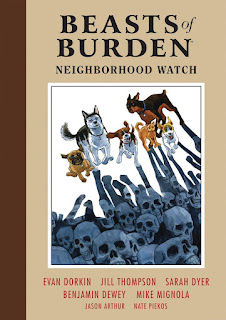
Beasts of Burden: Neighborhood Watch by Dorkin, Thompson, Dyer, Dewey, Mignola and others

It's an odd thing: while actually reading a Beasts of Burden book, it's entirely plausible - my disbelief is reasonably suspended. But both before and afterward, in retrospect, it all seems silly and I struggle to write about it in a non-dismissive way.

If that tone sneaks in, I don't really mean it. But there is something inherently goofy about the whole series, and I do have to acknowledge that.

As seen previously in the original Beasts of Burden (later subtitled "Animal Rites," har de har har), and seen later in the follow-up series Wise Dogs and Eldrich Men, all animals can talk to each other and some animals have magical skills and abilities.

I don't know if series creator Evan Dorkin meant it this way, but domesticated animals (dogs and cats so far) are on the side of Good, and wild animals (rats, corvids, some more exotic monsters) are on the side of a quite Lovecraftian Evil. The forces of Evil are led by the usual extradimensional entities in the final extent, but usually an evil human (alive or currently dead) in the immediate situation. [1]

The Good animals do coordinate with humans, some of the time, and there's a long tradition of partnership, man and dog, but the dogs are fully capable of battling eldritch menaces without the aid of opposable thumbs. So the Beasts of Burden stories are mostly about dogs running around the woods around Burden Hill, Pennsylvania, barking at and biting monsters to save at least this small corner of the world from the Many-Angled Ones. I should add that they do have mages as well: a couple of the animals here can cast spells, but most of them are just the standard somewhat-stronger-tougher-and-longer-lived-than-normal.

Neighborhood Watch is the miscellaneous collection of the series; it gathers all of the smaller and shorter series that came out in between the original series and Wise Dogs. So we have a couple of single-issue stories, a two-part epic, several anthology stories that were later stuck together into one comic book, and a crossover with Hellboy.

Hm, I may have discovered why I'm having trouble taking this seriously. When Hellboy wanders through one of your stories and puts a main character in his pocket, showing that what are massive supernatural threats to you are no big deal to him, the overall universe loses a certain amount of tension. Sure, these dogs might fail to stop any particular nasty thing, but that just means Hellboy or one of his crew will have to come in and quickly mop up. Sad, but not apocalyptic.

Anyway, these are miscellaneous stories, about (mostly) the same main cast as the other stories. Dorkin wrote or co-wrote all of them; Mike Mignola co-wrote the Hellboy story (semi-obviously), Sara Dyer co-wrote one other story. Art is by either Jill Thompson, the co-originator of the series, or Benjamin Dewey, who took over for a lot of this stuff and then did Wise Dogs. Lettering is credited to Jason Arthur and Nate Piekos: I don't think they worked on the same stories, but I can't tell you if it lines up as neatly as Arthur lettered Thompson and Piekos did Dewey.

And, as I said up top, I enjoy reading these stories even though I am in no way an animal person, particular a domesticated animal person. I suspect the people who really like them are much more heavily invested than I am, but that's fine: we all like and react differently to different things. If you want comics about dogs fighting supernatural evil, I don't know of any better option.


[1] Thinking far too deeply about it, I would love to see a series with the opposite premise: dogs and cats are the villains, because they have been tainted by human evil, and badgers or foxes or opossums or maybe raccoons are the heroes. Actually, yes, raccoons, maybe with corvids as advisors: that's the one I want.

Thursday, February 09, 2006

Two Dozen Or So Excellent Graphic Novels That You've Probably Never Heard Of

I've been thinking about doing this for about a week or so, and now I'm finally pulling books off of the shelves to do it. (Note: "now," in this case, was the evening of January 23rd. This post has been gestating a long time.)

Every so often, magazines and websites list "the Ten Best Modern Comics," or something like that, and it's always the same things. So I'm taking it as written that, by this point, you've heard of Maus and Watchmen and Safe Area Gorazde and Jimmy Corrigan. This list is of other books, ones that are more obscure, but still very worth reading (especially to readers who aren't already fans of the spandex crowd that infest most comics). I'll also try to give somewhat fuller bibliographic information, in case anyone wants to go out and find any of these. (Though, looking at the assembled details, I'd imagine most of these are long out of print. Oops.) My shelves are alphabetical by author (or, at least, they're supposed to be), so this list should be as well:
  • David Boswell, Reid Fleming, World's Toughest Milkman: Rogue to Riches (Vancouver, BC, Canada: Deep-Sea Comics, 1998; $13.95 trade paperback)
    A lot of the comics I'm going to recommend here are odd, idiosyncratic things, with various bizarre elements that don't seem like they should go together. This one is relatively normal in that company, being the well-drawn story of a surly milkman and his battles with the his unpleasant boss and overseer. Well, and his love life. And "the Perils of Ivan," his favorite TV show, which is about a skeleton sitting in a chair all day. It's very funny, and surreal in an unexpectedly grounded way.
  • Bob Burden, Flaming Carrot Comics, Collected Album No. 2: The Wild Shall Wild Remain! (Milwaukie, OR: Dark Horse Comics, 1997; $17.95 trade paperback)
    But here we get into as pure a dose of weirdness as comics -- or any medium -- can provide. Bob Burden is the wild man of comics, and the Carrot is his greatest creation; a low-budget superhero in a blue-collar town, battling dead dogs, zombies, and spindly aliens with an atomic pogo stick, a broken yo-yo, and the most unlikely dialogue you've ever read. This is the kind of story that gets called "dream-like," but it's not like any dream I've ever had; it's more like suddenly seeing into someone else's head, and not understanding the significance of half of what you see. Most of the series has been collected into four volumes, but the first is not as strong as the later books; this one finds the Carrot hitting his stride.
  • Eddie Campbell, Alec: The King Canute Crowd (Paddington, Queensland, Australia: Eddie Campbell Comics/Marietta, GA: Top Shelf Comics, 2000, $14.50 trade paperback)
    Pseudo-autobiographical comics, of the "why and how I became an artist" variety, from the writer/artist of the excellent Bacchus/Deadface series (and also the artist of From Hell, written by Alan Moore). I chose this one for accessibility to readers of prose "education of an artist" books, but the various Bacchus collections are also good introductions to his work (they showcase the ancient wine-god in modern times, usually telling his own versions of old myths and occasionally getting caught up in the battles of the other, very few, surviving gods). If you like this one, there are three more volumes of "Alec" stories.
  • Zander Cannon, The Replacement God (San Jose, CA: Amaze Ink/Slave Labor Graphics, 1997, $19.95 trade paperback)
    The beginning of a good epic fantasy story, in comics form, with a lot of interesting touches and an engaging, loose black & white drawing style. Unfortunately, it doesn't look like he could make a living doing this, because after a few more issues for another publisher, this series hasn't been seen for at least five years. Maybe it will come back someday; I hope it does. And this book stands just fine on its own, though the larger problems are still unresolved at the end.
  • Evan Dorkin, Who's Laughing Now? (San Jose, CA: Slave Labor Graphics, 2001, $11.95 trade paperback)
    Dorkin is not the first name that comes to mind when you think of autobiographical cartoonists, but I find his cartoony, steeped-in-pop-culture style and strong layouts makes his life (and mental anguish -- well, particularly his mental anguish) gripping reading. Some of these stories are laugh-out-loud funny, and some are borderline horrifying looks into the mind of a guy who's read too many comics and is too obsessed with his own childhood entertainment to function well in the world. (And, of course, that's nothing like any of us other comics-reading folks, right?) This isn't all autobiography, by any means, and even the personal stories are seen through a fantastic lens, so it's a great book for readers who, like Dorkin, feel like they've grown out of superheroes but don't want to leave comics behind.
  • Matt Feazell, Ert!: Not Available Comics (Detroit, MI: Caliber Press, 1995, $12.95 trade paperback)
    Feazell is the creator of Cynicalman, Cute Girl, and dozens of other extremely funny stick-figure characters. He used to (and for all I know, may still) write and draw mini-comics, and this is a collection of his best stuff as of a decade ago. He's very funny, and the stick figures are surprisingly expressive.
  • Bob Fingerman, Beg the Question (Seattle, WA: Fantagraphics Books, 2002, $24.95 hardcover)
    Semi-autobiographical story of hipsters in early '90s NYC, having lots of sex (well, the couple we follow have a lot of sex with each other; it's not a bed-hopping stroke book), trying to do good comics work, and toiling in the fields of low-rent porno comics. Fingerman's people are fleshy and lumpy, which works well in a story that's in large part about ambivalent feelings about different kids of sex (real, imaginary, cartoon) -- his characters aren't pneumatic sex robots, and the point of the story isn't to see Tab A go into Slot B repeatedly for several pages. But there is enough sex here that you wouldn't want to hand it to your ten-year-old. (That could be a plus or a minus, depending on the audience.)
  • Andy Garcia, Big City: The Complete Oblivion City Saga (San Jose, CA: Slave Labor Graphics, 1995, $19.95 trade paperback)
    More scratchy black and white art about strange people inhabiting a surreal city; I think I've found the kind of comics I like best. This one is very obscure, but a lot of fun.
  • Marc Hempel, A Gregory Treasury 1 (New York, NY: DC Comics, 2004, $9.95 trade paperback)
    Gregory is a big-headed person (probably a child, but it's hard to tell) who lives, wrapped in a straitjacket, in some kind of mental hospital. He doesn't talk, really. His only friend is a rat, Herman Vermin, who does talk -- too much. It's funny, it's cheap, so just go buy it. There's a second volume, too.
  • Greg Hyland, The Big Book of Lethargic Lad (Brookfield, CT: Destination Entertainment, 1998, $15.95 trade paperback)
    The funniest '90s superhero parodies I've ever seen (Mark Martin holds down the '80s crown), and laugh-out-loud funny even for someone (such as me) who hasn't read any of the things being parodied. Actually, this is probably "satire" more than "parody," since it's only rarely commenting on a specific story, rather than a trend or style. The series now appears on-line and in the back pages of Dork Tower -- in fact, it's the reason I started reading Dork Tower.
  • Scott McCloud, Zot! Book 1 (Northampton, MA: Kitchen Sink Press, 1997, $34,95 trade paperback)
    Light-hearted adventure comics, set in an alternate early '60s world of the future and featuring a girl from our world who crosses over to befriend (and maybe fall in love with) Zot!, the greatest hero of that world. If Mort Weisinger Superman comics a) made sense and b) didn't have plots that required Superman to be a dick, they might be like this. There were three volumes collecting the series before Kitchen Sink went under; unfortunately, the best run of the series would have been in the fourth volume. Oh, well. What was collected is still awfully good.
  • Frank Miller & Bill Sienkiewicz, Elektra: Assassin (New York, NY: Marvel Comics, 2000, $24.95 trade paperback)
    Miller's done more famous works (Sin City, his various Batman books), and has done works as good (and arguably more accessible) than this. But this is one of the great books to show what modern adventure comics are capable of. The art style is manic expressionist, using one of the widest palette of colors (and styles of color) that I've ever seen. The pages are drenched in words, as well: several levels of narration/internal monologue, and the kind of dialogue Miller used to be able to write before his brain got eaten. This book has ties to Miller's Daredevil run, but you don't need to know anything to start reading it -- in fact, knowing Marvel continuity could be a detriment to enjoying this book. It's about a possibly-crazy female ninja assassin (who should be dead), the government agents investigating her, and somebody's plot to destroy the world.
  • Peter Milligan, Brett Ewins & Steve Dillon, Skreemer (New York, NY: DC Comics, 2002, $19.95 trade paperback)
    I lied a few weeks ago, when I said Ex Machina was the first successful SF comic I'd ever seen; I'd forgotten about this one. Of course, the SF is really just a skin on a gangster story, which could have been set in any era. (As I recall, there's nothing here that needed to be science fictional.) But this is a great gangster story, with all of the necessary fear and loathing and violence, and the slightly spiky, '80s-looking art carries the story well.
  • Pat Mills & Kevin O'Neill, Marshal Law: Fear and Loathing (London, UK: Titan Books, 2002, $24.99)
    If you hate superheroes -- and I know I do -- you must read Marshall Law. He's a cop in a satirical near-future world where government-designed ex-supersoldiers are running wild. Luckily, he loves killing them. Kevin O'Neill is the only artist ever told by the high and mighty Comics Code Authority (of the USA, and back in the day when they actually meant something) that his entire style was unacceptable under the code. There's also a pretty good story in this one, besides the random superhero slaughter. (And the game of spot-the-reference doesn't really start being a major part of the series until later stories.)
  • Steve Purcell, The Collected Sam & Max: Surfin' the Highway (New York, NY: Marlowe & Company, 1995, $12.95 trade paperback)
    Those guys from that crazy old LucasArts computer game? Yeah, they were a comic first. And the comic is funnier. For those of you who don't know them, Sam and Max are a suit-wearing anthropomorphic dog and a borderline psychotic (but extremely cute) bunny. They're also freelance police.
  • Scott Saavedra, Dr. Radium Battles Phill, King of of the Pill Bugs! (San Jose, CA: Amaze Ink/Slave Labor Graphics, 2004, $9.95 trade paperback)
    If "She Blinded Me With Science" was a comic...well, it still wouldn't be much like this, but they're both goofy crazy-scientist artifacts of the '80s, so that's a good enough comparison for government work. Saavedra did Dr. Radium conics for a long time, in a variety of formats, but they've been recently collected (complete, I think) into three small volumes, starting with this one. Buy them and see the fabulous world of the future!
  • Will Jacobs, Gerard Jones, Tim Hamilton & Dave Garcia, The Trouble With Girls (Newbury Park, CA: Eternity Comics/Malibu Graphics, 1989, $7.95 trade paperback)
    Lester Girls is a reluctant hero. He always ends up saving the world, defeating the maniacal supervillains, shutting off the doomsday devices and bedding several supermodels at a time, but what he really wants to do is find time to sit quietly and read The Red Pony. But he's a polite and respectful young man, so he always does what he has to. The humor is broad and most would call it sexist (though this was, at the time, my wife's favorite comic, and one of the very few she'd read at all). I haven't re-read it in ages, but this was amazingly funny when it was at its best.
  • Ty Templeton, Stig's Inferno (Toronto, ON, Canada: Vortex Graphics, 1988, $6.95 trade paperback)
    Templeton is probably best known for his loose, energetic, cartoony art for various DC Comics titles over the past decade or so. (Lately he seems to have been working just an an inker, which I hope he enjoys, because it depressed the hell out of me to think about it.) This was his first comics work: the very funny story of a guy who accidentally goes to hell and ends up in charge of the place. If the world were fair, this would have been a huge hit and collected into many fat volumes, and Ty would now be working on something else equally funny and cool. Sadly, that is not the case -- but we do have this slim book to remind us of the world that could have been.
  • Andi Watson, Breakfast After Noon (San Jose, CA: Slave Labor Graphics, 2001, $19.95 trade paperback)
    Watson writes low-key comics stories focused on characters, which is a real rarity -- most of comics is either spandex lunatics, bizarre adventure stories, or autobiographical mutterings. He also has a nice art style that lends itself well to black and white reproduction (it almost looks like charcoal on art paper, though I'm pretty sure it isn't). This is one of his best stories, about a couple fighting with each other over the things we all fight about; it's just a nice story that in prose would be "mainstream" but in comics is about as unlikely and different as you can get (unfortunately).
  • Kyle Baker, Why I Hate Saturn (New York, NY: Piranha Press/DC Comics, 1990, $14.95 trade paperback)
    I can't tell you what an effect this had on my friends and I when it came out in 1990. Sure, there had been "good comics" before, like Maus and Watchmen, but those were generally serialized beforehand. And most of them were extensions of the usual comic-booky ideas (even Maus, with its sly Mickey-Mouseness). Why I Hate Saturn appeared simply as a book, and it was clearly a graphic novel -- a single story, told in comics form -- that had nothing to do with the usual four-color world. It was funny, it was touching, it was real. There are damn few great pure graphic novels out there, and this is the first one I found. I don't know if it will strike readers today the way it did me, but I can't doubt that it's still a wonderful story, told just the right way by a master.
  • Jean-Michel Charlier & Jean "Moebius" Giraud, Blueberry 1: Chihuahua Pearl (New York, NY: Epic Comics/Marvel Comics, 1989, price unknown, trade paperback)
    I've never been a big fan of Moebius's work; I've generally found it pretentious and off-putting (though that could be the fault of the translations). But the westerns he illustrated are a different story: wonderful landscapes, magnificent page designs, instantly recognizable characters -- all of Moebius's strengths are put to work in service of an exciting adventure story with philosophical undertones (instead of the opposite, in his own works).
  • Phil Foglio, Buck Godot: Zap Gun for Hire (Norfolk, VA: Starblaze Graphics, 1986, $7.95 trade paperback)
    Foglio also did the great sex comic of the '90s (Xxxenophile), but I thought that was a little too far out for this list. Buck Godot exists in two old album-sized graphic novels (of which this is the first) from Starblaze in the mid-80s, and then a short series of comics (never collected, as far as I can tell) in the late '90s. It's funny oddball space adventure that can turn serious when it needs to, drawn with a loose, energetic line and featuring the fattest title character ever in American comics.
  • Neil Gaiman & Dave McKean, Violent Cases (London, UK: Titan Books, 1987, $10.50 trade paperback)
    This was their first comics work, a standalone graphic novel with no connection to anyone else's fictional world. It would be cruel to say it's the best thing they've done, but, on the other hand, it has a power and a feeling all its own that the later Gaiman-McKean collaborations never quite touched. It's a great comic about memory and childhood (two things Gaiman's words and McKean's art evoke very well in general), and all those of us who bought it before Sandman started are sitting over here with smug smiles on our faces.
  • Rick Geary, Housebound With Rick Geary (Seattle, WA: Fantagraphics Books, 1991, $11.95 trade paperback)
    Geary has spent the last decade or so doing little books in his "Treasury of Victorian Murder" series, each one telling the story of a relatively famous murder from the second half of the 18th century. And those books are great, don't get me wrong. But I miss Geary's old stuff, the whimsical short pieces and single-page oddities that filled up his first two collections. Geary has a soft, rounded art style with lots of detail -- his people are very recognizable, though they often seem to have been sculpted out of marshmallows. His stories generally have a cheerful, happy disposition, even when they're about murder and mayhem (or if they're two pages of detailed drawings of motel signs). One of the many reasons to want the '70s National Lampoon back is that its great comics section gave space to people like Geary and Sharry Flenniken.
  • William Messner-Loebs & Sam Kieth, Epicurus the Sage (New York, NY: WildStorm Productions/DC Comics, 2003, $19.95 trade paperback)
    This is the collection of two original graphic novels and some related stuff from a decade before, and it's absolutely brilliant. If you know any philosophy types you want to turn onto comics, this is the book for them: the main character is the Greek philosopher Epicurus, of "all things in moderation" fame. This is the kind of book for which nothing is off-limits: sex, drugs, politics, gods, the nature of the universe and of man; it's all here, and it's all charming and thoughtful. And funny, too.
  • Tim Truman, Wilderness, Book 1: The Borderland (Lancaster, PA: 4 Winds Publishing Group, 1989, $12.95 trade paperback)
    Truman has a gritty scratchy style that appeals to me, and which looks better when done for (and presented in) black and white. This is the first volume of his magnum opus (well, at least unless he gets off the can and does the last two Scout series he promised us twenty years ago), a comics retelling of the life of a renegade on the American border around the turn of the 18-19th century. That border, at that point, was somewhere in Pennsylvania, of course. It's absolutely gripping, and the violence is nasty and real in a way spandex boys can never come close to. It's not a nice piece of American history, but Truman makes it come completely alive.
Whew! I wouldn't have started this if I knew it would take this long. Hope at least some of you find something interesting and new to read out of this exercise.

Monday, December 10, 2018

Reviewing the Mail: Week of 12/8/18

Every week, I list here any new books I've seen -- sometimes (as the title implies) through the mail from the fine publicity folks of publishing, sometimes from the library, and sometimes that I bought myself. This week, there's one book that came in the mail and then a large stack from a book-shopping trip on Friday. As always, actual new publicity books come first, so let me lead off with...

Terran Tomorrow, a new SF novel from Nancy Kress, published by Tor in hardcover in November. It's the concluding volume of her trilogy "Yesterday's Kin," after Tomorrow's Kin and If Tomorrow Comes, about first contact and some kind of interstellar killer spore-cloud. In this one, the human expedition comes back from the alien World to see what has happened to Earth in the intervening twenty-eight years...and I doubt there's be a novel if the answer was "everything went better than expected!"

And the rest of these are from that shopping trip:

Giant Days: Not on the Test Edition, Vol. 3 is the (yes!) third big hardcover collection of the Giant Days comic by John Allison, Max Sarin, and Liz Fleming. I covered the first two hardcovers in one post earlier this year, and I have actually already read this since buying it. (So, yeah, I do recommend the series: Allison does great stuff, alone or with other writers, and the Sarin/Fleming team work really well on this as well.)

Nexus Omnibus, Vol. 6 is credited to series creators Mike Baron and Steve Rude, but there's also a lot of art from other people -- this is the back half of the First Comics Nexus, when Rude was doing other projects. (And so was Baron -- he had a strong run on Punisher and some decent Flash stories around the same time -- but it's easier for writers to do multiple books at the same time.) I had a post earlier this year covering the first half of Nexus; I expect to have one next year on the back half once I get omnibuses 7 & 8.

Calla Cthulhu, Vol. 1 is a Lovecraftian comics series that I think is aimed at a YA audience, written by Evan Dorkin and Sarah Dyer with art by Erin Humiston. I got it, I think, mostly because I recently read Dorkin's Dork and feel sad about the self-reported state of his career and so want to support him. It's not the worst reason to buy a book! (And when I say "recently," I mean "the post about it doesn't go live until the 12th, so no link for you.")

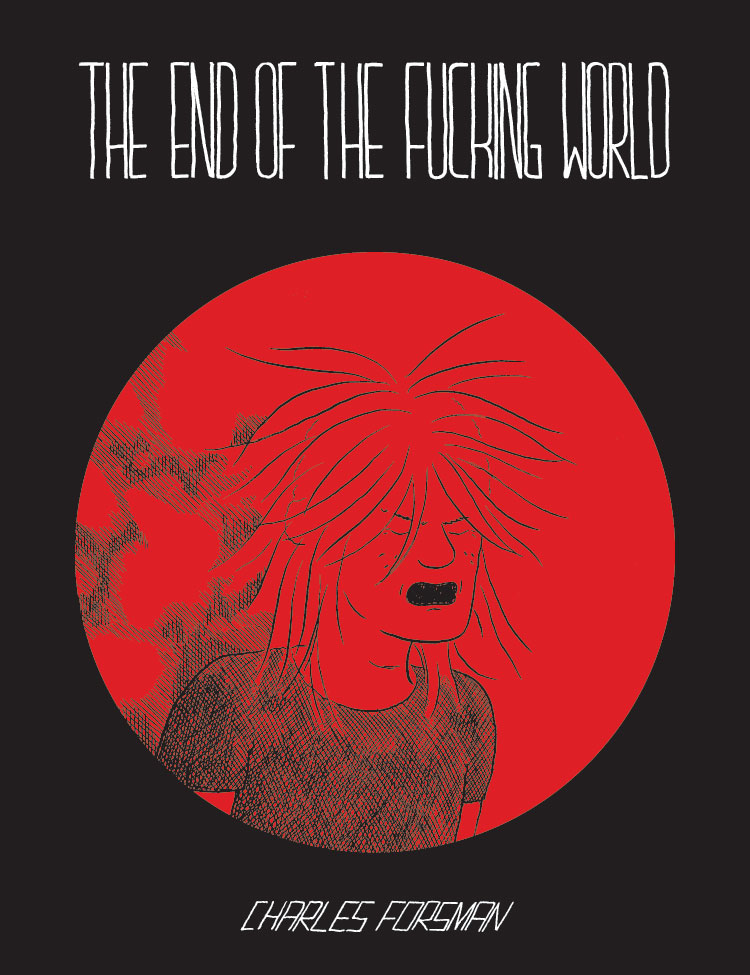
The End of the Fucking World was the breakout book by Charles Forsman, and maybe even his first book-format work; I'm not all that familiar with his career. I was impressed by his I Am Not Okay With This earlier this year, so I figured I should hit his big famous book next.

Tales of the Beanworld is "volume 3.5" of the collected Beanworld comics by Larry Marder. I finally read some Beanworld recently -- that post goes live on the 14th -- and now I want more. I believe the first omnibus collects the first two regular-size books, so I should, in a perfect world, read volume 3 before this. But I don't think I'm going to wait. Tales collects color stories that appeared in anthologies and other places -- outside of the regular Beanworld comic -- so it's not wrong to read it out of continuity...that's what I tell myself.

Michael Moorcock's Elric: The Balance Lost, Vol. 1 collects the beginning of a comics story about everybody's favorite mopey doomed albino from 2011, written by Chris Roberson and drawn by Francesco Biagini. I think I heard about this at the time, was vaguely interested, but never saw a book in person and forgot about it.

Paper Girls, Vol. 5 is the latest in the series by Brian K. Vaughan and Cliff Chiang, and I don't think I'm hate-reading it yet. (Though it is beginning to annoy me in its very Vaughan-esque "let's throw more complications in and hope no one notices there's no through-line" plotting. See my post on volume four for examples.)

Speaking of Vaughan, there's also Saga, Vol. 9, the comic he writes and Fiona Staples draws. You've probably heard of this one, and you might not agree with me that Vaughan is also stretching this one out, if you're enjoying the stretch. (The comics audience is eternally forgiving of things that seem to be stories and go on endlessly.) Here's my post on number 8 for reference.

Mage: The Hero Denied is subtitled "Vol. 5" to confuse everyone -- it's the first collection of this third series of stories about Matt Wagner's semi-autobiographical hero Kevin Matchstick. (So it's the fifth book overall, if you count the whole thirty-five year thing as one ongoing story, which you really shouldn't.) I recently re-read the first two stories, Hero Discovered and Hero Defined, because I knew this was coming out in floppy form.

Poochytown is the new book by the unique Jim Woodring. I ams going to read it, and I am going to try to sting words together to describe reading it, but I expect that will not be much more coherent than what I wrote about Weathercraft in 2010 or Fran in 2014.

Norse Mythology is not comics; it's a prose retelling of various legends by Neil Gaiman. And it's another piece of evidence for my theory that Gaiman, even at this point in his career, is deliberately making each book of his the first time he does something.

Time Travel: A History is a nonfiction book by James Gleick, the guy who wrote Chaos and Genius. It appears to be the story of both fictional time travel and whatever in modern physics is most relevant to the potential of actual time travel -- and that's a great combination for a reader like me.

Last is Kevin Young's big book Bunk, subtitled "The Rise of Hoaxes, Humbug, Plagiarists, Phonies, Post-Facts, and Fake News." It's been really well-reviewed, and it's out in paperback these days, so I might actually read it. Frankly, I suspect everyone in the US should be forced to read it, and maybe not allowed to vote unless they can pass a test on it, but I should put a damper on that opinion until I actually read the book to see if I agree with it.

Tuesday, January 11, 2022

Bill and Ted Are Doomed by Evan Dorkin and Roger Langridge

This is another one of those cases where I'm a fan of the other thing in the mix, and so will probably not be that good at reviewing how good the final product is at achieving its end. Just a warning up front.

What I mean is: I've been following Evan Dorkin (especially the comics he both wrote and drew, which are rare this last decade or two) and, to a an only slightly lesser extent, Roger Langridge, for years and years. They're both comics creators whose work I'll try to read almost no matter what it is.

Even if it's a sharecropped story deliberately constructed to fit in between two movies that I have never seen, for example.

Bill and Ted Are Doomed was a four-issue miniseries, collected into a single book a little later - that's how I read it - designed to help bridge the gap between the 1991 movie Bill and Ted's Bogus Journey and Bill & Ted Face the Music, which came out last year in some way. (Movie releases were a bit disjointed and weird in 2020, like so much else in the world.)

Now, I did see the first movie, Bill & Ted's Excellent Adventure, so I'm not completely unaware of the thing. But that was a long time ago, and is filed in my brain more under "'80s surfer stereotypes" than "the Bill & Ted universe."

So this book, which has their robot duplicates - who were evil in the second movie, I thought, but aren't evil here - and some little hairy naked inventor-types who only say "Station!" and I presume are also from that movie, because it would be really weird otherwise,...anyway, this book has a lot of stuff that I assume is fan-service for the actual fans, but I am not really one of them, so it's just weird details.

This is also handicapped by its mid-quel nature: it was seemingly designed to show Bill & Ted (and their families) roughly halfway between the youthful slackers of Bogus and the middle-aged losers of Music. And it can't solve the problem the later movie will, which is the core problem of the series (such as it is): Bill & Ted will, eventually, write the one song that brings the world together in peace and harmony and forms a global utopia.

Which is a fun conceit, but if they actually do it, all of the stories are over. So, unless they do in Music (I hope they do), they haven't done it yet.

Doomed is thus a book of failure. Bill & Ted are nearly broke, their band is forgotten, and they spend all their time trying to write the One Song and getting nowhere. Everyone around them is more sensible and normal than they are - that would pretty much have to be the case, honestly - so the band (Bill, Ted, their wives, and Death on bass) set off on a tour to refill their bank accounts.

And if you've ever seen any story about a band setting off on tour, you know it will not go well.

It does not.

There's a band that hates Bill & Ted for mostly inexplicable reasons - they're not metal enough, which is fair since Wyld Stallyns never stuck me as particularly metal, but I may be biased - and that of course leads to a disastrous festival somewhere frozen in Scandinavia where Our Heroes are once again in danger of dying.

It all does end, somewhat mutedly, since they can't actually write The Song or change their slacker/loser future or resolve their money problems. Again, this is a story set between two already-defined points, and exists mostly as a line extension to shake more money out of fans' pockets. It's a fun entertaining story, with the loose-limbed appeal of the other Bill & Ted stories, so it's almost certainly worth the few dollars it does shake out. But that doesn't change the pointlessness of it all.

Then again, I'm generally of the opinion that all sharecropped stories are deeply pointless, so you may not want to listen to me. This one is harmless at worst, goofy fun at best.