Monday, March 30, 2009

Reading 'till My Eyes Fall Out

The big Eisner-judging weekend is now over -- though I'm sworn to secrecy about the details until everything has been cross-checked and verified, so don't ask -- and I'm back at home. We tested the physical limits of just how much a small group of people can read in a short amount of time -- we five judges (and the administrator) were together just about every waking moment from Thursday evening to Sunday night, and if we weren't reading comics/graphic novels/manga, we were talking about them. (On Sunday, as we got into crunch time, we all actually brought comics to lunch to read, which was a glorious moment.)

Since I keep track of these things, here are my totals. But I should also point out that I didn't count dozens of "floppies" -- periodical comics -- nor the innumerable other books that I read parts of. It also doesn't count webcomics, which we were also reading. These are only the book-like objects that I read from beginning to end.
  • Thursday: 7 books
  • Friday: 8 books
  • Saturday: 13 books
  • Sunday: 11 books
  • Today: just one book, and it wasn't a comic, either (now that the judging is over)
Grand total for the trip: 40 books in 5 days.

I think I'm ready to read some words that don't have pictures attached to them for a couple of days....

Saturday, March 28, 2009

Harlan Ellison's Introductions

I'm off judging the Eisner awards this weekend, which means I'm spending every waking moment either reading comics or talking about them. So I need to dig into the archives -- which are nearly depleted at the moment -- for something I wrote somewhere else.

The posthuman construct generally called endy9 had been reading
Again, Dangerous Visions and was struck at how abrasive and self-serving his supposedly nice introductions could be. So that entity asked rec.arts.sf.written readers what those writers really thought about Ellison. I responded:

Harlan had gotten into a number of really nasty feuds even by the point of ADV -- I think his battle with Charles Platt extends back about that far.

Harlan was always divisive, but he was also one of the field's best short-story writers, a major luminary of the American New Wave (part of the reason he was divisive), and an editor buying stories that wouldn't be published otherwise.

His introduction to the first Dangerous Visions reads like pure bombast now, but it was more than half-true then: those stories really couldn't have been published anywhere else before that book, and things changed across the field afterward.

So the answer is a big "it's complicated" -- some people (particularly older writers and those associated with John W. Campbell and Analog) loathed Harlan and all that he stood for; some people fell out with him, one way or another (and Harlan in those days was not one to patch over differences, even small ones); and a lot of people either honestly liked him or tolerated his more bombastic qualities because of all of the great work he did.

He also only attacked people that he thought deserved it -- he teased his friends, but he attacked his enemies. (Harlan's teasing may seem rough, if you're used to sweeter writers, but you won't mistake it for his attacks once you've seen both.)

Friday, March 27, 2009

Comics Round-Up #6

I'm typing this post quickly on the night before I fly out to the weekend of judging, so this will probably be the last round-up post; the things I read on the airplane and at the secret undisclosed judging location will likely get mentioned only in my month-end list, if at all. But here's some more books from 2008 that I was reading as part of my duties as an Eisner judge...

Water Baby by Ross Campbell (Minx/DC Comics, July 2008, $9.99)

Another one of the shards of DC's ill-fated attempt to make digest-size comics for teenage girls, Water Baby is a little too aimless, in the end, to be completely successful, but it does channel a strong line in authentic teenage aimlessness, and Campbell's art is strong. (He seems to linger on the curves of his female characters -- and also keeps them in short & tight clothes, which, I have to admit, are appropriate to their locations and personalities most of the time -- a little more than I'd expect in a book for girls. But there's a good-looking buff boy as well...though there's not nearly as much of him shirtless as there is of the girls in their bikinis.

Brody's the girl on the cover; she's the viewpoint character, the one whose leg gets bitten off by a shark while she's surfing on the eighth story page. The story seems like it should be about her coming to terms with the loss of her leg -- and it is, but mostly on the level of subtext. The story up front is primarily a road trip, as Brody and her best friend Louisa drive the aforementioned buff dude Jake back north (from Florida, where Brody and Lou live) to get rid of him. Water Baby has the rhythm of a road story, with stretches of boredom alternating with more interesting moment.

The end doesn't quite click as it should -- it aims for a literary or indy-movie style, with an important moment, but a lot of the story is left in the air at that point, so there's a feeling that the book should have some more pages. Still, Brody is a fine heroine -- grumpy, obnoxious, and twitchy as only a late-teenager can be -- and Campbell lets her story unfold. (He also gets in some quite good dream sequences along the way.)

Nana, Vol. 1 by Ai Yazawa (Shojo Beat/Viz, November 2005, $8.99)

One of my overly-optimistic plans was to read the first volume of a bunch of critically-acclaimed manga series, so that I'll be better able to judge whatever volumes of them came out this year. Nice idea, but there's no chance that I'll get to anything else in that line before I fly out.

There are these two nineteen-year-old Japanese girls named Nana, who are completely different -- one is a quiet art student who's finally trying to grow up and not fall in love with every boy she sees, and the other is a punk musician with a live-in boyfriend who's about to abandon her (and their band) for stardom in Tokyo. (The one thing they do have in common is that they both live in a provincial city -- I don't think Yazawa ever says which one, in either case.)

So this volume has two independent stories, each about one of the Nanas. I presume the later volumes see them both head to Tokyo, where they each want to go, and probably meet. At this point, it's a solid shojo relationship story, with more nuance than most and a drawing style that's not too flowery. I can see that several things that I've read are probably influenced by Nana -- or both were influenced by a third, older work, but Nana is better at working with those materials.

Superman: Kryptonite by Darwin Cooke and Tim Sale (DC Comics, September 2008, $24.99)

And here's yet another retro superhero story; if I still cared about these empty costumes, I'd find it deeply ironic that the best talents -- the creators who actually have individual styles, thoughts, and ideas -- only touch superheroes these days with prestige out-of-continuity stories like these or big ugly pay-the-mortgage crossovers, which no one ever expects to be good or to have a lasting effect. Luckily, I didn't read superhero comics much as a kid -- I read random Dell/Western titles more than anything else, and not much of those; only coming to comics really at the age of seventeen at college -- so I have no burning love in my heart for any of these silly characters.

This is quite good for a retro superhero story, though the plot machinations in the second half are very Silver Age-y -- and I don't mean that in a good way. It's set early in Superman's career, and depicts the first time he was confronted with kryptonite. That very pulpy material doesn't sit well with the semi-realistic, melodramatic background of the minor villain -- Lex Luthor is the major one, as of course he always is in any retro Superman comic -- and the time-period of the story is equally fuzzy. All of the characters look and dress like they're in the late '30s, but carry cellphones; I guess that's to have the best of both worlds.

Sale, as always, draws men with jaws the size of billboards and women with legs that stretch into next week. He's not quite a caricature of himself, but he does seem to be getting more and more stylized as he goes along. Cooke's story is fine for what it is; he scrambles up pieces of the Superman mythos that he particularly likes and pieces them together into a mosaic. It's a good-enough Superman story, and I guess there's always a market for those.

COWA! by Akira Toriyama (Shonen Jump/Viz, July 2008, $8.99)

This is one of the few Eisner-nominated items that I had at hand but hadn't read; I borrowed my older son's copy of it. (He's a huge Dr. Slump fan, and I keep thinking I need to take the time to read that series through -- maybe after I get tired of Naruto.)

COWA! is late Toriyama; it came out in Japan in 1997, a couple of years after the ending of the Dragon Ball saga. And it's also clearly for kids in a way that Dragon Ball and Dr. Slump weren't -- it's filled with kid characters, and even the martial-arts-filled fight scenes are shorter and less violent than Toriyama's norm.

I have no idea what the title means, if anything, the main character is Paifu, the little guy on the cover. He's a half-vampire, half-werekoala who lives in a community of monsters at Batwing Ridge. But when monster flu strikes -- it killed half the town the last time it hit -- Paifu and a few others have to make their way to Horned-Owl Mountain, to get medicine to cure everyone. (The one token adult is a human ex-sumo wrestler, Mako Maruyama, who handles most of the fights along the way.)

And the result is both very much a Toriyama book -- funny asides, semi-bombastic fight scenes, and entertaining bickering -- while still being appropriate for most grade-schoolers. And now I really do want to read Dr. Slump, as soon as I have time.

Mesmo Delivery by Rafael Grampa (AdHouse Books, November 2008, $12.50)

Grampa is a Brazilian comics creator who comes from the same circle as Fabio Moon and Gabriel Ba (whom I've heard great things about, though I don't think I've actually read a page that either of them have touched), and this is his first full-length graphic novel. It's not all that long -- just fifty-two story pages -- and his detailed art (of often ugly and unappealing subjects) is reminiscent of a more decadent and looser Geoff Darrow.

This is a story about violence -- it exists purely to showcase the violence, and the plot is a loose rope to hang the various violent scenes on. It starts out slowly, with a trucker and his minder coming into a stop, but the fighting begins soon after that, don't you worry.

So the pictures are very well done -- as is the coloring (by Marcus Penna) in an entirely earth-toned pallet. But the story is nihilistic at best and pointless at worst -- so I hope we see more work from Grampa in the future, but that we also see more ambition from him as well.

Heavy Liquid by Paul Pope (DC Comics/Vertigo, March 2001/October 2008, $29.95/$39.95)

I read the paperback edition, since that's what my local library had, but it's the hardcover that's actually eligible, since it was published in 2008. But I hadn't read any Pope since some issues of THB, more years ago than I care to remember.

In the mid-2070s, a young man called only S -- for "the Stooge," which is what the villains call him -- has stolen a quantity of the title substance from some New York criminals (with the help of one dead character and one live character who don't really affect the story). Heavy Liquid is very rare and very expensive, but only S and his friends seem to have actually found a way to use it as a drug -- otherwise it's apparently valuable purely because it is so rare.

There's a fair bit of goons chasing S, but the main story here starts when "the Collector" -- I gather there can be only one -- hires him to find Rodan, a brilliant young woman sculptor who disappeared a few years ago...and who is also S's ex-lover. Of course he finds her, and of course other forces find him, and of course his increasing Heavy Liquid use becomes very important -- though not in the way the reader expects.

Heavy Liquid is a stylishly told adventure story, complemented by Pope's carefully muddied, slightly off-true pen lines. I'm not sure the end is as transcendent or special as I suspect Pope wanted it to be, but it all comes off pretty well.

Amelia Rules! Volume 4: When The Past Is A Present by Jimmy Gownley (Renaissance Press, 2008, $11.99)

I've avoided this series in the past, because it looked just too twee and heartwarming for my taste -- the title of this volume is a great example. But it's actually pitched at a higher level than I expected, and is remarkably clear-sighted on the subject of childhood. Amelia herself -- the blonde girl on the cover -- is ten years old, the daughter of divorced parents, and, I gather, moved to a small Pennsylvania town with her mother in the first book after the divorce. By this point, there's a good-sized cast of mostly kid supporting characters, and nearly all of them come across as real people. (I except the kid called Pajamaman, who stays in the background.)

Amelia Rules! is sweet and mostly positive and life-affirming...but it's pretty good despite that, and despite having very wordy captions. Amelia herself is a complex, interesting character, with most of the confusions and complications of a girl her age. (There's even something like a date for her in the middle of this book, and it's handled well.)

Gownley also is a fine letterer, with a strong Dave Sim influence -- he uses similarly long stretches of dialogue and narrative captions, and pulls out a variety of tricks with size and emphasis to capture the movement of the voice.

So if you stayed away from Amelia Rules! as I did, thinking that it was too twee for you, you may want to take a closer look. It's a slightly cartoony (in several senses) look at childhood, but it's very clear-eyed most of the time.

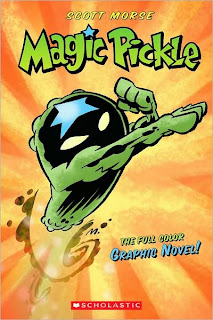
Magic Pickle: The Full Color Graphic Novel! by Scott Morse (Scholastic, May 2008, $9.99)

I reviewed two of Morse's graphic novels for ComicMix last year, but I didn't see his work for kids before today -- and I wish I had, because Magic Pickle is a hoot.

You see, fifty years ago, a scientist's experiment went awry, and gave life, intelligence, and superpowers to an ordinary pickle, who was quickly codenamed Weapon Kosher and stuck into coldsleep. He's woken up when his arch-enemies, the Brotherhood of Evil Produce, reforms to do the usual nefarious deeds, and has to deal with the girl whose bedroom is above his secret lab home.

So this is the story of a flying superpowered dill that fights carrots, lettuce, and so forth -- the tone is serious (in a pitch-perfect near-parody of late superhero posturing), but the matter is very, very funny.

Morse's art is energetic and cartoony in all the right ways; he gives a flying pickle with two glowing eyes and no other human features a personality and a goofy energy that are infectious.

Quote of the Week

"Sex without love is an empty experience, but as empty experiences go it's one of the best."
- Woody Allen

Thursday, March 26, 2009

More Books for Kids

I read most of these for Eisner consideration, and hope to discuss them briefly -- though I always hope that, and usually fail.

Otto's Orange Day by Frank Cammuso and Jay Lynch (Raw Junior/Little Lit Library, April 2008, $12.95)

A little orange-loving cat-boy gets a genie in a box from his Aunt Sally Lee, and decides to wish that everything in the world were orange. In best Midas fashion, he soon learns that sometimes too much of a good thing is just too much. The usual Three Wishes complications set in, until the status quo is restored.

My own younger son (Thing 2, as I usually call him here) is a big fan of the color orange, but, sadly, he's aged out of picture books and into chapter books recently, so I didn't really get to share this with him. (Instead we've been reading a succession of "Junie B. Jones" books, which I'm enjoying almost as much as he is, though probably for slightly different reasons.)

The art is nice, but this really is a book for little kids, simple, obvious moral and all. If my own young 'uns were still in preschool, I bet we'd love it, but, as it is, I've aged out of books like this.

Benny and Penny in Just Pretend by Geoffrey Hayes (Raw Junior/Little Lit Library, April 2008, $12.95)

Another book from the same series; a sequel, The Big No-No, is coming along in May. The two title characters are mice children, brother and sister, and the older Benny wants to play pirate without his kid sister. And she wants to tag along. The vocabulary is on a beginning-reader level; a lot of kindergartners will be able to read (or help a parent through) this book.

The art is particularly attractive in this one, but, again, it's a story for little kids and the people who read to them. It's a cute story, but even seven-year-olds are likely to find it "babyish."

Jack and the Box by art spiegelman (Raw Junior/Little Lit Library, October 2008, $12.95)

Yet more from the Little Lit empire, which is determined to conquer the world of children's books for comics. This one is by the husband of Little Lit's Editorial Director, Francoise Mouly. (And, yes, Spiegelman is definitely more famous in his own right as the author of Maus, but he can still get introduced as "Mr. Mouly" now and then.)

A boy named Jack gets a new toy -- which is, of course, a Jack-in-the-Box. (Although this one claims its name is Zack.) They play hide-and-seek, the only game the toy knows, and everyone says "silly toy" a lot. In a Cat-in-the-Hat-ish turn, some damage to Jack's room is done by a proliferating stream of creatures from the box, which Zack then fixes up as good as new.

Again, it's an early reader with a simple vocabulary and an obvious moral. Spiegelman is obviously having a lot of fun with it, and that's infectious -- I enjoyed this best of all of the "Little Lit" books that I've seen.

Boys of Steel: The Creators of Superman: by Marc Tyler Nobleman; Illustrated by Ross MacDonald (Random House, August 2008, $16.99)

This is a more typical lap book -- or, actually, since it's more likely to be read by kids boys on their own, it's destined to be read by a lot of first- and second-graders, particularly those looking for a quick book-report subject.

Nobleman focuses on the nerdishness of the young Joe Shuster and Jerry Siegel as he tells the story of how they created Superman as kids in Cleveland. (The story that every comics fan, no matter how peripherally connected, can recite from memory.) There's an afterword that explains how they signed away all rights to that creation, and were cheated in the bargain, but the main story is entirely peppy.

MacDonald -- and I still do a double-take every time I see his name, even though he's gotten a lot of work as a children's book illustrator these past few years -- has a nostalgic, '30s style which works well with the material. His work is the best part of the book; the story has been told so many times that the events almost have crease marks in them.

The Composer Is Dead: by Lemony Snicket; Illustrated by Carson Ellis; Music by Nathaniel Stookey (HarperCollins, March 2009, $17.99)

This, of course, isn't eligible for last year's Eisners -- it's neither a comic nor published in 2008 -- but it is the new Lemony Snicket book, so I wanted to read it.

And now I have. It's a minor work, another in the long line of books meant to introduce young people to classical music in a "fun" way. In this case, an Inspector is questioning the various instruments of the orchestra -- or, presumably, the people playing those instruments, but it doesn't make much difference -- to see who killed the composer.

Each section lives up to its own stereotype, which is amusing, but not much more. The art is solid, but the story was done in a much more amusing fashion thirty years ago by Monty Python as the song "Decomposing Composers."

There's also a CD of music composed by Nathaniel Stookey and played by the San Francisco Symphony (with some kind of narration by Snicket), but I didn't listen to that. This isn't quite spinach, but it's definitely in the family of leafy green vegetables; there's very little of the sly subversion of "Snicket's" novels for young readers.

I wish Daniel Handler would either retire the Snicket name or make the jump into a new work of similar heft to "A Series of Unfortunate Events." (Even a single YA novel would be good at this point.) The three books that have appeared since the end of that series have all been very frivolous, in various ways, and disappointing to boot.

There's a Wolf at the Door: Five Classic Tales Retold by Zoe B. Alley, with pictures by R.W. Alley (Roaring Brook Press, October 2008, $19.95)

Five fairy tales, all featuring the Big Bad Wolf, are retold in a very unthreatening style, with all danger carefully drained from them. It's the same wolf throughout, so he goes from one failure to the next, and that's mildly amusing.

(There's a Wolf aims at mildly funny for kids throughout, and hits that mark pretty consistently. These are very much tamed fairy tales, in which not even the Wolf gets hurt. There's no need for a woodsman in the Little Red Riding Hood story, or for a stewpot under the chimney for the Three Little Pigs.)

It's quite wordy, and most of the words -- all of the captions, and most of the dialogue -- is set in an obvious type rather than hand-lettered (or set to look like hand lettering). So it doesn't look as pleasing as it could, and it takes longer to read than one would expect. But the art has a fuzzy, cross-hatched sweetness, and I expect little kids will like these versions of the stories much better than those with more bite.

Wednesday, March 25, 2009

My Favorite Line from a Song at This Precise Moment

"I've got a pair of socks I like better than you."
- Hollowblue, "First Avenue"

Today's Top News

This is a blind item, because you need to see it cold. It involves one artistically-inclined British young man, a photograph that's probably safe for work unless your boss is a stick figure, and a Berkshire mansion.

Did You Know?

A quick lesson in copyright, from "Lady Sybilla" --
Copyright laws protect writers from unauthorized reproductions of their work, but such reproductions only include verbatim copying. Characters are only copyrightable if their creator draws them or hires an artist to draw them.
If your reaction was to snort a beverage through your nostrils, congratulations! You know something about copyright.

If your reaction was to nod sagely and tap your lips with your finger, then I'm afraid you have a little studying to do. (Preferably before the Hachette/Summit lawyers come calling.)

[via Nick Mamatas, and already at least a day late]

Three Comics Biographies

Yet more Eisner reading; I hope to squeeze my thoughts on these books down to a tighter word-count than I did for The Ten-Cent Plague, but time has been tight lately, and we all know it takes more time to write concisely. (Cue the Pascal quote here.) So I make no promises:

Man of Rock: A Biography of Joe Kubert by Bill Schelly (Fantagraphics Books, October 2008, $19.99)

Schelly's book-length study of Kubert encapsulates, in a nearly-Platonic manner, the strengths and weaknesses of the fan biography. On the one hand, Schelly is tirelessly enthusiastic for Kubert's work and has tracked down what must be every mention of Kubert in the fan press and on the Internet from the past fifty years -- plus engaging in what seem to be extensive interviews with Kubert, his family, collaborators and other comics creators.

But, on the other side, Schelly hasn't got the slightest bit of critical distance on Kubert: Man of Rock is something close to a one-man festschrift, and, according to the story Schelly tells here, nothing Kubert ever did in his life was even the slightest bit less than wonderful. Kubert was a tireless worker who always made his deadlines, a fearlessly inventive artist who left his stamp irrevocably on every genre and property he touched, and the sage of Dover, passing on the cartooning wisdom of the ages to a generation or two of younger creators. (And, on top of that, he's still doing incredibly vital work even now, in his eighth decade!)

Man of Rock is structured as a critical biography -- minus the actual criticism, unfortunately -- and it is tremendously useful, and quite entertaining to read. I personally don't think a true critical appraisal of any artist can be done while he's still alive and working, so I'd consider it premature, but it does collect a lot of primary and secondary sources, in case twenty years from now someone with more critical distance wants to look at Kubert's life.

Kubert's career starts out fairly typical for his generation of creators -- bouncing around from publisher to publisher as his work rose to its level in the late '30s and war years, trying and failing to launch a newspaper strip, trying out different genres in the '50s -- but then it took a turn to the particular, as Kubert settled down with one publisher (DC) and, more or less, one property (Sgt. Rock) for a couple of decades. Kubert is a popular, highly respected artist who worked during the years when superheroes were driving out every other kind of comic -- and yet did only minor and scattered superhero work. Schelly doesn't really delve into that tension; he doesn't show any sign of wanting to criticize the comics industry, either. But he does sketch out the space where such an analysis could go; again, we may have to wait for next generation's Kubert biography.

As a fan work, Man of Rock is of primary interest to those already converted; if the reader doesn't agree that Kubert is one of our finest cartoonists, working on some of the greatest stories in the history of the artform, all of Schelly's Panglossian fervor falls quite flat. Kubert's art, as reprinted here in crisp black-and-white, does mark him as a very inventive and distinctive craftsman in the field, though the writing in those same panels -- sometimes by Kubert but more often not -- only very rarely holds up its end of the equation.

Strange and Stranger: The World of Steve Ditko by Blake Bell (Fantagraphics Books, July 2008, $39.99)

Schelly's main asset and liability may have been his own enthusiasm for Kubert's work, but at least he had an approachable, relatively public figure to explicate; Blake Bell, by contrast, attempts here to create a critical study of a man who has violently shunned all publicity for forty years and created work of radically different levels of creative success, to put it mildly.

To be more specific: Steve Ditko last appeared at a comics event in 1964, has kept his family from speaking to Bell or any other writers, and spent the last three decades sinking his personal work deeper and deeper into libertarian crank-dom, sacrificing nearly all of what once made his art memorable and dynamic along the way. There's a hell of a story to be told here, but it's not the story Ditko believes, and he has done all he could to keep that story from being fully told.

So Strange and Stranger, despite a few stabs at being a biography of Ditko -- such as an unfocused opening chapter that begins with the 1889 Johnstown flood purely because Ditko's family moved into that town thirty-some years later, and then leaps giddily through a few scattered facts about his boyhood days -- is really a booklength critical study of Ditko's comics work. Bell shows every sign of wanting to both be fair and to have Ditko believe that Bell is on his side -- the evidence is that Ditko long ago fell into a "with me or against me" mindset -- and those two desires don't work well together. Bell does praise and damn Ditko's work according to its merits as he sees them, though, and that's all any of us (except Ditko) could reasonably ask.

Unfortunately, Bell is not a smooth writer, and his attempts to force Ditko's life and career -- or what he could trace of it from the outside -- into a coherent narrative often leaves gaps and unanswered questions -- unasked questions, most of the time. Bell doesn't mention Ditko's personal life as an adult at all -- we learn nothing of Ditko besides his work -- and even his insights on Ditko's work must be based on his own judgment or on popular wisdom; Ditko wouldn't be interviewed and apparently there was no one else who could speak to Bell, either.

Bell reprints a lot of Ditko's art, and that's where Strange and Stranger is at its strongest: in the explication of specific artistic styles, and, later, Ayn Randian themes in Ditko's comics stories. The panels aren't always placed to best effect -- the book could have used a stronger hand on design, to make all of the art work better on the pages -- but there is a lot of art here, including at least a score of full story pages, and it makes Bell's case even when his words aren't quite adequate.

Ditko's story is a sad, frustrating one: the reader wants to shake Ditko in 1968 or so and force him not to squander his talents on such inferior, haranguing work. Bell knows well that frustration, and he's good at exploring all sides of both early Ditko (to find the seeds of the later decadence) and late Ditko (to dig out the moments when his old facility for story-telling is allowed to shine through). Strange and Stranger is frustrating itself on top of Ditko's story, but even getting this much organized and published was a great feat; expecting Bell to have done more than this may be a ridiculous thing. And yet I do wish Bell had worried less about offending Ditko and more about what would have made this book truly incisive and definitive.

Bill Mauldin: A Life Up Front by Todd DePastino (W.W. Norton, February 2008, $27.95)

Bill Mauldin had at least three major careers -- as the quintessential chronicler of WW II's footsoldiers, the "dogfaces;" as the meteorically popular young man of the end of that war and the years immediately following, when everything he did turned to big piles of money almost immediately; and as one of the country's best and most fearless editorial cartoonists for a quarter of a century. The most famous, and most iconic career, of course, is that first one, and it's the one DePastino concentrates on in this compelling and definitive biography.

A Life Up Front is an excellent illustration of the maxim I noted above: that the real biography of any artist can only be written after he's dead. Only when the entire arc of a career -- or of however many careers as that artist eventually had -- is complete and can be seen clearly can the biographer work out how to correctly structure his book. DePastino knew this, and his book is a bell curve -- the middle of the book (nearly half of the total length) covers the war years, with a single chapter devoted to Mauldin's hardscrabble New Mexico childhood and the rest of the book covering the following sixty years of his life in chapters that each cover a longer and longer period. It's not that Mauldin's editorial cartooning career wasn't important, or a vital part of its time -- it was -- but that Up Front, Willie & Joe, and the rest of Mauldin's wartime cartooning career was so much more important and vital, to Mauldin and to America, that it needed to be the center and pivot of the book.

Bill Mauldin tells a great American story, one of the ones that became a cliche long ago -- the boy who goes off to war and becomes a man. But, even more than that, Mauldin became an artist, and a shrewd observer of the world, while at war in Italy. DePastino tells Mauldin's story with great verve and energy, making this first biography of Mauldin the definitive one for generations to come. He also makes copious use of Mauldin's own cartoons in telling the story, to great effect. This is what the biography of a cartoonist should be like: carefully researched, written with an abiding concern for and sympathy with its subject, casually profane when it needs to be, willing to examine even the least savory parts of a man's life, and compelling readable.

Tuesday, March 24, 2009

A New Publishing Term

Well, it was new to me. I doubt it was freshly coined.

The term: "rip & tip".

The context: a Production meeting.

The comparison: It's not a strip & rebind.

Are five people about to comment and say "Oh, that's as common as dirt! I can't believe you didn't know that!"?

Comics Round-Up #5

And here's another batch of books laid out in panels that I've read recently:

Atomic Robo, Volume 2: Atomic Robo and the Dogs of War: words by Brian Clevinger; art by Scott Wegener (Red 5 Comics, February 2009, $19.95)

It would be cruel and dismissive to say that Atomic Robo is nothing but a Hellboy rip-off -- "nothing" is so expansive a term. And there is the possibility, however slight, that Clevinger and Wegener were not influenced by Mignola in creating their own large, nearly indestructible, wisecracking adventure-fiction character who runs into various weird menaces at different points during the 20th century. It could all be a coincidence, right?

I also have to say that I haven't read the first Atomic Robo series, but I do know that he was built by Nicola Tesla, which tends to strengthen my point. AR is a lovable lug, though he doesn't really have a whole lot of personality besides "wisecracking robot that hits things really hard."

This volume collects the second AR miniseries, in which he fights at various points in WWII -- the invasion of Sicily, an assassination in Croatia, and a battle to take out another Nazi superweapon on Guernsey -- though those are three discrete stories rather than a larger arc. He's more or less indestructible, though he does get separated from his legs at one point, and there's some sort of electrical gun that conveniently shuts him down for a short time -- it never kills him, it just allows the stories to have some tension. The slugfests are choreographed well, and the banter is above average. But, really, this is just yet another decent comic about a tough guy hitting things until he saves the day, without anything particularly new and exciting about it. It's fine for what it is, but there's a lot of what it is out there.

MOME, Vol. 11: Summer 2008: edited by Eric Reynolds and Gary Groth (Fantagraphics Books, March 2008, $14.99)

I'm coming to realize that my avoidance of short fiction extends farther than I thought. I knew that I wasn't reading as many SFF stories as I used to -- in the days when I'd generally read two or three "Best of the Year" collections, plus some SFBC originals, plus some other scattered reprint and original anthologies from other houses -- but I hadn't really thought that I was similarly avoiding comics anthologies as well.

(Of course, that's probably overstating the case. I might "avoid" War for Civilized Identities or Crisis of the Mutant Skrulls, because they're high-profile enough to need to be avoided, but comics anthologies are small-scale things, off in their own corner of the field, and are easily overlooked by most of us.)

But, when I'm shoved into it, I find I like the short stuff pretty well. Mome has been running, semi-annually, for most of this decade, and I've been vaguely aware of it, but I never made an effort to read it. There were always other books -- longer books, ones all by the same author -- to get to first.

There are thirteen pieces here that are relatively complete stories, plus a text piece, an interview, parts of two serials, and a handful of full-page drawings that aren't quite comics. (Working from a definition of comics as images in a sequence, one image -- particularly a captionless one -- can be some other kind of art, but it's not comics. Not that this is a dismissal; an opera isn't a ballet, either.) And they're pretty much all on the literary end, from the cold camera eye of Al Columbia's "5:45 AM" to the one-day-closer-to-death ambiance of Paul Hornschmeier's "Life with Mr. Dangerous." Nothing here really lept out and walloped me, though I do keep coming back to Killoffer's wordless "Einmal Ist Kleinmal." But it's a solid, interesting anthology, filled with the world of a lot of people I hadn't been aware of before.

Judenhass by Dave Sim (Aardvark-Vanaheim, May 2008, $4.00)

As others have noted snarkily, Dave Sim is now solidly against the hatred of Jews -- not that anyone ever suspected him of believing otherwise -- but he's still on the other side of the question when it comes to women. Though he would certainly deny the parallel, and vehemently. It's dangerous to try to discern the motives of someone so intensely self-motivated and hermetic as Dave Sim, but I've had the feeling that Judenhass was, in part, his attempt to do something positive for the comics field, and perhaps to write his way back into it.

Judenhass -- the title means "Jew Hatred" -- is Sim's book about the Holocaust, the Shoah. Except it really isn't; in typical late-Sim fashion, it's an incredibly overthought book, with nearly photo-realistic tracings of horrible images (repeated, over and over, as if Sim were some Warhol of torture) under a collection of quotes by famous people saying vile things about the Jews as a race.

They're nasty quotes, yes. And the pictures are horrifying -- though Sim's drawings are not as horrifying as the real pictures are, since they're just that bit distanced. But Sim doesn't do anything but juxtapose the two; he doesn't link particular quotes to earlier pogroms and expulsions (of which there were many). All he does is poke the reader, saying, "See! See! The Nazis hated Jews! And other people did, too!" Which is true, and should not be forgotten -- but we haven't forgotten it, and we've been reminded of it in a thousand better ways.

Judenhass means well, but it bears the essentially Simian stamp of the autodidact: Sim dives into every new line of thought as if he was the first one ever to discover it. I'm glad that Sim thinks that hatred of Jews is bad, but I still wonder if he would extend that theory to cover hatred of any group of humans.

Janes in Love by Cecil Castellucci and Jim Rugg (DC Comics/Minx, August 2008, $9.99)

Janes in Love is the sequel to The Plain Janes, Minx's launch title, which I reviewed for ComicMix about a year and a half ago. (It is very close to being Minx's final title, so there's something of a bookend effect going on here.) And I'm afraid that the new book is more of the same, only more so.

The four Janes talk less realistically, but more obviously in "character." They're all in love, and talk about how they're in love, in stilted language, incessantly.

The Janes' art attacks are still as po-mo as ever, and I still have the lurking suspicion that it's because none of them has any artistic skill at all: they're more interested in the idea of being artists -- how transgressive! -- than with actually learning to paint, draw, sculpt, or, most importantly, see.

And the authorities, embodied by the requisite fat, white, crewcut meanie with a pencil-thin mustache, are still utterly unbelievable and oppressive. We even get scenes of parents talking about dangerous it is to do things like paint a fence with blackboard paint.

Janes in Love is obvious, and heavy-handed, and terribly condescending towards its assumed audience. But I'm not a teenage girl, so what do I know?

MOME, Vol. 12: Fall 2008: edited by Eric Reynolds and Gary Groth (Fantagraphics Books, September 2008, $14.99)

Would it be a cheat if I just said: "see above"? Because #12 is not terribly different from #11, and I doubt anyone expects it would be. This time there are thirteen contributors -- I think I counted correctly; Sophie Crumb has work at the beginning and end and Tom Kaczynski has four sound-related strips scattered throughout, but I don't think anyone else appears more than once.

As with the previous volume, there are some stories that work for me and some that don't -- luckily, the longest piece here, David B.'s "The Drum Who Fell in Love" (an epic thirty-five pages), is one that I liked and enjoyed, and that pushed the whole anthology into the win column. Some of the other stories I found inexplicable, and some fell flat. But, again, it's a big anthology of a lot of different people, and I expect anybody who likes "alternative" cartooning at all will find something to enjoy here.

Funeral of the Heart by Leah Hayes (Fantagraphics Books, April 2008, $14.95)

This book didn't work for me at all, and I'm not even sure I'd call it comics -- Hayes has scratchboard images, mostly full-page-size, with long text passages. It's organized much more like an illustrated book -- the images don't stand on their own, or tell the story directly, but the narrative does. (That's not why it didn't work for me; illustrated books can be excellent, even though I didn't think this one was.)

Hayes's narrative voice is almost like that of a young child: event follows event in a linear strand without consequences or a larger universe; her stories tell a world in which "and" is the only link and inexplicable things can't be questioned, since there's no context to judge them. Her prose affects a quick staccato style, with short declarative sentences following each other but not necessarily building on each other.

Her faces have the flat eyes and glum cheeks of Chris Ware, and being executed in scratchboard makes them more technically accomplished without adding much in the way of life or energy. There's the air of a gallery show hovering over Funeral of the Heart -- I could see the scratchboard pictures hanging on a wall, with the text next to them.

Hayes's stories strenuously avoid any emotional connections -- between characters, or to the reader -- which I have to see as a problem. And their disjointed style of telling turns them away from the usual story qualities into unmotivated sequences of events. So I can't call this book particularly successful -- though, saying that, I will admit that I doubt I'm particularly sympathetic to what Hayes is trying to do here.

Monday, March 23, 2009

A Shout-Out To All My Librarians!

The Eisner process of judging is very unlike anything I've done before -- I might get into the odder aspects of it in the future, once the tumult has died down -- and, because of that, I've been scrambling to get copies of as many nominated works as I could before flying out there on Thursday. (The countdown has begun.)

I couldn't have done any of it without the help of my local library system, which I've been using extensively to gather these books. And, so, by way of tribute, I'm going to list all of the individual libraries that have books in my house right at this moment. (The fact that I like to make lists might also have something to do with this.)
  • Passaic County Community College
  • Paterson Free Public Library
  • Clifton Public Library
  • Wayne Public Library
  • Ringwood Public Library
  • West Milford Township Library
  • Little Falls Public Library
  • Pompton Lakes Public Library
  • Alfred Baumann Library, West Paterson
  • Julius Forstmann Library/Passaic Public Library
I've also had books from the Cedar Grove and Caldwell libraries at times, though not at the moment. That's over half of the system, though my competitive side wants to aim to get books from all of the eighteen libraries before I'm done!

Reviewing The Mail: Week of 3/21

Last week I was rambling about the ebb and flow of review copies, and this week helps to prove my point: it's almost entirely comics/manga, led by the big monthly box from Yen Press.

As usual, I post these lists on Monday mornings because I know I won't manage to review every book I see, but I do want to at least note every one of these books -- usually at least mildly approvingly -- and look at them as they go out into the world to find their audiences.

Other Earths is DAW's paperback original anthology for the month of April, but it's a little different than the usual book filling that slot: it's edited by Nick Gevers and Jay Lake (with only the copyright page betraying the hand of Martin Greenberg's Tekno Books) and contains stories by such heavy-hitters as Jeff VanderMeer, Gene Wolfe, Robert Charles Wilson, Stephen Baxter, Lucius Shepard, and Alastair Reynolds. (Not to mention five other authors equally impressive, or nearly so.) The theme is also a bit looser than usual for a DAW anthology; Other Worlds contains alternate history stories -- not ones in which famous military leaders were cat-people, or ones where Alien Space Bats interfered at particular changepoints, or ones concerning the differences imaginable if Napoleon had been half-elf; but stories that just had to be alternate-historical, with no other prerequisites. Given the pedigree, this will probably be one of the major anthologies of the year -- and it's only $7.99.

Also from DAW in April is the second omnibus reprinting a near-future humorous detective series by John Zakour and Lawrence Ganem, Ballistic Babes. (I don't know if the series has an official title, but -- since all of the titles are about the hair color of a pneumatic, dangerous female -- it would be something like "Hairy Babes"...and that might explain why there isn't a series title.) This one reprints the third and fourth novels in the series, The Radioactive Redhead and The Frost-Haired Vixen. I haven't read these books, but I did use to do business with Ganem, many years ago -- he was a great guy and a skilled negotiator, if that's any recommendation for his books.

And then we jump into manga, first with some books coming from Del Rey on March 24th. (Which would be tomorrow, so they're probably out in stores already.) Negima!? Neo, Vol. 1 is the beginning of a series based on the popular anime series Negima!...and I haven't worked out yet why the manga version gets a "? Neo" tacked onto the end of the title. (The subtitle, "Magister Negi Magi," is easier to figure out: it refers to the main character, ten-year-old Negi Springfield -- who is not, in any way, at all reminiscent of Harry Potter, even in a bizarrely twisted Japanese way, so put that right out of your head, Warner Brothers -- the super-magician from England who has to run an all-girls magic school in Japan because every Japanese story will find itself set in an all-girls school if not prevented by heavy artillery.) Negima!? Neo was written by Negima! creator Ken Akmatsu, with art by Takuya Fujima. It's rated "OT" (for older teens), so I expect a lot of fanservice, panty shots, and young women "accidentally" surprised in the hot springs. Hmmm...I may just have to read this one!

Also from Del Rey and rated OT -- but actually shrink-wrapped, which makes me wonder if it's the manga equivalent of a "Hard R" -- is the first volume of Gakuen Prince, by Jun Yuzuki. It's set in an all-girls school -- see! see!!! -- that very recently started allowing boys to attend as well. It's also one of those super-elite schools that -- at least in manga -- students only can get into and stay in through grueling exams, and which are heavily stratified and clique-ridden. From the back cover copy, it seems to be about the battle among the girls to "get" the boys. But, from a quick peek inside, it seems to be more focused on one particular girl. And, as one could have guessed, she's a quiet, mousy "A" student who frantically thinks such terribly Japanese things as "Everyone will notice me! I don't want to stand out! No way!" on the third page. So I'm pretty sure she ends up with the tallest, cutest, smartest boy -- who also has a closet-full of secrets. (I may have been reading too much of this stuff lately...)

And also from Del Rey is the first book of Samurai 7, credited as "Manga by Mizutaka Suhou, Original Story by Akira Kurosawa." I suspect this is a very, very loose adaptation of The Seven Samurai, translated into its current science-fictional garb only after Kurosawa died -- he lived until 1998 and this was published in 2004, which suggests to cynical me an estate looking to license whatever it could to establish new income streams. It's set in the solar system in the medium future, and the heroes are people who fight giant robots with swords. (And win, most of the time.)

And now I'll get into the big stack of Yen Press manga from April -- until I mention another publisher or date, just assume all of these are Yen April books, kay? I'll start with the new titles:

GA: Geijutsuka Art Design Class is a four-panel humorous series set in an art school, by Shoulder-A-Coffin Kuro's Satoko Kiyuduki. And all of the characters are female. However, I can't prove that this school is all-girls until I actually read the book -- though I certainly have my suspicions.

Oninagi is by Akira Ishida, and is one part "Ooh! I'm a cute fifteen-year-old in my sailor suit! I love my darling senpai and I hope to get closer to him this school year!" and one part "Battling the demons as they appear in random locations." The main character -- "average schoolgirl Nanami" -- has some secret connection to the monsters that draws the attention of one of those Slayer-types, and things go on from there.

Step is by Yu Yanshu, reads left-to-right, and is in full-color -- it's Chinese rather than Japanese, and I can't tell you what variation on manga/manwha this should be officially called. This volume is also titled "Dynasty Tang," which is the name of an orphaned boy vampire who's one of the main characters. (And, to paraphrase something my brother said many times, who looks at a bloody fetus and says "Yes! I will name this child Dynasty Tang!"?) The main character, according to the back cover, is Mr. Han, who is little Tang's guardian as well as being a professional monster hunter. (You have to watch out for the amateur kind.)

Pig Bride is Korean, so it also reads left-to-right, and it launched out of Yen's Yen+ magazine (in which I read, and reviewed, the first three chapters). It's by KookHwa Huh and SuJin Kim, and is about a typical highschool boy who accidentally married -- in a very old-fashioned ceremony -- a girl in a pig mask eight years ago, while lost in the woods. (Could happen to anybody, right?) Now his "bride" is back, and things are getting complicated in a very weird way I'm sure I'd understand better if I were Korean.

Also launching out of Yen+ is Svetlana Chmakova's Nightschool: The Weirn Books, Vol. 1, which I also looked at in the above link. Chmakova is from Russian and resident in Canada, so she draws in a manga-influenced style (but left-to-right) -- and she's well-known for her series Dramacon. Nightschool is --as you might have guessed -- yet another school story, this time a secret night-time school for witches, vampires, and their ilk.

And now for the later volumes from Yen -- I might start to run out of things to say about these, particularly at this time of night.

Kyo Shirodaira and Eita Mizuno continue the story of "younger brother" and the Blade Children in Spiral: The Bonds of Reasoning, Vol. 7. I've reviewed many of the earlier volumes -- most recently Vol. 5 -- and that link can carry you backwards to discussions of the earlier books, if you want. I've found this series confusing and odd -- a psychological Japanese version of Saw, with complicated game-theory death-traps and lots of self-loathing. I still don't understand it, but here it is.

Croquis Pop, Vol. 4 continues KwangHyun Seo and JinHo Ko's story of a young "croquer" -- magically powerful artist, who of course has to use his powers to defeat regularly appearing "grudges" -- who is also the apprentice to a popular manwha-ga despite having essentially no drawing skills whatsoever. (To compensate, he has a self-image approaching that of a Mr. Naruto.) I've reviewed the first three volumes; click here to see Vol. 3 and go back from there.

One Thousand and One Nights, Vol. 7 is the latest in a series I haven't read at all; it was already a few volumes in by the time I saw it. It's by Han SeungHee and Jeon JinSeok and it's set in either a mythic Middle East or the modern day, or, just maybe, both.

Ume Aoki's Sunshine Sketch is a really sweet 4-panel series about four girls attending art school -- hmm; maybe it's time for a compare-and-contrast with GA, above? -- hitting its third volume this month. I reviewed the first two volumes -- go here for #2 -- but don't let the fact that this is set in a girls' school mislead you; it's gentle and cute, with no hint of panty shots.

And last from Yen this time is the second and concluding volume of Suzunari!, which I reviewed the first time around. (This one is also officially a March book, so it's already in stores now.) It's another 4-panel series, also set in a school, about a "normal girl" and her inexplicable, irrepressible catgirl double, who appeared out of nowhere at the beginning of the first book. Suzu is yet another one of those wacko oddball characters the Japanese love so much, probably for the obvious letting-off-steam reasons.

And now, on to a few last books that aren't published by Yen!

A cartoonist who bills himself as Box Brown -- again I invoke the spirit of my brother and the hypothetical bloody fetus, quizzically -- is publishing his first collection, Love is a Peculiar Type of Thing, into comics stores in June. (That means it's in the April Diamond catalog, Previews, which your shop -- assuming you do have one -- will beg etting very soon, probably this week.) Brown won a Xeric Award to help finance the publication of this book, which is a pretty big deal. He also has a website, so you can check out his work there -- though, despite the fact that he regularlly posts cartoons on the web, he insists he's not a "webcartoonist." Love is a collection of semi-autobiographical -- at least, I'm assuming they are, possibly on insufficient evidence -- stories about Ben and Ellen. It looks like fun, and I hope to review it -- after the Eisner frenzy ends, but (I hope) before the Diamond order deadline.

Andrew Fox wrote two books for Del Rey a few years back -- Fat White Vampire Blues and its sequel Bride of the Fat White Vampire -- which got admiring reviews but not (aparrently) a big surge of fan interest. But he's back with a new novel from Tachyon, The Good Humor Man, which is similar satirical, but SFnal rather than fantasy. It's set thirty years in the future, when all fatty food has been outlawed -- and it looks to be the usual tour of a bizarre, funny future. It's being published April 15th, in trade paperback.

And last this week is a book I was very happy to see: the new Dresden Files book from Jim Butcher, Turn Coat (eleventh in the series). I reviewed the previous book, Small Favor, last year, and I very much enjoy this Chandler-esque take on the modern urban fantasy series. I can't tell that this one is great until I read it, but I hope and expect it will be. Roc is publishing it in hardcover on April 7th.

Saturday, March 21, 2009

On the Old Scott Meredith Agency

I'm at Lunacon right now, using borrowed Wi-Fi in the lobby to check my email, so there's no time to finish up any of the real posts I should be doing. So, instead, here's a tangent from rec.arts.sf.written in March of 2008. I believe the original thread was about anthologies, but I tacked hard to starboard:

If I saw an old anthology where all of the stories were represented by one agency, I'd suspect that agency of packaging the anthology itself. I'd suspect it double if that agency were SMLA. That doesn't mean the agency was so great that they represented lots of writers, it implies that the writers got into the anthology because their agent made it a closed shop.

SMLA had what could either be termed honesty issues or image problems (depending on how generous one wants to be), but they also had a couple of excellent agents -- and an disproportionate number of the latter handled SF. You may just be seeing a selection bias effect -- SF guys are prominent on that list because they were prominent among the meat & potatoes of the SMLA list for a long time. (The top of the list, usually represented by Meredith himself when he was alive, were bigger at the time but often of more ephemeral interest.)

Friday, March 20, 2009

Quote of the Week

"Timely, the first major comics publisher to focus on horror, was putting out twenty-five horror books, each of which had six stories. 'There was a hell of a lot of editing to do, but I could handle it without any problem,' recalled Stan Lee, who said he single-handedly processed all the text for the whole line -- and, he said, wrote 'hundreds' of stories and, he said, commissioned all the art, he said, and designed characters, he said, and...."
- David Hajdu, The Ten-Cent Plague, pp. 189-190

Thursday, March 19, 2009

Busy, Busy, Busy!

There are two different "hoo boy, I am busy lately!" things I wanted to post, so it would be silly to turn them into discrete posts:

1) Last weekend, I was away for one night (and two days), with the family, at the majestic Great Wolf Lodge, to celebrate Thing 1's eleventh birthday.

This weekend, I'm going to be away for two nights (and parts of three days) at Lunacon. (In fact, this might be my last post before Lunacon, unless something comes up at work tomorrow.)

Next weekend, I'll be away for four nights and five days, in sunny San Diego...in some hotel ballroom, surrounded by stacks of comics, deep in Eisner judging. (I'm not complaining; if you'd told eighteen-year-old me, coming out of a local comics "convention" with a huge stack of funnybooks to read, that I'd be flown out to Comic-Con to read comics in twenty years, I wouldn't have believed it.)

Luckily, the sequence ends there, or I'd never be home again.

2) This week has also had an odd sequence: I'm not parking my car the same place twice.

Monday, I was at Great Wolf Lodge.

Tuesday, I parked at the Route 23 Park & Ride, so I'd be positioned to meet the family for a birthday dinner for Thing 1.

Wednesday, I was actually at my usual train station. Yay!

Today, I went to the Wayne station, since it was closer to my doctor's office, and I had a appointment.

Tomorrow, I'm going to drive into Hoboken, so I can head to Lunacon straight after work.


So I have no idea if I'm coming or going...let alone where I'm going. But I seem to be getting there very quickly.

Hugo Nominees!

Copied and pasted -- with only the slightest of formatting edits -- from the e-mail that Anticipation sent out earlier this evening, below is the official Hugo Nominee press release. I expect I will do my usual attempt at handicapping the winners, sometime closer to the date. (I usually don't post that until after the voting deadline, just because.)


Anticipation is pleased to announce the Hugo nominees for 2009. For more information about the award and the voting process consult our website.

The Hugo Award, first presented in 1953, celebrate the best in the field of science fiction and fantasy. Recipients are chosen by members of the World Science Fiction Society (WSFS). The Hugos are presented each year at the World Science Fiction Convention.

799 Total Ballots cast

Best Novel (639 Ballots Cast)
  • Anathem by Neal Stephenson (Morrow; Atlantic UK)
  • The Graveyard Book by Neil Gaiman (HarperCollins; Bloomsbury)
  • Little Brother by Cory Doctorow (Tor)
  • Saturn's Children by Charles Stross (Ace; Orbit)
  • Zoe's Tale by John Scalzi (Tor)
Best Novella (337 Ballots Cast)
  • ‘‘The Erdmann Nexus’’ by Nancy Kress (Asimov's Oct/Nov 2008)
  • ‘‘The Political Prisoner’’ by Charles Coleman Finlay (F&SF Aug 2008)
  • ‘‘The Tear’’ by Ian McDonald (Galactic Empires)
  • ‘‘True Names’’ by Benjamin Rosenbaum & Cory Doctorow (Fast Forward 2)
  • ‘‘Truth’’ by Robert Reed (Asimov's Oct/Nov 2008)
Best Novelette (373 Ballots Cast)
  • ‘‘Alastair Baffle's Emporium of Wonders’’ by Mike Resnick (Asimov's Jan 2008)
  • ‘‘The Gambler’’ by Paolo Bacigalupi (Fast Forward 2)
  • ‘‘Pride and Prometheus’’ by John Kessel (F&SF Jan 2008)
  • ‘‘The Ray-Gun: A Love Story’’ by James Alan Gardner (Asimov's Feb 2008)
  • ‘‘Shoggoths in Bloom’’ by Elizabeth Bear (Asimov's Mar 2008)
Best Short Story (448 Ballots Cast)
  • ‘‘26 Monkeys, Also the Abyss’’ by Kij Johnson (Asimov's Jul 2008)
  • ‘‘Article of Faith’’ by Mike Resnick (Baen's Universe Oct 2008)
  • ‘‘Evil Robot Monkey’’ by Mary Robinette Kowal (The Solaris Book of New Science Fiction, Volume Two)
  • ‘‘Exhalation’’ by Ted Chiang (Eclipse Two)
  • ‘‘From Babel's Fall'n Glory We Fled’’ by Michael Swanwick (Asimov's Feb 2008)
Best Related Book (263 Ballots Cast)
  • Rhetorics of Fantasy by Farah Mendlesohn (Wesleyan University Press)
  • Spectrum 15: The Best in Contemporary Fantastic Art by Cathy Fenner & Arnie Fenner, eds. (Underwood Books)
  • The Vorkosigan Companion: The Universe of Lois McMaster Bujold by Lillian Stewart Carl & John Helfers, eds. (Baen)
  • What It Is We Do When We Read Science Fiction by Paul Kincaid (Beccon Publications)
  • Your Hate Mail Will Be Graded: A Decade of Whatever, 1998-2008 by John Scalzi (Subterranean Press)
Best Graphic Story (212 Ballots Cast)
  • The Dresden Files: Welcome to the Jungle Written by Jim Butcher, art by Ardian Syaf (Del Rey/Dabel Brothers Publishing)
  • Girl Genius, Volume 8: Agatha Heterodyne and the Chapel of Bones Written by Kaja & Phil Foglio, art by Phil Foglio, colors by Cheyenne Wright (Airship Entertainment)
  • Fables: War and Pieces Written by Bill Willingham, pencilled by Mark Buckingham, art by Steve Leialoha and Andrew Pepoy, color by Lee Loughridge, letters by Todd Klein (DC/Vertigo Comics)
  • Schlock Mercenary: The Body Politic Story and art by Howard Tayler (The Tayler Corporation)
  • Serenity: Better Days Written by Joss Whedon & Brett Matthews, art by Will Conrad, color by Michelle Madsen, cover by Jo Chen (Dark Horse Comics)
  • Y: The Last Man, Volume 10: Whys and Wherefores Written/created by Brian K. Vaughan, pencilled/created by Pia Guerra, inked by Jose Marzan, Jr. (DC/Vertigo Comics)
Best Dramatic Presentation, Long Form (436 Ballots Cast)
  • The Dark Knight Christopher Nolan & David S. Goyer, story; Jonathan Nolan and Christopher Nolan, screenplay; based on characters created by Bob Kane; Christopher Nolan, director (Warner Brothers)
  • Hellboy II: The Golden Army Guillermo del Toro & Mike Mignola, story; Guillermo del Toro, screenplay; based on the comic by Mike Mignola; Guillermo del Toro, director (Dark Horse, Universal)
  • Iron Man Mark Fergus & Hawk Ostby and Art Marcum & Matt Holloway, screenplay; based on characters created by Stan Lee & Don Heck & Larry Lieber & Jack Kirby; Jon Favreau, director (Paramount, Marvel Studios)
  • METAtropolis edited by John Scalzi; Elizabeth Bear, Jay Lake, Tobias Buckell, John Scalzi, and Karl Schroeder, writers (Audible Inc.)
  • WALL-E Andrew Stanton & Pete Docter, story; Andrew Stanton & Jim Reardon, screenplay; Andrew Stanton, director (Pixar/Walt Disney)
Best Dramatic Presentation, Short Form (336 Ballots Cast)
  • Lost: “The Constant”, Carlton Cuse & Damon Lindelof, writers; Jack Bender, director (Bad Robot, ABC studios)
  • Doctor Horrible's Sing-Along Blog Joss Whedon, & Zack Whedon, & Jed Whedon, & Maurissa Tancharoen, writers; Joss Whedon, director (Mutant Enemy)
  • Battlestar Galactica: “Revelations”, Bradley Thompson & David Weddle, writers; Michael Rymer, director (NBC Universal)
  • Doctor Who: “Silence in the Library”/”Forest of the Dead”, StevenMoffat, writer; Euros Lyn, director (BBC Wales)
  • Doctor Who: “Turn Left”, Russell T. Davies, writer; Graeme Harper, director (BBC Wales)
Best Editor, Short Form (377 Ballots Cast)
  • Ellen Datlow
  • Stanley Schmidt
  • Jonathan Strahan
  • Gordon Van Gelder
  • Sheila Williams
Best Editor, Long Form (273 Ballots Cast)
  • Lou Anders
  • Ginjer Buchanan
  • David G. Hartwell
  • Beth Meacham
  • Patrick Nielsen Hayden
Best Professional Artist (334 Ballots Cast)
  • Daniel Dos Santos
  • Bob Eggleton
  • Donato Giancola
  • John Picacio
  • Shaun Tan
Best Semiprozine (283 Ballots Cast)
  • Clarkesworld Magazine edited by Neil Clarke, Nick Mamatas, & Sean Wallace
  • Interzone edited by Andy Cox
  • Locus edited by Charles N. Brown, Kirsten Gong-Wong, & Liza Groen Trombi
  • The New York Review of Science Fiction edited by Kathryn Cramer, Kris Dikeman, David G. Hartwell, & Kevin J. Maroney
  • Weird Tales edited by Ann VanderMeer & Stephen H. Segal
Best Fan Writer (291 Ballots Cast)
  • Chris Garcia
  • John Hertz
  • Dave Langford
  • Cheryl Morgan
  • Steven H Silver
Best Fanzine (257 Ballots Cast)
  • Argentus edited by Steven H Silver
  • Banana Wings edited by Claire Brialey and Mark Plummer
  • Challenger edited by Guy H. Lillian III
  • The Drink Tank edited by Chris Garcia
  • Electric Velocipede edited by John Klima
  • File 770 edited by Mike Glyer
Best Fan Artist (187 Ballots Cast)
  • Alan F. Beck
  • Brad W. Foster
  • Sue Mason
  • Taral Wayne
  • Frank Wu
The John W. Campbell Award for Best New Writer (288 Ballots Cast)
  • Aliette de Bodard*
  • David Anthony Durham*
  • Felix Gilman
  • Tony Pi*
  • Gord Sellar*
*(Second year of eligibility)


The 67th World Science Fiction Convention, known as Anticipation, will take place in Montréal, Québec, Canada from Thursday, August 6th through Monday, August 10th, 2009.

More information about Anticipation, including current membership rates, is available on our web site; you can also write to us for more information.

Wednesday, March 18, 2009

More Birthday Fun

I've been sitting on these two pictures since sometime Sunday; they were taken at Thing 1's first birthday party, the previous night at my mother's house.

The first photo shows myself (sporting a very severe haircut from that very morning) and Thing 1 demonstrating the ancient art of the nerdfight.

And then the second one shows Thing 1 passing on this wisdom to his younger brother, Thing 2.

Of such events are memories made.

(By the way, my usually too-hot-to-keep-his-shirt-on older son is wearing a hoodie in these pictures because, as he says, it makes him "look cool." Junior High is looming large ahead of us...)

Movie Log: Happy-Go-Lucky

I've never seen one of Mike Leigh's movies before -- they've all vaguely seemed like dreary British kitchen-sink dramas, with added improvisational spice to make them extra-difficult -- but my brother recommended Happy-Go-Lucky, and I'm glad he did. (And, looking at Leigh's work, it seems my impression of him was formed more than a decade ago and hasn't shifted with the actual facts.)

Sally Hawkins is our main character, a 30-year-old London schoolteacher named Poppy, who is eternally, entirely positive. And the movie follows her through a few weeks of her ordinary life. There are more scenes of her driving lessons -- with the at-first-normal-seeming Scott (Eddie Marsan) -- than anything else, but it isn't really the story of her driving lessons. It's just a view into Poppy's life -- if anything, it's an examination of a character who insists on always seeing the happy side of everything.

Poppy can get annoying in her peppiness; she's one of those people who's always saying silly little things to break tension or just to lighten the mood, and that mode can be quite jarring. But she's authentic in it; we see her choosing happiness over an over again, in all different situations, at times when that's not the obvious choice. She's quite inspiring, by the end.

Happy-Go-Lucky is a loose, almost disjointed movie; these are scenes -- particularly one with Poppy and an inarticulate bum -- that have no connection with the scenes immediately preceding or following, and don't tie in any further down the line, either. Everything in this movie is from Poppy's life, but it at times becomes a collection of moments that don't all have much to do with each other. She does meet a nice guy late in the film -- that's him on the cover, with his face pasted onto a scene in which he didn't appear -- but the movie isn't about love or romance. It's about happiness, pure and simple, and how to find or make it. It's not as funny as it might appear; it's a drama rather than a comedy, and it's pleasant rather than humorous. But, with those caveats, it's certainly worth seeing.

Rapid-Fire Amazon Links

I've been a bad Affiliate lately, letting these things pile up, so I'm going to toss them out all together, and those of you who care can click the links. As always, I make no claim that I use or care about any of this stuff, but Amazon did ask me nicely to mention it.

1) Spend $25 on clothes, get a free one-year subscription to various magazines aimed at people who shop for clothes a lot.

2) Buy James Bond movies on Blu-Ray (through the 23rd) and save up to $60. Hey! James Bond movies! If only I wasn't on a hiatus in my "Saturday Is Bond Day" series, I'd have a swell tie-in...

3) There are also 300 Blu-Ray discs priced as low as $13.99. Is $13.99 low for Blu-Ray? It's high for a "sale" price on a DVD, I'll tell you that.

4) Amazon also has 875 Playmobil toys, which they'd like people to know about.. Somehow, there hasn't been the massive number of Playmobil sets in my house that I expected -- I feel slightly robbed, from not having a daughter, since they have a killer giant Victorian house that I thought I'd eventually have an excuse to buy and play with. Oh, well. I've busied myself with Lego, instead.

2009 Clarke Award Nominees

The contenders for the coveted 2009 Arthur C. Clarke Award were announced last night, and they are:
  • Song of Time: Ian R. MacLeod - PS Publishing
  • The Quiet War: Paul McAuley – Gollancz
  • House of Suns: Alastair Reynolds – Gollancz
  • Anathem: Neal Stephenson – Atlantic
  • The Margarets: Sheri S. Tepper – Gollancz
  • Martin Martin’s on the Other Side: Mark Wernham – Jonathan Cape
I've read exactly zero of those books -- though I do have hopes to read at least two of them eventually -- so I have no predictions. Graham Sleight over at Locus reprints the full press release and adds some thoughts of his own, though, for those of you who are desperate to know more.

Tuesday, March 17, 2009

I Do Not Believe This Story Is True

But it is very funny: Rhode Island School of Design students run amok in corporate world.

Note that it comes from Brown. This may be a major clue.

A Perfectly Cromulent New Name

So while I was away yesterday -- I was off Sunday and yesterday at Great Wolf Lodge, a hotel/indoor water-park, to celebrate Thing 1's birthday -- the media entity once known as the Sci-Fi Channel decided to open itself to the ridicule of the blogeratti by proving that stupid and highly paid consultants are still America's strongest asset.

The new name: Syfy. (Pronounced precisely the same way as the old name, at least in intent.)

The new tagline: Imagine Greater.

The new stupidity: sweet, with an undertone of Internet bitterness.

Yes, it's a very dumb name, chosen almost entirely because it can be trademarked. And, yes, their new motto is both dumb and ungrammatical. But when did we ever expect anything more from the pointy heads at the Skiffy Channel? This is what they do.

I don't watch anything on their silly little network, so I really don't care what they call it. I do enjoy pointing and laughing, but I'll refrain for the moment. Why? Well, I've heard tell that a noble spirit embiggens the smallest man, and I hope to imagine greater.

{snicker}

Comics Round-Up #4

And yet more -- I'm still tossing several days' worth of 2008 graphic novels into these roundups to keep me from falling further behind in writing about what I read. So here I go...

Planet Saturday Comics, Volume One: written and illustrated by Monty S. Kane (Planet Saturday, February 2008, $12.95)

My ComicMix colleague Amy Goldschlager (who also read for me for a while back at the SFBC; have I mentioned recently what a small world publishing is?) reviewed this back in January, saying that "critiquing Planet Saturday feels a bit like kicking a puppy."

And it does: this is a sweet, light webcomic in its first print incarnation, with a number of lightweight stories about a forty-ish dad ("M" or Emory, who is a version of the author as thinly-veiled as any veil can possibly be) and his usually grammar-school-aged daughter Dot. Sometimes there are flashback stories, with Emory a boy of about Dot's age now.

The stories -- vignettes, really -- are only a few pages long, and all have that vaguely wistful, amused tone that not-terribly-reflective people get when they talk about their own children or childhoods. Kane's cartooning is strong and expressive; he's particularly good at giving his characters weight. His writing is less strong -- it's not actively embarrassing, but it is overwritten, with captions that threaten to overwhelm very slight events. I have two pre-teen children of my own, and can be quite soppy about them when provoked, so I found Planet Saturday cute...but no more than that.

The Lagoon by Lilli Carre (Fantagraphics Books, December 2008, $14.99)

I believe this is Carre's first full-length graphic novel; she previously had a book called Tales of Woodsman Pete from Top Shelf, but that seems to be a collection of her minicomics. The Lagoon tells one story -- well, sort of.

Somewhere near a small body of water lives a tween girl, her parents, and her mother's father. In that water lives a Creature, which looks like his namesake from the Black Lagoon but sings like the Sirens, calling all of the locals into the shallow water on the edge of the pond..and, occasionally, luring one or more of them into deeper water, to disappear forever. On a first reading, I thought they were clearly dead...but, looking again, it's perhaps possible that they're not.

The first section of the book lays out the relationships among those characters -- which aren't precisely as anyone would expect -- and leads to the inevitable firing of the Chekhov Gun. There's a second section, set somewhat later in time, which feels like almost an entirely different story -- it doesn't explain the events at the end of the first section (not that it needed to), but doesn't move beyond the relationships in the first section either, but just presents several of those characters in other events.

Carre has an expressive style reminiscent of Richard Sala -- and her stories are in the same literary territory as Sala's as well, so the gloomy blacks and busy cross-hatching add to the ominous, overwhelming feeling. The Lagoon is the work of a creator still finding her way, but there's real spookiness in these pages -- and she's telling a story in ways (particularly trying to evoke sounds and scents through a comics page) that I've rarely seen.

Jessica Farm, Volume 1 by Josh Simmons (Fantagraphics Books, April 2008, $14.95)

We all have a weakness for unfeasibly huge projects in one way or another -- perhaps we admire their audacity, or wish we were brave enough to attempt something similar, or simply stand in awe of their sheer scope. Jessica Farm evokes that reaction; Josh Simmons might just be the Gutzon Borglum of comics.

Simmons's crazy plan -- I have no second thoughts about calling it crazy; it is crazy, and I admire it for that -- is to draw 600-page graphic novel at the rate of one page a month. He began at the beginning of 2000 and intends to end it at the close of the year 2050. I don't know how old Simmons was when he started the project -- early '20s, if not younger, I hope -- but intending to do any one thing every month for fifty years, particularly a unified work of artistic creation, shows a ridiculous faith in one's future self to maintain the same goals and artistic values. Not to mention simply staying alive, which can sometimes be a problem.

Given that this first volume of Jessica Farm is the product of eight years of (very intermittent) work, and that Simmons's art style has notably changed over that time -- his first twenty pages or so are much rawer, with a near-underground sensibility, but that evens out to a more typical modern alt-comics look as the book goes on -- a single, unified storyline might be too much to ask. (We don't get one, in any case.) Jessica is a young woman who wakes up in her farmhouse on Christmas morning, and then has various adventures in that very large and extended house, among its very different creatures. The Christmas morning plot is quietly dropped about halfway through, and she's injured badly enough at one point that it's unlikely to still be the same day -- though I suspect Simmons's grand plan is to take fifty years to tell the story of one day.

Simmons does have well-paced, open pages; there's no sign that he has an urge to cram as much onto a single page as possible because he's only drawing one a month, and that's very encouraging. But I don't expect to care about Jessica Farm in eight years, let alone forty-one, and I doubt there are more than a handful of people besides Simmons who will. He'll probably do some very good work, but this is a stunt, and interesting primarily for the audacity of its concept.

What It Is by Lynda Barry (Drawn & Quarterly, May 2008, $24.95)

One of the very best aspects of the modern explosion of graphic novels is the increase in the number of books that are just different -- books that don't fall neatly into any one category or can't easily be defined in terms of what came before. In 2007, the great undefinable book was Bryan Talbot's Alice in Sunderland; in 2008 it was Barry's What It Is.

Barry's book is nothing like Talbot's; they're alike purely in being unique. Each is a record of one artist's deep concerns and connections, poured out in semi-fictional form and containing a thousand digressions that move the core narrative ever closer to the creator's own life and philosophy. (Well, maybe they're not quite as different as I first thought.)

What It Is is one part autobiography, one part meditation of the mysteries of sub-creation, and one part writing exercises. The last comes from Barry's own work as a teacher of writing and cartooning, and is aimed at getting students to start writing fluidly and naturally, letting their own ideas come out through memories and "images." (Images are at the heart of Barry's pedagogy, and this book rarely moves beyond them -- at the very end, there's a hint of using these exercises to help move into fiction or other kinds of writing, but the focus of most of the book is writing quick, tightly focused pieces about very specific elements of one's own past. It may indeed have its uses as a tool to get the words flowing, but I do wonder what the writers I know who also teach would think of it -- particularly since most of them are in highly imaginative fields.)

Barry's book speaks directly to the reader, assuming an audience of people who are not creative and who gave up all hopes of being creative years ago. (As the cover says, "Do You Wish You Could Write?" Personally, I always wish -- and try -- to write better, but I think that I already do write. But perhaps that monkey isn't speaking to me.) It's a thoughtful, immersive book coming from deep within one creator's experience -- so deep that there's no sign of any other way to become a creator. There's also nothing in here about actually drawing, which is of interest to a cartoonist -- again, Barry assumes a beaten-down, middle-aged audience that gave up on its dreams and hopes many years ago. I hope some people like that do find this book and are inspired by it, but I suspect its audience is much more likely to be among people who already are writers and artists or are already aiming in that direction.

I haven't tried the exercises myself; I have no real interest in reliving my childhood. But I also clearly don't need any help to start writing...though I possibly could use some help in cutting things down to manageable size. My personal idiosyncrasies aside, What It Is is a deeply felt, vital book, with some amazing autobiographical work, a distinctive and enticing visual style, and a wonderful flow of images from collage to comics to sketchbook and back again. It's hard to describe, but fascinating and amazing to read.

Love and Capes, Vol. 1: Do You Want to Know a Secret? by Thomas F. Zahler (IDW, November 2008, $19.99)

Some books, on the other hand, are much easier to describe: this is a superhero romantic sitcom, in a clean modern style that owes equally to animation and computers. The characters are variations on characters that we're all familiar with, allowing the story to get right into the sitcom/romcom elements without being bogged down in exposition.

Mark Spencer is the Superman-esque Crusader, and he reveals his secret identity to girlfriend Abby Tennyson (who works in a bookstore) in the first of the six issues collected here. And the plots flow out from there, in the usual, light ways: Abby accidentally tells her sister Charlotte, who works in the same store. Mark's best friend, the Batman-esque Paul/Darkblade, and his ex, the superheroine Amazonia, also put in major appearances.

Zahler writes in half-page, four-panel chunks (as he explains in his afterword), making Love and Capes almost read like a strip collection -- there's a punchline twice a page, always in the same spot. They're generally pretty good punchlines -- Zahler has the good sitcom knack of making his characters iconic but not quite generic, and his dialogue is solid -- but the rhythm can get pretty obvious. And Zahler shows no sign, at least at this point, of putting his characters through more than mild discomfort.

So Love and Capes is fun and entertaining, but it's a bit slight. It's really most fun for readers who can't quite break free from superhero comics, but still want something they can share with their girlfriends.

Amulet, Book 1: The Stonekeeper by Kazu Kibuishi (Graphix/Scholastic, January 2008, $9.99)

Kibuishi is the editor of Flight series of anthologies, which have become the standard-bearer for their own distinct community of creators -- neither the too-cool-for-school alt-comics types nor the arrested-development of the long-underwear crowd. (And also not quite the I-want-to-drawn-my-own-manga folks nor the hardcore webcomics people, though both of those were closer to the Flight gestalt.) I've found some of the work in that area to be somewhat too juvenile and timid for its own good, so I was a bit uneasy when Kibuishi signed a two-book deal with Scholastic -- one of the preeminent publishers of books for young people in the USA -- a few years back.

Amulet: The Stonekeeper is the first of those two books; Amulet: The Stonekeeper's Curse will finish up the story later this year. And my worries had less foundation than I expected; Amulet is clearly a story for younger readers, but it's neither sugarcoated for them nor done in a way that excludes older readers.

In plot, it's a fairly standard portal fantasy, with a variation on the Lost Princess plot: Emily and her younger brother Navin find themselves in a strange otherworldly land while chasing a creature kidnapping their mother from their new home. (New to them, but it's an old ancestral house, full of secrets -- including an amulet that Emily impulsively put on.) So: their mother has been taken by strange forces. The amulet has mysterious powers -- some of which Emily can use, or learn to use -- and guides them through dangers to a large stone house, where their great-grandfather, Silas Charnon, lies dying, surrounded by the robots and other devices he created over his long life.

The amulet tells Emily she must choose to take it or reject it -- this is a choice she can make only once, and never go back on. (And it's clearly not a simple choice; Navin is strongly against it.) But the amulet is seductive -- she learns that, using its power, she can go back in time to set unspecified things right. In the prologue, we saw Emily's father die, in front of her eyes, in a terrible car crash -- and we know what she wants to set right.

The moral choices thus aren't as obvious and simple as typical in stories for very young readers; Amulet has a visual style that may be appealing to grade-schoolers, but the content is pitched a few years older than that. And I hope and expect that in the second volume, Emily will learn -- like every good fantasy protagonist -- that power always has its price, and that nothing worth doing comes easily.

(And I have to admit that -- when I realized that this book came out just over a year ago -- I had an immediate hope that the second volume was already out, so I wouldn't have to wait to read it. Sadly, it's currently scheduled for September.)

Haunted by Philippe Dupuy (Drawn & Quarterly, March 2008, $24.95)

Dupuy has mostly worked with Charles Berberian on the "mr. Jean" stories, off which only Get a Life (I think) has been published over here. Like all teams, every so often they get sick of each other (or something like that) and do solo works, but this is one of a very few of those.

Haunted was published in 2006 in France, and so is making it over here pretty quickly -- it's a collection of loosely linked stories, all in a relaxed, almost sketchy style and often without panel boundaries. The stories are pulled together by repeated scenes of Dupuy jogging -- some of the stories happen to Dupuy while jogging (generally in a surreal way; these are not obviously autobiographical stories in any simple way) and some of them are suggested by events in those jogs, and some of them don't seem to have any clear connection at all.

A dog caught in a trap bites off his own leg. A minotaur caught in a maze kills others and them himself. A painter is told to focus on empty space, and ruins his life trying to do so. A man's body is infested by rats. A Mexican wrestler tries to fight a small figure (a boy? a small woman?). A group of friends, woodland animals, deal badly with their friend's loss of an arm. In between those stories, slightly less permanent dangers afflict the fictional Dupuy -- he falls down a hole in an empty museum curated by a talking dog, meets a blind old woman, befriends an art-collecting duck, sees his mother again.

The stories are all haunted by loss and aging -- all about loss and lack in one way or another. Dupuy's art is appealingly simplistic and energetic, but I'm not entirely sure what to make of the stories as a whole.

I'm leaving this last book at the end, because it's subject matter will offend many. In fact, I'm pretty sure it was designed to offend people; that's what the whole point is. So many of you may want to move on to something else now. If you don't -- you can't say I didn't warn you.

Monster Men Bureiko Lullaby: by Takashi Nemoto (PictureBox, December 2008, $19.95)

Sometimes all of the fancy critical words just fail you, and you're left saying things like "This is some seriously fucked up shit." Like now, for example.

This is some seriously fucked up shit. It's deeply, deeply in the underground tradition, with deliberately ugly art -- Nemoto has a small frame story at the beginning and end, mostly to show that he could draw like a regular manga-ka if he wanted to -- and as appalling and disgusting stories as Nemoto could think up.

There are four stories here, all drawn in a very busy, flat outsider style. The first three are short, ten to twenty-page affairs, and the fourth takes up more than two-thirds of the book. "Monster Men Bureiko" is the story of a man whose penis takes over for his head -- literally, flipping his body over. (That's him on the cover.) He has increasingly random three-page adventures until the storyline was cancelled by the magazine; it starts from nothing and goes nowhere.

"Pennise Life" is the story of a painter obsessed with his own dick, and "The Sex Rogue" is the story of a sex-obsessed fetus, who very quickly becomes the father of his younger "sister" and the father and grandfather of her "twin." These three stories are really just catalogs of things that Nemoto thinks will offend his readers; they careen around without logic and with deliberately ugly art, purely to provoke a reaction of disgust.

The last story is a bit more sophisticated, but only a little -- "The World of Takeo" is the life story of a giant boy/sperm, born from his father's masturbation during a nuclear explosion. His father is an obsessive serial rapist, his grandmother hangs herself out of shame, and even Takeo the sperm-boy grows up to be a transvestite, because only gay men appreciate him. This one is longer, so Nemoto has time to develop his ideas rather than just throwing them at the page as quickly as possible -- but it's still crude by design and very puerile.

I'm afraid I'm already too old to appreciate Monster Men Bureiko Lullaby; it's perfect for a young art student, just learning about the world and ready to wallow in some filth for a while. I don't wish that it didn't exist, but I half wish that I never heard of it.

Monday, March 16, 2009

Another Quote

This are the words from a single comics page, and quoting comics narration out of context doesn't always work, but here it is anyway:

"By then I knew who the best artists were in our class, who were the best writers. Out of 30 kids there were about ten that stood out and were good at something. The rest of us starting wishing.

I wish I could draw
I wish I could write
I wish I could dance
I wish I could sing
I wish I could act
I wish I could play music
I wish I could be funny.

By the 5th grade most of us knew it was already too late."
- Lynda Barry, What It Is, p.80

Reviewing the Mail: Week of 3/14

The tide of mail ebbs and flows at La Casa Hornswoggler, sometimes with a melancholy, low, withdrawing roar...but never mind about that now. What I meant to say is that some weeks are more comics-heavy, and some are all SFnal. This past week, for whatever reason, was one of the latter, with nothing from the comics side on the review front. (Which is fine with me, since I got a Big Eisner Box from the mothership, as well as picking up 15 other books for Eisner consideration at the library at various times during the week.)

By the way, in case the point of this post is confusing: I review books (here and elsewhere), so I get books in the mail to review. (It's a fairly simple mechanism, but one which the comics industry struggles to understand.) Since I know I won't manage to read everything -- I read pretty quickly, but get through only a small fraction of what I see -- I do Monday-morning posts to list and discuss the books that I've just seen, to bring a little attention to them and (sometimes) to make snarky comments.

And so it's time for me to get started...

First this week is one of the very best books written in the SF field. Period, full stop, no weasel words. Up there in the top 10 SF novels ever written. So, if you haven't read Robert Silverberg's Dying Inside yet, you're in luck -- Orb released this new edition on March 3rd, so you can find it at your favorite bookseller right now. (And if you happen to be reading this, Dave Itzkoff, you'll be happy to note that it has a cover that no one will sneer at on the subway.) It's the story of David Selig, a telepath who's used his power to slide easily though life -- but finds it fading as he sinks into middle age. Dying Inside is one of the two or three novels I'd recommend to literary fiction readers to show them that SF can do everything their genre can, and then some -- it's that good. And it's now back in print to show a whole new generation just how true and real a SF novel can be.

(And a comparison of the final cover -- above -- and what's showing many places online -- look here for a decent-sized version -- is yet another example of the difference between a lightning bug and real lightning. The other version has all the same elements, but the final cover tightens the focus on the image, making that single white eye the focus of the cover and emphasizing the idea of vision. The quotes are also both more prominent and clearer on the final cover.)

Urban fantasy heroes have proliferated to fill an entire fantasy ecosystem: there are wizards and druids, necromancers and slayers, and of course vampires and werewolves. I hesitate to say that any particular character type is new as an urban fantasy hero, since there have been so many, but I don't recall any ex-archangels before Tom Sniegowski's Remy "Remiel" Chandler, hero of last year's A Kiss Before the Apocalypse and now a second novel, Dancing on the Head of a Pin. He's also one of the few urban fantasy protagonists who doesn't narrate his adventures himself; this novel looks to be written in a tight third person. Dancing will be published by Roc on April 7th in trade paperback.

Also in the urban fantasy line, but with a more traditional background -- a young Chicago woman called Merit who's just become a vampire and who tells her story in the first person -- is the debut novel from Chloe Neill, Some Girls Bite. I do like that the girl on the cover is facing forward, fully dressed, and not sporting any too-obvious tattoos, but it otherwise looks to be very much down the middle of the genre. Some Girls Bite comes from NAL, Roc's elder sister in the Penguin empire, and will also be a trade paperback hitting stores on April 7th.

I'm not sure how to respond to Dragons Luck, the sequel to last year's Dragons Wild and probably the last novel that will appear under the byline of Robert Asprin, who died last May. On the one hand, I tremendously loved Asprin's early novel The Bug Wars when I was young, and the "Thieves World" series -- which he edited by Lynn Abbey -- was hugely influential on me and a generation of readers. (Plus his "Myth" light fantasy series, which I enjoyed for a while and my younger brother devoured.) But, on the other hand, he reportedly had a near-complete writer's block for more than a decade before his death, and no books credited only to him had appeared before Dragons Wild for quite some time. And this book is copyright in the name of the packaging firm Bill Fawcett & Associates. So I hope that all was a dodge to keep the IRS off of his back, and that he did write two substantial novels in the last years of his life. This counts as urban fantasy, too, I suppose -- Griffen McCandles learned in the first book that he was not a human professional gambler (as he had thought), but instead a powerful dragon. And it's coming in trade paperback from Ace on April 7th.

I also have here the first two books in a new series -- they don't seem to be a complete story, since the second book is described as a "continuation" rather than a "conclusion" -- by Mark Chadbourn, from Pyr. "Age of Misrule," about the return of the ancient Celtic pantheon and their immediate apocalyptic battle between good and evil forces in modern Britain, begins in May with World's End and immediately continues the next month with Darkest Hour. (A little research shows that this is a trilogy, originally published between 1999 and 2001 in the UK, and that the third book is called Always Forever. No sign yet of a publication date for that over here, though.)

And next is Nebula Awards Showcase 2009, the annual anthology collecting the previous year's Nebula Award winners, along with various other stories, pieces of winning novels, explanations of SFWA (Science Fiction and Fantasy Writers of America -- and, yes, the reason why the second "F" in the acronym is suppressed is one of the things that always require explanation), and whatever else seemed like a good idea that year. For the last decade or so -- since it took its current format -- it's been an interesting snapshot of the field at the time, though a bit scattershot -- and these books do sometimes seem like a year-delayed "Best of the Year" anthology. This year's edition is edited by Ellen Datlow, and includes all of that usual stuff. (There's also an essay by my former boss Ellen Asher, about her tenure at the SFBC, and I have to hang my head in shame and admit that I just skimmed it, looking for my name. I'm a bad, bad man.) Roc will publish this in trade paperback on April Fool's Day -- but don't read to much into that choice.

There's a beefy shirtless dude in chains on the cover of Sarah Monette's Corambis, indicating to me that this fourth book in her highly-acclaimed series (the one starting with Melusine) is still probably not my kind of thing. It's a secondary world fantasy, and it's always struck me as sounding like a Mauve Decade version of Scott Lynch's novels -- I'm sure someone will correct me if that's utterly wrong. Corambis will be published in hardcover by Ace on April 7th.

And last for this week is the new novel by Robert J. Sawyer, WWW: Wake, first in a new trilogy about that old faithful SFnal idea, the computer network that wakes up. And, from the title, I expect you can guess just which network Sawyer picked for this series. But this particular book looks to be more specifically about Caitlin Decter, a young blind woman who gets an experimental treatment designed to allow her to see -- which doesn't go quite the way it was planned. Wake is coming in hardcover from Ace on April 7th.

Saturday, March 14, 2009

The Ten-Cent Plague by David Hajdu

As part of my duties as an Eisner judge this year, I'm reading a lot of comics, yes -- but I'm also reading several books about comics. And, since I seem to be obsessive about mentioning every media product I consume, I'll be covering those as well.

(This post was originally going to sit as I added thoughts on other books, but I've now written 600 words on one book alone, so I'll just post it as is.)

The Ten-Cent Plague by David Hajdu (Farrar, Straus, & Giroux, March 2008, $26.00)

I'd heard mixed reports on this book, which is one reason I hadn't gotten to it before the Eisner crush, but I found it a California roll of a book: a big, tasty core of excellent reporting wrapped in a thin, slightly bad-tasting skin of mythologizing.

Hajdu has done an immense amount of research, and when he concentrates on the facts -- which does, most of the time, in the bulk of the book -- he's effortlessly authoritative and engaging, covering a myriad tiny details with amazing concision and clarity. But the prologue is pure rabble-rousing for the comics-reader who already knows the outlines of the story, a quick sketch of an woman who drew comics in the '40s and '50s but now -- fifty years after her career ended! -- is depicted as huddling in fear of nebulous anti-comics forces in her Florida retirement. The last chapter of the main narrative ends with a rush, as the Comics Code descends and everything, obviously, becomes horrible, and the curtain drops quickly. (There's also a short epilogue, a quick vignette of a visit Hajdu made to R. Crumb in France. If it's there for any purpose other than namedropping, it's presumably to tie Crumb back to the horror and crime comics that were the focus earlier in the book, but that link isn't made strongly, and the book otherwise fails to prefigure the undergrounds or to mention comics after 1954 at all.)

The main thing wrong with Ten-Cent Plague is that subtitle -- this is not at all the story of how "the great comic-book scare" "changed America." It is the story of that scare, but Hajdu ends his book before examining just as America might have been changed by it. This is a book about the comics industry up to the 1954 hearings, and seems to be solid on the players to that point and the facts of the creation of the Comics Code Authority. But it's not strongly focused; at times it seems to want to trace the careers of several creators in the field -- most notably Will Eisner -- and at times it seems to want to cover the entire field at the time.

And it does have a buried message, which it never fully explicates or makes the case for explicitly: that comics were unjustly accused, by Fredric Wertham and others, and that the Code destroyed a commercially and artistically vibrant art form. But Hajdu's own reporting makes it clear that the field was either declining or in turmoil in the early '50s, and though he doesn't directly say that the Code was responsible for the vast decline in comics published that he describes, he certainly implies it -- without giving equal time or credit to other factors. Hajdu also doesn't make the case that most of the crime and horror comics were any good at all -- probably because no one could make that case with a straight face. (Even their zenith, the EC stories, look pretty ham-fisted and obvious these days.)

So The Ten-Cent Plague relies on the reader's knee-jerk antipathy to censorship of any kind, and on comics fans' long history of exalting EC and demonizing Wertham to make its points for it. It's really only about half of the book it wants to be -- it lays out the players and the situation, and explains what happened, but doesn't examine the consequences, either intellectually or in the comics market of the later '50s. The reportage is excellent and very well endnoted, but the analysis is skimpy and second-hand.

Friday, March 13, 2009

People Who E-Mail Me For No Reason

Today's entry: the Community Center of St. Bernard in lovely Arabi, Louisiana. Sent to me at work, no less.

I can only sit here and look confused. (And then delete it.)

I Iz Serius Comix Revuer Nao?

As always, linking to links to me makes the Baby Jesus cry, but I haven't cared about that l'il fella since I was about sixteen.

Since I haven't posted anything else of substance today (and it's already Friday afternoon, the land where good intentions go to die), I'm happy to note that The Comics Journal's "Journalista!" blog has now quoted me up at the top of a daily post twice in two weeks.

I'm pretty sure they even know I'm not that other Andrew Wheeler.

This clearly means that I am a force to be reckoned with in Internet comics criticism -- along with about a hundred other people who read more stuff and are more felicitous in writing about comics than I am -- so you'd better get in good with me now, while you still can.

(It also means I should try to figure out what the hell I think about Monster Men Bureiko Lullaby, which is almost certainly the most offensive comic I ever will read. I do appreciate it for that, but, still -- wow.)

Quote of the Week

"Rabbits leave their young on their own, expecting the creatures to sustain themselves or die, about thirty days after birth, and so did comic-book publishers."
- David Hajdu, The Ten-Cent Plague, pp. 214-215

Thursday, March 12, 2009

Ron Miller Channels Pel Torro

There's a famously bad SF-novel description of clanking robots -- from some particularly lousy Lionel Fanthorpe novel, I believe -- which culminates in a cascade of repetitive metaphors. I heard Patrick & Teresa Nielsen Hayden do a dramatic reading of it at a Boston convention about a decade ago, and it never fails to raise a giggle. (This seems to be it here.)

Well, it now has competition.

One of those LJ creatures with weird names, Vaniel/Vandonovan, has posted scans of two pages of exceptionally very repetitive and repetitious words and sentences and paragraphs, full of metaphors and similes and descriptive language, describing a scene, an event with many, myriad descriptions of body parts and limbs and torsos and naughty bits...all from the novel Silk & Steel by Ron Miller. And I think Mr. Fanthorpe has been bested.

Go there and read. I dare you.

One short snippet:
Her arms were a corral, a fence, an enclosure; they were pennants; they were highways. Her fingers were incense. They were silver fish in clear water; they were the speed of the fish; they were the fish's wake. They were semaphores; they were meteors.
(Note: Ron Miller has done some very good astronomical art, among other things. Perhaps he was having a bad day when he wrote that scene. But it's so far over the top that I hope he did it on purpose.)

Watching the Watchmen (Sales)

Watchmen, according to the book-sales tracking system BookScan, was the #3 selling book overall last week, behind only Steve Harvey's Act Like a Lady, Think Like a Man and the unstoppable The Shack.

To put that in perspective: it's outselling all five Stephenie Meyer books...and that week was mostly before the movie opened. It must be nice to be Paul Levitz right about now.

Wednesday, March 11, 2009

Sweet, Sweet Schadenfreude

A few days ago, Boing Boing had a post with a bunch of business books with now-funny titles -- things like Why the Real Estate Boom Will Not Bust (with a cover showing a house floating in air, no less!) and Dow 36,000.

But I remembered a book with a much funnier cover...though I had trouble remembering the exact title.

Finally, I found it.

And then I started writing a blog post about it, wasting time and lines to try to put the actual bookshot low enough on the page to come as a surprise to at least some of you.

Did it work?

From the reviews, this was a satirical novel aimed at swelled-head i-bankers to begin with, but it's still a damn funny cover...particularly these days:

National Geographic Sends Nine on Permanent Safari

The e-mail newsletter Publishers Lunch reported today that National Geographic has eliminated nine jobs in their books division, including the publisher and at least two director-level positions.

Commonly Confused Words

A premiere is the first showing of some form of entertainment -- a movie, a TV show, a play.
A premier is a government official.

(More may be added over time.)

Of the Melding of Used Books There Is No End

SF Signal asked me to be part of one of their "Mind Meld" features again -- two weeks in a row! Whee! They like me! I feel like Sally Field. -- and of course I was happy to accept.

The post went up about eight hours ago, and is on the question:
Q: There are arguments for and against the used book market. What's your take? Does the used book market help or hurt the publishing industry?
Among the other folks replying: Nick Mamatas, Jonathan Strahan, Diana Gill, and Alan Beatts. Check it out.

Tuesday, March 10, 2009

When Countries Clash!

I'm giving this piece of sequential art at Strange Maps my highest approval when I say it's as good as a Kate Beaton history comic.

See Germany hit Poland with a lead pipe!

See the USA be all "meh" until Japan comes after some islands with a samurai sword!

See Germany run like a little baby, crying "Scheisse! Scheisse! Scheisse!"

Wonder at the explosion sound!

It was created by someone named Angus McLeod -- or using that name -- and originally posted on DeviantArt.

Now go read it and bask in the glory of its awesomeness.

Dear American Airlines by Jonathan Miles

I'm sure some reviewer, somewhere, has already made a wry comment on the irony of a writer named "Miles" producing a novel about air travel, so I'll stop trying to think of a particularly witty pun on the name of the author of Dear American Airlines.

I've often noted that I'm a soft touch for first-person narrators and for books with gimmicks -- epistolary novels, books written using a gradually decreasing alphabet, and so on -- so Dear American Airlines, a book purportedly written in longhand by one very angry air passenger during a very extended, unexpected layover in Chicago O'Hare airport, is obviously right up my street.

Bennie Ford was once a promising young poet, but now he's just a middle-aged failure, making a living by translating novels hardly anyone cares about from Polish to English and looking back through his alcohol-soaked life at his first failed marriage. (Note the lack of a comma between "first" and "failed," there.)

Bennie is trying to get from New York to San Francisco for the wedding of his daughter, Stella, who he hasn't seen since she was a baby. His wife -- also named Stella, which made for one unfortunate scene underneath a window for Bennie, since they met and married in New Orleans -- left him very early in the marriage, for what he can't quite admit, or wishes weren't, very good reasons.

But O'Hare is having some sort of trouble -- the gate attendants say that it's weather, but the sky is blue and unclouded -- so Benny's stuck there. And he begins a letter of complaint to American Airlines, which was supposed to deliver him to his only daughter in time to meet her as an adult, reconcile with her, and then walk her down the aisle.

Very little in Benny's life has gone the way he wanted it to, and he explains it all in painful, funny detail to whoever may be reading complaints at AA. (And it's surely no coincidence that Benny is turning over this last indignity, in a life full of drunken mishaps and lost opportunities, over to a higher power with those initials.)

Dear American Airlines is a short novel -- under two hundred pages, probably no more than 60,000 words -- but it circles around and around Bennie Ford's life, like a plane waiting for permission to land or a man who knows he's done wrong but just wants to explain it all in the way that puts him in a half-decent light. Bennie's voice is alternately hectoring and pleading, explaining and excusing, demanding and despairing. It's a great authentic American voice -- I've heard variations on many of its themes in my own head -- and marks the debut of a fine American writer.

Monday, March 09, 2009

Saturday Is Bond Day #4: Thunderball

"This is the best underwater fight ever!" yelled out one of my sons near the end of Thunderball -- and from that I take the lesson that they're still quite happy to watch early James Bond movies.

(Though we're taking a break next week, to get to Indiana Jones and the Last Crusade, and then I'll be away for two weekends -- so the Bond streak will be broken until at least early April.)

Thunderball is the underwater one, set mostly in and around Nassau in the Bahamas -- making this the second time in four movies that the series is poking around the Caribbean. (I didn't notice that when I was a kid, and I suspect one of the reasons for the so-quick return trip may have been to have more excuses to have Connery walking around without a shirt.)

This movie also continues the overall SPECTRE plot, after the sidebar story of Goldfinger, and is filled with things that immediately became cliches, particularly the scene where a half-seen Blofeld (only called Number One in this movie; a hat tip to Thing 1 who remembered his name) strokes his white Persian cat, browbeats his numbered minions, and kills one of them via push-button.

The plot is fairly simple: SPECTRE stole two nuclear weapons by taking over a NATO fighter, and is threatening to blow up a US or UK city if not given a hundred million pounds. Bond and his fellow agents fan out quickly to search for clues, and our man James, of course, is the one who finds them -- with SPECTRE's Number Two, a middle-aged guy with an eyepatch named Emilio Largo. Bond is sure Largo has the weapons, but he has to both find them and prove it before he can call in the cavalry.

He does, of course, leading to the aforementioned big fight, where a whole lot of paratrooping SCUBA soldiers battle the marauding hordes of SPECTRE, who are trying to get one of the bombs to Miami.

This was the longest of the movies -- two hours and a few minutes -- which led Thing 2 to start asking how much more movie there was at about the one-hour mark. He stayed in the room, though -- and the big battle at the end, I think, made it all worth it. (And there wasn't as much "kissing" in this one as the last couple, which kept them quieter.)

I definitely expect the boys will like the Roger Moore movies better -- they're flashier, and move faster, as I recall -- but I'm still glad we started with Connery, as God and Ian Fleming decreed.

(Yes, I know Fleming didn't really want Connery. But it's still a good line.)

Joker-ing Around

Today, for ComicMix, I reviewed two recent squarebound comics things about the Joker -- the newish graphic novel Joker by Brian Azzarello and Lee Bermejo, and a collection called Batman: Joker's Asylum.

Get Killola's "I Am The Messer" Album for Free!

When I did my "best of the year" lists for Green Man Review, about six weeks ago, one of the songs I mentioned was "This Is How the World Ends" by Killola, a great big slab of straight-ahead, old-fashioned rock behind a female singer who knows how to really belt.

And I've been listening to that song for a while, and vaguely looking for the album it was from -- and then, today, I learned that the band was giving away the record for free on the Internet, so I just nabbed it for myself. If your tastes are anything like mine, you may want to do the same.

There should be a widget below with the album, and the band's website is here. Hope you enjoy it. (Even better: the title text for their home page is "KILLOLA : DRINK BEER, EAST, GIVE SANDWICH TO DOG, NORTH, WAIT, WAIT, GET DEVICE, PRESS HITCHHIKE.")

Edit, two hours later: I've now listened to some of the other songs, and I should note that they all have short (mostly about 3-5 second) introductions from the band, giving the name of the song and saying that they're free courtesy of the name of the service. I'm finding that annoying enough that I expect I'll buy the record before too long...which, I'm sure, is the point. But I am enjoying the music.


Killola TrueAnthem Music" border="0">

Comics Round-Up #3

I'll keep doing these until I've read every comic published last year or the Eisner judging weekend is over -- whichever comes first. Here come some more random looks at things published last year...

Rapunzel's Revenge: written by Shannon and Dean Hale; illustrated by Nathan Hale (Bloomsbury USA, August 2008, $18.99)

In a world very much like the Old American West, a red-haired girl learns that her "mother" is actually a witch named Gothel who rules the countryside with an iron fist and a great magical talent for making things grow or not. She rebels, is duly locked up in a tower, and -- after a few years of growing -- manages to use her hair to get out. And then the story really starts, since she meets up with a rogue named Jack and sets off to save her real mother from Gothel's dungeons and -- just maybe -- topple the evil witch's rule.

This was created for and published to "young adults," which means there's no sex and the fights are all of the knock-the-guns-out-of-their-hands style. Since it's a fairy tale to begin with, and those are highly stylized to begin with, it didn't bother me, but it may bother some readers. I liked it; the art is clean and crisp in a strongly narrative style.

Punk Rock and Trailer Parks: by Derf (SLG Publishing, December 2008, $15.95)

Derf is the cartoonist who does The City strip for various alternative weekly papers; some might also remember him from his comic My Friend Dahmer, about growing up and going to the same high school as Jeffrey Dahmer.

This book isn't autobiographical, specifically, but it certainly looks like it's informed by Derf's own life. Otto "The Baron" Pizcok is a high school senior in 1979-80 who plays trombone in the band and wants to be much cooler than he secretly thinks he is. (Hence the recently self-chosen "Baron" nickname and geekily outgoing demeanor, full of Tolkien quotes and references to himself in the third person.) As the book opens, it seems that Otto will be a joke -- he's weird, ridiculously tall, and outgoing in that painful way unique to young male geeks. Two younger boys -- Peter and Wes -- look to be the viewpoint characters.

But then Otto goes to a punk club (The Bank in Akron, Ohio -- sounds very minor, sure, but it's the scene Devo and the Pretenders came out of, so it was mildly important for punk music at the time) with those two younger guys, and everything clicks. It's the world he was made for. He's still gangly and weird, but he has a purpose and a place in the world. And he settles into being our protagonist -- even our hero -- as the school year goes on.

His adventures aren't completely believable, but they're not meant to be: this is a lightly fantasized version of what life could have been, a story about the transformative power of just the right kind of music at the right time. For Otto and a lot of other kids in the late '70s, it was punk. For other kids, a few years before or after, it was dance music. For a lot of their older brothers and sisters, it was rock in the late '60s. The words change, but the tune stays the same -- freedom, energy, and something that can be completely their own.

Derf channels that feeling well, even with all of "The Baron's" dorkiness, and the occasional too-good-to-be-true turns of the plot. And, along the way, he also paints a picture of oddball mid-American life, showing that no matter how old and midwestern people get, they still have the ability to surprise you, and that they're all the stars of their own stories.

Punk Rock and Trailer Parks has great punk-rock energy and verve -- though it's attitude is a bit sunnier than I recall real punk of that era being. It's not for kids -- there's some nudity, sex, and other depravity, as you'd expect from punk musicians -- but it's a great book for older teens, or anyone who remembers being one.

Cleburne: Story & Pencils by Justin Murphy, Inks by Al Milgrom (Rampart Press, November 2008, $24.95)

This is a long, serious, very professional (in all aspects of its storytelling) historical graphic novel about the Confederate General Patrick Cleburne. As a damnyankee, I tend to look askance on special pleading by the descendants and defenders of the Lost Cause, who always (these days) play down that nasty little fact of slavery. Cleburne superficially falls into the same bucket; Cleburne was Irish-born, a great fighting general...and, most importantly (and the focus of this story) creator of and agitator for a plan which would emancipate at least some Confederate slaves and allow black men to serve in the Confederate Army.

So Cleburne has been the center of a whole lot of alternate historicizing; romantic post-Confederates who want to consider themselves non-racist sieze onto him as an example of how they believe the Confederacy could have moved beyond a massively racist society built entirely on slave labor. I tend to doubt that rosy image, as I doubt most rosy and alternate images of what might have been.

Murphy mythologizes Cleburne somewhat -- for one thing, I'm sure Cleburne would have been more casually racist than he's shown here; he might have had good relations with blacks, but it wouldn't have been anything near man-to-man equality -- but he's generally clear-eyed about his society and world. Cleburne's plan is strongly fought by many generals, and Murphy lets them speak in the tongues of the time, instead of twisting everything into a modern idiom. They are the villains, as much as anyone is a villain here, but they're much more representative of their time and class than Cleburne was.

Cleburne tells the story of the General's final year, from fall of 1863 through late 1864. Cleburne and his men fought well through that time, but the war was clearly going against them and the Army of Tennessee. (Lee's Army of Northern Virginia was holding together somewhat better, off in the East, but the Confederate war machine -- held together in the early war by brilliant generalship and the lack of the same by the Union forces -- was fraying at the seams.) The focus is mostly on Cleburne's battlefield prowess and plan for emancipation, with a subplot about his meeting and courting Susan Tarleton (the sister of the new wife of one of his fellow generals).

Again, Cleburne is slightly sanitized and packaged for modern sensibilities, but not overly so -- most of the characters look and act most of the time like authentic 19th century figures, and Murphy has done a lot of homework and put together a great story. I might think that Cleburne's plans were just as futile as the Confederate cause in general...but, then, a Northerner like me would say that, wouldn't he?

Fly: A True Story Completely Made Up: by Andy Fish (Undercover Fish Books, October 2008, $14.95)

A few days ago I read The Tragic Tale of Turkey Boy, which was Andy Fish's first graphic novel for 2008 (as I've been told, even though the copyright page says "December 2007"), and now here's the second one. It's not quite as nutty as Turkey Boy, but it's pretty far out there.

Francis Woombler is the little dude on the cover. Despite appearances, he's supposed to be grown up in this story, though he's pretty childlike. All his life, he's been obsessed with flying -- really obsessed. So much so that everyone calls him "Fly."

He's got one best friend -- Dwight, who's worn the same vaguely-Shatnerian yellow sweater every single day for the past far-too-long -- and a self-centered girlfriend named Maggie. And, after one of his many, many attempts to fly goes awry and lands him in the hospital for an extended stay, he comes to believe that Dwight has supplanted him in Maggie's affections. And things go on from there in ways that are predictable in their broad outlines, but deeply Andy-Fish-shaped in their weird specificity.

Fish revels in grotesquerie in his art, and his writing is very wordy -- against the thrust of most mainstream comics of the past decade. His people are all freaks, both in their bizarre character designs and in their obsessions. But it seems that he's trying to tell very down-to-earth stories out of those materials -- stories of love and hatred and all of the other emotions people have when they bounce off each other. I might find that his control is still a bit shaky -- like a young fastball pitcher who can't consistently get it over the plate yet -- but I have to admit that Fish is throwing some serious heat.

Rod Serling's the Twilight Zone: Walking Distance: Adapted by Mark Kneece; Illustrated by Dove McHargue (Walker & Company, September 2008, $9.99)

Rod Serling's the Twilight Zone: The After Hours: Adapted by Mark Kneece; Illustrated by Rebekah Isaacs (Walker & Company, September 2008, $9.99)

Picture if you will...a world where the Savannah College of Art and Design is the center of a project to transform stories from one medium to another and recreate the society of fifty years ago. For old teleplays can turn into new comics...in The Twilight Zone!

I'm not really sure why this series -- which adapts half-hour episodes of the old Twilight Zone series written by Serling into comics stories about about sixty-four pages -- exists in the first place. I'm even less sure why it seems to emanate directly from the Savannah College of Art and Design; neither the introduction by Anna Marlis Burgard (Director of Industry Partnerships for the SC of A and D) nor the afterword by Kneece (adaptor and a Professor of Sequential Art at you-know-where) explain that. But it does -- these two books came out in September, two more appeared in December, and a third pair is coming in May.

(Both of the illustrators are connected to the Savannah school, as well -- but both are clearly accomplished sequential illustrators, so that might just be a matter of familiarity.)

I've never been a fan of The Twilight Zone for the same reason that I've never liked O'Henry's stories all that much -- twist endings and gimmicks are cute, but they come at the expense of more straightforward, basic storytelling. Both of these stories are very Twilight Zone-y stories; one has a man mysteriously returned to the small town of his childhood, to meet his younger self and run around loudly stating the obvious over and over, while the other takes place in an eerie department-store where things end up being quite different than we expected.

The art is fine, the storytelling is well-done, and the stories kept me turning pages. But these simply aren't the kind of stories I care all that much about. If you do like The Twilight Zone, I'd look for these books. I think they were published mostly towards a young adult audience (and maybe primarily into libraries as well), if that helps you find them.

Mo and Jo: Fighting Together Forever: by Dean Haspiel & Jay Lynch (Little Lit Library/Raw Junior, September 2008, $12.95)

Stinky: by Eleanor Davis (Little Lit Library/Raw Junior, August 2008, $12.95)

Little Lit Library is a new imprint for books for young readers in comics form, launched by Francoise Mouly (also the art director for The New Yorker) in early 2008 with some input from her husband Art Spiegelman. These are two of the three books in the second season of Little Lit; I'm trying to get through them all, but they're scattered among the local libraries here in lovely New Jersey.

Mo and Jo is very conventional, and not particularly interesting to this adult reader: Mona and Joey are siblings (twins, I'd guess) who fight over everything, even their favorite superhero, the Mighty Mojo. When their mailman turns out to be Mojo, and passes on his super-suit to them since he's retiring, they rip it in half as they fight. But their mother sews it into two new costumes, splitting the powers: Mo can stretch her arms, Jo has magnetic boots. When Mojo's nemesis, Saw-Jaw, threatens to pop a giant parade balloon, they have to learn to work together to beat him. It's a nice lesson, but it's an obvious lesson, and the kids' fighting is obnoxious and repetitious.

Stinky is a bit sweeter, but it's still very much a book for kids: Stinky Seymour is a monster who lives in a swamp with his pet toad Wartbelly. He hates kids, since he assumes they like to take baths and eat yucky things like cake and apples and that they hate monsters and mud and slugs and swamps. But then a boy named Nick builds a treehouse on the edge of the swamp...and you can guess what happens from there, right?

Stinky has a map on the back endpapers, which automatically makes me like it better, but I'm still very much not the target audience. (Even my kids are getting a bit old for books like these.)

Wheeler's Postulate on Controversy

Between reading the Fark book -- which is all about media reactions to things -- and thinking about various old and recent controversies, I've come up with a theory. Now, I expect someone much smarter and more famous has already stated this more cleverly, but I do what I can.

So, to follow up Wheeler's Law of Hype, here's Wheeler's Postulate on Controversy:
Every scandal or controversy has two parts. The first part is shorter and focused on the actual subject of the event. The second part is much longer and more acrimonious, and is entirely about the information management during or prior to the first part.
Examples:

In politics, the actual scandal is one day's news. "What did he know and when did he know it" goes on for months. Who lied to whom? Has the public trust been violated? Did the media Go Too Far?

(The Fark "did the media go too far" model, which covers nearly every news story, slots in well here.)

On a message board, a flame war erupts. Inevitably, someone is banned. Then the real fight begins. "Why was X banned when Y is worse?" "The moderators are biased!" Some posters lead an exodus to a new home; others grovel. Sock puppets proliferate...at least according to some people.

There's a heated discussion on the Internet. If it wasn't originally about deleting posts, changing posts, privacy concerns, and access to information, it will be within a week. Perhaps there's a troll -- or an accusation of trolling. Perhaps disemvowelling is applied. Often whole swaths of the history -- comments, whole blog posts, even entire blogs -- are radically changed or entirely deleted. Outrage grows the more the past is changed.


In short: the discussion of every controversy eventually turns into a discussion of the way that controversy was handled. We are all spin doctors now.

Reviewing the Mail: Week of 3/7

This post -- and those like it, every Monday morning on this blog -- exists because I review books, and because I feel guilty for the books I don't manage to review. So I list everything as it comes in, with whatever commentary I can think up on a Sunday evening, in hopes that it will help steer some readers to books they'll love (or away from books they'd hate).

This week was a light one; there are only three things to write about. So I'll start right out with...

Elric: Duke Elric, fourth in the current series reprinting all of Michael Moorcock's "Elric" novels and stories in the order in which they were written. (As distinct from the last major reprinting of the series, from Millennium in the UK and White Wolf in the US, fifteen to twenty years ago, which had big fat omnibuses organized by internal chronology.) This one has illustrations and a cover by Justin Sweet, as well as an introduction by Michael Chabon, and includes The Sailor on the Seas of Fate (from 1976), "Duke Elric" (serialized in the comic book Michael Moorcock's Multiverse in 1997-98), and the new story "The Flaneur des Arcades de l'Opera" (from last year's colelction The Metatemporal Detective). So this book jumps over one major story -- "Elric at the End of Time" (1984) -- as well as the two novels The Fortress of the Pearl (1989) and The Revenge of the Rose (1991) and even the most recent Elric trilogy of earlier this decade. Perhaps the two intervening novels will be in the next volume -- they would go best together, and presumably wouldn't all fit here -- but it does make this book seem a slightly random collection of Elric-stuff. But Sailor is one of Moorcock's best adventure novels, and one of the tightest links in the chain binding all of his "Eternal Champions" books together, so it's worth having for that. And the care put into the texts and design for this series are, as always, extraordinary and well worth celebrating. Duke Elric will be published in trade paperback by Del Rey on March 24th.

The second thing I have this week looks like a book -- it's squarebound, and quite hefty -- but it's actually a magazine. The Comics Journal #295 is the latest issue of the premiere print outlet for comics criticism for the last twenty-some years...and it's the first issue I've actually looked at in longer than I can remember. (I used to read it, at least semi-regularly, for much of the '90s, but I think I lost the habit when my then-regular comics shop, Middle Earth in Montclair, New Jersey, closed down in '98 or '99.) I've seen it on shelves in passing since then, and noticed that it switched from a stapled mag with formidably small type to this current squarebound format on clean white paper with somewhat larger print. This issue has an interview with Brian K. Vaughan, another with Gipi, a pile of reviews, and some columns that I suppose are the usuals. (And -- oh, my! -- I see Kenneth Smith is still bringing up the rear, and he looks to be as incomprehensible as he ever was: this issue brings "The Crypto-Revolution of Our Age, XXIV. Conclusions: (B) 'Soulcraft' As Soulless Techne (Second Part)". I'm unsure if the (B) and (Second Part) are redundant, or if this really is the second part of section B of the conclusions. I've only skimmed a few lines of the text, but it makes we want to cry: "Every year of my life I grow more and more convinced that the wisest and best is to fix our attention on the good and the beautiful, if you'll just take the time to look at it.") This was the January issue; The Comics Journal is published nearly monthly (two out of every three months), so the February and possibly the April issues should already be out.

Del Rey's Star Wars program is launching into another nine-book series, following up on "Legacy of the Force" (which turned one of the next-generation characters into a dark Jedi, for reasons I though were more plot-driven than internally plausible), and the full title of the hardcover from Aaron Allston is thus Star Wars: Fate of the Jedi: Outcast. If it follows the usual pattern, this book, #4, and the conclusion will be hardcovers, and that's where all of the important (pre-plotted) events will happen...and those will be the least interesting books, since the in-betweeners are the ones where events can be allowed to follow the writer's own ideas. On the other hand, I'm pretty sure I'm not the audience for this book anyway. It's got Luke Skywalker on the cover (looking a bit younger than the sixty-ish he should be at this point) and a striking washed-out palette, so I expect it will be a big deal with the folks who (unlike me, these last two years) have kept up with the series. It's coming from Del Rey on March 24th, and Allston will be doing an eight-city tour in support of it starting at the same time.

Sunday, March 08, 2009

Who Will Be The Next Rowling?

So here's what I've been doing today (besides laundry, groceries, and the usual Sunday whirl) -- writing a "Mind Meld" piece for SF Signal, writing a review for ComicMix, writing my usual Monday "Reviewing the Mail" post, and writing two reviews that will go up here later Monday and on Tuesday morning. What I neglected to do: write anything to post today. Instead, we dip into the vaults.

The title question came up in a rec.arts.sf.written thread in mid-May 2008, and these are my various responses to different sides of that discussion, utterly devoid of context and probably less interesting than I think they are:


1: The Pessimistic View
I suspect anyone wanting to get a sample of Rowling's future career would be well-served to take a look at the work of Sue Townsend, author of The Secret Diary of Adrian Mole, Age 13 3/4.

(Townsend's book didn't become a series until a few years later, and wasn't popular on the ultramassive Potter level -- what has been? -- but otherwise it's pretty similar.)

2: Answering the musical question, "Why not Lloyd Alexander?"
The fact that he wrote forty years earlier in a different country might have had a bit to do with it. The parents of the kids buying Rowling's books weren't all born yet.

If we're going to question why every vaguely similar previous writer wasn't as successful as Rowling; we'd be here forever -- the point of Rowling is that no one similar was previously anywhere near her level of success.

3: And what of R.L. Stine?
That's a decent comparison within kid's books -- Stine sold boxcar-loads of books for a long time -- but not as good within books in general.

Rowling was one of those writers who seemed to create an entire genre behind her, because she was so immensely popular. (She didn't actually create a genre, just like Grisham didn't actually create the idea of a legal thriller, but there was a lot more of the kind of books they wrote
after them than there were before.)

Stine was really the next Sweet Valley High (mixed with Garbage Pail Kids, I guess.) Gossip Girl is the current holder of that throne.

4: No one ever sold as well as Rowling!
"She's the John Grisham of kid's books" would be roughly the publishing received wisdom from about 1998-99.

The next Rowling was Dan Brown.

Meyer is, at best, the one after that.

(The common thread is that they all came out of nowhere, wrote books that looked like they would be only mildly popular, and suddenly struck a nerve with a vast audience.)

5: Tolkien's outsold Rowling now, but how well did he do out of the gate?
That's true, but it has more to do with the increasing efficiency of the modern marketing/media/retailing engine than with the particulars of individual books.

It's the same mechanism that has made opening weekends the primary measure of a movie's importance these days -- the biggest media events are much larger, and much more front-loaded, than they used to be.

I expect there will be another writer -- someone we've never heard of now -- who starts writing in some previously neglected sub-genre in the next five years, catches on hugely, and has outsold Rowling by 2020.

Saturday, March 07, 2009

Movie Log: Danny Deckchair

The first official movie of my new "short and funny" regime is Danny Deckchair, an Australian romantic comedy from 2003. (Which reminds me that I saw someone online, in the last day or two, asking about romantic comedies from the last five years that weren't completely based on the woman being a wedding-obsessed, ridiculously klutzy dingbat -- this just misses the timing window, but otherwise qualifies.)

It's an amusing trifle, with Rhys Ifans as Danny Morgan, a Syndey guy in the building trades who just wants to take his upcoming two-week holidays camping up north somewhere. His live-in girlfriend, Trudy (Justine Clarke), was going along with the idea until she has a chance to meet local news personality Sandy Upman (Rhys Muldoon) -- she's a real estate agent or something like that -- whereupon she makes up a story to put the kibosh on the big trip.

So Danny's on vacation, but has nowhere to go, so he's moping about the house. And then he sees Trudy with Sandy one day while driving in the city. So, that weekend, when they have a big "barbie" at their house, Danny gets his friends to help him attach a whole lot of helium balloons to a lawnchair. He intends to just go up a bit and then come back down, but it doesn't work out that way.

After a "ohmygod I'm flying" sequence -- which mostly serves to show how completely impossible, if humorous, the idea is -- Danny crash-lands in the small town of Clarence, some distance away, in the backyard of parking cop Glenda (Miranda Otto). On his way down, he disrupted the local fireworks show, which led the only regular cop in town and a bunch of firemen to rush over there, thinking it was a UFO. Glenda quickly claims that Danny is a professor of hers from "Uni," and so everyone in town starts calling him "Professor." (It's not at all clear at this point, or for a while afterward, whether Danny and Glenda know each other's names -- even though he's living in her house.)

From there, the movie mostly focuses on Danny, who learns -- as do all similar movie protagonists -- that small towns are perfect, gemlike places to live and that a place like Clarence (and a girl like Glenda) are all that his life has been missing. Meanwhile, Trudy has become a media darling -- under the tutelage of Sandy -- pleading for any information on Danny's whereabouts. (I've never seen Justine Clark in anything else, so I'll reserve judgment on her acting talents in general, but she plays Trudy as an ever-expanding collection of tics and odd facial expressions as the movie goes on.)

Eventually, Danny falls in love with Glenda and vice versa...but then is torn away from her by events that you probably can guess. Will he go back to Clarence, in an over-the-top romantic gesture? Do you remember what kind of movie this is? All ends happily, as we knew it would.

Danny Deckchair is a minor movie, but it's pleasant and diverting, particularly for those of us who like to listen to various Australian accents for about an hour and a half. I do think the female half of the audience was cruelly robbed; Miranda Otto is massively cuter than Rhys Ifans, and even Rhys Muldoon is only a passable slice of beefcake who doesn't get a lot of screentime or business. But, so long as you can believe that someone could fall in love with Ifans, it mostly works as a story. (Just don't think too much about the plot, particularly that balloon flight.)

Random Thoughts on an Unnamed Topic

1) I find it very funny -- in a dark, cynical way -- that persons insisting on their own secrecy and anonymity are loudly calling for other persons -- named, actual, persons -- to be "shunned." It's enough to make me laugh out loud when those anonymous persons refer to themselves as "real human beings" without an iota of irony.

2) Remember that associating with evil people means that you are also evil. In any way, at any time, for any purpose. Always and forever. Also remember that it's the person attacking you who gets to define "evil."

3) You can never be clean, no matter how much you scrub or wring your hands. You were born soiled, and always will be -- unlike the people on my side of the fence, who are perfect and loving and unjustly oppressed.

4) The Internet, like many other places in this world, is full of absolute screaming lunatics.

5) People accusing others of vicious, evil behavior nevertheless become completely shocked when they themselves are accused of doing nasty things. We're all the protagonists of our own stories, and nothing we do can be, by definition, wrong.

6) For some people -- such as those in my line of work -- Search Engine Optimization means becoming more prominent. For others, it's the opposite. Either way, it's a dark art and rarely works the way one wants it too.

7) Everyone wants to be a secret agent; everyone thinks that they're going to be Deidre Dare. (Or closer to home, Jason Pinter. I could name a name much, much closer still.)

8) I still have no clue what's going on, though I'm boggled that it still is going on.

9) My oppression beats your oppression. Nyah!

10) Politeness is a lost art.

Edit, March 9 @ 7PM: Please also see Wheeler's Postulate on Controversy, which may or may not be related.

Two Barrels of Bile

Since the pile of "books to write about" is holding steady at nearly a dozen, I'm going to try to shove more things together and see if that helps work down the pile. So here are two books that are both, essentially, screaming "look at all those idiots" at the top of their lungs. I read them back-to-back, so I'll stick them back-to-back here.

Just How Stupid Are We? by Rick Shenkman (Basic Books, May 2008, $25.00)

Shenkman used to go by the less-breezy "Richard," probably when he was still trying to get tenure and writing books like Legends, Lies, and Cherished Myths of American History, but at some point in the past decade or so, he moved to Seattle and settled into being "Rick." Just How Stupid has a similar tone to Shenkman's earlier books (the ones I've read, at least), but the rhetoric is a bit louder this time and the conclusions are a bit broader.

I haven't seen a generic "all you people are morons" book for quite some time, which might mean that I haven't been paying sufficient attention. They were reasonably common in the early to mid '80s, but -- under the political pressure of the Clinton Administration and the Republican Contract with America -- speciated into liberal and conservative strains at about that point. So there were ever more similar books, but they were all clearly "all of those people are idiots who are ruining America" books. The culprits varied, by time as well as by political affiliation, but it was always the other side.

Shenkman is clearly a liberal, but he's a bit more even-handed; he believes Americans as a whole, and voters in particular, are irrational, easily manipulated, deliberately ignorant, unwilling to accept compromise, and utterly superficial. He runs around those topics for nine chapters, pulling out examples from recent history but also talking about the great stupidity of the 19th century American as well. In the end, he gives a few tepid prescriptions -- to the liberals, of course, since that's where his heart is.

I agree, pretty much, with his diagnosis -- people are stupid and easily led, particularly in large groups -- but have less faith in his solution. I suspect that politics, in the US as elsewhere, will be dominated most of the time by liars, thieves, cheats, and those intensely in love with themselves. And I don't see much hope in getting around that.

I don't actually recommend reading Just How Stupid Are We?; if you know anything about Shenkman and read the title, you already know what the book will tell you. A much better bet, even though it's now fifteen years old now, is P.J. O'Rourke's Parliament of Whores, which covers much of the same territory in more depth and with more bile and verve.

It's Not News, It's Fark by Drew Curtis (Gotham Books, May 2007, $20.00)

Since you're reading this on the Internet, it's a fair bet that you've heard of Fark. You might be a huge devotee of the snarky news aggregator, or you might be -- like me -- someone who vaguely knows that it exists and what it does, but haven't spent much time there. Curtis is the creator of Fark, and this book is an explanation of his theory of the Mass Media -- they're lazy and have a justifiedly low opinion of the American public -- with plenty of examples drawn from the vast Fark archives.

Curtis divides the world of bad news stories into several categories, with mostly self-explanatory, sarcastic titles: Media Fearmongering, Unpaid Placement Masquerading as Actual Article, Headline Contradicted by Actual Article, Equal Time for Nutjobs, The Out-of-Context Celebrity Comment, Seasonal Articles, Media Fatigue, and Lesser Media Space Fillers. After an introduction to what Fark is and what it does -- and a quick set of definitions of each category -- each one of those categories gets a chapter, with a list of actual examples. Curtis writes about the story, and then reprints some of the better comments from Fark at the time.

He also has a "how to make things better" chapter at the end, but admits that the way to make news better would be to make more boring news -- and there will always be someone ready to make exciting stupid news that will be more popular than the smart boring news. He also thinks that the Internet will kill local TV, which I find a bit unlikely -- but that might just be because I live near New York, center of the universe, so the media world revolves around stuff I care about already.

It's Not News, It's Fark has the characteristic tone of the smart-guy side of the Internet: informed but bored, sarcastic because that's easier than being witty, overly fond of running jokes and cultural references. It's quite entertaining for anyone who has already lost any illusions and preconceptions about the power and goodness of the mass media.

Friday, March 06, 2009

The Soul of Man Under Comics

Today for ComicMix, I reviewed a little trifle called Graphic Classics: Oscar Wilde, which was edited by one Tom Pomplun.

Special Auxiliary Going-Into-the-Weekend Quote

"The media absolutely cannot resist anything having to do with hot white chicks in distress."
- Drew Curtis, It's Not News, It's Fark, p.39

More Amazon Grocery Deals

I think I've expressed my bemusement with the concept of buying groceries from Amazon before -- it just doesn't seem like a good model to me.

However, they do sell various packaged foodstuffs, and they're currently having a sale (up to 40% off) on a whole bunch of them.

So, if you do want to buy groceries by mail, that's a way to save money on it, I guess...

Comics Round-Up #2

This is another in a series of occasional posts to write quickly about the big stack of comics/graphic novels/manga/call them what you will that I'm reading because I'm a judge for this year's Will Eisner Comic Industry Awards. This time I hope to be shorter than I was in my round-up of books for young readers -- we'll see if that's true.

Powr Mastrs, Vol. 2: by CF (PictureBox, December 2008, $18.00)

Either Powr Mastrs really was created by a teenage boy -- it's a complicatedly odd fantasy, set in a limited landscape, with a lot of juvenile sex and violence, populated by a cast of characters that seem more rolled up than fleshed out -- or it's some sort of parody or appropriation of that kind of teenage boy's style for its own purposes. Either way, it's so straight-faced in its grotesque baroque power struggles that it's difficult to talk about coherently.

This is the second volume; it's possible that the first one gave the entire project more sense and foundation. But, here, we start with a list of characters and a crude map of the setting -- very schematic and enclosed, as if drawn by a thirteen-year-old on lined notebook paper -- and then go into a series of stories about those characters. They all have their own plans, which are about as clear and comprehensible as those of Bob Burden's Flaming Carrot (though CF's characters come nowhere near Burden's sense of fun and infectious insanity).

To be blunt: I found it hard to figure out who these people were, how they related to each other, and what they wanted to do. Worse, I didn't care. CF's style is better than it appears to be at first -- it's deliberately crude, but his anatomy and sense of proportion are good. But his story is deliberately crude in the same way, and I wasn't able to see through that to figure out the point of this exercise -- if there is one.

Jayson Goes to Hollywood: by Jeff Krell (Ignite! Entertainment, January 2008, $12.95)

Jayson has been a strip character in various gay-themed publications for twenty-five years; the cover gives you the basic idea. The art aspires to Don DeCarlo, and only just misses most of the time. The writing is sitcom level bland, and it's clear that the setup hasn't budged a bit since the beginning -- Jayson's female roommate, Arena, says early in this book that she recently graduated from college.

There's a medium-sized cast, all stereotypes and all bland: Jayson is sweet and slightly naive; Arena is tougher but mainly defined as "the straight girl;" and from there on everyone else just has one trait apiece, as if creator Krell had to strictly ration personalities. I couldn't help thinking that, if I were gay, I'd probably find the Jayson strips demeaning and reductive -- and, even worse, desexualizing, since Jayson never dates or even looks for a partner at any point in this book. He's gay as a label, not because of anything he does. (In fact, the only sex in the book is the old fashioned hetero kind, to generate a baby for a woman who claims to be a lesbian.)

I'm hideously unread in gay comics, but I have to believe that there's better stuff out there than this. I've seen bits of Alison Bechdel's Dykes To Watch Out For, which is a slice-of-life strip like Jayson, but done much better. And I've read Howard Cruise's Stuck Rubber Baby, a fine graphic novel about growing up gay. On the other hand, I am straight, so it's possibly that actual real gay men see things in this that passed me by.

Delayed Replays: by Liz Prince (Top Shelf Productions, May 2008, $7.00)

This is a collection of Prince's webcomics, and her second book after Will You Still Love Me If I Wet the Bed? The strips are all four-panel horizontal, like the standard newspaper strip, and they're very much in the Kochalka-confessional mode, giving moments of her daily life. She seems to still be a student (probably college) at least in the early strips -- though, as is common for this form, all of the strips are moments taken out of context, so the reader gets to know Prince's personality, but not much of the details of her life.

She's got a nice loose drawing style, making this collection almost feel like a sketchbook. If you're interested in a collection of slice-of-life webcomics, here it is -- I don't know what else there is to say about it.

Abe: Wrong for All the Right Reasons: by Glenn Dakin (Top Shelf Productions, January 2001, $15.00)

I read this several months ago, and expected to do a paired post with another book from Top Shelf, Matt Kindt's 2 Sisters. But the latter is still languishing in the pile of books to be read, and Eisner stuff is going to keep pushing it down for the foreseeable future, so let me get this one off the to-write-about pile, at least.

I bounced hard off of this book; I say that up front. I'm the wrong reader for this, and it's quite possible that nothing I say should be taken as reasonable or worthwhile at all. But, to me, the title should have been Annoying for All the Usual Reasons. Abe -- originally Abraham Rat, denizen of a far-future super-automated, un-"natural" world and the alter ego of Captain Oblivion, and eventually just a blatant stand-in for the author -- is an authenticity grump, ever complaining about growing up and selling out and nattering on about freedom and the glory of the seasons and so on and on.

To be British about it -- and Abe is very British -- he's a whiny git. And I couldn't stand him on at least three-quarters of the pages in this book.

Freddie & Me: A Coming-of-Age (Bohemian) Rhapsody: by Mike Dawson (Bloomsbury USA, May 2008, $19.99)

Dawson has been obsessed with Queen since he was about ten years old (in 1986), living in England but about to move with his family to New Jersey. He loved all of their music from that point on -- not quite unconditionally, since he has favorites -- and still loves their music.

Since then, he went to college (Rutgers), worked in some kind of Web job, and somehow became a cartoonist. The book's not about any of that. It's somewhat about the guy he was in high school, but not much of that either. It's not about how liking Queen turned him into a particular kind of person, or gave him confidence, or made him want to be an artist (though, maybe, it did).

It's just a "and this year I did this, and talked about Queen to these people, and my favorite song from this album is that" book, full of vignettes that don't build or add up to a whole. The vignettes are thoughtful and turned into good comics pages, but they're all separate -- the only throughline to the book is "Mike Dawson really likes Queen." That doesn't build, or ebb, or do anything -- it's just the premise. There's nothing wrong with Freddie & Me, but it doesn't quite come into focus -- a lot of people have a favorite band, and that fact does not make them interesting enough to center a whole book around them.

The Tragic Tale of Turkey Boy: by Andy Fish (Undercover Fish, December 2007, $14.95)

And this is pretty darn weird. It's focused on that little dude on the cover, who is not himself Turkey Boy -- Turkey Boy is a movie star who looks like a turkey, and apparently is a turkey -- but is a huge, huge TB fan. But his aunt, who raised him and is as horrible as only fictional stepmothers and aunts can be, detests TB, and detests our nameless hero, and detests just about everything else that might bring joy and light to anyone's life. She's ugly and overbearing, a screaming harpy whom our hero would love to be rid of.

But it's not that simple -- even when it seems that it might be.

So Turkey Boy is actually the story of one fan's obsession with Turkey Boy, which doesn't end well for anybody. There are also two short stories, both about obsession and death, to fill up the book -- these aren't as successful as Turkey Boy (to the extent that I can call Turkey Boy successful), but are...I dunno. A decent stab at modern Grand Guignol? A cry for help? It's definitely something.

Fish has a very energetic style, and I'd hesitate to describe his artistic predecessors -- maybe I can say that I see something of the lunacy and grotesquerie of Ralph Snart. But this is definitely something else.

The Best Thing In Comics This Week

Even if you don't usually read PvP, check out this week's strips (starting here). It's a stand-alone piece called "Ombudsmen," and it's a satire of both Watchmen and the newspaper comics pages. Funny and all-too-true.

Killing Johnny Fry by Walter Mosley

Walter Mosley has been transcending categories for some time now -- first he was a promising mystery novelist, then one of the premier African-American writers of our time, and, finally, he seems to have leveled up to being considered as simply one of our better and more interesting writers, without any qualifiers. And he's taken a winding path to that end, probably leaving as many old readers behind as he's picked up new ones. There was a time when I'd read every one of Mosley's novels -- of course, he was focusing on the "Easy Rawlins" mystery series then, and only publishing about a novel a year. In the last decade, he's stepped up production greatly and spread into many different areas -- other more-or-less mystery series, science fiction, non-fiction, a Young Adult novel, explicitly literary novels, and this book, which is quite explicit in a very different way.

Killing Johnny Fry is subtitled "A Sexistential Novel," which is one way of describing it. It's a book that's all about sex -- not purely in itself, but as the motivator of human behavior. But there is an awful lot of sex in this book, and it's mostly porn/erotica-style sex: absolutely wonderful for all involved, with no fumbles or missteps or flagging attention, and with a succession of young and pneumatic women for our somewhat older and probably not gorgeous male lead. And I'm going to talk about some of that sex during this review, so -- if such things offend or fluster you -- you might want to move on to reading something else.

That lead is Cordell Carmell, a freelance translator in New York on the verge of middle age -- though, in his head, he's been at least middle aged (slow, set in his ways, tired) for his entire adult life. He has a comfortable routine, with a weekends-only girlfriend, Joelle, enough work to keep him busy and living reasonably well, and no real ambitions. But then one day he decides to surprise Joelle during the week -- and, in best cliche fashion, discovers her in the middle of having sweaty, deeply satisfying sex with a white man, Johnny Fry. Cordell sees much more than he wants to -- even rushing back once when he misinterprets Joelle's cries -- but they never see him.

And so a shocked Cordell decides he has to kill Johnny: not so much because he's fucking Cordell's girlfriend, or because he's white -- though those are both considerations -- but because he has an impressive penis (impressive even to a black man, goes the subtext here) which Joelle was ecstatic to take anally. Cordell has a particularly impassioned mental speech about how black women's anuses are only for the sexual use of black men -- though, to be fair, that was in the immediate aftermath, when he was angry about every aspect of the cuckolding and creating new reasons to be offended. Mosley does focus on the sticky details, here and later, but he's also unsparing in his depiction of Cordell's mental state; the book stays deep inside his head the entire time, and the thought of Joelle and Johnny having sex torments him from the moment he sees it.

To step back from the plot for a moment, anal sex is something of a recurring motif in Killing Johnny Fry, occupying about the place it does in modern porn -- difficult at first but intensely, uniquely pleasurable for a woman, and similarly wonderful for the penis-owner. But there are also two scenes in which a man is the receptive partner -- only of a dildo in the hands of a woman; Johnny Fry's transgressions don't go anywhere near male homosexuality -- and for a man, being taken anally is purely painful and demeaning, with an obligatory mention of smeared bodily fluids. For a novel that's aiming to be transgressive, some things are awfully traditional.

Back to the plot: because of that event, Cordell misses an appointment in Philadelphia -- instead, he holes up in his apartment with strong liquor and a new porn DVD. But he's soon back in the world, and suddenly sex is all around him -- particularly younger, highly attractive women who are interested in having sex with him. If my count is right, he has really, really good sex over the next week with Joelle (who's amazed and surprised at his new ardor); Lucy Carmichael, an aspiring photographer in her '20s whom he also agrees to act as an agent for; Sasha Bennett, a law student who lives upstairs from him (and has phone sex with another, female, neighbor at the same time); Monica Wells, a young mother who he met on the subway; and a woman in a sex club he knows only as Celia. That's a lot of nookie for a mousy fortysomething guy.

Along the way, Cordell also meets a porn star named Sisypha Seaman/Brenda Landfall -- after watching a DVD of her work and being introduced to her by the kind of amazingly thoughtful and caring phone counsellor who only exists in books like this -- and gets caught up in the investigation of a murder-suicide in his building. But he's mostly shedding his old life and creating a new one -- as a more driven, more sexual man, with a new job and as many women as he can handle.

(There's some very African-American-specific analysis that could be done of Cordell's changes; I'm not knowledgeable enough to do it, but this is all so blatant that even I can see the outlines of it.)

In the end, does Cordell kill Johnny Fry? Despite the title, that's not the point of the book at all. And there's no simple answer to the question, either.

Mosley has always come across as an instinctual writer, one who follows his ideas and obsessions wherever they lead him, and one who is willing to write blunt, uncomfortable, striking things if that's what the story demands. Killing Johnny Fry pushes that tendency even farther, in an unlikely direction -- but, then again, Mosley has also shown an acute knowledge of contemporary African-American literature and life, so we should have expected his take on urban erotica. This is not a novel to be taken entirely seriously -- it's a cartoon of itself at the best of times -- but it's definitely an interesting oddity for readers who're willing to go along with it.

Quote of the Week

"Character acting is, of course, one of the four things that the British still do supremely well, the others being soldiering, tailoring, and getting drunk in public, but you can have too much of a good thing, and there were points in Valkyrie when I felt that I was watching a slightly outre installment of the Harry Potter series."
- Anthony Lane, p.74 of the 1/5/09 New Yorker, reviewing some Tom Cruise movie

Thursday, March 05, 2009

A Photograph I Simply Must Share

No words are necessary. Well, maybe one: "inflatable."

Thought 1: from the costume, I suspect this thing is actually from the '80s. (How geeky am I that I can say something like that?)

Thought 2: I also suspect this photo of being from eBay, since it seems to be positioned on someone's bed. (The default "photo on eBay" look.)

[from, of all places, ChristWire, which may or may not be a Landover-esque parody site, via ComicMix]

Borders Slices Over 700 Mid-Level Managers in Stores

Galley Cat reports on Borders Group's latest round of cuts; this time 742 positions are being eliminated in stores, the vast bulk of them in the superstores. The cuts come out to a little more than one per store, and include positions as sales managers, inventory managers, training supervisors, and merchandise supervisors.

So individual Borders stores will be a little less good at selling, at controlling their inventory, training employees, and keeping track of their merchandise. Good luck to the laid-off in finding new jobs, and to those left behind in picking up the slack.

I Can Hear Alan Moore Scowling From Across the Atlantic

Just in case the Watchmen movie is complete crap, just think of what might have been...like Saturday Morning Watchmen.

It's pretty funny, actually, but, in the background, you can hear the sound of a million nerds crying out in pain.

Two Books of Wordless Comics by Guy Delisle

Guy Delisle doesn't just do cartoon books about his trips to oppressive Asian countries -- though, after Pyongyang, Shenzhen, and Burma Chronicles, it would be easy to think so -- he also does books of wordless comics stories.

Well, he has done wordless comics stories -- these two. I have no idea is he's doing any more, or will be collecting them. (These books pretty much cover the territory they've claimed, with no need for more in this particular area.)

Aline and the Others has 26 stories, each about one woman and titled with her name. Albert and the Others does the same with 26 stories about men. And if those number look familiar, take a bow -- there's one woman, and then one man, for each letter of the alphabet, and their names reflect that. (And let's see if I can spend this entire post merely stating obvious things.)

The stories are all short -- no more than a few pages, and are, as I said above, completely wordless. (If I were a comics publisher, I would love wordless books, since they are so much easier to publish internationally. But I suspect that they're less popular than books with words, because some people will think they're for kids, or that something's missing.) These are all cartoony stories -- a bit like Bill Plympton's animations, in their physical transformations and casual nastiness -- and nearly all of them are about the battle of the sexes, in one way or another.

Delisle's characters torment and transform each other (and themselves) with the physical pliability of a '20s cartoon -- it starts from the obvious metaphors (vagina dentata, the thin person struggling to get out of the fat one, etc.) and goes on and on from there, with a lot of very inventive ideas and some frankly unsettling ones. (These people are never satisfied with each other, and have lots and lots of ways to change themselves and each other.)

These two books are funny, in a manic, almost hysterical way -- they might be deeply depressing if taken seriously and looked at from a studious, psychological point of view. Luckily, I don't intend to do that.