Showing posts sorted by relevance for query new yorker. Sort by date Show all posts

Monday, February 17, 2014

Book-A-Day 2014 #48: How About Never -- Is Never Good for You? by Bob Mankoff

First up, a quick consumer note: Mankoff at no time in this book discusses the use of "Christ, what an asshole!" as the all-purpose caption for any New Yorker cartoon, and he only obliquely touches on the idea that New Yorker cartoons are deliberately hard to understand. (He does have a chapter on the Seinfeld episode where Elaine complains about them, but that turns into a discussion of E.B. White's dictum about frogs, humor, and dissection.) So anyone hoping for an official ruling on that caption will be disappointed.

People who actually like the cartoons in the New Yorker, though, will be much more satisfied with Mankoff's memoir with cartoons, How About Never - Is Never Good for You?, and that's for the best, as New Yorker cartoon-haters are vastly less likely to buy a book by the New Yorker cartoon editor to begin with.

How About Never is subtitled "My Life in Cartoons," and that's exactly what it does: combine a conventional memoir of Mankoff's life with a look at what it's like to be New Yorker cartoon editor, all copiously illustrated with cartoons from Mankoff and others, plus other art when appropriate (such as fumetti of important scenes from that aforementioned Seinfeld episode). So the text is shorter than you'd expect from a book of about 300 pages, but it also functions as a collection of New Yorker cartoons that illustrate Mankoff's life and work.

The memoir part kicks off the book, taking our author from birth (New York, 1943, to a very Jewish mother and father) through schooling, breaking into the New Yorker in the late '70s, starting The Cartoon Bank (a licensing service for cartoons, along the lines of the Bettmann Archives) in the early '90s, and then succeeding Lee Lorenz as New Yorker cartoon editor in 1997 at the tail end of the Tina Brown years. The end gets more convoluted than that: the Cartoon Bank was primarily designed to market New Yorker-style cartoons by New Yorker cartoonists, and so got involved directly with the New Yorker to license the actual cartoons from the magazine, and that led the magazine's parent company, Conde Nast, to buy The Cartoon Bank about a year before Mankoff got the cartoon editor gig.

In any case, the memoir portion is primarily focused on Mankoff's career: after a bit on how his parents gave him the traditional comedian's need to excel and entertain, it's all about humor and cartooning, with only brief mentions of his first two marriages and his personal life. And that's just perfect: anyone picking up How About Never cares primarily for Mankoff as a professional cartoon guy.

The last third of How About Never gets into that Seinfeld episode -- turning it into an exercise in comedy theory and applied cartooning -- and then the nuts and bolts of the cartoon editor's job, from receiving the weekly batches from the regulars, deciding among them, running the possibles up the chain to David Remnick, editor of the magazine, nurturing new talent, and the Cartoon Caption Contest. It's a good introduction to what a cartoon editor does, and Mankoff ends the book with a selection of the work of the new cartoonists who have broken in during his tenure, which is a great pay-it-forward moment.

Mankoff is passionate about humor in general and cartooning in particular, which is exactly what you want in the author of a book like this and a man holding the jobs he does (still head of Cartoon Bank, besides New Yorker cartoon editor and now only sporadically working cartoonist). How About Never is a funny, engrossing look at a smart, sophisticated artform by one of its top editors and practitioners; any fan of New Yorker cartoons will love and cherish it.

Book-A-Day 2014 Introduction and Index

Tuesday, November 05, 2013

The Best of the Rejection Collection edited by Matthew Diffee

The New Yorker runs cartoons -- it always was one of the top markets for single-panels, but now it stands pretty much alone (though you could make a case for Playboy) as the best market left. And The New Yorker rejects several hundred cartoons for every one they publish -- including a hundred or so by people you or I would consider prime "New Yorker cartoonists." And that means there's a lot of New Yorker-style cartoons that the New Yorker didn't buy, and that are pretty much unfit for any other use.

Matthew Diffee is a cartoonist whose work regularly appears in the New Yorker, and he deplored this situation -- so, in 2006, he convinced thirty of his fellow cartoonists to submit the best of their rejected cartoons, and a publishing company to issue them all as The Rejection Collection. It was not a book of New Yorker cartoons, of course -- every single cartoon failed to be published in the New Yorker -- but it was very much like a New Yorker collection. A year later, there was the inevitable sequel, The Rejection Collection 2.

The Best of the Rejection Collection collects bits of both of those books, and possibly a bit of new material, into what the subtitle of RC2 called "the cream of the crap." Diffee is still editing, and this time he adds an introduction anatomizing the various ways that these cartoons fail to be New Yorker-worthy -- too sexy, too dumb, too nasty, too weird, too silly, too hackneyed.

If you have the first two books, you don't need this one: it's basically the same material. If you don't have those books, and like the New Yorker style but wish it could loosen up a bit, this is exactly the book for you. If you can't stand New Yorker cartoons, you might find this amusing, but probably not hugely enjoy it. If you've never heard of the New Yorker...why did you read this far to begin with?

Monday, January 06, 2014

Book-A-Day 2014 #6: Blown Covers by Francoise Mouly

A small industry has recently grown up of works that didn't appear in the New Yorker. First, Matthew Diffee edited two collections of cartoons rejected by the New Yorker -- The Rejection Collection, original and Vol. 2 -- and later re-edited them with some new material into a comprehensive edition of cartoons the New Yorker did not run. I'm not aware of any outlet running stories or journalism that was spiked by the New Yorker, but I wouldn't bet a penny that doesn't exist, somewhere.

And recently the New Yorker itself decided to get into the act of publishing things that it didn't publish, which is circular in some very convoluted way. Francoise Mouly, the legendary editor of RAW and art editor for the New Yorker for nearly two decades, has put together a book of covers that she almost ran on the the magazine, or that nearly were chosen, or otherwise came thisclose to being real magazine covers.

But they're not; they all got kill fees at best -- many of the ideas here are in sketch form, and so probably didn't even get that. (Of course, now all of those artists are getting paid -- I fervently hope -- for their appearances in this book. But that's not at all the same thing, and doesn't have the same cultural cachet as a real magazine cover.)

The covers here are nearly all topical -- with a few exceptions for areas that are always vaguely topical, like sex and race relations -- and mostly cluster in the last decade, from 2000-2011 (the aftermath of the Bush-Gore election and 9/11) on. Mouly organizes them into a half-dozen topical chapters, covering sex, religion, politics, celebrities, and so forth.

Blown Covers has a lot of commentary by Mouly, on the subject of covers in general, the kinds of topics and ideas that make good covers, and about the specific unused covers and sketches she's assembled in this book. There's a lot of work here from Mouly's husband art spiegelman, as would be expected, but probably even more from Barry Blitt, who has a great eye for the topical image and a zeal to tackle the biggest and most divisive news stories of the week.

(I should mention that Blown Covers also contains a lot of actual covers of the New Yorker, both in Mouly's introduction -- which explains her theory of covers, and something of the history of the New Yorker cover -- and in the thematic chapters, illustrating what Mouly did run with after she shows the also-rans.)

Since this is Mouly's book, it's entirely about her reign as art editor and the choices she made, but that's reasonable, since before the Tina Brown era (which was just shortly pre-Mouly), the New Yorker avoided topical covers almost entirely, and any details of the decision-making process for covers would probably be much less interesting. ("Well, for September 16 of '57, we wanted something autumnal, but not too autumnal, so Larry Horsehand's falling leaves over a covered bridge was just a bit too far.")

Actual and potential New Yorker cover artists have already scoured this book for any scrap of direction -- it came out in 2012 -- and diehard New Yorker fans probably already have their copies as well. But it's interesting even to non-diehards; Mouly is grappling with the question of how to tastefully illustrate and comment on the news, which is always going to be an open question in the media. And she does it thoughtfully, with some great examples.

Book-A-Day 2014 Introduction and Index

Wednesday, November 06, 2013

The New Yorker Cartoon Caption Contest Book, introduced by Robert Mankoff

Once upon a time there was a magazine called The New Yorker.

When The New Yorker ran a cartoon, it was a New Yorker Cartoon.

And under that cartoon was a group of words, a New Yorker Cartoon Caption.

After seventy-odd years of publishing cartoons with captions all written by the cartoonist, one plucky editor decided to run a cartoon without a caption, and ask New Yorker readers to come up with plausible captions for that cartoon and then vote on the best choice. And that was the New Yorker Cartoon Caption Contest.

After five years of annual New Yorker Cartoon Caption Contests, they suddenly began appearing in every weekly issue. And then, after two years, there were enough to form a stack of paper large enough to bind.

And that, dear children, is how The New Yorker Cartoon Caption Contest Book came to be.

Each contest takes up two pages. On the first is the cartoon, with a line beneath it signifying the missing caption and a box of commonly-occurring words and phrases in the set of caption entries -- as if there were trying to SEO-ize their own cartoons.

On the second page is the cartoon bedecked with winning caption, the two losers, and two other captions the editors liked almost well enough to be finalists at the time. Alongside those bits of copy, there's a pie chart illustrating the caption voting, and, sometimes, a short remembrance by a winner or finalist about how the Cartoon Caption Contest changed their lives forever.

Up front is an introduction by New Yorker cartoon editor Mankoff, which explains the concept and history somewhat less flippantly than I've just done.

And that's what you have here: a bunch of crowd-sourced New Yorker cartoons, festooned with data and thoughts about the process. It's a particularly interesting book for those who worry about using exactly the right word or phrase -- seeing the same cartoon with several different captions clearly illustrates what Twain called the difference between lightning and a lightning bug.

(Full disclosure: I've entered this contest a number of time -- not all that regularly, I admit -- and never been a finalist, proving something or other.)

Sunday, April 05, 2009

Two Books of New Yorker Cartoons

These were both in the library as I was poking through the middle of the 700s (where they hide graphic novels and similar stuff), so I read them both in an afternoon.

First was The New Yorker Book of Money Cartoons, published by Bloomberg in 1999. This was two stock market crashes (and various other events) ago, but the jokes about bankers, bosses, and were not all that different. Being the New Yorker, though, most of the cartoons are less specifically targeted -- they all have something vaguely money-related behind them, but otherwise don't have much in common. (I have a mental picture of a huge database of cartoons at the New Yorker, and some functionary punching in "Keyword: Money" and outputting the first 110 cartoons that come up.) There's no individual copyright notices, but I got the sense that these were mostly '80s and '90s cartoons -- only a few things looked much older than that. (Perhaps the first generation of New Yorker cartoonists thought that it was vulgar to joke about money?)

This was a perfectly adequate New Yorker collection, but it did suffer a bit from repetitive punch lines: rich people have lots of money and hold onto it tightly; average shlubby New Yorker types have no clue about their finances.

The other book was The New Yorker Book of True Love Cartoons (also from 1999), which I might actually own. (Now that I've read it, and think about it.) This one reads a bit like they were aiming for a New Yorker Book of Sex Cartoons and either ran low too soon or lost their nerve -- the more pointed and funnier pieces are about sex rather than "luurve." This one also fails to have information on how old the cartoons are, but the net seems to be cast wider -- there's Arno and Booth and Addams and Saul Steinberg here, as well as the moderns Roz Chast, Bruce Eric Kaplan, and Robert Mankoff. I thought this was a stronger collection, probably because New Yorker cartoonists know more about sex and love than they do about money.

Monday, May 28, 2018

Book-A-Day 2018 #148: The New Yorker Book of Mom Cartoons

Sometimes my timing sucks. I realized I had this book sitting on my shelf on Mother's Day. So I was able to read it on Mother's Day, but I really should have posted this review on Mother's Day.

Well, such is life. Que sera, sera, as someone's mother said once.

So here, belatedly, is The New Yorker Book of Mom Cartoons, a 2008 book extruded from the Cartoon Bank and The New Yorker apparently without the aim of human hand. (In other words: it doesn't credit any editor.)

Like the other New Yorker books in the same oblong paperback format, it has one hundred cartoons, each appearing alone on a page, all on one loose theme. Some of the cartoons are about actual mothers and their children -- small or adult -- and some are about people acting like mothers, or referring to mothers, or threatening others with mothers. Basically, these are cartoons that could be tagged "Mom" in some large database...which, coincidentally, is probably exactly how they were identified in the Cartoon Bank.

There are forty-six total cartoonists: the book may not have an editor credited or any front matter, but it has a useful index of cartoonists, because the New Yorker knows what cartoon fans really care about. Barbara Smaller takes pole position with eight cartoons here, followed by Bruce Eric Kaplan, Donald Reilly, and Danny Shanahan all tied at six. Nothing is dated, but my sense is that the choices skew more towards the modern than the classic period -- and that breakdown of cartoonists tends to reinforce that impression.

I've written about New Yorker cartoons before, and the same rules still apply: they do tend to be arch and allusive, and the least of them are very Zeitgeist-y in a way that can make them opaque as soon as a few weeks later or as far as a couple of states away. I didn't find this particular book to have much that fell into that category, but then again I tend to like New Yorker cartoons (obviously).

This series is generally fun: they each have a good mixture of cartoonists in various flavors of the New Yorker style, and so are great as a way to sample New Yorker cartoons. Pick one on a topic that seems funny to you, and it's one of the best ways to see if these cartoons will click with you.

Saturday, January 12, 2013

Single Panels from Wheeler and Gross

No, I'm not the Wheeler in question -- my lack of drawing skill nearly flunked me in a theater arts course back in college (and was one of the things that put the kibosh on my vague plans in that area). But here are two books of cartoons by men who can draw -- and be funny at the same time -- which I read in the not-too-distant past.

I Thought You Would Be Funnier by Shannon Wheeler

Wheeler is best known as the creator of Too Much Coffee Man -- one of those brilliant ideas that someone would have come up with eventually, but so intensely itself that afterward you can't imagine it in anyone else's hands -- but he's been trying to sell single-panel cartoons to The New Yorker for some time. (And with some success; I've seen his stuff there a few times.) This may in part be because New Yorker is almost the only market standing for single-panel cartoons -- I'll come back to that later -- but it's a damn good market, too.

(By the way, Shannon Wheeler is no relation to me, as far as I know -- Wheeler is a pretty common name. But I'm willing to pretend to some vague connection, since he's good at what he does, and even vaguely reflected glory is pretty nice. Also, I was somewhat grumpy about Wheeler's 2007 collection Screw Haven, When I Die I'm Going To Mars at ComicMix, and I note approvingly that he doesn't seem to have taken any of my advice, but is still advancing in his career and work while trying new things. Also also, what I read was is the first book of its name -- in true comic-shop-publisher style, there are already at least two subsequent volumes with exactly the same title.)

These are all intensely New Yorker cartoons -- moment of urban ennui, with lots of talking animals, couples in bed, men talking from behind desks, and all of the other usual furniture. If you don't like that sort of thing, you will not enjoy this book. Wheeler also uses a somewhat different art style here than the TMCM strips -- all black and white and looking like it was drawn with various markers, quite a bit like Matt Diffee's work in the New Yorker.

So these are all pure single-panels: one image, one line of caption. Cartoons like that have to work instantly -- show a scene and twist it, at the same moment; they're either funny right away or not at all. And they're all in a particular fairly narrow niche of that world; the New Yorker doesn't take cartoons too explicitly about sex, or with gross-out humor, or anything too corny, or representative of myriad other kinds of human behavior too far from their remit. Wheeler works in that milieu pretty darn well, running down the middle of the style -- not sarcastically commenting on it like Bruce Eric Kaplan or obfuscating it like Roz Chast -- and so this is a solid collection, full of funny stuff in that style.

So, again: if you like that style, this is a swell book. Since it was published by a comics-industry house (BOOM!), it might not reach the hardcore New Yorker-lovers as well as it should, but it's worth seeking out.

Your Mother Is a Remarkable Woman by S. Gross

This book, on the other hand, is from 1992, and shows the cartoon ecosystem we used to have, since it reprints cartoons from a period of more than a decade prior to that date. (The New Yorker cartoons here are dated, since that magazine buys copyright, and wants notice -- and some of those are back to the early '70s.) The front matter gives a long, fascinating list of places the cartoons originally appeared -- I won't list them all, but they include Science Digest and Psychology Today, Harvard Business Review and Good Housekeeping, Audubon and Teenage besides the usual suspects like New Yorker, Playboy, and National Lampoon. That meant that more cartoonists were able to make at least some money from the single-panel form, and that cartoons on a wider variety of topics were being created regularly.

On the other hand, for a cartoonist usually seen as being cutting and vicious (famously the author of I Am Blind and My Dog Is Dead), these are almost all sweet, inoffensive cartoons -- not bland, precisely, but pretty, and nice, and almost entirely suitable for your maiden aunt.

If you happen to be a maiden aunt, and are looking for amusing cartoons, I can highly recommend this collection. If not, it's still amusing, but it might feel a bit old-fashioned and same-y if you read it all through too quickly. In that case, I recommend putting it somewhere -- perhaps the smallest room in your house -- where you can read one or five cartoons at a time, be amused by them, and then continue on with your day.

(Of course, this book has probably been out of print for close to twenty years now, so the specific recommendation isn't all that useful. That's what you get for getting literary opinions off the Internet!)

Wednesday, March 11, 2026

Your Caption Has Been Selected by Lawrence Wood

This book is less official than I thought - not that that's a bad thing, but I should note it.

Lawrence Wood is the reigning champion of the New Yorker's weekly Cartoon Caption Contest - he's won eight times and been a finalist fifteen times, far above anyone else. Bob Mankoff is the founding editor of that contest, though he left the New Yorker a few years back. Wood, supported and introduced by Mankoff, wrote Your Caption Has Been Selected to explain what the contest is, how it works, and, most importantly, how entrants can maximize their chances of winning.

(The long and informative subtitle, as required by any nonfiction book, is "More Than Anyone Could Possibly Want to Know About The New Yorker Cartoon Caption Contest.")

Your Caption was published by St. Martin's Press in 2024, and is not officially endorsed or otherwise directly connected with The New Yorker, as a disclaimer on the copyright page states. But...it does reprint more than a hundred New Yorker "drawings," with and without captions, so old-publishing-hand me suspects there was some kind of underlying agreement, possibly brokered by Mankoff.

Obviously, the audience for Your Caption is made up almost entirely of people who are already well aware of the Cartoon Caption Contest, and probably enter it regularly. (I used to enter back in the early days, but fell off the wagon some years ago and have never quite remembered to start up again.) So the "what is it" portion of the book is short and somewhat perfunctory - and it's not that hard to explain, anyway. 

Here's my potted version: The New Yorker posts a "drawing" without a caption on Week One, and during that week collects reader-contributed captions for it, which are also up- and down-voted by readers and sorted by a semi-automated system. In Week Two, an august board of New Yorker worthies selects three finalists, which are presented for a final reader vote in Week Three. Week Four sees the winning caption published.

Wood uses about a hundred examples, including the first few annual versions of the Contest going back to 1999, to discuss, in concrete terms, what makes a good cartoon caption and what should be avoided. His lessons are generally pretty good ones: be short, address the elements of the cartoon (who is speaking, any incongruities, all the major oddities), avoid the obvious jokes that everyone else will think of, and put it into the best words for the idea possible. He has some more detailed rules, too, which are also good - don't take my thumbnail here as covering it all.

This is a fun book about cartoons, which delves more deeply into how and why single-panel cartoons are funny - and the ways in which they can attempt to be funny and fail - than a "normal" collection of cartoons. If you're the kind of person interested in theories of humor, this is a good choice. Or if you just want to see your name in The New Yorker and win a contest - it could be useful there, too.

Saturday, October 29, 2011

Comics Round-Up: No Connection Whatsoever

And here are four more graphic novels (or similar beasts) that I neglected to write about soon after I read them, when they were fresh in my mind. Let's see what I care to remember...

Mister Wonderful is part of the endless repackaging of Daniel Clowes, though this piece (unlike most of his recent books) didn't first see life as a single issue of his old comics series, Eightball. No, this first appeared in the short-lived New York Times Magazine "Funny Papers" section, one of the few moments when the Grey Lady tried to emulate regular newspapers.

The story has been reworked slightly -- each large NYT page has been broken into two shorter, wider pages, to pad the length up to something that can be called a book -- and there are some other changes as well, but it's still the same, just told in a slightly different form. (And it's also a story very similar to Clowes's last standalone graphic novel, Wilson, which I reviewed here last year.)

Marshall is a middle-aged sad sack, divorced, lonely, nearly broke and with no real hopes of getting any better. He narrates this story -- intensively narrates it, in a caption-filled style very out of fashion in most of mainstream comics, which shoves us directly into his head and holds us there, hostage perhaps, until the end of the book. Marshall isn't great company, unfortunately -- he's obsessive about his own shortcomings, and self-flagellation is only interesting for so long.

Mister Wonderful is the story of one day in Marshall's life -- one night, really -- starting with a blind date, and continuing on from there. Marshall's been set up with Natalie by mutual friends, and Natalie is probably just as damaged as Marshall is, in her own ways -- but we only see her through Marshall's eyes, and only see her when Marshall gets out of the way, which is hardly ever. So Mister Wonderful is primarily a tour through Marshall's psyche, with short stops along the way to take in some real-life events that illustrate that his poor self-image is well rooted in his actual competencies.

It doesn't have the satirical edge of Clowes's earlier work -- Clowes wants us to identify with Marshall and care about him. (Mister Wonderful is most like a work by a slightly more friendly, and less formalist, Chris Ware.) But Marshall is undeniably tedious and suffocating -- though he is nowhere near as horrible as the "hero" of Clowes's Wilson was, so he does have that to (very slightly) recommend him. Clowes can create characters that are damaged, self-obsessed, and fascinating -- recall Enid and Rebecca from Ghost World -- but, these days, he's tending to leave off "fascinating," which is unfortunate.

The New Yorker On the Money is much easier (and quicker) to describe: this 2009 book (edited by New Yorker cartoon editor Robert Mankoff) collects cartoons from the New Yorker's long history about finance, economics, and just money. As usual with the New Yorker, there's a decided tilt towards cartoons about either "big business" (a bunch of guys in suits around a table) or "the rich" (either two men sitting in club chairs, or some kind of swanky party). This particular New Yorker collection, I have to say, stints hugely in the guy-on-a-desert-island cartoon.

So this is somewhat an updated and supersized new edition of the New Yorker Book of Money Cartoons (published in 1991, and reviewed here by me, which is why I remember it), organized by decade and substantially longer. If you're looking for the definitive collection of New Yorker-style "drawings" about bankers, conspicuous consumption, and the idle rich, this is it. If you can't stand New Yorker cartoons, this probably won't change your mind.

I'm probably all out of superlatives to describe Rick Geary's "Murder Treasury" books -- eight books were published in the "Treasury of Victorian Murder" from 1995 through 2007, and four since then have comprised the "Treasury of XXth Century Murder" -- since I've reviewed many of them over the past few years. (The Mystery of Mary Rogers, The Terrible Axe-Man of New Orleans, Famous Players, The Lindbergh Child, The Saga of the Bloody Benders, and The Case of Madeline Smith)

This year's entry in the series is The Lives of Sacco & Vanzetti, an impeccably researched, carefully constructed, and utterly engrossing book about two anarchists convicted and executed for murder in the early 1920s, despite mixed evidence and world-wide outrage about the case. (It was one of the very first times that there really was world-wide coverage of a single event, in that first era in which news truly became global.)

As usual, Geary doesn't pick a side -- he presents all of the evidence, as dispassionately as possible, and ends with a page detailing the best arguments on both sides. (He clearly prefers murder stories that are still mysteries, decades later -- the stories that are unfinished, and will never be fully closed.) And his linework is as precise and detailed -- just this side of finicky -- as ever. I find that the least-known cases make for the most fascinating Geary books, since all of the facts are completely new, but even this heavily picked-over piece of history gives him a lot of scope to retell the story.

Sacco and Vanzetti were both alive, and years from the murder they may or may not have committed, when the strips in George McManus's Bringing Up Father were drawn and published; this book collects the first two years of that long-running strip, from 1913 and 1914. It's from the very dawn of the American newspaper strip, and many of these strips still have the stiffness of the 19th century to them at times, along with the lack of gutters between panels of an art form still figuring out its ground-rules.

I have to admit that I don't find martial violence as side-splitting a running joke as McManus's contemporaries seemed to, but, at this early point, Bringing Up Father wasn't primarily about Maggie hitting Jiggs with the rolling pin -- though that did occur now and then. The core of the strip was Jiggs, that boisterous, glad-handing, common man, thrown against his will into the realms of the upper class, propelled by his social-climbing wife, Maggie. (The strip never did explain how Jiggs got suddenly rich -- never even hinted at it, which is probably for the best.) Jiggs, of course, would much rather prefer to sneak off to a bar, or a card game, to waste time with his old chums -- and practically every working man in New York seems to have been his chum!

Bringing Up Father was a limited strip, but it worked pretty well within those limitations. McManus became a much more interesting and intricate artist later on, but these early strips are still consistently entertaining, which is pretty good for throwaway entertainment nearly a hundred years old.

Thursday, December 20, 2007

The Rejection Collection, Vol. 2 edited by Mathew Diffee

The New Yorker is the pinnacle of single-panel cartoons: they pay the best, and claim to only print the best. (Some might argue the latter point.) And, because of that, they recieve vastly more submissions than they could ever print. Dozens of cartoonists send in their "batch" weekly to Bob Makoff, the New Yorker's cartoon editor, and he whittles that huge stack (over 500 a week) down to a smaller stack that goes to the New Yorker's editor, David Remnick. And so about twenty cartoons are chosen a week, leaving hundreds rejected each and every week.

Matthew Diffee, himself a New Yorker cartoonist, wanted to find a home for the "orphan" cartoons, so last year he edited The Rejection Collection. (And I can only imagine what it was like for all of the cartoons that were rejected for the book of rejected cartoons.)

It was a success, so he's back again with a sequel -- more cartoons the New Yorker didn't want, from cartoonists like S. Gross (who did the cover), Gahan Wilson, Roz Chast, Sidney Harris, and Jack Ziegler. As in the first book, each cartoonist provided three or five cartoons, filled out a two-page questionnaire for Diffee, and took a number of pictures (face, feet, writing utensil, work-space, and refrigerator) for the title page of his/her section.

The questionnaires get repetitive, though they're all amusing. The cartoons are the point, though, and what they mostly turn out to be are New Yorker cartoons on non-New Yorker subjects (bathroom humor, sex, general tastelessness). If you miss the cartoons from the '70s National Lampoon, this is as close as you're going to get this century.

Friday, November 02, 2012

Women on the Outside: Two Memoirs

Pretty much by accident, I happened to read these two books back-to-back recently: two memoirs by women of their lives tangentially connected to the arts, both about their youth and ideals and how those ran into the actual circumstances of life. One is from a woman who worked as a receptionist for a classy magazine for a long time after wanting to write; the other from a woman who wanted to be a rock star and spent a number of years not quite getting there. One is a highly lauded bestseller; the other is little-known and obscure.

One of these books is smart and incisive and clear-eyed; the other is gauzy and vague and platitudinous. And I think you've probably been around the block enough to have figured out which is which.

Janet Groth spent over twenty years as the receptionist of the eighteenth floor of The New Yorker's offices -- "the writers' floor," she was told when she was hired. Those years were 1957 to 1978, and twenty more years later -- after an entire second career as an academic that clearly progressed more satisfactorily than did the New Yorker gig -- she wrote The Receptionist about those years, to join that long shelf of books about the fabled New Yorker offices. One would assume that a book based on twenty years would be filled with juicy, interesting stories of the writers she worked with (or at least in front of), but one would be mistaken: The Receptionist only devotes a few introductory chapters to the famous denizens of that eighteenth floor (all of whom were amazingly nice and kind and special) in her early years, and then instead devotes the bulk of its space to a look at the young Groth's neurotic love-life. (And that could have been an engrossing book: she was on the front lines of the sexual revolution, as a young professional woman from the sticks in big bad New York in the high Mad Men years.)

The Receptionist is a slim book, but don't let that fool you: it's even slighter than it looks. It masquerades as an insider's look at the New Yorker in its golden years under William Shawn, but Groth was never an insider -- in fact, the buried message of The Receptionist, the one Groth doesn't seem to have realized herself, is that she remained on the outside that entire time, ushering people into offices but then leaving herself for a seat by the elevator. (And that book, had she realized it, could also have been something really worth reading.) Though, perhaps, I might be too hard on Groth: it's possible that she wrote a passionate, deeply felt, wart-and-all look at the men of the '50s and '60s New Yorker, and that the folks at Algonquin edited that all out, for fear of lawsuit or unpleasantness. That's very unlikely, though: Groth's writing in The Receptionist shows an essential timidity (yes, the very thing that American society tried its hardest to inculcate in her entire generation, but that's an explanation, not an excuse) and instinctive turning away from any kind of conflict, so I very much doubt that version of The Receptionist ever did, or could, exist.

Groth simply doesn't want to hurt anyone's feelings, or reputation, so The Receptionist is maddeningly non-specific, as she refuses to even name the boyfriends she had fifty years ago for fear something utterly unspecified might happen. Groth writes, in her early chapters, about how a few New Yorker types pursued her -- she only includes the ones that did so gracefully and as gentlemen, like John Berryman and Joe Mitchell, leaving the reader to wonder if there were any real wolves on the premises -- without ever quite making the connection to why they did so: she was blonde and young and (apparently) available. She never makes the case that they liked her for her she's too busy talking about what geniuses they all were. But surely there must have been more steel in the twenty-something Groth than she tells us, because, according to her, she didn't succumb to the advances of any of those eighteenth-floor geniuses, over a course of many years and what must have been many (genteel, gentlemanly) attempts to get into her pants.

She did, though, succumb to the advances of others, starting with a cartoonist she calls "Evan Simm" and leading through a small group of mostly young men over the next few years -- and this makes up the bulk of the book, the story of how one young woman went from thinking she'd marry the first man she slept with, to thinking it would be the second, to finally realizing (a few years later) that her relationships with men were not healthy. But Groth tells us this -- and tells it to us, too often, at secondhand or by hiding the names of her boyfriends -- rather than making it immediate and real. Maybe she's just too far from that mixed-up twentyish girl to empathize with her anymore, but the young Janet Groth is unknowable in The Receptionist, and the older Groth not much better: it's never clear why she does any of the things she does (or doesn't do), or even that Groth realizes that she's being that opaque.

So The Receptionist combines a tepid whitewashed look at the New Yorker fifty years ago with a bland veiled story of one woman's sexual coming of age in the same era (minus the actual coming of age and learning anything) into one mediocre package. It is a bestseller, but, then, I've already said "mediocre" once, so I'm repeating myself.

Alina Simone isn't famous. She possibly never will be famous. She has never worked for people that are famous. (Though her childhood best friend is Amanda Palmer, who became exactly the kind of rock star that Simone burns to become.) She has, however, been a recording and touring musician -- not as successful as she'd like, but working at what she wants to do -- for the past decade, releasing three full-length records. She might not have done exactly what she wanted to do, but she's nobody's receptionist. And, last year, a collection of autobiographical essays -- it's not quite a single narrative, though the book does have an arc as a whole -- called You Must Go and Win was released, at about the same time as her most recent record, Make Your Own Danger.

And, in sixteen months, You Must Go and Win has sold about 13% of what The Receptionist has done in four. (Who says that rock 'n roll is more popular than the written word?) Once again, there is no justice in the world.

Simone is smart, authentic and entirely honest -- a good part of You Must Go and Win is taken up with her struggles with her own dreams. How does she know what she really wants? Does she want what she really wants? But even more of You Must Go and Win is concerned with the essential meat of the memoir: who am I? where did I come from? how did I end up here?

And when "here" is a flea-infested (and tiny) sublet in Brooklyn, there's an immediate tension there. Even better, "where did I come from" has an equally interesting, specific story: Simone was born in Kharkov, which is currently in Ukrane but was part of the Soviet Union when her parents got permission to leave. (She's a little older than you might expect, from a would-be rock star, and her voice is all the better and richer for it.)

You Must Go and Win is partially about rock 'n' roll, and about dreams thereof, but it's just as much about Russia and Ukrane and weird parts of the world, about punk rock in the old Soviet Union and Simone's love for the dead punk icon Yanka Dyagileva, about her fears and loves and the non-profit day job that kept sending her to Siberia, about traveling the country with Amanda Fucking Palmer, about the Russian Orthodox church and the heretical Doukhbors. Simone is an interesting person, with passions for odd bits of intellectual and social history, depressive in that old Russian way, but always clear about who she is and what she can do. And she writes with the energy of punk rock and the intellectual intricacy of an Orthodox icon.

I read You Must Go and Win because I knew Simone's music, but that's completely unnecessary. She's a great chronicler of her own life, and has lived enough interesting moments to fill many more books like this. This is the book you should be reading.

Sunday, January 04, 2015

Funny Ladies by Liza Donnelly

Like Gaul, the story of women cartoonists in the New Yorker is divided into three parts. There were a number of strong female voices in the magazine in the first decade or two, led by Helen Hokinson, Barbara Shermund, and Mary Petty, who appeared regularly, did popular covers, and were well-known. And there has been a new and continued flourishing of women cartoonists -- with Roz Chast, Victoria Roberts, and Liza Donnelly at the head of the list -- after Lee Lorenz took over as cartoon editor in 1973.

But the time in between was different: the early pioneers started getting frozen out in the 1940s, and no cartoons by women appeared at all in the New Yorker from 1959 to 1973, which is frankly appalling when you realize it. There are potential explanations -- the New Yorker went more political in the post-war years, the cartooning world was shifting to the more lascivious cartoons of Esquire and then Playboy, the culture pretty explicitly drove women to marriage and motherhood and domesticity right after WWII -- but there clearly was some element of choice on the part of William Shawn (editor-in-chief) and James Geraghty (art editor) in those years, and they chose to entirely exclude women. And they should definitely be judged based on that choice.

That story, in all three parts, is told well by cartoonist Liza Donnelly in her 2005 book Funny Ladies, published to celebrate the 80th anniversary of the magazine. At that point, Donnelly had been selling cartoons to the magazine for more than twenty-five years, so she knew the modern players well and had great access to dig into the histories of that earlier period. Donnelly likes and respects the New Yorker, so she somewhat soft-pedals the appalling middle of that history, but it is a big hole in the middle of the history she tells here: women were unwelcome at the New Yorker for almost a third of its run.

Donnelly, though, primarily wants to celebrate and appreciate the great work by that long list of women who did cartoon for the New Yorker -- contemporaries like Carolita Johnson and Marisa Acocella Marchetto and Kim Warp, early voices like Nancy Fay and Nora Benjamin and Alice Harvey, quirky standouts of the Lee Lorenz era like Nurit Karlin and Ann McCarthy and Hughette Martel -- and so her book combines the through-line of the magazine (editorial changes, the changes in captioning policy and style) with thumbnail sketches of the work and careers of all of those women cartoonists, in as much detail as she could find out and would fit. She gets in at least one cartoon by each woman cartoonist, with several for the major names like Hokinson, Petty, and Chast (and herself, of course), but Funny Ladies is primarily an illustrated narrative, not just a book of cartoons.

There are a lot of talented women to celebrate here -- and that three-part story has some very obvious lessons for women and feminism and the importance of keeping pushing forward -- which makes Funny Ladies into a thoroughly engrossing book to read. And Donnelly is the absolutely perfect woman to tell this story.


Tuesday, February 02, 2021

Blitt by Barry Blitt

I've been off the art-book beat for a while now, but, back in my SFBC days, that was one of my regular areas of expertise. (Well, at least the SFF side -- we also had a very short-lived club for "real," aka famous, art, and other clubs had various kinds of art of interest to their members as well.)

But I dip back into it every so often, particularly when it crosses over to cartooning, where I've kept in touch with current state more consistently. (I haven't been to even a SF convention art show in five years or so now, or read Spectrum in about that long.) So that's the consumer warning: I used to care about art books, and this is one, but it's not the same kind that I used to care about, and that was in another country. (And the rest of that quote.)

That's how I came to Blitt, a coffee-table book collecting the covers, sketches, advertising pieces, random illustrations, and other drawings by Barry Blitt, best known for a series of New Yorker covers. (Particularly the "terrorist fist bump" one of Barack and Michelle Obama, if you're trying to place him.)

Blitt leads off with those covers, as you'd expect -- the first two sections are "The New Yorker" (mostly covers) and "Cartoon Politics" (largely New Yorker, and with a few covers as well). It gets more general from there, at about the halfway point, pulling out more obscure and odd work from earlier in Blitt's career (including a little illo I love, captioned "Burt Lancaster doesn't give a shit about you") through chapters about "Process" and "Not Rejected" and "Crazy Ideas."

Blitt is a great cartoonist and caricaturist -- not necessarily the same thing, but being good at the latter is a big bonus for the former -- who always seems willing to be looser and more energetic than a lot of his competition. And his use of soft colors (watercolors? I am no expert on art) is also great. A Blitt picture is funny and looks like it just happened, almost randomly, as he was attacking his board. (That is not how any great cartoons happen, of course, but being able to give that illusion is really powerful.)

Blitt includes a self-conscious introduction by Blitt himself and appreciations by New Yorker editor David Remnick, columnist Frank Rich, fellow artist/political cartoonist Steve Brodner, Steven Heller, and New Yorker art editor Francoise Mouly. It's the first book of his work to be published, after a career of about thirty years in illustration and political cartooning and other stuff in that vague territory, so it has all of the big hits you'd expect, plus a lot of process stuff and quirky pieces from his earlier, jobbing-illustrator period.

It's a good book. If you like political cartoons or New Yorker covers or Blitt in general, you should read it.

Wednesday, August 21, 2013

Incoming Books: August 21

For some reason, I found myself poking through the great remainder seller Edward R. Hamilton's website the other day -- actually, I'm not 100% sure Hamilton is still around, or if he ever existed in the first place, but there's been a business with his name on it for at least twenty years and that's good enough for me -- and, since I am weak, the following books showed up on my doorstep today.

(I'll provide Amazon links, since I get a kickback on those, but, if you're interested in any of these books, you're nuts if you don't check Hamilton first and get them dirt-cheap.)

The Old Reliable, yet another of the seemingly endless stream of P.G. Wodehouse books in lovely little hardcovers from Overlook. They will run out one day, I know. But today is not that day.

How to Avoid Huge Ships and Other Implausibly Titled Books, the official book for the thirtieth anniversary of the wonderful Diagram Group Prize, introduced by The Bookseller's Joel Rickett. It's the kind of book that people who love books love, and it doesn't get better than that.

The Secret Pilgrim, a 1990 novel by John Le Carre in a 2008 edition. I may try to get all of the Le Carres I can in the new spiffy Penguin editions -- since I recently read The Spy Who Came in From the Cold and finally discovered him officially -- but this will at least give me one to have about the house in case I suddenly decide I need a little Smiley in my life right now.

Quite Enough of Calvin Trillin, a retrospective of the career (funny division) of one of the most humorous and humanist writers of the past fifty years. I reviewed it when it was published a couple of years ago, but that was a library copy -- now I have one of my own.

The Best American Comics 2008 -- I don't feel so bad about buying this one. Sure, I did lose my original copy in my flood of '11, but that was a galley to begin with, which I got for free. (I'm much more annoyed about all of the books I spent good money on and didn't get to read.) I reviewed this back in the day for ComicMix.

The Irredeemable Ant-Man, collecting what I think is the whole 2006 Marvel series written by Robert Kirkman and drawn by Phil Hester and Cory Walker. Every so often, I dip my toe back into long-underwear comics, usually with books that are either goofy or outright parodies. This falls pretty comfortably into that bucket, I think.
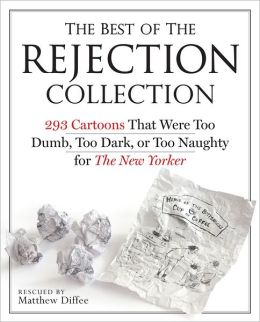
The Best of the Rejection Collection, re-collecting a bunch of cartoons the New Yorker rejected, under the editorial eye of Matthew Diffee. As I understand it, this doesn't quite act as a compilation of the original Rejection Collection and the inevitable sequel, Vol. 2, but it does have a lot of the material from those two books and not a whole lot (if any) additional stuff. But I lost those two books in the flood, so this looks like a double bargain to me.

An Anthology of Graphic Fiction, Cartoons, and True Stories: Volume 2, the ungainly second anthology of comical stuff edited by Ivan Brunetti back in the year eight. It's too clever by half -- see my review for ComicMix -- but it's full of good stuff that I no longer had, and it was going cheap.

The New Yorker Cartoon Caption Contest Book is a thing that exists -- first the New Yorker just published cartoons, then they published cartoons without captions, and asked their readers to make up the funny, and then they published a book of the resulting assemblages, and, even later than that, the book was remaindered and cast into outer darkness. It's edited by Robert Mankoff, and I like New Yorker style cartoons -- and have even intermittently entered the contest.

The Cartoon History of the Universe and The Cartoon History of the Universe II, since there's no way I could live without having some Larry Gonick around the house. I may try to get my sons to read these, if I can figure out how to forbid them from doing so first to make it more enticing.


The National Lampoon's Encyclopedia Of Humor, an artifact from the magazine's '70s heyday (edited by the inimitable Michael O'Donoghue) reprinted sometime recently as part of a not-terribly-successful attempt to revitalize the brand. (I've got a couple of other books from that effort, which survived the flood but still haven't managed to get themselves read.)

And last is yet another book related to the New Yorker: Blown Covers, collecting a bunch of paintings and other pieces of art that didn't quite make it onto that magazine's cover, edited by its art editor, Francoise Mouly. I may be obsessed with the New Yorker, I admit.