Showing posts sorted by relevance for query kochalka. Sort by date Show all posts

Tuesday, December 11, 2012

Kochalka and Kochalka Again

All artists want to stretch, to do different things and not get stuck in a rut. Some are more successful than others, though -- some are so much better at their particular area than anything else, and some have a sensibility that only really works in one style. But Shakespeare wrote both comedies and tragedies, and even Meryl Streep dove into musical comedy singing ABBA songs, so every creative person wants to try to do the same -- to be Chris Gaines as well as Garth Brooks, to direct as well as act, to show the world The Day the Clown Cried. And the results are often less than attractive.

James Kochalka, though, seems to have no trouble with it. On the comics side, he does graphic novels for kids -- particularly the Johnny Boo series -- at the same time as projects like Superf*ckers, which should be kept far away from children (particularly the ones who like to copy what they read). And when you add in his music, animation, and game projects, it's difficult to understand when the man sleeps, or if he has any thought that doesn't immediately express itself in art.

Pinky & Stinky is one of Kochalka's books for kids -- originally published in 2002, so it's older than most of his material in that area (Johnny Boo, the Monkey Vs. Robot books). Like so many Kochalka fictions, it has an odd premise -- two talking pigs are sent on a ten-year mission to Pluto --that's immediately and completely accepted. Events follow in a linear, almost dream-like way: an asteroid hits the piggies' rocket, so they crashland on the Moon. They salvage what they can from the crash, and walk until they find human astronauts at a pumping station. Most of the astronauts don't like the "fat little piggies," and, in the ensuing conflict, they all fall beneath the surface into the ice city of the hand-shaped Moon Men. And so on -- the piggies end up triumphant in the end, but there's a lot of activity along the way, all of it both following directly from previous events and plausible the way stories told by elementary-school boys are plausible. It's silly and adventurous like a Saturday-morning cartoon, and Kochalka's loose, energetic style suits it well.

American Elf is something else again, the daily diary comic Kochalka has been doing, and posting online, since October of 1998.  He draws himself as an "elf" -- pointy ears, massive overbite -- but most of the rest of the "cast" (which means just the people Kochalka encounters in the course of his life) are drawn like Kochalka humans: simplified and cartoony, but meant to be human. There are exceptions, though: one friend and band-mate, Jason, is drawn as a cartoon dog, and crowds tend to become shaggy outline figures -- just as real crowds seem like a mass rather than individuals.

Diaries are a tricky form: they can easily descend into banality (of the "I had toast for breakfast" style), but that very prosaic every-day-ness is what makes the best diaries really work. American Elf, more than ten years on, is a casual, immediate account of moments in Kochalka's life -- one cartoon, usually in four square panels, now always in color, on one or two events that happened in the last day or so. Those can be domestic moments with his wife, Amy, and two young sons, sometimes touching but more often riotous or complaining, since those are two rambunctious boys and Kochalka doesn't gloss over how nervous and angry and hard to live with he often is. Or they can be moments from his various artistic careers -- a "rock show" or a concert for troubled kids or phone conferences with Hollywood or the minutia of designing a game or read-testing his new comics stories with his sons. It's all together in American Elf -- all of the stories and thoughts and moments and ideas, the conflicts and meals and errands and bedtimes of a real life, presented as they happen and assembled into books afterward.

Book 4 is the most recent collection, with all of the strips from 2008 through 2011 -- a fat book, like the first collection, and unlike the middle two, which only collected two years each. That added bulk is good for Book 4; it gives a wider view of Kochalka's life, from just after the birth of his second son Oliver up past Oliver's fourth birthday, with time to see projects come and go and feel the ebb and flow of the year (summer camping trips, holidays, comics conventions at the same times each year). Kochalka's eye on his own life is unsparing and all-encompassing, from fears to lusts to career concerns to anger to playing with his sons -- and, in every strip, it feels like utter honesty, no matter what the subject. American Elf is one of the great comics of our time, and it got that way quietly, assembling itself day by day through Kochalka's eye and hand and brain, making art every single day out of something that happened to him, something that he thought and felt. The brilliance of American Elf is that it has no beginning or end -- a reader can jump in beginning any day (today, six months ago, the beginning, 2002) and come back to it every day for more. But Book 4 is a great package for a great strip, and Kochalka's life and art is well worth exploring and examining and celebrating.

Wednesday, April 16, 2025

Mechaboys by James Kochalka

I've said this before - multiple times - but a reading life goes through various odd turns and stages. Creators that you think of as being current favorites can have multiple books that you expect to get to "later," are for different audiences, or that you just never see.

And suddenly you realize it's been a decade since you read a James Kochalka graphic novel.

When my kids were younger, I read a bunch of his books for kids - with and to them, or passed on to them after - but that petered out when they were in their mid-teens; Kochalka's books for younger readers tended (at least then; we've just established I'm thoroughly outdated on his current career) to the younger end. And I read his American Elf diary comics, until those ended. (In fact, the last Kochalka book I covered here was the collection of the earliest American Elf strips.)

So when I saw a Kochalka book in my library app - one for teens, mostly, rather than little kids - I decided a decade was already too long to go without Kochalka.

Mechaboys is tonally closer to Superf*ckers than to the kid books, though even his work for little kids gets a bit snotty and rude - Kochalka, I think, is an old-school punk, and his characters are brash and pushy and in-your-face no matter what the story. It's the story of two high school seniors, Zachery (who wants to be called Zeus) and Jamie (who wants to be called James). They just built a mech suit in their garage - Zachery is living with Jamie and his widowed mom for not-entirely-specified problems-with-his-family reasons - out of what seems to mostly be an old lawnmower.

Because this is a Kochalka comic, the mech suit basically works - it makes the wearer bigger and stronger and tougher, though it does need to be started with a pullstring, because former lawnmower.

Our heroes are bullied in school - well, some jock-types pick on them for being weird and different, but it's fairly low-key for bullying in a graphic novel for teens. The jocks are jerks rather than assholes, basically: just about as thoughtless and impulsive and destructive as our heroes, only in different ways. Still, it's a huge pain for the guys, and they want to get even or win out or whatever - all those outsider "we'll show them" ideas.

The mech suit has multiple outings: crashing into a car, visiting a keg party at Booger's Hollow, and eventually disrupting the prom. But things don't go quite the ways either Zachery - the more alienated and angry and violent of the two - or Jamie - who thinks a girl in their class might like him, and wants to figure that out - expect. There are fights, including a huge mostly joyful free-for-all at the prom at the end. 

This is a quick, fun story that takes unexpected twists all the time, in Kochalka's mature cartooning style, all rubber-hose characters with rounded organic black lines. It reminded me how much fun Kochalka's work is, and how I really shouldn't have gone without it for so long.

Saturday, January 04, 2014

Book-A-Day 2014 #4: American Elf by James Kochalka

James Kochalka kept a daily diary comic, posted online at americanelf.com, for more than fourteen years, starting in late 1998 (with a few hiccups in the early months) and running through the end of 2012. That's one of the little-acknowledged great achievements in modern comics, a sustained burst of story and art unmatched by anyone else working today.

Even more important than the raw fact of American Elf's existence is that the strips were good all of the time, and sublime a lot of the time. Kochalka's life had interesting aspects and moments -- he fronted a rock band as well as being a cartoonist, and the years of the strip saw him grow from an ambitious but rough-edges young man into a slightly more settled husband and father -- and he launched the strip with a strong sense of focus on those aspects and moments. And that only got better as he gained more experience putting an entire day, or a moment that encapsulates that day, into four little comics panels.

All but the last year of American Elf has been collected, and I've written about much of it here -- Book Two, which collected the strips from 2004 and 2005; Book Three, which did the same for 2006 and 2007; and the double-sized (and, in retrospect, ill-timed) Book Four, which covered 2008 through 2011. The first four-plus years of the strip were originally self-published by Kochalka in a few smaller books under the title Sketchbook Diaries, and were then gathered together to make the first volume of the collected American Elf. And it's that first book that I came to last -- which isn't even ironic, since the whole point of a good diary is that each entry explains itself, and so it can be begun anywhere.

There's definitely an element of Kochalka finding himself in these early years, and a lot more questioning of the point of the exercise itself than he'd do later. But even from the beginning -- there's a comics introduction by Kochalka that makes this point explicitly -- he was trying to show a whole life through the small everyday moments, so the focus and detail and drive was there from the beginning.

It all began with a short run of strips -- two and three a day, actually -- during the San Diego Comic-Con in August of 1998, which inspired Kochalka to start doing it daily. (Though it did take him about two months to get around to that, showing that we're all procrastinators.) The early strips are more whimsical and sillier than Kochalka's later work -- not that he stopped being silly, but he worked out ways to be seriously silly as he went on, if that makes sense. These early years of American Elf are also more metafictional than the later ones -- Kochalka's strips were often about being strips, or about trying to find of twist moments to make better diary strips.

But the real joys of American Elf are of seeing this young man -- often too angry, always too energetic, a raw nerve vibrating against a world that doesn't know what to do with him -- as he works and plays and thinks and lives his life, building a work of art around those little moments. Maybe American Elf couldn't have gone on forever -- no life can be examined all the time -- but, still, we can wish that it went on longer, or could come back somehow, someday.

Book-A-Day 2014 Introduction and Index

Thursday, December 23, 2010

Book-A-Day 2010 # 323 (12/23) -- American Elf, Book Two by James Kochalka

I covered the big-picture stuff about James Kochalka's daily journal comic American Elf earlier this year, when I reviewed the third collection as Book-A-Day #61, so go back there if you missed it the first time around. This is the second collection of the strip, bringing together the 731 strips that Kochalka drew and posted during 2004 and 2005, and it's much the same thing as the third volume. (Only, you know, earlier.)

American Elf, Book Two starts when Kochalka already has more than five years of daily personal comics under his belt, so he's already entirely confident in his style and has a well-tested sense of which moments and thoughts will work as a four-panel strip.

As with the third volume, it's a mixture of work concerns and home life -- but Kochalka is a cartoonist and musician, so he works at home a lot of the time, so strips can be about both working on a cartoon book and watching his then-infant son Eli. (I may be more of a sucker for the Eli strips than most readers are, since I have two sons of my own -- they're a couple of years older than Eli, but I remember the rampaging-toddler days well.) Kochalka is a moody guy, and realizes it in these strips -- there's a loose sequence of days when he decides to be happy, and to stop (or to try to stop) yelling at his family for no reason, but, like most of us, he doesn't always live up to what he wants to do.

Diaries fall into two main categories: those that are interesting because the diarist did important, interesting things, or was around when important things were done, on the one hand, and those that are worth reading because the diarist can take everyday events and make them interesting. Kochalka is mostly on the second side; he does have some rock shows, and flies for book signings and pitch meetings with TV executives, but the strip isn't about how awesome those things are, but about how the shower in the place he's staying in LA makes a different noise on his skull, or how he forgot he had a concert one night. American Elf makes good reading, either day-by-day as it's posted, or in collections like this, because it's one distinctive American life -- Kochalka's only slightly odd, perhaps an elf, but one living in Burlington, Vermont, and getting up in the middle of the night (even after a rock show) because the baby's crying.

Each strip is pleasant, but, like many strips, American Elf gains strength and energy as it goes -- like a fiction strip, knowing the characters and their relationships makes it both funnier and more touching. And Kochalka is still a master at both distilling cartoon-able moments from his everyday life and drawing them in that instantly recognizable, cartoony style of his.


Book-A-Day 2010: The Epic Index

Monday, April 05, 2010

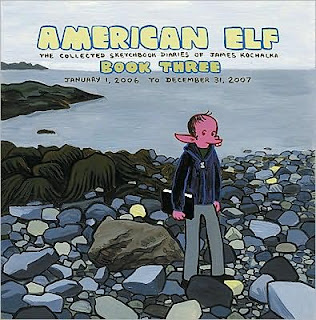
Book-A-Day 2010 # 61 (4/5) -- American Elf, Book Three by James Kochalka

James Kochalka, like so many people, keeps a diary. Unlike most of them, he keeps it in public. And, almost uniquely, he does it in comics form -- generally a four-panel strip every single day. (Even more impressively, I just realized he's been doing it -- again, every single day -- since October of 1998. I'm not completely sure I've managed to sleep and eat every day since 1998, and Kochalka's done a comic all of those days.) This, as the title probably clued you in, is the third collection of that daily strip, covering the years 2006 and 2007 from beginning to end.

American Elf has the ordinariness of a good diary: it focuses mostly on small moments and conversations, things that can be encompassed within four panels and not feel like an excerpt or a piece of something larger. And so the strip mixes up all of Kochalka's lives -- cartoonist (of this strip, of children's books, of other projects), rock star (selling a song to Fox for a TV theme, getting dropped by his record label, playing shows), family man (his second son, Oliver, is born towards the end of this book). Each strip stands alone, as that one moment, but they also tie together -- reading more and more of American Elf, we watch Kochalka's first son Eli start growing up, and eavesdrop on Kochalka's marriage. (Like any creator worth his salt working in an autobiographical mode, Kochalka comes across as absolutely fearless, willing to put any part of his life at all into his strips -- it may not be precisely true, but Kochalka makes us believe it.)

You can read American Elf on the web, day by day -- I certainly do, and I recommend it to anyone interested in comics about real lives -- but it gains depth and power from a collection, unlike so many other diaries and journals (in comics or prose). Which means I need to go back and get the first two collections -- this is one of the major works of comics autobiography of our time.

Book-A-Day 2010: The Epic Index
----------------
Listening to: Apache Beat - Your Powers Are Magic
via FoxyTunes
 

Thursday, November 13, 2025

Quit Your Job and Other Stories by James Kochalka

I haven't read much of James Kochalka's work recently, but that's OK: this book is from before most of the books of his I read anyway!

(Does that make sense? I'm not sure it even makes sense as a sentence, let alone as an argument.)

Quit Your Job and Other Stories collects four Kochalka comics stories that I think are nearly thirty years old now: the copyright page lists 1997, 1998, and 2002 dates. This book is from 2015, which is still longer-ago than it seems.

There are four stories, alternating long and short, and they're all linked, somewhat, sort of. The first, title story is the most separate - the Kochalka-insert character (apparently called Magic Boy, but never named that in the book) is seen as a young man, living a normal life one day in a snowy town, talking to his talking cat and skipping work when he misses the bus. He also finds a magic ring in the snow along the way, though all it seems to be able to do is blow things up when he gestures at them - not one of your traditional "magic ring" properties, and less useful than wishes or invisibility or being able to rule the world if you renounce love. The title, in context, is descriptive rather than imperative - I'd always taken it the other way.

"Primal Brown" is the shortest story, and a connector - Magic Boy, or maybe Kochalka-the-cartoonist, is at his drawing board, and draws or dreams this story, which I suspect is a Peanuts reference. A round-headed naked kid with a single curlicue hair comes out of the water in a jungle, somewhere, and then the cartoonist wakes up.

The last two stories have the Primal Brown character in them, as well as the old-man version of Kochalka's Magic Boy character - again, not called that, but drawn like Magic Boy in other stories so let's assume it's him. The other long story is "Paradise Sucks," which has multiple threads that mostly come together: Brown and some similar people in a jungle, the wizard-looking God who made them (and his insect buddies/helpers) pretending to be nice to the jungle people but mostly teasing them, and old Magic Boy living on dumpster roasted nuts and making abstract expressionist art that urbanized round-headed guys love before suddenly finding himself in the same jungle as God and the primal people.

Last is "The Devil Makes a Man," in which one of the insects - explicitly the devil here, I suppose - makes a robot friend from Brown's rib, but Brown kills it because it's against God's will. (Which...I dunno, I didn't see anything in this story or earlier that explicitly says that, but maybe....?)

The title story is the most straightforward; the others function more on dream or imagistic logic, with scenes that flow into each other and go odd places along the way - they imply or sketch their meanings and purposes more than say anything outright.

This is quirkier, earlier, rawer Kochalka than most of what I've seen - a creator still making comics pages from the thrill of it, and seeing where each ink line takes him rather than planning out a careful journey up front.

Monday, September 27, 2010

Reviewing the Mail: Week of 9/25

Usually, "Reviewing the Mail" is a wander through the stacks of books that the publicists of the world -- and I don't think we appreciate publicists enough, honestly -- have sent me that week, along with my ritual declarations of Not Having Read Them Yet and Making Possibly Unwarranted Assumptions from Back-Cover Copy. However, this week that stack only contained two books, which is quite wee and not really up to a full-bore Monday-morning blog post.

Luckily, though, I have some other books, which I paid for, to mention as well. So "Reviewing the Mail," this week, will be in three parts, just like Gaul:

one of which the Belgae inhabit (Books in the Mail proper) -- First here is a new vampire novel with the possibly audience-confusing title Twilight Forever Rising, by Russian author Lena Meydan and translated by Andrew Bromfield. Now, I don't think that anyone not named Stephenie Meyer should be barred from writing vampire novels with the word "Twilight" in the title, but, if one is already translating from a language that doesn't use the Roman alphabet, one might be able to find a synonym that won't confuse a legion of passionate teenage girls. (On the other hand, maybe I'm crazy to suggest that a vampire novel with a good reason to have the word "twilight" in its title should ever shy away from that.) In either case, this has nothing to do with sparkly vampires -- Meydan's hero is a rare vampire empath, struggling to balance his personal desires and the needs of his house (and, it looks like, some Fate of the World issues as well). Again, Meydan is Russian, so I would not be surprised if there were some Doom involved. Twilight Forever Rising is coming in trade paperback from Tor on September 28th; it's billed on the cover as "A Novel of the Vampire Clans," so there may well be more in this series coming.

The other book that came in the mail is so different from Meydan's that it can't be mentioned in the same breath; it's Babymouse: Cupcake Tycoon, latest in the graphic novel series (beloved by middle-grade girls) by Jennifer L. Holm and Matthew Holm. This time, our heroine is determined to raise the most money for her school library to win a contest -- and, of course, help the library, too. It's the thirteenth in the series, and is the usual small paperback from Random House, hitting shelves on September 28th.

the Aquitani another (bought at Borders) -- Borders e-mails coupons to their club members -- so far, even to the free tier of members, like me -- like clockwork these days, three or four times a week, so that there's always an active coupon to induce one to go shop there. (And Borders is my default Big Bookstore, since it's the one closest and easiest to get to from my house -- proximity being huge in retail.) This last Friday, the Borders marketing machine spit out one of the top-end coupons -- 40% off paperbacks, up to two per person -- so I grabbed the list of stuff I was going to buy anyway, checked it against the website's predictions of what would be in store, and bought:

Sundome, Vol. 7 by Kazuto Okada. I don't know if I'd call myself a fan of this creepy teen psychosexual manga series, but it is the only manga that I make a point to keep reading, even if I don't get review copies. (I reviewed Vol. 6 as Book-A-Day #4, and there are links from there back to what I wrote about the first five volumes.) You probably won't want to read this series in public, but it's a fascinating -- if at times unpleasantly so -- and unflinching look at obsessive young sexuality.

And then there's Julia Wertz's Drinking at the Movies, the first full-length graphic novel from the creator of the webcomic The Fart Party. It's a memoir of her move to Brooklyn -- and, from what I can see, her realization that she was drinking way too much -- but I have hopes that it's better than the flood of memoir comics that the big New York houses have been pumping out for the past few years.

those who in their own language are called Celts, in ours Gauls, the third (books from Top Shelf) -- So the excellent small comics company Top Shelf had a sale a couple of weeks ago, and I bought a bunch of books from them. Those books also arrived this week:

Super F*ckers by James Kochalka, which is some kind of teen superhero book in the inimitable Kochalka style. I haven't seen anything by Kochalka yet that isn't worth reading, and I love repeating his name over and over again, too -- Kochalka Kochalka Kochalka.

The 120 Days Of Simon by Simon Gardenfors. Gardenfors is a Swedish cartoonist, and this was his stunt book: he advertised on the Internet for places to stay, since he wanted to stay away from his home for four months, and not stay in the same place more than two nights (and, then, get a book out of it as well).

The King by Rich Koslowski. I got this graphic novel about Elvis -- who isn't dead, apparently -- because it was really cheap, Top Shelf published it (so it must be pretty good), and because I liked Kozlowski's "Three Geeks" strips when I saw them, years ago. Hey, why not?

Moving Pictures is a newish graphic novel -- came out at the beginning of the summer, I think -- by Kathryn & Stuart Immonen, and having something to do with French art collections during WWII. The reviews have been good, and the Immonens have done good work before.

I know almost nothing about Niklas Asker's Second Thoughts, which was another part of Top Shelf's big burst of works by Swedish cartoonists earlier this year. But it was on sale, and what are sales for, if not for trying new things?

And last is James Kochalka again, with American Elf, Vol. 2, the second collection of his online diary strip. I read the third collection as Book-A-Day # 61, and was impressed then by how well this daily strip reads in larger chunks, and I've wanted to work backwards to the earlier collections since then.

And that's what showed up in my house to read over the past week -- well, not counting a large pile of books from the library (I dove into their online database again, looking for graphic novels I'd missed) -- and I expect a majority of them will show up as Book-A-Day posts in the next month.

Friday, October 12, 2007

Monkey Vs. Robot by James Kochalka

In a jungle somewhere, robots are building a mysterious factory...presumably as part of the evil scheme of someone-or-other. Elsewhere in the jungle, a group of monkeys (Tribe? Pack? What is the collective noun for monkeys, anyway?) go about their normal lives.

A robot kills a monkey, a monkey kills a robot. And then the battle is on.

Kochalka is one of the most distinctive and individual voices in modern comics; he manages to do autobiographical pieces that aren't self-indulgent (probably because he does them as a single-page daily diary, which focuses him to look at specifics and keep it short) and also does odder comics. Like this one, which I think was his first book-length project, back in 2000.

Monkey Vs. Robot is a nearly wordless book-length comic, drawn in Kochalka's distinctive thick-lined, loosely-rendered style, in which, yes, monkeys fight robots. That's pretty much the whole plot. There's some vague symbolism (monkeys = nature, robots = technology), but it's clear that this isn't what really interests Kochalka. He just wants to get into the hot monkey-robot action.

And I can definitely appreciate that; this is a fun story, with some unexpectedly poignant moments (on both sides).

Sunday, October 05, 2025

Reviewing the Mail: Week of October 4, 2025

This is the second of three weekly posts listing a big box of comics-format stuff I got from Midtown Comics about two weeks ago now. I'm breaking them into five-book chunks to keep me from typing for too long on a sunny Saturday morning and just because I can. This time, I have the middle of the alphabet, authorially:

I have two things written by Matt Kindt; I've mostly read the stuff he draws, too, but I gather that, like a lot of people in comics, he does other kinds of projects to make money and keep a career going. (Throwing no shade there: my own career wandered away from a "creative" field into  a deeply dull, B2B end of marketing that pays nicely but no one cares about.) First up is Apache Delivery Service, where the art is from Tyler Jenkins and the colors by Hilary Jenkins. This is some kind of thriller or horror story, set in the jungles of Vietnam (the war as well as the country, as I understand it), with two men (soldiers?) searching for a lost treasure.

The other Matt Kindt-written thing is Bang!, where the art comes from Wifredo Torres, and the colors are from Nayoung Kim and Bill Crabtree in various permutations. This is some kind of spy thriller thing, though I think each issue might start from a different starting place, and some of the storylines might be fictional within its overall world. Anyway: looks twisty and complex, and the quotes are mostly in the "this is awesome!" mode without giving details, so I suspect Big Reveals and Shocking Twists starting pretty early.

I had James Kochalka's Quit Your Job and Other Stories on my list of books to get for a long time - so long that I don't remember why, exactly. This is the 2015 edition - possibly expanded, or at least with a new introduction - of a book Kochalka originally published in 1997. My guess is that this was "adult" Kochalka - or maybe I mean a Kochalka book from before he started doing so much specifically for young readers, not that it's necessarily anti-kid - and I wanted to dive into that end of his work. I guess I'll see.

I thought Be That Way was a graphic novel, but it isn't, exactly: this 2023 Hope Larson book mixes comics pages, longer prose sections (in what look like a lettering font), spot illustrations, and some design-y pages to tell the story of one teen girl's life in the early '90s through her diary. So it's denser than I expected: good for depth, possibly not as good if I wanted to just read it quickly.

And last for this batch is Graylight from Naomi Nowak. I read one of Nowak's books back in the Aughts, and reviewed it for ComicMix then. This book is from the same era, so I decided to check it out. From a quick google, it looks like Nowak is mostly making paintings and jewelry these days, rather than comics, but I count "making art the way you want" as a win, no matter the form. Maybe she'll come back to comics, or some other narrative form, eventually. The description of this book is very vague, so I have almost no idea what it's about - which is also a good thing on occasion.

Sunday, September 10, 2006

Book-A-Day #54 (9/9): Pinky & Stinky by James Kochalka

We went to the library today ("today" being Saturday, 9/9) -- well, actually, we went to two libraries, but I don't feel up to telling the story of the perambulations of the comedy team of Thing 1, Thing 2, and Minivan Dad, and you probably don't care, anyway -- and the boys got a small pile of media (1 DVD, 1 VHS, 2 magazines, 3 manga collections, 3 picture books, and a partridge in a pear tree).

I picked up this; it was in the "juvenile graphic novel" section (where Thing 1 was intently browsing, and I was kibitzing), I'd always mean to read something by Kochalka (I'm now regularly checking out his webcomic American Elf, and I've been hearing about him for ages), and so there I went.

I'd call this a kids' comic rather than all-ages; there's a flatness of emotional effect and of motivation that's more common in stories for children. The title characters are pigs sent on an exploratory mission to Pluto, but they crash-land on the Moon, are mistreated by the human US astronauts there, and end up aiding the Moon-Men against those astronauts. It was fun and pleasant, and maybe the boys will like it (it's going up to their rooms now), but I'm glad I didn't spend my own money on it. I might flip through a Kochalka book the next time I'm at my comics store, though.

Wednesday, March 04, 2009

A Pile of Comics for Younger Readers

I'm hip-deep in reading for the Eisner Awards, and if I try to give every one of these books its own post, none of those posts will ever get finished. So this, instead, will run (quickly, I hope) through a stack of books published for kids and teens during 2008.

I'm neither a kid nor a teen, though, so -- even if you're not, either -- you might find some of these book of interest, as I did.

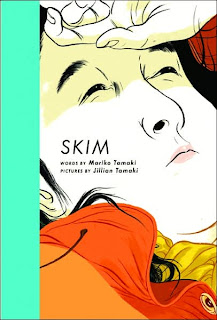
Skim: words by Mariko Tamaki, drawings by Jillian Tamaki (House of Anansi Press/Groundwood Books, Feb 2008, $18.95)

This is a lovely -- both in the delicate and detailed drawings of Jillian Tamaki and in the thoughtful and incisive writing or Mariko Tamaki -- book, told in the voice of teenager Kimberly (Skim) Keiko Cameron. Skim is chubbier than she might prefer, an aspiring Wiccan, a student at a private girls' school, and (like so many teenagers) not at all sure of where she'll fit into the world. It's the sort of story we've all seen a million times, especially in YA fiction: a sensitive young person tells her own story -- in this case, there's even specific references to writing this in a diary -- but that's because millions of us were sensitive teens, and it's a story that can resonate strongly when told well.

And this is told very well; it's one of the finest graphic novels I've read recently. The Tamakis make Skim a real, specific person; she's grumpy and distracted, wondering about love and Wicca and friends and the whole world. There are some "issues" in this book, but I'm not going to tell you what they are; merely mentioning them would give the wrong impression. Skim isn't a book about "problems facing today's teens" -- it's one young woman's story, told brilliantly and by turns funny and moving, sweet and sad. If you see a copy, pick it up: this is a real gem.

No Girls Allowed: written by Susan Hughes, illustrated by Willow Dawson (Kids Can Press, August 2008, $16.95)

The stories of seven women who dressed as men for extended periods of time -- from the Egyptian Pharoah Hatshepsut to US Civil War soldier Sarah Rosetta Wakeman -- are told, in lots of stilted captions and slightly less stilted dialogue, enlivened by Dawson's clear, crisp, and slightly quirky art. (One example: all of the female characters -- down to the images of the creators on the back flap -- have that circle on one cheek that you can see on Mu Lan on the book cover to the left.)

No Girls Allowed is much more "educational," and much less fun. I'm sure it could be very useful to some kid staring down the barrel of an essay deadline, but the stories it tells are rendered dry and flattened. Hughes never speculates or goes beyond what history records, which makes this useful as a reference, but not as much fun as a collection of stories. All of these women were highly secretive -- they had to be, to pass as men for years -- and so there's often not a lot known about them...but that's all there is in No Girls Allowed.

Claire and the Bakery Thief: by Janice Poon (Kids Can Press, March 2008, $15.95)

A pre-teen girl moves to the small town of Bellevale when her parents buy an old bakery there, and at first has trouble making friends, until she meets fellow outdoors-lover Jet. But the parents are fighting -- Claire's mother didn't want to leave the big city in the first place -- and eventually Mom goes away with a mysterious Artificial Flavoring Salesman. Claire and Jet then need to find and save her.

This is positioned as the first in a series, and it means well. (There are even recipes at the end, and a message of eating local/organic/healthy.) But it's both trite and silly, and ends up either trivializing or ignoring Claire's parents' marital troubles. OK for young girls who like to cook, not of much interest to anyone else.

Johnny Boo: The Best Little Ghost In The World: by James Kochalka (Top Shelf Productions, June 2008, $9.95)

Kochalka has done books for kids -- or books that are also appropriate for kids, perhaps -- before, and his quick, cartoony style works well in this short story about a boy ghost and his best friend Squiggle (who looks different, and flies, but is also a ghost, I guess). Boo and Squiggle run and play, and then have some trouble with an ice cream monster. It's a fun, light adventure story for boys, with the loose narrative structure and ideas of a game a couple of kids would play on the spot out in the yard.

So this is light, but a lot of fun -- probably of most interest to younger boys (up to six or seven) and the more tomboyish girls of similar ages.

Yam: Bite-Size Chunks: by Corey Barba (Top Shelf Productions, July 2008, $10.00)

Yam is the little boy in the all-encompassing jumpsuit on the cover; his TV-dog doesn't seem to have a name. This book collects a twenty or so short wordless comics stories about him and his friends, ranging from single-pagers up to one thirty-eight pager. Several of the stories originally appeared in Nickelodeon Magazine, so this character is already familiar to a swath of the preschool set.

The stories are the kinds of things you'd expect from wordless stories for preschoolers -- lots of food and friendship and being nice, with some game-playing and mild conflict and (in the longest story) Yam being in love with a cute shopkeeper but eventually realizing he's just a kid and she isn't. Barba's art is cartoony, but more detailed and noodly than Kochalka's, with a lot of things to look at in every panel. My eight-year-old enjoyed reading it with me, but the subtle details of the stories -- they're wordless, remember -- sometimes escaped him, and will likely escape much of the target audience.

Korgi Book 2: The Cosmic Collector: by Christian Slade (Top Shelf Productions, July 2008, $10.00)

This is another wordless story, but this time it's a fantasy tale, set among winged people called Mollies who live in Korgi Hollow with their fox-like Korgis. (The girl on the cover is a Mollie named Ivy, and the "dog" is her Korgi, Sprout, who has special powers.) The backstory is pretty extensive, for a story told without words, and that requires a several-paragraph long prologue up front (as narrated by a giant friendly toad with a hat and a telescope) as well as a list of characters and races at the end. (This does mean that the reader finds out the point of the story, and something of the details, only after the story is done, which is sub-optimal.)

There's this alien (we learn from the list of characters) named Black 7 (ditto) who shoots Mollies to steal their wings and tack them up on the walls of his house. Ivy takes exception to being treated that way, and goes to get her wing back, either by sneaking or by force. Korgi has more action than most of these other books, and so could skew slightly older -- though the wordlessness tends to push the age down. (As does the slightly twee names and aspects, from "Mollies" to the talking friendly toad Wart.)

Slade's art is gorgeously dynamic and detailed, with magnificent shading. I suspect the art is well more than half of the appeal of Korgi, though the story is just fine for what it is.

Coraline: adapted and illustrated by P. Craig Russell fron the novel by Neil Gaiman (HarperCollins, June 2008, $18.99)

I've now had my fill of Coraline for a while, having seen the film, re-read the Gaiman novel and now read this comics adaptation by Russell within barely two weeks. Russell's adaptation is much more faithful into the comics form than Henry Selick's was for the film, but the film is a much more impressive achievement -- even leaving aside the 3D and other aspects that give film an undeniable edge over any book.

Russell tells Gaiman's story, entirely using Gaiman's words as far as I could tell, and doesn't change even the slightest of plot details. Selick, though, changed quite a bit of the details, adding a character for Coraline to talk to, changing the nature of her final confrontation with the Other Father, and seriously changing the dynamics of the final well scene. Selick's changes all increased the tension and visual interest; Coraline, as a novel, was very quiet and centered in Coraline's head. That's the great gulf between a novel and a movie, of course: a movie can only show what's happening on the outside, though it can hint and imply mental states, while a novel can dive right into a stream of consciousness and make the reader know exactly why a character did something. Graphic novels, at their best, hybridize the two forms -- they can't be quite as visually exciting as movies, since they don't move, but they can come very close. And they can show the inner life of a character just as fully and in as much detail as a novel can.

But Russell, in adapting Coraline, didn't add anything to the mix but his own prodigious skills -- the story is precisely the same, and the otherworldly elements, such as the Other Mother and her creatures, are left understated, not going an inch beyond Gaiman's descriptions of them. His graphic novel is precisely Gaiman's Coraline translated faithfully, while Selick's movie is the same story given a new visual style and a few changes to work better in a different medium.

Unfortunately, to my eye, Russell -- though one of the masters of modern comics and the creator of a long shelf of great adaptations, from Elric to the massive, magisterial Ring of the Nibelung -- wasn't the best choice to illustrate this particular story. The original illustrations for the novel (at least in the US editions I've seen) was Dave McKean, who brought his usual chiaroscuro forms, which imply much more than they illustrate. And Selick's movie also took a more surreal visual style, with its lanky puppets and gorgeous but subtly unreal settings. Russell, on the other hand, is magnificent at drawing real things and real space -- his Coraline is a particular girl of about ten, and the Other Mother looks like a real woman with buttons for eyes.

That's usually a great strength, but it hampers Russell, particularly near the end, when the Other Mother's world is supposed to simplify down and become more crude -- "no more than a crude scribble" and "just a child's scrawl." Russell draws those scenes as warping and twisting, but not deteriorating -- not at all like the drawings of a child. The one place where the text gives specific visual instructions that are precisely translatable to comics, Russell is too good an artist to carry them out.

It may be just that I've had my fill of this story right now, but I found Russell's comics version the third and least of the versions of Coraline. It's neither the pure words Gaiman wrote the story in nor something new and wondrous like Selick's movie -- it's gorgeous and impeccably drawn and laid out, as always with Russell, but doesn't quite grab a life of its own.

Sunday, November 14, 2010

Book-A-Day 2010 # 284 (11/14) -- Superf*ckers by James Kochalka

This book has absolutely no redeeming qualities except for its own glee at being precisely what it is. Handily enough, that's plenty. Superf*ckers is the comic that Mark Millar has been trying to write for his entire career, but has never been innocent enough to do right. It's simultaneously decadent and fresh, sweet and sour, a straight superhero comic and a brutal parody of one.

The Superf*ckers are a teen superhero team along the lines of the Legion -- large, ready to have try-outs all the time, squabbling, far-flung. But, in the usual James Kochalka deflating-expectations manner, their secret headquarters is "in the field behind his house" in Burlington, Vermont. And they act like normal obnoxious teens -- or maybe realty-show contestants -- than like most four-color superheroes: fighting with each other, playing pranks, doing drugs, casually tormenting the newbies, screwing and trying to screw each other, accusing each other of being gay, and making lots of dick jokes. They don't battle villains (super or otherwise), have any relationship (good or bad) with law enforcement, cackle about their piles of money, lord over lesser humanity, care about their public image, or do any of that currently trendy long-underwear stuff -- they're just a bunch of half-socialized kids with a clubhouse and superpowers.

This book collects four issues -- numbered non-consecutively, not quite every other issues from the "real" run of the 270s -- that were originally published separately over the past half-decade, along with a Jack Krak solo first issue and some short strips at the end. It all works because this isn't yet another revisionist superhero story -- it's just about a bunch of punk kids making trouble. Sure, these kids have distinctive costumes and powers, but that just defines them: they could as easily be skateboarders or graffiti taggers or petty thieves. Superheroism is their way of rebelling and making trouble -- and that's more interesting and new than a thousand "realistic" urban vigilantes. For anyone who really likes superheroes -- or cares that much about them to really hate them -- Superf*ckers will be annoying and obnoxious in all of the wrong ways. But, if you just want fun comics about a bunch of kids with impulse-control issues, horribly foul mouths, and bad luck, it'll go down just fine.


Book-A-Day 2010: The Epic Index