Showing posts sorted by relevance for query rick geary. Sort by date Show all posts

Thursday, July 01, 2021

Stories from the '90s by Rick Geary

Self-publishing can strip out a lot of the standard bullshit of publishing. If this book had been published by a Fantagraphics or Dark Horse, it would be called something like Prairie Moons and Night Drives, or maybe True Stories and Other Lies.

But, since Rick Geary assembled it himself out of his archives and published it himself, it can be exactly what it is: Stories from the '90s. Simple, clear, true.

Geary has been assembling his shorter stories into various books for a few years now; I think this is the most recent one, but I hope there's at least one book's worth left of newer work. Already available are Early Stories (pretty self-explanatory), The Lampoon Years: 1977-1988 (mostly single-pagers from National Lampoon in its declining years, though Geary's work was excellent), and Rick Geary's Book of Murder (stories about murder, more and more straightforwardly as his career went on, over a roughly thirty-year span). Older Geary fans may remember At Home with Rick Geary (from 1985) and Housebound with Rick Geary (1997); I think most of those pieces have been collected in these four books now, along with a lot of other material.

Stories from the '90s is even bigger than the previous books - they all landed in the 80-90 page range, while this one tops out at 120. (And is slightly more expensive, though slightly cheaper than his more recent individual Kickstarted books - as usual, pricing is complicated and based on multiple factors.)

And, of course, the whole point is that its full of oddball Geary stories. There are some long ones, like "Prairie Moon" and "Tragedy in Orbit" and "Mr. Nickelodeon" and "Our Illustrious Visitor of 1959," but that's only "long" in context: there are a passel of three-pagers and a half-dozen longer than that, but most of the work here is in single-page form. Geary was always deeply quirky in his short comics, full of strange transformations, matter-of-fact narration of bizarre events, random juxtapositions, and a sprightly, conversational tone no matter the style or matter of a story. This book has one Mask story - yes, the  same character the movies were about; it was a comic first, with work by a whole lot of different people - a couple of Geary-esque retelling of unlikely historical events, and a whole bunch of one-pagers on topics like "Desperate Clergy," "Secret Places of My Shameful Past," "Transgression Hotline," and "Yes, It Happened."

Geary's art is mostly softly rounded here, full of people pulling faces during their madcap antics. His lettering is precise and lovely, either in bigger stories or framing those tiny little boxes of enigmatic objects he did a lot early in his career.

This is one of the most Rick Geary books possible, and it is wonderful. The only way I know of to get it is directly from the author, but don't let that stop you: he uses one of the major amalgamators for merch (Storenvy), and it all works well. Hornswoggler says check it out.

Sunday, January 12, 2014

Book-A-Day 2014 #12: The Elwell Enigma by Rick Geary

Rick Geary's major project for the last couple of decades has been a long series of graphic novels, each about a particular famous murder case from American history -- he began with the "Treasury of Victorian Murder" in eight volumes from 1995 to 2007, and has since moved slightly forward in time with the "Treasury of XXth Century Murder," with six books so far. The Elwell Enigma stands next to that series: it's not part of it, officially, but it's the same kind of story and sees Geary using the same skills and techniques.

We could speculate why Elwell Enigma is not part of the main series: it's a bit shorter than the series standard -- 48 pages vs. 80 -- and the case was not solved at all (though many of the other cases Geary has covered have serious mysteries remaining, or questions of whether the right people were punished). But that really doesn't matter: this is the kind of thing Geary does well, and it's a fine package telling an enticing story.

Unfortunately, this won't be widely available: it was a Kickstarter campaign last year, and the book doesn't seem to be available to anyone who didn't back that campaign. And, if I'm adding things up correctly, that means there are only about 250 copies of this floating around, unless Geary printed up a bunch of them for other purposes and will release those later. (Which would be very nice for Geary fans.)

In any case, this is the story of the murder of the wealthy bridge expert Joseph B. Elwell, who was shot to death in the early morning of June 11, 1920 in his Upper West Side home. Geary doesn't have as much to work with here as in some of his previous books: Elwell was a womanizer (something he had in common with several other murder victims and perpetrators in the series), but didn't have any single really scandalous affair. And it looks like the police might even have been honest this time: they searched diligently for a lead, but none of Elwell's paramours or bridge students could have killed him. (The alternative there is that the real killer was quietly hushed up for whatever reason, but Geary doesn't even give that as a possibility, so presumably there was no gossip at the time that he was able to turn up.)

So the case in Elwell Enigma is very much an enigma: Elwell was shot by someone he let into his home soon after the milkman did his rounds that morning -- in bare feet and pyjamas, without hairpiece or dentures -- and that person got away completely. This was all nearly a hundred years ago, though, so -- unless the perpetrator was very young then and very old now -- everyone involved is now dead. Because of that enigmatic aspect, Elwell Enigma is not as satisfying as many of Geary's similar books: he just didn't have enough material to work with here (or he left out a lot of blind alleys the police followed to keep the book to this size, perhaps).

Backers of Elwell Enigma also got a 24-page PDF of older Geary crime comics, called "Digital Murder," which collected a bunch of his very first murder stories from the early '80s -- mostly set in middle America of the time, and presented as true, though they might actually be fictional. (It also includes a 2007 story, "Blood on My Hands," in a similar style.) I'm a fan of those early Geary comics -- their matter-of-fact laconic narration, the quick panel transitions, the dispassionate narrators, the casual bloodsheet, the deeply amusing juxtaposition of the early Geary's round, lumpy, cartoony characters with the dark deeds narrated. But, as far as I remember, "Digital Murder" was an unexpected bonus; I can't find any reference to it on the Kickstarter page.

But, maybe, if Geary was digging through his files to collect these, that means there's a chance that a larger collection of those old strips -- maybe even the ones that aren't about murders -- could surface, something to replace those old copies of At Home with Rick Geary and Housebound with Rick Geary. I can only hope.

My apologies if I've made this book sound too enticing, since I imagine it would be very difficult to find. Maybe you know a Geary fan who can lend it to you?


Book-A-Day 2014 Introduction and Index

Wednesday, September 06, 2017

Early Stories: 1977-1988 by Rick Geary

It's a cliche that creators resent their fans who like best the "early funny ones," but I have to be that guy for just a second. Rick Geary has had a wonderful career: he has a quirky but devastatingly precise line and has made several dozen excellent graphic novels about historical murders over the last couple of decades. (Plus a number of other things.)

But he started out even quirkier, and I might like that ultra-quirky Geary even better than the meticulous, methodical, organized chronicler of mayhem. For about the first decade of Geary's career -- say, the period covered by Rick Geary Early Stories: 1977-1988 -- a Geary comics page was as likely to be a collection of lovingly-detailed kitchen appliances as anything else. Or a carefully-drawn collection of vignettes from oddly-named motels from around the country. Or a series of unexplained and possibly supernatural events, narrated dryly and matter-of-factly, as if it was just another day.

Geary nailed a deadpan affect from the beginning, and that, plus his almost-immediately strong drawing abilities made these slices of bizarre life unique in the cartoon world of the late '70s. You might not have entirely understood an early Geary story, but it was compelling and memorable and unlike anyone else.

Those stories were collected other places over the years, most notably the Geary collections Housebound and At Home with Rick Geary. Both of those are long out of print, so it's wonderful to see Early Stories gather eighty pages of prime high Geary weirdness into one place. You're not going to find this book easily, though -- it may turn up in a comic shop or independent bookstore or two, but the only dependable way to find it is to buy it directly from the author.

And I do recommend that you do that, if you have any inclination towards odd, off-the-wall stories told matter-of-factly in comics form. Early Geary practically invented that style, and remains its undisputed master.

Wednesday, October 11, 2017

The Story of the Lincoln County War by Rick Geary


I almost wish I'd held onto Louis Riel and reviewed that together with Rick Geary's The Story of the Lincoln County War: both are stories in comics about 19th century rebellions, mostly for good reasons against corrupt and nasty rulers, that ended with the destruction of the rebellion and the loss of its cause. Louis Riel was a Canadian, and his story had a racial element that eventually turned that story into one of the important lessons of that nation.

Rick Geary, though, has a more sordid story to tell: one motivated by greed and lust for power on one side, and a slightly purer desire to make a living (or, maybe, to push out the old cabal and supplant it with a new corrupt cabal, in someone's wildest dreams) on the other. The place is Lincoln County, New Mexico, in the late 1870s -- a huge expanse of mostly empty land, with ranchers, farmers, and a few townspeople. The current cabal extends all the way up to the territorial governor, and is anchored by the shopkeeper/merchant to the local fort. (He has an admirably compact supply chain, with hired rustlers stealing local cattle for him to sell as beef to that fort, plus a near-monopoly on most staples and the kind of predatory credit that soon afterward gave rise to the company town.)

On the other side is a new shop-owner, trying to get into the business, and a local lawyer who used to work for the cabal and either was kicked out or smartened up. Eventually, it turns to violence, because it always does.

This is "war" in the local-history sense; at no time is there a pitched battle or real tactics, though an army detachment does get into the fray at one point, with the expected results. The fighters in this "war" are close to the conventional idea of cowboys: well-armed young men in bands riding around a semi-barren landscape and shooting at each other. And, since one side of this "war" does have control of the local government, meaning both the apparatus of the law and the assistance of that army detachment, the outcome is not really in doubt.

Over a long period of time, they say, the arc of humanity does bend towards justice. But any story about individual people doesn't have that luxury of time, and this arc was bent in an entirely different direction. The best thing you can say about this "war" is that it was short and, as far as Geary tell us, didn't claim any civilians. It did spawn a few outlaws, most notably someone Geary here calls by his "real" name, William Bonney. (And so this book is something of a prequel to Geary's The True Death of Billy the Kid from a couple of years ago. Like that book, The Story of the Lincoln County War was funded through Kickstarter. It's not yet on Geary's web store, but that would be the most likely place to find it.)

This is Geary in his usual mature sombre-historical mode, not the madcap Geary of his early career. (Though that wild-hair Geary still does make occasional appearances, once in a while.) As always, he's very good at 19th century faces, at physical spaces from maps to rooms to dusty streets, and at explaining complicated, violent, nasty bits of history to a modern audience. Again, this was a Kickstarter project, presumably because it was considered to have less wide of an appeal than Geary's usual books about historical murders. But this is an interesting bit of unpleasant history -- another tale of capitalism run riot and corrupt, in case we need one more in these fallen days -- told well by a master of comics. If you can find it, it's worth it.

Wednesday, May 27, 2020

The Wallace Mystery by Rick Geary

I've written a lot about Rick Geary here over the years; I'll try not to repeat myself too much now. His comics work for the past couple of decades has been variously-titled series of graphic novels, generally in a slightly smaller physical format than a standard pamphlet comic, about famous historical murders of the last two hundred years, in the US and UK. (Or regions that are today parts of those nations, to be pedantic.)

There was the Treasury of Victorian Murder, the Treasury of XXth Century Murder (which may officially be ongoing), the Little Murder Library (which is definitely ongoing), and various one-offs and other things. The one thing they all had in common: murders that got a lot of media attention at the time, so they had enough primary and secondary sources for Geary to sift through to make his comics.

The most recent book in this long string is The Wallace Mystery; it's part of "Little Murder Library." Like the previous books in that series, Geary self-published it through his Home Town Press, and publicized and capitalized it through a pre-publication Kickstarter campaign. It's not yet available in his webstore -- and not available anywhere else that I can see -- but will probably be available through Geary eventually.

For now, you might have to settle for me telling you about it.

Geary's self-published books are a bit less "finished" than the ones he publishes through others (mostly NBM, the last twenty-five years or so). The front covers are simpler, there's less text on the back, and the spine is really minimalist. The art is comparable in style: one or two largeish panels, fully drawn with watercolors to add depth and tone. The text is typeset, though, in a square all-caps font  that is clean and readable but which I don't love that much. (And comics feel less like comics when the type is clearly set -- a good font-based-on-the-artist's-lettering can go a long way to avoid that.)

But they're otherwise pure Geary -- it's just Geary with less publishing support, obviously because he's doing just about all of the work himself.

Wallace Mystery tells the story of the 1931 murder of Julia Wallace of Liverpool, a 52-year-old married woman with no obvious enemies or problems. For the usual reasons, her husband William was the primary suspect, and ended up going to trial for the killing. Geary tells the story in his usual style: generally straightforward, but occasionally florid, with excursions into theory and unanswered questions, the product of a mind pulling on all of the strings at once.

Geary runs through the whole story, through the death of William and the other major characters. That's one of the benefits of his matter: you can end cleanly if everyone is dead, even if important facts (like actual proof of the murderer) are still in dispute.

Wallace Mystery is not one of Geary's major books: in general, my advice with Geary is to pick a murder case you've heard of and read that book first. Unless you're an expert on Liverduplian history, this will not be that. But it's another good entry in that string, and it's great to see him still doing his thing, dependably and well, this far along in his career.

Thursday, April 02, 2026

A Billy the Kid Alphabet by Rick Geary

This was a Kickstartered project; you might not be able to get it. On the other hand, Rick Geary has been making books for decades - and comics for even longer than that - so I have to think that he'll have a way for people to buy his stuff. You don't get a career of that length and depth by making it hard for people to pay for your work. My guess is that it will show up on the Books page of his website eventually.

Geary has been doing Kickstarters for books - at this point, I think his output is about one Kickstarted book a year, and he's had probably a dozen or more going back at least a decade - for a while, and I've been backing them to get the books, since I'm a long-standing Geary fan.

The project for 2025, which got to me early in the new year, was A Billy the Kid Alphabet, an abecedary about the man known to history as William Bonney.

And you might be asking "wait, didn't Geary already do a book about Billy the Kid?" That's right: in 2015, he did a more traditional narrative version of Bonney's story, The True Death of Billy the Kid. That earlier book is longer, organized in a more familiar way, has more details, and in general is a better place to start. (Geary also did a book about the related Lincoln County War around the same time.)

But Geary is a fun, quirky creator, and I do enjoy his quirky projects. This is definitely one of them.

Alphabet more-or-less tells Bonney's story, though not in order. Geary has a reasonable word or phrase for each letter, from Alias (covering the names used by Bonney) to Zero (debunking the "he survived his death" rumors), but the stricture of the alphabet means that, for example, the Lincoln County War is referred to a few times before we get to Regulators (the group Bonney was part of during that war) and Tunstall (the landowner Bonney worked for, whose death sparked the war).

So Geary does get to the high points of Bonney's life - that war, his capture, trial, and escape, how he was killed by Sheriff Pat Garrett - but not quite in the order that they happened in life. This might confuse some readers, assuming Alphabet has readers who aren't familiar with the basic facts already.

Each letter has a left-hand page, with the letter big and the explanatory text for the chosen word, and then a right-hand page, with a Geary pen-and-ink illustration of the thing he's writing about. As always, Geary's art is detailed and particular - he's always been good at 19th century faces, clothing, and surroundings, and Alphabet shows his strengths well.

Again, this is a book that would be difficult to find at this point, though it will probably be available from the author in the near future. If you are a Geary or Bonney fanatic who didn't know about it, I wish you luck in finding it.

Tuesday, March 28, 2023

The Fatal Bullet by Rick Geary

Rick Geary's most obvious oeuvre consists of a sequence of small-format books about historical murders, spanning three decades from Jack the Ripper in 1995 to The Black Dahlia in 2016. [1] Each one is meticulously crafted and deeply researched before drawn with Geary's complex illustrative line, and they usually feature maps and diagrams of murder scenes alongside traditional comics panels.

The Fatal Bullet was fairly early in that sequence; it was published in 1999. Unlike most of Geary's choices, there's no mystery in this one, nothing central still unknown today. Geary here tells the story of Charles J. Guiteau's 1891 assassination of President James A. Garfield, which was done in public and has nothing mysterious about it at all.

Well, other than why Guiteau did it. And that's what Geary looks to explain here: he explicitly sets a 19th-century moralizing tone - somewhat tongue-in-cheek - in the front matter, with a chart depicting "The Two Roads" - the "happy, prosperous life" of Garfield and the "downward path" of Guiteau. And the book follows in that mode: pitched somewhere between penny-dreadful and serious-newspaper, sounding largely like an account from the time period, Geary outlines the lives of both men to show how they came to their fatal encounter.

The one thing this doesn't allow him to do is diagnose Guiteau, who clearly had some kind of mental disorder - he was found sane and guilty at trial, of course, but he was driven to the murder by a monomania about factions in the Republican Party and and vastly inflated sense of his own importance. Any serious modern psychological profiling of Guiteau would break that historical model, and that may be why Geary avoids it. Or maybe no one knows what Guiteau's problem was. 

In any case: he was a nut. A "frustrated office seeker" - he had no qualifications besides a stump speech he wrote supporting Garfield that was never actually used and his own boundless faith in himself - who wanted to be made ambassador to a major, cushy European capital and had been bugging Garfield and his Secretary of State for months. With no luck in that direction, he got it into his head that killing the president would miraculously make everything better and get him the job he wanted.

It didn't work, obviously. Guiteau was immediately arrested, held until Garfield died, then speedily tried and executed. But murders are about people doing extreme things for extreme reasons; that's what this whole long series of books by Geary are about, in the end. And this is somewhat atypical in its lack of mystery, but otherwise right down the middle of the style. Geary's art is lush and immersive as ever, the words are energetic and carefully researched, and the whole thing told excellently. What more could you want out of a murder tale?


[1] And he's self-published a small shelf of similar books since then, actually.

Friday, September 03, 2010

Book-A-Day 2010 # 212 (9/3) -- The Terrible Axe-Man of New Orleans by Rick Geary

Rick Geary knows his historical murder stories -- he's been turning gruesome tales from a century or two ago into compelling comics for more than twenty years now, since the original Treasury of Victorian Murder in the late '80s. Again and again, he's gravitated to the stories that were never quite solved -- Jack the Ripper, The Borden Tragedy, The Mystery of Mary Rogers, The Lindbergh Child -- each time showing the facts, as far as they're known, and then leaving the mysteries clear as he describes the possible explanations.

The Terrible Axe-Man of New Orleans is the third book of Geary's current series, "A Treasury of XXth Century Murder," which is just an extension of the previous eight books in "A Treasury of Victorian Murder" -- all eleven books are smallish hardcovers (about 5" x 8"), under a hundred pages, each about one particular murder or series of murders, ranging from 1841 (Mary Rogers) to 1922 (Famous Players). The Axe-Man, who may or may not have been an enforcer for the local Mafia, killed six and wounded six others, most of the time chiseling out a panel from a back door of a grocery/apartment run by Italian immigrants and attacking the inhabitants with their own axe, then running away without stealing anything.

As usual, Geary begins with detailed scene-setting, going back to New Orleans's founding and its role in the War of 1812 before jumping forward to the Jazz Age and the years 1918 and 1919, when the Axe-Man was active. That background is one of the few solid things about this case -- Geary makes clear that some of the attacks could easily have been copy-cats, and even the main sequence of murders (those Italian grocers, presumably killed to scare their fellows into accepting "protection") might well have been done by different men. Geary runs through the sequence, placing each event in time and space -- and giving a sense of the public mood at the time -- in his inimitable detailed art, with its thousands of precisely parallel lines and his amazingly expressive faces, alternately toothily smiling, bewildered, sullenly peering out from lowered brows, and staring stolidly forward.

Geary, as always with his engrossing historical murder-mysteries, carefully researches the facts and presents them dispassionately, discussing plots and possibilities over panels of precisely depicted black-and-white mayhem. He goes as far as the facts will allow, but no farther -- a man does die at the end, and he may have been the Axe-Man (or, at least, responsible for some of the murders), but Geary also makes clear the holes in the story, and other suspects for some of the attacks.

There's no one better at depicting the quirks of a past era in comics form than Geary; he draws details of clothing and setting carefully to make it just right, uses his panels as windows to show those times in the greatest depth, and never loses sight of the fact that his characters aren't just modern people in funny clothes. And violent death brings out his best instincts -- of wanting to know what happened, but, even more importantly, to be sure what he can know. The Terrible Axe-Man is another great volume for the shelf of fine Geary books about mayhem and bloodbaths among our great-grandparents.
Book-A-Day 2010: The Epic Index

Tuesday, July 25, 2006

Book-A-Day #8 (7/24): A Treasury of Victorian Murder: The Case of Madeleine Smith by Rick Geary

Rick Geary has been quietly producing slim, attractive little comics accounts of ghastly 19th century murders on a regular basis for over a decade now -- Jack the Ripper came out in 1995, and there have been five books in between, each covering one scandalous and horrifying crime (not to mention the earlier miscellaneous Treasury of Victorian Murder, Vol. 1).

This is the newest one, and the story isn't as spectacular or appalling as some of the others, but Geary's wonderful pen-and-ink work is always pleasing. (I do miss the wilder caricatures and facial expressions of his earlier work, though; he's settled down a bit with age, and that's not always for the best.)

For readers who haven't read Geary before, I'd recommend The Borden Tragedy or The Beast of Chicago (or perhaps, for those who want a wider look at his very varied comics work, Housebound with Rick Geary, if you can find it). Madeleine Smith is nice, but not one of his best, so it's not a great first Geary book.

Wednesday, January 03, 2018

Book-A-Day 2018 #3: Two Treasuries of Murder by Rick Geary

Rick Geary has been retelling historical murders as small graphic novels for about two decades now -- first a series of famous Victorian crimes, and then moving slightly forward in time to the first half of the Twentieth Century.

I recently re-read two of them, because I'd bought new copies to replace ones lost in my 2011 flood. Since they're both old books, and part of basically the same series, I thought I might as well throw them together into one post. I didn't realize at the time that these two books straddled the switch from Victorian to XXth Century. That's potentially a major change...but it wasn't really. Geary just was extending the era he was writing about somewhat, while keeping the style and matter of the books consistent.

So The Lindbergh Child was published in 2008; it's obviously the story of the kidnapping and (accidental?) death of Charles Lindberg's infant son in New Jersey in 1932.  And The Saga of the Bloody Benders was published the year before, telling the more historically obscure story of a family (?) of murderous shopkeepers who terrorized Labette County, Kansas in 1870. (Geary was born in Wichita, and his work has often returned to Kansas -- it's a place he knows well.)

In both cases, Geary is working with historical records -- obviously there's a a lot more around the Lindbergh kidnapping, but the Bender case is reasonably well-known in Kansas, with plenty of research done over the years. What both have in common is what seems to attract Geary to all of his stories: an essential core of mystery, of things unknown and unknowable. Did Bruno Hauptmann kidnap the baby Lindbergh, or was he a minor conspirator framed by police? Who were the Benders, and where did they go afterward?

I don't want to attribute motives to Geary, but it's clear this project is important to him: no one spends twenty years doing the same thing artistically for no reason. He's clearly drawn to the mystery of murder, the questions of motive and culprit, and the ways news fans out into the world after something shocking. Both of these books have his trademarks: precise lines to delineate people, places and things in historical detail; panels that leap from one image to the next to cover a large subject in a short space; careful maps and plans of houses and spaces; laconic narration that occasionally asks those big questions of who and how and why; and copious quotes from the speech and letters and documents surrounding the case.

There's no explicit motive behind the series of books: maybe they exist to show what human beings are capable of, maybe they exist to cast light in dark places. Geary has no lessons for his readers. He's not as quirky and light of touch as in his non-murder books, but the murder books aren't dour. There's no tone of moralizing: just a questing mind, trying to lay out the facts as best they can be known, and sketch the possible explanations for those facts.

These are two good books in a good series; the quality level has been consistent since 1995's Jack the Ripper. They're not books about murder for people who want to be whipped into a frenzy of hate, or to know something for sure -- they're for those of us who live in the real world of possibilities and conjectures, who can be satisfied with what can actually be known. I hope there are a lot of us. I tend to doubt it.

Thursday, December 27, 2012

Death and Death: Two Graphic Novels

These two books are both death, in very different ways. So I thought they could share a post.

Lovers' Lane by Rick Geary
Old murder cases have a complicated fascination: the usual surprise and apprehension at lives being cut short, mixed in with our own incomplete understanding of the time and place and a sense that all of those people are dead now, anyway, making the "cutting life short" argument at least very ironic. Rick Geary has been working that angle for over twenty years now, with a series of small graphic novels, each about one murder case -- first as "A Treasury of Victorian Murder," and more recently moving slightly forward in time with "A Treasury of XXth Century Murder."

(I've reviewed a number of those books over the past few years: The Case of Madeleine Smith, The Saga of the Blood Benders (here), The Saga of the Bloody Benders (ComicMix), The Lindbergh Child, Famous Players, The Terrible Axe-Man of New Orleans, The Lives of Sacco and Vanzetti (at the end of a round-up).)

Geary's approach is as painstaking as his precisely parallel shading lines: the facts of a case, meticulously researched (with a bibliography of sources) and laid out systematically, as far as anyone knows them, and the mysteries presented equally carefully, with just a hint of which explanations Geary finds more plausible. He has an eye for faces and for the details of dress -- both useful in stories about people a hundred or more years in the past who are usually depicted as either stunned or stoic.

Lovers' Lane is the story of a double murder in 1922: the Rev. Edward Hall and his equally married lover, Eleanor Mills, in New Brunswick, New Jersey. Their bodies were found one morning, posed under a tree in farmland on the outskirts of town, with their love letters scattered all around them. The obvious first suspects were the wronged families: Hall's wife, Johnson & Johnson heiress Frances (and her brother, Willie Stevens, who lives with them and has an unspecified mental disorder), and Mills's husband, the meek janitor James. Both acted suspiciously the day or the murders, but both had alibis, and both had no obvious reason to suddenly break, after months of the affair.

The bulk of Lovers' Lane covers the investigation and eventual trial, with a large cast of characters -- not just the families but the witnesses or potential witnesses, including a colorful local "Pig Woman," the police and prosecutors and coroners, all involved in a complicated case right on a country border and connected to a prominent family (and, of course, one victim was prominent himself as the minister of a major Episcopal church). There are many details, and many contradictions -- plus the usual routine ruining of evidence that always happened in those days -- but Geary skillfully presents all of this material cleanly and compellingly; he has a good story to tell, and he's going to do it right.

This is not one of the most famous cases Geary has retold -- it's from my home state, and even I hadn't heard of it before this book -- but one of the great strengths of this series is that everydayness of it. All of these murders were sensations in their days, as there's a sensational murder, somewhere, every day of this year. But sensations die in time, and what's left is the facts -- and that's what Geary will show you, with a face almost completely straight and a twinkle in his eye as he runs through the suspects and witnesses, the weapons and wounds, the alibis and lies and confusions left to history. It's a magnificent achievement, all the more because Geary makes it all seem both easy and routine.

The Song of Roland by Michel Rabagliati

Everyone dies. Every single person: the good and the bad, the ones you can't live without and the ones you can't believe are still around. Even the people that are absolutely central to your life, even the ones who leave holes that can't be filled. One of those people is Roland Beaulieu, the stepfather of "Paul," Michel Rabagliati's self-insert character in the series of graphic novels based on his life.

All of the other books have been titled around Paul -- see my reviews of Paul Has a Summer Job, Paul Moves Out, and Paul Goes Fishing -- but this one is The Song of Roland; it's the story of an older man and his big family. (Three daughters, three sons-in-law, five grandkids.) He's a particular man in a particular place -- a retired supermarket executive and Quebecois who loves his province and country but complains when his children are too loudly in favor of independence. When Song of Roland begins, he has the traditional house in the country, where the whole family gathers for summers and holidays, but it's turning into suburb and Roland is feeling too far from his family (his "rabbits," as he calls them), so he moves to a condo in the middle of this story.

Song of Roland isn't a plot-driven story; it's about the times spent with family over the course of a few specific years -- and the memories and stories told at those times of older holidays and summers, of childhoods and early lives and other people who aren't there this year, or at all. Like the other Paul books, it's from Paul's point-of-view, but it's less focused on his life and graphic-arts career: this is Roland's story.

Song focuses down as it goes, beginning with one summer, moving on to the next year, and then tightening the pace of events, first to months and then, near the end, to days. And everyone knows how it must end; Roland is terminally ill with pancreatic cancer, and he goes from being strong and central to first a complaining, crabby patient, then a man at peace with his fate, and, finally, just a body in a bed, working his way out of the world heartbreakingly slowly.

Rabagliati takes a leap with Song of Roland, in telling a story that isn't about him (or his fictional stand-in), but that widens out that fictional world. His UPA-ish clean lines and minimalist but expressive faces move the story along, with humor (even slapstick) where appropriate but a growing deep sadness and acceptance as the book rolls towards its end. His prior books were lovely, sweet stories, but Song of Roland is something more resonant and wide, the story of one man's death and all of the lives he touched and made and enriched.

Sunday, May 05, 2024

Reviewing the Mail: Week of May 4, 2024

One book this week, the product of a Kickstarter, and it is...

The Bonito City Tragedy by Rick Geary!

Geary has been kickstarting (when that's a verb, does it take the capital letter? oh, the weird usage questions we get these days) books for about a decade, I think. I've backed a bunch of them, I know.

He used to do small-format books on national or global-level murder stories of the past (first exclusively the 19th century, then shifting to mostly the 20th) for various publishers (I think mostly NBM), but the kickstarted books have tended to be smaller, local historical murders - or similarly local stories that are not quite as murder-centric. I won't claim the list is comprehensive, but books I've gotten from Geary since 2014 include The Elwell EnigmaThe True Death of Billy the KidMurder at the Hollywood Hotel (with The Lampoon Years: 1979-1992 and Rick Geary's Book of Murder also at that link), Early Storties: 1977-1988The Story of the Lincoln County WarThe Secret Door at the White HouseChester & Grace: The Adirondack MurderThe Wallace MysteryCarrizozo: An Illustrated History, and Stories from the '90s.

This is another story of death in rural New Mexico - where Geary has lived for the past decade-plus - but I don't know much more than that. But a new Geary story about death and quirky local history is a good thing, so I'm on board. (Let's be honest, if I signed up for the history of his hometown - Carrizozo is the book I'm referring to, and I did enjoy it - I'm probably on board with anything Geary wants to do at this point.)

At the moment, it looks like Geary's regular site and Storenvy pages are down, but I'll put those links in, just in case they come back. The book itself doesn't have an ISBN, so I don't think it will be available through the normal channels.

Monday, February 22, 2016

Reviewing the Mail: Week of 2/20

Hey, I'm back!

Sometimes I get books in the mail for free, which is pretty darn cool. When I do, I post on Monday morning to list those books, and present them as positively I can for whoever may be reading. (But, once in a while, "as positively as I can" is barely above "criminally libelous," because I don't like everything equally and I have a tendency to sarcasm.) I do this because I want to help out those books and the people who wrote/published/publicized them, and because that's pretty much the point of sending out books free to people.

Anyway, I have two such books this week. Let's look at them, shall we?

First up is Black City Saint, by Richard A. Knaak, whose name I haven't seen around for a while. (So good for him -- either for working somewhere I didn't pay attention, or getting back into the limelight. Either is just fine.) I remember Knaak as a writer of mostly gaming-influenced epic fantasy back in the '90s and aughts, but, like so many other old epic-fantasy hands, he's turning his talents to fantasy stories set in a more modern world recently. Black City Saint, a trade paperback from Pyr in March, focuses on an immortal man in 1920s Chicago, tasked with guarding the Gate to Faerie since he slew the Dragon some long time ago. (It seems Knaak hasn't wandered too far from his earlier stuff, which is probably really good news for his fans.) Our hero, that immortal guy, is also fated to see his eternal love die over and over again, because urban fantasy requires doomed love. That's the set-up: there's also bootleggers, and the remnants of that Dragon, and a secret flow of really nasty faerie-folk to deal with...you know, I wouldn't be surprised if this turns into a series.

And then there's The Brotherhood of the Wheel by R.S. Belcher, a March Tor hardcover and a dark contemporary fantasy from the author of The Six-Gun Tarot (which I think I still have around here, and plan to read Real Soon Now). This book is about the secret offshoot of the Knights Templar, who still hold to the original tenets of that brotherhood: to safeguard the roads and the safety of those who use them. And, since there are the usual nasty supernatural beasties lurking around the fringes of things, there's plenty of safeguarding and saving to be done.

And let me also mention that I just received Murder at the Hollywood Hotel, a new book by Rick Geary that he funded through Kickstarter. I don't think it's otherwise available -- well, it might show up on Geary's webstore eventually, but it's not there now. It's another story of historical murder, drawn with a bazillion tiny little perfect lines -- but I already said it was by Rick Geary. I chose one of the higher tiers of the campaign, so I also got two miscellaneous Geary self-published books, The Lampoon Years and Rick Geary's Book of Murder. Those two are in the webstore, for those who are interested, as are his last few kickstarted books.

Tuesday, March 01, 2016

Read in February

Um, this is awkward, but I'm writing in late May because I realized I haven't kept up with these monthly posts. It's part of the general collapse of my book-reviewing apparatus, obviously, but I used to be able to handle simple record-keeping.

So I may be writing quick list-posts for February, March, April and May this morning. (It's Memorial Day, 7:55 AM, as I type this.) And I'm declaring review bankruptcy again -- I did it a year ago, just after starting my current job, but it clearly didn't stick. [1] The same factors are in play: very long working/commuting hours plus a deep and abiding sense of pointlessness; I've now been out of the SF world for eight years and seem to be drifting career-wise away even from a tenuous connection to book publishing. I do like writing about books, but spending hours on things that maybe a hundred people will read is quixotic at best, and I'm trying to get less soft-headed as I get older.

So this is what I read in February:

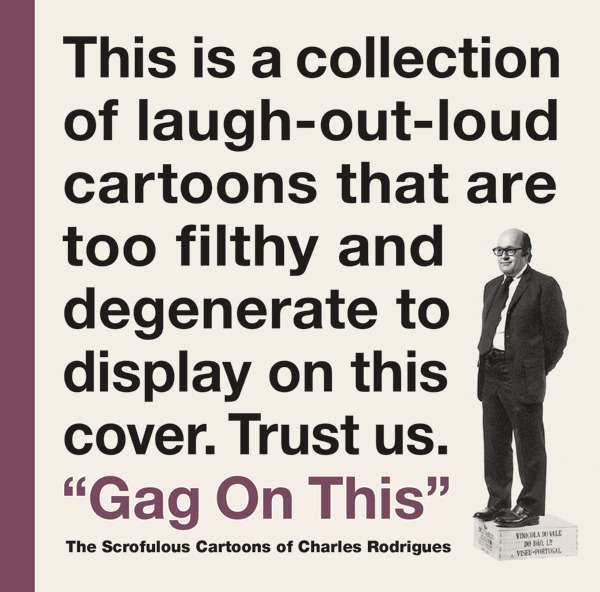
Charles Rodrigues, "Gag On This" (2/1)

A companion volume to the earlier Ray and Joe (which collected Rodrigues's longer continuity strips from National Lampoon), with a whole lot of single-panel gag cartoons of varying degrees of scabrousness. Actually, those degrees vary from "quite" to "unpublishable," so adjust your scabrousness detector accordingly. Rodrigues was as cruel and heartless and vicious in creating jokes as S. Gross or John Callahan -- more so, even, I'd say -- so keep that in mind. If nothing in this book offends you, there's probably nothing in the world that could.

Alexandra Lydon and Laura Kindred, eds., Worst Laid Plans (2/3)

This is the physical manifestation of a live show created by the Upright Citizens Brigade -- or, more accurately, an extension of that show into the print medium. Each contributor writes up the worst sex story that happened to him or (mostly) her, for humorous effect.

It is mostly funny rather than sexy, because bad sex is not generally arousing to most people. It could make a bathroom book in a household that doesn't have teenage boys in it -- it wasn't in my house, for that reason -- or a quick read some day you need to realize viscerally that other people have it worse than you do.

Charles M. Schulz, The Complete Peanuts, 1993 to 1994 (2/9)

Two more years of late-period Schulz, with all of the strengths and weaknesses thereof. (I've already written about most of these collections -- 1957-1958, 1959-1960, 1961-1962, 1963-1964, 1965-1966, 1967-1968, 1969-1970, 1971-1972, 1973-1974, 1975-1976, 1977-1978, 1979-1980, 1981-1982, 1983-1984, 1985-1986, 1987-1988, 1989-1990 -- and so I find myself without anything particularly new to say at this point. I might rouse myself when we hit the very end, or the promised extra volume after the end that will collect odds and ends and L'il Folks. [2] We'll see then, I suppose.

P.G. Wodehouse, Performing Flea (2/10)

Wodehouse -- author of the Jeeves & Wooster trifles, the Blandings Castle stories, the tales of Uncle Fred, the exploits of Psmith, and many other things -- never wrote a formal autobiography. But his old school chum William Townend, who was also a novelist, collected letters Wodehouse wrote to him over a 30-plus year span and collected them in this book, published in 1953. It covers the height of Wodehouse's career from the beginning of the twenties -- when he'd been a working writer for twenty years already, mind you -- and runs to the year before publication (thus leaving out the last twenty years of Wodehouse's life; he had a very long and busy career). It also has Wodehouse's diary of his internment during WWII, which turned out badly for him after he made a couple of humorous broadcasts from Berlin. This is for the more devoted Wodehouse fan, obviously, but it's a nice life, or partial life, in letters.

Kyle Baker, Why I Hate Saturn (2/11)

A great, great book I used to have before the flood. I can't do any better than quote what I wrote about it here in 2006:
I can't tell you what an effect this had on my friends and I when it came out in 1990. Sure, there had been "good comics" before, like Maus and Watchmen, but those were generally serialized beforehand. And most of them were extensions of the usual comic-booky ideas (even Maus, with its sly Mickey-Mouseness). Why I Hate Saturn appeared simply as a book, and it was clearly a graphic novel -- a single story, told in comics form -- that had nothing to do with the usual four-color world. It was funny, it was touching, it was real. There are damn few great pure graphic novels out there, and this is the first one I found. I don't know if it will strike readers today the way it did me, but I can't doubt that it's still a wonderful story, told just the right way by a master.

Jason Shiga, Bookhunter (2/12)

Another book I re-bought, and re-read, in the wake of the 2011 flood. I guess having most of your books destroyed is a good excuse to buy and read some of your favorites again? Not the way I would have preferred to do it, though.

See my review from the first time around.

Shannon Wheeler, I Don't Get It (2/16)

Wheeler is most famous as the creator of Too Much Coffee Man, and, not incidentally, is in possession of the single greatest last name possible. (I won't allow any argument on this point.) So I want to follow his stuff when I remember, though I remember not nearly as often as I should.

Wheeler has been working as a New Yorker style single-panel gag cartoonist -- yes, just exactly as that market is contracting to the New Yorker and almost nothing else in the world; we Wheelers are famously quixotic -- and I think he's pretty darn good at it. Of course, he would be, being a Wheeler. This is a small-format collection of a hundred or so of those cartoons. It's divided into the traditional stages of grief -- Denial, Anger, Bargaining, Depression, and Acceptance -- which I literally realized only now while typing this. So this Wheeler is a sneaky one -- keep your eye on him. (And the best way to do that is to buy his books.)
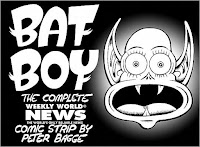
Peter Bagge, Bat Boy (2/17)

One of the biggest potential dangers of working at home out of your own head all of the time is becoming a crank from lack of interaction with normal people on a regular basis. Plenty of cartoonists fall somewhere on that spectrum, particular the more auteur types -- Dave Sim is the type specimen. Peter Bagge isn't that far along, but he definitely has tendencies in that direction and hobbyhorses that he will ride off into the sunset at the slightest provocation.

So it's great to see him doing work that's not out of his own head, that forces him to engage with outside ideas and turn them into fiction. Even if those ideas are bizarre and stupid, frankly.

Which brings us to Bat Boy, which is nutty and manic in the style of Hate-era Bagge -- maybe because it's from 2004 and '05, closer to the Hate era than now, or maybe because it's from the Weekly World News, the nuttiest, most manic newspaper imaginable. It's set in the world that WWN reported on, which is only very vaguely like our own, though it's ostensibly real. And the main character, obviously, is their mascot, Bat Boy, a boy who is a bat. He gets into all kinds of international and domestic intrigue, in weekly installments, along with a bewildering cast of oddballs, politicians, celebrities, and nuts. This isn't Bagge trying to be serious in any way, and is wonderful precisely because of that.

Jessica Mitford, Hons and Rebels (2/17)

The famous memoir by the fifth of the six famous Mitford sisters of the interwar years -- she was the Communist, as opposed to her sister Unity the Nazi and her sister Nancy the satiric novelist -- about her childhood. Jessica was thirteen years younger than Nancy (and ten younger than Pamela, the #2 sibling), so she writes of a time when their famously choleric father had settled down somewhat.

And, actually, this is more the story of young woman Jessica Mitford than about the crazy Mitford house in her childhood; she grows herself up fairly quickly and spends most of the book on the few years before the war and how she met and married her first husband (also her cousin, in that very aristocratic British way). So Hons and Rebels is really the story of the young woman who ran off to America, turned Communist, and eventually wrote The American Way of Death. I don't believe there is a better first-hand account of the fascinating childhoods of the Mitford sisters -- the best book on that is probably a collection of letters or group biography. (And I may try to figure out what that best book is, someday.)

Marc Hempel, A Gregory Treasury, Vol. 1 (2/18)

See immediately below.

Marc Hempel, A Gregory Treasury, Vol. 2 (2/22)

The original four large-format graphic novels from the late, lamented Piranha Press line -- seriously, was there anything under that imprint that wasn't wonderful in some way? were collected a decade later in two mass-market-paperback sized volumes, maybe to cash in on the manga craze or maybe just because that format seemed like a good idea at the time. (It's a nice portable format, I'll give it that, but "portable" is often at odds to "readable" when it comes to comics paperbacks -- luckily, this is fine, though I would have preferred the original larger size.)

Gregory is a small person -- maybe a child, maybe a grown man who is just very short -- who lives in what is obviously an insane asylum and who is timid, uncommunicative, manic, pensive, and scared in nearly equal measure. Oh, and there's a talking rat who's his best friend, in between getting killed. The Gregory books were the second-best Piranha titles about philosophy, after only Epicurus the Sage, and they might have been first if they were really about philosophy. They're funny and thoughtful and quirky and wonderful -- and I wish Hempel had had more opportunity to do similar things since. (His TUG & buster was in a similar vein, I guess, but that ended before the '90s did, and I don't think he's had a chance to work in that same vein this century.)

Rick Geary, Murder at the Hollywood Hotel (2/24)

Geary's most recent Kickstarted book is slightly out of his usual style -- it's presented like a storybook or coloring book, with large images on each page and a line or two of narration below. But it's a story of murder a hundred years ago, which is as Geary as you can get.

A young man leaves Kansas -- it's nearly always Kansas, with Geary, since he came from there himself -- to make his fortune in Hollywood in 1915, and settles into a hotel full of other wanna-bes and also-ises. Then there's a murder, of course.

I love Geary's lovely just-this-side-of-naif narration, and his gorgeous precise lines, and this book showcases both of those very well.

Rick Geary, The Lampoon Years: 1979-1992 (2/25)

Oh, I'll roll this in with the next one.

Rick Geary's Book of Murder (2/26)

That Kickstarter had a reward tier that included these two books that Geary published himself, so I plunked down my shekels. (I like current Geary, but I also like the Geary of the '80s, all surreal short stories and inexplicable occurrences and whimsy tinged with nastiness.)

Book of Murder collects stories from 1977 through 2008, some of which appeared in Geary's first two, long-out-of-print collections and many of which are newer than those books. And, obviously, these are all about various murders -- though often obliquely, as in the four portraits that make up the first story, "Wichita Murder Houses" -- in one way or another, like so much of Geary's work.

Lampoon Years is mostly or entirely single-page strips, in that surreal early Geary style, which all originally appeared in the National Lampoon during the years on the cover. Geary was too young to work for NatLamp during its heyday, but he was one of the best things in the dwindling and dying NatLamp of the '80s. These strips might be a bit weird for fans of Geary the straightforward chronicler of historical murder, but I miss the whimsical Geary, so it was great to wallow in that world again for a while.

Neil Gaiman and J.H. Williams III, The Sandman: Overture (2/29)

When an author goes back to one of his most famous works for a 25th Anniversary story, no one actually expects it will be good. We're all hoping for "not embarrassing," particularly when the original story ended, with great finality, almost twenty years before. So it's a bit difficult to express just how impressive Sandman Overture is.

It not only lives up to the original run of Sandman, but extends and amplifies that story (or those stories, if you prefer), providing a new frame to an existing work of art that throws the things we thought we knew into a different relief and casts pools of light in directions we didn't realize were there.

I'm not going to actually review this book; it's too late to do that. But I will say I was hugely impressed by it, and very happy to know that the late sequel can be something new and wonderful.


Endnote: I'm typing these words about a week later, on June 4th. (My birthday -- whoopie.) I make no promises, but I think I can keep up this pace -- clearing out an old month in a week or two -- and be "caught up" by sometime in July, when I can see if there's anything I particularly want to do with this blog. (Probably not: I've never been one to plan deeply, except for "let's read something every day for a set amount of time.")

[1] I am in danger into turning into the book-review Donald J. Trump, frankly.

[2] There was a blog post on that site the other Andrew Wheeler runs that called the 1999-2000 volume "penultimate," saying there would be one more book after that with the odds & sods. But there's now a description of 1999-2000 online -- it was published a few weeks ago, but I haven't seen it in person -- that says that book includes L'il Folks. So I'm not sure if the fabled extra volume will actually exist, or what might be in it if it does.

Tuesday, October 16, 2018

Book-A-Day 2018 #289: Chester & Grace: The Adirondack Murder by Rick Geary

Rick Geary is back, with a new book about a historical murder -- one that was the basis for Theodore Dreiser's An American Tragedy and a couple of classic movies.

But this is not a new book in the Treasury of Victorian Murder, or in the Treasury of XXth Century Murder -- it's one of the smaller one-off books that Geary has been publishing himself and promoting on Kickstarter, following The Elwell Enigma, The Story of the Lincoln County War, The Death of Billy the Kid, and Murder at the Hollywood Hotel. (And the even weirder The Secret Door at the White House, which, usually for Geary, is not about murder at all.)

So you won't find it in a bookstore; your best way to get it has already closed, since the Kickstarter campaign obviously ended a while ago. (It may turn up in his online store soon, but it's not there yet.)

Well, maybe I should take that "one-off" comment back: Chester & Grace: The Adirondack Mystery does proclaim itself to be the first in yet another series of Geary books about famous murders, the "Little Murder Library." I'm not sure if this means anything is changing with the other series, if he's now branding the things I'm calling "one-offs," or if it actually is yet another new series of historical murder stories from Geary. As with so many other things in the world, we will see what we will see. [1]

One July day in 1906, a young couple rent a rowboat at Hotel Glenmore on Big Moose Lake in upstate New York. They don't return that night, and a search eventually turns up the woman's body. She is identified as Grace Brown, an unmarried woman from Cortland (downstate). She was also pregnant. The man is believed to be her boyfriend, Chester Gillette, and he is soon found, identified as the man at Hotel Glenmore, and put on trial for Grace's murder.

Chester, of course, denies that he killed her, though his story changes somewhat. At first he denies ever being there, but eventually claims that she was distraught and threw herself out of the boat. And that he tried to save her, but it was in vain, and he couldn't even find her body and was so distraught by grief he just started walking in the wrong direction for several days.

The jury and judge do not find this convincing. Chester sees justice, in the usual way of the time: fried in the electric chair in 1908.

Geary is an old hand at telling these stories, and does it well here. He's working with softer colors than usual this time, possibly some kind of colored pencils or art crayons. But his precise lines and detailed schematics are the same as ever, and he has a knack for faces that are both subtly expressive and period-appropriate. As with the other self-published books, the text is set in a large, bold font as captions and text around his illustrations -- this is slightly less "comics" than his books about murder in the NBM-published series are.


[1] ObBadMovieQuote: "Future events like these will affect you...in the future!"

Thursday, October 01, 2009

Read in September

Looking at my posts for the past month, I see that I've neglected to review/mention a whole lot of these. I suppose a massive lassitude descended on me in the aftermath of "James Bond Daily;" that tends to happen when I finish up one of my bizarre reading projects. But let's see if I can't catch up, either here or elsewhere, on those other books that I've read recently.

As always, title links alone go to my review of a book, and links above my quick thoughts about that book go to that giant Internet bookseller, for more opinions or a chance to buy the thing yourself.
  • Yuji Iwahara, Cat Paradise, Vol. 1 (9/1)
  • Hosana Tanaka, Ninja Girls, Vol. 1 (9/2)
  • Donald E. Westlake, Get Real (9/2)
  • Julia Wertz, The Fart Party, Vol. 2 (9/3)
    I reviewed the first collection of Julia Wertz's rudely engrossing webcomic for ComicMix last year, and this book collects another big chunk of it. It's pretty much the same kind of stuff -- Wertz is a bit like a less self-consciously artsy Julie Doucet, with a shorter-story, webcomics ethos, and she tells stories about her own day-to-day life and troubles, mostly -- though this book sees her making the big move to Brooklyn and has fewer "my horrible day waitressing" strips.
  • Rick Geary, The Adventures Of Blanche (9/4)
    I'd been thinking about doing a "real review" of this book, but I saw it several months late to begin with, and I'm beginning to believe that I don't have anything much to say about it. Blanche collects three one-shots -- in which the title character goes to New York, Hollywood, and Paris in 1907, 1915, and 1921, respectively -- from 1992, 1993, and 2001. The Blanche stories have the casual frivolity, loose-limbed plotting, and anything-can-happen atmosphere of Geary's earlier, shorter stories, and it was a real treat to have that kind of Geary story back again. We've mostly seen the serious Geary over the past couple of decades, as he worked at the Treasury of Victorian Murder, so it's wonderful to be reminded just how silly and funny he can be. Blanche isn't as oddball and bizarre as Geary's early gag strips -- try to hunt down At Home With Rick Geary, or Housebound, for those -- but it does see him using that sense of humor in support of a more defined story, and indulging his love for period detail without having to have a historical murder at the center. This book is frivolous, but in the best possible way.
  • Melissa Marr & Xian Nu Studio, Wicked Lovely: Desert Tales: Sanctuary, Vol. 1 (9/8)
  • Christopher Buckley, Losing Mum and Pup (9/8)
  • David Mazzucchelli, Asterios Polyp (9/8)
  • Yuki Sato, Yokai Doctor, Vol. 1 (9/9)
  • Atsushi Suzumi, Amefurashi: The Rain Goddess, Vol. 1 (9/10)
  • Bryan Lee O'Malley, Scott Pilgrim, Vol 4: Scott Pilgrim Gets It Together (9/11)
    I've been catching up on this series, about a book a month, for the mid-part of this year, and I'm now only one book behind. There's something fresh and exciting about these books -- particularly in the casual way that they mash-up the various spaces inside and outside the skulls of their young protagonists -- but others have written a lot about that already, and I haven't managed to articulate yet what I find really interesting and fresh about O'Malley's work. But I'm still enjoying this tremendously, and I'll be looking for Volume Five the next time I'm in a comics shop -- and that's probably the highest recommendation I can give; that I'll be actively looking to spend my own money on something.
  • Robert Silverberg, Other Spaces, Other Times (9/11)
  • Seth, George Sprott: 1894-1975 (9/13)
  • Daniel Manus Pinkwater, Fat Men From Space (9/13)
    I probably would have found this thin and unsatisfying if I'd read it on my own, but it was a wonderfully enjoyable experience to read it to my younger son over three nights in the middle of the month. Middle-grade books are hard to go back to as an adult; we get used to the more detailed descriptions of books for older people and lose the facility of creating entire worlds in our heads based on one carefully-worded sentence written right at a nine-year-old. I've re-read Pinkwater's young adult books with appreciation, but the ones for younger readers really need to be read with someone of the right age to make them sing. This is one of his best middle-grade books, and I hope someone -- or several someones -- will be inspired to introduce it to a smart and quirky third grader some time soon.
  • Roger Langridge, The Muppet Show Comic Book: Meet The Muppets (9/14)
    By all reasonable estimates, this book just should not work at all: in the first case, it's a licensed book, and we all know how those usually fare. Plus, it's an attempt to turn a puppet TV show -- an old one, too -- into a comic, which doesn't even make sense. Finally, Jim Henson has been dead nearly twenty years, and no one else has shown the care and grace he did in overseeing these characters. That's all true, but it's also all besides the point, because Langridge has managed -- through some sort of infernal pact, I expect -- to take what was best and most characteristic of the Muppet Show TV series from the late '70s and translate that into comics that are just as funny and touching and wonderful as those puppets manipulated by Henson and Oz and Goeltz and Hunt. I can't explain it, but Langridge did it. And if you ever liked those TV shows, this book is very much like four or five new shows from that era -- without the random guest stars -- unexpectedly popping up for your enjoyment. Meet the Muppets is appropriate for younger readers -- and the publisher, Boom!, seems to be aiming it mostly at them -- but it's not limited to them, and I expect many of the people who will like this best are those of around my age, those who saw the original Muppet Show on TV when they were kids themselves.
  • Jason, The Living and the Dead (9/15)
    Another short graphic novel by the Euro-cartoonist who only goes by one name -- I think he's Norwegian, but I don't feel like looking it up right at this moment -- this time with a dishwasher and a prostitute fighting off zombies. Reviews of Jason's comics use the word "deadpan" a lot; I'll note that and try not to use the word again -- even if it is the most obvious and apropos word to describe his work. I like his stuff, even if it is deliberately affectless most of the time. This one is really, really short though -- that Euro-album length that feels to Americans (at least to me, some of the time) like a slightly overgrown single issue of something. With that length and Jason's laconic, often wordless pages, The Living and the Dead reads amazingly quickly.
  • Danica Novgorodoff, Refresh, Refresh (9/16)
  • The Hernandez Brothers, Love and Rockets: New Stories, Vol. 2 (9/17)
  • Lev Grossman, The Magicians (9/17)
  • Neil Gaiman, Odd and the Frost Giants (9/17)
  • Adam Rapp & George O'Connor, Ball Peen Hammer (9/18)
  • Kage Baker, The Hotel Under the Sand (9/18)
  • Bill Watterson, The Complete Calvin and Hobbes, Vol. 3 (9/19)
    The third volume of the bug-crushingly complete reprinting of one of the finest newspaper strips of modern times got stuck under a pile of other things for a couple of year -- I have a lot of books that I want to read, and probably a couple of dozen things with bookmarks in them at any given time -- but I pulled it back out about a month ago, and finished it off a few pages every night before bed. I don't know if I have anything to say about this volume that I didn't say about books one or two, but the Calvin & Hobbes strip is still as wonderful and funny as it ever was. I could also mention that my two sons have gone through a big Calvin & Hobbes phase since then, though I probably should also mention that they still like Garfield better. (Who ever said eight-year-olds have great taste?)
  • Neil Kleid & Nicholas Cinquegrani, The Big Kahn (9/21)
  • Johnny Ryan, Prison Pit, Book One (9/22)
  • Justine Larbalestier, Liar (bound galleys) (9/22)
  • Joe Daly, The Red Monkey Double Happiness Book (9/23)
  • Bruce Paley & Carol Swain, Giraffes in My Hair: A Rock 'n' Roll Life (9/24)
  • Peter Sagal, The Book of Vice (9/26)
  • Lilli Carre, Tales of Woodsman Pete (9/28)
  • Nicolas Mahler, Lone Racer (9/29)
  • Scott Mills, Trenches (9/30)
  • Gail Carriger, Soulless (9/30)
And that's what I read this month. Reviews to come quickly for that big mass of linkless books at the end...at least I hope so.