


No new books, so let the winds of randomness waft us back to 2005. Here's what I was reading that week:
Kage Baker, Mother Aegypt (7/14)
This was a miscellaneous story collection - as I recall, it did have a Company story or three, but that wasn't the point of it - from one of my favorite writers of the Aughts, whose career was cut vastly shorter than it should have been. According to ISFDB, it (appropriately) has a baker's dozen stories in it, and according to Amazon, it's still available. Baker wrote great novels, but her short fiction, especially her novellas, are even better. (Many people, including me, have said that's the hallmark of the best speculative fiction writers: that they write great novellas.) So I recommend this, or The Best of Kage Baker, or any other story collection published during her too-short career.
Suzanne Lloyd, Harold Lloyd's Hollywood Nudes in 3-D! (7/15)
Holy crap! What a title, and what a book to forget it entirely existed! Yes, the Harold Lloyd, the silent film star. Yes, classy large nude photographs of young ladies - happy ones, as I recall, well-paid for the work - from the '40s through the '60s. And, yes, in 3-D, with glasses and all. And, to top it all off, yes, edited and assembled by his granddaughter, who has also produced a documentary on his more-famous pursuits. I don't remember it, and it was lost in the flood, which is a shame - this is something I would run over and pull out right now if I still owned it.
Bill Willingham, et. al., Fables, Vol. 5: The Mean Seasons (7/16)
In this era, I was really bad at listing the full credits on comics, even though that "et. al." mostly means "Mark Buckingham." I mean there are the James Jean covers, and I'm sure someone colored it, but the Amazon listing is just Willingham/Buckingham, so why couldn't I have done the same? Truly, our past selves contrive to disappoint us again and again.
This was fairly early in the fantasy-characters-in-the-real-world series, and followed up the prior book's major attack on Fabletown (the NYC pocket neighborhood where most of the characters lived at that point) with a couple of flashback stories to "Bigby" Wolf during WWII. I'm getting this from other people's plot synopses, mind you: those details are vaguely familiar once I see them, but I couldn't tell you unaided what happened in, say, Vol. 7.
Allen M. Steele, Coyote Frontier (7/17)
Third in an alien-world trilogy by a dependably meat-and-potatoes SF writer. Is that faint praise? I thought Steele was always readable, usually a lot of fun, and occasionally - especially in some of his better short fiction - really strong. There were dozens of writers whose work I read semi-regularly in the SFBC days that I would not give that much praise to.
I don't remember this series well, but I enjoyed it at the time. I think it had the inherent trilogy problems: the first book was the best and most original, and the latter books mostly worked up variations on the American-frontier-in-SPAAAACE! idea.
Robert Holdstock, Mythago Wood (7/19)
Not sure why I was reading this: possibly as a potential Special Collector's Issue book for SFBC (we did two magazines of all "classics" twice a year in those days, and I put "classics" in quotes because we made up the definition as best suited us at that moment, though it usually did include some decade-old stuff) or possibly just for my own entertainment and to read backward in the field. Mythago was a winner of the World Fantasy Award for Novel in 1985, and I do periodically threaten to read all of those, so that could be it.
This is a well-known, excellent novel that starts somewhat thornily and has an odd central conceit: there's this one ancient wood, somewhere in Britain, and all the mythic stuff that matters comes from there and lives there. I liked it, but it didn't send me to read more Holdstock, so perhaps I didn't like it as much as I might have.
I will note that I was tempted to start this list a day early, since on the 12th I read the utterly unlikely combo of Tom Perrotta's story collection Bad Haircut and Toni Bentley's paen to being taken anally, The Surrender. But I don't think I actually have anything to say about either of them: I was running through all of Perrotta, and don't remember that book at all. And the Bentley was a big deal that year, selling very well for the clubs, and I am not without prurient interest, particularly when said prurient interest is lying about the office in stacks of bound copies.
The latter did eventually lead to a very early post on this blog. That past self is also mildly disappointing, though the post is not quite as cringeworthy as I thought it would be.


 -- I'm still not sure if I will re-read these, but I now just need two or three of them.
 by P.G. Wodehouse, in the wonderful Overlook edition, which I'm trying once again to collect (I lost fifty or so of them in the 2011 flood, and am back to around forty at this point -- but Overlook is closing in on having published all of Wodehouse's roughly hundred books by now.) This, I believe, is a collection of stories all concerning Stanley Featherstonehaugh Ukridge, who is one of Wodehouse's lesser-known great comic creations. And I'm sure there will come a time when I'll need it to lift my spirits.
 and its lesser-known sequel
  .
.
 , edited by Maxime Valette, Guillaume Passaglia, and Didier Guedj. (Yes, F My Life was originally French -- with a title that roughly translates to "the Shit Life" -- and only came to the English language after a first initial success there. The things you learn from quirky little books.)
 , which was her second memoir/collection of essays. She's an interesting figure anyways, and I also want to understand my older son better -- he's "on the spectrum," as they say, though exactly where is a fuzzier thing.
 . I may end up back in the fields of mass-market publishing, soon or eventually, and that kind of thing has always fascinated me: why do so many people decide they want this, right now?
 , from Christopher Miller. I heard about this somewhere and knew I had to have it: I love weird encylopedias, the quirky side of history, and humor.
 , from 1989. If you're a SF or science person, you've seen his work many times -- you may even have a Harris up on the door of your office right now.
 , by George R.R. Martin with Elio M. Garcia, Jr. and Linda Antonsson. Since I'm not commuting at the moment, if I can ever make myself sit down and read, I'd be able to sit down and read this big thing. And I'm always fond of fake nonfiction, which this more-or-less is. (I think there's some actual fiction in there, too.) [1]

 by Tatsuya Ishida. Yes, it's all online, and there's no reasonable chance the whole series will ever be collected in book form. But sometimes I just want things between two covers, OK?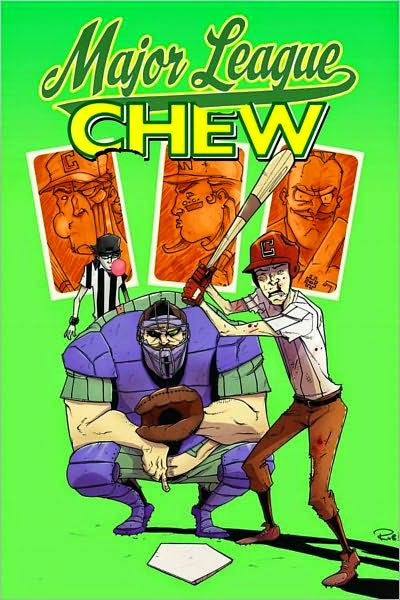
 by John Layman and Rob Guillory -- I think I now have three of these lined up, so I might run through them quickly and write one post. (Or run through them slowly or quickly and bury them in an end-of-month roundup: could go either way.)
 -- the 1997 Kitchen Sink edition that's the only time the first ten color issues of the series were collected, and what looks like the only time they ever will be collected. (Seriously, they're not vastly different from the later black and white issues -- they're not training-wheel comics or anything.) Another book I'm very glad to have back in my hands.
 -- I'm not even sure what this is, or how it fits it, but I'll give it a try
 &
& 
 &
&  -- I'm now missing 7, oh woe is me
 , by Moore (here laughably credited as "The Original Writer") with artists Alan Davis, Rick Veitch, Chuck Adams, and John Ridgway. It's still one of the better arguments that it's possible to take superheroes seriously.
 is one of the great graphic novels of our time, though I don't see it mentioned with Blankets or Ghost World or Bottomless Bellybutton all that often. (It did win the Eisner for Best GN for Nate Powell in 2009 though, which is something.) I had a rough galley before the flood -- I
 , though I couldn't tell you where or when. But it's a horizontally-formatted book, collecting what was oriignally a webcomic, and with any luck I'll read it soon.
 , with the first seven issues, and
  , collecting up to #16 -- which is a shame, since only one more would finish off the original series. (And another one would collect the mini-series, and two more would get all of War Shaman between covers. Heck, as long as I'm wishing, how about a world where Truman either can now do Marauder and Blue Leader, or one where he got to them around 1990ish?) Well, at least these two books exist, and I have them now.
 , the beginning of the latest spin-off from Bill Willingham's Fables series. (This one was written by Willingham with Matthew Sturges with pencil art mostly by Phil Jimenez and inks more often than not from Andy Lanning.) I'm not really sure what angle this takes from the original, but I do want to catch up on this and Fables, though I'm clearly already missing the big finish.