Tuesday, April 06, 2010

Your 2010 Clarke Award Nominees

I'm trying to get back into the habit of posting SFnal awards news and commentary; I seem to have inadvertently gafiated (or nearly done so) while I wasn't paying attention. There were a big flurry this past weekend, so I'm running late on them.

First is the Arthur C. Clarke Award for the best Science Fiction novel of the year published in the UK; this year's nominees are:
  • Spirit - Gwyneth Jones (Gollancz)
  • The City & The City - China MiĂ©ville (Macmillan)
  • Yellow Blue Tibia - Adam Roberts (Gollancz)
  • Galileo's Dream - Kim Stanley Robinson (HarperCollins)
  • Far North - Marcel Theroux (Faber & Faber)
  • Retribution Falls - Chris Wooding (Gollancz)

The Clarke is a judged award, which partially explains why it has a tropism to the literary and lesser-known; this year's judges were Chris Hill and Jon Courtenay Grimwood ( for the British Science Fiction Association), Francis Spufford and Rhiannon Lassiter (for the Science Fiction Foundation) and Paul Skevington (for the science fiction news website SFCrowsnest.com).

As usual with the Clarke, it's an eclectic mix, including several books that haven't been published in the US yet (and might not make it here any time soon, if ever). I won't try to handicap it, since I've only read one of the books so far (the Mieville), and was not overly impressed by that.

Book-A-Day 2010 # 62 (4/6) -- Horns by Joe Hill

It's a tough job, being a devil. Nobody appreciates the hard work you do, and unless your cosmology is particularly Manichean, you're destined to lose badly in the end. No one would decide to become a devil deliberately, right? But that's the thing about being a devil -- you just fall into it.

Ignatius Perrish never thought that he'd know what being a devil was like -- he was a straight-arrow kid from a good family, destined for a do-gooder job -- but then everything went to hell for him a year ago. His girlfriend Merrin Williams broke up with him just hours before he was about to fly to London for his new job...and then was found dead, brutally raped and murdered, later that night. Everyone assumed that Ig did it, but he was never charged after a screw-up with the DNA evidence at a state lab. The job evaporated, of course. And Ig was left in a small New Hampshire town with people who've known him his whole life -- and all believe, completely, that he's gotten away with murder.

But Horns opens a year after Merrin's death, when things have just gotten even worse for Ig. After a drunken night -- the details of which he can't remember at all -- he wakes up with a splitting headache. And what's splitting his head most are two finger-sized horns rising up from his temples. He soon figures out that it's not a hallucination and that the horns are real. They've also given him an unsettling new power: everyone he meets is compelled to tell him their darkest, most unpleasant secrets and thoughts, especially those concerning him. And no matter who he runs into -- from his new girlfriend Glenna Nicholson to the staff at a medical clinic to the local police to his own rich and sophisticated family -- those secrets are horrible and toxic, and they all are absolutely sure that Ig killed Merrin.

But if there's one thing in the world that Ig knows for sure -- and it just might be down to that, at this point -- it's that he didn't do it. He ran away, distraught, and slept in his car out in the middle of nowhere, while someone else killed the only woman he'd ever love. And that man is still out there.

The horns give Ig power, but it's a nasty, corrosive power -- the kind that turns a man into a devil. He can learn everything about a person by touching them, and everyone is full of hate and fear and deceit. And he can influence people's actions -- but only to make them do the things they tell themselves that they shouldn't. And so Ig can't even find the time and mental calm to use his new powers to solve Merrin's murder; he's just riding the tidal wave of everyone's disgust and rage, trying desperately not to be crushed by it.

That's what the plot of Horns would be, if it moved entirely forward. But Hill embeds long flashbacks along the way, like jagged rocks in the narrative flow: the first, "Cherry," is the second section of the novel, and breaks the headlong energy of the first sixty pages to spend the next sixty explaining how Ig met Merrin and his best friend, Lee Tourneau, when they were all young teenagers, about fifteen years before. None of the other flashbacks are as long or as disruptive, but the pattern is set -- as much as Horns moves forward, it moves backwards as well, usually closely following Ig's touching someone new and learning more horrible secrets.

(Horns is structured into several sections, each exactly ten chapters long -- but those chapters are radically different lengths, and there's no obvious rationale for the different sections, as one is itself a complete flashback, and then later sections incorporate smaller flashbacks within them. It feels as if there may have been a more tightly structured novel struggling to break out of Horns -- or as if it originally was much more structured, and didn't entirely break out of that.)

Those flashbacks take the focus off of Ig, and specifically off Ig's horns -- the ostensible center of the novel. And, somewhere along the way, the reader starts to think that Ig isn't all that interesting as a devil -- all of his demons are external, and his personality comes into focus as a fairly generic wimpy "nice guy" -- and that Lee is a far more interesting and compelling figure. (For a horror novel, that is: I'd walk a mile or so out of my way to steer clear of him.)

Hill does gain some of that momentum back in the last quarter of the novel, once Ig gives up on his old life and gives in to the horns, but Horns is a stuttering horror novel, one that bounces around theological ideas but only sets them free at the very end and that constructs a too-pat, and too-tight, supernatural universe to constrain its action. The end of the novel in particular implies a lot of things about the world that Hill could have done glorious things with earlier in the book, if he wasn't preoccupied with sad-sack Ig and his mopey love for poor dead Merrin.

Of course, Horns is a second novel, after Hill's amazingly creepy Heart-Shaped Box (and his even better story collection 20th Century Ghosts); it's a cliche that sophomore efforts are disappointing. And Horns is only really disappointing compared to Heart-Shaped Box and his strongest stories (such as "Voluntary Committal" and "Best New Horror"); it's a solidly bracing and thrilling horror novel with a killer opening and a great punch at the end. If the middle meanders a bit; well, nobody's perfect, right?

Book-A-Day 2010: The Epic Index
----------------
Listening to: Harley Poe - What's a Devil To Do?
via FoxyTunes

Monday, April 05, 2010

A Belated Realization

I really have to start blogging -- on whatever I have at hand -- as soon as I sit down in front of this computer at home, or else I'll just fritter my time away doing a dozen other things at the keyboard.

Lately, I've been engaging in the Blogger's Sin much too heavily -- re-reading old posts of mine and chortling at how funny and smart that guy was. It's the writing equivalent of peeing on your own leg -- sure, it makes you feel warm briefly, but all the other effects are unpleasant.

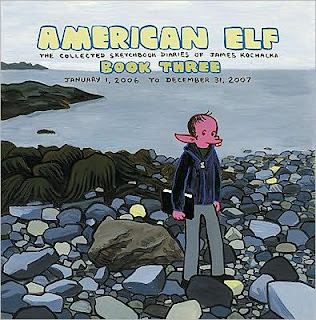
Book-A-Day 2010 # 61 (4/5) -- American Elf, Book Three by James Kochalka

James Kochalka, like so many people, keeps a diary. Unlike most of them, he keeps it in public. And, almost uniquely, he does it in comics form -- generally a four-panel strip every single day. (Even more impressively, I just realized he's been doing it -- again, every single day -- since October of 1998. I'm not completely sure I've managed to sleep and eat every day since 1998, and Kochalka's done a comic all of those days.) This, as the title probably clued you in, is the third collection of that daily strip, covering the years 2006 and 2007 from beginning to end.

American Elf has the ordinariness of a good diary: it focuses mostly on small moments and conversations, things that can be encompassed within four panels and not feel like an excerpt or a piece of something larger. And so the strip mixes up all of Kochalka's lives -- cartoonist (of this strip, of children's books, of other projects), rock star (selling a song to Fox for a TV theme, getting dropped by his record label, playing shows), family man (his second son, Oliver, is born towards the end of this book). Each strip stands alone, as that one moment, but they also tie together -- reading more and more of American Elf, we watch Kochalka's first son Eli start growing up, and eavesdrop on Kochalka's marriage. (Like any creator worth his salt working in an autobiographical mode, Kochalka comes across as absolutely fearless, willing to put any part of his life at all into his strips -- it may not be precisely true, but Kochalka makes us believe it.)

You can read American Elf on the web, day by day -- I certainly do, and I recommend it to anyone interested in comics about real lives -- but it gains depth and power from a collection, unlike so many other diaries and journals (in comics or prose). Which means I need to go back and get the first two collections -- this is one of the major works of comics autobiography of our time.

Book-A-Day 2010: The Epic Index
----------------
Listening to: Apache Beat - Your Powers Are Magic
via FoxyTunes
 

Reviewing the Mail: Week of 4/3

There's only so many ways I can say the same old thing every week, so this time it's the speed version: these are the books that showed up in my mailbox last week. I haven't read them. But here's what I do know about them now:

Gene Luen Yang's new short graphic novel Prime Baby has the supremely satisfying (because it's true) line on the back cover: "As seen in the funny pages of The New York Times Magazine." (Admittedly, the Funny Pages seem to have disappeared after Prime Baby stopped, and the Times still doesn't have anything like a real comics section, but even a baby step is a step.) Prime Baby was the last of the graphic novels serialized there, though this one -- each episode a single strip of three or four panels -- looked much more like a traditional newspaper strip that its comics-page predecessors. First Second Books is publishing Prime Baby this month, at the ridiculously low price of $6.95. At that level, how can you not buy the new graphic novel by the author of American Born Chinese, I ask you?

Bitter Seeds is the first novel from Ian Tregillis, a physicist at Los Alamos who has also written for George R.R. Martin's Wild Cards superhero alternate-history series. From the first credential, you might expect an equation-filled wonkfest full of Orion drives, beautiful scientists' daughters who need to have the plot explained to them, and can-do spirit. Luckily, Bitter Seeds looks to draw much more heavily on Tregillis's other experience: it's the first novel in an expected series, a historical fantasy novel set during WWII. But this WWII has demon-summoning warlocks defending Britain from technologically-created Nazi superman. The concept is brilliantly exciting, and the writing looks strong as well. Bitter Seeds has quotes from Martin (which one might expect) and from Cory Doctorow (who writes a lot, but doesn't blurb very much at all -- let alone saying that a book "has a white-knuckle plot, beautiful descriptions, and complex characters). I also note that it's edited by Patrick Nielsen Hayden, whose taste I haven't managed to find fault with yet. It's coming from Tor in hardcover this month, and I expect a lot of people will be talking about it as one of the debut books of the year. (And I'm trying to figure out how quickly I can get to it myself.)

Ian McDonald's Ares Express -- a novel about railroads set on Mars, and the sequel to McDonald's first novel Desolation Road -- was published in 2001 in the UK, but has taken until now to finally reach the US in a native edition. (Though I imagine a fair number of those UK books are scattered around in the libraries of McDonald's fans.) Pyr is bringing it out in trade paperback, to match their edition of Desolation Road from last year, on the 13th -- so, if I know book-distribution systems, it's on its way to stores across the country already, and might even be in a few of them already. McDonald is a smart, interesting writer whom I haven't read nearly enough of -- though every McDonald book I have read was well worth the time.

Douglas Clegg's new novel is Neverland, which is either horror or "dark suspense," depending on your preference, and it's coming from Vanguard Press as a trade paperback next week. A group of kids on a family vacation discover an old shack in the woods and take it as their clubhouse -- and, before long, discover they're not the first ones to use that shack. This looks to be supernatural horror -- the flap copy talks about the children worshipping "a creature of shadows...called 'Lucy'" -- rather than the more mundane kind, so those who like their stories of childhood to have intrusions of extra-dimensional entities will want to take a look at Neverland.

Pyr continues its quick-fire publication of Adrian Tchaikovsky's "Shadows of the Apt" epic fantasy series with a second book, Dragonfly Falling, coming a mere month after the first, Empire in Black and Gold. It's got another kick-ass Jon Sullivan cover, hitting a new high of photo-realism and having a woman who actually wears armor that protects her (reasonable people can differ on the usefulness of all the spiky bits, which I suspect might poke the wearer at unfortunate times). Dragonfly Falling will be in stores a week from tomorrow, and it looks like the third book, Blood of the Mantis, will be coming quickly as well -- so epic fantasy fans will want to dive right in here.

Also from Pyr this month is George Mann's novel Ghosts of Manhattan, a steampunk superhero story set in 1920's New York. It's expected to turn into a series, for all of your steampunk-lovers out there.

And last for this week is a blast from the past: Yoshihiro Tatsumi's Black Blizzard, a thriller that was his first published graphic novel back in 1956. Tatsumi, of course, is the author of a magnificent sequence of shorter realistic stories -- some of them collected in English as The Push Man and Other Stories, Abandon the Old in Tokyo, and Good-Bye -- from the late '60s and early '70s, as well as the massive comics autobiography A Drifting Life. Drawn & Quarterly are taking an interesting path in bringing Tatsumi to North American audiences: instead of continuing the Push Man sequence with more collections of shorter work, they jumped to the later Drifting Life, and then all the way back to this book. Presumably, they're trying to show the bredth of his work as quickly as possible, and -- given the incredible strength of the Tatsumi books we've seen so far (my reviews of them can be read elsewhere) -- I have to applaud the effort. Black Blizzard will be available this month.
----------------
Listening to: The Teenagers - Starlett Johansson
via FoxyTunes

Sunday, April 04, 2010

My New Favorite Picture

Because it just says it all.

Book-A-Day 2010 # 60 (4/4) -- A Home for Mr. Easter by Brooke A. Allen

When this book showed up on my doorstep just over a week ago, I knew that it had to be today's Book-A-Day. And now it is.

This is Brooke Allen's very first full-length comics work; she's actually still a student in the comic art program at the Savannah College of Art and Design. For all I know, she may have several dozen stories scattered across anthologies, but I don't think so; I think this is her big debut, and finishing a two-hundred-page solo graphic novel is a huge accomplishment for anyone, let alone a full-time student.

More important than the bare fact that it exists, though, is that A Home for Mr. Easter is a rambunctious romp, goofy fun from a new talent who's good at honest-to-God cartooning, who clearly loves distorted body shapes, thumpingly physical action, and characters whose dialogue is just as odd as their looks. (And their looks are pretty dark odd.)

Tesana is a rather large teenage girl in some dumpy city somewhere: she clearly has had a lot of practice in keeping her temper, and keeping herself to herself, in the face of hostility from her schoolmates. (Not to mention her mother...which I'll try not to do.) Tesana has the sweetness of a big tough loner -- more buried than on her sleeve, but it's there.

But then, while trying to help out with decorations for a school pep rally, she discovers that a little white rabbit (with an "8" on his backside) can lay colored eggs. She decides, in that unshakable way large (and assumed to be slightly dim) characters do in stories like this, that she will return the bunny, which she has named Mr. Easter, to his home.

Of course that's not nearly as easy as it sounds, and soon Tesana is running at high speed into the woods, pursued by a very motley and bizarre array of rabbit-hunters, from an evil pet-shop owner to his nerdy scientist brother, from a creepy magician to a pack of animal-rights activists. Luckily, Mr. Easter can talk -- and his eggs have their own powers, as well. Even better, Tesana is a human bulldozer, and she's not going to stop until she does what she says she will.

A Home for Mr. Easter is somewhat rough in spots, and its plot is mostly of the one-damn-thing-after-another school. But it has an undeniable electricity, from Allen's energetic and appealing lines to her slangy, funny dialogue to that deeply weird plot that nevertheless comes across as utterly believable. It's the story of one girl and her rabbit, and the vast hordes that try to stop them. It's quick and funny and exciting and just plain good comics. I can't wait to see what she does for Christmas!

Book-A-Day 2010: The Epic Index
----------------
Listening to: Dragonette - Jesus Doesn't Love Me
via FoxyTunes
 

Saturday, April 03, 2010

Book-A-Day 2010 # 59 (4/3) -- Batman: Year 100 by Paul Pope

Are there any Batman stories that haven't been told yet? Now, that might not be a fair question -- the same story can be retold differently, as The Odyssey became Ulysses -- but, honestly, is there anything new to do with Batman that isn't just set-dressing? Even Year 100, one of the best-reviewed and highly-awarded superhero stories of the past decade, from one of the most original and individual talents of our generation, is really just another running-on-rooftops, stopping-the-evil-plot story, drawing from a well that's provided the precise same elements a million times before.

Pope does draw a great Batman, sweaty and twitchy and ugly, and puts him into an equally engaging Gotham City, full of grungy subway tunnels and offices and, of course, those rooftops. And his 2039 is equally a lived-in future, full of old buildings as well as odd new technologies -- maybe too much of the old stuff, actually, since it looks like 1999, or 1979, or 1959, more than it even looks like today, let alone tomorrow.

But it is officially 2039 in this story, a world in which there's been a Batman for a hundred continuous years (in some way that the story doesn't want to explain). The central government, and its F.P.C. cops, run roughshod over citizens, local police, and all semblance of privacy. That is, they do so until Batman goes up against them. Luckily, Pope is still as unwilling to stoop to exposition as ever; we learn or infer everything important about this world as the story races forward. He never stops to have anyone explain anything, which is tremendously appealing. But that does mean that most of this story is unexplained: Batman is real, is Bruce Wayne, has helpers (a young man he calls Robin, a female doctor and her teenage computer-hacker daughter), and runs around Gotham by night, unknown to nearly everyone...but we don't know why or where or even much of how. It's a stripped-down vision of Batman, the original costumed vigilante distilled to his essence.

The story itself is pretty obvious, with its nasty government goons, a good cop named Gordon, and so on -- in fact, it's awfully close to Miller and Mazzuchelli's Year One, which it explicitly references several times. But, again, Pope isn't trying to tell a new Batman story -- he's retelling a standard Batman story his way, with his twisted bodies and battered faces, his sinuous curves and his thousand little lines. And he doesn't even want to tell all of this story: there's no backstory, besides that odd hundred year stretch of Batman, and the ending implies higher authorities that the story itself went to pains to deny. What Pope wanted to so was to put Batman into action -- rough, dangerous, physical action, with boots scraping and muscles straining, bodies flying through space to land with thumps and crashes -- in another Paul Pope milieu, another future that looks like a mid-century tenement district that miraculously escaped both gentrification and urban renewal, another set of crenelated rooftops, dark corridors, and fire escapes.

Year 100 won two Eisner Awards in 2007, presumably showing that Eisner voters like both Batman and Paul Pope-isms. It's an energetic piece of standard action comics rendered in an idiosyncratic style; there have been dozens of Batman stories at least this good, and Pope's other work also typically is this accomplished, if not more so. But this is a Reese's Cup of comics: the Batman chocolate might be cheap and streaky and the Pope peanut butter over-processed, but it punches two buttons at once, and that was enough.

Book-A-Day 2010: The Epic Index
----------------
Listening to: Nicole Atkins - The Way It Is
via FoxyTunes

Friday, April 02, 2010

Book-A-Day 2010 # 58 (4/2) -- Panic X Panic, Vol. 1 by Mika Kawamura

A great lassitude lies heavily on me tonight, preventing me from writing anything substantial about the three novels I've read recently, or even the half-a-nostalgic-superhero-story I read today. No, I have the kind of mood that means my Book-A-Day post will be a quick, desultory look at something I can feel entirely superior to -- a book that's purely a genre exercise. Don't say I didn't warn you....

If you judge entirely from manga, Japan is a nation entirely made up of secret gateways to hideous realms of demons, closed away and locked centuries ago and only kept so by the unstinting work of legions of devoted demon-fighters. And, for all I know, it could be true -- the closest I've ever been to Japan is Anaheim.

In Panic X Panic, the young rapscallions tasked with keeping the demons at bay are young Mitsuki and Kakeru. Her family runs a small shrine, and his a small church -- thus brilliantly trivializing two great religious traditions at once for the sake of a minor shojo comic. They've been friends -- in the fighting-with-each-other-all-the-time-because-that-shows-that-they're-destined-to-be-in-luuuuurve style -- since early childhood, and now appear to be in middle school. (Though the aggressively cutesy style, with occasional chibi influences, may be throwing off my Manga Character Age Detector somewhat.)

But then they learn about the inevitable demons, and that they need to work together to save the world, and...honestly, the demons aren't all that important -- this is a series for girls, not boys -- they're really just an excuse for these two to be stuck with each other and fight until they eventually fall helplessly in love. (In the same way that someone would fall helplessly into the Grand Canyon.)

Oh, and this book also has a short story about a young teen girl who dresses up like her sick brother to go karaoke-ing with his friends to find out "The Secrets of Boys." (Which aren't all that impressive, as anyone who ever was a boy could have told her. Still, at her age I would have cut off a finger to learn the equivalent secrets of girls, and those are equally unimpressive.)

All in all, for a girls' manga with an inexplicable title and deeply generic elements, Panic X Panic is cute and harmless, and far more pleasurable to read than I'm making it sound. It will not tax even one of your little gray cells, true. But how many comics will?

Book-A-Day 2010: The Epic Index
----------------
Listening to: Okkervil River - Another Radio Song
via FoxyTunes
 

Quote of the Week: The Rogue

"[Jose] Canseco has been described as a charmer and a clown, but in fact he is a rogue, a genuine one, and genuine rogues are rare, inside baseball and out. It's not enough to flout the law to be a rogue -- break promises, shirk responsibilities, cheat -- you must also, at least some of the time, and with the same abandon, do your best, play by the rules, keep faith with your creditors and dependents, obey orders, throw out the runner at home plate with a dead strike from deep right field. Above all, you must do these things, as you do their opposites, for no particular reason, because you feel like it or do no, because nothing matters, and everything's a joke, and nobody knows anything, and most of all, as Rhett Butler once codified for rogues everywhere, because you do not give a damn. One day you make that breathtaking play at the plat from deep right. Another day you decide for no good reason to come into the game during the late innings of a laugher and pitch, retiring the side (despite allowing three earned runs on three walks and a pair of singles) -- and forever ruining that cannon of an arm.

I've never seen a man who seems more comfortable than Jose Canseco with who he is -- not with who we think he is, like George W. Bush, or with his best idea of himself, like Bush's predecessor, but with himself, charmer and snake, clown and thoroughbred. He doesn't care what you think of him; if anything, he derives a hair more pleasure from your scorn and contumely than he does from your useless admiration. By coming forward as he did to peel back the nasty bandage on baseball's wound, it was not that Canseco had nothing to lose, as some of his critics claimed. A man like Canseco never has anything to lose or gain but his life and the pleasure he takes from it."
- Michael Chabon, "On Canseco," pp.147-148 of Manhood for Amateurs

Thursday, April 01, 2010

One Report Video

Here's another day-job video, which I hope you'll find at least mildly more interesting than you would most of the stuff I do at my day job. It's for the new book One Report, by two very smart, highly connected, and really passionate guys, about how corporate reporting should integrate all of the ancillary statements (environmental, human-impact, etc.) that a company also makes.

(So I'm posting it because I believe in what they're saying, because I'm proud of it, and because I still think being able to post videos here is neat.)

Apropos of Nothing in Particular

"Every normal man must be tempted at times to spit on his hands, hoist the black flag, and begin to slit throats."
- H.L. Mencken

A Most Auspicious Day

As usual, many people have saved up news of the most amazing and unlikely nature to post today, on the glorious First of April. Antick Musings is entirely in favor of such news, and, as we have done in past years, endeavors to link to as much of it as we can find, beginning with...
  • Charles Stross explains the genesis of his upcoming sparkly-unicorn romance series from Harlequin.
  • Jeff VanderMeer announces the hasty sequel to The Kosher Guide to Imaginary Animals -- The Goyim Guide to Tainted Meats -- which he will edit with Ann VanderMeer.
  • OF Blog of the Fallen's Larry announces his upcoming anthology: Squirrelpunk.
  • OF Blog of the Fallen also rounds up some apocryphal and unlikely news.
  • Orbit has harnessed the power of proton decay to create environmentally-friendly, carbon-neutral, self-destroying e-books.
  • SFWA reinstated their previous, much-loved, website.
  • Fantasy writer Steven Brust announces his retirement from writing to dive into the much more lucrative world of professional bingo.
  • ComicMix reports that DC is recalling the last issue of Blackest Night due to a production error that led to massive story changes.
  • Independent-bookstore newsletter Shelf Awareness's issue today contains several shocking stories, including a lead feature on the new Nazi-Communist-socialist-African-atheist-Islamist regime, a look at Apple's iPad accessories, and Borders' new two-for-one CEOs.
  • Locus magazine, as usual for early April, is ahead of the curve with stories on Google's new plan to digitize the Library of Alexandria, a list of author news from the first quarter of 2010, the new authorized sequel to Atlas Shrugged, and Tachyon's new make-a-genre contest.
  • I do not believe that the latest installment of Mike Sterling's amazing End of Civilization -- in which Sterling, a humble comic-shop manager in sunny California, reads through the mighty monthly Diamond catalog and presents various items for perusal by the thrilled masses -- is actually in this category. But I just can't be sure. (That's the horrible thing about the modern comics market.)
Updates to come as events warrant -- Keep Watching the Skies!

Update 1: Publishers Weekly reports on a petition to make notable author of rotten thrillers Brad Meltzer stop writing -- including quotes in support from David Baldacci, Nora Roberts, and R.L. Stine.

Update 2: John Scalzi -- who seriously doesn't need a link from me -- is not participating in the general tomfoolery, but he has posted a poll about his current Sekrit Project.

Tor.com has posted a flurry of interesting articles this morning:
Update 3: ComicMix reports on a Ghost Rider musical. (Note: there's an outside chance that this is real; I'm not going to bet that Marvel doesn't have a stupider idea than Spider-Man: Turn Off the Dark.)

A Dribble of Ink reports George R.R. Martin is slicing up his novel-in-progress yet again, to focus on fan-favorite character Brienne.

Update 4: Blizzard introduces the Battle.net Neural Interface, for a more immersive World of Warcraft experience.

The Tour de France has been bought by Disney.

Finally -- in the least likely news of all -- ex-Veep candidate Sarah Palin will host a TV show tonight, in which other celebrities pretend that she interviewed them.

Update 5: And a few scattered fragments discovered the next day:

Trainjotting crusades against the possibility of seat licences on Metro-North Railroad.

Get ready for League of Extraordinary Gentlemen: 1988!

Entmoot discusses same-sex marriage.

Mark Waid shoots up Boom! offices.

Congress declares Pluto "is, too" a planet.

Book-A-Day 2010 # 57 (4/1) -- Deadman Wonderland, Vol. 1 by Kataoka and Kondou

Comics, as a medium, is absolutely loaded with insane premises, genre books more than anything else. (Think of whatever the current origin and state of play is for your favorite superhero, for example: how many times has he been dead? has the devil stolen his marriage recently? who else has been him?) But even against that kind of tough competition, Deadman Wonderland (by Jinsei Kataoka and Kazuma Kondou) is impressive, with a near future that sees Japan create an amusement park-cum-high security prison on top of the rubble from the Great Tokyo Earthquake and then throw a twelve-year-old boy in there on a death sentence because he was the sole survivor of a massacre in his classroom. (The most plausible explanation for the latter is that he was scapegoated to hide a secret government project, but it does make one wonder about the status of the rule of law and the right to a fair trial in this world.)

But, anyway, Ganta is that boy, and he saw a weird flying figure -- which he named the "red man," the usual horrific figure with masked head, giant grin, tattered and very photogenic rags around him and giant chains -- enter his classroom, kill everyone, and then disappear. When he woke up, he was rushed to trial, quickly found guilty, and shoved into Deadman Wonderland, where every prisoner is under sentence of death and also must caper for the entertainment of the public. (Those two aspects, of course, are not unrelated: the capering generally involves a lot of death.)

Ganta is a standard shonen protagonist: a relatively smart hard worker who fit completely into his age cohort and wanted only to have a standard, boring life but was thrust into a bizarre situation that rewards the cruel, the vicious, the cunning, and the duplicitous. (None of which things the standard shonen protagonist is.)

There's a fellow prisoner who befriends Ganta -- for purposes that the reader knows are not so pure -- and various cacklingly evil and corrupt adults in positions of power, from guards on up to the scientists and administrators that keep the "red man" (whom they call "the original sin") in the usual high-tech containment vessel. And there's a weird girl, Shiro, who was friends with Ganta when he was very young and who seems to have the run of the prison. (She also wears one of the weirdest costumes in all of comics, a white form-fitting bodysuit complete with giant mittens and a target-like design on her right boob.)

This is clearly the kind of series where the Big Secrets will be teased for a while, and probably will turn out to make about as much sense as the premise. But the point is the ride along the way, with lots of crunchy violence and ridiculously over-the-top situations, and Kataoka and Kondou play that for all its worth, with over-dramatic scenes on every other page. It's very difficult to take Deadman Wonderland seriously, but, as a post-Battle Royale pseudo-supernatural manga for boys, it does what it sets out to do, even if what it sets out to do is very silly.

Book-A-Day 2010: The Epic Index
----------------
Listening to: Rykarda Parasol - A Drinking Song
via FoxyTunes
 

Books Read In March

This was the first full month of the Book-A-Day 2010 regime, meaning that there will be no capsule reviews below. On the other hand, that also means that there are more links to longer reviews than has been the case in some recent months.

So this post is pretty much exclusively an index this time around, which means most of you will have already stopped reading before this colon:
And that was March. Did you read anything good this past month?