


"Experience is that marvelous thing that enables you to recognize a mistake when you make it again."
- Franklin P. Jones
Friday, January 28, 2011


Thursday, January 27, 2011
Zen Koan for People in Fabric-Covered Boxes
Jobs done for money never quite bring enough.
Jobs done for love are too often unlovable.
Satisfaction comes through finding another reason to keep going.
Jobs done for love are too often unlovable.
Satisfaction comes through finding another reason to keep going.
Book-A-Day 2010 # 358 (1/27) -- Polly and the Pirates, Vol. 1 by Ted Naifeh
 Even though there are still real pirates in the world -- and news of their attacks turn up, every so often, focusing our attention briefly on the Horn of Africa or odd corners of Southeast Asia -- in stories, pirates have been almost entirely stripped of their terror and wonder, turned entirely into a catalog of funny looks (eyepatch, wooden leg, parrot, striped bandanna on the head, sashes and vests and puffy shirts and vaguely naval jackets) and an excuse for old-fashioned seafaring adventure. Pirates are old-fashioned, so they're safe -- from the movies (where Tim Powers's deeply unsafe novel On Stranger Tides is going to lend its name, and probably not much else, to the latest big action franchise) to graphic novels for pre-adult readers.
And that brings us to Polly and the Pirates
 , a collection of the six issues of Ted Naifeh's adventure story for readers of most ages. (The back cover has one of those age-band logos indicating that it's for people seven years and older, which doesn't strike me as wrong...or unreasonable.) Most of Naifeh's work has been for younger readers -- or, at least, not deliberately aimed away from them -- from Gloomcookie to Courtney Crumrin to his most recent gig illustrating the Good Neighbors graphic novels over Holly Black's writing. (See my reviews of the three Good Neighbors books.)
But Polly is more obviously for pre-adults; the heroine is living in a boarding school in a mildly alternate late-19th century San Francisco (some names are different; North America seems to be made up of more countries than we're used to; and, of course, there are pirates sailing in nearby waters, fought by very British-navy-looking types in gigantic ships), with the usual two friends, one prim and serious, the other wild and enthusiastic. And the dangers are never life-threatening -- Polly is more worried that her headmistress will find out the scandalous things she's getting up to, or that she'll lose honor.
But, as you might guess, young Polly -- her age is never precisely nailed down, but she seems to be around junior-high size -- gets caught up with a gang of pirates, and it has to do with her own family's past. So she races around after a lost treasure map (originally belonging to the fabled Pirate Queen, Meg Malloy), discovers that her stage-trained swordcraft works pretty well in real life, and figures out which pirates to trust and which to battle.
It's always great to see a girl get to be the swashbuckling one -- it's still not as common, or as unremarkable, as it should be, so each time it happens is a small joy -- and Naifeh has a deft hand at making Polly feminine but not girly and adventurous without being stereotypically tomboyish. She's her own person -- though she does have one of those occasional unsettlingly large and bulbous Naifeh heads. If I had a daughter, I'd want her to be just like Polly.
Book-A-Day 2010: The Epic Index
Wednesday, January 26, 2011
Book-A-Day 2010 # 357 (1/26) -- Zombies Calling by Faith Erin Hicks
 New creators often make up for a looseness of purpose and control with vast reserves of enthusiasm and energy -- they might not know exactly what it is they want to do, or precisely how to do it, but they're going to do that, whatever it ends up being, as strongly as they can. It's endearing and often contagious, and one of the best reason to seek out new creators.
Zombies Calling
 wasn't Faith Erin Hicks's first comics story -- she'd worked on long-form webcomics before that -- but this was her first do-it-all-at-once, published-all-together story, where she could control all of the pieces and fix all of the pages before putting it out for the public to see. (And I doubt prose novelists realize what a luxury that is; Dickens didn't have it, most of the time, even though nearly all novelists have it now.)
Zombies has a heroine who is as energetic and enthusiastic as they come: Joss, a Canadian college student with massive loans, two semi-slacker roommates and an encyclopedic knowledge of zombie movies. And, of course, if a modern story references zombies, you know that they're going to appear. (This is precisely the opposite of the rule Joss cites -- Joss has codified all of the knowledge to be found in zombie movies into a series of rules, though Hicks missed the opportunity to beat the movie Zombieland to the punch and organize her story around those rules -- but it seems to me much more common these days. Every single zombie story starts out with people who deeply know zombie mythology, since those are the obvious audience-identification characters after forty-plus years of zombie movies.)
So the plot from there is pretty obvious: zombies attack -- well, shamble around, mostly, but they'll eat your brains if they can manage to get their hands on you -- and Joss leads her two friends to safety using the rules. Except, as I said, Hicks doesn't really organize the story around the rules, so Joss's knowledge is more theoretical than explored. And she doesn't really lead them to safety, either -- I won't give away the ending, but most of the things she says always happen in zombie movies (like the miraculously appearing cache of weapons) don't actually come true. That may have been Hicks's point, but it's so subtle as to be buried, and so it's difficult to say if she meant it.
But Zombies is tremendously enthusiastic and likable, just like Joss, and Hicks does a great version of the slightly grungy pseudo-Oni-house-style. It's a light, breezy zombie story, about some college kids who just want to live their lives without having their brains eaten. Sure, Hicks's metaphor is spelled out a bit too precisely near the end, but this is a book with a lot of heart and an infectious power. (Like zombies themselves, I suppose.)
Book-A-Day 2010: The Epic Index
Tuesday, January 25, 2011
Book-A-Day 2010 # 356 (1/25) -- AX: Alternative Manga, Vol. One edited by Sean Michael Wilson
 Someone else's avant-garde is a difficult thing to evaluate: without a close knowledge of their state-of-the-art, who can say even what direction the radical fringe is setting out in, let alone how successful they are? For that matter, it's not even certain that an outsider will be able to realize what makes a story avant-garde to begin with -- one could easily be left wondering what the point of the whole thing was.
So I'm treading lightly around AX: Alternative Manga, Vol. One, the first American collection of manga stories translated from the Japanese alternative manga anthology of the same name. (If I had to explain AX into North American terms, I suppose it's something like Mome -- though with a very different role in a very different market.) This fat book has thirty-three stories by thirty-three creators, all of them originally published in AX in Japan between 1998 and now. (Though, unfortunately, the book doesn't say exactly when any of these stories were first published -- there are decent capsule creator bios at the end to put each person in a larger artistic context, but nothing to specifically slot these stories into a coherent sequence.)
Some of the stories here are clearly "alternative" -- about sex and violence and bodily functions, transgressive in one way or another -- while others are small, carefully-formed stories about people, like literary short stories the world over. But there's also a retelling of Aesop's "the Tortoise and the Hare," and a few other seemingly inoffensive stories -- for a change? or are they equally striking against the standard manga industry in some way that isn't clear to me? A really good review of AX would run through those stories one by one, but that's more strength or time than I have on day 356. What I can say is that the variety here is amazing -- particularly for a reader who has a narrow view of manga as "bug-eyed girls swooning over boys with long hair" or "go-getter ninjas battling for three hundred pages at a time," AX will show that Japan is a country with a huge ecosystem of comics, with room for vastly different kinds of expression.
I found a lot of the work here puerile for the sake of being puerile -- crude and nasty rather than interesting and thoughtful -- but these aren't the comics of my country, and they're not my taboos being flouted. Even so, there's a lot to impress in AX, from Yoshihiro Tatsumi's creepy "Love's Bride" near the beginning of the book to the equally creepy (and gorgeously drawn) closer, "Six Paths of Wealth" by Kazuichi Hanawa. When it comes to alternative comics, Japan -- or the creators of this anthology, at least -- are in a place something like the underground comics creators of the late '60s, in love with flourishing of their own talent and with their freedom to write and draw whatever they want. AX is an indispensable book for anyone interested in what else is going on in Japanese comics -- though I can still hope that the editors have a deeper well to draw from for future volumes than just shock and surprise.
Book-A-Day 2010: The Epic Index
Monday, January 24, 2011
Book-A-Day 2010 # 355 (1/24) -- The Ring of Solomon by Jonathan Stroud
 In the first half of the last decade, Jonathan Stroud wrote one of the great fantasy trilogies of our time -- and he did it under the "young readers" banner, so a lot of fantasy fans barely noticed. (The kids did; the first three "Bartimaeus Novels" were huge sellers and joyously received by both actual young readers and their teachers and librarians.) The original Bartimaeus trilogy starts off feeling like yet another response to Harry Potter -- with a young British hero learning how to use magic in a world that superficially resembles our own -- but Stroud had a much more ambitious plan than Rowling did; the Bartimaeus books blend serious philosophical and social issues with amazing action sequences, and tell their story in first two, then three distinctive, separate voices. Even more impressive, Stroud didn't go out of his way to make any of his main characters overly likable: that young British magician, Nathaniel, is cold and cruel, like all magicians in his world; the djinn he summons, the titular Bartimaeus, has a tremendously engaging first-person voice, but easily admits that he'd be happy to slaughter as many humans as he could and flee back to his own world; and the third voice has her own concerns, once she appears. Those three books -- The Amulet of Samarkand, The Golem's Eye, and Ptolemy's Gate -- were not just a good sequence of books for young readers, or a fine action trilogy, but one of the highlights of the modern fantasy scene, a fully-formed work worthy to be compared with Tim Powers or Gene Wolfe in its scope and power.
Six years later, Stroud returned to Bartimaeus and his world with a prequel, The Ring of Solomon
 , set about three thousand years earlier. Obviously, all of the human characters of the trilogy are absent, not having been born yet, but some of the supernatural folk are familiar, starting of course with Bartimaeus himself. And if Ring of Solomon isn't as impressive and strong as its predecessor, that's only to be expected from a prequel. While the original trilogy was about the essential limits of freedom and responsibility for both the summoned and the summoner, Ring of Solomon is a more conventional fantasy tale, with those nasty magicians on one side and the good guys (human and supernatural alike) on the other.
It's about 950 B.C., at the height of King Solomon's rule; Israel is the strongest power at the eastern end of the Mediterranean, and Jerusalem is the greatest city of the age. Like the trilogy, Ring is told primarily through two voices, and, as in the trilogy, one of them is Bartimaeus, whose first-person voice narrates about half of the book. The rest of the book is in third-person, with a scattering of chapters from various points of view (suitable just for that moment) and more than a third given over to the other major protagonist, Asmira. Bartimaeus is in service to Khaba, one of Solomon's seventeen master magicians, and causing trouble as always. Asmira is a young woman, one of the hereditary guards of Balkis, Queen of Sheba, and has been set on a mission to Solomon's capital, Jerusalem, after Balkis has refused demands for first her hand in marriage and then a massive tribute from Solomon's supernatural emissaries.
So Bartimaeus wants to be free -- and, twice in the course of this novel, he thinks he is free to return to the Other Place, whence djinn and their compatriots come from -- and Asmira wants to stop Solomon's impending attack on her country, which she expects to do by finding her way to Solomon and killing him. But neither of those things will be easy, particularly while Solomon wears the ring of the title -- one of the strongest magical artifacts ever known, which summons a legion of medium-rank spirits when touched and calls a uniquely powerful spirit when turned.
Ring's plot has a lot of complications and action, but it's essentially linear: Bartimaeus and Asmira must meet and then work together to get to Solomon. That doesn't work out the way either of them expects, of course -- and not just because Jerusalem is absolutely crawling with higher-order spirits -- and the enjoyment of Ring is in seeing how that happens. Ring doesn't aim as high as the original trilogy did, though it does have a interesting line in the question of freedom and slavery, but it's still more than just a romp -- Stroud is a writer with a serious undertone, no matter how frivolous and off-handed Bartimaeus may seem at any given moment.
Book-A-Day 2010: The Epic Index
Reviewing the Mail: Week of 1/22
 I've sometimes thought that, if I were really smart and organized, I could manage to only get in books for review that I really wanted to read, and at the same time get all of the books I wanted to read. That's an ideal that will never be met in the real world -- since there are publishers that don't consider Antick Musings to be one of the great media outlets of the world, on the one hand, and publishers that are enthusiastic enough to send me books that I haven't heard of, on the other. But, still, it lives as a dream: to get all of the books I want, effortlessly, in the mail.
This week came really close to that dream -- I can't say how many books that I would have loved didn't come to me, since it's always hard to prove a negative, or know what else is whizzing through the mail to luckier reviewers -- with three books arriving, two of them things I've been looking forward to for months now. (Though, as always, I need to point out here that I haven't read any of these books yet -- and there's still two library books ahead of them in the hopper -- so what I have to say below is based on prior knowledge and a quick glance.)
First is Jo Walton's new novel Among Others
 , a fantasy version of her own life, about a teenage SF-reading girl in Wales in 1979 and her struggles with finding a place for herself in the world and with her half-mad magic-dabbling mother. All early accounts are that it's absolutely brilliant, and Walton can certainly do brilliant -- she wrote both the exceptional alternate history Farthing
 and the World Fantasy-winning Victorian dragon-dramedy Tooth and Claw
 , among several other major books. It comes with impressive quotes from Cory Doctorow, Patrick Rothfuss, Suzy McKee Charnas, Robert Charles Wilson, Ellen Kushner, Harry Turtledove, and Steven Brust, and was heralded by a very rare please-look-at-this post by her editor, Patrick Nielsen Hayden. [1] Walton is one of the best and most incisive writers in the SFF field, so this is likely to be one of the best books of the year -- and you have most of the year to read it. Among Others was published in hardcover by Tor earlier this week.
 Next I'd like to turn to the book I didn't know about ahead of time, because we have to make room for surprises in our lives. Col Buchanan's first novel is Farlander
 , the first in a fantasy series that looks to be more gritty-dark than epic-bright (with an assassin hero and a brewing war that doesn't seem to have a "bad guy"), and it's got a great cover with both a cool airship and a tough figure with notably darker skin than we usually see on fantasy covers. Farlander was also published by Tor this week, after a British edition from Tor UK a few months back.
 And last for this week is the new Gene Wolfe novel, Home Fires
 . It's somewhat of a riff on The Forever War
 -- a young couple agree to be married, but one of them has to serve a tour of duty in the military, fighting aliens around some far-off star, before they can be together. Twenty years later, that soldier returns, still a young woman, while her husband is a rich, settled man in his forties. So of course they go on a Caribbean cruise, where, the flap copy says, they meet with "a complex of challenges, not the least of which are spies, aliens, and battles with pirates." Wolfe has been one of the must-read writers of the SFF field for thirty years now, with even his minor novels like An Evil Guest
 (my review) and The Sorcerer's House
 (my review) rewarding close attention, and his best works, like the multifarious New
 Sun
Sun /Long
/Long Sun
Sun /Short
 Sun
Sun sequence, are signposts of the best that SFF can achieve. So it's wonderful to have a new Wolfe around the house -- this one was also published by Tor, which is having a great week.
[1] Such things have to be very rare, or all authors start expecting them, for one thing.
Sunday, January 23, 2011
Book-A-Day 2010 # 354 (1/23) -- Wanted by Millar and Jones
 The Wife, unlike me, is not given to spending a lot of time thinking about her past entertainment choices -- like a normal person, she enjoys things while they're happening, and then goes on with her life. But there are a few works that have made stronger impressions on her, a very few stories that have stuck permanently in her head. And one of those few is the dementedly awesome movie Wanted, which makes very little sense but does so with such style and verve that she and I could only stare at it, look briefly at each other to laugh out loud, and then go back to the spectacle in front of us. We could accept the bullet-bending, the secret societies, the casual brutal violence, but what finally convinced us that Wanted was not to be taken at all seriously was the Loom. That secret society in Wanted, the viewer (along with wee, at-that-point-still-misty-eyed James McAvoy) is told, follows the infallible instructions for assassination that it is given by a centuries-old loom, via the imperfections in the resulting fabric. The Holy Loom! The Oracular Loom! Nothing either of us has seen in a movie since then has matched that random insanity, and it remains a fixed star of our movie constellation, a signpost of nuttiness beyond which nothing has yet passed.
And so when I realized that my local library system had a copy of the graphic novel of Wanted
 -- written by Mark Millar with art by J.G. Jones, the first issue of which, apparently, was the sole source of that movie -- I hoped it was equally nutty, and that perhaps I'd see The Loom brought to life on a comics page. But my life is a gauntlet of disappointment and dashed hopes, because the comic Wanted is far more generic an example of its type than the movie Wanted is. The movie Wanted is, in many ways, a by-the-numbers action thriller, populated by the requisite Everyman hero with daddy issues and the Hot Babe who drags him into the deep end -- but it has that streak of what-the-hell random insanity to spice up the proceedings.
The comic Wanted starts from the same premise -- though heaped with Millar's trademark condescension towards his assumed audience -- with a shlubby young nebbish burdened by those same daddy issues and about to meet his very own Hot Babe. But Jones draws Wesley Gibson like he's just been kicked out of the special emo chapter of Aryan Youth, and all of the details of Wesley's life are Millarishly tuned for maximum teeth-on-edge friction, so that the reader can't simply enjoy the story. And then that story is just yet another very familiar tale of superpowers and the adolescent fantasies thereof, without any of the bizarre changes on standard themes that the movie rang.
You see, in the very unsubtle backstory to the comics Wantedworld, the supervillans slaughtered all of the superheroes in 1986 [1] and took over the world, changing both history and everyone's memories to make it seem as if they and their foes had never been. They then faded into the background for no clearly explained reason -- but the reader will have to break himself of the habit of looking for explanations if he wants to continue reading Wanted. As in so many "revisionist" comics, Wanted will provide no explanations, only assertions -- once something has been said, the reader must nod and say "Ah, of course" and never attempt to make analogies or to build a mental model of this world, since the assertions will never line up to make a coherent whole. A catalog of the things that don't make sense in Wanted would be longer than Wanted itself; it's a list of tired tropes, palmed cards, bald assertions, and standard scenes rather than a coherent work in its own right. (One could even make the argument that Millar either lost track of, or couldn't be bothered to remember, what he'd written about this world from one issue to the next -- the question of costumes is just one such entirely muddled example.)
So, yes, the supervillains rule the world, but do so quietly (for no reason). And Wesley's "superpower" is that he's really, really good at killing -- this is hereditary, you see, and principally means that bullets go exactly where he wants them to. And the fact that superpowered types are generally quite difficult to kill is not a factor in Wanted, because this is Wesley's superpower. Get it? That's only the first of at least a dozen things the reader must shrug and accept if he's to make it through all of these pages and the oh-so-trendy violence they contain.
Anyway, Wesley is plucked out of the life that Millar clearly attributes to his audience and put through a scattershot training sequence to bring him into his full powers, meanwhile getting quite a lot of (entirely off-page [2]) nookie from that Hot Babe. Along the way, his unpleasant doormat personality is swapped for an even more unpleasant complete-ass personality, and one must assume that Millar intends this to be an improvement. And so on: there's the usual intrigues and battles among the supervillains, with a high body count by the end. (This trade paperback includes a "Dossier" issue, with profiles of all of the major characters, at the end, and I noticed as I read through it that practically every one of them was dead by that point.) Wesley does bad things...but Millar keeps the really horrible, unforgivable stuff in his narration, so he can have both the frisson of a utter anti-hero and keep the comics readers from deserting the story in droves. In the end, Wesley gets everything he ever could have wanted and vastly more, because that's the kind of story that this kind of comics likes to tell.
(Once again, I have to note that I'm apparently very unlike the typical long-underwear comics reader: when there's vast carnage and megadeath in a story, I think about what it would be like to have myself or my family in the middle of those horrors, while the Wednesday Crowd simply is sure they're special enough to always be the guy in the tights flying around and punching people. So I always have vastly less interest in those destructive set-pieces than the trufen do.)
Wanted isn't bad, by the standards of modern big dumb comics punchfests: it's not nearly as obnoxiously obvious as The Boys or as button-punchingly stupid as Kick-Ass. Come to think of it, the morality in it probably compares reasonably well with Cry for Justice. Jones's art is less flashy than many of the current favorites, but it's good at differentiating the vast army of nasty monsters Wanted calls a cast, and strong at the traditional panel-to-panel storytelling virtues. In fact, Wanted was more professional, and less interesting, than I'd hoped it would be -- there have been many revisionist superhero stories over the past three decades, and this is just another one, without all that much to distinguish it. I was hoping for something quintessentially corrupt, and all I found was yet another story saying that comics readers desperately love the Special People and will always believe themselves one lucky moment away from joining their ranks. I already knew that.
This is a book that needed more oracular looms in it, and less of the same dialogue and situations that every shorts-on-the-outside character has been pretend-facing for the last twenty years. If Wesley really is the kind of bastard who rapes and kills everyone who's ever been less than deferential to him, we need to see him doing that -- preferably with some style and verve, which he doesn't show much of in this book. (McAvoy was a great upgrade; the comics Wesley goes from being a mopey loser to being a mopey killer without ever becoming interesting.) Wanted, sadly, becomes just another object lesson of how superheroes continue to strangle everything that could be good about adventure comics and channel an entire universe of potential stories into revisions of and reactions against the same few tired tenets of a dull Comics Code ethos.
[1] The fact that most of the characters are obviously thinly veiled versions of DC properties only makes this less subtle, as if it could have been.
[2] Wanted is remarkably prim for a book about a super-assassin who talks about rape and dismemberment all the time; there's no nudity and even the violence is barely more notable than what you'd see in a Code-approved book from the same year. One might even begin to wonder if Millar wants to have it both ways: to seem thrillingly transgressive without actually having to depict real transgressions.
Book-A-Day 2010: The Epic Index
Saturday, January 22, 2011
Book-A-Day 2010 # 353 (1/22) -- Odds & Ends by R. Crumb
 Everybody has what the British call a lumber room, full of the junk that you don't want to throw out, but aren't going to use any time soon. For some of us, it's an attic. For others, a basement. Some manage to shove it all into the hall closet. Artists often have a wall-full of flat files. But we've all got that accumulation of stuff that doesn't really fit anywhere but still seems to be worth holding on to.
The good news is: if you get famous enough, you can publish it, and make some money out of the deal. R. Crumb knows that -- not only has he had folks lining up to publish (and a longer line of people lining up to buy, which is crucial) his sketchbooks since the late '70s, he also found a home, about a decade ago, for his Odds & Ends
 , which are a very miscellaneous and random assortment of artwork from 1960 through 1999, with a very few comics pages but mostly other things.
So Odds & Ends has illustrations from small newspapers, a surprising assortment of Christmas and baby-announcement cards that Crumb did for friends and acquaintances, many covers to comics by Crumb and others, samples from his work at American Greetings in the '60s, a clutch of artwork related to Edward Abbey's novel The Monkey Wrench Gang, some posters and other vaguely commercial art, and many other drawings that can only be called miscellaneous. It's all Crumbishly interesting, each in its own way, but it's inevitably an assortment of random stuff.
I still count myself as a new reader of Crumb, since I'm still trying to find my way to his central, essential work -- and that's not particularly easy. Crumb has been blessed with a long, fruitful career, a publisher (Fantagraphics) willing to put out a massively multi-volume collection of his entire oeuvre, and a late resurgence with books like last year's Genesis (my review) -- but that's all meant that there isn't an easily-findable Mr. Natural book, or a standalone Fritz the Cat volume. (If those actually are the most important, central Crumb works -- I think they are, but I could easily be wrong.) This is not really a book for me, or for anyone who isn't already a huge Crumb fan -- it's a book that works best if it elicits reactions like "Oh, this reminds me of X!" or "I never knew Crumb did Y!" But his line is wonderful to look at, and there are an awful lot of good pictures in Odds & Ends, so there is something even for confused newbies like me.
Book-A-Day 2010: The Epic Index
Friday, January 21, 2011
Book-A-Day 2010 # 352 (1/21) -- The Five Fists of Science by Fraction & Sanders
 First EC Comics brought us Two-Fisted Tales. Much later, the Church of the Subgenius upped the ante with the mostly prose Three-Fisted Tales of "Bob"
 . (Not to mention One-Fisted Tales, one of the best, and funniest, of the smutty-comics boom of the mid-90s.)
As far as I can tell, there have been no four-fisted tales. But there are The Five Fists Of Science
 , a steampunk historical SFnal adventure from 2006, written by Matt Fraction (who has gotten a much higher profile since then) and illustrated by Steven Sanders (who is now drawing S.W.O.R.D. for Marvel, so he's doing just fine for himself, as well). The five fists in question belong to Nicola Tesla, Mark Twain, and Tesla's aide Tim Boone, who has a metal prosthetic hand -- sadly, the book doesn't quite answer the question as to which of Tim's hands counts, and why the other one doesn't. Perhaps it's just that one hand is required to hold on, which would be appropriate.
Five Fists starts with a wonderful back cover, all Victorian melodrama in multiple typefaces with a strong line in the ecstasy of Science! The story itself is set in 1889, with a sixtyish Mark Twain returning, slightly more embittered than before, from a failed European peace conference to meet fortyish Tesla and forge their own Science!-driven plot to bring peace to the great powers of the world [1] via the creation of a steam-powered giant mechanical man controlled by a single operator in the head. (Twain and Tesla, whose finances are both shaky, also hope to make quite a bit of money selling the machines -- which are so powerful that they, deliberately echoing what's still in the future of our world, will be too dangerous to use and so create what one might call a state of mutually assured destruction.) They enlist the aid of Baroness Bertha von Suttner, a friend of Twain's, a fellow agitator for peace, and (most importantly) a woman well-known to the leaders of the world, to help them make the case to the various crowned heads...but the demonstrations do not go well, and no orders are placed.
Meanwhile, a shadowy cabal -- made up of the fiendish scientist Thomas Edison, the callous businessman Andrew Carnegie, the technical genius Guglielmo Marconi, and led by the evil magician John Pierpont Morgan -- is planning something suitably fiendish, building an iron-framed tower in New York, gathering cryptozooical creatures from the corners of the Earth, and making sacrifices to dark gods. The Twain/Tesla backup plan -- to use the giant robot to battle monsters they fake up themselves, from more bits of Tesla genius -- brings them to the attention of said shadowy cabal, and the showdown begins.
Five Fists is breezy and just historically accurate enough to always feel plausible, and, above all, never forgets that it's both a comic book and a piece of popular entertainment. It's a bit rough around the edges -- especially Sanders's art, which is occasionally too dark to quite see what's happening or who someone is supposed to be. If you're looking for a steampunk comic -- or a story about a Tesla-Twain team-up -- you're not going to find a better one than The Five Fists of Science.
[1] Fraction slightly misrepresents Twain's views on war, and the tenor of the time, for effect here. Twain was more concerned with colonial abuses -- strong nations rampaging over poor -- than with the next big war.
Book-A-Day 2010: The Epic Index
Quote of the Week: Her Own Shin-Bone
"I haven't any right to criticize books, and I don't do it except when I hate them. I often want to criticize Jane Austen, but her books madden me so that I can't conceal my frenzy from the reader; and therefore I have to stop every time I begin. Every time I read 'Pride and Prejudice' I want to dig her up and hit her over the head with her own shin-bone."
- Mark Twain, in a letter dated 13 September 1898
- Mark Twain, in a letter dated 13 September 1898
Thursday, January 20, 2011
Book-A-Day 2010 # 351 (1/20) -- Ayn Rand's Anthem: The Graphic Novel by Santino & Staton
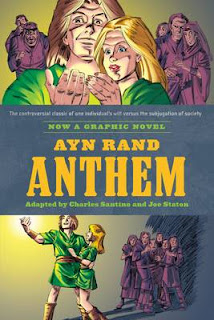 I'm honestly surprised that it took until 2011 for a philosophy as inherently cartoonish as Objectivism to be turned into a graphic novel; I expected Ayn Rand's glib certainties and sweeping generalizations would have been taken up by some fast-talking comics purveyor long before this. But apparently not: only now has Rand's slim pamphlet of a selfishness-is-good manifesto been turned into an equally slim comics version, with characters just as clean-featured and Aryan as anyone could have asked for. (And, yes, Rand's own ancestry makes that ironic, but it made it ironic long, long ago, and by her own hand.)
The resulting object has the appropriately grandiose title Ayn Rand's Anthem: The Graphic Novel
 , and was adapted by Charles Santino (who also served as Production Director) and drawn by Joe Staton. It appears, in fact, to have been shot directly from Staton's pencils, giving the entire book a sketchy, unfinished look.
The story of Anthem is just as pure and uncompromising as it was when we all first read it at the impressionable age of thirteen. (I pity anyone who comes to Anthem for the first time older than mid-teens; I doubt it would work at all.) In an unspecified future, the dirty Commies have conquered the whole world, and made all men utterly equal -- abolishing individual names, sorting everyone into occupations by cruel whim, and, worst of all, eliminating the first person singular pronoun, Ayn Rand's most prized possession. But there's one man -- strong, upright, even-featured, blond, attractive, smart as only an author's pet can be -- named Equality 7-2521 who discovers lost and forgotten things, is a one-man technological Renaissance, falls in love with a woman who is equally attractive and blonde though not shown to be particularly intelligent, and who inevitably falls foul of the evil and corrupt government of his village before escaping into the untamed wilderness where he finds an amazingly preserved modernist bungalow to raise his inevitable brood of little egomaniacs.
When you're a smart teenager, feeling oppressed by the entire rest of the world -- which you're morally certain is vastly beneath you in intellect -- Anthem is one of those stories that says "there's a bigger world than this, and you can get out and find your place in it." For that message, it's very welcome -- but the "shadowy leftist forces will drag all men to their level" message was more entertainingly, and briefly, encapsulated in Vonnegut's "Harrison Bergeron" a quarter-century later. And Rand's love affair with her own unbridled will is tiresome even in so short a piece. So leave Anthem, in whatever form, for the terminally teenaged or the more-libertarian-than-thou; they'll enjoy it more than the rest of us, anyway.
Book-A-Day 2010: The Epic Index
Wednesday, January 19, 2011
Book-A-Day 2010 # 350 (1/19) -- Poisoned Pens edited by Gary Dexter
 If you want something said really well, you'll want to go to a writer to get it done. And writers are also well-known for not getting along with each other -- like artists in other fields, they're prone to feuding with their rivals (or betters, or inferiors, or competitors, or just whoever happens to be handy). So you would think a collection of quotes from various writers throughout history, all devoted to the proposition that some other writer is really absolutely appalling, would be a wicked joy to read.
But I found Poisoned Pens: Literary Invective from Amis to Zola
 , a collection of just such quotes collated and organized by Gary Dexter, to be only intermittently exciting, amid stretches of blather and boredom. Dexter likes to give context, which is an admirable impulse, but it often leads to long, long quotes (there are dozens in here that are a page long or longer) instead of zingers.
Poisoned Pens is also arranged chronologically, so the reader has to dig through Chaucer and Cicero and Spenser before getting to insults that aren't elaborately coded in rhyming couplets. (I exaggerate slightly.) And the section on the moderns -- where one expects the really juicy slander and character assassination to be (and is correct to do so) -- seems to be the shortest, as if Dexter either wasn't as interested in it or wasn't able to get permissions for the good stuff.
I also found myself wishing that back-and-forth insults were arranged together, instead of organizing the whole book by slandered author chronologically. Even a re-organization by author of the quotes would add some life by bringing all of one person's nastiness together, and it really would have been best if it went something like Gertrude Stein on Hemingway, Hemingway on Stein, Stein on Wyndham Lewis, Hemingway on Lewis, and so on. It's easy to lose track of who really hated who as you plod through pages and pages of long-winded literary criticism of people like George Meredith, whom no one really cares about to begin with.
There is some good stuff in Poisoned Pens: quite a number of zingers and even more careful demolitions. But it's mostly literary criticism -- biased criticism, yes, unfair criticism, absolutely, but still mostly focused on the work rather than the writer. I'm sure Gore Vidal alone has said enough horrible things about other writers to fill a book this size, and I was hoping for more salacious gossip and rude insults and less "E.M. Forster never gets any further than warming the teapot" (Katherine Mansfield). Readers with less strict definitions of invective will enjoy this more than I did, but, characteristically, I thought it wasn't nearly nasty enough.
Book-A-Day 2010: The Epic Index
Tuesday, January 18, 2011
Book-A-Day 2010 # 349 (1/18) -- I Love You, I Hate You, I'm Hungry by Bruce Eric Kaplan
 Of all the categories of books that are difficult to review -- dream-diaries, collections of sexual fantasies, train schedules, compendia of accounting standards -- collections of single-panel cartoons are the ones that I find myself reading the most often. A great cartoon, of course, marries exactly the right words to a precisely correct drawing to make one harmonious, and humorous, effect. And if criticizing humor is difficult in the first place -- as E.B. White and his frog noted -- then doing so for two dimensions simultaneously is yet another level of complication, doubling the chances to utterly miss the point, delve into obscure intellectualism, or try to escape quickly by saying something facile and trite.
Which is all to say that I just read Bruce Eric Kaplan's new book of cartoons, I Love You, I Hate You, I'm Hungry
 , and I think it's very good, in that very BEKish way, but I hate trying to be any more specific than that.
(Checking my archives, I see I've previously managed to get away without saying much about BEK books -- Edmund and Rosemary Go to Hell got its own post, but it was a short one; The Cat That Changed My Life got a short paragraph in a monthly run-down; and so did Every Person on the Planet -- and that those books all had plots and storylines; I seem to have missed writing about BEK's previous excellent books of single-panel cartoons, No One You Know and This Is a Bad Time.)
Kaplan is a deeply 21st Century cartoonist; his figures are both blockily figural and bluntly honest -- they take the feel-good language and bushy lines of '70s Edward Koren cartoons and straighten them both out into arrows pointed precisely at what they want right now. (As much as they can tell what they want; Kaplan's people are modern urban types, and they're more clear that they want it now than they are about what they want.)
Look, I can't give you a dozen Kaplan cartoons here, but I can give you their captions, which will show you the flavor:
- "I'll check with Ann -- she takes care of everything involving human contact."
- "It's nice to finally be able to put a face to a humiliating nickname."
- "Being a mother who fetishizes every aspect of parenting is a full-time job."
- "This has been a really challenging time for me superficially."
- "There'll be other horrible men who don't really like you."
- "I thought the vaguely homoerotic undertones would be better."
- "I woke up in a strange marriage with my clothes off."
- "He's not in recovery -- he just speaks that way."
- "And this is our child, but we never use him."
- "Why do we need some piece of paper to say that we hate each other?"
- "I saw the most fascinating picture of a celebrity getting a cup of coffee today."
Humor is individual, of course -- a lot of people have never found anything that the New Yorker publishes to be funny, and Kaplan is the epitome of the current incarnation of the New Yorker cartoon. But I, and many other lovers of cartoons, think his work is both thrilling and really funny. And, in the end, that's what any discussion of humor boils down to: this is a collection of jokes, and they made me laugh more often than not.
Book-A-Day 2010: The Epic Index
Monday, January 17, 2011
Book-A-Day 2010 # 348 (1/17) -- Salt Water Taffy: The Truth About Dr. True by Matthew Loux
 One of the curious things about the modern graphic novel market is that the wider world is vastly more interested in stories for younger readers and in memoirs than the comic-shop crowd would ever have expected. Well, perhaps "wider world" may be too much of an assumption; the gatekeepers to that world, the publishers and booksellers interested in graphic stories, are the ones pushing memoirs and books for kids. It's good to have different segments to a market, even if the "mainstream" segments are as narrow and confining in their own way as the superhero-centric direct market is, since that at least gives creators three bowling alleys to try to aim their stories down.
Matthew Loux has been bowling in the kids-comics alley for a few years now with his "Salt Water Taffy" series, about two brothers (ages eleven and eight) living in the small town of Chowder Bay, Maine for one long summer vacation. (I reviewed the first two books for ComicMix back in 2008.) And a third book in that same series has just come along, in The Truth About Dr. True
 . I won't say that it's a pure strike -- to continue my increasingly-more-annoying metaphor -- but Loux does knock a lot of pins down, and is very entertaining while doing so.
The first two books had notable supernatural elements -- giant, talking animals in both cases -- and Dr. True continues in that vein, as the boys discover an century-old bottle and open it to release the ghost of Dr. Gershom True, namesake of the town's taffy shop and great-grandfather of that shop's proprietor. That ghost calls into question the history of the town's greatest hero, Captain William Hollister, and leads to a confrontation between both two ghosts and those ghosts' present-day relatives. There's a fairly pat reversal at the end -- well-executed, and entirely appropriate for the youthful audience of this story, but the kind of thing older, more jaded eyes have seen a thousand times before -- and then peace reigns again.
Loux's art is still one of the great appeals of "Salt Water Taffy," with slashing angles and swooping lines; it gives energy and movement to even static pages of characters talking to each other. Dr. True is a great book for pre-teens, and quite a bit of fun for their parents (or others of that age), though it won't hold much appeal for older teens and know-it-all twentysomethings.
Book-A-Day 2010: The Epic Index
Subscribe to:
Posts (Atom)
