


Of course, Locus already knows what the winner is, in every category -- this is just the list of the top five finishers reorganized alphabetically -- but it does have the shape of a shortlist, so Locus hopes that we will all treat it as one.
And the awards will go to an already-determined subset of the following works:
Science Fiction Novel
- Surface Detail
, Iain M. Banks (Orbit UK; Orbit US)
- Cryoburn
, Lois McMaster Bujold (Baen)
- Zero History
, William Gibson (Putnam; Viking UK)
- The Dervish House
, Ian McDonald (Pyr; Gollancz)
- Blackout
/All Clear
, Connie Willis (Spectra)
- Under Heaven
, Guy Gavriel Kay (Penguin Canada; Roc)Kraken
- Kraken, China Miéville (Macmillan UK; Del Rey)
- Who Fears Death
, Nnedi Okorafor (DAW)
- The Fuller Memorandum
, Charles Stross (Ace; Orbit UK)
- The Sorcerer's House
, Gene Wolfe (Tor)
I've reviewed Kraken, The Fuller Memorandum, and The Sorcerer's House here, and not read the other two.
First Novel
First Novel
- The Loving Dead
, Amelia Beamer (Night Shade)
- The Hundred Thousand Kingdoms
, N.K. Jemisin (Orbit UK; Orbit US)
- Shades of Milk and Honey
, Mary Robinette Kowal (Tor)
- The Quantum Thief
, Hannu Rajaniemi (Gollancz; Tor)
- How to Live Safely in a Science Fictional Universe
, Charles Yu (Pantheon)
I've reviewed Shades of Milk and Honey and How to Live Safely in a Science Fictional Universe; I haven't read the others yet -- though The Quantum Thief is only being published in the US this month.
Young Adult Book
Young Adult Book
- Ship Breaker
, Paolo Bacigalupi (Little, Brown)
- Mockingjay
, Suzanne Collins (Scholastic)
- Enchanted Glass
, Diana Wynne Jones (HarperCollins UK; Greenwillow)
- I Shall Wear Midnight
, Terry Pratchett (Gollancz; HarperCollins)
- Behemoth
, Scott Westerfeld (Simon Pulse; Simon & Schuster UK)
I've reviewed I Shall Wear Midnight and Behemoth here, and I'd missed the publication of Enchanted Glass entirely. (I now have a hold at the library for it.)
Novella
Novella
- Bone and Jewel Creatures
, Elizabeth Bear (Subterranean)
- The Lifecycle of Software Objects
, Ted Chiang (Subterranean)
- "The Mystery Knight"', George R.R. Martin (Warriors
)
- "Troika", Alastair Reynolds (Godlike Machines
)
- "The Lady Who Plucked Red Flowers beneath the Queen's Window'", Rachel Swirsky (Subterranean Summer '10)
Interesting to see that this category is now dominated by books; I'm not sure what that says about the traditional SF magazines.
Novelette
Novelette
- "The Fool Jobs", Joe Abercrombie (Swords & Dark Magic
)
- "The Truth Is a Cave in the Black Mountains", Neil Gaiman (Stories
)
- "The Mad Scientist's Daughter", Theodora Goss (Strange Horizons 1/18-1/25/10)
- "Plus or Minus", James Patrick Kelly (Asimov's 12/10)
- "Marya and the Pirate", Geoffrey A. Landis (Asimov's 1/10)
I reviewed both Swords & Dark Magic and Stories; I'd agree that the Gaiman was one of the best stories in that book -- and one of the best I'd read last year -- but I would not go as far with the Abercrombie. And the magazines do make a comeback in this category; perhaps current circumstances make it difficult for them to publish novellas? (Or, perhaps, just the highest-profile novellas?)
Short Story
Short Story
- "Booth's Ghost", Karen Joy Fowler (What I Didn't See and Other Stories
)
- "The Thing About Cassandra", Neil Gaiman (Songs of Love and Death
)
- "Names for Water", Kij Johnson (Asimov's 10-11/10)
- "Thirteen Ways of Looking at Space/Time", Catherynne M. Valente (Clarkesworld 8/10)
- "The Things", Peter Watts (Clarkesworld 1/10)
Clarkesworld has an amazing batting average this year; remember that they only publish two stories a month.
Magazine
Magazine
- Analog
- Asimov's
- F&SF
- Subterranean
- Tor.com
Tor.com is a magazine? You keep using that word -- I do not think it means what you think it means. Just because something publishes short fiction semi-regularly does not make it a magazine.
Publisher
Publisher
- Baen
- Night Shade Books
- Orbit
- Subterranean Press
- Tor
If anyone thinks Tor won't win this category, for the umpty-umpth year running, I'd be happy to make a little side wager.
Anthology
Anthology
- Zombies vs. Unicorns
, Holly Black & Justine Larbalestier, eds. (McElderry)
- The Beastly Bride
, Ellen Datlow & Terri Windling, eds. (Viking)
- The Year's Best Science Fiction: Twenty-Seventh Annual Collection
, Gardner Dozois, ed. (St.
- Martin's)
- Warriors
- Swords & Dark Magic
- Mirror Kingdoms
, Peter S. Beagle (Subterranean)
- What I Didn't See and Other Stories
- Fritz Leiber: Selected Stories
, Fritz Leiber (Night Shade)
- The Best of Kim Stanley Robinson
, Kim Stanley Robinson (Night Shade)
- The Collected Stories of Roger Zelazny: Volume Five: Nine Black Doves
, Roger Zelazny (NESFA)
Editor
- Ellen Datlow
- Gardner Dozois
- Gordon Van Gelder
- David G. Hartwell
- Jonathan Strahan
Artist
- Bob Eggleton
- Donato Giancola
- John Picacio
- Shaun Tan
- Michael Whelan
Once again I have to ask, seriously, what genre art Whelan has done recently? He's an excellent artist, and did piles of great SF/Fantasy book covers, true. But he's been retired from that part of his career for over a decade, and it's time for the fans to get that through their thick heads and start voting for the great artists who still are working in the field.
Non-fiction
Non-fiction
- 80! Memories & Reflections on Ursula K. Le Guin
, Karen Joy Fowler & Debbie Notkin, eds.
- (Aqueduct)
- Conversations with Octavia Butler
, Conseula Francis (University Press of Mississippi)
- Robert A. Heinlein: In Dialogue with His Century: Volume 1: 1907-1948: Learning Curve, William H. Patterson, Jr., (Tor)
- CM Kornbluth: The Life and Works of a Science Fiction Visionary
, Mark Rich (McFarland)
- Bearings: Reviews 1997-2001
, Gary K. Wolfe (Beccon)
I'd love to think that something other than the Heinlein book had a chance here, but I'm much too cynical for that.
Art Books
Art Books
- Bob Eggleton, Dragon's Domain
(Impact)
- Spectrum 17
, Cathy & Arnie Fenner, eds. (Underwood)
- Donato Giancola, Middle-Earth: Visions of a Modern Myth
(Underwood)
- Shaun Tan, The Bird King and Other Sketches (Windy Hollow)
- Charles Vess & Neil Gaiman, Instructions
(Harper)
I note, with mild puzzlement, that the author of the book comes first in this category, unlike all of the others -- and except for the one book edited by non-artists. This is very curious. I resolutely refuse to read anything into that fact, but I do always hope for greater consistency in the future.


 is not about those things, of course. It couldn't possibly be, since it's made of words. But it fits snugly around a void of the unspeakable, and its title hints at all of the things that it doesn't say.
 . (Other pieces, from various places, were recently assembled into the autobiography-in-fragments
  , which I reviewed last year.) And the back fifteen years of those essays -- roughly the Asimov's years -- have now been brought together as
  , by the newish New York small press Nonstop.
 is the first new novel from SFWA President John Scalzi since 2008's
  , and the first standalone (not set in the Old Man's War-iverse) since 2006's
  . Of course, it's only a standalone within Scalzi's oeuvre, since it's a reworking of H. Beam Piper's 1962 novel
  , which had
 . I've grumbled about the increasing tendency of mainline SF to look backwards (alternate history, steampunk, deliberately retro futures) -- and I'm certainly not the only one, or even near the first, to do so -- but I'll save those grumblings for an actual review of Fuzzy Nation. The book is a pleasant old-fashioned skiffy adventure story, lightly updated to modern mores, and is suitable both for current SF readers (as long as they don't demand adventurousness) and those who drifted away from the genre before the New Wave. Fuzzy Nation is a Tor hardcover with an official on-sale date of May 10th -- but I doubt it's a "day-and-date" book, so you could buy it right now, if you want.
 was a three way collaboration between three female fantasy writers -- a concept that inexplicably was reasonably common, and popular, for several years -- which I remember well from my time at the bookclubs, but was surprised to re-discover was originally published in 1996. The three authors are Melanie Rawn, Jennifer Roberson, and Kate Elliott, and Golden Key -- a novel about a family of painters with a secret magical power in a Renaissance-esque world -- was very well-received at the time, and was even nominated for the World Fantasy Award. (Which doesn't happen a whole lot with multi-author books.) There's a new mass-market paperback edition of Golden Key coming from DAW in June, though, sadly, they've cropped the great Michael Whelan cover art so that Whelan's
 , a contemporary fantasy by Irene Radford set in small-town Oregon. (Though I hasten to note that it doesn't seem to have any sparkly vampires in it. No buff shirtless werewolves, either, as far as I can tell.) This particular town, though -- called Skene Falls -- has a wood outside it filled with pixies, and the pixies are now threatened by the imminent destruction of the woods. Add one normal woman -- who never quite gave up on the pixies she saw as a child -- plus one pixie woman exiled to live as a mortal, and I expect they'll make up a plan to save the woods that's So Crazy It Just Might Work.
 , edited by Jean Rabe and Greenberg. It has sixteen stories by mostly the usual Tekno anthology crowd -- Michael A. Stackpole, Jody Lynn Nye, Elizabeth A. Vaughan, C.J. Henderson -- all about love amid corsets and cogs, goggles and gauges, and all the usual steampunk furniture.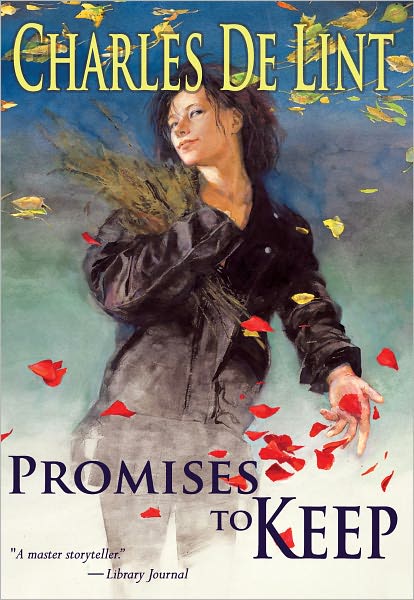
 -- about the early history of Jilly Coppercorn, one of the central characters of his fictional city of Newford -- was originally published in 2007 as an expensive hardcover from Subterranean. In June, though, it will finally be re-released, as a reasonably priced trade paperback from the fine San Francisco publishers Tachyon.
 , last March, and already they've got the fifth book,
  , in a matching trade paperback this month. (Tchaikovsky seems to be a quick writer, but he's not that quick -- Pyr is catching up with Tor UK. Tchaikovsky's home publisher, who started the series in 2008. But the UK is still one book ahead, with
  hitting stores there in February.)
 (even though it reads left-to-right and was adapted from the English-language version of Tendo's memoir), adapted by Sean Michael Wilson and illustrated by Michiru Morikawa. Kodansha USA is publishing Yakuza Moon: The Manga Edition in July as a trade paperback.
 . As usual, the American editions of Dungeon books each collect two albums of the French Donjon series -- in this case, "Night of the Ladykiller" and "Ruckus at the Brewery" -- and, as always, the series is written by Joann Sfar and Lewis Trondheim. (The continuity of Dungeon is detailed -- though not all that complicated -- so let me just aim any interested parties at
  , which
  , the first book in the central "Zenith" subseries.

