


 , a superhero novel about Celia West, the completely unpowered accountant daughter of the two most popular and powerful heroes of Commerce City.
So, the first question is: what comes after the Golden Age? Whether you're Hesiod or Jack Kirby, the obvious answer is "The Silver Age." And After the Golden Age is a quite Silver Age-y book, full of gangsters (organized into teams, with spiffy nicknames, and I would not be at all surprised if many of their gangs had dress codes) who politely kidnap Celia repeatedly in the vain hope of using her as a shield against her parents. (This is seen to never work, but -- in best Silver Age fashion -- the gangsters keep doing it, because they need to follow the essential Weisinger plots or else they are nothing.)
This is lucky for Celia; if this were an Iron Age story, she'd be in pieces in the fridge before page ten, and we wouldn't have much of a novel. But she does live in a more genteel age, with defined standards of behavior for both heroes and villains, and so her kidnappings tend to just disrupt her schedule and horribly frustrate her.
(Vaughn lampshades the inevitable question: Celia doesn't leave Commerce City because she doesn't want to -- sure, she has no relationship with her parents, and has a career that usually takes young public accountants through extensive travel around the country for the first few years of their careers, but, by gum! she's going to stay right there in Commerce City because
The rest of the book is agreeably muddle-headedly Silver-Agean like that: Celia starts dating a young police detective, Mark Paulson, whose father is the city's Mayor, with the usual obvious parallels between their parents. Celia's ur-kidnapping was by the Olympiad's (her parents' superteam) greatest foe, the Destructor, as a young teen, and she ran away to join the Destructor's gang not long afterward, in a fit of teenage pique at sixteen. (And this is endlessly brought back up throughout the novel, as though this was a superhero world in which no one had ever made a heel or face turn even once -- let alone dozens of times a year, as in the modern era.) Celia is given primary responsibility to build a forensic accounting case against the Destructor (even though he's old, possibly senile, and has been locked up in not-Arkham for a while now) as part of a major criminal case against him, for no obvious or specific crimes, and even though her multiple conflicts of interest would make any opposing counsel salivate at the thought. The whole plot, in fact, is entirely second-hand: it's all standard superhero furniture that seems to be in this novel because it belongs somewhere in a superhero story, and not because Vaughn had specific reasons for wanting any of it.
Vaughn keeps it all going with her narrative voice, but it doesn't make a whole lot of sense if you spend any time thinking about it. But, remember: in the Silver Age, stories aren't supposed to make sense. Celia has more than the recommended level of angst, and is batted around by events -- she's supposedly driven and responsible, but her accountancy work isn't dramatic, so Vaughn just mentions it now and then, and it really doesn't add up to much.
Celia bounces off the supers of her hometown -- her parents, Captain Olympus and Spark; Arthur Mentis, the telepath who was a late addition to their team; Annalise, aka Typhoon, a water-powered hero her age -- as she slowly learns about the requisite sinister plot. And, of course, she gets kidnapped in the furtherance of that plot, but it all turns out all right in the end -- city saved, true love found, the whole nine yards.
After the Golden Age is a pleasant if slightly musty-feeling superhero story; it's based on several-decade-old tropes and doesn't bear a whole lot of resemblance to what superhero stories look like these days. (Of course, superhero stories have looked horrible for much of the last two decades, so not looking like that isn't necessarily a bad thing.) Vaughn makes it entirely an enjoyable read, but this isn't a book to think too deeply about motivation or realism as you're running through the pages.


 , second novel in a trilogy called "To Hell and Back" -- though it means that more puckishly than most fantasy books would -- and I'll direct you to my review of the first novel,
 is the fourth novel in the series -- after The Atrocity Archive, The Jennifer Morgue, and The Fuller Memorandum (see
 is a really swell way to waste a dozen hours or so, if you have any interest at all in Disneyland, theme-park history, or just the ways that American icons morph and adapt over the course of a couple of generations of continuous operation. Chris Strodder's book contains over 500 entries, covering every element of the Disneyland park -- people, attractions, stores, lands, restaurants, events, TV shows, promotions, and less definable stuff -- with details of what it was (or still is), how it's changed, and what's interesting about it. Upfront, there are maps of the park as a whole and the various lands, with buildings and areas keyed to a list of the various things that have been there over the years -- this is sometimes a bit vague, due to major renovations, but generally is usefully precise. And the back of the book has an extensive index, a solid bibliography, and an appendix listing the entries by land and type (attraction, person, restaurant, store, etc.). Strodder also has included his own black-and-white photos of every element that's still in existence, though those those photos tend to be small in the book -- there are a few photos in color on Strodder's

 is a nicely portable guide from the folks at Lonely Planet -- this particular one was written by Adam Skolnik, who gets no cover credit but a smouldering pseudo-romance-novel-cover author photo at the back to (presumably) make up for it. As the title implies, it's pocket-sized, with a lot of color photography among the icon-filled, heavily-designed pages -- a good travel book packs a lot of details onto each page, and this is a good-looking example of that model. There's also a map stuck into the back. What I have is the third edition, which just came out in May.
 -- and you might, too, just from looking at that cover. From the back cover, I gather that the main characters are Ryuka and Ixto, the former of which is under a spell that makes him irresistible to the same sex, but I have no idea what else they are, what kind of culture those names (or outfits) would come from, or anything other than the fact that this book features cute boys getting busy for the enjoyment of a female audience. (Though perhaps that will be enough.) It's from Yen Press, and publishes this month.
 , from Satoko Kiyuduki. (I
 , the opening of "A Tournament of Shadows." This is a prequel to the previous Morlock novels; I see from the opening chapters that he hasn't even been born yet as the book begins. The main action of Guile concerns a war between dwarves and dragons, which seems to be in the secondary world Morlock travels in the prior novels -- so readers should not be worried that Guile is entirely about an infant Morlock. This novel was published by Pyr on August 21st.
 -- a collaborative fix-up novel by Cory Doctorow and Charles Stross, adding a new section and some corrections to their previously-published novellas "Jury Service" and "Appeals Court" -- when I saw it as a bound galley, and now I mention it again now that it's a real finished book. It's a Tor hardcover, officially on sale tomorrow.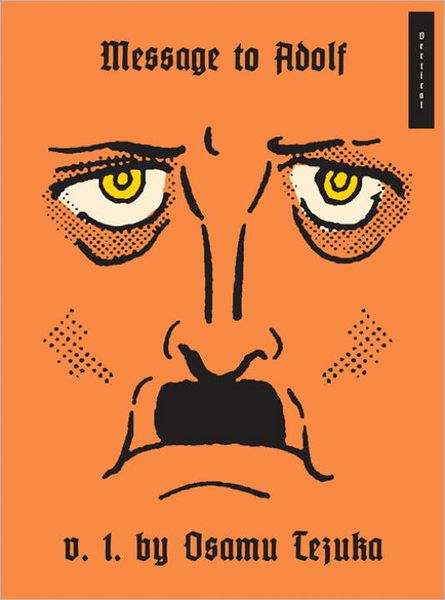
 . This was one of his last major works, serialized in the 1980s, and, starting in the 1930s, tells the story of three men named Adolf: Nazi official's son Kaufmann, Jewish baker's son Kamil, and Hitler. This first volume was just published in late August; the second half will come out in November.

 , the word "kids" means particularly small children: definitely those under the age of ten, and mostly those up to the age of six or seven.
 by William Carlos Williams -- it's one of the great poems in the English language, and I needed to read it again. (And my last copy got lost in the flood.) I'm already one Part in as I type.
 by Steven M. Barrett -- my younger son (Thing 2) is rather competitive and something of a completionist (not unlike his father, yes). So this is to give him a task for this year's vacation -- finding stuff while we're in the World of Walt.
 is a Paul Theroux travel book that I thought collected short pieces -- like Fresh Air Fiend, which I've been reading slowly for several years now. I was wrong; it's selections from several longer books. I don't know why anyone would want to read chunks of Great Railway Bazaar, Old Patagonian Express, Kingdom by the Sea, Riding the Iron Rooster and Sunrise with Seamonsters instead of just picking one of them, but some people are just weird, I suppose. And I now have a disposable Theroux book to press on someone if ever the need arises.
 by Ambrose Bierce -- I've been complaining for several years that the LoA needed to do Bierce, so I was very happy to see that they did. This book contains what looks to be all of Bierce's short stories -- which fall into three rough categories: ghost stories, Civil War stories, and tall tales; all of which are dark, gory and cynical -- plus The Devil's Dictionary and the writings Bierce collected as Bits of Autobiography for his 1909-12 Collected Works. I'd have preferred at least two volumes of Bierce -- adding in Write It Right and selections of his journalism and letters -- but this is the core of his work. Bierce is, to my mind, the greatest half-unknown American writer. (But the greatest half-unknown American work is Frank Norris's amazing novel
  .)
.) : the LoA has done two Vonnegut volumes so far (though I do wonder if they'll continue and do his later, lesser books) -- this one and another collecting novels and stories from 1950 through '62. This one has both Cat's Cradle and Slaughterhouse-Five in it, and I intermittently think I should re-read some Vonnegut (particularly since I don't think I've read any of his major novels as an adult).
 -- I had a copy of Just Enough Libeling pre-Deluge, and I have a feeling there will come a day when I suddenly want to read some Liebling.
 by Martin Amis -- it's his new novel, it's been getting good reviews, and there was a time when I fanatically read everything Amis wrote. (I think the horrible Night Train cured me of that, but House of Meetings was strong, so he's half-won me back.)
 by Gary Krist -- I still have vague thoughts about collecting the '80s Vintage Contemporaries, and this is a collection of stories I've heard about for twenty-plus years without ever actually reading. (I also keep misremembering that it was the source of the movie of the same name, but I don't think it actually was.)
 by Janet Groth -- Groth was the receptionist at the New Yorker offices for 21 years -- 1957-78, so not recent years -- and this is her memoir of that time, with the expected focus on vaguely thrilling and/or titillating stories about the boldfaced names of the literary world.
  by Rick Riordan -- Thing 2 asked for this, since it's the new book in a series he's been reading. (He's still on a tear through mostly YA fantasy -- just read The Phantom Tollbooth without even my forcing it on him, and working through the "Dark Is Rising" books as well.
 by China Mieville -- this is also officially a YA book, but it's for me. Yes, I still haven't read last year's Embassytown, maybe because it looked more "worthy" -- i.e., like spinach -- but it's on the shelf. And this one might well lap it.
 by Akiyuki Nosaka -- I have to admit it: I picked this one up entirely because of the title (which means it did its job). It's a Japanese novel from the late '60s, which is about a pornographic film company -- and what I have is a Tuttle edition, printed in 2006, only for sale in Japan.
 by Daniel Pinkwater -- This is Pinkwater's only novel for adults, and I got to thinking about Pinkwater recently. In particular, I was thinking that I don't have any of his books anymore (they were all lost in the flood), and so I'm going to correct that as quickly as possible.
 (an Uncle Fred novel from 1958),
  (a standalone 1931 novel),
  (a 1940 novel about ham and marriage, which I read a year before I began this blog), and
  (the classic 1933 Blandings novel about Gallahad's memoirs).
