The novel is a fairly well defined category at this point: a collection of words (anywhere from about forty thousand of them up to half a million), telling a story of some kind, generally in prose but not necessarily, stuck between two covers. But George Walker here collects four
wordless novels -- stories told entirely in pictures on the page -- to shake up that idea.
Despite my tag on this post, these four stories aren't "comics" by most definitions, since they each have one image to a page, and none of the visual language of comics -- no speech or thought balloons, no captions, no panel transitions. They're somewhere in the same family tree, obviously, but they also show by their existence that the prose novel is not that far away in the same tree -- that sequential storytelling has some elements in common no matter what the building blocks of the story, whether prose or poetry or images. As the afterword from the cartoonist Seth makes clear, the "wordless novel" draws its visual imagery and language from the silent movie rather than from comics -- not unlike recent books by Brian Selznick like
The Invention of Hugo Cabret and
Wonderstruck -- though Selznick mixes stretches of prose with his movie-derived images.
So,
Graphic Witness
collects four stories from the first half of the 20th century (more or less), when there was a brief flourishing of this form. (Milt Gross's
He Done Her Wrong, which I've
reviewed twice, is a parody of that flourishing.) According to Walker's introduction, the form was most associated with radical politics, and he implies this is because they could avoid censorship by not including any of the trigger words -- presumably things like "trade unionism" and "socialism" and "worker solidarity." That implied theory does neatly explain why that flourishing mostly ended with WWII, since the world changed significantly at that point, and the politics were no longer the same.
All four of these books also use the same style of art, which was the standard for this short-lived art form. All are printed from cut blocks -- whether linocuts or woodcuts or otherwise -- and so have that white-lines-on-black scratchboard look, with all of its strengths of immediacy and imagistic power balanced by the difficulty of doing intricate detail work. (Though Lynd Ward, in particular, manages a fantastic array of line widths and crosshatching to achieve all of the effects of ink on paper.)
Franz Masreel, a Belgian who worked in this area mostly during the wars, and had his most success in Germany, leads off with 1918's
The Passion of a Man, probably the earliest work of this kind. (It's also made up of only twenty-five images, which may perhaps deform the idea of a "novel" in an entirely different direction.) It's the crudest of the four in its story-telling, covering the story of a poor young man from his illegitimate birth through hard times and rabble-rousing (maybe union organizing, maybe leading a revolution) to his inevitable end. It's clearly agitprop, but strongly conceived and told.
Next is Lynd Ward, the best-known worker in this form to Americans: he made six books in this style over the course of a decade, from 1929's
God's Man to 1937's
Vertigo. (And, continuing the implication that this was an art-form tied to a particular moment in time, lived another fifty years without quite completing another such story.) Walker has chosen Ward's third book,
Wild Pilgrimage, from 1932. It's a more complex story than Masreel's
Passion, telling the story of one man's wanderings from a dark industrial city into a more pastoral landscape -- which has its own share of darkness. Ward also mixes the real world, in black, with dreams or visions of his main character, in a reddish tint, to add another level of depth and reflection. There's something like a labor riot at the end of
Pilgrimage as well, bringing this nameless man's story to a similar end to hat of Masreel's hero.
Italian-born San Franciscan Giacomo Patri tells the story of a different sector of the class struggle in 1940's
White Collar, his only wordless book.
White Collar is more naturalistic than Ward's or Masreel's work, telling the story of an advertising artist and his family in a
noir-esque '30s style, with only a few intrusions of symbolic art. Patri's hero is firmly above the union workers when his story begins, living in a suburban house with his wife and two children and commuting to his city job. But then the 1929 stock market crash hits, and he's out of work. He tries various things, but none of them succeed and the bills keep piling up, until his family is thrown out of their home and they join the army of similar people: all now equal and unified against the heartless capitalists. Patri's art is not quite as complex as Ward's, but it "reads" more crisply on the page, and he varies the sizes of his images to suit his subjects in a way that anticipates later comics developments.
Walker's last selection is the only post-war choice: Canadian Laurence Hyde's 1951 book
Southern Cross, also his only wordless book. (I haven't emphasized just how much work and time goes into each individual woodcut: Hyde spent three years making his book, and Patri about the same amount of time.) The politics have shifted, but
Southern Cross is still a book to persuade: it tells the story of a loving family on some South Pacific island -- presumably Bikini Atoll -- who are ripped from their homes by US forces who are testing a nuclear weapon. And that, of course, is not the end of the trials for this family: a persuasive book must pile up the drama to make its case. Hyde doesn't vary his image's size as much as Patri did, but he does break his flow of mostly small, same-sized images to punch specific moments, and his art is supple and evocative.
I don't know the rest of this field well enough to independently verify Walker's description of it, but it fits everything I know: the wordless book did only last for a short time, and its central works are clearly deeply political in motivation and purpose. The four books he's selected and presented here are each strong in their own ways, both in storytelling and in art. I suspect these stories will be more interesting in a social-history context than in looking at the history of American comics, since they draw much more from the general leftist thought of the time than from what was then a minor and disreputable art form. But they're worth reading and thinking about, particularly as our own era rumbles into levels of income inequality not seen since the late Twenties.


 , the second full-length graphic novel from Brian Fies (after Mom's Cancer, which I read way back in the misty early days of this blog when I didn't write long meandering posts about books all the time). It's about the dream of the future from the 1939 World's Fair, and it seems to be fictional, unlike Mom's Cancer.
 from Matt Fraction and Howard Chaykin. This is a complicated mystery story set in the world of early TV in the '50s, with lots of Chaykin dames in their over-constructed lingerie (and not much else, much of the time). I mostly enjoyed the first volume, despite admittedly not entirely understanding it.
 B.P.R.D.: Hell on Earth, Vol. 7: A Cold Day in Hell
 by Mike Mignola, John Arcudi, Lawrence Campbell, and Peter Snejbjerg. I'm trying to keep up better with Hellboy-verse stories these days, and I might just sit down for a big week of B.P.R.D. soon. (This was one I was missing in the middle; it's not the most recent book.)
 Over Easy
 , a memoir-ish graphic novel -- or maybe a graphic memoir with some degree of fictionalizing -- from Mimi Pond, who did a lot of great work for National Lampoon in the '70s and whom I haven't seen much lately. (I see that she did a long-running strip for Seventeen magazine for part of that time, which was way off my radar.)
 Dungeon: Twilight, Vol. 4: The End of Dungeon
 , the last book in the series -- well, more will be published, but this one is at the very end of the internal timeline -- which is written by series creators Joann Sfar and Lewis Trondheim. The two individual French albums collected here are drawn by Alfred (of Why I Killed Peter fame) and Mazan (who seems to have had several long-running series in Europe that have never been translated into English).
 Bandette, Vol. 2: Stealers, Keepers!
 , the second book collecting a comic by Paul Tobin and Colleen Coover. I really enjoyed the first one, and I always like Coover's sunny, expressive art.
 Grendel vs. The Shadow
 by Matt Wagner. I probably heard about this at some point -- I'm not completely cut off from all sources of information about the usual comic-shop stuff -- but I was surprised to see it on the shelf. I like Wagner, though I think he's spent too much time this century doing Hunter Rose stories -- and I also think that's what the market-slash-editors keep asking him for. And I guess I'm the problem, because I keep buying them, and providing financial incentive to keep making them.
 Last is the one book with only words on the pages: Defender of the Innocent
 , a complete collection (so far) of Lawrence Block's stories about Martin Ehrengraf, the criminal defense attorney whose clients are always innocent, no matter what else has to happen for that to be true. Block's short stories are sharp and sneaky -- possibly even better than his novel -- so this should be fun.


 , from Terry Pratchett, Ian Stewart, and Jack Cohen. Like the first two Science of Discworld books (and the fourth, which hit the UK several years ago and is still forthcoming on my side of the pond), it combines alternate chapters of a Pratchett-written Unseen University story about wizards poking at a created "Roundworld" with chapters about the actual science implied by those pokes, written by working scientists and popularizers Stewart and Cohen. I don't remember if I read all four of these books, but they start very strong and glide gently downhill, as the authors have less impressive material each time out. Darwin's Watch is a June 2015 trade paperback original from Anchor in the US, only ten years after the UK publication.
evolution.JPG)
 , the first novel from TV writer PJ Manney, coming on June 1st from Amazon's 47North imprint. (So you might have trouble finding it in any smaller independent bookstores that Amazon hasn't managed to drive out of business yet.) It's a technothriller in the vein of Blood Music, with the plucky genius researcher who injects himself with his own creation and then gets caught up in the usual evil conspiracy to control everything.
 is the third novel in Alex Bledsoe's Tufa series, about a secret race of musically magical people in a (hidden?) county in Tennessee, and their intrigues and problems. (I suspect there's an influence from Manly Wade Wellman's "Silver John" stories here, since Bledsoe is also working with authentic American legends.) In this one, one of the two Tufa ever stripped of their powers and exiled is back, and of course she's pissed. Long Black Curl is a Tor hardcover, on sale May 26.
 , the sequel to The Unremembered and the continuation of the "Vault of Heaven" series. It's one of those books where there's an ancient evil god out there, and his millennia-old magic chains are failing, so Bad Stuff is ramping up and will keep doing so until the Cast of Thousands travels across the entire map, learns Important Lessons about themselves and the world, gathers all of the Plot Tokens, and reassemble in the last book for a few of the less important characters to die and the rest to be triumphant. (I may be slightly flippant about epic fantasy here. I may also be less than accurate about this particular series.) Trial of Intentions is a Tor hardcover, also available May 26th, and the cover letter insists that it works perfectly fine as an introduction to the series.

 , coming in a trade paperback edition from Tachyon in early June. Like all of Reynolds's work, it looks like smart hard-ish science fiction, set in the medium future among former soldiers from both sides of a long, huge interstellar war who wake up on a ship where things are going badly wrong.
 . Rajaniemi has written several novels, though I've only managed to read the first one (
 , an original anthology of SFnal stories about videogames edited by Daniel H. Wilson and John Joseph Adams. It'll be an original trade paperback from Vintage, hitting stores on August 28. And it has new stories from twenty-six very diverse writers, from editor Wilson to Charles Yu, from Seanan McGuire to T.C. Boyle, from Hugh Howey to Catherynne M. Valene, from Rhianna Pratchett to Cory Doctorow, all of whom tell stories inspired by videogames in one way or another.
 , which hits paperback from Penguin on May 26th. The first in the series is A Discovery of Witches, and I'm afraid I haven't read any of them, so I can't tell you much. But this one does see our heroes -- "spellbound witch Diana Bishop and vampire scientist Matthew Clairmont" -- return from Elizabethan London to the modern day and the characters from the first book.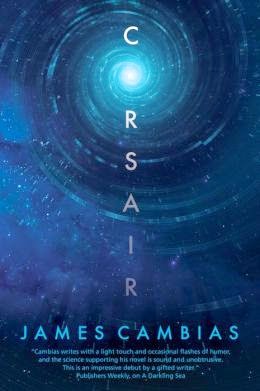
 . It's set in the near future, when asteroid mining has become big business, and top computer hackers battle over the systems dropping the payloads into the ocean -- some on behalf of their employers, the mining companies, and some on behalf of pirates and thieves who want to divert and steal the payloads. (I'm surprised that there's not a stronger regulatory structure around an activity theoretically capable of destroying cities, but that may come up later in the book.) Corsair is a Tor hardcover, and is available now.

 so intensively (though it was the night of March 26-27, so it wasn't that recent), but I think it's more likely the opposite: I like Theroux so much, and keep returning to his work, because we're similar types of curmudgeons, and have compatible views of the worth of humanity. I still haven't read any of his novels, despite meaning to do so, but I get to one of his travel books at least once a year [1] and always deeply enjoy them.
 , the print manifestation of a once-zeitgeisty website of sad, amusing and Schadenfreude-ian real life stories, and it is the thing that it is and no more than that.
 is from that era: I saved a shelf-worth of unread large-format books from the flood, and that shelf is getting read very slowly. (When you read mostly on trains, big books have to fit into the small bits of other reading time.) It was a subject I thought I was interested in -- I'd read a 1926 book, Castles, by the early 20th century military historian Charles Oman, which had a lot of details of warfare and great illustrations. And so I thought this book, written by Lise Hull with great photographs by Stephen Whitehorne, would be in a similar vein.

 collects the back half of the Rex Libris comics series from about six years ago: issues six to thirteen are here, following the first five in the companion volume I, Librarian. (See
 , continuing an epic fantasy story in a vaguely medieval-German world (hence the title). I reviewed
 , which actually concludes this relatively short story of cybercrime and social-media bullying.
 by Gamon Sakurai, about a sub-group of humans who cannot be killed and who are thus declared not human because of it. As is typical for manga, the central story focused on a typical teenage boy -- Japan is the world leader in tight audience identification characters -- and his new life once he discovers he's one of these "demi-humans."
 . This one is a magical school story, though the main character is pretty much exactly like the one I described a paragraph ago: manga delights in heroes who are essentially interchangeable.

 , originally published in 1989 by Rutgers University Press and available sporadically since then in other editions. This one focuses specifically on Harris's science cartoons -- he's had other collections with food cartoons, or business cartoons, or environmental cartoons, but this one is mostly people in white coats pointing at blackboards or strange animals talking about their evolutionary path.
 (2/24)