So the big Hellboy story is over -- it's been over longer than most people think, as I argued when I wrote about the second volume of Hellboy in Hell. But Hellboy is still a valuable piece of intellectual property, with a potential movie reboot still kicking around in the background somewhere. So there has to be some Hellboy product coming out on a regular basis, to help keep the lights on at Dark Horse and to keep Mike Mignola busy.
Well, maybe that's too cynical a view of things. Hellboy is an interesting, fun character, and his history contains vast swaths of space and time to throw additional stories into. It's not impossible that Mignola and his collaborators are really, really enthusiastic about all of those possibilities and that Mignola is taking on such a large number of collaborators and doing a whole lot of unrelated one-off stories because that's precisely what the Hellboy universe needs right at this moment. The world is vast; all things are possible. And it's clear that Mignola and team are enjoying what they're doing.
So what we have here is Hellboy and the B.P.R.D.: 1954, containing four miscellaneous stories all taking place in that year and all written by Mignola with Chris Roberson, his current major writing collaborator (following John Arcudi). Two of the stories were two-issue mini-series, another was a single issue, and the fourth appeared in a giveaway comic for Free Comic Book Day in 2015.
(Similar volumes covering the years 1952 and 1953 came out previously.)
The four stories are all entirely separate, which is nothing new for Hellboy: even now, probably a majority of the books featuring him are made up of miscellaneous tales of investigating (and then, inevitably, punching to death) some mysterious folkloric thing in some odd corner of the world. The best of the short pure-Mignola stories relied on folklore and atmosphere rather than tying everything into the standard Hellboy mythology, and it's good to see that most of the stories here follow in that vein.
We lead off with a two-parter, "Black Sun," drawn by Stephen Green in the traditional dark and moody style of other-hands Hellboy-universe stories. I tend to think of that look as being codified by Guy Davis in B.P.R.D., but a lot of people (the Fiumara brothers, Duncan Fegredo, Ben Stenbeck, Tyler Crook, James Harren, and even Fabio Moon and Gabriel Ba) have worked in that vein on various Hellboy-related stories over the years and done good work. "Black Sun" features both Nazis and flying saucers, and is the most core-mythology of the stories here.
Moodiest (and probably best) is the single-issue story, "The Unreasoning Beast," with art by Patric Reynolds. It has a monkey in it; I probably shouldn't say more than that.
The other two-parter is "Ghost Moon," set in Hong Kong. Brian Churilla draws this one, and I found the style to be brighter and more open than most Hellboy stuff. Some of that may be Dave Stewart's colors, but he colors nearly everything in the Hellboy universe, so it must be a deliberate choice here. This is another story using real-world folklore, but I found it a little pat and obvious.
And last is the shortest piece, "The Mirror," drawn by Richard Corben. Corben's grotesques work pretty well for Hellboy, though I personally like his work best in small doses. This is more a vignette than a story, but it's a nice vignette.
We all know that this book exists because a lot of us like Hellboy and want to keep reading stories about Hellboy, even when there's no compelling in-story reason for those stories to continue. If that describes you, you'll probably like this book: it does that Hellboy thing, in the extended-universe manner, and does it pretty well. But if you haven't gotten into the Hellboy thing yet, go back to the pure Mignola stuff and start there.
Thursday, April 12, 2018
Wednesday, April 11, 2018
Book-A-Day 2018 #101: Aama, Vol. 3: The Desert of Mirrors by Frederik Peeters
I don't know if it's the Moebius influence, or something inherent to French SF comics, but Aama is hurtling headlong towards those old questions of transcendence and identity, with a gigantic unknowable biological system (partly or entirely built by people, but now out of their control) providing both instant death in thrillingly unique and horrible ways and also transformative mental experiences that one expects will culminate into someone becoming The Incal or some such thing.
(I may be being a tad reductive here. Please adjust your assumptions accordingly.)
That's where we are with Aama, Vol. 3: The Desert of Mirrors, hitting the three-quarters mark of this soft SF planetary opera by Frederik Peeters. (See my review of the second volume, The Invisible Throng; I covered the first one in a very short way during one of my review bankruptcies.)
This is book three of a four-book series -- if you're confused by my first three paragraphs, it's only to be expected. Aama is soft SF as well, full of unlikely biology and lots of things that probably violate at least one of the laws of thermodynamics. So any explanations will be believable in as much as you're satisfied with a certain lack of rigor in the flying-slipstick category and with the nature of the Big Questions underlying Peeters' story.
This time out, we get the aftermath of the horrific ending of Invisible Throng, and finally circle back to the beginning of the first book, The Smell of Warm Dust, surprising those of us (well, me, at least) who had forgotten entirely that the main story was a very extended flashback. We also learn more about the Muy-Tang Corporation, which set up this experiment -- and, if you know anything about corporations in science fiction stories, you won't be expecting them to turn out to be honest and true and to have the best interests of humanity in mind. (I am also struck, yet again, at how French comics will casually kill off what seem to be central characters and not look back. That's unusual for comics, where every character is assumed to be an IP that everyone hopes will be a movie one day.)
Peeters has to wrap this all up in one more book, which seems entirely possible -- the end of this book is hurtling towards a conclusion, so the question is whether there's as much as ninety pages of comics left to tell that ending. I may not entirely buy the science here, but it's a good story, and Peeters is handling the transcendence/connection stuff better than a number of other comics-makers I've seen (Moebius and/or Jodorowski, for example) -- and by "better," I mean "in a way that doesn't make me complain out loud."
So: Aama is still neat and quirky and full of sudden violence and sudden insight and revealing character moments. Given that the series won the Best Series award at the Angouleme festival in 2015, I suspect Peeters kept that up for the final book...which I now have to find.
(I may be being a tad reductive here. Please adjust your assumptions accordingly.)
That's where we are with Aama, Vol. 3: The Desert of Mirrors, hitting the three-quarters mark of this soft SF planetary opera by Frederik Peeters. (See my review of the second volume, The Invisible Throng; I covered the first one in a very short way during one of my review bankruptcies.)
This is book three of a four-book series -- if you're confused by my first three paragraphs, it's only to be expected. Aama is soft SF as well, full of unlikely biology and lots of things that probably violate at least one of the laws of thermodynamics. So any explanations will be believable in as much as you're satisfied with a certain lack of rigor in the flying-slipstick category and with the nature of the Big Questions underlying Peeters' story.
This time out, we get the aftermath of the horrific ending of Invisible Throng, and finally circle back to the beginning of the first book, The Smell of Warm Dust, surprising those of us (well, me, at least) who had forgotten entirely that the main story was a very extended flashback. We also learn more about the Muy-Tang Corporation, which set up this experiment -- and, if you know anything about corporations in science fiction stories, you won't be expecting them to turn out to be honest and true and to have the best interests of humanity in mind. (I am also struck, yet again, at how French comics will casually kill off what seem to be central characters and not look back. That's unusual for comics, where every character is assumed to be an IP that everyone hopes will be a movie one day.)
Peeters has to wrap this all up in one more book, which seems entirely possible -- the end of this book is hurtling towards a conclusion, so the question is whether there's as much as ninety pages of comics left to tell that ending. I may not entirely buy the science here, but it's a good story, and Peeters is handling the transcendence/connection stuff better than a number of other comics-makers I've seen (Moebius and/or Jodorowski, for example) -- and by "better," I mean "in a way that doesn't make me complain out loud."
So: Aama is still neat and quirky and full of sudden violence and sudden insight and revealing character moments. Given that the series won the Best Series award at the Angouleme festival in 2015, I suspect Peeters kept that up for the final book...which I now have to find.
Recurring Motifs:
Book-A-Day,
Comics,
Foreigners Sure Are Foreign,
Reviews,
Science Fiction
Tuesday, April 10, 2018
Book-A-Day 2018 #100: The Ghost in the Shell by Masamune Shirow
People will tell you that The Ghost in the Shell is a single story, about a cyborg cop in a complex future Japan and her pursuit of a mysterious AI called The Puppeteer. They are lying to you.
Oh, that thread is here, and the very last installment here sees the conclusion of that story. It's a plausible lie, like all the best ones.
But Ghost in the Shell is three hundred and fifty pages of comics, across eleven long chapters, and most of those chapters are individual episodes of our heroine murdering lots of people because the government tells her to. Puppeteer comes in during one of those murder sprees earlier in the book, and then returns in the aftermath of yet another kill-that-guy mission for something like an ending.
There is a lot of pseudo-philosophical talk about brains and bodies, and a whole lot of skiffy bafflegab -- which I think was not translated as crisply and clearly as it should have been -- about the cyberpunk details of the technology here. But that's not nearly as unique as Ghost's boosters pretend it is -- or as coherent.
Of course, we do have to remember that Ghost started serialization in 1989 and was collected in 1991 -- cyberpunk wasn't new at that point, true (in fact, I think "Vincent Omniveritas" had declared it dead several years before), but Ghost showed that cyberpunk was going global and infiltrating new media. If you think of it as an '80s cyberpunk comic, Ghost is pretty good -- it has a complex, lived-in world, lots of interesting technology turned to criminal and/or destructive purposes, and a deeply jaundiced view of anyone in power. Masamune Shirow might have been working on the other side of the world, in a different language, and a different medium than the first wave of cyberpunks, but he could see what was important in that mode and turn it into the stories he wanted to tell.
The street finds its own use for things, as they say.
In this case, it's the story of a cyborg mass-murderess, who is our heroine because she kills people the government aims her at, and we still thought that was good enough in the '80s. (She does get in trouble near the end for her bloody work, but only because she was unfortunate enough to do it where a camera could see it -- the killing itself is never questioned for a second, by anyone in the book.)
As you might guess, I found it a lot to swallow. Oh, not that a government would have a secret assassin -- that's traditional enough in this kind of story. Maybe a bit that she's part of a big squad with a code number ending in nine -- explicitly shown to be one of a series of similar teams with mostly non-overlapping opportunities for mass murder -- which implies a level of bloodthirstiness that seems unlikely to be sustained for very long, even in a country as full of targets as Japan. Mostly because Major Motoko Kusanagi never really becomes a person: she's a collection of standard manga reactions and poses, there to be in the middle of the action and do Cool Stuff. Her entire personality is "dangerous sexy manga chick."
Again, 1989 was another world -- Japan doubly so, manga triply so. But, coming to Ghost in the Shell now, it does not look terribly impressive.
Oh, that thread is here, and the very last installment here sees the conclusion of that story. It's a plausible lie, like all the best ones.
But Ghost in the Shell is three hundred and fifty pages of comics, across eleven long chapters, and most of those chapters are individual episodes of our heroine murdering lots of people because the government tells her to. Puppeteer comes in during one of those murder sprees earlier in the book, and then returns in the aftermath of yet another kill-that-guy mission for something like an ending.
There is a lot of pseudo-philosophical talk about brains and bodies, and a whole lot of skiffy bafflegab -- which I think was not translated as crisply and clearly as it should have been -- about the cyberpunk details of the technology here. But that's not nearly as unique as Ghost's boosters pretend it is -- or as coherent.
Of course, we do have to remember that Ghost started serialization in 1989 and was collected in 1991 -- cyberpunk wasn't new at that point, true (in fact, I think "Vincent Omniveritas" had declared it dead several years before), but Ghost showed that cyberpunk was going global and infiltrating new media. If you think of it as an '80s cyberpunk comic, Ghost is pretty good -- it has a complex, lived-in world, lots of interesting technology turned to criminal and/or destructive purposes, and a deeply jaundiced view of anyone in power. Masamune Shirow might have been working on the other side of the world, in a different language, and a different medium than the first wave of cyberpunks, but he could see what was important in that mode and turn it into the stories he wanted to tell.
The street finds its own use for things, as they say.
In this case, it's the story of a cyborg mass-murderess, who is our heroine because she kills people the government aims her at, and we still thought that was good enough in the '80s. (She does get in trouble near the end for her bloody work, but only because she was unfortunate enough to do it where a camera could see it -- the killing itself is never questioned for a second, by anyone in the book.)
As you might guess, I found it a lot to swallow. Oh, not that a government would have a secret assassin -- that's traditional enough in this kind of story. Maybe a bit that she's part of a big squad with a code number ending in nine -- explicitly shown to be one of a series of similar teams with mostly non-overlapping opportunities for mass murder -- which implies a level of bloodthirstiness that seems unlikely to be sustained for very long, even in a country as full of targets as Japan. Mostly because Major Motoko Kusanagi never really becomes a person: she's a collection of standard manga reactions and poses, there to be in the middle of the action and do Cool Stuff. Her entire personality is "dangerous sexy manga chick."
Again, 1989 was another world -- Japan doubly so, manga triply so. But, coming to Ghost in the Shell now, it does not look terribly impressive.
Recurring Motifs:
Book-A-Day,
Comics,
Reviews,
Science Fiction
Monday, April 09, 2018
Book-A-Day 2018 #99: The Playmate Book by Gretchen Edgren
Some books entomb an entire era. It's even better when they were published at exactly the right moment, so a later reader can see how something was just before it changed entirely. I have one such book today.
The Playmate Book, which was written, compiled, and/or edited by longtime Playboy Senior Editor Gretchen Edgren, was published in late 1996, compiling the faces and figures and details of all of the five-hundred-plus attractive young women who had appeared as the centerfolds of that magazine up through the end of '96.
And, yes, 1995-1996 was when the modern Internet -- which we called the World Wide Web back then, to differentiate it from gopher and email and other kinds of protocols -- exploded onto the scene and started to change and destroy both all existing content businesses and the way Americans learned about sex.
(Also see my review of Erotic Photography for a history lesson of How We Used To Find Porn.)
Now, Playboy's first issue was in December of 1953, so this book missed the fortieth anniversary by about three years and was shy of the forty-fifth by another two. (It looks like there was a revised edition a decade or so later, possibly connected to the fiftieth anniversary. But all editions of this seem to be out of print now...well, or maybe just hidden by Amazon for "adult content.") It's hard to say why the forty-third anniversary was the one that got the commemorative book, but I like to think that somewhere deep in the back of someone's mind was the unformed suspicion that this Internet thing was going to destroy Playboy's ability to make boatloads of money from taking pictures of attractive naked young women, so they might as well milk it while they could.
This is a big, coffee-table style book, with a white cover that shows all scratches, dings, and scuffs. (My copy is in pretty good shape, but I did have it for twenty random years before finally looking at it.) Inside are nearly four hundred pages, with at least one picture of each of those five-hundred-and-fourteen women, often but not always their centerfolds. Particularly notable women -- the Playmates of the Year, media stars like Marilyn Monroe and Pamela Anderson, and so on -- get more space, up to two full spreads for Dorothy Stratten and a few others.
As usual with official Playboy publications, everyone is happy and friendly and got along perfectly well, even if a huge proportion of them ended up sleeping with Hugh Hefner. (And there's not a hint that doing so might have been an unspoken prerequisite for getting into the centerfold.) But, honestly, there's only room for one fairly short paragraph for most of these women, so it's no surprise that each blurb just hits the high points: what was she doing before Playboy, notable professional modeling/acting credits, one weird fact, and what was she doing in 1996. Some of the women managed to get lost between their initial appearance and 1996; I bet the Internet would make compiling a similar book easier these days, since everyone is findable now.
The women with bigger careers or more notable events have more words as well as more pictures, of course. And there are sidebars scattered throughout, by Hefner, photographers like Pompeo Posar and Ken Marcus, and Playboy editors like Marilyn Grabowski -- roughly a sidebar for every third or fourth woman, probably in cases where someone had an anecdote to share or an interesting memory of that woman.
(I am assiduously using the word "woman" here, since I am a Vassar grad. The book itself prefers "girl" throughout.)
This is an attractively designed and produced book full of well-photographed very attractive women (across the span of the back half of the twentieth century) not wearing much at all, and seemingly happy to show off all their charms. But pictures of every single one of these women -- in great profusion, in various sizes and from various eras of their careers -- are now as close to you as the search box at the top of your browser. This is still a nice artifact, and a fun way to waste some time, but the world has moved on: books and magazines are no longer the way we look at pictures of attractive naked people.
I don't know if that was a sad thing or a happy thing: we all got more naked people than we knew what to do with, while an industry fell apart and an army of former smut-merchants were forced to find other work. I do know than in the vaguely creepy capitalist category, I much prefer Hefner to Zuckerberg, for whatever that's worth.
The Playmate Book, which was written, compiled, and/or edited by longtime Playboy Senior Editor Gretchen Edgren, was published in late 1996, compiling the faces and figures and details of all of the five-hundred-plus attractive young women who had appeared as the centerfolds of that magazine up through the end of '96.
And, yes, 1995-1996 was when the modern Internet -- which we called the World Wide Web back then, to differentiate it from gopher and email and other kinds of protocols -- exploded onto the scene and started to change and destroy both all existing content businesses and the way Americans learned about sex.
(Also see my review of Erotic Photography for a history lesson of How We Used To Find Porn.)
Now, Playboy's first issue was in December of 1953, so this book missed the fortieth anniversary by about three years and was shy of the forty-fifth by another two. (It looks like there was a revised edition a decade or so later, possibly connected to the fiftieth anniversary. But all editions of this seem to be out of print now...well, or maybe just hidden by Amazon for "adult content.") It's hard to say why the forty-third anniversary was the one that got the commemorative book, but I like to think that somewhere deep in the back of someone's mind was the unformed suspicion that this Internet thing was going to destroy Playboy's ability to make boatloads of money from taking pictures of attractive naked young women, so they might as well milk it while they could.
This is a big, coffee-table style book, with a white cover that shows all scratches, dings, and scuffs. (My copy is in pretty good shape, but I did have it for twenty random years before finally looking at it.) Inside are nearly four hundred pages, with at least one picture of each of those five-hundred-and-fourteen women, often but not always their centerfolds. Particularly notable women -- the Playmates of the Year, media stars like Marilyn Monroe and Pamela Anderson, and so on -- get more space, up to two full spreads for Dorothy Stratten and a few others.
As usual with official Playboy publications, everyone is happy and friendly and got along perfectly well, even if a huge proportion of them ended up sleeping with Hugh Hefner. (And there's not a hint that doing so might have been an unspoken prerequisite for getting into the centerfold.) But, honestly, there's only room for one fairly short paragraph for most of these women, so it's no surprise that each blurb just hits the high points: what was she doing before Playboy, notable professional modeling/acting credits, one weird fact, and what was she doing in 1996. Some of the women managed to get lost between their initial appearance and 1996; I bet the Internet would make compiling a similar book easier these days, since everyone is findable now.
The women with bigger careers or more notable events have more words as well as more pictures, of course. And there are sidebars scattered throughout, by Hefner, photographers like Pompeo Posar and Ken Marcus, and Playboy editors like Marilyn Grabowski -- roughly a sidebar for every third or fourth woman, probably in cases where someone had an anecdote to share or an interesting memory of that woman.
(I am assiduously using the word "woman" here, since I am a Vassar grad. The book itself prefers "girl" throughout.)
This is an attractively designed and produced book full of well-photographed very attractive women (across the span of the back half of the twentieth century) not wearing much at all, and seemingly happy to show off all their charms. But pictures of every single one of these women -- in great profusion, in various sizes and from various eras of their careers -- are now as close to you as the search box at the top of your browser. This is still a nice artifact, and a fun way to waste some time, but the world has moved on: books and magazines are no longer the way we look at pictures of attractive naked people.
I don't know if that was a sad thing or a happy thing: we all got more naked people than we knew what to do with, while an industry fell apart and an army of former smut-merchants were forced to find other work. I do know than in the vaguely creepy capitalist category, I much prefer Hefner to Zuckerberg, for whatever that's worth.
Recurring Motifs:
Book-A-Day,
Reviews,
Smutty
Reviewing the Mail: Week of 4/7/18
No good deed goes unpunished.
My Book-A-Day engine has been running pretty well so far this year, but I belatedly realized that every prior time I did Book-A-Day, I had a mechanism sending me free books regularly. (Either I was at the SFBC, where there were shelves of random books available for the taking, or I was getting a lot of publicity titles since I actually did something with them once in a while.) This time around, I've got none of that, and my unread shelves -- at least the comics portion, the ones that can be read easily in a day -- is beginning to dwindle. (Well, I've still got parts of three shelves, but there's a lot of multi-book series that I want to write about together, and each of those takes planning so it doesn't blow up my schedule.)
Luckily, there's always a backup plan. Books are not a scarce commodity in the modern world.
I put through a lot of holds through my local library about two weeks ago, and many of them came through in the past few days -- enough to keep me going for another two weeks. (Through...roughly the tenth of May. Hmm. Still a lot of year to go....)
And these are those library books, which should show up in the rapacious maw of Book-A-Day quite soon:
The Adventures of Tintin, Vol. 1 by Herge -- a nice little hardcover collecting three of the Tintin books. My guess is that it's the first three, from the volume number, but it might not be so. I've never read any Herge, so I thought I might as well use Book-A-Day as an excuse.
Voices in the Dark, a graphic novel by Ulli Lust adapted from the novel by Marcel Beyer -- I liked Lust's autobiographical Today Is the Last Day of the Rest of Your Life, so I figured I'd check out this odder project of hers. I believe this was actually created earlier than Today.
Tank Girl, Vol. 1 by Jamie Hewlett and Alan Martin -- I'm pretty sure I had this book, or an earlier incarnation of it, and I definitely had the early-90s Tank Girl comics from before Hewlitt realized making rock 'n' roll was more fun and lucrative than making comics. But I haven't read it in ages, so why not check in again?
The Unbeatable Squirrel Girl, Vol. 4: I Kissed a Squirrel and I Liked It by Ryan North and Erica Henderson -- This is a fun series, and I'll keep reading it as long as I can get it from libraries. (See my recent post on Vol. 3, which links back to the first two.)
Astro City: The Dark Age, Vol. 1: Brothers and Other Strangers by Kurt Busiek and Brent Eric Anderson -- I wandered away from this "Silver Age done right" superhero series sometime over the past decade or so, which is why I'm only now getting to this 2008 collection. I'm not entirely in sympathy to the impulse here, but doing versions of iconic superhero characters and stories is a huge draw for a big segment of American comics, so I take a look at that stuff regularly to try to figure out what the deal is.
Free Country by a dozen or so people led by Neil Gaiman -- Twenty years or so ago, everything in corporate comics had to be an event. (Not all that different from now, then!) The Vertigo "line" at DC was actually a bunch of entirely separate comics with a rough shared audience and stance, but they had to have a big Event in their annuals (which they also had to have) in 1993. It was called The Children's Crusade, and there were bookend standalone comics that the various individual comics' annuals slotted in between, more or less. It was not the most successful experiment. After a couple of decades, though, someone at DC realized they had a couple of issues written or co-written by Gaiman that were sitting uncollected and not making them any money. So they commissioned a new team (Toby Litt and Peter Gross) to create a new middle, and then put out the end product as a book with a new Gaiman introduction. I can't imagine it all comes together well, but I'm fascinated to see just how jury-rigged and bizarre it is.
Valerian: The Complete Collection, Vol. 1 by Pierre Christin and Jean-Clauide Mezieres -- I didn't see the recent movie (along with a lot of other people), but it reminded me this series of adventure comics from France existed, and that I hadn't read any of them. Movies are opportunities to publish stuff, so I'm happy to see this exists, and I'll see what these stories are actually like. It's a shame that Laureline has entirely lost cover billing, though.
The Hospital Suite by John Porcellino -- Porcellino is one of the great minimalists of comics, but I've never quite clicked with his work as much as I keep thinking I should. (I looked at his book Piece of My Heart back in the 2010 Book-A-Day run.) But I do like his quiet comics, when I remember to look for them. And I did this time.
The Abominable Mr. Seabrook by Joe Ollmann -- The non-fictional account of a somewhat famous (at least at the time) hard-drinking and adventurous reporter in the early 20th century. I'd never heard of him, but that doesn't mean much.
Boundless by Jillian Tamaki -- Jillian Tamaki is the creator behind Supermutant Magic Academy and one-half of the Tamaki cousins team of Skim and This One Summer. So I have no idea what this is, and I want it anyway: it's her new book. (Takes a quick look.) Original graphic novel, as far as I can tell -- cool.
Ms. Marvel, Vol. 5: Super Famous by G. Willow Wilson and more artists than usual -- This is a book I keep trying to like, and not quite succeeding at the level I hope I will. (I started my post on Vol. 4 with "This book pissed me off," for example.) I keep trying, since I think the things that annoy me aren't the fault of the creators, and things I do like are because of the creators. But it's a hell of way to read a comic, man. Marvel has a lot to answer for.
Lumberjanes, Vol. 3: A Terrible Plan by Noelle Stevenson, Shannon Watters, and Carolyn Nowak -- I come to this series only occasionally, since I'm the wrong reader for it in so many ways. But I like Noelle Stevenson's work, and this is what she's doing these days, so I dive in when I can. It's about teen girls being friends -- what could be wrong with that? (See my post on Vol. 2 for more of me explaining more of this stuff.)
Going Into Town by Roz Chast -- Chast was a city kid who raised suburban kids. She made this book to explain New York to them...even though I think they're all grown up and have figured it out by now (if they're going to). I've never been a city kid, but I love NYC and I love Chast's work.
Tenements, Towers & Trash by Julia Wertz -- The onetime Fart Party cartoonist turned into an urban explorer and chronicler, dropping this big, weighty book last year. (Props to Johanna Draper Carlson of Comics Worth Reading, who reminded me it existed after I wrote about the big Fart Party compendium in February.)
My Book-A-Day engine has been running pretty well so far this year, but I belatedly realized that every prior time I did Book-A-Day, I had a mechanism sending me free books regularly. (Either I was at the SFBC, where there were shelves of random books available for the taking, or I was getting a lot of publicity titles since I actually did something with them once in a while.) This time around, I've got none of that, and my unread shelves -- at least the comics portion, the ones that can be read easily in a day -- is beginning to dwindle. (Well, I've still got parts of three shelves, but there's a lot of multi-book series that I want to write about together, and each of those takes planning so it doesn't blow up my schedule.)
Luckily, there's always a backup plan. Books are not a scarce commodity in the modern world.
I put through a lot of holds through my local library about two weeks ago, and many of them came through in the past few days -- enough to keep me going for another two weeks. (Through...roughly the tenth of May. Hmm. Still a lot of year to go....)
And these are those library books, which should show up in the rapacious maw of Book-A-Day quite soon:
The Adventures of Tintin, Vol. 1 by Herge -- a nice little hardcover collecting three of the Tintin books. My guess is that it's the first three, from the volume number, but it might not be so. I've never read any Herge, so I thought I might as well use Book-A-Day as an excuse.
Voices in the Dark, a graphic novel by Ulli Lust adapted from the novel by Marcel Beyer -- I liked Lust's autobiographical Today Is the Last Day of the Rest of Your Life, so I figured I'd check out this odder project of hers. I believe this was actually created earlier than Today.
Tank Girl, Vol. 1 by Jamie Hewlett and Alan Martin -- I'm pretty sure I had this book, or an earlier incarnation of it, and I definitely had the early-90s Tank Girl comics from before Hewlitt realized making rock 'n' roll was more fun and lucrative than making comics. But I haven't read it in ages, so why not check in again?
The Unbeatable Squirrel Girl, Vol. 4: I Kissed a Squirrel and I Liked It by Ryan North and Erica Henderson -- This is a fun series, and I'll keep reading it as long as I can get it from libraries. (See my recent post on Vol. 3, which links back to the first two.)
Astro City: The Dark Age, Vol. 1: Brothers and Other Strangers by Kurt Busiek and Brent Eric Anderson -- I wandered away from this "Silver Age done right" superhero series sometime over the past decade or so, which is why I'm only now getting to this 2008 collection. I'm not entirely in sympathy to the impulse here, but doing versions of iconic superhero characters and stories is a huge draw for a big segment of American comics, so I take a look at that stuff regularly to try to figure out what the deal is.
Free Country by a dozen or so people led by Neil Gaiman -- Twenty years or so ago, everything in corporate comics had to be an event. (Not all that different from now, then!) The Vertigo "line" at DC was actually a bunch of entirely separate comics with a rough shared audience and stance, but they had to have a big Event in their annuals (which they also had to have) in 1993. It was called The Children's Crusade, and there were bookend standalone comics that the various individual comics' annuals slotted in between, more or less. It was not the most successful experiment. After a couple of decades, though, someone at DC realized they had a couple of issues written or co-written by Gaiman that were sitting uncollected and not making them any money. So they commissioned a new team (Toby Litt and Peter Gross) to create a new middle, and then put out the end product as a book with a new Gaiman introduction. I can't imagine it all comes together well, but I'm fascinated to see just how jury-rigged and bizarre it is.
Valerian: The Complete Collection, Vol. 1 by Pierre Christin and Jean-Clauide Mezieres -- I didn't see the recent movie (along with a lot of other people), but it reminded me this series of adventure comics from France existed, and that I hadn't read any of them. Movies are opportunities to publish stuff, so I'm happy to see this exists, and I'll see what these stories are actually like. It's a shame that Laureline has entirely lost cover billing, though.
The Hospital Suite by John Porcellino -- Porcellino is one of the great minimalists of comics, but I've never quite clicked with his work as much as I keep thinking I should. (I looked at his book Piece of My Heart back in the 2010 Book-A-Day run.) But I do like his quiet comics, when I remember to look for them. And I did this time.
The Abominable Mr. Seabrook by Joe Ollmann -- The non-fictional account of a somewhat famous (at least at the time) hard-drinking and adventurous reporter in the early 20th century. I'd never heard of him, but that doesn't mean much.
Boundless by Jillian Tamaki -- Jillian Tamaki is the creator behind Supermutant Magic Academy and one-half of the Tamaki cousins team of Skim and This One Summer. So I have no idea what this is, and I want it anyway: it's her new book. (Takes a quick look.) Original graphic novel, as far as I can tell -- cool.
Ms. Marvel, Vol. 5: Super Famous by G. Willow Wilson and more artists than usual -- This is a book I keep trying to like, and not quite succeeding at the level I hope I will. (I started my post on Vol. 4 with "This book pissed me off," for example.) I keep trying, since I think the things that annoy me aren't the fault of the creators, and things I do like are because of the creators. But it's a hell of way to read a comic, man. Marvel has a lot to answer for.
Lumberjanes, Vol. 3: A Terrible Plan by Noelle Stevenson, Shannon Watters, and Carolyn Nowak -- I come to this series only occasionally, since I'm the wrong reader for it in so many ways. But I like Noelle Stevenson's work, and this is what she's doing these days, so I dive in when I can. It's about teen girls being friends -- what could be wrong with that? (See my post on Vol. 2 for more of me explaining more of this stuff.)
Going Into Town by Roz Chast -- Chast was a city kid who raised suburban kids. She made this book to explain New York to them...even though I think they're all grown up and have figured it out by now (if they're going to). I've never been a city kid, but I love NYC and I love Chast's work.
Tenements, Towers & Trash by Julia Wertz -- The onetime Fart Party cartoonist turned into an urban explorer and chronicler, dropping this big, weighty book last year. (Props to Johanna Draper Carlson of Comics Worth Reading, who reminded me it existed after I wrote about the big Fart Party compendium in February.)
Recurring Motifs:
Reviewing the Mail
Sunday, April 08, 2018
Book-A- Day 2018 #98: Saga, Vol. 8 by Brian K. Vaughan and Fiona Staples
I should probably stop writing about Saga through the lens of my own expectations. I want it to be a single story that started with the birth of one child in this space-fantasy universe, and to have it end well in a way that wraps up that story. But it's becoming more and more clear that creator Brian K. Vaughan instead sees Saga as a universe to tell stories in, and that those stories will all be somewhat related to that central family.
So I'm looking for a unity that isn't here, and will never be here: Saga will run as long as people keep buying it (or until artist Fiona Staples decides she wants to do something else; I can't imagine this continuing without her), and it will be a normal comic-book, full of issues that are separate stories or add up to an "arc" of three or six issues. Eventually, it will stop, for whatever reason, but the whole of Saga is not a single story and there's no way to make it one at this point.
I'm sad about this, because there are enough serialized adventures in comics already and not enough stories, but no one asked me. I do hope I can draw a line under than thought here, and leave it buried: it's not a useful framework for looking at Saga going forward from here. (And I see I keep saying a variation of the same thing every time I write about Saga, which must be tedious on your end: see my posts on volumes one, two, three, four, five, six, and especially seven for my repeated cataloging of pointless objections.)
So: here's Saga, Vol. 8, collecting another chunk of six issues. The first of these even seems to be an attempt at an introduction for new readers, that old standby of serialized comics. Let me just note that "new-reader friendly" is only important in a medium where going back to the beginning is infeasible or impossible: Netflix has built a big business on letting people binge from Season One Episode One.
Anyway, this volume is the story of an abortion. Well, it's described as an abortion, repeatedly, but the baby is dead in the womb -- in a mystical, woo-woo kind of way that means that child is also a ghost running around nearby -- which means the medical procedure is actually quite distinct from an abortion. One suspects Vaughan might be trying to make points, or just be provocative for the sake of being provocative. The big events at the end of the last volume left that child dead in the womb, and apparently it's not simple to just get him out. (If anything were simple, it wouldn't be Saga.)
I find it harder and harder to write about the Saga volumes at this point: I'm trying not to give away who needs an abortion, even though that's blindingly obvious to any semi-serious reader of the series. But I feel like the plot details of part forty-three of an umpty-ump part story shouldn't be splashed around; I think most readers will want to get here under their own power. And, more seriously, Saga is becoming more and more soap-opera-ish with each issue: I forget precisely which TV-head is the guy running around in this issue (Count something? the Duc of NBC? Crown Prince Cyborg MCMLXXVI?), and I can't remember where Lying Cat got to (she's not in here at all), and I'm only vaguely invested in the some-other-horrible-person-has-captured-The-Will-and-has-now-learned-our-heroes-exist-oh-woe plotline.
Look, these are sturdy, well-built characters. They inhabit a big, complicated universe. Staples can draw any damn thing Vaughan can throw at her, and make it look both real and retroactively obvious. Many of the relationships here are ones readers care about and are invested in. But Saga seems to be still proliferating, and the initial burst of energy that was so enticing is slowly expanding into that big universe, like the Big Bang, and is cooling and becoming less excited as it goes.
Hmm. I guess I can't stop talking about the same issues with Saga every damn time. Oh, well. Saga has gone from being a thunderbolt of energy and passion to a solid, entertaining space adventure comic. It's still very nice, but it's not what it was.
So I'm looking for a unity that isn't here, and will never be here: Saga will run as long as people keep buying it (or until artist Fiona Staples decides she wants to do something else; I can't imagine this continuing without her), and it will be a normal comic-book, full of issues that are separate stories or add up to an "arc" of three or six issues. Eventually, it will stop, for whatever reason, but the whole of Saga is not a single story and there's no way to make it one at this point.
I'm sad about this, because there are enough serialized adventures in comics already and not enough stories, but no one asked me. I do hope I can draw a line under than thought here, and leave it buried: it's not a useful framework for looking at Saga going forward from here. (And I see I keep saying a variation of the same thing every time I write about Saga, which must be tedious on your end: see my posts on volumes one, two, three, four, five, six, and especially seven for my repeated cataloging of pointless objections.)
So: here's Saga, Vol. 8, collecting another chunk of six issues. The first of these even seems to be an attempt at an introduction for new readers, that old standby of serialized comics. Let me just note that "new-reader friendly" is only important in a medium where going back to the beginning is infeasible or impossible: Netflix has built a big business on letting people binge from Season One Episode One.
Anyway, this volume is the story of an abortion. Well, it's described as an abortion, repeatedly, but the baby is dead in the womb -- in a mystical, woo-woo kind of way that means that child is also a ghost running around nearby -- which means the medical procedure is actually quite distinct from an abortion. One suspects Vaughan might be trying to make points, or just be provocative for the sake of being provocative. The big events at the end of the last volume left that child dead in the womb, and apparently it's not simple to just get him out. (If anything were simple, it wouldn't be Saga.)
I find it harder and harder to write about the Saga volumes at this point: I'm trying not to give away who needs an abortion, even though that's blindingly obvious to any semi-serious reader of the series. But I feel like the plot details of part forty-three of an umpty-ump part story shouldn't be splashed around; I think most readers will want to get here under their own power. And, more seriously, Saga is becoming more and more soap-opera-ish with each issue: I forget precisely which TV-head is the guy running around in this issue (Count something? the Duc of NBC? Crown Prince Cyborg MCMLXXVI?), and I can't remember where Lying Cat got to (she's not in here at all), and I'm only vaguely invested in the some-other-horrible-person-has-captured-The-Will-and-has-now-learned-our-heroes-exist-oh-woe plotline.
Look, these are sturdy, well-built characters. They inhabit a big, complicated universe. Staples can draw any damn thing Vaughan can throw at her, and make it look both real and retroactively obvious. Many of the relationships here are ones readers care about and are invested in. But Saga seems to be still proliferating, and the initial burst of energy that was so enticing is slowly expanding into that big universe, like the Big Bang, and is cooling and becoming less excited as it goes.
Hmm. I guess I can't stop talking about the same issues with Saga every damn time. Oh, well. Saga has gone from being a thunderbolt of energy and passion to a solid, entertaining space adventure comic. It's still very nice, but it's not what it was.
Recurring Motifs:
Book-A-Day,
Comics,
Reviews,
Science Fiction
Saturday, April 07, 2018
Book-A-Day 2017 #97: The Anthologist by Nicholson Baker
I'm no expert, but I think this counts as a vast, sweeping novel for Nicholson Baker. Sure, I haven't read all of his books, but the ones I've seen -- The Mezzanine, Room Temperature, Vox, and A Box of Matches -- are all tightly constrained around a short moment in time, and almost entirely concerned with a character's interior life. (Vox is about two character's interior lives, or at least the parts of those lives that directly affect their genitals.)
By contrast, The Anthologist takes place over the course of several weeks, and actually has several other major characters in it. Sure, it does take place mostly in the head of the narrator, Paul Chowder, but we can't expect Baker to jump straight into family sagas, can we?
I'll admit that Anthologist, if it were written by anyone else, would count as a novel deeply focused on one character and his interior life. But Baker's been so deep in that direction that it comes almost as a surprise that Paul actually has external dialogue with other real people in a real world in this book.
(I may not be making the best case here that anyone would want to read this book, or anything by Baker. Well, he's a witty, sprightly writer who has lots of interesting insights and embodies those in appealingly flawed characters. And his books are like nobody else's -- which is a powerful reason to read them.)
Paul is a minor poet, living somewhere in New England. He's supposed to deliver the introduction to a big anthology of rhyming poetry -- he sent in the book itself long ago -- but he's just not getting it done. The Anthologist is, maybe, what he wrote instead of that introduction, or a record of his mind during the time he finally got down to that introduction. (Depending on how aggressively textual you are, you could argue it either way.)
Paul has a lot of opinions about poetry: he likes rhyme, even though he's no good at it himself. He insists that the usual terms for meter and feet are wrong in various ways, and that analysis of poetry must take into account implied rests at the ends of lines. And so on -- I have no idea if these are Baker's own opinions, or purely the character's, or even if they bear any resemblance to actual disputes in the world of poetry. And it doesn't really matter: the point here is that we have a smart, verbal Baker character telling us about something he cares deeply about and has spent a lot of time thinking through.
He's not just thinking and writing about poetry, though. His long-time girlfriend left him, partly because he can't manage to finish a simple book introduction. And there's the other issues of his life: a friend or two, neighbors, whether he'll have to go back to teaching poetry for a living (which he loathes). He's just a guy, who does something specific and cares deeply about it. And Baker brings us into his world and head, and lets us live there for a few months that are important to Paul.
Maybe they'll be important to you, too. Maybe the theory of poetry here will spark something; maybe you'll see yourself in Paul's relationships with others. Maybe you'll just enjoy the way Baker puts words and thoughts together -- the traditional job of a novelist, which Baker is really good at.
Maybe. Why not?
By contrast, The Anthologist takes place over the course of several weeks, and actually has several other major characters in it. Sure, it does take place mostly in the head of the narrator, Paul Chowder, but we can't expect Baker to jump straight into family sagas, can we?
I'll admit that Anthologist, if it were written by anyone else, would count as a novel deeply focused on one character and his interior life. But Baker's been so deep in that direction that it comes almost as a surprise that Paul actually has external dialogue with other real people in a real world in this book.
(I may not be making the best case here that anyone would want to read this book, or anything by Baker. Well, he's a witty, sprightly writer who has lots of interesting insights and embodies those in appealingly flawed characters. And his books are like nobody else's -- which is a powerful reason to read them.)
Paul is a minor poet, living somewhere in New England. He's supposed to deliver the introduction to a big anthology of rhyming poetry -- he sent in the book itself long ago -- but he's just not getting it done. The Anthologist is, maybe, what he wrote instead of that introduction, or a record of his mind during the time he finally got down to that introduction. (Depending on how aggressively textual you are, you could argue it either way.)
Paul has a lot of opinions about poetry: he likes rhyme, even though he's no good at it himself. He insists that the usual terms for meter and feet are wrong in various ways, and that analysis of poetry must take into account implied rests at the ends of lines. And so on -- I have no idea if these are Baker's own opinions, or purely the character's, or even if they bear any resemblance to actual disputes in the world of poetry. And it doesn't really matter: the point here is that we have a smart, verbal Baker character telling us about something he cares deeply about and has spent a lot of time thinking through.
He's not just thinking and writing about poetry, though. His long-time girlfriend left him, partly because he can't manage to finish a simple book introduction. And there's the other issues of his life: a friend or two, neighbors, whether he'll have to go back to teaching poetry for a living (which he loathes). He's just a guy, who does something specific and cares deeply about it. And Baker brings us into his world and head, and lets us live there for a few months that are important to Paul.
Maybe they'll be important to you, too. Maybe the theory of poetry here will spark something; maybe you'll see yourself in Paul's relationships with others. Maybe you'll just enjoy the way Baker puts words and thoughts together -- the traditional job of a novelist, which Baker is really good at.
Maybe. Why not?
Recurring Motifs:
Book-A-Day,
Literature,
Reviews
Friday, April 06, 2018
Book-A-Day 2018 #96: Rise of the Black Flame by Mignola, Roberson & Mitten
Another day, another Hellboy spinoff. It's not quite that frequent in the real world, but it certainly can seem that way. (And I did just talk about The Visitor: How and Why He Stayed yesterday.)
Rise of the Black Flame is another unnecessary book, which fills in backstory that wasn't required the first time around. Of course, all fiction is unnecessary if you think of things that way -- but this is material that explains how one character got the beginning of another story when we already had "he was subsumed by some alien evil power," and that was good enough.
Again, for me basically every single "mainstream" comic is totally unnecessary -- who does Spider-Man fight this month? which character will have a shocking death touted in press releases three months ahead? does any of it track back to anything at all from the original creators? -- so this is a very minor complaint. Rise of the Black Flame is more original than any Superman story from the past ten years, for example. But it's still a sign of the rot at the heart of comics: this is a medium utterly speciated into the narrow niche of delivering exactly the same thing on a weekly basis to a purportedly adult audience.
So, yes: two British cops in Burma in the early 1920s follow the path of some kidnapped girls, learn of a shadowy evil cult next door in Siam, meet up with two female paranormal investigators -- one of whom has a link to Sir Edward Grey of Witchfinder fame, to keep the world-building knitted together -- and eventually find their way to the sinister temple crouching in the jungle where an aeons-old cult is ready to finally summon The Great Darkness. Do they manage to foil the incarnation of the being who later becomes a major antagonist to Hellboy? Of course they don't -- we already know that.
Christopher Mitten is another solid artist for the Hellboy universe: he's more towards the realistic side than creator Mike Mignola, with maybe some echoes of long-time B.P.R.D. artist Guy Davis. And Chris Roberson, the current major story collaborator with Mignola, knows this world about as well as anyone not in Mignola's head can -- it's all smooth and well-told and connected.
But this is, in the end, another villain origin story. Those are never particularly necessary to begin with, and this one even less than usual. It has nice atmosphere and tells a solid adventure story, but it just takes us to the place we always knew it was going.
Rise of the Black Flame is another unnecessary book, which fills in backstory that wasn't required the first time around. Of course, all fiction is unnecessary if you think of things that way -- but this is material that explains how one character got the beginning of another story when we already had "he was subsumed by some alien evil power," and that was good enough.
Again, for me basically every single "mainstream" comic is totally unnecessary -- who does Spider-Man fight this month? which character will have a shocking death touted in press releases three months ahead? does any of it track back to anything at all from the original creators? -- so this is a very minor complaint. Rise of the Black Flame is more original than any Superman story from the past ten years, for example. But it's still a sign of the rot at the heart of comics: this is a medium utterly speciated into the narrow niche of delivering exactly the same thing on a weekly basis to a purportedly adult audience.
So, yes: two British cops in Burma in the early 1920s follow the path of some kidnapped girls, learn of a shadowy evil cult next door in Siam, meet up with two female paranormal investigators -- one of whom has a link to Sir Edward Grey of Witchfinder fame, to keep the world-building knitted together -- and eventually find their way to the sinister temple crouching in the jungle where an aeons-old cult is ready to finally summon The Great Darkness. Do they manage to foil the incarnation of the being who later becomes a major antagonist to Hellboy? Of course they don't -- we already know that.
Christopher Mitten is another solid artist for the Hellboy universe: he's more towards the realistic side than creator Mike Mignola, with maybe some echoes of long-time B.P.R.D. artist Guy Davis. And Chris Roberson, the current major story collaborator with Mignola, knows this world about as well as anyone not in Mignola's head can -- it's all smooth and well-told and connected.
But this is, in the end, another villain origin story. Those are never particularly necessary to begin with, and this one even less than usual. It has nice atmosphere and tells a solid adventure story, but it just takes us to the place we always knew it was going.
Recurring Motifs:
Book-A-Day,
Comics,
Fantasy,
Horror,
Reviews
Thursday, April 05, 2018
Book-A-Day 2018 #95: The Visitor: How and Why He Stayed by Mignola, Roberson & Grist
Stories are as fractal as you want them to be. It can be one big, sweeping story, or thousands of little stories happening at the same time. The only limits are the creators' imagination and the audience's patience.
Audiences have had a lot of patience with Mike Mignola's supernatural alternate history anchored by Hellboy, and he -- along with a small army of collaborators -- has had a lot of imagination. So that particular story has become very fractal, with individual sub-series hiving off from what seems like every even vaguely interesting character or situation in Hellboy.
Not changing the subject at all, here's The Visitor: How and Why He Stayed, a whole miniseries dedicated to the Figwit of Hellboy, that random alien guy who showed up twice and (remarkably) didn't try to kill Hellboy either time.
On the positive side, it has strong, distinctive art from Paul Grist, who is equally good at people and punch-ups. The story (by Mignola with his current major co-writer Chris Roberson), while inevitably episodic to cover The Vistor's whole career on "Ab-Juda Earth" -- did you think The Visitor would ever get a second miniseries? -- has real emotional resonance and depth.
Balancing that out is the fact that what we have here is five issues about a robot-looking alien dude with unexplained superpowers that seem to emanate from a flying featureless green-glowing PDA, who wanders around the edges of some Hellboy stories and repeatedly decides not to try to kill Hellboy. It is about as sidebar as a story can possibly be and still be a story.
I like Grist's work, and I like Roberson's work. And I like the Hellboy universe. I even like the human story the team wove around The Visitor hanging around for a few decades, while he was waiting to see if Hellboy would start the apocalypse and need to be killed. But I can't say this is a story that needed to be told, or that would exist at all if there weren't an insatiable need for more Hellboy-universe material to fill the Dark Horse publishing schedule.
If, like me, you're still reading everything even vaguely related to Hellboy and liking it, you will enjoy The Visitor. The rest of you would probably be better served by finding a book that tells its own story.
Audiences have had a lot of patience with Mike Mignola's supernatural alternate history anchored by Hellboy, and he -- along with a small army of collaborators -- has had a lot of imagination. So that particular story has become very fractal, with individual sub-series hiving off from what seems like every even vaguely interesting character or situation in Hellboy.
Not changing the subject at all, here's The Visitor: How and Why He Stayed, a whole miniseries dedicated to the Figwit of Hellboy, that random alien guy who showed up twice and (remarkably) didn't try to kill Hellboy either time.
On the positive side, it has strong, distinctive art from Paul Grist, who is equally good at people and punch-ups. The story (by Mignola with his current major co-writer Chris Roberson), while inevitably episodic to cover The Vistor's whole career on "Ab-Juda Earth" -- did you think The Visitor would ever get a second miniseries? -- has real emotional resonance and depth.
Balancing that out is the fact that what we have here is five issues about a robot-looking alien dude with unexplained superpowers that seem to emanate from a flying featureless green-glowing PDA, who wanders around the edges of some Hellboy stories and repeatedly decides not to try to kill Hellboy. It is about as sidebar as a story can possibly be and still be a story.
I like Grist's work, and I like Roberson's work. And I like the Hellboy universe. I even like the human story the team wove around The Visitor hanging around for a few decades, while he was waiting to see if Hellboy would start the apocalypse and need to be killed. But I can't say this is a story that needed to be told, or that would exist at all if there weren't an insatiable need for more Hellboy-universe material to fill the Dark Horse publishing schedule.
If, like me, you're still reading everything even vaguely related to Hellboy and liking it, you will enjoy The Visitor. The rest of you would probably be better served by finding a book that tells its own story.
Recurring Motifs:
Book-A-Day,
Comics,
Fantasy,
Reviews,
Science Fiction
Wednesday, April 04, 2018
Book-A-Day 2018 #94: Lewis & Clark by Nick Bertozzi
I've already done my song-and-dance about explorers in my post four years ago about Bertozzi's book Shackleton, so it's best to take that as read here. [1] But Shackleton lived in an age when most of the world had been mapped and organized; he was trying to fill in one of the last few open spaces on the map, to be The Guy who got his name on that effort.
By comparison, Lewis and Clark were just military men sent off by their commander, with orders roughly equivalent to "check out what's over that hill there." It turned out "that hill there" was the Rocky Mountains, but there were a lot more empty places on maps a hundred years earlier. Lewis and Clark led a team through one of those big empty places, and helped fill it in.
(Well, fill it in for white people on the East coast of North America. The people already in those lands had a decent sense of at least their immediate area.)
But, anyway. Nick Bertozzi told a story about explorers before Shackleton. And this is it: Lewis & Clark, an album-sized graphic novel that I suspect was aimed at least partly at a school audience. If I still worked at a publishing company that sold into the trade -- which I didn't, for a good year or so even before I left Wiley in 2015 -- I could have looked up how it sold, and maybe gotten a sense if that strategy was successful. But, instead, I can come to Lewis & Clark as just another reader.
Bertozzi tells this story in episodes, a page or three at a time. He has the whole 1803-1806 expedition to cover (plus a little before and afterward), and only 137 pages to fit thousands of miles of wandering and many many eventful days into, so that's not surprising. (If there are any Lewis and Clark scholars out there, I can't guarantee your favorite moment from the expedition is dramatized in this book.) He somewhat alternates between single pages and double-page spreads, which is occasionally confusing -- the reader isn't always sure whether to read straight across the top tier, or continue down the left page. That does make for some impressive vistas, though -- Lewis & Clark takes advantage of its larger size, which can make up for the black and white art. [2]
I get the sense Bertozzi's aim here was to faithfully chronicle the high points of a historically important event, and not provide commentary or his own opinions. If so, he did a great job: Lewis & Clark is the kind of comic that feels like a camera-eye, a view into a world long gone. His art is bold and strongly story-telling, moving the action forward. This is, inevitably, a very episodic book, but it's an engrossing one, and the personalities of the main characters come through even told in episodes.
[1] Shackleton was a 2014 book I read when it was new; this is a 2011 book it took me seven years to get to. I have no compelling reason for why it happened that way, and must throw myself upon the mercy of the court.
[2] I'm fine with b&w myself -- I got into comics in the '80s, when b&w was hip and trendy -- but, for a lot of people, it's means the work is unfinished.
By comparison, Lewis and Clark were just military men sent off by their commander, with orders roughly equivalent to "check out what's over that hill there." It turned out "that hill there" was the Rocky Mountains, but there were a lot more empty places on maps a hundred years earlier. Lewis and Clark led a team through one of those big empty places, and helped fill it in.
(Well, fill it in for white people on the East coast of North America. The people already in those lands had a decent sense of at least their immediate area.)
But, anyway. Nick Bertozzi told a story about explorers before Shackleton. And this is it: Lewis & Clark, an album-sized graphic novel that I suspect was aimed at least partly at a school audience. If I still worked at a publishing company that sold into the trade -- which I didn't, for a good year or so even before I left Wiley in 2015 -- I could have looked up how it sold, and maybe gotten a sense if that strategy was successful. But, instead, I can come to Lewis & Clark as just another reader.
Bertozzi tells this story in episodes, a page or three at a time. He has the whole 1803-1806 expedition to cover (plus a little before and afterward), and only 137 pages to fit thousands of miles of wandering and many many eventful days into, so that's not surprising. (If there are any Lewis and Clark scholars out there, I can't guarantee your favorite moment from the expedition is dramatized in this book.) He somewhat alternates between single pages and double-page spreads, which is occasionally confusing -- the reader isn't always sure whether to read straight across the top tier, or continue down the left page. That does make for some impressive vistas, though -- Lewis & Clark takes advantage of its larger size, which can make up for the black and white art. [2]
I get the sense Bertozzi's aim here was to faithfully chronicle the high points of a historically important event, and not provide commentary or his own opinions. If so, he did a great job: Lewis & Clark is the kind of comic that feels like a camera-eye, a view into a world long gone. His art is bold and strongly story-telling, moving the action forward. This is, inevitably, a very episodic book, but it's an engrossing one, and the personalities of the main characters come through even told in episodes.
[1] Shackleton was a 2014 book I read when it was new; this is a 2011 book it took me seven years to get to. I have no compelling reason for why it happened that way, and must throw myself upon the mercy of the court.
[2] I'm fine with b&w myself -- I got into comics in the '80s, when b&w was hip and trendy -- but, for a lot of people, it's means the work is unfinished.
Recurring Motifs:
Book-A-Day,
Comics,
Non-Fiction,
Reviews,
The Past Is a Foreign Country
Tuesday, April 03, 2018
Book-A-Day 2018 #93: Fatherland by Nina Bunjevac
Every family has secrets. Every father is, to some degree, a mystery to his children.
But very few children have a father who was actually a terrorist, who blew himself up as part of an assassination plot. Nina Bunjevac, a Yugoslav-Canadian cartoonist, is in that unenviable position: her father died when she was still very young, in 1977, after Bunjevac's mother had fled with her and an older sister back to Yugoslavia to get away from her father's dangerous temper and activities.
That's a meaty subject for a graphic memoir, and Bunjevac tackled it in 2014's Fatherland, combining her own contemporary life with the story of her father's life and radicalization.
Fatherland begins with Bunjevac in the present day, and the reader expects something like Fun Home or Maus -- tying a parent's deep flaws back to the cartoonist, and the cartoonist coming to terms with it and moving forward with her life. But that's not the story Bunjevac is telling here: she moves from herself in the present day to her family in childhood (with a hiccup or two, as she runs through the same material more than once -- I suspect the pieces of Fatherland may have stood separately, originally, and aren't entirely integrated here) and then dives deeply into her father's life.
This is a book about Peter Bunjevac -- first, what he did to his family, and then how he turned into that man, and how he ended. Bunjevac sees her father entirely from outside: she knew him in life for only her first few years, and it sounds like relatives took a long time to come around to talking about Peter's many problems and demons.
Bunjevac has a compelling eye in Fatherland, and a photorealist stippling style that reminds me of Drew Friedman -- though the substance of their stories is very different. But I was left wondering about the people in this story: what does the adult Bunjevac feel about her father now? What about his beloved sister, who we see dropping into grief at his death? And what about her older brother, Peter Bunjevac's namesake, who was left behind in Canada when his mother and two sisters fled? The younger Peter Bunjevac is almost completely absent from this book, but he's the one I want to know about. What's it like to be the son of a terrorist, to have the same name and much the same face as your father the terrorist?
I may be, once again, looking for a book different from the one that actually exists -- I do that a lot. The shadow Fatherland in my head can always be more compelling than the real one, because it's not tied down by reality. But the real Fatherland is compelling and visually stunning; as a thing that actually does exist, it's pretty damn good.
But very few children have a father who was actually a terrorist, who blew himself up as part of an assassination plot. Nina Bunjevac, a Yugoslav-Canadian cartoonist, is in that unenviable position: her father died when she was still very young, in 1977, after Bunjevac's mother had fled with her and an older sister back to Yugoslavia to get away from her father's dangerous temper and activities.
That's a meaty subject for a graphic memoir, and Bunjevac tackled it in 2014's Fatherland, combining her own contemporary life with the story of her father's life and radicalization.
Fatherland begins with Bunjevac in the present day, and the reader expects something like Fun Home or Maus -- tying a parent's deep flaws back to the cartoonist, and the cartoonist coming to terms with it and moving forward with her life. But that's not the story Bunjevac is telling here: she moves from herself in the present day to her family in childhood (with a hiccup or two, as she runs through the same material more than once -- I suspect the pieces of Fatherland may have stood separately, originally, and aren't entirely integrated here) and then dives deeply into her father's life.
This is a book about Peter Bunjevac -- first, what he did to his family, and then how he turned into that man, and how he ended. Bunjevac sees her father entirely from outside: she knew him in life for only her first few years, and it sounds like relatives took a long time to come around to talking about Peter's many problems and demons.
Bunjevac has a compelling eye in Fatherland, and a photorealist stippling style that reminds me of Drew Friedman -- though the substance of their stories is very different. But I was left wondering about the people in this story: what does the adult Bunjevac feel about her father now? What about his beloved sister, who we see dropping into grief at his death? And what about her older brother, Peter Bunjevac's namesake, who was left behind in Canada when his mother and two sisters fled? The younger Peter Bunjevac is almost completely absent from this book, but he's the one I want to know about. What's it like to be the son of a terrorist, to have the same name and much the same face as your father the terrorist?
I may be, once again, looking for a book different from the one that actually exists -- I do that a lot. The shadow Fatherland in my head can always be more compelling than the real one, because it's not tied down by reality. But the real Fatherland is compelling and visually stunning; as a thing that actually does exist, it's pretty damn good.
Recurring Motifs:
Book-A-Day,
Comics,
Memoirs,
Reviews
Monday, April 02, 2018
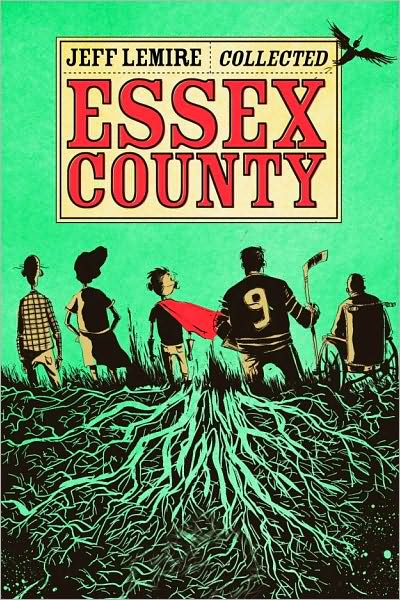
Book-A-Day 2018 #92: Essex County by Jeff Lemire
An omnibus can bring together things that stood well on their own, but work more strongly together. Or it can drag things into one place just for the novelty of volume -- that's fine, since bigger is still nice -- which is more common in our fallen world.
I'm happy to say that Jeff Lemire's Essex County is the first kind of omnibus: there are connections in the three graphic novels collected here that become much clearer when they're all in one volume. And the extras included at the end, nearly obligatory these days, actually add to and extend the main story, showing roads Lemire went down a short way and was going to integrate more strongly with the whole until he thought better of it.
Essex County comprises a trilogy of graphic novels that were nearly the first things Lemire published: Tales from the Farm, Ghost Stories, and The Country Nurse. (Back in 2008, I covered Ghost Stories and Country Nurse for ComicMix.) Up front is an introduction by Darwyn Cooke, new for the combined edition in 2009. And at the end are two related short stories, "The Essex County Boxing Club" and "The Sad and Lonely Life of Eddie Elephant-Ears," which started out as part of Country Nurse but were extracted during the creation process. And then last is a collection of bonus material: promo art, character designs, unused pages.
Tales looks a little rougher and less-formed in its art than the later books, but Lemire settled into his mature style -- as blocky and rough-hewn as it is, full of distorted faces and inky, bleak Canadian landscapes -- pretty quickly. (Some people might say that all of Lemire's work looks too rough or less-formed; those people are called Philistines.)
And the stories are very much the same sort of thing Lemire has gone on to focus on in his personal work: small-time Canadians, who never dreamed of very much but didn't even get that, caught up in long family stories and connected deeply to people who they'll never talk to again. There's a lot of hockey, a lot of farming, a lot of hard work at mostly blue-collar jobs. And, again, the three books of Essex County each tell a separate story like that, but the three together interlock to tell that same story on a larger scale.
So this is the story of a family and a place, over the course of close to a century. They have it tough, but they're tough people: they know how to survive. Well, we all survive up until the point that we don't, and they're no different.
Essex County is a major achievement in comics -- it won the Alex award from the ALA, the Doug Wright Award, and the Joe Shuster Award. And it's a major achievement as a Canadian novel, selected in 2011 as one of the "Essential Canadian Novels of the Decade." It's, as my favorite Vice President might have said, a big fucking deal. And it's a great story on top of that, told by a great storyteller. Read it, if you haven't already.
If you have, read it again.
I'm happy to say that Jeff Lemire's Essex County is the first kind of omnibus: there are connections in the three graphic novels collected here that become much clearer when they're all in one volume. And the extras included at the end, nearly obligatory these days, actually add to and extend the main story, showing roads Lemire went down a short way and was going to integrate more strongly with the whole until he thought better of it.
Essex County comprises a trilogy of graphic novels that were nearly the first things Lemire published: Tales from the Farm, Ghost Stories, and The Country Nurse. (Back in 2008, I covered Ghost Stories and Country Nurse for ComicMix.) Up front is an introduction by Darwyn Cooke, new for the combined edition in 2009. And at the end are two related short stories, "The Essex County Boxing Club" and "The Sad and Lonely Life of Eddie Elephant-Ears," which started out as part of Country Nurse but were extracted during the creation process. And then last is a collection of bonus material: promo art, character designs, unused pages.
Tales looks a little rougher and less-formed in its art than the later books, but Lemire settled into his mature style -- as blocky and rough-hewn as it is, full of distorted faces and inky, bleak Canadian landscapes -- pretty quickly. (Some people might say that all of Lemire's work looks too rough or less-formed; those people are called Philistines.)
And the stories are very much the same sort of thing Lemire has gone on to focus on in his personal work: small-time Canadians, who never dreamed of very much but didn't even get that, caught up in long family stories and connected deeply to people who they'll never talk to again. There's a lot of hockey, a lot of farming, a lot of hard work at mostly blue-collar jobs. And, again, the three books of Essex County each tell a separate story like that, but the three together interlock to tell that same story on a larger scale.
So this is the story of a family and a place, over the course of close to a century. They have it tough, but they're tough people: they know how to survive. Well, we all survive up until the point that we don't, and they're no different.
Essex County is a major achievement in comics -- it won the Alex award from the ALA, the Doug Wright Award, and the Joe Shuster Award. And it's a major achievement as a Canadian novel, selected in 2011 as one of the "Essential Canadian Novels of the Decade." It's, as my favorite Vice President might have said, a big fucking deal. And it's a great story on top of that, told by a great storyteller. Read it, if you haven't already.
If you have, read it again.
Recurring Motifs:
Book-A-Day,
Comics,
O Canada,
Reviews
Reviewing the Mail: Week of 3/31/18
As long-time readers of this blog know, every Monday morning I list whatever books have arrived over the past week. Originally, that was limited to new titles sent by publishers for publicity purposes, but I recently decided that was too limiting and started including everything: books I bought, books from the library, books reveled to me by mystic forces in a sudden flexing of the laws of time and space.
But, even with that expanded remit, there's no guarantee I'll have anything to mention in a given week. I suppose I could organize my life so that I always buy at least one book a week -- and that probably wouldn't be that difficult, though my wife might not be entirely happy -- but that's too much trouble.
This is one of those weeks: you've probably guessed. There are about a dozen books wending their way to me via library holds, but none of them are in hand yet. And I didn't buy anything this week.
So I'm just left to hope you all had a happy spring-solstice religious festival of your choice over the weekend, and wish you joy and wonder this week.
But, even with that expanded remit, there's no guarantee I'll have anything to mention in a given week. I suppose I could organize my life so that I always buy at least one book a week -- and that probably wouldn't be that difficult, though my wife might not be entirely happy -- but that's too much trouble.
This is one of those weeks: you've probably guessed. There are about a dozen books wending their way to me via library holds, but none of them are in hand yet. And I didn't buy anything this week.
So I'm just left to hope you all had a happy spring-solstice religious festival of your choice over the weekend, and wish you joy and wonder this week.
Recurring Motifs:
Reviewing the Mail
Sunday, April 01, 2018
Book-A-Day 2018 #91: Ted McKeever's Meta4
Well, this is going to be difficult to write about. Let's see if I can figure out a way into it. Maybe facts are a way to begin.
Ted McKeever is a quirky, idiosyncratic comics creator, who started out with deeply personal, bizarre books like Transit and Eddy Current but eventually, like so many before him, gravitated to drawing superhero comics for the Big Two, presumably because he liked eating regularly and keeping a roof over his head. (We all like that, don't we?)
On one of his returns from that world of commerce, in 2010, he put out another quirky, personal comics series, in five individual black-and-white issues. That was Ted McKeever's Meta4, collected into one volume a year later.
The story is driven as much by images as by plot, with events that may be real or may be symbolic -- or both. And what it all "means" is subject to interpretation: McKeever may have some specific ideas in mind, but he made comics pages that are deliberately cryptic and opaque. Every reader may come out of Meta4 with a different idea; many of them may have the idea "this is not for me at all." And that's all fine.
What happens? A man in a space suit -- call him an astronaut -- is at Coney Island, amnesiac. He is befriended/saved/abducted/overwhelmed by a large bald woman in a Santa Claus suit, who eventually lets him know her name is Gasolina. (Her speech, in the comics, is presented only in dingbats.) He has scars, markings on his body that she is sure is a map. So she burns down her tattoo shop and the two of them hop, hobo-style, into a boxcar to head west and find our the spaceman's secrets. His name, maybe, is Bzoma, from a receipt in his pocket. What they find out west is a secret government project, obviously, but they don't quite get there and phantasmagorical things happen in the vicinity. The story ends with images of the spaceman, naked in the wilderness, with a mark on his head that makes him look really oddly like Watchmen's Dr. Manhattan. (Perhaps the whole thing is a metaphor about McKeever's time in corporate comics? I doubt it's as simple as that.)
There's also a female pilot, who the spaceman may have seen die as a boy -- may have caused her plane crash by throwing a rock. And there's radio dialogue from police and their dispatchers responding to some mass shooting incident, where they can't find the shooter.
Again, all of that may be real, or metaphorical, or both at once. It may all be connected, or separate. It may what you believe it is, or it may be what McKeever wanted it to be. It may be art, or it may be a confusing mess. You get to decide.
I found McKeever's art here to be amazing, working with all of the tools of ink and white space, light and dark -- from scratchy pen lines to inky blobs, from super-realistic to ultra-cartoony. As you might have guessed, I connected less with the story: there's clearly something here that McKeever wanted to put out, but it's not presented in any way I can make clear, to myself or anyone else.
If you like experimental, weird comics, McKeever is someone to dive into. If you hate that kind of stuff, though, you will probably not enjoy his work.
Ted McKeever is a quirky, idiosyncratic comics creator, who started out with deeply personal, bizarre books like Transit and Eddy Current but eventually, like so many before him, gravitated to drawing superhero comics for the Big Two, presumably because he liked eating regularly and keeping a roof over his head. (We all like that, don't we?)
On one of his returns from that world of commerce, in 2010, he put out another quirky, personal comics series, in five individual black-and-white issues. That was Ted McKeever's Meta4, collected into one volume a year later.
The story is driven as much by images as by plot, with events that may be real or may be symbolic -- or both. And what it all "means" is subject to interpretation: McKeever may have some specific ideas in mind, but he made comics pages that are deliberately cryptic and opaque. Every reader may come out of Meta4 with a different idea; many of them may have the idea "this is not for me at all." And that's all fine.
What happens? A man in a space suit -- call him an astronaut -- is at Coney Island, amnesiac. He is befriended/saved/abducted/overwhelmed by a large bald woman in a Santa Claus suit, who eventually lets him know her name is Gasolina. (Her speech, in the comics, is presented only in dingbats.) He has scars, markings on his body that she is sure is a map. So she burns down her tattoo shop and the two of them hop, hobo-style, into a boxcar to head west and find our the spaceman's secrets. His name, maybe, is Bzoma, from a receipt in his pocket. What they find out west is a secret government project, obviously, but they don't quite get there and phantasmagorical things happen in the vicinity. The story ends with images of the spaceman, naked in the wilderness, with a mark on his head that makes him look really oddly like Watchmen's Dr. Manhattan. (Perhaps the whole thing is a metaphor about McKeever's time in corporate comics? I doubt it's as simple as that.)
There's also a female pilot, who the spaceman may have seen die as a boy -- may have caused her plane crash by throwing a rock. And there's radio dialogue from police and their dispatchers responding to some mass shooting incident, where they can't find the shooter.
Again, all of that may be real, or metaphorical, or both at once. It may all be connected, or separate. It may what you believe it is, or it may be what McKeever wanted it to be. It may be art, or it may be a confusing mess. You get to decide.
I found McKeever's art here to be amazing, working with all of the tools of ink and white space, light and dark -- from scratchy pen lines to inky blobs, from super-realistic to ultra-cartoony. As you might have guessed, I connected less with the story: there's clearly something here that McKeever wanted to put out, but it's not presented in any way I can make clear, to myself or anyone else.
If you like experimental, weird comics, McKeever is someone to dive into. If you hate that kind of stuff, though, you will probably not enjoy his work.
Recurring Motifs:
Book-A-Day,
Comics,
Reviews
Read in March 2018
Not to jinx it, but...I seem to be chugging along with this Book-A-Day thing. My comics shelves are noticeably less full than they were a couple of months ago, and I'm getting the posts out every day like clockwork.
This means something is about to go horribly wrong, doesn't it?
Thu Bui, The Best We Could Do (3/1)
Marjorie Liu and Sana Takeda, Monstress, Vol. 1: Awakening (3/2)
Cecil Castellucci and Marley Zarcone, Shade the Changing Girl, Vol. 1: Earth Girl Made Easy (3/3)
Jonathan Lethem, editor, The Best American Comics 2015 (3/4)
Roz Chast, editor, The Best American Comics 2016 (3/5)
Stewart O'Nan, The Night Country (3/5)
Batton Lash, The Soddyssey and Other Tales of Supernatural Law (3/6)
Batton Lash, The Werewolf of New York (3/7)
Ryan North and Erica Henderson, The Unbeatable Squirrel Girl, Vol. 3: Squirrel, You Really Got Me Now (3/8)
Frank Miller, Brian Azzarello, Andy Kubert, and Klaus Jason, Batman: The Dark Knight: Master Race (3/9)
Kyle Baker, Nat Turner (3/10)
Paul Grist and Phil Elliott, Jack Staff, Vol. 2: Soldiers (3/11)
Charles Forsman, I Am Not Okay With This (3/12)
Pascal Girard, Nicolas (3/13)
Eleanor Davis, You & A Bike & A Road (3/14)
Bill Corbett and Len Peralta, Super-Powered Revenge Christmas (3/15)
Sergio Aragones, Mark Evanier, and Thomas Yeates, Groo Vs. Conan (3/16)
Jeff Lemire and Dustin Nguyen, Descender, Vol. 4 (3/17)
Brian K. Vaughan and Cliff Chiang, Paper Girls, Vol. 3 (3/18)
Cassandra Jean, Reindeer Boy (3/19)
Alan Moore and Kevin O'Neill, Nemo: Heart of Ice (3/20)
Alan Moore and Kevin O'Neill, Nemo: The Roses of Berlin (3/21)
Dan Wells, Nothing Left To Lose (3/21)
Alan Moore and Kevin O'Neill, Nemo: River of Ghosts (3/22)
Ted McKeever's Meta4 (3/23)
Jeff Lemire, Essex County (3/24)
Nina Bunjevac, Fatherland (3/25)
Nick Bertozzi, Lewis & Clark (3/26)
Mike Mignola, Chris Roberson and Paul Grist, The Visitor: How and Why He Stayed (3/27)
Mike Mignola, Chris Roberson and Christopher Mitten, Rise of the Black Flame (3/28)
Nicholson Baker, The Anthologist (3/28)
Brian K. Vaughan and Fiona Staples, Saga, Vol. 8 (3/29)
Gretchen Edgren, The Playmate Book (3/29)
Masamune Shirow, The Ghost in the Shell (3/30)
Frederik Peeters, Aama, Vol. 3: The Dust of Mirrors (3/31)
That's 35 books, for the third month in a row. If I can keep up this pace, I might even beat my record for most books read in a year. (That's currently 419, set in 1993: a year when I didn't have the Internet or children to distract me, plus I was reading for a living.) Of course, we all know any "if this goes on" projection is guaranteed to be wrong.
This means something is about to go horribly wrong, doesn't it?
Thu Bui, The Best We Could Do (3/1)
Marjorie Liu and Sana Takeda, Monstress, Vol. 1: Awakening (3/2)
Cecil Castellucci and Marley Zarcone, Shade the Changing Girl, Vol. 1: Earth Girl Made Easy (3/3)
Jonathan Lethem, editor, The Best American Comics 2015 (3/4)
Roz Chast, editor, The Best American Comics 2016 (3/5)
Stewart O'Nan, The Night Country (3/5)
Batton Lash, The Soddyssey and Other Tales of Supernatural Law (3/6)
Batton Lash, The Werewolf of New York (3/7)
Ryan North and Erica Henderson, The Unbeatable Squirrel Girl, Vol. 3: Squirrel, You Really Got Me Now (3/8)
Frank Miller, Brian Azzarello, Andy Kubert, and Klaus Jason, Batman: The Dark Knight: Master Race (3/9)
Kyle Baker, Nat Turner (3/10)
Paul Grist and Phil Elliott, Jack Staff, Vol. 2: Soldiers (3/11)
Charles Forsman, I Am Not Okay With This (3/12)
Pascal Girard, Nicolas (3/13)
Eleanor Davis, You & A Bike & A Road (3/14)
Bill Corbett and Len Peralta, Super-Powered Revenge Christmas (3/15)
Sergio Aragones, Mark Evanier, and Thomas Yeates, Groo Vs. Conan (3/16)
Jeff Lemire and Dustin Nguyen, Descender, Vol. 4 (3/17)
Brian K. Vaughan and Cliff Chiang, Paper Girls, Vol. 3 (3/18)
Cassandra Jean, Reindeer Boy (3/19)
Alan Moore and Kevin O'Neill, Nemo: Heart of Ice (3/20)
Alan Moore and Kevin O'Neill, Nemo: The Roses of Berlin (3/21)
Dan Wells, Nothing Left To Lose (3/21)
Alan Moore and Kevin O'Neill, Nemo: River of Ghosts (3/22)
Ted McKeever's Meta4 (3/23)
Jeff Lemire, Essex County (3/24)
Nina Bunjevac, Fatherland (3/25)
Nick Bertozzi, Lewis & Clark (3/26)
Mike Mignola, Chris Roberson and Paul Grist, The Visitor: How and Why He Stayed (3/27)
Mike Mignola, Chris Roberson and Christopher Mitten, Rise of the Black Flame (3/28)
Nicholson Baker, The Anthologist (3/28)
Brian K. Vaughan and Fiona Staples, Saga, Vol. 8 (3/29)
Gretchen Edgren, The Playmate Book (3/29)
Masamune Shirow, The Ghost in the Shell (3/30)
Frederik Peeters, Aama, Vol. 3: The Dust of Mirrors (3/31)
That's 35 books, for the third month in a row. If I can keep up this pace, I might even beat my record for most books read in a year. (That's currently 419, set in 1993: a year when I didn't have the Internet or children to distract me, plus I was reading for a living.) Of course, we all know any "if this goes on" projection is guaranteed to be wrong.
Recurring Motifs:
Books Read
Subscribe to:
Posts (Atom)