Wednesday, May 06, 2020

Trillin on Texas by Calvin Trillin

Sitting in the drafts on this very blog is an essay I will never write -- almost the only thing on paper is the title: "I Am Not Calvin Trillin's Son-in-Law."

I'm not going to explain that here. I'm not sure I could. That's what the essay would have done, if I were able to do it. But Trillin is a writer I've been reading for thirty years, since I think my earliest working days, and is one of the best models I know of how to be a good writer and a good man: funny, pointed, true, dogged, smart, engaged, whimsical, honest, committed, clear-eyed.

As you go through life, people ask in passing who your heroes are, who you look up to. I've never been good at those questions: I tend to say I don't have any. But I suppose my heroes are newspapermen and similar jobbing writers, the ones I read a lot of when I was young and impressionable, whose path I wanted to follow while knowing I never would. Trillin. Art Buchwald. Russell Baker. Dave Barry, sometimes. Mike Royko. Roger Ebert.

But mostly Trillin. He combined a regular-guy honesty and plain-spokenness with the real writing chops befitting a New Yorker staff writer. He had a deep understanding of the sneakiness and chicanery of political life that never descended into simple cynicism, like a Molly Ivins who somehow maintained optimism and focus despite it all. And I kept reading Trillin whenever I could even for the twenty years or so that I was officially on the other side of the great American political divide. (I still tend to say, when asked, that I am registered as a Republican, as if that was an event that can't be taken back.)

And here I am writing about him in the past tense. Calvin Trillin is still very much with us, in his mid-eighties, still living in Greenwich Village as he has for fifty years or so. But his most recent books of new work were a slim book of doggerel about the 2012 presidential election and the 2016 children's book No Fair! No Fair!, so he may be semi-retired at this point. And I've always thought his prose was much better than his verse -- frankly, I think everyone does, even Trillin, but he enjoys writing verse and when you're an American icon in your eighties you can do what you want.

So we're in the era where the "new" Trillin books are collections -- 2011's Quite Enough, the racial-relations-themed Jackson, 1964 from 2016 (which I still haven't seen myself). And the subject of this blog post: Trillin on Texas, an oddity from a writer born in Kansas City and associated strongly with New York, published in 2011 by the University of Texas Press.

It's relatively short, with eighteen pieces in its hundred-and-eighty pages, plus a quick intro from Trillin. Those pieces originally appeared from 1970 through 2008, and all of them (except a funeral oration for Molly Ivins) originally appeared somewhere journalistic (mostly the New Yorker) and likely also appeared in a more general Trillin collection. So this is a book for Trillin completists and readers of Texiana (is that the word I mean? frankly, is it a word at all?).

I don't care all that much about Texas myself -- I mean, a whole lot of my current colleagues live and work there, in the Dallas area, and I like and respect them, and I do have a cousin and her family in Austin, but it's not one of my top five states -- so I was here as a Trillin completist. And I was not disappointed.

The pieces here are semi-random, and arranged in a pleasing order that has no obvious structure -- it's not chronological, and if it's geographical, I'd have to plot it out on a map to understand it. But each of them is smart and witty and full of great Trillin lines -- look, here's a semi-random quote, from "Mystery Money" on p.21:
The City of Waco found that having nearly five hundred thousand dollars in cash was a burden. The money had to be kept somewhere. I had to be guarded. It represented a potential liability if it got lost or if the city was sued for giving it to the wrong parties. A lot of parties were asking for it.
I'm not actually recommending this book, unless you're a) already a Trillin fan who didn't know about it or b) a Texan who needs an excuse like this to try Trillin. Otherwise, head to his collections of columns (my pick: Enough's Enough, the title essay of which influenced my parenting style as much as the dad from Calvin and Hobbes), or his books about food (best collected in The Tummy Trilogy) or the great Travels With Alice.

Actually, just start with Travels With Alice. I did, thirty years ago, and it's just as good now. Someday, you'll get to the other end of his books and pick up Trillin on Texas. It'll be there waiting for you.

Tuesday, May 05, 2020

Totally Weird and Wonderful Words edited by Erin McKean

There are different kinds of people in the world. We've all heard of a "people person" or an "animal person," and we could extend that schema to include people who prefer complicated machinery (hardware and/or software), to those who only care about the appropriate gender for their amors, and to the people who care most about ideas.

Me, I'm a word person. I think we're one of the smaller of those tribes, but my first career was in book publishing, an entire industry built by and for word people, so I may just be indulging in the old "it is a proud and lonely thing to be like me, one of The Chosen People." There may be vast numbers of us. If you're reading this, you're probably among them.

(And, yes, it's a reductive idea and no person is actually just one of those things. I'm talking about tendencies and preferences here, obviously. Stop being so literal, bud.)

Totally Weird and Wonderful Words is a book for us. More than that: it's one of the best books for us -- for those of us who read and prefer the English language, at least. Erin McKean, one of the world's premier word-persons -- editor-in-chief of the Oxford American Dictionary Program and editor of Verbatim: The Language Quarterly -- compiled two collections of interesting and quirky words (2002's Weird and Wonderful Words and the following year's More Weird and Wonderful Words), which this 2006 book combines and integrates.

I won't claim that it has all of the weird and wonderful words in the English language; that would be patently false. But it does include several hundred of them, organized and explained by an expert.

McKean even explains what she means by "weird" and "wonderful" up front, in the new introduction to this compilation that sits alongside the original introductions for the individual books. (Scholarly publishers are the best for making sure to include every last possible bit of metatextual apparatus, and I love them for it.) A word is weird either orthographically -- because it has odd combinations of letters unusual in English -- or because it describes a weird idea or thing. Even better, a word can be weird in both ways. And a word is wonderful because it means something interesting, describing in one quirky word a feeling or thing that otherwise needs several full sentences, or that was difficult to explain at all -- it's wonderful because it evokes wonder, at the thing it depicts or that it exists at all.

I read this book back a ways -- it was my bathroom reading last autumn, and I finished it in early November -- so the specific words I was going to call out in this post have all fled my brain since then. But I can tell you I found something fun and exciting on every page: both the old favorites that I use myself and great quirky little-known words that I was previously unfamiliar with.

Many books of words are written for people who are only kind-of word people; they're half-hearted and hope to bring in the fabled (and mostly mythical) general audience. McKean has no time for that nonsense. Her book is filled entirely with the kinds of words she means, and nothing else -- every single one is both weird and wonderful. Totally Weird and Wonderful Words is for people who collect words, the ones who actually do have favorite words (among mine are antidisestablishmentarianism and preantepenultimate, for obvious silliness-of-prefix reasons), and those who actually prefer to read books of words for pleasure.

If that's you, and you haven't seen this book before, you're in for a treat.

Note: The first book had a cover and internal illustrations by Roz Chast. The second had a cover and internal illustrations by Danny Shanahan. This combined edition has the Chast cover and all of the internal illos from both -- unless you are a massive fan of Shanahan covers, it's clearly the preferred package.

Sunday, April 12, 2020

Low Content Mode = Time for a Personality Quiz!

Yes, I'm still here.

(Like all of us, I'm stuck here for the duration, sheltering in place even more than I was a month ago.)

About a week ago, Tor.com linked to what purported to be a more-serious version of the Internet staple, the "which tree are you?" quiz. (Tor post, actual link to the pompously named Open-Source Psychometrics’ Project’s Statistical “Which Character” Personality Quiz.)

And we all want to know which fictional characters (or tree, or small furry creatures, or Pirates of the Caribbean movies, or whatever) we are most like, don't we?

I know I did. And it was a Sunday where I couldn't really leave the house, so I ran through the quiz.

And (you have a to imagine a drumroll here, I'm afraid -- though some '90s homepages would have embedded a tinny sound of a drumroll, and who would have thought that era would have any web functionality that we'd want to keep?)....

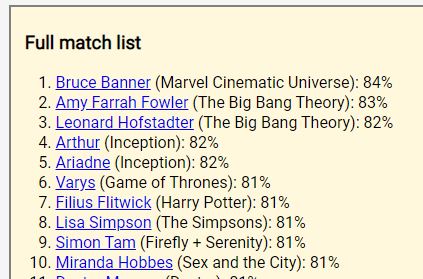
I am most like a character whose movies I have not seen:

But I like ol' Green Goliath -- I followed the Peter David run of the comic, more years ago now than I want to admit, and am fond of the Gamecube video game -- so that's fine with me.

The site gives an exhausting -- no, literally exhausting; it runs to 540 entries down to 22% matches -- list of also-rans, but who's got time for that? I took a quick screenshot of the top 10, which is what the site creators should have done (and put the rest behind a "obsessives click here" jump link).
Several of those characters are familiar to me, and I even agree with a couple of them. (Not totally thrilled with Flitwick as such, but happy to see my self-identification as Ravenclaw is confirmed.)

Anyway, I am hereby recording this for posterity, in case I ever want to know how closely I matched Lucius Fox (81%) or Mr. Darcy (80%) or Hermione Granger (80%) or Homer Simpson (26%) in the year 2020, sometime in my own indefinite future.

I hope this quiz gives you an equal amount of frivolous momentary amusement in this dark time.

Monday, March 30, 2020

Reviewing the Mail: Week of 3/28/20

So I think these two books have been in my hands for at least a week and maybe longer. Apologies to the fine publishing companies responsible for them (and for getting them into my hands), but I've been even more busy/distracted than usual the past little while.

(I've said to a couple of people that this pandemic has a severely asymmetrical affect on different people -- a lot of people have nothing to do, but a substantial group have vastly more to do. Obviously, medical personnel are in Category Two, but so are lots of attorneys, tax professionals, and risk-management/compliance folks, all of whom are the folks my company supports. So we're a bit busy, too. If you happen to be in one of those buckets, we have a global COVID-19 resource page with lots of free resources for your profession to help you navigate it for yourself and your business and/or clients. Hope it helps; hope you and your operations make it through this relatively unscathed.)

Anyway: books! They came in the mail!

I haven't looked at them, since I haven't picked up a book to read, um, this year? Maybe longer.

Catch-22 is on the corner of my desk mocking me right now, and the book I thought would be next off to the side and would be mocking me if it weren't under my Vassar alumnae magazine and so decently hidden. Some day I will read books again. These may even be the ones. Anyway, that ritual debasement out of the way, here we go...

The Immortal Conquistador is a standalone short fantasy novel (maybe novella? it's 184 pages in a 5 1/2 x 8 1/4 paperback format with reasonably sized type, so it might sneak it right around 40k words, and I'm not about to do a cast-off on it right now) by Carrie Vaughn, set in the world of her Kitty Norville books. (Which I where I point out I still have four of those -- not even including the last two -- sitting on my shelf to be read, even though the series has been dormant for five years now.)

Conquistador is about the vampire Rick, the five hundred year-old ex-conquistador (hence the title) originally known as Ricardo de Avila. It's not clear if this is his life story -- the whole "who he is and how he came to be!" thing -- or if it's a modern story in which he's the main character. It's available right now, in paperback form, from the fine people at Tachyon Publications. (Whose base in San Francisco I would have called one of the epicenters of the current pandemic in the US a couple of weeks ago, before my much-too-competitive NYC area muscled up to the top of the chart.)

The other book is entirely different: Goldie Vance: The Hotel Whodunit by Lilliam Rivera, which apparently is based on a comics series by Hope Larson and Brittney Williams. Goldie herself is an amateur teen detective, of the kind we've seen so many of over the years, based in the Crossed Palms resort in Florida, where her father is the manager. It's a middle-grade novel, and I suspect the comics series is pitched as the kind of "all-ages" book that kids actually do read, maybe more than the usual comic-shop crowd.

My guess is that Goldie is set in the modern day, but the plot of this novel has a major studio filming a big monster movie on Crossed Palms premises, so it may be a more interesting version of the modern day. This is the first Goldie novel, but I imagine the hope is that there will be many more; middle-grade readers love to fill up a shelf with the same thing and the publishers love to accommodate them. It's from Little, Brown Books for Young Readers, and was officially on sale March 17th.

Also: Goldie is biracial and some variety of queer, which will be a positive for a lot of those middle-grade readers (among others), and possibly a negative for people whose reaction will cause the rest of us to judge them. Just so you know, in case you have either of those reactions.

(Note that I'm giving links to that big hegemonic Internet bookstore, since I always do. But, given circumstances in the world, I'd actually recommend going to IndieBound instead and seeing if your local is doing mail-order and/or delivery/pick-up. It's tough out there right now for small business, so support the ones you want to still be around when we stop sheltering in place.)

Monday, February 24, 2020

Reviewing the Mail: Week of 2/22/20

Oh, don't even ask.

But I do have a few new books to mention this week!

Two of them came in the mail -- in a mailer heavily battered and repacked by someone claiming the unlikely name of "Nixie Sorter" and admitting there may have been other things, possibly wondrous and valuable things, in that package originally that were now irretrievably lost -- and one more was a book I just bought, perhaps because I still think of myself as someone who actually reads books. (Which I am not, at the moment.)

The two books in the mail both came from the Night Shade arm of Skyhorse, and I have to admit that I have no idea who the editorial staff is there these days, despite once knowing people on both sides of that equation quite well. (Well, I'm pretty sure Tony Lyons is still running Skyhorse, so hi to both him and whoever he hired to edit SFF for him.) Both are advance proofs; both are publishing in June; both will be hardcovers. And the two books are very different in nearly every way, which is nice for the field and for the health of the Night Shade program.

First up alphabetically (and in the package as repacked by the estimable Nixie) is Neal Asher's The Human, third in his current series "Rise of the Jain." Asher writes zippy, exciting space-opera adventure, and as I recall his super-science is generally on this side of the plausible line. (He's British, you know. No idea if that has anything to do with anything, but don't we colonials usually grant anyone with even the loutiest British Isles accent the benefit of the doubt?)

And then we have a book that's fantasy rather than sf, old rather than new -- The Best of Jules de Grandin by Seabury Quinn, a new collection edited by George Vanderburgh (who also edited Night Shade's previous five-volume collection of the complete de Grandin). Quinn is the great forgotten Weird Tales writer -- if you know the original Weird Tales at all, you think of Lovecraft and Howard first, maybe Clark Ashton Smith next, maybe August Derleth if you're a masochist. Quinn, in those days, was actually more consistently popular than any of those [1], and his work has been occasionally re-discovered since then, only to fall into obscurity again and again. de Grandin is his most famous character, an occult detective based in Harrisonville, NJ, whose stories were told in the Sherlock Holmes manner by his assistant, Dr. Samuel Trowbridge. I have to admit that I've never read Quinn, but having a nice new collection of twenty of the best stories of his most famous character definitely moves him up the list. Maybe it would for you as well?

And last is The Eye of Mongombo, the first third of a long-thought-dead comics series by Doug Gray. Eye was originally supposed to be a twelve-issue comics series from Fantagraphics; it started in mid-1989 and ran for seven issues before Gray quietly walked away. Last year, he popped back up with a Kickstarter to finally finish it off -- the project didn't hit its goals but he went forward anyway, and this first volume is now available via Lulu. (If you're reading this in the future, Grey intends to get the book onto the usual bookselling platforms, so you could check there as well. I bought a copy almost as soon as he announced it.) Eye is a wacky adventure comic about a two-fisted Indiana Jones type (Cliff Carlson) who was turned into a duck and thrown headlong into the usual high-adventure chase for a mysterious artifact in South America. I liked it a lot the first time around, and I have an obvious interest in people who were in an interesting creative field, disappeared for a while, and then came back.


[1] Though, frankly, if I had to bet, the most popular creator for Weird Tales was Margaret Brundage...who was not a writer at all.

Saturday, January 25, 2020

Metaphorical Love

Here's a song I'm liking a lot recently. I gather from the comments on this YouTube version that the singer/songwriter, Kate Davis, has been playing it different ways for years, but this is the first time I've heard her stuff.

I am a sucker for tricky, sneaky metaphors, and I love that about this song. But she also sings it compellingly, and lets the song do its own thing without getting in its way.

The video is oddly more impactful than just listening to the song -- visuals are pretty simple, but it really leans into the heart of the metaphor.

Anyway, here's "Open Heart" by Kate Davis. I gather it's on her new record, Trophy.

Monday, January 13, 2020

Reviewing the Mail: Week of 1/11/19

Most of this stuff came in last week, but you may have noticed by now that this blog is in extremely low-content mode. (You may also have guessed that I've been neglecting it.) But I did get the following books recently, and I wanted to mention them.

One came in from a publisher -- bless their hearts! I have no idea why I'm still on anyone's publicity lists at this point -- and three were purchases from Fantagraphic's big Cyber Monday sale that were delayed in transit to me for various reasons.

Publicity:

Hilo, Vol. 6: All the Pieces Fit is the latest in the young-readers graphic-novel series by Judd Winick, who probably wishes people like me wouldn't still think of him as "that guy from an early reality show, you know, the one whose gay friend later died". Hilo is the kid with glowy hands on the cover: he's a robot superhero, more or less, and he's been chasing the Big Bad (Razorwark! a very appropriately Big Bad name) for five books now. This is promised to be the big finale. I read the first book a few years back, and buried a quick note about it in a long post covering everything I read for two months. All the Pieces Fit is a hardcover from Random House Books for Young Readers, on sale February 4.

Fantagraphics Sale:

Free Shit is a collection of a minicomic Charles Burns has done for shows and festivals for years -- and maybe just made up to send to friends -- with sketches and little drawings and random stuff. (Doesn't seem to have any story content, as you'd expect from a sketchbook.) This book collects the first twenty-five issues.

Reincarnation Stories is the new graphic novel from Kim Deitch, which means two things: it's going to be largely about some oddball corner of the entertainment world in the early 20th century, and Kim Deitch is going to be a major character in what seems to be a fictional, even fantastical, story. In this case, it's all about how he is -- or may be -- the reincarnation of minor (fictional) Hollywood figure Sid Pincus, and how that's manifested throughout his life. Reviews have been great, and Deitch is a master, so I'm looking forward to it.

And last is Tonta, the latest collection of stories from the current incarnation of Love & Rockets by Jaime Hernandez. (As opposed to the latest collection of stories from the current incarnation of Love & Rockets by his brother Gilbert, which I'd have to check to figure out which book that was). It's about The Frogmouth's goofy half-sister, the one Jaime draws with the face he previously reserved only for old ladies, though I think she's just supposed to be a not-conventionally-attractive teenager. (Jaime, for all his skill and ability, has not spent much time drawing people who are not conventionally attractive. Like, hardly any time.)

Friday, January 03, 2020

Quote of the Week: Retail Politics

Normally, officeholders in a state like Texas have differed from eminent public servants in the federal government  primarily in the way some social scientists claim that lower-class Americans differ from those Americans who have arrived in the middle class -- an inability to defer reward. A commissioner of an important federal regulatory agency is content to live on his government salary, secure in the knowledge that his next job may be as a highly paid executive or counsel in the industry he has been regulating. Distinguished Washington lawyers who serve as deputy secretaries of one department or another are ordinarily not given large retainers to use their influence until after they resign their posts. In some states, though, it is understood that such patience is too much to ask of a poor frail human being who happens to find himself governor.
 - Calvin Trillin, "Reformer," originally published 1972 in The New Yorker, available in Trillin on Texas, p.174

Wednesday, January 01, 2020

Favorite Books of 2019

So this is not going to go the way it used to.

Typically, I have a long explanation up front -- see last year for a type specimen -- about how I do this, and why there are twelve books, and then list one top book for each month along with a few other things worth mentioning.

But there are several months in 2019 where I didn't finish a single book: 2019 has been a massive outlier in my reading life (and, I hope, not the new normal). So that style simply won't work.

To be more specific, I only read 44 books in 2019. That's not just down from 2018's record-breaking 433, it's less than a third of the previous low, 2017's 139. I just don't have a regular time or place for reading actual books in my life now, and it shows.

I started typing this thinking that I would end up with a shorter list -- four or five books, maybe -- of recent things I read this year and can recommend. But I also almost completely stopped reading new books as the year went on, instead trying ever-more-powerful re-reads and classics to try to jump-start my reading enthusiasm (current candidate: Catch-22).

So that shorter list would actually be the first three things I read, back in January -- Neil Gaiman's Norse Mythology, Charles Stross's The Labyrinth Index, and Steve Erickson's Shadowbahn. And that seems more than a little pointless.

In the end, I do not have a list of favorite books that I read in 2019. In fact, I'd like to forget the way I was reading in 2019, along with a lot of other things about 2019, as quickly as possible.

(Also: in past years I would do another first-of-the-year post linking back to the first and last posts of the prior year. Since I've also been posting vastly less often this year, I'm not going to do that at all.)

I have no idea how 2020 will go. I'm coming to think I need some kind of structure in my reading life, as I did in 2018 (when I had basically the same physical set-up and working life as 2019). And "do this every day" clearly works well for me. But the book-a-day metric tends to push me to often-junky graphic novels and manga, which isn't what I want. So I may need to set a page goal: we'll see.

Anyway. I hope 2019 was less frustrating for you (in this way, at least) than it was for me. And best wishes for a better 2020.

Tuesday, December 31, 2019

Reviewing the Mail: Week of 12/28

Normally, since I missed yesterday for lazy-on-vacation reasons, I'd just roll these books over to next week. But next week is an entirely different year, and I'm also trying to procrastinate slightly less these days.

So enjoy this unprecedented Tuesday edition of Reviewing the Mail!

This time out, I have two books that came in the mail, in radically different genres, and four graphic novels that I bought for myself so that The Wife could give them to me for Christmas. (It's not the most surprising way to get gifts, but it can't be beaten for receiving things you actually want.)

From the Mail:

Peter Watts is an Angry Sentient Tumor is a collection of "revenge fantasies and essays" by the title character/individual/writer. I think it's just a quirkier take on the standard "fiction writer's random nonfiction works" book, but it could, I suppose, be a themed series of very detailed murder plots against people he hates. (That would be out of character for a Canadian, I suppose. Probably isn't.) From a quick glance at the intro, it looks like these pieces originally appeared on Watts's blog over the past decade and a half or so. And now they're all in this book, which was published by Tachyon in November.

Real Pigeons Fight Crime by Andrew McDonald and Ben Wood is one of those pseudo-graphic-novel thingies -- lots of illustrations on each page, with dynamic art that has some sequential elements but isn't laid out as panels, and typeset text running around and between that art -- for younger readers that are so popular these days. It is, as you might guess, about talking pigeons, and I gather that they do fight crime. It's also the first in a series: Eat Danger and Nest Hard are promised as forthcoming. It's coming from Random House Books for Young Readers in January 7, and it looks like a hoot for a certain kind of younger reader (or maybe a no-longer-younger reader, I won't judge).

Pressies (No, the other kind of pressies!):

Maria M. by Gilbert Hernandez -- the full noir story, originally promised as two volumes but eventually (after the first volume was published, and I bought it, and it sat on my shelf for several years waiting for the end so I could read the whole thing) published as one book this past year. I think this is part of his "fictional movies from the world of Palomar" series, or maybe an even weirder variation on that: it may be the movie Killer made about Maria, or an alternate version of that movie without Killer. I dunno; I'll have to read it.

O Josephine! is the latest collection of comics stories by Jason, the Norwegian cartoonist who is nearly impossible to Google. It has four roughly album-length stories in its hundred and eighty pages, three of which seem to be his usual fiction and one the non-fictional story of a walk he took in Ireland (either a follow-up or warm-up to his book On the Camino).

How I Tried to Be a Good Person is a big fat graphic memoir by Austrian cartoonist Ulli Lust, and so basically a sequel to Today Is the Last Day of the Rest of Your Life, covering a polyamorous love triangle she was involved with some time ago -- the book seems to be vague about exactly when, but I'd guess late '80s or early '90s given that Last Day took in place in 1984, when she was 17.

And last is Glen Ganges in: The River at Night by Kevin Huizenga, which includes the title character's name in the title as if it were a Batman comic when it is in fact about as far from a Batman comic as it is possible to be. (And that is a good thing.) Huizenga is thoughtful and philosophical and grounded and deeply human, and this book has gotten great reviews -- I'm looking forward to it.

Monday, December 23, 2019

Musica, Dein Kannst Lieblich Kunst

No, I don't speak German. (My younger son does, kind of. At least he took it for five years in school.) But my high school Madrigal group -- did I ever mention I was in a madrigal group in high school? I wasn't very good, and am retroactively surprised that they kept me around -- did that song, and it's been stuck in my head ever since.

It emerges randomly for no good reason, and I can't even sing the thing because I 1) don't remember the German well enough b) can't pronounce the German even if I did know the right words, and III) I can't now sing even as well as I did in high school, which (as I noted above) was not that good to begin with.

For instance, right now, when I'm trying to introduce a Spotify playlist of some of my favorite songs of the past decade, instead I'm rambling about a german choral piece that has nothing to do with any of it. One might think I'm doing this deliberately.

One might even be right....

A lot of people do lists like this at the end of a year, but I don't really listen to enough new music in any one year to make a decent list. However, I saw that the estimable John Scalzi (of whom you may have heard) recently did one for the last decade.

And I thought: "Aha, that's a trick worth stealing." And so I did.

Since the calendar is turning over two digits instead of one in about a week, suddenly any list covering 10 years is just as good -- maybe better -- than one covering this current year. (And, frankly, it wouldn't be hard for anything to be better than this current year.) So here I am.

I'm shamelessly stealing Scalzi's shtick: only one song per performer, that being my favorite for the past decade (but standing in for a lot of other stuff, obviously), and even using Spotify as my widget of choice, since it's free. My list however, is longer than his, because I'm lazier: my initial list had 56 songs, and after a first cut I had exactly fifty, which was such a nice round number I stopped.

The widget seems to default to the order I put them in, which isn't definitive by any means. And I have no way of knowing if you will share any of my musical tastes: I go for either talky stuff or noisy instrumentals, across a few musical subgenres.

I hope you enjoy this; I was just reminded I wanted to do it by seeing webcomics genius John Allison do his list of forty albums for this year alone. And if you don't enjoy it...oh weell.

After the widget: three songs I would have added, but Spotify didn't have them.


The sadly missing:

Empty Space Orchestra, "Exit Strategy"

Yellow Ostrich, "'Til I Disappear" (the album version is longer, but this is the version I like better)


Harvey Danger, "The Show Must Not Go On" (their break-up song, released online something like a year after they actually broke up)

Monday, December 16, 2019

Reviewing the Mail: Week of 12/14/19

I have a book to write about this week as well: a new SF novel.

Lost Helix is by Scott Coon, and I think it's his first novel. (The materials don't mention any earlier novels, and do mention multiple short fiction publications.) It's coming from Dancing Lemur Press in trade paperback, and will hit on June 2, 2020.

It sounds like general SF adventure: our hero is a young man named DJ, who grew up on an asteroid mining facility but isn't interested in any of the obvious life-paths on offer there. But he gets thrown into intrigue when he learns some things he wasn't supposed to, and is soon on the run from the relentless Agent Coreman. (DJ is also a musician, which looks like it could be important to the book -- he's not just some general slacker, but a specific guy with specific dreams.) This all sounds interplanetary rather than interstellar, but the description doesn't make it clear either way.

You will have to wait a bit for Lost Helix, I'm afraid, so if that sounds intriguing, set your calendar now.

Monday, December 09, 2019

Reviewing the Mail: Week of 12/7/19

I aten't dead.

But this blog only exists in as much as I have something to say here, and I haven't had a lot of that lately. Work has been weird this year, in all sorts of ways, and that's disrupted my reading. And the outside world is even more of a dumpster fire in 2019 than it was before...and I don't want to go directly political here. So I've been quiet.

But I'm still here, and this blog will pick up when and if I have things to write about. If I start reading more, for example. Or if I get shiny new books.

As it happens, I have a shiny new book today: The Deep & Dark Blue, a middle-grade graphic novel by Niki Smith, Lambda-award-winning (well, as part of an anthology; does that count? maybe I should say "nominated" to be more strictly accurate) creator of Crossplay and other comics stories.

(I saw an early galley of the book back in the summer; that copy is still sitting unread on my shelf but will be replaced by the shiny new one in a moment...and I'd like to promise that the shiny new one will get read quickly, but...well, you know.)

This is an adventure story mixed with coming-out; twin tween nobles Hawke and Grayson are forced by a coup to flee and hide as Hanna and Grayce within the Communion of Blue, an all-female magical order whose powers manifest in weaving and other textile work. The coming-out part is that while Hawke seems to think of this as just a disguise, becoming Grayce is much more important, and central, to her. I expect it all ends up super-happy, since that's what middle-grade GNs do these days. (Woe is reserved for prose, and for a slightly older audience.)

The Deep and Dark Blue will be published in hardcover on January 7 by Little. Brown.

Monday, October 21, 2019

Reviewing the Mail: Week of 10/18/19

Three books came in the mail last week -- all things I purchased -- and somehow I neglected to write about them last Sunday.  So here they are:

Very British Problems is the book extension of a multi-media project -- I think it was a Twitter feed first, in that very 21st century way, but there's TV and radio and probably tea-cozies and woolly jumpers and Very British package holidays as well by now. The book is written by Rob Temple, and it's deeply stereotyped, but it's by British people, so that's OK.I am not actually British in any normal sense, but I am emotionally quite British by nature, since northeastern WASPs are their first cousins. Anyway, the book is a collection of small embarrassing, self-effacing moments of the kind that are generally humorous.

Threesome is an old Lawrence Block novel, originally published as by Jill Emerson, and it's a sex book. Block wrote a lot of sex books starting in the late '50s and running through the early '70s, and his main professional activity the last few years seem to have been republishing them under his actual name. I'm a huge Block fan, and I have vague ideas about getting all of those books, since even his early semi-lousy books have interesting aspects. I'm definitely going to pick off a few of the ones that seems to be better-written and/or quirkier, like this one -- the story of a menage a trois told by the three participants alternately.

Last is By Night, Vol. 1, the first collection of a new series written by my favorite webcomicer, John Allison. Allison has been doing more floppy comics lately -- probably because those have a more dependable revenue stream, and who can blame him? -- but it's meant that I'm forgetting to keep up with his work, and that's annoying. (For example, shouldn't there be a fourth "Not on the Test Edition" of Giant Days by now? I intend to keep up with that series, but it become difficult if the publisher changes formats and plans randomly in the middle.) This is quite Allisonian, in that it's the story of two (probably headstrong and highly verbal) teen girls who get involved with a supernatural portal in what seems to be a normal small town, and at the same time much less Allisonian, since that small town is in South Dakota rather than the British Midlands.

Friday, October 04, 2019

14th Anniversary Post

I have an excessively tidy mind, but it manifests in pretty idiosyncratic ways.

For example, October 4th was the 14th anniversary of the blog, and on that date every year (except the fifth and tenth, which I missed because...I guess I'm just a normal neurotic human being who undercuts himself) I put up a long post looking back at the prior year.

Doing that post takes a while, so I try to put it into my drafts early, so I can work on it over a period of days, if not weeks.

This year, I did create a dummy post, at least a week early.

And never typed a word into it.

Until today, December 8th, a good two months late.

So this is not that anniversary post. It is, instead, a monument to the fact that apparently I couldn't just delete the empty draft post like a normal person, but instead had to type this.

See you next year, possibly.