Wednesday, January 26, 2022

A Treasury of Victorian Murder, Vol. 1 by Rick Geary

I wrote about this book extensively just three years ago, during my last Book-A-Day run. And that post is a nice, straightforward explanation of what the book is, how it fits into Geary's larger career, and what a reader might get out of it.

I don't know if I can do better than that this time: you might want to just hit that link.

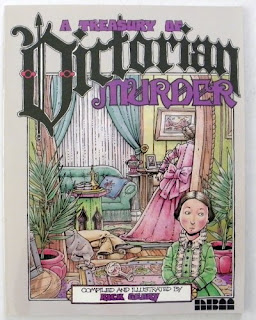
This time, writing about Rick Geary's A Treasury of Victorian Murder, Vol. 1, I want to look at the cover.

There it is: right in front of you. A cluttered High Victorian room, stuffed with things. So stuffed it takes a moment to notice the body sprawled on the floor; the woman stalking away to the right is more prominent. That's Geary for you: he'll promise murder, and deliver murder, but not be blatant about it. The murder is one thread of the story he wants to tell - the central thread, yes, the lurid thread, but all of the other objects in that room are just as carefully delineated, in his art and in his story.

And who is that in the foreground? I go back and forth: is that a child or a young woman? She could be sitting down, or she could be that short. She could be the murderess, or an innocent bystander, or a  neighbor whose unexpected visit caused the discovery of the heinous deed. Her face will not give away any of that: she's composed, but not calm. Is that a worried crease to her lips? What is she looking sideways at?

She's the one element of the cover that points outward to us the readers. She's our path into this image, our guide into the story we build in our own heads about the cover image. Perhaps I need to say here that it comes nowhere near the facts of any of the three stories in the book: it's clearly not illustrating anything within. This is a pure picture, a cover to be "A Treasury of Victorian Murder." The book will not tell us how to read this image. This cover stands alone: it implies a story Geary has not explicitly told.

It's also a moment: it's a comics cover, not an illustration. The figure at the front is glancing to her left; the woman in pink is stalking out of the room. There is motion throughout - this is not a static picture, but a moment in time, a moment that will be gone instantly. Something happened a second ago, something else will happen next. But what we have is this moment, as a window into this scene and this Victorian murder.

That's what Geary gives us. The cover is larger and more detailed than most of the panels in the stories inside - though not all of them; there are a couple of fold-out double-page spreads - but it's in their style and manner. This is what we find within: questions and moments, figures and mysteries, bodies and shocks, clutter and detail.

If the cover intrigues you, the book will do more than that.

Tuesday, January 25, 2022

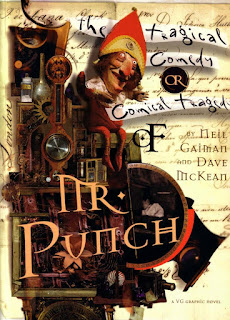
Mr. Punch by Neil Gaiman and Dave McKean

To me, the core Neil Gaiman stories are about young people, encountering things they don't understand. The Ocean at the End of the Lane. "How to Talk to Girls at Parties." Violent Cases. Coraline, something of an edge case - since the core set of stories are all about a young person like Gaiman.

And, of course, Mr. Punch.

I don't want to speculate how much of this story is "true." That's the wrong question anyway: the truth of a story is the story-ness of it, and this is a great story, told beautifully by Gaiman's words and Dave McKean's art. (I wish they had worked together more: they are each other's best collaborators.)

It's a graphic novel about a young British boy, about fifty years ago, remembered by that boy as a man, about twenty-five years later. So it's now as far back in time itself as the events it depicted were when it was published: this is a 1995 book about things that happened in the late '60s. The boy is Gaiman. Or he is not. Or, more accurately, that again is not the right question.

It's the story of how the boy learned about Punch and Judy shows, about his grandfather's failing seaside business, about family stories. Like all stories about childhood, it's about memory most of all: what is remembered, how it's remembered, what looms larger looking back than it did at the time. It is an intensely told story, constructed carefully by Gaiman even as it seems to be narrated off-the-cuff by the man in the story who is and is not Gaiman.

And, most of all, it's about the questions of childhood: the things you asked at the time, the things you wish you'd asked at the time, the things you know you never would have gotten a straight answer about, and the things you didn't even think could be questions until much much later.

Punch and Judy shows are alien to Americans: they don't exist here. I don't know if they exist in Britain, these days: I get the sense the boy in this book was from the last generation to see that kind of puppet theatre all over the place. So this might be entirely a dispatch from a foreign country: for all of us, everywhere.

That's entirely right, though: that was the point and purpose of Mr. Punch. It was always a dispatch from the foreign land of childhood, the land we all were born in and can never return to. And it's just as strong and thoughtful and moving now as it was then. Mr. Punch does not change with time, as Gaiman points out. He is always the same, always there, holding strong his side of the stage, eternally on the puppeteer's right hand.

Monday, January 24, 2022

Reviewing the Mail: Week of 1/22/22

One book this week: a publicity title that the publisher actually asked me if I wanted to see. (So I am feeling a certain internal pressure to actually read and post about it quickly, which is running up against my current six-week buffer on posts. Oh, modern problems!)

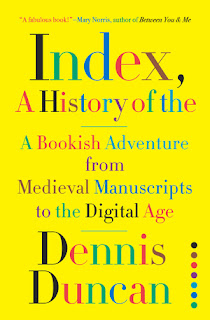
Index, A History of the is a new non-fiction book which does exactly what it says. Subtitle is "A Bookish Adventure from Medieval Manuscripts to the Digital Age," publisher is Norton, and it will be released into the wild on February 15 in hardcover. Author is Dennis Duncan, who teaches at University College London and writes for the usual classy outlets of that location (Times Literary Supplement, London Review of Books, Guardian).

It has a very impressive index of its own, as of course it must. The critical apparatus in general looks strong for a three-hundred-page book aimed at consumers: Norton knows how to make and publish books like this to an audience that wants borderline-frivolous topics treated seriously. (And I say that as a member of that audience.)

I expect this will be the next book I read, barring unforeseen circumstances: it looks like the kind of thing I'd enjoy.

Friday, January 21, 2022

Quote of the Week: Teas, High and Otherwise

Has there ever been a more English word than chutney? It's almost disappointing to discover that it's a name for a vinegary mush of spiced, preserved vegetables, and not, for example, an affectionate nickname given to the now-disgraced Earl of Lichmond-on-the-Blather by a beloved nanny. Part of the appeal is that it's an Indian word, coming to Britain in the days of English colonial rule and sticking delightfully to the tongue like itself on an en-Stiltoned cracker.
 - Fraser McAlpine, Stuff Brits Like, p. 86

Thursday, January 20, 2022

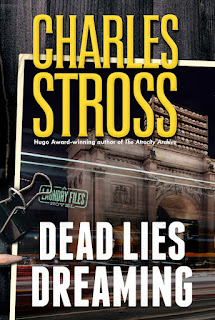
Dead Lies Dreaming by Charles Stross

I'm a year late and not as enthusiastic as I thought I would be: this will likely be short.

I've loved all of the previous books set in this world, but I had a hard time getting into Dead Lies Dreaming. This is not a "Laundry Files" book, partly because that government organization has been disbanded and partly because it's about other people doing other things. But I didn't think I was particularly invested in Bob Howard as a protagonist, or that particular government agency, so I was happy to dive into the story of some other people, relatively normal civilians, in a world sliding into a pick-and-mix of Lovecraftian apocalypses in the middle of the past decade.

(See my post on The Labyrinth Index for the most recent of the original series, and links backward to previous books.)

So: Nyarlathotep, more-or-less (an avatar of him, at least) is Prime Minister of the UK, which makes this world not quite as dystopian as you might think (human beings can still go about their lives mostly untroubled!) but still noticeably dystopian (pyramids of skulls in public parks! several other Lovecraftian death cults are jockeying for power, some apparently through mass sacrifices of their own!). Also, every bad thing about our real world is also happening in fantasy form, since Charles Stross is a mostly realistic writer who has never seen a horrible thing he didn't immediately incorporate into a novel.

(I've long wondered how he manages to get out of bed in the morning: his creative muse, at least as seen from the outside, tends to the bleakest of the bleak and the darkest of the dark.)

Living in this shitshow are our cast: four young people squatting in the ruins of a palace that used to belong to the family of one of them (Imp, Game Boy, Doc, and the Deliverator); an ex-cop now working in private security (Wendy); and Imp's older sister Eve, the personal assistant to a evil billionaire. (But I repeat myself.)

All of them are also sorcerers of some power, or possessors of mid-level superpowers, depending on how you want to look at it. This probably means all of them have extradimensional beings already snacking on their brains, because that's how power works in Stross's world, but they're young enough not to show any effects yet, and the real apocalypse could easily come along before the many-angled ones manage to eat too many brain cells.

Or they could die from other things: it's a dark, dangerous world. Living long enough for magical Alzheimer's to kill you can be seen as the good outcome. (Have I mentioned Stross's worlds are really really dark? I may be understating the case.)

I think their powers are all clear in Stross's head, but I kept mixing up the four squatters, and never quite got straight what each of them can do. It felt like several of them were mostly "really good at persuading people," though that's mostly their leader Imp's thing.

In fact, it took a long time to get the four squatters' names and personalities clear in my head: Stross jumps from real names to goofy code names to physical descriptors to emotional descriptors as he writes about them, and it took me a while to get that The Deliverator is Del is Rebecca is the Black woman. (Also, Imp is an asshole - charismatic visionary subcategory, so with an explanation, but still an asshole - and all of the four are damaged needy whiny bastards a lot of the time.) They also all get introduced in a high emotional register, so they emote madly at each other for the first two or three chapters in which they appear.

Anyway, these four people that I'm supposed to relate to but initially found deeply annoying and confusing are running a series of big robberies, despite a magic-powered surveillance state that uses summary execution as the answer to any crime more serious than failing to pay a TV license. They are doing this to fund a movie that Imp plans to direct, because of course he does. Their powers are sufficiently good that they have gotten away with it up to now, and have nearly what they need for the movie, so it's maybe One Last Job And Then They Can Retire.

Wendy runs into them during one of those robberies, causing a rapid transition from "cop attempting to catch them" to "co-conspirator and Del's new girlfriend," and their skills and some huge coincidences get all of them pulled into Eve's schemes on behalf of her horribly, horribly evil boss. There are also a few large men toting powerful firearms, who are mostly in the narrative to provide danger for a while until they get killed by each other or more horrible things. All of those characters travel through a house larger on the inside to get to a Dreamlands version of past London, where the big ending happens.

I liked all of the sentences, found the paragraphs pleasant, and read all the way to the end. But this one wasn't as compelling a read as some of Stross's earlier books have been for me: the characters weren't appealing enough to offset how dark and miserable his worlds always are. Frankly, I didn't like any of them all that much - Wendy was fine; I kept hoping she would bug out and find a more interesting plot among people less aggressively boho and whiny - and so wasn't as invested as I wanted to be in seeing them not get killed by the over-the-top combo of Peter Thiel, Harvey Weinstein, and Aleister Crowley that is the villain of the piece.

That all sounds like the definition of "a me problem." If you think you would be any more amenable to a boho retelling of Peter and Wendy in a crapsack mostly-contemporary Lovecraftian London, Dead Lies Dreaming is one of the best books to read as an introduction to Stross's no-longer-Laundry-centric world.

Wednesday, January 19, 2022

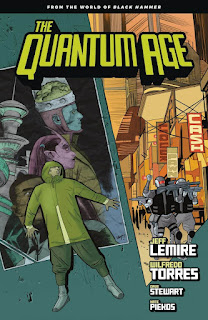
The Quantum Age by Jeff Lemire and Wilfredo Torres

So it's Black Hammer time again! This one doesn't have "Black Hammer" in the title, but it's the next story in the series, following somewhat directly from Age of Doom, Part II, which presented itself as the big, final, absolutely definitive ending.

But we all know about endings in superhero comics, right?

Thus we come to The Quantum Age, written by Jeff Lemire (like all of the Black Hammer books) and drawn by Wilfredo Torres. This one features Lemire's take on the Legion of Super-Heroes, though, in this timeline, they're only one hundred years in the future instead of five.

(There is also what seems to be an unfortunately ham-handed, and awfully late, metaphor for Muslims post-9/11 dumped in the middle, which drives a lot of the larger plot but is badly explained and defined - the George W. Bush figure clearly has some kind of motivation, but it seems to be all in Lemire's head and not on the page.)

Anyway, we start with the bright, shiny happy future one hundred years on, with an interstellar polity of some kind defended by a big team of super-powered young people, including a really obvious Brainiac 5 type. (There's also clear versions of the original three Legionnaires, and more-or-less clear versions of a lot of others; as usual, Black Hammer is largely about reworking someone else's IP.) A new Black Hammer - Hammer Lass, who I mistakenly thought was the same Black woman legacy Black Hammer as the one before, but is actually a different Black woman legacy Black Hammer, which I should have known because her costume is somewhat different - appears near the end of the first issue to tease the same goddamn "what happened to the heroes who died in the not-Crisis?" story as every other book in the series.

But then issue two drops us into a crapsack future twenty-five years later, which we gradually learn was caused by a humanity-first genocidal totalitarian state led by a ex-not-Legionnaire, who took over, in some way the book never event hints at, after a massive Martian invasion. Apparently, when Earth was invaded by one alien race, that made all humans everywhere, or at least enough of them to utterly change society and government, immediately hostile to all other races everywhere in the galaxy, and most of them are being exterminated. Well, this is superhero comics: so it looks like that, but it may just be overstated for dramatic impact in the moment.

And we follow yet another new character, who gets the uniquely stupid name of Barbaliteen later on. Again, Lemire has an infinite universe, where he can create anything he wants, and he just keeps ringing obvious changes on other people's fifty-year-old stories for children.

Now, I have to spoil the earlier Black Hammer stories to complain adequately about this one, so stop reading now if that bothers you. You see, the end of Age of Doom II absolutely required the lost heroes to go back to their pocket universe, and stay there forever. It was the usual "needs of the many outweigh the needs of the few" stuff - very serious, very superheroic. There was no other option, Lemire told us there, very seriously: none of them could ever go back to the real universe in any way, for any reason, or the Anti-God would saunter back in and do whatever vague horrible thing Lemire never quite described.

But then the two of those heroes who stuck the rest of them in the pocket universe are back in the normal universe in this story, with no explanation. So the "you absolutely need to stay there or else Anti-God will eat the universe" is more of a possibility than a real thing, and the ones who did it all just quietly left the others behind to rot on a lousy farm with each other.

(Oh, one other character got out, somehow, but that's a separate spoiler, so I'll avoid complaining directly about that.)

So the story I thought was bullshit for one reason is now retroactively bullshit for an entirely separate reason. Does that make me happy? Well, happy is a sliding scale. I'd prefer that the whole Black Hammer saga make somewhat more sense and not be so obviously Lemire playing with other people's toys - there's glimpses of his serious style throughout Black Hammer, and if the whole thing wasn't so deeply self-indulgent, it could have been a lot better. This is one of those comics in which a lot of strong, true moments add up to nothing at all because the overall plot is a weird combination of second-hand, half-assed, and just plain silly.

Every time I read one of these books, it manages to annoy me in new and different ways. That's impressive, so I think I'll keep going to see just how many ways there are. I have faith in Lemire and the boundless childishness of the default superhero universe.

Tuesday, January 18, 2022

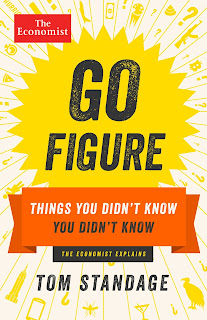
Go Figure by Tom Standage

I tend to be a stickler for credits, and am not always complimentary when a book plays fast and loose with them. On the other hand, sometimes I complain about things that are super-minor, which is silly.

So, let me try to be measured here. Tom Standage is credited as the author of Go Figure, a collection of explainer articles that originally appeared separately in The Economist in the handful of years leading up to 2016. Standage was Deputy Editor of The Economist for that period; he was responsible for this department. However, it says in this book that he did not write all of these articles - there was a team who did this regularly, possibly including researchers on top of actual writers - and it's not entirely clear if he wrote any of the pieces from a blank page, or if he was primarily the editor.

If the book said "edited" or "compiled" by Standage, or by Standage "with" or "and" some way of defining that team, that would be fine; it would be clear and descriptive. What annoys me is one person standing up and taking credit for something I'm pretty sure was a group effort.

Of course I could be wrong: maybe I misunderstood. Maybe Standage did write all of these articles from scratch, however often they appeared, for several years, and then compiled them into the book in 2016. If so, it's entirely reasonable to only list him on the cover.

But I'm pretty sure that's not how it happened.

The book itself is slightly out of date at this point: journalism dates quicker than most non-fiction, though explainers are more shelf-stable than breaking news. But it's all, as far as I can tell, still accurate - there may be more details about many of these areas, but I didn't see anything that was superseded.

It's organized into a number of rough categories, which are fairly vague: the first two sections are "things you didn't know you didn't know" and "things you've quietly always wondered." It gets a little better-defined from there, which sections on differences between countries, economics and numbers, leisure and sport, newish tech (mostly Internet-related), and science. Each section has around fifteen articles; each article is about two book pages - Standage says in his afterword that the format is to write in four paragraphs, and I bet there was a target word-count, too. (Which he does not mention.)

It is from The Economist, so it has their biases deeply embedded in it: capitalism is the greatest good of all time, everywhere in the world, and economic analysis will always provide the correct answer, no matter what that means for actual human beings or what insight other kinds of expertise might bring to a situation. A reader can get a lot of interesting data and ideas from the book, as long as that very clear bias is kept in mind.

Monday, January 17, 2022

Reading Into the Past: Week of 1/17/02

As usual: on Monday, if I have new books, I write about them here. If I don't, I pick a random year in my reading notebook and try to remember the books I read this time that year. (How much do any of us remember about things we did ten or twenty years ago? It is an odd exercise, I admit.)

This time, our number is 2002:

Julianne Balmain, Office Kama Sutra (1/10)

Before I look it up, I'm going to assume that I read it because of that title, and also that I found out about it through work. I have a sneaky suspicion that QPB offered it: it's got their kind of title.

And...it is exactly what you'd expect from the title: a tongue-in-cheek guide, written in faux-Orientalia, about pursuing nooky in the office. I suspect 2002 is awfully late for a book like that; it would not fly now, even written by a woman (and illustrated by another: Thorina Rose). It looks amusing, but, these days, it would be a race between being condemned for cultural appropriation and being condemned for making light of workplace sexual harassment.

Michael I. Meyerson, Political Numeracy (bound galleys, 1/11)

I was still a Good Republican in 2002, though I was wavering. So this may well be a "why lefty economics never adds up" book, though I hope not. Let me check.

Nope: looks like this was more of a follower in the school of Freakonomics: applying scientific rigor, at least in theory, to some thorny policy questions to find Provable Right Answers. A lot of people thought that was possible, in that technocratic time, but that thread in American discourse seems to have mostly disappeared: right-wingers aren't interested in objective facts or science to begin with, and left-wingers are coming from a different direction.

It looks like Meyerson was either using political issues to explain mathematical concepts, or using mathematical concepts to show how political issues could be solved in a roughly utilitarian way, and I don't think anyone took the hint.

Kazuo Koike and Goseki Kojima, Lone Wolf & Cub, Vol. 16: Gateway Into Winter (1/13)

This was just past the half-way point of the samurai epic, which was collected in twenty-eight volumes. Even if I read dug out the descriptive copy for this book, I don't think I could say anything coherent about this specific piece of the larger story. I did think the whole series was excellent, and I'd read it again if I hadn't lost all of those books in my 2011 flood. (Buying twenty-eight books for a re-read is more than I feel up to at the moment. Maybe someday.)

Doron Swade, The Difference Engine (1/15)

I had to look it up, because my mind kept going to the Gibson/Sterling book of ten years earlier. This is a non-fiction work about Charles Babbage and his machines, and, knowing that, I can vaguely remember reading a book about that at some point. (This one, presumably: unless I've read multiple books on Babbage without keeping track, which is unlikely but not impossible.)

Swade was assistant director of the Science Museum in London, and led the team that built the first working Difference Engine in 1991. (So I'm pretty sure this is the book I'm remembering.) As I vaguely remember now, it's Babbage's story, not Swade's -- there might be an intro or something about his team's work, but the book itself is a conventional this-one-interesting-thing-in-history kind of book.

Calvin Trillin, Tepper Isn't Going Out (1/16)

This book I actually do remember! Trillin has only written a few novels - Barnett Fummer Is an Unbloomed Flower, a very hippie-inspired book from the late '60s, Floater, a very newspaper-inspired novel from 1980, and this one, a very New York-inspired book that was new at the time.

Trillin is a great writer, funny in a wry way no matter what he's writing, and I remember this as one of his best books. It is deeply frivolous - as I recall, he referred to it as a the only novel ever written about parking. Tepper is a guy who likes to read the newspaper in his car, and inevitably, people ask him if he's leaving that spot. He isn't. I believe he becomes local-famous for this, and the plot escalates from there: silly, parochial, and specific, all things Trillin is good at.

Richard Stark, The Score (1/17)

This is the fifth of the Parker novels; I may have been trying to read through them at the time. A decade later, in 2013, I read and reviewed the entire series in the puckishly titled blog series "Starktober." (No points for guessing what month it took place in.) So let me just link to my more detailed post on The Score.


Immediately before that, I finished Jorge Luis Borges's Selected Poems (no memory at all). And right afterward I had some reading for work: a two-book Star Trek: Stargazer series by Michael Jan Friedman (I don't remember what Stargazer was; my guess is a book-only series with some new characters) and then R.A. Salvatore's novel Transcendence (I'm sure it was part of some series; but I'd have to look it up.).

Friday, January 14, 2022

Quote of the Week: Always Someone Else's Shout

I've had to explain some of the peculiarities of British English swearing to my North American colleagues on several occasions. Those most often eliciting a degree of bafflement are tosser, wanker, and twat, so for the sake of North Americans reading this, here's my handy guide.

[description of buying rounds in a pub excised: the important bit is that you're supposed to buy at least one round for the whole group, on pain of social opprobrium]

So, with this in mind, let's meet Adam, Barry, and Chris.

  • Adam has forgotten his wallet tonight. He has to borrow some money so he can get a round in. Adam is a tosser.
  • Barry has forgotten his wallet but makes no attempt to borrow money. He drinks but doesn't buy a round. Barry is a wanker.
  • Chris always "forgets" his wallet, accepts a drink at every round and then tries to cadge some money for a kebab on the way home. Chris is a twat.

 - Emma Bryne, Swearing Is Good for You, pp.19-20

Thursday, January 13, 2022

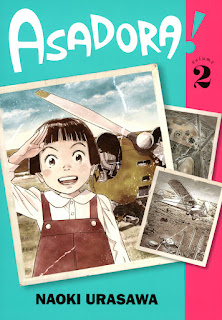
Asadora!, Vol. 2 by Naoki Urasawa

Middle volumes are tough to write about, particularly for a series that the reader expects will run for a while. For the fairly early books: how do you tell what will be really important in the end, and what's just scene-setting? For the books deep into the series: how do you even describe what's happening among characters with hundreds of pages of backstory?

Asadora!, Vol. 2 is a middle volume - the first middle volume of this series, he said puckishly. Like the first book, it's by Naoki Urasawa, a highly respected manga-ka whose work I'm only vaguely familiar with. My post on the first book is scheduled to go live in three days as I write this, so I am hoping I remember to turn some of the words in this sentence into a link. (If I didn't, I apologize. Use the search function.)

The series centers on Asa: she was about nine in the first book, set in 1959 during a massive typhoon. From some narration in that book, I believe the series will follow her up to something like the present day, likely hitting just a few major events years apart. And I think "events" will mostly be disasters. There's a Godzilla-sized monster that has not yet been clearly seen, lurking around the fringes of the story - it's a good bet to assume that will cause some more disasters.

In the aftermath of that typhoon, Asa teamed up with her kidnapper - it was a pretty weird mentor/mentee meet-cute, I guess, but Urasawa made it plausible - to semi-commandeer a small airplane to airdrop food parcels to people stuck in floodwaters. Urasawa depicted the authorities, at least the local cops, as either completely incompetent or just entirely overwhelmed, completely unable to cope with the size of the disaster. But one girl and one critically-injured thief, supported by a street of rice-ball-making shopkeepers, could feed a huge swath of Nagoya.

This second volume picks up in the middle of that rescue effort: it's a few moments later, on the same day, as the end of the first book. Asa and Kasuga (the kidnapper) are still air-dropping rice-balls to survivors, but other dramatic events interfere with that as the book goes on.

Well, actually, there's a chapter before we pick back up - a team of scientists are in a jungle somewhere, looking for something, and arguing fiercely about whether they should keep going or turn back. (It is a bit cliched, I have to admit.) And then they see a tree with a gigantic claw-mark - dun dun DUNNNNNN!

This book ends the 1959 episode, with Asa finding some survivors important to her and getting something that will be major in her life. That takes about three-quarters of the book; the rest begins a new episode, set in 1964. (The year of the Tokyo Olympics, in case we have forgotten.) Asa is now a teenager, and has somewhat different problems. Kaguya is still around, and his past is causing complications.

Oh, and the Godzilla-sized-thing is still out there: a few more scraps of evidence pop up just before the end of this volume, and there's a connection back to that squabbling-scientists first chapter.

At some point, Asa will be flying a plane around or above that monster, probably dropping something on it. But that has not happened yet. Maybe next volume it will attack the Tokyo Olympics!

This is zippy and fun, but it's not clear where it's going or how long getting there will take. Are we going to get ~350 pages for each episode, and will those episodes be set about five years apart up to the present day? If so, that would imply Asadora! could be as much as 7000 pages and thirty-five volumes. But those are massive assumptions; it could be a lot shorter. (It could, I suppose, actually be longer, too - manga is a format that is not afraid of multi-thousand-page stories.)

So far, there's a whole lot of mystery, a whole lot of spunky-girl stuff, and very few answers. That's fine for a beginning, but the balance will need to tip at some point: I hope sooner than seven thousand pages from now.

Wednesday, January 12, 2022

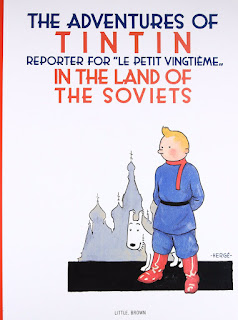
The Adventures of Tintin, Reporter for "Le Petit Vingtieme, in the Land of the Soviets by Herge

OK. Going from the mature peak of any art form back to the earliest examples is going to be a big surprise. And if it's all by the same creator, it's not fair to compare the early stuff to the really good stuff.

But, boy howdy did Herge get better over his career.

I finally dropped all the way back to the beginning of the Tintin series, the inimitably titled The Adventures of Tintin, Reporter for "Le Petit Vingtieme," in the Land of the Soviets, originally serialized in the newspaper advertising itself in the title during 1929 and 1930. And it is....not nearly as well-done, in every possible way, than even Tintin in America, which came just a few years later.

On the positive side, Tintin does actually seem to be a a reporter in this book, though that's mostly an excuse for his travels: he does spend one night frantically writing something that he never manages to file. (And never does anything else reporter-ish, like talking to people and taking notes, or even having a dispassionate view of anything he encounters.)

Soviets is a really weird model for the rest of the series: it's nearly three times as long as the others (138 story pages) and reads like a run-on sequence of very slapstick newspaper adventure comics from ten or twenty years earlier. There's no depth of characterization, none of the verbal wit Herge developed later, and the art is quicker and sketchier, possibly because of the newspaper publication.

Instead, we get agitprop. Did you know the Soviet Union was bad? It's bad. Really bad. Tintin is sent on an assignment to Soviet Russia to report on something, or maybe everything - this isn't particularly clear, maybe since it was just a thin excuse to send him in that direction. Immediately (on page 2) a scruffy commie tries to murder Tintin, since - we will hear this over and over - the USSR is one big Potemkin village, where everything is horrible in every way, and if right-thinking Belgians (well, maybe other people elsewhere too, but who cares about them?) knew the truth they would be shocked and appalled, which would lead to something unclear.

The plot follows that initial impetus: Tintin is traveling, first to get into Russia and then to get out of it, while various dirty commies try, sometimes with massive military force and sometimes with sneaky sabotage, to murder him. Several times, for variety, they capture him, tie him up, and threaten to murder him slightly later.

None of this is successful, obviously, since he went on to star in twenty-three more books over the next fifty years or so. This is partially because the narrative is so clearly on Tintin's side that nothing can harm him, and partially because this (twelve-year-old? I guess?) little blonde kid can beat up absolutely anyone and everyone he comes across, probably because his heart is true and they're all dirty commies.

This is not good. It is amusing for anyone who can avoid taking it seriously. It moves very quickly, with that Perils of Pauline-style one-damn-thing-after-another plotting, and a reader will not be bored. (Annoyed, maybe. Baffled, possibly. Bemused, if they're lucky.) It is primarily of interest for people who know the mature Herge and want to do a compare-and-contrast, and possibly for fans of social history who want to see a master-class in fear-mongering.

Tuesday, January 11, 2022

Bill and Ted Are Doomed by Evan Dorkin and Roger Langridge

This is another one of those cases where I'm a fan of the other thing in the mix, and so will probably not be that good at reviewing how good the final product is at achieving its end. Just a warning up front.

What I mean is: I've been following Evan Dorkin (especially the comics he both wrote and drew, which are rare this last decade or two) and, to a an only slightly lesser extent, Roger Langridge, for years and years. They're both comics creators whose work I'll try to read almost no matter what it is.

Even if it's a sharecropped story deliberately constructed to fit in between two movies that I have never seen, for example.

Bill and Ted Are Doomed was a four-issue miniseries, collected into a single book a little later - that's how I read it - designed to help bridge the gap between the 1991 movie Bill and Ted's Bogus Journey and Bill & Ted Face the Music, which came out last year in some way. (Movie releases were a bit disjointed and weird in 2020, like so much else in the world.)

Now, I did see the first movie, Bill & Ted's Excellent Adventure, so I'm not completely unaware of the thing. But that was a long time ago, and is filed in my brain more under "'80s surfer stereotypes" than "the Bill & Ted universe."

So this book, which has their robot duplicates - who were evil in the second movie, I thought, but aren't evil here - and some little hairy naked inventor-types who only say "Station!" and I presume are also from that movie, because it would be really weird otherwise,...anyway, this book has a lot of stuff that I assume is fan-service for the actual fans, but I am not really one of them, so it's just weird details.

This is also handicapped by its mid-quel nature: it was seemingly designed to show Bill & Ted (and their families) roughly halfway between the youthful slackers of Bogus and the middle-aged losers of Music. And it can't solve the problem the later movie will, which is the core problem of the series (such as it is): Bill & Ted will, eventually, write the one song that brings the world together in peace and harmony and forms a global utopia.

Which is a fun conceit, but if they actually do it, all of the stories are over. So, unless they do in Music (I hope they do), they haven't done it yet.

Doomed is thus a book of failure. Bill & Ted are nearly broke, their band is forgotten, and they spend all their time trying to write the One Song and getting nowhere. Everyone around them is more sensible and normal than they are - that would pretty much have to be the case, honestly - so the band (Bill, Ted, their wives, and Death on bass) set off on a tour to refill their bank accounts.

And if you've ever seen any story about a band setting off on tour, you know it will not go well.

It does not.

There's a band that hates Bill & Ted for mostly inexplicable reasons - they're not metal enough, which is fair since Wyld Stallyns never stuck me as particularly metal, but I may be biased - and that of course leads to a disastrous festival somewhere frozen in Scandinavia where Our Heroes are once again in danger of dying.

It all does end, somewhat mutedly, since they can't actually write The Song or change their slacker/loser future or resolve their money problems. Again, this is a story set between two already-defined points, and exists mostly as a line extension to shake more money out of fans' pockets. It's a fun entertaining story, with the loose-limbed appeal of the other Bill & Ted stories, so it's almost certainly worth the few dollars it does shake out. But that doesn't change the pointlessness of it all.

Then again, I'm generally of the opinion that all sharecropped stories are deeply pointless, so you may not want to listen to me. This one is harmless at worst, goofy fun at best.

Monday, January 10, 2022

Reading Into the Past: 1/10/98

On a Monday morning here, you get one of two kinds of posts. If I got new books - no matter how I got them - I'll list them. If I don't get new books, I pick "that week" in a random past year of my reading notebook, list the books I was reading then, and try to remember anything about them.

That's "Reading Into the Past." Think of it as the opposite of review of new books: an examination of what, if anything, remains in memory of books read long before.

This time, the RNG gave me 1998, so here's what I was reading at this time that year:

James Blish, Earthman Come Home (in Cities in Flight, 1/3)

I read the first two books of Cities in Flight on the first of the year. And the fourth one the next day, so I think I'll put any thoughts about the series together below.

James Blish, The Triumph of Time (in Cities in Flight, 1/4)

This was the first and only time I read Cities in Flight: I do not remember being particularly impressed. (I don't remember being impressed by anything of Blish's; in my memory, he's a dour and dull writer, plodding in the small and depressing in the big. Oh, the two magical-apocalypse books are OK because their pyrotechnics are bigger, but, in my memory, they're all the same kind of neo-Calvinist thing.) As I remember, the four novels are all quite separate - by many years in both writing and internal chronology, I think - and only a few characters even appear in multiple books. Plus the whole point of the series is another one of those Atom Age parables that nothing ever gets better and everyone is horrible and cruelty is the iron law of the universe. I do not regret letting them slip out of my mind: let me put it that way.

Anne Fadiman, Ex Libris (1/5)

I remember liking this, and, before I look it up, let me say that I think it was a small collection of essays about books that she particularly liked. (Maybe originally appearing somewhere like The Atlantic? Something classy and literary, I think.) Probably also some element of "what I read while young, to mold me into the classy literary intellectual I am today," he said with more cynicism than is probably warranted.

After looking it up: Fadiman is the daughter of Clifton Fadiman (if you remember that name, congratulations! you are at least as old & stepped in random publishing history as I am), and this is her memoir of growing up in a world steeped in (drawl it out for maximum impact) high literature and how she occasionally slummed in things that are not quite as highbrow. I still have pleasant memories of it, but I think it could come across as awfully precious to readers who don't at least like some of the Great Classics, since she is a big-time Great Classics type.

Ian McEwan, Amsterdam (1/6)

I'm several books behind on McEwan now, and started having trouble keeping track of which was which long before that - so many short novels, all well-written, all realistic, all about middle-class British people, will tend to blur in the mind. So I have to admit I have no memory at all of which one this was.

According to sources, this is his Booker-winner, which makes me sad I can't remember it independently. It's the one where two old lovers of the same woman meet at her funeral - I think he jumps into flashbacks from there, with some kind of revelation at the end. McEwan is always an excellent writer and creates great characters, but he has the prolific novelist's problem: there's so much that's all pretty good or better that they all get forgotten in the general mass.

Damien Broderick, compiler, Not the Only Planet (1/7)

I'm going to guess this was a book of quotes and try to look it up. It is not ringing any bells.

Oh! The cover is familiar: it's actually a book of short stories about SFnal travel, published by the Lonely Planet people in one of their occasional frenzies of line-extension. I'm not sure why Broderick was credited as "compiler" rather than "editor" - sure, reprint collections are assembled and their "editors" typically don't touch a word of the text, but that is the standard credit. Maybe Broderick was persnickety about it; it's the kind of thing I could see me being persnickety about. (Speaking as someone who compiled a number of single-author collections in my own day, and who doesn't entirely remember what credit I gave myself.)

ISFDB has a TOC, which is pretty impressive: "Let's Go to Golgotha!" and "Trips," "Tourists" and "Seven American Nights," among others. Probably a fun book to read, even now, if you can find it.

Connie Willis, editor, Nebula Awards 33 (bound galleys. 1/10)

Let me try to remember how it worked in that era: this would have been a book published in 1998 reprinting stories that won the Nebula in 1997 by ending their eligibility period in 1996 and mostly being published in 1995. I used to complain that the Nebula books should be billed as "The best stories of two years ago!" and people would just glare at me. I believe the rules have changed since, and Nebulas are no longer trailing indicators as they used to be - no idea if anthologies of the winners are still a thing, though.

Again, I'll grab a TOC from the indispensable ISFBD and also link to the official list of winners on the Nebula site. I do remember some of those stories - Swanwick's The Dead" in particular on the positive side, though I do not think I was a big fan of "Abandon in Place." No particular memory of this specific assemblage that Connie put together, though it does have a ghastly cover that I'm sure we can't blame on her. (It was the late '90s! Everything was "cyber"!)


Friday, January 07, 2022

Quote of the Week: Leg Before Wicket

Sport, as any cultural critic will happily confirm, is a metaphor. Most commonly it's a metaphor for a conflict of some sort and a useful way to lance the boil of tension between rival communities. But while football is a metaphor for a great big punch-up in a pub car park, and rugby is a metaphor for a great big punch-up in a pub car park while holding an ostrich egg, cricket is a metaphor for a more medieval, chivalrous kind of battle entirely.
 - Fraser McAlpine, Stuff Brits Like, p. 113

Thursday, January 06, 2022

Wild's End, Vol. 1: First Light by Dan Abnett and I.N.J. Culbard

Sometimes a high concept can be unfairly dismissive. I could describe Wild's End as a "X meets Y" story - I will, later - but that would minimize it, and make it sound vastly more derivative than it really is.

(On the other hand, this is a book from 2015, so it's entirely possible everyone reading this already has a good idea what X and Y are. And the cover gives some really strong hints, too. But I'll go with it for now.)

There have been other Wild's End stories since this; I don't know if the series is final, or if more will be coming. But this one was the beginning, and it stands by itself: it does have a "and what's next?" ending, but a lot of stories that never get sequels have endings like that, too.

So there was a miniseries, called just Wild's End I think. The collection got named Wild's End, Vol. 1: First Light slightly later, once there was a glimmer of a Vol. 2 in the works. This story was written by the British novelist and comics writer Dan Abnett, with art by I.N.J. Culbard, who I know best for his Lovecraft adaptations. (See my post on The Dream-Quest of Unknown Kadath.)

And what's it about?

There's a small English village - Lower Crowchurch, somewhere unspecified but far from metropolises, next to a river. It's somewhere in the early 20th century, between the wars. The Great War is still relatively recent, so I'd think more '20s than '30s, but somewhere in that era. Clive Slipaway, a former Navy man, has recently moved to that village, perhaps as retirement, and is invited to help with planning for the annual fete.

During the meeting to plan the fete committee, another man breaks in: Fawkes, a local ne'er-do-well. He has a tale of a horrible event he witnessed the night before, something that crash-landed in a field and killed his friend Bodie. The villagers dismiss it as drunken ramblings; Slipaway finds something more compelling in it.

Fawkes and Slipaway and a few others go to investigate. And they find that Fawkes was absolutely right: a "star" did land, something did emerge, and it's killing people. Something mechanical-looking, on tentacle-like cables.

Did I mention all of the characters are anthropomorphic? You can probably figure that out from the cover.

So the high concept here is "Wind in the Willows meets War of the Worlds," more or less - there's very little of Wind in the specifics of the characters, but that's how Hollywood would log-line it. Something has landed from space in the middle of a supposedly-bucolic setting, and a mixed group of locals, more or less led by Slipaway, has to stop it before it kills all of Lower Crowchurch.

Abnett walks the reader into the premise slowly: we see his characters from the beginning, as we always must in comics, but we've seen anthropomorphics a million times before, and Culbard makes them real individual people with their own body language and gesture. When they reveal the machines for the first time - should I call them Martians? no one does in this book - it's not a surprise, but a confirmation. Even without the cover, even without reading any description, we knew it would be something like that: we knew almost exactly.

There's a lot of depth and nuance here: more than you might expect in a book about fox- and dog-headed men fighting alien machines. These are all real people in a real world, one that is very similar to our own from the era, and their problems - aside from the murderous machines - are real problems, and their ways of thinking and reactions are not action-movie moments but realistic and often unfortunate.

I'd had this book on my "find and read it" list for years; I waited far too long. If you haven't read it, add it to your list as well: it's worth it. And now I'm off to see if the next story is available the same way I read this one.