Monday, February 14, 2022

Reviewing the Mail: Week of 2/12/21

Four books from the library this week, and these are they:

Aster and the Mixed-Up Magic, by Thom Pico and Karensac. I got this one, and realized that it's actually the second book. I think it was linked in some end-of-year round-up, which may be why I heard about it and not the previous book, but, however it happened, I had this one in hand, had at least a vague reason to want to read it, but wanted to find the previous book first.

It's some kind of book-for-younger-readers - my guess is middle-grade, but I'll have to read it to be sure - and it seems to be about a kid who has magic. I'm not sure if it's our world, a fantasy world, or something more baroque.

And I'm holding off reading it until I can get the first one, but the library only lets me keep books three weeks...oh, golly! whatever will I do?

Aster and the Accidental Magic, by Thom Pico and Karensac. Oh, look! The library system also had the previous book, and got it to me within a few days of my request. The modern world is pretty awesome sometimes, particularly when you ask for something free and get it almost immediately. When that something is a book, it's downright magical.

Again, you might want to know what the books are about, but I haven't read them yet, so I'm vague on that. But I'm pretty sure they're magical-kid stories for tweens (maybe slightly younger than that), and I would not be surprised if they are more diverse than the similar books of my own youth. (I read a lot of books about sad rich white kids - that might partly have been me, but I think it was a massive genre in the '70s for no obvious reason.)

The Thud by Mikael Ross. This is another book that I chased down because it was on someone's Best-of-2021 list. (Or I'm pretty sure that's why. Hey, we all add things randomly to our Books-I-Want-to-Read lists, and do we care that much why or how? No: we want to read more good stuff, and details sometimes just slow that down.) As I understand it, this is fiction - aimed at a YA audience - but based fairly closely on real people and the real town they live in; the story is made-up but the moments are probably mostly based on reality. In Germany, there's a town called Neuerkrode which is largely populated by people with developmental disabilities - our teenage hero goes to live there after his mother has an accident. This is, I gather, the story of how he comes to find a life there.

The Little Wooden Robot and the Log Princess by Tom Gauld. Because of the oddities of scheduling and timing, I've already read this and just wrote a post about it right before starting to type here. So I can either repeat myself or write something totally different...or, maybe, just stick to the factual this time. This is a fairy tale in picture-book form, Gauld's first book for younger readers (Hey! I've got a theme: I didn't pick books for younger readers on purpose, but that's what came in from the library.) and it's very Gauldian and very good.

Friday, February 11, 2022

Discipline by Dash Shaw

Comics is a deliberate art: even the pieces that seem quickly made or sketched are carefully planned. There's a huge amount of work that goes into a page that goes by your eyes in a minute or less, for every creator of every kind of comics.

But even in that company, working in that form, Dash Shaw is more deliberate than most, and looks less deliberate. His art is loose, at times mimicking a sketchbook. His lettering looks more like handwriting a lot of the time. His people are driven by immediate urges and demands, sometimes almost uncontrollably.

Discipline is perhaps the peak of that side of Shaw, or at least a peak. The pages do look like something out of a sketchbook, with unbordered pictures that form comics without quite looking like comics. His lettering is in script, slightly fussy, to fit this 19th century story - it could easily be the handwriting of one or more of the characters in the book. And his main character does the one thing his community hates most of all: goes to war.

Charles Cox is seventeen in 1863, a Quaker growing up in an Indiana community of Quakers: quiet, sober, serious, dedicated to self-improvement, bettering their community and world, and non-violence in both their individual lives and the wider world. He has unnamed parents and what seems to be a slightly older sister, Fanny.

Only after finishing the book do I think about that: only two children, on a farm in the 1860s? What's the story there? How many crib deaths lie in the past of this family, how many other children lost before these two grew up?

It's the middle of the Civil War, and Charles is old enough to fight. Old enough to grapple with the moral side of the conflict, too: he deeply believes in both the rightness of the Union cause - Quakers were vastly more abolitionist than most of America, and much earlier - and in the value of the Quaker non-violence ethos. Those two things are in immediate conflict: the nation will not be pulled back together, nor the slaves be freed, though non-violence and pacifism.

So Charles does run off and enlist. Discipline is mostly his story, alternating with Fanny's story back at home, where she is "courted" by Cyrus, who looks to my eye to be substantially older than her. Shaw tells those two stories in two ways: in his loose art, which has no direct dialogue and takes place essentially in pantomime, and with narrative captions, which we mostly take to be the letters these two send back and forth but also include unvoiced thoughts and ruminations.

In his afterword, Shaw says a lot of the language in the book is directly from letters and other documents of the period: these are largely the words of actual Quakers of that time, and the rest is deeply influenced by them.

Charles goes through quick, brief training. He marches south, fights in his first battle, and marches much further south with Sherman's army. His story is full of events: wounded, captured, sick, prison-break.

Fanny's story gives us more of the conflicting views of Quakers on the war, including the ongoing argument about whether they should pay the increased taxes to fund the armies. Quakers, we learn, have for generations specifically refused to pay any taxes that go to armed forces: they refuse, entirely, to fund violence. And it also gives us a view of her relationship with Cyrus, in those silent panels: we may miss the most important thing, but we'll learn it in words before the end.

Shaw is not giving us an answer to the central conflict here. He is not expressing an opinion about whether fighting in the Civil War - or any war, any conflict - was right or necessary for any person. He's telling a story about people living through it, making choices, and trying to live up to their ideas. 

They are very high, very strong ideals. A lot of us could do well to try to be closer to them, even if we don't exactly believe in the specific God at the center of those ideals.

Discipline is much quieter than a reader would expect for a book about the Civil War, almost a meditation. It's much more a Quaker book than a war book, which is entirely appropriate. And I found it almost entirely successful on its own terms: it sets out do so something specific and succeeds entirely at that.

Thursday, February 10, 2022

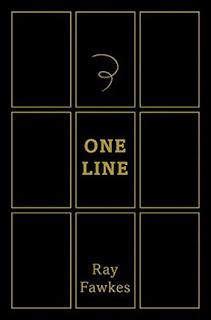
One Line by Ray Fawkes

The old editor in me should have expected a third: all art aspires to the condition of trilogy, we used to joke.

Maybe that's true. Ray Fawkes found a way to take one of the best graphic novels anyone has ever made and do it again, and then again one more time.

A decade ago, he made a great book, One Soul. On facing pages of nine-panel grids, he told the stories of eighteen lives simultaneously, from birth to death. (Spoiler: not everyone dies at the same time.) It was brilliant, it was simple in its brilliance, and it felt like the kind of tour de force that could only be done once.

But then a few years later Fawkes came back with The People Inside. That book took a similar structure - multiple stories, the same story in the same place throughout the book - and told stories of relationships. Not individuals, all by themselves, but people finding each other, falling in and out of love, living their lives together. And that panel structure let him have double-panels for couples, which could break and re-form in different directions as the relationships changed.

How could he follow that up?

It took another seven years, but One Line is the answer. This time, Fawkes is using that same structure to tell the stories of families through generations. Or maybe, to be expansive about it, nations. After a brief prelude set in prehistoric times, the first part introduces eighteen characters in their eighteen panels. Some are related - two sets of brothers, one set of sisters. There are other almost-pairs, as with a Chinese and Japanese family that will interact over time, or an Indian local and the Englishman ruling him.

Fawkes tells these stories in the same allusive, stream of consciousness style as the previous two books: the captions in each panel both serve as a continuous narrative and tell the story of that one family straight through the book.

The book has multiple sections, corresponding to generations - very clearly to begin with, a little more loosely towards the end.

And, as in One Soul, when a character dies, that panel goes dark for the rest of the section. This will be important, as it was important in One Soul. More important, actually: by the end of One Line, I came to believe it was the most important thing.

One Line takes place over the last two or three centuries, and is full of war and pogroms as those years were. These eighteen people start out all over the world: if you pay attention, you can figure out where each of them are, more or less. Some of these people will try to kill each other, and some will succeed.

And the generations roll on, with new generations not necessarily knowing the connections previous generations had. Or not caring. So the black panels pile up in each section.

Fawkes has a positive message in the end, as he did in the previous two books: he's showing here how bad humanity can be but also how good it can be. And this is just as strong, just as human, as the previous books: these are, again, some of the best graphic novels from anyone.

I'm pretty sure there's no room for another book in this sequence...but I've said that before.

Wednesday, February 09, 2022

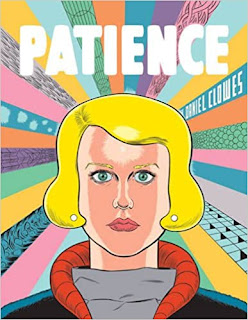
Patience by Daniel Clowes

It's never a good thing to realize, halfway through, that you've read a book before. Especially when you've just bought a shiny new copy, and the realization includes the fact that another copy - just as shiny, also bought new - is probably on a shelf upstairs in your house. (I haven't looked yet; maybe it isn't. Maybe I read it from a library the first time?)

You see, if you read a book again on purpose, that's fine: it means you remember it, and want to experience it again. And reading a new book is obviously normal. But thinking it's new to you when it isn't - that's not a good experience.

So I re-read Patience yesterday (as I write this). It was the 2016 graphic novel from Daniel Clowes, and is still his most recent book. I read it for the first time in 2017, and let me take a second to re-read what I wrote about it then.

<pause>

OK, I agree with all of that. Clearly I didn't remember it deeply, and I trusted my Books Wanted list more than I should have, but it's a solid Clowes story, very much in his usual style and manner. For all of Clowes's characters' histrionics, I find I don't really engage emotionally with them: they are very emotional people who Clowes often seems to be examining like a scientist with a bug.

That may be one reason why I don't remember Clowes stories viscerally: they're all distanced to begin with. The Clowes affect subliminally says "these people are damaged and wrong in various ways; pay attention to them but don't care about them." I doubt Clowes intends this affect for Patience, but it's so ingrained into how I read his work, so tied to his art style and method of viewing characters, that he'd need to change a lot to break that habit. And I suspect I'm not alone in this.

Anyway, Patience is a good Clowes book that didn't impress itself strongly in my memory. Everything I said in my old post is still how I'd characterize it as a story. I have no new insights to impart. Come back tomorrow; with luck, I'll have a read a book for the first time and have something interesting to say about it.

Tuesday, February 08, 2022

Why Did We Trust Him? by Shannon Wheeler

I like reading books of single-panel cartoons, but they're not great blog fodder.

There's no story to write about, obviously, and unless the cartoonist has a really clear theme or topic, there's no hook to hang a review on. "Hey, here's a bunch of jokes by this one person!" doesn't say much.

So, here's a bunch of jokes by Shannon Wheeler, collected as Why Did We Trust Him? It was published by Top Shelf in 2019, and followed several similar earlier books by Wheeler, including I Told You So, I Thought You Would Be Funnier, and the mixed single-panel and comics-stories collection Memoirs of a Very Stable Genius.

This one has a table of contents, which is unusual for a book of single-panel cartoons. Even less usual: it seems to have an entry for every single cartoon, and is organized into sections - Introduction, Contents, Word, Afterword, Index, Glossary, Footnotes. These sections just have cartoons in them, and there's no obvious, say, "Index" theme to that section. It seems to be just a meta-joke about book design, which is fine with me.

(I did not spend any time comparing punchlines with the entries in the ToC: that would be crazy.)

This book seems to have a lot of cartoons about clowns, Sisyphus, and fishbowls, along with the usual cartooning staples: a couple in bed or at the dinner table, desert islands, gurus on mountaintops, people in Heaven or Hell. As I said, it's a book of single-panel cartoons.

I think it's funny, and Wheeler has a good style for the format: mostly thin lines with some gray washes for emphasis - looks like that could actually be some kind of watercolor, from the thinness and translucency. (I am not an artist, and may be embarrassing myself with this comment.)

The ecosystem for cartoons like this has mostly collapsed: you can find a few online in places like GoComics and the like, along with individual artists' social accounts (is it still mostly Tumblr these days?), but the vast thundering herds of magazines that bought dozens of cartoons each are mostly gone. If you like 'em, you probably need to seek out books like this one. So seek it.

Monday, February 07, 2022

Reading Into the Past: Week of 2/5/94

This is Monday. (I know, I know.) On Mondays, if I got any new books, I write about them here. If not, I write about the old books I read "this week" in some past year.

This time out, the past year is...1994! And the list is both short and weird, which suits me.

James Morrow, Towing Jehovah (1/30)

When I was an editor at the SF Book Club, my boss Ellen Asher and I used to regularly discuss putting together a "blasphemy flyer," collecting all of the books we offered that could offend the Mrs. Grundys of the era. Sure, there were some other books, like God: The Autobiography (which sold well for us for years but I otherwise never saw or heard anywhere else in the world), but it would largely be a Jim Morrow collection, which might be why we never did it.

(Another reason being that it would be designed to offend people, which is not generally a good idea to do in a business context.)

Morrow had already won the World Fantasy for Only Begotten Daughter, which is probably a better, definitely a more popular, and absolutely a friendlier novel than the chilly, doom-laden, deliberately anti-theistic Towing Jehovah. So he was clearly doubling down at this point in his career, focusing on one of his major themes really tightly - did I mention this was the beginning of a trilogy, in which God's gigantic dead body is found floating in the Atlantic, and things get weirder from there? It is.

So: this is a good book, a major book, a powerful book. I don't know if I can recommend it to all readers, though. For some of you, you might just burst into flames upon trying to read it, and I wouldn't want that on my conscience.

Jim Thompson, Cropper's Cabin (1/31)

Vintage Crime/Black Lizard was reprinting all of Thompson's novels in somewhat unified trade dress (they had a batch for each season, and, as art directors will, the design tended to drift over the course of a few years), and I was buying and reading all of them. This was one: I'll have to look it up to see which one it was.

OK. This is a 1952 novel, about the son of a sharecropper in Oklahoma (where Thompson was born and lived) who was in love with the daughter of a man he hates. I think Thompson used that same vague plot - not the sharecropper part; the "obsessed with the wrong girl" part - more than once, but I have a vague memory of this book, and it's too-headstrong-for-his-own-good hero. (All Thompson heroes are tragic, one way or another, either for themselves or others.) Core-period Thompson is always good.

Macintosh User's Guide for Macintosh Performa Computers (2/3)

This was the manual that came with my first "real" computer (I had a TRS-80 Color as a teen, hence the qualifier), which I bought sometime that winter from an office-supply store on Route 46 in Totowa. (The one that was previously a movie theater, and is now some kind of women's-clothing emporium; I think it was an OfficeMax back in the day. This will mean nothing to those of you who aren't local.)

And, yes, I did read it cover-to-cover; we were serious about our computers in my day!

Jon A. Jackson, The Blind Pig (1/4)

This was some variety of mystery novel; I know I read a couple by Jackson and I may have read everything he published. Let me go check - maybe I'll find out he's had a booming career since then, and this series now has thirty books, including a bunch of award winners. (I write that down, since it's always my hope: I want things to have gone well while I wasn't paying attention.)

OK, this is Detective Sergeant Mullheisen - I seem to remember he had some nickname (aha! It's "Fang") - and this was the second of ten novels. They were quite hardboiled, especially for a series with a cop protagonist, and set in a mob-riddled Detroit, with a lot of great recurring characters and wonderfully sleazy atmosphere. The Diehard was the first one; this was the second. They might feel out-of-date these days, but I enjoyed all the ones I read. 

Saturday, February 05, 2022

Books Read: January 2022

As always, this is almost entirely for me in the future rather than for any other reader. Links will follow once the posts go live.

This is what I read last month:

Guy Delisle, Factory Summers (1/1/)

Kickliy, Perdy, Vol. 2 (1/2)

Roxanne Moreil and Cyril Pedrosa, The Golden Age, Book 1 (1/8)

Tardi, Farewell, Brindavoine (1/9)

Pascal Girard, Rebecca & Lucie in the Case of the Missing Neighbor (1/15)

R. Kikuo Johnson, No One Else (1/16)

Steven Brust, The Baron of Magister Valley (1/16)

Basil Wolverton, Scoop Scuttle and His Pals (1/17)

Dan Nadel and Frank Santoro, editors, Return to Romance! The Strange Love Stories of Ogden Whitney (1/22)

Joann Sfar, Lewis Trondheim, and Boulet, Dungeon Zenith, Vol. 4: Outside the Ramparts (1/23)

Peter Kuper, Joseph Conrad's Heart of Darkness (1/28)

Joan Didion, The White Album (in We Tell Ourselves Stories in Order to Live, 1/28)

Grant Snider, I Will Judge You by Your Bookshelf (1/29, digital)

Jordi Lafebre, Always Never (1/30, digital)

Friday, February 04, 2022

Second Reading by Jonathan Yardley

OK, I'm dropping this on a Friday, which I'm typically not using for reviews these days, because I want to make this short and avoid total Ouroboros nature here.

Second Reading is a collection of the monthly column of the same name, by Jonathan Yardley, from the Washington Post (I'm not sure if it was in Book World or not; Yardley just uses the name of the paper). It ran from 2003 through 2010, and, in that column, Yardley re-read books that had been important to him at one point or other and then wrote about them.

So you can see that reviewing a collection of re-reviewed book reviews could get just a wee bit tail-eating.

The column ran to ninety-seven entries; sixty of them are included in the book. Yardley does not explain how he made the cut, or why he didn't make two slightly shorter books. (Well, as a former editor, I'm pretty sure the answer to the second part is "Kent Carroll was only willing to publish one," possibly with a side order of "you can't make two books called 'Second Reading'.") There is a list of the omitted entries at the end, and all of the entries are also available as part of the Neglected Books website.

Other people's opinions about books are interesting as long as they're informed and reasonably well-written: Yardley's work is both, since he had been a newspaperman and book reviewer for about fifty years when he began this project.

Some people like reading essays on books they know well, so they can quibble. Some like reading essays on books they haven't read, so they can add to their lists and bookselves. I tend to like a mix, or maybe I just get a mix, since my reading has been random and haphazard, so I don't have any category where I'm entirely one or the other. Second Readings gave me both: a few books I am familiar with, like Catcher in the Rye and A Moveable Feast, but mostly things I'd either never heard of ( a biography of W.C. Fields, the novels of Harold Frederic, J.F. Powers, and Frederick Lewis Allen) or intend to read someday (The Twelve Caesars, Tom Jones, Speak, Memory).

Yardley writes solid essays about all of them, making them interesting for the scope of five pages, and making me at least momentarily want to read every book he covers. For many, though, like the several "problems of rich prep-school people" novels and the similar ones about bishops and early 20th century provincial businessmen, the impulse passed quickly.

This book is pitched these days as a guide for book groups, and it definitely is that. I don't know how those groups pick their books - I'm no good at letting anyone else pick what I'm going to read next, so I avoid them - but Yardley makes the case for a lot of different, oddball books being worth reading, which is one of the great successes in writing about books.

Thursday, February 03, 2022

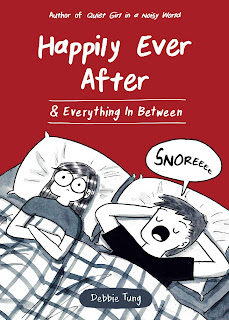
Happily Ever After & Everything In Between by Debbie Tung

I'm writing this early the morning of Christmas, about a cute little inoffensive book, so I expect this will be short and mild.

Happily Ever After and Everything In Between is a collection of single-page comics by Debbie Tung - they might have appeared somewhere else first, or might have been created for this book; it doesn't say - all about her newlywed life with her husband Jason. According to her bio in the book, she lives near Birmingham in the UK, but the book itself isn't specific about place or country: it could be just about anywhere in the English-speaking world (or even wider than that, if we pretend it could have been translated).

In the Olden Times, books like this were designed to sit by the cash register in a store, looking attractive and grabbing the attention of people in the right demographic or lifestage, or maybe just their friends and relatives looking for gifts for those people. Now I think these books have to make their way in the larger and more difficult online world, hoping for Google juice and that their creators' social accounts drive enough traffic to keep them going.

Either way, it's a nice book. That's what it aims to be, that's what it does: slice-of-life moments that are generally applicable, told with humor and drawn in a slightly cartoony, very relatable style. (I see a little Kate Beaton in Tung's figures, especially in motion - but I think a lot of young cartoonists have a bit of Beaton influence these days.)

Tung and her husband are specific people, but books like this lean into the universality of the experience: getting used to living with someone, being surprised daily by the reminder that you're actually married, buying your first house, not wanting to cook, starting to think about kids, and so on. If you've been a newlywed, a lot of those things will be familiar, and that's what Happily Ever After aims to do: show you Tung's version of those universal moments, in a sweet and fun way.

I found Tung a little more universal than someone like Sarah Andersen (whose Adulthood Is a Myth is about a lifestage two or three steps before this one), which is great for that spot by the cash register but made me want a bit more quirk and specificity. But happy people, and happy couples, are all very alike, and Tung seems to have been very happy when she made this book. There's no way I can count that as a negative. Happily Ever After is sweet and fun and nice: it will be a lovely read for people in that lifestage (or who can look back on it fondly).

Wednesday, February 02, 2022

Skyscrapers of the Midwest by Joshua W. Cotter

The memory of a book is not the same as an initial assessment, or a re-read. Looking back, when starting to write about Joshua W. Cotter's excellent graphic novel Skyscrapers of the Midwest, I see that I read it at almost the same time as Nate Powell's Swallow Me Whole. At the time, I said Skyscrapers was my favorite, but I've thought about Swallow much more often in the past decade, and returned to Powell's work in a way I haven't for Cotter.

So which of the two is "better"? 2008 Andy thought it was Skyscrapers. The default Andy of about 2010-2020 would probably say Swallow if asked to choose between the two. And today, after I've just re-read Skyscrapers?

Today I think I'm going to say picking between two books by completely different people is s silly game, that books are not in competition with each other in any sense other than for attention in the moment. The world is wide; there's room for everything. There's especially lots of room for strong books.

But today I have just re-read Skyscrapers. And I seem to be avoiding writing about it directly - maybe because what I wrote in 2008 is still entirely applicable and I don't really have anything to add to that. This is the story of a boy who probably is a semi-fictionalized version of Cotter himself, at the age of 10 in 1987. I wrote about a lot of the impressive elements of the story a decade ago, and I only have a few things to add to that.

There's a subplot here about a young man - eighteen or twenty, I guess - who looks a lot like the young protagonist and is in a bad relationship (almost entirely because of him) with a woman of the same age. Reading Skyscrapers this time, I wondered if that was supposed to be a flashforward, the same boy a little older. I don't think so: the rest of the book is set in 1987, and there's no transitional elements to imply that shift in time. More importantly, he interacts with the main plot once, so he must be a different person - maybe similar, maybe a warning of what the protagonist could become.

There's also some fake-nonfiction elements as part of the package - the letter column is answered by a cowboy named "Skinny Kenny," as the biggest example, but there are also some fake ads and similar stuff. This is loosely incorporated into the overall story, since "Skinny Kenny" replies to letters that, at least in one case, is clearly by a character in the story and is about the story.

But those are the only major pieces I didn't mention in my old post: otherwise, I agree with what 2008 Andy said. This is impressive, and it still struck me in 2021 as a lot like a more humanist, less formalist version of a Chris Ware story: similar elements about a similar childhood, with the story heading in a different direction and with a very different art style. In Ware, the story is about how a boy is irreparably broken - whether because of comics, or just adjacent to comics isn't really important. For Cotter, the hermeticism of a boy's imagination is both positive and negative, like so many things in life, and his characters need to have other connections, especially to family, to get through those tricky years.

We do sense that this boy will get through; he won't be broken like a Ware character. And I'm reminded that I've lost track of  what Cotter has been doing for the past decade, so I really should see if he's done anything else this strong.

Tuesday, February 01, 2022

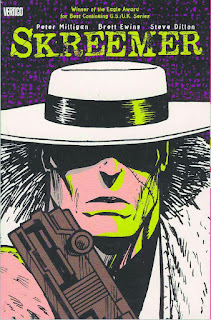
Skreemer by Peter Milligan, Brett Ewins, and Steve Dillon

I have to start with the quibble: I'll move on to praise in a moment. I'm sorry; it's just how my mind works.

Skreemer is a SFnal gangster story, originally serialized in six comics issues in 1989 and collected some time later. It was written by Peter Milligan, with art by Brett Ewins and Steve Dillon. It's set after a slow apocalypse: a series of plagues seems to have just overwhelmed the world and collapsed governments. At least, it's done that in the unnamed city the book takes place in, and, as far as the narrative says, across all of America.

Because it's a gangster story, most of the main characters are gangsters: Veto Skreemer is the main character, the guy on the cover. His henchmen and allies and enemies are most of the others; a family named Finnegan are the contrasting group of civilians.

For the resonance, for the kind of story Milligan wants to tell, they have to be gangsters. Outlaws. Violent men carving up empires of illegal activities. And they are.

But there's no society for them to be outlaws against. They are as much government as their nation has, though Milligan doesn't spend time showing that: for his story, they have to focus on drugs and prostitution, not taxes and resolving disputes.  But if the reader thinks about it for a moment, it's clear that their world can't have any functioning money, and doesn't have any laws left for them to break.

They're actually warlords, not gangsters. Milligan clearly knows this: the fact that the gang leaders take the title of President and carve up the nation shows he's gesturing in that direction. There's dialogue that talks about the whole nation, but all we see is this crumbling ruin of a city.

Who is picking up the garbage? Who is trucking food into the city? For that matter, who is growing food, and do the Presidents have guards stationed on the farms to make sure the food flows into the otherwise-starving cities? How is this society functioning at all, if the only order is imposed by '30s-style gangsters who spend all their time lounging in sybaritic splendor and baroquely murdering each other?

None of that is what Skreemer is about. The reader is not supposed to think about any of that; the world-building is besides the point. This is a story about people, in horrible, extreme situations; the world is constructed around them to force those situations. Some readers may find that artificial and limiting; Skreemer is not a good book for those readers.

That's what's missing in Skreemer: I don't want to say what's "wrong" with it, since it's not part of the plan or the story to begin with. It's an aspect of the book and story and world that simply doesn't exist, is not taken account of.

The story of Skreemer is about predestination and choices, about the evil that men do and the good they claim they could possibly do. Veto is cold and calculating in every moment, from the time we see him as a boy of about nine. If we're SF readers, we realize early he has some kind of presentiment of his future, but we don't get the full explanation until nearly the end. But the short version is: Veto knows what will happen. All of it, all of the important moments. Everything has already happened, is already done, as far as he's concerned. We don't follow his point of view - we see him entirely from outside, usually as a cipher - but he's another one of those precognitives who are utterly trapped, who feel like they are acting out exactly what they must do, without choice or change or free will.

Milligan tells Veto's story sideways and inside out, seeming to jump around the timeline while actually laying it all out very carefully and methodically. Our narrator is not even born during the course of the story; we never see him. Nothing is a surprise to Veto, even as he tries to find a way out of his destiny: he thinks if he can have a child, that will break the pattern he's seen. (He's right, I suppose.)

It's all juxtaposed with the story of the Finnegan family, who are just trying to survive the chaos, though not all of them do. The father is obsessed with the old drinking song "Finnegan's Wake," maybe just for last-name reasons. They go through their own horrible situations, and choices.

Well, if they are choices. Veto doesn't think so: he thinks it's all set, all final already. Everything from the collapse to his rise to his own inevitable death: utterly unalterable.

That's the story of Skreemer. The things Veto Skreemer saw and lived through, mostly in that order. It's dark and full of violence, with horrible things happening to characters we care about. It's a gangster story: that's required. Blood must flow, betrayals must be swift and shocking, and most of the cast must not make it to the end.

It's a very good SFnal gangster story: stronger in the gangster than the SF, inevitably. Ewins and Dillon tell it in a straightforward adventure-comics style of the era, without fancy panel layouts, to support Milligan's complex flashbacks-within-flashbacks structure. That was a good choice: a more baroque visual style would have been too much baroqueness at once.

It's not quite a lost classic, but it's a strong story by three creators who have worked together in different permutations a number of times, and have later done other things that this story prefigured. It's a solid comics story that does some interesting things: there's always room for more like that.

Monday, January 31, 2022

Reading Into the Past: Week of 1/29/05

Every Monday, I talk about a list of books here. If I've gotten anything new, that's the list. If I haven't...that's when "Reading into the Past" comes into play.

This series of posts looks at what I was reading "this week" in a randomly-chosen past year, from the period when I did keep a reading notebook (so I know what I read) but didn't have this blog yet (so there isn't already a post about that book). It is a weird and quixotic thing, but it is mine own.

This time out: the end of January of 2005.

Andre Norton, The Beast Master (photocopies, in Beast Master's Planet omnibus, 1/23)

This I read for work, obviously - I was Senior Editor of the SFBC at the time, and this omnibus was being published by Tor later that year. Beast Master was the first novel about Hosteen Storm, some guy in the future who could talk to animals (I think he had a Native American background to explain that - well, in those days it was probably an "Indian background," but you know what I mean). The other novel in this omnibus is Lord of Thunder; I don't seem to have read that, but the SFBC did offer the omnibus. And Lynn McConchie then wrote a series of sequels, supposedly "in collaboration" with Norton, but I always doubted how much the senior author did in the junior-senior pairings like that.

I never imprinted on Norton as strongly as some people of my generation did. I read some of her books when I was younger and enjoyed them, but never really went out of my way to read more - and Norton always had lots more; she was prolific and generally dependable. My memory is that this series is on her sillier side: psionics stories have not aged terribly well to begin with, and psionics stories about a noble savage and his animal friends have it even worse.

Robert E. Howard, Bran Mak Morn: The Last King ("read parts and skimmed parts," bound galleys, 1/23)

Here we see the era when I was "handling" a lot of books for work, and being clear about how much of them I actually read. (Elsewhere in this notebook I see "got through most of it" and "poked through parts," but the most common thing is "read beginning & end." You can get most of the point of genre fiction, especially a series novel, by reading the first 50 and last 50 pages, if you have to.)

This one was part of a somewhat scholarly project reprinting a lot of Howard work by Del Rey in the early years of the century - I think there were four Conan books first, with all of the stuff by other people stripped out of the mid-70s twelve-volume series and a serious attempt made to get back to preferred texts and proper chronological order. Bran was part of the second wave, along with Solomon Kane and Kull; I don't think we did all of them in the club, but I'm pretty sure we did this one.

I'm not a huge Howard fan; I've mostly stuck with Conan, which is his best stuff, as far as I could tell. My memory is that most of this collection - the cover calls it a novel, but it's not, at all - is OK pulp adventure, with a couple of stories substantially better than that.

Steve Almond, Candyfreak (1/24)

Popular nonfiction is always the same kind of thing: shortish books, in a breezy style, about something interesting to at least a big swath of people. It helps, the past three decades or so, if the writer can pretend that thing changed the entire world - that's not required, but it's been a major strand in the nonfiction world. This one was a bestseller, so you may have heard about it - I bet it's still selling decently even now, since the world Almond depicts is basically the same: there are a few big food/candy conglomerates, though they do tend to trade divisions to each other, like baseball cards, every so often, and they have kept buying up or forcing out the smaller players.

I remember liking this, and I think I went on to read at least one more Almond book, which is a good sign. But I'm also a guy whose family took an annual trip to the Hersheypark amusement conglomerate (mostly for the roller coasters & similar stuff, but always with a stop to the gigantic visitor's center and gift shop) for a couple of decades, so you may have to recalibrate your expectations.

John Kovalic, The Dork Side of the Goon (1/25)

I know this was a collection of Kovalic's popular webcomic Dork Tower, but I'll have to look it up to tell which one. According to that big internet bookstore, it's #7, and seems to be from the era where it looked like the series might actually move forward with some of its plotlines. (It's been irregularly-published for what feels like the last decade - never quite going away, but reduced to monthly random gags at times and often dropping what seemed to be central plots.) I like Kovalic's humor, even though the only tabletop gaming I did was back in highschool, and - though I think he's made a good living doing card art and creating games - I do wish he had time and financial incentive to tell more stories in comics form, since I like stories better than random art.

J.G. Ballard, Millennium People (1/26)

Before I look it up: I think this was Ballard's new novel at the time, and almost the last one he published. (My memory is that we got one more, and that he's been dead not quite a decade at this point.) Ballard's novels always came in clusters: the last group was about shiny new buildings and developments and other built environments in Europe, the not-quite-as-shiny people who moved into them and caused trouble with their neuroses and messy lives, but not nearly as much apocalypse as the similar urban novels of the '70s or the phantasmagorical books of the '80s. This one was right in the middle of that cluster: was it the one about the holiday camp in Spain? Now let me check my facts.

Actually, Cocaine Nights is the one set in Spain; Super-Cannes is the one set in a planned community near Cannes; and Kingdom Come the one about the mall outside London, his last novel. Millennium was second-to-last, with the original UK hardcover in '03 and the US edition (I think) somewhat delayed, and was the most general, about terrorists in the London suburbs - Ballard was always writing about suburbs, even when he didn't seem to be - and the man with the name starting with M who investigated and inevitably joined them. And he died in 2009; more than a dozen years ago now. Tempus fugit.

Thinking about Ballard always makes me want to read more Ballard, but which Ballard? The chilly  core stories? The '70s urban novels? The '60s cozy apocalypses? The experimental stories? The pseudo-autobiographies? Or the late flourish this one was part of? So many choices....

Simon Furman, et. al., Wallace & Gromit: The Whippet Vanishes (1/27)

I'm pretty sure this was a collection of the comic strips - originally from newspapers or comics? - from the UK starring Nick Park's claymated duo. But let me check.

No, this seems to be an original GN about W&G - I think the ongoing comics came slightly later, or maybe didn't make it to this side of the Atlantic until substantially later. As far as I can tell, this is indeed a story about W&G investigating a whippet (the dog breed, not the teenage drug of my youth) disappearing.

Nick Hornby, How to Be Good (1/28)

Hornby is a writer who makes deeply readable books that are thoughtful in a mass-market way, if that makes sense. (In some ways, he's very parallel to Tom Perrotta, his US equivalent.) I like his books a lot while reading them, but, even though he doesn't have a whole lot of books, I still struggle to remember which one was which. And that's my backhanded way of saying I don't remember anything about this one unaided. So time for some aid:

OK, so this is the one about a woman who - to be hugely reductive - was "the good one" in her marriage, until suddenly her husband changes and becomes massively more charitable, kind, giving, open - all of those things. And she...doesn't hate it, because that would be petty and wrong. But she's suddenly at sea in a lot of things in her life.

I think Hornby is a really incisive writer about the kind of lives lots of people actually live - a lot like Perrotta. He'll be read, at least by scholars, in a hundred years as they construct theories about "the mind of early 21st century humanity," if that's a positive for anyone.

Daniel Pinkwater, Atilla the Pun (1/29)

I've read a lot of Pinkwater; many of his middle-grade (and the rarer YA and one adult) novels are among my favorites in the world. This I think is a more minor work, but I don't remember it well, so let me research:

This is the sequel to Magic Moscow, which I'm not sure if I read as an adult. This time, a punmaster from the historical depths of the Eastern steppes is transported, magically, to the modern day, and causes upheavals and consternation among the people of what I think was the early '80s originally. Generally not considered to be one of Pinkwater's best, but just fine if you want more - which is pretty much exactly how I came to it.

Sunday, January 30, 2022

Another Song from the Movie I Will Never Make

Someone, somewhere, absolutely needs to use this song in a movie - in my mind, it's a scene with first one person moving forward, marching or walking but definitely out in public as an example, maybe doing something quixotic or unlikely, not demanding but hoping they're not alone in what they want, and is joined by more and more until the good guys win.

It's "Rome" by Ratatat, and however many people have heard it, that's not enough:

(It's also one of those songs where I can't help but keep the beat as it plays: it's that compelling.)

Friday, January 28, 2022

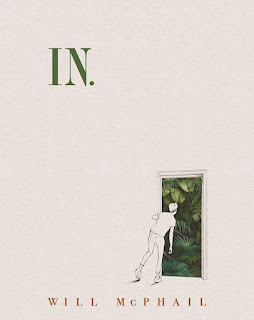
In. by Will McPhail

This graphic novel is just too damn good to be Will McPhail's first book-length project. He has to have a drawer-full of stuff, or maybe he's published short work somewhere. The drawing I completely believe; I've seen his cartoons and they're assured enough that I believe he could easily make the jump from single panels to juxtaposed images. But the story here? How does someone go from a one-line joke to a full-realized story of almost three hundred pages?

So, um, yeah, this is pretty good. In. is apparently the first long narrative Will McPhail has created, and it works from beginning to end.

It's about this guy, Nick, who lives in a big city (not unlike McPhail, who lives in Edinburgh, though this city is more vaguely New York) and works as an artist (also not unlike McPhail). He's got a sister, Anne, and a mother, Hannah, and early on he meets a woman, Wren, who could turn into a girlfriend if everything goes right.

But he feels like he doesn't connect with people, like he just skates across the top of conversations, saying generic things back and forth with people, and never gets to know anyone. He's not sure if he wants to get deeper into other peoples lives, but he feels like he's missing something, as if he's just play-acting at life. In fact, he's actually play-acting in the first contemporary scene of the book, as if this is how he thinks adults, or normal people, act with each other.

But then he connects, unexpectedly - he says something really honest and really listens to the answer. McPhail illustrates this conversation, and similar ones later in the book, as a surreal scene that Nick falls into - it's related to the topic, loosely and visually, but McPhail is not illustrating what Nick learns. Instead, he's showing what it feels like: a visual, comics metaphor for a deep human connection.

The rest of the book looks like McPhail's cartoons: line art with light washes of gray for emphasis and texture. But the surreal sections are fully painted, and striking every time they appear. (McPhail also signposts that a color scene is about to begin by zooming into the speaker's face and showing their eyes in color: another nice visual metaphor about seeing that only works in comics.)

I don't want to detail what the story is about from there: every story is in the telling of it. Nick does start out a bit immature, a bit unconnected - that's the point - and learns how to be different. Along the way, McPhail does things right both big (those surreal scenes, the overall flow of the book, all of the characterization) and small (a dozen throwaway joke names for coffee bars and alcohol bars, an amusingly arch depiction of Nick and Wren's first sexual encounter).

One of the most impressive things, particularly for a first book, is that I can point to something like a dozen things that McPhail does really well, and nothing at all that I'd seriously criticize. No book is perfect, but I'd be hard-pressed, even as a former editor, to point to anything in In. that I'd have red-penciled or asked for revisions on.

So: yeah. Really impressive. Thoughtful, deep, meaningful, lovely. Takes advantage of the comics form brilliantly, though I can still see someone wanting to turn this into a movie. (They'd probably screw it up, since it's already as good as it can be, but it would have four great parts to entice various actorly types.) If you haven't read it, you probably will want to.

Thursday, January 27, 2022

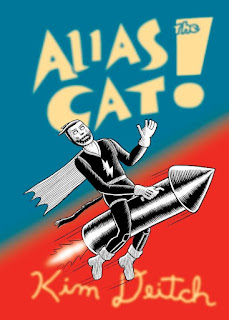
Alias the Cat! by Kim Deitch

I don't know if all of the Waldo stories are consistent. I don't know if they can be consistent, or if Deitch would want them to be.

I kind of hope they aren't, actually. Memory is flawed, history is misunderstood, the past is a mystery. And demon-creatures shouldn't be completely knowable, able to be nailed down to a specific timeline.

Alias the Cat! is a Waldo story: it's almost twenty years old now, but close to the last major Waldo story to date. It followed A Shroud for Waldo and The Boulevard of Broken Dreams (probably the centerpiece of the Waldo universe) and was in turn added onto by The Search for Smilin' Ed. Deitch's most recent book, Reincarnation Stories, is a similar style but doesn't include Waldo as far as I remember.

What does any of that mean?

Well, Deitch presents himself as an autobiographical cartoonist, one fascinated by popular entertainments of the early 20th century: cartoons, circuses, movie serials, comic strips, carnivals, and so on. Ephemeral stuff, things that are largely forgotten or lost. His big stories, for the last thirty years or so, tend to combine his discovery of some old piece of entertainment with a retelling of that old story - or the circumstances surrounding those people, or a complicated combination of the two. We get comics pages of Deitch talking to the reader directly, about the things he's discovered, and pages of him doing things in his life, and we also get stretches retelling the history he's discovered, or - as in this book - supposedly reprinting old comics by someone else from a hundred years before. It all combines together into fictions that mimic non-fiction, as surreal and supernatural elements are first hinted at and then leap into the center of the story.

They're impossible, and Deitch presents them all as if they're true. I'd say he presents them "straightforwardly," but he doesn't - Deitch portrays himself as excitable, eager to chase down these crazy ideas, as maybe more than a little bit naïve or gullible, someone always ready to believe in a great story.

Alias the Cat! is a three-part story: it appeared originally as three separate comics, in 2002, 2004, and 2005, and each volume has that Deitch energy and enthusiasm - each one has that air of "hey, look at what I just discovered!" They each end inconclusively, with mysteries left unsolved: even the third, even the end of this book and story.

Again, that's the nature of history, of the kind of stories Deitch tells. There's only so much Deitch-in-the-story can find out, only so much that has survived a hundred years. Only so much Waldo will tell, or allow to be told.

Waldo is a anthropomorphic character, like a black cat - call him Felix's evil twin, or dark doppelganger. He was a character in forgotten '20s cartoons, or a real creature impossibly in the real world, or a supernatural entity centuries old, or a hallucination only seen by the insane: he's all of those things in turn, or at the same time. He's a trickster at heart, a hedonist who has been everywhere and done everything and is ready to tell entertaining and possibly even true stories about those places and things.

As Alias the Cat! opens, Deitch-the-character insists he's never met Waldo, and that he's not saying that Waldo is a real person in the actual world. He likes Waldo stuff, and likes digging into these old stories, but he's not some kind of nut, he's not crazy - he can't see Waldo. All that will change by the end: meeting Waldo, being crazy, all of it.

Each of the three issues has its own arc and obsessions, from "furries" to Waldo's time as the charismatic leader of a tropical island, to a forgotten movie serial from the 1910s that strangely paralleled the actual events surrounding its release, to a forgotten New Jersey town populated entirely by midgets. Deitch-the-character keeps getting in deeper and deeper, more excitable and surprised by each new revelation.

This is all fiction, as far as I know. Waldo is not real, Deitch did not meet him, and meeting Waldo didn't send Deitch into a sanitarium for observation. As far as I know. But how far do any of us know?

Alias the Cat! doesn't end as well, as definitively as Boulevard or Smilin' Ed - it's an uneasy, uncertain ending, an ending about things that didn't happen rather than about the things that did. Maybe a disappointing ending rather than a triumphant one, but a true ending, an ending based on those bits of history and forgotten popular entertainments, and what's left of any of them in the modern day.

I don't know if I'd recommend starting reading Deitch here: I'd recommend running more or less in publication order, or starting with Boulevard if you want to jump forward to the big book. But this is a big middle piece of the Waldo saga; you'll get here eventually.