


Monday, March 22, 2010
What's Frustrating Me Right at This Very Second
If someone says "I have my opinion, don't bother me with your facts," is there any way that the opinion isn't a prejudice?


Fictional Mood Swings
I remembered one of the reasons I usually don't read horror this afternoon, deep in the middle of Joe Hill's (excellent, though deeply depressing) new novel Horns :
I'm the kind of reader who often takes his mood from the book he's reading, especially with fiction. And so reading a grim book about nasty things happening to difficult people makes me a difficult person. Which is no fun for anyone.
Anyone else have that problem?
:I'm the kind of reader who often takes his mood from the book he's reading, especially with fiction. And so reading a grim book about nasty things happening to difficult people makes me a difficult person. Which is no fun for anyone.
Anyone else have that problem?
Book-A-Day 2010 # 47 (3/22) -- Empowered 3 by Adam Warren
 Empowered is undoubtedly sexist, silly, and sophomoric -- that's the whole point of it. It's a series about a minor superheroine whose (none-too-impressive) powers derive from a very fragile supersuit (that is also, of course, superthin and skin-tight), who has what she always refers to as "body image issues" (she's drawn as not quite as super-thin -- yet busty -- as most superheroines, and obsesses about the size of her rear end). Oh, and she also started as a sequence of bondage pin-ups, and only developed an actual story later on, so her stories rest on the triple pillars of her ineptitude, her pulchritude, and her being-tied-up-itude.
I read the first book, and didn't really review it, since I saw it about the time Vol. 3 came out, and hoped to do a bigger review of several volumes. I never saw #2, but I've just recently read #3 and #4 -- watch for #4 tomorrow -- and, honestly, the plot isn't the kind that missing two hundred pages will make any difference in understanding.
Empowered -- we learn that her civilian name is Elissa Megan Powers on the next-to-last page; isn't that cute how her initials are E.M.P.? -- drags her eternally positive (if self-doubting) self through a variety of stories that, as usual, focus on her suit being torn, her self-esteem being shredded, and her limbs being tied in positions that (presumably) Adam Warren thinks his audience will find arousing. That was moderately amusing for one volume, but as the shtick for a series, it's a bit lacking in depth -- there's only so many changes Warren can ring on the idea without letting Emp actually get some backbone and skills (and hence ruining the entire premise.)
I'd say that one Empowered volume is about the maximum that any one person of average interests would require; if you particularly fetishize curvy blond women in torn garments and tight bondage, you may up that to two -- possibly three if you also have a fetish for ninjas. (Remember Voltaire's maxim: "Once, a philosopher. Twice, a pervert.")
Book-A-Day 2010: The Epic Index
Reviewing the Mail: Week of 3/20
 There wasn't a lot of mail this week, possibly as a result of the massive flooding last weekend. But what did come it fell very neatly, and evenly, into Manichean categories -- two graphic novels and two prose novels; two books that I had already read and two that I haven't. For someone like me, it's very comforting when the world falls into neat boxes like that.
The first thing that hit my mailbox this week was Twilight: The Graphic Novel, Volume 1
 . It's based on the Stephenie Meyer novel -- and credits her with a by-line, though my impression is that she was a consulting editor at best -- with "art and adaptation" by Young Kim, which certainly sounds like "did all the work" to me. The art is disconcertingly photo-realistic in a pseudo-Ryoichi Ikegami style, with lots and lots and lots of closeups of dead-looking eyes in blank faces. (It probably works better when you're reading the story rather that just poking through it, though.) This doesn't adapt the entire Meyer novel, even though it seems to be about 250 pages (there are no page numbers) -- a Volume Two is promised on the last page. Hachette's Yen Press just published this in hardcover, and I expect they're very happy about this new license to print money.
 Next was another graphic novel, Foiled
 , which was written by Jane (ten zillion books for kids of all ages, and a shelf of awards that stretches from here to Poughkeepsie) Yolen with art by Mike (Parade (With Fireworks)
 ) Cavallaro. I read this last month -- working from PDFs -- and wrote about it for my next Realms of Fantasy column. So it feels like it's in the past to me, even if no one but me and a couple of editors have seen the review yet. Foiled will be published in May by First Second.
And then there was Kage Baker's novel Not Less Than Gods
 . When I reviewed it about two weeks ago, I thought it was Baker's last novel. I've since learned from Tor (which published this book on March 16th in hardcover) that there's one more Baker novel, a fantasy related to The Anvil of the World
 , coming this summer. So this is not the last Kage Baker novel -- but don't let that stop you from running right out to get it immediately.
 And last for this week is the other book I haven't yet read, a novel from longtime comics writer Steve Englehart called The Long Man
 . It's the sequel to The Point Man, about immortal alchemical magickian Max August and his battles against the shadowy forces of repression and world-dominating conspiracies. It all sounds very pulpy and comic-booky -- which is just what Englehart knows how to do best. Long Man was also published by Tor on March 16th -- and it's this month's "Sci Fi Essential Book," from the network that changed its name from that to Syfy. (Wonder if the series will change name as well? It's slightly odd to have a tie-in book, even so loose a tie as "we think this is neat," have an outdated corporate logo and name on it.)
----------------
Listening to: The Deathray Davies - I Regret The Day I Tried To Steal Daniel's Ego
via FoxyTunes
Sunday, March 21, 2010
Book-A-Day 2010 # 46 (3/21) -- Captain Britain and MI13, Vol. 1 by Cornell and Kirk
 Just to get them out of the way, the full credits here are: written by Paul Cornell, pencilled by Leonard Kirk, inked by Jesse Delperdang with Scott Hanna, kibitzed by about eight million editors, suits, and random Marvel hangers-on.
Captain Britain and MI13 is apparently one of the better recent long-underwear comics; at least, I've seen it mentioned glowingly on a lot of of comics blogs over the past year or so. And this Cornell bloke is also popular among the geeks of the Anglosphere for his Doctor Who scrips and other work. So I decided I might as well take a look at CB & MI13; I don't much care for flayed naked people punching each other these days, but I'm still willing to be convinced by a particularly good story.
This, though, is not a particularly good story. It's a bastard son of shotgun-married parents, begotten out of the dead MAX series Wisdom by a giant thumping prick of a crossover called Secret Invasion. Wisdom, from what I can tell from this book, focused on a government spook with superpowers, Pete Wisdom, who worked in some capacity for the UK's government-superpowered-spook division, MI13. (Since it was a MAX series, I assume he said "shite" and "arse" and "bollocks" and "bugger" a lot, and did more than his share of shagging, bending the elbow, and brooding over his place in a dark, unpleasant universe.) And Secret Invasion, which was I believe two mega-crossovers ago -- it's very hard to keep track when you don't care -- saw the old Fantastic Four villains the Skrulls attempting to conquer Earth for the umpteenth time, in the new modern clenched-teeth fashion and with huge repercussions worldwide, which would resonate throughout the Marvel universe forever...or until the next crossover started up three days later.
So Captain Britain and MI13 begins in the middle, with someone the new reader doesn't recognize getting killed by someone who wasn't on the previous page, and secret skrulls blossoming like particularly unpleasant weeds everywhere. This four-issue storyline is meant to be the "assembling the team" story, but half of the team assembles in one place (CB himself, Wisdom, and Spitfire, who I think is a semi-secretly vampiric heroine from WWII) while the other half (the Black Knight, whom huge Marvel fans might actually have an opinion on, and a random female Muslim doctor named Faiza, who is dull and bland as a tea-towel that's been washed a thousand time) does other things somewhere else.
There's also some hugger-mugger about Avalon -- the mystical otherworld that is the source of England's power, blah blah blah -- which also gets invaded by skrulls, and then saved by some other bad guys that most of us won't recognize. Oh, and CB dies briefly, and for no real reason. You'll recognize all of the plot points as they march past; they're all old favorites.
It ends as we all knew it would: all the heroes together, in a flattened section of London, with dead or frozen skrulls all around, agreeing to fight the good fight and never ever kill any being that isn't a dirty alien skrull, then wandering off in search of a clubhouse, or possibly a spot of tea.
Perhaps this series got better from here, but the story collected in this book is paint-by-numbers crossoverism, and there's no obvious reason to continue unless a reader is really keen on seeing a guy dressed up in the Union Jack punching people on a monthly basis. The art is very much like every other series like this, though Kirk is solidly on the decent anatomy and composition side of the field.
Book-A-Day 2010: The Epic Index
---------------
Listening to: Richard Thompson - Ça Plane pour Moi [Live 2003]
via FoxyTunes
Saturday, March 20, 2010
Book-A-Day 2010 # 45 (3/20) -- Kimmie66 by Aaron Alexovich
 I should have warned you folks up front that not all of these Book-A-Day posts are going to be gems; I expect I'll be phoning in a number of them, particularly if I keep this up as long as I hope to. The posts I write on Wednesday and Thursday nights (deep into the week, hence tired and worn out) are likely to be the worst...and it's Wednesday evening as I type this. So don't expect too much.
Kimmie66 was one of the second wave of books from DC's ill-fated Minx imprint; the series was intended to provide an American alternative to manga for teen girls, but it never quite took off. (Possibly because actual manga has been driven mostly by series, and the US doesn't have the infrastructure developed to allow a team to pump out product at the rate required -- come to think of it, the modern American comics industry has gotten demonstrably worse at delivering popular content on schedule over the past decade or so.) The Minx books were all readable, solid entertainment for young women (and others who happened across them), but none of them were great, and several showed signs of pandering to their presumed audience.
Aaron Alexovich doesn't do that here, though; Kimmie66 is a fantasy story in SFnal dress -- you can tell the difference first because the main character turns away from technology at the end and secondly because it makes its "ghost" a limited, dangerous, dull creature that must be contained and destroyed rather than something new and interesting; it's renormative all the way -- set in a world two centuries hence where everyone spends all of their leisure time in "lairs," virtual reality MUDs. (And so it already feels a bit like yesterday's future, the dream of the Internet generation before Facebook and Twitter.)
Alexovich's main character is Telly, a teen girl who hangs out in a goth (not emo; again, this book was conceived several years ago) lair called Elysium, and is worried about her best friend Kimmie, who disappeared after sending a suicide note. Telly, with the help of her second-best friend Nekocat, her family, and an 1337 haxxor she meets (sorry, but he totally is), finds out what actually happened to Kimmie, and puts things as right as they can be put.
Kimmie66 looks nice, and Alexovich tells his story smoothly, but it's really nothing all that special. If you happen to be a goth girl in 2005 or 2006, you might love it. If you come across it at random in your library, as I did, it might serve to waste an hour of your time reasonably well.
Book-A-Day 2010: The Epic Index
----------------
Listening to: School Of Seven Bells - Connjur
via FoxyTunes
Friday, March 19, 2010
Book-A-Day 2010 # 44 (3/19) -- The Splendid Magic of Penny Arcade by Krahulic and Holkins
 There are plenty of webcomics out there. There are even a dozen or so gaming webcomics. And there are a handful of incredibly popular webcomics. But there is only one -- and there could only be one -- Penny Arcade. Often obscure, frequently profane, nearly always funny. (Though, often, only to those playing the same game as the creators at that moment.)
Similarly, there have been four Penny Arcade books, reprinting the online strips, published by Dark Horse over the past few years, and there will undoubtedly be more collections. But The Splendid Magic of Penny Arcade is something else -- look, I'll let writer Jerry Holkins explain:
We are often asked questions of various kinds about the strange life we lead as online image wranglers. Some questions deal with the remainder of our meals, specifically, are we going to eat them? Others refer to our bizarre, frenzied rituals, or the waxy sheen that gives our flesh the cast of death. Beyond this introduction, burning questions such as these receive a proper airing.Splendid Magic is a companion to Penny Arcade, in the popular "coffee table" format, with chapters about the history of the strip, of its creators (Holkins and artist Mike Krahulic), of its various unlikely offshoots (primarily the annual Child's Play charity drive and the PAX live-gaming convention), and its inexorable rise to be one of the central idioms of the modern Internet, up there with StrongBad, Goatse, TV Tropes, and 4chan. (Not everyone would agree that being a central idiom of the modern Internet is a good thing.)
This book is, in some way, like a common FAQ that has metastasized into some terrible physical form. Under what circumstances would two misanthropes ever create a charity? We touch on this. How did a handful of people who liked playing video games end up starting the premiere public gaming event in the United States? That is a great question, actually, and we will tell you how. The questions become more and more granular, up to and including items like "What kinds of things do you have on your shelves?"
And what is Penny Arcade? Well, there are these two guys -- Tycho Brahe and Gabriel, who are not precisely Holkins and Krahulic -- who live together and play a lot of video games. It's a comic strip, so stranger things happen as well, but the core of the strip is as it has been for the past decade: these two guys really like to play video games, and that's the source of most of their conversations with each other and interactions with the world.
Splendid Magic explains how Penny Arcade went from being just another decently-drawn and pretty funny online comic to being the unstoppable juggernaut that it is today. Along the way, the book reprints a bunch of Penny Arcade strips -- generally the ones you already know, like the Cardboard Tube Samurai stories, the awesomely horrible work of L.H. Franzibald, and "Paint the Line," plus a long section of Jerry and Mike's favorites, with commentary, near the end of the book -- and features both creators writing about their work. It's not an exhaustive guide to Penny Arcade, but no book of reasonable length could be, given that they've done seventeen hundred or so strips, most of which have at least four or five obscure gaming references in them.
The only major complaint I have about Splendid Magic is that its photographs, mostly in the sections about Child's Play and PAX, are completely uncaptioned. I know who Wil Wheaton is, and some of the other faces are vaguely familiar, but it would have been great to actually tell the reader that one figure is Holkins and another is Krahulic, instead of making him guess.
On the other side, there's a section of fan art from professionals -- Kazu Kibuishi, Scott Kurtz, Becky Cloonan, and others -- that includes a totally awesome piece from Bill Amend. The comic itself is just pretty good, but Amend wrote his comments on it in a close approximation of Holkins's clotted, densely allusive and heavily emphasized blog-writing style. (Holkins mostly writes in a calmer style in the book, which is something of a relief.)
The book isn't strongly organized to show off the evolution of Krahulic's artwork, though there is one section where he writes about what he's learned over the past ten years. But Penny Arcade's art has become immensely stronger and more expressive as Krahulic grew as a cartoonist, and today's he's as good as anyone doing humor, in any medium.
If you don't know Penny Arcade, go check out the link -- there's no reason to buy an expensive show-it-off-in-your-living-room book about a property you're not familiar with. (And, if you're not a gamer, don't expect to understand more than half of the strips -- but, still, the ones you do get should more than make up for it. And even the ones that whiz overhead at high speed can be oddly amusing.) But if you're already a fan, you'll want this book.
Book-A-Day 2010: The Epic Index
----------------
Listening to: Harley Poe - Corpse Grindin' Man
via FoxyTunes
Quote of the Week: Consequences
In honor of the review that will go live in half an hour:
Don't say another Goddamn word. Up until now, I've been polite. If you say anything else -- word one -- I will kill myself. And when my tainted spirit finds its destination, I will topple the master of that dark place. From my black throne, I will lash together a machine of bone and blood, and fueled by my hatred for you this fear engine will bore a hole between this world and that one. When it begins, you will hear the sound of children screaming -- as though from a great distance. A smoking orb of nothing will grow above your bed, and from it will emerge a thousand starving crows. As I slip through the widening maw in my new form, you will catch only a glimpse of my radiance before you are incinerated., Then, as tears of bubbling pitch stream down my face, my dark work will begin. I will open one of my six mouths, and I will sing the song that ends the Earth.- Tycho Brahe, explaining to Gabriel why he should shut up about Warhammer Online, in Penny Arcade
Thursday, March 18, 2010
Book-A-Day 2010 # 43 (3/18) -- Hespira by Matthew Hughes
 Matthew Hughes is one of the best examples modern SF has of the power of second chances [1], with two books from what was then Warner Aspect -- the very amusing and light-hearted Fools Errant and Fool Me Twice -- followed by a single novel for Tor, Black Brillion, and then a spray of titles from smaller presses in the years since. For some incomprehensible reason, neither the two Fool books nor Black Brillion were notably successful; I can't see any reason why the SF audience would avoid a writer as witty and endlessly pleasurable as Hughes, but they certainly didn't buy all that many copies of those books. But Hughes has kept writing, adding new wrinkles to his Vancean far future with each book and becoming one of the most entertaining writers the modern genre has to offer.
(I'm not at all unbiased when it comes to Hughes; I loved the Fools books and did a 2-in-1 of them at the SFBC when I was there, and bought Black Brillion for the club as well. And I've enthusiastically reviewed the first two books in the Hengis Hapthorn series from Night Shade -- Majestrum and The Spiral Labyrinth -- as well as the standalone Template.)
Hespira is the third novel about Hengis Hapthorn, the foremost freelance discriminator of Old Earth in its penultimate age. Hengis is a man entirely of the age of science, a firm believer in logic and the essential rationality of the universe. So it was a hard blow for him when he learned that the laws of the universe oscillate between rationalism and sympathetic association -- what less educated types might term "magic" -- and that the end of his age, and the rise of a new age of magic, was imminent. He learned of this quirk of the universe in Majestrum, and was dragged bodily into the world to come in Spiral Labyrinth, but Hespira opens with Hapthorn back in his own time, with things mostly back to normal. OK, his AI "assistant" shows an upsetting degree of humor and independent thought, a vestige of its period spent incarnate as a magical familiar. And the formerly internal part of his mind that worked by intuition has been reified into the body of Osk Rievor, an researcher into the growing power of magic that Hapthorn still consults as he used to do when it was part of his mind.
Hapthorn is in a dark mood as this novel opens, taken to thinking about whether it would be best to end his own life before the rational world is replaced by one ruled by willpower. His current case was far below his ability; he was acting as a go-between for a rich man to ransom some valuable property that was stolen from him. Unfortunately, that rich man then scandalously broke the rules of proper conduct in such matters by attempting to follow and assassinate the thief, which led both sides to widen their battle (through the sort of criminal cannon fodder that rings of thieves already employ and rich men can hire) and both of them to incidentally decide to eliminate Hapthorn along the way.
At the same time, Hapthorn came into contact with an amnesiac young woman, Hespira. She's not conventionally pretty -- Hapthorn points out that she's nearly the opposite of his tastes in that area, and grumpily sour to boot -- but he feels a strong desire to protect and help her. So he takes her off-world to trace her origins -- if nothing else, it will be a workout to his investigatory skills. The path of Hespira's true name and path is not a simple one, of course -- it wouldn't be worthy of Hapthorn if it were -- and it leads through several human-colonized worlds before it brings them back to Old Earth for the denouement. And, unpleasantly for Hapthorn, sympathetic association is involved.
Again, I can be reliably counted on to call each new Matthew Hughes novel a triumph; he writes wonderful books that I enjoy massively. The Vancean flavor of the Fool books have been mixed with a dash of Wodehouse, a couple of jiggers of Conan Doyle, and a shot or two of Wolfe to form a bracing cocktail that is nothing but Hughes. Hespira in particular builds on its two predecessors to make a satisfying end to a trilogy -- and what SFF reader can resist a trilogy? Hughes is the writer I invariably mention whenever the question of modern underrated writers comes up; he writes the kind of wonderful, funny, thoughtful, exciting, zippy novels that should be massively popular and winning him shelves-full of awards.
[1] The other, to me would be Kage Baker, who was rescued from the wreck of Harcourt's quirky SF program by Tor close to a decade ago. And anyone who likes Baker would probably greatly enjoy Hughes, for that matter.
Book-A-Day 2010: The Epic Index
----------------
Listening to: Haley Bonar - Holiday In Outer Space
via FoxyTunes
Wednesday, March 17, 2010
Book-A-Day 2010 # 42 (3/17) -- Market Day by James Sturm
 James Sturm has had a great impact recently, both as cartoonist (of The Golem's Mighty Swing and several other historical graphic novels) and as an educator (director and co-founder of the Center for Cartoon Studies, one of the few MFA programs in comics in North America). His new graphic novel, Market Day, is a short book with a pointed moral -- but I'm not entirely sure if I took the moral from it that Sturm wanted me to.
Somewhere in Eastern Europe, sometime about a century ago, Mendleman makes rugs by hand, by himself, on a farm far outside the closest town. He's married, and his wife is expecting their first child -- from this, I assume that he's relatively young. The story takes place entirely on one Market Day -- the time Mendleman goes into the town to sell his wares -- and, from the crowds, everyone else also goes into town to buy and sell.
Mendleman, along with a few other craftsmen, heads towards the store of Albert Finkler -- "always our first stop." (Given the reactions of other merchants later, I suspect that Finkler's was also usually their only stop.) But Finkler has retired and been replaced by his son-in-law, who brusquely explains that Finkler filled his storerooms with vastly more overpriced merchandise than could be sold, and that he'll be paying much less than his father-in-law did, in the cases where he's willing to buy at all.
Mendleman, who admits himself that he's dreamy and unworldly, is shocked by this, and wanders through the market, collecting more rejections. He clearly creates rugs that are lovely and finely crafted, but they also have turned out to be too large and too expensive for the actual market in this town. Sturm never says so, but it's clear that Finkler was effectively a patron of the useful arts: he paid too much for vast quantities of things that he couldn't sell -- he bought them all because they were excellent, and paid as if they were objets d'art. (And perhaps this is why his son-in-law is now operating his business.)
Sturm presents this from Mendleman's point of view, and he's staggered by what he sees as a betrayal. What he does is glorifying God, and failing to support Mendleman in his work is to deny all that is holy and true. Well, maybe.
But maybe this is a poor town, and maybe Mendleman himself does not exclusively seek out the finest and best of every single item he uses in his life, because he can't afford to do so. (Sturm does not extend Mendleman's reveries on the glories of rug-making to a general philosophy of only purchasing goods made with an equal care and devotion.) Mendleman has a real sadness, which is partially heartbreaking and partially annoying, since he's insisting that the world owes him a living doing precisely what he wants to do. And, of course, the world owes no one a living, and those who can do what they love and enjoy are the rare, happy few.
Mendleman is clearly a stand-in for the artist in general, and the comics creator in particular, making Market Day something of a manifesto-in-disguise. "Treat my work seriously," it murmurs, "for what I do is inherently special and wonderful." Again, maybe so. But Mendleman clearly had no sense at all of who he was making rugs for, and what needs those people had for rugs. He's just a rugs-for-rugs-sake kind of guy, and Market Day is slyly asserting that he should be supported simply because his rugs are high quality and beautiful.
But Mendleman gives up all too easily; rather than do anything other than precisely the rugs he wants to do exactly the way he wants to, and selling them to the one guy who would pay his prices, he's resigned, by the end of Market Day, to giving up on the work he loves (rather than do it one iota differently) and go back to farming.
My mother had a phrase for that: "cutting off your nose to spite your face." (Your own mother may have expressed similar sentiments; they're fairly general among mothers.) And I wonder if Mendleman, a year or so from now, will find himself similarly frustrated when his lovingly hand-cultivated wheat, or goats, or cows don't fetch the prices he demands for similar reasons. We all wish the Mendlemans of the world well, but we never want to go into business with them. Sturm constructs Mendleman's story as if he had no options -- this is "The Cold Equations" of rug-making -- but there are always possibilities between two stark opposites.
Book-A-Day 2010: The Epic Index
----------------
Listening to: Jacob Golden - Shine A Light
via FoxyTunes
Tuesday, March 16, 2010
Book-A-Day 2010 # 41 (3/16) -- Cyanide & Happiness by "Kris, Rob, Matt & Dave"
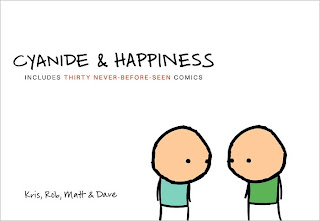 There's a landrush going on right now, as publishers chase popular webcomics to pin them down into dead-tree form. Dark Horse, the major comics publisher, had an early lead, with books from Penny Arcade, Sinfest, Achewood, The Perry Bible Fellowship, and Wondermark, but the New York houses have jumped in more recently, with Random House doing a trilogy of Goats book and HarperCollins picking up this first collection of the Cyanide & Happiness strip.
Cyanide & Happiness is an oddity even by webcomics standards: it's created in turns by four young men (who joined in on the strip one by one, and didn't really know each other beforehand), who each work in a slightly different crude style -- all of which would make R.C. Harvey rend his garments in rage -- and who write, almost exclusively, about squirm-inducing topics. If John Callahan were Voltron, these four guys would be the robots that come together to make him.
Let's take a random sampling -- p.52 has a joke about mutation, p.137 is about death notification, p.76 about stillbirth, p.19 voyeurism, and so on. Nearly every page has something to offend a reader. That kind of dedication to an ideal is inspiring, and should be a model for other young cartoonists with minimal skills -- they, too, can have a very funny, and usually offensive webcomic, if only they're willing to put in the long hours of hard drinking required.
The book contains 120 strips that originally appeared online, though at least a few from the strip's earliest days have been redrawn, plus thirty brand-new strips, which are not available for free on the Internet. As I said when I got this book in for review, it's for all of us who can remember 101 Uses for a Dead Cat (or the Truly Tasteless Jokes books), or anyone who has ever memorized more than two dead baby jokes. (What, you millennial kids think you invented tasteless humor? Pshaw.) Anyone who enjoys humor that they're not sure if they should laugh at will find something very funny in Cyanide & Happiness, and possibly something else that will deeply, deeply offend them. But them's are the risks you have to take.
Book-A-Day 2010: The Epic Index
----------------
Listening to: Blue Eyed Blacks - The Wrong Thing
via FoxyTunes
Monday, March 15, 2010
Book-A-Day 2010 # 40 (3/15) -- Crogan's March by Chris Schweizer
 I've been told that the frame story in Chris Schweizer's "Crogan" books -- in which a modern-day doctor tells stories from the adventures of his sensation-seeking forbears to his young sons -- was strongly requested or imposed on Schweizer by his publisher; I don't know if that's true, but I'd like to believe it. The frame stories -- both in this book and its predecessor, Crogan's Vengeance -- are entirely unnecessary, and serve only to turn an only mildly didactic story into a thuddingly obvious one. The boys and their father feel mustier and more old-fashioned than the historical stories they introduce, like refugees from some '50s "Boy's Own" series. Luckily, the frame story is more vestigial here than it was in Vengeance, so I can hope that Schweizer is attempting to minimize the role of the modern rugrats in his series.
The central story this time follows Peter Crogan, fighting with the French Foreign Legion in North Africa in 1912. Crogan's unit suffers under a demanding sergeant and from the contempt of the regular French Zouaves -- and that's before they get their new dashing commander and find themselves in the middle of a local tribal conflict.
As with Vengeance, Schweizer is working in a traditional area, and he's well aware of the cliches. That doesn't mean he avoids the cliches -- he's writing an old-fashioned adventure story, with equally traditional morals, so this desert epic has sandstorms and oases, secret tunnels and bar fights, hopeless sieges and daring escapes, mysterious monsters and shocking endings...everything but Fort Zinderneuf. It's a rousing adventure, though, again, that frame story does tend to put the whole enterprise into a juvenile box -- but that's OK.
Book-A-Day 2010: The Epic Index
----------------
Listening to: Hem - A-Hunting We Will Go
via FoxyTunes
Reviewing the Mail: Week of 3/13
 Regular readers of this feature -- both of you -- will remember that the last two weeks were notably light on mail, allowing Yr. Humble Correspondent to keep nearly even with the flood. [1] This week sees that trend reverse, with a good fourteen books arriving in the last seven days. I don't complain either way -- it would be incredibly churlish to do so -- but once again my attention is called to the gap between what we want to do (read everything, in this case) and what we're actually physically capable of doing (which is much less).
Before I list those fourteen books, let me quickly reiterate what this post is: I haven't read any of these books yet, though I have watched them stack up next to my desk as the week has gone on, and poked through some of them a bit. So the following post should not be taken as any kind of a serious review; I'm just noting that I've seen these books, and calling out whatever features of them seem most interesting (for good or bad; I try to focus on the positive, but I'm ill-equipped to do so) to me at the moment.
First up is the new Carrie Vaughn novel, Kitty Goes to War
 , the eighth book in one of the best urban fantasy series out there. (And that leads me to realize that I've gotten behind -- I haven't read Kitty Raises Hell
 and I don't even have a copy of Kitty's House of Horrors
 .) Anyway, this is an excellent series, much more strongly grounded in the real world (including that pesky rule-of-law thing that fantasy series usually like to romp all over) than most, and it's shown no signs of munchkinization, either. Kitty Goes To War will be published in mass-market -- I also can't believe that this series is still published in original mass! this is a steal! -- by Grand Central Publishing, the house that makes the trains run on time, this July.
 On the Odd Hours
 is a graphic novel by Eric Liberge, published by NBM in a co-publishing arrangement with the Louvre Museum. (Yes, that Louvre.) It's the third book from that publishing arrangement, after Nicolas De Crecy's Glacial Period
 and Museum Vaults
 by Marc-Antoine Mathieu, though the three books are otherwise completely separate. (I reviewed Museum Vaults a couple of years ago, and briefly discussed the series then.) Like the other two books, Odd Hours is set in the Louvre, and is about art as much as it is a work of art in its own right. NBM will publish it in April as a paperback with (of course) French flaps.
William Peter Blatty is one of those working writers -- he's published about a dozen novels and scripts about as many screenplays over the past fifty years -- whose name is remembered primarily for one work. In Blatty's case, that's The Exorcist: he wrote the novel in 1971 and the screenplay for the subsequent movie. And since then, he's mostly worked in similar areas, with stories of Catholic priests and demons, together or separately. His new novel is Dimiter
 , which does not obviously contain any demons, but is a religious thriller (and so might have a Catholic priest lurking in it somewhere), set in Albania and Jerusalem in the 1970s. Blatty has been working on this book, on and off, since a 1974 research trip to Israel, but only recently woke up one day with the ending finally in his mind. Dimiter will be published by Forge tomorrow, so all you long-suffering Blatty fans can run right out immediately and get it.
 Next I have a bunch of manga volumes, all of them from Tokyopop and all of them publishing in April:
The Japanese do like their niche series, which explains the appeal of Yoshitsugu Katagiri's Red Hot Chili Samurai, Vol. 1
 , whose first volume I have right here. I just have to quote the back cover copy here: "Samurai Kokaku Sento likes peppers. Scratch that -- he loves them. The only thing Kokaku likes better than eating a hot chili pepper is helping his father kick the butts of bad guys! With the help of his bespectacled friend Ento and cutie-pie girl of action Ran, Kokaku will take a bit out of crime -- but not before biting a spicy pepper first." For those of you scoring your Manga Bingo cards at home, that's Culinary, Samurai, a gimmie for Shonen, Goofy Sidekick, and Moe. Please see Mrs. Nakamura at the cage to claim your prizes.
 I haven't yet read the first volume of Kou Matsuzuki's Happy Cafe -- though I can see it from where I'm sitting -- but the second one
 is already here. This is on the shojo side, with an ordinary girl working in a pastry shop with the requisite two exceptionally tall and thin cute boys (one dark-haired and one light, since that's the way they always come from the factory) and having hijinks that are rather more sweet than wacky ensue.
Speaking of two boys, from the Blu imprint (for yaoi, boy-boy love stories created by and for women), there's Love Knot
 by Lemon Ichijo, in which two old school friends meet again as adults and have huge relationship drama, plus a little tasteful sex.
 I also have here Animal Academy, Vol. 4
 by Moyamu Fujino, which is a youth-rated series about a school for shape-shifters. I haven't seen the earlier volumes, but this seems to be filled with a lot of very large-eyed children looking and talking intently at each other rather than fighting in their animal forms, so I'm going to guess that it's on the shojo side.
And here's another book where I haven't gotten to the first volume yet: Mikansei No. 1, Vol. 2
 by Majiko! (The bang is part of the creator's name.) If I recall from the first book, this is the story of a teen girl from the future who wants to become a famous singer in our time -- and this book seems to focus on band drama. (I do wonder if including "No. 1" in the title of a series that will have multiple volumes is a good idea, but clearly the original Japanese publisher doesn't mind a little confusion.)
 I also have Maid Sama! Vol. 4
 by Hiro Fujiwara, the latest in the wacky series about a girl who's a tough student council president by day and a cute maid-cafe waitress by night. (This is a series for girls, so the psychosexual implications alone are fascinating.)
Tokyopop is also publishing a giant complete collection of Mizuho Kusanagi's Mugen Spiral
 , previously released as two separate volumes. I believe it's a romance between a modern female mystic and an ancient demon (resident in the body of a cat), but I'm reading heavily between the lines to get that, and I may be wildly misinterpreting.
 The universe of .hack -- a comic I haven't read and have only the vaguest familiarity with -- continues to proliferate with .hack//4Koma
 , a collection of 4-panel joke strips with the characters from the main story. It will presumably be of most interest to fans of the series itself, though there is a tiny sliver of cartoony fan-service on the cover, for whatever bizarre reason.
Thus concludes the Tokyopop offerings for April. (Well, their offerings that I saw; it's quite likely that they're publishing other stuff, too.) And so I'll turn back to the SFF shelves, with three new mass-market paperbacks from DAW, the publishing house that sounds like a manga sound effect:
 Gini Koch's debut novel will be a strong contender for the cutesiest title of April -- it's begins a SF series (with a very urban-fantasy-sounding premise) under the name Touched by an Alien
 . Speaking of cutesy, Koch's heroine is Katherine "Kitty" Katt. (Ahem.) She fights alien monsters to save all of mankind -- naturally. It will be published by DAW in mass market.
DAW's obligatory anthology of the month for April is Cthulhu's Reign
 , edited by noted Lovecraftian Darrell Schweitzer and featuring new stories by such fiendish luminaries as Jay Lake, Ian Watson, Gregory Frost, Brian Stableford, Laird Barron, Richard A. Lupoff and Schweitzer himself.
 And last for this week is another mass-market from DAW, a reprint of John Marco's novel Starfinder
 , the first book in his "Skylords" series. It's set in a steampunky-sounding world, full of flying machines called dragonflies (and the dirigible on the cover, presumably), but the tag on the spine says "Fantasy," which I suppose will help to explain the spectacles-wearing dragonoid creature also on that cover.
[1] Given what's been going on today in my neighborhood -- see this eye-opening chart for the gory details of waterflow three blocks from my house -- perhaps I should not have used that word. But I believe every graveyard requires a jaunty whistle when one walks past it.
----------------
Listening to: Bess Rogers - Everything To Lose
via FoxyTunes
Sunday, March 14, 2010
Book-A-Day 2010 # 39 (3/14) -- Captain Freedom by G. Xavier Robillard
 There have been a lot of superhero novels over the years -- from Superfolks
 to Miracle Monday
 , from Count Geiger's Blues
 to Superpowers
 , from one interchangable licensed product
 to another
 . So it would be very difficult to make the case that Captain Freedom is the very worst superhero novel every published. In fact, it's quite likely that's not true at all -- Robillard always shows a command of the English language, and his sentences form into coherent paragraphs and chapters at all times. No, Captain Freedom is certainly not the very worst superhero novel ever.
But it's not very good, either.
Captain Freedom masquerades as a novel, but it's really a sequence of tedious vignettes -- thirty-one of them -- only vaguely linked in a sequence. Many of those sections have only a tenuous relevance to the sections preceding and following them, as if Robillard is tossing out every variation on superhero cliches he can think of, as quickly as he can think of them, without bothering to filter or edit, and all of those sections have a hasty, half-baked urgency, with anything that could possibly have been a dramatic scene flatly narrated at second-hand and every idea given equally minimal weight and space.
Robillard begins with Captain Freedom having been forcibly retired from his mid-level office at Gotham Comics -- one of many, many potentially funny ideas that Robillard tosses out and then ignores in favor of tossing out more potentially funny ideas that he can also ignore -- and then flashes back to badly and superficially cover his career (in present tense, which our first-person narrator the Captain excuses for a reason that makes little sense and doesn't lead to anything) until coming out of the flashback at some murky point and then floundering aimlessly for another fifty pages until the book ends after a chapter not notably different or more conclusive than the half-dozen before it.
If Captain Freedom was a comedian, it would be Don Rickles -- a relentless stream of one-liners that insults the audience's intelligence. Make that Rickles on a bad night. A really bad night. Buried in this novel are ideas that, in more careful hands than Robillard's, could have been the kernels of at least a half-dozen funny superhero books. But everything is Captain Freedom is reduced to the same bland level, with a relentlessly talky narration that bleeds all tension and interest out of the book and characters who all talk exactly like each other -- when they're allowed to talk at all, which is rare, since Robillard would rather tell everything at second-hand than actually write a scene.
The best reason to read Captain Freedom would be if one were contemplating writing a superhero novel and needed inspiration. It's one of the finest examples of "If this can get published, I know I can" that I've ever seen.
Book-A-Day 2010: The Epic Index
----------------
Listening to: we are soldiers we have guns - Damn those TV shows, damn them straight to hell
via FoxyTunes
Subscribe to:
Posts (Atom)
