


The big publishing news of the day was that Terry Goodkind had returned to Tor -- where he was discovered by the fine editor James Frenkel and nurtured into a massive bestseller -- in a three-book deal beginning next year. The first book of the deal is specified to be a "Richard and Kahlan novel" -- referring to the main characters from his eleven-book "Sword of Truth" -- which may be just an odd way of referring to the twelfth volume of "Sword of Truth," or may imply that this new novel will be in a somewhat different direction.
The press release -- I got it via e-mail, and it's also been posted online -- doesn't state what the second and third books will be, or the title of the first book, but does say that the "Richard and Kahlan" book will come in early 2011. Perhaps those later books are unspecified in the contract, though that's unusual in my experience.
This announcement confused me, since I thought Goodkind was in the middle of an existing three-book deal, with Putnam. I dug out the news from 2008 -- Publishers Weekly still has the story online -- and found that I had remembered correctly; Putnam bought three standalone novels, of which they've only published The Law of Nines in hardcover last August. There's a paperback scheduled for this August, and I would have expected Goodkind's second Putnam hardcover to publish at the same time or soon afterward.
When they bought those books, Ivan Held, president of G.P. Putnam's Sons, insisted that "Putnam [would] be able to get Goodkind’s books into a wider market than Tor did," and that the first book would be "mainstream fiction, not fantasy." Unfortunately, publishing doesn't always work out the way we expect -- in the end, Law of Nines sold less than a quarter of the number of hardcover books that Confessor, the eleventh volume of "Sword of Truth" did, and featured a young man named Rahl who came into contact with a gorgeous woman from a secondary world where magic works -- quite possibly the same world that "Sword of Truth" takes place in. So it may have fallen between two stools -- too different for the "Sword of Truth" fans, too much the same thing for the people who read Joseph Finder and Steve Martini. It may not have been published as "fantasy," but it wasn't clearly not fantasy, either.
Still, it's unusual to see major press releases touting three-book deals for the same author only one book apart. Given Goodkind's sales history at Tor, I have to see this as a good thing for his career -- that's a sales force that has a long history with Goodkind books, and specifically with "Richard and Kahlan" books, and it will have been more than three years since Confessor by the time this new book emerges, so the audience will be ready for it.
It looks to me as if Goodkind has learned the unfortunate truth of the series author: if you become a major bestseller from a series, you do have a hard core of fans for anything you do afterward -- but most of your readers are fans of the series, and will only stick around as long as you're writing that series. Terry Brooks knows that, as did Robert Parker and David Eddings. Perhaps Goodkind will eventually join many similar writers in alternating series books with smaller-selling non-series (or new series) books -- or maybe he'll follow the Sue Grafton mold, and pull whatever else he wants to write about into that one series. (Not that he didn't do something very much like that in the "Sword of Truth" books!)
I also note that Goodkind supposedly sold two different books -- A Different Kind of Human and The Hinges of Hell -- to Doubleday Canada, for publication last year and this. (I examined that announcement when it was made in June of 2008.) Different probably turned into Law of Nines, since Dd Ca published that last year, but I wonder if they're holding onto their deal for Hinges of Hell?
Also, given the vague, half-informed numbers being thrown around by anonymous commentors on that post, Putnam is taking an uncomfortably full bath of Goodkindish red ink right now, which could explain why they aren't publishing the other two books on their contract. (If, indeed, they've released Goodkind, and not just pushed those books far back into the future and waived some specific we-get-the-next-book clauses.)
Monday, April 19, 2010


George Scithers, 1929-2010
I saw the story at Locus, which has the details: long-time editor George Scithers has died after a massive heart attack on the 17th. I didn't know him well, but he was a friendly face on the convention circuit, and always a gentleman with an easy smile and great insight. He'll be greatly missed.
Movie Log: Airplane II: The Sequel, Top Secret!, & The Naked Gun 2 1/2
 2009 was the year of James Bond for me; I watched nearly all of the films with my two sons before diving into the Fleming novels (and then also watching some non-Bond adventure movies with the boys as well). 2010 seems to be turning into the Year of the Spoof -- we saw Spaceballs and the Sellers Pink Panther movies in the fall (and Galaxy Quest, counts too, I guess) as a warm-up, and now have seen both Airplane movies, the first two Naked Guns, Robin Hood: Men in Tights and Top Secret! over the past month or so, mostly on Saturday afternoons.
Airplane 2 is a movie I've seen pieces of so many times -- and which is so obviously a retread of the first movie, which I've also seem pieces of so many times -- that it's difficult to think of it as an actual movie with a plot rather than as a collection of funny lines and ideas. (On the other hand, the filmmakers clearly didn't think of Airplane 2 as much more than a loose framework for a series of funny lines and ideas, so I'm not convinced that I should spend much time doing the work they didn't.) It generally considered to be a pale copy of the first movie, but I found it consistently funny this time, crammed full of gags, most of which still hit. I've probably seen it more times than the first one, so -- heretical thought! -- I probably prefer it to the first one, since I know it better.
 Top Secret! was the movie Zucker-Abrahams-Zucker made instead of Airplane 2, which isn't necessarily a good or bad move, since both movies were underperformers at the box office, and Top Secret! is minor and not a crammed with jokes as the usual ZAZ product. (OK, so the "Police Squad!" TV show came earlier, and in the same timeframe as Airplane 2 -- but that was a failure as well, and Top Secret! was their next movie.) It's a parody of Elvis Presley movies, which was a very odd choice for the early '80s -- not only had Elvis been dead for several years, his movie career ended about fifteen years before. Val Kilmer, looking very young and game, makes what he can of the gags, but the musical numbers -- authentically Elvissey as they are, and even though they're all amusing -- steal a lot of the movie's momentum. Top Secret! is also set in a world where the French Resistance is still active, for no obvious reason -- and that never becomes as funny as it should be. It has some laughs, sure, but it's pretty much as forgettable and minor as I'd remembered it.
 And then we got to The Naked Gun 2 1/2: The Smell of Fear this week; it's the same kind of thing as the first Naked Gun movie, only more so. ZAZ was becoming heavily formulaic by this point, and Leslie Nielsen had moved out of his original deadpan to mug horribly for the camera and do all manner of silly physical comedy. (When ZAZ movies work, they do so because they're filled with actors playing their parts straight and don't seem to realize how silly it all is.) The sex jokes also hit a new high here, which makes it possibly unsuitable for some audiences. (My younger son kept asking me why things were funny, and my older son wasn't sure whether to laugh or not -- it's not the best choice to watch with tweens.)
----------------
Listening to: Social Distortion - Story Of My Life (Live)
via FoxyTunes
Book-A-Day 2010 # 75 (4/19) -- Resistance, Book 1 by Jablonski and Purvis
 They used to say "War is not safe for children and other living things." Of course, they were dirty hippies, and they kept trying to get us to drop out and "live on the land, man," among other unpleasant activities, so we might not want to give too much weight to their views. But war is also hell, as some other people used to say, and hell is for children (at least according to Pat Benatar). It's an eternal conundrum. I suppose, but let's see if this book clears up any of it.
Resistance -- written by Carla Jablonski and illustrated by Leland Purvis -- is a war story for children, a graphic novel set in France in 1942 and focusing on three pre-teens in a small town somewhere in the wine-growing countryside of Vichy France: Paul Tessier, his younger sister Marie, and their friend Henri Levy. Henri is Jewish, which hadn't really made a difference until this point -- but there are suddenly more German soldiers about, and Henri's parents disappear swiftly and mysteriously. Paul and Marie decide to hide Henri in the caves for storing wine barrels, and start thinking about fighting back against the Germans.
From there, they swiftly run into the real Resistance and become part of it, passing secret messages and sketching German troops. Towards the end of this book, the three children -- accompanied by Peter's older sister, Sylvie -- are on their way to Paris to get Henri to something like safety.
This book doesn't finish the story, of course -- note that "Book 1" in the title -- but it does close out the immediate action. It's very much a historical story for younger readers -- making the Germans nasty but essentially faceless, and keeping their real crimes and the actual horrors of war off-page in the name of maintaining focus on the young heroes -- and it's very successful on that level, with the kids talking through their emotions believably and doing no more than is plausible for children their age.
So far, Resistance is fine but not particularly special -- there are a thousand pure-prose novels for young readers about WWII at least this good, and a number of books (starting with one girl's diary) that are much better at conveying the sense of what it was like during those times. Resistance does bring a decent version of that story into a comics form, and it is entirely worthy to sit on that shelf -- and, perhaps, it might bring some reluctant readers into this story.
Book-A-Day 2010: The Epic Index
----------------
Listening to: Okkervil River - So Come Back, I Am Waiting
via FoxyTunes
Reviewing the Mail: Week of 4/17
 It's a short list this week, so there's every chance that I'll actually get to read all of these books before long -- but I do need to point out, as I do every week, that I haven't read any of them yet.
The Many Deaths of the Firefly Brothers
 is the new novel from Thomas Mullen, whose first book, The Last Town on Earth
 , was widely praised (USA Today Debut Novel of the Year, Chicago Tribune Best Book of the Year, James Fenimore Cooper Prize). It's the story of two bank-robbing brothers, Jason and Whit Fireson, in the mid-30s depths of the Great Depression, who are cut down in a hail of bullets, but may not be exactly dead -- and, from the title and some hints in the flap copy (and the fact that Random House sent it to me, specifically), I suspect that there's some fantastic element to their survival. Whatever the reason, Firefly Brothers is a major literary novel from what we in the business like to call "Little Random," and hit store shelves in hardcover on January 26th. (Which begs the question of why I'm seeing it now -- perhaps, unlikely as it may seem, this book is getting a second publicity push after three months on the market? I took a quick look at its numbers in that book-industry sales tracking system that will remain nameless, and it's been chugging along at a slow pace that's probably depressing someone at Random.)
 From the sublime (I hope) to the ridiculous (patently), next in my stack this week is College in a Nutskull
 , compiled and edited by Professor Anders Henriksson. It's another one of those lists of dumb things people say, of the subcategory "students getting classwork wrong." Most of the examples of that I've seen -- there are several lists working their way through e-mail at any given time, like tapeworms in the Body Internet -- heavily crib from each other and may have been circulating for years or decades. But this book claims to be all-new, entirely from Henriksson and his colleagues, and so all sourced from actual, and presumably recent, boneheaded university students. So if you would like to weep at the ignorance of the present generation, this is the book for you -- it was published by Workman in February. (I guess this was the week for publicists to catch up on their mailings to minor bloggers!)
 And last for this week is the latest manifestation of the current literary craze: the zombie mash-up. In true brand-extension fashion, Seth Grahame-Smith's novel Pride and Prejudice and Zombies
 (on which he had no little help from a Miss Austen) begat the prose prequel Pride and Prejudice and Zombies: Dawn of the Dreadfuls
 , and has now shown further fecundity in begetting Pride and Prejudice and Zombies: The Graphic Novel
 . It's credited to Austen and Grahame-Smith, as adapted by Tony Lee and illustrated by Cliff Richards. (Note well the 's' in 'Richards' -- though it would be much more amusing if Cliff Richard had turned to drawing comic books in his retirement.) If you've held off on reading the original novel because you preferred a version with more pictures and fewer words -- or if you just can't get enough of Bennets slaughtering the undead with their parasols -- Del Rey will have the graphic novel version in stores everywhere on May 4th for your delectation.
----------------
Listening to: Fishbone - Bonin' In The Boneyard
via FoxyTunes
Sunday, April 18, 2010
Movie Log: Wilde
 Fifteen or so years ago, I read Richard Ellman's excellent biography of Oscar Wilde -- I was on vacation somewhere, I remember (probably the Amish country in Pennsylvania, about the only place The Wife and I could get to in the early days of our marriage), and I found it as compelling as it was supposed to be. A few years later, that biography was turned into a movie, but it took me another decade to get around to seeing Wilde. (But we're on a period-movie kick lately, so it moved higher in the rotation.)
Stephen Fry has the physical size, the leonine head, and the verbal acuity to play Oscar Wilde; he might not have been precisely born to play the part -- I still reserve that honor for his Jeeves -- but he's as perfectly cast as any man could be. The movie Wilde focuses primarily on his dangerous love-life, starting with Michael Sheen's Robbie Ross and moving on quite quickly to a young Jude Law as the gorgeous and unstable Bosie Douglas.
Wilde is a movie that assumes its audience knows the story, which is a reasonable assumption in most cases. (The Wife didn't know much about Wilde, though -- she was surprised to find out he was gay, which I didn't think anyone could have avoided knowing.) So there's an air of doom around Bosie, and a sense of inevitability for most of the movie. That makes Wilde less compelling to watch, since it's primarily rolling out a series of inevitable events that the audience wishes wouldn't happen. (I'm coming to think good biopics need to be made about people whose lives will surprise the audience -- that can either be done, usually badly, by heavily fictionalizing the life of a well-known figure, or, with generally better results, by picking second-tier or otherwise lesser-known people.)
In the end, Wilde hews closely to one of the great pillars of the Modern Historical Movie -- that the Victorians had great clothes, and wonderful country houses, but they were dreadfully emotionally repressed, and frightfully backward, so it's splendid that we're not them anymore. Wilde's life was more interesting and complex than that, but complexity is death to a movie script -- so we get another version of the Great Man torn down by his unquenchable love for someone utterly unsuitable.
----------------
Listening to: Tom Waits - Old Shoes (And Picture Postcards)
via FoxyTunes
My June Realms of Fantasy column
It was squeezed out of the actual issue -- those pesky stories ran long, I suppose -- but it's now available, in all its glory, on the ROF website.
Book-A-Day 2010 # 74 (4/18) -- Black Blizzard by Yoshihiro Tatsumi
 There are a few creators who arrive fully formed, whose first book is their best, or at least as good as the later works. (Of course, when I try to think of examples, what comes it mind are the great one-book authors -- Harper Lee, Margaret Mitchell, etc. -- who aren't quite the same thing.) But most people take a while to work up to their peak; they might be good enough to get published, but they're going to get better from there.
So it's no slam to say that Black Blizzard, an book-length manga story by Yoshihiro Tatsumi from 1956, is nowhere near as accomplished as his great later short stories (collected in The Push Man and Other Stories
 , Abandon the Old in Tokyo
 , and Good-Bye
 ) and his massive autobiography of his early career, A Drifting Life
 . It's not his first long story -- a short interview of Tatsumi by his editor, Adrian Tomine, in the end of this book mentions that Tatsumi had already written, drawn, and published seventeen stories of about this length previously -- but it's from very early in his career, and more than fifty years ago in the development of graphic novels.
Black Blizzard has similarities to Tatsumi's later fictional work -- it features a young man battered by circumstance, and in a seemingly impossible situation -- but it has a much more conventional thriller plot, and that young hero is more conventionally attractive, relatable, and innocent than later Tatsumi stories would countenance. Orchestra pianist Susumu has been arrested for murder after he woke up from an alcoholic blackout next to a dead body, and is handcuffed to a hardened criminal when their train derails. (It's not at all clear why two murder suspects are being transported by train in the first place; it's merely the set-up for the cliched melodramatic situation, so that point should be skimmed over quickly.)
The two men run and hide in a snowy wilderness, but can't cut the chain connecting them -- eventually, they decide that one of them must lose his hand to separate them. (Again, this is the kind of pulp fiction where it's easier to amputate or crush a hand without tools than to find a hacksaw to cut a chain; that's a feature rather than a bug.) In the way of a typical cheap melodrama, everything turns out much better than anyone would have guessed.
There are moments -- particularly early on, when the two men know little about each other and are mostly antagonistic -- that feel like "real" Tatsumi, but most of this book is competent old-fashioned melodrama with a simplistic '50s manga style designed for drawing speed. (The interview in the back matter also informs us that it only took Tatsumi twenty days to finish this, which would be blindingly fast for 128 solo pages if the drawing wasn't so clearly quick and dirty.)
This is an odd choice for Drawn & Quarterly to publish after their other Tatsumi books; it's substantially less accomplished and interesting, on all levels. I'm still hoping/assuming that he has another few volumes of stories equivalent to Abandon the Old, and I'd much rather see those than something disposable like Black Blizzard. This book is of interest almost entirely as a signpost showing how far Tatsumi had to go from the beginning of his career to its peak.
(I've reviewed all Tatsumi's previous books, either here or for ComicMix: Drifting Life, Good-Bye, Abandon the Old, Push Man.)
Book-A-Day 2010: The Epic Index
----------------
Listening to: Matthew Sweet - Someone to Pull the Trigger
via FoxyTunes
Saturday, April 17, 2010
Amazon Deals: Quick-Fire Round!
My Secret Masters have been getting annoyed with me lately; they've sent me many offers that I was supposed to pass on you people, but I've been leaving them for later. But I'm on the verge of attracting unwelcome attention from the Lidless Eye of Seattle, so have some quick links:
1) Need baby stuff? (Need it slightly later than right this second, which is when The Wife and I always needed baby stuff?) You can get free two-day shipping from Amazon if you sign up to subscribe, as well. (Did you ever think, when you were young and fabulous, that you'd ever consider subscribing to diapers? Life is just an endless sequence of unpleasant realizations, isn't it?)
2) Amazon has noticed that Mother's Day is coming up, and, through its vast databases, determined that most of you were not vat-grown, and are likely to have mothers. So they'd like to entice you to buy those mothers gifts from their vast catalog, from which they've excerpted a tastefully curated selection .
.
3) Speaking of holidays, Earth Day is coming up on Thursday. So any of you hippie types who want to celebrate that -- if you're also the kind of person who celebrates Earth Day by having expensive consumer goods transported across a vast continent by airplane and truck -- will want to go spend money here.
4) If I'd been more organized, I would have pointed out earlier that the Amazonians were offering a get two years for the price of one offer on magazine subscriptions this month. Hey, the month's not over yet, right? And we all love subscribing to magazines through an Internet emporium...don't we?
Please return to your regular activities after conducting whatever commerce you feel is necessary. Remember: only your frenzied and over-extended consumer activities can sustain the world economy and keep us from a devastating "double-dip" recession. No pressure.
1) Need baby stuff? (Need it slightly later than right this second, which is when The Wife and I always needed baby stuff?) You can get free two-day shipping from Amazon if you sign up to subscribe, as well. (Did you ever think, when you were young and fabulous, that you'd ever consider subscribing to diapers? Life is just an endless sequence of unpleasant realizations, isn't it?)
2) Amazon has noticed that Mother's Day is coming up, and, through its vast databases, determined that most of you were not vat-grown, and are likely to have mothers. So they'd like to entice you to buy those mothers gifts from their vast catalog, from which they've excerpted a tastefully curated selection
.3) Speaking of holidays, Earth Day is coming up on Thursday. So any of you hippie types who want to celebrate that -- if you're also the kind of person who celebrates Earth Day by having expensive consumer goods transported across a vast continent by airplane and truck -- will want to go spend money here
.4) If I'd been more organized, I would have pointed out earlier that the Amazonians were offering a get two years for the price of one
offer on magazine subscriptions this month. Hey, the month's not over yet, right? And we all love subscribing to magazines through an Internet emporium...don't we?Please return to your regular activities after conducting whatever commerce you feel is necessary. Remember: only your frenzied and over-extended consumer activities can sustain the world economy and keep us from a devastating "double-dip" recession. No pressure.
Incoming Books: 16 April
 I had to be in the city for an errand yesterday afternoon, so I took a detour and visited Jim Hanley's Universe, a great comic-book store hampered by an unintuitive organizational system. [1] I wandered in circles there for a while, gradually gathering the following books (plus some Sonic and Tiny Titans for my two sons) --
Popeye, Vol. 4: "Plunder Island"
 by E.C. Segar -- I've been looking for it for months now, and I finally ran into it in person. Of course, I still haven't read Vol. 2 or 3 yet -- they're so big that I need to sit down at home, or maybe take it on a long family car trip. (The Wife drives for those, since it's her minivan.) So this will go onto the pile for some indeterminate time, but I hope just having it will give me reason to dive into # 2, "Well, Blow Me Down!"
Hello, Again
 by Max Estes -- I've never heard of this or Estes before, but it was half-price and it was published by Top Shelf; that's enough for me to take a flyer on it.
 The Muppet Show Comic Book: The Treasure of Peg-Leg Wilson
 by Roger Langridge -- Langridge's first Muppet Show collection was a hell of a lot of fun, so I'm back for the follow-up.
Dungeon: Twilight, Vol. 3: The New Centurions
 written by Joann Sfar and Lewis Trondheim, with art by Kerascoet and Obion -- I'm beginning to think that I will gather all of the Dungeon books and read them straight through -- whatever that means for a series as scattered in time as this one -- but, while I'm working on that, I might well read this on its own.
Almost Silent
 by Jason -- this collects four of his shorter books. I'd already bought & read one of them -- The Living and the Dead -- so it took some thinking to decide to buy this. But I did give in, eventually.
The Complete Peanuts, 1973-1974
 by Charles Schulz -- You know why. If not, start with the first book and work your way up.
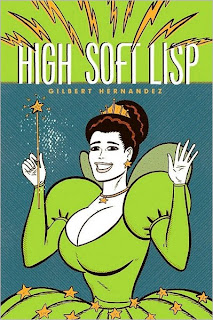 High Soft Lisp
 by Gilbert Hernandez -- I know this is mostly stories I already have, and I'm afraid buying it will put me on the slippery slope to rebuying the entire Love and Rockets saga in those giant hardcovers, but I couldn't help myself. Fantagraphics: exploiting Hernandez junkies since 1982.
[1] Most of the material for sale -- individual comics, trade paperbacks, and similar permutations of printing-on-paper -- is organized alphabetically in several long rows of shallow wire racks running down the middle of the store. I say "alphabetically" -- most of the material is alphabetical by title, though some of it, interspersed, is alphabetical by author. Those rows run onto their endcaps, more or less in sequence, though the endcaps seem mostly to be themed (new releases in the front of the store, major authors/series in mid-aisle and the back). There's also a set of bookcases on one wall, with graphic novels and collections that follow the identical scheme -- alphabetical by something-or-other -- and which overlap the main section unpredictably. Oh, and then two publishers -- Drawn & Quarterly and NBM -- have their own sections, which I think means books from those publishers aren't anywhere else. And then there's the R. Crumb shelves, over by themselves. And the manga section, which I think is all alpha by title, though I haven't investigated it closely. And the strip-reprint section, which also is alpha by title (probably). And the section for younger readers, which seems to be clumped by publisher, and then alpha by title. And of course the smut is over in an annex at the back of the store, as used to be common before the Internet smashed the market for comics porn. There are probably other sections I'm forgetting or ignoring (like an impressive mini-comics display); none of these have signs of any kind (other than small shelf talkers for authors or titles).
 I do have to applaud them for having something different than the usual comic-shop Great Wall of New Releases; it's much more of a bookstore feel, with backlist fully integrated into frontlist. But it desperately needs a system of signage to show browsers where everything is.
It's the kind of store where you almost have to start at one end, look at everything, and give up once you've found more good stuff than you can afford. (Which isn't difficult, I should say.) Coming in with a list of things to find, as I did, can be very frustrating, though I did find the above big stack eventually. So, if you're in New York, check it out -- but don't hope to dash in, grab something specific, and get back out.
Book-A-Day 2010 # 73 (4/17) -- Nightschool: The Weirn Books, Vol. 3 by Svetlana Chmakova
 I've written before about Chmakova's urban fantasy comics series -- I covered both the first and second volumes in reviews for ComicMix -- and I'm still enjoying it in this third volume, as answers begin to explain some of the mysteries. (And that's as it should be -- a creator can only raise so many questions before she hits the point where she has to start answering some of them.)
This volume opens with a focus on Daemon (the tall scary guy with tight cornrows) and his Hunters -- he's fighting an army of werewolves in their home (lair? den?), while another army of werewolves attacks his safe house, where the three young folks on the cover defend their compatriots who were knocked out by Alex Treveney back in the first book. The Hunters are pretty much what you'd expect they would be, given their name and the background of the world, and they're just about tough enough to handle anything. (The "just about" keeps it interesting.)
Eventually the story finds it way back to Alex, who is still attending her first
So this volume is mostly concerned with filling in backstory -- but Chmakova gives us a big fighting-with-werewolves scene to start off with, so backstory is welcome about then. (And there's more than a bit of megadeath in the backstory, too.) This book sees things getting somewhat too melodramatic -- there's one character whose anguished dialogue is really too much, even for a pop-fiction comic about werewolves and the folks who hunt them -- and some of her names are a little silly. But that's not substantially different from the wave of pure-prose urban fantasy (and its epic counterpart), so I can't really fault Chmakova on that account. I am hoping that the explanation for the supernatural stuff gets a little more distinctive and interesting -- it's a bit doomy and second-hand for my tastes so far -- but this is still a reliably entertaining and engrossing chunk of modern fantasy.
Book-A-Day 2010: The Epic Index
----------------
Listening to: Oingo Boingo - Elementary Physics
via FoxyTunes
Friday, April 16, 2010
My Tombstone
Has been discovered in Sevier County, Arkansas. Apparently I died over a hundred and twenty years ago, and was married to a woman named Mariah before that!
Such are the joys (or discontents) of having a boring, common name.
Such are the joys (or discontents) of having a boring, common name.
Any Connection to Other Industries Will Be Left To the Reader
The beginning of an excellent post by Persona Non Data:
"Mention you bought an actual CD these days and the response might equally be "where?" or "have you heard of iTunes?" Yet, after more than ten years of both legitimate and illegitimate access to down loadable music, the humble CD together, with its environmentally challenged jewel case continues to represent over 75% of music sold."
Go read it.
"Mention you bought an actual CD these days and the response might equally be "where?" or "have you heard of iTunes?" Yet, after more than ten years of both legitimate and illegitimate access to down loadable music, the humble CD together, with its environmentally challenged jewel case continues to represent over 75% of music sold."
Go read it.
Book-A-Day 2010 # 72 (4/16) -- Athena: Grey-Eyed Goddess by George O'Connor
 Athena is the second in a four-volume series of graphic novels about the Greek gods for younger readers, following Zeus: King of the Gods (which I haven't seen yet, but will be looking out for), and to be followed by books on Hera and Hades. O'Connor is the artist of Ball Peen Hammer, a graphic novel by the playwright Adam Rapp, which I reviewed for ComicMix last fall.
This is officially for younger readers, but some parents may want to vet it first -- there's no explicit blood or gore, but O'Connor sticks pretty close to the mythological sources, which means there's a lot of typically god-like bad behavior here. This volume features five different exploits of Athena -- her parentage and birth, her ill-fated battle with her close friend Pallas, the battle against the Gigantes who besieged Mount Olympus, the story of Medusa and Perseus, and the story of Arachne -- all framed and told by the three Fates.
O'Connor has a moody, dynamic style that suits his subject matter well; his work here looks a lot like the early comics of Tim Sale. And the exploits of the gods give him a lot of scope for adventure stories, so -- with any luck -- there will be more than four of these books. Again, Athena is a bit more bloodthirsty than some people might be comfortable with, but it's damn good comics about the original warrior woman.
Book-A-Day 2010: The Epic Index
----------------
Listening to: Matthew Sweet - Divine Intervention (demo)
via FoxyTunes
Quote of the Week: Housing in Lincoln
"There is no housing shortage in Lincoln today -- just a rumor that is put about by people who have nowhere to live."
- Councillor Murfin, Lord Mayor of Lincoln
- Councillor Murfin, Lord Mayor of Lincoln
Subscribe to:
Posts (Atom)
