Wednesday, May 31, 2017

Home Fires by Gene Wolfe

There are things you can depend on from Gene Wolfe. The book will be told by a man (with very rare exceptions): one who knows more than he says, and is skilled at more things than he even knows. There will be long conversations that break off suddenly and never quite address the point you thought was at issue. There will be female characters who don't quite seem human: overly emotional, mercurial figures who sometimes are said to be loved by the hero and sometimes seem to be burdens to him. (Or, often, both.) That hero will never have any real emotions expressed through his actions. He may say that he has them, and you get to decide if you believe him.

You get to decide if you believe the hero about a lot of things in a Wolfe novel.

You will figure out much of what is going on by yourself -- not in the way of a mystery novel, exactly, but more in the way of a child moving into an unfamiliar new life situation, full of strange adults with agendas they will never explain to you. Events will happen swiftly and unexpectedly, and the plot you were anticipating will fail to happen, perhaps repeatedly. The ending will not necessarily be a dying fall, but you should prepare for one.

With that in mind, then, this is Home Fires, his novel from 2011. (I'm running behind: he's had two since then, The Land Across and A Borrowed Man.) It is both a hundred years or so in the future and a pastiche of the 1940s, as often in recent Wolfe books. Wolfe never stoops to an infodump, but we readers learn that this is a moderately dystopian world, possibly overpopulated, possibly post-Peak Oil and definitely run by corrupt hereditary politicians from top to bottom. In what is perhaps an echo of 1984, our main characters are from the North American Union and occasionally talk about the two other great powers in the world, the EU and Eurasia. (I am sorry to say this seems to be a EU as conceived by paranoid right-wingers; in a throwaway detail we learn that sharia law is practiced there. But all the pieces of this world seem to be horrible in their own ways, so that does not necessarily indicate Wolfe's personal politics circa 2010.)

A quaint, pulp-era interstellar war is raging, and has been for at least a few decades, between the nations of Earth and an alien race called the Os. Both races need the same kind of habitable world, and so infantry forces battle on the surfaces of those worlds, across the galaxy, to secure them for one race or the other. Neither force seems to use anything like armor (personal or tank), let alone unmanned devices. This war may not be precisely a stalemate, but it certainly doesn't seem like anyone is winning. Somehow, spying -- both among the supposedly-allied human nations and across the species barrier -- is really important and common.

(I pause for bemused laughter.)

The economy is similarly pulp-era, with no sign of automation even to the level we have it today. Our hero is the managing partner of a law firm, and has a secretary, who herself has an assistant. (There may be a global CEO or two who have two PAs these days, but that would be rare. And law firms have been getting leaner with the sharpest of razor blades for the last two decades.) But, for some reason Wolfe does not state, this administrative overstaffing on top of the pressures of a people-intensive galactic war have led to a massive oversupply of workers, so that there are thousands of applicants for each open positions, leaving poor job-seekers routinely out of luck for years at a time.

With Wolfe's modern novels, the reader has to tease out the background information that is pertinent to his plot from the background information that is not: Wolfe was born in 1931, and his worldbuilding more and more shows his age. Most of the things I've been mentioning for several paragraphs are unlikely and anachronistic, but they are not important. This is not a story about the interstellar war, or the unlikely economy, or the sail-powered globe-trotting ultra-luxury cruise liners that are nevertheless repeatedly attacked and conquered by murderous pirates.

No, it's a story of a marriage -- or, rather, of a contract, since this is a world where marriage is personal and religious, while contracts are the public things done at the courthouse with real legal power. (Once again, one scratches ones head and wonders if Wolfe deliberately made this world a pseudo-libertarian nightmare, or if those were just ideas he was toying with at the time. But speculating on Wolfe's motivations is never useful.)

Twenty years ago, two young people -- undergraduate Chelle and law student Skip -- made a binding promise to contract, as Chelle enlisted in that war. Due to the usual time-dilation effects of '70s-style interstellar wars, she's now about eighteen months older and at the end of her service, with scars physical and mental. But he lived all of those twenty-plus years, and is now, as I noted above, moderately rich and powerful, though his firm seems to be a small litigation boutique and his practice not particularly focused on things that would bring in a lot of money (class actions, if those even still exist in this world, or defending local legitimate businessmen who are always being accused of running some criminal enterprise or another).

I do need to note here, again, that Home Fires kept tossing details at me that I knew enough to look askance at. Wolfe novels are always tossing off seemingly-minor details like that, but it's less appealing when the reader knows how such things work in the current world and can't make the fictional world cohere given the facts stated.

Anyway, Skip goes to meet Chelle as she disembarks from the giant spaceship back from wherever. For no reason he tells us, or that makes much sense later on, he brought along her mother Vanessa -- whom Chelle divorced years before she even met Skip -- even though that meant hiring a company to decant Vanessa's stored memories (she's dead) into a borrowed body for the occasion. Vanessa is needy and manipulative and demanding, but it at first seems to have been a good idea, since Chelle doesn't even seem to notice that Vanessa is an entirely different person twenty years younger than she should be.

(No, Wolfe doesn't ever explain any of that. Or even, as far as I could see, give details that could build an explanation. In general, it does not pay to spend much mental energy working out motivations and mental models for Wolfe's female characters: they are flighty, unearthly creatures, outside the ken of men such as Wolfe and his readers.)

Skip and Chelle's relationship needs to be rekindled, obviously. (Both of them seem totally outwardly committed to that rekindling while simultaneously internally assuming that it won't work and working assiduously to ruin the relationship.) So they set off on a round-the-world year-long cruise to get to know each other again.

But Chelle has not yet gotten out of the habit of random casual sex with fellow soldiers. And Skip had a decade-plus affair with his assistant Susan -- he seems to be able to emotionally separate from that, if he was ever emotionally connected to a single thing in his life to begin with -- but it brings along other complications, because, as usual with Wolfe, women are crazy bitches.

I pause here to note that Susan and Chelle and Vanessa are all women. Just a note.

Oh, yeah, and remember the pirates? There are pirates.

And the people who rented Skip a new body for Vanessa want it back, because he tried to pull a lawyer trick to "save" her and he's apparently not as good a lawyer as he thinks he is.

So the story of a couple trying to find out if they still have anything in common turns into the usual Wolfean stew of gunfights, tense verbal negotiations that cut off suddenly, chapter-ending knockouts, and repeated kidnappings. This may all be a good thing, because, as Wolfe presents them, the answer to the question "Do Skip and Chelle have any future" is clearly "Oh hell no."

Three hundred pages later, the novel ends. The women still don't make much sense as human beings, and Skip is still a cold fish who has more skills than are plausible. But it was an interesting experience along the way, and Wolfe is never boring -- confusing sometimes, baffling occasionally, and quirky always, but never ever boring.


Tuesday, May 30, 2017

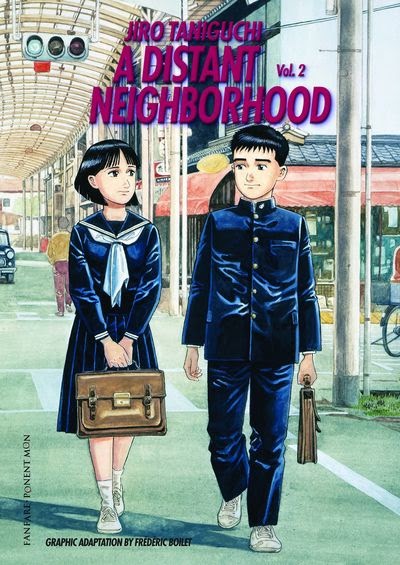
A Distant Neighhborhood, Vol. 2 by Jiro Taniguchi

Hiroshi is still stuck in his middle-school self as the second half of this story begins -- he was a salaryman in his mid-forties, as the first book set up, who accidentally went to his childhood home on the wrong train and fell asleep on his mother's grave -- but he's mostly learned to act like a normal young man and to stop telling people about the future.

A Distant Neighborhood is a quiet story, for all of the time-slip fantasy behind it: the story of one man getting a chance to see his young parents through adult eyes, and finally understanding them because of that. Taniguchi presents that story deliberately and naturalistically; Hiroshi gets worried and upset by the coming day when he knows his father will disappear forever, but Taniguchi uses that to drive Hiroshi's inner narrative and feelings, not to motivate external action. This is a story that takes place primarily within Hiroshi -- the story of how he learned things and re-evaluated a pivotal time in his young teen years.

Taniguchi ends this precise story the only way he can, balancing the beginning exactly with the end. Hiroshi can only take back memories and realizations -- but that's more than enough. A Distant Neighborhood is a manga mostly about children in middle-school and one boy's family, but it's vastly different from most of the manga on those themes that get translated here: this is a book with adult concerns and ideas, thoughtful and still and lucid as a deep pool.

Monday, May 29, 2017

Reviewing the Mail: Week of 5/27

Sometimes I dream of the perfect books-in-the-mail week: I get exactly the books I'd want to read next, and precisely as many books as I'd read the next week. Since the universe is infinite, it's theoretically possible, but since even I don't know what I'll want to read three days from now (or what will affect my reading time and inclination), it's practically impossible.

But, some weeks, I get just one book, and it's practically begging me to jump the queue and read it next...so that's pretty close.

(In case you're confused: I review books, so publishers send me books to review. Fewer now than in the past, since blogs are pretty 2006 these days, and my traffic is not setting the Internet on fire. But free stuff is a wonderful thing in any circumstance, so I celebrate those books every Monday morning.)

This week, that book was Nothing Left to Lose by Dan Wells.

It's the sixth novel about John Wayne Cleaver, and, I suppose, the end of the second loose trilogy. (Each book is a standalone, like a mystery novel, but they tend to cluster.) John is a teenage sociopath -- diminished emotional affect, urges to kill, voices in his head, the whole bit -- who has tried his whole life to keep himself controlled and good. Unfortunately, John lives in a dark-fantasy universe, where a group of people got supernatural powers thousands of years back and have been predating on humans ever since, in various horrible and unpleasant ways. John has been tracking and killing these monsters for several years now, since they wrecked his young life back in the first three books. Along the way, he's lost just about everything but himself, and all of his hopes for anything else.

John has a great voice, and Wells lets him tell the stories directly -- they're compelling, page-turning stories that move well and and bleakly excellent. See my reviews of the first trilogy, The Devil's Only Friend, and Over Your Dead Body for more details.

Nothing Left to Lose is a trade paperback from Tor, coming on June 6th. It may be the end of John's story.

Thursday, May 25, 2017

Snotgirl, Vol. 1: Green Hair Don't Care by Bryan Lee O'Malley and Leslie Hung

Sometimes, a main character is the entire book. A reader's reaction to her determines everything. If you sympathize with her, you sink into the book and are swept along. If not...well, in that case, things are rockier.

I have to admit that I didn't warm to Lottie Person, the tediously self-centered, vain and shallow main character of Snotgirl. She's a fashion blogger in LA, the epitome of the empty-headed young person who lives 24/7 with a phone in her hand, an emoji in her heart, and an uplift at the end of her sentences. I won't say that I hate her, but I'd rather not spend any more time in her company than I have to, and if I knew her in real life, I probably would hate her.

(She reminded me of Stephanie Plum, the similarly ditzy heroine of a series of novels by Janet Evanovich. I hate-read five or six of those books, back when I read much more and when I was reading professionally, always with the hope that Steph would finally wise up, even just slightly, and get the least clue about herself or her life. I am older and less tolerant of the travails of the young and fabulous now.)

Snotgirl is entirely from Lottie's point of view: it's deeply invested in her and her view of the world. If you're not willing to deeply believe in this neurotic young woman, and insist along with her that blogging about clothing is a serious and worthy pursuit for an adult, you will be left cold, grumpy and entirely outside the story.

As I was.

I am impressed that this is written by Bryan Lee O'Malley, cartoonist of Seconds and the mega-popular Scott Pilgrim stories -- it has the focus on youth and complicated, flawed protagonists of those previous books, but it digs much more directly into a very female life and world-view than he's one in the past. My opinion is probably not that believable on this subject, but Lottie felt deeply real to me: not a person I want to spend time with, admittedly, but like someone I could easily see existing in the real world.

It looks gorgeous, too, as a book about fabulous people and their fabulous clothes should -- artist Leslie Hung and colorist Mickey Quinn create a crisp, larger-than-life world of gorgeous clear-skinned people in outfits that pop and a vibrant, energetic color palette.

But I just don't like Lottie at all. I don't care about her massive allergy-driven self-doubts, and I'm not intrigued enough by her new frenemy Caroline's obvious gaslighting and negging to want to keep up with more Snotgirl. Lottie is shallow when she isn't mean, and mean when she isn't shallow, and occasionally both at the same time. I just don't want people like that in my life, even fictionally.

That's totally fine -- there need to be more comics not for middle-aged white guys like me -- but I'm a little sad that I bounced off it so hard. I'll have to see what O'Malley does next -- and maybe see what else Hung has done, since I'm not familiar with her work.

Wednesday, May 24, 2017

The Stone Heart by Faith Erin Hicks

The trilogy begun in The Nameless City continues here in The Stone Heart -- and, as we all know about trilogies, that means that this book will be darker than the first and have less of an ending. Both of those things are true, and I'll also note that some of the things I grumped about in the world-building of the first book are muted or explained otherwise here -- I don't think Hicks even knew my post existed; just that those are obvious questions that she either already had in mind or had raised to her by librarians or readers or her editors.

So: we're still in not-13th century China, in the city that is officially Nameless in this book (I don't think anyone calls it DanDao, the official name under the current conquerors). Our heroes Kaidu (teen son of a conquering general) and Rat (orphan teen daughter of locals killed by those conquerors and raised by the local monks) saved the life of the General of All Blades in the previous book, making them moderately important and influential. That General, in fact, has come around to the idea that Nameless should be governed by an independent council, made up of representatives of the great warring nations and the locals. It hasn't happened yet, but the current set of conquerors are moving forward to make it happen -- if one of the other major warring nations can be brought on board.

Not everyone agrees with that utopian dream, of course -- particularly not young Dao lordlings who currently expect to grow up to rule this great city and who would be exiled from it under the proposed plan. And lordlings in a feudal society have violent options to stop changes they don't like.

Things get dark -- again, this is the middle book of a trilogy, so that's to be expected. Our heroes can't save the day if the day doesn't need to be saved. There is a lot of age-appropriate death and destruction before the end of The Stone Heart, and there is a day that is definitely endangered. It will probably be another year before the concluding third book, The Divided Earth, which may test the patience of some younger readers (and, who knows? older ones as well). But, from the evidence here, Hicks will reward that wait -- she's been telling great comics stories for a while now, and this trilogy shows her stretching to a larger canvas and doing a great job of it.

Tuesday, May 23, 2017

Underworld: From Hoboken to Hollywood by Kaz

Everything declines and falls; everything takes ship for the West and its inevitable end. But sometimes things can be reborn, as the Age of Gold turns to the Age of Silver. So underground comics died, as their audience aged out or grew up or got real jobs or got embarrassed or just went somewhere else. But much of the same energy and subject matter and style came back in comics that ran in the burst of weekly free newspapers that sprang up in the late '80s and flourished in the '90s.

(And some of that, in turn, went into webcomics when those weeklies, in their turn, were strangled by market forces.)

One of the most aggressively underground of the strips in those papers was Kaz's Underworld -- a weekly strip with no continuity, just a collection of grotesque lowlifes who swore and killed each other and did drugs and parodied themselves and older comics. (Kaz is the working name of a cartoonist with the jaw-buster moniker Kazimieras G. Prapuolenis; if I had a name like that, I'd want to work under something shorter as well.) And that strip apparently is still running, though I can't imagine where -- those free weeklies are pretty much all gone.

Underworld: From Hoboken to Hollywood collects what seems to be the full run of the strip, incorporating six earlier books that chronicled the strip from 1992 through 2008 and three sections (also originally separate books?) titled "Underworld USA" from the years since then. The strip might have been re-launched, in the same venues or somewhere else, in 2009 as "Underworld USA" -- the book isn't entirely clear there. (There are also a few strips that are repeated; I suspect because they got accidentally duplicated in the original books and this new compilation didn't go back to the original strips.)

Underworld is a wallow in the gutter, deliberately. The characters are lovably horrible people, murderers and drug addicts and sex fiends and creeps and scumbags. That's the point. And they inhabit something like the world of classic comics or early black-and-white cartoons, where anything can happen for a gag and it all goes back to the way it was for the next installment. So the strip is remarkably consistent over the twenty-plus years collected here -- Kaz's art got somewhat more expressive and precise along the way, but that's the main difference -- as the characters do the same things in the same ways, for mostly humorous purposes.

I read Underworld, on and off, throughout the '90s in the New York Press, more or less its home paper. So I have some nostalgia -- nostalgie de la boue, I suppose -- for Kaz and his creations. But three hundred pages of the same thing is a bit wearying; I don't know if anyone who doesn't already like and remember these characters will make it through to the end. Frankly, I think the smaller books are a better format for a strip like this -- some things just aren't made to be entombed in a giant hardcover slab.

Monday, May 22, 2017

Reviewing the Mail: Week of 5/20

Hey! You know how I list and summarize/pitch the books that show up in my mailbox here? How I do it every Monday? That whole thing?

Well, obviously I can only do it if I get books in my mailbox.

Last week I didn't.

So, instead, I'm going to spend the time this lovely cool Sunday morning by trying to finish up posts on the books I read last week. That might be of more or less interest to you particularly; I don't know. But it's what I can do, and it's what I will do. See you here next week for another mailbox check.

Sunday, May 21, 2017

The Other Chain

So a week ago the family went off for Mother's Day festivities, our choice of which might seem odd to some. (We did the dinner-out thing the night before, because we are neither crazy nor fools, and didn't want to fight the crowds of those who are one or both.)

What we did was see a movie. A big Hollywood blockbuster movie, which you may have heard of, about a group of misfits guarding a galaxy, the sequel to a similar movie about the same people. We did this at 11:15 in the morning, so the price was at the level my '80s-born heart still thinks is the right price for a movie, and that price made me and The Wife happy.

(The Wife avoided that original movie when my sons & I went to see it in the theater, because she thought it would be too boyish, and then did not believe us when we told her she would really like it. She subsequently watched it on TV and had to admit that once again, as usual, I was right in all things.)

That movie features really prominently a song called "The Chain." That song was rolling around in my head for several days, along with several others from aforesaid movie.

But that's not what I'm here to talk about.

On shuffle in my car, a couple of days ago, this other song called "The Chain" came up in the rotation. It's more my style to begin with -- I never completely get into songs about happiness and success and things like that -- and the juxtaposition amused me more than it should have.

So here's Ingrid Michaelson with another tale of bad love -- about a girl, a boy, some promises, and something locked up tight:


Friday, May 19, 2017

Gobler Toys: The Fun We Can't Remember by Steve Casino and Steve Fink

I've mentioned before that I'm a sucker for fake non-fiction: the kind of books that barefacedly claim something untrue, and spin that out at great length, completely straight-faced. It can be a serious history book like For Want of a Nail, or a puckish natural history guide like Dragons: The Modern Infestation, or an encyclopedic takedown of an entire genre like The Tough Guide to Fantasyland.

Or, as here, a heavily-illustrated nostalgic guide to the best-known products of a post-war toymaker that is slightly hampered by the fact of never actually existing.

Steve Casino and Steve Fink -- both of them equally toilers in the toy mills and collectors of brightly-colored plastic crap from their own late-Boomer youths -- have constructed the story of a company only a little too silly to be real, and its weird genius of a founder, Ira Gobler, in Gobler Toys: The Fun We Can't Remember.

The toys here are almost plausible, like a Weeble-esque toy for kids to climb into and drive around called Gobler's Wobblers. They all look like the detritus of some slightly quirkier universe, where a pull-toy called Senor Sandwich -- which smells like real salami! -- could have been a smash hit in the early 60s.

And the quirky head of that company also is nearly believable, with his penchant for publicity and knack for creating popular fads -- though his insistence that all of his genius comes from tugging on his "neck skin" (six inches of excess flesh hanging below his face) will make all but the most gullible suspect something is up.

As you might imagine, this was a website first, and the site is still up -- the book is from 2003, so this was an Internet 1.0 (or maybe 1.1) play, back when Microsoft was the only evil overwhelming tech monopoly. The book is different from the site, and has a lot of material not on the site, though the site does have some video (which books, sadly, still can't provide). It's an obscure book, more or less self-published and over a decade old, but worth searching out for those who like fake history and quirky jokes.

Thursday, May 18, 2017

Terms and Conditions by R. Sikoryak

Sikoryak has made his comics career out of taking words and pictures from other people and mashing them together -- most notably collected in Masterpiece Comics. His thing generally is to redraw famous comics pages -- sometimes new pages in the style of someone old and/or dead, but usually the famous art itself -- and put different words into the balloons, for amusing, satiric, and or artsy purposes.

A couple of years ago, he decided, for whatever reason, to abandon high literature and take his text from much duller reality -- Apple's iTunes Terms and Conditions, a legal document that millions of us have accepted without actually reading. The book Terms and Conditions explains, in a short postscript, how he went about working on this project, and which iterations of the changing legal document were used for various versions of these pages, but it never actually tells us why he did it.

The book also never mentions that Sikoryak replaced the main characters in all of this redrawn art with what looks like a Steve Jobs figure -- the name Jobs is never mentioned, nor the fact that this book has a single main character throughout all of its hundred art styles. But it's what he did, and you can see many of the styles of Job on the front cover.

Sikoryak's postscript also notes that he worked on his book in batches of pages, a dozen or so at a time. He would draw those page and then shoehorn some T&C onto them, and then go onto the next batch. So he didn't pick pages to coincide with the text; he just redrew a bunch of famous comics pages to star Steve Jobs instead, and then tossed what is essentially lorem ipsum text onto those pages.

It's all very arty. But I don't really see the purpose or use of it. Terms and Conditions can have no artistic unity in any way -- each page in completely independent, and the text is pure legal boilerplate. The enjoyment in reading it is primarily in recognizing each page (if you do so instantly) or in trying to figure out the source if it's vaguely familiar. It is a cold and pointless thing, of interest primarily to people who like conceptual art.

Wednesday, May 17, 2017

Amadeo & Maladeo by R.O. Blechman

Blechman has been making comics and related art for six or seven decades now, going back to 1953's The Juggler of Our Lady. Most of that stuff was collected a few years back in Talking Lines -- but Blechman is still around and still making art.

(If anything below ends up sounding critical -- I never know which way my fingers will tend -- let me say up front here that it's really damn impressive that Blechman is still around, still working, and still getting books published. This is a man who was born in 1930 and got into the Art Directors Hall of Fame nearly twenty years ago...and he had a new book out in 2016. I only hope I can be around when I'm 86.)

Amadeo & Maladeo is a historical graphic novel, something of a compare-and-contrast about two musician-composers in the late 18th century, loosely inspired by the life of Mozart. And it looks like it will have a crisp, defined contrast between the two of them, but then...wanders off into specifics on both sides that make that comparison muddied.

I'm torn on whether that makes this book stronger or weaker -- on the one hand, the book it seemed to be heading towards could have been dull and obvious, with the rich prodigy brought low in the end and the poor kid finding fame and success in America. On the other hand, their careers aren't particularly parallel, and there's a moment where something bad happens to a middle-aged Amadeo -- a carriage accident of some kind -- that Blechman never quite explains.

But, anyway, Amadeo is a prodigy, performing for the crowned heads of Europe in the 1750s, before the age of ten. Maladeo, born on the other side of the blanket to a servant girl who had a happy night with Amadeo's violin-teacher father, performs on street-corners and is shanghaied to New York at a young age.

In the end, we are with Maladeo as a happy old man, which I suspect is the big clue -- Blechman himself lived to an impressive old age, and he had Amadeo die at an age similar to Mozart's. Neither man could choose his life, of course, and both had successes and happiness along the way -- but Maladeo is still going at the end, and that has to count for something.

So there may not be a moral here, just the story of two contrasting lives. The world has enough morals, though, so the lack here is not a problem. And Blechman's trademark "shaky line" is as expressive and wonderful here as ever -- note that it's not because of age; he's always drawn like that on purpose. If you're not expecting something stark and classical in its construction, you'll likely enjoy Amadeo & Maladeo a lot.

Tuesday, May 16, 2017

Brody's Ghost Collected Edition by Mark Crilley

Brody's Ghost was a six-book series that came out from 2010 through 2015; I saw the first volume and then lost track of it. Crilley, of course, first came to comics-readers' attention with his series Akiko, an all-ages series that ran for a decade starting in 1995 and spawned a series of prose novels as well as the comics stuff.

And, since time wounds all heels, I'm chagrined to realize that Akiko ended a good decade ago, and that Crilley, who I thought of as a young guy, is actually a couple of years older than me (and so is young slightly less than I am, which is already not much at all). It really is horrible how we all keep on getting older and more tired and how good things we enjoyed move further into the past and away from us.

But Crilley doesn't need my ennui. He spent the first half of the current decade writing and drawing this series, and it's now assembled -- nearly six hundred pages of main story, sidebar color extras, covers, sketchbook pages, and similar stuff -- in Brody's Ghost Collected Edition.

Brody is a slacker and a loser, living in a dump of an apartment and getting by on busking and the oddest of odd jobs, pining over Nicole, the girlfriend he lost most of a year ago and resolutely not getting on with his life or doing anything constructive. (He also seems to have been dumped for a scary anger issue, and not his general mopery, which makes him that much worse.)

His world is a mildly dystopian near-future city, all ruin and corruption and piles of junk, though Brody never has to worry about finding food and there's no sign the corrupt cops specifically target any particular populations, or are corrupt in any more corrosive ways than simply taking bribes to let criminals sell their illegal wares to a willing population. This is not a story of world-building, so a reader should just take the signposts and leave it at that.

One day, Brody sees a ghost -- Talia, who was sixteen when she died six years ago and who claims to have been kept out of Heaven until she accomplishes one major Good Deed on earth. That good deed is to stop the Penny Killer, a particularly unpleasant serial killer of young women, and she needs a ghost-seer to do it, since she can't directly interact with the physical world. Brody, since he can see her, is by definition a ghost-seer, and so she intends to haunt the hell out of him until he does what she wants.

Brody's Ghost was originally published as six books, so each book has a definite shape, and leads to a major change or shift in the plot. As you might have guessed, Talia does recruit Brody in the first book, since it would be tedious to have six hundred pages of a mopey guy refusing to help out a cute goth ghost girl.

I shouldn't tell you too much about the later plot twists, though I can gesture in the direction of saying there will be some -- fairly conventional, nothing that breaks suspension of disbelief -- and that the second book is mostly about turning slacker-Brody into ripped ghost-seer Brody through intensive training by a samurai ghost. (Crilley has always had a tropism towards Japan and japonaiserie, as seen both in the character of the sensei and the fact that his character has a sensei to run him through a hundred-page training montage.)

Brody's Ghost is a solid comics story in a pretty conventional idiom: guy discovers he has a mysterious power that he has to use to make the world better, and fights against it (and his mentors) for a while before finally doing the thing he was Meant To Do. I'm not crazy about the Brody-Nicole relationship: we don't see it ever being particularly healthy, so I tend to think of it as purely Brody projecting his own neediness and demands onto the more stable and grounded Nicole. (I suspect Crilley did not want to reinforce this interpretation.)

Crilley tells that story in his mature style, one part manga-inspired and one part animation-crisp. His lines are always clear and communicate instantly, which is a rare gift. The dialogue is also quite good: his characters are real and living (well, some of them are dead, but you know what I mean). If you grew up on Akiko, you're right about the age to really like Brody's Ghost.

Monday, May 15, 2017

Reviewing the Mail: Week of 5/13

This is one of the weeks where I have just one book to tell you about -- so, just to remind you, this Monday-morning posts lists whatever books I got in the mail the week before, with whatever interesting facts I can glean from them without actually trying to speed-read them on a Sunday.

This week, the book is Thornhill by Pam Smy, a novel/graphic novel hybrid from Roaring Brook, a young-readers imprint of Macmillan. Smy is an illustrator based in the UK, and this is her first novel -- though it's not a traditional all-words novel, but more along the lines of Brian Selznick's Wonderstruck (or his earlier The Invention of Hugo Cabret), in which one story is told in words and a contrasting story is told in pictures, and the two stories merge at the end because otherwise it wouldn't be a novel.

This may be a larger sub-genre than I'm aware of, and possibly Selznick is not even its originator -- but it's clearly a small thing, since writing basically a whole novel and also drawing a hundred-plus full-page illustrations require a particular set of skills that not very many people possess. (From the evidence here, Smy does possess all of those skills.)

The Thornhill of the title is an imposing Victorian edifice, an orphanage in 1982 when Mary is an unhappy inmate there and an abandoned ruin in 2016 when Ella moves in down the street. Mary's story is told in her diary entries; Ella's is told in full-page illustrations that are not entirely unlike comics. I expect there is a supernatural element in play here, but I won't make any predictions as to what that is.

Thornhill is available in hardcover on August 29th -- but you might have to go over to the kids' section of the store to find it.

Friday, May 12, 2017

Spanish Fever edited by Santiago Garcia


In 2013, Santiago Garcia edited a collection of comics by mostly younger creators from his native Spain, under the title Panorama. Three years later, the US publishing outfit Fantagraphics got Erica Mena to translate all of those comics and issued it in an English edition under the title Spanish Fever, burying Garcia's name deep in the book so it looked like it sprang forth fully-formed.

(I'm not sure if the title change is a subtle indication that Americans are too stupid to recognize translations without being hit on the head, or a smart way of flagging it to the audience that might care about it. And it's not like Panorama is the greatest, most specific title in the world to begin with.)

So Spanish Fever (nee Panorama) contains twenty-six stories by just about as many creators -- there's one writer-artist pair, but all of the rest are portmanteau cartoonists doing all of the work themselves -- most of whom are from Generation X or younger, and so came of age after the end of Spain's repressive Fascist dictatorship in the 1970s.

(It still surprises me, when I realize it again, that an honest-to-God fascist dictatorship was still ruling a major country in the heart of Europe within my lifetime. And, without getting political here, it shows the need to be vigilant against the rise of fascist tendencies and groups in our own countries at all times.)

I would love to point out my favorite stories and creators in Spanish Fever -- that's why I read books like this -- but nothing has stuck in my mind strongly (and poking through it again to write this post, I'm just feeling "oh, that was an OK story" or "I kinda like that art style; it reminds me a bit of Dash Shaw" rather than anything more energizing). Maybe I was just in the wrong mood, or I'm not the right reader. But nothing really lept out at me as a story I loved or a creator I wanted to see more of. That could be an artifact of reading all of the stories back-to-back, on a train -- I don't want to place the blame on the book. But it does mean I don't have anything to point at and gush about.

Spanish Fever is a nice collection of quite varied work by a group of creators I didn't know at all. Several of them have had book-lengths work out as well, for further reading, and a couple of those have even been translated into English. All of these pieces, though, seem to be full works -- there's no excerpts, which I greatly appreciated. (Too many English-language anthologies of comics are full of ten pages from the middle of this and a vignette ripped from the other.) If you're interested in Spanish comics, or in broadening your comics-reading horizons more generally, it's a great book.

Thursday, May 11, 2017

Carpet Sweeper Stories by Julie Doucet


Julie Doucet hasn't made comics for publication in a decade -- and hasn't done it regularly for nearly two. Every reader is now expecting the sentence to announce "until now!", but Carpet Sweeper Tales isn't actually comics itself.

The problem is that I'm having a hard time saying just what it is.

Doucet took images from 1970s Italian fumetti -- comics-like stories told through captions over photographs -- and reconstructed them into short comics-esque pseudo-narratives, overlaid with her own ransom-note-style cut-and-paste captions. Those captions are, as far as I can tell, supposed to be read in English -- Doucet is Canadian and bilingual in French, so that could be an option -- but they don't actually make sense much of the time.

Doucet has been making gallery art since she left comics, so my suspicion is that each piece is supposed to be much closer to an art installation than anything resembling a story. Her captions delight in the sound of words rather than their meaning, and the flap copy specifically says Carpet Sweeper is meant to be read out loud. So the fact that I can't tease a coherent narrative out of most of the short stories in this book might be a feature rather than a bug -- I think that's what Doucet wanted.

Look, I'll give you an example -- here's a page near the end of the piece "Brdd and Catalma," which the two characters are having an incomprehensible conversation in a car. (Many of the photos are of people in cars, and a number are named after cars...that may mean something, but it's not clear what.)

That's what Carpet Sweeper looks like: full-page grainy photos from what look like '70s car ads, overlain with deliberately ragged cut-and-paste type. It's clearly what Doucet wanted to do, and it's definitely idiosyncratic.

But it makes Carpet Sweeper Tales awfully esoteric and artsy, yet another vague criticism of mid-modern life and ideals that doesn't make those actual criticisms clear and precise. Doucet used to make great, visceral, immediate comics, full of life and fantasy and held together by her strong voice and vision. This is no way looks like a step forward from what she used to do.