Lands of epic fantasy have one big continent, with an irregular coast. There may be islands off the coast here and there, but there's only one continent, only one world. There's one kind of people on one side of the continent and another kind over on the other side. Those groups don't get along all the time, of course -- and, if we're telling an epic fantasy story, it will be during a time when they're spectacularly not getting along. Maybe there's a big wall slicing across the middle of that continent, Robert-Frostly trying to make good neighbors out of warring parties. It won't work, of course. We want our epic fantasy story, and that requires blood and death and devastation, pain and sorrow and misery, and heroic figures that feel all of that pain and yet find ways to transcend and transform their world, in the end.
But we're not at the end. We're at the beginning, with the one continent and the big wall and the two nations of very different people, about to go to war and kill untold numbers of both of them. And an epic fantasy war, like an epic fantasy story, can be expected to go on for a long time.
This particular example is Monstress, a stylish comic written by lawyer/novelist Marjorie Liu and drawn by manga-ka Sana Takeda. The first collection is called Awakening: it has the first six issues. The war hasn't even started yet by the time we hit the last page in this book, which is also typical for epic fantasy. I've seen this world described as "Asian-inspired," and it may be, but it looks like pretty standard to me: humans on one side, "elves" on the other. The "elves" are here called Arcanic, and are explicitly half-breeds of humans and the immortal used-to-be-godly Ancients, but they're even divided into Seelie and Unseelie Courts -- pardon me, Dusk and Dawn -- to make the parallel more obvious.
There are also Lovecraftian Old Gods, who lurk in spaces between worlds and have bodies that don't fit the humanoform plan. So far, though, while they may be called evil monsters who want to destroy the world, the one we see is in practice somewhat more reasonable and amenable. (And there's talking cats, because epic fantasy.)
An epic fantasy heroine must be someone secretly special, but seemingly inconsequential. A young girl, perhaps, who lost an arm in a way we don't yet know. But actually the daughter of a major figure in the world. But actually the keeper of huge secrets. But actually the host of an Old God. But actually possessing perhaps the most powerful magic of her world. But actually special.
This is Maika Halfwolf: she's seventeen when the story begins. A major war between Arcanic and human forces ended a few years back with a huge magical event that the humans think the Arcanics deliberately triggered. The war was otherwise inconclusive -- the borders are in the same place, and the humans are still pushing those borders, led by the obligatory all-female order of religious zealots who also have not-magical-via-a-footnote powers. And the Arcanics are much weaker, in many ways, than the humans suspect. Maika may have the key to winning a new war, for one side or the other. But, right now, she's looking for revenge on the humans she blames for her mother's death, and for a way to control that hungry Old God within her.
So: big continent with a wall in the middle, races ready to go to war again, lots of specific magic and looks-like-magic powers, decayed former gods and ominous forces from outside the world. Looks exactly like epic fantasy.
Liu musters the tropes well -- Maika is a strong, interesting character, headstrong in all of the usual epic-fantasy-protagonist ways while still being an individual. The world around her is big and complicated, and even the minor "villains" have depth and quirks. Takeda's art -- I think she's working in watercolors over ink, since she does the whole thing, pencils to color -- is equally rich and detailed, with instantly recognizable people and amazing spaces and fantastic objects for them to fight with and race through.
This is a good epic fantasy, in a medium that hasn't had much good epic fantasy. I personally have read more than enough epic fantasy in my day, but I guess there's always room for a little more if it's done with style and verve. Monstress does that.
Tuesday, March 13, 2018
Monday, March 12, 2018
Book-A-Day 2018 #71: The Best We Could Do by Thi Bui
A family of six flees a war-torn country, after American troops abandon it and let "invaders" from the other half of what used to be the same country conquer the portion they used to protect. The family has to sneak out by boat, crammed in with others, across an open sea, and hope for help and refugee status on the other end. They make it to the USA, the country they picked, and assimilate as best they can, working hard, living in small spaces, getting spat on by the natives.
Three decades later, one of those refugee children is a doctor; the others all productive members of society as well. The parents are naturalized citizens, and separated. And the third of those four children -- Thi Bui, who was only a few years old when they fled -- is becoming a mother herself, and investigating her family's stories and history to learn more about where she came from.
This is The Best We Could Do. It's an immigrant story, which is to say the most American kind of story possible. (If you disagree with me about that, the door is that way. Don't let it hit you as you leave.)
Thi Bui had a complicated relationship with her parents -- they were demanding and tough the way a lot of first-generation immigrant parents were, trying to keep up the traditions of their homeland and be more American than anyone else at the same time. She was the third girl of the four kids -- the youngest was the only boy -- which means her sisters, nearly ten years older, got to fight the battles so that she could have it a little easier. This book is the story of those complicated relationships, through the life stories of those parents, all the way up to the present day.
The Best We Could Do is a graphic novel that took Bui around fifteen years to make -- not the writing and drawing, or not entirely, but gathering the stories of her family and writing her way into them. She had to find this story, to make it out of the materials in front of her, and that took time. This may be one of the best examples of the maxim "everyone has one great book in them" -- but I don't want to jinx Bui. She may go on to tell other stories as well, and they may take less than fifteen years. (I hope so: it would be a shame not to have other books by her, when she can make books this strong.)
But right now we have this book, and it's an engrossing, encompassing view of the lives of one Vietnamese-American family. A book of tradition and hard work and fighting against outside forces and leaping at a chance for safety and happiness. Again, a quintessentially American story, and a great one.
Three decades later, one of those refugee children is a doctor; the others all productive members of society as well. The parents are naturalized citizens, and separated. And the third of those four children -- Thi Bui, who was only a few years old when they fled -- is becoming a mother herself, and investigating her family's stories and history to learn more about where she came from.
This is The Best We Could Do. It's an immigrant story, which is to say the most American kind of story possible. (If you disagree with me about that, the door is that way. Don't let it hit you as you leave.)
Thi Bui had a complicated relationship with her parents -- they were demanding and tough the way a lot of first-generation immigrant parents were, trying to keep up the traditions of their homeland and be more American than anyone else at the same time. She was the third girl of the four kids -- the youngest was the only boy -- which means her sisters, nearly ten years older, got to fight the battles so that she could have it a little easier. This book is the story of those complicated relationships, through the life stories of those parents, all the way up to the present day.
The Best We Could Do is a graphic novel that took Bui around fifteen years to make -- not the writing and drawing, or not entirely, but gathering the stories of her family and writing her way into them. She had to find this story, to make it out of the materials in front of her, and that took time. This may be one of the best examples of the maxim "everyone has one great book in them" -- but I don't want to jinx Bui. She may go on to tell other stories as well, and they may take less than fifteen years. (I hope so: it would be a shame not to have other books by her, when she can make books this strong.)
But right now we have this book, and it's an engrossing, encompassing view of the lives of one Vietnamese-American family. A book of tradition and hard work and fighting against outside forces and leaping at a chance for safety and happiness. Again, a quintessentially American story, and a great one.
Recurring Motifs:
Book-A-Day,
Comics,
Memoirs,
Reviews
Reviewing the Mail: Week of 3/10/18
This week, I got one book from the library and several from a comics shop. (And none directly from publishers.) The good news is that means I'm likely to read most or all of these books quickly.
The library book was You & A Bike & A Road, a graphic novel by Eleanor Davis that has no explanatory copy on it whatsoever. It's published by Koyama Press, but that's basically the only thing the outside of the book says. I think this is the nonfictional story of a long bike trip Davis took, but who knows? I've never seen blind-boxing applied to book design before, and I'm not sure it's the best idea. But this was a library book, which means it's low-risk to me, and I did like How to Be Happy, Davis's book of short comics stories.
And new books I bought included the below:
Jack Staff, Vol. 2: Soldiers by Paul Grist. Last month I finally got to the first volume, a decade or more after this series ended, and the comics shop I went to had the other three books, plus what I think is the last volume of Kane that I missed before that. But let's start slow, with this book....
Paper Girls, Vol. 3 by Brian K. Vaughan and Cliff Chiang. I'm still not entirely sure I trust Vaughhan to tell a full, satisfying story, but I'll give this one another volume to see where it's going. I did like volumes one and two, which is a good sign.
Descender, Vol. 4 continues the space opera series by Jeff Lemire and Dustin Nguyen -- and see my reviews of volumes one and two and three for more details. This is not particularly hard SF, but it's smart space opera, which is about as close as I've seen comics ever get.
And last is Dave Sim's High Society, the second collection of his long-running curate's egg of a comic Cerebus. I've now got two volumes, which I may read soon. I think finding anything deeper into this series, at this point, requires buying them online, so we'll see if I get sucked back in that far.
The library book was You & A Bike & A Road, a graphic novel by Eleanor Davis that has no explanatory copy on it whatsoever. It's published by Koyama Press, but that's basically the only thing the outside of the book says. I think this is the nonfictional story of a long bike trip Davis took, but who knows? I've never seen blind-boxing applied to book design before, and I'm not sure it's the best idea. But this was a library book, which means it's low-risk to me, and I did like How to Be Happy, Davis's book of short comics stories.
And new books I bought included the below:
Jack Staff, Vol. 2: Soldiers by Paul Grist. Last month I finally got to the first volume, a decade or more after this series ended, and the comics shop I went to had the other three books, plus what I think is the last volume of Kane that I missed before that. But let's start slow, with this book....
Paper Girls, Vol. 3 by Brian K. Vaughan and Cliff Chiang. I'm still not entirely sure I trust Vaughhan to tell a full, satisfying story, but I'll give this one another volume to see where it's going. I did like volumes one and two, which is a good sign.
Descender, Vol. 4 continues the space opera series by Jeff Lemire and Dustin Nguyen -- and see my reviews of volumes one and two and three for more details. This is not particularly hard SF, but it's smart space opera, which is about as close as I've seen comics ever get.
And last is Dave Sim's High Society, the second collection of his long-running curate's egg of a comic Cerebus. I've now got two volumes, which I may read soon. I think finding anything deeper into this series, at this point, requires buying them online, so we'll see if I get sucked back in that far.
Recurring Motifs:
Reviewing the Mail
Sunday, March 11, 2018
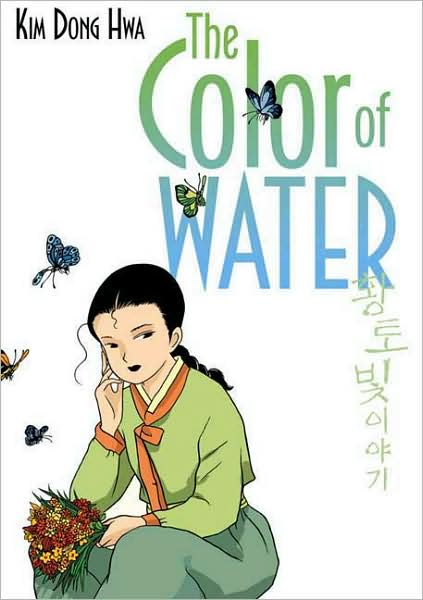
Book-A-Day #70: The Color of Water and The Color of Heaven by Kim Dong Hwa
Once again I see that I read the first book of a trilogy nearly a decade ago (The Color of Earth, in 2009), carefully shelved the following two books, and left them there for "someday."
Well, "left them there" is understating it: I had to move these books around repeatedly, looking at them over and over again, and somehow (I'm not sure how) saving them from my 2011 flood that destroyed so many other things I thought I wanted to read more quickly.
But every one of us has a million things we didn't do, and far fewer that we actually did do. As we get older, focusing on the first makes less and less sense -- those things are almost infinite.
So I finally did read The Color of Water and The Color of Heaven, the bulk of a trilogy by Korean manwha creator Kim Dong Hwa, retelling the story of his mother's adolescence, nearly a century ago in sleepy rural Korea. (Dong Hwa's note, I realize only now, does not say this is his parents' story, so I wonder about the strapping young man who is the hero of these books, and how he relates, if at all, to the author's actual father.)
Ehwa is sixteen, or so the flap copy tells us -- the books themselves never mention her age. There's a lot they don't mention, though: this trilogy is set in a small village somewhere in Korea, and if we weren't told it was the twentieth century, there's nothing here to clue us into that. Life goes on here as it always has, in a quiet, pastoral way.
In the first book, Ehwa had crushes on two local young men -- first the monk Chung-Myung, and then the orchard farmer's son Sunoo. But this is a romantic story -- Dong Hwa spent most of his career making romantic stories for young women -- so we know it will end with a true love, even if there are a lot of tears and long speeches about emotions before then.
And there are plenty of speeches about emotions: from Ehwa; from her mother, a widowed tavern-keeper; from the men they both love; and from nearly everyone else in this small Korean town, who are all obsessed with talking about women as flowers and men as butterflies and other unsubtle metaphors. Each page is pleasant, and the dialogue is true, but a reader may begin to wonder if rural Koreans ever think of anything else, or if that's why they are still so rural and backward in 1920ish.
I'm picking on these books, which are sweet and lovely -- Dong Hwa is good at drawing expressions, and at showing character in his faces. And the dialogue, as I said, is true -- it's only that there's so very very much of it in the six-hundred-plus pages of these books.
I suspect the natural audience for this trilogy is both substantially younger and substantially more female than I am, so my reaction doesn't mean much. My sense is that these books are exceptionally good for their kind, and I did enjoy reading them. It's only that sweet romances tend to bring out the Marvin the Paranoid Android in me....
Well, "left them there" is understating it: I had to move these books around repeatedly, looking at them over and over again, and somehow (I'm not sure how) saving them from my 2011 flood that destroyed so many other things I thought I wanted to read more quickly.
But every one of us has a million things we didn't do, and far fewer that we actually did do. As we get older, focusing on the first makes less and less sense -- those things are almost infinite.
So I finally did read The Color of Water and The Color of Heaven, the bulk of a trilogy by Korean manwha creator Kim Dong Hwa, retelling the story of his mother's adolescence, nearly a century ago in sleepy rural Korea. (Dong Hwa's note, I realize only now, does not say this is his parents' story, so I wonder about the strapping young man who is the hero of these books, and how he relates, if at all, to the author's actual father.)
Ehwa is sixteen, or so the flap copy tells us -- the books themselves never mention her age. There's a lot they don't mention, though: this trilogy is set in a small village somewhere in Korea, and if we weren't told it was the twentieth century, there's nothing here to clue us into that. Life goes on here as it always has, in a quiet, pastoral way.
In the first book, Ehwa had crushes on two local young men -- first the monk Chung-Myung, and then the orchard farmer's son Sunoo. But this is a romantic story -- Dong Hwa spent most of his career making romantic stories for young women -- so we know it will end with a true love, even if there are a lot of tears and long speeches about emotions before then.
And there are plenty of speeches about emotions: from Ehwa; from her mother, a widowed tavern-keeper; from the men they both love; and from nearly everyone else in this small Korean town, who are all obsessed with talking about women as flowers and men as butterflies and other unsubtle metaphors. Each page is pleasant, and the dialogue is true, but a reader may begin to wonder if rural Koreans ever think of anything else, or if that's why they are still so rural and backward in 1920ish.
I'm picking on these books, which are sweet and lovely -- Dong Hwa is good at drawing expressions, and at showing character in his faces. And the dialogue, as I said, is true -- it's only that there's so very very much of it in the six-hundred-plus pages of these books.
I suspect the natural audience for this trilogy is both substantially younger and substantially more female than I am, so my reaction doesn't mean much. My sense is that these books are exceptionally good for their kind, and I did enjoy reading them. It's only that sweet romances tend to bring out the Marvin the Paranoid Android in me....
Recurring Motifs:
Book-A-Day,
Comics,
Foreigners Sure Are Foreign,
Reviews
Saturday, March 10, 2018
Book-A-Day 2018 #69: The Art of Asking Your Boss for a Raise by Georges Perec
Books can be based on anything: a random thought, a meme, a movie, a video game, a common saying, some old story the author wants to fix. But this is the only book I know based on a chart.
Georges Perec was a French writer of the mid-twentieth century, connected with the Oulipo group and deeply interested in making fiction based on arbitrary rules and other restrictions. He's probably best known on my side of the Atlantic for A Void, a novel that doesn't use the letter E. (He seems to be best-known in general for Life: A User's Manual.)
The cover proclaims this small book to be The Art of Asking Your Boss for a Raise, but it actually has a much longer title inside, translated faithfully from the French equivalent: The Art and Craft of Approaching Your Head of Department to Submit a Request for a Raise. And that longer title contains the bones of this novella-length work in embryo: this is a book of particulars, of roadblocks, of options, of a nearly choose-your-own-adventure style of choices and of being driven down those choices one by one in turn, with no real choice.
The endpapers contain the chart that this book was based on -- though, oddly, the two seem to have been translated by different people, so we have "engineer" one place and "professor" the other. (David Bellos translated the book, and also provided a helpful introduction. He may have also translated the chart, and used different terms for some unknown reason.) It's a flow-chart, assuming you are a man in some middle-rank position in some random French company in the mid-60s, seeking to buttonhole your boss to ask for a raise. There are, as there must be, various reasons why doing so is not possible or advisable at any given moment -- the boss's daughters have measles, or he has a fishbone from lunch in his stomach, or he doesn't look up when you knock, or he's simply not there at all, among several others -- and, if those are the case on any cycle around the chart, you must start again at the beginning.
The chart itself was created (likely in a somewhat simpler and less silly form) by a French computer scientist, Jacques Perriaud, who then apparently set out to find a novelist who would follow it "as a computer would" and turn it into fiction. That is perhaps even more bizarre than the fact that Perec actually did so. The resulting work is written as if one long run-on sentence (though a careful reader can see where periods and other punctuation would be) and cycles through all of the options on that chart, some of them repeatedly on every cycle, until finally, after eighty pages, getting in front of that boss, finding him in a receptive mood, making the case for a raise, and getting a generally favorable response.
This is obviously a literary stunt, and anyone's interest in it will be entirely based on how much she likes literary stunts. I found it short enough not to wear out its welcome, and weird enough to be fun -- particularly since the 50 years and an ocean between Perec's working world and mine have changed many aspects of office life. It is definitely one of the quirkiest books I've read, and I treasure it for that.
Georges Perec was a French writer of the mid-twentieth century, connected with the Oulipo group and deeply interested in making fiction based on arbitrary rules and other restrictions. He's probably best known on my side of the Atlantic for A Void, a novel that doesn't use the letter E. (He seems to be best-known in general for Life: A User's Manual.)
The cover proclaims this small book to be The Art of Asking Your Boss for a Raise, but it actually has a much longer title inside, translated faithfully from the French equivalent: The Art and Craft of Approaching Your Head of Department to Submit a Request for a Raise. And that longer title contains the bones of this novella-length work in embryo: this is a book of particulars, of roadblocks, of options, of a nearly choose-your-own-adventure style of choices and of being driven down those choices one by one in turn, with no real choice.
The endpapers contain the chart that this book was based on -- though, oddly, the two seem to have been translated by different people, so we have "engineer" one place and "professor" the other. (David Bellos translated the book, and also provided a helpful introduction. He may have also translated the chart, and used different terms for some unknown reason.) It's a flow-chart, assuming you are a man in some middle-rank position in some random French company in the mid-60s, seeking to buttonhole your boss to ask for a raise. There are, as there must be, various reasons why doing so is not possible or advisable at any given moment -- the boss's daughters have measles, or he has a fishbone from lunch in his stomach, or he doesn't look up when you knock, or he's simply not there at all, among several others -- and, if those are the case on any cycle around the chart, you must start again at the beginning.
The chart itself was created (likely in a somewhat simpler and less silly form) by a French computer scientist, Jacques Perriaud, who then apparently set out to find a novelist who would follow it "as a computer would" and turn it into fiction. That is perhaps even more bizarre than the fact that Perec actually did so. The resulting work is written as if one long run-on sentence (though a careful reader can see where periods and other punctuation would be) and cycles through all of the options on that chart, some of them repeatedly on every cycle, until finally, after eighty pages, getting in front of that boss, finding him in a receptive mood, making the case for a raise, and getting a generally favorable response.
This is obviously a literary stunt, and anyone's interest in it will be entirely based on how much she likes literary stunts. I found it short enough not to wear out its welcome, and weird enough to be fun -- particularly since the 50 years and an ocean between Perec's working world and mine have changed many aspects of office life. It is definitely one of the quirkiest books I've read, and I treasure it for that.
Recurring Motifs:
Book-A-Day,
Foreigners Sure Are Foreign,
Literature,
Reviews
Friday, March 09, 2018
Book-A-Day 2018 #68: Nightlights by Lorena Alvarez
Sandy is one of those imaginative kids you see a lot in fiction -- every creator's idealized version of her origins, smart but unfocused, spending all of her time scribbling in notebooks. (Novelists have slightly different versions, as do other creative types: this is the cartoonist's version.) She attends a strict Catholic school, somewhere vaguely Latin -- call it Bogota, Columbia, where creator Lorena Alvarez grew up herself.
And she travels to wonderful worlds in her dreams, full of color and life and happiness, where everything is both friendly and adventurous. Lights appear and turn into whatever Sandy imagines -- and, if she draws those things, they will last. Sandy's story is presented in vibrant color, in an animation-inspired style. Nightlights looks almost like a Miyazaki movie translated into comics pages, and has some of the same lessons and concerns.
Sandy's mother wants her to focus on her schoolwork, to be more grounded. So do the requisite grumpy nun teachers at her school, who are possibly the least nurturing teachers ever depicted in any fictional work. But Sandy just wants to draw and dream. Sandy's friends...well, as far as we can tell, Sandy doesn't have any friends, since she lives entirely in her own head. Does she want it that way? Well, she does leap onto the first girl who reaches out to her, which could be a clue.
That girl is Morfie, with purple hair and eyes, who immediately says Sandy's drawings are "really good." Morfie, we quickly see, is not normal -- she claims to be in "a different class," but Sandy sees her sitting in a tree later that day during a storm. And that night, Morfie is in Sandy's dreams as well, demanding Sandy draw for her so she can adore Sandy.
Nightlights is a book at least partially for younger readers, so it's not likely that Morfie will take over Sandy's life and turn her into an image-making machine. And it's a short book, so Sandy will find her way out before too long. And she does so in an interesting manner -- one that implies (as does the final pages) that she is paying attention and learning when she seems to be just scribbling doodles in her notebook.
Perhaps that's the lesson of Nightlights. It's the kind of book that seems bound to have a lesson, though it's not clear what that lesson should be. Alvarez never makes it clear where Morfie comes from, or what her deal is. She's clearly not just "the new kid," but what is she? And is Sandy's world -- either the daytime one of school or the nighttime one of strange lovable creatures -- infested with similar beings? What is the meaning of the last page?
I like Nightlights, and particularly appreciate the lovely, vibrant art. But it seems to be just this side of a formal allegory, and I can't figure out what the signs and signifiers mean. Typically, a book like this has a moral for the Sandy character to learn: do your homework first, for example, or never give up on your dreams, or perhaps the nuns are right and the Beloved Mother hates it when you draw in class. But none of those seem right for Nightlights. The moral, if any, seems to be for us: for people who might find a Sandy in our lives.
Maybe that moral is that we should trust her. She may seem unfocused and wild, but she will pull through in the end. She knows what's important, and what adoration isn't worth anything. I'll take that moral, I guess, whether it's what Alvarez meant, or not.
And she travels to wonderful worlds in her dreams, full of color and life and happiness, where everything is both friendly and adventurous. Lights appear and turn into whatever Sandy imagines -- and, if she draws those things, they will last. Sandy's story is presented in vibrant color, in an animation-inspired style. Nightlights looks almost like a Miyazaki movie translated into comics pages, and has some of the same lessons and concerns.
Sandy's mother wants her to focus on her schoolwork, to be more grounded. So do the requisite grumpy nun teachers at her school, who are possibly the least nurturing teachers ever depicted in any fictional work. But Sandy just wants to draw and dream. Sandy's friends...well, as far as we can tell, Sandy doesn't have any friends, since she lives entirely in her own head. Does she want it that way? Well, she does leap onto the first girl who reaches out to her, which could be a clue.
That girl is Morfie, with purple hair and eyes, who immediately says Sandy's drawings are "really good." Morfie, we quickly see, is not normal -- she claims to be in "a different class," but Sandy sees her sitting in a tree later that day during a storm. And that night, Morfie is in Sandy's dreams as well, demanding Sandy draw for her so she can adore Sandy.
Nightlights is a book at least partially for younger readers, so it's not likely that Morfie will take over Sandy's life and turn her into an image-making machine. And it's a short book, so Sandy will find her way out before too long. And she does so in an interesting manner -- one that implies (as does the final pages) that she is paying attention and learning when she seems to be just scribbling doodles in her notebook.
Perhaps that's the lesson of Nightlights. It's the kind of book that seems bound to have a lesson, though it's not clear what that lesson should be. Alvarez never makes it clear where Morfie comes from, or what her deal is. She's clearly not just "the new kid," but what is she? And is Sandy's world -- either the daytime one of school or the nighttime one of strange lovable creatures -- infested with similar beings? What is the meaning of the last page?
I like Nightlights, and particularly appreciate the lovely, vibrant art. But it seems to be just this side of a formal allegory, and I can't figure out what the signs and signifiers mean. Typically, a book like this has a moral for the Sandy character to learn: do your homework first, for example, or never give up on your dreams, or perhaps the nuns are right and the Beloved Mother hates it when you draw in class. But none of those seem right for Nightlights. The moral, if any, seems to be for us: for people who might find a Sandy in our lives.
Maybe that moral is that we should trust her. She may seem unfocused and wild, but she will pull through in the end. She knows what's important, and what adoration isn't worth anything. I'll take that moral, I guess, whether it's what Alvarez meant, or not.
Recurring Motifs:
Book-A-Day,
Comics,
Reviews,
You Know: For Kids
Thursday, March 08, 2018
Book-A-Day 2018 #67: Louis Undercover by Fanny Britt and Isabelle Arsenault
Children know more than adults give them credit for. They know huge things, things too big for words, things they try not to think about. As they get older, they can corral those huge things with words and tame them into the pieces of normal life. But kids can't do that yet: the world is big and dangerous and surprising and entirely out of their control.
Louis is one of those kids: old enough to know things, too young to do anything about them. He's eight or ten, maybe -- old enough to be responsible for his kid brother Truffle (who is not really named Truffle). And he shuttles between his separated father and mother, when he wants to focus on Billie, the girl in his class who he thinks about all the time, but hasn't quite worked up the courage to actually talk to yet.
Fanny Britt and Isabelle Arsenault (writer and artist, respectively) tackle a different story from their first graphic novel Jane, the Fox & Me here -- Louis is younger than Helene was, and there's nothing he can do to solve his own problems. Well, there is something he can do to solve his problem with Billie, and we'll see by the end of the book if he's able to do that.
But Louis's father has a drinking problem, the kind that starts with wine at 11 AM to quiet the shakes and goes on to mania and then depression from there like clockwork. Louis and Truffle seem to only live with their father on weekends, or occasionally -- but this all new. Their parents were together not that long ago, and Louis desperately wants things to go back to normal.
Their mother is the one keeping things together: getting the boys to school, hiding her tears from them, working and cooking and mothering as hard as she can. She moved them from that big, now-mostly-empty house the father is still rattling around about eighteen months ago, to a small apartment in Montreal. The parents are not divorced. Nothing is final. But even Truffle knows, on some level, that something is wrong with his father.
Louis Undercover, if you want to be reductive, is the story of a family broken by an alcoholic, seen by a child, told in comics. But it's so much more than an "issue" story, deeper and more resonant. We all worry about our parents. We all worry about our children. We all are in families that don't work as well as we want them to. We all want to both go back to the good times in the past and move forward to new good times in the future.
Louis tells us this story: it's all in his words, and Britt makes them cutting and true, every moment. Arsenault's softly colored pages, with their fuzzy panel borders, draw us into that story, and make it real while keeping it from being so cutting we can't stand it.
This is a lovely, true book. Like so many books made for younger readers, it should not be restricted only to them. And, frankly, an adult -- a parent -- will get a lot more out of Louis Undercover than even the most thoughtful and mature child. But that's what great books do: they meet you where you are, and also wait for you to grow up, so they can meet you there as well.
Louis is one of those kids: old enough to know things, too young to do anything about them. He's eight or ten, maybe -- old enough to be responsible for his kid brother Truffle (who is not really named Truffle). And he shuttles between his separated father and mother, when he wants to focus on Billie, the girl in his class who he thinks about all the time, but hasn't quite worked up the courage to actually talk to yet.
Fanny Britt and Isabelle Arsenault (writer and artist, respectively) tackle a different story from their first graphic novel Jane, the Fox & Me here -- Louis is younger than Helene was, and there's nothing he can do to solve his own problems. Well, there is something he can do to solve his problem with Billie, and we'll see by the end of the book if he's able to do that.
But Louis's father has a drinking problem, the kind that starts with wine at 11 AM to quiet the shakes and goes on to mania and then depression from there like clockwork. Louis and Truffle seem to only live with their father on weekends, or occasionally -- but this all new. Their parents were together not that long ago, and Louis desperately wants things to go back to normal.
Their mother is the one keeping things together: getting the boys to school, hiding her tears from them, working and cooking and mothering as hard as she can. She moved them from that big, now-mostly-empty house the father is still rattling around about eighteen months ago, to a small apartment in Montreal. The parents are not divorced. Nothing is final. But even Truffle knows, on some level, that something is wrong with his father.
Louis Undercover, if you want to be reductive, is the story of a family broken by an alcoholic, seen by a child, told in comics. But it's so much more than an "issue" story, deeper and more resonant. We all worry about our parents. We all worry about our children. We all are in families that don't work as well as we want them to. We all want to both go back to the good times in the past and move forward to new good times in the future.
Louis tells us this story: it's all in his words, and Britt makes them cutting and true, every moment. Arsenault's softly colored pages, with their fuzzy panel borders, draw us into that story, and make it real while keeping it from being so cutting we can't stand it.
This is a lovely, true book. Like so many books made for younger readers, it should not be restricted only to them. And, frankly, an adult -- a parent -- will get a lot more out of Louis Undercover than even the most thoughtful and mature child. But that's what great books do: they meet you where you are, and also wait for you to grow up, so they can meet you there as well.
Recurring Motifs:
Book-A-Day,
Comics,
Reviews,
You Know: For Kids
Wednesday, March 07, 2018
Book-A-Day 2018 #66: The Compleat Discworld Atlas ostensibly by Terry Pratchett but really not
Terry Pratchett died in March 2015, and this book, with his name very prominent on the cover, was published six months later. One might have a justified skepticism about how much of the material here was actually written by Pratchett -- doubly so if one remembers Pratchett had been suffering from a rare early-onset form of Alzheimer's disease for the decade before that, and trebly so if one is aware how ancillary books are usually put together for bestselling writers.
What we have here is The Compleat Discworld Atlas, which says its by Terry Pratchett "aided and abetted by The Discworld Emporium." The Discworld Emporium is explicated in the lawyer-type on the copyright page: it's four people, and apparently organized as a company for the purposes of doing Discworld stuff. (Surprisingly to this reader, Stephen Briggs, the long-time major-domo of non-fictional Discworld, is not part of the consortium. Perhaps there has been a coup, or a schism.)
But, you know, we don't need the author to comb through his books and collate the scattered details of the world he built there. Authors generally are not great at doing that, anyway, and prefer to go on building that world rather than researching what they've already done. That's a job for other people to begin with: dedicated, obsessive people. Fans. You know what I'm saying.
But the audience wants to think that the author is telling them the secrets behind the fictional world, and the audience is the one who actually pays money. So a fake non-fiction book will want to seem like it's by the original author, even if it's put together by an Emporium of other people. That all brings us here.
Compleat Discworld Atlas is the successor to the series of individual "mappes" published in the '90s, a major part of the first non-fictional Discworld flourishing, led by the aforementioned Mr. Briggs. The Streets of Ankh-Morpork was first, in 1993, on the grounds that cities will have a definite shape, even if whole worlds can be a bit messy and unclear. But The Discworld Mappe soon followed, and then A Tourist's Guide to Lancre, and, last and least, Death's Domain. Non-fictional Discworld shifted into other avenues -- Nanny Ogg's Cookbook, for example, and a yearly series of desk diaries. But the mapping impulse was apparently still there, and finally burst forth with this full-fledged atlas, in the works at the time of Pratchett's death.
Atlas contains both a book and a map, combined in a sturdy heavy-paper cover. The map is quite large: roughly three feet square when entirely unfolded. One side is a clear map of the whole Disc, lightly colored in greens and light browns to show forests and mountains and deserts, with physical and political features labeled and hard-to-see dotted lines to indicate political boundaries. The reverse is a more "traditional" map, with Great A'Tuin below and the gods above -- it's very striking but not meant to be used as an actual map you can find things on. The map is deeply folded to fit into the package, but I'd be surprised if flat, rolled versions weren't also available for those who need to have the Discworld on their walls.
The accompanying book covers the lands of the Disc in roughly descending order of how much we know about them, starting with the Circle Sea (particularly Ankh-Morpork) and expanding outward from there in a sequence that doesn't quite follow any particular geographic rules. Generally each section starts off with a colored political map, so we can see where the borders are, but it omits those a couple of times for no obvious reason. There's also a lot of art in this book, which is credited in tiny type hidden on the copyright page as "additional illustrations by Peter Dennis." The maps themselves are presumably by some or all of the Emporium, who comprise Isobel Pearson, Rob Voyce, Bernard Pearson, and Ian Mitchell. The roles of the various Emporiumizers are never explicated.
The book won't tell a devoted Discworld fan anything she doesn't already know: this is a derivative work, not something original and new. (Contrast it to George R.R. Martin's The World of Ice & Fire, which was almost entirely about things devoted readers didn't know -- though some of them were annoyed in that case because he was telling stories from his fake-history instead of continuing the main series. Fans are rarely happy with an unalloyed joy -- this is what I'm saying.)
But it's a nice package about Discworld, and it was published at just the right time: there won't be any new Discworld novels or other stories unless Rhianna Pratchett relents at some point under the weight of increasingly large cheques dangled in front of her eyes.
No one ever needs a fake non-fiction book. But I enjoy them, probably much more than I should, and this is a solid example of the type, only faintly identifiable as a line-expanding product to be sold to bolster a corporate bottom line.
What we have here is The Compleat Discworld Atlas, which says its by Terry Pratchett "aided and abetted by The Discworld Emporium." The Discworld Emporium is explicated in the lawyer-type on the copyright page: it's four people, and apparently organized as a company for the purposes of doing Discworld stuff. (Surprisingly to this reader, Stephen Briggs, the long-time major-domo of non-fictional Discworld, is not part of the consortium. Perhaps there has been a coup, or a schism.)
But, you know, we don't need the author to comb through his books and collate the scattered details of the world he built there. Authors generally are not great at doing that, anyway, and prefer to go on building that world rather than researching what they've already done. That's a job for other people to begin with: dedicated, obsessive people. Fans. You know what I'm saying.
But the audience wants to think that the author is telling them the secrets behind the fictional world, and the audience is the one who actually pays money. So a fake non-fiction book will want to seem like it's by the original author, even if it's put together by an Emporium of other people. That all brings us here.
Compleat Discworld Atlas is the successor to the series of individual "mappes" published in the '90s, a major part of the first non-fictional Discworld flourishing, led by the aforementioned Mr. Briggs. The Streets of Ankh-Morpork was first, in 1993, on the grounds that cities will have a definite shape, even if whole worlds can be a bit messy and unclear. But The Discworld Mappe soon followed, and then A Tourist's Guide to Lancre, and, last and least, Death's Domain. Non-fictional Discworld shifted into other avenues -- Nanny Ogg's Cookbook, for example, and a yearly series of desk diaries. But the mapping impulse was apparently still there, and finally burst forth with this full-fledged atlas, in the works at the time of Pratchett's death.
Atlas contains both a book and a map, combined in a sturdy heavy-paper cover. The map is quite large: roughly three feet square when entirely unfolded. One side is a clear map of the whole Disc, lightly colored in greens and light browns to show forests and mountains and deserts, with physical and political features labeled and hard-to-see dotted lines to indicate political boundaries. The reverse is a more "traditional" map, with Great A'Tuin below and the gods above -- it's very striking but not meant to be used as an actual map you can find things on. The map is deeply folded to fit into the package, but I'd be surprised if flat, rolled versions weren't also available for those who need to have the Discworld on their walls.
The accompanying book covers the lands of the Disc in roughly descending order of how much we know about them, starting with the Circle Sea (particularly Ankh-Morpork) and expanding outward from there in a sequence that doesn't quite follow any particular geographic rules. Generally each section starts off with a colored political map, so we can see where the borders are, but it omits those a couple of times for no obvious reason. There's also a lot of art in this book, which is credited in tiny type hidden on the copyright page as "additional illustrations by Peter Dennis." The maps themselves are presumably by some or all of the Emporium, who comprise Isobel Pearson, Rob Voyce, Bernard Pearson, and Ian Mitchell. The roles of the various Emporiumizers are never explicated.
The book won't tell a devoted Discworld fan anything she doesn't already know: this is a derivative work, not something original and new. (Contrast it to George R.R. Martin's The World of Ice & Fire, which was almost entirely about things devoted readers didn't know -- though some of them were annoyed in that case because he was telling stories from his fake-history instead of continuing the main series. Fans are rarely happy with an unalloyed joy -- this is what I'm saying.)
But it's a nice package about Discworld, and it was published at just the right time: there won't be any new Discworld novels or other stories unless Rhianna Pratchett relents at some point under the weight of increasingly large cheques dangled in front of her eyes.
No one ever needs a fake non-fiction book. But I enjoy them, probably much more than I should, and this is a solid example of the type, only faintly identifiable as a line-expanding product to be sold to bolster a corporate bottom line.
Recurring Motifs:
Book-A-Day,
Fantasy,
Non-Fiction,
Reviews
Tuesday, March 06, 2018
Book-A-Day 2018 #65: Kaijumax, Season Two: The Seamy Underbelly by Zander Cannon
It's taken two library systems to get me caught up on Zander Cannon's giant-monsters-in-prison comic series, and that seems a lot more complicated than it should be. But any system that gets books you want to read into your hands is, in the end, a successful system -- so I'm not going to complain.
Cannon is following the Classy Cable TV style here: six-issue mini-series, each basically self-contained, coming out about the same time each year. I expect that gives him time to do some other comics work as well, and (more importantly) time to plan the next series and promote the book of the last series, as comics is getting more and more disconnected from the just-put-something-out-in-pamphlet-form-every-month business model. (And, let's be honest: that model was good for the companies that owned the companies and characters, but not so good for anyone else in the pipeline.)
So: here is Kaijumax, Season Two: The Seamy Underbelly. Electrogor, the nice guy who looked like our main character back at the beginning of the first season, has broken out of prison with Green Humongo, and the two of them are hiding out with Red Humongo, who is Green's brother despite their having completely different origins. But the cast of characters is much wider than just our two fugitives, and they're scattered all over the place -- I'd say "around the world," but one of them spends substantial time on what I'm pretty sure is the moon.
Cannon has backed his way into something like a racial allegory, though he has an afterword where he denies that was the point, and explains that the parallels came as he turned "giant monsters in prison" into something more than just a joke idea by trying to take it seriously. I found it an interesting strand of the story -- kaiju as a minority group, dispossessed and discriminated against, and the family dramas between the cop kaiju brother and the criminal kaiju brother. I'm not part of the racial group that the kaiju mostly reference, so I can point to that element and note it, but readers who are closer to a real-world version could have very different responses.
Anyway, there's a big cast, sprawling around the world and elsewhere, of cops and criminals, jailers and jailed, corrupt and honest, and those who cross all of those categories. It's a fairly dark moral universe for both the kaiju and those they call "squishies." (Cannon plays it monster-movie style, but there has to be a lot of death in the background of Kaijumax. Every monster in prison represents at least a few thousand dead humans, maybe more.)
And it's a noirish cartoon version of every monster movie ever, too: giant piloted robots and giant self-aware robots, lizards from the depths of the ocean and Lovecraftian beasts from between the stars, demons and mad scientists and scheming sons. It's only because the monsters are so apt to get addicted (to nuclear power, to fictional monster-drugs) that this world even still exists.
Season Two is darker than the first one, almost paradoxically, since this is the storyline taking place almost entirely outside of prison. But prison is where things are relatively simple, right? You follow the rules (official and unwritten), you keep your nose out of places it shouldn't be, you keep your head down, and you do your time. There's no place to keep your head down in the wider world, and everywhere your nose is could be a place it shouldn't be.
You have to be able to take Kaijumax seriously to enjoy it -- to accept the premise, admit the science is severely bent at best, and appreciate the models. If you can do that, it's a fine comic about loyalty and friendship, good and evil, what you have to do and what you can do, and, as the first book put it, terror and respect.
Cannon is following the Classy Cable TV style here: six-issue mini-series, each basically self-contained, coming out about the same time each year. I expect that gives him time to do some other comics work as well, and (more importantly) time to plan the next series and promote the book of the last series, as comics is getting more and more disconnected from the just-put-something-out-in-pamphlet-form-every-month business model. (And, let's be honest: that model was good for the companies that owned the companies and characters, but not so good for anyone else in the pipeline.)
So: here is Kaijumax, Season Two: The Seamy Underbelly. Electrogor, the nice guy who looked like our main character back at the beginning of the first season, has broken out of prison with Green Humongo, and the two of them are hiding out with Red Humongo, who is Green's brother despite their having completely different origins. But the cast of characters is much wider than just our two fugitives, and they're scattered all over the place -- I'd say "around the world," but one of them spends substantial time on what I'm pretty sure is the moon.
Cannon has backed his way into something like a racial allegory, though he has an afterword where he denies that was the point, and explains that the parallels came as he turned "giant monsters in prison" into something more than just a joke idea by trying to take it seriously. I found it an interesting strand of the story -- kaiju as a minority group, dispossessed and discriminated against, and the family dramas between the cop kaiju brother and the criminal kaiju brother. I'm not part of the racial group that the kaiju mostly reference, so I can point to that element and note it, but readers who are closer to a real-world version could have very different responses.
Anyway, there's a big cast, sprawling around the world and elsewhere, of cops and criminals, jailers and jailed, corrupt and honest, and those who cross all of those categories. It's a fairly dark moral universe for both the kaiju and those they call "squishies." (Cannon plays it monster-movie style, but there has to be a lot of death in the background of Kaijumax. Every monster in prison represents at least a few thousand dead humans, maybe more.)
And it's a noirish cartoon version of every monster movie ever, too: giant piloted robots and giant self-aware robots, lizards from the depths of the ocean and Lovecraftian beasts from between the stars, demons and mad scientists and scheming sons. It's only because the monsters are so apt to get addicted (to nuclear power, to fictional monster-drugs) that this world even still exists.
Season Two is darker than the first one, almost paradoxically, since this is the storyline taking place almost entirely outside of prison. But prison is where things are relatively simple, right? You follow the rules (official and unwritten), you keep your nose out of places it shouldn't be, you keep your head down, and you do your time. There's no place to keep your head down in the wider world, and everywhere your nose is could be a place it shouldn't be.
You have to be able to take Kaijumax seriously to enjoy it -- to accept the premise, admit the science is severely bent at best, and appreciate the models. If you can do that, it's a fine comic about loyalty and friendship, good and evil, what you have to do and what you can do, and, as the first book put it, terror and respect.
Recurring Motifs:
Book-A-Day,
Comics,
Reviews,
Science Fiction
Monday, March 05, 2018
Book-A-Day 2018 #64: Brief Histories of Everyday Objects by Andy Warner
If a webcomic is intended all along to become a book -- if it's being created as a book, and put up online as a teaser or buzz-builder along the way -- is it somehow less of a webcomic? I'm sure there are webcomics purists who will insist it is: there are purists for everything, and we're probably all purists for something. But, realistically, what difference does it make?
I discovered Andy Warner's Brief Histories of Everyday Objects before the book came out, when he was serializing the individual pieces online. I read it like a webcomic, was happy when I heard it would be a book, and (eventually) found and read the book. That looks like success, from an ex-publishing hand and still-marketing professional. That looks like the way it's supposed to work.
Warner's introduction here doesn't quite say either way: he developed Brief Histories as "an idea for a comic." I think I've seen elsewhere that he had the book deal in place ahead of time...but maybe I'm making that up. (I like people to have book deals; it makes them happy, pays them for their work, and gets stuff for me to read. Win/win.) However it happened, Brief Histories was on the web, and it is now a book.
Warner gives the history, or a history, of forty-five random common objects, from toothbrushes to bicycles. Each one gets four pages, three and a half of them telling one main narrative, plus a few panels of "briefer histories" at the end for random fun facts that Warner presumably couldn't fit into the main story. These are not all necessarily the entire history of these objects, or even their original creation -- it tends to be a funny story that's reasonably close to the modern day, meaning a lot of 19th century and early 20th century inventors.
It's all true, as far as I know, and it's all pretty funny. Warner is an energetic cartoonist who uses a lot of blacks and tones, giving his pages vibrancy and depth. And, of course, they're often about obsessed people talking about their creations in semi-anachronistic dialogue from Warner, which adds to the humor. (And will probably annoy purists, again -- though purists are not likely to enjoy four-page quick takes on anything.)
To sum up: Brief Histories is funny, enjoyable, and, if you don't watch out, you just might learn something.
I discovered Andy Warner's Brief Histories of Everyday Objects before the book came out, when he was serializing the individual pieces online. I read it like a webcomic, was happy when I heard it would be a book, and (eventually) found and read the book. That looks like success, from an ex-publishing hand and still-marketing professional. That looks like the way it's supposed to work.
Warner's introduction here doesn't quite say either way: he developed Brief Histories as "an idea for a comic." I think I've seen elsewhere that he had the book deal in place ahead of time...but maybe I'm making that up. (I like people to have book deals; it makes them happy, pays them for their work, and gets stuff for me to read. Win/win.) However it happened, Brief Histories was on the web, and it is now a book.
Warner gives the history, or a history, of forty-five random common objects, from toothbrushes to bicycles. Each one gets four pages, three and a half of them telling one main narrative, plus a few panels of "briefer histories" at the end for random fun facts that Warner presumably couldn't fit into the main story. These are not all necessarily the entire history of these objects, or even their original creation -- it tends to be a funny story that's reasonably close to the modern day, meaning a lot of 19th century and early 20th century inventors.
It's all true, as far as I know, and it's all pretty funny. Warner is an energetic cartoonist who uses a lot of blacks and tones, giving his pages vibrancy and depth. And, of course, they're often about obsessed people talking about their creations in semi-anachronistic dialogue from Warner, which adds to the humor. (And will probably annoy purists, again -- though purists are not likely to enjoy four-page quick takes on anything.)
To sum up: Brief Histories is funny, enjoyable, and, if you don't watch out, you just might learn something.
Recurring Motifs:
Book-A-Day,
Comics,
Non-Fiction,
Reviews
Reviewing the Mail: Week of 3/2/18
These days, books for this weekly post fall into three categories:
As usual, I haven't read any of this stuff yet; it just got here.
Pascal Girard's debut graphic novel Nicolas, a small, poignant look at his younger brother, who died while Girard was still a kid, returns in a slightly expanded hardcover edition. I was really impressed by Nicolas the first time around, but I lost that copy in my 2011 flood. New edition = good reason to buy something again.
I Am Not Okay With This collects a series of comics about a fifteen-year-old girl named Sydney that I think were originally published as minicomics. (The pages look like they could work in that format, too.) It's by Chuck Forsman, who also created the book that was the basis of the TV series The End of the Fucking World -- but I haven't read that, or seen the TV series. As usual, if something has some media hype, I tend to look for a book very loosely connected to it.
Saga, Vol. 8 by Brian K. Vaughan and Fiona Staples, though they're now credited the reverse way, in alphabetical order. (I like to keep comics credits in order of operations for clarity: writer, penciller, inker, colorist. Even if the publisher doesn't.) This is a thing, and if you're reading Antick Musings, you should be familiar with that thing.
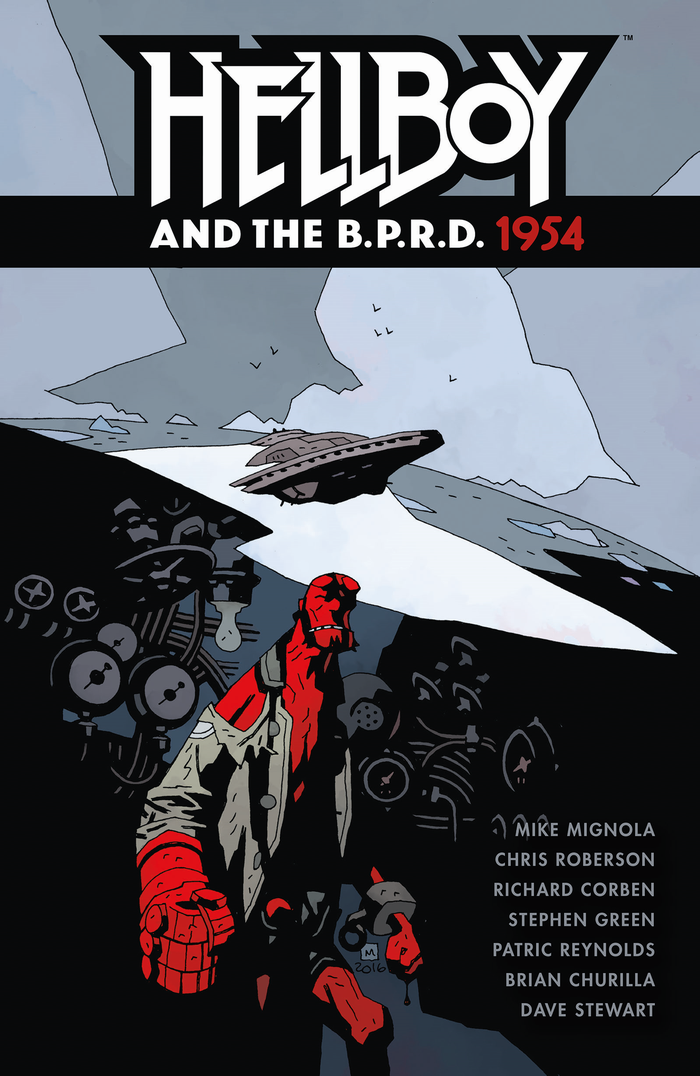
Hellboy and the B.P.R.D.: 1954 continues the continuity-insert series written by series creator Mike Mignola with Chris Roberson, this time out with four discrete stories drawn by different people (Stephen Green, Patric Reynolds, Brian Churilla, and Richard Corben). I bet Hellboy punches some monsters with a big red fist.
Giant Days: Not on the Test Edition Vol. 2 is the second hardcover collection of the comics series written by John (Bad Machinery) Allison and drawn by Max Sarin. This one, as usual for comics hardcovers, re-collects paperback volumes three and four and came out later than them. It also includes the second of Allison's three self-published Giant Days stories, which is one reason why I switched from the paperbacks to the hardcovers. But now I see there will be a full collection of the three self-published stories, called Early Registration, coming this December, and I'm not clear if there will be anything there that won't be in a Not on the Test Edition Vol. 3. So I want to buy this series in a consistent format, but I'm not sure if that will even be possible. Annoying.
Speaking of inconsistent formats reprinting a series, may I introduce you to Angels and Magpies? It's another collection of Love & Rockets stories, this one all from Jaime Hernandez, in the current series of uniform collections, but I have no confidence that series actually includes everything, or that there's a simple strategy to read them. (I still plan a big re-read of all of L&R, if I can figure out what "all" means and get it.)
Last up in this category is Aama, Vol. 3: The Desert of Mirrors, three-quarters of the way through Frederik Peeters's space-opera epic. See my review of Vol. 2 for more.
The Best American Comics 2015 was guest-edited by Jonathan Lethem, and Bill Kartalaopoulos took over as series editor that year as well, so it might be moire different than usual from previous volumes. See my recent review of 2013 for an overview of the series and a possible explanation of this and the next book.
The Best American Comics 2016 followed a year later, with Roz Chast as guest editor. And it's basically the same thing as the above: one year's worth of North American comics, as seen through one particular point of view.
The Unbeatable Squirrel Girl, Vol. 3: Squirrel, You've Really Got Me Now has the single stupidest back-cover credit I have ever seen, which is emblematic of where modern corporate comics is today: "Collecting The Unbeatable Squirrel Girl (2015B) #1-6 and Howard the Duck (2015B) #6." No, it's not putting the issue numbers in italics -- though that is stupid -- it's the fact that both comics had a "2015B" series with at least six issues that year. Both comics launched twice in the same year, at least once for six months. That is deeply, deeply stupid. It's not because of series creators Ryan North and Erica Henderson, obviously -- it's all on Marvel. Reading the series in library copies several years later helps to keep the stupid levels to manageable, though.
And last is Batman: The Dark Knight III: Master Race, which I have heard is not as stupid as the deeply stupid second installment or the nearly brain-dead All-Star Batman and Robin series. But it's probably at least mildly stupid. This time out, series creator Frank Miller has co-writer Brian Azzarello to tame his rampant racism (I assume) and Andy Kubert and Klaus Janson to make prettier pictures than he would have. (Though there was a time when Miller's pictures were both un-pretty and good. That was long ago, now.)
(Those are the kind of things I probably wouldn't say out loud about books sent to me for publicity purposes -- publishers get a little shirty when you describe their plans as "stupid." Libraries have no such problems.)
- Publicity titles, sent by publishers
- Things I bought
- Books from the library
As usual, I haven't read any of this stuff yet; it just got here.
Category 2
Pascal Girard's debut graphic novel Nicolas, a small, poignant look at his younger brother, who died while Girard was still a kid, returns in a slightly expanded hardcover edition. I was really impressed by Nicolas the first time around, but I lost that copy in my 2011 flood. New edition = good reason to buy something again.
I Am Not Okay With This collects a series of comics about a fifteen-year-old girl named Sydney that I think were originally published as minicomics. (The pages look like they could work in that format, too.) It's by Chuck Forsman, who also created the book that was the basis of the TV series The End of the Fucking World -- but I haven't read that, or seen the TV series. As usual, if something has some media hype, I tend to look for a book very loosely connected to it.
Saga, Vol. 8 by Brian K. Vaughan and Fiona Staples, though they're now credited the reverse way, in alphabetical order. (I like to keep comics credits in order of operations for clarity: writer, penciller, inker, colorist. Even if the publisher doesn't.) This is a thing, and if you're reading Antick Musings, you should be familiar with that thing.
Hellboy and the B.P.R.D.: 1954 continues the continuity-insert series written by series creator Mike Mignola with Chris Roberson, this time out with four discrete stories drawn by different people (Stephen Green, Patric Reynolds, Brian Churilla, and Richard Corben). I bet Hellboy punches some monsters with a big red fist.
Giant Days: Not on the Test Edition Vol. 2 is the second hardcover collection of the comics series written by John (Bad Machinery) Allison and drawn by Max Sarin. This one, as usual for comics hardcovers, re-collects paperback volumes three and four and came out later than them. It also includes the second of Allison's three self-published Giant Days stories, which is one reason why I switched from the paperbacks to the hardcovers. But now I see there will be a full collection of the three self-published stories, called Early Registration, coming this December, and I'm not clear if there will be anything there that won't be in a Not on the Test Edition Vol. 3. So I want to buy this series in a consistent format, but I'm not sure if that will even be possible. Annoying.Speaking of inconsistent formats reprinting a series, may I introduce you to Angels and Magpies? It's another collection of Love & Rockets stories, this one all from Jaime Hernandez, in the current series of uniform collections, but I have no confidence that series actually includes everything, or that there's a simple strategy to read them. (I still plan a big re-read of all of L&R, if I can figure out what "all" means and get it.)
Last up in this category is Aama, Vol. 3: The Desert of Mirrors, three-quarters of the way through Frederik Peeters's space-opera epic. See my review of Vol. 2 for more.Category 3
The Best American Comics 2015 was guest-edited by Jonathan Lethem, and Bill Kartalaopoulos took over as series editor that year as well, so it might be moire different than usual from previous volumes. See my recent review of 2013 for an overview of the series and a possible explanation of this and the next book.
The Best American Comics 2016 followed a year later, with Roz Chast as guest editor. And it's basically the same thing as the above: one year's worth of North American comics, as seen through one particular point of view.
The Unbeatable Squirrel Girl, Vol. 3: Squirrel, You've Really Got Me Now has the single stupidest back-cover credit I have ever seen, which is emblematic of where modern corporate comics is today: "Collecting The Unbeatable Squirrel Girl (2015B) #1-6 and Howard the Duck (2015B) #6." No, it's not putting the issue numbers in italics -- though that is stupid -- it's the fact that both comics had a "2015B" series with at least six issues that year. Both comics launched twice in the same year, at least once for six months. That is deeply, deeply stupid. It's not because of series creators Ryan North and Erica Henderson, obviously -- it's all on Marvel. Reading the series in library copies several years later helps to keep the stupid levels to manageable, though.
And last is Batman: The Dark Knight III: Master Race, which I have heard is not as stupid as the deeply stupid second installment or the nearly brain-dead All-Star Batman and Robin series. But it's probably at least mildly stupid. This time out, series creator Frank Miller has co-writer Brian Azzarello to tame his rampant racism (I assume) and Andy Kubert and Klaus Janson to make prettier pictures than he would have. (Though there was a time when Miller's pictures were both un-pretty and good. That was long ago, now.)(Those are the kind of things I probably wouldn't say out loud about books sent to me for publicity purposes -- publishers get a little shirty when you describe their plans as "stupid." Libraries have no such problems.)
Recurring Motifs:
Reviewing the Mail
Sunday, March 04, 2018
Book-A-Day 2018 #63: Men Without Women by Haruki Murakami
There are seven stories here. One is titled "Men Without Women," but it's not just the title story. Murakami is writing about men who have lost women, or are just separated from them. Men who are alone, each in their own way.
All Men Without Women. (Get it?)
This is Murakami in New Yorker story mode, rather than quirky-fantasy mode -- in fact, three of the translations here originally appeared in The New Yorker. There are no mysterious cats, no visits to or from alternate dimensions, no magical girls, no ominous dark holes in the ground.
There is more than a little jazz music, played on old-fashioned LPs, to show us that this is still Murakami, after all. But fans of early Murakami should know that this is the modern Murakami of Colorless Tsukuru Tazaki rather than the Wild Sheep Chase Murakami.
I also have the vague sense that these seven stories almost have the same main character -- several of them have narrators who seem to be just not-Murakami, but several have specific details to make them more distinct. (And it's possibly someone could assemble those details into a single consistent character, though "Samsa" would be tricky to shoehorn in.) I suspect this is just Murakami doing several stories in a common style or idiom rather than something purposeful: these aren't linked stories in a normal sense, just seven stories about lonely men and the women they don't have.
Murakami, as translated from the Japanese here by Philip Gabriel and Ted Goossen, has exquisite, precise prose and a laser-sharp eye on the emotional foibles of a certain kind of very human man. And he's never been known as a writer of plot, so no one will be surprised to find out there isn't a whole lot of plot in any of these stories.
I found this book slightly disappointing: I miss the wild early Murakami. But are any of us as wild as we were thirty years ago? It's a fine collection of literary stories, well-translated and presented in a classy package.
(Parenthetically, Murakami got the title from Hemingway, but "Men Without Women" will always remind me of the greatest American rock 'n' roll record that hardly anyone knows, from Little Steven and the Disciples of Soul. So here's the title song.)
All Men Without Women. (Get it?)
This is Murakami in New Yorker story mode, rather than quirky-fantasy mode -- in fact, three of the translations here originally appeared in The New Yorker. There are no mysterious cats, no visits to or from alternate dimensions, no magical girls, no ominous dark holes in the ground.
There is more than a little jazz music, played on old-fashioned LPs, to show us that this is still Murakami, after all. But fans of early Murakami should know that this is the modern Murakami of Colorless Tsukuru Tazaki rather than the Wild Sheep Chase Murakami.
I also have the vague sense that these seven stories almost have the same main character -- several of them have narrators who seem to be just not-Murakami, but several have specific details to make them more distinct. (And it's possibly someone could assemble those details into a single consistent character, though "Samsa" would be tricky to shoehorn in.) I suspect this is just Murakami doing several stories in a common style or idiom rather than something purposeful: these aren't linked stories in a normal sense, just seven stories about lonely men and the women they don't have.
Murakami, as translated from the Japanese here by Philip Gabriel and Ted Goossen, has exquisite, precise prose and a laser-sharp eye on the emotional foibles of a certain kind of very human man. And he's never been known as a writer of plot, so no one will be surprised to find out there isn't a whole lot of plot in any of these stories.
I found this book slightly disappointing: I miss the wild early Murakami. But are any of us as wild as we were thirty years ago? It's a fine collection of literary stories, well-translated and presented in a classy package.
(Parenthetically, Murakami got the title from Hemingway, but "Men Without Women" will always remind me of the greatest American rock 'n' roll record that hardly anyone knows, from Little Steven and the Disciples of Soul. So here's the title song.)
Recurring Motifs:
Book-A-Day,
Foreigners Sure Are Foreign,
Reviews,
Short Fiction
Saturday, March 03, 2018
Book-A-Day 2018 #62: Pluto, Vols. 1 & 2 by Naoki Urasawa with Takashi Nagaskai
When I read a book, I care a lot more about who did it than I do about who owns it. (Since I read a lot of comics, I run up against the other kind of reader a lot -- Marvel Zombies and DC Shambling Hordes and Image Ghouls and the lot.) And, since I've worked in publishing, I know the names on a book cover don't necessarily reflect who actually did that work -- but the book itself can usually tell you, if you know where to look.
(Example: books by famous people without a listed co-author almost inevitably credit someone effusively in the acknowledgements as "helping to clean up my mess" or "brought order to my chaos." That is the person who actually wrote all of the words in the book, including that credit.)
So I'm not surprised that this manga series has the official title Pluto: Urasawa X Tezuka, or that it credits Osamu Tezuka (dead more than a decade before this was even an idea) equally with Naoki Urasawa, who actually came up with the story and drew all of the pages. Urasawa did co-write with his longtime collaborator Takashi Nagasaki, and Tezuka's son Macoto Tezka did some not-well-defined kibitzing (and who knows how many art assistants Urasawa had), but this story is primarily Urasawa's work. So that's how I'm going to refer to it, and how I do think of it: Pluto by Urasawa.
It does have a Tezuka connection, since it's a re-imagining of an Astro Boy/Mighty Atom story from the early 1960s ("The Greatest Robot on Earth") and was published beginning on the in-universe "birthday" of Astro Boy. But Pluto is no more a collaboration with Tezuka than a modern retelling of Hamlet is a collaboration with Shakespeare. Pluto was collected in eight volumes: I read the first two of them recently.
The world is near-future, or perhaps alternate present. Technology is more or less as it is today, except for intelligent robots. Some are humanoform, some are bipedal but clearly war machines, some can change bodies quickly and easily. There was some kind of civil-rights struggle in the recent past, but that's basically over: robots are equal to humans, and work alongside them all over the world. And there are seven "Great Robots of the World" -- better than their peers in some way Urasawa doesn't really explain in these volumes. But they are better, and known to be better. And the world has agreed never to make any more of them, presumably out of fear that humans will be replaced by them.
(Robots show no sign of replacing people otherwise; they seem to be a minority, and it's unclear how they are created. My best guess is that they're all one-offs, each uniquely created for a specific purpose, and assembly-line construction just doesn't work for robots for some reason we'll never know. But we do learn of one who was a beat police officer, so this explanation is only barely plausible.)
One of those Great Robots has just been murdered: Mont Blanc, a giant Swiss firefighter, killed in the middle of a violent, quick-moving fire. Investigating the murder is Gesicht, a police detective for Europol who is also one of the Seven. Gesicht is also investigating the murder of a European robot-rights activist, whose death scene was staged similarly to that of Mont Blanc. He quickly realizes there is a serial killer at work: attacking the Great Robots and their defenders.
That killer has strength and agility impossible in any human, and leaves no physical traces at the crime scenes. But robots cannot harm humans -- as far as anyone knows, only one robot ever was able to break that programming, and he's a broken, half-dead thing in prison. So the killer is impossible either way -- something unknown, one way or the other.
This is the kind of mystery where the detective has no serious clues or leads, and is reduced to warning the killer's possible victims and chasing after the mysterious killer. So Gesicht goes to see the other Great Robots -- he misses North No. 2, a war machine, but does see and warn two wrestlers (Turkish and Greek) and Atom, the Japanese boy robot in the Astro Boy role here. As of the end of the second volume, one of the Great Robots is still unknown -- presumably, readers of Tezuka already know who that will be. (And, equally presumably, they don't mind the utter lack of women among Great Robots, since this was originally a 1960s story for Japanese children.)
Urasawa builds an ominous atmosphere early, full of swirling confusion and danger, mimicking the whirlwind that the killer hides in to attack his victims. (I say "his" without knowing -- but Urasawa is rewriting a '60s story, so I'm comfortable with my assumption.) Urasawa's art is on the solid, realistic side of manga, with a strong story-telling flair. And his plotting and dialogue is equally strong: this is my first Urasawa story, but it's easy to see why he's considered a major creator.
I don't know the original Astro Boy story at all, so that lack is no problem. Pluto stands on its own, with only some wonkiness in the world-building pegging it as a structure built on someone else's foundation.
(Example: books by famous people without a listed co-author almost inevitably credit someone effusively in the acknowledgements as "helping to clean up my mess" or "brought order to my chaos." That is the person who actually wrote all of the words in the book, including that credit.)
So I'm not surprised that this manga series has the official title Pluto: Urasawa X Tezuka, or that it credits Osamu Tezuka (dead more than a decade before this was even an idea) equally with Naoki Urasawa, who actually came up with the story and drew all of the pages. Urasawa did co-write with his longtime collaborator Takashi Nagasaki, and Tezuka's son Macoto Tezka did some not-well-defined kibitzing (and who knows how many art assistants Urasawa had), but this story is primarily Urasawa's work. So that's how I'm going to refer to it, and how I do think of it: Pluto by Urasawa.It does have a Tezuka connection, since it's a re-imagining of an Astro Boy/Mighty Atom story from the early 1960s ("The Greatest Robot on Earth") and was published beginning on the in-universe "birthday" of Astro Boy. But Pluto is no more a collaboration with Tezuka than a modern retelling of Hamlet is a collaboration with Shakespeare. Pluto was collected in eight volumes: I read the first two of them recently.
The world is near-future, or perhaps alternate present. Technology is more or less as it is today, except for intelligent robots. Some are humanoform, some are bipedal but clearly war machines, some can change bodies quickly and easily. There was some kind of civil-rights struggle in the recent past, but that's basically over: robots are equal to humans, and work alongside them all over the world. And there are seven "Great Robots of the World" -- better than their peers in some way Urasawa doesn't really explain in these volumes. But they are better, and known to be better. And the world has agreed never to make any more of them, presumably out of fear that humans will be replaced by them.
(Robots show no sign of replacing people otherwise; they seem to be a minority, and it's unclear how they are created. My best guess is that they're all one-offs, each uniquely created for a specific purpose, and assembly-line construction just doesn't work for robots for some reason we'll never know. But we do learn of one who was a beat police officer, so this explanation is only barely plausible.)
One of those Great Robots has just been murdered: Mont Blanc, a giant Swiss firefighter, killed in the middle of a violent, quick-moving fire. Investigating the murder is Gesicht, a police detective for Europol who is also one of the Seven. Gesicht is also investigating the murder of a European robot-rights activist, whose death scene was staged similarly to that of Mont Blanc. He quickly realizes there is a serial killer at work: attacking the Great Robots and their defenders.
That killer has strength and agility impossible in any human, and leaves no physical traces at the crime scenes. But robots cannot harm humans -- as far as anyone knows, only one robot ever was able to break that programming, and he's a broken, half-dead thing in prison. So the killer is impossible either way -- something unknown, one way or the other.
This is the kind of mystery where the detective has no serious clues or leads, and is reduced to warning the killer's possible victims and chasing after the mysterious killer. So Gesicht goes to see the other Great Robots -- he misses North No. 2, a war machine, but does see and warn two wrestlers (Turkish and Greek) and Atom, the Japanese boy robot in the Astro Boy role here. As of the end of the second volume, one of the Great Robots is still unknown -- presumably, readers of Tezuka already know who that will be. (And, equally presumably, they don't mind the utter lack of women among Great Robots, since this was originally a 1960s story for Japanese children.)
Urasawa builds an ominous atmosphere early, full of swirling confusion and danger, mimicking the whirlwind that the killer hides in to attack his victims. (I say "his" without knowing -- but Urasawa is rewriting a '60s story, so I'm comfortable with my assumption.) Urasawa's art is on the solid, realistic side of manga, with a strong story-telling flair. And his plotting and dialogue is equally strong: this is my first Urasawa story, but it's easy to see why he's considered a major creator.
I don't know the original Astro Boy story at all, so that lack is no problem. Pluto stands on its own, with only some wonkiness in the world-building pegging it as a structure built on someone else's foundation.
Recurring Motifs:
Book-A-Day,
Comics,
Foreigners Sure Are Foreign,
Reviews
Friday, March 02, 2018
Book-A-Day 2018 #61: The Best American Comics 2013 edited by Jeff Smith
As you might be able to tell from the year in the post title, I've gotten more than a little lackadaisical about keeping up with this annual series of the best in comics created by North Americans. (I reviewed 2006 at the beginning of 2007, 2007 later in 2007, 2008 in 2008, 2009 in 2009, 2010 in 2011 after the next book was published, 2011 in 2012, 2012 in 2013, 2014 in 2014, and have so far missed 2015, 2016, and 2017. If it were still my job to keep up with things being published, I would probably be deeply ashamed of myself -- but it hasn't been for a decade now, so I'm not.)
But I'm still interested in good comics, as always. So here I finally am with the Jeff Smith-edited The Best American Comics 2013, only four and a half years after it was published and six-and-a-half to seven-and-a-half years after the work in it originally appeared.
This is the point where one is supposed to say "better late than never," but I don't want to tempt anyone. "Best of" volumes always have a problem with age: even in the best of times, the beginning of the year they celebrate is about eighteen months before publication, and sometimes it can be even longer. The Best American Comics has an idiosyncratic September to August "year" to begin with, which makes it more convenient for their publishing schedule but can be confusing to someone trying to keep track of when things were published. (Although there's no real reason to bother to do that, if you're not running a media outlet or reprinting books for a living.)
Anyway, in this fine book are full stories and excerpts (more of the latter, as usual) from comics works originally published from September 1, 2011 through August 31, 2012 and made by people either currently resident in North America or "North American" (whatever that means). Translations would be OK as long as you're French Quebecois or Mexican, I suppose, though I don't recall seeing any of either in this series so far. (Too bad the old Yiddish publishing industry died out: it would be fun to see that in the modern comics world.)
The usual suspects are represented with the expected work: Alison Bechdel with an excerpt from Are You My Mother?, Craig Thompson with one from Habibi, Leela Corman with a bit from Unterzakhn, Eleanor Davis with "Nita Goes Home," Derf Backderf with some pages from My Friend Dahmer, and stories from Laura Park, Kate Beaton (who also provides the cover), Gabrielle Bell, Vanessa Davis, and Paul Pope. There's something of a tropism to cartoonists over teams, which is probably mostly a reflection of what the literary/artistic end of the comics world is like.
More obviously commercial work is represented, too, of various kinds: Faith Erin Hicks is here with an excerpt from Friends With Boys, Tony Puryear with a piece from Concrete Park (before it became a series, I think), and Terry Moore with some of Rachel Rising. All in all, there are 30 comics stories here from 33 creators, with Evan Dorkin showing up twice, as writer of a story with Jill Thompson and cartoonist of a collection of his "Fun" gag strips from Dork!
Some people you might expect are missing: the Hernandez Brothers, Dan Clowes, Peter Bagge, and Charles Burns are ones I thought of. But, without doing tedious research, I'm not sure what they published in that time period, if anything. And anyone interested in a book like this is going to know who they are to begin with -- making room here for Sophie Goldstein and Sammy Harkham and Jeremy Sorese is probably better, if we're making judgments like that.
As always, it's a kaleidoscope of very different kinds of comics. I tend to check to see if the guest editor has tastes wide enough that there's at least one story in the book that I don't like or get at all -- paradoxically, that's what makes the best editors. Smith doesn't manage to do that, which means either my tastes keep getting wider or they're very in tune with his to begin with.
Any book in this series is worth reading, if you like comics and want a sampler of what's good out there. I found 2013 a little less adventurous than some other years, but it's always impossible to tell if that was the year or the editor. Libraries have a lot of these books; check 'em out there. It's what I do, these days.
But I'm still interested in good comics, as always. So here I finally am with the Jeff Smith-edited The Best American Comics 2013, only four and a half years after it was published and six-and-a-half to seven-and-a-half years after the work in it originally appeared.
This is the point where one is supposed to say "better late than never," but I don't want to tempt anyone. "Best of" volumes always have a problem with age: even in the best of times, the beginning of the year they celebrate is about eighteen months before publication, and sometimes it can be even longer. The Best American Comics has an idiosyncratic September to August "year" to begin with, which makes it more convenient for their publishing schedule but can be confusing to someone trying to keep track of when things were published. (Although there's no real reason to bother to do that, if you're not running a media outlet or reprinting books for a living.)
Anyway, in this fine book are full stories and excerpts (more of the latter, as usual) from comics works originally published from September 1, 2011 through August 31, 2012 and made by people either currently resident in North America or "North American" (whatever that means). Translations would be OK as long as you're French Quebecois or Mexican, I suppose, though I don't recall seeing any of either in this series so far. (Too bad the old Yiddish publishing industry died out: it would be fun to see that in the modern comics world.)
The usual suspects are represented with the expected work: Alison Bechdel with an excerpt from Are You My Mother?, Craig Thompson with one from Habibi, Leela Corman with a bit from Unterzakhn, Eleanor Davis with "Nita Goes Home," Derf Backderf with some pages from My Friend Dahmer, and stories from Laura Park, Kate Beaton (who also provides the cover), Gabrielle Bell, Vanessa Davis, and Paul Pope. There's something of a tropism to cartoonists over teams, which is probably mostly a reflection of what the literary/artistic end of the comics world is like.
More obviously commercial work is represented, too, of various kinds: Faith Erin Hicks is here with an excerpt from Friends With Boys, Tony Puryear with a piece from Concrete Park (before it became a series, I think), and Terry Moore with some of Rachel Rising. All in all, there are 30 comics stories here from 33 creators, with Evan Dorkin showing up twice, as writer of a story with Jill Thompson and cartoonist of a collection of his "Fun" gag strips from Dork!
Some people you might expect are missing: the Hernandez Brothers, Dan Clowes, Peter Bagge, and Charles Burns are ones I thought of. But, without doing tedious research, I'm not sure what they published in that time period, if anything. And anyone interested in a book like this is going to know who they are to begin with -- making room here for Sophie Goldstein and Sammy Harkham and Jeremy Sorese is probably better, if we're making judgments like that.
As always, it's a kaleidoscope of very different kinds of comics. I tend to check to see if the guest editor has tastes wide enough that there's at least one story in the book that I don't like or get at all -- paradoxically, that's what makes the best editors. Smith doesn't manage to do that, which means either my tastes keep getting wider or they're very in tune with his to begin with.
Any book in this series is worth reading, if you like comics and want a sampler of what's good out there. I found 2013 a little less adventurous than some other years, but it's always impossible to tell if that was the year or the editor. Libraries have a lot of these books; check 'em out there. It's what I do, these days.
Recurring Motifs:
Book-A-Day,
Comics,
Reviews
Thursday, March 01, 2018
Book-A-Day 2018 #60: Beowulf by Santiago Garcia and David Rubin
This is the most over-the-top version of Beowulf since the silly 2008 movie, but that might just be what inevitably happens when you let comics people get their hands of a story about a guy who kills monsters and dragons.
Do I need to back up? Do I need to explain Beowulf? (I hope not: my younger son recently read Beowulf for school -- the Heaney translation, I think and hope -- so if even Captain Oblivious knows who the greatest Geat is, the rest of you should as well.) If not: famous long Old English poem (actually Old English, vastly different from the modern stuff, unlike Chaucer) about a guy who goes to Denmark to kill a monster, kill the monster's mother, and talk about how great he is. Much later, he's old and the king of his people back at home when a dragon rampages, and he manages to kill it but dies in the process. (Spoiler alert for a book a thousand years older than you are. Also: Hector dies, Odysseus gets home, and Aeneas founds Rome.)
That often-told story was turned into comics a few years back -- I'm being vague because the book doesn't say when -- by Spanish cartoonists Santiago Garcia and David Rubin. This Beowulf was translated by Sam Stone and Joe Keatinge and published as an album-sized hardcover by Image at the end of 2016.
It's a very visual representation of the story, which is all to the good: Beowulf, as a poem, is all about language, so turning the comics version into an image-driven work, intensely constructed and full of complicated panel layouts, makes this Beowulf it's own distinct thing, using the powers of its current medium to tell the story it's own way. Rubin is good at darkness, ominousness, and sudden violent action, all of which are very important here -- to my eye, he's from a similar school to Geoff Darrow, with pages full of detail and huge action panels overlaid with a spray of smaller panels to show individual moments.
Otherwise, well, this is Beowulf. It's a pretty straight adaptation, all muscular men striving and celebrating and lamenting and declaiming. Adapting Beowulf into a visual medium inevitably makes it an action story full of violence, which is exactly what happens here. But it's a classy, literary action story full of violence, so that makes it much more impressive. (Right?)
Do I need to back up? Do I need to explain Beowulf? (I hope not: my younger son recently read Beowulf for school -- the Heaney translation, I think and hope -- so if even Captain Oblivious knows who the greatest Geat is, the rest of you should as well.) If not: famous long Old English poem (actually Old English, vastly different from the modern stuff, unlike Chaucer) about a guy who goes to Denmark to kill a monster, kill the monster's mother, and talk about how great he is. Much later, he's old and the king of his people back at home when a dragon rampages, and he manages to kill it but dies in the process. (Spoiler alert for a book a thousand years older than you are. Also: Hector dies, Odysseus gets home, and Aeneas founds Rome.)
That often-told story was turned into comics a few years back -- I'm being vague because the book doesn't say when -- by Spanish cartoonists Santiago Garcia and David Rubin. This Beowulf was translated by Sam Stone and Joe Keatinge and published as an album-sized hardcover by Image at the end of 2016.
It's a very visual representation of the story, which is all to the good: Beowulf, as a poem, is all about language, so turning the comics version into an image-driven work, intensely constructed and full of complicated panel layouts, makes this Beowulf it's own distinct thing, using the powers of its current medium to tell the story it's own way. Rubin is good at darkness, ominousness, and sudden violent action, all of which are very important here -- to my eye, he's from a similar school to Geoff Darrow, with pages full of detail and huge action panels overlaid with a spray of smaller panels to show individual moments.
Otherwise, well, this is Beowulf. It's a pretty straight adaptation, all muscular men striving and celebrating and lamenting and declaiming. Adapting Beowulf into a visual medium inevitably makes it an action story full of violence, which is exactly what happens here. But it's a classy, literary action story full of violence, so that makes it much more impressive. (Right?)
Recurring Motifs:
Book-A-Day,
Comics,
Foreigners Sure Are Foreign,
Reviews
Subscribe to:
Posts (Atom)