Tuesday, May 31, 2022

Little Nothings, Vol. 2: The Prisoner Syndrome by Lewis Trondheim

Sometimes I write about a book thinking it might influence some people to read it - this is especially true if the book is new, or has something flashy that will be attractive to a large number of readers.

But sometimes I write about the second book of a series of diary comics - seven published in French, only four in English - which is a decade old, deeply out of print, and never was or will be fashionable. And then I know I'm writing mostly for myself: so I can read this, some time in the future, and remember what I thought, and wonder about that guy's thought processes and judgements. If there are any similar folks along for the ride: well, that's good, too, I guess.

So today I have Little Nothings, Vol. 1: The Prisoner Syndrome, from Lewis Trondheim. The strips collected here appeared, one by one, on his website - the last twenty or so are still there - and then were collected into book form in French about 2008, and translated into English for this edition in 2009. As I said, the English edition is out of print, though you can find it the usual ways if you want to.

I read (and wrote about) the first book in the series a month ago; if I remember, I'll drop a link in here once that post goes live. Prisoner Syndrome is mostly the same kind of thing - what I said there is just as true about this book.

Well, there's one difference: Prisoner seems to be even more focused on vacations and festivals than Umbrella was - it feels as if these are the comics Trondheim made when he was away from home. Maybe that was the point? These were the exercises to keep those muscles moving - observation, drawing, turning little moments into comics pages - when he was doing other things, and not caught up in his major work.

Trondheim is one of the greats of world comics, and these are some of his most personal, interesting, quirky comics. I can't pitch it any more strongly than that: if that's not appealing, move on to something about spandex-clad psychopaths pummeling each other instead.

Monday, May 30, 2022

Reading Into the Past: Week of May 30, 2004

This post will go live on Memorial Day, so excuse me if I'm hoping for a week with just a couple of books; I'm not expecting  a whole lot of eyeballs on this. (Not that anyone cares in the best of times; I do these to have something to post on Mondays and because it amuses me.)

This time, let's see what books I was reading "this" week in the fabulous year 2004:

James Alan Gardner, Radiant (typescript, 5/25)

This was one of his "League of Peoples" books, which were smart and well-written and interesting and fun to read and though-provoking and which I hear he will never, ever write any more of. (And I wonder how happy his publishing experience was; sales clearly did not grow as people who liked those books - me, for example - might have hoped.) I think I made every single book in the series a SFBC Selection, and wrote personal blurbs for several, so I like to think I did what I could.

But which was this one? Let me check.

OK, it was the seventh and last, which somewhat wrapped up the series, but not really. (It was a very loose series to begin with - all the same galactic setting, a character or two that showed up again in the background, but almost always completely different stories.)

Read this series, if you find it. Good, entertaining, fun SF that might even make you think.

Terry Brooks, Tanequil (bound galleys, skimmed, 5/25)

I'm afraid I don't remember exactly what this is; I'm sure it was a piece of some Shannara series, but I read a lot of epic fantasy in those days, and I read most of it at speed. (When I was writing reports, I read with a notepad at hand to write down names of people and places and then cryptic notations like "MG & DW to Fal to find Sword of R, fight with forces of Ma." The rest of the time, I read the first fifty and last fifty pages pretty closely but tended to go at great speed through the middle.)

This is the middle book of the "High Druid of Shannara" series, crammed in between the equally-entertainingly-named Jarka Ruus and Straken. I try not to pick on Terry Brooks, since by all accounts he's a nice guy, he's been telling the stories he wants to for decades, and lots of readers love his stuff. But I've found his work perhaps just a tad on the standard side.

Robert Siegel, editor, The Onion: Dispatches from the Tenth Circle (5/26)

This was a collection of articles from The Onion, back when that existed on paper, was a force to be reckoned with, and collections of periodicals were still a thing that could exist in the world. The Internet has destroyed all of that; The Onion is owned by someone else now - I want to say a bunch of osteopaths from Oshkosh, or something equally horrible - and it's entirely an online thing where it's difficult to say if any material is new. I also get the sense all of the writers from their classic days are long gone, not that it was ever a place for bylines: The Onion was all about that very specific tone and point of view.

You probably had to be there. I see newer reviews of this book tend to use the phrase "not politically correct," which is entirely backwards in an attempt to coopt what was largely very angry lefty humor for right-wing ends. Onion jokes cut very close to the bone, but they always punched up.

Robert Benchley, Benchley Lost and Found (5/27)

I've read bits and pieces of Benchley here and there, but never dug into reading all his work the way I did with Perelman. (For that matter, I don't think I even did a concerted effort to read Thurber: it was Perelman, of the great humorists of that era, that I imprinted on.)

This particular book was a posthumous "hey! this stuff was never collected! we can make some money off it!" collection, or at least that's my cynical take on it. I remember precisely nothing about this book in particular.

Anonymous, editor, Playboy 50 Years: The Cartoons (5/28)

Playboy was always great for cartoons. Sure, most of the time they had to be "sexy," and it was a particular mid-century view of what was both "sexy" and "funny," but every market has its idiosyncrasies. Playboy ran a lot of cartoons, they ran a lot of cartoons large (many full-pagers for most of their run), they paid really well, and they had a bunch of regulars who were in every or nearly-every issue.

Only the New Yorker is in the same rough category: they trade off money for prestige, and might be roughly equal in number of cartoons. (And the "who is more circumscribed by tradition" debate could run for years without answer.)

This was published when Playboy was on the downward trend, but only gently: the Internet hadn't entirely revolutionized porn or murdered magazines yet. And it was a gigantic celebratory book for the 50th anniversary of the magazine, featuring lots of great cartoons and lots of cartoons with lovingly depicted naked female flesh, with those two things sometimes but not always being the same.

Andi Watson, Love Fights, Vol. 1 (5/29)

A great book by a great creator, though only half of the full story, as the title implies.

I've re-read it more recently, and wrote about it then, so let me just say go to that link instead of trying to remember the book here.

Peter Robinson, Playing With Fire (5/30)

I'm going to guess that this was part of his series about a police detective - in Yorkshire? I want to say somewhere in the North of England, but I could be massively wrong - but I can't tell you more without looking it up. So I will.

OK, the main character is Inspector Alan Banks, this was the fourteenth book, and there have been thirteen more since then, so it's exactly the middle of the series at the moment.

This is the one about an arsonist, as the title implies. And I may have failed to keep up with Robinson for the last decade or so, but all of the books of his I read were really impressive: he's one of those police-procedural writers who is a novelist first, so they're compelling, well-written books about people in complicated, dangerous situations, not just puzzle-books.

Friday, May 27, 2022

Quote of the Week: You Are Wondering Why I Have Called You All Together

But those who read thrillers are an impatient race. They chafe at scenic rhapsodies and want to get on to the rough stuff. When, they ask, did the dirty work start? Who were mixed up in it? Was there blood, and, if so, how much? And - most particularly - where was everybody and what was everybody doing at whatever time it was? The chronicler who wishes to grip must supply this information at the earliest possible moment.

 - P.G. Wodehouse, "The Crime Wave at Blandings," in Lord Emsworth and Others, p.9

Thursday, May 26, 2022

Rain Like Hammers by Brandon Graham

Genre fiction in comics tends to be straightforward: it explains the world and the stakes up front, then sends a generally pretty obvious Protagonist off to Do the Thing, which far too often is Saving the World.

Brandon Graham, in his afterword to Rain Like Hammers, describes that as being like a Japanese game show where the goal is to get someone to eat a hot dog as soon as possible after waking up. And he's not into speed-eating hot dogs.

Graham's stories tend to start in a more leisurely fashion. His camera-eye is focused, but not insistent. Hey, look over here, it says. Something is going on; I wonder what it is?

Rain Like Hammers collects a five-issue comics story - the issues were published in the first five months of 2021, and this collection came out in August. They're long issues, too - the book is unpaged, but I think they're 48 pages each. So my first question is: how serialized was this? Clearly, Graham created it in five chapters, but I really doubt he did that during those five months. But those afterwords - there's one for each issue, two pages each of sketchbook-style comics - do show the process of making the book; he seems to have made it in order, finishing each page in turn and not going back to rework based on better ideas later.

At one point he mentions his initial plan was to have five loosely-connected single issue stories - maybe, I think, ones that all came together in the final issue? - and that's clear in the transition between the first two issues, which are entirely different, about entirely different people in entirely different places. But, in the end, this is mostly one story, seen from a couple of angles, with a second story as a way in and a bit of parallax later.

We start out in a mobile city, on some alien planet in some future. Eugene is new in Elephant City: he finished his schooling recently, and came here on purpose, to do some keeping-the-city-running job that Graham doesn't explain in detail. Eugene is a bit lonely, finding his footing in a new place and new to adulthood. But he seems like a sensible, devoted person: we think will be OK, we want to trust him, he hope he will do well. His story for the first issue is mostly low-key, but something from outside this world is causing trouble for many of the animal-named crawling cities, and we see a little of that here.

The second issue begins what then seems to be the main story, and we may wonder what happened to Eugene, for many pages. (We will find out.) A supercriminal, Brik Blok, is heading to Sky Cradle, a space habitat of some kind that is the seat for the rulers of this part of human space: a group of self-selecting immortal families. We think he is dangerous, we think he is exciting, and we are not entirely sure if we are on his side.

What Brik Blok is coming to do on Sky Cradle is something we learn quickly, but we learn more and more details over time: we learn it iterated, first the headlines and then the depths, eventually getting to things Brik Blok didn't know himself. Brik Blok's initial plans, whatever they were, fail before he even reaches Sky Cradle: he's in a different body, in an society he doesn't know well, with a new uncertain ally or friend.

Brik Blok is coming to save El. Or maybe retrieve her, or maybe support her. She is young and smart and, we believe, on the side of right. She's part of a program of "candidates" for immortality: they are tested and twisted and transformed to become more of the ruling class. We start to think we don't like this ruling class, and start to feel more positively towards those who resist. We quickly learn she did not choose to join this program...though we learn more details later.

Rain Like Hammers is mostly the story of Brik Blok and El. Two people fighting against the power structure, or trying to - both with incomplete information at this point in their lives. (This is the kind of SF where people can live a very long time - maybe even if they're not officially one of the "immortals" - and who they once were and what they once did could be forgotten or lost or mislaid.)

They do not foment a revolution. They are not even trying to topple the immortals: their aims are smaller, more specific than that. As I said at the beginning, this is not that kind of comic: they are not going to Do the Thing, not going to Save the World.

But they, and Eugene, may be able to save themselves, and get away.

Graham tells this story from the inside, with pages full of quiet moments and strange details of this far-future world. His SF is always deeply distinctive, with things he never explains, a big lived-in universe full of odd creatures and people, all living their own lives and wandering across his pages. He tones down the wordplay these days, especially in more serious, grounded stories like this one, but there's still some of that joy in the complications of language.

SF that requires the reader to think about it and make up his own mind about it is rare in comics - it's not all that common in prose, frankly. That's what Graham does; that's what this is. Any reader who likes that kind of SF should check it out, or anyone who likes stories with a bit of gnarl to them.

Wednesday, May 25, 2022

The Eyes of the Overworld by Jack Vance

Sixteen years later, [1] Jack Vance returned to the world of the Dying Earth - site of his first published book - for a series of stories in The Magazine of Fantasy & Science Fiction, that, in the manner of the time, eventually saw themselves fixed-up into a book of their own.

This second Dying Earth book, The Eyes of the Overworld, is more of a novel than the first book is, but less so than the two actual novels that Vance wrote in that setting another sixteen or so years later. It tells the adventures of Cugel the Clever, who is nearly as good at getting out of trouble as he is at getting into it. (And who, as the self-named often are, is perhaps not quite as clever as he thinks, or as he needs to be in a particular situation.)

Cugel's episodic adventures begin when he is enticed to attempt to steal valuables from the manse of Iucounu the Laughing Magician but is caught in the act and forced to retrieve a magical item for Iucounu. From there, he has seven, mostly novelette-length episodes, which see him dropped into another form of trouble and eventually find his way out of it. Broadly, the magics of Iucounu drop him far away, where he needs to take away that magical item and then get all the way back to Iucounu.

Vance was always a sprightly and fun writer, and these stories are from one of his peaks, in the mid-60s. (A lot of his best novellas came from that era, and these stories are only a bit shorter than those peaks.) I'm happy to have had a chance to re-read them, and recommend a random Vance book to anyone who likes precise, distinctive writing in their adventure stories - this one, another Dying Earth book, the Lyonesse novels, a Demon Princes book, or any standalone after the mid-60s (and maybe before then).


[1] See my post on The Dying Earth for the before that preceded the later.

Tuesday, May 24, 2022

Blubber by Gilbert Hernandez

The urge is to just post that Samuel Johnson meme - you know the one - and leave it at that.

Because Gilbert Hernandez's Blubber is easily the most what-the-fuck book I've ever seen, and I used to see self-published lunacy on a regular basis. (Not to mention Steering Locks!, a unique mostly visual jeremiad against the way cars are secured that was the one thing lost in my 2011 flood that I most regret.)

Maybe the way is in to try to be factual.

Blubber collects what are threatened to be the first six issues of the comics series of the same name; the copyright page says 1995-2021, so my understanding is that it is very irregular. (Well, yes, but in publication frequency as well.) According to the Grand Comics Database, the first issue actually came out in 2015, so it's roughly annual, which is slightly more frightening. Perhaps some of the material had been lying around for twenty years and Hernandez only now published it?

This is not set in any of Hernandez's established fictional universes, for which you can thank whatever deities you believe love and cherish humanity. In the way of a lot of Hernandez story-series, it starts out by doing a thing, and rings a whole lot of changes on that thing before finally turning somewhat meta and deigning to explain, slightly, in passing, what the hell the deal was with that thing in the first place.

OK. <deep breath> The thing is: there are these monsters, or people, or animals - Hernandez calls them "cryptids," starting very late in the book, after the reader has settled into whatever completely different explanation that reader prefers - who live in a parallel universe. (The where is much less important: it's mostly just backgrounds so the creatures aren't hanging in mid-air.) Some of them look like human beings, and maybe they actually are. Most of them look like bizarre grotesqueries, because they are. There are also some characters who are humans from our universe, maybe, or who at least claim to be. They are all weird, they are all different, they are all extreme, they are all energetic.

They are all monsters of the id. They are all creatures of vast and uncontrollable and all-encompassing appetites.

What do they do? They fuck. They shit. They kill each other. Occasionally even in that order. Often in vastly more baroque ways than I feel competent to describe. Without doing a count, my impression is that well over two-thirds of them have dicks, so more of them can do the fucking. (Has anyone done a scholarly paper on the place of the futa in modern drawn porn? This is where my thoughts drift while looking at what feels like endless pages of anatomical unlikelihoods punctuated by deliberately goofy dialogue.)

Again, Hernandez starts by just showing this. A parade of weird-looking creatures, as if in a demented, scat- and sex-obsessed nature documentary, appear, engage in reproductive and feeding behaviors, and are replaced by other creatures who do the same. Eventually, human beings are part of the mix - though they are just as grotesque, in their appetites and in their body proportions, as the "cryptids." (They are, I will admit, somewhat less likely to die randomly and unpleasantly at the end of a story, but only somewhat.)

Oh, and, for something like a reason or structure, multiple characters start insisting around about the 75% mark that the only way to get back to the real world - to be clearer, to gain the ability to travel between the two worlds at will - is to fuck a cryptid. It is unclear if this is true, if it was part of the story-world from the beginning and Hernandez just neglected to mention it, or if it's just yet another crazy notion thrown in for yet another what-the-hell reason.

I believe that all of Blubber is supposed to be funny. I gather it is meant to be a satire of something, but I suspect it's even more a writing & drawing exercise for Hernandez himself - "do five pages of random things fucking, no filter - GO!" I generally did not find it to be funny on purpose, though its extreme lunacy is not un-funny. Some of it has very, very dry humor that I appreciated, but it's generally so far over the top it would be difficult to make out the top with high-powered optical instruments.

Do not read this in public. Do not leave it anywhere people of weak minds, or any children or housepets you particularly like, could find it. If Birdland was Hernandez doing relatively straightforward porn and Garden of the Flesh was him using porn to make (to me, unclear and muddied) comments on religion, Blubber is Hernandez subsuming everything about story, character, setting, and plot to the most all-encompassing, pansexual, rampaging-id version of porn he could conceive. It is pornographic, yes, but it's deliberately unpleasant pornography, made so that no matter how outrĂ© your fetish - you may be a bisexual vore furry thinking this is totally up your alley, and I am here to tell you Hernandez will creep out even you - you will come away thinking that this Hernandez character definitely goes a bit too far.

Blubber goes too far. That's the point.

Monday, May 23, 2022

Reading Into the Past: Week of May 25, 1991

Here's how this is going to go. I'm going to use a random number generator to pick a year, from 1991 to 2007. I'll look up in my reading notebook to see what I was reading at that time in that year. I'll list those books here. I'll write something about what I remember about those books, if anything.

And then we'll all move on with our lives, with a new, probably not all that profound, appreciation of the vagaries of memory and the destructive power of accumulating years.

And...scene!

The year is 1991. See my post from 2006 for the weird quirks of my very early reading notebook (including those random numbers, which are pages, my early trackable metric), if you care. Here's what I listed as "Week Ending 5/25":

Harris, The Silence of the Lambs (386)

We all know what this is, right? "Harris" is Thomas Harris, and this is the second of his thrillers set in the Hannibal Lecter-verse. It's a very good thriller, as I recall.

My only real question is whether I read it after seeing the movie, or if I read it because I was expecting to see the movie. I know I saw the movie first-run, and that opened in February of 1991, so, on preponderance of evidence, and noting that Young Andy was 22 years old at this point, I'm going to say I saw the movie first (something which has tended to reverse in the years since).

Jennings, The Ambiguous Iroquois Empire (end, 208)

I am pretty sure this was a big, relatively serious history book about early America. I was probably interested in it because the Iroquois nation extended across the places I grew up (and have lived since then). Let me see if I can find it and validate my memory.

Looks like I remember correctly: it's Francis Jennings, the book won at least one award, and it was fairly new at the time, having come out in 1990. And it's part of a three-book series (maybe the middle one?) by Jennings about various ways Native nations coped and dealt with settlers in North America - those all adding up to "not well" in the end, but it took a couple of hundred years to get there.

Rucker, The Hollow Earth (308)

A great, though less typical, novel by one of my favorite authors, Rudy Rucker. Edgar Allan Poe adventures into the Symmesian hollow earth! This was, I think, pretty new at the time, but - from the fact that I seem to have read the finished book - I assume that I was not reading it as a potential SFBC offering. It, or Rucker, may have been just too weird. 

Ballard, The Day of Creation (254)

One of the many apocalyptic novels by J.G. Ballard, who I was working my way through at the time. (I don't think anything of his was ever considered for the SFBC during my years there; most readers are philistines, as always.)

I thought this was one of the early books, from the '60s, but I misremembered: it was his 1987 novel, so fairly new at the time. It is an apocalypse, about a driven doctor in Africa obsessed with making the Sahara bloom. I don't remember the details, but I bet he does it while drinking a lot, and downed airplanes and drained swimming pools somehow are important. My flippancy aside, all of Ballard is worth reading.

Eco, Travels in Hyperreality (307)

I read Umberto Eco's big smart-people novels - The Name of the Rose and Foucalt's Pendulum - like everyone else in those days. And I liked them, so I moved into his non-fiction to see if I could find some of the same kick. 

This collection of essays came out in 1990 - at least, the English-language edition did; I'm not sure if it was a new assemblage for the American market or a straight translation of something existing in Italian - and was marketed heavily to people like me. (It succeeded, not just with me.) My memory is that this one is his "essays about America" book, which shows marketers and editors were just as cynical then are they are now.

O'Brien, Going After Cacciato (338)

One of the great novels to come out of Vietnam, though that's about all I remember about it. The author is Tim O'Brien, and I should probably re-read it someday. (I do have his If I Die in a Combat Zone, which I think is a memoir, on my to-be-read shelves for something different, if I want that.)

Norton and Lackey, The Elvenbane (typescript, end, 454)

I read a lot of Andre Norton and Mercedes Lackey in my years at the SFBC. I was not a huge fan of Late Norton: I thought her style got clotted and she spent a lot of time on tedious fantasies that didn't show her strongest writing. But she was super-popular, so I guess I was the outlier. Lackey I thought of as a guilty pleasure for a long time, I guess largely because her books were so "girly," about telepathic bonding and relationships and magical sparkly horses and so on. But, at some point, I realized there was nothing guilty about it: she wrote fun books that I enjoyed, and she did a bunch of them in the '90s. So I guess I grew up, at least a little bit.

This was planned to be a Big Deal, and I think was at least a Moderate Deal. It was the era of engineered fantasy Events, like Black Trillium, in which editors brokered treaties among big fantasy writers to have them write Even Bigger fantasies together. As I remember, this launched a trilogy, which was pleasant but not as wonderful as anyone hoped it would be. And it seems to now be out of print, in the way of all things.

Various periodicals (438)

Yes, I kept track of pages read in magazines in those days. (OK, this would also include Comics Buyer's Guide, a weekly in newspaper broadsheet format, but it was mostly glossy magazines.) No idea exactly what it was, nor would I or anyone else care.

Friday, May 20, 2022

Quote of the Week: Sorry, eh?

There are even more galvanizing aspects to the Canadian psyche than mere reticence. There is the collective fear, at least when I was growing up, of becoming too big for our britches. To paraphrase Lorne Michaels (my countryman), it's the kind of place where they award Miss Canada to the runner-up because the prettiest already gets to be prettiest. Rather than demanding liberty, or, failing that, death, we are a country forever giving up our seats to the elderly, all the while thanking one another for not smoking.

 - David Rakoff, "Extraordinary Alien," p.97 in Fraud

Thursday, May 19, 2022

Steeple, Vol. 2: The Silvery Moon by John Allison

As I type this, my post on the first volume of Steeple was written close to a month ago but has not yet gone live. So I am trying to space things out on this blog, but I may not be spacing them quite far enough for my own systems to work well. (Let's hope I remember, once that post does go live, to drop in a link here somewhere.)

In any case, this is a sequel to the first Steeple, which was written and drawn by John Allison with colors from Sarah Stern and letters from Jim Campbell. The first collection also appeared first as a five-issue series of floppy comics.

Steeple, Vol. 2: The Silvery Moon, by comparison, appeared originally on-line at Allison's site, and is an all-Allison joint. (There is a cover by Max Sarin, presumably in an attempt to draw in the Giant Days audience.) This one collects two somewhat discrete stories, and I can even link you to those stories online, on the cheekily-titled steeple.church site: The Silvery Moon and Secret Sentai. I just noticed they were (still) there; I haven't been as good at keeping up with Allison's new comics there over the past couple of years as I vaguely searched for a copy of the first Steeple book to read first.

Anyway: this is set in a different corner of the Scarygoround -cum-Giant Days-iverse, down in the Cornish town of Tredregyn, where Rev. David Penrose upholds the glory of the Church of England by battling invading mermen every night (and doing essentially nothing vicaresque besides that) and the Magus Tom Pendennis does what he wilt at the Church of Satan down the lane, and what he wilt is generally sneaky and not always nice, but it tends not to be what one would actually call evil.

It's more like a football rivalry than a battle for the soul of the town, honestly: the locals line up with their rooting preferences, and it seems like Satan is well in the lead, maybe because he always has the best tunes and dancing.

Our main characters are Billie Baker and Maggie Warren; the trainees in the two churches. Billie came to town for the CoE, but, through some odd events at the end of the first book, the two have switched roles, with the lusty, motorcycle-riding Maggie now assisting Rev. David and energetic and immensely good-hearted Billie now organizing community outreach for Satan.

Allison, as usual, has a decent-sized central cast, who are interestingly quirky. I don't think these folks have gotten quite as defined as the Giant Days crew or his best Bad Machinery characters (Lottie Grote, for example), but they've had fewer pages to do so to date.

In any case: this is two more adventures of Billie and Maggie, one with a werewolf and one with a Japanese guy in a funny costume. They are both Allisonianly quirky and fun, and he's filling out the details of this corner of his world nicely as he has more pages and time to do so.

I've said it many times: Allison is one of the most entertaining, and most distinctive, comics-makers of his generation, and his stories are always fun and always different from what anyone else is doing. How can you not want to read that? 

Wednesday, May 18, 2022

The Golden Age, Book 2 by Roxanne Moreil and Cyril Pedrosa

Endings are harder than beginnings: any story-teller will tell you that. So if I quibble that The Golden Age doesn't end as well as it begins, I'm largely saying that it's a story, and that's what stories do.

Reading the second half, though - the graphic novel or bande dessinee The Golden Age, Book 2, written by Roxanne Moreil and Cyril Pedrosa, and drawn by Pedrosa with some coloring support from others - there were several times my editor's pen itched to make notes. I don't know if these would have made the story better, but if I were involved in the creation, these are the things I would have asked.

First, Book One follows Tilda, the older child of the now-dead king of Antrevers. The beginning of Book Two looks like it might follow her younger brother, who finally gets a name (Edwald) for what I think was the first time at the very end of this book. Edwald does not become our viewpoint at any time here; this is still Tilda's story. And maybe it had to be. But for a story about political factions and civil war, about opinions on how the world is supposed to be, about noblesse oblige and the democratic impulse, about the battle for the soul of a kingdom, something wider than just Tilda and a handful of advisors as viewpoints would have been useful. As it is, Edwald's side is basically an evil caricature, with nothing good or positive about them, not even stability or continuity, and that feels like a lack.

Second, both books begin with the same group of peasants, standing in for the whole population of Antrevers, the ones who will be affected by all of these battles and decisions by nobles and kings. It looks like those people may be important to the action of the story, as thematically they are important: The Golden Age is the story of a transition from autocracy to something like democracy, in a very simplified sense. But they really aren't. The masses are there to fight against each other, while the Important People stand in the center of panels to declaim and fight each other, to do the Important Things. The Golden Age says that it's about them, but like so many supposedly-democratic works of the fantastic, the strong single person is more interesting, easier to work with narratively, than a mass of "just ordinary people."

I like parallels; I like books to set things up and then knock them down; I like guns on mantlepieces to be taken down at just the right moment and fired. Golden Age does not quite do those things; it instead is caught up in a vague supernatural element that seems to inherently corrupt all of the autocratic rulers of Antrevers and a possibly prophetic old book of political philosophy (or is it mean to be religion? It's presented in the manner of a religious text, but its matter is political). Golden Age seems to want to say this mystical book is the Law of the Universe, but the actual operation of the magical things here is deeply obscure: are they set up by a god or gods? were they the embodied power of the ancient kings who stole power from the masses? were they self-generated somehow? are they actually operating against each other, as they seem to be, or is there some deeper balance underneath them?

So, anyway, there's a magical box and a magical book. The book is supposed to be in the box, but the box seems to be the source of all the bad stuff and the book the source of all the good stuff, so thematically, locking the good stuff inside the bad is a weird metaphor.

I should be clear, after going so deeply into the weeds: this is the subtext, and only occasionally reaches the level of text. The story here is that Tilda's tired, mostly unpaid, deeply fragile army is besieging Edwald's castle, and not doing well. Tilda has had a vision of victory, and is utterly uncompromising in that vision, but does not seem to notice ways that the actual world does not line up with her visions. Meanwhile, another army loyal to Edwald is on its way: Tilda's forces need to win quickly, or will lose forever. And she's already shattered most of their strength in repeated pointless assaults on a portion of the curtain wall she is sure her forces can break.

So the story is about the siege, and the fight, and who lives and who dies, and how they kill each other. The big ending includes the book and the box, and whatever magics they have. And, as I said, it works pretty well but feels not quite as crisp as it should be to me.

Pedrosa, though, gives us another set of absolutely gorgeous pages, striking in their vibrant colors and stunning in their energy. That makes up for any gaps in the themes: the book powers over any possible quibbles through pure visual power, culminating in a stunning phantasmagorical conclusion. 

Tuesday, May 17, 2022

Fraud by David Rakoff

I didn't start reading David Rakoff until after he died, which I suppose is unfortunate for both of us. (Him more so, obviously.) He was a moderately popular writer of humorous nonfiction, semi-autobiographical division, presenting-self-as-incompetent subdivision, with major lines of patter about being gay, Jewish and Canadian (and sometimes all three at once). He only published three books of essays, since his full-time writing career only lasted a little more than a decade. I've now, a decade after he died, managed to read two of the three: I'm not getting to anything all that quickly these days.

I read Don't Get Too Comfortable in 2015, and covered it in a long, everything-I-read-that-month post. But this is the book before that; this is the one that introduced Rakoff to the world. Well, as much as anything did; he was a magazine writer so had been writing in public and getting attention for five years or so before this book came out in 2001.

So this is Fraud: a collection of essays about mostly topical things of the late '90s, from a deeply neurotic point of view, by a man now dead. It's still funny, I'm happy to say, but it does feel like it comes from another world these days: the world twenty years ago is not at all the world today. It was a sillier, lighter, more frivolous place...or at least it seemed so, to people who, like me and Rakoff, were relatively young then.

The loose through-line is given by the cover: Rakoff does present himself as incompetent in most aspects of modern life, but, really, this is a collection of magazine essays and This American Life pieces. It's all go-there, look-at-this-stuff reporting designed to be humorous, and it all succeeds pretty well. Rakoff was good at being funny, whether he's climbing a New Hampshire mountain, looking for fairies in Iceland, spending time with a group of new NYC schoolteachers from Austria, or returning to Tokyo (where he lived briefly soon after college).

If you like I-am-incompetent humor, from a New York point of view, Rakoff was very good at that at and very funny. And he's got at least two books in that mode - I still haven't read his third, Half Empty, which I hear is more dour and (not coincidentally) was written while he was unsuccessfully fighting Hodgkin's lymphoma, so I can't speak to that one.

Monday, May 16, 2022

Reviewing the Mail: Week of May 14, 2022

I have a Platonic ideal in mind for a lot of the things I do - you may as well.

We don't always manage to hit that level, but it's always there, as something to strive and hope for, a benchmark to compare to.

For these "Reviewing the Mail" posts, the Platonic ideal is pretty simple: at least one new book to write about (the best would be precisely one), preferably a book I want to read. In the perfect case, it would be a book I didn't know existed until it hit my hands.

Reader, today is as close to that ideal as I have ever come.

The one book I have to write about this week is a new middle-grade novel by Daniel Pinkwater, who's been one of my favorite writers since I was in the middle grades. It's called Crazy in Poughkeepsie, it's just been published by Tachyon, and I'd been paying so little attention that I didn't know it was coming at all.

So this is, I think, his first book since Adventures of a Dwergish Girl, which was also set in the Hudson Valley. Does that mean the two books are related? Pinkwater has done clusters of loosely related books several times in his career, so it could be that. It could also be that he lives near Poughkeepsie, and has for decades, and generally sets books in places he has lived - Poughkeepsie, Hoboken, Chicago.

It's also illustrated, by Aaron Renier, who is also a graphic novelist, of the Walker Bean books (which are pretty darn good thereownselves, I'd say).

So this looks like it's exactly my sort of thing, and I'm avoiding reading the back-cover copy to give you more details here, because I expect to start reading it later today and probably finishing it before the weekend is over. So why get preconceptions I don't need?

I'm going to read it. My recommendation is that you do so as well. Have a nice week.

Friday, May 13, 2022

Quote of the Week: Be Here Now

I said to myself: three days

and you'll be seven years old.

I was saying it to stop

the sensation of falling off

the round, turning world

into cold, blue-black space.

But I felt: you are an I,

you are an Elizabeth,

you are one of them.

Why should you be one, too?

 - Elizabeth Bishop, "In the Waiting Room," lines 54-63, p.160 in The Complete Poems: 1927-1979


Thursday, May 12, 2022

The True Story of the Unknown Soldier by Tardi

The title gives away the end. You may not realize how, as you dive into the surreal, dreamlike early pages, but it will all be clearer by the end. And the title gives away the end.

The True Story of the Unknown Solider is a very early work by Tardi, the French cartoonist whose parents named him Jacques. It is one slim album with two stories in it: the title story, and one called "The National Razor." Both are the stories of a very young man, enthusiastic and energetic, strong in his passions for love and hate, and both stories have the characteristic strengths and weaknesses of a man like that.

The back-cover copy gives away all of the secrets of "True Story" - our hero is a pulp fictioneer turned Great War solider, traveling through visions in his own mind. Again, you won't learn this reading the story for at least half its length: you'll get the surrealism and the abrupt breaks without knowing why, much like the nameless protagonist. (So perhaps, if you're going to read this book, forget what I just said and avoid reading the back cover.)

"National Razor" is somewhat anti-war as well, though the title refers to the guillotine, which Tardi is also against. I found this one a bit more muddled, though less obviously surreal. Its hero has returned from war - which one is not clear, or important - and is out of synch with his life. He's either pulled into strange conspiracies or violently reacting to shell-shock, or maybe even both. He commits horrible crimes...I think, and is punished viciously for them.

At this stage in Tardi's work - see also his first published album, Farewell, Brindavoine - I get a sense that only the Tardi-character is important, that only the skinny guy in the bowler hat and mustache at the center of the story matters. Women are distractions or sex-objects, other men are threats or monsters, the world exists to torment and chafe That One Guy. Later it would all change; later he would have world with more real people in it. But, at this point, it's all id: all That One Guy and the things that happens to him.

These two stories are weird and thorny and a bit slapdash, in that way of a young energetic creator. I could dig in more to the details and themes, but that feels like nailing a butterfly to a wall: it's better to read and experience them. So do that, if this makes you interested at all.

Wednesday, May 11, 2022

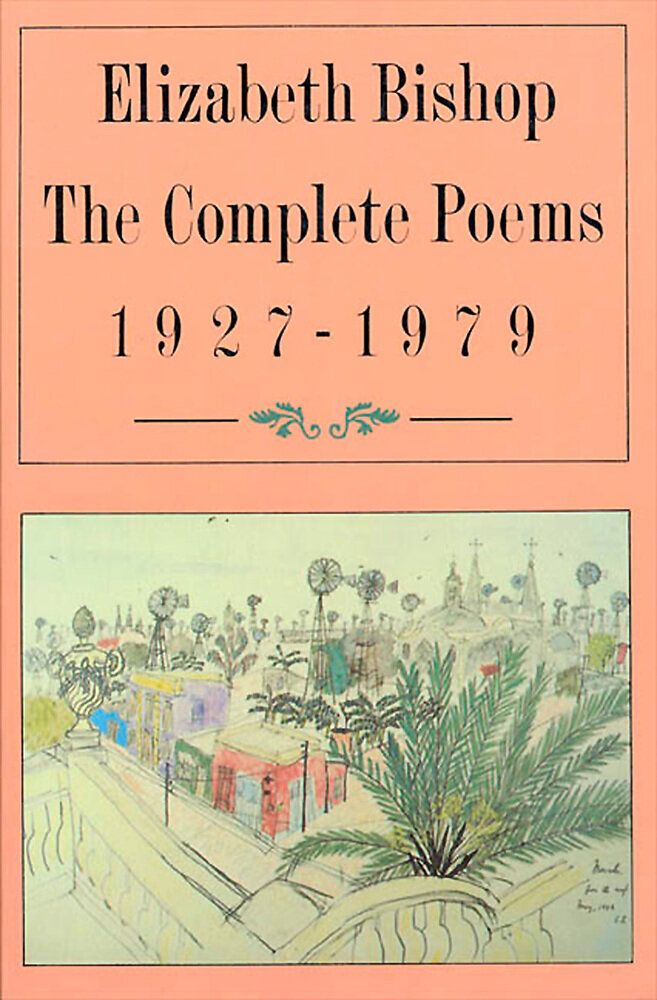
The Complete Poems: 1927-1979 by Elizabeth Bishop

Do you know how long it takes me to get a to a book on my to-read shelves? I can give you one hint: this book was superseded a decade ago, a newer, possibly larger Poems having hit in 2011. I just discovered that when searching for a link and finding the book I own is deeply out of print. (I was hoping there was something newer, and I was happy to find that true.)

My copy of Elizabeth Bishop's The Complete Poems: 1927-1979 is from the fifteenth printing in 1995, with a 10% off penciled price on the first page, so I might have gotten it it new. I'm pretty sure it was the late '90s, but can't tell any more specifically than that. It's been on my shelves for a couple of decades, moving bookcases and somehow surviving my 2011 basement flood.

And I finally read it this year: I'm trying to read the work of at least one poet a year, someone I know a little about but haven't read in depth before. For Bishop, what I knew was that she went to Vassar, decades before me, so there's an old home connection. And of course "Visits to St. Elizabeth." I'd probably also read "The Moose" at some point.

But that was it: I knew she wrote poetry, went to the same college as me, lived and died before I even knew her name. Had a vague sense of her life, and did a little Wiki-reading when starting this book, but that's not particularly relevant. Bishop was a very private woman, and wanted her poetry to stand on its own. I can understand that, and do my little bit to reinforce it.

Complete Poems is short: less than three hundred pages, even collecting what I think were four separate books (North & South, A Cold Spring, Questions of Travel, and Geography III) and several previous "collected" editions. The last fifty pages are translations, mostly from the Portuguese - she lived in Brazil for a long time - with a few from French and Spanish.

It's organized in what I think is the usual standard: chronological for the major work, then the "Poems Written in Youth" (youth being up to a year before the first "mature" poem, in her mid-20s), and finally those translations. That means the reader begins with the most tightly constructed, hermetic Bishop poems: she loosened up, I think, as her life and career went on.

I am no good critic of poetry. So I try to point at what I see, what seems interesting. In Bishop I see a lot of work about places, either where she was living or traveling at the time or places from her youth - lots of Brazil, lots of Nova Scotia and Massachusetts. The poet is usually absent, or, rather, the poet is the viewpoint rather than a speaker or the line of argument. Bishop's poems, to me, seem to be mostly about seeing, or maybe inhabiting, about the world around in all its complexity, and how things and people fit into that world.

There's a lot of good poetry here. I'll have an excerpt I particularly like for the weekly quote this Friday. And I end posts about poetry the same way every time: read poetry. It's condensed language, deeper and richer and more concentrated than prose. We all need to take time to read the hard stuff. Maybe for you it could be Bishop, or Shelley, or Spenser, or someone brand new. But poetry, I think, is even more important than prose, more central. So we all should take the time for it, when we can.