Thursday, June 30, 2022

Book Love by Debbie Tung

I'm usually not a fan of the log-line format, but sometimes I read a book that is really obviously "this one book I read recently" mixed with "this other book I read recently." I'd still probably avoid saying so, unless it was clear that was the author's intention, and not just random stuff I'm reading into it.

Today is one of those days. I just read a short, pleasant, inoffensive book of comics about books, Book Love, all from Debbie Tung, whose Happily Ever After & Everything In Between I hit back in winter. And Book Love, as a "aren't reading and physical books and bookstores and libraries and curling up to read just totally awesome" book, will be a lot like similar books - such as Grant Snider's I Will Judge You by Your Bookshelves, which I also read toward the end of winter.

So, yeah: this is like A + B. Because it's on the same topic as B by the author of A. Not a huge stretch, I admit.

As I understand it, Tung started out making comics online. Those comics tended to run to some specific themes - like her relationship with the guy she married, or books, or being an introvert - and all of those themes became books collecting her comics. (Having been in the sausage factory myself, I know I'm hugely simplifying: I bet she created almost as many new comics for each book as she reprinted, for example.)

This was the second one; it came before Happily Ever After but after Quiet Girl in a Noisy World, in 2019.

And it is a whole bunch of comics, mostly four square panels to a small-format page, about how awesome books are. If you're my age, you can probably predict every beat, ever bit of joy, every wonderful thing Tung celebrates. That's not bad; it just shows that Book Love is in a particular genre - and it's a lovely, positive, warm & fuzzy entry in that genre, which has and will make a lot of people happy to read it.

I am not quite this uncritically "books are kewl" in my own life - partially because I'm not uncritical about anything and partially because I used to do books for a living. But even a grump like me can enjoy a sweet, fun book like this, so unless you are substantially grumpier than I am, I assume you will enjoy it, too.

Wednesday, June 29, 2022

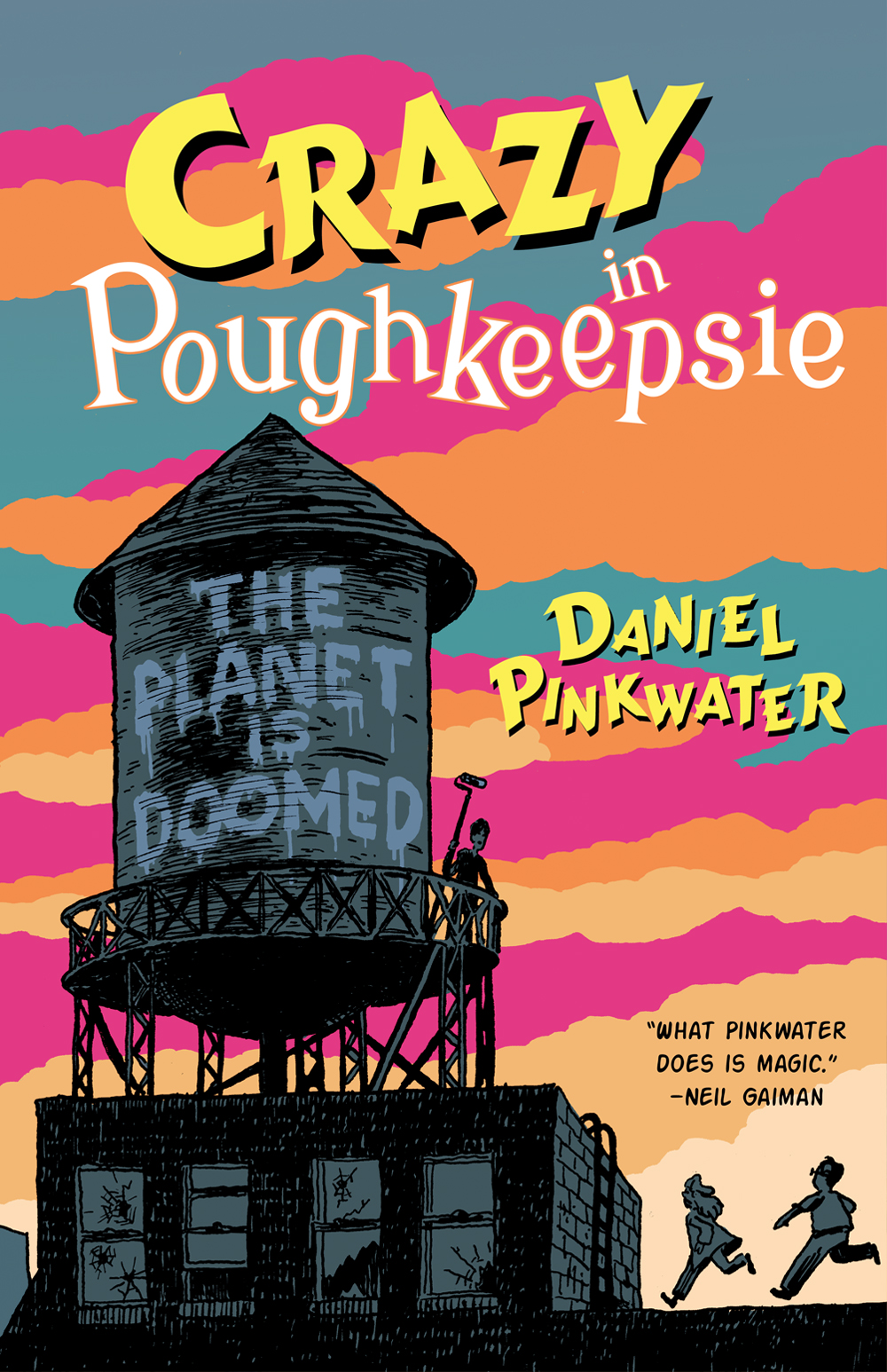
Crazy in Poughkeepsie by Daniel Pinkwater

Poughkeepsie is one of the great American place names - great as a name, I mean. Some places are great because of their image, or what has happened there. But a few are great purely because of their names - I could also mention Walla Walla and Oshkosh. I wouldn't say Poughkeepsie is a particularly crazy place, though I only lived there for a few years, during college, a long time ago. But any place can be crazy for the right people at the right time.

And any place in a Daniel Pinkwater book is going to be at least a little crazier and unusual than default normal to begin with.

Pinkwater has been writing books - mostly for people who are not quite adult yet, with the exception of the excellent Afterlife Diet - for pretty much my entire life, and they've been wonderful, unique things particularly well-suited to the kind of weird kids who read a lot and grow up to read blogs, think interesting thoughts, and live the lives they dreamed about when they were young. His books for young readers often tend to come in series, or clumps, or clusters - from the Magic Moscow books to the Snarkout Boys to the Hoboken Chicken Emergency, and including several things that don't have a name, like the Neddiad - Yggyssey - Adventures of a Cat-Whiskered Girl not-at-all-a-trilogy.

Crazy in Poughkeepsie continues that trend; it's loosely related to Pinkwater's last novel, Adventures of a Dwergish Girl, which was also set in the Poughkeepsie area. (Pinkwater himself has lived in the Hudson Valley for several decades now, and he's generally tended to set books in the places he's lived - Chicago and Hoboken are two other examples.)

This time out, it seems to be the modern day, since a secondary character is concerned with climate change, but all of Pinkwater's books take place in a somewhat timeless, definitely unique world - some are clearly set in the past (mostly the '50s, era of Pinkwater's own youth), but most are "now, more or less." How much more and how much less is left to each reader to determine, particularly if she's wondering just how old Molly the Dwerg is, and if it's the same Molly in Cat-Whiskered (explicitly in the '50s) and Dwergish (maybe the '80s, maybe now, maybe not).

Our narrator, the standard Pinkwater smart, not-thin, quirky kid, is Mick this time out. Mick lives in Poughkeepsie, and does not think it's at all crazy. But his big brother Maurice has just come back from a Himalayan trip having successfully found a guru, and that guru - Lumpo Smythe-Finkel, originally from New Jersey - has been installed in the extra bed in Mick's room, along with his dog Lhasa. Luckily, Mick is in a happy mood from summer camp - he may be the only character in a novel for young readers I've ever seen who is happy and satisfied from his summer-camp experience - and he gets along well with his new roommates.

The guru, in fact, insists that Mick is his real disciple, since Maurice is now busy with a part-time job and community college. Mick doesn't entirely agree, but he likes wandering the streets of Poughkeepsie with the guru and Lhasa...and his life is becoming more interesting because of the guru.

Various odd Pinkwaterian events follow from there, more or less logically and absolutely reasonably: the Pinkwater world is quirkier and happier than our own, with some dangers and problems but nothing that smart and thoughtful people can't work out between themselves. I've always wanted to live in a Pinkwater world, and one of the great sadnesses of my life is the continual realization that I don't. But we can all escape into a Pinkwater world at any time, if the real one is too much or just because we want to be happy.

Yes, that's it. Read Crazy in Poughkeepsie if you want to be happy. Pinkwater encapsulates the smart-kid sense of a big wide world full of possibilities and neat stuff better than anyone else - does it so well even crusty old people can feel that as strongly as when they were twelve. Read this book, read Young Adult Novel, read The Education of Robert Nifkin. But read Pinkwater, and be happy.

Tuesday, June 28, 2022

Ye by Guilherme Petreca

We are in a vaguely medieval world, with peasants in a countryside, bustling cities of commerce, and wide oceans plagued by pirates. If anyone rules this world, we don't know who: our viewpoint is at the level of those peasants, and any rulers don't impinge on their lives.

What matters, though, is The Colorless King, something like the devil figure of this world. The Colorless King is responsible for "all plagues and wars, all suffering and tragedy," which sounds to me like it neatly absolves human beings of any responsibility for bad things. We do see him in this world: he is real, he has power, and he does at least some of the things the humans say he does. How much those humans are responsible for their own actions, though - that's left vaguer than the definitive narration at the beginning of the book.

Our narrator and viewpoint is a young man. His name is Ye and so is the book's. The only thing he can say is his name, for a McGuffin-y psychological reason that the reader suspects will be solved by the end of his story. And, as he must, he is forced to venture out across that wide world, alone, to fix a burden put on him by The Colorless King. We see that burden laid; we know it is real. It's that kind of book - there are subtleties, but it's not possible to deny the central supernatural plot.

If we're familiar with stories, we suspect some of the shape of this one: Ye will travel widely, will be shifted unexpectedly, will be delayed and misrouted and abducted and capsized, as he heads towards a specific place and person we see him reach in the first few pages. We may also suspect a story like this must be circular, and that Ye will end up back in his native village, wiser and more experienced and ready to settle into that rural (paradise? rut?) for the rest of his now-blessed life.

If we expect things like that, we will not be mistaken.

Guilherme Petreca, a Brazilian cartoonist and art director, has apparently had a longer career in his native country, but Ye is the only work of his translated into English so far. It is the kind of universal, fabulist story that tends to travel well, so it was likely a good choice. It tells durable lessons in mostly the straightforward language of a folktale or legend. The art is just a bit mannered, the buildings with slightly askew proportions and the people with small features in large blocky faces, as if to signpost that the story is not entirely realistic, that we are to universalize it and not just think of it as this one story about this one young man. 

I could quibble with the details of the fable, but what good would that do? Fables tell particular kinds of lessons, and Ye fits that bill closely. It does what it sets out to do, and does it well, with art that's particularly strong at suddenly shifting from generally soft, pleasant colors into deep black spreads to indicate the workings of the Colorless King. I don't think Ye was meant, specifically, for younger readers, but it's the kind of book that would work well with them: simple enough, with enough depth, about the right kind of person on the right kind of journey.

All in all, I'd call it a success, and hope that more of Petreca's work has a chance to get translated.

Monday, June 27, 2022

Reviewing the Mail: Week of June 25, 2022

So, the next few weeks of "Reviewing the Mail" will be a slight cheat. I recently got a big box of remainders from HamiltonBook - which, as always, I recommend for people like me who enjoy diving through vast lists of books and finding odd cheap things to buy.

And I'm going to parcel that big box out into three weekly posts, because I don't enjoy sitting here and typing stuff about twelve books all at once. And the box fairly cleanly falls into three categories, or at least I can divide it into three categories.

First up is Skiffy, four books of SFF by names that may be familiar:

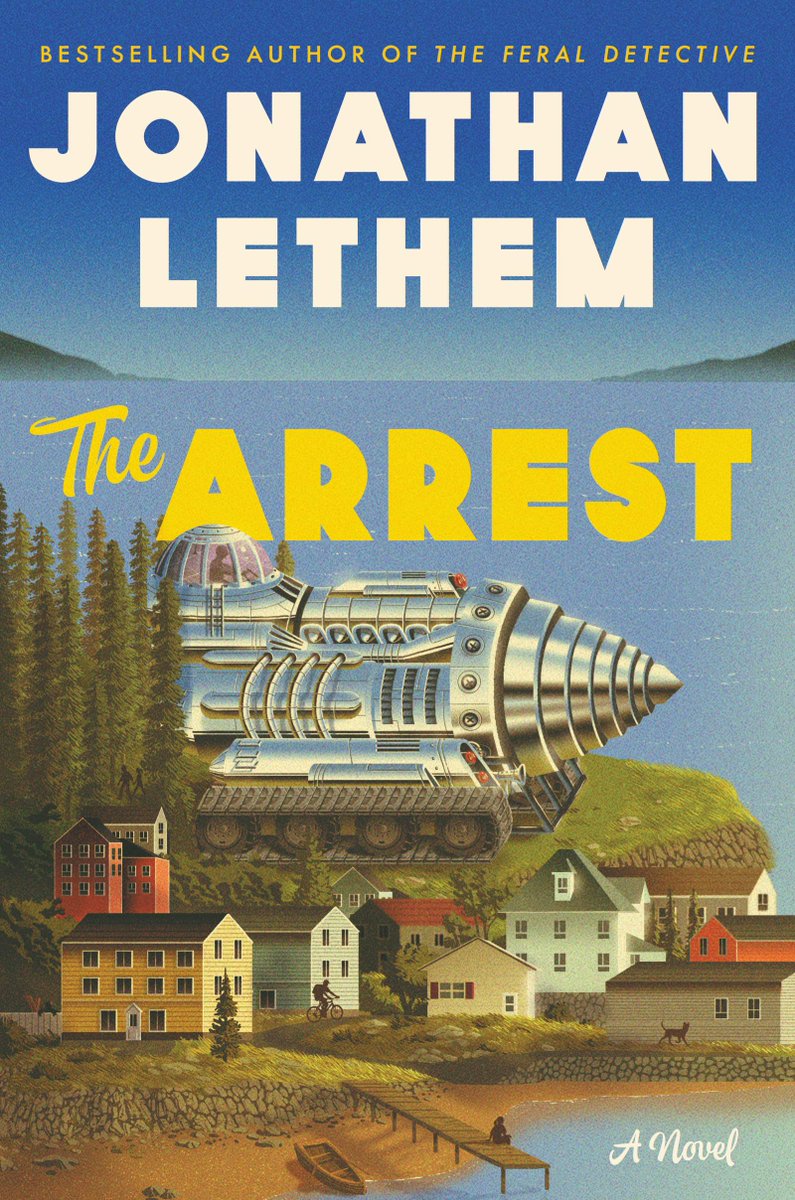
The Arrest is the 2020 novel by Jonathan Lethem, who I think of as a writer I read regularly but just realized the only thing I've covered in the fifteen-year life of this blog was his Omega the Unknown comic. So I guess I haven't read any of his novels in at least a decade. This is one of those cozy catastrophes, all about the people left behind, where we're probably not supposed to think about how billions of people died of starvation or something. In this case, it's a world where "cars, guns, computers, and airplanes, for starters" stopped working, which means megadeaths within days (see: food distribution). I expect that won't impinge on the book at all, which is about a former-screenwriter and his asshole ex-friend.

Lethem is a good writer, but he's also someone I always find myself arguing with in my head - non-fiction, comics, or novels, doesn't matter - which is good intellectual exercise even if it's not always entertaining in the normal way.

Hummingbird Salamander is Jeff VanderMeer's most recent novel, a standalone thing that I think is somewhere between an ecothriller and SF. (Or maybe both. Probably some fungus, too.) VanderMeer is a writer I think I do like, and keep gathering his books without ever reading them at half the speed I acquire them. I have no explanation for this phenomenon.

The Sundering is the middle book of Walter Jon Williams' "Dread Empire's Fall" space opera trilogy; I think the series has grown at least two books since them. I had the original mass-market paperbacks of this series on a shelf, and I was expecting to read the three of them straight through for a potential SFBC omnibus, but then I was no longer in a position to buy books for the SFBC, and I kinda stopped reading all of the thing I had on that for-work list. I then lost those original books in my 2011 flood.

But I've read just about everything else Williams has written - he's a great, versatile writer who has done many different things really well - so I might just find time to read a big space opera series, as long as it's from him. So I'm gathering these again.

And Interlibrary Loan is Gene Wolfe's last, posthumous novel. I have no idea if he actually finished it before he died, and I'm not confident I would be able to tell, anyway - Wolfe was always a tricky, sneaky writer who left out vast swaths of what other writers would consider vitally important information.

Amazon seems to think this is a sequel to A Borrowed Man, which I have but have not read, and the titles/ideas certainly line up. So they may be right.

Friday, June 24, 2022

Quote of the Week: Among the Crops of the Locale Are

The dead and pieces of the dead turn up in El Salvador everywhere, every day, as taken for granted as in a nightmare, or a horror movie. Vultures of course suggest the presence of a body. A knot of children on the street suggest the presence of a body. Bodies turn up in the brush of vacant lots, in the garbage thrown down ravines in the richest districts, in public rest rooms, in bus stations. Some are dropped in Lake Ilopango, a few miles easy of the city, and wash up near the lakeside cottages and clubs frequented by what remains in San Salvador of the sporting bourgeoisie. 

 - Joan Didion, Salvador, p.351 in We Tell Ourselves Stories in Order to Live

Thursday, June 23, 2022

Salvador by Joan Didion

Reporters write about moments, about places, about the intersection of the two: what it's like to be here when it is now. Some pieces are more obvious about it than others.

The novella-length essay Salvador is very obvious: this is El Savador in 1982. It may be germane to other places and other times - other civil wars, other death squads, other countries in turmoil, other groups of disappeared, other counts of mounting bodies every morning - but it is particular.

Joan Didion went there, for what seems to be about two weeks in February, with her husband John Gregory Dunne (who is never named here, but referenced). She talked with government officials and NGO people, intellectuals and other reporters - anyone she could talk to, it seems. She traveled as much as she could, as much as was safe: that doesn't seem to have been that much. El Salvador is a small country - Didion pointedly notes that it's smaller than several counties in her native California - but it was war-torn and full of armed men in 1982, and bodies appeared in specific, almost ritual spots nearly every morning.

She does not give us much of the geopolitical background: she does get into the sea of acronyms of political parties-cum-paramilitaries, but it's confusing and unclear, I think on purpose, like hearing the complicated story of some other family's messy feuds. The US was trying to impose peace, but not quite succeeding. Right-wing death squads were very active, though most of the deaths they caused were "officially" unsolved. If I'm reading between the lines, the left-wing rebels were responsible for far fewer deaths, but maybe not for lack of trying.

It was the kind of place and the kind of time where a lot of things were generally assumed but not said officially, where impressions and news reports were more important than actual facts, since the actual facts were suppressed or not known or considered unimportant or just neglected. That kind of place leads to conspiracies - some of them theories, many of them real.

Didion was the right kind of writer for a place and a time like that. She was always concerned with both what really is true (but isn't said) and what is presented for public consumption (and is carefully constructed out of a thin scaffolding of truth garlanded by lies and fancy). El Savador in 1982 was mostly image, with a substance avoided and hidden and manipulated. This is a good, though harrowing, look at what that was like, and may be a useful reference for other countries and other times that are in their own civil wars, or may be pushed into them.

Wednesday, June 22, 2022

Saint Cole by Noah Van Sciver

There is no Saint Cole. No one was ever canonized under that name - there is a Saint Colette, but given the subject of Noah Van Sciver's graphic novel, there's no chance that's the reference meant. It is not the name of a town. It is not metaphorical; there is no one named Cole in the book.

"Saint Cole" is a random squawk, emitted by a minor character whose whole point is that he's mentally damaged. It is meaningless. I have no idea why it's the title of this book. There is something vaguely ironic that the story of a man named Joe who is deeply unsaintly is named Saint Cole, but 99% of life is that ironic to begin with. It's not much to hang a story on.

Saint Cole is the story of an alcoholic, a loser who thinks he isn't a loser, a bad man who thinks he's pretty good. I find that I have less and less sympathy for characters like that every year, so I may not be giving Joe his due here.

But, to be honest, Joe isn't due much. Sure, he works long hours, but he's a jerk who drinks too much, has no aims or plans, and is unpleasant to everyone around him pretty much continually. Just working hard doesn't buy you anything.

Joe is a waiter at the restaurant New Yorkies, in some minor city somewhere: it's roughly walkable, so it's not deep suburbia, and Joe lives in an apartment with a parking lot. He's in his late twenties, living with his girlfriend Nicola and their baby son. They're just barely making it: Joe takes every last shift he can, working every single day, and Nicole stays home with the baby, which Joe resents. Over the course of four days, starting on a Saturday, Joe...well, I shouldn't give it away. But Joe is a loser and a fuck-up, so he fucks up and he loses things. Take that as read.

Angela, Joe's mother-in-law, moves in with them on the first day, which adds to the friction. He doesn't like her, for reasons that don't seem sufficient. But then, Joe hates just about everyone and everything: he doesn't seem to need reasons. He's just that kind of young man, fueled by anger and self-loathing and loathing for everything else in equal measure. Oh, and by alcohol. He's fueled by a lot of alcohol.

Saint Cole is the story of Joe drinking and then fucking things up, to to give a quick log-line. I called him an alcoholic before, but he really comes across as a drunk: a guy who isn't compelled to drink; he just drinks because he wants to, and he always wants to drink more. That kind of guy can easily turn into an alcoholic, but I don't think Joe is there yet.

Yet.

Van Sciver draws this in a mostly indy style, more conventional than I remember his The Hypo being. It's all thin lines, lots of details of dingy rooms and sad lives: indy in the matter and the style equally.

I'm not a good reader for a book like this, and I can't really recommend it. If you like stories of self-destructive losers more than I do, you might take a look. It's smartly written, it looks good, and Van Sciver tells the story well. But it's an unpleasant story about an unpleasant man, and all I felt at the end was happy that I didn't have to spend any more time with Joe. 

Tuesday, June 21, 2022

Hearts at Sea by Pedrosa

Jean-Paul is living in some minor city in France, probably near the German border. He works in his family's business - something to do with handcrafted wooden toys - and is old enough to have struck out on his own or aimed at his own goals in life. But that has not happened: he's quiet, and solidly under the (comfortable, friendly, but still smothering) guidance of his mother. His friends seem to be all connected to the business, his life is quiet and circumscribed, there's no sign he's ever had a girlfriend or lover despite endless fantasizing about a woman he meets while jogging every day.

One day he snaps, for no obvious reason. He's supposed to do yet one more thing for his mother and the business, but, instead, goes off on a cruise. It's not clear where the boat is going - my guess is out in the Atlantic, maybe to the Canaries or Azores? but it could also be the Mediterranean. It's sunny and warm, and he's part of a group of mingling singles, which he does not fit into at all.

Hearts at Sea was (Cyril) Pedrosa's first solo bande dessinee, published in 2006 after a few collaborative works and a few years in the animation mines. It's remarkably quiet and assured, entirely focused on Jean-Paul though viewing him entirely from the outside in a naturalistic way. We can assume Pedrosa sympathizes with Jean-Paul - that's why he's telling this story, right? -  but we never get into Jean-Paul's head or entirely understand him.

But then, do we ever understand anyone? I don't know if I could honest say I understand myself.

This is Jean-Paul's story, in one album-length book. It takes him from that point where he's clearly unhappy in his life, and unsure what to do, through an eventful cruise - though not eventful in any of the ways he probably fantasized or hoped for; he's not good at interacting with other people and not entirely clear on what he wants or how to get it - and to the point where he makes a major life decision at the end.

So it's a low-key story, entirely on an interpersonal level. There is some action; single cruise ships do lend themselves to some activities, particularly those fueled by intoxicants. But it's, in the end, a story about people, and mostly this one person.

Pedrosa did bigger stories after this, and became even more assured - Three Shadows, which I still think is a masterpiece, came immediately afterward - but this shows well his strengths. There's the rumpled people, the precise colors, the creased and individual faces, the occasional visionary sequences, and the deep understanding of people. It was a fine start, and it's still a fine book.

Monday, June 20, 2022

Books Read: May 2022

I usually try to do these monthly posts on the first weekend of the month, but that doesn't always happen. It might mean that I actually have some links; let's see.

Zidrou and Jordi Lafebre, Lydie (5/1, digital)

Farel Dalrymple, Proxima Centauri (5/7, digital)

Jose Munoz and Carlos Sampayo, Billie Holliday (5/8, digital)

Adam Christopher, Killing Is My Business (5/8)

Pedrosa, Hearts at Sea (5/13, digital)

Noah Van Sciver, Saint Cole (5/14, digital)

Joan Didion, Salvador (in We Tell Ourselves Stories in Order to Live, 5/14)

Guilherme Petreca, Ye (5/15, digital)

Daniel Pinkwater, Crazy in Poughkeepsie (5/15)

Debbie Tung, Book Love (5/21, digital)

Jeff Lemire, et. al., Black Hammer: Streets of Spiral (5/22, digital)

Sarah Andersen, Herding Cats (5/27, digital)

P.G. Wodehouse, Barmy in Wonderland (5/27)

John Allison, Bad Machinery, Vol. 10: The Case of the Severed  Alliance (5/28)

Gemma Correll, The Worrier's Guide to Life (5/29, digital)

Jim Woodring, The Frank Book (5/30, digital)

Nick Hornby, Funny Girl (5/30)


I'm already two-thirds of the way through the next month, so I can say for sure: I've read more books since then, and will keeping putting posts here - I'm running about six weeks ahead right now.

Reviewing the Mail: Week of June 18, 2022

One book this week, another one from the library. I actually got the notification the previous Saturdays, so I could have gotten this quickly and included it in last week's list, but, as you can see, I didn't.

(Look for similar stretching-content-across multiple weeks tricks on upcoming Mondays!)

Alone in Space is a collection of Tillie Walden's earlier comics - three shorter (50-80 page) graphic novels that she did before her big breakout Spinning, plus over a hundred pages of short stories she did when even younger. (That section is titled "Comics by Tillie Walden Aged 16-20 years old," to make it clear, the way a Collected Poems will have a bunch of "Juvenilia" or "Poems Written in Youth" at the end.)

Walden has done several impressive books already in her still-young career: On a Sunbeam and Are You Listening? as well as Spinning. A lot of people have a book in them, one story they need to tell. Walden is something rarer: she's consistently putting in the work - making comics takes a long time - to make long, thoughtful, detailed stories, each of which is very different from the one before. I don't know if she can or wants to keep up that pace, but she's just hitting the back half of her twenties with four big books of her work out in the world, which is incredibly impressive.

So I'm going to read this one to see where she started, and tide me over until she finishes the next big new book.

Friday, June 17, 2022

Quote of the Week: Fallible Memory

Timetables, it had to be said, were not my strong point, given that I had no recollection of events prior to six in the morning, each and every day. That was because I was a robot with a state-of-the-art miniaturized data tape sitting behind my chest plate, a ribbon of condensed magnetic storage slowly winding one reel to the other, the events of the day recording themselves through the medium of me.

 - Adam Christopher, Killing Is My Business, p.18

Thursday, June 16, 2022

Killing Is My Business by Adam Christopher

If I say anything here that might be construed as a complaint, let me say first that I got this book as a review copy five years ago, and that I only just managed to read it now. It's also the fourth book in a series, and the only one I've read.

What I'm saying is: I'm pretty sure I'm responsible for any confusion, doubt and uncertainty here. If anything I write below sounds enticing, you might be best off finding the first book in the series, Brisk Money, and starting there. [1]

Raymond Electromatic is the only robot PI in early 1960s Los Angeles. Well, he's apparently the only functioning robot left anywhere, but he's a PI. Well, he was a PI when the series started, and now pretends to be a PI. But the mainframe who is his boss, Ada, realized sometime between the first book and the third one (I'm not sure exactly when) that Ray could make more money as an assassin for hire, and so that's what he does now.

Thought One: Ray and Ada do seem to have an oddly nonexistent relationship with the authorities. There used to be a Department of Robot Labor, and it may start up again, but no sheriffs or city cops or federal agents or other government officials seem to ever talk to the only remaining intelligent robot in the world, or to a mainframe that seems to be vastly more intelligent and manipulative. (This may have been a plot point in a previous book.)

Thought Two: How exactly does an immobile mainframe find clients looking for assassin services? Particularly when Ray is her only hands or mobility device? Frankly, I feel like Ray should spend a lot more time just doing maintenance on Ada, not to mention every other requiring-hands task, unless this is a Plot Point in a previous book.

Thought Three: Ray is very much an unreliable narrator: his memory tape lasts only twenty-four hours, and so he forgets everything that happened in the past, except for the things programmed into his permanent memory (language, detecting skills, driving a car, killing people, geography - stuff like that). So while there's a lot of stuff that I could ponder "how does this work?", author Adam Christopher has explicitly set up this series so his hero and narrator doesn't know those things - and, even more fun, tells the reader things that he will himself forget by the next chapter.

It's a neat noirish device, Gene Wolfe's Latro as mediated by Raymond Chandler, and that plus the excellent voice Ray uses to narrate makes Killing Is My Business a fun, zippy read that I got through in record time. Whatever else I say about it, this book is deeply entertaining - and the things I could quibble about are quite likely things Christopher has built in, but that Ray doesn't understand or notice.

The actual plot here is a bit loose and minimal, or at least it seems so from Ray's point of view. Every day, he wakes up in an alcove and Ada tells him what he needs to know: where to go, what to detect, who (if anyone) to kill. This time out, he starts out shadowing a city planner, and then unsuccessfully looks for a real estate magnate. But most of the book is about how Ray infiltrates the inner circle of a mobster in order to find out some secrets (the nature of said secrets are not revealed to Ray, though he is told he'll know them when he finds them) before he knocks off the guy.

That works fine for Ray's laconic narration: the typical PI novel is about going places, looking for and/or talking to people, and that's what Ray does. He does spend rather less time murdering humans than I expected from the premise, actually.

The ending is rather less conclusive than I expected in what I thought was the fourth book in a mystery/thriller series about a robot detective. But, as you will know if you have read my footnote, this is actually the middle book of what I gather is inherently a science-fictional trilogy, and so cliffhangers and lots of tension are to be expected. 

All in all, it was fun and I enjoyed it, but my main takeaway is that this is not the book to start with if you want to read about Ray Electromatic. Learn from my mistakes, O Best Beloved, and do better yourselves.


[1] Oh, wait. It looks like two of the four books listed on the card page as "The Ray Electromatic Mysteries" are not, strictly speaking, books. Elsewhere, I learn that Brisk Money and Standard Hollywood Depravity are both novellas (and thus secondary?) and that the only actual previous book is Made to Kill, which implies the PI-to-assassin switch happened pretty quickly.

Wednesday, June 15, 2022

Billie Holiday by Munoz and Sampayo

I should tell you their first names, though the book doesn't: Jose Munoz and Carlos Sampayo. Munoz is the artist; Sampayo is the writer. They're both Argentine, though they mostly worked in Europe, over the past forty-plus years. Both still alive, as far as I know, now in their upper seventies.

Billie Holiday was written in Spanish, originally published in 1991. It's had editions in English since then - I have no idea if it's always been the same translation. This one is from NBM, and came out in 2017. It includes a long discursive introduction about Holiday by Francis Marmande, who I gather is a prominent French writer on jazz. The introduction tells us her story in an in-your-face, demanding style - not unlike the book itself, though in a different way - probably in part because the comics pages themselves will only lightly touch on that story.

This is a biographical graphic novel, or bande dessinee - Holiday was a real person, and this book tells stories from her real life, as true as any other book about historical people. But it's not her whole life, or a carefully-organized life: it's scenes from her life, mostly out of context, as understood or experienced much later.

Holiday was a jazz singer, and writer of her own songs - among the best of all time in the former, and not too shabby at the latter. She was Black and a woman in a time when either of those things was a burden and both were an iron cage. She was an addict and a stormy personality, I think - the book and the introduction are more poetic about it - which didn't help, but who ever min-maxes their own life to be the most successful version of themselves? She achieved a lot. She fought hard. She died young.

This book is about her only at a distance, for all she's on a majority of the pages. A reporter is working late at night, thirty years after her death (so in 1989 - farther back from our today than Holiday's death was from his), suddenly having to write a feature article about her for the anniversary, for some unnamed publication that clearly is really bad at planning out their editorial calendar. The book we read is...his thoughts as he writes that article? What he learns about Holiday that long night? Somehow that article as transmuted into comics pages? I'm not sure the frame story actually makes any sense, or is necessary: we don't need to have Holiday's story mediated by some white guy thirty years later.

But it's the way Munoz and Sampayo told this story: it's the way we get it.

Think of it as a jazz improvisation, I suppose: talented creators stepping up into the spotlight, picking up their instrument, and playing the melody, but doing it their way, however feels right, that night and on that stage.

We only see Holiday as an adult, only after she's already famous. The scenes are not dated, but seem to be basically in chronological order. Call it mostly the 1950s; the last decade of her life. It's mostly set at night, mostly at times when things aren't going well for Holiday. Almost as much about her great collaborator and friend Lester "Prez" Young, as about her alone - maybe what I mean is that it's largely about his influence on her, though Holiday comes across as someone who would not let herself be influenced, who did what she felt she had to do (songs or men or drugs or whatever) at the time, no matter what the consequences.

Sampayo provides that quirky structure, the story that flows around and through her life, the frame-story of someone presumably not all that different from Sampayo himself, considering this story so many years later. Munoz provides the atmosphere: he's one of the most distinctive artists in the world, tormented sweaty faces emerging from his blocky, utterly compelling slabs of ink.

This is probably a book largely for people who already know at least the outline of Holiday's life; you won't learn things very clearly here. Or, more obviously, for fans of other works by Munoz and Sampayo.

The best way to discover Holiday is through her songs: I'd recommend "Strange Fruit" or "Crazy He Calls Me" or "Easy Living" as places to start.

Tuesday, June 14, 2022

Proxima Centauri by Farel Dalrymple

Some creators use a single universe, or multiverse, for all their stories. Sometimes it's on purpose from the beginning, sometimes they just tend to accrete together over time. I'm coming to think Farel Dalrymple is one of those creators - this book has a minor character who was one of the main characters in It Will All Hurt, and Dalrymple's foundational Wrenchies (set substantially later in time, I think) characters are referenced several times.

I also should admit that I find Dalrymple's stories interesting, and I do seem to keep coming back, but I don't seem to really get them. When I wrote about Wrenchies, and Hurt, I said that, and I'll say it again here. Darlymple makes stories about damaged young people in landscapes filled with elements of fantastika - both SFnal and fantastic - but I tend to think they are all really inner landscapes, personal worlds or collective unconsciousnesses or something more complex than that. What they do isn't that important, not even how they change. What matters is how they feel about the world, in an endless, timeless now that keeps them adolescent eternally to cycle through the same few (wrenching, uncomfortable, jagged) emotional states.

So the point of a Dalrymple book is not the story. It's not even the characters, who seem to be avatars of the same ideas coming up in different shapes and names. It's the pain and the raw emotions of those central characters, the ones who hurt and are inherently unhappy.

That's how I came to Proxima Centauri, the story of "teenage wizard adventurer Sherwood Breadcoat" - that's another thing; they all have names like they're in some tabletop RPG that the players care deeply about and yet can't quite take seriously - who is trapped on some kind of space habitat in the star system implied by the title. It is much less SFnal than that makes it sound, though: Sherwood uses "magic and tech," and the tech is just as much "wave a thingy so that stuff happens" as the magic is.

What Sherwood does is wander around, brooding adolescently about the girl he wishes would pay more attention to him, his personal failings, the search for his missing brother Orson (who we see in inset scenes, and who seems to be a massive jerk), and how much fun it is to slaughter random creatures and people. What he does not do is take any serious action to actually solve his problems or do the things he claims to want: he is very, very adolescent, in the worst possible ways.

Luckily, I guess, the rest of the cast mostly calls him on it: this isn't a book that's on Sherwood's side. In fact, there's darkly ominous mumblings about how he will inevitably destroy everything good and wonderful - not, as far as I can tell, because he's a sulky undisciplined adolescent, though they do complain about that, but just because he's fated to destroy everything and so there's nothing anyone can do about it.

That cast is medium-sized, and varied in look and supposedly in who they are, but they really just serve as a Greek Chorus around him, all saying more or less the same things in different ways and all there to serve as comparisons to show how adolescent and self-centered and unpleasant Sherwood actually is. (Dalrymple draws him as a very young adolescent - I'm a big guy, and my sons were big guys, so my meter may be off, but I pegged him at core middle-school years: maybe twelve, maybe thirteen at best.) 

There's a lot of activity, and a lot of moments in Proxima Centauri, but it's all circling: the same kinds of events, the same emotions, over and over until the big ending in which Sherwood does or does not destroy everything as fated. As I said above, I'm still not sure if I really get what Dalrymple is trying to do here: it seems like a really long trip around something that's not all that exciting, new, or different. But the moments are interesting, and he has a way with adolescent angst, which is always popular.

So I guess I'll come back for another Dalrymple book eventually, and see if that gets me any further into understanding.

Monday, June 13, 2022

Reviewing the Mail: Week of June 11, 2022

This week, I got a few books from the library, which means, of course, that they're things I not only wanted, but specifically asked for. And also that I don't own them; they will need to go back in a few weeks, so other people can read them in turn.

But they're in my hands right now; this is what they are:

Billionaires is a graphic novel - or maybe a collection of shorter graphic stories, I guess - by Darryl Cunningham. Cunningham is British, he seems to have been doing non-fiction comics for some number of years now, he got this book published by Drawn & Quarterly, and I was about to say "I've never read his books before." But I've gotten cagey in my middle age, so I checked this blog's back numbers, and found I did read a previous Cunningham joint: How to Fake a Moon Landing, which I quite liked back in 2014. This new book provides sketches of the lives of Jeff Bezos, the Koch brothers, and Rupert Murdoch, and I suspect Cunningham may not be totally in favor of all the things those grab-handing pasty bastards have done.

Tunnels was Israeli cartoonist Rutu Modan's new book for 2021; I'm amused to see it was also from D&Q. Modan's previous books include The Property and Exit Wounds and Jamili and Other Stories. (As I add them, two of those links are currently not working correctly; the ComicMix domain seems to have been hijacked by someone. I live in hope that my old mediocre reviews will return, someday.) The back cover has quotes rather than a description, but there's an explainer about the Ark of the Covenant on the first few pages, and it seems to be about archeology. I would not be hugely surprised if the other kind of "tunnels" - the ones Palestinians make to smuggle themselves or weapons or food or whatever underneath their tight Israeli-controlled borders - are also in the mix somehow.