Monday, February 06, 2023

This Year: 1975

"This Year" is a series of weekly posts, each about one song from one year of my life. See the introduction for more.

I've lived in New Jersey most of my life. I say that as a possible excuse, or reason - you know there's got to be some Springsteen on this list somewhere.

And I wrestled with a bunch of different songs, trying to fit them into the sequence. Atlantic City was a strong contender, and The River - as always, I love songs that tell stories, especially bleak ones. The demo version of Stolen Car has been one of my favorite songs since I heard it, but that seemed too much like special pleading: a list like this needs to be focused on normally-released works, things that were out and in the world in the years when they were made, not something sneaking out in a collector's package decades later. I can't claim a song for a specific year when it wasn't available until decades later.

In the end, for Bruce Springsteen, I came closer to optimism than I usually do, and picked Backstreets as my song for 1975.

Springsteen, to my mind, is most drawn to things broken, lost or gone - breaking away, getting out (on the positive side) or getting stuck and left behind, on the more common negative side. His biggest song was about getting away from where you came from while you still could; his most misunderstood song is about coming back and finding things are even worse than before.

Backstreets is about living there - wherever your "there" may be - about still being young and energetic enough for hopes and dreams. And about how those hopes and dreams are dashed.

It's still about a break. Most of Springsteen's songs are about the speaker, but Backstreets is about the one spoken to: Terry, who did something and is now gone. For a song this wordy, this specific about so many things, it's notable that what happened is entirely vague - "when the breakdown hit at midnight."

Not just vague, but passive. No one did anything - Terry, or the mysterious "him" who the speaker hates. Like so much Springsteen, the world is overwhelming, and individual people will be overwhelmed. But here, the speaker is still fighting, still holding onto that thread of life and plans.

That's what gives Backstreets life. That's what makes it a song of hope, despite whatever happened to Terry. (Did he switch sides in some gang fight? Did he go away forever? Is he dead?)

But remember where they are, what they're doing - they're not defiant. They're not out in the center. They're not standing up in the light of day. They're running for their lives at night on them backstreets.

And that might be - no, absolutely is - the best we can get, and it is enough.

Sunday, February 05, 2023

Reviewing the Mail: Week of February 4, 2023

Two more books from the library for this week.

What more can I say about that category? Even at my age, the fact that I can look something up online and ask for it to be held for me, for free, in a building in my town is amazing.

Modern society, man! Civilization! It's really nice. We should all try to preserve it, and not, like, destroy the financial position of our national government for petty and incoherent political ends. (But that's just me.)

Cranial Fracking is a 2021 collection of humorous essays by Ian Frazier that I only realized exited a couple of weeks ago, when I was typing up my thoughts on his 2000 book On the Rez. [1] The most recent previous collection of Frazier's funny stuff was Lamentations of the Father (which had a deeply unfortunate cover) and the most famous one was Coyote V. Acme. I generally think Frazier is really good at this funny-essay stuff, so I'm looking forward to this one.

Also in the funny-stuff category, Number One Is Walking, a memoir of Steve Martin's life in the film industry, written by Martin and drawn - the whole thing is in graphic-novel form, for some inexplicable reason - by Harry Bliss. In fact, it looks like the memoir peters out about halfway through, and the back of the book is Martin/Bliss single-panel gag cartoons. I have no ideas if those are related to Martin's film career, or just random stuff put in to add laughs and bulk the book out to a salable length. Either way: I got it from the library, as previously mentioned, so I don't care.


[1] Look for my post on March 1st. Mark it on your calendars! (Or don't; I'm not your mother.)


Saturday, February 04, 2023

Books Read: January 2023

As always, this is is almost entirely for Future Me, which is why I forget to do it regularly and bury it on the weekends when I do remember. But here's what I read in January:

Bruno De Roover and Luc Cromheecke, Daubigny's Garden (1/1, digital)

Guy Delisle, World Record Holders (1/2)

The World of S.J. Perelman (1/2)

New York Public Library, Peculiar Questions and Practical Answers (1/4)

Andi Watson and Simon Gane, Sunburn (1/7)

Manu Larcenet, Ordinary Victories, Vol. 2: Trivial Quantities (1/8, digital)

Tony Perrottet, The Sinner's Grand Tour (1/8)

Ruppert and Mulot, The Perineum Technique (1/14, digital)

Drew Friedman, Maverix and Lunatix: Icons of Underground Comics (1/15, digital)

Jon Ronson, Them: Adventures with Extremists (1/15)

Will Henry, Snug Harbor Stories (1/16, digital)

Jean-Yves Ferri and Manu Larcenet, Back to Basics, Vol. 5: Revolutions (1/21, digital)

Deena Mohamed, Shubeik Lubeik (1/22, digital)

Lucy Knisley, Kid Gloves (1/27)

Malaka Gharib, It Won't Always Be Like This (1/28)

Paul Theroux, Figures in a Landscape (1/28)

Iasmin Omar Ata, Nayra and the Djinn (1/29, digital)

Ian Frazier, Cranial Fracking (1/29)


I expect to continue to read books, unless I'm hit by a bus. And, since I work from home these days and barely leave the house, the odds of that have fallen substantially. Hope your own lives are similarly trending to lower chances of random death.

Quote of the Week: He Had a Hat!

Like so much of Jewish culture, kvetching has its roots in the Bible, which devotes a great deal of time to the nonstop grumblings of the Israelites, who find fault with everything under the sun. They kvetch about their problems and they kvetch about the solutions. They kvetch in Egypt and they kvetch in the desert. No matter what God does, it's wrong; whatever favors He bestows, they're never enough.

 - Michael Wex, Born to Kvetch, p.3

Friday, February 03, 2023

Steeple, Vol. 3: That's the Spirit! by John Allison with Sammy Borras

The third collection of John Allison's Steeple comics is a big, capacious thing, with one long Steeple story, a short Steeple story to start off, and a crossover with...maybe Solver? or Wicked Things? [1] ...called "Author Unknown?" in the middle. It features no page numbers, but a quick count shows it to have over 150 story pages, plus covers and some sketches in the back to bring the whole package up to what I think I accurately counted off as a 176-page package.

That, then, is Steeple, Vol. 3: That's the Spirit! All written and drawn by creator Allison, with colors on "issues 4-6" by Sammy Borras (note - nothing is identified as an "issue" within the book itself; the three stories have full-page titles but no issue breaks other than that). A big wodge of excellent Allisonian comics, all of which (I think) originally appeared on his website. [2]

Before I write about those three stories, let me link back to my posts on the first two collections (one and two) and sketch the setup: Tredregeyn is a picturesque Cornwall village, home to St. Pirin's church (CoE) and an outpost of the Church of Satan. Running St. Pirin's is Rev David Penrose, a beefy exemplar of a man who spends most of his time fighting off nightly invasions from a very diverse group of aquatic monsters who are evil but seem so far to be unconnected to the Satanists. Running the Other Side is Magus Tom Pendennis, a thin, weedy bastard who seems to be not so much evil as just a selfish, unpleasant twerp. The main characters are Billie Barker, who was a trainee CoE priest but defected to the Other Side, and Maggie Warren, who ditto in reverse - they are best friends despite their officially-opposed roles.

Right! So the first story is a single "issue" long, with a cover and twenty-two story pages, and sees Billie and Maggie having imbibed too much before and after (and possibly during) a midnight Christmas Eve service at St. Pirin's and subsequently having attracted a minor supernatural creature that torments them, because that's what happens in Allison's worlds. I hope I'm not spoiling anything by saying they are not cursed for ever and ever on page twenty-six of a 176-page book, but it is a close-run thing.

Then comes "Author Unknown?" in which Shelly comes to town on a book-signing tour - she does a series of picture books for kids called "Tibkins" after the tribble-ish main character - and gets into danger. Lotty is dispatched to find and save her, and, after some misunderstandings, is aided by Billie and the Rev. in doing so. The danger is very Tredregeyn, I'll say that much.

And then the bulk of the book is the long story, which I suppose is probably titled "That's the Spirit!" It's sparked by a couple of things: Maggie and Billie love the cozy detective drama Clotted Crime, which is set in Cornwall but filmed in Devon, and Billie is learning just how different Satan is from The Chap Upstairs (the CoE provides their curates with free living quarters and a small living stipend; Satan doesn't pay at all but does charge rent), which is causing her financial trouble. One plea to Baphomet later - and some related odd events, since this is Steeple - and Clotted Crime starts filming its new series right in Tredregeyn.

This is a longer story, so the complications continue to pile up from there, including an attractive but dim actor who dates Billie, Maggie's estranged father (a former MP and high muckety-muck in a more evil, larger Satanic church), and the inevitable aquatic horrors that Tredregeyn can never seem to get beyond. It does all end reasonably well, but Allison sets a number of obvious hooks for future stories along the way.

I'll also note that Steeple seems to want to be about sex - Lottie and Shelly note, when leaving Tredregeyn, how deeply "horny" the whole place is, and the Satanic rites mentioned seem to be entirely orgies rather than sacrificing goats and seeing to destroy one's enemies and so forth. But it's also very British in its attitude towards sex, and Allison seems to have gotten more reticent at presenting his main characters even post-coitus than in the Scary Go Round days, so sometimes they seem to be protesting way too much and not actually fucking very much at all.

Perhaps one is to assume there is always some fucking going on, just off-panel, all of the time - or maybe just that everyone else is fucking all the time, but Maggie and Billie are not. (Or maybe Maggie used to, and Billie does now - that job seems to be very heavy on the facilitating-orgies work, but it is vague as to how much "facilitating" includes "participating," for maximum humorous and dramatic opportunities.)

In any case: it's zippy and funny adventure stories, Allison-style, towards the more supernatural end of his work, with more references to sex than typical. His dialogue is still like no one else's, his body language is excellent, and his plots are convoluted in the best ways. As always, I highly recommend anything by Allison, and this is his newest book.


[1] The main guest star is the incomparable Lotty Grote, star of both Solver (currently ongoing online, at least intermittently) and Wicked Things (on hiatus at best). The secondary guest star is Shelly Winters of old, who seems mostly settled into comfortable adulthood now after the usual Allisonian young-adult chaos.

[2] Note: navigation has gotten more complicated, after what I think was at least one webcrash, the migration of the vast Bad Machinery archives to GoComics and other activities involving older comics like ScaryGoRound and even the fabled Bobbins moving mostly into paid spaces. Scroll down, look for a calendar on the right, and choose from the selector below the calendar to get to the beginnings of the various stories still available there. See also this blog post from Allison for a list of stuff and where to read and/or buy it.

Thursday, February 02, 2023

Mudman, Vol. 1 by Paul Grist

This is nearly everything, but not quite everything. Mudman ran for six issues from Image in 2011-2013, and the first five of those issues were collected in Mudman, Vol. 1.

It's clearly a teen superhero comic, another one in the long line spawned by Spider-Man, and slightly more conventional than creator Paul Grist's previous superhero comic Jack Staff. I knew, going in, that there was just one collection, and assumed the series was dead, but I didn't realize there was one stray uncollected issue out there, taunting me.

Owen Craig is a teenager at the beginning of a new school term in Burnbridge-on-Sea, a sleepy English village that's probably in some specific part of the country (on the sea, obviously - I got that part - but I bet Grist has a county and rough location in mind, too). Some not-really-explained thing happens, in an abandoned "Scooby Doo" house out on the sea-side, and Owen gets fabulous mud-based powers!

Spoiler: mud-based powers are not actually all that fabulous.

As with Jack Staff, there's a lurking sense that Grist can't quite take all of this superhero stuff essentially seriously. Oh, he has a mysterious cool-looking figure who says cryptic things, has unknown powers, and radiates danger, and he's toned down the random splash pages that were so fun in Jack Staff. But this is still a comic about a teenage boy - a gawky, bullied, more-than-a-little goofy boy - who gets mud-based superpowers, and it's really hard to say, "Yeah! Mudman! Splat that bad guy!"

(It reminds me of my joke in college, when a group of friends were fake-creating a superteam. I came up with a guy called String Boy, who could control anything made out of string. Obviously pathetic: that was the point. The big deal was going to be that, several years in and probably as part of a big Crisis hoo-haw, String Boy would discover Cosmic Strings - an actual scientific theory, which I think I only broke as much as comics writers ever do - and bootstrapped himself up to Beyonder-level powers to Show Them All.)

This is not exactly an arc; Grist is following a much older comics model in which every issue is an actual separate story on its own. So we have five loosely connected, and consecutive, tales of Owen as he gets the powers of Mudman and starts to figure out what the hell their deal is. There are bank robbers, and that mysterious (ex-hero? world-class villain?) figure, and Owen's father, a local police detective. There is the new girl at school he has a crush on and a female figure who appears mostly in visions and may have died decades ago. There's a whole lot of complications that Grist didn't really get to do much with, because this ended in six issues, likely because the superhero audience was not as excited by a mud-based superhero as he hoped.

So this is fun, kind of a lower-key Jack Staff, and good for people who like that Paul Grist superhero stuff - I do, and I wish more people did - but it's also a decade old, not particularly successful when it came out, unfinished, and about a British kid whose power is to hurl balls of mud at people. C'est la vie.

Wednesday, February 01, 2023

Born to Kvetch by Michael Wex

I am not going to write this post in any attempt at faux-Yiddish; that would only embarrass both of us. In fact, I think I'll try to be short and mostly-factual, since there's nothing specific I can bring to this book - no point of view or expertise - that would be at all relevant. (I am not Jewish, a linguist, Canadian, of Eastern European extraction of any kind, or anything else related.)

So: Born to Kvetch. A surprise 2005 bestseller by Canadian novelist, lecturer, translator, and general man-about-Toronto Michael Wex. Subtitled "Yiddish Language and Culture in All of Its Moods," and broken into a baker's dozen chapters, each of which goes through some aspect of life or history and describes the usages and meanings of a bunch of related Yiddish words.

I had it sitting on my read-it-someday shelf; I bought it randomly a decade ago, a good ten years after it was published. And I like books on words, especially if I think I know a little bit already. (I grew up in a town with a fair number of Jewish people and have the usual American familiarity with Classic Hollywood Yiddish - i.e., very, very little but feels like at least a handle.)

Wex is a fun, amusing writer, who claims an authoritative tone and ranges widely through the Yiddish language and culture to explain the words he includes. This is a very quotable book, which I suppose one should expect from a novelist. For example: "Yiddish started out as German for blasphemers, as a German in which you could deny Christ without getting yourself killed any more often than necessary." (p.21)

Or, deeper in the book:

Nature cannot be completely divorced from politics, either. Modern Yiddish literature developed more or less simultaneously with the pogrom and racially (rather than religiously) based anti-Semitism. The European landscape wasn't neutral; it belonged to the gentiles, was bound to those gentiles in a way that it could never be to any Jew, who could be forced off it - or even under it - at gentile discretion: a tree is a beautiful thing until you're tied to it by an angry mob. It is surely no accident that many rhapsodic Yiddish descriptions of the European landscape were written by emigrants who had no interion of ever setting foot in those landscapes again,. Their full beauty emerged only in memory, after the threat was finally removed - the trees were nice enough, it was the people that you had to look out for.

(p.164)

I did know a hell of a lot less about Yiddish than I thought I did, starting with how things are spelled under the standard YIVO system - it's pretty different from Classic Hollywood Yiddish, even if the pronunciations are roughly similar. Wex is coming from the living language of Yiddish, which means the Orthodox world of today and the earlier world of vast swaths of Eastern Europe of a century or so ago. Kvetch is almost as much about Orthodox Jewish practice and life as is is about the Yiddish language, because a language defines and is defined by the people who use it daily; the words in it are the things that are important to them and that they do all the time.

I don't know of a better book about Yiddish, but, then again, I probably wouldn't. I am as goy as you get. This is an excellent book on words and what they mean, with a strong sideline on the people that use them.

Tuesday, January 31, 2023

Shubeik Lubeik by Deena Mohamed

Anyone who's traveled in the lands of SF has heard the complaints about worldbuilding: too much research and not enough life, a love of one's own creations, special pleading and crank ideas. But most of fiction never went that far down the rabbit hole to begin with; most genres could use more worldbuilding, more thought put into how fictional worlds work, more rigor and more demonstrations.

I have no idea if Deena Mohamed ever heard any of those SFnal arguments: she's Egyptian and works in the comics form, but it's a big world full of ideas that bounce around, so anything is possible. Her new graphic novel Shubeik Lubeik is a masterclass in how to do worldbuilding well, immersing the reader in an alternate present that's a lot like our world in many ways, with the usual One Big Change.

This is a three-part story, and, from the author's acknowledgements, I think they originally appeared separately when published in Egypt. So call it a trilogy if you have to, but it's all one thing, and the US publication puts it all under one set of covers, the way it should be. I can't find a translation credit, and the acknowledgements seem to be in the same "font" as Mohamed's comics-pages lettering, so I'm guessing this was either originally in English or that Mohamed translated it into English herself. Either way: this is the kind of graphic story that's the product of one person, from ideas to layout to words to colors to letters.

One quick note: this reads right-to-left on the page, like manga - or, more relevantly, like Arabic in print - rather than left-to-right, as English-language comics generally do. I didn't see a notice to that effect in the digital copy I read; it should be more obvious in the physical book. And the first few comics pages have just a few panels, stacked vertically, which can obscure the reading direction at first. If you've ever read "unflipped" manga, it shouldn't be any issue, but it's something to know in order to read Shubeik Lubeik correctly.

"Shubeik Lubeik" are the traditional first words of a djinn: what he says when he's released from his lamp or bottle or whatever. In English, it would be "your wish is my command," which means we're getting shortchanged compared to the graceful rhyme in Arabic. Mohamed tells the story of three wishes here - three powerful, life-changing wishes - in a modern-day Cairo where the last century was subtly different after wishes were discovered, systematized, and industrialized.

There's some interesting background details there: Mohamed doesn't dwell on them, but she clearly understands well how colonialism works and has worked out the different ways it would have affected this changed world. Some of that is plot-relevant, especially near the end, but a lot more is just the world our characters live in. Wishes are consumer products, so there's international commerce and consumer-protection legislation, wish-mining nations and wish-refining nations, standard levels of wishes and international agreements about all of that.

That's the first thing to know about Shubeik Lubeik: it's deeper and much more resonant than you might think. It's not the story of a djinn, or multiple djinni. In this world, a wish is a powerful piece of transformative magic, but not a person. The people who matter here are all human, and what matters to them is what matters to all of us: family and partners, how to fit into the world, friends and working life, history both family and official. The difference is that they can buy wishes - strong ones are very expensive, dangerous ones are cheap - and try to phrase what they want in just the right words so they actually get it.

All three stories start with Shokry, who runs a kiosk on a Cairo street - in an American context, think of it as a concentrated, one-man convenience store or bodega, open to the air and crammed full of stuff to sell to passers-by. Among that stuff is a case with three first-class wishes: he's had them for a long time and would really like to get them off his hands.

Shokry is a good Muslim, of a tradition that says that using wishes is sinful, no matter why. So the wishes are a burden of conscience to him: he doesn't want to keep them, after all these years. He doesn't want to be the cause of bad acts of others. They are valuable, but it's a value he's never been able to tap, and he will never use them himself.

All three wishes do get used, one per section. If you know anything about wish-stories, you can guess the paths will not be smooth for the people wishing, and that having a wish is only the beginning. The three stories are all serious, with flashes of humor - the first is the most serious, with a lower-class woman, Aziza, who runs into bad trouble just trying to use her wish.

In between the three sections are more of those worldbuilding details: text features that mimic government bulletins or consumer pamphlets from this world, explaining the history and regulation of wishes, giving warnings about the dangers of third-class wishes or detailing the new Egyptian requirements for all wishes to be registered with the government and their uses approved beforehand. This sometimes prefigures things that will be important in the story later, sometimes adds color and detail to the world, sometimes makes it clear that Great Powers are just as rapacious and destructive in this world as in our own. All of it is depth: this is a living world, full of complex people, and the addition of wishes didn't change life, but it did make things different in new and inventive ways.

Mohamed has delivered here a major work, full of engaging cartooning and real people and emotionally resonant stories. She immediately leaps as a major comics-maker on the world stage, telling us stories we wouldn't hear otherwise, from a perspective new and exciting and particular and specific. Shubeik Lubeik is a magnificent achievement and sure to be one of the best graphic novels of the year.

Monday, January 30, 2023

This Year: 1974

"This Year" is a series of weekly posts, each about one song from one year of my life. See the introduction for more.

I don't know if all happy families are exactly the same, but sadness and negative emotions are stronger and more resonant in music - songs of happiness and cheer rarely touch me, while songs of depression and nihilism get played over and over again.

This is one of the saddest songs I know, bleak to its core, a warning sung to a newborn about what to expect from the world. My song for 1974 is The End of the Rainbow by Richard and Linda Thompson.

"I feel for you, you little horror" is how it starts, and it gets more specific from there. Richard Thompson sings it straightforwardly: he's not gloating or lamenting, just being honest. These are things the baby needs to know, the truth of the world that baby has just landed in, and Thompson isn't happy to explain it, but he needs to.

Because "life looks so rosy in the cradle," a baby is coddled and cared for, every desire fulfilled as quickly as possible. But the rest of the world is full of  "tycoons and bower boys" and "all the sad and empty faces." The words may seem over-the-top, far too extreme, but the delivery is so deadpan that it comes across as understatement: the world is at least this bad.

I love this song with the same part of me that loves Houseman's "Terence, this is stupid stuff": the part that wants to believe the worst, is ready for disaster at every turn, the catastrophizing mind that never turns off. That part of me is sure that there's nothing at the end of the rainbow, and only needed the Thompsons to make it clear.

Sunday, January 29, 2023

Reviewing the Mail: Week of January 28, 2023

This week I have two library books to write about, and these are them:

Kid Gloves, Lucy Knisley's 2019 book about her pregnancy. My library system has had a hard time getting it to me - I feel like I've had a hold on it, on and off, since publication - which might imply it was really popular, or might just imply there's only one or two copies in the system, and one of them got lost for a while. (Who knows!) This is something of a sequel to Something New, her 2017 book about getting married, but all of Knisley's graphic novels to this point were memoirs of one kind or another, so I could call them all "sequels" if I wanted to. Having a baby seems to have launched her into the wider world of books for kids - I see she's done a few picture books since then and has started a middle-grade GN series - which just shows how kids always upend your life, in ways you don't expect.

It Won't Always Be Like This is another graphic memoir by a young woman, Malaka Gharib. Well, I should back up: it's a memoir of when Gharib was young, and largely, I think, about her relationship with her father and his life in Egypt when she was a teenager, but I have no idea how old Gharib is now. She could be older than me! (I hope not.) This was on a best-of-the-year list or two for '22, which is how I heard about it and why I wanted to read it.

Saturday, January 28, 2023

Quote of the Week: You Are What You Eat

They were nice people and they paid her well enough, and on time, which meant something. They always told her she could have whatever was in the fridge, but, whenever she opened the gleaming chrome door, all she found inside were probiotic yoghurts. People in Neom took care of their gut bacteria the way people in other places looked after their children. Which is to say, personally.

 - Lavie Tidhar, Neom, p.8

Friday, January 27, 2023

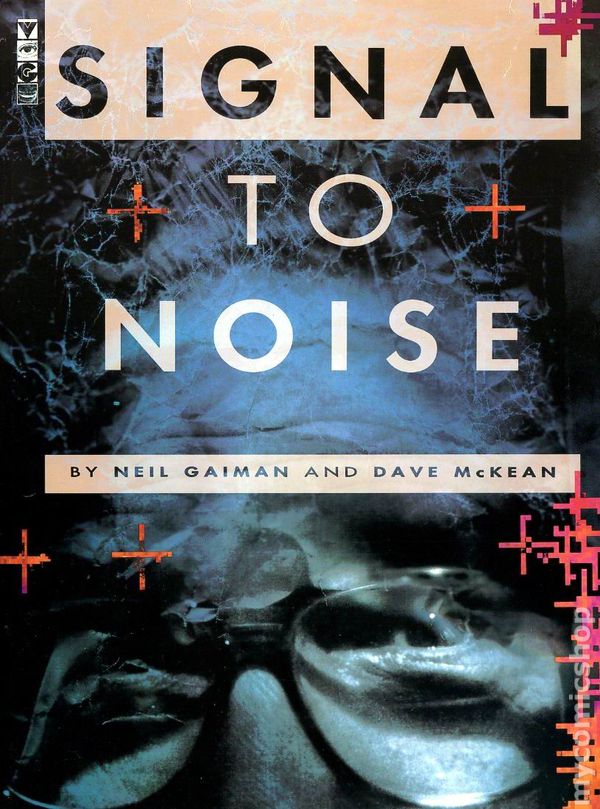
Signal to Noise by Neil Gaiman and David McKean

This is the story of a prominent filmmaker, in the middle of his career, about to embark on what he thinks would be his masterwork, who prefers to die slowly and in great pain than to listen to a female doctor.

Oh, and he also refuses to listen to his closest collaborator, who is also a woman.

Gaiman and McKean, at least their 1992 versions, would not I think characterize Signal to Noise that way. The Andy Wheeler who read it back in those days wouldn't have, either. But as someone who is now older than "the filmmaker" is, boy howdy is he the guy who can't get out of his own damn way. And I frankly can't see it as a coincidence that both of those voices of rationality are women: that's the role women are always stuck with, when dealing with pig-headed "visionary" men, having to try to cajole or entice some stupid bastard into doing the thing that is actually better for him, and feeling it's somehow their fault when they can't quite manage to do it.

You may notice I do not have much patience for this unnamed man-child. He is a self-indulgent prick. The movie he is attempting to make seems to be a boring plot-less slog, in which a large group of "common people" assembles in a hostile environment - expecting to all die - where they shuffle about for some extended period, and then do not die. Frankly, I think at least several of them likely would die, from exposure on a mountain-top, but I am not a visionary art-flick director.

I should explain the movie premise, I suppose. In AD 999, in a random village somewhere in Europe, everyone is sure "the millennium" means the world will end. There's no whisper of "Jesus returning" or the Kingdom of Heaven flowering forth on the Earth, just the doom of world-destruction. So they all wander up to the top of the local mountain to await midnight [1] and their inevitable deaths, during which time the camera presumably swoops around a lot to make some kind of visual interest out of a bunch of ragged peasants standing in the snow in the dark. Then, when they don't die, they go back to the village: The End!

This movie would be a tedious mess; we don't see any aspect of it that shows characters or relationships, so we tend to assume all of these characters would be broad, generic types for maximum axe-grinding. And it is a movie entirely about something that does not happen.

I also wonder if 2022 Gaiman and McKean would see this filmmaker differently; they're both substantially north of his fifty these days, and have each spent the last two decades (roughly) in filmed entertainment, so their opinion of their earlier depiction of a world they now live in may not be entirely laudatory.

I should clarify: within the context of Signal to Noise, the reader is meant to believe that this unmade movie, which I am sorry to tell you has the incredibly pompous title Apocatastasis, would be brilliant and wonderful. This is the point of the book: that Unnamed Genius needed to be dying to make it, virtually, in his head, and then write a script that just maybe will be turned into that perfect movie after he snuffs it.

But wait...notice the palmed card there? Turned by whom? The film theory embedded here is pure auteur: a film is made by One Towering Talent, One Man With a Vision, not all of the little people who get in the way and sully his vision. The equivalent of those "common people" milling about in the movie itself, with no clear idea of what to do, just a crazy thought of apocalypse. And the auteur is gone by the end of the book; only his script remains.

Signal to Noise is ambitious and gorgeous and full of ideas. I've always had it in my head as the least-successful of the Gaiman/McKean collaborations, and my impression is that the rest of the world feels that way as well. It's a book that aims higher than it hits, at least for readers who can't fully invest in the myth of the Self-Martyred Creator. I found central aspects of it deeply annoying; readers similar to me will likely feel the same.


[1] I am not an expert on medieval timekeeping, but there's a prominent Signal From Fred moment here where the narrative points out that clock faces did not even exist until several hundred years later. I suspect the entire idea of "a moment in time" as something that could be defined was alien to this society: they lived in days and the eight liturgical divisions of the day (Prime, Terce, etc.), but that's about it. "Midnight" was not a thing. The moment of "New Year's Eve" as the modern world knows it even less so.

On top of that, I'm pretty sure days began at dawn for medieval Christians, and at sunset for their Jewish neighbors. And that's a pity, because the sun breaking out on the horizon would actually be a lovely visual metaphor for non-apocalypse if Gaiman & McKean had thought of it.

Thursday, January 26, 2023

Philip K. Dick: A Comics Biography by Laurent Queyssi and Mauro Marchesi

Every life is a story. I definitely believe that. Every life can be told, in some way, as some kind of story, in a meaningful way. But that doesn't mean every life can be told well in every kind of way.

Writers' lives are mostly interior, so they tend to be told best in ways that can show that interiority, to explicate what was going on in their heads. Visual media tend to prioritize external action, so those are best for the lives of people who did external things, politicians or activists or business leaders or sports figures or entertainers.

So I was concerned there was a mismatch of substance and style in Philip K. Dick: A Comics Biography, a 2017 life by Laurent Queyssi and Mauro Marchesi, translated from French into English by Edward Gauvin.

Dick was a guy who sat in a room and pounded a typewriter, for thirty-some years. He was a guy who had a shattering experience that he called his Exegesis, in which something he considered the Godhead touched his mind directly and gave him a radically different vision of the world. He was a guy whose books were stylistically similar and formed a generally consistent world-view and set of concerns, but where plot and character details are less important, often generic. Writings about his work need to range across his corpus to make connections - a few individual novels are important in themselves, but the ways they return to the same concerns and ideas is even more characteristic and central.

That did not look to me like a life that would work terribly well in comics form.

And this comics biography doesn't really engage deeply with his work - it's what he does, and titles pop in here and there, but the focus is more on his multiple marriages, his engagement with SF fandom and the drug culture, and the standard life-stuff of a bio. We open with Dick seeing an early rough-cut of Blade Runner (based on his novel Do Androids Dream of Electric Sheep?) to set the scene, near the end of his life, and then drop back to see his story chronologically, starting with the death of his infant twin sister Jane and then running quickly through a couple of childhood moments and then into his writing career.

This book has a succession of events, which as far as I know are all true, and which line up throughout the life of the writer Philip K. Dick. So it is a biography. But I didn't find it a very satisfying one - all of the products of his mind are hidden here, mentioned in passing at best, and the reason anyone would want to know more about Dick are those stories and ideas: Perky Pat. Can-D and Chew-Z. Second Variety. Kipple. "The Empire Never Ended."

I don't think any of those words appear in this book. I don't think Palmer Eldrich or Ubik are mentioned; there's just not enough space in a book like this.

In the end, though, it might be that I'm not the audience for this book. This is not for anyone who already knows who Philip K. Dick is, not for anyone who's read more than one or two of his novels. (I've read most of them, I think: I was collecting the Vintage editions of his SF in the '90s and think I got through all of those at least once, but not his mainstream novels.) This is a book for probably younger readers, probably having to do an assignment for school on a famous person, and the hope is that this book, or a book like it, will let them complete that assignment successfully and maybe even more on to the actual works of the biography's subject.

Maybe that will happen. Good luck to Queyssi and Marchesi in that aim; they do make Dick's external life interesting here. But if you know anything about Dick already, this will be at least a little disappointing.

Wednesday, January 25, 2023

Neom by Lavie Tidhar

Some books are about story; some books are about place; some books are about people.

And some are about ideas or wordplay or, sadly, making the next payment on the yacht, but let's leave those other options aside for now.

Neom has a story, but it's not a book about its story. It's about a place, and a group of people who live in or come to that place. It's also, not to blow up my schema too much, a book deeply in conversation with earlier SF stories - to give just one example, there's a mechanical intelligence called "a Fondly" and you can guess what kinds of mischief it gets up to when the temperature gets too hot.

Neom is the place: I gather that it is a real-world place, but just barely so right now, a dream of a city on the Red Sea, deep in the Arabian desert. In Lavie Tidhar's novel, we're several centuries in the future: how far, exactly, isn't clear, by design. But this is the same era as his Central Station, and numerous other stories.

There have been wars - big, transformative, horrible wars - but they are over. Earth is peaceful and prosperous, though individuals are not always so. Humans are dominant, and the only group of sentients still generating new physical sophonts - with an asterisk for the digital-only Others of the Conversation, who touch the physical universe occasionally and lightly - but those rambunctious past centuries generated robots (humaniform) and war machines in other shapes (Leviathans in the seas, mecha, giant sandworms, and so on into smaller sizes), at least one kind of speaking, uplifted animal, and the cyborged robotniks. All of those are still around, here and there - some worn out or nearly-destroyed, some damaged (physically, psychologically, both) and solitary in the deep desert, many departed for Mars and the Outer System, some living among baseline humans as just more neighbors.

It is a big, complex, deeply science-fictional universe Tidhar sets his stories in, and any story only shows small pieces of that universe, with glimpses and hints of other pieces and places. Neom, even more than Central Station, is a book about being a SF novel, about being set in this specific SF world and at the same time referencing or ringing changes on a dozen older relevant books and stories. It's a modern, smart SF novel for people who have read a lot of SF and unabashedly want to read more of it.

Neom in this fictional world is a bustling, rich, forward-looking city, very lightly ruled and changing every moment to stay on the cutting edge of every possible thing it could be on the cutting edge of. But our viewpoints are not on the bustlers, those at the bleeding edge, but the ones a bit slower, a bit more left behind, a bit more out of place in the eternal Now of Neom.

Nasir is a policeman, a shurta - a good one, devoted to his duty, in this place where the police don't have a lot to do, for laissez-faire and rich & peaceful reasons.

Mariam works a dozen small jobs, cleaning apartments and working in a shop and so forth: she's got the striving, hard-working side of Neom to heart, though she's not the kind who ever will get ahead or be on the bleeding edge of anything.

The robot is an enigma, an old war machine come to Neom for unexplained purposes, giving no name and no explanation.

Salah is a boy, the sole survivor of the Abu-Ala extended family of scavengers and traders. His whole tribe was wiped out while excavating the dead city of Dahab, where a terrorartist [1] set off a time-dilation bomb back in the days of the wars, a bomb that is still exploding now, in slow-motion, inside a bubble of frozen time. He came out of that explosion alone, with a treasure that he hopes is valuable enough to get him off Earth forever, to get him to a new life on Mars.

Those are most of the elements of this short book: I could also mention Anubis, the talking jackal Salah takes up with, the terrorartist Nasu, and a couple of important secondary characters: the trader in old technology Mukhtar and Sharif, skilled at rebuilding ancient tech and once apprentice to Nasu.

Some of those people are in Neom already and some are heading to Neom. Because of them, something that has been asleep in the desert for centuries will wake up, and the equally old plans of Nasu will start to move forward again. None of that sounds positive; it's not supposed to.

I won't tell you how Neom ends, only that it ends well. This is a smart, open-hearted, short SF novel deeply steeped in the history of the robot and mechanical man in SF, and that has plenty of its own changes to ring on those ideas, set, as I said, in a deep, complex, interesting universe of its own. If any of that sounds appealing, you definitely should read it.


[1] This is just what it sounds like: an individual that uses the elements of terror - explosives, death, fear, destruction - to create a site-specific "art" installation. Think of it as Damien Hirst's shark, but in real time with human beings.

Tuesday, January 24, 2023

12 by Manix Abrera

You don't have to revisit works of art you loved to check your opinions. No one will force you. But, if you loved it the first time, you probably want to experience it again, eventually - oh, it's never the same the second time, nothing is, but different is not the same as less good.

I noticed that Manix Abrera's great collection of wordless comics 12 was available digitally in the US recently. I first read it more than a decade ago, back when I was more plugged into SF/comics publishing and had occasional dispatches from quirky and interesting areas of that world; at that point, 12 had been published in Abrera's native Philippines but not easily available anywhere else in the world. There may have been an element of gloating in my review: see! I can get things you plebeians can't! (Or I may be slandering my old self. Either way, he can't do anything about it now.)

And I read 12 again, thinking I would probably love it again, and could recommend it again, and, this time, the people reading my recommendation would actually have a decent chance of being able to find the book.

And, not to bury the lede: yes and yes and yes. I agree with everything I wrote the first time - go back to that post for more details of the stories and ideas, since I don't plan to repeat myself. These are great wordless stories, funny and frightening and touching and goofy and thought-provoking in turn. Abrera is a fine cartoonist as well; his blobby everyperson protagonists are nicely both specific and general at the same time.

And this time, 12 was published in the US, so the author bio and other surrounding material is in English, meaning I know a little more about Abrera than I did the first time. That doesn't really matter - it's the stories that matter - but it's nice to see, and it's also nice to see that Abrera's follow-up 14 (see my post) is also available in the US. It's not a sequel in any way, but it's a single long wordless story, and 12 is a collection of twelve wordless stories, so it's the same kind of thing.

I hope this means that Abrera's other work - I know he's done non-wordless comics, mostly in Tagalog I believe - will be translated for the US market, and maybe that whatever he's done since 14 (which I saw in 2015) will also make it over here. Even if not: he's got two great books of wordless comics out for the US market, both of which arrived here at the end of 2022. Go check them out.