Showing posts sorted by relevance for query peter bagge. Sort by date Show all posts

Saturday, August 23, 2014

Book-A-Day 2014 #235: Apocalypse Nerd by Peter Bagge

A friend of mine is fond of saying "everything's worse with libertarians" -- it's cruel and reductive, and definitely not true universally. But there's a certain kind of libertarian, particularly here on the Internet, who does make everything worse. (There are similar Troskyites, too, but libertarians infest the Net the way roaches do a dirty kitchen, scurrying out of all corners at the slightest attractive morsel.) They shove everything into a few pre-defined rhetorical boxes, and then spread their hands as if they've proved something -- and they're at their very worst when it comes to extreme situations and lifeboat rules.

Peter Bagge doesn't have a pleasant, positive view of humanity in the best of times -- maybe that's why he is a libertarian, actually -- and that has imbued all of his comics work from the beginning: even his best characters are self-loathing neurotic wrecks, and the worst are full-on psychotic assholes. When they're firmly embedded in a functioning society, that works just fine -- we can see their foibles and flaws against the standard backdrop of normal expectations. But let them loose away from civilization, and all of the wheels come off quickly, in a very messy way.

That's why Apocalypse Nerd sat on my shelf for a long time, despite the fact that I've liked Bagge's work for a long time -- sure, Hate more than anything else, since Bagge did excellent work for a long stretch there in the '90s. This is his explicitly libertarian book, the one where the North Koreans nuke Seattle and the two standard Bagge protagonists -- too-effete, too-civilized man of intellect and his mulleted outdoorsy, law-breaking he-man friend -- make their way through the chaos afterwards, out in the North Cascades. Like all such Bagge duos, they spend most of their time yelling at each other, as they try to find a safe and secure place to be after the end of the world. And the people they run into are mostly as bad as they are, if not worse.

There's libertarianism deep in the DNA of this book, so deep it can't be reasoned out: it's a book where people immediately start fighting and stealing and killing the minute anything bad happens, because they're Peter Bagge characters in a Peter Bagge world. They are all atomized, individual, separate, and only the heavy hand of society and its laws kept them in line at all. So Apocalypse Nerd is the Bagge story where all those wheels come off on page five, and Bagge still has a long, long spiral to go down from there.

(The very end of the book -- the last six pages -- perhaps aim in a different direction, and could be read as making a case for civilization. But at the end of a hundred-plus pages going the other way, it read to me more like Bagge just needed an ending, and irony was a dependable way of crafting one.)

Now, Bagge started work on Apocalypse Nerd in 2003, and published it between early 2005 and late 2007. So he was clearly working in the war-panic era, when the fictional destruction of a city evoked 9/11 and shadowy evil foreign terrorists. The idea of a single event flattening an entire American city, killing many and leaving hundreds of thousands homeless, was still fiction.

But while Apocalypse Nerd was still coming out -- the late summer of 2005 -- something not too different did happen to an American city. And for all of the bungling and malfeasance and horrible decisions and rotten management of the aftermath of Hurricane Katrina in New Orleans, it didn't devolve into a Baggean libertarian free-for all: like most disaster situations, the people on the ground mostly tried to help each other and survive and get back to normal.

So Apocalypse Nerd read even more like a cartoon to me than it was supposed to: Bagge's people are notably worse than actual humans in the real world. Sometimes, that makes them enjoyable to read about. But, this time, it was just sad to see how badly they could screw up everything.

Book-A-Day 2014 Introduction and Index

Tuesday, March 24, 2026

The Complete Neat Stuff by Peter Bagge

I read Hate back in the '90s, like the twenty-something slacker I was then. And I've read most of what Peter Bagge has published since then, more-or-less, eventually. I don't know if you could call me a fan of his work, since I seem to always complain about the same few aspects: the oh-so-nuanced "don't let government spend any money ever" libertarianism that is ludicrous in the context of Bagge's id-driven characters, mostly. Those two elements are both interesting and particular, but they directly contradict each other: in a world of Bagge people, libertarianism is literally insane; his people require major, intrusive government programs just to keep them from blithely and randomly murdering each other on a whim.

But he's a great cartoonist with a particular point of view and usually a knack of constructing interesting stories (if, too often, ones that allow him to grind his very particular axes), so I do keep coming back to the Bagge well to see what he's done that I missed.

And I finally thought that I should go all the way back. Fantagraphics, who was Bagge's first major publisher, did a big two-volume set a decade ago to collect all fifteen issues of his debut series, Neat Stuff, from the late '80s.

The Complete Neat Stuff has almost five hundred pages of comics, featuring Bagge in some of his earliest published work, all rubber-hose arm flailing and screaming and gigantic Big Daddy Roth toothy mouths and other extreme transformations of his characters. He's gotten somewhat more realistic in his cartooning than this since - this is the early, extreme, most underground-influenced work Bagge ever did.

In the underground tradition - and something that Bagge has kept up, mostly, since then - these are regularly very wordy comics, full of people making long speeches (usually at the top of their lungs; they're Bagge characters). Those characters are, almost all of them, horrible people in different ways - this also has been central to Bagge's work from the beginning.

Neat Stuff was a single-creator anthology, with a number of different characters, each in their own distinct stories, all mixed together over the course of five years and those fifteen issues. Any particular issue had stories about multiple characters, but I'll take each strand separately, which, I think, will make it more coherent. The two volumes here, though, present the issues as they originally appeared, in the original story order, with only the covers separated out into a separate section to show them in color.

Probably the nicest character is the sad-sack Junior, a twenty-something guy who does very little but eternally dreams of getting out from under his mother's thumb. (Frankly, his mother is mostly absent in the stories, so she doesn't seem that bad, either.) He's weak-willed and feckless, mousy and unmotivated, good-hearted but utterly unable to do anything productive. And his stories mostly petered out - there was a sequence early here in which he moved out, lived in a rooming house, and started to build a separate life, but then he moved back home and his stories got shorter and rarer, entirely focused on his sad-sackness. My guess is that Bagge realized he could either change Junior into a different character - one who did get out, and what happened next - or he could keep Junior the same. And Bagge characters, in this era (and arguably throughout his career), are about staying exactly the same.

The most realistic characters are the married couple Chet and Bunny Leeway, who - if I want to be pompous - embody late-80s suburban ennui. They're about thirty, and have Bagge's own sourness about anything and everything in the real world - all friends are dumb, transparent phonies; all culture is stupid; all activity is pointless; and life is a harsh grind that they hate but can't think of any way to change or mitigate. All you can do is drink vast quantities of alcohol to numb the pain and make other people interesting enough to talk to, and then - this was the '80s - drive drunk on to your next event. There aren't a lot of these stories, which is good: the Leeways are so comprehensively sour that they work best in small doses. They are the kind of people you want to grab hold of, shake, and say "isn't there anything at all that you enjoy? Why not do more of that?"

But that's, I think, the core Bagge viewpoint. Life is horrible, full of other people who are hideous and inherently wrong, and no one with a brain can be happy for a second ever.

I mostly enjoyed the stories about Studs Kirby, the once-and-then-again right-wing talk radio host. He's in a small city somewhere, probably in the midwest - parenthetically, all of these characters seem to be in particular places, though Bagge doesn't always make that clear. (The Leeways are probably in the Pacific Northwest; the Bradley family is in New Jersey.) Studs is a jerk and a loudmouth, like so many Bagge characters, but the secondary characters in his stories actually realize that and call him out on it. It doesn't help, of course, since Bagge characters are generally incapable of growth, learning, or getting better at anything, but it does tag to the reader that Bagge knows that Studs is an obnoxious blowhard. The stories are mostly about Studs getting into various obnoxious-blowhard situations, first as a former talk-radio guy trying to get back to a regular working-guy life, and then once again on the radio, stirring up shit with hair-trigger anger and the regular Bagge-character aptitude to take everything the worst possible way and escalate massively at the drop of a hat.

Then we get into the oddball, wacko characters, like the '60s crooner turned '80s evangelist Zoove Groover. He shows up in short features, tracing his weird and goofy career, for a few issues and then disappears forever. These are fun, but mostly in flashback mode - there's one or two stories closing out the '80s Zoove, with the bulk about his teen-idol days. They're tonally different from most of this work - almost sweet, in that "look at this crazy character!" style - and don't really connect with anything else in Neat Stuff.

Then comes the big cluster of goofballs: Girly-Girl, Chuckie-Boy, and the Goon in the Moon. Girly-Girl is the usual underground chaos-generator, a supposedly elementary-school girl with an endless well of energy and an equally endless set of demands for everything in the world. Chuckie-Boy is her dumb, loving stooge, there to be abused. The Goon is a middle-aged guy who is their friend (?!) and an alcoholic, and later on becomes a bit of a horndog in stories without the kids. These are the characters who do the most "underground" stuff - murdering each other, screaming & hollering, rampaging about - that kind of thing.

And then there's the stories about the Bradley family, which were some of the longest and most involved in Neat Stuff and led directly into Bagge's follow-up series, Hate. The father Pops is thinly characterized, just a middle-aged guy who wants to be left alone and seems to hate his family. (But then everyone hates everyone in a Bagge story.) Ma is put-upon, and comes across (to me, at least, thirty-some years later) as the closest thing to a reasonable human being in any of the Neat Stuff stories - which of course means she's marginalized and mostly ignored. Babs is a dumb teen girl obsessed with dumb teen girl stuff, and Butch similarly a violent, impulsive grade-schooler - neither one has any real depth.

Buddy, the older brother, is the Bagge self-insert character, explicitly taking what I hope he realized were his worst qualities as a young man and amplifying them - lazy, self-obsessed, unmotivated, thoughtless, grumpy and crabbed and nasty. These stories mostly focus on him, as he ends his high school years and starts an aimless "adult" life - selling a little weed to his friends but not otherwise doing anything at all to further his own life and independence and aims. (Assuming he has any aims.)

I would have liked to see more of Ma, but I don't know if twenty-something Bagge could have given us much from her point of view. Buddy is an annoying twerp - he was still an annoying twerp throughout most of Hate, too, though he did at least support himself financially and become semi-responsible, which were big steps up from the way he appears here.

Neat Stuff was a lot of things, and all of them were loud and brash and in-your-face, just like their characters. I can see why Bagge decided to end it and focus on one somewhat more realistic story - this material goes off in lots of directions and expends a lot of energy in that. That energy mostly covers over the essential sourness - all of Bagge's people are horrible, to themselves and each other, and they're embedded in worlds that are equally sour and horrible. I'd say that's a young man's yawp against the world, except that Bagge's stories have been pretty consistently in that vein for the past forty years: he still is out there making stories about how the world is sour and everyone is a complete idiot. But this is where it started.

Wednesday, October 25, 2017

Sweatshop by Peter Bagge and others

This is not a limited series. I know: I was surprised, too. But Peter Bagge's afterword, which explains the history of Sweatshop, makes it clear that it was intended to be ongoing, and that he would have been happy to keep it running for a much longer time.

That didn't happen: Sweatshop got a six-issue run from DC in 2003, when that company was in one its periodic throes of trying to broaden its range, which was followed by the inevitable and equally periodic pullback to its core competency of grimacing people in spandex punching each other repeatedly.

Sweatshop is not about spandex, or punching. It does have its share of grimacing, and other extreme facial expressions, because we are talking about Peter Bagge here. But, otherwise, it doesn't look much like a good fit for DC. Our central character is Mel Bowling, a comics creator on the far side of middle age. He's the credited creator of the syndicated strip Freddy Ferret -- though it's really put together by his oddball crew of young, underpaid assistants -- and a lazy, narcissistic golf-playing blowhard.

(The set-up is not unlike some manga about manga-making -- Bagge doesn't mention any inspirations, or Japanese comics at all, in his afterword, but it's at the very least a striking case of parallel development.)

Reading the first issue, I thought it would feature Bagge's art on stories about the whole team and his fellow artists (Stephen Destefano, Bill Wray, Stephanie Gladden, Jim Blanchard, and Johnny Ryan also contribute art to these stories) each picking up from the POV of one of the assistants. That would have been neat, and more formally interesting, but it's not the way the series ended up going: the feint in that direction was apparently a scene-setting one-off for that first issue. Instead, there's mostly a lead story for each issue drawn by Bagge, and then additional stories drawn by one or more of the others, in the style of old humor comics.

The stories are all about that crew in Bowling's studio -- worrying about the "Hammie" awards, planning and going to the big Comic-Con, dealing with a new writer joining the team, and various career and personal issues for all of them. It's not quite as zany and slapstick as Bagge got in the '80s and '90s, but these are broad characters who do crazy things: it's a lot like a sitcom on the page.

Sweatshop is funny, and probably even funnier the more you know about strip comics: I suspect Bagge buried jokes and references I didn't get among the ones I did see and laugh at. Some readers may find the changing art styles distracting, though they all are in the same tradition -- Bagge's rubber-hose arms and googly eyes are probably the most extreme, cartoony style here, with the others giving a (sometimes only very slightly) more restrained version of the same look. What can I say? It's a funny collection of stories about comics and comics people, and a decade has only dated it slightly. (A contemporary version would definitely have at least one issue full of webcomic jokes.)

Friday, December 15, 2023

Reset by Peter Bagge

I'm running close to a decade behind reading Peter Bagge's books - but, the weird thing is, I seem to still be reading all of his books, just with that big time-delay. I have no explanation, and may catch up one of these days: cartooning is time-intensive work, and even someone as prolific as Bagge doesn't pile up books the way a prose writer like Stephen King or Nora Roberts does.

That's as close to a reason why I read his 2012 miniseries/2013 graphic novel Reset here at the end of 2023. As usual, I find bits of the worldbuilding to be weird, especially in retrospect: maybe because of the things Bagge needed to create this story, maybe because I fundamentally don't agree with his assumptions about life and society in general.

Bagge's worlds are full of mildly updated '50s gender-essentialism: men are hot-headed and often physically violent, because They Are Men and the World Is Frustrating. Sometimes they are divided into the smart ones (effete, tentative, too weak for this world, typically wearing glasses) and the strong ones (stupid as a post, addicted to incredibly counterproductive ideas, full of zeal and energy for all the wrong things, typically wearing mullets). Women are sneaky, vindictive shrews who you (the reader, who is of course a man) can never trust and who drive you (ditto) crazy all the time, and usually won't even let you fuck them! (Not that you want to: damn harpies! But a man has needs!)

This time out, the man is Guy Krause, right in the middle of that Bagge male stereotype: we meet him in a mandated traffic-safety class, where he was forced after a road-rage incident. Krause is a minor celebrity, a former stand-up comedian turned movie actor, maybe B or C-list at best but recently hitting a stretch of bad luck and bad breaks.

The woman is Dr. Angie Minor, who meets him in that class - with ulterior motives, we soon learn - and recruits him for a research project.

That project is not what it seems to be, of course. And Bagge seems to be interested in yet a third aspect of the project, which makes the book a bit lumpy and thematically jumbled. But let me start with what it seems to be.

Angie is working for an unnamed company, developing a fancy new VR headset and associated software program. They claim not to know what they'll use it for yet, but they can create a Choose-Your-Adventure version of a subject's life, after some serious, presumably expensive research, to build the world-model. (Anyone who understands capitalism will have warning bells ringing in their heads at this point: there's no plausible product here aside from maybe masturbatory fantasies for billionaires.)

So Guy will be put in a chair with this headset and some fancy electrodes and relive important moments of his life, while Angie and her tech, Ted, monitor him to find out...something they're unclear about. The title comes from the fact that Guy has one control, a button that pops him out of the simulation and resets it back to the base state: the beginning of this particular scenario.

It is also the big honking metaphor at the center of the book, of course: what would you do if you could live the important moments in your life over? If you could Reset, what would you do? Bagge runs away from this idea almost immediately; it doesn't fit his plot and his tech is too crude to really be believable to the user.

Ray is both a bad subject - headstrong and unwilling to be led and obnoxious (did I say he's a Bagge main character yet? I may be repeating myself) - and the only possible subject for this custom bespoke simulation based entirely on his life, which seems really weird and becomes the obvious Chekhov Gun looming over the whole book. And, yes, the real explanation of Angie's research comes into it - though Bagge never gives any adequate explanation of why Guy was chosen, aside from the very weak initial "you're famous enough that it was easy to research you" one, which is only plausible if they sign up the subject before doing the research.

The plot is more about what's really going on and less about Ray's re-living his life, though I think Bagge wants the core of this story to be what Ray learns. (He does re-connect with a girl he had a crush on in high school, for example.)

Again, in a Bagge world, everyone is selfish and horrible and unpleasant - occasionally not all that bad to specific other people that they like, at that moment, but you can never count on that. So people yell at each other, act out, ramp up the experiments, maliciously comply with instructions, and much more. We do find out the secret reason for the project in the end, and it's dumb and vague and doesn't make a whole lot of sense that that would lead to this.

So it's a Bagge book: full of talky, angry people with rubber-hose limbs gesticulating at each other, spitting fire, yelling, and so on. I don't have an overly sunny view of humanity, I think, but even I think he can be a bit much. This one is amusing and doesn't have any unpleasant background assumptions (unlike Apocalypse Nerd, for example); it's somewhat lumpy but generally moves well and is full of amusing Bagge stuff. Maybe not top-tier Bagge, but pretty close: good, almost current work from a creator who is like no one else. If Bagge seems interesting, this is a decent one to dive into, though Hate is still the core.

Wednesday, October 01, 2025

Yeah! by Peter Bagge and Gilbert Hernandez

I never want to discourage creators from stretching, from trying new things and talking to new audiences. But, sometimes, it just doesn't really click.

In the late '90s, Peter Bagge had been making sarcastic comics about grumpy twenty-something slackers in Hate for more than a decade; his work was really closely associated with not just a particular adult audience, but a very specific tone and style. It's no surprise that he wanted to do something different.

What he did was surprising, though: he wrote the all-ages, Comics Code-approved girl-band comic Yeah! for DC Comics, collaborating with Gilbert Hernandez. (Hernandez's career has taken a lot of odd turns, and he's worked with a number of writers over the years, so this was not quite as much of a departure for him - I've always gotten the sense that Hernandez just has the desire or need to generate a lot of work, to keep himself engaged and happy, and the more different the better.)

Bagge's introduction in this 2011 collection of Yeah! - notably from Fantagraphics, longtime publisher of both Bagge and Hernandez, not DC, which is a big signpost to the fortunes of the series for those who can read tea-leaves - notes that he had an eight-year-old daughter at the time, and had gotten happily into "girl culture," which reignited his love of pop music. There always are reasons and explanations for specific projects; they always make sense to the creators at the time, and enough sense to the publishers that they make it out into the market. The question, always, is how that market responds.

Yeah! was not a success in the market. It ran nine issues, and was only collected a decade later by a different publisher. (And here I should also note that the collection is in black-and-white, but I think the original comics were in color, since characters make comments about the colors of things pretty regularly, and 1999 was awfully late for a book for tween girls without color.)

And the comics are...OK, I suppose. Bagge is a wordy writer, and this reads not too differently from his better-known work, to the point that the regular Bagge reader starts wondering if these characters are actually being honest and straightforward, or if Bagge has just unlocked a previously inaccessible level of sarcasm. There's one backup strip at the end that Bagge draws himself, and it's really hard not to read it like a Hate story - Bagge clearly intends for it to be taken straight, but regular readers will assume spleen and bile in his phrases.

Yeah! is the name of the band: Honey, Woo-Woo and Krazy, three best friends not quite out of their teens, a few years into a music career. They are struggling on Earth but the biggest act in the galaxy, beloved by millions across dozens of alien worlds. (But this was a contemporary Earth that hadn't had a first contact yet, so there's no commerce with those alien worlds, so the vast loot Yeah! brings in is useless. They don't seem to even bank it on an alien world so it's available for tours or such, like the old Soviet Union; they just give it away or ignore it.) They also have an old, nutty guy as their manager: Crusty; his inventions got them out into the galaxy but his general incompetence can't get them any good gigs on Earth.

The nine issues are each basically standalone, with goofy adventures either on Earth or in space - including the inevitable flashbacks to reveal Who They Are and How They Got Here - as Yeah! chases fame and fortune here (with little success) and gets involved in odd alien things out there. On Earth, they have a rival, Miss Hellraiser, and a band of boys, The Snobs, who always beat them in battle-of-the-bands situations and one of whom has a crush on Woo-Woo. In space, the characters are all one-offs - there's the driver of their space limo who shows up a couple of times without actually getting a personality or anything to do. The stories are all wordy, and all full of the cultural assumptions and ideas of a guy Bagge's age (early 40s around this time), including a bunch of hippie jokes.

This is all fine: it's amusing and entertaining, and the gestalt of Bagge's writing and Hernandez's art works well together. It is too wordy, in that old-fashioned comics style, full of long captions and long dialogue balloons that say a lot of the same things over and over again. And it all comes across as something like a generation-later version of Bob Hope: goofy, sui generis comics that are meant to appeal to a younger audience but are full of the ideas and plot devices of old people.

Yeah! is basically forgotten, for good and sufficient reasons. It might not quite deserve that, but most things get forgotten twenty-five years later. If you really loved Josie and the Pussycats (the movie, the concept or the comics) and wish there was something else sorta like that, you might be in luck.

Wednesday, February 24, 2021

Peter Bagge's Other Stuff

Peter Bagge is a world-class grump, and I have to respect that. I tend to connect that to his libertarianism, but the direction of influence is unclear and it's not as if comics isn't full of grumpy loners outside of libertarians, either. But Bagge has had a long career both making comics about fictional grumpy, obnoxious people and making comics about how he is libertarian and so entitled to be grumpy personally about such-and-such, so he's been leaning into it for some time now.

Although, come to think of it, the last decade of his work, focusing mostly on biographies of strong-willed but not necessarily libertarian people of the past, might show him starting to walk down a path of slightly less grumpiness -- and I emphasize slightly.

But here I am looking at Classic Bagge, the man who spent more than a decade making a comic book called Hate and meant it the whole time. So expect every page to be pickled in bile, to mix my metaphors.

Peter Bagge's Other Stuff is the odds-and-sods collection from the Hate era, gathering stories he did with other creators (mostly as the writer) or for other purposes, most but not all of which appeared, first or eventually, in the quarterly or annual Hate comics of the '90s and '00s. It is absolutely chock-full of grumps and cranks and losers and weirdos of all types: you would be hard-put to find a single functional human being on any page of this book.

So this may be a book best read in bits rather than straight through. Bile and spleen can be fun, but too much will curdle. And there's enough here to curdle the strategic federal cheese reserve.

What you will find in Other Stuff:

  • four stories about young hipster Lovey and her horrible friends
  • the Musical Urban Legends series, and a couple of related rock 'n' roll stories
  • a large section of collaborations, with work by both Hernandez brothers, Alice Cooper (writing), Adrian Tomine, Alan Moore (writing), Daniel Clowes, Johnny Ryan, Danny Hellman, R. Crumb, Rick Altergott, and a few others
  • six single-page biographies of scientists
  • several other assorted "true" stories, some of them vaguely reportage
  • a dozen-and-a-half strips of "The Shut-Ins," early-Internet super-adopters and shunners of the outside world, created to appear on a website promoting Adobe products
  • and a couple of even weirder things
This is very varied and odd; the section with collaborative work is possibly even weirder than the stuff I gave more attention to above (a R. Crumb Cathy parody! Ack! Dilbert as a Muslim terrorist, offensive in so many ways I can't even catalog them!). Bagge is a creator seemingly unafraid of letting out every idea he has ever had, which is good for the breadth and depth of his work but also can result in some what-the-hell?! moments. This book has more than a few of them.

Friday, November 16, 2018

Book-A-Day 2018 #320: Everybody Is Stupid Except for Me by Peter Bagge

In the first decade of this century, Peter Bagge did a lot of cartooning for Reason magazine. (He might still do so; I don't know. As far as I know this book doesn't have a sequel, so I vaguely guess that he moved on.) It was all more-or-less topical stuff, since Reason was a topical magazine with a Libertarian slant, and eventually there was enough of it to make a book.

This is that book: Everybody Is Stupid Except for Me, collected those Reason strips (single-pagers and longer pieces) in 2009, organized into a number of thematic chapters about the general kind of thing that Bagge is complaining about there.

Now, don't get me wrong: Bagge may be a libertarian, but he's not a crank. Well, not fully. My guess is that he's lived in liberal-wonderland Seattle for so long that he had to react to that somehow, and standard conservatism came with things like god, guns, and war-mongering that he never was interested in. And Libertarianism is one of those beautiful political philosophies, like Communism, that devotees can both argue the permutations of endlessly and claim that it's never been tried in practice, so it will obviously be perfect if we would only try it.

Bagge is also not always clear about exactly what he does believe in. He's clearly annoyed by the "libertarians don't like roads" ideas, but...libertarians often do say that all activity now run by the government (fire and police protection, ensuring safe food and water, the military, social programs, and, yes, roads and infrastructure) should instead be done only by private industry. Maybe Bagge isn't that kind of libertarian, but it's a little like saying you're a Communist and then complaining when people bring up Karl Marx.

Anyway, Bagge hated the Gulf War, bans on contraception (though he was also skeeved out by reporting on swingers), modern art, Christian rock, malls, the kind of people who he finds in casinos (though, as a libertarian, he's fine with gambling being legal), Seattle's monorail project, public funding for sports stadiums, Amtrak, the war on drugs, the hard-core homeless (he calls them "bums"), and, of course, politicians, particularly the liberal ones running for President in 2008.

In general, he's against governments spending money on things, or any taxes he has to pay, or anything else that might interrupt his life or make him think about things he doesn't care about. Libertarianism tends to be a philosophy of selfishness at the best of times, but Bagge really leans into it.

He generally avoids grumpy-old-man mode in the stories here, partly because he's of the my-opinions-are-so-nuanced-it-will-take-several-pages-of-text-heavy-panels-to-explicate-them and partially because he still has a lurking tropism to want to let people kick out the jams and go crazy. (Potential topic for discussion: young punks turn into old libertarians.)

This book is very topical, and all of these topics have moved on from where they were in 2001-2008. So reading it today can be quaint -- oh, how precious that he thought that worrying about healthcare was absurd! And some of those politicians were not always completely truthful when they carefully answered reporter's questions! Oh, shock, let us all clutch our pearls.

The world has gotten vastly more stupid since this book came out. You can't blame Bagge (or libertarians) for the stupidity, though it is more-or-less his end of the political spectrum that has blown up everything in American society for no good reason and with no actual solutions.

But at least we can keep complaining about the government spending money on people we don't like!


Friday, April 25, 2014

Book-A-Day 2014 #114: Woman Rebel by Peter Bagge

There are two kinds of biographies: some are too long, some are too short. (No book is ever exactly the right length; then it would be perfect, and we all know there's nothing perfect in this world.) Either way can be good, as long as it's not too far in that direction: a thousand pages about Adlai Stevenson or three about the first Queen Elizabeth. But, all in all, it's better to be too short: that's the old show-biz saying of always leaving them wanting more.

Peter Bagge's comics-format biography of Planned Parenthood founder and contraceptive pioneer Margaret Sanger, Woman Rebel, is definitely too short: it zips through Sanger's eventful eighty-plus year life in a mere 72 pages, giving each year less than a page. It gets a bit choppy because of that brevity, actually, as Bagge piles scenes on scenes and smash-cuts between years to get all of the events he wants to cover into the book. It's rare to say so these days, but this is one book that could have used a little decompression to give it some more air and space.

Sanger was a driven, energetic, monomaniacal woman -- so far, you can easily see the appeal to Bagge, who has spent most of his career telling the fictional stories of driven seekers who want something so much they sometimes even know what it is. But Sanger was successful and sociable -- scandalously so, since she was a major proponent of free love when that was a marker of the radical left-wing in the first half of the twentieth century -- and eventually rich, none of which is at all typical for a Bagge character. (Tom Spurgeon, of the online site Comics Reporter, makes this exact point at greater length in his scene-setting introduction.) After a parade of losers, it's a treat to see Bagge work on the life of someone who had strong opinions and directly affected the world for good: Sanger saved uncounted women from endless, health-sapping pregnancies, and not a few from death along the way.

She traveled the world, founded and ran several organizations (and fell out with the leadership of a number of those as well), wrote books and pamphlets and newsletters, had affairs with more men than Bagge even tries to track, fought multiple court battles and was arrested and thrown in jail more than once, and raised and distributed millions of dollars to the causes she supported so strongly. Through it all, she was opinionated, headstrong, and demanding -- but also, clearly, friendly and endlessly sociable, particularly after her second marriage made her rich and lifted her into greater contact with America's upper classes.

Woman Rebel will leave most readers wanting more, even after its extensive notes and afterword from Bagge at the end. And that's exactly what a good biography should do.

Book-A-Day 2014 Introduction and Index

Friday, June 26, 2026

The Complete Hate, Vol.1 by Peter Bagge

There was a time when slackers were hip. Especially young slackers, particularly in Seattle or thereabouts. I don't know why. I don't remember the sequence, thirty-some years later - I think it was a "scene" first, even before Nirvana hit big, with breathless media coverage about what all these wacky young people were doing.

But it was a big deal, for a while. Just before and during the first wave of grunge, when my generation, GenX, was young and aimless and energetic, with hair and abs and knees as good as any of us were ever going to get. A lot of us resented the attention and the stupidly breathless media focus on mostly dumb egotists doing mostly dumb egotistical things, while the vast majority of that generation were living ordinary lives and doing normal things - much like what the average Boomer probably thought about hippies, come to think of it.

I think Peter Bagge's Hate comics series might actually have been one of the early signposts of that scene - the first issue came out in April of 1990, well before Nirvana's Nevermind or the movie Slackers. Oh, it was definitely already a scene - Bagge himself had moved to Seattle, for reasons I'm sure he would argue long and loud had nothing to do with any of that, a few years before - but I think in Spring of 1990 it was still a mostly underground scene, known by cognoscenti, and not the media extravaganza it became a year or so later.

The Complete Hate, Vol.1 collects the first half of Bagge's 1990s Hate comics: the first fifteen issues, from 1990 to 1994. (He's done other things called Hate since then, first an Annual for about a decade, then an newer Revisited that I haven't seen.) This is the full Buddy-in-Seattle run, starting with a minor time-skip from the end of the Bradley family stories in Neat Stuff.

As it often is with Bagge, all of his characters are horrible people who make universally bad decisions, with massive anger issues and an almost total lack of impulse control. (I enjoyed that in fiction a lot more at the time, before people almost exactly like that took over all the levers of my government.) Buddy Bradley is the central character, and the one who comes closest to being a functional adult - oh, he still makes bad decisions every time he gets the chance, but we see his thought processes as he almost resists his impulses and sometimes even feels bad about the things he does. Well, he mostly feels bad because bad things happen to him because of his stupid decisions, because he's a Bagge character and they have no capacity to mentally model other people's thinking at all.

Buddy is working in a used-book store: it's a McJob that lets him steal stuff from work and doesn't require too much effort or thinking. (Slacker, remember?) This is actually a step or three up from where we saw him at the end of Neat Stuff - he was living on a beach at that point, having gotten kicked out of every home he possibly could have - so baby steps, huh?

His childhood friend Stinky (Leonard Brown, the guy on the cover) also made the trek, and is more suited for the fake-it-till-you-make-it culture, having no self-awareness at all and only ego. Their third roommate is the socially awkward loner George Cecil Hamilton III, who mostly stays in his room, reading and writing conspiracy-theory materials. (Yes, people like that existed before the Internet - they tended to use the mails, they had a much lower profile, and the world was better for their relative disconnection.)

And Buddy's ex-girlfriend Lisa and new girlfriend Valerie (as of the beginning of the series) are also roommates, making more sitcom-like opportunities for drama.

These fifteen issues take that cast, add in a few supporting characters, and bounce them off each other violently and chaotically for what seems to be maybe a year or so in-universe. (There's no way the timeline is as long as the four-plus years the issues took to come out.) Nobody learns anything, nobody gets better at anything, nobody advances in their careers - people do move in and out, change jobs and chase dreams (like Stinky's band, which almost takes off), and break up and form new "relationships," because things are always happening in a Bagge comic.

It's energetic and nutty: these people will always make the worst choice possible when given the chance. I don't think Bagge even wrote it that way; this is just how he sees people. It intersects with his core libertarianism, of course: he's of the school that you should just let people do whatever, because people are universally horrible and that (somehow) keeps everyone off his lawn. I still think that Bagge characters + libertarianism = something like The Purge all night every night, but I'm not here to enforce logical consistency into fictional worlds.

His cartooning is still aggressively rubber-hose here, with the old faithful concentric-circles to show that characters are running really fast, too. It's very wordy, too - his characters may not be good at getting what they want, but they can yell back and forth at each other for pages on end.

Hate is a time-capsule now, this first batch probably the most so. This was a time and place in American culture, and Bagge had a predictably sour and jaundiced take on it before it had even properly gotten started. If you can have sympathy for characters who resolutely refuse to do anything to deserve sympathy, you can have a great time reading it.

Thursday, September 01, 2016

Founding Fathers Funnies by Peter Bagge

It is definitely not fair to say "Peter Bagge is a libertarian, and so of course he's obsessed with the Founding Fathers." Not fair at all. But Bagge is well-known in comics as a libertarian, and here's a whole book full of silly gags about the guys who wrote the Constitution, so....I don't know how else to put it.

Founding Fathers Funnies collects strips that appeared under that title as backups in Bagge's sour mid-aughts comic Apocalypse Nerd, plus a few from Dark Horse Presents, and some unknown number of new strips. And they're both actual history and deeply Bagge strips, which makes for an interesting combination.

History tends to hagiography, and particularly so with revered people like the Founders. There's a non-stop parade of big fat biographies of Adams and Washington and Jefferson and so forth, wrestling with their issues and making them out to be Major Serious People doing Major Serious Things. But in a Bagge world, everyone is angry and self-serving and casually cruel and forgetful and ready to make a mean verbal or practical joke.

So here an Adams comeback makes people fall backwards in the most cartoony way possible and a rubber-armed John Paul Jones carves his way through British soldiers whose eyes turn to Xs as he kills them. The history is real, but the style is the farthest thing from reverent possible. And that's all a very good thing: we need to pull our heroes down from their pedestals regularly, to look at them from all sides and see who they really were.

Franklin comes out the best here, unsurprisingly: he was the most modern and cosmopolitan of the Founders, as well as the least political and the most focused on his own wealth and pleasure. But Adams is probably the most fun: a grumpy pseudo-Puritan always getting himself into feuds and whose logic takes him to surprising conclusions that he doesn't always want to live up to. In other words: a normal smart human being. It's a joy to see Bagge tease the human moments out of what are too often bronze idols..and it's very funny, too.

Saturday, January 13, 2018

Book-A-Day 2018 #13: Fire!! by Peter Bagge

When I got this book, I noted here that Zora Neale Hurston seemed like an odd choice for cartoonist Peter Bagge to biographize. But his introduction to the book itself makes his interest clearer: Hurston had politically idiosyncratic views, and -- though Bagge never uses the word -- seems to be as close to a libertarian as a black woman could be in the early Twentieth Century. So all is much clearer now.

Like Woman Rebel, his biography of Margaret Sanger, Fire!! tells the long, event-filled story of one woman's life in probably too-few comics pages (seventy-two, in this case), so that every page or two is a discreet event that Bagge needs to get into his narrative. There are twenty-six pages of notes to contextualize and explain the comics pages, which does not make for the most smooth or integrated reading experience. (I wonder if Fire!! will have its best life in classrooms and school libraries -- it's a solid look at an important literary-historical figure in a format that will appeal to a lot of kids who don't want to read too much.)

In case you don't know, Hurston was a writer, published as a novelist and a collector of folklore, active mostly in the 1930s and '40s and associated with the Harlem Renaissance in New York during the early part of that time. She grew up in an all-black town in central Florida, the somewhat wild and somewhat coddled daughter of two of the leading figures in that town, to the age of thirteen, when her mother died and upended her life entirely. Her next decade or so was spent all over, in often rough circumstances, but she eventually finished high school in her late 20s (having shaved a decade off her age to pretend to still be a teen) and bounced through several colleges before landing at Barnard College in 1925 and graduating three years later at the age of 37. (Still pretending to be ten years younger, which she kept up the rest of her life.)

She's most famous these days for Their Eyes Were Watching God, her semi-autobiographical 1937 novel. But she was spent years on the road collecting and writing local folklore stories, first in the rural US South and then in several Carribbean nations. And she was a very colorful character, to put it mildly -- boisterous, demanding, flamboyant, opinionated, married multiple times, profoundly original and unique.

Bagge does some justice to Hurston, and all of his pages are good. But, like Woman Rebel, Fire!! feels rushed and cramped, like what's left of five pounds of flour after it's been dumped into a two-pound sack. His story would have been seriously improved by either focusing on a particular period of Hurston's life, or by giving the narrative more pages to breathe and consequently some space that isn't just hurtling from one major event to another.

Fire!! will be a boon to thousands of young people looking to write a short biographical paper on someone important -- young people still do that, don't they? And it's a nice reminder of a fine writer who was also a deeply interesting and grumpily particular person. But I do wish it was more than that, because it could have been.

Tuesday, March 01, 2016

Read in February

Um, this is awkward, but I'm writing in late May because I realized I haven't kept up with these monthly posts. It's part of the general collapse of my book-reviewing apparatus, obviously, but I used to be able to handle simple record-keeping.

So I may be writing quick list-posts for February, March, April and May this morning. (It's Memorial Day, 7:55 AM, as I type this.) And I'm declaring review bankruptcy again -- I did it a year ago, just after starting my current job, but it clearly didn't stick. [1] The same factors are in play: very long working/commuting hours plus a deep and abiding sense of pointlessness; I've now been out of the SF world for eight years and seem to be drifting career-wise away even from a tenuous connection to book publishing. I do like writing about books, but spending hours on things that maybe a hundred people will read is quixotic at best, and I'm trying to get less soft-headed as I get older.

So this is what I read in February:

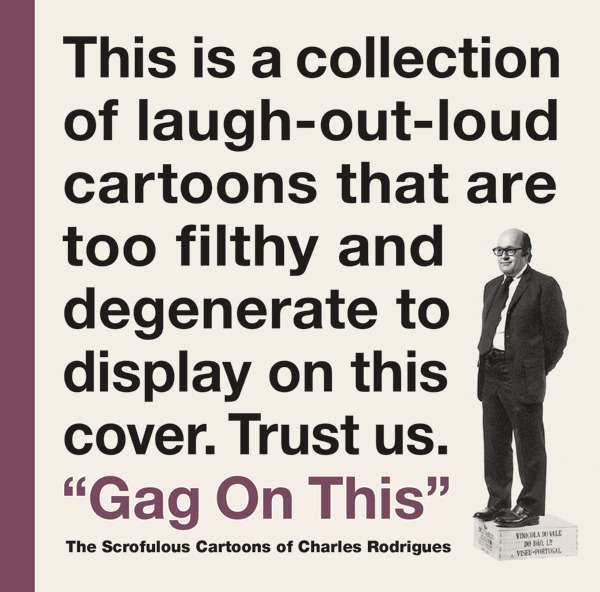
Charles Rodrigues, "Gag On This" (2/1)

A companion volume to the earlier Ray and Joe (which collected Rodrigues's longer continuity strips from National Lampoon), with a whole lot of single-panel gag cartoons of varying degrees of scabrousness. Actually, those degrees vary from "quite" to "unpublishable," so adjust your scabrousness detector accordingly. Rodrigues was as cruel and heartless and vicious in creating jokes as S. Gross or John Callahan -- more so, even, I'd say -- so keep that in mind. If nothing in this book offends you, there's probably nothing in the world that could.

Alexandra Lydon and Laura Kindred, eds., Worst Laid Plans (2/3)

This is the physical manifestation of a live show created by the Upright Citizens Brigade -- or, more accurately, an extension of that show into the print medium. Each contributor writes up the worst sex story that happened to him or (mostly) her, for humorous effect.

It is mostly funny rather than sexy, because bad sex is not generally arousing to most people. It could make a bathroom book in a household that doesn't have teenage boys in it -- it wasn't in my house, for that reason -- or a quick read some day you need to realize viscerally that other people have it worse than you do.

Charles M. Schulz, The Complete Peanuts, 1993 to 1994 (2/9)

Two more years of late-period Schulz, with all of the strengths and weaknesses thereof. (I've already written about most of these collections -- 1957-1958, 1959-1960, 1961-1962, 1963-1964, 1965-1966, 1967-1968, 1969-1970, 1971-1972, 1973-1974, 1975-1976, 1977-1978, 1979-1980, 1981-1982, 1983-1984, 1985-1986, 1987-1988, 1989-1990 -- and so I find myself without anything particularly new to say at this point. I might rouse myself when we hit the very end, or the promised extra volume after the end that will collect odds and ends and L'il Folks. [2] We'll see then, I suppose.

P.G. Wodehouse, Performing Flea (2/10)

Wodehouse -- author of the Jeeves & Wooster trifles, the Blandings Castle stories, the tales of Uncle Fred, the exploits of Psmith, and many other things -- never wrote a formal autobiography. But his old school chum William Townend, who was also a novelist, collected letters Wodehouse wrote to him over a 30-plus year span and collected them in this book, published in 1953. It covers the height of Wodehouse's career from the beginning of the twenties -- when he'd been a working writer for twenty years already, mind you -- and runs to the year before publication (thus leaving out the last twenty years of Wodehouse's life; he had a very long and busy career). It also has Wodehouse's diary of his internment during WWII, which turned out badly for him after he made a couple of humorous broadcasts from Berlin. This is for the more devoted Wodehouse fan, obviously, but it's a nice life, or partial life, in letters.

Kyle Baker, Why I Hate Saturn (2/11)

A great, great book I used to have before the flood. I can't do any better than quote what I wrote about it here in 2006:
I can't tell you what an effect this had on my friends and I when it came out in 1990. Sure, there had been "good comics" before, like Maus and Watchmen, but those were generally serialized beforehand. And most of them were extensions of the usual comic-booky ideas (even Maus, with its sly Mickey-Mouseness). Why I Hate Saturn appeared simply as a book, and it was clearly a graphic novel -- a single story, told in comics form -- that had nothing to do with the usual four-color world. It was funny, it was touching, it was real. There are damn few great pure graphic novels out there, and this is the first one I found. I don't know if it will strike readers today the way it did me, but I can't doubt that it's still a wonderful story, told just the right way by a master.

Jason Shiga, Bookhunter (2/12)

Another book I re-bought, and re-read, in the wake of the 2011 flood. I guess having most of your books destroyed is a good excuse to buy and read some of your favorites again? Not the way I would have preferred to do it, though.

See my review from the first time around.

Shannon Wheeler, I Don't Get It (2/16)

Wheeler is most famous as the creator of Too Much Coffee Man, and, not incidentally, is in possession of the single greatest last name possible. (I won't allow any argument on this point.) So I want to follow his stuff when I remember, though I remember not nearly as often as I should.

Wheeler has been working as a New Yorker style single-panel gag cartoonist -- yes, just exactly as that market is contracting to the New Yorker and almost nothing else in the world; we Wheelers are famously quixotic -- and I think he's pretty darn good at it. Of course, he would be, being a Wheeler. This is a small-format collection of a hundred or so of those cartoons. It's divided into the traditional stages of grief -- Denial, Anger, Bargaining, Depression, and Acceptance -- which I literally realized only now while typing this. So this Wheeler is a sneaky one -- keep your eye on him. (And the best way to do that is to buy his books.)
Peter Bagge, Bat Boy (2/17)

One of the biggest potential dangers of working at home out of your own head all of the time is becoming a crank from lack of interaction with normal people on a regular basis. Plenty of cartoonists fall somewhere on that spectrum, particular the more auteur types -- Dave Sim is the type specimen. Peter Bagge isn't that far along, but he definitely has tendencies in that direction and hobbyhorses that he will ride off into the sunset at the slightest provocation.

So it's great to see him doing work that's not out of his own head, that forces him to engage with outside ideas and turn them into fiction. Even if those ideas are bizarre and stupid, frankly.

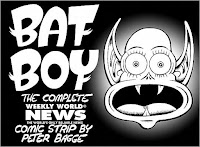
Which brings us to Bat Boy, which is nutty and manic in the style of Hate-era Bagge -- maybe because it's from 2004 and '05, closer to the Hate era than now, or maybe because it's from the Weekly World News, the nuttiest, most manic newspaper imaginable. It's set in the world that WWN reported on, which is only very vaguely like our own, though it's ostensibly real. And the main character, obviously, is their mascot, Bat Boy, a boy who is a bat. He gets into all kinds of international and domestic intrigue, in weekly installments, along with a bewildering cast of oddballs, politicians, celebrities, and nuts. This isn't Bagge trying to be serious in any way, and is wonderful precisely because of that.

Jessica Mitford, Hons and Rebels (2/17)

The famous memoir by the fifth of the six famous Mitford sisters of the interwar years -- she was the Communist, as opposed to her sister Unity the Nazi and her sister Nancy the satiric novelist -- about her childhood. Jessica was thirteen years younger than Nancy (and ten younger than Pamela, the #2 sibling), so she writes of a time when their famously choleric father had settled down somewhat.

And, actually, this is more the story of young woman Jessica Mitford than about the crazy Mitford house in her childhood; she grows herself up fairly quickly and spends most of the book on the few years before the war and how she met and married her first husband (also her cousin, in that very aristocratic British way). So Hons and Rebels is really the story of the young woman who ran off to America, turned Communist, and eventually wrote The American Way of Death. I don't believe there is a better first-hand account of the fascinating childhoods of the Mitford sisters -- the best book on that is probably a collection of letters or group biography. (And I may try to figure out what that best book is, someday.)

Marc Hempel, A Gregory Treasury, Vol. 1 (2/18)

See immediately below.

Marc Hempel, A Gregory Treasury, Vol. 2 (2/22)

The original four large-format graphic novels from the late, lamented Piranha Press line -- seriously, was there anything under that imprint that wasn't wonderful in some way? were collected a decade later in two mass-market-paperback sized volumes, maybe to cash in on the manga craze or maybe just because that format seemed like a good idea at the time. (It's a nice portable format, I'll give it that, but "portable" is often at odds to "readable" when it comes to comics paperbacks -- luckily, this is fine, though I would have preferred the original larger size.)

Gregory is a small person -- maybe a child, maybe a grown man who is just very short -- who lives in what is obviously an insane asylum and who is timid, uncommunicative, manic, pensive, and scared in nearly equal measure. Oh, and there's a talking rat who's his best friend, in between getting killed. The Gregory books were the second-best Piranha titles about philosophy, after only Epicurus the Sage, and they might have been first if they were really about philosophy. They're funny and thoughtful and quirky and wonderful -- and I wish Hempel had had more opportunity to do similar things since. (His TUG & buster was in a similar vein, I guess, but that ended before the '90s did, and I don't think he's had a chance to work in that same vein this century.)

Rick Geary, Murder at the Hollywood Hotel (2/24)

Geary's most recent Kickstarted book is slightly out of his usual style -- it's presented like a storybook or coloring book, with large images on each page and a line or two of narration below. But it's a story of murder a hundred years ago, which is as Geary as you can get.

A young man leaves Kansas -- it's nearly always Kansas, with Geary, since he came from there himself -- to make his fortune in Hollywood in 1915, and settles into a hotel full of other wanna-bes and also-ises. Then there's a murder, of course.

I love Geary's lovely just-this-side-of-naif narration, and his gorgeous precise lines, and this book showcases both of those very well.

Rick Geary, The Lampoon Years: 1979-1992 (2/25)

Oh, I'll roll this in with the next one.

Rick Geary's Book of Murder (2/26)

That Kickstarter had a reward tier that included these two books that Geary published himself, so I plunked down my shekels. (I like current Geary, but I also like the Geary of the '80s, all surreal short stories and inexplicable occurrences and whimsy tinged with nastiness.)

Book of Murder collects stories from 1977 through 2008, some of which appeared in Geary's first two, long-out-of-print collections and many of which are newer than those books. And, obviously, these are all about various murders -- though often obliquely, as in the four portraits that make up the first story, "Wichita Murder Houses" -- in one way or another, like so much of Geary's work.

Lampoon Years is mostly or entirely single-page strips, in that surreal early Geary style, which all originally appeared in the National Lampoon during the years on the cover. Geary was too young to work for NatLamp during its heyday, but he was one of the best things in the dwindling and dying NatLamp of the '80s. These strips might be a bit weird for fans of Geary the straightforward chronicler of historical murder, but I miss the whimsical Geary, so it was great to wallow in that world again for a while.

Neil Gaiman and J.H. Williams III, The Sandman: Overture (2/29)

When an author goes back to one of his most famous works for a 25th Anniversary story, no one actually expects it will be good. We're all hoping for "not embarrassing," particularly when the original story ended, with great finality, almost twenty years before. So it's a bit difficult to express just how impressive Sandman Overture is.

It not only lives up to the original run of Sandman, but extends and amplifies that story (or those stories, if you prefer), providing a new frame to an existing work of art that throws the things we thought we knew into a different relief and casts pools of light in directions we didn't realize were there.

I'm not going to actually review this book; it's too late to do that. But I will say I was hugely impressed by it, and very happy to know that the late sequel can be something new and wonderful.


Endnote: I'm typing these words about a week later, on June 4th. (My birthday -- whoopie.) I make no promises, but I think I can keep up this pace -- clearing out an old month in a week or two -- and be "caught up" by sometime in July, when I can see if there's anything I particularly want to do with this blog. (Probably not: I've never been one to plan deeply, except for "let's read something every day for a set amount of time.")

[1] I am in danger into turning into the book-review Donald J. Trump, frankly.

[2] There was a blog post on that site the other Andrew Wheeler runs that called the 1999-2000 volume "penultimate," saying there would be one more book after that with the odds & sods. But there's now a description of 1999-2000 online -- it was published a few weeks ago, but I haven't seen it in person -- that says that book includes L'il Folks. So I'm not sure if the fabled extra volume will actually exist, or what might be in it if it does.

Monday, January 08, 2018

Reviewing the Mail: Week of 1/6

Hi there! In keeping my my new simplified Reviewing the Mail policy that Everything Counts®, this week's post will include both books that came unexpectedly from purveyors of publicity and books I bought myself because a comic shop was having a great sale.

First, the former:


(It was a quiet week.)

Then, the latter:

Fire!! by Peter Bagge -- this is a comics biography of Zora Neale Hurston, who is, if not the last person I'd expect Bagge to focus on (I'd put Anthony Trollope or Marcel Proust even further down the list), at least pretty far down. I've only ever read Their Eyes Were Watching God by Hurston, like a lot of other people, but she always seemed like an interesting, larger-than-life character, so maybe that's it. Anyway, an interesting choice for Bagge, and I want to see what he did with it.

King David by Kyle Baker -- One of his more obscure books, in that animation-derived style that's not my favorite thing in the world. But I'm trying to catch up on the Baker stuff I missed, since he does good stuff and does change up his style and matter, and I never actually read this one as far as I can remember.

Nexus Archives Vol. 2 by Mike Baron and Steve Rude -- I'm trying to collect these, more slowly than I probably should, with the aim of reading all or a big chunk of Nexus sometime in the future. This one gets me to a full run of volumes 1-5, so that could happen if I want it to.

Sex Criminals, Vol. 4: Fourgy! by Matt Fraction and Chip Zdarsky -- The book collections of this series come out irregularly enough, and the premise has been getting continuously more complex, that I'm not confident I remember what was happening for the cliffhanger at the end of #3. Well, let's see if I can pick it up from context.

Prison Island by Colleen Frakes -- Some manner of memoir, I think about a family member in some hard-to-get-to-prison. (I have the book in front of me, so I'm deliberately not checking it, so I can record the vague impressions that got me to spend money, quirky as they may be.)

Rolling Blackouts by Sarah Glidden -- A big reported book about various journeys in the Middle East. I know I've seen good reviews of this, though I think it's over a year old at this point.

The Iron Duchess by Roger Langridge -- Langridge serialized this on his website, though I think I came in somewhere in the middle and never bothered to go back to the beginning. (I find reading narrative in comics pages online is vaguely annoying, so I tend not to do it.) This is another Fred the Clown story.

Royal City, Vol. 1: Next of Kin by Jeff Lemire -- I'm a little behind on Lemire, since I still have his big book Roughneck sitting on the shelf, but this is the beginning of what should be a longer series, and it was cheap. And Lemire is dependably good when he's drawing his own stuff -- and maybe even dependably good when he's not writing about people who wear their underwear on the outside.

The Customer Is Always Wrong by Mimi Pond -- Another big memoir-ish book of comics from Pond! Only a couple of years after the equally-large and impressive Over Easy! It's great to see her back, so I hope this is a huge success and she has a big book every second or third year for a couple of decades to come.

Paul Has a Summer Job by Michel Rabagliati -- I seem to be re-buying and re-reading all of the books in this semi-autobiographical series without really meaning to. Well, they're all good, so why not?

And last is Sh*t My President Says by Shannon Wheeler, in which my fellow Wheeler illustrates some of the more appalling Tweets of the guy who didn't expect to be President and is determined to prove that he shouldn't have been.