This week's "Manga Friday" column for ComicMix reviewed the one, the only Bat-Manga!
Friday, October 31, 2008
Da Na Na Na Na Na Nah -- BAT-MANGA!
This week's "Manga Friday" column for ComicMix reviewed the one, the only Bat-Manga!
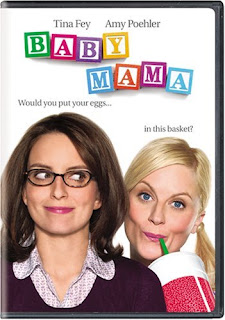
Movie Log: Baby Mama
Anyway, Baby Mama. It's an obvious comedy, one in the very long line of movies spawned from Saturday Night Live. This one is not as obviously a SNL movie as some, but the two leads -- Tina Fey and Amy Poehler -- are clearly riffing on the kinds of characters they're known to do on SNL, and the audience went to see this because it knew them from SNL, so...it's a duck.
Tina Fey is a driven top executive of a Philadelphia-based firm which is not in any way meant to be Whole Foods. (Nuh-uh.) Her career is in top gear, but, to do that, she's completely neglected her personal life -- she has no man, alas! Her biological clock is ticking ever louder -- her fecund sister, Maura Tierney, and "outspoken" mother, Holland Taylor, also don't help -- so she decides to have artificial insemination.
(Silly Tina Fey! Don't you know that meddling in God's Realm -- procreation -- never works in a Hollywood movie? Babies are only made the old-fashioned way, through tastefully implied in-between-scenes sex between the people who have to fall in love to make the plot work.)
So Fey moves on to Plan B, which involves the high-end surrogate operation run by the seemingly eternally pregnant herself Sigourney Weaver. One should be surprised when said high-end operation belches forth the clearly low-end Amy Poehler, playing every stereotype of poor people other than wearing a bib overall with only one strap. One should, but one is not, because one has seen Hollywood movies before, and buddy movies require said buddies to be as mismatched as possible.
Wacky hijinks ensue. No, really: that's the appropriate description of the entire movie; it's a SNL sketch writ large. (A funny one, yes, built around attractive, funny people, but still a thin, obvious thing.)
(I will say that this movie passes the Bechdel Test quite easily -- as long as "not talking about men" doesn't have some sort of exemption for talking about pregnancy. I might just be expecting the Bechdel Test to stand against all gender-stereotyped behavior, which is too much to ask of any single metric.)
I haven't mentioned Greg Kinnear, who is in this movie so Fey can have someone to fall in love with. Or Steve Martin, who's quite funny as Fey's Harvard Business School/Hippie boss. Or Dax Shepard, as the obviously wrong guy Poehler needs to learn to extract herself from.
If you've seen the trailer -- and you probably have, by this point -- you know what this movie is about. If you laughed at the trailer, you'll laugh at the movie; not just those same jokes, but many more that are very similar. If you hated the trailer, stay far away from the movie.
But, as every vaguely geeky male of about my age must admit, Tina Fey is intensely hot, which was more than enough reason for me to be happy to look at her for about a hundred minutes.
The Only Writers Left Not Blogging...
No snarky comments from me; I've never read any of Steel's books, but I used to sell the heck out of them. And I know there are a lot of women who love her books, and will be thrilled to know that "Danielle" is now that much more accessible and real to them.
Roger Ebert Explains How To Review
Plus, as Gawker points out, many, many of his examples -- while also being true, apropos and entirely appropriate -- are daggers aimed directly at the heart of his TV replacement, Ben Lyons.
That's how a good critic does it.
A Great Band for Today: Harley Poe
I don't know all that much about them -- they're pretty obscure -- but they've got a great sound, and they're a perfect band for Halloween. So, in case there's anyone out there looking for some party music for tonight, here's what I know and could dig up.
Harley Poe sounds a lot like early-period Violent Femmes, but their music is almost entirely about horror-movie imagery -- zombies, vampires, maniac killers, and the like. (They've got songs about being zombies and about fleeing zombies, about being a vampire on a date with a girl, and discovering that the girl you're on a date with is a vampire -- they're equal opportunity that way.)
So the sound is acoustic punk -- fast but not electric, angry but not screeching. And that generally goes well with the lyrics, especially in songs like "It's Only the End of the World" and "What's a Devil to Do?" (which I've mentioned here before). They do have some slower songs, but it's the high-velocity ones that really showcase their sound, and dark sense of humor, the best.
They're essentially a joke band, I guess, but they're easily the greatest joke band since Dread Zeppelin (who had two excellent albums and then started wearing the joke thin -- I expect the same will happen to Harley Poe in time, if they didn't already break up).
Harley Poe released three records, all within thirteen months starting in early 2006 -- In the Dark, a full-length with ten studio songs and four live tracks; then The Dead and the Naked, which was the other way around: five studio songs and ten recorded live (and recorded well, at a clearly happy concert at someone's house); and then one-half of a split record, Harley Poe and the Dead Vampires, with five songs from each band.
Harley Poe has a MySpace page, as every band is now required to do.
You can hear some of their music at Last.fm, and watch some videos (quite grainy and amateur) on YouTube.
There are also some MP3s to listen to and buy at Mtraks. Mtraks also has a good Selection of Harley Poe videos, mostly from one particular videotaped performance. (These seem to be the same as the YouTube videos, but they're better organized.)
You can also hear or buy their music on this very page, using this handy Amazon widget. (And if anyone guesses that I made this post so that I could play around some more with Amazon's MP3 widget, well, you're not completely wrong...)
Or, if you prefer the traditional "shiny disc" format:
So: it probably says something telling about me that these guys are one of my current favorites, but they are, and maybe I am. (Whatever you're thinking.)
Quote of the Week
- Judy Blundell, in an interview with Publishers Weekly
Thursday, October 30, 2008
Movie Log: Young at Heart
"Young at Heart" is the name of the chorus, as well as the name of the movie, and they've toured Europe several times in their twenty years of existence. I have to admit that most of them -- with the exception of one gentleman who's now too sick to perform with them except on special occasions -- don't have voices that are substantially better than, say, mine. (And, if you've never heard me sing, it's for a reason.)
Of course, like Johnson's pig on its hind legs, the point isn't how well they sing, but that they sing at all. The chorus has the slight aspect of a postmodern joke, particularly when their conductor and leader, Bob Cilman, has them working on a complex, difficult, and atonal Sonic Youth song. Obviously, both the chorus and their audience wants to see them sing old songs that everyone remembers, particularly if those songs have allusions to age in them. Cilman seems to fight that tendency as much as he can -- even against the chorus, whom he can be quite tyrannical towards -- but it's not at all clear why he started this thing in the first place, and kept it up so long, if he secretly thinks it's just schmaltz. (Maybe he just likes to stretch himself and his singers.)
Anyway, this does come down on the "heartwarming" side, but it mostly gets there honestly. The narrator -- whom I think I should recognize, but I didn't; he's British, and I think his name is Jonathan -- is mostly unobtrusive, and lets the various chorus members tell their own stories. I have the feeling that there's several times as much footage left on the cutting room floor as ended up in the movie, and that the movie was edited to focus on the more "touching" stories -- keep that in mind if you see it.
But it's only ordinarily manipulative for a movie, and the old folks have great attitudes and opinions, for the most part. Their singing may be only decent, but the fact that they can do it is still something to be celebrated.
I Generally Hate This Kind of Thing
Copy this sentence into your livejournal if you're in a heterosexual marriage, and you don't want it "protected" by the bigots who think that gay marriage hurts it somehow.
This isn't a LiveJournal, but I still agree. And people who talk about how the definition of marriage has always and forever been exactly the same really haven't been paying attention.
Wednesday, October 29, 2008
A Question to Pronoun Users
a) I would have everybody marry if they can do it properly. -- Jane Austen
b) I waved to the man and they waved back at me.
(Emphasis added for clarity.)
Because all of the people arguing "it was good enough for Jane Austen!" are trying to justify sentences like the latter -- which I expect Miss Austen would loathe, with a quiet, time-appropriate, womanly loathing -- on the basis of sentences like the former.
Do you honestly think that "they" is is in common use as the definite neuter singular third-person pronoun? Are there style guides or dictionary usage notes to support such a thing? (Is it allowed in Chicago or AP style?)
Has no one on the Internet ever heard of the "if it's clumsy, rewrite it" rule? I despair for the world.
I Like the Night Life, I Like to Boogie
Movie Log: One Fine Day
The movie was One Fine Day, and, somehow, we never bothered to see it when it came out, or for a decade afterward. We finally fixed that on a recent Friday night. (Oh the thrills of long-time married life! A "date" is sitting in the living room on a Friday night watching an old movie and yelling up the stairs for the kids to settle down and go to sleep.)
One Fine Day is another movie that definitely has a formula. I won't say that it transcends that formula, but maybe I should call it more of a recipe: it uses the expected elements in pretty much the expected ways, but is baked just the right length of time and comes out quite tasty and sweet.
Clooney and Pfeiffer are both single parents, he of a girl and she of a boy. The kids are in the same class -- kindergarten, I assume, given their ages -- but the parents haven't met before. Due to some frivolous horseplay of Clooney's, both kids miss their class trip, and are their parents' responsibility all day. (The trip the kids missed was on the Circle Line, which made me question the movie. Sure, it could be some kind of fancy all-day charter, but the typical Circle Line cruise -- even the all-the-way-around-Manhattan trip, which I've taken -- is generally only about two hours long. Those kids should be back in school by lunchtime...but, then, we'd have no movie!)
But both of them are in for busy days, with little time for babysitting:
Clooney is a reporter whose corruption scoop is coming unglued -- there's going to be a late-in-the-day press conference by the guy he claimed was dirty, and the paper will have to run a retraction (and Clooney will be fired), if he doesn't have back-up by then.
Pfeiffer works for an architecture firm, and has a major presentation that day, because in a movie like this someone has to be frantic about "the {somebody} account."
So they reluctantly (on her part much more than his -- she's the tight-ass, buttoned-up career woman, he's the fun-loving laid-back guy) trade kids back and forth, bouncing around New York City as they day goes on. They start off mostly disliking each other, but you know that can't last, can it?
One Fine Day is a slightly nonstandard romantic comedy, centered on a couple of smart, attractive people who do interesting things and can talk well about it, which makes it a great pleasure to watch, (Clooney in particular is one of the great talkers of modern cinema -- there are actors who do a lot of their work silently, but Clooney's not one of them; he's at his best when he's got two or three pages of dialogue to run through.)
New York is also close to being the third major character of the movie; nearly all of it was filmed on location, and I bet you could map this movie pretty easily.
I doubt One Fine Day is going to hit anyone's list of the greatest movies of all time, but it's a great date movie -- from a first date, to married-for-fifteen-years-and-watching-it-on-DVD. That's all good.
Tuesday, October 28, 2008
Movie Log: Son of Rambow
It's 1982, somewhere in England. (All jokes about how there are parts of England that would be lucky to get up to 1982 this decade suppressed.) Will Proudfoot (Bill Milner) is about twelve, one of two children of a widow and part of a very strict Puritan sect. He's never seen a movie; the first scene of the movie has him exiled to the hallway at his local school, doodling in his notebook while his schoolmates watch some dull documentary.
And that's where he meets Lee Carter (Will Poulter), the school's resident troublemaker. Lee quickly sizes up Will, and takes merciless advantage of Will's innocence and unworldliness. But just being around Lee opens up Will's world -- in particular, he sees a movie for the first time because of Lee. That movie is First Blood, and it sets the rest of the plot in motion.
Lee and Will start filming their own sequel to First Blood, starring Will as "Son of Rambow" and Lee as the Richard Crenna character. Things go on from there, as they will -- a somewhat over-the-top (but always enjoyably so, and in keeping with the time period as well) French exchange student named Didier also becomes part of the film.
Son of Rambow does have something like a lesson at the end, but it's not crammed down the audience's throats. And the scenes along the way all ring true -- this is the story of these boys, in their world, in 1982, not something concocted out of a Hollywood scripting class. It also has an occasionally flamboyant visual style, as Will's drawings come to scratchily-animated life on the screen as they do in his head. It's something of a small film, and one that's easy to miss. But it's definitely worth seeking out; Will and Lee are very memorable kids, and their story is worth seeing.
They Are Not Singular
"They" is used, and understood, by the vast majority of English speakers to be third person plural, and making that word less useful and distinctive does not seem to me to be a worthy goal. Many writers have used individual words idiosyncratically, or in a non-standard manner, but that doesn't mean that all of the things a word has ever been thought to mean in the past are equally valid as meanings today.
I also note many of the usages noted by Cheney or on the linked page are of the form "everyone...they" or "anyone...they." Those may be technically singular, but "any" and "every" always retain a sense of multitudes to them.
There are many good ways to communicate that a singular third-person has an unknown (or unimportant) gender; making a myriad of other sentences less intelligible along the way is not one of them.
In the current case: "I'll pay one author for one story."
Join the Campaign to Keep They Plural!
Monday, October 27, 2008
A Trip to Yop City
Movie Log: Run, Fatboy, Run
Oldest, and possibly least, of those movies is Run, Fatboy, Run, which proves that Simon Pegg can be a generic romantic-comedy hero just like every other vaguely attractive actor. It's a terribly, terribly generic movie, hobbled by a thuddingly obvious script. The actors -- Pegg as the man-boy who needs to learn to grow up, Thandie Newton as the girl he left pregnant at the altar, and Hank Azaria as her requisite too-good-to-be-true new American boyfriend -- struggle to make us care about the plot, which is the usual slop in a new bucket.
There's some decent physical comedy in Run, Fatboy, Run, and the secondary characters, who don't have to pretend to be deep and soulful, are freed to embrace the tackiness and genericism of their parts. (Harish Patel is Pegg's landlord, a grumpy Indian widower with a thick accent and a quick hand for physical punishment when he becomes Pegg's trainer. India de Beaufort plays Patel's sexy daughter, although the scenes in which she becomes a credible threat to Pegg's true love for Newton were obviously left on the cutting room floor. And Matthew Fenton is Pegg's best friend, a role that only exists because otherwise the audience would rightfully assume that he has no friends.)
There are also some strange, pointless villains, in a wasted attempt to add some tension. And another one in the recent series of far-too-concretized metaphors, which shows up at the climax.
Should I mention the plot? Does anyone care? Pegg wants to win back Newton, and to do so he impetuously says he's going to run a marathon in London. Eventually he does race, and finish, against far greater odds than make any sense whatsoever.
The Wife and I saw Run, Fatboy, Run because The Wife thought it looked funny, and liked Pegg in Hot Fuzz. But this is a much more forgettable and minor movie; see it only as a way to waste time and laugh a bit.
Commenting on Comics of the Times
This isn't actually a Direct Market issue -- not in the case of Watchmen or of The Dresden Files: Welcome to the Jungle -- since both have sold strongly enough in particular weeks through book-industry outlets to outrank many books on the published lists.
The problem is that the bestseller lists are actively, and heavily, managed -- perhaps for the image of the New York Times, or perhaps for the benefit of the Times's ad-sales department. The Times deliberately leaves out many categories from their bestsellers lists -- their "fiction bestsellers" doesn't include books published as Young Adult, or graphic novels of any kind. (As we've all recently learned.) Similarly, their non-fiction list is mostly limited to history, memoirs, and current events -- they suppress all how-to books, self-help, computer books, and other categories.
Given that sales data is all captured electronically these days, it's clear that the Times must start with a compiled weekly list of sales (from the outlets that report to them) and then decide which books are actually "fiction" or "non-fiction" by their definitions, and which are not worthy of being listed at all.
(When you see the Times folks talk about the list, they often say that a book "was placed" on a list -- I suspect this is how they refer to it internally, and another sign that their bestseller lists shouldn't be taken as pure reportage.)
From their website: "Among those categories not actively tracked are: perennial sellers; required classroom reading; text, reference and test preparation guides; journals and workbooks; calorie counters; shopping guides; comics and crossword puzzles." Note that "among," as well -- they're leaving themselves the room to "not actively track" other things, at their whim.
A Brief Detour Into Politics
Fact 2: I'm going to be at Walt Disney World on Election Day.
So, since I wanted to vote this year -- it's a fairly big one, in case you hadn't heard -- I had to get an absentee ballot. I finally filled the thing out last night, signing my name sixteen times, darkening a host of little black ovals, and sealing several envelopes inside each other. And I mailed it this morning.
So my part in this election is done. I do want to encourage Americans to vote this year, particularly if they care about the outcome -- if you don't care, don't bother to vote, since you'll do it wrong.
And I'm sure nobody cares, but...I voted for a Democrat for a national office for the first time that I can remember. I was rooting for McCain back in 2000, but I just couldn't get behind the 2008 version. (Something similar nearly happened back in 1992, but the elder Bush eventually convinced me to stick.) The final straw, I guess, was Sarah Palin -- if that's the kind of decision McCain is going to make, I don't want him to be my President. If he'd picked even Tailgunner Joe Lieberman, I probably would have voted differently.
On the other hand, I voted the straight Republican ticket otherwise -- my local government incumbents, who're doing a decent job and have a chance to stay in office, and the current sacrificial lambs to Frank Lautenberg and Bill Pascrell. (The latter is my guy in the House -- I'm in a district that includes the local city, which means it'll go Dem until and unless the office holder is found in bed with the proverbial dead girl or live boy.)
So: vote in your own localities, and good luck in getting representatives that you can stomach.
Slave Leia Pillow Fight
Yes, I'm practically just copying this Topless Robot post -- but he already had the perfect headline, and I can't pass up the opportunity to post more pictures of multiple Slave Leias.A world that contains this is a good world -- that's my opinion, and I'm sticking to it.
Reviewing the Mail: Week of 10/25
So, this week I saw:
I read John Scalzi's Agent to the Stars
I saw Suihelibe!, Vol. 1
Crayon Shinchan is apparently a TV show, but I've never seen it. It's also a manga, which I've just seen, in the form of Crayon Shinchan, Vol. 6
Last for this week is the massive and massively over-designed Bat-Manga!
Sunday, October 26, 2008
A Quiet Weekend
I'm going to be going on a long vacation -- seven days with the family to see "the Mouse" at his Florida home -- in just over a week, so there's actually frantic activity going on behind the scenes here at Antick Musings HQ.
For instance, over this weekend I wrote four book reviews for this blog (all currently scheduled to be published while I'm away) and two for ComicMix (coming up tomorrow and Wednesday), on top of the usual big Monday "Reviewing the Mail" extravaganza. So, although this channel has been pretty quiet, I've actually been very busy.
But this post is really just so something has this date-stamp on it; I have a mania about posting every day, even if there isn't anything to say.
Oh, here's one bit of news I don't know if I mentioned: I'm not going to World Fantasy. It's too far, too expensive, and the flights are too complicated. (Not to mention that I'd have to come back right after the banquet, sleep a few hours, and then fly back out with the family to Orlando.) Not this year, I'm afraid. But I do want to try to make it to San Jose next year (although, if I remember my business travel schedule correctly, I think I'm going to be in San Francisco only two weeks later, which is annoying).
If you drink heavily in memory of me -- and of all those who couldn't manage to schlep to Calgary this year -- the World Fantasy Gods will be please, if not appeased.
Saturday, October 25, 2008
Incoming Books: 25 October
And they were...
First was an order from Edward R. Hamilton, who has been my favorite used-books retailer for at least fifteen years. He puts out regular catalogs, he has just about everything currently in remainder status (plus some still-new books at decent discounts), his shipping is ridiculously speedy (especially if you live close to Connecticut, as I do), and his website is bare-bones but serviceable. Before I learned, as a book-club editor, that I could just ask rights people at houses for copies of books (occasionally, and nicely), I used to get huge boxes from Hamilton regularly.
Now an order from them is rarer, but still happens now and then -- like last week, when I ordered:
Dzur
And, once I was in that neighborhood of the Hamilton website, I found my way to The Big Book of Sex "Quotes"
I also was recently reading Josh Karp's A Futile and Stupid Gesture
The books are National Lampoon Magazine Rack
Caine Black Knife
And last was Ken Grimwood's Replay
Friday, October 24, 2008
The Halcyon Science Fictional Days of the Eighties
Someone mentioned (on rec.arts.sf.written) in early August that golden time when "a whole bunch" of SF writers could command huge advances, and wondered if we would ever see their like again. As always, I disagreed:
Actually, your list there is almost complete, and a bit misleading. There was a short period, from the late '70s through the late '80s, during which a few SF writers got huge advances, but it wasn't all of them, and it didn't last.
The three writers who got huge advances no matter what they wrote -- the ones who commanded an large audience just due to their own writing -- were Heinlein, Clarke, and Asimov. (And that was because they were the iconic, world-famous "Big Three" SF writers, with a stature and a popularity that no one else could ever match.)
Herbert got big money, but only for "Dune" books. Silverberg got a big advance for his return to the field with Lord Valentine's Castle (and sequels), but not otherwise, and not really after that. Pohl got increasingly good money for the "Heechee" books. Niven and Pournelle got big advances for their very mainstream thriller-y SF books. But that was pretty much it for clearly SF books (depending on how you characterize McCaffrey's Pern novels).
On the other side, Dick wasn't making that kind of money, and neither was Simak. Nor was just about anyone else of their stature and time in the field -- the big money was going to books in very popular series...much like it is today.
The center of gravity now has mostly shifted to fantasy, in part because fewer SF writers are trying to write big, unabashedly popular series like Dune or Heechee or Pern these days. (It seems to be mostly the Brits who are -- people like Hamilton and Reynolds. The Great American Hope in this area is John Scalzi, and his meteoric rise shows that there were people who really wanted books like that.) The big space opera series of our times is Star Wars, and we shouldn't be surprised that there's a larger audience for space opera than for dreary stories of loss and the inevitable destruction of mankind.
A Week and a Day At ComicMix
On Monday, I reviewed Guy Delisle's Burma Chronicles
On Wednesday, I reviewed the Paul Gravett-edited The Mammoth Book of Best Crime Comics
And today's Manga Friday column covered the second volumes of Yukako Kabei's Kieli
There'll be more next week, and I might even manage to kick to those reviews on the days they're posted.
Thursday, October 23, 2008
An Enlarged Orbit
To quote the press release:
Tim Holman, who relocated from London to New York in 2006 to help set up Orbit, has been appointed VP and Publisher of the new division, reporting to CEO and Chairman David Young. Reporting to Tim Holman will be Kurt Hassler, Publishing Director of Yen Press. Kurt will be assuming responsibilities previously shared with co-Publishing Director Rich Johnson, who will be leaving the company at the end of October. Alex Lencicki has been appointed Marketing and Publicity Director for the new division.Congratulations to both Tim and Alex on their new roles -- I don't know Kurt, except by reputation, but it's an excellent reputation, so congrats to him as well. I'm sorry to hear about Rich Johnson leaving, but it always sounded odd that Yen had two co-equal heads; that kind of structure usually doesn't last for very long.
This isn't the first SFF imprint, and it's probably not the first such imprint to have other groups reporting into it -- but it may be the first division of a US publishing company to be named after its SFF line. (Can anyone think of an earlier example?)
And I hope this means that my friends at Yen and my friends at Orbit are already playing well together, to publish more swell books in their overlapping areas. Good luck to all of them...and keep me on your publicity lists!
An Artsy Meme
Your result for What Your Taste in Art Says About You Test...
Balanced, Secure, and Realistic.
10 Impressionist, -8 Islamic, 2 Ukiyo-e, 1 Cubist, -5 Abstract and -14 Renaissance!

Impressionism is a movement in French painting, sometimes called optical realism because of its almost scientific interest in the actual visual experience and effect of light and movement on appearance of objects. Impressionist paintings are balanced, use colored shadows, use pure color, broken brushstrokes, thick paint, and scenes from everyday life or nature.
People that like Impressionist paintings may not alway be what is deemed socially acceptable. They tend to move on their own path without always worrying that it may be offensive to others. They value friendships but because they also value honesty tend to have a few really good friends. They do not, however, like people that are rude and do not appreciate the ideas of others. They are secure enough in themselves that they can listen to the ideas of other people without it affecting their own final decisions. The world for them is not black and white but more in shades of grey and muted colors. They like things to be aestically pleasing, not stark and sharp. There are many ways to view things, and the impresssionist personality views the world from many different aspects. They enjoy life and try to keep a realistic viewpoint of things, but are not very open to new experiences. If they are content in their live they will be more than likely pleased to keep things just the way they are.
Take What Your Taste in Art Says About You Test at HelloQuizzy
I will say that their "Renaissance" paintings mostly looked earlier than that (and were rotten reproductions to boot). If there was a clutch of 19th century Academy painters, or some Breughel or similar, my results could have been quite different.
Wednesday, October 22, 2008
Borders "Boycott": Request for Information
The thing is, I don't believe there is any such group.
Pat Cadigan did call for a boycott -- more than a month ago -- but I didn't see anyone else picking up on that.
Greg Frost urged readers to go to independent bookstores, and Tobias Buckell just wanted his readers to go where the book would be available (wherever that would be convenient for them). Is there anyone else out there who did call for a boycott?
And, again, this was just over a month ago -- if there was a boycott, surely there would be some tangible evidence of it by now, right? (At least a website with a manifesto and a logo, surely.)
Tuesday, October 21, 2008
My Brother, the Cartoonist
Very early in this blog's existence, I tried to guilt-trip my talented brother, Dan Wheeler (not the baseball player) into restarting his minimalist, sarcasm-soaked webcomic The Happy Freaking Ray of Goddam Sunshine, but nothing came of it.Well, after a three-year comics drought, Dan took part in 24-Hour Comics Day over the weekend, and posted 24 new strips in about 22 hours. So go take a look at it, would you?
Skipping the Side Issues
1) Fewer people than I expected have taken offense to what I said about independent bookstores, possibly because everyone thinks I'm too wedded to the brilliance of my own ideas to see any other viewpoint. But let me take the other side, somewhat, for a change.
Independent bookstores are the diners to chain stores' Cheesecake Factory -- much less dependable, with a vastly greater amplitude of variability. So the best independents are much better than the best chain stores, but the worst independents are much worse. Chain stores don't vary as much -- the flagship B&N on Fifth Avenue is nice (though not the wonderful place it used to be, when it included the Annex across the street), and I hear good things about the new Borders concept stores, but the vast mass of both chains are roughly the same.
Independents are all very different from each other. Leaving aside primarily used-book stores for now (and the "oh, those wonderful lost bookstores, with their quirky owners" nostalgia is usually at least 60% about used books to begin with), small independents are the ones to be the most suspicious of. Some of them are excellent -- generally the ones started by refugees from other parts of the book world (ex-editors, ex-sales reps, people who fled other stores) -- and many of them are adequate. (The lousy ones tend not to have survived to this point; there was a really nasty winnowing process over the past two decades.)
So my favorite stores, and anyone's favorite stores, are nearly always independents. (For me, it's the Montclair Book Center, the Strand, and some places that aren't there anymore.) My point was that we often forget all of those mediocre independents and the really lousy, now-departed ones.
2) A handful of people have frowned at my posting semi-solid BookScan numbers, and I might not have done it the same way if I'd know the audience that post would get. But, even with the caveat that those numbers are incomplete (since not all bookselling outlets report to BookScan), I think it's important to talk about real numbers and real cases, rather than tiptoeing around all of the details.
Writers often don't know anything about the economics of the business, and, if the climate now is that Borders will either take 2-3 thousand of a given SFF hardcover or trade paperback original (enough for a small display presence on an endcap) or not take it at all, that's important for them to know. (I'm not actually saying Borders is doing that, since I don't work in that category now, and I don't know. But the editors, marketers and sales people at those writers' houses will know precisely what Borders, and the other major accounts, are buying, and an author who knows what questions to ask can find out the landscape before sell-in and do their best to help their publishers sell their books.)
So, again -- sorry to Greg and Toby for pushing things into public like that, but those numbers are fairly typical, not anything to be ashamed of.
On that subject, one anonymous commenter wrote "the divulging of hard numbers can seriously hurt an author in more ways than just the chain stores--in things like getting convention appearances or invites." Now, I'll never put any stupidity past any member of humanity, particularly when that member of humanity is also a member of a committee. But if conventions avoid Greg and Toby because of this -- when many, many other authors are selling very similar numbers -- those conventions are staffed by very impressive morons.
And everyone in the business -- editors, marketers, bookstores, and the larger agencies -- already have these numbers. Anyone who doesn't have direct access can get them. The only people who don't know how writers are actually selling are the writers themselves.
3) I got into the inventory control question in a comment on the original post, replying to a commenter named Tessa. And then I got into it even more (and thought about it some more), in a comment string over at David Levine's LiveJournal. I won't repeat what I wrote there -- or the mostly good points I was responding to, from someone called calimac -- except to reiterate that Borders is going through a financial crisis (one distinct from the larger financial crisis, even), which seems to be impacting their inventory decisions.
4) I got a ridiculous number of links to that post, probably more links than this entire blog gets most months. (So I should jump up a bit in the Technorati rankings for a little while -- hey, isn't it about time for John Scalzi to do another "Top SFnal blogs" ranking?, he asked, disingenuously.)
I won't list them all -- though many of the links (seen at the bottom of the original monster post) contained other folks' thoughts on the issue, and many of those are from other publishing professionals. Some people come to conclusions that I can't agree with, but that's the way of the world. (Some of them, though, seem to have read a slightly alternate world version of that post, in which I wrote about things quite differently.)
The one I do want to mention specifically is io9's, because, well, you know how I am with io9. (They mean well, but they have all of the flaws inherent to the speedy-and-breezy blog model, and very few of the newsy benefits.) Their headline is "Should SF Writers Boycott Borders?", and I think I answered that in my original post. The post itself is a collection of quotes stitched together in a hasty fashion. Please, parents, don't let your kids get their opinions on SF from io9.
If anyone has any specific questions, it might be easier to ask them here than on the original monster. (I'm still replying to comments there, though, since that's where the traffic's going.)
Books -- But Not As We Know Them
Those of us whose Photoshop skills are not up to that level can still participate -- voting on which of those covers are the best is open until Friday.
Monday, October 20, 2008
Skipping Along Merrily
In case anyone is wondering if I plan any of this...if I had any idea "On Being Skipped" would be any more interesting than any other post here, I wouldn't have buried it late on a Friday evening before a two-day family trip. It all seems very random from where I sit.
I've had big spikes in traffic before -- Neil Gaiman linked to me when I asked "What Are the Great SF Novels of the '90s?" and a lot of people kept reloading a lot during my unpleasantness last summer, not to mention the more recent (and deliberately snotty) post King Canute Has a Posse. But I think this spike is bigger than the previous ones. (Though -- and I have to be honest here -- it's still only big for writing/publishing blogging; the political guys have nothing to worry about.)
The reaction to that post seems to be mostly positive, though a few people don't like my tone. (I'm afraid that's about as friendly and conciliatory as I get, though -- that is me trying to play fair and speak neutrally.)
No one has come right out and asked "what can writers do about this?" and that's good, because I really don't have an answer to that question. I do think that knowing more about the landscape can help writers, so I'll lamely mutter something about "spreading information" and then change the subject.
I do want to apologize to Greg Frost and Tobias Buckell for using them as the subjects of that post; I probably would have done things differently if I anticipated this level of interest. I do think that authors should know more about all aspects of the book business, especially retail, and that all of us in the field need to have a better sense of what the real numbers actually are -- but putting someone else's sales figures out in front of a large audience at least looks rude, and that wasn't my intent.
One other thing: the actual sales of those books are definitely higher than the round numbers I posted, since many sales are not captured by BookScan. But I was mostly talking about the big chains, which are included in BookScan's figures, so I thought the numbers (inaccurate as they can be) were close enough for that.
So: if you came here because of a link to "On Being Skipped," and you stuck around, welcome. This blog has a loose focus on books and publishing, but wanders aimlessly in other directions as well. The list of "Recurring Motifs" in the sidebar acts as a tongue-in-cheek index, and is also a decent quick sample of both my usual topics and my sense of humor (such as it is). I welcome thoughtful comments -- I write long, and I appreciate that in commentors as well. If you drop me from your blogroll in two days, I won't mind -- my own reading list has fluctuated wildly over the past three years, so I tend to expect that everyone else's does, as well.
Reviewing the Mail, Week of 10/18, Part Two: Comics
I'll lead off with B.P.R.D. Vol. 9: 1946
The company I'm not naming also sent me Gantz, Vol. 2
And, lastly, I haven't been reading the comics featuring the ACG hero Nemesis since 1965, when he debuted in Adventures Into the Unknown. (I had a small excuse: I wasn't born until 1969, and didn't start to read until a couple of years later.) But I can remedy that with Nemesis Archives, Vol. 1
Reviewing the Mail, Week of 10/18, Part One: SFF
This week, it was a large stack -- despite Monday being a no-mail holiday -- so I'm dividing it into two pieces. The first will cover science fiction, fantasy, and similar stuff, while the second (coming very soon this morning) will cover comics.
And so:
I'll start off with Fast Ships, Black Sails
Also coming in mass-market on November 4th, from Roc's sister-in-law imprint DAW (headquartered in the same building, but different in many ways, not least ownership), Better Off Undead
Going Under
DAW's other November hardcover is from the SFnal side of the fence: R.M. Meluch's Strength and Honor
And last for this week is Sharon Shinn's Fortune and Fate, the fifth in her "Twelve Houses" series. Um. I've run out of things to say, it appears. So I'll just wrap up by saying this is yet another November hardcover, this time from Ace.
Saturday, October 18, 2008
Off to Hershey Park
This means I'll be away from the Internet -- this blog, other blogs, my e-mail, the whole ball of wax -- until late on Monday. I've already written and time-locked the usual Monday morning "Reviewing the Mail" posts, but anything else will have to wait until I get back.
In particular, if anyone else has questions, thoughts, or fulminations on last night's On Being Skipped, I'll be happy to continue that line of discussion...but not until later on Monday!
Feiffer & Fantagraphics Make the NYTBR
earlier this year.
In what I think is an unprecedented review, a book of comics has made the front page of The New York Times Book Review -- David Kamp on Explainers. I'm sure Fantagraphics' publicity folks (who are probably half of someone, knowing the size of many comics companies) will be exceptionally happy this weekend.
And doubly so, since there's also a full-page review of several "Love & Rockets" collections by the Brothers Hernandez -- Jaime's The Education of Hopey Glass
Itzkoff Sings an Anathem
And plenty of people have been tentatively saying that Stephenson has inflicted another baggy monster on us -- some have been more pointed in their criticism -- so merely saying that Anathem is not all that good wouldn't be controversial. Though the word is that Stephenson actually managed to write an ending this time, which would be inspiring if true.
Actually, Itzkoff fall smack-dab in the middle of the opinions on Anathem: he thinks it has some good points, but that it is essentially trying to do something non-novelistic and gets carried away in intellectual games at the expense of the core story. Those are Stephenson's great failings, shown over and over again -- he'd much rather intellectually wander off to investigate something cool than to stick to the point at hand -- so I'm inclined to believe Itzkoff.
So no bile this time: Itzkoff did take a whole page of the New York Times Book Review to cover one book, but it's an important book, one of interest to general NYTBR readers as well as those of us in the genre. If he's going to write reviews like this, I could even wish that he'd appear more often than once every four months.
Friday, October 17, 2008
On Being Skipped
Greg Frost was skipped by Borders. Toby Buckell was skipped by Borders. Pat Cadigan was outraged. Gwenda Bond was more thoughtful. Many other people examined their liberal guilt about buying from a chain store, and were vaguely uncomfortable about the whole thing. And I'm sure there are plenty of other authors who heard that their new hardcover or trade paperback was getting skipped by Borders without going on the web to tell everyone about it. Nobody's jumped up to say that they were skipped by B&N yet -- probably because B&N has more cash and is in a generally better position than Borders, so they're less likely to be tightening their belts that much -- but both chains skip books every single day. Every buyer for both chains skips books all of the time.
By the way: that's what it's called when your book isn't picked up by a particular bookseller. Your book is "a skip," and they have "skipped" you. We don't like it very much on the marketing end, either, though I have to tell you that my already skip-filled list has gotten even worse lately. I already tell my authors -- accounting and finance guys -- that bookstores are mostly a lost cause for their category, so the thing to do is drive sales to online retailers in any way possible. That's unlikely to happen to SFF, so there are still some blessings to be counted. A skip is still a notable occasion in this genre -- the outrage itself is a sign that we're still healthy at retail.
But skipping is now in the air. I avoided writing about it immediately afterward because when I write about anything related to publishing many people assume I'm taking a "pipe down, whiners!" tone, even if that's not what I'm saying. I like both Greg and Toby -- I think I've had dinner with each of them at least once, which makes us con-friends -- and want to see their books do well. And being skipped is not good.
But bookstores are businesses, not public conveniences. No store has the responsibility to carry every book published -- although, to be honest, that's a straw-man argument, since no one is asking for that. (They're just wishing that their books, the books they like, and the books by their friends be spared the chopping block.) I market books for a living, so I can tell you an unpleasant truth: the order for any book, from any account, starts at zero. The publisher's sales rep walks in the door with tipsheets and covers, past sales figures and promotional plans, to convince that bookseller's buyer to buy that book. In many categories -- SFF is still one of them -- the chain buyers say "yes" the overwhelming majority of the time. But not all the time. Sometimes, that buyer is not convinced, and the order stays at zero.
For many accounts, this is routine. Wal*Mart takes only a handful of books for their stores -- and is taking fewer for their website recently, as well. Starbucks carries two or three books a year. (Though you know that publishers are pitching them many, many more than that.) The warehouse clubs are very selective. There are lots of organizations and groups that sell books, and many of them (particularly professional societies) have to have the book read and evaluated first before they can make their decision. That all might sound unrelated to SFF, but that's part of my point: SFF is a small part of a much larger world of bookselling, not a thing in itself, and even bookselling is part of an even larger retail world -- which, as you know Bob, is not expected to be terribly strong this year.
And the order number always starts at zero. It's the job of the publisher -- specifically, the marketing and sales team -- to push that number up to a level they think is reasonable. In some cases, like mine, that's a few hundred books, even in a big chain. For example: I'm very happy with the way CauseWired
I don't know if writers know the numbers of chain bookstores -- which are public, but not all that public -- so let me explain them a bit. Barnes & Noble has the most: over 700 superstores, less than a hundred B. Dalton mall stores, and about 700 college stores. (Most of those can be ignored by everyone but textbook authors; less than a hundred of those carry "real" books.) Borders has about a thousand stores, almost evenly divided between Borders superstores (slightly more of these) and mall stores (Walden and the rebranded Borders Express chain), plus a couple of dozen airport stores.
Generally, for a hardcover or trade paperback that's not being pitched for something promotional (I won't get into co-op here, but, to be short: front-of-store positioning and most other in-store display areas are not only paid for by the publisher but also have strong competition for the few available paid slots), you're talking about whether the order is one, two, or maybe three copies per store. Or, possibly, if the book is only going to the top stores for that category -- and that number of stores varies by category. For the kind of books we're talking about -- midlist originals in hardcover and trade paper -- there will be no substantial distribution into mall stores.
So you're talking about a B&N order that could be potentially as high as 2100 (for what we marketing folks would call a "high B+" book), or as low as a few hundred (for an order only going to "top stores"). The equivalent Borders number runs up to about 1500, with about the same bottom.
I should also point out that chainstore buyers have budgets; they don't have an infinite amount of money to play with. They have to buy books for all of the stores in the chain, in their category, given the money they have available -- this is called "open to buy," and varies depending on recent sales, returns, and what else is publishing that month. Like any other budget, I'm sure buyers start with the most important things -- the big books that month -- and work their way down the list. If the money runs out before they hit the bottom, that's it.
Amazon, the third of the three big general booksellers in the US these days, has one store: their website. And they do carry everything, but -- since they do only have one "store" -- don't carry as much inventory on any particular book; they don't have any need to have a physical copy available near purchasers. I doubt publishers will pass on Amazon order quantities to any but the highest-end authors, and those numbers don't matter as much, anyway. What's important is that Amazon has stock on hand to sell -- and to keep the book's status as "in stock," meaning that it ships immediately. It can get more complicated than that, but as long as your book says "in stock" on Amazon, don't worry about that. (Worry about other things about Amazon: is it the right cover, the right descriptive copy, has the author signed up for Amazon Connect, and so on -- but don't worry about their inventory position.)
I've wandered away from my point: skips happen. They're part of the continuum of book orders. I'll admit that they're much worse to an author than to a publisher -- an author has a book or two a year (or seven or eight if she's Nora Roberts, but I digress), while the publisher probably has three or four books in that program that month. Any one skip is a much bigger deal to the author than the publisher. But they do happen.
Let's talk specifics. Frost's Lord Tophet was skipped because his previous book (the one Lord Tophet is the second half of), Shadowbridge, didn't sell well enough. Frost complains that no one quite says how much "enough" is, which is true; generally, you know what "enough" is when you hit it. Recently, Editorial Ass answered a similar question, saying that 7,000 copies is a strong sale for a first literary novel. Her numbers are reasonable for a fairly literary mid-career midlist fantasy novel as well. I can't look up Shadowbridge's Borders-only sales, but I can look it up in general.
Frost points out that Shadowbridge "received glowing reviews and went back to print twice in its first six months." But neither of those things, sadly, mean anything on their own. Lots of books are glowingly reviewed and don't sell -- ask the literary writers selling 1500 copies of their first novels -- and reprinting twice in six months can just mean that the first printing was tiny. What I can say: Shadowbridge sold less than 2,500 copies, as a $14.00 trade paperback, across all reporting sales outlets (which include Borders, B&N, Amazon, and others), since the beginning of this year. Of those, almost 2000 were sold at the "Retailer" level, which includes Borders, B&N, and other brick-and-mortar stores. If those were sold evenly between B&N and Borders superstores, and nowhere else, each superstore sold a little over a copy and a half.
For Buckell, Sly Mongoose got skipped by Borders, and Ragamuffin was his last book. Using the same sales-reporting system, for a $24.95 hardcover published last June, sales are well under a thousand copies. ("Retailer" sales were barely five hundred.) Ragamuffin didn't sell as many hardcover copies at retail as Borders has superstores; if they had a copy in every store, they returned a large percentage (probably more than half). And, since B&N didn't skip Sly Mongoose, it's plausible that more of the retail copies went through B&N than Borders.
Looking at the numbers that way, even without knowing what percentage of sales were through Borders and which weren't -- and without knowing the average sell-through of the category for that period and Borders actual buy on the two old books -- these skips look reasonable. We'd prefer that the books of our friends and favorite writers not be skipped, but it's hard to argue that Borders should buy five hundred to a thousand copies of a book that they probably estimate would sell only a few hundred.
Pat Cadigan all but called for a boycott of Borders in her post. Even allowing for the effect of anger, and the tendency of blog posts to be overly extreme and rabble-rousing, I can't see that this would be a good idea. Even if it had a noticeable effect -- and that's a big "if" -- getting SFF readers to move their business away from Borders is exceptionally unlikely to get Borders to start stocking SFF in more depth. Rather the reverse, actually. If Cadigan wants Borders to cut back on SFF, she has an excellent plan. If not, not.
I'm afraid Frost, in his essay, gets into the Shangri-La theory of bookselling, in which there was a golden age -- now passed, alas! -- in which all booksellers were tall and strong, all bookbuyers were discerning and studious, and all books were well-written and wondrous. Like all "in my day" trips of nostalgia, it's deeply mistaken.
One thing is indeed true: about eighteen years ago, there were 7,500 independent bookstores; now there are 1700. Sure, some good stores closed. But the rosy-colored view of the wonderful lost indy bookstore, land of miracles, where enlightened, Buddha-esque bookmen and -women sold only the finest of literature to a happy and contented audience is pure bunk. Most of those vanished stores were too small, undercapitalized, badly run marginal businesses run by cranks. They went out of business because they were bad at business, lacking any point-of-sale systems or serious inventory tracking at all. If they didn't return all that many books, it was because they had no idea what they had or where it was. Oh, and most of them -- as those of us who remember those days without the gauzy light of nostalgia -- were actively hostile to science fiction and fantasy. (Remember? This is the era when SF sold mostly in paperback, through entirely different channels, or in small hardcover editions to libraries. Those supposed wondrous independent stores of yore didn't carry SFF.) The independent stores still open are probably 90% of the well-managed independent bookstores that ever existed; there's a serious selection bias in looking at what's still around and extrapolating that back to all of the stores that didn't survive -- most of them didn't survive for a reason.
The reason the chain stores bloomed -- first with the mall stores in the '80s and then with superstores in the '90s -- was that those stores were vastly better than the bulk of the existing independent bookstores. The mall stores were clean and had discounts; they were usually about the same size as the indies they drove out. The superstores were even better: as large as the largest indies (of which there were only two or three dozen in the country -- now there are well over a thousand chain superstores), full of books, well-lit, with comfy chairs and expensive coffee drinks.
What no one talks about these days is what the superstores also replaced. Independent stores used to be a major piece of the bookselling puzzle, but they were equalled, or bettered, by department store book departments. (I used to shop at Bloomingdale's for books before Walden's and Dalton's came into my area, and there were millions of people like me.) That was the professional, organized, controlled-inventory side of the book business back then -- and it's come back, in a way, with the rise of Wal*Mart and the warehouse stores. If you just wanted to buy a popular book in 1985, or 1975, you went to the book department of your local Gimbel's, or Macy's, or whatever, and got it there.
So, sure, order from an independent store if it makes you feel better about yourself, or if you want to support a local business -- if you actually have a decent independent nearby. (Most people don't.) But don't kid yourself that it's going to make much of a difference. Borders will stay in business, or be sold to someone, or go belly-up, based on much larger market trends. And the long-term trend of the last ten years and more is for sales to move to online bookstores (particularly that one named after a big river).
And skips will keep happening -- to some of us more than others. Pray that SFF sales never get driven online as thoroughly as business books have; that's all I have to say.
Addendum: To hammer home something I thought was clear above -- but has gotten fuzzy in some of the links to this post -- Greg Frost and Tobias Buckell are both utterly right to be worried about their books being skipped by a major retailer, and nothing I wrote should be taken as denying that. I am not calling them any unpleasant names, which others may attribute to me.
I just wanted to explain a part of the process that I thought was deeply opaque to writers, and give them a sense of how a book might come to be skipped.
I'm very sorry if anyone took any kind of personal attack away from this post; nothing of the sort was intended.
Second Addendum: Since this post has been linked so widely, and will probably draw traffic at odd times in the future, let me mention my follow-up posts:
- Skipping Along Merrily, a mixture of second thoughts and bemused surprise
- Skipping the Side Issues, an attempt to address some things I missed the first time around
- and Borders "Boycott": Request for Information, in which I tried to figure out if anyone actually was boycotting Borders. (So far, I haven't found anyone.)
I also need to thank all of the sales team at Wiley -- they're a great bunch of professionals, and it's entirely due to their enthusiasm and knowledge that I have any idea how this process works.
Not Picking on Chuck Asay This Time
I wrote about Chuck Asay's editorial cartoons last week, and characterized him then (by implication) as unstoppably right-wing in his cartooning. Well, I was wrong.Today's cartoon is a direct poke at Bush, Paulson, and Bernanke (all basically recognizable, even though two of them are in 3/4 view). And that's a damn good bear, too, with a fine expression.
So Asay is clearly capable of making his shots where he sees them, which is all I ask of an editorial cartoonist. He's had an awful lot of cartoons recently blaming Barney Frank and Chris Cox for the subprime mess -- and some of it can fall at Congress's feet, but there are plenty of Executive Branch agencies whose job it is to police the markets -- but that's par for the course on his side of the aisle.
Quote of the Week
- Sarah Vowell, The Wordy Shipmates, p.22
Thursday, October 16, 2008
In Which I Stoop to Reviewing Garfield Books
Wednesday, October 15, 2008
The World Is Weirder Than We Can Imagine
There is a flickr group entirely for pictures of Robocop on a unicorn. There's nothing I can say that can equal that, so there it is.
Linkage and Translation
Lyons first fulminates specifically:
How can it be that the son of a feminist, a woman who shares a rough and ready equality with her husband, who works outside the home and shares in decision-making, could ask such a question in 2008?One might note that perhaps the mental landscape of children is not as entirely created by parents as one might want to believe. Just because she is a feminist doesn't mean her son -- even at the age of eight -- will be.
(And his question isn't "Are women important," which is how Lyons seems to be taking it. His question is somewhere in the range of "is this right for me to read?" or "will I like this?" And that does have an individual aspect to it, as well as the more general cultural question of what it's appropriate for Person X to do.)
But then Lyons goes very general:
How is it that, in our modern world, which claims to believe in gender equality, a young boy of eight could feel it might be inappropriate for a boy to read a novel about a girl?If she actually believes that she lives in a "modern world" which "claims to believe in gender equality," I would be greatly surprised; she's saying this for effect. But let me be blunt: the majority of the people in the world do not believe in gender equality, or anything close to it. The number of people in North America who believe in gender equality may be a majority, but I wouldn't bet on that.
Lyons goes on from that flight of rhetoric to ask specific questions of specific women actually working in the SF field...about a purported gender bias in SF. There doesn't seem to be any relationship between the cause and the effect here. Lyon's son -- affected by whatever societal factors, which certainly do not include the adult written SF field -- expressed doubt that a children's fantasy book about a girl was something he should be reading...and so Lyons decided to investigate whether adult SF is biased against women.
Wouldn't it make more sense for her to try to find out where her son got the idea that books about girls aren't for boys to read? Wouldn't that actually have something to do with what she was concerned about?
So Lyon's results are useful...but have nothing to do with her premise. There are some serious social-science studies about how boys grow up, though, if she wants to investigate those. And the responses to her questions, from about a dozen female writers, are varied and bring up many points to consider.
Tuesday, October 14, 2008
Kibbles and Bits
And, in completely different news, I reviewed Rutu Modan's collection Jamilti and Other Stories
yesterday for ComicMix.
The Reason I Used to Like John McCain
This was classic McCain behavior—one of the reasons he's been such a crappy Republican in the modern Bush era is because he can't really stand the rabble that makes up the base. As a man of privilege who's decidedly not religious and who's always been a bit misanthropic, he's not comfortable around screaming hordes of nativist morons.You and me both, John, you and me both.
Monday, October 13, 2008
Nothing to Be Frightened Of by Julian Barnes
He opens Nothing to Be Frightened Of by writing "I don't believe in God, but I miss Him," to which Barnes's philosophy-professor older brother intones, "Soppy." And that's the tension of the rest of the book, between Barnes's wistful agnosticism and his brother's more muscular atheism, the battle between wishing there could be that God you can't believe in and snorting at the idea of any God.
Along the way, Barnes includes some elements of memoir, writing about the now-dead older generations of his family and giving some scenes from his earlier life. But the focus, always, is within Barnes's head: this isn't an autobiography of what he did, but a reflection on what he thought, and what the people important to him -- family members and historical figures -- also thought about the subject of death and mortality.
It's a short book, less than 250 pages, and it doesn't have any chapters, adding to the meditative feeling. Barnes runs topics into each other, shifting from religion to personal history through philosophy to history and then back to religion over the course of twenty or thirty pages, and then circles back over the same ground, or onward into other areas.
Barnes, as always, is a thoughtful, erudite, careful writer -- his passions are sublimated and terribly English passions and his fears are similarly contained and English. (Here, his brother's voice is very welcome -- the elder Barnes is intemperate and never worried about anyone else's feelings.) He's a fine guide through the garden of the fear of death.
Look at that face on the cover: doesn't he look knowledgeable? Isn't that a face to trust?
Barnes has been a favorite writer of mine since I stumbled across the sublime A History of the World in 10 1/2 Chapters
A Meme That's Only Mostly Dead
The rules: When you see this, post in your own journal with your favorite quote from The Princess Bride. Preferably not "As you wish" or the Inigo Montoya speech.
My contribution: "Have fun storming the castle!"
(I say that quite a lot when someone leaves me behind to go do something.)
Reviewing the Mail: Week of 10/11
So here's what made the mailman curse me this week:
Jack McDevitt -- a great guy, by the way, and a fun writer in a somewhat old-fashioned style that I've always been fond of -- has two major series. Back in my days at the SFBC, my boss Ellen Asher and I somehow, without ever talking about it explicitly, divided those two series between us, so we could both get some of Jack's books to read. I got the "Priscilla Hutchins" books, like Deepsix and Chindi. Ellen got the "Alex Benedict" novels, like Polaris and Seeker. The Devil's Eye
Steven L. Kent has written three previous novels with "Clone" in their titles for Ace, and my incredibly highly tuned publishing senses are tingling that this is some kind of series. The Clone Elite
My manga pickings were slim this week -- not that I'm complaining, since I had twelve things on that pile already with just two books coming in. First of them was CMX's Two Flowers for the Dragon, Vol. 3
From Tor's corporate sibling St. Martin's Press is a book I didn't even know was coming -- I'm much less plugged in to what everyone is publishing now that I'm not following them all obsessively for the SFBC -- a big nonfictional guide to the work of Neil Gaiman called Prince of Stories. It's by Hank Wagner, Christopher Golden, and Stephen R. Bissette, and covers Gaiman's entire career, offering thumbnail sketches of the plots of all of his comics and novels (short stories, screenplays, illustrated tea-cozies, nightmares, etc.), along with interviews with his collaborators, background details, and what I can only describe as "other stuff." I tend to think that Gaiman fans probably already know most of what's in this book, but Prince of Stories does stick it all into one place for ease of reference. It's being published October 30th.
Sunday, October 12, 2008
Accessability, Fantasy, and Harry Potter
Somehow, rec.arts.sf.written fell into a discussion of whether fantasy is accessible to new readers a few months back, as part of a general frenzy about Stephenie Meyer (which of course led back to J.K. Rowling). I tried to be the voice of clear, pure reason, as always, and I'll let you decide if I succeeded.
First, I dove in to say everyone else was wrong:
What on earth is "real" fantasy fiction, and how does it differ from "fake" fantasy fiction?
And there's a whole lot of very strong-selling fantasy books over here in the genre, both of the secondary-world-epic and of the vampire-shagging varieties, which a very large number of people seem to find easy to understand.
Harry Potter is no more accessible than Anita Blake or Rand al'Thor.
Then a Peter Knutsen declared that one must use a fantasy genre reading protocol to read genre fantasy, which launched me into a fit of sarcasm:
Achtung! Fantasy novel approaching, Fritz! Break out the Fantasy Novel Reading Protocol!
As others have said, here you're just asserting things that no one else agrees with.
Admittedly, there are strategies that can be useful in reading various genre SF and Fantasy works, but that's not what you're saying.
(The way one reads a secondary-world fantasy, most urban fantasy, alternate history, and most future-set SF is not all that different from the way one reads a mystery novel -- keep a close eye out for telling details, and try to figure out what those details imply.)
He also doubted my (above) declaration of accessibility, so I broke out the heavy guns:
Why yes. I have an accessibility meter right here. Let me start it up.
{high-pitched hum}
Harry Potter comes in at 18 -- the first book; the later ones vary.
Anita Blake is a 17.
I misspoke slightly; Rand is actually a 22.
Dhalgren is a 56, Ulysses a 73, and Finnegans Wake a near-perfect
97. Go Dog Go, on the other hand, is a 1.
Then Mr. Knutsen declared that the Harry Potter books use what he called "hobbits" -- unlike such books as Le Guin's Wizard of Earthsea. I confessed befuddlement:
I may regret asking this, but...
What creatures or persons in Harry Potter and the {Foo} Stone are at all like hobbits?
Hobbits are short people, very fond of food and the sedentary life, who live in a idealized pastoral version of England and are themselves something of an idealized version of the British people. They are cut off from the wider, more dangerous world, and like it that way.
I can't think of any group in the Rowling book that are at all like hobbits.
Responding, Knutsen flatly said that Harry is a hobbit and Ged is not:
Is this another one of the things that only makes sense in your own head?
Harry Potter is a white suburban kid in the modern world who is also simultaneously The Lost Heir, neither of which is very hobbity. He also yearns for adventure, which is very unhobbity.
Ged is a black kid from the sticks who knows he's destined for Bigger Things -- much like Mr. Potter. actually.
Knutsen also denied my above description of hobbits:
If you're going to make up your own definitions of words, there's no point trying to communicate with you. And I think you'll find that the general referent for "hobbit" is the short fellows from the novel of the same name by J.R.R. Tolkien.
Then he asked me to compare Philosopher's Stone with Wizard of Earthsea:
OK. I'm comparing them right now. HPatPS is a bit longer, but AWoE is written more elegantly. They both scare the cat about equally when flung in that direction. So what?
Robert Collins tried to butt in, so I was snotty to him, too:
Are you disagreeing with me, with Peter, or with both of us?
(This is Usenet, so I'm expecting the last.)
"Hobbit," as Peter was using it, could actually be a useful critical term -- if it weren't confusing and he hadn't neglected to explain until afterward what he meant.
But a short, snappy word for "useful idiot to whom the plot/setting is explained" would be nice. (Gardner Dozois, talking about utopias, called something similar "taking the tour of the steam-grommet factory.")
Knutsen explained that a hobbit, obviously, has to be someone to whom the setting is explained, or else hobbits would run rampant over all literature, and we wouldn't want that, for reasons he found too obvious to state or even imply. I tried to make nice:
Well, you did coin the term "hobbit," so I suppose you can define it as idiosyncratically as you want. But the distinction you're trying to make is so fine that high-powered instruments are unable to detect it.
Useful idiots to whom things are explained at great length are very common in fiction, as several people have pointed out to you. That mechanism is very old, and has been used in all genres through history, so finding something unique in its usage in SF requires some serious critical contortions.
You're making the plot/setting distinction because it fits your theory about genre-specific protocols, but I don't see that the "You're probably wondering why I've called you all together" speech is different in kind from the "you see, elves are different from Englishmen" speech.
Both kinds of speech involve one character acting as a stand-in for the reader while another character is a stand-in for the author, while useful information is shoveled as quickly as possible. And I don't see why the reader stand-in is a "hobbit" only in stories in which the infodumps are setting-related.
And that's where I gave up arguing with him.
Saturday, October 11, 2008
A Selection from the Top Shelf
Jeremy Tinder, Cry Yourself to Sleep -- an anthropomorphic rabbit named Jim loses his job in a sandwich shop due to (choose one) rampant anti-furry racism or his own incompetence and lackadaisical attitude. His roommate Andy (a normal human) has his semi-autobiographical novel rejected. And their friend, a robot, wanders about and worries about himself.
It's odd and small, but it has a quirky charm -- it's the comics equivalent of an indy movie, with a bunch of young people who don't know what to do with their lives meeting and talking and running around in various permutations. (The three guys on the cover are the main characters, but there are a number of secondary characters -- and the plot is a bit more complicated, with more varied activity, than my thumbnail sketch might imply.)
This was a lot of fun -- Mahler's art is idiosyncratic and amusing, even before his characters do anything. And these wordless stories might read quickly, but they're very funny, in a sly way. It looks like this is the only work of Mahler (who's Austrian) to have made it to America, but I hope it's not the last.
It's a pleasant story on the surface, and probably deeply personally allegorical for the cartoonist underneath -- the rabbit feels like a personal-insert character. Mawil has a loose drawing style that's particularly good with water, and he manages to make his girls cute without giving them conventional faces at all. (I should also note that the redhead is topless on the cover, and throughout much of the book, for those of you for whom that would be a plus or a minus.)
All three of these books are still available cheaply from Top Shelf -- see the link up top -- but now the deal is that you have to buy one graphic novel at full price, and can then get up to five of the sale items at $3 apiece. It's a good deal on some good comics -- I haven't yet seen a Top Shelf comic that I didn't enjoy.
A Term Which Has Always Bugged Me
(Close readers may have noted that my sympathies lie mostly on the other side.)
Now, to my ear, "first past the post," when applied to voting, would mean a system where the first candidate to get, for example, fifty thousand votes in a district would win that district, no matter what happens later. This is what first means -- that it happens before something else.
As far as I know, this is not actually the system in use anywhere in the known universe. "First past the post," in practice, means "winning a majority of the votes actually cast legally in that district." To my mind, that's winning.
The other alternatives -- which also include instant-runoff ballots, to encourage the indecisive and obsessive reshufflers of their "Top Six" -- all seem to be deliberately designed to encourage and succor small, radical parties that will never become broad enough to actually govern, and so will be focusing all of their energies on being spoilers or minor coalition partners.
And, to be blunt, I don't see why the designers of any political system would want to encourage parties that will never govern. The point of democratic politics is not to let people "have their voices heard," or to make them feel better about themselves -- it's to give those people a say (second-hand and limited as it is) in how their country is governed. And forcing single-issue folks to form coalitions and make compromises will give them more of the tools to be able to govern than letting them stay off in their own little dreamlands.
ComicMix Times 2
And yesterday, my Manga Friday column featured reviews of Papillon
Friday, October 10, 2008
Hit and Run by Lawrence Block
This series shows Block's fascination with routine and with what people find themselves doing. (I commented on this a bit when I wrote about Hit Parade.) Keller drifted into the killing-people-for-money business when he was young, and just never drifted out of it over the course of a long career. But, as this book begins, he's been slowing down and toying with the idea of retiring. He's older -- how old, we don't exactly know, but probably in his forties -- and he has more than enough money, even given his occasionally expensive stamp-collecting hobby. His only connection with that world is Dot, who is essentially his booking agent: various bad guys know her, and call her when they need someone dead, and she passes on the details to Keller.
So he's doing what they both think of as "one last job" -- out in Iowa to kill a random man because a voice on the phone to Dot sent over a large pile of money -- when the visiting governor of Iowa is killed, very publicly and messily, by a gun that Keller had handled. And very soon thereafter, the people framing him get his picture into the hands of the authorities.
Keller is left in Des Moines, nearly broke, with credit cards in the name of a governor's assassin, needing to get back to New York, Oh -- and Dot isn't answering the phone any more. In the hands of another writer, in another series, that would turn into a thriller. But it doesn't for Keller, not really. There are thrills, but Hit and Run doesn't dwell on them, and doesn't hasten its steady, measured pace for false drama along the way.
Keller does make his way back to New York, and on to other places, and he is on the run from the police. But the point of Hit and Run isn't the running, or the tension, or the fear (or even the revenge at the end, against the people who set him up) -- it's about Keller. Hit and Run is that unlikeliest of things in any commercial genre, a closely modeled novel of character.
Block has come through the mystery field, somehow -- he's spent fifty years writing all types of mysteries and thrillers, carefully and quickly, in series and solo, under his own name and various pseudonyms, and has gotten to the point where what he writes is a mystery novel just because he's the one writing it, just because he's internalized every lesson the field can teach -- or just because that's what we expect from a book with "Lawrence Block" on the cover. But the Keller books have very little of the mystery genre in them, and they're all the better for that. Hit and Run, in particular, is a thoughtful, even quiet novel about a man whose life is turned upside down and has to rebuild it in a new way. It's tremendously exciting to see a writer like Block, at this point in his career, still achieving successes like Hit and Run and still pushing onward to do new things.
A New Literary Rule
Or perhaps I just mean "self-involved, proclaimedly literary writers"?
Quote of the Week
- Peter D. Schiff, author of Wiley's Crash Proof
Thursday, October 09, 2008
Two for the Road by Jane & Michael Stern
It was published in May of 2006, but I'd had a galley lying around since sometime before that, which I finally got to over this summer.
There are nineteen chapters, each of which is about some aspect of their traveling and eating life, and each of which ends with a couple of recipes (usually two) from restaurants mentioned in that chapter. They start out more-or-less chronological, with the Stern's first trip or two, but turn thematic quickly. (Presumably because, from an eating point of view, a trip to Iowa in 1978 isn't terribly different from one in 1985, or 1997.)
They're engaging writers, and they've eaten a lot of great food over the years -- both things that made me salivate, and things that they liked but which I wouldn't touch with a bargepole -- so this book is very entertaining. It also has an index of all of the places mentioned, which would make it particularly useful for the glovebox of a car on a cross-country trip.
If you like to eat, and you're not all stuck up about it, I bet you'd like this book.
I Am Drooling As I Type This
Jay Walker has a library I would kill for. And I don't mean just one person. No, I'd work my way through an entire Army platoon, with garrote and knife, to get a library like the one profiled in Wired last month.(Actually, I've had a dream library in my head for about the last ten years, and this one only partially fits that model. But it's close enough for government work -- I'd be ecstatically happy with anything even remotely similar.)
In the "Yes, But..." Department
I do feel publishers are under very strong pressure to sell books rather than encourage long-term readers.Well, yes. In the same way that stereo manufacturers are under strong pressure to sell speakers rather than encourage long-term audiophilia. The latter is what we in business call a "nice to have," while the former is a requirement to stay in business.
Encouraging long-term readers is a good thing, of course, and contributes to the health of the overall book business. But it isn't, and can never be, a publisher's primary goal. And I would hope that Dame Margaret would be happy to have publishers who really strongly want to sell copies of her books.
Wednesday, October 08, 2008
Stop Me If You've Heard This by Jim Holt
This is a slim book -- 126 pages, before the bibliography and index -- on a humorous subject, but it's meant seriously. It reads, actually, a bit like a master's thesis on humor for some incredibly progressive university, by a student who can write much better than most. It is divided into two, essentially equal sections, one each covering "History" and "Philosophy."
Holt is not trying to explain all of humor -- just the joke. He traces its development from the humorous story, which is not the same thing, and his history seems plausible to me. (Of course, I've never seriously investigated this myself, so he could be wrong -- but, even if he is, he's entertainingly and believably wrong.)
Along the way, Holt throws in a lot of jokes -- some to illustrate his points or extend some idea, and others just because he's writing a book about jokes, so he needs to have some of them in it. Some of those jokes are more colorful than others -- there's a fair bit of blue, to be more precise -- which may offend maiden aunts of all ages and descriptions. Holt isn't quite pedantic, but he does write in a mildly academic style -- this book is meant to be a serious look at humor, not a collection of yucks.
So Stop Me If You've Heard This is a book for people like me: the ones who over-analyze and over-intellectualize everything, who want to know about the history and background of minor parts of human life. I enjoyed it, and, if you're like me, you probably will as well.
Tuesday, October 07, 2008
Personal Days by Ed Park
Personal Days, like Gaul, is divided into three sections. The first, "Can't Undo," is very reminiscent of Then We Came to the End -- it's written in second-person plural and divided into lots and lots of small sections under headers (like a business book, presumably). The second part, "Replace All," is ostensibly organized as an outline (sections are noted like this -- II (A) i (a) -- and cascade under each other before returning back up to the higher level), but is written more conventionally, as a third-person plural story viewing all of the characters from the outside. And then the end of the novel, "Revert to Saved," is one long letter, from one character to another, in an attempt to wrench Personal Days into being a tour de force.
Personal Days is good but not great, crumbling under the weight of flaws that might have become strengths with some more thought and work. The various characters -- Pru, Laars, Jack II, Lizzie, Jonah, Jenny, Crease, and Jill -- work for a company that does unspecified work, somewhere in New York. That non-specificity could have been ominous -- if it was focused on a single character. Since we don't have a single protagonist, we realize that it's just that Park isn't telling us what they do, since surely someone in this office knows what work they do.
The characters have some life, but aren't crisply delineated -- they're like people half-remembered, the colleagues you had at that one job five years ago, the people who were your best friends for nine months and whom you said you'd never forget. The ones you haven't seen since you left that job.
The plot is easy to describe: this company is slowly laying people off. Three now, four six months ago, another two at the end of the year. None of that is announced ahead of time, of course: it just happens when it happens, suddenly and surprisingly. Things are tightening, duties are shifting, and everyone is in fear of losing their jobs. Add to that a slightly confusing structure -- including people who may be bosses or may not -- and a distant, uncommunicative ownership, and you have a recipe for uneasiness. Of course, in real offices like that -- and I lived through one for several years -- the employees are networking frantically, trying to get out and into another, more stable job somewhere else. At his company, though, no one leaves except by being fired.
But, really, I'm not being fair to Personal Days. It's an inventive, entertaining novel of the American workplace, plugged into the anxieties and fears of today. It's not Then We Came to the End, no -- but no other novel is. Personal Days is a good novel for this year, funny when it needs to be and thoughtful almost as often as it wants to be. It's quite an achievement for a first novel, and I'll be waiting to see what Ed Park does next -- he's a talent to keep an eye on.
Monday, October 06, 2008
This Year's Family-Trip Playlist
This year's Hershey Park trip is quickly coming up -- we're going in a couple of weeks for their special Halloween season. (If you're anywhere nearby, I recommend this time of year highly -- the prices are a bit lower, nearly all of the rides are open, and the crowds are tiny. Plus, it's cool but not cold and amusement parks are always better after dark anyway.)
And so I've been working on this year's CD. Because I'm
I'll take the jeering; I like playing with widgets.
Amazon's MP3 store isn't perfect -- nothing is -- and it's specifically imperfect in missing four of the songs that will be on my CD. For those of you playing at home, those are:
- Nothing Burns Like Bridges by Penny Century (#2 -- after To the Dogs Or Whoever)
- Voices Underground by Capsula (#10 -- after You Cross My Path)
- Dear Confessor by Immaculate Machine (#16 -- after My Rights Versus Yours)
- Headrush by Hot Springs (#17 -- right after Dear Confessor)
Reviewing Webcomics for ComicMix
Lamentations of the Father by Ian Frazier
Lamentations of the Father is his third collection of funny essays, after Dating Your Mom (1986) and Coyote V. Acme (1996), and it contains thirty-six pieces (most of them New Yorker "Shouts & Murmurs" size, and a large proportion of them from there, with others -- like the title piece -- from The Atlantic and other places).
It also has one of the most hideous covers I've seen in my nearly twenty years in publishing. Frazier isn't the most handsome man to begin with (no offense), is posed badly, and then the background has its own entirely separate set of aesthetic issues. One thing I can say: this is not a cover you can miss in the bookstore; you can't pretend that you didn't see it.
These are New Yorker-y pieces, so they tend to the wry and observational rather than being full of yucks and slapstick. (Though there's some lower-brow humor in here as well -- for instance, the several pieces about "the Cursing Mommy.") So some of these are a bit distanced; they can't be obvious jokes -- not for that audience -- and thus are occasionally a bit elliptical.
But I found most of this book at least worth smiling at, and a few pieces even got an audible chuckle out of me on the train, which is quite good. Frazier is both funny and smart, which should be celebrated.
(And, for a small taste of this book, I posted the first part of the title piece as my "Quote of the Week" last week.)
Reviewing the Mail, Week of 10/4: Not Yen
This is the second half -- everything else.
I'll lead off with a major original SF anthology, Fast Forward 2
The last book in the Drawn & Quarterly package was Berlin: City of Smoke
I mentioned Thomas M. Disch's final short fiction collection, The Wall of America
Last this week is the biggest book: the hefty An Anthology of Graphic Fiction, Cartoons, and True Stories, Vol. 2
Reviewing the Mail, Week of 10/4: Yen
Some weeks, the pile is large enough that it needs to be divided in half. Sometimes it's split between comics and prose, sometimes other ways. This week is another big one, and it divided very evenly -- between books from Yen Press, and books that were not from Yen Press. First, the Yen books.
These are all manga of one kind or another, all published in paperback by Yen Press in October. And they are:
B. Ichi
There's also the second volume of Kieli
Speaking of comics that sometimes confuse me, here's volume five of Spiral: The Bonds of Reasoning
Moving into the higher numbers, I also have the seventh volume of Angel Diary
And last from Yen this month is Yun JiUn's Cynical Orange, Vol. 5
Sunday, October 05, 2008
Why Then, This Is the Midlist, Nor Am I Out of It
"Midlist" is a term of art, and not closely defined. But, in general, if an author has the "lead" book for his publisher in the month he is published in, he's not midlist, precisely.And then someone complained about the delay between George R.R. Martin's books, and here's how I came back:
By that definition, Bujold, Weber, Steve Erikson, John Ringo, and Robin Hobb are all above the midlist. Cherryh is iffy; most of her books over the past decade or so haven't been obviously the "biggest" book their particular publishers put out that month.
But the "X can get this; everyone else can't" formulation more generally applies to bestsellers, which are a subset of lead titles. Rowling, King, "J.D. Robb," and Crichton are all well into "get what they want" territory. Jordan, Goodkind, Martin, and Hamilton are nearly at that level, and can probably get most of the things they really want. Writers who are regular bestsellers but not overwhelmingly so -- like Feist and Brooks -- get a lot of what they want.
Also, "lead" and "midlist" are terms from paperback publishing, and don't map exactly to the current, mostly hardcover-driven field. (It's not always obvious, in a publisher's seasonal catalog, which September book is the most important, but paperback sell-in kits are much clearer.)
I got the feeling that they thought Martin was spinning his wheels and hadn't faced the fact that his conception for the book was too big to fit between two covers, and so they pushed him for a solution -- but pushed gently and in a friendly manner.{his point about people deserting the series snipped here}
On your other point: books can take a while to write, you know.
Yeah, yeah. People said that about Jordan for ten years and about Hamilton for at least the last five. And their sales keep rising, somehow...And then more about Martin:
As Kent said, the kind of delay a fan considers "huge" is nothing to a publisher. Dan Brown's next book is substantially later than Martin's is, for example, and his publisher will be excited about that book for the next ten years, if necessary.Edit, Later: I should mention that all of the names up in the first couple of paragraphs were being bandied about in the conversation on rasfw at the time; I listed them to try to define who was and wasn't midlist. (And the Hamilton I meant was Laurell -- Peter sells well in the UK, but I believe Laurell comfortably outsells him even there.)
Some writers have the kind of delays when they drop entirely out of contact -- those are worrying. Posting regular blog updates like "just finished this other tricky chapter" (and presumably communicating with an editor in more detail) is miles away from that.
As far as I know, Dance With Dragons hasn't been scheduled in the first place, so it's never been delayed.
I also see that this post has been linked to by a "Song of Ice & Fire" board, which paraphrased the top of this post in not exactly the way I would have done so myself. (In particular, this isn't really "how publishers see authors," but rather how authors are positioned by publishers, which is a subtle but important distinction.) Also note that any particular author's place on a list will vary over time -- writers are often referred to, loosely, as being "midlist," but it's actually that writer's books that have been (at that point) midlist.
As the Martin fans over at that board will know well, a writer can find a large audience in mid-career and have his books leap up to the top of a publisher's list. (And the opposite can happen as well; ask Eric Van Lustbader.)
Doctors and Lawyers and Manga, Oh My!
Saturday, October 04, 2008
Third Anniversary Hullabaloo
In the past year, I've posted 834 times, which is less than last year (841, inflated by a lot of "Blog in Exile" posts) but more than 2006 (809). But those three numbers are pretty consistent; I guess this is about as much as I blog.
On the last two anniversaries, I had long posts -- 2006, 2007 -- with lots of links and comments about what had gone on in the previous twelve months. So I'm doing it again.
One year ago today I bought a new car (which isn't all that new now, but it was then). Soon afterward, I also asked for opinions on laptops, though I managed to avoid doing one of those tedious opening-the-box liveblogs when I actually got the thing. Both of those purchases had to do with the new job, which started just over a year ago now, and so I probably shouldn't mention it here. Oops.
I've also been reviewing books for ComicMix for this past year -- I started a little earlier than that, though.
The travails of the name of Andrew Wheeler are of obvious interest to me, as with People Whom I Am Not, I Aten't Dead, the meme of Eating Everything, and The Wide World of Andrew Wheelers.
I mostly avoided talking about my family this past year, out of a worry about either boring the audience or over-sharing, though I did blog the Halloween costumes of Thing 1 and Thing 2. I also noted that My Son Does Not Appreciate Me. There was a tiny bit of More Bragging About My Smart Kids. There also was An E-mail From My Wife, Reposted Verbatim. But that's about it: my boys are ten and seven, and wonderful kids (if utter doofuses, at the same time), even though I don't mention them much.
At the end of last year, I posted my annual Favorite Books of the Year, neatly divided by month rather than by genre or anything more obvious.
David Itzkoff's been ducking me this year -- at least, that's how I prefer to describe the situation -- but we did have A Very Itzkoff Christmas. Some time later, Itzkoff resurfaced to review two short YA novels, and I wasn't happy then, either. Since reviewing books is such hard work, he then turned to asking random people who the new Arthur C. Clarke was. Later in the year, Itzkoff was enthusiastic about the new editions of Michael Moorcock's Elric books, but even that could not satisfy me.
I reviewed a bunch of books over this past year, and I think it was during this year that I finally broke down and called what I do "reviewing." Some of the reviews I think said interesting things are these for Naomi Novik's Empire of Ivory, Karen Russell's St. Lucy's Home for Girls Raised by Wolves, Richard Rhodes's Making Love, John Mortimer's Rumpole Misbehaves, Iain M. Banks's Matter, Cory Doctorow's Little Brother, Jim Steinmeyer's Charles Fort, Paul Melko's Singularity's Ring, Carrie Vaughan's Kitty and the Silver Bullet, Richard Aleas's Songs of Innocence, Jack O'Connell's The Resurrectionist, Charles Stross's Saturn's Children, Toby Barlow's Sharp Teeth, and John Varley's Rolling Thunder. (Since I was also reviewing books -- comics and graphic novels, mostly -- for ComicMix, I'll just link to my longest and most time-consuming review there, for the biography Schultz and Peanuts.)
My review of Anton Strout's Dead to Me turned into an examination of the Ace Standard, a critical term I don't believe anyone else has used before or since.
Speaking of reviews, I pondered Bad Reviews at unconscionable length once. And worried at that bone once more in Negative Reviews Redux.
I also reviewed many movies, in an even more slapdash fashion, but I think I was amusing about Enchanted, The TV Set, semi-liveblogging Batman Begins, Stardust, actually liveblogging Beowulf, Girl From Rio, You Kill Me, and Blow Dry.
I also complained about things at great length -- that's what blogging is for, isn't it? -- such as the N