Monday, August 31, 2009

In Which I Become Syncopated

Over at the ComicMix, today I reviewed a new anthology of comics nonfiction -- Syncopated, which was edited by Brendan Burford. It's got a very low-key, serious package, but it's full of good, interesting comics, so I hope it doesn't get overlooked in favor of flashier competition.
----------------
Listening to: The Brunettes - B-A-B-Y
via FoxyTunes

The Dictionary of Imaginary Places by Alberto Manguel & Gianni Guadalupi

This is the expanded and revised edition, published in hardcover in 2000 -- it sat on my shelves for several years, and then I've been reading it, an entry here and there, for the past two years. (It was my bathroom book, actually -- I may have an odd sense of what makes a good bathroom book.)

Manguel and Guadalupi have combed the literature of dozens of countries and thousands of years to find thousands of countries, continents, and cities that only ever existed in imagination -- from Abaton to Zuy, from Narnia to Ruritania, from Lilliput to Utopia. Each place has an entry, with some fictional worlds -- such as those created by J.R.R. Tolkien, Tove Jansson, and Godfrey Sweven -- having many separate entries for different places, and others having only a single entry. The stories covered here run the gamut, from utopias to fantasies to travellers' tales, including many places that were originally intended to be believed along with the more fanciful locales.

It's all presented in a quiet gazetteer style, with some very deeply buried winking, but mostly presented straight, as if all of these places shared the same world. (In an introduction, Manguel notes that they chose only places that had a direct connection to the real Earth -- secret continents, lost lands, forgotten ancient legends, and even some portal fantasies like Narnia were included, but specifically alien worlds were not.)

Dictionary of Imaginary Places also has maps, as any self-respecting book of fantastic geography must. They're all excellent, and all in the same style, further adding to the sense that all of these lands are accessible from each other. Where else will you find a book with maps of Islandia, Arkham, Middle-earth, and Standard Island?

As I get older and grumpier, I find that I'm questioning the assumptions of the books I read more and more. (Though not my own assumptions, I'm sure.) And this book led to a lot of cranky internal dialogues, since it's packed with the utopian thought of several centuries -- a huge number of the societies depicted here seem to have started from a thought something like "Life would be just perfect if we could only stop the peasants from drinking and make them work even harder" or "wouldn't the world be so much better without all those lousy Protestants in it?" The utopias all seemed to me to be based on thoughts like that, on wanting to control humanity so tightly that finally everything would work out perfectly for once. Those do get tedious after a while, so I recommend reading this as I did -- a little bit a day over a long period of time, possibly then running off to read some of the primary sources as the interest strikes you.

But at least half of the places listed here have no connection at all to any utopian urge -- they were built for other reasons, as the background for a particular story, for plausible deniability, as part of an intellectual game, or just because. And Dictionary of Imaginary Places is a wonderful and unique reference work for the lands of the imagination; there's nothing else like it, and it does its work splendidly.

James Bond Daily: The Law of the Quantum of Solace

From the story of the same name, on pp.092-093 of For Your Eyes Only:
The Governor paused and looked reflectively over at Bond. He said: 'You're not married, but I think it's the same with all relationships between a man and a woman. They can survive anything so long as some kind of basic humanity exists between the two people. When all kindness has gone, when one person obviously and sincerely doesn't care if the other is alive or dead, then it's just no good. That particular insult to the ego -- worse, to the instinct of self-preservation -- can never be forgiven. I've noticed this in hundreds of marriages. I've seen flagrant infidelities patched up, I've seen crimes and even murder forgiven by the other party, let alone bankruptcy and every other form of social crime. Incurable disease, blindness, disaster -- all these can be overcome. But never the death of common humanity in one of the partners. I've thought about this and I've invented a rather high-sounding title for this basic factor in human relations. I have called it the Law of the Quantum of Solace.'
----------------
Listening to: Moonbabies - Forever Changes Everything Now
via FoxyTunes

Reviewing the Mail: Week of 8/29

To reiterate what I say every week: I love getting books to review in the mail, but I feel guilty about it as well, since I know I'll never manage to read all of the books I see, let alone write anything coherent about them afterward. So, to make sure I can give everything at least a little attention, I do weekly round-up posts of the books that have just arrived at La Casa Hornswoggler.

I haven't read any of these yet -- with one notable exception this week -- but there are things I can glean from the packaging and my knowledge of the field, so I'll tell you what I do know, or guess, in hopes that it will help lead people to books they will enjoy.

This week I have a lucky thirteen books to mention, starting with the second book in a fantasy series by our most recent Campbell winner: David Anthony Durham's The Other Lands. I didn't read the first book (Acacia), though several people whose opinion I respect liked it a lot have praised it highly. (I haven't started any new epic fantasy series since I left the old job, though -- I may have burned out on the subgenre for a few years.) Other Lands will be published in hardcover by Doubleday on September 15th.

To switch gears immediately, the next book on the pile -- this week, I didn't reorganize it, for once, so I'm just running through things in the reverse order that they came in the mail -- is a manga volume from Del Rey, by Hosana Tanaka, called Ninja Girls, Vol. 1. It's the usual lost-heir stuff -- common to both Westerners and Easterners -- with the typical manga fillips that this lost heir can be told by the small horn in the middle of his head, and that a group of "beautiful ninja girls" are going to try to restore him to the throne. I can say nothing against a book called Ninja Girls; this hit stores August 11th.

Also from Del Rey manga, but published last week, is Wataru Mizukami's Four-Eyed Prince, Vol. 1. It's a highschool love story, in which the heroine has just declared her love for an older boy at school, and had him reject her...and then goes to live with her long-estranged mother, and learned that the dreamy boy is actually her older brother. (Well, half-brother. No, wait! He's actually the son of mom's first ex-husband, so he's no blood relation at all! Whew!) Manga love to traffic in near-incestual relationships, for reasons I won't try to characterize, and this is yet another one of those. I also note from the back cover that the heroine has seaweed-green hair, which matches her eyes.

Red Snow is another translation of Japanese comics, but it comes from the other end of that tradition -- it's a collection of short stories by Susumu Katsumata, who was part of the gekiga movement for realist and adult themes and has published extensively in the seminal avant-garde magazine Garo. Red Snow collects stories of rural Japan, based on Katamata's childhood, and it won the Japanese Cartoonists Association Grand Prize in 2006. Drawn & Quarterly will publish Red Snow in September in hardcover.

And then there's Dawnthief, another book in James Barclay's heroic fantasy series "Chronicles of the Raven." (That Raven being, as I never tire of quoting, "six men and an elf," which sounds more and more like a World of Warcraft-themed porno the more I think about it.) It was originally published in the UK in 1999, but it's only making its way across the Atlantic now, with this spiffy trade paperback from Pyr, which will be in stores September 15th.

My eternal suspicion that my mailman reads some of my mail -- fueled by the fact that I've occasionally gotten two issues of The New Yorker the same day, one of them a week late -- has been aroused again by the arrival of Kim Dong Hwa's The Color of Water, second in the graphic novel trilogy about the coming of age of a young Korean woman about a century ago. I blame my mailman, because I saw the third book, The Color of Heaven, about three weeks ago, and Water was publishing earlier (in September). So, if you happen to be reading this and are my mailman, know this: I'm watching you.) Also, see my review of the first book, The Color of Earth.


Those who get hissy-fits at "spoilers" shouldn't even look at the title of David Wong's John Dies at the End, a webserial-turned-small-published-book-turned-big-published-book (and in the process of turning into a movie, too) coming on October 2nd from Thomas Dunne Books. From what I've heard -- I haven't read any of the iterations of this story so far -- it's one of those comic horror stories that all the kids love these days. (I'm getting old enough now to say that ironically, right?)

I also got a box of books from a SFnal small press that I hadn't previously known about, Fantastic Books. (I believe this is the Fantastic Books that's run by Warren Lapine and is part of his Wilder Publications print-on-demand operation -- as described in this io9 article -- but the books don't mention Wilder, so I'll leave that as in informed guess.) The interiors of these books are nearly up to professional level -- they have real running heads, decent gutters, square bindings, and frontmatter that's 95% of the way there. There are some elements that could have used a bit of tweaking by a book designer -- such as the text of a book starting on a left-hand page, and sections generally starting higher on the page than would be preferable -- but the insides are cleanly readable, and only look POD to the careful eye. The covers are more obviously POD, though -- generally simple type on the front, and images that are pretty simple as well. The back covers are even more obviously unstyled, and the spines just have the title and author in large letters -- no indication of the publisher at all.

These Fantastic Books are all reprints of existing material, but are mostly new collections of stories, which is always good to see. Those books are:
  • Uncle Bones, collecting four novellas (originally published in 2009, 1982, 1980, and 1964) by Damien Broderick.
  • Human Voices, a collection of fourteen stories by James Gunn, originally published between 1972 and 2001 (mostly in the '70s and '80s). This is probably identical to the 2002 Five Star collection by the same name.
  • Judgment Day and Other Dreams, which collects fifteen stories by T. Jackson King, mostly from the early '90s.
  • and This Fortress World, James Gunn's first novel, originally published in 1955.
I saw Kate Elliott's Traitors' Gate -- finale of the Crossroads Trilogy -- back in May in bound-galley form, and don't really have anything new to say about it now. It's a Tor hardcover that published last week.

And last for this week is the paperback of Marisa Acocella Marchetto's Cancer Vixen, a graphic-novel memoir of her falling in love and getting breast cancer. I thought I'd done a full-fledged review of it, but I'd misremembered -- I just mentioned it briefly in this monthly round-up last February. Marchetto is a real character -- she portrays herself as very much the thin NYC fashionista, but with a wink -- and she tells her story with a cartoonist's eye for the telling details and for dialogue. This paperback edition will be published by Pantheon on September 29th.
----------------
Listening to: My Education - Sluts & Maniacs
via FoxyTunes

Sunday, August 30, 2009

Movie Log: Adventureland

I was a teenager in the '80s myself -- though I never worked at an amusement park -- so I was pre-disposed to like Adventureland, in which Jesse Eisenberg (whom The Wife and I just saw in his far more obscure movie Roger Dodger earlier in the week; it's truly an odd and random world) plays the Michael Cera character: young, earnest, tongue-tied, sexually inexperienced and naive, and amazingly good-natured.

Eisenberg's character, James Brennan, graduates from an unspecified college in the opening scenes, but quickly learns that his plans to spend the summer in Europe, tramping around with his rich college friends, won't happen; his father has been transferred to a worse job, and he'll need to get a job himself to help pay for his grad school in the fall. (Eisenberg is actually 26, but he looks and acts more like 18 in this movie, so there was some befuddlement for a while in our viewing location about the fact that he's supposed to be a college graduate who's still that young-seeming, innocent, and so forth. He feels much more like a high school graduate, or he went to a really, really academically-focused college and did nothing else for four years.)

So James gets a job at Adventureland, the local mediocre amusement park, partly because his ex-friend Frigo (a jerk who is always punching James in the balls and otherwise abusing him, which James never retaliates....because he's an utter "nice guy" wimp) can give him rides to work. And, once there, he quickly falls for co-worker Em (Kristen Stewart), who is also having a secret affair with the older married maintenance man Mike (Ryan Reynolds).

And things amble on from there, through a fairly large cast, including a number of young park workers, two or three sets of parents and the couple that run Adventureland. The center is the James-Em relationship, though James is such a puppy dog that he doesn't wear his heart on his sleeve, he actually has it in his outstretched hand all day long, and so he tells anyone he's having a conversation with that he's in love with Em, nearly from the moment he meets her. (Did this boy even date in college?) All of the youngsters have various parent problems, and they also have each other problems. There's a sexy girl -- Margarita Levieta as Lisa P. -- who might like James for his puppy-dog-ness, but that never comes into focus, though they do have a "date."

Actually, Adventureland is an amiable collection of subplots that don't reach much resolution. James and Em do date, more or less, for a while over the summer -- or, rather, they have a series of scenes together -- and then things go wrong, leading to a muted version of the Big Romantic Gesture at the end. It's a pleasant movie, but I suspect it relies too much on the actual memories and history of the screenwriter and not enough on invention and craft; it could have used a bit more focus. (For one thing, we don't learn that this park is outside Pittsburgh until the end credits.)

----------------
Listening to: Moonbabies - Summer Kids Go
via FoxyTunes

Amazon Again Clears Its Throat and Softly Vocalizes "Snow Leopard"

If you're a Mac user, like me most of the time (there are three desktops in my house, and all of those are Macs, but my needs-to-interface-with-the-day-job laptop is a PC), you may be interested in the new OS upgrade, called "Snow Leopard" as part of Apple's tedious current big-cat naming system.

Sadly, gigantic and massively profitable software companies didn't get that way by giving away their wares for free -- something bloggers like myself should probably take to heart -- and so, if you want a Snow Leopard, you'll have to pay for it.

Amazon will be more than happy to sell you a copy, and they instructed me to inform you that you can do so by clicking on the below box and following the usual e-commerce path. (They assume that, being Mac users, you're smart enough to know how to buy something online.)

James Bond Daily: You Only Live Twice

Bond is a broken man as You Only Live Twice begins, the one thing he cared about in life (however clumsily Fleming had set that thing up in the previous novel, One Her Majesty's Secret Service) taken from him. He's fumbled two missions in a row, and this time he's not amusing himself with writing mental resignation letters -- he's beginning to expect M to demand his resignation, for cause, at any time.

You Only Live Twice is the Bond novel I remembered most clearly from when I read them all about twenty-five years ago, and it's probably the best book in the series. (And that must be gratifying to the shade of Fleming, since this is the last book he finished and saw published.) Series novels often have trouble making credible threats to their heroes, but Live Twice starts out with Bond still in shock from an event that happened eight months before, has his obituary prominently featured, and ends with him walking unknowingly into the worst possible danger for a man in his line of work. And that doesn't even include what happens to him at the Castle of Death -- a refurbished medieval pile on a rocky Kyushu cliff, filled with the deadliest flora and fauna of six continents and its own indigenous volcanic fumaroles -- or at the hands of its mysterious master.

You Only Live Twice is a "you've got one last chance" novel -- I believe that wasn't nearly the cop-movie cliche in 1964 that it became in subsequent decades -- in which Bond's boss M sends him to Japan on a secret diplomatic mission: to ingratiate himself with Tiger Tanaka, head of the Japanese secret service, and to get the British access to the Japanese sources of Soviet intelligence. (At the moment, those are heading directly to the USA, which is not inclined to share with a country they're more and more considering a very junior partner.) So it is grounded in the specifics of that moment in the Cold War, like the best Bond stories -- tied strongly to the geopolitics of two large blocs facing each other, and elbowing sharply within the ranks on each side.

Bond spends some time with Tiger, and the two become something like friends -- across a gulf of cultures that Fleming portrays well, if in the terminology (and with the unexamined biases) of his time. And Tiger decides that he'll give Bond what he wants...if Bond does a mission for him.

And that's where the Castle of Death, owned by an eccentric Swiss biologist, comes in. The Japanese government is concerned by the ever-growing number of suicides that the Castle is attracting, but has no aboveboard reason to expel him and can't be seen to move against him directly. So Tiger tells Bond to kill the man, shut down his bizarre garden of death, and then all will be well. It doesn't go that smoothly, even with the aid of Kissy Suzuki, a gorgeous young Ama shellfish diver from a nearby village; the secretive lord of the Castle of Death is an old enemy of Bond's. The last fifty pages of Live Twice are a series of attacks on Bond -- mentally, physically, and emotionally -- and nearly all of them strike home, and most of them do permanent damage.

You Only Live Twice is a doom-laden book, filled with death, decay, and the promise of mortality. It's easily the best of the Bond novels, folding the by-now-familiar spycraft and smirking, self-satisfied villain into a larger context and making a world in which Bond is no longer larger-than-life, just a damaged man who's no longer even as good at the one thing that used to distinguish him. I'm unsure if it works quite as well out of the context of the other novels, but it's well worth reading, even for readers who have no interest in working through the rest of Fleming.
----------------
Listening to: Laura Cantrell - Love Vigilantes
via FoxyTunes

Saturday, August 29, 2009

There's a Hunter at ComicMix

I should be clearer: not a hunter, The Hunter -- Darwyn Cooke's graphic novel adaptation of the classic noir novel, with the full title Richard Stark's Parker, Book One: The Hunter.

And I reviewed it yesterday for ComicMix.
----------------
Listening to: The Mendoza Line - Morbid Craving
via FoxyTunes

James Bond Daily: A Nice Girl Like You...

A kindly police detective tries to explain the ways of the world to Vivienne Michel, who, the previous evening, was saved, loved, and left by a familiar British secret agent, on p.162 of The Spy Who Loved Me:
'This underground war I was talking about, this crime battle that's always going on -- whether it's being fought between cops and robbers or between spies and counter-spies. This is a private battle between two trained armies, one fighting on the side of law and of what his own country thinks is right, and one belonging to the enemies of these things.' Captain Stonor was now talking to himself. I imagined that he was reciting something -- something he felt very strongly about -- perhaps had said in speeches or in an article in some police magazine. 'But in the higher ranks of these forces, among the toughest of the professionals, there's a deadly quality in the persons involved which is common to both -- to both friends and enemies.' The captain's closed fist came softly down on the wooden table-top for emphasis, and his inward-looking eyes burned with a dedicated, private anger. 'The top gangsters, the top FBI operatives, the top spies and the top counter-spies are cold-hearted, cold-blooded, ruthless, tough, killers, Miss Michel. Yes, even the "friends" as opposed to the "enemies". They have to be. They wouldn't survive if they weren't. Do you get me?" Captain Stonor's eyes came back into focus, Now they held mine with a friendly urgency that touched my feelings -- but not, I'm ashamed to say, my heart. 'So the message I want to leave with you, my dear -- and I've talked with Washington and I've learned something about Commander Bond's outstanding record in his particular line of business -- is this. Keep away from all these men. They are not for you, whether they're called James Bond or Sluggsy Morant. Both these men, and others like them, belong to a private jungle into which you've strayed for a few hours and from which you've escaped. So don't go and get sweet dreams about the one or nightmares from the other. They're just different people from the likes of you -- a different species.'
----------------
Listening to: Rilo Kiley - More Adventurous
via FoxyTunes

Friday, August 28, 2009

James Bond Daily: On Her Majesty's Secret Service

On Her Majesty's Secret Service is implicitly the second book of a trilogy; it follows Thunderball and precedes You Only Live Twice in what I'm sure someone has called "the SPECTRE trilogy." This time, Bond actually comes face to face with his supposed nemesis, Ernst Stavro Blofeld, though Blofeld doesn't really stack up well against Doctor No and Goldfinger, or even Hugo Drax from Moonraker.

SPECTRE doesn't seem all that dangerous, either -- it popped up out of nowhere in Thunderball and was smashed at the end of that book, with Blofeld himself fleeing ignominiously (though entirely offstage) a few steps ahead of the world's gendarmes. In this book, he's got a new scheme, but we don't see it from his point of view, and SPECTRE is never officially revived. For Bond's supposed nemesis, Blofeld and his organization are pretty darn wimpy.

And their plot -- which isn't revealed until late in this book, so I won't spoil it -- is fairly thin as well, particularly after the nuclear terrorism of Thunderball. The fact that he may be doing it all to make a killing on currency arbitrage, as M suggests at one point, also makes Blofeld smaller and less exciting, like some overgrown swinging-dick bond trader. The movies did many things to the Bond stories, good and bad, but they definitely succeeded in making Blofeld more interesting, important, and dangerous.

As Secret Service opens, Bond has been chasing Blofeld -- without having any real leads, and to the exclusion of any other work -- for nearly a year, and is so sick of it that he's drafting resignation letters in his head. But then he meets La Comtesse Teresa di Vicenzo on the road to the Casino in Royale-les-Eaux, and is captivated by how willful, self-destructive, and damaged she is. (Royale, as Fleming makes sure to mention on p.15, is where Bond fell in love with Vesper Lynd, who betrayed him and died for it.) Bond falls for "Tracy" for insufficient reasons in insufficient time -- or, at least, Fleming declares that Bond falls in love rather than going to the trouble of dramatizing it -- but he sees her very little in this novel.

Tracy's father, Marc-Ange, is the Capu of the Union Corse -- the tight fraternity of Corsican criminals who are the dominant force in French organized crime. (This gives Fleming an opportunity to drag out his racial theories, which are creaky to a 21st century reader but relatively progressive for a grumpy Englishman born in 1908.) Marc-Ange wants Bond to marry his daughter -- on the evidence of their one semi-forced night together -- but Bond begs off, getting merely a lead to Blofeld's location.

Secret Service ambles on amiably from there, not picking up much momentum until Bond finally has to flee Blofeld's Swiss mountaintop ski chalet/allergy clinic/fortified camp at night on skis. Then there's another period of lassitude, while various boffins explain to each other and the reader what, precisely, Blofeld is trying to do.

Finally, there's a flurry of activity, back on that Swiss mountain, and Bond is left free to marry Tracy. The last chapter of Secret Service takes place right after their wedding, and it's the best part of the novel, and one of Fleming's most touching scenes. But it's not really earned by the preceding novel: again, Bond seems to marry Tracy on a lark. (And she seems flightier and less stable than most of the women he's attracted up to this point...unless that's what made him choose to marry her.)

Secret Service is a solid entry in the series, but it can't help but be disappointing. Tracy is thinly characterized and mostly offstage, making her a poor Great Love of Bond's life. Blofeld is not particularly menacing, and the Bond of this novel has no particular monomania in chasing him. (In a replay of the "Letters from Fred" in Thunderball, Bond grumps about the first couple of chapters, wishing he was playing cat-and-mouse with his real enemies, the Soviets.) Secret Service is entertaining, but it's only middling Bond.
----------------
Listening to: Rilo Kiley - Always
via FoxyTunes

Movie Log: Shorts

My sons love Robert Rodriguez's movies. Oh, sure, they only know his stuff for kids -- the three Spy Kids movies and The Adventures of Sharkboy and Lavagirl -- but they really like those movies. That's not to say that they even realize that one guy directed all those movies, because I don't think they do know that. But they know what they like, and they like Rodriguez movies for kids. So they've been bugging The Wife and I about Shorts for as long as the previews and ads have been running, and I took them to see it this Saturday afternoon, after the rain and general bad weather put the kibosh on our planned trip into NYC.

It's a very boyish movie, telling a series of linked stories -- in a fun back-and-forth, no-wait-I-should-have-told-you-this-story-first series of "shorts" -- set in a small Texas town where all of the parents work for Black Box, a company that makes an all-in-one gizmo made of smaller, endlessly reconfigurable black boxes. (It looks like sugarcube-size nanotech, to be honest.) The CEO of Black Box is mercurial and demanding, and living in this town is contingent -- for both working spouses and their families -- on continuing to keep him happy and the Black Box rolling out ever newer permutations. Into the pressure cooker of the development of version X (which has a very Mac-ish logo; one might wonder if James Spader, as the CEO, is meant to resemble Steve Jobs) drops a rainbow-colored stone that grants wishes. As the movie makes clear near the end (in an unfortunately heavy-handed way -- Rodriguez doesn't let his young audience get it themselves), the wishing stone is what the Black Box wants to be, and what everyone really wants.

And so there are a series of stories, told somewhat out of chronological order, in which various kids -- mostly boys -- find the stone, use it to make unfortunate or badly-thought-through wishes, and then only just barely manage to make it through the subsequent adventures. Our main hero kid -- who has braces, no friends as the movie begins, and a bully problem in the form of the CEO's very Wednesday Addams-esque daughter -- holds the whole thing together, through his narration and his instinct, almost alone among the kids, of wanting to keep the stone safe and not do ridiculous things with it.

There are a number of lessons near the end, and I'm afraid they become a bit obvious. (They're nice lessons, and I hope my boys take them to heart, but they thud down strongly.) Rodriguez has done this with most of his movies for kids -- he's great at the action and the adventure, but he always has his characters talk far too much at the end about what they've learned, when he should leave it more to inference.

Shorts may have parents rolling their eyes in the end, and probably will be less appealing to the female half of the human race (of whatever age), but it has a lot of fun as it goes along and it did not disappoint a number of boys who were very eager to see it (my own, and many others in the theater). So I have to count it as a success on its own merits.
----------------
Listening to: Cracker - James River (live)
via FoxyTunes

Quote of the Week

"There's nothing better than good sex. But bad sex? A peanut butter and jelly sandwich is better than bad sex."
- Billy Joel

Thursday, August 27, 2009

Movie Log: Roger Dodger

Campbell Scott is one of those actors you recognize from his face rather than from his name; he works a lot -- and he has a type of character he plays regularly -- but he doesn't generally headline movies. Roger Dodger, for whatever reason, is the story of a Campbell Scott character, and he's as caustic and demanding in each one of these hundred-odd minutes as he usually is in his typical three-to-five minute scene in a more normal movie.

Scott is often a petty tyrant, an obstacle in other people's stories; here, his character Roger Swanson is his own obstacle, a full-on prick of an advertising copywriter whose more-hard-boiled-than-thou act long ago hardened into a shell of nasty fast talk surrounding...well, we have no idea, actually. Scott's Roger is a man obsessed with women -- with pulling women, to use the notch-on-the-bedpost term that's most appropriate. Roger doesn't respect women, but, then again, he doesn't respect other men, and he probably doesn't even respect himself.

Roger Dodger is mostly Scott-as-Roger talking his way through a series of long scenes, over the course of two days and nights, as his office affair (with his boss, a very nice-looking Isabella Rosselini) is ended by her unilaterally and his college-bound nephew Nick (Jesse Eisenberg, looking like the pre-coming of Michael Cera in this 2002 movie) turns up to tag along with him.

Roger tries to teach Nick his heartless woman-getting method, which doesn't entirely succeed; it doesn't fit with Nick's puppy-dog demeanor in the first place, of course. Roger's style is predicated on his being an utter bastard, working -- and that style does work pretty often, for whatever reason -- from his hyper-verbalism, his alpha-male assumptions, and his rugged good looks.

I watched Roger Dodger thinking it would fit into the "short and funny" regime. But it's not particularly funny, after the opening scene, and the long scenes make it feel longer than it is. The shaky Steadicam work also adds a layer of tediousness to the movie. There's some interesting stuff here -- Scott is worth watching, and it's nice to see Jennifer Beals as one of the women Roger and Nick try to pick up -- but, in the end, Roger Dodger is the portrait of a prick who doesn't learn better, which is less than enthralling.
----------------
Listening to: Hallelujah The Hills - It's All Been Downhill Since The Talkies Started To Sing
via FoxyTunes

James Bond Daily: Those Damnable Women Drivers

007 slanders the driving abilities of half the human race, from p.115 of Thunderball:
Women are often meticulous and safe drivers, but they are very seldom first-class. In general Bond regarded them as a mild hazard and he always gave them plenty of road and was ready for the unpredictable. Four women in a car he regarded as the highest potential danger, and two women nearly as lethal. Women together cannot keep silent in a car, and when women talk they have to look into each other's faces. An exchange of words in not enough. They have to see the other person's expression, perhaps in order to read behind the other's words or to analyse the reaction to their own. So two women in the front seat of a car constantly distract each other's attention from the road ahead and four women are more than double dangerous, for the driver not only has to hear, and see, what her companion is saying, but also, for women are like that, what the two behind are talking about.

But this girl [Domino] drove like a man. She was entirely focused on the road ahead and on what was going on in her driving mirror, an accessory rarely used by women except for making up their faces. And, equally rare in a woman, she took a man's pleasure in the feel of her machine, in the timing of her gear changes, and the use of her brakes.
----------------
Listening to: Kate Tucker & The Sons Of Sweden - Faster Than Cars Drive
via FoxyTunes

B.P.R.D. in the Mix

Just before running off to Chicago on Sunday -- did I mention that I was in Chicago for two days this week? -- I pushed through a review to ComicMix, of the most recent collection of a Hellboy-universe story. The book is B.P.R.D., Vol. 10: The Warning, by Mike Mignola, John Arcudi, and Guy Davis.

The week's nearly over, and I haven't had any other reviews there -- maybe tomorrow, if I manage to write something tonight. Watch this space for detail

Wednesday, August 26, 2009

Backlist Books Are Never Times Bestsellers...Unless They Are

The prima donna (and I mean that in both senses) of the bestseller lists, The New York Times Book Review, is proudly crowing all over the book media that its upcoming weekly list will feature Julia Child's book Mastering the Art of French Cooking in the #1 slot of their odiously and ramblingly titled "Advice, How-to & Miscellaneous" list.

This is very nice for the now-deceased Child, and for Knopf, her publisher. It might even be nice for all of the people who, inspired by the movie Julie & Julia, are going to try to cook French meals that take six hours, a hundred ingredients, a dozen pieces of special equipment, and the patience of a mountain.

But the Times has repeatedly said that "evergreen" books are not included in their lists, and Mastering the Art of French Cooking is a 1961 book. In what sense is it not "evergreen?"

Or is the real lesson here the one that I've been saying for years: that the Times will, and does, willfully gerrymander their lists all of the time, to keep books that they personally dislike off the lists (or push them to "lesser" lists) and to elevate books that they do like. And until such a time as they clearly explain their rules for "placing" books on the list -- note well that verb they use, and how very active it is -- we should not take it seriously at all.

Movie Log: Dick

Dick is an absolute hoot, and I don't know how I managed not to see it for the last ten years. It's a secret history movie -- one in which what we all think really happened during some period in the past didn't really happen that way -- in which two bubble-headed teenage girls were responsible for the downfall of Richard Nixon.

These two girls happened to be at the Watergate the night of the break-in -- one of them lives there, and the other is her best friend -- so they saw G. Gordon Liddy in the stairwell. The next day, their class had a field trip to the White House, and things just spiral weirdly from there. At first, they like Nixon -- one of the girls develops a crush on him -- but, before too long, they are disillusioned with "Dick." (One of the more obvious jokes in Dick -- repeated a couple of times -- is their talking about Nixon in public, as "Dick", and then suddenly the ambient noise is much quieter, so everyone else thinks they mean the other kind of dick, ho ho ho.)

There are piles of very funny people jammed in all sides of this movie -- from Will Ferrell (yes, I know, but he's fine here) and Bruce McCullough as the eternally squabbling Woodward & Bernstein to Dave Foley as Bob Haldeman and Harry Shearer as Liddy.

It's funnier the more you know about Watergate; I found myself laughing out loud and then quickly giving background to The Wife, who's not one to dwell on forty-year-old politics. But if you know the names and the vague outlines, it's very funny. (It doesn't get too insider-y about Watergate; I don't think Jeb Magruder is even mentioned.)

I'm still trying to watch short and funny movies a lot of the time, and this was another attempt, which succeeded better than I expected. It's short (though not too short), and very funny. And Kirsten Dunst is darn cute, too, though she was borderline jailbait at the time. If you managed to miss this movie for the last decade, too, you just might want to take a look at it.
----------------
Listening to: Ingrid Michaelson - Overboard
via FoxyTunes

James Bond Daily: The Spy Who Loved Me

This is the real oddity among the Bond novels: it's much shorter than the others, and is the only one of the books told in the first person. Even more oddly, it's not in Bond's voice, and he only shows up about two-thirds of the way through this slim novel.

The Spy Who Loved Me is the story of Vivienne Michel, a young Canadian woman (educated in England and only recently returned from there to North America, on a long slow tour south through the USA) who starts off far too bubbly, in that Fleming female voice that I hope seemed more authentic at the time, but luckily settles down a bit as the book goes on. The action of the novel takes place entirely at Dreamy Pines Motor Court, a minor motel in the Adirondacks where Viv is working for a couple of days -- to close up the place, at the tail end of the season in mid-October -- before heading back on the road on her scooter.

But first she has to flash us back through her past -- the oh-so-proper English girls picked on poor-Viv-the-colonial at her upper-crust London school, her first serious boyfriend was only interested until he got what he wanted (which is what all young men want in stories from the '50s and early '60s), and her next serious boyfriend/boss sent her to Switzerland to pay for her abortion with her severance pay when she whimpered to him that he'd gotten her pregnant -- to establish that she's just as damaged as any of the Bond Girls, and to get her to Dreamy Pines.

The main action of Spy Who Loved Me takes place over one evening and night, as two nasty thugs arrive, from the owner, to close up Dreamy Pines for good. They, of course, make threats to Viv and attempt to manhandle her, but she's spunky, which helps her only a little. And then, when all seems bleakest, James Bond shows up unexpectedly, since his car got a flat tire while driving through the area. Bond battles the thugs (and the fire they set to destroy the motel), and beds Viv before he leaves, very early the next morning and before she wakes up.

The idea of telling a Bond story from a secondary POV is a good one, but it would have been more interesting, and more substantial, if the girl (and she is a girl, for all that she's in her mid-twenties and has been self-supporting for many years) had been less of a ninny and had had more to do with the actual plot. It also would have been far better if Viv had been caught up in one of Bond's actual missions, and not just a bit of crime he stumbled into.

Come to think of it, Spy Who Loves Me seems to be the intersection of two stylistic tricks: telling a series story from the POV of a secondary character, and showing how the hero affects the lives of a person he meets only briefly.

It's the slightest and least of the Bond novels to this point, but one does have to give Fleming marks for trying something new; he clearly wasn't content to push out a variation on the same thing year after year. But Spy Who Loved Me will always be a very minor Fleming novel, and his attempts at an authentic female voice will not endear him to 21st century audiences. (Though I'm sure there were young women very much like this back in the early '60s -- probably many more than there are now, and I wouldn't bet on the type having been extinguished.)
----------------
Listening to: Harvey Danger - Little Round Mirrors
via FoxyTunes

Tuesday, August 25, 2009

James Bond Daily: 007 Dreams of a Passing Motorist

The sight of a pretty girl can always set Bond to woolgathering, as here on pp.140-141 of Goldfinger:
There was the blur of a pretty face hidden by white motoring goggles with dark blue lenses. Although Bond only saw the edge of a profile -- a slash of red mouth and the fluttering edge of black hair under a pink handkerchief with white spots, he knew she was pretty from the way she held her head. There was the authority of someone who is used to being admired, combined with the self-consciousness of a girl driving alone and passing a man in a smart car.

Bond thought: That would happen today! The Loiure is dressed for just that -- chasing the girl until you run her to ground at lunch-time, the contact at the empty restaurant by the river, out in the garden under the vine trellis. The friture and the ice-cold Vouvray, the cautious sniffing at each other and then the two cars motoring on in convoy until that evening, well down to the South, there would be the place they had agreed upon at lunch -- olive trees, crickets singing in the indigo dusk, the discovery that they liked each other and that their destinations could wait. Then, next day ('No, not tonight. I don't know you well enough, and besides I'm tired') they would leave her car in the hotel garage and go off in his at a tangent, slowly, knowing there was no hurry for anything, driving to the west, away from the big roads. What was that place he had always wanted to go to, simply because of the name? Yes, Entre Deux Seins, a village near Les Baux. Perhaps there wasn't even an inn there. Well, then they would go on to Las Baux itself, at the Bouches du Rhone on the edge of the Camargue. There they would take adjoining rooms (not a double room, it would be too early for that) in the fabulous Baumaniere, the only hotel-restaurant in France with Michelin's supreme accolade. They would eat the gratin de langouste and perhaps, because it was traditional on such a night, drink champagne. And then....

Bond smiled at his story and at the dots that ended it. Not today. Today you're working. Today is for Goldfinger, not for love.
----------------
Listening to: Cracker - We All Shine A Light
via FoxyTunes

Movie Log: Sita Sings the Blues

We've hit the point where it's possible for one person to make a movie -- except for voices, Nina Paley was entirely responsible for Sita Sings the Blues.

It's an animated movie, probably mostly done with Flash, that intertwines the story of the Ramayana with Paley's own recent break-up, giving it all a soundtrack of blues songs sung in the '20s by Annette Hanshaw. It's narrated by three youngish-sounding Indians -- who don't entirely agree, or precisely remember, the story of the Ramayana -- and it's absolutely wonderful.

It's a movie that is even better the less you know about it; I tried not to explain it to The Wife just before we watched it, and I think it was better for that. (And it's hard to describe to begin with; it has a non-linear structure and the three major elements seem like they shouldn't go together.)

To be blunt, if you like movies, you should find the time to see Sita Sings the Blues. It quite possibly will be the first big signpost for a major, exciting new direction for movies, and it's just really, really well done.
----------------
Listening to: The Loom - Song For The Winter Sun
via FoxyTunes

Monday, August 24, 2009

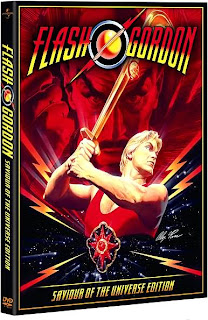
Movie Log: Flash Gordon

We've given up on the last decade or two of Bond movies, at least for now, but we're still watching movies as a family just about every Saturday night. Last week was Ponyo, before that was Ghostbusters, and this week we saw a massive wedge of cheese The Wife and I hadn't looked at for nearly thirty years: Flash Gordon.

There's a peculiar acting calculus going on in this movie -- Sam J. Jones (Flash) can't act at all, which is a negative. As if to counteract that, nearly all of the other roles are filled with the hammiest overactors possible, from Topol (Dr. Hans Zarkov) to Max von Sydow (Ming the Merciless) to Timothy Dalton (Prince Barin) and finally, at the height, to the irrepressible Brian Blessed (Prince Vultan of the Hawkmen). It's as if the filmmakers thought that if they put enough acting around Jones, some of it would affect him, or at least bring the average level of acting in the movie up to par. Sadly, Jones is so flat that not even Blessed can counteract him. Oh, sure, Blessed is marvelous here -- his every line is a thing of joy, and his speeches during the final battle had my sons calling them out immediately afterward with glee -- but even he can't make Jones any more than a stiff.

And that's really a pity, since Flash Gordon is enormous fun if you can ignore the giant slab of useless beefcake at its heart. The sets are gorgeous, the costumes even more so, and the spaceship designs are a marvelous '30s-esque rococo. Even the far-too-synthesizer-dependent soundtrack from Queen is fun in its own deeply silly way. (And Flash Gordon doesn't take itself too seriously -- it's not jokey, but it's light-hearted, in the old style, so silliness is just fine.)

The story is the usual one, retold a dozen times: Ming is the evil Emperor, and he's taken notice of Earth. Genius scientist Hans Zarkoff knows something is causing trouble for Earth, and has built a spaceship to go investigate. His unlikely co-pilots are Flash (in this version, a quarterback for the New York Jets football team) and the gorgeous Dale Arden (a travel agent (?!) played by Melody Anderson). They arrive on Mongo, are captured and mistreated by Ming, and eventually unite the warring princes under Ming to overthrow him and bring peace to Mongo.

It's still not a good movie, of course -- time will never improve Flash that way -- but it's an entertaining hunk of cheese that looks very good (particularly Anderson and Ornelli Muti in a succession of ridiculously over-the-top gowns with more fabric in their hair than on their bodies) and is reliably entertaining. Blessed is the biggest highlight, especially the way he caresses the word "Dive!" about a dozen times near the end and gives his every line with a huge grin that manages to stay in character.

James Bond Daily: Thunderball

Thunderball is to the Bond novels what For Your Eyes Only would later be to the movies -- a moment where the series steps back from cartoonish excesses, integrating some of the new baroque elements and dropping others to return to the strengths of earlier works.

In the case of the novel, it hearkens back to From Russia With Love, before the double supervillain exercises of Doctor No and Goldfinger. The stakes are still high -- the evil, and previously unknown, criminal organization SPECTRE has hijacked two nuclear weapons and is demanding a huge ransom from the US and UK -- but there's no larger-than-life supervillain chortling at Bond during the climax and explaining his evil schemes, just a nasty but realistic criminal bureaucrat carrying out his orders with intelligence and care.

If the reader didn't know that Fleming had a house in Jamaica, she might begin to suspect something of the sort by this point in the Bond series. For a sequence of novels about international espionage at the height of the Cold War, they take place surprisingly often in Caribbean paradises (and secondarily in the USA), and hardly ever in the real war zone of Europe. In Thunderball, Bond even notes to himself that he'd rather have had the "Iron Curtain beat," assuming that the real action would be closer to the Soviets (whom he half-suspects is really behind the plot).

That's only one of several "Signals from Fred," which could be conscious or unconscious on Fleming's part, but that all tend to call attention to themselves and seem to act as special pleading. (Another is when Felix Leiter -- Bond's CIA friend from Live and Let Die and Diamonds Are Forever, who has been dragged back into the shop for this situation -- repeatedly points out that supervillain-style plots, including the one he and Bond are trying to track down, don't actually happen in real life.) Given that Thunderball is notably more grounded than the previous two books, it feels like Fleming's conscience nagging him about the kind of books it thinks he should be writing.

In any case, there really is a plot against the free world, Bond really is in the right place to foil it, and he and Leiter do so, with the aid of an American nuclear submarine. (Which could be taken as realistic or not, as you wish: it's a big, shiny piece of war hardware put at their disposal with very little care for the chain of command, but it's also one of the newest, and most deadly, tools of the Cold War -- and the literary Bond is entirely a creature of the Cold War.)

Thunderball is slightly disappointing, in the end -- SPECTRE is more mysterious than SMERSH, and Bond doesn't have any strong reason to hate it, and Emilio Largo isn't terribly exciting as a villain -- but it's clear that Fleming thought that the Cold War was settling down, and possibly going away, leaving Bond and men like him to cast around for other things to do. It falls between the two stools of Bond -- it's not a Cold War thriller like From Russia With Love or Casino Royale, but it's not as over-the-top as Doctor No or Goldfinger. It's still very entertaining, and Bond himself is as compelling as ever, but this reader wished that nuclear blackmail would have been a bit more exciting than this.
----------------
Listening to: The Deathray Davies - She Can Play Me Like A Drum Machine
via FoxyTunes

Reviewing the Mail: Week of 8/21

First, the obligatory explanation: since I review books, publishers send me books to review. I appreciate that, and -- particularly since I'm a book marketer myself, though for things much drier and useful than fiction and comics -- I want to do what I can to help those books find the readers that will enjoy them. But I know that I won't manage to review them all -- and I'll certainly dislike, even loathe, some of those books, so they wouldn't all get positive reviews.

But I can mention them all as they come in, which is what I do. These Monday-morning posts list what I saw the previous week, with as much as I can figure out (or already know) about them from a cursory glance. Some will get real reviews eventually; others will not. Only time will tell.

This week's list is short, which is good, because I will/did fly to Chicago at 4:00 PM tomorrow/yesterday -- tenses are difficult when you're writing something on Saturday to be posted on Monday morning -- and I should be packing now. In other words: if you're reading this on the day I posted it, I'm currently in Chicago, engaged in high-level, nail-biting meetings about the future of accountancy itself! (Or something like that.)

Anyway, first is X-Men: Misfits, Vol. 1, an attempt to turn the very popular American superhero property X-Men into something like the very popular Japanese manga format and style. It's written by Raina Telgemeier and Dave Roman (both of whom are cartoonists in their own right), with authentically Japanese art by Anzu and her studio. (There's the usual manga page in the back, where Anzu introduces her helpers, apologizes for missing her deadlines, promises to do better in the future, and all the rest.) In this version of the X-Men, the focus is on teenage Kitty Pryde, who's enrolling in a special school for people with extraordinary powers -- so far, so very similar to many manga, right?. But this school, before she got there, was all-boys -- another very manga-style concept -- which I take to mean that Phoenix, Storm, Rogue, et. al. don't exist in this continuity. I know just enough of the X-Men basics to be interested in this very different version, and have been out of the loop long enough that I doubt I'll care (or necessarily notice) the things Telgemeier and Roman have changed. So this looks like fun to me. Del Rey Manga published it, in the usual manga format, on August 18th.

Next is something very unlikely; the 11th book in a series I've never read and never had any thought I would read -- Babymouse: Dragonslayer. (If my children wre girls instead of boys, I'm sure I'd know this series well -- but they're not, so I don't.) As I understand it, Babymouse is a very popular character with tween girls (I may be overstating the age of the target audience, actually), and her graphic novel adventures have led to various other products with her image on them. This book is one part fantasy quest -- all in Babymouse's head, as far as I can tell -- and one part math-is-tough-but-worth-it school story. It's by Jennifer L. Holm and Matthew Holm -- the brother-and-sister team that created the character and did the previous ten books -- and will be officially published tomorrow by Random House.

I reviewed Jack O'Connell's The Resurrectionist when it was published in hardcover last summer; it's now coming out in a trade paperback edition this September 22nd from Algonquin. I didn't entirely like the book, but it's full of interesting bits, and plenty of other smart readers liked it much better than I did.

And last this time out is the third book in the debut trilogy by that reclusive, "off the grid" pseudonym John Twelve Hawks, The Golden City. The first book, The Traveler, came into the SFBC back when I still worked there, but my boss (World Fantasy Life Achievement Award-designate and upcoming Worldcon Guest of Honor Ellen Asher) read it instead. And that's fine -- it's a metaphysical thriller set in the modern world and a secondary one, which isn't usually my thing. But it does mean I can't say much about this one. It is the big finish to the series, which presumably means that the heroes will win and the villains will be defeated -- that's what makes it fiction -- but I don't really know who either of those groups are. Anyway, this is a big book for Doubleday, coming in hardcover on September 8th, and they really hope that you, or someone like you, will go out and buy it.
----------------
Listening to: The Rosewood Thieves - Los Angeles
via FoxyTunes

Sunday, August 23, 2009

James Bond Daily: The Only Way To Dress For Golf Is Not to Dress for Golf

007 sniffs at the sartorial aspirations of Auric Goldfinger on pp.087-088 of Goldfinger:
Many unlikely people play golf, including people who are blind, who have only one arm, or even no legs, and people often wear bizarre clothes to the game. Other golfers don't think them odd, for there are no rules of appearance of dress at golf. That is one of its minor pleasures. But Goldfinger had made an attempt to look smart at golf and that is the only way of dressing that is incongruous on a links. Everything matched in a blaze of rust-coloured tweed from the buttoned 'golfer's cap' centered on the huge, flaming red hair, to the brilliantly polished, almost orange shoes. The plus-four suit was too well cut and the plus-fours themselves had been pressed down the sides. The stockings were of a matching heather mixture and had green garter tabs. It was as if Goldfinger had gone to his tailor and said, 'Dress me for golf -- you know, like they wear in Scotland.' Social errors made no impression on Bond, and for the matter of that he rarely noticed them. With Goldfinger it was different. Everything about the man had grated on Bond's teeth from the first moment he had seen him. The assertive blatancy of his clothes was just part of the malevolent animal magnetism that had affected Bond from the beginning.
One feels the need to note that Fleming specifically denies that Goldfinger -- ugly, grasping, uncouth, obsessed with gold -- is Jewish. That's good to know. Wouldn't want to think he's a stereotype or anything.
----------------
Listening to: Josh Ritter - You Don't Make It Easy Babe (live)
via FoxyTunes

Saturday, August 22, 2009

Incoming Books: 21 August

I'm on the Borders e-mail list, so I get some kind of offer from them at least once a week -- usually it's something like "all DVD box sets 30% off in stores" or "buy one paperback, get another for 30% off, limited to store stock only." And usually I put the coupon aside, sometimes with a vague intention to go to the (very close) Borders to see what they have. But recently they sent me a coupon with a better offer, which was also good at their website, and so I've actually spent some money.

The deal was to buy one book, and then get a second one for 50% off -- so I found some small-press SF books (four of them), that didn't have any discount on Amazon. And the first two came in yesterday -- I suppose the other two will arrive later, and I'll mention them then.

My four books broke down neatly -- two by Zelazny, two by Silverberg -- and this package continued the split, containing the two Silverberg books:

Other Spaces, Other Times is Silverberg's memoirs of his life in the science fiction world -- conglomerated and adapted from various things Silverberg has written (introductions, columns, etc.) over the past few decades for various reasons. It seems to be all edited together to form a coherent narrative -- and, even if it isn't, I've mentioned several times in the past that I have a weakness for collections of fiction writers' occasional nonfiction, so I expect I'll like this even if it is choppy and disjointed. It's published by an outfit called Nonstop Press, whom I've never heard of. (They say that they're in New York, which is even more surprising -- the book credits Luis Ortiz as editor and Bret Erway as copy editor, and I haven't heard of them. Have I been out of the SF world that long?)

And the other Silverberg book is the third in the ongoing Subterranean Press "Collected Stories" series -- the first of them that I think I've bought, which shows how far behind I am -- Something Wild is Loose, which collects stories from 1969 to 1972. Silverberg is and was an amazing writer of short fiction, and that's perhaps his best period. So -- assuming I ever have time to get to this book, which is a big assumption -- I've got a great book of short stories to look forward to. And now I'm officially collecting this series, so I'd better hurry and find the other books.
----------------
Listening to: Cordero - Come On Dear
via FoxyTunes

Movie Log: Ponyo

I can't tell you the last time that I saw a movie on opening day, but I did it for Hayao Miyazaki's new film Ponyo, and the whole Hornswoggler clan (The Wife and my sons Thing 1 and Thing 2) loved it.

It’s a version of the “Little Mermaid” story, filtered through Miyazaki’s usual environmental concerns and with his desire to tell a story appropriate for five-year-olds. (Since the main characters are themselves five.) It's sweet and lovely, as immersive as any of Miyazaki's movies but with a lightness and simplicity that he usually doesn't have.

I saw it a week ago, and I've seen four movies since (busy week!), so there's not much more to say. I do intend to see it again -- I have vague ideas of seeing all of Miyazaki's movies again, preferably one a day in order, but that's less likely to happen -- and I may have more to say about it then.

But, for now: it's a lovely movie that's appropriate for anyone over the age of three and a great introduction to one of the best filmmakers in the world. How can you miss that?
----------------
Listening to: Frou Frou - Breathe In
via FoxyTunes

James Bond Daily: For Your Eyes Only

For Your Eyes Only is the only break in the novel-a-year pace of the Bond books; one wonders (without bothering to do any research) if Kruschev's real-world dismantling of SMERSH, Bond's overall nemesis, in 1958 might possibly have caused a novel to run onto the rocks and sink. (Or perhaps Fleming was caught up in one of the earlier schemes to make a Bond movie, or just took more time with the next year's Thunderball -- which was based on a screen treatment by Fleming and two others, after all -- or maybe there's some reason I couldn't even guess.) It collects the five Bond short stories that had been published to that point, which were:

'From a View to a Kill,' adapted from Fleming's teleplay of the same name for a never-finalized TV series, originally published in this collection in 1960 -- It's a full Bond plot in miniature, with evil Russians, a girl to be seduced, a bit of a puzzle to be solved, and some wet work before it's all done. From the title, I've always vaguely thought it was about Bond assassinating someone with a sniper scope, but it's nothing like that -- a Soviet cell has knocked off a dispatch rider with secret documents in the forests of Northern France, and Bond has to find and stop them.

'For Your Eyes Only,' another adapted teleplay -- This one, on the other hand, does see Bond at one end of a sniper rifle, as he goes to New York's Adirondack Mountains to kill some people pretty much unofficially as a favor for M. (Of course, they do need killing, as we American say.) There's a girl in this one as well; for the aborted TV show, Fleming seems to have been playing up the fact that Bond can always find some excellent sack-fodder.

'Quantum of Solace,' originally published in the May 1959 issue of Cosmopolitan, of all places -- The best of the stories in this book is a long story of infidelity and the death of love, as told by an aging colonial administrator to Bond over drinks late one evening.

'Risico,' the third and last adapted teleplay -- The title, I'm sorry to say, is one character's dialect way of saying 'risk.' Much of this story was incorporated into the movie For Your Eyes Only, though it only forms part of Act II and a piece of the plot armature there. Bond traces a narcotics pipeline through Northern Italy, and finds that the mastermind is not who he thought it was at first.

'The Hildebrand Rarity,' from the March 1960 Playboy, a much more expected home for a Bond story -- One of the ugliest of Fleming's rich ugly Americans offers Bond a ride on his yacht as part of a natural history hunt for the very rare title fish. One of them doesn't make it back, which pleases the rich man's young (and still awfully close to innocent) wife.

The two pieces that were written as stories are, unsurprisingly, better than the three adapted teleplays, which are decent adventures with some Fleming edge. The best thing here has the least Bond in it, and, in general, For Your Eyes Only is really mostly for Bond completests.

----------------
Listening to: Elvis Costello - Complicated Shadows
via FoxyTunes

Friday, August 21, 2009

James Bond Daily: The Joys of the Open Road

007 is vexed by a slow driver on his way to play golf, on pp.072-073 of Goldfinger:
A repainted sky-blue Ford Popular with large yellow ears was scurrying along the crown of the road ahead. Mechanically Bond gave the horn ring a couple of short, polite jabs. There was no reaction. The Ford Popular was doing its forty. Why should anyone want to go more than that respectable speed? The Ford obstinately hunched its shoulders and kept on its course. Bond gave it a sharp blast, expecting it to swerve. He had to touch his brakes when it didn't. Damn the man! Of course! The usual tense figure, hands held too high up on the wheel, and the inevitable hat, this time a particularly hideous black bowler, square on a large bullet head. Oh well, thought Bond, they weren't his stomach ulcers. He changed down and contemptuously slammed the DB III past on the inside. Silly bastard!
----------------
Listening to: Slaraffenland - Meet and Greet
via FoxyTunes

Quote of the Week

"I was serious about Spanish. I was never serious about French. Sure, I will still exchange nasty remarks with a Paris taxi driver now and again. But my public announcement that, more or less as a matter of policy, I do not use verbs in French was widely taken as an acknowledgement that I could no longer be considered a diligent student of the language. I never made a systematic attempt at Italian, and I have simply ignored German. Spanish is my foreign language."
- Calvin Trillin, Travels with Alice
----------------
Listening to: The Brunettes - B-A-B-Y
via FoxyTunes

Thursday, August 20, 2009

James Bond Daily: Short People Got No Reason

James Bond, whose height I can't call to mind at the moment, ponders the problem of those whom you have to pick up just to say hello, on p.029 of Goldfinger:
What else could he guess? Bond always distrusted short men, They grew up from childhood with an inferiority complex. All their lives they would strive to be big -- bigger than the others who had teased them as a child., Napoleon had been short, and Hitler. It was the short men that caused all the trouble in the world. And what about a misshapen short man with a red hair and a bizarre face? That might add up to a really formidable misfit. One could certainly feel the repressions. There was a powerhouse of vitality humming in the man that suggested if one stuck an electric bulb into Goldfinger's mouth it would light up. Bond smiled at the thought.
----------------
Listening to: Local H - Manipulator [Live]
via FoxyTunes

Wednesday, August 19, 2009

Another Dose of Murder from Geary

Today, over at the ComicMix, I reviewed Rick Geary's new graphic novel, Famous Players, the latest in his series about infamous murders.

And I noticed that my ComicMix reviews have been patchy this summer -- one week in July, this week in August, and a few in June. Summer is the busy time for conferences at work, which is part of the reason -- and you can't discount laziness and inertia, either. As I often say, I shall strive to do better in the future.
----------------
Listening to: R.E.M. - Sitting Still (live)
via FoxyTunes

Linking To Writing About Blogging...On a Blog

The recursiveness level is well over my head, so this is just a quick note to say that SF Signal had one of their Mind Meld pieces, posted in the wee hours of the night, on the following topic:

First it seemed like everyone was writing a blog. Then it seemed like everyone was getting a MySpace page. Now it seems like everyone is hopping on the FaceBook and Twitter trains. We asked this week's panel about it:

Q: How has blogging and the emergence of social networking changed the face of publishing? How has it affected you personally?
And I was one of the contributors to that meld, along with Kristine Kathryn Rusch, Rose Fox, Pablo Defendini, and several others.

Go check it out if you like, and argue with our premises and conclusions...since that's what social networking is all about.

James Bond Daily: In Which the Villain Claims to Have a Good Reason for Not Just Killing 007

It's no better than the million excuses since, but this is the one Julius No claims on pp.182-183 of Doctor No:
Doctor No said quietly, 'You said that power was an illusion, Mister Bond. Do you change your mind? My power to select this particular death for the girl is surely not an illusion. However, let us proceed to the method of your departure. That also has its novel aspects. You see, Mister Bond, I am interested in the anatomy of courage -- in the power of the human body to endure. But how to measure human endurance? How to plot a graph of the will to survive, the tolerance of pain, the conquest of fear? I have given much thought to the problem, and I believe I have solved it. It is, of course, only a rough and ready method, and I shall learn by experience as more and more subjects are put to the test. I have prepared you for the experiment as best I could. I gave you a sedative so that your body should be rested and I have fed you well so that you may be at full strength. Future -- what shall I call them -- patients, will have the same advantages. All will start equal in that respect. After that it will be a question of the individual's courage and powers of endurance.' Doctor No paused, watching Bond's face. 'You see, Mister Bond, I have just finished constructing an obstacle race, an assault course against death. I will say no more about it because the element of surprise is one of the constituents of fear, It is the unknown danger that are the worst, that bear most heavily on the reserves of courage, And I flatter myself that the gauntlet you will run contains a rich assortment of the unexpected. It will be particularly interesting, Mister Bond, that a man of your physical qualities is to be my first competitor. It will be most interesting to observe how far you get down the course I have devised. You should put up a worthy target figure for future runners. I have high expectations of you. You should go far, but when, as is inevitable, you have finally failed at an obstacle, your body will be recovered and I shall most meticulously examine the physical state of your remains. The data will be recorded. You will be the first dot on a graph. Something of an honour, is it not, Mister Bond?'
----------------
Listening to: Local H - No Problem [Live]
via FoxyTunes

Tuesday, August 18, 2009

World Fantasy Defines 2009 Lifetime Achievement, From A to Y

This year's Lifetime Achievement winners for the World Fantasy Award were announced earlier today, and they will be Jane Yolen and Ellen Asher!

My heartiest congratulations to both -- I worked with Ellen for sixteen years (and refer to her regularly, and without any sarcasm, as the Uncrowned Queen of Science Fiction) and just the other day was poking through a library shelf of middle-grade novels and noticing just how darn many good books Jane Yolen has written.

I got an e-mail from one of the Secret Masters of Fandom tipping me off this morning; the official word that it was no longer secret came via Locus Online.

All of the other World Fantasy Awards will be announced at this year's World Fantasy Convention in San Jose over Halloween weekend; sadly, I will not be attending this year, for distance and time and not-working-in-the-field-right-at-this-second reasons.

James Bond Daily: Goldfinger

Goldfinger is Doctor No done again, with slight variations -- in some ways, it's more refined and tightened (particularly in the three-encounters structure), and in others, it's clumsier (as with the shuffling of three Bond girls, and the anti-climax at Fort Knox). The most interesting lesson of Goldfinger-the-book is that Goldfinger-the-movie is faithful to all of the things that are good about it, and deviates only to be more like Doctor No (the book and movie), only to be more like the Platonic ideal of a James Bond story.

Goldfinger also echoes Moonraker, with a rich, ruthless man (first Drax, then Goldfinger) cheating while gambling, and that cheating being what originally brings Bond into the picture and onto the villain's trail. In this case, Bond is passing through Miami, runs into a minor character from Casino Royale, and is enlisted to help figure out how Goldfinger is cheating.

After humiliating Goldfinger in America, Bond is set to investigating Goldfinger's gold-smuggling, and so goes off to play golf, in hope of ingratiating himself with the villain, getting a job in his operation, and unravelling the whole plot. (Fleming insists on giving the reader a stroke-by-stroke depiction of the game; I found it tolerable but it runs on for nearly two whole chapters.)

Eventually, the third encounter comes about -- do we all remember Goldfinger's Chicago dictum about interference? once coincidence, twice happenstance, thrice enemy action? -- and Bond finds himself once more the captive of a sinister figure with designs on the world. The plot in the book is subtly different than the one in the movie -- as I said above, the movie machines some rough edges from the plot, though it also disengages Goldfinger from the vague overall anti-SMERSH plot of Fleming's books. (Though I have to admit, the SMERSH connection, as here, is often pretty perfunctory.)

Goldfinger does get in his allotted number of villain speeches, and they work quite well -- he's both a megalo- and a monomaniac, with the Fleming touch to make his dementias seem entirely reasonable while he's speaking.

Without looking at the dates, a casual reader might assume that Goldfinger was influenced by the movies -- it has that feeling of doing the same sort of thing as before, only broader and bigger -- but Goldfinger was published in 1959, and the movie of Doctor No wasn't released until 1962. So this is still all Fleming at this point -- the feedback from the film series could only have affected the last novel (or two, at best). And I'm now searching my memories to remember if the books do keep getting bigger and less realistic from here -- but I don't believe they do.
----------------
Listening to: Tom Waits - I Don't Wanna Grow Up
via FoxyTunes

Monday, August 17, 2009

ComicMix is Stuffed With My Words

But only in the sense that ComicMix ran a review I just wrote, of a book titled Stuffed! It was written by a TV guy, Glenn Eichler, and illustrated by Nick Bertozzi.
----------------
Listening to: The New Pornographers - The Body Says No
via FoxyTunes

James Bond Daily: The One Ubiquitous Mid-Century Fetish

From p.142 of Doctor No, in which James and Honey are the unwilling guests of the titular Doctor:
He stood away and held her at arms' length. For a moment they looked at each other, their eyes bright with desire, She was breathing fast, her lips parted so that he could see the glint ot teeth. He said unsteadily, 'Honey, get into that bath before I spank you.'
What is it with mid-20th century guys threatening to spank their girlfriends?
----------------
Listening to: Nick Cave & The Bad Seeds - Hold On To Yourself
via FoxyTunes

Movie Log: How to Lose Friends & Alienate People

For some reason, I thought How to Lose Friends & Alienate People was a Run Fatboy Run-level Simon Pegg vehicle, so I didn't rush to see it, and came in with very low expectations. But it's actually pretty good -- oh, it's no Hot Fuzz; I'll admit, but it's funny a lot of the time, and the "only a non-elite life is worth living" message doesn't become dull and blunt until near the obvious end -- so I was happily surprised.

It's based on a memoir by Toby Young -- apparently, quite loosely based, since Young crawled back to England at the end of his adventure, which the Pegg character does not -- and is of the time-honored "young man from the sticks comes to the Big City, is tempted by its decadent charms (and its even more decadent women) but eventually chooses the path of righteousness and a Good Woman" formula, with Megan Fox as the bad girl (a dumb-as-rocks up-and-coming movie star) and Kirsten Dunst as the good girl (Pegg's colleague and eventual boss).

Pegg is the publisher and editor of a scurrilous, low-rent London satire magazine when Jeff Bridges (playing not-Graydon Carter and running not-Vanity Fair) drags him to NYC and gives him a lucrative contract for what are really very unlikely and mostly unexplained reasons. Pegg takes a while to adjust to kissing celebrity ass rather than kicking it, but eventually he succumbs to the lures of the fast life.

How to Lose Friends is probably annoying and tedious to those who have actually read Young's memoir; I haven't, so I found it a serviceable comedy along very obvious lines. It resolutely stays as far away from new ground as it possibly can, but it's pleasant enough as it goes along, and Pegg's character is a lot of fun as long as he keeps his British rough edges (which isn't nearly long enough). Dunst is cute and lovable; Fox is scorching and yet clueless; and Bridges good as the grumpy soft-living boss whom Pegg, in the end, can't follow. It's not nearly as smart and interesting a movie as it should have been, but it's not a disaster, just a disappointment.

I may have to read the book now.

Reviewing the Mail, Week of 8/15: Part Two: SF and Fantasy

See this morning's first post for the reasons for the split and my weekly attempt to explain why I do this in the first place; here are the books that arrived last week that have just words on their pages:

I'm giving Freda Warrington's Elfland pride of place here because it has my favorite SF/F cover this week -- a gorgeously evocative painting from Kinuko Y. Craft. (Goes to check the flap to see if he got it right -- Yes!) Warrington is a British writer with seventeen novels under her belt, but Elfland is the first one to be published in the US, and is the first novel in a series that the book itself calls "Aetherial Tales" but the letter refers to as "Books of the Silver Wheel." It's a contemporary fantasy about a society of Aetherials -- humanoids who came to Earth from the Otherworld some long time ago, and presumably have some variety of magical abilities -- and their travails when the usual every-seven-years opening of the Gates to their homeland doesn't happen on schedule. Tor will publish Elfland in hardcover on August 18th, which is tomorrow.

The Silver Skull is a Cold War novel, about an island nation under secret siege from an implacable enemy that seeks to overwhelm and conquer it, and the superspy who battles those enemies to save his Queen. It is England, but the Queen is the first Elizabeth and the spy is Will Swyfte (a name that possibly seemed more glamorous in the 1560s than it does to my ears). And the enemy is the forces of Faerie. Now, it may be just because I'm in the middle of reading all of the James Bond books, but that sounds like a damn good premise to me. But Mark Chadbourn thought of it first, so my hat is off to him. (And my cloak is covering a mud puddle so he can cross the street.) Pyr will publish The Silver Skull in November as a trade paperback, and I imagine they will have more in the series down the road.

From DAW as a September mass-market is Seanan McGuire's debut novel, Rosemary and Rue, the first book in a contemporary fantasy series with a strong Faerie strain. I'm sorry to inform you that McGuire's series heroine has the stripperific name October Daye, though. But it's entirely possible that she's already tormented her (fictional) parents sufficiently for that.

I mentioned E. Van Lowe's Young Adult novel Never Slow Dance with a Zombie -- about a high school overrun with zombies in the middle of the heroine's junior year -- when I saw the bound galley a few weeks ago, but I now have the finished book, so I'll mention it again. I like the title, I like the cover, and I particularly like (given the books I've been reading this past year, like How To Ditch Your Fairy and Flora's Dare) YA novels with first-person female narrators. So, if I ever get the time to actually read it, I expect I'd like Never Slow Dance With a Zombie. Tor Teen is publishing it as a really cheap trade paperback ($8.99!)...tomorrow!

Barely Bewitched is the second novel in a humorous and romantic contemporary fantasy series that prides itself on its southern flavor. (Although it's set in Texas, and I know plenty of people who argue that Texas is not part of "the South," in its Platonic form.) The author is Kimberly Frost, the first-person witch narrator has the very southern name Tammy Jo, and the first book (in case you remember it) was Would-Be Witch. Berkley publishes Barely Bewitched on September 1st as a trade paperback.

Every month, DAW has an anthology from the Tekno Books machine -- it's almost like a big magazine, with some semi-regular contributors and an ever-changing theme. This time out, the issue is called Intelligent Design and the editor is Denise Little. It has eleven original SF stories -- from writers like Laura Resnick, Kristine Kathryn Rusch, Jody Lynn Nye, and Janny Wurts -- on the subject of evolution vs. creationism. (I expect a fair number of alien gods to be involved, but I could be projecting a '50s mindset onto it.) The Usual Suspects should note that six of the stories here -- more than half -- are by women, so they can't complain about it. Perhaps they'd prefer to celebrate something instead? Intelligent Design is a September DAW mass-market paperback, making its way through the distribution chain right this moment.

Violette Malan's new novel The Storm Witch -- a September trade paperback from DAW -- is another adventure of yet more people with interesting names, Dhulyn Wolfshead and Parno Lionsmane. Dhu and Par -- I call them by their nicknames, the little scamps -- are both Partners with a capital P and members of the Mercenary Guild with a capital MG. (Though, sadly, they don't drive an MG, which would be a totally awesome thing to toss into an otherwise normal sword-and-sorcery novel.) Please do not confuse Malan's The Storm Witch with Jam'es Clem'ens' Wit'ch Storm, which is completely different and has the capability to completely fry your brain.

And last for this week is another DAW book: Mickey Zucker Reichert's Flight of the Renshai. It sees Reichert return to her most popular series for the first time since 1998's The Children of Wrath. And it's got a nice Jody Lee cover of a man who doesn't seem to have any eyeballs. (I am assuming, tentatively, that this is a plot point.) He does have a couple of cool swords, though, and the requisite flowy red hair to show that this is a Norse-inspired fantasy. Flight of the Renshai will hit stores in hardcover on September 1st.
----------------
Listening to: Over The Rhine - It's Never Quite What It Seems
via FoxyTunes

Reviewing the Mail, Week of 8/15: Part One: Comics and Graphic Novels

There's usually one week each month where the mail is much heavier than the others, and, for August, that would be this week. (Unless one of the next two weeks turns out even heavier, which would be awesome in more than one way.) So my usual single post is being broken into two pieces; the second half will cover SF and Fantasy books, and should be popping up here in a couple of hours.

Here's the deal with these posts: as you can see, I get a lot of stuff in the mail (a lot of bloggers/reviewers do), and it's unlikely that I'll have the time, energy, and will to read them all and write official reviews. But I can -- and do -- note all of these books as they come in, and say whatever I can about them from a cursory glance. It might not be a lot of attention, but my hope is always that it will help books find readers that will enjoy them. And, with that said, let's dive into this long list:

One of the buzz books -- there's usually a small handful, no more than half a dozen, books that nearly everyone seems to have read and be enthusiastic about -- from this year's BEA convention was David Small's comics memoir Stitches, which W.W. Norton will publish in hardcover on September 8th. I've only just seen it now, because I only got to BEA on Saturday, after the buzz had gone around the hall several times and the galleys had evaporated. Small is an award-winning children's book author -- he got the Caldecott, among others -- but this is his first work for adults, and his first graphic novel. Small grew up in the '50s, in one of those families we now call dysfunctional, but were just "families" back then. It's one I'm really looking forward to.

On a whole different level -- but also wonderful in their own way -- are three collections of Antonio Prohias's long-running "Spy Vs. Spy" feature from Mad magazine: Danger! Intrigue! Stupidity!, Missions of Madness and Masters of Mayhem. If you read Mad any time from the '60s to the '80s, you know Prohias's work: those two color-coded, beaked agents of destruction, forever scheming to destroy each other and neither of them ever being successful. Prohias's strips are reminiscent of Chuck Jones's Roadrunner cartoons -- only with two coyotes and no roadrunner. Each of these three medium-sized trade paperbacks -- a little bigger than a mass-market -- collects nearly two hundred pages of wordless Spy Vs. Spy strips, with all of their attendant inventive violence and intrigue. They're all available this month from Watson-Guptill.

The Big Kahn is a new graphic novel by Neil Kleid (Xeric Award-winning author of Brownsville) and Nicolas Cinquegrani. It's the story of a beloved Rabbi -- except that, after his death, his family and congregation learn that Rabbi David Kahn wasn't Jewish in the first place. The book description mostly talks about Kahn's two sons, and how they deal with the revelation...but (and I'm sure I'll have to read the book to figure out how this comes into play) Judiaism is determined matrilineally, so they're still precisely as Jewish as they were before, and that all depends on their mother (who, presumably, is just as Jewish after her husband's death as she was before it, no matter how Jewish, precisely, that was). The Big Kahn is being published in September by NBM.

Adam Rapp is a writer in various media (plays, novels, films) who seems to specialize in the horrific and the unpleasant -- his one adult novel is called The Year of Endless Sorrows, for example -- and he's now come to comics with the graphic novel Ball Peen Hammer, joined by George O'Connor on art. (And can I complain about the credits on this book? It's a graphic novel, not an illustrated piece of prose, so it's insulting to O'Connor's work to credit it as "by Adam Rapp; artwork by George O'Connor" unless Rapp actually laid out the damn thing and O'Connor just followed his thumbnails. The art in comics is as important as the words; turning a script into a page is more than just "illustrating.") Ball Peen Hammer takes place in one of your obligatory nihilistic near futures, in a conveniently nameless city where the survivors of "war and plague" (why not throw in famine and death while you're at it?) form "diseased deranged mobs that roam the streets." I warn you: the publisher calls it "an unflinching meditation on art and human nature," which usually means that none of the characters are pleasant, that most of them die in hideous ways, that the ending is bleak and depressing, and that you may not be able to understand large stretches of it. Of course, I may be wrong. Ball Peen Hammer will be published October 1st by First Second.

Del Rey and the Dabel Brothers extend their beachhead into graphic novel urban fantasy (already established with the Jim Butcher books together, and with other Dabel projects with other co-publishers) in Mercy Thompson: Homecoming, an original graphic novel in Patricia Briggs's popular werewolf series. It's written by Briggs and David Lawrence (an editor at Dabel and the creator of the Ex-Mutants) and has art by Francis Tsai and Amelia Woo, and it will be on shelves as a hardcover on August 25th.

The rest of this list all comes from one big box, crammed full of wonderful stuff from Fantagraphics, that I found on my doorstep a week ago today when I came back from Montreal. (And there's very little that's better as a welcome-home gift than that, particularly since Scarlett Johansson keeps refusing to wait behind my door in a bikini.)

I've only seen Johnny Ryan's work -- which is deliberately offensive in nearly every possible way, showing an impressive comprehensiveness -- in small doses before, but now I have a concentrated shot of Ryan at his best/worst. Prison Pit: Book One is the first in a new series about ultra-violence among a group of nasty characters inspired equally by pro wrestling, Fist of the North Star, and Grand Theft Auto. I expect epic levels of scatology and violence with a vague SFnal skin, all in Ryan's only slightly grown-up version of the notebook drawings of that creepy boy we all knew in seventh grade. Prison Pit is publishing on October 20th.

The Squirrel Machine is a major graphic novel, in a vaguely steampunk style, from Hans Rickheit. I don't know Rickheit's work, but it looks to fit in well with the general run of Fantagraphics' creators: careful detailed art slightly reminiscent of Rick Geary, and a deeply symbolic, surreal story that follows image much more than narrative. It's also coming October 20th.

I complain about the world sometimes -- who doesn't? -- but it's hard to find fault with a world in which Love and Rockets: New Stories, No. 2 lands on my doorstep when I didn't expect it. That's a world that still has grace and surprise in it, a world I can believe in. The current incarnation of Love and Rockets -- one of the best comics of all time, with separate but compatible universes of story created by brothers Jaime and Gilbert Hernandez for the past almost thirty years -- is a yearly trade paperback with about fifty pages of comics from each of them. It's also coming on October 20th.

The Red Monkey Double Happiness Book includes two new stories by South African cartoonist Joe Daly, both of them featuring stoners Dave and Paul. I don't know Daly's work -- his previous book is Scrublands, from 2006 -- but Fanta describes this one as "stuffed to the gills with mystery, suspense, action, adventure, conspiracy theories, cool cars, and massive amounts of killer weed." It's yet another piece of Fanta's attempt to utterly dominate the comics world on October 20th.

You know, all of these books from Fantagraphics are publishing on October 20th, so I probably don't need to say that every time. Hmm. Anyway, next is Giraffes in my Hair: A Rock 'N' Roll Life, by Bruce Paley (who lived it) and Carol Swain (who drew it). Paley and Swain "live together in London," according to the publicity materials for this book, which I guess means that Paley is still far too rock 'n' roll to get married. Giraffes tells stories from ten years of Paley's life, from the late '60s through the late '70s, from his late teens to about thirty. Swain is an acclaimed British cartoonist, and this book was well-reviewed when it was originally published in France.

Last from the 10/20 Fanta box, and last for this week, is the first book in their program reprinting a huge swath of the work of the great French cartoonist Jacques Tardi. It's West Coast Blues, a noir graphic novel adapted by Tardi from the novel Le Petit Bleu de la Cote Ouest by Jean-Patrick Manchette (the novel has been translated into English as Three To Kill) and originally published in 1976.
----------------
Listening to: Josh Ritter - Golden Age of Radio (live)
via FoxyTunes

Sunday, August 16, 2009

James Bond Daily: The Birth of the Talking Killer

The title character explains himself to 007 on p.161 of Doctor No:
Doctor No said, in the same soft resonant voice, 'You are right, Mister Bond., That is just what I am, a maniac. All the greatest men are maniacs. They are possessed by a mania which drives them forward towards their goal. The great scientists, the philosophers, the religious leaders -- all maniacs. What else but a blind singleness of purpose could have given focus to their genius, would have kept them in the groove of their purpose? Mania, my dear Mister Bond, is as priceless as genius. Dissipation of energy, fragmentation of vision, loss of momentum, the lack of follow-through -- these are the vices of the herd.' Doctor No sat slightly back in his chair., 'I do not possess these vices. I am, as you correctly say, a maniac -- a maniac, Mister Bond, with a mania for power. That' -- the black holes glittered blankly at Bond through the contact lenses -- 'is the meaning of my life. That is why I am here. That is why you are here. That is why here exists.'
----------------
Listening to: Holmes - Let Go
via FoxyTunes

Movie Log: I Love You, Man

I guess I shouldn't call I Love You, Man a "romantic comedy," since the world wants to call it a "bromance" -- more than that, the movie that revitalized "bromances," as if there was a vast pool of previous movies in that category. But it's a movie about love with a lot of jokes in it, which makes it a romantic comedy by any standard other than the most blinkered Hollywood definition -- the kind that includes notes of demographics and discussions of Reese Witherspoon's oevure.

It's funny and witty, with characters who talk interestingly -- if, at time, very stupidly, on purpose -- and who have real connections to each other that aren't pure plot requirements. It's not a great movie, but it'll be watched in fifty years, even outside film-school symposia on the comedy resurgence of the mid and late aughts.

Paul Rudd plays a guy -- you know, that guy? the one Rudd always plays? that guy -- who's about to get married to Rashida Jones, and is ridiculously happy until he realized he doesn't now have, and apparently never has had, a real male friend. (I'm a cynic, and think those kind of deep, meaningful, lifelong connections are generally Hollywood bullshit, particularly when it comes to men. Or maybe I'm just an overgrown Paul Rudd character myself.)

So Rudd has a funny montage of "dating" to find male friends, with the usual mishaps (jerks, weirdos, gay men), and then runs into Jason Siegel. Something like the usual rom-com cliches follow -- only funnier, since they're two guys, get it? -- and it actually is funny most of the time, and the wheels of the plot stay underneath the Paul Rudd vehicle until near the end, when there must be the inevitable break-up before the teary wedding reunion.

I Love You, Man is a movie that takes a very well-worn set of cliches and puts the slightest of spins on it; it's entertaining and fun and silly, but not a movie that bears any deep thought. (Rudd apparently doesn't need to work at all at his real estate job; he can wander off for days at a time, and seemingly is only handling one house Must be nice to be a Realtor in a comedy.)

Saturday, August 15, 2009

Movie Log: The Wrong Guy

I don't feel bad about missing The Wrong Guy, because everyone missed The Wrong Guy. It's a Dave Foley vehicle from 1997 -- back when it seemed like "a Dave Foley vehicle" could be a category; probably filmed in the hiatus after NewsRadio's first season -- that has something of the feel of mid-period Kids in the Hall.

The most important thing for me to note about The Wrong Guy is that it's funny. Really, really funny. Almost all the time, and every time it tries to be funny. I had low expectations going in -- and who wouldn't, with a movie this obscure and only twelve years old? -- but there were more good laughs in the first ten minutes than I expected from the whole movie.

Foley plays one of his standard KitH characters, the nebbishy office worker who works pretty hard and is terribly nice, but has vast reservoirs of dew behind his ears and is fated never to get anywhere. In this case, that guy is Nelson Hibbert, VP of something at a random corporation, engaged to the retiring boss's daughter, and sure that he's going to be the next president.

He isn't, of course; his office rival is marrying the boss's favorite daughter. Nelson makes threats in the boardroom, then retreats to his office to bawl like a little girl. And then goes to confront the boss, one-on-one -- only to find him dead, with a dagger in his back. Nelson assumes that everyone else will assume that he killed the boss -- particularly after a hysterical (in both sense of the word) scene in which Nelson screams, grabs the dagger, and gets blood all over himself -- and so he goes on the run.

The movie mostly focuses on Nelson's sub-Fugitive exploits from there, intercut with scenes of the detectives who know he didn't do it (but think the real killer, whose picture they have, is much too professional for them to have a chance to catch him), and with that killer, whose escape plans Nelson keeps interfering with.

Along the way, Nelson finds love, and there's a big confrontation among all of those characters -- in a very silly way; The Wrong Guy obliterates the common comedy problem of having a suspenseful climax that's still funny -- after which it all ends happily, since this is a comedy.

The Wrong Guy is one of the funniest movies I've ever seen -- it's so full of generally smart humor (with a few dumb gags for spice) that I'm tempted to start giving away the best parts. (Like the nature of Nelson's new girlfriend's father's business, and his nemesis -- it's subtle, but completely hilarious.) But I won't; this is a movie people should see for themselves. Yes, you've never heard of it. I have no idea what happened to it in theaters, and why there isn't a cult around it -- it's that funny. I have to assume that even we legion of KitH fans haven't heard of it, that it really is as obscure as it seems.

That's a shame, but the great thing about an obscure movie is that it allows you to discover it. No one can feel smart for appreciating Annie Hall or It Happened One Night or even The 40-Year-Old Virgin. But The Wrong Guy is a movie that can be discovered and loved; I hope you will.

James Bond Daily: Honey's Revenge

From pp.115-117 of Doctor No:
'Well, anyway we all lived happily together until I was fifteen and Nanny died and then things got difficult. There was a man called Mander. A horrible man. He was the white overseer for the people who own the property. He kept coming to see me. He wanted me to move up to his house near Port Maria. I hated him and I used to hide when I heard his horse coming through the cane. One night he came on foot and I didn't hear him. He was drunk. He came into the cellar and fought with me because I wouldn't do what he wanted me to do. You know, the things people in love do.'

'Yes, I know.'

'I tried to kill him with my knife, but he was very strong and he hit me as hard as he could in the face and broke my nose. He knocked me unconscious and then I think he did things to me. I mean I know he did. Next day I wanted to kill myself when I saw my face and when I found what he had done. I thought I would have a baby. I would certainly have killed myself if I'd had a baby by that man. Anyway, I didn't, so that was that. I went to the doctor and he did what he could for my nose and didn't charge me anything. I didn't tell him about the rest. I was too ashamed. The man didn't come back. I waited and did nothing until the next cane-cutting. I'd got my plan. I was waiting for the Black Widow spiders to come in for shelter. One day they came. I caught the biggest of the females and shut her in a box with nothing to eat. They';re the bad ones, the females. Then I waited for a dark night without any moon. I took the box with the spider in it and walked and walked until I came to the man's house. It was very dark and I was frightened of the duppies I might meet on the road but I didn't see any. I waited in his garden in the bushes and watched him go up to bed. Then I climbed a tree and got on to his balcony. I waited there until I heard him snoring and then I crept through the window. He was lying naked on the bed under the mosquito net. I lifted the edge and opened the box and shook the spider out on to his stomach. Then I went away and came home.'

'God Almighty!' said Bond reverently. 'What happened to him?'

She said happily, 'He took a week to die. It must have hurt terribly. They do, you know. The obeahmen say there's nothing like it.' She paused. When Bond made no comment, she said anxiously, 'You don't think I did wrong, do you?'

'It's not a thing to make a habit of,' said Bond mildly. 'But I can't say I blame you the way it was.'
----------------
Listening to: Elvis Costello - Hidden Shame
via FoxyTunes

Friday, August 14, 2009

Wiley Planning for Layoffs in UK, Possibly Australia

The Bookseller reports that John Wiley & Sons is currently consulting its way to eliminating 45 jobs in the scientific, medical, technical, & scholarly division in its Chichester, UK offices. There may also be 15 job losses in Melbourne, Australia.

The work of the to-be-laid-off employees -- though not the employees themselves, and possibly not the headcount -- will be transferred to Wiley's Singapore offices.

Best wishes to all of my colleagues during this unpleasant time, and my vain hopes that exactly 45 of them in exactly the right jobs in Chichester will find better jobs elsewhere during the course of the consultation.

James Bond Daily: In Which Bond Is Wright

From pp.221-222 of Goldfinger, a novel published in 1959 and written by Ian Fleming, a man born in 1908:
Bond came to the conclusion that Tilly Masterson was one of those girls whose hormones had got mixed up. He knew the type well and thought they and their male counterparts were a direct consequence of giving votes to women and 'sex equality.' As a result of fifty years of emancipation, feminine qualities were dying out or being transferred to the males. Pansies of both sexes were everywhere, not yet completely homosexual, but confused, not knowing what they were. The result was a herd of unhappy sexual misfits -- barren and full of frustrations, the women wanting to dominate and the men to be nannied. He was sorry for them, but he had no time for them.
For comparison, note this 2009 work by John C. Wright, born 1961. And what's all this about progress, anyway?

James Bond Daily: A Honey on a Beach

From p.079-080 of Doctor No, in which 007 sees Honeychile Rider:
It was a naked girl, with her back to him. She was not quite naked. She wore a broad leather belt round her waist with a hunting knife in a leather sheath at her right hip. The belt made her nakedness extraordinarily erotic. She stood not more than five yards away on the tideline looking down at something in her hand. She stood in the classical relaxed pose of the nude, all the weight on the right leg and the left knee bent and turning slightly inwards, the head to one side as she examined the things in her hand.

It was a beautiful back. The skin was a very light uniform cafe au lait with the sheen of dull satin. The gentle curve of the backbone was deeply indented, suggesting more powerful muscles than is usual in a woman, and the behind was almost as firm and rounded as a boy's. The legs were straight and beautiful and no pinkness showed under the slightly lifted left heel. She was not a coloured girl.

Her hair was ash blonde. It was cut to the shoulders and hung there and along the side of her bent cheek in thick wet strands. A green diving mask was pushed back above her forehead, and the green rubber-thong bound her hair at the back.

The whole scene, the empty beach, the green and blue sea, the naked girl with the strands of fair hair, reminded Bond of something, He searched his mind, Yes, she was Botticelli's Venus, seen from behind.
Note how careful Fleming is to point out that Miss Rider may be tanned, but she's certainly not coloured. It was 1958, after all.
----------------
Listening to: Elvis Costello - She Was No Good
via FoxyTunes

Quote of the Week

"Writing reviews can be fun, but I don't think the practice is very good for the character."
- W.H. Auden

Thursday, August 13, 2009

James Bond Daily: Doctor No

Doctor No is the prototype of the modern American thriller, via the movie version -- all of the big Hollywood action movies of the past forty-five years (and their parodies, and the TV and literary versions of the same plot) derive from this slim fifty-year old book. Oh, there were definitely precursors -- Doctor Julius No himself is in large part an updating of Sax Rohmer's Fu Manchu, for one example -- but Fleming put together all of the important elements here, in a neat package suitable for use and copying by a million subsequent hacks, copyists, and admirers.

We have a hero who's been kicked around by life: Bond nearly died at the end of the previous book, From Russia With Love. In fact, his boss, M, gives him this particular mission -- investigating the disappearance of the British Secret Service's man in Jamaica and his secretary -- because he expects that the two just ran off together, and this mission will be a nice relaxing way to ease Bond back into the business. Read "too old for this shit." Read "I'm watching you, {protagonist}!"

We have a villain cold and implacable in his evil. Doctor No does have a fiendish plot, but he's mostly an amoral schemer, increasing his own personal power and wealth at all costs. He's a Yellow Peril for the Atom Age, updated with a German father, a missile-diverting scheme and claws for hands -- but he's still emotionless, still a tall slim figure moving smoothly and quietly, still dressed in the long lines and flowing clothes of the old Western image of the Chinese coolie.

And that villain has a secret lair -- again, so did Fu Manchu, but No's base is gleaming and modern, complete with a complicated death-trap to force the hero through. Doctor No works for the great menace of his age, the Soviet Union, but at a remove -- he can both be an independent agent of evil and a representative of the massed forces of evil, and thus all evil to his 1958 audience, both the yin and the yang.

In the end, the hero triumphs -- surviving the death-trap, taking revenge on the villain, saving the girl and riding her off into the sunset. (Or rather vice-versa; Honeychile Rider, one of the more dominant Bond girls, demands her "slave-time" of 007 in the last chapter.) Could it be otherwise?

Doctor No encompasses all of the million variations on that plot since; it realizes that it's a cartoon, that the Bond series has moved miles away from the relatively straight spycraft of Casino Royale, but also knows that it's punching through to a clearer, starker realm, creating the Platonic ideal of the 20th century thriller.

And then, a year later, Fleming took many of the same ingredients, torqued them up yet another notch, and produced the refined version: Goldfinger. But that's for the next post...

Wednesday, August 12, 2009

Movie Log: Bottle Shock

Whenever I see a movie based on a true story, I always wonder just how much is "true story" and how much is "based on." About midway through Bottle Shock, when the blond girl inexplicably starts ignoring the brown-skinned guy (whom she'd previously liked better, and even slept with) to take up with the dull-witted blond guy, I started to have the suspicion that this movie is very much the Hollywood Version of the famous-to-wine-snobs "Judgment of Paris."

And that's OK, I guess. Especially if that's what actually happened in real life. But I do get tired of seeing characters color-coded quite that blatantly, and used for silly plot complications.

Otherwise, Bottle Shock is a loose-limbed movie, half about Steven Spurrier (Alan Rickman), a British wine merchant in Paris who tried to drum up business with a France-versus-California blind tasting, and half about the travails of one of those California wineries, run by Jim Barrett (Bill Pullman). Barrett has a ne'er-do-well son, Bo (Chris Pine), a chip-on-his-shoulder Latino right-hand man, and a new young female intern. (Who is the one I alluded to in the first paragraph; the son and the Latino whatever-you-call-a-guy-who-is-the-#2-in-a-winery are the boys who jockey for her affections as the movie requires a love interest.) Spurrier spends most of the movie in California, scouting for the contest, and Bo comes back to Paris with him for the tasting, so the two plots do overlap and intersect a lot...but they don't exactly combine.

Bottle Shock has a number of events that I found hard to swallow as things that happened in real life -- perhaps they did, but they weren't made convincing here. It's neither a particularly bad nor a particularly good movie; just one that takes its purportedly true story, runs it through the homogenization machine that is Hollywood, and decants the palatable result into a very old bottle indeed.

James Bond Daily: 007 Wonders If a Woman Really Is In Love With Him

From pp.151-152 of From Russia with Love, in which he thinks about a woman he just spied on, and tries to decide if it's plausible that she fell in love while spying on him:
Bond finished his drink and lit another cigarette. He put the problem away and turned his mind to the girl.

Tatiana Romanova. A Romanov. Well, she certainly looked like a Russian princess, or the traditional idea of one. The tall, fine-boned body that moved so gracefully and stood so well. The thick sweep of hair down to the shoulders and the quiet authority of the profile. The wonderful Garboesque face with its curiously shy serenity. The contrast between the level innocence of the big, deep blue eyes and the passionate promise of a wide mouth. And the way she had blushed and the way the long eyelashes had come down over the lowered eyes. Had that been the prudery of a virgin? Bond thought not. There was the confidence of having been loved in the proud breasts and the insolently tilting behind -- the assertion of a body that knows what it can be for.

On what Bond had seen, could he believe that she was the sort of girl to fall in love with a photograph and a file? How could one tell? such a girl would have a deeply romantic nature. There were dreams in the eyes and in the mouth. At that age, twenty-four, the Soviet machine would not yet have ground the sentiment out of her. The Romanov blood might well have given her a yearning for men other than the type of modern Russian office she would meet -- stern, cold, mechanical, basically hysterical, and, because of their Party education, infernally dull.

It could be true. There was nothing to disprove her story in her looks. Bond wanted it to be true

Another Thing I May Possibly Have Been the Only One in the Universe to Notice

The cover to the next Jim Butcher "Dresden Files" book (Changes) has been posted a bunch of pages around the 'net, sparking the usual conversations. (So far, I haven't seen anyone say that he utterly loathes it, or that it's raping his childhood, but the day is still young.)

I seem to be the only person whose first thought was, "Huh. Guess Butcher is abandoning his previous titling scheme."

You see, all of the previous Dresden Files novels had two word titles, and the two words always had exactly the same number of letters in them. And I may perhaps have been the only one who took note of that, for what it's worth. I'm not sure if that's perspicacity or OCD, but I've got it.

Tuesday, August 11, 2009

Reviewing the Mail: Week of 8/8

They are sitting in a neat pile back in New Jersey. I, on the other hand, am in Montreal at the Worldcon. So the real post will be delayed by at least a day.

Thank you for your patience, and please stay in your seats until the ride comes to a full and complete stop.

Update: And here they are!

First is a new short novel by Kage Baker, The Hotel Under the Sand, from the folks at Tachyon. Looking more closely at it, I see that it's not only about a nine-year-old girl (and the magical hotel she discovers), but it's officially a middle-grade novel (ages 9-12, grades 4-7). I do wonder if Tachyon has the distribution and contacts to get this book into the right section -- it can be a hard and thankless thing, to publish a book when you have no relationship with the buyer for that section of the chain book store -- but good luck to them for trying it. The Hotel Under the Sand is a trade paperback, and was published last month -- it's also (as is common with books for younger readers) quite inexpensive, so, if you see it, you might as well buy it.

Patricia Brigg's "Alpha and Omega" werewolf series continues with Hunting Ground, a mass-market paperback coming from Ace at the end of this month. I note that the back-cover copy refers to the heroine being "mated to" another character -- in context, essentially the Prince of All Werewolves, and probably a big slab of man-titty, as the Smart Bitches would say -- which may be a fancy way of saying that they're "partners," in the modern no-strings sense, or may have a more early-Pern implication about the series. I dunno which, so I will hereby express my ignorance and see if anyone sets me straight.

From Ace's sister imprint Roc -- but several months later, in November -- is Devon Monk's urban fantasy Magic in the Shadows: An Allie Beckstrom Novel, the third in the Allie Beckstrom series. Is it catty of me to note that "Allie Beckstrom" is a more plausible name than "Devon Monk"? (And does that mean anything, when so many urban fantasy writers really do have unlikely names?)

I now have a finished copy of My Rotten Life: Nathan Abercrombie, Accidental Zombie, a middle-grade novel by David Lubar. And that means I can read one and give one to my sons, both of whom I think would really like it. Maybe we can all read it and give our combined thoughts? Let's see if I can organize that...some time soon. Anyway, My Rotten Life is an August paperback for all of the middle-graders (particularly boys) in your life.

I reviewed The Color of Earth, the first book in a manwha (Korean comics) historical trilogy of coming-of-age graphic novels by Kim Dong Hwa, for ComicMix back in April. I somehow missed seeing the second book, The Color of Water, because now I have the third one, The Color of Heaven, in hand. Heaven will be published in September by First Second, and I might just try to read it without the middle book, because the first one was a luminously specific story that really impressed me.

Nine Gates is the new Jane Lindskold novel, the second in the "Breaking the Wall" series, after Thirteen Orphans. It's a Tor hardcover publishing next week, and it's a fantasy novel set in the modern world in which the magic of Chinese folklore is real. (And that's about all I know about it.)

And last this week is Prospero Lost, the first novel by L. Jagi Lamplighter (and the first of at least two, since Prospero in Hell is promised). I met Ms. Lamplighter briefly at Worldcon, but forgot to mention to her that I'd just seen this -- she was very happy, in the way that only a first-time author who has very recently seen her own words in hardcover can be. It's a fantasy set in the modern world, in which the sorcerer of The Tempest and his family are still alive and active in the present day -- well, Prospero was recently alive and active, but you can see from the title that there is some doubt as to his current health. Prospero Lost has an interesting premise, a great cover, and glowing quotes from a whole bunch of people -- Kage Baker, Wen Spencer, Laura Resnick, James Stoddard, Lamplighter's husband John C. Wright -- so I hope to make time for it "soon." (I've hit the point where I can't say I'll read anything soon without sarcasm quotes, he said, glancing up at the pile of unread books literally looming over his head to the immediate right and threatening to fall on that very head.)
----------------
Listening to: Nick Cave & The Bad Seeds - Today's Lesson
via FoxyTunes

Your Science Fact of the Day!

Courtesy of Nick Mamatas's review of G.I. Joe: I Can't Be Bothered To Look Up the Real Subtitle, this explanation of how objects behave in summer movies these days:
[I]t turns out ice only floats when you're not very very angry at the people riding in little submarines under it. Once you're sufficiently annoyed it falls right down on top of 'em.
And now you know.

James Bond Daily: What '50s Men Knew About Women

Bond asks advice from Kerim Bey, head of the Turkey section of the British Secret Service, on p.130 of From Russia with Love:
'There only one thing I want to know,' said Bond flatly. 'What do you think of this girl? Do you believe her story or not? Her story about me? Nothing else matters. If she hasn't got some sort of a hysterical crush on me, the whole business falls to the ground and it's some complicated MGB plot we can't understand. Now. Did you believe the girl?' Bond's voice was urgent and his eyes searched the other man's face.

'Ah, my friend,' Kerim shook his head. He spread his arms wide. 'Tat is what I asked myself then, and it is what I ask myself the whole time since. But who can tell if a woman is lying about these things? Her eyes were bright -- those beautifully innocent eyes. Her lips were moist and parted in that heavenly mouth. Her voice was urgent and frightened at what she was doing and saying. Her knuckles were white on the guard rail of the ship. But what was in her heart?' Kerim raised his hands, 'God only knows.' He brought his hands down resignedly. He placed them flat on the desk and looked straight at Bond. 'There is only one way of telling if a woman really loves you, and even that way can only be read by an expert.'

'Yes,' said Bond dubiously. 'I know what you mean. In bed.'
Is this perhaps the very first instance of adding "in bed" to the end of anything?

Monday, August 10, 2009

Incoming Books: Worldcon Edition

It wouldn't be a trip if I didn't come home with new books, and this was a trip. (And, if you can follow that logic, I'll be back later with the ol' "All men are mortal" wheeze.) Some of these I picked up various places and some of them I bought in the various used bookshops of Montreal. All of them are things that looked worth reading, but I'm so far behind that I'll need to pencil them in for 2017:

Book of Secrets by Chris Roberson, one of the launch titles for the mighty Angry Robot imprint from Harper UK. Chris is a great guy whom I've only read a few things by, and he writes so damn fast that I'm getting two or three novels behind on him every year. This novel is packaged to look precisely like a Da Vinci Code knockoff, but I suspect it may not be -- particularly since the original edition of Book of Secrets was published in 2001 (by Roberson himself), and Da Vinci only came out in 2003. But it's a secret-society thriller of some kind, I think.

How to Be Idle by Tom Hodgkinson is one of those books I'm sure I've been hearing about for years. (I'm slightly less sure that I didn't actually read it ten years ago, or that I don't have a copy lurking somewhere in my stacks. But searching for evidence of either of those things would be deeply non-idle, so I won't do it.) Hodgkinson founded the magazine The Idler in 1993, and this is his manifesto of non-work. Suddenly, I'm worried that he's the writer of the turgid, dull introduction to The Idler's Glossary, which I'm currently poking through -- if so, I hope this is better.

Jeff VanderMeer recently praised Derek Raymond's "Factory" noir novels, so when I saw the first one -- He Died with His Eyes Open -- on a random bookstore shelf, I automatically picked it up. (Jeff and I were World Fantasy judges together, so I have a half-decent sense of where his tastes and mine intersect.) It sounds like it's the kind of book that I wished China Mieville's The City and the City had been more like -- a gritty but well-written story about an unnamed detective, investigating thanklessly for the Department of Unexplained Deaths. I don't know when I'll get to it, but there are three more after this one.

I picked up Slights at the Angry Robot party -- and only afterward wondered if I was supposed to (Anticipation's parties looked like closed parties --- lots of alcohol -- but seemed to be open, so I may have treated decorations as freebies) -- entirely because I spent fifteen minutes or so talking with its author, Kaaron Warren. Slights is a horror novel about a female serial killer, written in the first person (from what I assume will become the serial killer's POV, though I've only read a few pages in), and it's very much the kind of novel I claim loudly that I don't like. Well, I haven't read this one yet, so I'm not sure if I like it, but it sure as hell looks compelling.

I also found a book of collected journalism by Jessica Mitford, the least likely of the famous Mitford sisters -- the one who was famous for writing The American Way of Death rather than for tongue-kissing Hitler, writing upper-crust novels, or marrying rich heirs. The book is called Poison Penmanship: The Gentle Art of Muckraking, it was published in 1979, and it even has an afterword by Carl Bernstein (who was about as famous as a muckraker could be, in 1979). Mitford intersperses the collected pieces with then-new commentary about how she became a crusading journalist and how others could do it as well.

Nick Mamatas's novel Move Under Ground was in large boxes in the giveaway area of the giant space containing the dealer's room and art show, which I take to mean that B&N or Borders (or both) decided to return a whole lot of them sometime in the recent past. I hope it did OK for Mamatas and Prime (the publisher) before that, and now I have a chance to read it. This is the novel in which Jack Kerouac squares off against a cult that worships Cthulhu, so I have to read it at some point.

Moxyland is another book from Angry Robot that walked away with me from their party. It's by Lauren Beukes and I grabbed it almost entirely because the back cover reads "What's really going on? Who's really in charge? You have no fucking idea." I respect an imprint that drops the f-bomb on the back cover of a paperback book, I really do. Angry Robot's little "if you like this try that" stripe -- a great idea, which is on all of their launch titles -- also compares this to This Is Not a Game, Little Brother, and Halting State, three novels that I've actually read and enjoyed, which is also a plus.

So, to sum up: in four days, I got seven new books, and read exactly zero -- not a good sign, but nothing new.

I Now Have to Go to the Reno Worldcon

Not only is their author Guest of Honor the incomparable Tim Powers, but their Editor GoH is my own long-time boss, the uncrowned Queen of Science Fiction, Ellen Asher!

Full announcement here; congratulations to Reno and Ellen!

James Bond Daily: The Cold Opening

The first page of 1958's From Russia with Love:
The naked man who lay splayed out on his face beside the swimming pool might have been dead.

He might have been drowned and fished out of the pool and laid out on the grass to dry while the police or the next-of-kin were summoned. Even the little pile of objects in the grass beside his head might have been his personal effects, meticulously assembled in full view so that no one should think that something had been stolen by his rescuers.

To judge by the glittering pile, this had been, or was, a rich man. It contained the typical membership badges of the rich man's club -- a money clip, made of a Mexican fifty-dollar piece and holding a substantial wad of banknotes, a well-used gold Dunhill lighter, an oval cigarette case with the wavy ridges and discreet turquoise button that means Faberge, and the sort of novel a rich man pulls out of his bookcase to take into the garden -- The Little Nugget -- an old P.G. Wodehouse. There was also a bulky gold wristwatch on a well-used brown crocodile strap. It was a Girard-Perregaux model designed for people who like gadgets, and it had a sweep second-hand and two little windows in the face to tell the day of the month, and the month, and the phase of the moon. The story it now told was 2.30 on June 10th with the moon three-quarters full.
And: no, it isn't. He's not, and it's not him, either.
----------------
Listening to: Holmes - Not a Political Song
via FoxyTunes

Sunday, August 09, 2009

2009 Hugo Award Winners

I'm both antsy and a quick walker, so I think I was the first person to make it back to the party hotel (the Delta) from the Palais where the Hugo Award ceremony just ended. (But I bet several people were liveblogging the Hugos, so this won't be the first notice of the winners.)

Sadly, no one asked me if the awards were over, so I'd didn't get the chance to say to the elevator operators -- as I'd been planning to do -- "Apres moi, le deluge."

Before I list the actual winners, I'll note that my predictions were correct in slightly more than half of the cases -- and that's fine, because the ones I got wrong were almost entirely because friends and people I greatly respect won instead of my cynical choices. So I'm very happy with this list of winners, and I hope you are, too.

Best Novel: The Graveyard Book by Neil Gaiman (HarperCollins; Bloomsbury UK)
Best Novella: “The Erdmann Nexus” by Nancy Kress (Asimov’s Oct/Nov 2008)
Best Novelette: “Shoggoths in Bloom” by Elizabeth Bear (Asimov’s Mar 2008)
Best Short Story: “Exhalation” by Ted Chiang (Eclipse Two)
Best Related Book: Your Hate Mail Will be Graded: A Decade of Whatever, 1998-2008 by John Scalzi (Subterranean Press)
Best Graphic Story: Girl Genius, Volume 8: Agatha Heterodyne and the Chapel of Bones Written by Kaja & Phil Foglio, art by Phil Foglio, colors by Cheyenne Wright (Airship Entertainment)
Best Dramatic Presentation, Long Form: WALL-E Andrew Stanton & Pete Docter, story; Andrew Stanton & Jim Reardon, screenplay; Andrew Stanton, director (Pixar/Walt Disney)
Best Dramatic Presentation, Short Form: Doctor Horrible’s Sing-Along Blog Joss Whedon, & Zack Whedon, & Jed Whedon & Maurissa Tancharoen , writers; Joss Whedon, director (Mutant Enemy)
Best Editor, Short Form: Ellen Datlow
Best Editor, Long Form: David G. Hartwell
Best Professional Artist: Donato Giancola
Best Semiprozine: Weird Tales edited by Ann VanderMeer & Stephen H. Segal
Best Fanzine: Electric Velocipede edited by John Klima
Best Fan Writer: Cheryl Morgan
Best Fan Artist: Frank Wu
The John W. Campbell Award for Best New Writer: David Anthony Durham

I predicted that Chiang, Scalzi's Hate Mail, WALL-E, Doctor Horrible, Datlow, Hartwell, Giancola, Wu, and Durham would win. But I'm thrilled to death to see that the voting fans are not as cynical as I am, and that Ann VanderMeer, John Klima, and Cheryl Morgan won Hugos.

Congratulations to all; Now I'm off to find some parties.

Update: Two extra points to note.

One, Anticipation got their press release out just as soon as the ceremony ended. That might seem like a small thing, but it isn't, and they should be commended for being so buttoned up and professional.

Two, I forgot to mention that Andrew Porter, erstwhile publisher of SF Chronicle, was honored with the Big Heart Award (for service to fandom). I don't usually get into the fandom awards, but it's Andy, and I'm happy to see him get that recognition.

Update 2: The full voting breakdown has been posted by Anticipation. And I also reposted my original handicapping post with a rundown of what I got right and wrong.

James Bond Daily: What Those Dirty Commies Really Want

A conversation between 007 and his "elderly Scotswoman" cleaning lady, from pp.96-97 of From Russia with Love:
'Yon man was here again last night about the Televeesion.'

'What man was that?' Bond looked among the headlines.

'Yon man that's always coming. Six times he's been here pestering me since June. After what I said to him the first time about the sinful thing, you'd think he'd give up trying to sell us one. By hire purchase, too, if you please!'

'Persistent chaps these salesmen.' Bond put down his paper and reached for the coffee pot.

'I gave him a right piece of my mind last night. Disturbing folk at their supper. Asked him if he'd got any papers -- anything to show who he was.'

'I expect that fixed him.' Bond filled his large coffee cup to the brim with black coffee.

'Not a bit of it. Flourished his union card. Said he had every right to earn his living. Electricians Union it was too. They're the Communist one, aren't they-s?'

'Yes, that's right.' said Bond vaguely. His mind sharpened. Was it possible They could be keeping an eye on him? He took a sip of the coffee and put the cup down. 'Exactly what did this man say, May?' he asked, keeping his voice indifferent, but looking up at her.

'He said he's selling Televeesion sets on commission in his spare time. And are we sure we don't want one. He says we're one of the only folk in the square that haven't got one. Sees there isn't one of those aerial things on the house, I dare say. He's always asking if you're at home so that he can have a word with you about it. Fancy his cheek! I'm surprised he hasn't thought to catch you coming in or going out. He's always asking if I'm expecting you home. Naturally I don't tell him anything about your movements. Respectable, quiet-spoken body, if he wasn't so persistent.'

Could be, though Bond. There are many ways of checking up whether the owner's at home or away. A servant's appearance and reactions -- a glance through the open door. 'Well, you're wasting your time because he's away,' would be the obvious reception if the flat was empty. Should he tell the Security Section? Bond shrugged his shoulders irritably. What the hell. There was probably nothing in it. Why would They be interested in him? And, if there were something in it, Security was quite capable of making him change his flat.

'I expect you've frightened him away this time.' Bond smiled up at may. 'I should think you've heard the last of him.'
Communist infestation or good old-fashioned capitalist entrepreneurial spirit? You decide...
----------------
Listening to: Josh Ritter - California
via FoxyTunes

Saturday, August 08, 2009

The Bad Cover Contest Rolls On

You know, I do a lot for you folks, and I don't ask for much. (I don't even explicitly ask about all of my Amazon links, preferring to leave that to implication and guilt.) One of the very few things I did ask for was for you to vote for my title in Orbit's big ongoing Bad Cover saga.

But it didn't work -- you folks may have voted loyally (for all I know), but Rise of the Fallen, Book Seven: The Pre-Antepenultimate Battle lost -- lost!!!! -- to Across a Trembling Sea the Cyborg Fairies Dance.

I'll get over my soul-crushing disappointment eventually. And there's still a chance for a little bit of glory -- Orbit is now looking for an author and a cover reading line for this book. So go and do your worst.

Scattered Worldcon Thoughts

I've been in town a hair over twenty-four hours, which means this is as good a time as ever to start pontificating. So here's what I've noticed or thought so far:
  • There really is a Tim Horton's on every corner here. On the other hand, when I was looking for a bank yesterday -- preferably a TD Bank -- I couldn't manage to find one.
  • The turndown service in the Delta is the best I've ever seen -- they even filled my ice bucket.
  • There's supposedly free Wi-Fi in the convention center (the Palais), but this laptop was not able to find any network called "Anticipation" there, and so I have stopped lugging it about and will now leave it safely here in my hotel room.
  • I've run into a lot of the people I was hoping to catch up with (and even caught up with a few of them), but I don't want to descend into name-dropping, so I won't say who they were.
  • The con suite here has so much food that it's not strictly necessary to each actual meals anywhere else.
  • Speaking of food, the parties had some quite impressive spreads last night, too. I even sampled a local delicacy called a "smoked meat sandwich." (The genericism of the name worried me briefly, I'll admit, but it was tasty, whatever sort of To-Serve-Fan kind of meat it actually was.)
  • Speaking of parties, Anticipation has planned them well (possibly aided by local laws) -- all the major ones are on the 28th floor of the Delta (entirely made up of dramatic two-floor suites), and all of those are essentially open to the entire convention. (And serving alcohol, too -- the two big no-nos of an American Worldcon. I want to give the matter further study, but, right at this moment, I'd be cautiously in favor of having the Worldcon in Montreal forever.)
  • Speaking of alcohol, "the bar" for this Worldcon is in the Intercontinental, right across from the Palais (the convention center). It's small, far from the outside, difficult to maneuver through, and has a very limited number of beer choices (as Jetse de Vries was bemoaning last night), but, aparrently, it's where all of the pros and/or Brits are gathering to schmooze.
  • Speaking of Brits, I noticed in the newsletter that Martin Hoare isn't here. Who's going to phone David Langford at an ungodly hour about his Hugo win? We cranky conservative SFnal types don't like these radical changes....
  • Speaking of ungodly, customs was a pain on the way up -- a good fifty-minute delay (sitting in my car, slowly dying of carbon monoxide poisoning from the other two thousand cars all around) to have a two-minute conversation with a gentleman I could barely understand.
  • Speaking of conversations, I've only made it to one panel so far, yesterday afternoon. It was about what fans don't know about book marketing and distribution, and I mostly sat in to see if the panelists (an agent, a book editor, a writer, and a magazine editor) knew what I know about b.m. and d. From the evidence of the panel, I win -- but I generally consider myself to have won most of the time anyway.
  • Speaking of winning, congratulations to Chris Roberson for getting the Sidewise Award for The Dragon's Nine Sons and to Cory Doctorow for seizing the Prometheus Award for Little Brother. (I don't remember who won the short fiction Sidewise, but congratulations to whoever that is, too.)
  • Speaking of Cory Doctorow, this morning he had a signing line rivaling that of Neil Gaiman's epic queue last evening. For those intent on using line-length as a gauge for handicapping the Hugos, please remember to take into account that Doctorow is somewhat closer to being a local (being a Canadian but not a Montrealler) and that Gaiman has another signing, probably of equally massive proportions, tomorrow.
  • Speaking of proportions, the Delta is really quite convenient to the Palais -- once Your Humble Correspondent looks at a map and walks in the correct direction, unlike my first attempt yesterday. It's only a couple of flat blocks away, and both are nice facilities. (I can't speak to the other hotels; I've only made a quick visit to the Intercontinental's bar.)
  • Speaking of nice facilities, a walk this afternoon to find some used book stores took me through McGill territory (the local University), and that institution certainly attracts some very eye-catching co-eds. (Of course, I'm not only married, but look and feel old enough to be their fathers, but leave that aside for now.)
  • Speaking of looking and feeling old, that's a sign that it's time to finish up and post this rambling, silly list.
And that's my Worldcon so far -- still to come, the Masquerade tonight (which I fear will be run by the crowd that did Torcon of blasted memory), the Hugos tomorrow night, possibly more panels if I can find anything interesting, and more partying.

James Bond Daily: 007 Prices Women

This is from p.200 of Diamonds Are Forever, and I suspect it is precisely as sexist as it it true:
'Up to forty, girls cost nothing. After that you have to pay money, or tell a story. Of the two it's the story that hurts most.'
----------------
Listening to: Yo La Tengo - Here To Fall
via FoxyTunes

Friday, August 07, 2009

James Bond Daily: From Russia With Love

After the sidetrack of Diamonds Are Forever into the American underworld, From Russia With Love gets Bond back to his most obvious (though not most common) home: European East-West intrigue. The first two-fifths of this book, a section called "The Plan," traces a plot hatched by SMERSH, the secret Soviet terror agency, to cripple its enemies by framing and killing a Western spy in a place where they can guarantee immediate, scandalous media coverage. And, as you might have guessed, the Western spy they decide to trap is 007.

And then the rest of the book is "The Execution," in which Bond takes the bait -- gorgeous Tatiana Romanova, a young woman in the Soviet secret apparatus whose cover story is that she fell in love with Bond from his file -- in Turkey, pokes about a bit there with the head of station, Kerim Bey, and then takes the Orient Express back to Paris. The assassination plot takes Bond almost entirely by surprise, and he only just makes it out alive. (As, of course, we know he must have, since we can see the list of later 007 novels on the card page.)

Bond talks a bit too much in this book, in a sometimes too-Hemingwayesque rush of short sentences. Fleming is better with his other characters' dialogue, and only indulges his mid-century taste for phonetic dialect in a mercifully few instances. But From Russia With Love is a lesser Bond novel, the thriller equivalent of those horrible "keyhole" essays many of us were forced to write in school -- it tells us what it's going to tell us, and then it tells us. (Thankfully, it doesn't finish up the keyhole by then telling us what it told us.) Fleming is experimenting a bit with his structure, particularly in not bringing Bond onstage until nearly halfway through the novel, but the important thing to remember about experiments is that not all of them succeed. This one isn't a failure, but it's not a pure success, either. (Among other things, there are two excellent villains here in Rosa Klebb and Donovan Grant, who aren't given enough to do in scenes with Bond and are both dispatched too quickly.)
----------------
Listening to: Little Tybee - Glass Brigade
via FoxyTunes

Thursday, August 06, 2009

Off to Worldcon

I'm going to be shutting down the computer momentarily, and going to bed. In the morning, I'll throw some stuff in a suitcase and drive for quite a long time to get to Montreal.

I'll have my laptop, and I hear that there's Wi-Fi in the Delta (where I'll be), but I can't say whether I'll blog anything at all over the next four days. So, just in case I don't, I've pre-loaded "James Bond Daily" posts for those four days, so that Antick Musings won't be completely dark.

See you on the other side...

James Bond Daily: Casino Architecture

In which 007 strolls through the gaming floor of The Tiara casino hotel, on pp.135-136 of Diamonds Are Forever:
The first thing he noticed was that Las Vegas seemed to have invented a new school of functional architecture, 'The Gilded Mousetrap School' he thought it might be called, whose main purpose was to channel the customer-mouse into the central gambling trap whether he wanted the cheese or not.

There were only two entrances, one from the street outside, and one from the bedroom buildings and the swimming pool. Once you had come in through either of these, whether you wanted to buy a paper or cigarettes and the news stand, have a drink or a meal in one of the two restaurants, get your hair cut or have a massage at the 'Health Club,' or just visit the lavatories, there was no way of reaching your objective without passing between the banks of slot machines and gambling tables. And when you were trapped in the vortex of the whirring machines, amongst which there sounded always, from somewhere, the intoxicating silvery cascade of coins into a metal cup, or occasionally the golden cry of 'Jackpot!' from one of the change-girls, you were lost. Besieged by the excited back-chat from the three big craps tables, the seductive whirl of the two roulette wheels, and the clank of silver dollars across the green pools of the blackjack tables, it would be a mouse of steel who could get through without a tentative nibble at this delicious chunk of lucky cheese.
----------------
Listening to: The Arrogants - Nothing Good Will Ever Come of This (No Drums Version)
via FoxyTunes

Incoming Books: 5 August

Partially as a reward to myself for getting through this year's American Accountants Association meeting, and partly because I hadn't been to a comics shop in a month or more -- which is becoming my usual pattern; I'm one of the many, many people who are far too busy to go to a store every Wednesday -- I hit both of the major midtown Manhattan stores yesterday: both the one actually called Midtown Comics, and the outpost of Jim Hanley's Comics Universe, which could be one of the great comics stores if it weren't for eccentric shelving strategies and less-than-perfect fixtures.

But I managed to dig through the piles of underwear perverts (and the New Comics Day crowd salivating for them) to find the following things, which of course I think are much better than the books other people like:

Astro City: The Dark Age, Vol. 1: Brothers & Other Strangers by Kurt Busiek and Brent Anderson, which is only superhero-y book I still buy. And, even then, when there's a collection every four or five years, I pick it up, and try to decide if it's worth spending money on. Busiek tells good stories, but it's become very clear that he cares deeply about the history and psychology about people who dress up in silly clothes to punch each other, which is a very odd thing to care deeply about.

Richard Stark's Parker: The Hunter is the first in a series of adaptations of a great run of crime novels (by Stark, a pseudonym for Donald E. Westlake) by Darwyn Cooke. I've only seen bits of Cooke's work before -- he's mostly done "mainstream" comics, and I've already noted my distaste for most of those -- but his stuff has always looked really good to my eye: thoughtful and stylized, the art and story of a creator who always has his own viewpoint. So now I'll see what he does to a story I already know -- and, from a first glance, this book looks gorgeous, from the blue-toned art on lightly green-yellow pages to the classy early '60s look of the book design.

Rick Geary's The Adventures Of Blanche collects three widely-spaced single issues from the last decade or so, telling adventures of the title character in three different cities. I have two of those issues, but, still, I'll buy almost any new book by Rick Geary -- particularly one that showcases his sly underhanded sense of humor, like these stories do.

I'm making my way through Jason's books as I come across them and feel like reading them, so this time I grabbed The Living and the Dead. On the positive side, it's got a neat cover and it was the cheapest of the Jason books I saw. On the negative side, it's about zombies, which I'm generally allergic to. But I suspect Jason's deadpan style will go well with the walking dead, so I'm up for it.

I'm stalling out on buying collections of strip cartoons ever faster these days -- I think I've broken my three-decades-long Doonesbury habit, and just one volume of Sheldon seems to have been enough -- but I did get the sixth collection of Scott Kurtz's PvP strip, Silent But Deadly. Maybe it's because these strips are still from just before I started reading it regularly, I don't know. But Kurtz does everything a good newspaper strip should: delivers a funny gag nearly every day and tells larger stories along the way, with great characters, nice art, and only the obligatory Internet-required level of fan references.

I am a comics blogger, so I'm required to read and write about Asterios Polyp, the graphic novel David Mazzucchelli has apparently been working on all this time. I just hope that it's half as good as the hype says it is.

I will only be three years behind everyone else in reading Scott Pilgrim & the Infinite Sadness, third in Bryan Lee O'Malley's series about the young Toronto slacker whose life is like Slackers crossed with Super Mario. I may even manage to catch up by the sixth book!

And last -- except for some stuff for my sons that I won't mention -- is a book I didn't buy on my last comics trip, out of a possibly-misguided sense of loyalty to Midtown Comics....who didn't have a copy when I got there. (Similarly, this time I thought I should buy the Richard Stark/Darwyn Cooke book at Hanley's -- but they were sold out, so I got it at Midtown. I think life is just too complicated to start worrying too much about which comic shop to buy a book from.) Anyway, that book is The Fart Party, Vol. 2, another collection of funny webcomics by Julia Wertz, which you should all go and buy, because she totally needs the money. (And it's good slice-of-life stuff, smart enough not to go too heavy on the woe-is-me-I'm-a-poor-twentysomething-living-in-squalor material.)
----------------
Listening to: The Innocence Mission - Since I Still Tell You My Every Day
via FoxyTunes